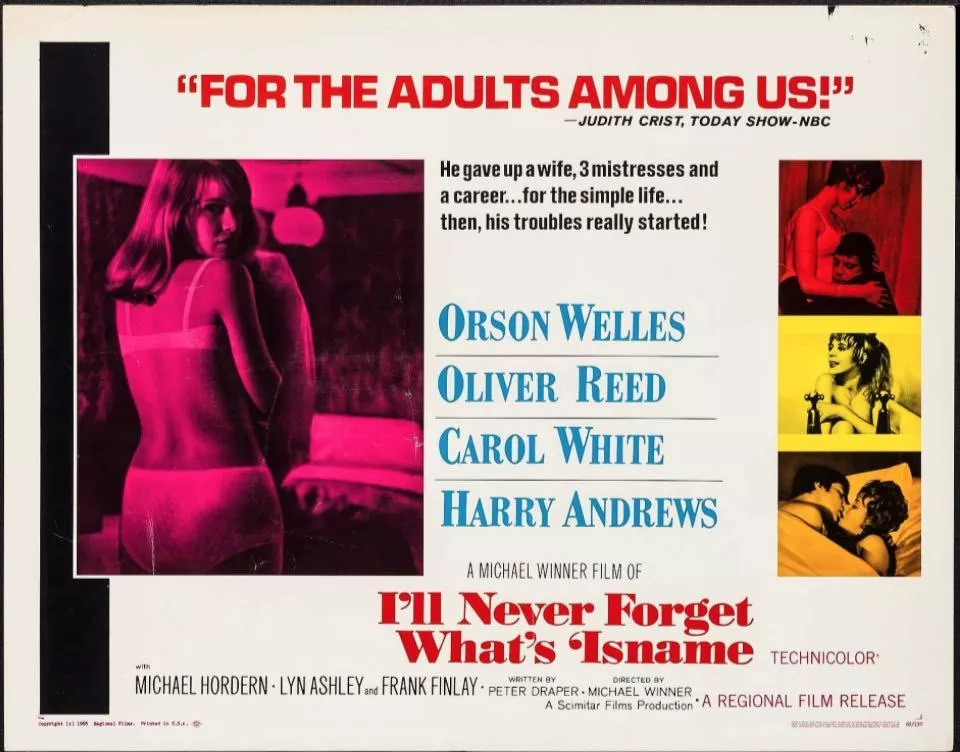
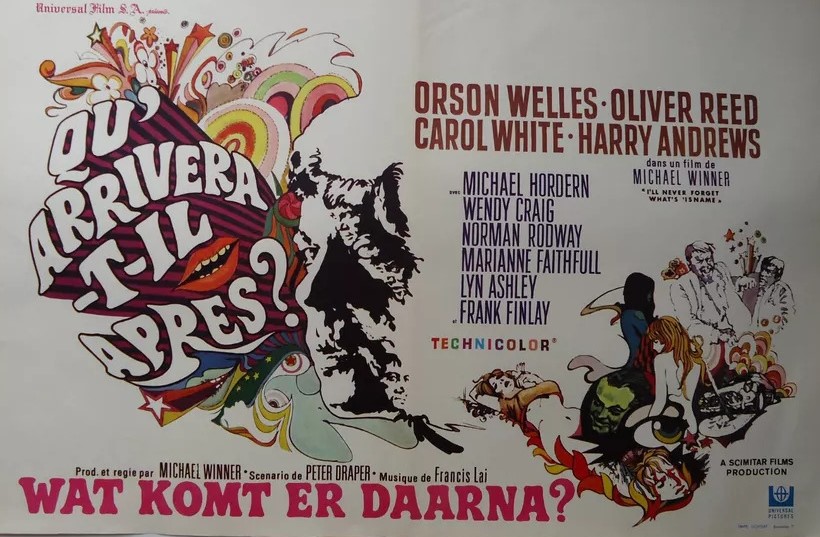
Director Michael Winner’s proudest moment – from a critical perspective. Rave reviews all round and hailed as a rising star of British cinema. Such adulation didn’t last long, of course, Hannibal Brooks (1968) and The Games (1970) elicited little critical reposnse and whatever kudos he achieved from a couple of westerns was soon blown away once he went down the Death Wish (1974) brutal revenge route. So this fits into the anomaly department in his canon and, although pretentious in spots, it does show a fine intelligence at work and a singular prophetic quality that should have contemporary reverberation.
For a start, he highlights the creativity of the advertising world that became the training ground for such British directorial talents as Ridley Scott (Alien, 1979), his brother Tony (Top Gun, 1986), Alan Parker (Midnight Express, 1978) and Adrian Lyne (Fatal Attraction, 1987) as well as producers in the vein of David Puttnam (Chariots of Fire, 1981). Perhaps more interesting are the ecological aspects, predicting the importance of waste both as an issue and a financial opportunity.
And although If… (1969) was viewed as the pre-eminent depiction of public school immorality, this provided a much shorter introduction to the prevalence of public school attitudes in society. You might also suggest, should you be so bold, that Winner envisioned the boom in reality televison, when the camera is not used to create illusion but to pick at the scabs of society. And we might also fast forward to Jaws (1975) whose meanest character shares the same surname as our hero here, whose personality defects are what drives the picture.
Within all this there’s a fair chunk of satire. And it’s rare for this director to so obviously poke fun at his heroes.
The narrative follows disillusioned advertising ace Quint (Oliver Reed) as he tries to extricate himself from various romantic entanglements in order to concentrate on first playing a more meaningful role via literary creativity and then, when that option is pulled out from under him, exposing the hypocrisy from which he has made his fortune.
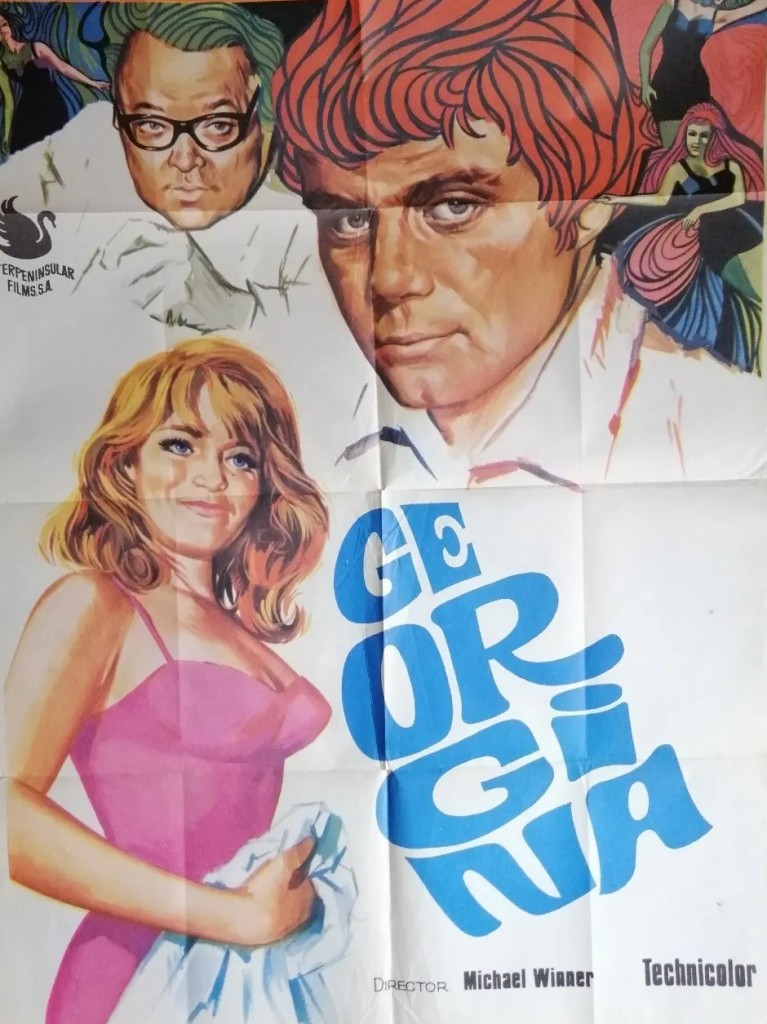
The movie opens with a stunning image. Quint wielding an axe. Despite this being in the middle of London, he scarcely receives a second glance – as if this might be construed as typical English eccentricity – as he marches towards his posh headquarters, proceeds to smash his office and hand in his notice to boss Lute (Orson Welles). He finds work in a literary magazine with old school chum Nicholas (Norman Rodway) where, unfortunately given he already has a wife and several mistresses, he falls for virgin secretary Georgina (Carol White).
But despite his success he is tormented by his schooldays, which instead of toughening him up made him more vulnerable to abuse from a teacher and to bullying from fellow pupils led by entitled thug Maccabee (Harvey Hall). The nightmarish glimpses of school are sharply brought into focus when he encounters Maccabee again and witnesses the savage hounding of another innocent man.
Meanwhile, Lute keeps popping up, either to try and seduce Quint back to his job or to sabotage his existing one. When a fight breaks out at one of Lute’s parties he wants it stopped before another of his precious artworks is broken rather than before a participant ends up in hospital. Lute takes English eccentricity to the extreme, enjoying a massage while playing Scalextrix, the epitome of avuncular decency except that he’s twisting the rules.
Even with his diabolical childhood, it’s hard to sympathize with Quint. He’s little more than a charming lout, but I suspect his is a more universal condition, those who have so much easy wealth inclined to poke at the foundations of success, and seek a more worthwhile profession. The ending is contrived, but, then, the fun has to stop somewhere.
That said, Oliver Reed (The Assassination Bureau, 1969) presents a more rounded character than in many of his later films. From the confidence of his delivery you get the impression that Orson Welles (House of Cards, 1968) – top-billed ahead of Reed – improvised many of his lines. He’s certainly having some fun with his role, but then that is the seductive part of his character. Carol White (Daddy’s Gone A-Hunting, 1969) is the big surprise, bringing a genuine freshness to her role, before she conformed to the Hollywood dictat. And you won’t forget the malicious Harvey Hall (The Games, 1970).
The quite amazing cast includes Edward Fox (Day of the Jackal, 1973), Michael Hordern (Where Eagles Dare, 1968) as a demented headmaster, Marianne Faithfull (The Girl on a Motorcycle, 1968), Harry Andrews (The Long Duel, 1967) as a writer with a creepy hobby, Wendy Craig (TV series Not in Front of the Children, 1967-1973), Ann Lynn (Baby Love, 1969) and Frank Finlay (The Shoes of the Fisherman, 1968).
It’s entirely possible that it was pure coincidence that Winner covered so many topics relevant to today but I’m giving him the beenfit of the doubt. Written by Peter Draper (The System / The Girl-Getters, 1964).
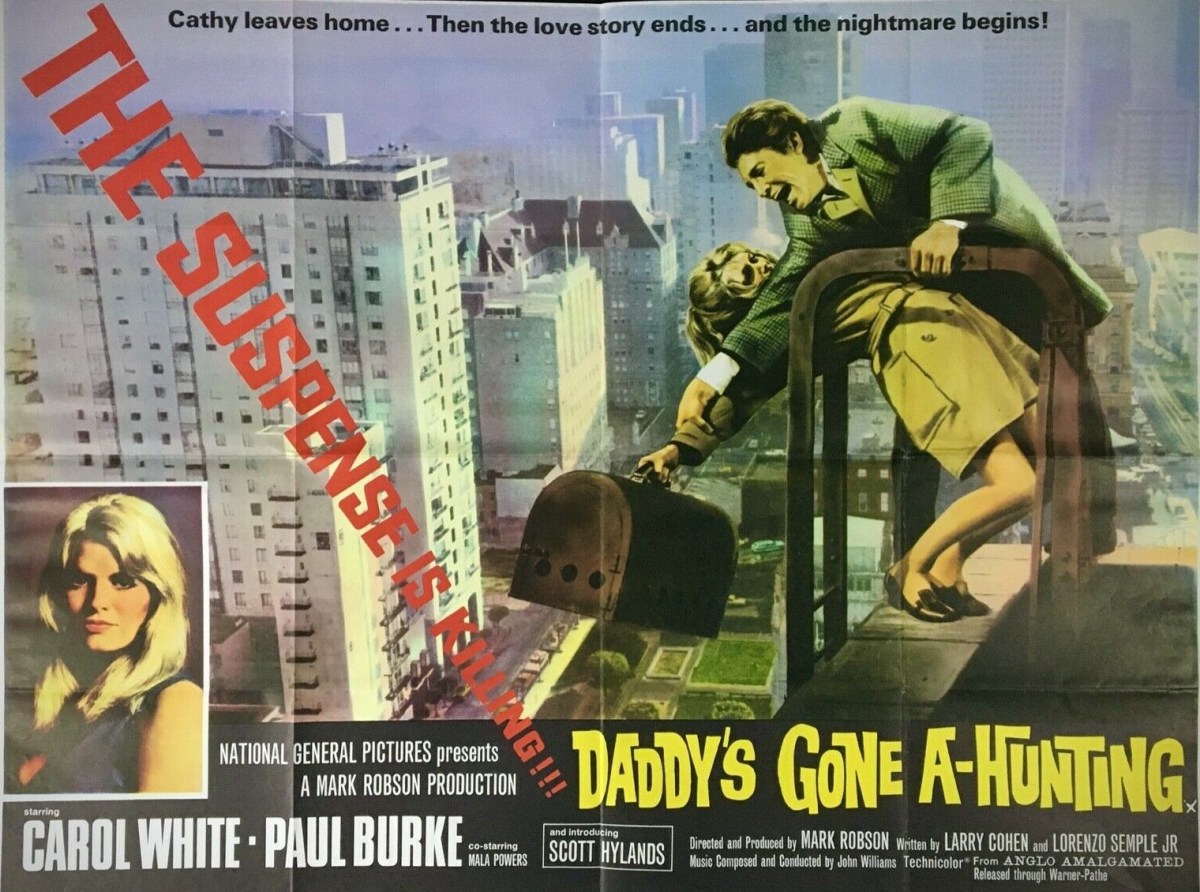
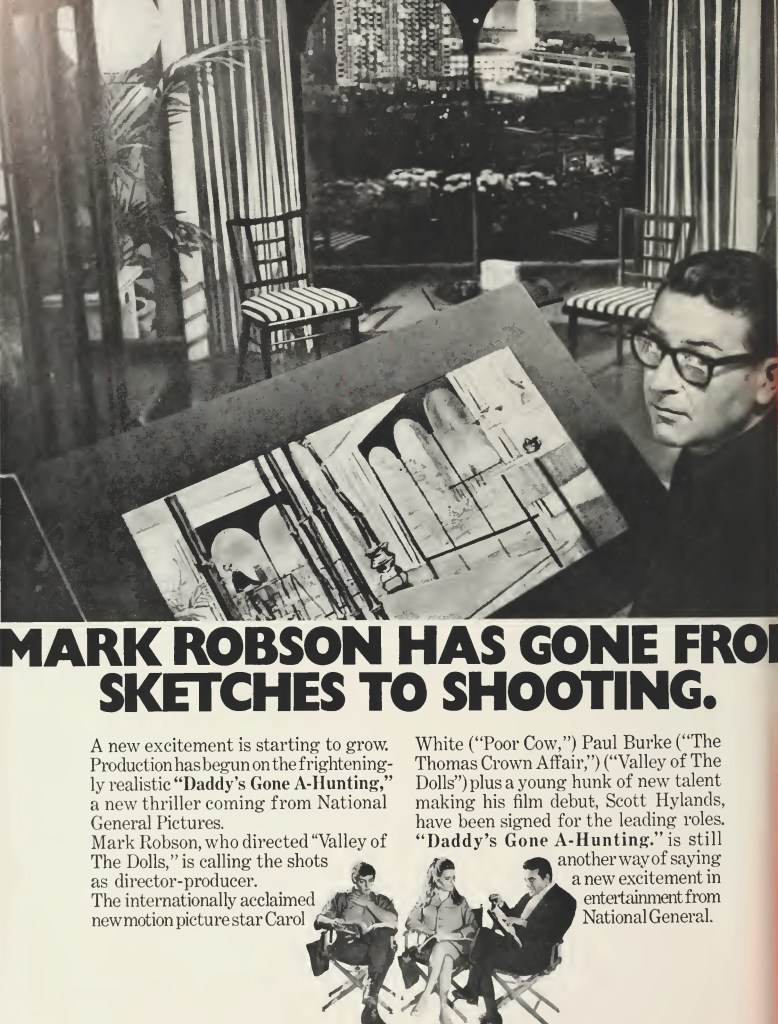
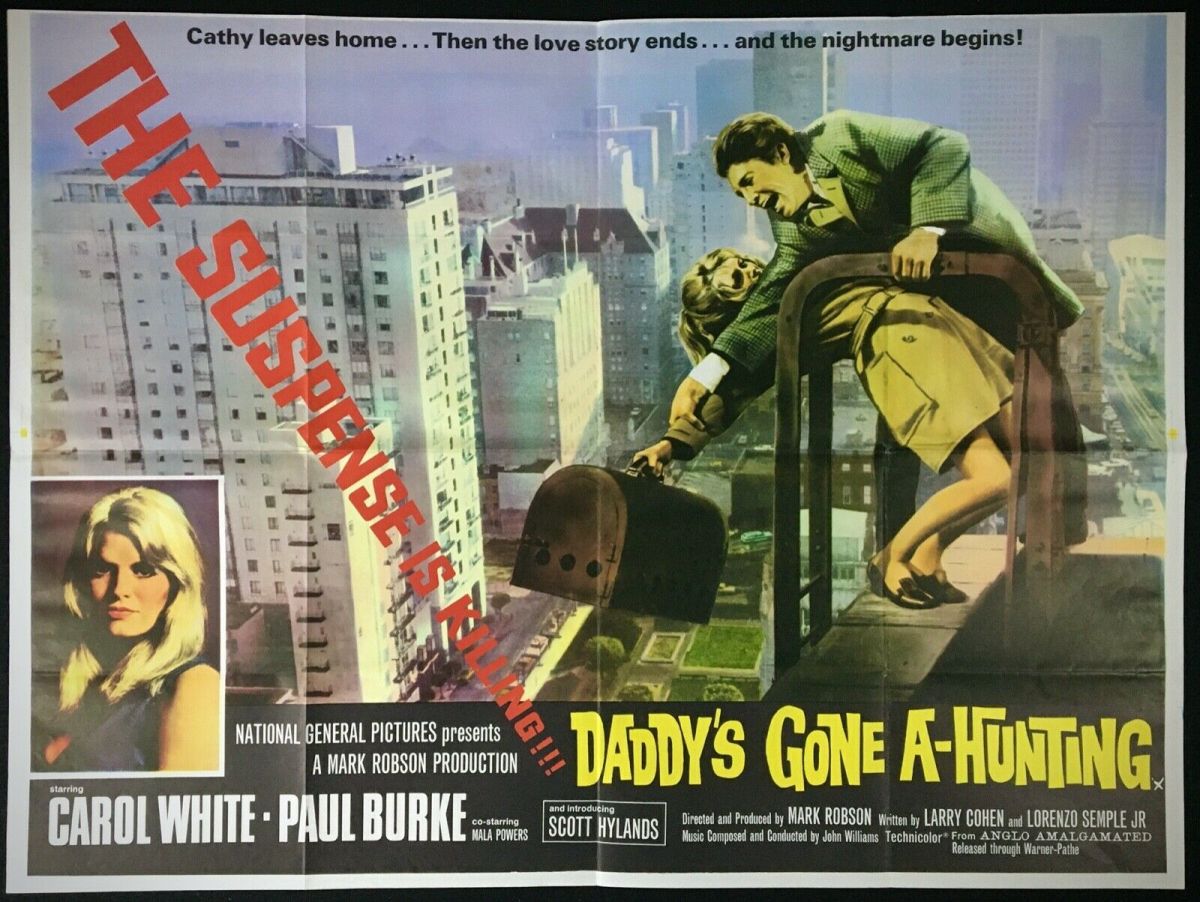
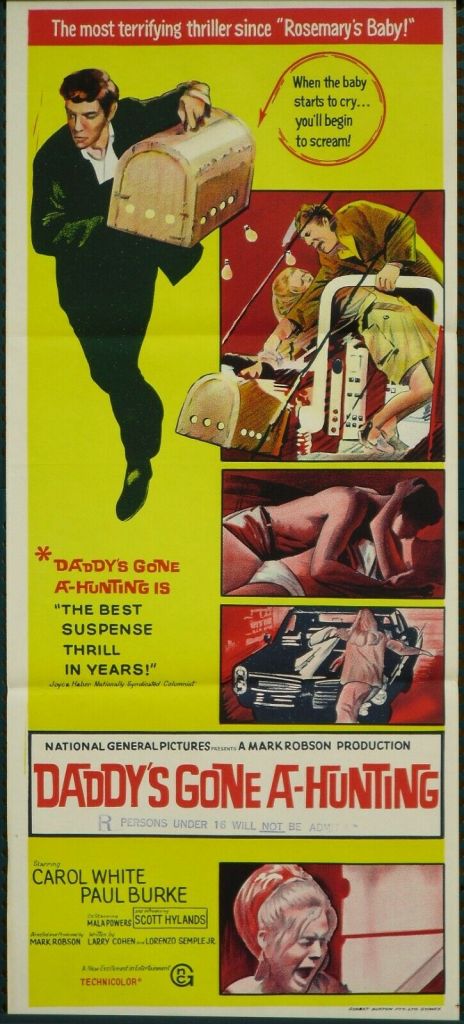
Everyone wants to be a star-maker. Director Mark Robson thought he had some form in this area after Valley of the Dolls (1968) showcased Barbara Parkins and Sharon Tate. There’s no doubt British actress Carol White reveling in critical kudos for Poor Cow (1967) had promise. But not necessarily good professional advice otherwise how to account for a supporting role in Prehistoric Women/Slave Girls (1967) her first picture after success in three BBC television productions. The female lead in Michael Winner’s I’ll Never Forget Whatisname (1967) was followed by a small role in the more prestigious John Frankenheimer drama The Fixer (1968). But none of these films did anything at the box office. Enter Mark Robson.
This thriller might have made her a star had it not been so darned complicated. It veers from paranoia to stalkersville to Vertigo via Gaslight without stopping for breath and some elements are so obviously signposted at the start you are just waiting for them to turn up. Plus, if ever a film has dated, it’s this one, going back to the days when abortion carried automatic stigma and fathers could get away with lines like “you murdered my baby.”
So, one of the few times in history San Francisco got snow (it averages zero inches annually according to Google) the meet-cute is sketch artist Cathy (Carol White) being hit by a snowball thrown by wannabe Kenneth (Scott Hylands, making his debut). But when she realizes how much he enjoys watching cats stalking canaries decides she doesn’t want his baby and aborts it.
A few years later she marries congressional candidate Jack (Paul Burke from Valley of the Dolls) and when pregnant crosses paths with Kenneth who manages to insinuate himself into her family via her husband. Twist follows twist until we are on the Top of the Mark (a famous city landmark) for a gripping climax.
White does well as she shifts through the emotional gears but she is barely given respite from being overwrought so at times her acting appears one-dimensional rather than varied. In fairness to her, the movie’s plot gives her no chance to deliver a settled performance. Hyland looks as if he’s auditioning for a role as a serial killer, but the depth of his cunning and his twisted perceptions kept this viewer on edge – what it would take for Cathy to make amends will chill you to the bone.
Robson has some nice directorial touches, a scene reflected in the eye of a cat, a clever jump-cut from marriage proposal to marriage ceremony and some flies in milk. Mala Powers makes a welcome big screen appearance after nearly a decade in television. That this whole concoction emanated from the fertile imaginations of screenwriters Larry Cohen (It’s Alive, 1974) and Lorenzo Semple Jr. (Fathom, 1967) might give you an idea of what to expect.
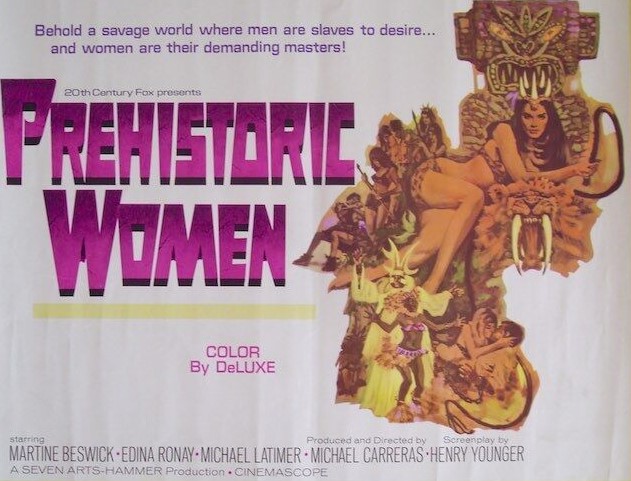
Can a dash of feminism rescue campy trash? Or even a genetics overload? Or is it enough to wonder what career hole Carol White (Never Let Go, 1960) found herself in to end up here? Or should we just sit back and watch the Pan’s People-style choreography and admire the astute re-use of all those bikinis left over from Hammer’s previous venture into this territory, the much more successful One Million Years B.C. (1966). Whatever, there’s no escaping the wooden acting and the one-note direction.
Dennis Wheatley (The Fabulous Valley, The Lost Continent, They Found Atlantis) and C.S. Lewis for that matter had the knack of transporting characters back in time or into other worlds. There’s usually some routine artefact, door or whatnot, that allows access to an amazing kingdom, or, in this case, queendom.
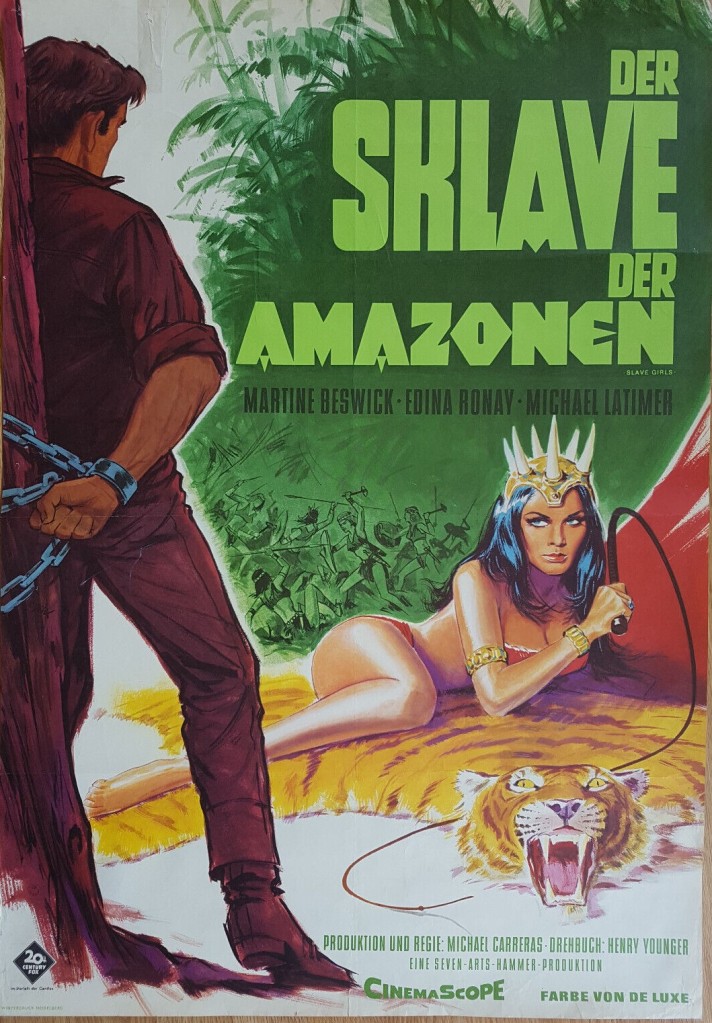
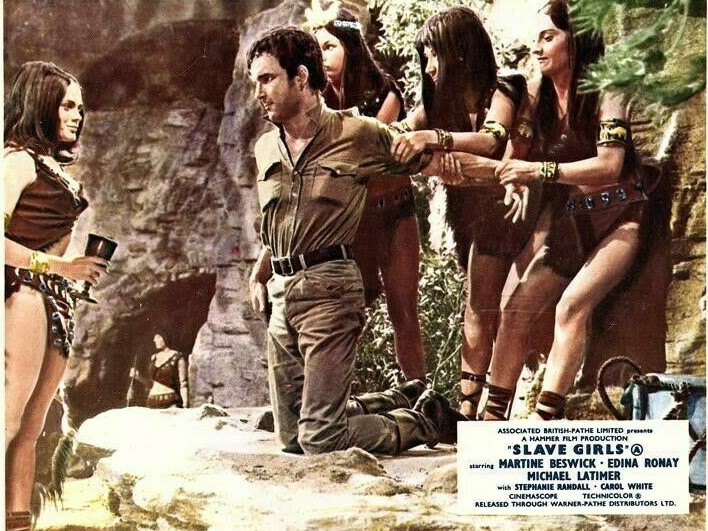
Here, big game hunter David (Michael Latimer), about to be sacrificed to some pagan African god, instead finds himself thrown back in time, chasing bewitching blonde Saria (Edina Romay), who, unfortunately is on the run, so when she is apprehended, so is he. Queen Kari (Martine Beswick) takes him as her lover. But he’s less keen, repulsed by her harsh rule. When one of her subjects rebels, the queen doesn’t delegate the task of bringing her into line but takes her on mano-a-mano. David, put to work with the other male prisoners, soon plots his escape.
Setting aside the expected mumbo-jumbo – the tribe worships a mythical white rhino (phallic symbol anyone?) for example – if you want to extract anything more from this, there are fresh fields to plunder. For example, brunettes, such as Kari, are in control, but only after rebelling against the blondes who had subjugated the black-haired women in similar fashion as Kari. As well as having a female ruler, the movie makes a relatively pertinent point that gender scarcely comes into it when a dictator imposes such harsh conditions on their subject, Kari, for example, making the blondes eat off the dirt.
I’m not convinced the irony is deliberate. David, scion no doubt of Victorian nobility who made their pile from scarcely paying their downtrodden peasants a living wage, and who goes around shooting leopards, is hardly in a position to ask the queen to cool it. When she even considers giving him some equality – a big role reversal right there – he wants her to treat everyone in a nicer fashion.
The movie had an unsual history. Made quickly after “One Million Years B.C.” it was released in the U.S. as “Prehistoric Women” in 1967 but flopped so it was heavily cut, re-titled “Slave Girls” and sent out in 1968 in the UK as the support to “The Devil Rides Out.” The new title is a bit of misnomer because her kingdom is as full of slave men. The girls refers to the blondes.It was released in the U.S. in February 1967 by Twentieth Century Fox and managed a tie-in in one city with Cara Nome perfume.Actually, U.S. grosses were not as bad as have been reported – a “good” $25,000 in first run in Detroit, second only to “Grand Prix” there for the week, and decent enough openings in Boston, Minneapolis and San Francisco.
And she has the insecurity of Napoleon, needs to be loved, and not in mercenary fashion, and willing to attempt some form of rudimentary seduction if that’s what it takes to tempt the suddenly high-principled David into her bed. There’s an element of upending the Gentlemen Prefer Blondes trope, as though brunettes have always hankered after putting those ditzy blondes in their place.
Hammer lost sight of the fact that One Million Years B.C. owed as much to Ray Harryhausen as the statuesque temptations of Raquel Welch in a fur bikini and in its haste to cash in on that film’s big box office rushed into production a movie minus the battling dinosaurs. Although, of course, they could merely be making historical amends, since everyone knows dinosaurs and man (never mind women in fur bikinis) did not co-exist. And possibly ignored the fact that the puny Michael Latimer was no substitute for the brawnier John Richardson of the previous picture.
If you’re not so interested in gender politics, you can always enjoy the dancing, which appears to take up a disproportionate amount of time (well, all those bikinis, need to be used). I was disappointed to discover the choreography was not the work of Flick Colby of the legendary BBC TV Top of the Pops dance troupe, but by one Denys Palmer, an actor it appears, whose main claim to fame was appearing in a classic Dr Who episode.
This was triple-hyphenate job, so blame Michael Carreras (The Lost Continent, 1968) for the screenplay and the direction and for taking on the production duties, or praise him for seeding a campy knock-off with issues that register more strongly today.
This was intended to be a big step-up for Michael Latimer but he was so charisma-free that he didn’t score another movie credit until low-budget British B-picture Man of Violence (1970). Martin Beswick (The Penthouse, 1967) never got another shot at a top-billed role. Carol White did better, next up was Poor Cow (1967) and from there it weas a small step to Daddy’s Gone A-Hunting (1969), but she doesn’t stand out here the way she did in Never Let Go (1960). If anyone stole the show it was Edina Ronay, and much good it did her, her next outing was in the lamentable Three (1969).
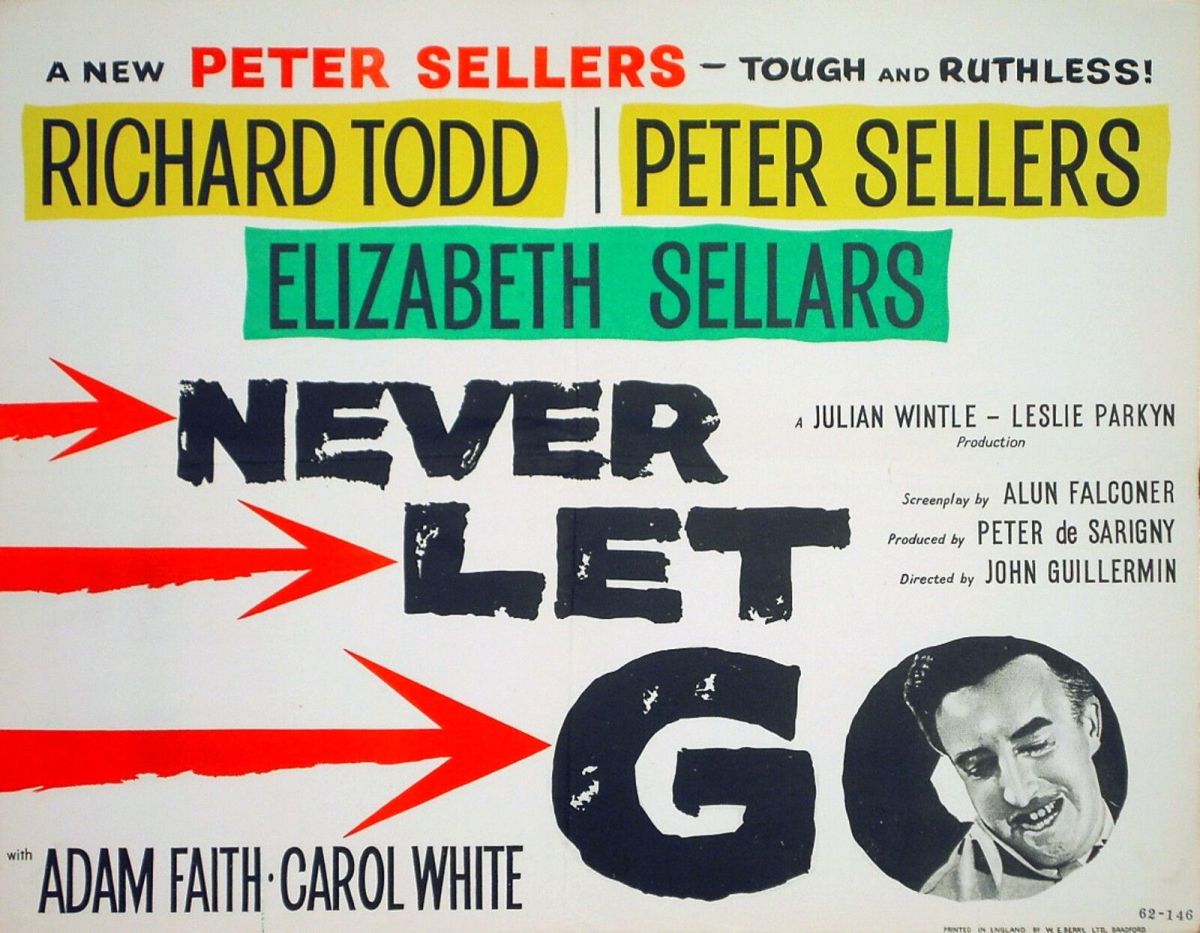
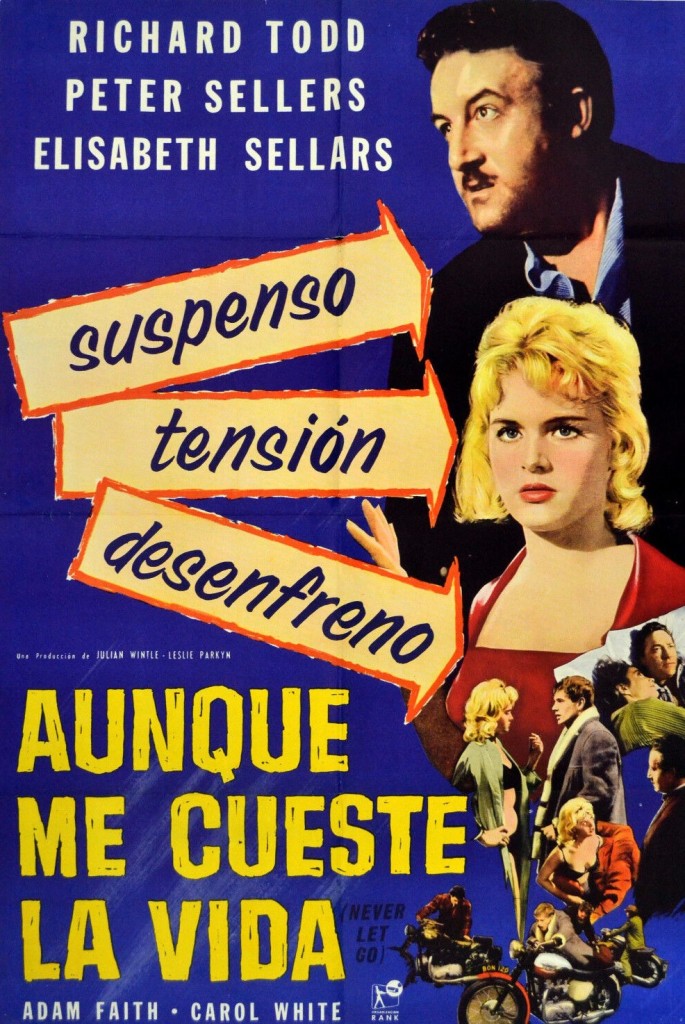
Under-rated British film noir classic. All the principals playing against type. Comedian Peter Sellers (The Millionairess, 1960) as the villain, British hero Richard Todd (The Dam Busters, 1955) comes seriously unstuck, pop star Adam Faith (Beat Girl / Wild for Kicks, 1960) tosses away his cuddly image. One of the earliest scores by John (James Bond) Barry. First grown-up role for Carol White (Daddy’s Gone A-Hunting, 1969). As much savage violence as the censor would allow at the time.
Down-on-his-luck salesman John (Richard Todd) has his car stolen. It’s uninsured. Without it he can’t get to his appointments on time. The police aren’t interested. So he has to investigate. That leads first to dodgy Teddy Boy Tommy (Adam Faith) who steals cars to order for supposedly legitimate businessman Lionel (Peter Sellers) and makes a play for Lionel’s young mistress Jackie (Carol White).
The interest lies not so much in the investigation as how those involved deal with pressure. John, hardly able to support wife Anne (Elizabeth Sellars) and two kids, has a history of failure, squandering money on get-rich-quick schemes, and apt to blow his top at clients who complain when he fails to keep appointments.
Doesn’t take long for him to lose his job. But instead of knuckling down and finding another, he stubbornly refuses to abandon his investigation, upsetting Scotland Yard Inspector Thomas (Noel Willman) who has much bigger fish to fry.
Lionel is a cocky gangster not afraid to lash out. In fact, he seems to enjoy battering people with his fists, feet and broken bottle. He treats Jackie with contempt, reminding her she’d be a sex worker if it wasn’t for him. He’s got a nice little empire and has kept his nose clean. He pays off corrupt cops.
But the last thing he expects is to be pursued by a loser like John who’s not cut from the John Wick template. Not does he possess the very particular set of skills that appear to be the prerequisite of anyone embarking on a mission of revenge.
If director John Guillermin (El Condor, 1970) hadn’t been obliged to tag on a happy ending, this would have been a downbeat tour-de-force, with the good guy losing everything in order to win back his self-respect.
It just sizzles with tension. Lionel belongs to the generation that spawned the likes of Harold in The Long Good Friday (1980) or the Kray Twins, a simmering, stewing piece of work, all gloss on the outside, a tinderbox on the inside.
There’s fabulous photography, eyes trapped in pools of light, overhead camera staking out victims, and seedy London picked out in detail. Newspaper vendor Alfie (Mervyn Johns), of pensionable age, the only witness to the crime, has his bedsit ransacked, the tiny terrapin he treasures crushed underfoot, when inadvertently he gives too much away.
Tearaway Tommy isn’t such a tough guy when Lionel comes battering on his door. Jackie is the only one who not so much stands up to Lionel as treats his idea of romance with disdain. Even when John fingers Lionel, Inspector Thomas bluntly tells him he’s too small fry and the cops aren’t interesting in chasing after his plebeian vehicle.
Lionel is the kind of gangster who is never going to realise he can’t always get away with it, that he might have to trim back his ambition until the coast is clearer. Instead, he batters on regardless, determined to terrify everyone into acquiescence.
As the movie progresses, the more you learn about John, the less you sympathise. His wife has stood by him through mostly thin, and will stick by him even if unemployed, but draws the line at antagonising a gangster who doesn’t know when to draw a line. John isn’t Gary Cooper in High Noon. He’s not a principled defender of the law. He’s almost as bad as the gangster, in that he doesn’t know when to stop, regardless of the danger this places his family.
Understandably, Peter Sellers attracted most of the critical plaudits, but this is the role of a lifetime for Richard Todd, who detonates his screen image, battered and bloodied almost beyond recognition, not hiding behind a stiff upper lip. Carol White, too, is superb as the mistress who just about recognises that this is not a good deal, and that she’s a chattel, not a loved one.
John Guillermin’s direction is superb. Coupled with the insistent, jazzy John Barry score, this is British film noir (admittedly, that’s not large pool to draw on) at its best.
Stunning opening section thrown away by shifting tone and despite excellent performances by the Oscar-nominated Alan Bates and Dirk Bogarde drifts into Kafkaesque virtue-signalling.
But let’s get the title out of the way first. I had assumed a “fixer” was a manipulator, an underworld type of character who could, for a price or future favor, sort out problems or find someone a job or act as an intermediary between politicians or businessmen. Not so. Yakov (Alan Bates) is nothing more than a handyman, who can fix broken windows or railings and turn his hand to anything such as wall-papering or basic accountancy.
In the credit sequence he demonstrates his skills by fashioning with wood, a couple of screws and some steel, a razor, with which to remove the hair and beard that would identify him as a Hassidic Jew. He is, as soon becomes apparent, afflicted by dogs. As he departs his remote cottage in a cart, a vicious dog so disturbs his horse that it bolts, resulting in the loss of a wheel. He continues his travels on horseback, arriving in a small town in time to witness a parade and Cossacks rampaging through the streets.
As it’s set in Czarist Russia, his journey is accompanied by melancholy violin with, for some reason, a disturbing undercurrent of military drum. As the credits end, we cut to the Russian flag and a marching band. He hides in terror as the horsemen drag people along by the ear, slash with sabers, hang others. It’s a pogrom, the type of attack commonly experienced by Jews living in ghettoes.
Up to now, it’s just outstanding. Then it tips into the picaresque. Yakov helps an old drunk Lebedev (Hugh Griffiths) who’s fallen down in the snow in the street. As reward he is offered work wall-papering a room. He has a prick of conscience when he realises that Lebedev is an anti-Semite. Lebedev’s daughter Zinaida (Elizabeth Hartman) seduces him. But, on spotting some blood on a cloth, he refuses to go through with the act.
Luckily, my reading of crime novelist Faye Kellerman has alerted me to the fact that it is an act of faith for Jews not to make love when a woman is menstruating. Luckly, Zinaida isn’t so up on her Bible (Leiticus 15: 19-23 in case you were interested) that she catches on to this revealing fact, for, as has been pointed out earlier, minus the distinctive curl, Yakov doesn’t have the physical characteristics associated in those times with a Jew. In fact, you would say Lebedev would more easily pass for one.
Anyway, Lebedev gives him another job, of counting the loads leaving his brickworks because he suspects he is being swindled. But the foreman, who has been rumbled, and suspects Yakov of being a Jew, calls in the Secret Police, it being a crime for Jews to leave the ghetto.
Now we tip into Kafka. The initial charge against Yakov is that he harbored another Jew during Passover. But then things spiral out of control. He is accused of passing himself off as a Gentile (non-jew), attempted rape of Zinaida and then of ritual murder, killing a small child.
Investigating magistrate Bibikov (Dirk Bogarde) is sympathetic and manages to avoid the rape charge much to the fury of prosecutor Grubeshov (Ian Holm) but once the other charges mount, he is nailed, everyone determined to prove an innocent man guilty.
This is based on a true case and clearly was a case of persecution and Yakov’s transition from worker happy to hide his ethnicity to gain work to a man who rediscovers his religion is a piece of great acting from Alan Bates. But the points are hammered home endlessly and where director John Frankenheimer (The Train, 1964) so deftly dispensed with dialogue in the superb opening sequence, now he more than makes up for it with leaden speeches, and a film that would worked better for being considerably shorter.
It feels like Hollywood is hard at work. After some moments of mild happiness Yakov’s cinematic chore is to invoke sympathy for an entire nation rather than taking on the Holocaust directly. Dalton Trumbo’s (Lonely Are the Brave, 1962) screenplay is filled with brooding lines. But providing Yakov with an interior monologue when he dithers over having sex doesn’t work at all, certainly not next to the more effective use of that technique in John and Mary (1969).
At the outset, Frankenheimer treats violence with discretion. We don’t see the dog being impaled on a saber, just its corpse thrown at Yakov. We witness a rope being wound round a man’s neck, as innocent of any crime as Yakov, but not the actual hanging. So what begins as highly-nuanced turned into a battering ram of a picture and characters forced into lines like “the law will protect you unless you are guilty” and “I am man who although not much is still more than nothing.”
Alan Bates (The Running Man, 1963) certainly deserves his Oscar nomination and Dirk Bogarde (Modesty Blaise, 1966) might feel aggrieved he missed out on a Supporting Actor nomination. But too many of the rest of the cast over-act. It’s an all-star cast only if you’re British. But check it out if you’re a fan of Hugh Griffith (The Counterfeit Traitor, 1962), Elizabeth Hartman (The Group, 1966), David Warner (Perfect Friday, 1970), Ian Holm (in his sophomore movie outing), Carol White (Daddy’s Gone A-Hunting, 1969) and Georgia Brown (Lock Up Your Daughters!, 1969).
Frankenheimer at his best when he lets the action play without the overload and there’s one almost Biblical scene, lit only by candlelight, that demonstrates his cinematic virtuosity. But otherwise it’s drowned in the verbal rather than the visual. Trumbo based his screenplay on the Pulitzer Prize winner and bestseller by Bernard Malamud.
Some effective moments, but too long drawn-out to make the impact expected.
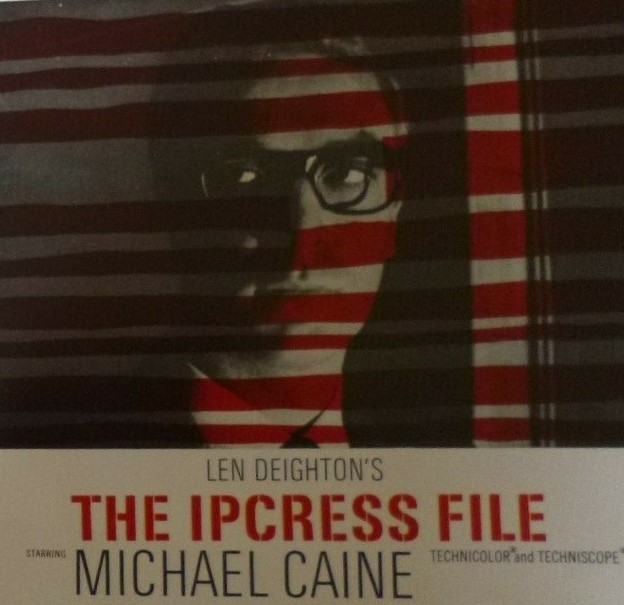
Producer Joseph E. Levine (The Graduate, 1967) would be cancelled these days for his treatment of Michael Caine back in 1964. Levine had stumped up (along with Paramount) the $1.7 million budget for what was assumed to be the actor’s breakout picture, Zulu (1964), and signed him up to a seven-year contract. Caine would receive $75,000 – his fee for Zulu had been just $10,000 – in his first year, with increments every following year.* But before the film was released Levine rescinded the contract on the basis that Caine “looked like a queer on screen.”
While Zulu was a box office smash in Britain, in the United States it was a big flop despite the marketing dollars thrown at it by Levine. And nobody needed a younger version of the British stiff- upper-lip. And despite the buzz before the film opened, producers were not clamouring at Caine’s door, the only options on the table a small part in a television production of Hamlet at Elsinore (1964) and the leading role in The Other Man (1964), a television drama about Britain succumbing to the Nazis in 1940.
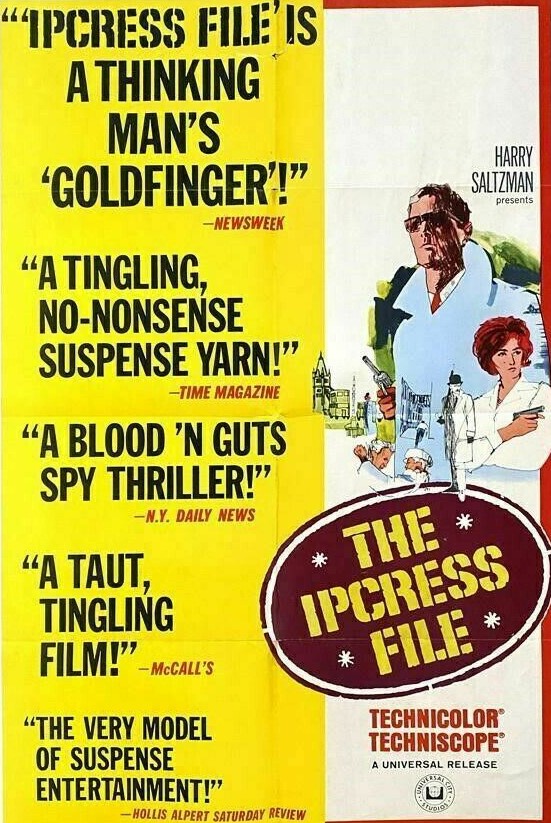
That is, until Bond producer Harry Saltzman summoned him to his table in a restaurant and in a conversation that lasted all of two minutes offered him The Ipcress File and a seven-year contract. Aged 32 at this point, Caine was mature enough to be ranked a proper rising star, the casualty rate among the twenty-somethings accorded that status alarmingly high mostly due to their screen immaturity.
However, Saltzman owed his involvement in the picture to another chance meeting. He had been in the United Artists offices in New York when hair product entrepreneur Charles D. Kasher arrived to pitch Len Deighton’s novel The Ipcress File as a potential movie. Saltzman was looking for an alternative to James Bond that would appeal to international audiences with the emphasis on low-cost. He put together the picture on a budget of only $460,000. But the project looked dead in the water when original Hollywood backers Columbia pulled out shorlty before shooting was due to star. Universal saved the day.
Hammer director Jimmy Sangster recommended Canadian director Sidney J. Furie (Wonderful Life/Swingers’ Paradise, 1964) who had just turned down A Hard Day’s Night (1964) and just signed up to do indie horror movie Devil Doll (1964) before managing to ease himself out of that contract.
Caine was far from first choice. Christopher Plummer had chosen The Sound of Music (1965) instead and Richard Harris, a bigger name in Hollywood after MGM roadshow Mutiny on the Bounty (1962) and a critical success after This Sporting Life (1963) turned it down in favour of Sam Peckinpah western Major Dundee (1965). In a bid to give the character the ordinariness he required Harry H. Corbett (Rattle of a Simple Man, 1964) was also considered. Caine had been sharing a flat with Terence Stamp (The Collector, 1963) but when Stamp decamped to America moved in with composer John Barry and was thus the first to hear the music Barry had dreamed up for Goldfinger (1964).
Aware how easily contracts could be dissolved Caine “stuck to him (Saltzman) like a drowning man to a straw.” Thus, he was present when discussions arose over naming the spy – anonymous in the book which was written in the first person. It was decided the character should have a dull name. “Harry” was chosen before everyone present realized the producer might just take offence. However, Saltzman’s real first name was Herschel, so he laughed it off.
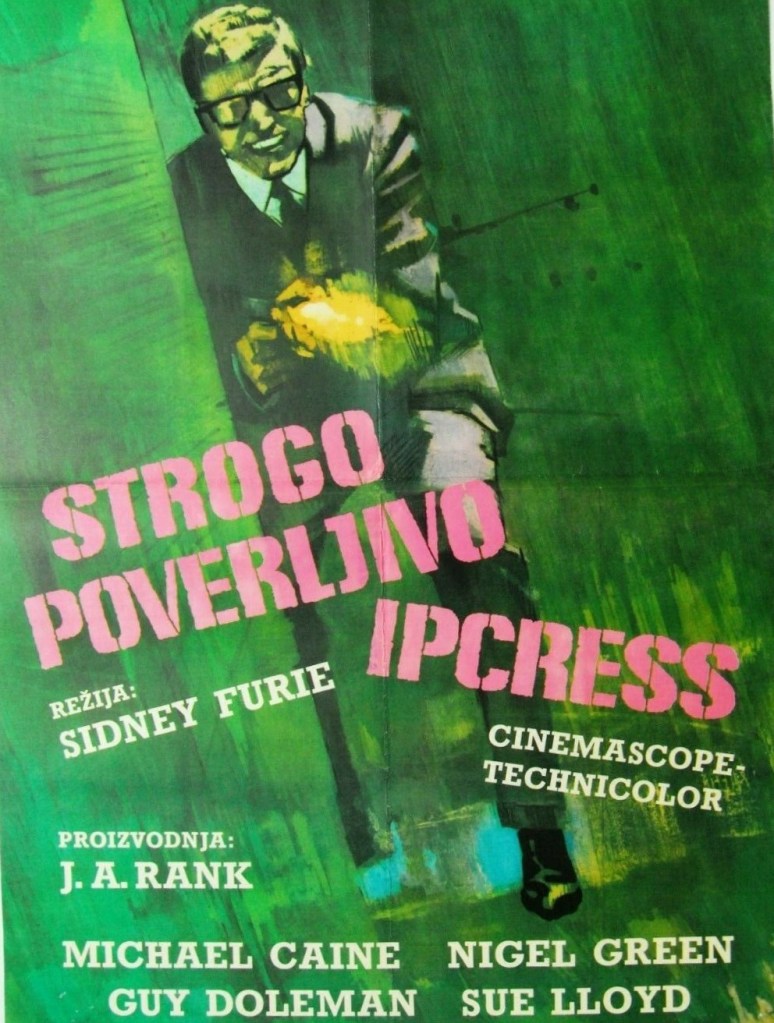
Saltzman also came up with idea of the character wearing glasses to make him look more ordinary. Caine was short-sighted in real life and always wore glasses and Saltzman noticed how comfortable he was with them, knowing how to handle them properly, unlike clear-sighted actors given spectacles for roles without having any idea what to do with them. It was surprising how fragile the spectacles were, though, Caine getting through the allocated three pairs and new supplies having to be commandeered. Saltzman took the ordinariness too far, suggesting a duel with supermarket trolleys as one of the big fight scenes.
Even though Furie had never met Caine, he disliked him, having come across the actor and his friend Terence Stamp at the White Elephant Club in London. “I’d see Terence Stamp always there with this other blonde guy who wore glasses,” recollected Furie, “and they were rather chummy and always had these pretty girls at their table, and they were always laughing. And I sort of hated him at the time. Sometimes, I would get a bit drunk and tell whomever I was with, ‘I want to punch that guy in the face.’ I guess I was jealous.”
Joan Collins, completely out of favour in Hollywood and with no roles since The Road to Hong Kong (1962), auditioned – as did the unknown Carol White (Poor Cow, 1967) – for the part of Jean that went to Sue Lyons, in her first featured role. Otherwise, the main roles went to established British character actors including Nigel Green (Zulu), Gordon Jackson (The Great Escape, 1963) and Guy Doleman (Thunderball, 1965)
Interestingly, laughable though it is now, a character who cooked was considered to be gay, even though Palmer clearly used his cooking skills for female seduction. Unfortunately, no great cook himself, Caine was unable to crack two eggs with one hand and the movie used the hands of author Len Deighton, so excellent a cook he had written a cookbook. That explains why the hands that picked up the eggs on screen had blond hairs but the hands that cracked them had black hairs. The cooking scene remained the cause of macho concern, with one U.S. studio executive demanding the scene be re-shot with the woman cooking the meal.
Director Sidney J. Furie (Wonderful Life/Swingers’ Paradise, 1964) hated the script and demonstrated his loathing by gathering cast and crew together on the first morning of filming and burning the script on the studio floor. While sticking to the basis of the screenplay, characters were encouraged to improvise. The poor script – Kasher had called it “garbage” – was the reason for introducing this kind of style, the script being rewritten as production proceeded.
Furie recalled, “All day there were two writers writing our scenes for the next day…We knew where we had to get to because Harry Saltzman, the producer, had ordered the set for the climax built, so we were stuck with it.” If the pages didn’t turn up, Furie found ways to instigate delay, getting the cameramen spending an inordinate amount of time lighting a scene. Furie sipped whisky in his Scotch all day, not enough to be inebriated but “it would help me go with my gut.” The full complement of writers involved in the script were James Doran and W. H. Canaway plus uncredited contributions from Lukas Heller (The Dirty Dozen, 1967) , Lionel Davidson (source author for Agent 8 ¾, 1964) , Ken Hughes (The Trials of Oscar Wilde, 1960) and Johanna Harwood (Dr No, 1962).
Furie’s style on The Ipcress File was very distinctive – “scenes where you had someone’s shoulder blocking the screen and you could only see three quarters of the screen…If you try to use the screen the way a painter uses a canvas, somehow it’s not considered acceptable.”
Furie and Saltzman did not get on, the producer loathing what he saw as the director’s stylistic excesses and was convinced he required editor Peter Hunt to rescue the project once shooting was complete. For his part, Furie’s definition of producers was “the people who tried to wreck the movie.” Explained the director, “I was very depressed always when we started shooting, thinking that it was going to be really lousy and I didn’t know what to do, so I told myself I would come up with a style of shooting that is different. I put shoulders across the screen, I shot up at things, I shot down, just to make it different, to give it ambiance. It was done out of insecurity.”
At one point the director quit the set, resulting in a chase through London with the producer’s Rolls Royce in pursuit of the London bus on which the director had escaped. However, Furie conceded, “The movie would not have gotten made without him (Saltzman) and his devotion to seeing it through, considering the problems with Universal, no matter how much I fought with him during the making of it.
To Saltzman’s astonishment when Peter Hunt arrived and examined the dailies he told the producer “this is the most brilliant footage I’ve ever seen” In order to convince the producer that it was all going to work, Hunt edited together the sequence where, with a marching band in the background, Nigel Green marches in step to the tempo followed by “dialogue between Green and Guy Doleman, carefully intercut with their closed umbrellas stepping with them in motion…Once I assured him (Saltzman) it would be a good film, he started getting confident.”
While British critics lauded the picture, its reception Stateside was mixed, “though the public weighed in heavily with its money” – Variety noting not just that it was “short on thrills,” over-stylised, and could do with being a “a trifle more lively,” the overall verdict being that it was “so soft-pedalled that the audience will be screaming for more kicks” of the Bond kind.
*NOTE: In his autobiography Caine stated his $75,000 annual salary would double every year. That doesn’t sound right. A second year of $150,000 and even a third of $300,000 might be acceptable for a rising star. But if you were looking at $600,000 for his fourth year and $1.2 million for his fifth up to $4.8 million for the final year, that would make him by the end of the decade easily the highest-paid star in Hollywood. Caine would need to be working like a Trojan, four or five films a year, to come anywhere close to earning such sums and his movies would all have to be big hits. Of course, to cover his costs, Levine could farm him out to other studios, but even so, it was a disproportionate amount for any actor to earn. Even John Wayne and Steve McQueen would not pull in such a salary by 1971.
SOURCES: Daniel J. Kremer, Sidney J. Furie: Life and Films (University of Kentucky Press, 2015), p74-84; Michael Caine, What’s It All About? (Arrow Books, 1993) p189-190, 195-210; Michael Caine, The Elephant to Hollywood (Hodder and Stoughton, 2010), p85-90; Paul Rowlands, Interview with Sidney J. Furie, Money into Light website, 2017.
Everyone wants to be a star-maker. Director Mark Robson thought he had some form in this area after Valley of the Dolls (1968) showcased Barbara Parkins and Sharon Tate. There’s no doubt British actress Carol White reveling in critical kudos for Poor Cow (1967) had promise. But not necessarily good professional advice otherwise how to account for a supporting role in Prehistoric Women/Slave Girls (1967) her first picture after success in three BBC television productions. The female lead in Michael Winner’s I’ll Never Forget Whatisname (1967) was followed by a small role in the more prestigious John Frankenheimer drama The Fixer (1968). But none of these films did anything at the box office. Enter Mark Robson.
This thriller might have made her a star had it not been so darned complicated. It veers from paranoia to stalkersville to Vertigo via Gaslight without stopping for breath and some elements are so obviously signposted at the start you are just waiting for them to turn up. Plus, if ever a film has dated, it’s this one, going back to the days when abortion carried automatic stigma and fathers could get away with lines like “you murdered my baby.”
So, one of the few times in history San Francisco got snow (it averages zero inches annually according to Google) the meet-cute is sketch artist Cathy (Carol White) being hit by a snowball thrown by wannabe Kenneth (Scott Hylands, making his debut). But when she realizes how much he enjoys watching cats stalking canaries decides she doesn’t want his baby and aborts it. A few years later she marries congressional candidate Jack (Paul Burke from Valley of the Dolls) and when pregnant crosses paths with Kenneth who manages to insinuate himself into her family via her husband. Twist follows twist until we are on the Top of the Mark (a famous city landmark) for a gripping climax.
White does well as she shifts through the emotional gears but she is barely given respite from being overwrought so at times her acting appears one-dimensional rather than varied. In fairness to her, the movie’s plot gives her no chance to deliver a settled performance. Hyland looks as if he’s auditioning for a role as a serial killer, but the depth of his cunning and his twisted perceptions kept this viewer on edge -what it would take for Cathy to make amends will chill you to the bone.
Robson has some nice directorial touches, a scene reflected in the eye of a cat, a clever jump-cut from marriage proposal to marriage ceremony and some flies in milk. Mala Powers makes a welcome big screen appearance after nearly a decade in television. That this whole concoction emanated from the fertile imaginations of screenwriters Larry Cohen (It’s Alive, 1974) and Lorenzo Semple Jr. (Fathom, 1967) might give you an idea of what to expect.
Catch-Up: Mark Robson films previously reviewed in this Blog are: The Prize (1963) and Lost Command (1966).




 The Magnificent 60s