I wasn’t aware that celebrated sci fi author John Wyndham had written a sequel to his iconic novel The Midwich Cuckoos, filmed as Village of the Damned (1960). And it turned out he didn’t (he did make an attempt but abandoned it after a few chapters). So he had nothing to do with the sequel. But the original had proved such a hit MGM couldn’t resist going for second helpings.
And there was nothing the writer could do about it, it being standard procedure that when you sold your novel to Hollywood the studio retained all the rights and could commission a remake, sequel, turn it into a television series, without consulting you.
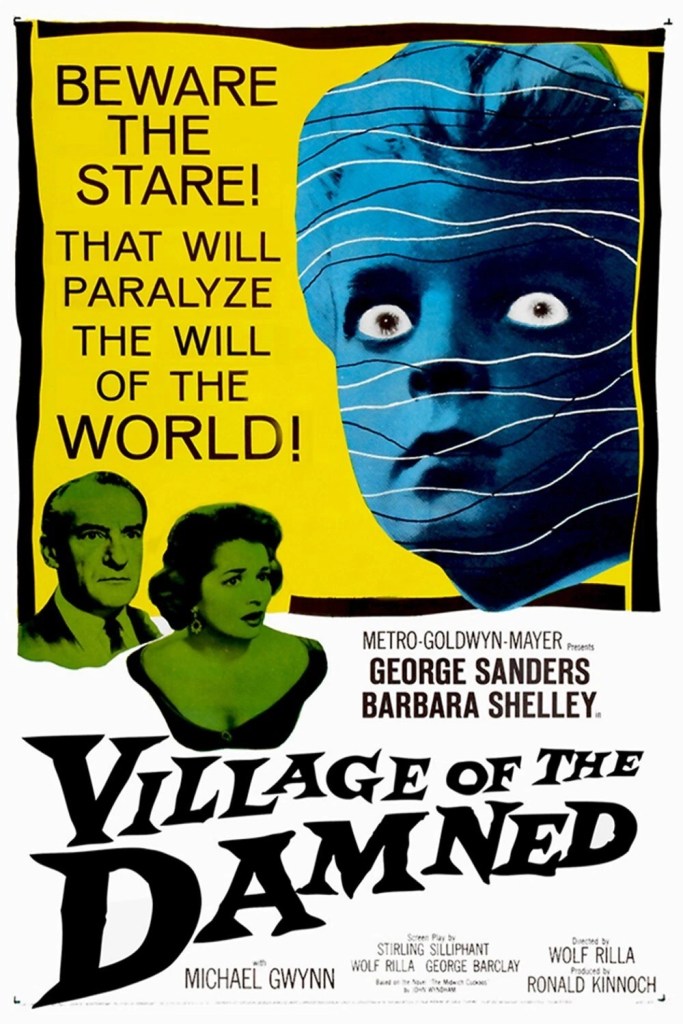
The only drawback for a potential sequel was that main adult character Professor Zellaby (George Sander) and all the kids had died in the original, though the final image of eyes flying out of the burning house might have suggested the children had actually survived. And, as we know these days, just when your main character dies it doesn’t prevent him miraculously returning to life should box office dictate.
So screenwriter John Briley (Oscar-winner for Gandhi, 1982) was handed the sequel. And what we get is a lot of atmosphere, a chunk of running around in empty London streets (the result not of mass evacuation but filming in early morning when roads are clear), a very slinky turn from Alan Badel (Bitter Harvest, 1963) showing what he can do when hero not villain, and a twist on the previous problem – how to vanquish the kids – which is whether to weaponize them. Mostly, we are reminded of how better telekinesis was dealt with in the original picture and how poorly this compares to the likes of Brian De Palma’s later Carrie (1976) and even his The Fury (1978).
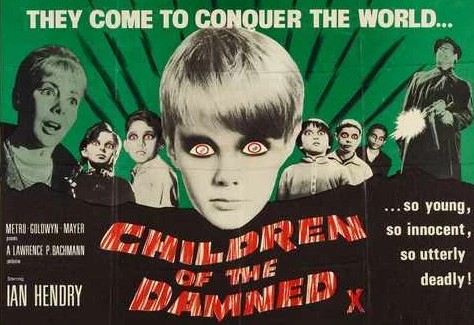
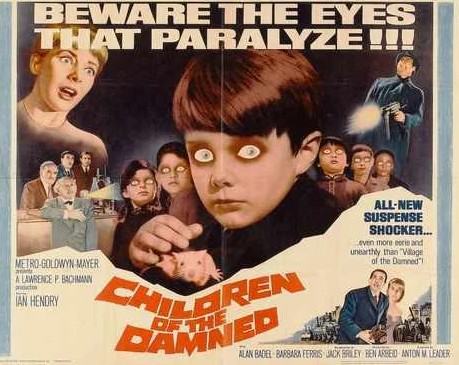
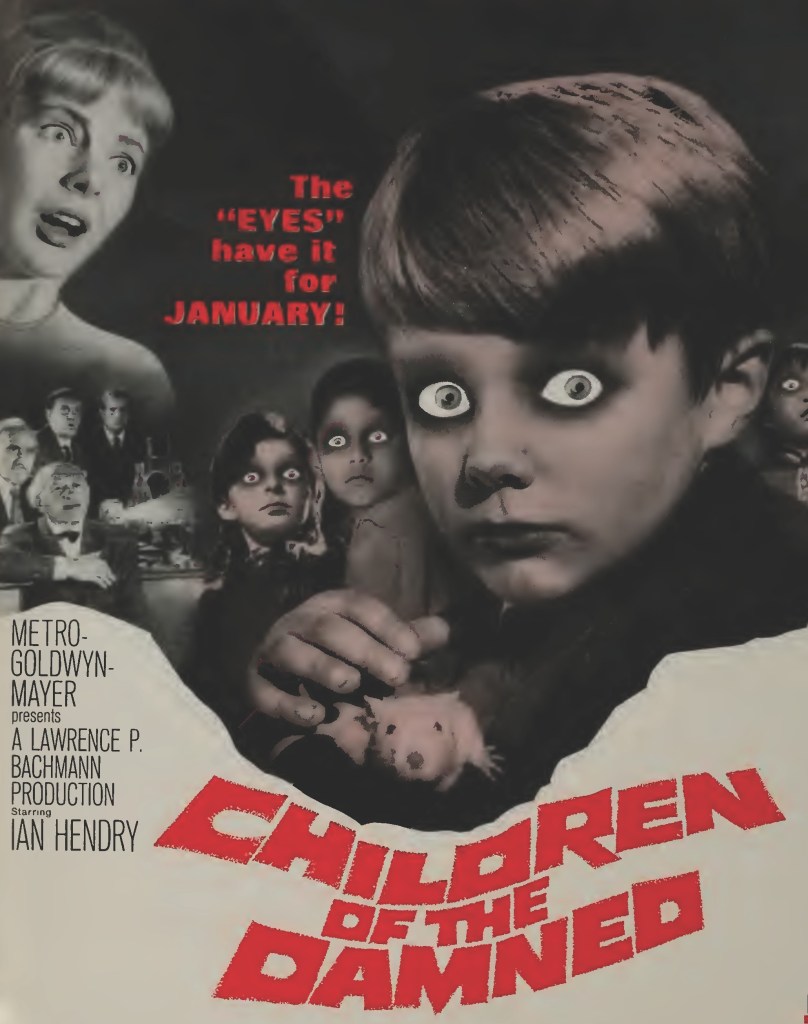
Apart from the title, there’s barely a nod to the previous incarnation, except that discerning the children’s paternity proves impossible. An United Nations project has tracked down six kids with incredible intellects. Like Professor Zellaby, British psychologist Dr Tom Llewellyn (Ian Hendry) and geneticist Dr David Neville (Alan Badel) want to study the kids while the more shadowy figure of Colin Webster (Alfred Burke) appears to have more sinister purpose in mind.
In any case none of the three achieve their goals because the kids escape and take refuge in an abandoned church, defending themselves against the authorities and the military by their brain controlling abilities and by the devising of a sonic weapon. Immediately under their thumb is the aunt, Susan (Barbara Ferris), of the young boy Paul (Clive Powell) who initially excited the interest of the British scientists.
Opinion varies as to whether the children are a genetic freak of nature, aliens or an advanced human race. The authorities can’t decide whether they are a threat or a wonder and decide to eliminate them, then change their mind, while the children decide to fight back then change their minds. The ending is quite a surprise.
Although the kids still have the fearful eyes, they are generally a lot less effective a scare than when the small gang of them stood side by side in the previous picture and stared at adults until they did the childrens’ bidding or killed themselves. There’s way too much discussion among adults. In the previous picture, those kinds of conversations had more emotional impact, since it was the villagers who were left distraught. Here, you couldn’t care less about the adults.
Interestingly enough, the standout isn’t any of the kids at all, but Alan Badel, who comes over as the libidinous sort, but very charming, and views any woman as fair game, but it’s fascinating to see how his usual screen persona here makes him a hero whereas in most other films exhibiting much the same characteristics he comes across as shifty, mean or downright villainous.
Ian Hendry (The Hill, 1965) was a rising British star but isn’t given much to get his teeth into. Barbara Ferris (Interlude, 1968) has a vital role.
Directed by television veteran Anton M. Leader (The Cockeyed Cowboys of Calico County, 1970) who makes his screen debut.
Superb chiller that, unusually, takes time to develop several strands over a longer time frame than is normal for a genre where the immediate takes preference. Opens a new dimension of terror, too, with the brain control sub-genre that would spill over into brainwashing. You could also, if you were of a mind, point to the genuine growing social power of the young as emphasized later in the decade with movies about hippies. It might not be too much of a stretch to point to the “Youthquake” at the end of the 1960s when pandering to a youthful audience nearly destroyed Hollywood.
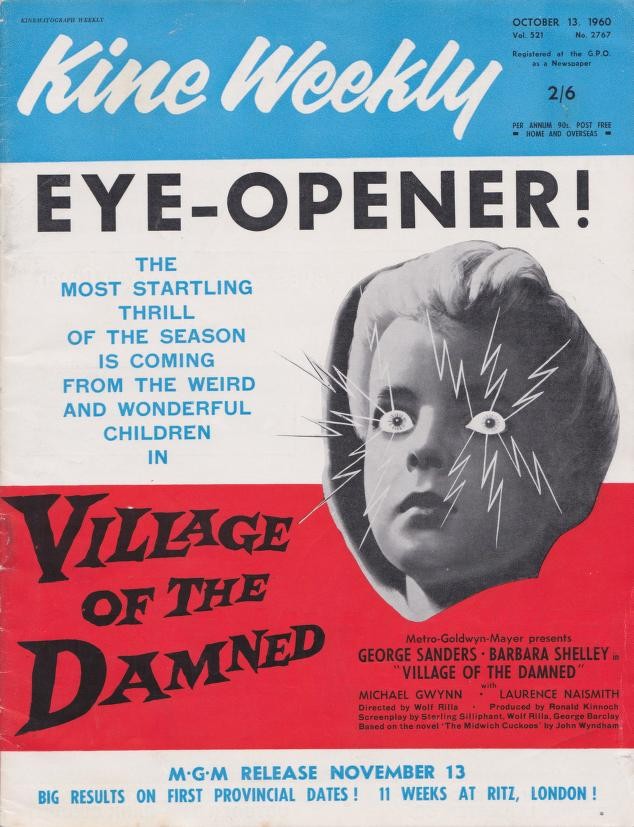
Terrific opening sequence of everyone in the small village of Midwich dropping to the ground, the immobilized driver of a bus crashing off the road, the driver of a tractor hitting a tree, taps left running, telephone calls cut off, all manner of accidents ensue. You think everyone’s dead, as do the military, called in to investigate. They cordon off the area, employ canaries and then humans to discover how far the danger spreads. But when a soldier who is dragged out unconscious from the forbidden zone wakes up, they soon realize the population is merely unconscious.
Childless couple Professor Gordon Zellaby (George Sanders) and younger wife Anthea (Barbara Shelley) are among those affected, apparently suffering no side effects for having been knocked out for around four hours. A couple of months later Anthea is delighted to report she’s pregnant. She’s not alone. But for many of the villagers what would be a cause for celebration causes untold grief. One husband returns home after a year away to find his wife is pregnant. In the days when pre-marital sex was frowned-upon, virgins, similarly affected, are shamed.
The pregnancies don’t run to the normal period either, and fully-grown children are born within a few months. What’s more, they all look as if they have inherited the same genes. Their blonde hair and striking eyes suggest they share the same father. Soon it transpires they can not only read minds but control them, causing at least two people to commit suicide.
Turns out this is a global problem, several other communities afflicted with the same condition, the Russians so concerned at the prospect that they bomb one village to oblivion, other cultures simply murdering the children. Here, being English, where fair play still rules regardless of potential threat, the children are taken under the wing of Professor Zellaby, though the military, having sealed off the area, wait in the wings, itching to wipe out the troublemakers.
Quickly, it becomes a duel for power, the children will do anything to protect their species, Professor Zellaby at first wanting just to study the kids and understand them but soon recognizing the threat.
In between bouts of action, most of which is discreetly handled, none of the deliberately shocking scenes that might have emanated from an exploitationer, the authorities have plenty of time to ponder their existence. A leap in genetic mutation, or extraterrestrial origins, are among the options considered.
Eventually the villagers react like terrified Transylvanians confronting Dracula and attempt to set fire to the building where the children are housed but reckon without the brain control that can be exerted. In the end Professor Zellaby comes up with a self-destructive solution.
This is formidable stuff, all the more so, because in the days when most monsters grew fangs or claws or developed huge bodies and were otherwise physically frightening, the worst these kids get up to is to have a striking glow in their eyes, a startling contrast to their blonde hair, calm demeanor and neat uniform clothing.
Tremendously well done and it helps to have cast mainstream actors like George Sanders (Warning Shot, 1967) and Barbara Shelley (only later did she become a Scream Queen) and others who don’t carry the tinge of the horror genre.
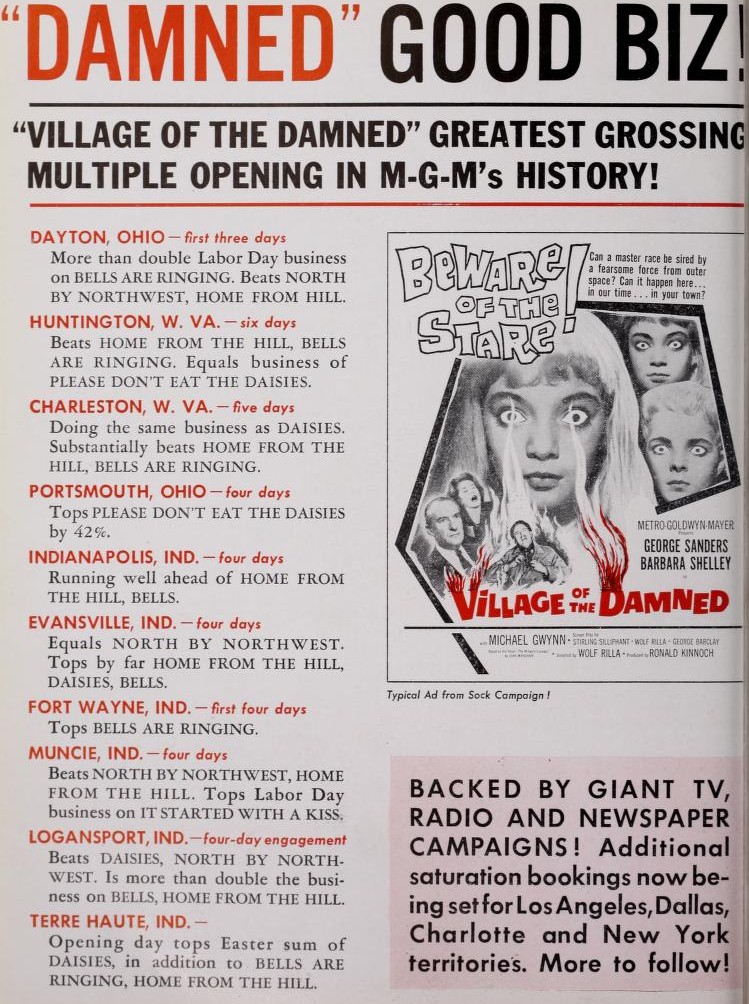
Very well paced by German director Wolf Rilla (The World Ten Times Over, 1963) who resists the temptation to overplay his hand, achieving much more by leaving it to your imagination. Stirling Silliphant (The Slender Thread, 1965), George Barclay (Devil Doll, 1964) and the director adapted the groundbreaking novel The Midwich Cuckoos by John Wyndham. Horror maestro John Carpenter remade this in 1995, which only wnent to show how more successful the restraint of the original was.
Absolutely mesmeric. Would be catnip for contemporary audiences with its shifting time frames, juggling perspectives, narrative sleight-of-hand, and heavily feminist-oriented outlook with its slating of misogyny. Ripe for a remake and with the adventurous directors around these days they should be vying for the opportunity. But I should warn you, steer clear of the version that showed on Amazon Prime which cut the four-part television series in half.
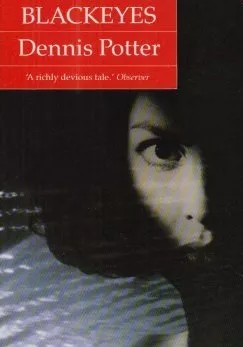
British screenwriter Dennis Potter was something of a national institution before this appeared, the BBC ponying up vast sums (in television terms) for his experimental programs that included the likes of Pennies from Heaven (1978) – remade as a movie three years later with Steve Martin – and The Singing Detective (1986) (remade seventeen years later with Robert Downey Jr) and his blend of pastiche and males struggling with raw emotion had made him not just a household name but accorded him worldwide acclaim.
However, just as Peeping Tom (1960) put the kibosh on the career of Michael Powell, Blackeyes proved a major critical reversal and after the mauling it received and outraged headlines in the national media Potter somewhat lost his mojo and automatic critical favor although Lipstick On Your Collar (1993) helped a certain Ewan McGregor to make his mark.
In part, Blackeyes is way ahead of its time in the use of the stylistic devices mentioned above which when incorporated into the works of, for example, David Lynch or Christopher Nolan, were hailed as groundbreaking.
So this is a three-hour-plus show setting precedents that not only break all the rules of narrative but blows them sky-high and has so many layers you can hardly keep up and that narrative spinning continues to the very end. You could almost entitle it “Whose Story Is It, Anyway?”
Elderly author Maurice (Michael Gough) has fashioned the experiences of his model niece Jessica (Carol Royle) into a bestselling literary novel. Leading character Blackeyes (Gina Bellman) is taken advantage of so often by men that she commits suicide, wading out dressed in sexy night attire into a lake. Although Maurice makes a fine specimen suited-and-booted and talking to admiring audiences at book fairs, in reality he’s a sodden old drunk living in a threadbare apartment with a teddy bear. But he’s intellectually adroit as shown with his verbal duels with a smug journalist who spouts artistic jargon.
Jessica is so annoyed that she has not been acknowledged as the source of her uncle’s novel – he claims it is a work of imagination – that she begins to write her own fictional version of her life story, calling into question some of the events in her uncle’s account. So that’s two perspectives already. Stand by for a third, that turns the entire story on its head.
It appears Blackeyes (Gina Bellman) has not committed suicide. Detective Blake (John Shrapnel) is convinced she has been murdered, especially after he finds a list of names stuck in her vagina (yes, despite Blake gamely searching for every euphemism under the sun, the actual word, to add to the shock and horror of an audience and especially critics reeling from the sex and nudity, was used on the BBC) and later finds her diary which provides another version of events.
He’s an old-school detective, and while not beating anyone up, not above handing out a good thump in the ribs to anyone giving him lip. So while following Maurice and his niece, we are also finding out more about Blackeyes via the cop’s investigations and how she was taken advantage of in the advertising profession and world of photographic modeling. She is even the one who gets the blame when someone tries to rape her.
Her life could be viewed in two ways, as a sexually independent woman or as a victim of MeToo.
To counteract what is presented as a sordid existence there comes into her life a gentler soul, advertising copywriter Jeff (Nigel Planer) and he’s writing and rewriting versions of a more old-fashioned romance where they enjoy a meet-cute (of sorts) and get talking and move onto romantic walks along the seaside. But Jeff’s too diffident a fellow to appeal to Blackeyes and he doesn’t even get to first base. But it also turns out that he’s been watching Jessica through binoculars (they live across the street from each other) and there’s a marvelous moment when he realizes that Blackeyes occupies the same apartment as Jessica and that he could at that very moment be watching himself.
All the way through there’s been a male voice-over, measured, commenting on the action, advising on twists in the story, adding a different perspective to characters, offering many polished bon mots, and it takes you quite a while to realize that this is an entirely new voice, and doesn’t belong to either Maurice or Jeff. In the ordinary run of things, this character would turn out to be the Hercule Poirot of the piece, putting the jigsaw together, explaining all.
In fact, he’s another element of the jigsaw. He’s not just the narrator. Everyone we’ve seen are characters in his fiction. But they don’t always obey the rules and at the very end Blackeyes escapes.
So just a stunning piece of television. Although Michael Gough (Batman Returns, 1992) received the bulk of what little plaudits there were, the series is carried by New Zealand actress Gina Bellman (Leverage, 2008-2012, and Leverage: Redemption, 2021-2023) who is simply superb. She rises above what could easily have been a cliché – and in some respects was written as a cliché version of the “dumb blonde” at male beck and call. Her comic timing for a start turns many scenes on their heads. But what’s often been overlooked is her transitional skill. She moves from male fantasy figure to believable human being and from there to rebel. And that takes some doing.
Gina Bellman hates talking about this series, my guess on account of the nudity and the backlash that created for a young actress, but she should be proud of her achievement. This is more than solid stuff.
Writer Dennis Potter also directed and his camera is always prowling around the edges.
The word auteur was over-used but this genuinely fits that category.
One description of this film’s prequel The Nightcomers (1972) was that, even with the overt sex and violence, it was an arthouse picture masquerading as a horror movie. And obviously absent the sex and violence that’s how I feel about this one. I’m of the old-fashioned school when it comes to horror – once in a while I expect to jump. The biggest problem here is that fear is telegraphed in the face of governess Miss Giddens (Deborah Kerr). Instead of the audience being allowed to register terror, all the tension is sapped away by one look of her terrified face.
Atmospheric? Yes! Scary? No.
Certainly, the set-up is likely to spark the darkest imaginations. Orphans Miles (Martin Stephens) and Flora (Pamela Franklin) are abandoned by their uncle (Michael Redgrave) who wants to spent his time enjoying himself in faraway London without having to bother about the care of the minors. The governesses he installs are given carte blanche to deal with any situation that arises – as long as they don’t concern him with it. And he’s so disinterested in the children’s welfare that he hires a completely inexperienced governess in Miss Giddens despite the fact that the previous occupant of the post, Miss Jessel, had died in mysterious circumstances and a little digging would have revealed that she lived a hellish life under the thumb of valet Quint.
The kids appear somewhat telepathetic or telekinetic – Flora knows Miles is coming home before Miss Giddens does, Miles knows when the governess is standing outside his door. They’re maybe a too bit self-indulgent – Flora enjoys watching a spider munch on a butterfly and isn’t above finding out if her pet tortoise can swim, while Miles has Miss Giddens in a neck stranglehold.
But it’s unlikely the children are summoning ghosts – Quint appears to Miss Giddens at the top of a tower and again peering in through a window, Miss Jessel turns up, too, and I lost count of the number of disembodied voices. The ghosts it turns out have taken possession of the children in order to continue their relationship.
And while this is all very clever it does not chill you to the bone. The children are not as cute as they need to be to make this work. You get the impression, given half the chance, they would happily turn into little savages and experiment with all manner of cruelty. And that would occur whether there was the likes of Quint around to lead them astray because the adults in their lives are so selfish and set the wrong kinds of standards. But with the focus perennially on the trembling Miss Giddens, there’s little chance of getting inside the heads of the children.
Since jump scares are not in director Jack Clayton’s cinematic vocabulary, the best scenes are not visual, but verbal, housekeeper Mrs Grose (Meg Jenkins) filling the governess in on the unequal relationship between Quint and Miss Jessel, Flora imagining rooms getting bigger in the darkness (effectively more dark), Miles seeing a hand at the bottom of the lake.
There’s certainly an elegiac tone and the camera clearly sets out to destabilise the audience but that’s just so obvious it seems more an arthouse ploy than a horror schematic.
This was start of Deborah Kerr (Prudence and the Pill,1968) playing psychologically distorted characters. Over the previous decade she had revelled in a screen persona that saw her playing the female lead (sometimes the top-billed star) opposite the biggest male marquee names of the era – Burt Lancaster (twice), Cary Grant (twice), Yul Brynner (twice), Gregory Peck, William Holden, Robert Mitchum (three times), David Niven (twice), Gary Cooper. Now she turned fragile and that screen persona, introduced here, would see her through the next decade.
So she’s both very good and very bad here. Her character facially registers her inner thoughts but those too often get in the way of the audience. I found the kids more limited in their roles, not through acting inexperience, but through narrative restriction.
Jack Clayton (Dark of the Sun, 1968) directs from a screenplay by Truman Capote (In Cold Blood, 1967) and William Archibald (I Confess, 1953) from the celebrated Henry James story.
A bit too artificial for my taste. Probably heresy to admit it but I preferred the prequel.
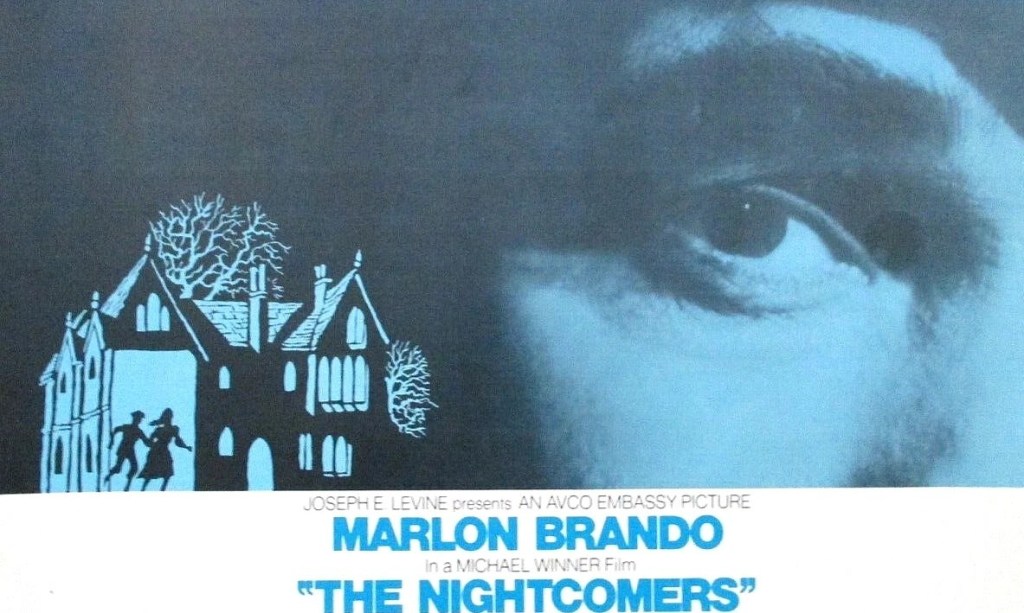
Marlon Brando’s box office cachet had crashed. He hadn’t made a picture in two years following the flop of Queimada/Burn (1969) which had followed his debilitating box office trend of most of the decade. While his stock remained high enough to headline such big budget numbers as The Chase (1966) and Reflections in a Golden Eye (1967), thereafter confidence in his marquee value tumbled. Apart from Queimada, he had only been signed up for Night of the Following Day (1968), another loser.
But that last picture had brought him into the orbit of independent producer Elliott Kastner (Where Eagles Dare, 1968) who had been a friend of director Hubert Cornfield (Pressure Point, 1962) when they had both worked as agents at MCA. “Although he was crazy,” recalled Kastner, “I loved his writing and his drive.” Kastner was a fan of Cornfield’s earlier movies especially as they had been delivered on short time schedules. “I wanted to do something with Marlon Brando and he wrote Night of the Following Day.”
Brando still had clout in Hollywood. His three-picture deal with Universal obliged the studio to pony up for any (financially viable) projects he put to them. Kastner was delighted to hop over from his base in London to the French location and although the movie continued the actor’s poor reception at the box office, the producer enjoyed the experience.
Brando wasn’t averse to the “resting” that most actors endure, stints of unemployment between gigs. So when the actor approached Kastner to work with him again, it took the producer by surprise. “Marlon wanted to do a film,” said Kastner, “which was unusual for Marlon because he hides from work. He wanted to do a film in Europe and he loved staying at my house in the country. I talked to (Brando’s agent) Jay Kanter (who later became Kastner’s business partner) about it and we gave him a screenplay called The Nightcomers…that Michael Winner wanted to direct.”
Kastner had liked Winner’s output and was equally attracted to the fact that he also worked fast. Winner was contemptuous of directors who shot too much footage, especially “coverage”, filming a scene from too many different angles. But he was also a very fast editor. He took an editing caravan with him on location, and after the day’s filming ended at 6pm he spent the next two hours watching rushes and another two hours after that editing. His editor Freddie Wilson said,” His speed of decision in the cutting room saves a great deal of time and money.”
Winner had been sitting on the screenplay by Michael Hastings for some time. “No one was rushing to finance it,” remembered Winner, until Brando showed an interest. Winner arranged to meet the actor at his “modest Japanese-style house” in Los Angeles. However, insurance proved a sticking point following payouts for Quiemada.
“On a personal level,” recollected Kastner, “I thought he (Winner) was a bully with waiters. He was really nasty to people beneath him. I didn’t have much (personal) respect for him but he was very amusing.”
Due to scheduling conflict Vanessa Redgrave (Blow-Up, 1966) turned down the role of Miss Jessel. Winner also offered the part to Britt Ekland (The Double Man, 1967) provided she could bring some financing to the project. In the end, remembered Kastner, “Michael wanted to cast this girl with this big bust who was a halfway decent actor.” Neither Redgrave nor Ekland could compare in the bust measurement department to Stephanie Beacham, so clearly chest size was not a priority.
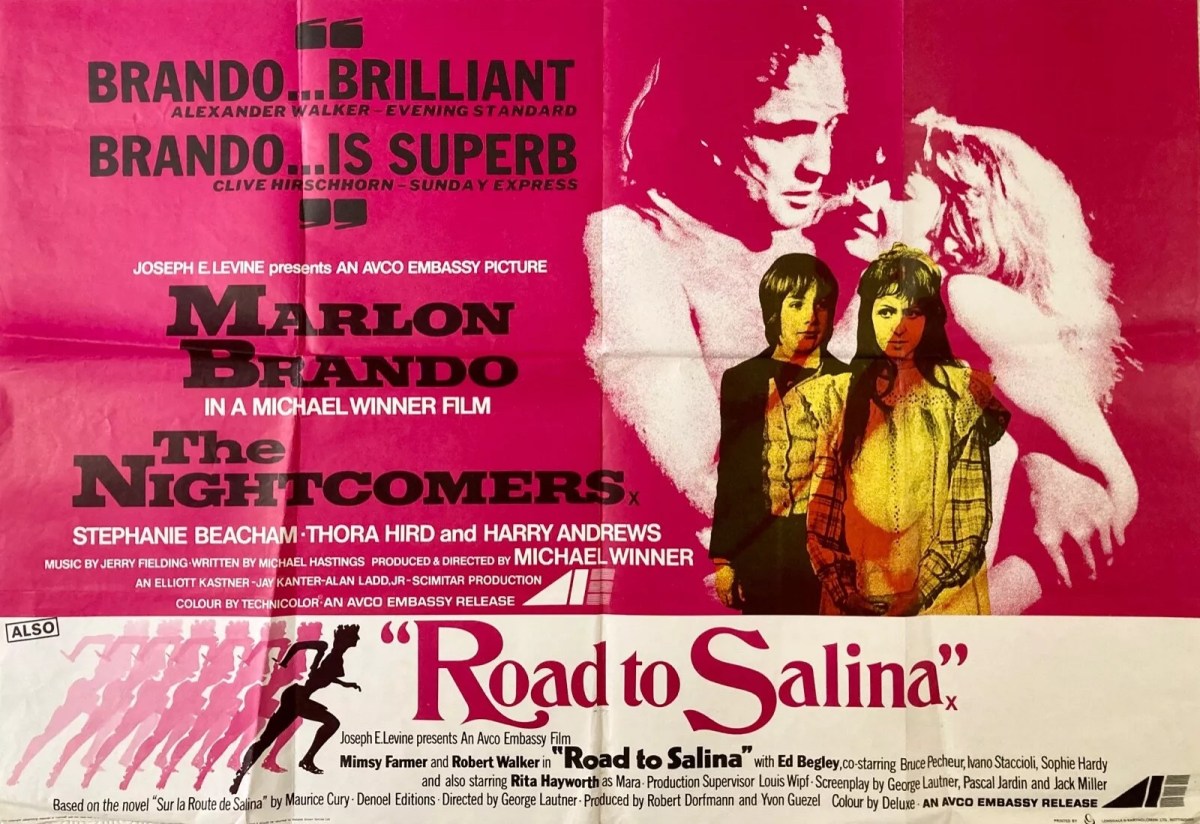
Kastner reckoned Brando “would bring plenty of poetry” to the project. It was remarkably cheap even for a star of Brando’s fading attraction. The budget was $686,000, of which Kastner received $50,000 as a producer’s fee plus 30% of the profits. Winner deferred his fee, only paid if the movie made money. At that point, Kastner was leading the way in finding funding outside the studio system. Funding for When Eight Bells Toll (1970), for example, was entirely sourced from an American businessman. For The Nightcomers, Kastner located investment of $100,000 from a company called Film & General Investments. Universal was involved through its contract with Brando – paying him his $300,000 salary for this picture to count as the final one on his contract, but declined to distribute the picture. For another producer, this might have been enough to kill off the project, but not for Kastner, who, following his current practice, intending to sell the completed film to a distributor.
As far as Kastner was concerned the movie went into immediate profit. Joe Levine of mini major Avco Embassy, still riding high after the success of The Graduate (1967) and The Lion in Winter (1968), ponied up $1 million for the worldwide rights plus a share of the profits. But Avco also limited its exposure, selling a 40% share to businessman Sigmond Summer for $1 million. (Judging from later legal documents, Universal retained some financial interest in the picture).
Brando had decided Quint was Irish. To learn the dialect, Brando and Winner got together with a group of Irishmen in the back room of a pub, one whom became the actor’s dialog coach on location.
The six-week shoot, on locations in Cambridgeshire, Britain, with Sawston Hall doubling as the mansion, began in January 1971. There was another reason for the speed of the shoot. Winner had contracted with United Artists to make Chato’s Land (1972) and there was no time to spare between the movies. Over 100 actresses auditioned for the role of the female orphan. Winner, seeking “someone over 18 who looked 11,” selected Verna Harvey (she also won a role in Chato’s Land).
Although Winner had gone to some expense to set up a private dining room for the star at Sawston Hall, Brando preferred to eat with the crew. According to Winner, despite Brando’s fearsome reputation, he knew all his lines, immensely patient with his young inexperienced co-stars, concerned about the crew, and, as importantly, arrived on time and even watched rushes, a rarity among the profession. Brando used earplugs to prevent distraction from extraneous noise. During the shoot Francis Ford Coppola flew over to spend time discussing the script of The Godfather with Brando.
Brando initially refused to have stills taken of him during the sex scene and only gave in after considerable persuasion, though he kept his wellington boots on. He wanted to leave the drunk soliloquy to the end of shooting. Though he was actually drunk after consuming a lot of Scotch, “he remembered his lines immaculately…(and) also matched his hand movements and body movements, which is very important in movies,” explained Winner, “because if you have to cut different bits of film together if the body or hands or arms are in a different position you’re in trouble.”
Jerry Fielding didn’t record his score until July during a three-day session with an orchestra of 80 at Cine Tele Sounds Studio. Despite his editing prowess, Winner realized his final version didn’t work. “The first cut was too fast. For a moody period film I’d just messed up. I put back seven minutes (of footage) and spent another three weeks getting it right.”
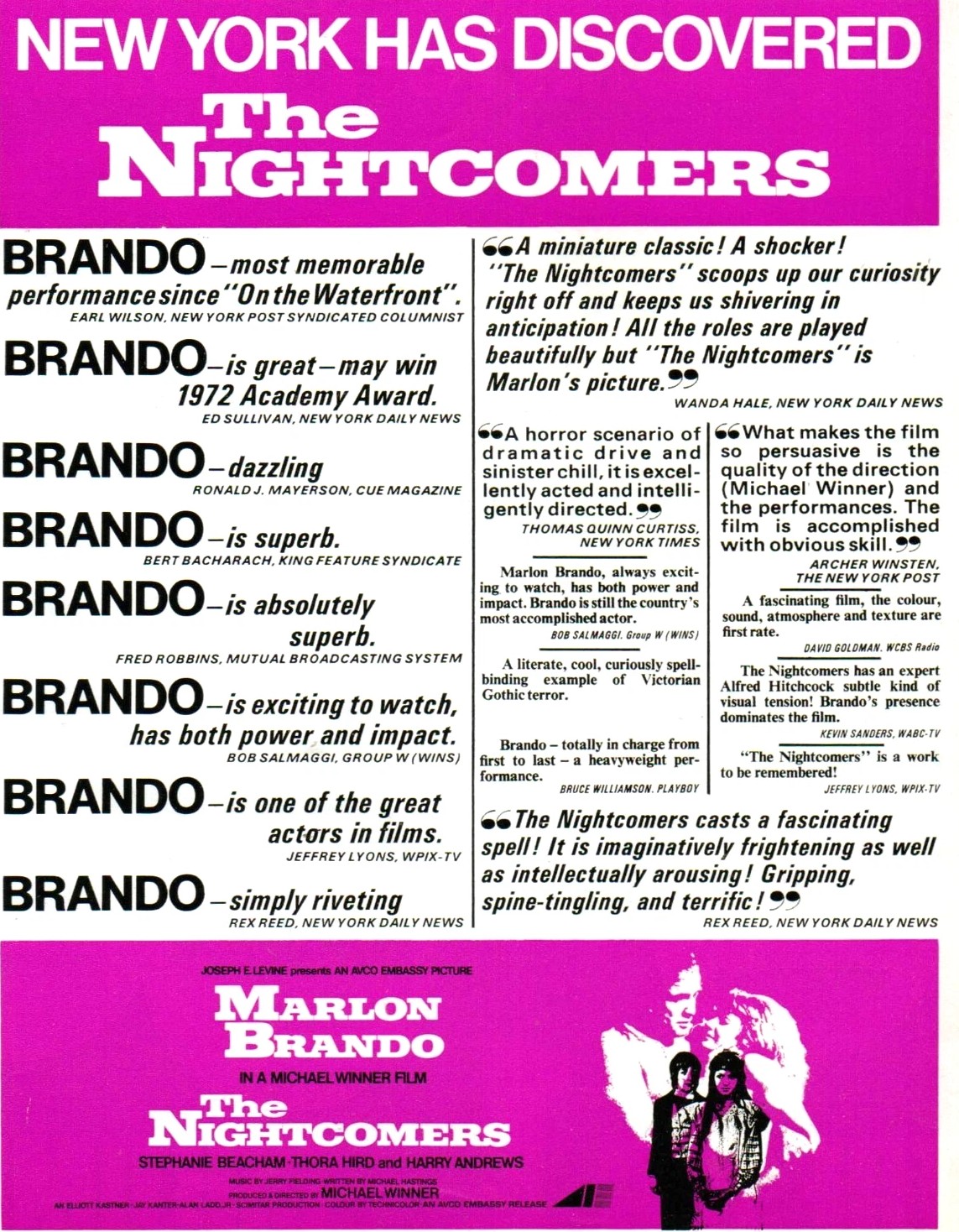
Thanks to its world premiere at the Venice Film Festival alongside the likes of Sunday, Bloody, Sunday (1971), it was touted, perhaps unwisely, as an arthouse picture, rather than majoring on the sex and violence. While Variety tabbed it a “grippingly atmospheric thriller,” only two out of the five most influential New York critics gave it the thumbs-up.
A distribution deal was not struck till the end of 1971. Rather than potentially riding along in the slipstream of The Godfather (1972), which was already attracting huge hype, Avco decided that it was better to come out before the Mafia picture than risk being swamped in its wake. But there was confidence in the project. “Joe Levine thought the film was so brilliant we didn’t have to wait for The Godfather,” related Winner.
It launched first in America, opening in February 1972 – beating The Godfather to the punch by a month – at the 430-seat Baronet arthouse in New York. The opening week of $20,700 was rated “nice” and held well for the second week before plummeting to $11,000 in the third week. It was yanked after six weeks.
By the time it spread out into the rest of the country, The Godfather rollercoaster was well into it stride, but the early release had not particularly gathered any pace and in the aftermath of the Coppola movie it was certainly buried. It opened to $6,500 in Boston compared to The Godfather’s second week of $140,000. There was a “scant” $39,000 from 13 houses in Los Angeles, a “modest” $4,000 in Louisville though $5,000 in San Francisco was rated “brisk” and the same amount in Washington “snappy.
Initially, at least, Britain appeared more propitious. It opened in key West End venue the 1,400-seat Leicester Square Theatre to a “loud” $24,700 and though it dropped $10,100 in the second week, the third and fourth weeks improved on the second. Eight weeks into its West End run, when it was still pulling down $13,300, The Godfather put it to the sword with a record-breaking $191,000 from five West End houses. After that pummelling, The Nightcomers managed only three further weeks.
In fact, the movie did surprisingly well, especially overseas. Total rentals came to $1.69 million, a clear million-dollar profit on the negative cost. While less than half a million came from the U.S., and only $160,000 from Britain, the overseas market kicked in the bulk of revenue – $986,000 – possibly because it was released after The Godfather (1972) rather than, as in the UK and the US, before. In the run-up to and in the wake of The Missouri Breaks (1976), it was included in Brando perspectives at the Museum of Fine Arts, where it was presented as a “novel film…lost in the shadow of The Godfather,” and Carnegie Hall. But an attempt at commercial reissue proved disastrous – a “weak” $1200 in Pittsburgh.
Except from a financial perspective, Kastner wasn’t especially impressed, calling it “grim, boring, contemptuous of story, oblique.” Viewers, including me, beg to disagree.
SOURCES: Elliott Kastner’s Unpublished Memoirs, courtesy of Dillon Kastner; Elliott Kastner Archive, courtesy of Dillon Kastner; Michael Winner, Winner Takes All, (Robson Books, 2004); “Production Review,” Kine Weekly, January 23, 1971, p10; “Not So Young,” Kine Weekly, May 22, 1971, p16;“Jerry Fielding,” Kine Weekly, July 17, 1971, p10; “Michael Winner,” Kine Weekly, August 13, 1971, p10; “Nightcomers to Avemb,” Variety, January, 19,1972, p5; “New York Critics,” Variety, February 23, 1972, p35; “Picture Grosses”, Variety, 1972: February 23-April 26, June 7-14; July 19- Sep 27; “Broadway,” Box Office, February 9, 1976, pE2; “Museum of Fine Arts,” Box Office, October 18.
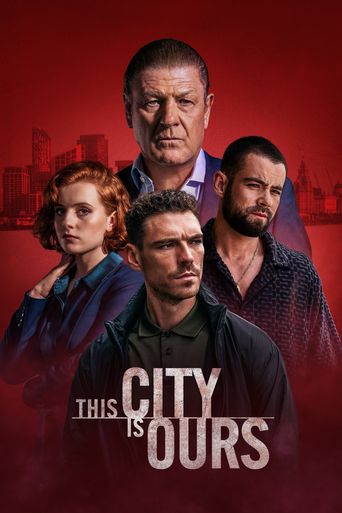
Knockout! Just stunning! I’m running out of superlatives for this one, the best crime series since The Wire (2002-2008). For sure, it takes a lead from The Godfather (1972) in that the core concerns family. But in a far more emotional manner than the Coppola epic where apart from a couple of scenes between Michael (Al Pacino) and his father (Marlon Brando) actual male expression of feelings is kept to an absolute minimum as though that might contaminate the pot.
Here, women, both in their relationships with husbands/fiancés, and their own naked ambition are very much to the fore. The new generation of males are vulnerable because of their desire for family, utterly exposed by love for babies and unborn babies, as opposed to old school boss Ronnie Phelan (Sean Bean) who spent little time with his son. And the fear of those on the fringes of being excluded from the “family” or those on the inside being cast out gives the narrative an iron soul.
The nail-biting climax is driven by three incidents involving the most vulnerable and therefore the most loved members of the clan. There’s betrayal, revenge and double-crossing but none of the infidelity or drug/alcohol abuse that was often a hallmark of the genre.
The tale pivots on three events. The first is of the brooding variety. Ronnie has allowed Michael Kavanagh (James Nelson-Joyce), almost an adopted son, to take the lead in crucial negotiations with Spanish drugs kingpin Ricardo (Daniel Cerqueira) much to the annoyance of his son Jamie (Jack McMullen). The second is that, in consequence, Jamie decides to hijack the next shipment. When Ronnie discovers his son is behind the plot, he decides not to follow up, and Michael realizes that blood is indeed thicker than water and that he will be squeezed out of his position in the organization. So he kills Ronnie and assumes command.
Except Jamie doesn’t take too kindly to this notion and, although generally not too bright and certainly way too impulsive for his own good (the Sonny, to keep The Godfather parallel going, of this particular gang), works out that only Michael had the motive to commit the murder which of course Michael strenuously denies. Both convince themselves the only way to take control is to rub the other out.
And then we’d be in standard gangster territory except for the other, emotionally-driven, plotlines. Jamie has a son he absolutely adores. Michael, with an unexpectedly low sperm count for a hardman, is hoping for an IVF baby with his girlfriend Hannah (Diana Onslow), a respectable businesswoman but hiding a very dark secret. Michael’s sidekick Banksy (Mike Noble) is grooming his son in the business. Ronnie’s wife Elaine (Julie Graham) treats Michael like a son and is inclined to take his side against Jamie. Rachel (Laura Aikman), wife of Jamie’s sidekick Bobby (Kevin Harvey), has ambitions way above her station of lowly book-keeper. She finds a way of finessing the fact that she physically controls the organization’s cash – and that it’s Ronnie’s wife whose name is on anything the gang owns – to exploit the divisions in the family as a means of of becoming the de facto “Godmother.”
Meanwhile, Ricardo, for good reason, distrusts Jamie and will only do deals with Michael, for whom he acts as mentor (so, if you like, Michael has two dads) although Jamie plans to sidestep the Spanish connection and go elsewhere for drugs which would have the dual effect of leaving Michael isolated and, with Rachel controlling the purse strings, potentially millions of pounds in debt. And hovering in the wings is a crafty cop, causing problems in every sneaky way possible, and a liability Cheryl (Saoirse Monica-Jackson), stuck with keeping to the code of omerta even though she guesses Ronnie wiped out her husband.
So it’s a game of shifting loyalties, grasping after power, with uber gangsters laid emotionally low by commitments to babies and pregnant wives. There’s none of the posturing of The Godfather, no making excuses for career choice or murderous thugs who draw the line at dealing drugs or women purportedly unaware of what their husbands do for a living.
Directed with occasional elan and pace and a great nose for the cliffhanger. Terrific writing by Stephen Butchard (The Last Kingdom, 2015-2018), both in dialog and twists on character interaction, and with a marvellous sense of narrative. You never know which way it’s going to go.
But most of all bursting with outstanding talent. You won’t see a deader eye this side of Clint Eastwood than James Nelson-Joyce (A Thousand Blows, 2024-2025) in his first leading role, who’s as comfortable exploring his own emotions as planning destruction. Mother hen Julie Graham (Ridley, 2022-2024) could easily turn into Ma Barker. Hannah Onslow (Belgravia: The Next Chapter, 2024) is tormented by her secret. Laura Aikman (Archie, 2023) manipulates and schemes. Virtually the entire cast are seasoned television actors, yet they’ll never have been lucky enough to encounter such character depth before.
Get on to your local streamer/television station and harangue them to buy this from the BBC.
One of those bonkers pictures whose nuttiness is initially irritating but ends up being thoroughly enjoyable once you give in to the barmy plot and overheated melodrama. Murder, suicide, madness, illicit sex, blackmail – and that’s just the start of this farrago of nonsense. And set in Liverpool before The Beatles made it famous.
Christine (Susan Hayward), a doctor, is jailed when she kills her married seriously ill lover in a mercy killing. She’s not convicted of the murder but of the lesser crime of medical malpractice, but after serving an 18-month sentence finds she is unemployable, even in more lowly professions where her prison stretch counts against her.
When she is hired by the attorney Stephen (Peter Finch) who prosecuted her to look after his mentally ill wife Liane (Diane Cilento), the audience will already smell a rat given that Christine has changed her name and therefore the lawyer must have made considerable effort to track her down. His argument is that since she is no longer a qualified practitioner, she cannot advocate to have his wife committed to a mental institute, as a proper doctor would be required to, since Liane is clearly a danger to herself and other people. Your immediate suspicion is that Christine has been hired to take the rap once Liane is bumped off.
And it doesn’t take long for Christine to work out that not everything adds up. Liane is given enough rope to hang herself, access to a car to cause an accident, access to a horse which could easily bolt or fall.
Liane has been told her Irish father died in an accident where she was driving, the incident that triggered her madness. But when we discover the father, Captain Ferris (Cyril Cusack), is very much alive that’s the cue for a slew of unlikely events. When Liane finds her father, he’s not in the least a candidate for canonization, but an alcoholic. That triggers further mental trauma. And another accident, self-inflicted. After Christine administers pills, the young woman is found dead.
Bit of a stretch to compare it to the movies mentioned in this poster.
Naturally, an inquest brings up Christine’s past and suspicion falls on her. And that would be par for the course, and it would be up to the condemned woman to find a way to prove her innocence. But that takes us into even murkier depths.
There’s bad blood between Capt Ferris and Stephen and the inference that this was only resolved by the father offering his underage daughter to the lawyer to be followed by the unscrupulous father blackmailing Stephen. Then it turns out there’s no case to answer and that Christine is innocent because, blow me down, Liane committed suicide.
But what should have been a straightforward, if unlikely, murder plot comes unstuck because it can’t make up its mind what it wants to be. Too many ingredients are thrown into the pot and the result is a mess.
Even the queen of melodrama Susan Hayward (Stolen Hours, 1963) can’t rescue this. And the pairing with Peter Finch (Accident, 1966) doesn’t produce the necessary sparks. Despite a variable Irish accent, Diane Cilento (Hombre, 1967) comes off best as the wayward deluded young woman.
Robert Stevens (In the Cool of the Day, 1963) directs from a screenplay by Oscar-nominated Karl Tunberg (The 7th Dawn, 1964) adapting the bestseller by Audrey Erskine-Lindop.
Had every opportunity to be a star attraction in the So Bad It’s Good sub-genre but fails miserably. Still, if you enter into the swing of things, remarkably tolerable.
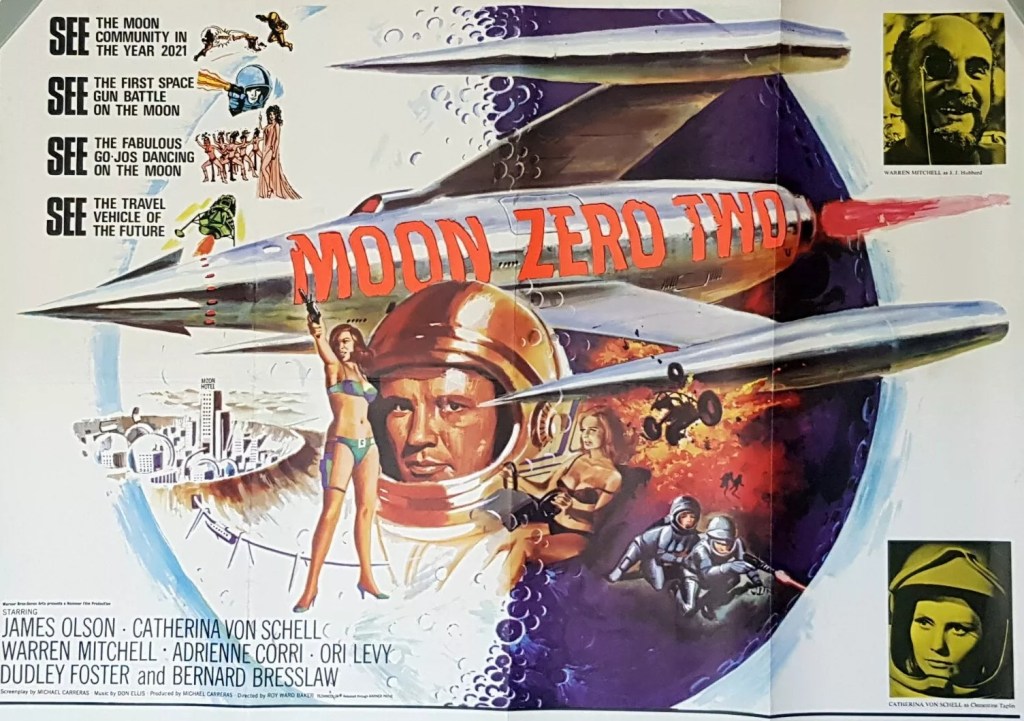
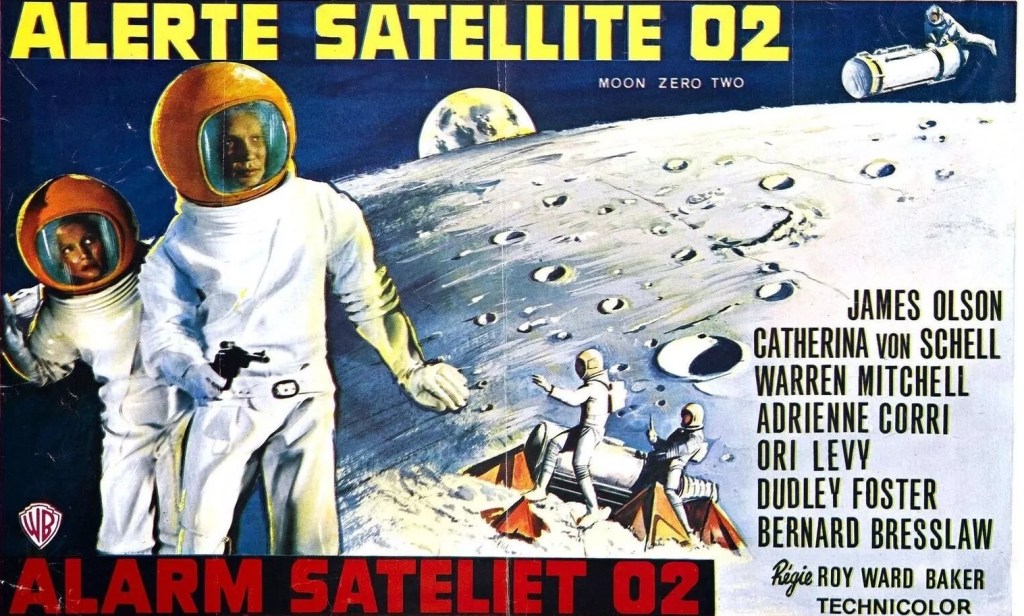
Not much that’s redeemable from this British sci fi effort. Maybe the idea of the “dirty universe” clogged up by waste with salvage hunters retrieving bits of old satellites and space objects. Or maybe an early version of “unobtainium,” the rare mineral that’s going to make someone very rich, in this a solid block of sapphire and some mined nickel. Or maybe the colonizing of the Moon for gain rather than the advance of science.
But that’s about it. Takes about 30 minutes for a story to emerge, the rest of the time taken up with info dumps and character background, so we know that ace pilot Bill (James Olson) was the first man on Mars and wants to repeat the same feat for Mercury, Jupiter and other distant planets and would rather become a salvager than lower himself to become a passenger pilot. His girlfriend Liz (Adrienne Corri) is an officious official and threatens him with being grounded on safety grounds.
But that kind of bureaucracy is par for the course in British sci fi which liked to clutter up the narrative with accountants (The Terronauts, 1967, et al) and various levels of officialdom. And there’s another British trope. Take a well-known comedian and turn him into an unlikely tough guy of sorts – Eric Sykes as an assassin in The Liquidator (1965) would be in pole position but Carry On regular Bernard Bresslaw runs him close here as a gun-toting bodyguard.
Or maybe the Brits just like a hybrid. Stick some comedy into sci fi. Certainly the animated credits suggest this is going to major on comedy, which turns out not to be the case unless you were laughing at how inept the whole project is.
Especially when director Roy Ward Baker simply resorts to slo-mo to suggest loss of gravity in space. And when the space outfits look as if they were run up by someone’s ancient auntie. Just to show the bad guy is a bad guy, entrepreneur J.J. Hubbard (Warren Mitchell) wears a monocle. He hires Mike to go find the sapphire asteroid and bring it back to the Moon, where it can be dumped on the “far side”, well away from any nosey parkers, to make it look as if it had landed there on its own, thus bypassing Space Law.
But Mike’s already made the acquaintance of Clem Taplin (Catherine Schell) who’s hiked up from earth to search for missing geologist brother and once Mike’s located the sapphire he heads out into the far side of the Moon to find the brother. They find him all right but by this point he’s just a skeleton though he has uncovered nickel deposits. He’s been killed by Hubbard and the couple are ambushed and have to shoot their way out (the efficacy of bullets in space in never explained) in a manner that suggests, as the posters liked to proclaim, a “space western.”
Mike gets his revenge by stranding all the bad guys he hasn’t already killed on the sapphire in space.
It would have probably been okay if any of the actors had shown any screen spark. But they’re all lumpen, although perhaps you can blame the restraints of the space costumes, or maybe even just the script. Oddly enough James Olsen would make his mark in sci fi adventure The Andromeda Strain two years later, but that had both better direction (by Robert Wise) and a more intriguing script (from Michael Crichton).
You might as well have wrapped up Catherine Schell (On Her Majesty’s Secret Service, 1969) in cotton wool for all the impact she was able to make. Warren Mitchell (The Assassination Bureau, 1969) looks as if he’s desperately trying to stifle a grin.
Hammer boss Michael Carreras (The Lost Continent, 1968) wrote the screenplay, and produced, so he should at least share the blame with Roy Ward Baker (Quatermass and the Pit, 1967).
Originally dismissed as meretricious trash, contemporary re-evaluation reveals it as uncommonly prophetic. You can start with the feral children, abandoned by their guardian, lack of parenting allowing space for pernicious ideas to foment. Or with the pornography correlative, the young, posited as unruly voyeurs, conditioned by the internet into believing that violent sex is the norm. Or with the influencer seeding notions that demolish the accepted Establishment views. Or impressionable children creating a distorted world view based on their interpretation of adult behavior.
Audiences and critics back in the day were taken in by the most cunning Maguffin of all, that this was some kind of more realistic Downton Abbey/Upstairs, Downstairs power struggle played out among the servants against the background of a sadistic/masochistic affair. Lives can be ruined on a whim. A letter to the absent landlord can destroy a career. Remember from Downton Abbey the importance in the servant hierarchy of the role of the owner’s valet. To be summarily demoted from that lofty position to gardener, forced to tug your forelock in gratitude at not being cast out, and you can see where power lies.
Instead, consider this a slow-burn, deliberately understated drama where, against the style of the usual horror picture, the score (by Jerry Fielding) offers no clues, a virtually anonymous piece to lull you into thinking this is a pastoral setting where genuine evil, as opposed to acts of mean inconsideration, can flourish.
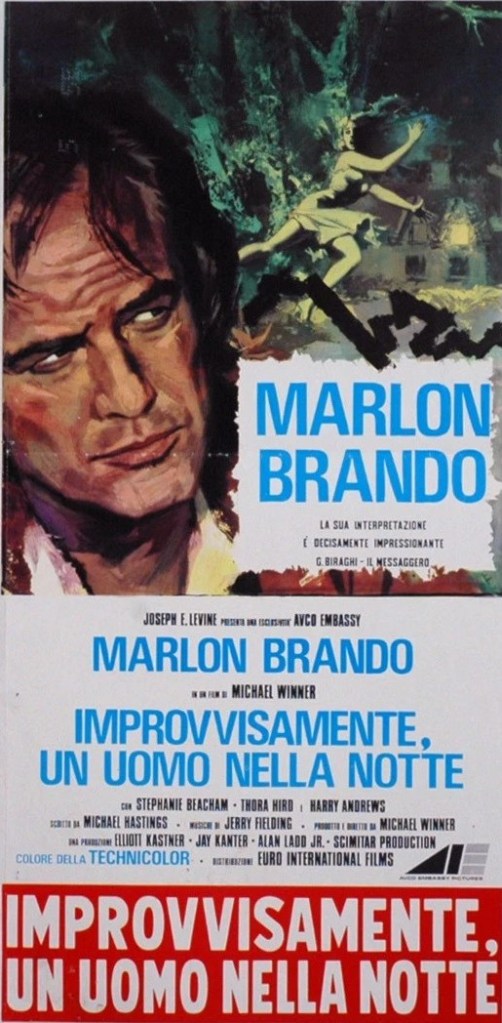
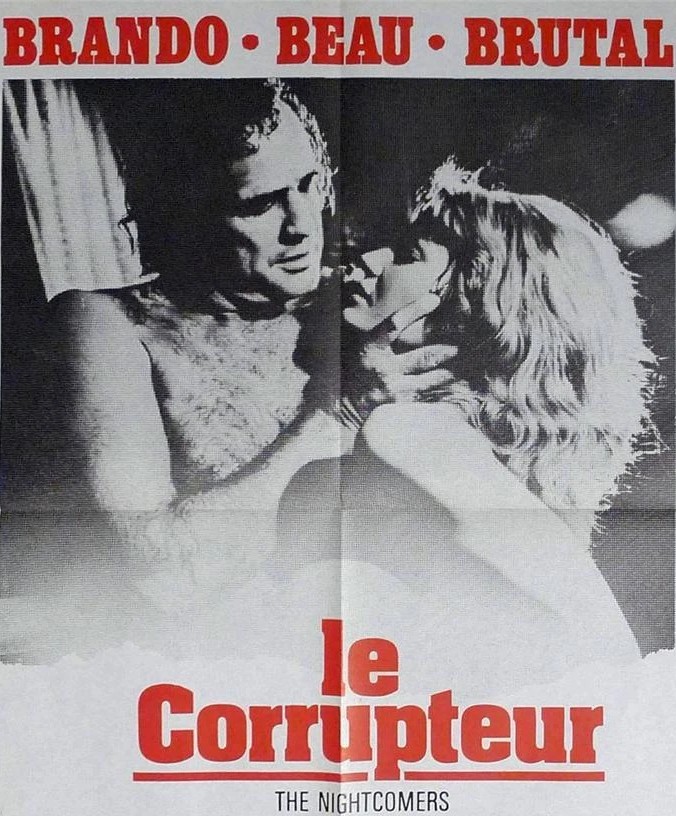
Watching it entirely from the perspective of the children, ignoring the appeal of the top-billed Marlon Brando engaging in licentious and disturbing sex with the governess Miss Jessel (Stephanie Beacham) he has groomed, and a completely different movie emerges. It reveals more than any other study of children unexpectedly grown violent how vulnerable young minds are to suggestion and that in the absence of adult intervention how easy it is for them to devise a fantasy whose fabric is drawn from their misinterpretation of the real world.
My guess is that back in the day the attempts by teenage Miles (Christopher Ellis) and younger sister Flora (Verna Harvey) to copy the bondage scenes and violent sex witnessed by the voyeuristic boy would have had the audience in stitches rather than reeling in shock. There would have been very little in the audience experience beyond teenage gangs to suggest that young children could be guilty of such depravity – this is long before the murder of Jamie Bulger in England or the mass shootings by teenagers in America. So laughter would be the natural response.
But times are different now. We know that children existing outwith genuine adult supervision are prone to suggestion and acting on impulse. Miles and Flora have been taught by gardener Quint (Marlon Brando) to ignore traditional views of Heaven and Hell, to imagine that torture of small creatures is acceptable, and that love is hate, and that only in death can true lovers be united. Miles has been taught to shoot with a bow-and-arrow by Quint and there’s more than a touch of irony in how quickly the young fellow masters this skill that leads to a grisly climax.
While the adults largely ignore the children, the children are not ignoring the adults. They are in thrall to what they see and hear and make up their own minds about how to put the world to rights. Had the children been adults driven by loneliness and abandonment to such acts, they would viewed simply as evil monsters. But here they are demonstrably not evil, just misguided, and by the very people who should be guiding them. Quint takes inherent joy in corrupting the young, it’s the simplest type of revenge he can enact against his master, filling the heads of the next generation of overseers with information that runs counter to the accepted.
The British censor left largely untouched the rape scenes in The Straw Dogs and A Clockwork Orange out the same year. He was much tougher on this, excising the bondage sequences, as if such prurience would diminish the impact. Certainly, that did the trick at the box office for audiences, denied shock content, ignored it.
If all this isn’t enough to trigger reconsideration of the picture, then the grooming of the governess (Stephanie Beacham), her submission to male control, will strike a contemporary chord. Despite the respectability of her position, she is revealed as eminently vulnerable, born out of wedlock, witnessing how tough life was at home without a protective male figure, not just prone to accepting Quint’s brutality but conditioned herself to wait in a more romantic setting for the gentler lover of her imagination who never arrives. While the housekeeper (Thora Hird) comes over as any powerless functionary exerting what little power she has.
Marlon Brando (The Chase, 1966) is especially good and the scene where he blackens his teeth to amuse the children might have been a dress rehearsal for the sequence in The Godfather where, unintentionally, he frightens the child. Except for Dracula A.D. 1972 (1972) in Italian crime tale Mafia Junction (1973), rising star Stephanie Beacham’s star failed to significantly rise, and she never again enjoyed such an important, and difficult, screen role, especially in those scenes where she attempts to exert control.
Written by Michael Hastings (The Adventurers, 1970).
It might be a contradiction in terms to suggest that much-maligned British director Michael Winner (Hannibal Brooks, 1969) ever came close to producing what you might term a masterpiece, but within his own portfolio this is surely the chief contender.
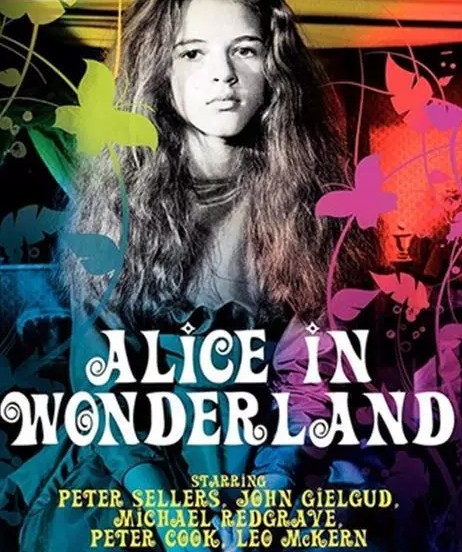
Young bucks wanting to make a bigger splash are apt to rampage through sacred texts and treat unwary audiences to avant-garde notions. Thus, Jonathan Miller (Take a Girl Like You, 1970), in his debut, set aside all expectations and in fairness purists had decried Walt Disney’s 1951 telling of the Lewis Carroll classic. In truth audiences weren’t so in love with the Disney version either, an unusually low hitter for the company, and one that only really found its niche when reissued to catch a whiff of the stoned hippies who had drooled over 2001: A Space Odyssey (1968).
This 1966 reimagining might have been buried in the vaults after its initial showing except that Jonathan Miller went on to become something of a British institution, renowned directed of opera and stage plays, writer and presenter of a number of highly-regarded television projects and a regular on the talk show circuit. That his career had begun in sensational fashion, one of the hands on the tiller of the satirical Beyond the Fringe stage show (a hit in the West End and Broadway) and television program, meant that when he decided to spread his wings into the movies, no expense was spared.
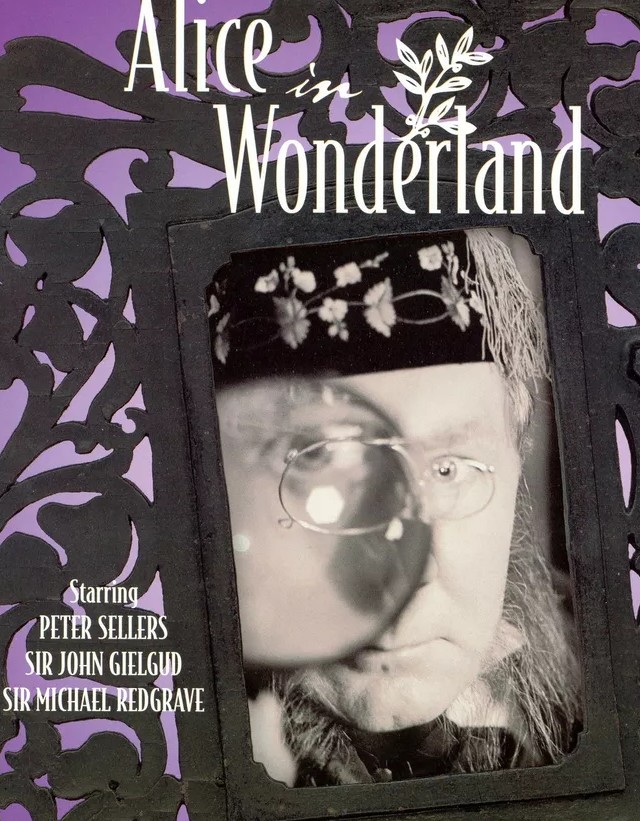
Big stars flocked. What other neophyte could attract stars of the caliber of Peter Sellers (The Pink Panther, 1964), John Gielgud (Khartoum, 1966), Michael Redgrave (Goodbye, Mr. Chips, 1969), Leo McKern (Bunny Lake Is Missing, 1965), Peter Cook (The Wrong Box, 1966) and playwright Alan Bennett (The Madness of King George, 1994)? All admittedly in small parts but that was the nature of the all-star enterprise.
And that would have been fine if they had all been employed to supply the voices. Or if audiences had the fun of trying to determine who was who when hidden under the ton of make-up required to turn them into White Rabbits or Mock Turtles or Caterpillars or Lobsters cutting a quadrille.
But Miller had determined that not only was the Disney version short of the mark but for too long readers had missed the entire point of the Lewis Carroll book. He decided the point of the story wasn’t humor at all, nor a succinct exploration of the pitfalls of language, but about a young girl adrift in a adult world of confusion. So that was bye-bye to the cuteness.
He even broke a cardinal role. Alice doesn’t fall down a rabbit hole. The whole thing is a dream.
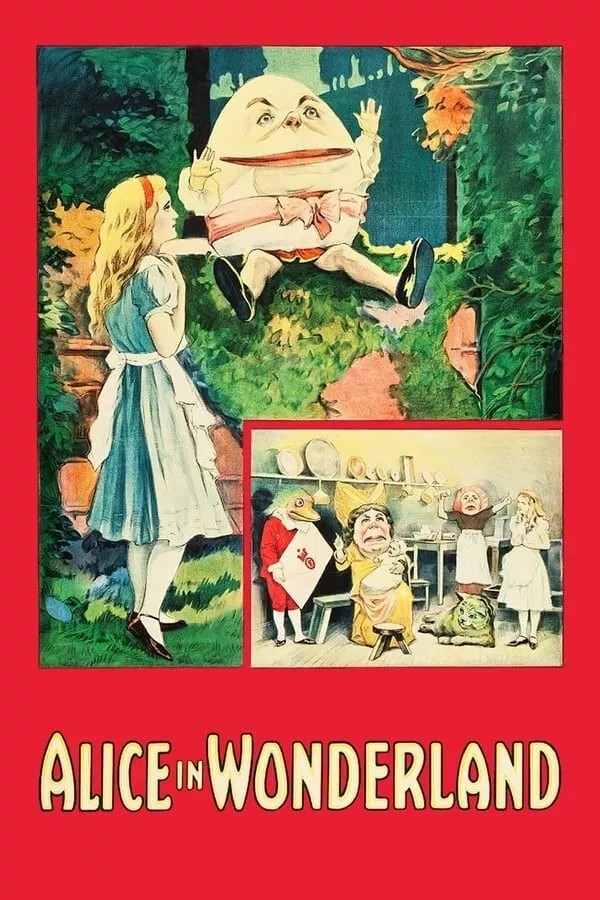
They’ve been adapting the book since the early days of cinema. This poster dates from 1915.
So you need to listen carefully to find out, with the lack of make-up, which actor is playing which fantasy character. And this isn’t set in any fantasy world either, certainly far removed from the famous illustrations that accompanied the book. It takes place in Victorian times which, yes, reflects the era in which the book was written, but, no, seems an extremely odd decision to give what is still fantasy some kind of realism.
It’s as if the director didn’t really have the courage of his convictions. That said, if he was catering to the arthouse mob, it’s got that kind of cinematic sensibility, with voice-over and unusual compositions.
Just to help you out, let me tell you that Peter Sellers plays the King of Hearts, John Gielgud the Mock Turtle, Michael Redgrave the Caterpillar, Alan Bennett the Mouse, Finlay Currie the Dodo, Leo McKern the Duchess and Peter Cook the Mad Hatter. The part of Alice went to 13-year-old Anne-Marie Mallik who never made another movie.
While it retains enough of the original to be recognizably based on the book – with all the catchphrases, “off with their heads” etc – the locale is just totally at odds with the story. And while it’s a tonic to hear the mellifluous tones of John Gielgud uttering the author’s immortal words, it would have been better just to hear his voice.
My guess is this is only still available because Miller made such a name for himself. You can catch it on Talking Pictures.







 The Magnificent 60s