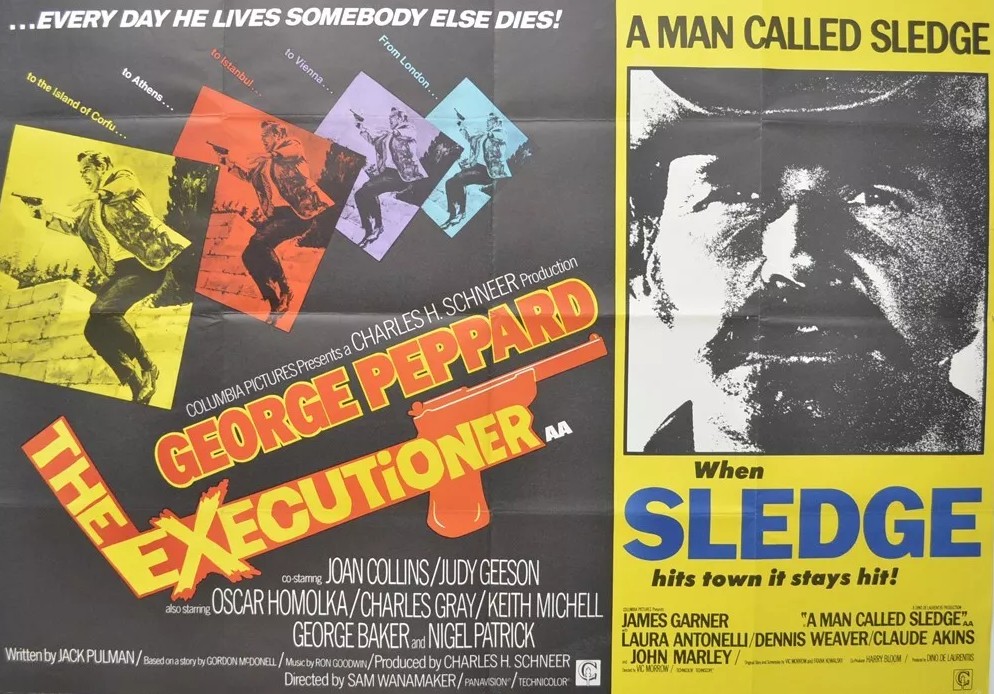
The Executioner (1970) ****

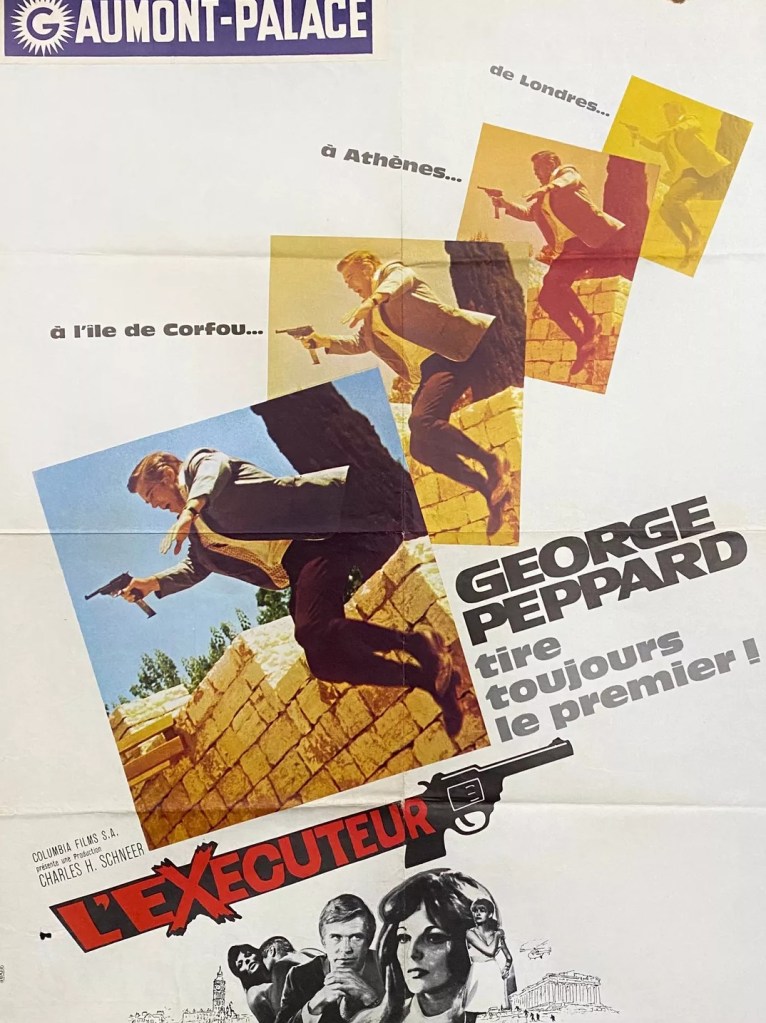
Minor gem. One of the espionage films of the era ignored by audiences because it lacked the verve of James Bond, no car chases or bedhopping hero to maintain interest when the narrative stretched credulity. Ignored by critics because it starred the vastly underrated George Peppard. Yet if you wanted an actor to show pain, to suffer from humiliations to his dignity, there was no one better, in part because on screen (and apparently in real life) arrogance was key to his persona. Here, you can add confusion to that mix of unwelcome emotions.

Beginning a scene with the aftermath of slaughter has become a modern thriller trope – see The Equalizer 3 (2023),  The Accountant 2 (2025) for the most recent examples –  but this is where the idea began and it’s how this picture opens, the only survivor of the massacre being the wife Sarah Booth (Joan Collins) whom our hero John Shay (George Peppard) covets. An immediate flashback shows them consummating their love. So you’re guessing there’s something of the James Bond in Shay, carrying on an illicit love affair.

But in fact that’s just one of the clever titbits of misdirection director Sam Wanamaker (The File of the Golden Goose, 1969) throws our way. And, gradually, we realize this is not so much about dirty dealings in the espionage business, the usual hunting down of a double agent, our hero clashing with disbelieving and frosty upper class bosses, but more about how the flaws in human nature turn characters inside out.

It’s no surprise that Shay is an outsider, not with that American accent standing out a mile in the British secret service run by the cut-glass accents of the likes of Col Scott (Nigel Patrick) and Vaughn Jones (Charles Gray). He’s not a member of the club, old boy. He bristles at not belonging – “belong to me!” wails girlfriend Polly (Judy Geeson). And he’s been passed over  by love of his life Sarah for another agent Adam Booth (Keith Michell) not because the latter has wealth and status but because Shay’s mind is too often elsewhere.

Though you are initially led to believe that Shay is having an affair with Sarah, that turns out to be far from true, although the glances he casts at her are enough to make Polly think they still are. And part of the reason his superiors distrust his assertion that Adam is a double agent is because they think he just wants rid of his rival so he can make another play for his former lover.   

Shay is so convinced that he is right that he gets Polly, who also works in the secret service but in the backroom department, to sneak out top secret files. When he stitches up enough information to make the case against Adam, it backfires and he’s suspended. But then, egged on by a discovery by top boffin Crawford (George Baker) working on some top secret stuff,  he decides to kill Adam and chuck the body out of a plane into the English Channel – hence becoming the executioner of the title.

Then the twist is truly in when Shay takes Adam’s place on a mission to Greece, which has also been planned as a second honeymoon for Adam and Sarah. This latter fact doesn’t dissuade Shay from making a romantic play for Sarah. However, there are nefarious dealings afoot espionage-wise but in what proves the first of many miscalculations Shay comes unstuck and is beaten up by the opposition and Sarah kidnapped. The ransom the Soviets demand is Crawford.

The massacre that we saw at the start solves that problem.

But it turns out Shay has let desire for Sarah muddle his brain for Adam was not a secret agent. Shay has been further duped into that belief by Crawford who also has romantic designs on Sarah, though it has to be said in her defense that Sarah has encouraged neither of these potential suitors.

There is one final twist but that’s just another nail in the coffin.

So what sets out to be a different kind of spy thriller turns into the polar opposite of what audiences might have expected, playing more on the human frailty of the hero than hitherto in the genre.

George Peppard is excellent, especially when expressing emotional pain and confusion, continuing a superb run of acting roles – ignored by the critics of course but tossing his screen persona away – that ran from Rough Night in Jericho (1967) and P.J. (1967) to Pendulum (1969). Judy Geeson (Brannigan, 1975) has the better female role as the disgruntled but faithful girlfriend. Aside from the occasional acidic remark, Joan Collins (Subterfuge, 1968)  is strictly there for the glamor.  Written by Jack Pulman (Best of Enemies, 1961) from a story by Gordon McDonnell (Shadow of a Doubt, 1943).  

Well worth a look.

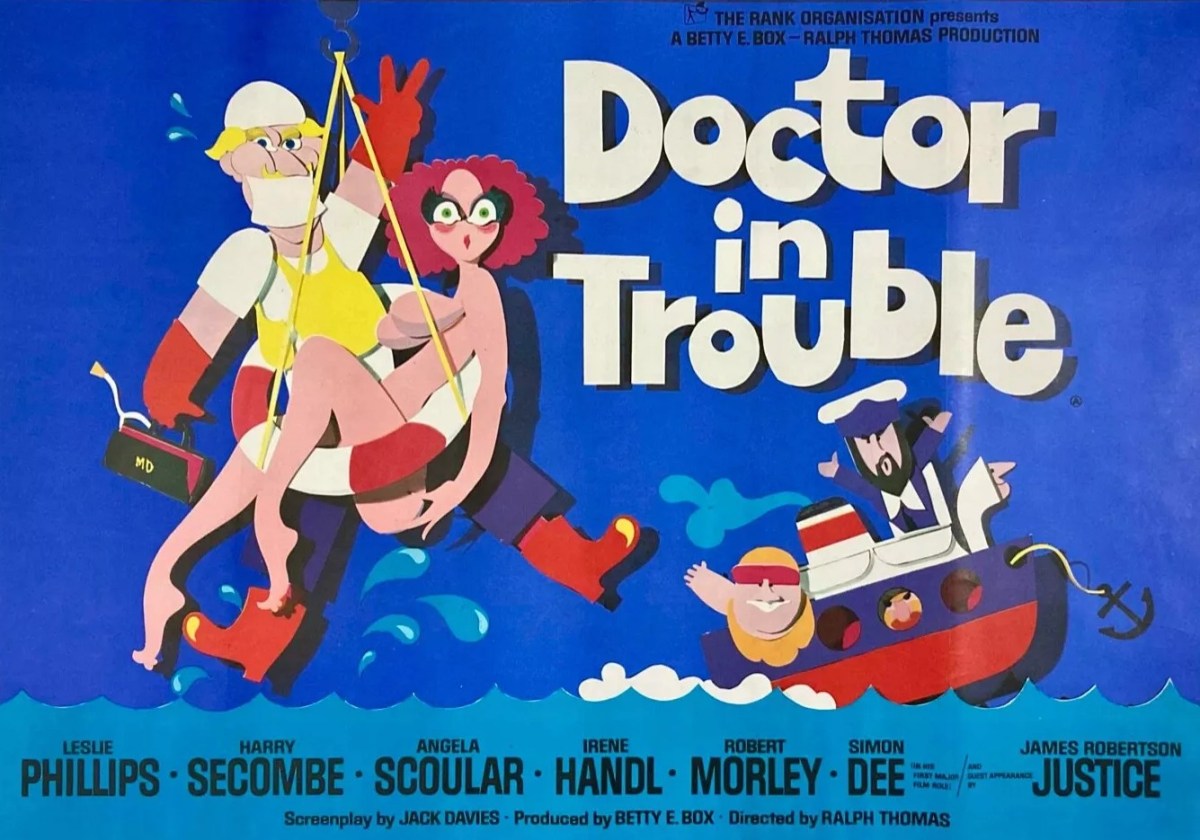
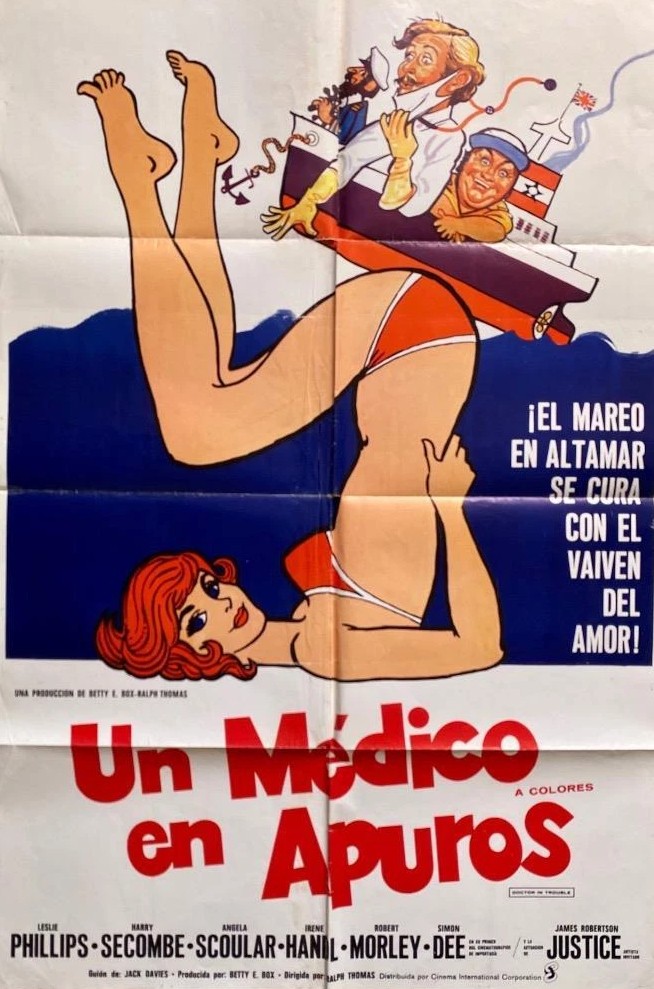
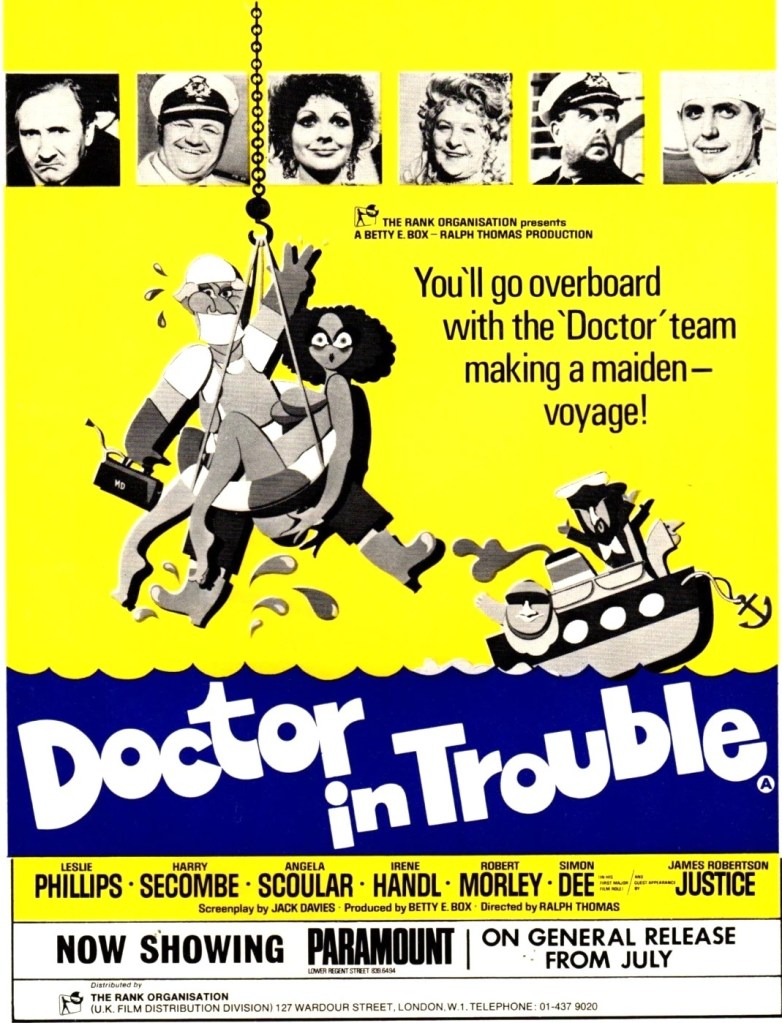
Doctor in Trouble (1970) **

Limp ending to a fine series. Torpedoed by too many oddities. Leslie Philips returns in the top-billed role, but he’s not playing the suave Dr Gaston Grimsdyke of the previous iteration, but instead a more hapless version of Dr Paul Burke, the character he played a decade before in Doctor in Love (1960).

Confused? You will be. It’s clearly set up for James Robertson Justice to play two characters, a la Sinners (2025), his usual Sir Lancelot Spratt and his presumably identical brother, ship’s captain George Spratt. But Justice fell ill and the naval part was taken by Robert Morley, of similar bombastic ilk, but in diction more long-winded and fluffy and lacking the bite of the surgeon.

In the last two episodes I’d seen there had been an obnoxious salt-of-the-earth character who turned out to be surprisingly artistic. Here, we have to settle for the nouveau riche Pools-winner (a gambling game of the era) who is channeling his inner Sidney James, all leer and not much else. And if you want proof that it’s never a good idea to hire a television personality merely because he has a large following, look no further than Simon Dee.

Several notions will not endear themselves to the contemporary audience – the cross-dressing, the cliché gays, and the Englishman in brownface playing an Indian. That’s not to mention the pratfalls and endless falling into swimming pools.

There’s even less of a plot than in the last outing. Dr Burke (Leslie Philips) accidentally stows away on a cruise ship after pursuing model girlfriend Ophelia (Angela Scoular) who’s working there. He also comes up against actor Basil Beauchamp (Simon Dee), an old school bete noire, who plays a doctor in a television soap.

Dr Burke is hounded by the ship’s Master-at-Arms (Freddie Jones) so occasionally it lurches into farce. And there’s any number of sexy debutantes either desperate to climb into bed with the TV star or hook the gambler.

If it had settled on one tone – slapstick, sex comedy or farce – it might well have worked even in the face of the poor script. Cor blimey, there’s even some fleeting nudity from Ophelia and Leslie Philips and a striptease that’s way out of place for what was originally a much gentler comedy than the Carry Ons. In terms of style it’s all over the place and not a single member of the cast is appealing enough to rescue it.

Had Leslie Philips been in traditional “ding-dong” comfort zone it might have passed muster but here he’s just the butt of all the jokes without generating an ounce of sympathy. Robert Morley (Some Girls Do, 1969) isn’t a patch on James Robertson Justice. Angela Scoular (On Her Majesty’s Secret Service, 1969) seems off-key, Freddie Jones (Otley, 1969) as if he’s in a different picture while the constantly leering Harry Secombe (Oliver! 1968) belongs in a Carry On. Graham Stark (The Picasso Summer, 1969) is deplorable as the Indian waiter Satterjee.

The only person to rise above their station is Joan Sims (Doctor in Clover, 1966) who makes a cameo appearance as a Russian nurse. In bit parts you might spot Yutte Stensgaard (Zeta One, 1969) and Janet Mahoney in her debut.

Directed as usual by Ralph Thomas. Script by Jack Davies based on a Richard Gordon bestseller.

After this, the series was reimagined for television and returned to its gentle comedy roots.

For completists only – and even then…

Doctor in Clover / Carnaby M.D. (1966) ***

Ding dong! All change. Out go the dithering twerps and in comes the seductive lothario. Dirk Bogarde after one last charge and no longer the country’s top attraction at the box office has departed for the more receptive arthouse climes of King and Country (1964), Darling (1965) and Accident (1966). In his place, at St Swithins, has come Dr Gaston Grimsdyke (Leslie Phillips) who imbues the character with trademark seductive purr.

With Gaston able to be upfront in his intentions, there is less reliance on the innuendo that suffocated rival Carry On series, and seemed to cover all manner of male deficiencies, most obviously the ability to pursue a girl in the normal acceptable manner. The exceptionally slight narrative is more a series of sketches and falls back on slapstick, some of which is hilarious – two doctors covering everyone in foam – and others less so (how many times can you fall fully clothed into a swimming pool?).

The patients line up to fill any gaps, headed in the main by “I-know-my-rights” walking medical encyclopedia Tarquin Wendover (Arthur Haynes) who despite his rough exterior reveals a penchant for ballet, and Russian ballet dancer Tatiana Rubikov (Fenella Fielding) determined to attract the male gaze.

Now there are two medics to put everyone in their place, Sir Lancelot Spratt (James Robertson Justice) and starchy Matron Sweet (Joan Sims) who revels in handing out a ticking off and takes on Spratt over what might be deemed these days a support animal in the shape of a parrot – and wins. At least she wins round one. But then her steely resolve crumbles as she believes she is secretly being wooed by Spratt.

But in the days when ageing male Hollywood idols were being teamed up, with nary a concern about the obvious age gap, with women half their age, and the likes of James Bond and Alfie never had to countenance rejection, it’s quite amazing that this piece of froth takes a more realistic approach. The main storyline revolves around the 35-year-old Gaston being knocked back by the 20-year-old French physiotherapist Jeannine (Elizabeth Ercy) who, for plot reasons, appears almost constantly in a swimsuit.

In a bid to make himself more appealing, Gaston embarks on a series of rejuvenating activities and treatments, planning to inject himself with a serum which, as you might he expect, he manages to inject into Spratt with hilarious consequence. He then turns to a “mood-enhancing” gas but that rebounds on him when he finds himself instead falling for the matron. As a subplot he is rival with his cousin Miles Grimsdyke (John Fraser) for a plum job – and is passed over, ironically, because he looks too young.

British audiences were taken by the twists to the formula and turned it into one of the top 15 films of the year at the box office. And I can certainly see its continued appeal. The days of the inept romantic are over. This is the permissive sixties after all. And while Gaston is rejected by Jeannine his flirtatious moves are welcomed by the equally seductive Nurse Bancroft (Shirley Anne Field), though since she is already engaged flirtation is as far as she’ll go and Gaston is disinclined to pursue the matter once he notices the size of her future husband.

There’s even a daring, for its time, sequence involving male hands mistakenly caressing each other, with their owners enjoying such fondling before they realize their error.

Leslie Phillips (The Fast Lady, 1962) is in his element – and he has a far better command of comedy than Dirk Bogarde – and a delight especially as his constant amour is constantly curbed. Despite third billing Shirley Anne Field (Kings of the Sun, 1963) has little more than an extended cameo even though she shines in what little she has to do. James Robertson Justice (Mayerling, 1969) remains the grumpy heart of the picture though Carry On regular Joan Sims runs him close. Elizabeth Ercy (The Sorcerers, 1967) has the delightful job of putting Gaston in his romantic place. Suzan Farmer (633 Squadron, 1964) puts in a brief appearance as do a host of British television names including Arthur Haynes (The Arthur Haynes Show, 1957, 1966), Terry Scott (Hugh and I, 1962-1967) and Alfie Bass (Bootsie and Snudge, 1960-1963)

Directed, once again, by series regular Ralph Thomas, taking a break from more serious efforts like The High Bright Sun (1965). Written by Jack Davies (Those Magnificent Men in Their Flying Machines, 1965) from the Richard Gordon bestseller.

Inoffensive Saturday matinee material.

Tomorrow at Ten (1962) ****

Surprisingly hardnosed for a British crime thriller. Surprisingly stylish and when the sting in the tail comes, it’s an emotional one, adding a deeper level to one of the main characters. In most crime picture – wherever they originate, Britain, Hollywood, France, Italy – the detectives may well complain to their colleagues about their superiors but they never take them on head-to-head and again and again. For that element alone, this is well worth watching.

The opening has you hooked, way head of its time, you would be more likely to see this type of approach in a picture from a top-name director, Alfred Hitchcock for example. A man, Marlowe (Robert Shaw) enters a derelict detached house carrying three parcels. He climbs a flight of stairs. With a key he opens a locked door. It might be a bedsit it’s so scarcely furnished except for the child’s bed. He sits down at the table, empties out two bottles of milk and some food. He opens a long parcel wrapped in paper and takes out a stuffed toy. He flips it over on its stomach, cuts open its back, pulls out the stuffing and from his last parcel removes a small bomb which he places in the empty space.

(At this point I have to explain that the toy is a gollywog, an innocent enough toy at the time but which has different connotations now, so is rarely mentioned, but this particular type of toy has a bearing on the plot, so forgive me if I make further mention of it.)

Next time we see him he’s wearing a chauffer’s uniform, picking up a small boy, Jonathan, (Piers Bishop) to take to school. Only, as you’ll have gathered, he has another destination in mind, but takes care not to frighten the child, to keep him distracted to the extent of the child thinking there’s nothing untoward as he is taken upstairs. He’s delighted with the toy, and not, at this point, too worried to be left alone.

Meanwhile, at the boy’s house, nanny Mrs Robinson (Helen Cherry) receives a telephone call from the school asking where the boy is. Just as the perplexed widowed father Anthony Chester (Alec Clunes) is given the news, Marlowe, now dressed in a suit, and carrying a Gladstone bag, appears at the door. Anthony greets him by name.

In the study Marlowe explains he has kidnapped the son, requires £50,000 in ransom, has planted a bomb set to go off the next morning at ten o’clock (hence the title), but will only release details of the child’s whereabouts once he is out of the country. Chester, a millionaire, has no qualms about paying up. Marlow is as cool as a cucumber. He has come up with the perfect crime. He will get off scot-free, become instantly rich and no one will come to any harm.

Except the nanny is listening at the door and dials 999. The local cops call in Scotland Yard. Assistant Commissioner Bewley (Alan Wheatley) assigns the case to Detective Inspector Parnell (John Gregson) quickly revealed as a tough nut, threatening to turn a suspect in a jewel robbery loose so that his pals will think he’s squealed and exact vengeance.

By the time, he reaches the house, Chester has gone off to withdraw the cash from the bank.  Inside, Parnell confronts Marlowe. And so begins a game of cat-and-mouse. Marlowe holds firm, believing that the cop will give in to save the child, Parnell searches for a psychological weakness in the criminal’s makeup that he can use to crack him. Each convinced of their own mental strength in a battle with an innocent life at stake.

Chester returns with the money and is furious to discover the cop. When Parnell refuses to play along with handing over the cash to the kidnapper, Chester pulls out his ace, the old boys network, calling up Bewley, asking for Parnell to be removed from the case. Bewley, happy to do a favor for a wealthy pal, agrees. But Parnell refuses to go.

Bewley goes in person to confront his insubordinate officer. Still, Parnell refuses to budge, verbally attacking his smug superior, threatening to go to the newspapers.

While the pair are arguing, Chester loses his rag, physically attacking Marlowe. In the struggle, Marlowe falls  back, hits his head and falls unconscious. Bewley, who has reluctantly agreed to let Parnell continue, now responds with spiteful glee. The cop will carry the can if the child dies.

Chester, meanwhile, is calling in the top medical experts to save Marlowe, money no object. But Parnell can’t afford to wait and enlarges the inquiry, putting out a public appeal, Marlowe’s face on the front page of the evening newspaper. But every other investigation can’t be halted just for this case, so Parnell is frustrated when various beat cops, originally going door-to-door, are pulled off onto other case.

Meanwhile, we already know Jonathan has worked out something is wrong, But the window is sealed with steel mesh and the door is locked and eventually he goes to sleep cuddling the deadly toy.

Marlowe shows no sign of recovery and dies. Bewley ups the stakes against Parnell. A beat cop looks at the outside of the house in question but walks away. Parnell gets a tip-off that leads him to a nightclub called the Gollywog Club and encounters Marlowe’s parents who run the place. Their name is Maddow. They haven’t seen their son in several months and while they accept he’s a criminal, the mother reminisces about what a loving boy he was.

Eventually, Parnell finds the estate agent who rented the property to Marlowe. By now they have just five minutes to get to the property.

They arrive a few minutes after the deadline.

But Jonathan has inadvertently saved his own skin, and ironically the plan has backfired because of Marlowe’s insistence on hiding the bomb in a stuffed toy of sentimental value rather than secreting it in a cupboard or somewhere the child would not have looked, and even if he found it wouldn’t know what it was.

After waking up Jonathan has washed his face and hands and decides the toy could do with a bit of tidying up the same so dunks it in a sink full of water, thus nullifying the bomb.

Parnell goes home, welcomed by wife and – child the same age as Jonathan.

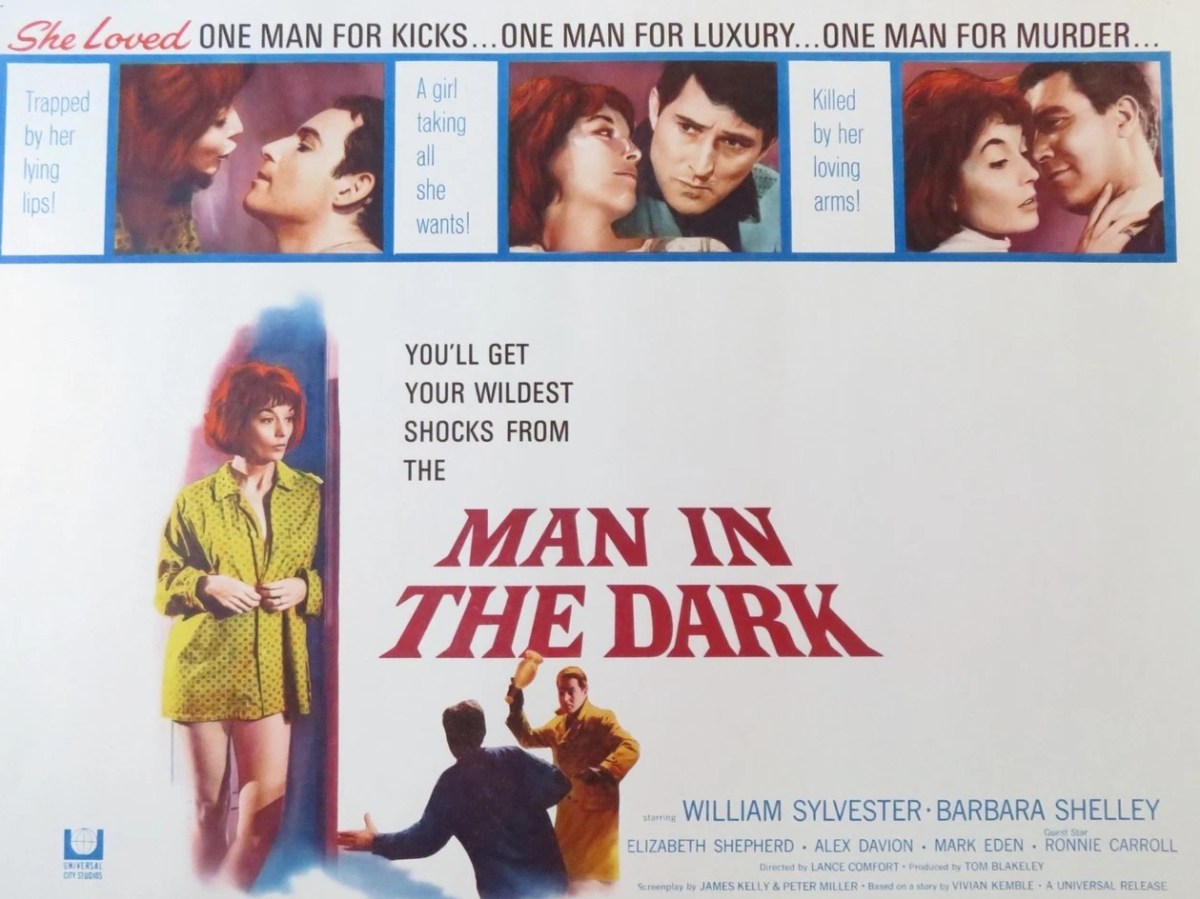
So, yes, much of the tale is par for the course, several twists to up the tension, but Parnell’s duels with his boss put this on a different level, and the realisation at the end that he has managed to set aside the feelings for his own child. And it’s also elevated by the direction of veteran Lance Comfort (Devils of Darkness, 1965) who takes time out – in an era when such features were usually cut to the bone – to add atmosphere. The first and last scenes are outstanding for different reasons and the two verbal duels make for a fascinating movie.

Stronger cast than most in this budget category – John Gregson (Faces in the Dark, 1960) and Robert Shaw (Jaws, 1975) bring cool steel to the affair.

Though little-know, Tomorrow at Ten has been acclaimed as one of the top 15 British crime pictures made between 1945 and 1970 and I wholeheartedly agree.

Another welcome revival from Talking Pictures TV.

Behind the Scenes: United Artists Goes to War on a Low Budget – “Submarine X-1” (1968) and Five Others

With the contraction of Hollywood production in the 1960s, cinemas worldwide were always crying for pictures – any pictures – that could take up a weekly slot or pad out a double bill. (The single-bill programming that is standard these days was not welcome in most cinemas, except a prestigious few, and audiences expected to see two movies for the price of their ticket). Indie unit Mirisch had scored such a big hit with aerial war number 633 Squadron (1964) – it recouped its entire cost from British distribution so was in profit for the rest of its global run – that Walter Mirisch persuaded distribution partner United Artists to attempt to capitalize on the idea and thus set in progress a series of war pictures to be made in Britain.

There would be cost savings through the Eady Plan. Each film would have a “recognizable American personality in the lead” and have American directors. Budgets would be held under $1 million. Half a dozen movies were planned, the first appearing in 1967, the last in 1970.

Quite whether James Caan (Red Line 7000, 1965) passed muster as a well-known enough star to qualify as a “personality” at the time he headlined Submarine X-1 (1968) is debatable, as was the presence of James Franciscus (The Valley of Gwangi, 1969) in Hell Boats (1970) and Christopher George (Massacre Harbor, 1968)  in The Thousand Plane Raid (1969) though Stuart Whitman (Rio Conchos, 1964)  exerted a higher marquee appeal for The Last Escape (1970). Veteran Lloyd Bridges (Around the World under the Sea, 1966) who headlined Attack on the Iron Coast (1968) was probably the best known, but these days that was mostly through television. And David McCallum owed whatever fame he had to television as part of The Man from U.N.C.L.E. double act and the idea that would still be enough to attract an audience for Mosquito Squadron (1969) seemed dubious.

Beyond setting up the project, Walter Mirisch had little to do with the actual production, putting that in the hands of Oakmont Production, which beefed up the action with judicious use of footage from other pictures. Invariably, reasons had to be given to explain why actors with American accents were members of the British fighting forces – most commonly they were represented as Canadian volunteers or might have British nationality by dint of having a British mother.

Storylines followed a similar template. At its heart was a dangerous mission. Leaders were invariably hated for some previous misdemeanor or because they were ruthless and drove the men too hard. If there was romance – not a given – it would border on the illicit. And someone required redemption.

And while none of the stars chose – or were chosen to – repeat the experience, Oakmont established something of a repertory company behind the scenes, writers, directors and producers involved in more than one movie.

Italian poster (photobusta) for “Hell Boats”. I found Japanese and Australian posters
for most of the films in the series.

Boris Sagal (Made in Paris, 1966) directed both The Thousand Plane Raid and Mosquito Squadron and then made his name with The Omega Man (1971). Paul Wendkos (Angel Baby, 1961) helmed Attack on the Iron Coast and Hell Boats. Walter Grauman who had kicked off the whole shebang with 633 Squadron returned for The Last Escape. William Graham (Waterhole #3, 1967) as the only outlier with just Submarine X-1 to his name.

Veteran producer Lewis Rachmil (A Rage to Live, 1965) oversaw three in the series – Hell Boats, Mosquito Squadron and The Thousand Plane Raid. Another veteran John C. Champion, younger brother of celebrated Broadway choreographer Gower Champion, was involved in a variety of categories. Champion is almost an asterisk these days, best known these days for producing the film Zero Hour! (1957) that inspired disaster parody Airplane! (1980). He was only 25 when he produced his first picture, low-budget western Panhandle (1948). He was behind another four low-budget westerns pictures before Zero Hour!, which had a decent cast in Dana Andrews and Linda Darnell. But that was his last movie for nine years as he switched to television and Laramie (1959-1963), barely reviving his movie career with The Texican (1966) starring Audie Murphy.

He produced Attack on the Iron Coast and Submarine X-1 and was credited with the story for both plus The Last Escape. Irving Temaner produced The Last Escape and received an executive producer credit on Attack on the Iron Coast and Submarine X-1.  Donald Sanford (Battle of Midway, 1976) was the most prolific of the writers, gaining screenplay credits for Submarine X-1, The Thousand Plane Raid and Mosquito Squadron. Herman Hoffman (Guns of the Magnificent Seven) wrote Attack on the Iron Coast and The Last Escape.

Cinema managers were not, it transpired, queuing up for the product. Most commonly, when reviewed in the British trade press, their release date was stated as “not fixed” which generally meant that United Artists was hoping the review would do the trick and alert cinema owners.

In the United States, they rarely featured in the weekly box office reports, though Portland in Oregon appeared partial to the product, Attack on the Iron Coast appearing there as support to Hang ‘Em High (1968), Mosquito Squadron supported The Christine Jorgensen Story (1970), Hell Boats supported Lee Van Cleef western Barquero (1970) while The Last Escape supported Mick Jagger as Ned Kelly (1970). To everyone’s astonishment a double bill of Hell Boats / The Last Escape reported a “big” $10,000 in San Francisco, but that proved an anomaly.

In Britain, the movies fulfilled their purpose as programmers, not good enough to qualify as a proper double bill, but accepted as supporting feature for a circuit release on the Odeon chain. Since UA supplied Odeon with its main features, it proved relatively easy to persuade the circuit to take the war films to fill out a program. This kind of second feature would be sold for a fixed price not sharing in the box office gross. However, they were given the kind of all-action poster they hardly deserved.

So in 1968 Attack on the Iron Coast went out with The Beatles Yellow Submarine. In 1969, Submarine X-1 supported slick heist picture The Thomas Crown Affair, which with Steve McQueen and Faye Dunaway in top form scarcely needed any help securing an audience. Hell Boats was supporting feature in 1970 to Master of the Islands (as The Hawaiians starring Charlton Heston was known). As well as accompanying it on the circuit Mosquito Squadron in 1970 made a very brief foray into London’s West End with thriller I Start Counting and then reappeared a few months later as an alternative choice of support for Billy Wilder flop The Private Life of Sherlock Holmes. If you went to see Burt Lancaster western Lawman in 1971 you might have caught The Last Escape – equally it could have been If It’s Tuesday, It Must Be Belgium (cinema managers could choose either).

United Artists, under the financial cost in the early 1970s, pulled the plug on “programmers” such as these. Walter Mirisch in his biography, disingenuously suggested that the six movies had done relatively well. But that wasn’t supported by the studio’s own figures.

Collectively, they made a loss of $1.7 million. Only Attack on the Iron Coast made it into the black and then by only $59,000. Hell Boats lost $700,000. None of the movies earned more than $200,000 in rentals in the United States.

Although Mirisch managed to keep budgets down to around the million-dollar mark, they would have had to be much smaller to see a profit. Ironically, it was the cheapest, Attack on the Iron Coast costing $901,000,  that made the most. Submarine X-1 lost $150,000 on a $1 million budget, Mosquito Squadron lost $253,000 on a $1.1 million budget while The Thousand Plane Raid lost $50,000 more on the same budget. The longer the series went on, the worse the losses – The Last Escape lost $449,000 on a $995,000 budget while for Hell Boats the budget was $1.36 million.

SOURCES: United Artists Archives, University of Wisconsin; Walter Mirisch, I Thought We Were Making Movies, Not History (University of Wisconsin Press, 2008) p204; Reviews, Kine Weekly – Feb 9 1968, Aug 31 1969, January 1970, April 18 1970; “Flops Loss-Cutting,” Variety, August 26, 1970, p6; “Picture Grosses,” Variety – March 13 1968, May 8 1968, April 24 1968, October 2 1968, June 10 1970, July 1 1970, July 8, 1970, August 12 1970, August 26 1970.

Submarine X-1 (1968) ***

One of the tropes of the World War Two mission picture was that it afforded plenty scope to boost the careers of supporting players – The Dirty Dozen (1967) being the best example given it boasted Charles Bronson, Ernest Borgnine, Donald Sutherland (the denoted breakout star), Jim Brown (another breakout) and Telly Savalas.  Never mind that here you could hardly find an interesting face, never mind well-written character in this one, you were struggling to find the James Caan as defined by The Godfather (1972).

Even with production shrinking and the industry throwing more and more money at the actors who supposedly guaranteed box office, Hollywood was still trying to blood new talent. But most failed to connect – Burt Reynolds was another who took a helluva long time, by movie standards, to find a fanbase.

Though Caan had been chosen by Howard Hawks to headline Red Line 7000 (1965) that had sunk without trace and a supporting role in the director’s El Dorado (1967), while exposing him to a larger audience, had not, as yet, pushed him that far up the Hollywood tree, top billing in neither Robert Altman’s Countdown (1967) nor Games (1967) doing much to bolster his marquee credentials.

His career could go either way – fizz and pop in a part that provided the opportunity to create a defined screen persona or fizzle and die after using up too many Hollywood lives. We all know which way it went so this could be considered a testing ground. And he reins in his screen persona so much he could almost qualify for a Stiff Upper Lip Award.

As ever, Yanks in many World War Two pictures set in Britain had to come in disguise.  Commander Bolton (James Caan) is acceptable in the Royal Navy if he’s Canadian and a volunteer rather than American, though you’d be hard put to distinguish the nationalities by Caan’s accent.

It was also a given of this type of war picture that the recruits hated their leader with a vengeance – Lee Marvin in The Dirty Dozen leading the field, though you could equally point to Frank Sinatra in Von Ryan’s Express (1965) – “why did 600 Allied prisoners hate the man they called Von Ryan more than they hated Hitler” ran the tagline – and William Holden in The Devil’s Brigade (1968). .

Here, Bolton is in hot water for obvious reasons. He was a poor leader, causing the deaths of the majority of his crew on the 50-man submarine Gauntlet after an ill-chosen attack on the German battleship Lindendorf. The movie starts with him and the remainder of the crew staggering out of the water onto dry land. Even when he’s cleared at a tribunal, the stench of incompetence sticks. So it’s any wonder that he’s put in charge of a secret operation with many of the survivors, unless of course it’s the kind of suicide mission that offers redemption.

As it takes forever to reveal, the British have built mini-subs, manned by three men, for a second go at the Lindendorf safely stowed out of the way in the Norwegian fjords. So apart from simmering resentment and mutterings everywhere, the first section is the standard training where, as is par for the course, Bolton is a hard-ass, forcing men dying of exhaustion back into the freezing water to complete the designated exercise.  

Except for incipient rebellion, there’s not much else in the way of plot before we head for the fjords, not even a romance which might make an audience more sympathetic to Bolton. The Germans, somehow, have got wind of this secret mission taking place in a remote part of Scotland (Loch Ness, actually) and send in a parachute team.

On land it’s as dull as ditchwater, but once we head to sea, it’s a more than competent action picture.

If James Caan has learned anything from his first four pictures, it’s not obvious, as mostly what he does is grimace. The supporting stars look as if they knew from the outset that this wasn’t going to do anything for their careers – and with the exception of David Sumner (Out of the Fog, 1962), they made barely a scratch on the movie business.

It didn’t help that the naval operation had been filmed before as Above Us the Waves (1955) starring John Mills (S.O.S. Pacific, 1960) and directed by Ralph Thomas (Deadlier than the Male, 1967).

Directed by William Graham (The Doomsday Flight, 1966) who had just scored a surprising hit with Waterhole #3 (1967). Written by Donald Sanford (The 1,000 Plane Raid, 1969) and Guy Elmes (Kali-Yug, Goddess of Vengeance, 1963).

Torpedoed by the acting, only partially rescued by the action.

Doctor in Love (1960) ****

Chortled all the way through. You can see why it was the biggest film at the British box office in 1960. Dirk Bogarde had turned up his nose at repeating the character for the fourth time and went off to make more serious pictures like Victim (1961) which, it transpired,  dented his box office appeal. Replacement Michael Craig (Mysterious Island, 1961), while brawnier, passes this particular screen test with flying colors though he has his work cut out to hold his own against such practised scene stealers as James Robertson Justice (Mayerling, 1968) and Leslie Phillips (The Fast Lady, 1962) and once Virginia Maskell (The Wild and the Willing, 1962) enters proceeding her coolness makes the camera her own.

I was surprised how much this relied on innuendo. But this is a gentler exercise in smut than the sniggering guffawing Carry On approach. And there’s little chance of it descending into misogyny since the females hold all the aces. The plot is episodic and none the worse for that and even a diversion into a strip club, which might suggest a narrative clutching at straws,  proves a surprising highpoint.

Basic story shifts Dr Hare (Michael Craig) out of hospital and into general practice which provides ample comedic opportunity via patients and colleagues. But, first of all, just to confuse matters and as if the producers were worried the series might not survive outside the boundaries of St Swithins Hospital, the tale begins with him returning to hospital with what turns out to be jaundice.

Cue the booming interventions of Sir Lancelot Spratt (James Robertson Justice) and the first of the love stories wherein Hare and Dr Hinxman (Nicholas Parsons) are rivals for flighty Nurse Sally Nightingale (Moira Redmond), who, in the first of many knocks to the male ego, while playing off one against the other goes off with another man. Before she does, Dr Hinxman takes revenge by prescribing all sorts of medications which will leave Hare so indisposed he is unable to respond to the nurse’s ardor.

Back in civvy street, as a GP, Dr Hare has to fend off predatory female patients and secretary Kitten Strudwick (Carole Lesley) and deal with standard comedic issues such as the boy who gets his head jammed in a cooking pot and the less common task of explaining the facts of life to a 40-year-old virgin. His boss Dr Cardew (Nicholas Phipps) is under the thumb of a wife who has shipped out to California only to summon her husband every now and then. The ever-amorous Dr Burke (Leslie Phillips) fills in and is the prime mover in an episode that involves strippers Dawn (Joan Sims)  and Leonora (Liz Fraser). There’s a particularly good reversal in a drunken scene where the totally inebriated Wildewinde (Reginal Beckwith) completes all the police drunk tests (if that’s what they’re called) with ease.

When Dr Burke is incapacitated, his place is taken by Dr Nicola Barrington (Moira Redmond). And that should have been enough of a plot to see the picture through but the movie doubles down on complication. Dr Barrington fends off Dr Hare and when Nurse Nightingale reappears Barrington in due course quits. Dr Spratt is also on board for further scene-stealing duties including ruling the roost in a strip club and undergoing an operation.

The romantic situation is resolved, Dr Spratt is put in his place temporarily and our hero effects a return to the hospital.

I wouldn’t say the writing (by Nicholas Phipps) is of the highest caliber but the jokes come at an assembly line pace and the cast are superb, barely a cast member incapable of stealing a scene. You hire James Robertson Justice and Leslie Phillips at your peril. Without Dirk Bogarde hogging the scenery, this flows much better than others in the series, with the supporting cast being more than just foil to a star who was a major box office attraction at the time. And it helps that the women – Moira Redmond (Nightmare, 1964), Virginia Maskell, Carole Lesley (Three on a Spree, 1961), and Carry On regulars Joan Sims and Liz Fraser –  are even more adept at scene-stealing than the men and not merely foil for misogynist jokes as in the Carry On series.

Director Ralph Thomas (The Wild and the Willing) seems to have found a new lease of life without having to deal with Dirk Bogarde and brings a certain verve to proceedings, especially in tripping up male ego.

Comedy is such an odd one to judge. Many a time I have sat through with scarcely a titter movies I’ve been told are hilarious. Other times I’ve been told to give them a free ride because they are making a point. So I stick to my own rule.

Make me laugh – I don’t care how – and this had me laughing all the way through.

Hot Enough for June / Agent 8 3/4 (1964) ***

Thanks to his language skills unemployed wannabe writer Nicholas (Dirk Bogarde) is recruited as a trainee executive on a too-good-to-be-true job visiting a Czech glass factory  only to discover that while engaged on what appears a harmless piece of industrial espionage is in fact considerably more serious.  Complications arise when he falls in love with his chauffeur Vlasta (Sylva Koscina) whose father, Simenova (Leo McKern), is head of the Czech secret police.

Eventually, it dawns on Nicholas that he is in the employ of the British secret service headed by Colonel Cunliffe (Robert Morley). Soon he is on the run. Adopting a variety of disguises including waiter, Bavarian villager and milkman, he evades capture and makes a pact with Vlasta that neither of them will participate in espionage activities.

A chunk of the comedy arises from misunderstandings, Iron Curtain paranoia, the destruction of indestructible glass, password complications, Nicholas’s contact turning out to be a washroom attendant, and from the essentially indolent Nicholas being forced into uncharacteristic action. Soon he is adopting the kind of ruses a secret agent would invent to outwit the opposition, including burning the hand of a man with his cigarette and stealing a milk cart.

The romance is believable enough and Vlasta has the cunning to shake off the secret agent shadowing her, although the ending is unbelievable and might have been stolen from a completely different soppy picture. Although Nicholas is clearly in harm’s way several times that is somewhat undercut by the espionage at a higher level being presented as a gentleman’s game.

There are unnecessary nods to 007 and the kind of gadgets essential to Bond films, although none come Nicholas’s way. But these attempts to modernise what is otherwise an old-fashioned comedy largely fail. Taking a middle ground in comedy rarely works. You have to go for laughs rather than plod around hoping they will miraculously appear. And in fact the comedy is redundant in a plot – innocent caught up in nefarious world – that has sufficient story and interesting enough characters to work.

That the movie is in any way a success owes everything to the casting. Dirk Bogarde, though well into his 40s, still can carry off a character more than a decade younger. He can turn on the diffidence with the flicker of an eyelash. And yet can call on inner strength if required. He is the ideal foil for light comedy, having made his bones in Doctor in the House (1954), reprising the character for Doctor in Distress (1963) and dipped in and out of serious drama such as Victim (1961) and the acclaimed The Servant (1964), released just before this.

In some respects it seems as if two different pictures are passing each other in the night. The Bogarde section, excepting some comedy of misfortune, is played for real while in the background is a bit of a spoof on the espionage drama.

Sylva Koscina (The Secret War of Harry Frigg, 1968) is excellent as the beauty who betrays her country for love. Robert Morley (Topkapi, 1964) and Leo McKern (Assignment K, 1968), although in on the joke, are nonetheless convincing as the secret service bosses.  Look out for a host of lesser names in bit parts including Roger Delgado (The Running Man, 1963), Noel Harrison (The Girl from U.N.C.L.E. 1966-1967), Richard Pasco (The Gorgon, 1964) and stars of long-running British television comedies John Le Mesurier, Derek Fowlds and Derek Nimmo.  

This was the eighth partnership between director Ralph Thomas and Dirk Bogarde, four in the Doctor series but also three serious dramas in Campbell’s Kingdom (1957), A Tale of Two Cities (1958) and The Wind Cannot Read (1958). In themselves the comedies and the dramas were successful, but mixing the two, as here, less so. Written by Lukas Heller (Flight of the Phoenix, 1965) from the bestseller by Lionel Davidson.

American distributors were less keen on this picture and it was heavily cut for U.S. release and retitled Agent 8¾ presumably in an effort to cash in on the James Bond phenomenon. I’ve no idea what was lost – or perhaps what was gained – by the editing.

The end result of the original version is a pleasant enough diversion but not enough of the one and not enough of the other to really stick in the mind. 

Should you be interested in how the book was translated into the film, there’s another article here covering that. Link below.

It Takes a Thief / The Challenge (1960) ****

Extremely dark-edged thriller at least a decade ahead of its time. Absolute corker of a sting in the tail. Instead of being the gangster’s moll, Jayne Mansfield – following on from another British-made thriller Playgirl After Dark / Too Hot to Handle (1960) – turns the genre on its head by playing the smart leader of a gang of bank robbers constantly evading detection by the police. Anthony Quayle (East of Sudan, 1964) drops his good guy stiff upper lip screen persona in favor of a villain.

Most heist movies either fall into the category of mostly heist (Topkapi, 1964) and half-heist and half-aftermath. Here the heist is dealt with pretty quickly and then we’re into a complicated aftermath with double cross the order of the day. Even the supposed good guys – a cop and a union leader – have a distinctly mean streak. And on top of that we have a whole load of car chases. Just one would be unusual at the time for this budget category, but here we have three, complete with crashes and cars totaled off the road. And on top of that there’s an exceptionally creepy attempt at getting an inconvenient young child to commit suicide by playing chicken on a railway line.

Widowed lorry driver Jim (Anthony Quayle), who has dreams of owning a farm, is seduced into acting as the driver for the latest bank heist organized by Billy (Jayne Mansfield). While his van loaded with the loot tootles off unimpeded, she acts as bait in another car to snooker the cops into pursuing the rest of the gang. As proof of her love for him, she entrusts him with burying the loot in a place of his choosing.

He doesn’t get the chance to dig it up again because someone’s snitched on him, most likely Billy’s ex Kristy (Carl Mohner). And since he can’t snitch on the gang to save his own skin he ends up doing a five-year stretch. When he comes out, he finds the cops shadowing his every move, and Kristy taking his place in Billy’s bed. Det Sgt Gittens (Edward Judd) decides to play dirty by suggesting that Jim is intent on double-crossing her.

The gang, determined on recovering the loot as soon as possible, have their own arsenal of dirty tricks, beating up Jim’s mother and kidnapping his son.  You’d think that with his mum black and blue and his son in the hands of the crooks that Jim would give up the loot. But, as I said, he’s not a good guy and is willing to risk all he supposedly holds dearly to get his hands on the dosh.

There’s a twist that Thunderbolt and Lightfoot (1974) later down the line exploit. Instead of someone building a school over the hiding place as with the Clint Eastwood picture, here it is hidden under dozens of barrels of high explosive encased in barbed wire. With the deadline approaching for killing his son, Jim attempts to enlist a bunch of local laborers only to be stopped in his tracks by the bureaucracy of a union shop steward.

Meanwhile, the couple, and despite all the motherliness of the childless wife (Barbara Mullen), forced to hide the child aren’t making the slightest attempt to help him escape. Instead, we watch with incredulity as one of the hoods, stumbling upon an easy way to get rid of a body, tempts the child into playing the aforementioned game of chicken.

Tension remains at a peak all the way through, in part because audiences are expecting Anthony Quayle to rouse himself from the depths of criminality and do the right thing, but mostly, in the template that Christopher Nolan would follow, three sets of narrative constantly come together.

There are two stings in the tail. Firstly, the burial site is obliterated when the barrels of high explosive shoot sky high. Secondly, with decided relish, Sgt Gittens informs Billy that the cops recovered the loot years before, so he’d risked mother and son for nothing. You can’t get blacker irony than that.

Jayne Mansfield was a much bigger attraction than Anthony Quayle and she puts in a superb performance as the mastermind and the practical woman, not willing to put career or love life on hold while Jim does his time. And while she’s slinky enough and occasionally brazen, she’s also decidedly human, but no more inclined than Jim to allow anybody to get in the way of the rewards of crime.

Like the crime pictures Britain showed a distinct aptitude for in the 1970s – Get Carter (1971), Villain (1971) and Sitting Target (1972) – this stays resolutely on the wrong side of the fence with not a single redeemable character.

Written and directed by John Gilling before he shifted into horror (The Reptile, 1966), this is a more than able piece, pulling no punches and resisting the temptation to sneak in any sentimentality.

Minor gem.

Catch it on Talking Pictures TV.

The Long Good Friday (1980) *****

Got two predictions correct – that the conversion of London Docklands into upmarket housing was a potential goldmine and that London would become the beating financial heart of Europe. Though I would have thought everyone, even as arrogant a character as gangster Harold Shand (Bob Hoskins), would have known not to tangle with the IRA. Of course, he hasn’t done this deliberately, that’s just the sting in the tail, unravelling the complex mystery of who’s got it in for him.

This would be a fitting addition to the 1970s trilogy of British gangster pictures par excellenceGet Carter (1971), Villain (1971) and Sitting Target (1972) –  except you could argue it’s better than the lot. Here we’re on The Godfather Part II territory, the big-time hood who’s gone legit. Harold already owns a casino, upmarket restaurant and pubs, and swans around in a luxury yacht but he’s got his eye on bigger game, investment in the Docklands, an ideal money-laundering concept, and he’s hooked a potential partner in American Mafia chief Charlie (Eddie Constantine).

Much as Harold would like to show off his svelte businessman side, his attempts to ooze class disappear at the first sign of trouble and soon he is working those teeth so hard he could be auditioning for Jaws. We’ve got an inkling of what’s going on but it takes a good while for everything to add up and even then Harold is convinced someone’s got their sums wrong since he’s ruled the London underworld for a decade and nobody with any sense would take him on.

The businessman façade falls away when his close aide and longtime buddy Colin (Paul Freeman) is murdered and his Rolls Royce and a pub are blown up. And it takes virtually the whole picture for Harold to discover just why a woman on her way to a funeral stopped the car long enough to spit in the face of one of Harold’s top henchmen, Jeff (Derek Thompson).

So mostly what we’ve got is Harold reverting to old-style violence, presumably using the methods that got him to the top in the first place, as he tortures and terrifies everyone in sight. Some of the brutality is inventive stuff as movie torture goes, one fellow having his naked backside sliced open by a machete, the rest of the top gang leaders rounded up in an abattoir as if they were sides of beef awaiting slaughter.

Meanwhile, wife Victoria (Helen Mirren), a version of what used to be known as “posh totty”, tries to keep the deal active by charming the pants off every male who comes within a sniff of her, some so driven by temptation they declare they “want to lick every inch of her.”

So, on the one hand, it’s big business and all the jiggery-pokery that goes in the legitimate world even among illegal contenders, and on the other hand it’s all the jiggery-pokery that goes on in the illegal world among all the illegal contenders.

Incredible score by Francis Monkman. Why he wrote so few is a mystery.

While there are many standout moments – and you’d be hard put to beat the climactic scene of Harold in the back of a taxi facing his demise – and director John MacKenzie wields his camera with considerable verve, his ace in the hole is always the expressive face of Harold. Whether he’s practising his bonhomie, or stiffening at the latest outrage, or letting loose physically and verbally it’s a fabulous acting tour de force as if James Cagney had met Al Pacino. And like Oliver Reed in Sitting Target, simmering rage is smoothed over by feminine companionship, the close bond between Harold and Victoria one of the key ingredients.

Turned Bob Hoskins (Zulu Dawn, 1979) into a star and had the British end of the industry been in better shape he had might made a smoother transition to the top echelons instead of waiting for Mona Lisa (1986) to polish his credentials.

Although we Brits like to think the acting of “national treasure” Helen Mirren was always being recognized on the domestic front, long before she achieved unquestionable credibility from pocketing an Oscar for The Queen (2006), in truth by this point her movie career was in limbo. Hardly any screen work since her breakthrough in Age of Consent (1969) and three of her last four pictures – Caligula (1979), S.O.S. Titanic (1979) and The Fiendish Plot of Fu Manchu (1980) – counting as calamities. This was a fresh take on an actress who, too often for her own good, had been seen as better naked than clothed.

It was almost a homage to cult to employ Eddie Constantine (S.O.S. Pacific, 1960) but it was surprising how many of the supporting cast came good including future James Bond Pierce Brosnan as a gay killer, Paul Freeman (Raiders of the Lost Ark, 1981), Derek Thompson (nearly 40 years on BBC series Casualty), and future director Dexter Fletcher (Rocketman, 2019).

Original screenplay by Barrie Keefe on his debut.

Still stands up as a gangster great.

Discover WordPress

A daily selection of the best content published on WordPress, collected for you by humans who love to read.

The Atavist Magazine

by Brian Hannan

WordPress.com News

The latest news on WordPress.com and the WordPress community.