Suspect / The Risk (1960) ****

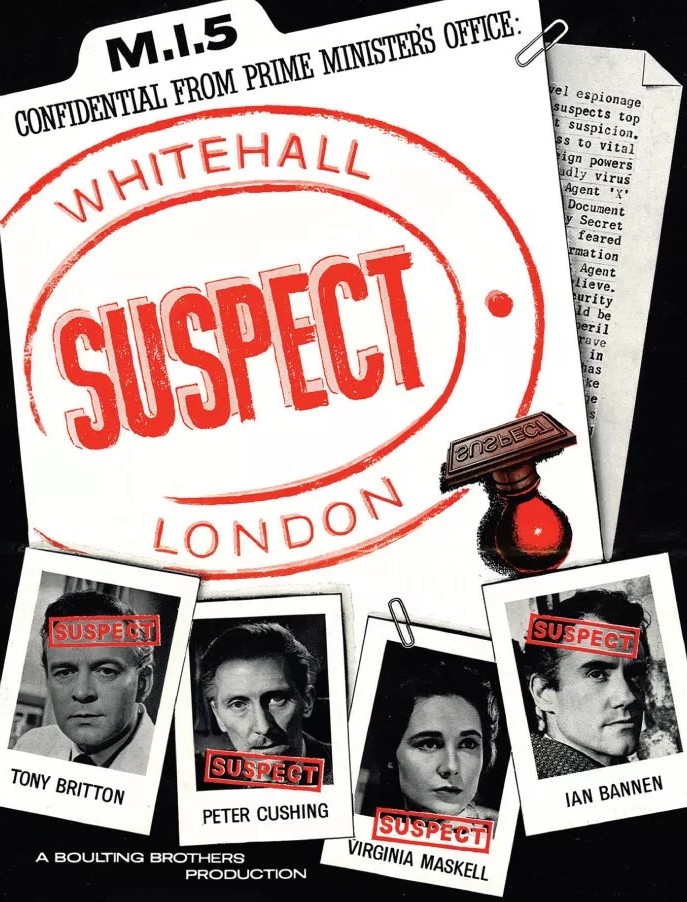
Marvellous long-forgotten character-driven espionage drama exploring the twin themes of guilt and duty. It would appear to be stolen by two supporting actors, Ian Bannen and Thorley Walters, but in fact both play roles that have significant bearing not only on the narrative but on our understanding of the most important characters. Not only do we have the main plot, but we also have two well-worked sub-plots, one concerning disability and the other of more sinister relevance – a 1984 Big Brother theme.

Basic tale concerns a laboratory that has discovered a bacteria that can cure plague. Hopes of  a celebratory drink all-round and academic kudos on publishing his paper for top boffin Professor Sewell (Peter Cushing) are dashed when the Government in the shape of the pompous Sir George Gatling (Raymond Huntly) steps in, steals the discovery and makes the staff sign the Official Secrets Act.

Romance No 1 – Virginia Maskell and Tony Britton in the lab.

While the revered professor takes it on the chin, colleague Bob Marriott (Tony Britton) is outraged so vocally in public that he attracts the attention of the shady Brown (Donald Pleasance) who suggests to the dupe that there is a way of getting the information out to the wider scientific community, especially to plague-ridden countries.

However, don’t let Sir George’s pomposity fool you. He doesn’t trust this bunch an inch and puts the Secret Service on their tail to assess “the risk” and we dip into the dark kind of web (not that kind of dark web) and the mundane business of deception and betrayal shortly to be explored by the likes of John Le Carre (The Spy Who Came in from the Cold, published in 1963) and Len Deighton (The Ipcress File, published a year earlier).

Rather than this outfit being headed by a version of the prim George Smiley, Mr Prince (Thorley Waters) has a lot more in common with the unkempt Jackson Lamb of the Slow Horses series. His incompetence is an act to make visitors to his shambles of an office under-estimate him.  But he’s got that Columbo knack of asking the most important question just when an interviewee thinks the interview is over.

Also in the background, coming more increasingly into the foreground, is an unusual love triangle between colleagues Bob and Lucy Byrne (Virginia Maskell), who kiss and hold hands in the cinema, and Lucy’s flatmate, the disabled war vet Alan Andrews (Ian Bannen). The fact that Lucy and Alan live together at a time when such a relationship was frowned upon and would be career death in certain circles and that they were once engaged to be married gives it an edge. That Alan has lost an arm and a hand so needs to be cared for – fed (as in food spooned into his mouth),  washed (you can guess that aspect), cigarette lit and removed between puffs, dressed – suggests significant intimacy for an adult.

Obviously, she’s the kind of lass who couldn’t abandon him to the welfare system, and he’s the kind of man who broke off their engagement so she wouldn’t feel tied to him for the rest of her life. But he also hates what he’s become, his desperate reliance on her, what he’s lost, and that’s turned him into not just a bitter individual but a particularly cunning one, who has developed the trick of torpedoing any nascent romance. “You can’t compete,” he gloats to Bob, “because you can’t make her feel good.”

Romance No 2 – Ian Bannen and Virginia Maskell.

But when that doesn’t work, he befriends Bob and surreptitiously eggs him on to betray his country and in so doing, hopefully, kill off the romance.

Mr Prince is a delight. Accorded the best lines, he makes great use of them. When his subordinate Slater (Sam Kydd) abrasively brings Dr Shole (Kenneth Griffith) in for questioning, he reprimands him with the rather coy, “Oh, you haven’t been rough again.” To Dr Shole (Kenneth Griffith), the most susceptible of the professor’s acolytes, he warns, “Tell him (Sewell) not to be a fool or you’ll smack him on the backside.”  Though Dr Shole has a superb retort, “We’re not exactly on those terms.”

Professor Sewell appears mostly on the back foot. While quietly seething at being denied his professional day in the sun, he accepts duty. Even so, he’s smart enough to outwit Prince when the traitor is caught.

The background of the wheels-within-wheels of Government, the silent overseeing of ordinary lives, the authorized level of spying, comes as something of a shock, since despite George Orwell’s best efforts Big Brother was seen as a clever fiction that could not occur in this most democratic and upright of countries where “fair play” was the rule. Visually, this is well done, we see eavesdroppers in mirrors in pubs and, as I said, Prince seems the least effective of operatives but with the kind of personality that you could easily have built a series around.

Disability from war was a constant of post-war British pictures, most often demonstrated by a character with a limp, as with general dogsbody Arthur (Spike Milligan) here. The Oscar-winning The Best Years of Our Lives (1946) was the most effective at dealing with the physical after-effects of the Second World War. But there, the worst-affected soldier, had prosthetic hands. Here, Alan does not, so the scenes of him being tended to by Lucy are emotionally more powerful.

She tends to his emotions, too, and will embrace him and kiss him on the mouth though he’s not dumb enough to read true romantic commitment into those demonstrations of affection. Clearly, there is emotional residue from their engagement, from which you guess she will ultimately be unable to entangle herself, unless he can find a more brutal way of helping her out of the dilemma.

The lab aspect is surprisingly well done. We don’t get any real information on the scientific breakthrough. Mostly, what we view is the grunt work, the laborious checking of thousands of samples for another experiment. At one point Bob thrusts his arm into a contraption packed with buzzing flies as if he was a competitor in I’m a Celebrity, Get Me Out of Here.

Ian Bannen (The Flight of the Phoenix, 1965) is the standout but character actor Thorley Waters (Sherlock Holmes and the Deadly Necklace, 1962) runs him close. Tony Britton (better known later for television comedy) has the least interesting role, but Virginia Maskell (Interlude, 1968) has too much to do without dialog to demonstrate her dilemma. Peter Cushing (The Skull, 1965) is solid as always and Spike Milligan provides light relief.

Joint direction by the Boulting Brothers (The Family Way, 1967), Roy and John. Screenplay by Nigel Balchin (Circle of Deception, 1960) based on his own novel.  

Exceptionally solid stuff. I was very much taken by the unusual approach, the themes and the acting.

Worth a look.

Twisted Nerve (1968) ***

Another rich kid with mental health issues though without Orson Welles to offer expiation. The cause of this character’s illness is undetermined but it’s easy enough to spot the trigger to violence. The lad’s father is dead and his mother’s new husband, a wealthy banker, wants him out of the way, or at least out of the house, or at least, given he’s twenty-one, out working rather than mooning about the house all day.

And this was certainly the year for the movies exploring split personality – if such shallow treatment could be deemed investigation – what with Tony Curtis and Rod Steiger in serial murderous form in, respectively, The Boston Strangler (1968) and No Way to Treat a Lady (1968). And for movie fans it was an unexpecteldy speedy reteaming for Hayley Mills and Hywel Bennett after the humungous success of The Family Way (1967) in which the actress shed her child-star persona in no uncertain manner and the British film industry was, apparently, suddenly blessed with a duo with marquee appeal.

A poster that gives the game away. And an apostrophe issue.

This takes the Rod Steiger route of charming killer rather than a Tony Curtis puzzled and horrified by the demands of his ulterior personality. Given the emphasis on mental illness these days, Twisted Nerve is the hardest of the trio to take, since it’s effectively a play on an old gimmmick, deviousness concealed inside appeal.

Martin (Hywel Bennett) faced with expulsion from his house by overbearing substitute father Henry (Frank Finlay) pretends to scoot off to France but instead inveigles himself into the boarding house run by Joan (Billie Whitelaw) after tricking her librarian daughter Susan (Hayley Mills) into extending a sympathetic hand to his alter ego, the childish Georgie, whose behavior falls only a little way short of sucking his thumb and clutching a teddy bear.

Joan’s initial cynicism gives way to maternal feelings when he clambers into her bed in the middle of the night after a supposed nightmare. (And not with sexual intent.)

Occasionally, Martin cannot control his true feelings, despite Susan rebuffing his romantic overtures. Father is the first victim, substitute mother Joan the second and it’s only a matter of time before Susan becomes a target either for his stifled sexuality or his inner venom.

This would probably work just as well minus the schizophrenic element. In fact, there’s too much of tipping the nod to the audience. Eventually, Susan’s suspicions are aroused but  director Roy Boulting (The Family Way) is no Alfred Hitchcock able to manipulate an audience. So, mainly, what we are left with is Hywel Bennett’s ability to pull off a double role rather than his victims’ susceptibility to his charms.

Hayley Mills’ character could do with fattening up, otherwise she’s just the dupe, bright, bubbly, self-confident and attractive though she is, although her mother, in passing, is given more depth, a lonely attractive widow prone to sleeping with her attractive guest Gerry (Barry Foster) and, unnerved to some extent by her daughter’s growing independence, wanting a son to mother.

It’s only un-formulaic in the sense that the director is playing with an audience who were not expecting anything like this as a story fit for their two newest adult stars so hats off especially to Bennett for considering a role that could as easily have typecast him for the rest of his career. As I said, setting aside the mental illness elements, Bennett is good fun, as he toys with both aspects of his character, adeptly dealing with those who would patronise him, and like Leopold and Lowe convinced he can get away with the perfect crime, whose planning and attention to detail is noteworthy.

As with the Chicago killers it’s only accident that gives him away, although the policeman here (Timothy West) is less dominant than his American counterpart.

Clearly filmmakers of the 1960s were beginning to grapple with mental illness but either lurching too far towards romance as a way of instigating tragedy as with Lilith (1964) or to the most violent aspects of the condition as with virtually anything else beginning with Psycho (1960).

Worth a look for Hywel Bennett’s chilling performance – template for Edward Norton’s turn in Primal Fear (1996) – and Hayley Mills fans won’t want to miss it. Strong performances by Billie Whitelaw (The Comedy Man, 1964), Barry Foster (Robbery, 1967) and Frank Finlay (The Shoes of the Fisherman, 1968) help enormously. There was quite an input into the screenplay. Along with Boulting, Leo Marks (Sebastian, 1968) doing the heavy lifting adapting work by Roger Marshall (Theatre of Death, 1967) and, in his only movie credit, Jeremy Scott. Great score by Bernard Herrmann.

Well done with misgivings.   

The Family Way (1966) ****

Nudity was not an option for previous child stars attempting to make the leap into adult roles. Shirley Temple in the 1930s and Margaret O’Brien in the 1940s were kids when they played kids and when they outgrew their cuteness audiences proved indifferent.

Being older when playing younger characters increased the chances of career survival. Silent movie superstar Mary Pickford was 22 when she first tackled child heroine Tess of the Storm Country (1914) and 30 for the remake and she made an absolute fortune from these kinds of roles. Judy Garland was 17 when The Wizard of Oz (1939) appeared and managed another 15 years at the top before drugs and drink took their toll, still worthy of supporting roles after A Star Is Born (1954) and even star billing in her last film I Could Go On Singing (1963). But she was fired from Valley of the Dolls (1967), ironically enough given the film’s subject matter, due to alcohol and drug dependency.

Hayley Mills was 14 when her first Disney picture Pollyanna (1960) was released and for the next five years at that studio never played anyone approaching her true age. She was protected from studio abuse because this was Disney and because her father was actor John Mills, who often appeared in her movies. When the Disney contract ended, Sky, West and Crooked (1966), her father’s directorial debut, attempted to refashion her screen persona with a more challenging role.

But The Family Way forced audiences to set aside all preconceptions. Not only did she show her naked derriere, but this was a film essentially about sex. No sex is actually shown because  newly-weds Jenny (Hayley Mills) and Arthur (Hywel Bennett) have problems consummating their marriage. You can thank the Carry On films for the snigger-snigger British mindset to sex. The promiscuous and often predatory characters of Darling (1965) and Alfie (1965) occupied a different world, almost a foreign country as far as the inhabitants of this solid working-class town were concerned.

They would have looked askance at such permissiveness. Here, at this particular point in history, both sexes were still expected to be virgins when they married. Sex in Darling and Alfie, for example, carries little emotional overtones. The Family Way is novel in treating sex as fundamental to happiness within marriage.

The subject of impotence would not be first on your list when you set out to make a warm-hearted drama. But here screenwriter Bill Naughton (Alfie) in adapting his play All in Good Time uses the theme to explore family values. But where recrimination – and subsequent confrontation – might be the first port of call for another writer, Naughton foregoes that obvious route to concentrate on the way impotence eats at a man’s self-worth. Two secrets drive the plot but the second is preserved right to the end, resulting in possibly the most moving finale you will ever watch.

In documenting working-class life it is superior to the earlier Saturday Night and Sunday Morning (1960). It is life without inbuilt bitterness. Families are still crammed into small houses, a visit to the housing department – to get a new council house or just be put on the waiting list – an invitation to humiliation, but there is full employment and enjoyment to be found in simple pleasures.

Family dynamics are expertly explored. Arthur, with a shelf load of books and penchant for classical music, is diametrically opposed to his down-to-earth but exceptionally obtuse father Ezra (John Mills), and there is a wonderful scene early on where Arthur seeing how badly his father takes defeat allows him to win an arm-wrestling competition.

Ezra is the standout, devoted to the memory of a long-departed childhood pal and struggling with his position as patriarch especially in the face of perennial sniping by wife Lucy (Marjorie Rhodes). Ezra is so expressive of longing and emotion, and it is he who has the heart-breaking final scene.

The older characters are fully rounded, bluff exteriors concealing fragile emotion. Hard-faced Lucy appears almost fey when she recalls a moment of love. Jenny’s burly father (John Comer) cannot cope with her departure from his household, especially as that leaves him at the mercy of his shrewish wife (stand-up comedienne Avril Angers).

Hywel Bennett begins a successful movie career with a difficult part, an introspective role calling for him to contain his emotions – not venting his spleen like the endlessly complaining Arthur Seaton of Saturday Night – until they erupt in a spectacular fist fight that does not go at all the way you would expect.

Barry Foster (Frenzy, 1972) has the showy part as the rough-edged  workmate and Murray Head (later part of the love triangle in Sunday, Bloody Sunday, 1971) also makes his debut in an equally showy role as Bennett’s brother who makes advances to his frustrated sister-in-law.

Even without the nudity, Hayley Mills, the denoted star, makes the transition to movie adulthood with ease. In part, all she had to do was drop the unnatural excitement that appeared essential to her Disney portfolio. Her delivery, her reading of a line, had always been good and she had clearly worked out she was going to be an actress not a sex symbol so there was no exaggerated use of her physicality.

Even the nudity worked in her favor, startled to be disturbed emerging from a bath, genuinely shy, not the mock-shy or reveling in her naked state that was de rigeur in Hollywood. She was also helped by being a light foil to the brooding, gloomy Bennett, her natural bright personality, while affected by their problem, still capable of enjoying harmless pleasures.  

This was a distinct change of pace for the fraternal producer-directing team John and Roy Boulting, stalwarts of British production since the 1940s with a host of well-regarded dramas and comedies, often with Peter Sellers, to their name.  Generally, they took turns about in the director’s chair – the former putting his name to thriller Brighton Rock (1948) and comedies Lucky Jim (1957)  and I’m Alright, Jack (1959), the latter claiming credit for drama Fame Is the Spur (1947), thriller Run for the Sun (1956) and comedy A French Mistress (1960). Occasionally, they shared the directing chore as with thriller Seven Days to Noon (1950), comedy Heavens Above (1963) and in this contemporary drama.

Their approach to The Family Way went against the grain of the gritty working-class dramas in the vein of Saturday Night and Sunday Morning and This Sporting Life (1962). Nobody here has a job they hate or comes home covered in grime. In fact, since the central thrust (pardon the pun) of the movie is about pleasure (sexual, that is), it is set against a background of enjoyment. Both principals have jobs in entertainment, Arthur an assistant projectionist in a cinema, Jenny working in a record store and also seen at a disco and a motocross event. Alcohol plays a role, of course, but not to the extent of over-indulgence, not drinking yourself to oblivion like Arthur Seaton, and its main purpose is to present the father as an amiable host.

What impact the burgeoning affair between Hayley Mills and Roy Boulting (33 years her senior) had on the production is anyone’s guess but possibly it helped steady the star’s nerves when it came to the nude scene. From today’s perspective the nudity appears gratuitous. And certainly back then it was shocking, ensuring an X-certificate (although the subject matter probably already guaranteed that).

Actually, it was social comment. While living in a decent-enough house, the family lacked one particular amenity – an indoor toilet. Washing took place at a communal sink or in the privacy of a bedroom with a bowl of water. A bath was a mobile unit, a zinc item dragged out of the scullery into the living room, filled with endless pots or kettles of hot water.

But for a young woman to take a bath demanded privacy. So when Jenny is interrupted in her ablutions, males and females in the audience had opposite reactions. It would not be unreasonable to suggest that males simply enjoyed the sight of the naked posterior. Women, on the other hand, would wince.

Aversion to nudity may have played a part but more likely women would feel deeply the humiliation at the lack of privacy in such a household, that someone could come upon you at your most vulnerable at any time. Sure, nothing went hidden in such houses, the sounds of any activity would carry through walls, but such a deep personal activity as exposure while taking a bath said far more about the brutal congestion of family life than jokes about hearing someone urinating into a container in the next room.

Paul McCartney contributed a very hummable melody as part of his debut movie score.

American audiences did not respond so well to Hayley Mills’ emergence as an adult actor and the movie failed to click at the box office there. But by that point it was already in profit, a runaway British hit (among the top twelve films of the year) and set the female star up for an adult career, pointed Hywel Bennett in the right direction and gave John Mills one of his most memorable turns.  

Very entertaining with terrific acting.

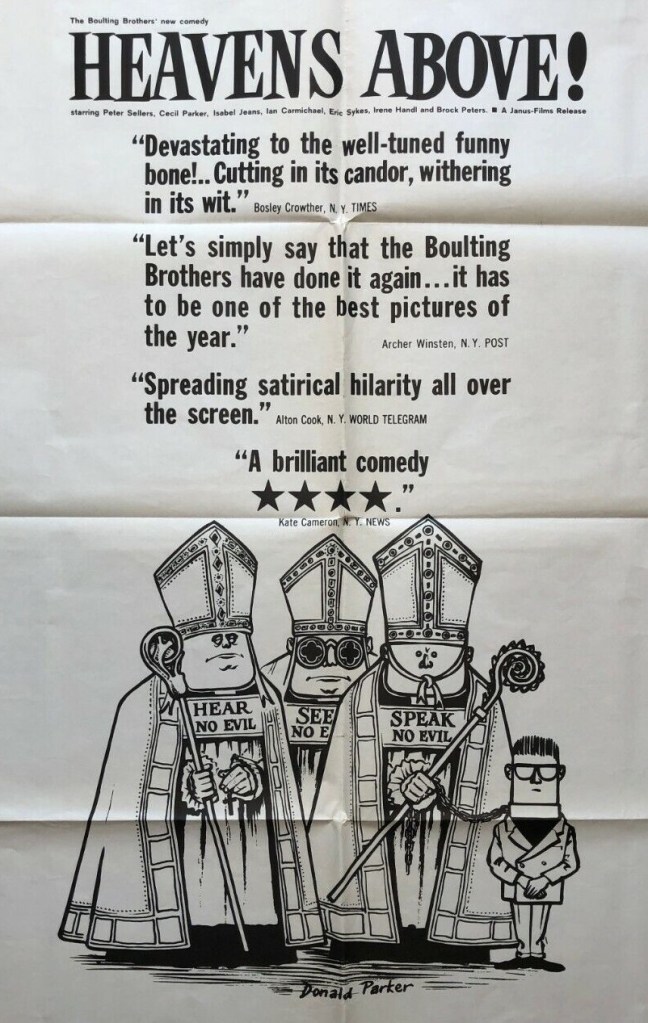
Heavens Above! (1963) ***

Surprisingly topical – food banks a key element – social satire. And a surprising box office smash – among the top 12 films of the year – in Britain, although the Boulting Brothers (I’m Alright Jack, 1959), often viewed as inheriting the Ealing mantle, had both commercial and critical form.  

In a case of mistaken identity, simplistic prison chaplain Rev Smallwood (Peter Sellers) is sent to rich parish Orbiston Parva, virtually endowed by the Delpard family, owners of the Tranquillax business nearby. Smallwood, an advocate of the meek inheriting the earth and making it his mission to ensure the rich can enter the kingdom of Heaven other than through a needle, convinces Lady Delpard (Isabel Jeans) to spread her wealth. This takes the form of the Good Neighbour Fellowship, whereby she sets up a food bank whose popularity soon endangers the town’s retailers and merchants, the public, naturally enough, preferring to do their shopping at the free church outlet than spend money on a butcher or baker (possibly candlestick makers escaped the impact).

Meanwhile, to show he is up to scratch in the poverty ranks, Smallwood invites into his palatial manse the Smith family who are being evicted from their plot of ground to make way for an expansion of the Tranquillax factory. Despite ruffling feathers in the ministry, Smallwood can’t be turfed out, since religious law dictates he effectively owns the manse. However, once shops have to close for lack of trade and factories, for lack of goods being sold, make thousands redundant, Smallwood’s do-gooding backfires.

While Harry Smith (Eric Sykes) is an archetypal welfare swindler (taking home £90 a week) and inclined to siphon off items from the food bank for his own entrepreneurial purposes as well as stealing lead from the church roof, the rest of his enormous brood, led by the redoubtable Rene (Irene Handl) are converted to the joys of Christianity, enough so much so that baptism and marriage (between the couple) beckon.

Most of the humour is gentle, the biggest laughs – Smallwood inadvertently eating dog biscuits, a dog peeing on his leg, choirboy reading a dirty book, the butler initiating a miraculous intervention – are straight out of the Charlie Chaplin joke book. And the timing for many lines appears out of kilter, as though the laughs were not intended.

British films around this time often received rave reviews from U.S. critics which ensured reasonable business at the arthouses while not striking a box office chord with the general public. there.

Apart from Smallwood, his assistant Matthew (Brock Peters) and the converted Lady Despard you are hard put to find any Chistians. As one character observes “not enough decent Christians to feed one lion.” And the townspeople are generally shown as scroungers of one kind of another with the Smiths typical sex-obsessed chip-guzzling working class. The business owners, bishops, aristocrats and assorted politicians are similarly pilloried for greed and inefficiency so you could say the Boultings are being fair straight down the line.

The best scene, and the one that makes the most out of a comic situation, is when the real Rev Smallwood (Ian Camrichael) turns up, is treated as an imposter and locked up for displaying psychotic tendencies. And there’s a clever, even more topical ending, involving space exploration, which equally cleverly mimics an earlier scene. Actually, there are two scenes that echo earlier activities, and both are intelligently used.

The satire retains some of its bite. There are even more rich people around now who hold onto their wealth and there are more poor people in clear need of help, assistance that would extend far beyond food banks, a relatively recent phenomenon. You can be sure selfish big business will be as self-interested.

Peter Sellers, complete with regional accent, in pre-Pink Panther mode shows dramatic skills that he would rarely be allowed to exhibit until much later in his career and although I think he should have been permitted more leeway in his lines he doesn’t deliver them as though he is milking a joke which means dramatic intent is not diluted. He is perfectly believable as the quietly-spoken forgiving vicar surrounded by more grasping colleagues who appear to have forgotten the basics of Christianity, his immediate boss, for example, on holiday in Monte Carlo.

British television comedian Eric Sykes (The Liquidator, 1965), barely recognisable after abandoning his trademark stance and voice, is the standout as the conniver-in-chief. Brock Peters (The Pawnbroker, 1964) is effective as the bin lorry driving protégé and Isabel Jeans (A Breath of Scandal, 1960) a delight as Smallwood’s slightly dotty benefactor – her look as she realizes he has scoffed the dog biscuits worth a couple of laughs. The others, good as they are, are called upon to play little more than stock characters: Cecil Parker (The Comedy Man, 1964), Ian Carmichael (The Amorous Mr Prawn, 1962) and Irene Handl (The Wrong Box, 1966). Look out for Roy Kinnear (Lock Up Your Daughters!, 1969), the first Doctor Who William Hartnell and the future Miss Marple Joan Hickson.

Ably directed by Roy and John Boulting who easily hit all their targets, the screenplay is by Frank Harvey (I’m Alright, Jack), John Boulting and critic Malcolm Muggeridge.  

Discover WordPress

A daily selection of the best content published on WordPress, collected for you by humans who love to read.

The Atavist Magazine

by Brian Hannan

WordPress.com News

The latest news on WordPress.com and the WordPress community.