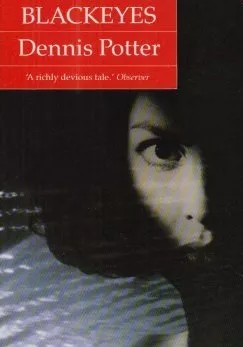
Blackeyes (1989) *****

Absolutely mesmeric. Would be catnip for contemporary audiences with its shifting time frames, juggling perspectives, narrative sleight-of-hand, and heavily feminist-oriented outlook with its slating of misogyny. Ripe for a remake and with the adventurous directors around these days they should be vying for the opportunity. But I should warn you, steer clear of the version that showed on Amazon Prime which cut the four-part television series in half.

British screenwriter Dennis Potter was something of a national institution before this appeared, the BBC ponying up vast sums (in television terms) for his experimental programs that included the likes of Pennies from Heaven (1978) – remade as a movie three years later with Steve Martin – and The Singing Detective (1986) (remade seventeen years later with Robert Downey Jr) and his blend of pastiche and males struggling with raw emotion had made him not just a household name but accorded him worldwide acclaim.

However, just as Peeping Tom (1960) put the kibosh on the career of Michael Powell, Blackeyes proved a major critical reversal and after the mauling it received and outraged headlines in the national media Potter somewhat lost his mojo and automatic critical favor although Lipstick On Your Collar (1993) helped a certain Ewan McGregor to make his mark.  

In part, Blackeyes is way ahead of its time in the use of the stylistic devices mentioned above which when incorporated into the works of, for example, David Lynch or Christopher Nolan, were hailed as groundbreaking.

So this is a three-hour-plus show setting precedents that not only break all the rules of narrative but blows them sky-high and has so many layers you can hardly keep up and that narrative spinning continues to the very end. You could almost entitle it “Whose Story Is It, Anyway?”

Elderly author Maurice (Michael Gough) has fashioned the experiences of his model niece Jessica (Carol Royle) into a bestselling literary novel. Leading character Blackeyes (Gina Bellman) is taken advantage of so often by men that she commits suicide, wading out dressed in sexy night attire into a lake.  Although Maurice makes a fine specimen suited-and-booted and talking to admiring audiences at book fairs, in reality he’s a sodden old drunk living in a threadbare apartment with a teddy bear. But he’s intellectually adroit as shown with his verbal duels with a smug journalist who spouts artistic jargon.

Jessica is so annoyed that she has not been acknowledged as the source of her uncle’s novel – he claims it is a work of imagination – that she begins to write her own fictional version of her life story, calling into question some of the events in her uncle’s account. So that’s two perspectives already. Stand by for a third, that turns the entire story on its head.

It appears Blackeyes (Gina Bellman) has not committed suicide. Detective Blake (John Shrapnel) is convinced she has been murdered, especially after he finds a list of names stuck in her vagina (yes, despite Blake gamely searching for every euphemism under the sun, the actual word, to add to the shock and horror of an audience and especially critics reeling from the sex and nudity, was used on the BBC) and later finds her diary which provides another version of events.

He’s an old-school detective, and while not beating anyone up, not above handing out a good thump in the ribs to anyone giving him lip. So while following Maurice and his niece, we are also finding out more about Blackeyes via the cop’s investigations and how she was taken advantage of in the advertising profession and world of photographic modeling. She is even the one who gets the blame when someone tries to rape her.

Her life could be viewed in two ways, as a sexually independent woman or as a victim of MeToo.

To counteract what is presented as a sordid existence there comes into her life a gentler soul, advertising copywriter Jeff (Nigel Planer) and he’s writing and rewriting versions of a more old-fashioned romance where they enjoy a meet-cute (of sorts) and get talking and move onto romantic walks along the seaside. But Jeff’s too diffident a fellow to appeal to Blackeyes and he doesn’t even get to first base. But it also turns out that he’s been watching Jessica through binoculars (they live across the street from each other) and there’s a marvelous moment when he realizes that Blackeyes occupies the same apartment as Jessica and that he could at that very moment be watching himself.

All the way through there’s been a male voice-over, measured, commenting on the action, advising on twists in the story, adding a different perspective to characters, offering many polished bon mots, and it takes you quite a while to realize that this is an entirely new voice, and doesn’t belong to either Maurice or Jeff. In the ordinary run of things, this character would turn out to be the Hercule Poirot of the piece, putting the jigsaw together, explaining all.

In fact, he’s another element of the jigsaw. He’s not just the narrator. Everyone we’ve seen are characters in his fiction. But they don’t always obey the rules and at the very end Blackeyes escapes.

So just a stunning piece of television. Although Michael Gough (Batman Returns, 1992) received the bulk of what little plaudits there were, the series is carried by New Zealand actress Gina Bellman (Leverage, 2008-2012, and Leverage: Redemption, 2021-2023) who is simply superb. She rises above what could easily have been a cliché – and in some respects was written as a cliché version of the “dumb blonde” at male beck and call. Her comic timing for a start turns many scenes on their heads. But what’s often been overlooked is her transitional skill. She moves from male fantasy figure to believable human being and from there to rebel. And that takes some doing.

Gina Bellman hates talking about this series, my guess on account of the nudity and the backlash that created for a young actress, but she should be proud of her achievement. This is more than solid stuff.

Writer Dennis Potter also directed and his camera is always prowling around the edges.

The word auteur was over-used but this genuinely fits that category.

A masterpiece.

Scoop (2024) ***

Except for the interviewee being an obliging idiot, this could as easily have turned into an own goal by a BBC desperately trumpeting its values to an indifferent nation that has been wooed away by the streamers. When the top dog is indulged by having her own top dog, a whippet, sitting at her feet everywhere she goes in BBC HQ and the supposed news bosses believe a scoop is snatching someone else’s scoop you’re on a very sticky wicket indeed.

And it’s worth bearing in mind that this show only came about because the person who set up the interview Sam McAlister (Billie Piper) had a severe case of schadenfreude and believing she hadn’t been sufficiently well rewarded wrote a book about the episode and nabs a writing credit here.

There’s not really a sympathetic character in the whole feature, unless you count the 450 journalists being shown the door because the Government won’t let the BBC raise the licence fee to cover its running costs and the BBC refuses to lower the fees it pays its top presenters (who only stay out of the goodness of their hearts because of course they would get richer pickings on commercial channels) to achieve the same end.

The only person who comes close is the sad-eyed Royal PR guru Amanda Thirsk (Keeley Hawes), heart roasted by looking after spoiled man-child Prince Andrew (Rufus Sewell in an ill-fitting face mask) – inclined to throw a tantrum should some housekeeper fail to arrange his battalion of teddy bears in the correct order – and clearly desperate to believe the prince could not possibly be at fault. However, the idea that you would let such a dope loose on Newsnight, facing one of the world’s toughest interviewers in whippet-lover Emily Maitlis (Gillian Anderson), shows remarkably poor judgement, especially when the prince just can’t see what all the fuss was about when he was doing the right thing by standing by his old pal, a convicted paedophile.

Anyone expecting proper investigative journalism or a thrilling narrative up to standards of All the Presidents Men (1976) or Spotlight (2015) – where the journalists actually do the hard work of the digging rather than just regurgitating a story that’s already out there, albeit with a bit more gloss, and the luxury of a one-hour time slot – would be looking in the wrong place.

Wouldn’t it be nice if we had discovered just a little bit more about Bernstein and Woodward’s personal lives, whether they owned dogs or had girlfriends or maybe a sick mother, just to fluff out the story a bit, but luckily Alan J. Pakula had more to worry about than what clothes his Woodward and Bernstein had to wear when confronting their subjects.

The BBC high-ups, when not toddling off to sit in boxes at the opera, come across as up their own backsides. Sam is shown to be an outsider, who, unfortunately, dresses like she’s going clubbing, which gets everyone’s back up, but, red card here, seems surprisingly ignorant of the juicier details of the story she’s investigating.

Netflix has been on a roll with The Crown so presumably thought any story with a royal connection would be equally a ratings winner, not realizing that you still need interesting characters to snaffle the viewers and no number of angst-ridden people is going to cut it.

I can’t vouch for the truth of the impersonations of real characters, but while Gillian Anderson seems to catch the essence of Emily Maitlis, Rufus Sewell’s intonations are very much the actor’s own while the face mask seems to wobble from time to time. Billie Piper got the thumbs-up from Sam. I doubt if Amanda Thirsk would care for her worst PR moment to be dramatized but Keeley Hawes at least lends her gravitas. 

Suicide by television is the best way to describe the prince, locked into a self-serving version of himself as charming war hero best suited to modelling Army uniforms glittering with medals. However, it struck me at the time and I was reminded of this omission here, that none of the investigative journalists have sought to investigate the small matter of the Pizza Express alibi. I would have thought it would be relatively easy to establish if Andrew was there on the night in question. Directed by Philip Martin.

This only goes to prove that not only can you lead a horse to water but without much encouragement you can get it to drown itself.

The original interview is better value than this. But we should perhaps thank Netflix for allowing its rival a moment in the sun.

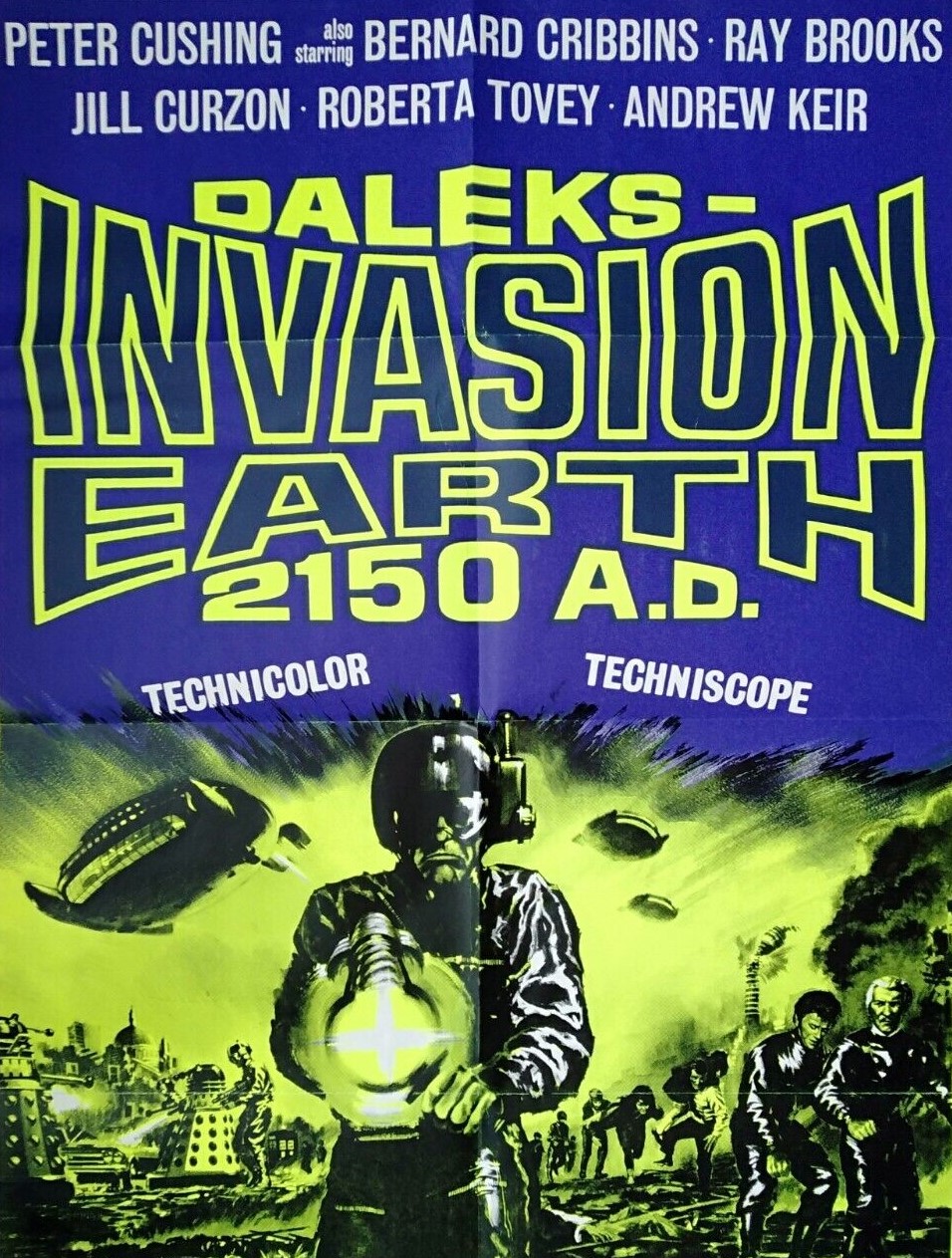
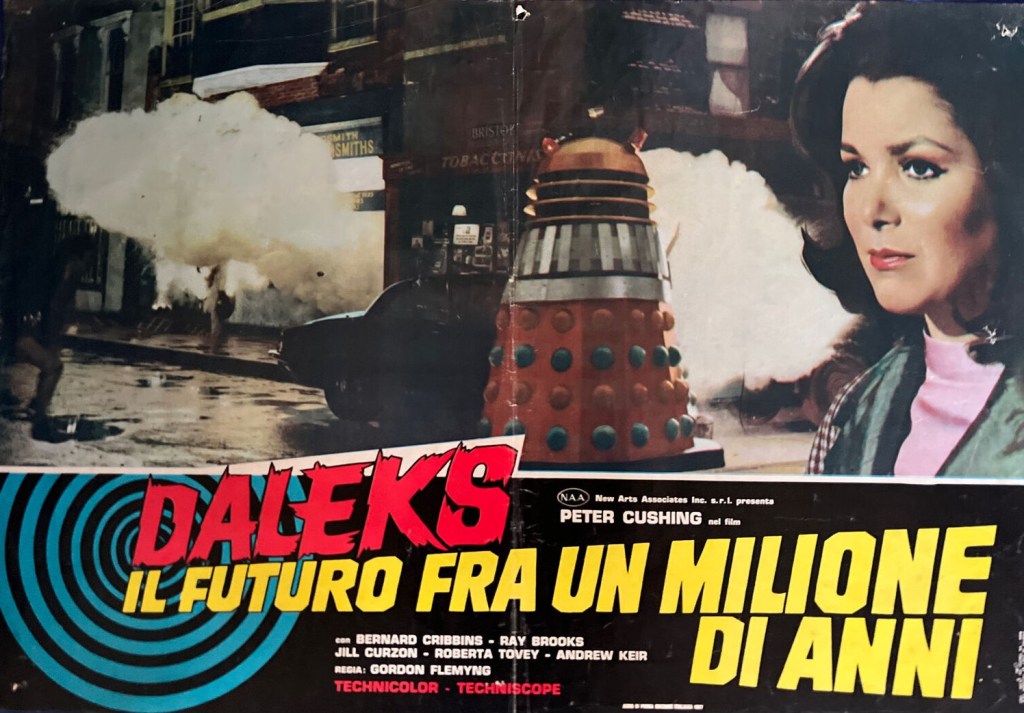
Daleks’ Invasion Earth 2150 A.D. (1966) ***

Sequels being all the rage – James Bond, Matt Helm, Derek Flint, The Pink Panther, The Magnificent Seven – in the 1960s it was no surprise that the success of Dr Who and the Daleks (20th top film at the British box office in 1965) suggested that a second go-round might be as profitable. As was standard, a recurring formula was the key.

In this case, Dr Who (Peter Cushing) and grand-daughter Susan (Roberta Tovey) repeated their previous roles though another grand-daughter Barbara (Jennie Linden) was replaced by a niece Louise (Jill Curzon) and hapless passenger Ian (comedian Roy Castle) was ousted in favour of  hapless London cop Tom (comedian Bernard Cribbins). But returning director Gordon Flemyng (The Split, 1968) upped the ante. Instead of waiting ages for the dreaded mechanical monsters with their electronic catchphrase (“Exterminate”) to appear, they turn up virtually in the first reel.

As if to emphasise the versatility of the Tardis, this time instead of space travel it’s time travel, Dr Who turning up in a blitzed London virtually two centuries ahead only to discover his nemesis rules the planet. It being set in a familiar locale, nobody is loaded down with information dumps, a tedious feature of the first picture, and it doesn’t take as long to get going, and our heroes, in various configurations, and while befriending the rebels – leader Wyler (Andrew Keir) and David (Ray Brooks) – endure a cycle of trap and escape while the good doctor tries to work out what brought the daleks to his home planet.

I’m giving this the benefit of the doubt and suggesting that the first appearance of the daleks is a homage to Dr No (1962) although one of the creatures emerging from the River Thames is hardly a patch in the sexy-entrance stakes as a bikini-clad Ursula Andress. Amidst all the mayhem, there are a couple of standout sequences, the best of which is a comedy skit involving Tom, disguised as a leather-clad member of the brainwashed automatons. This reminded me of Bob Hoskins in the first Super Mario Bros (1993 vintage) being trapped in an elevator with the Goombas. Tom is just too human to fit into this gang, constantly out of step with their actions.

Naturally, the Dr Who team are split up, allowing the action to move into two converging directions. The daleks plan to turn the planet into a giant spacecraft it can tow around, that storyline somehow involving a mining operation outside London while there’s some clever sci fi tomfoolery using the Earth’s magnetic poles to destroy the enemy.

Oops, I’ve given away the climax. Not that anybody cares that much, the main fun being the escaping formula – the daleks even use this as a plot twist, commending the intelligence of any human who can manage to escape – and watching the doctor outwit the enemy. Actually, the main fun is the dastardly daleks. Every time they appear you can imagine yourself back in a cinema crammed with thousands of kids yelling “Exteminate! Exterminate!”  

The plot keeps rolling along, no time to draw breath. And we’re not having to bother with any of the boring MCU claptrap intent on giving the super-villains a backstory or expiating their evil brains. The daleks represent alien domination, and they’re not here to give lectures on inhumanity or peace. In their determination to kill, they could almost be contemporary, given the number of serial killers and/or madmen clogging up cinema screens.

If not conspicuously inventive, Gordon Flemyng’s management of a large cast and a variety of action brought him to Hollywood attention. Given the storied career of Peter Cushing (The Skull, 1965) storied career, his performances as the doctor are generally overlooked, which is a pity, because he is certainly among the best to essay this character.  Carry On regular Bernard Cribbins livens up proceedings without needing to resort to slapstick in the Roy Castle mode. This must have seemed a bit of a come down for Ray Brooks after unexpected hit The Knack (1965) but he always seemed more at home on the small screen (although Flemyng hired him again for The Last Grenade, 1970).

The series ended here after the movie flopped on home territory. The original had bombed in the States, so the producers were heavily dependent on British box office. I guess just getting U.S. audiences aware there was such a thing in Britain as a “police box” would have been harder to grasp than the fact that it housed a time machine, and that the interplanetary craft was just there without a whole story about how it had come into being.

Made on a miserly budget by anybody’s standards, the sfx was never going to come up to scratch. But who cares.

“Exterminate! Exterminate!”

https://amzn.to/3FkXVJa

Quatermass and the Pit / Five Million Miles to Earth (1967) ****

Five million dollars.  That’s roughly the budgetary difference between Hammer’s Quatermass and the Pit and Twentieth Century Fox’s Fantastic Voyage. Although the protagonists in the latter face the unexpected, the movie is (as would be 2001: A Space Odyssey, 1968) an exercise in awe, in controlled exploration of wonder, whereas Quatermass, lacking the money for special effects, concentrates more on story and human impact. The government funds the experiment in Fantastic Voyage while Professor Quatermass (Andrew Keir) finds nothing but obstruction from his superiors.

Quatermass and the Pit is a masterpiece of stealthy exposition. Virtually every minute brings another development, gradually building tension, stoking fear. The principals – Dr Roney (James Donald), Barbara Judd (Barbara Shelley) and the professor – are cleverly kept apart during the early stages. A human skull discovered on a building site for a London Underground station is followed by a skeleton. Palaeontologist Roney determines it is five million years old, older than any previous find.

A metallic object is found nearby. First guess is an unexploded bomb from the Second World War. But it’s not ticking. And a magnet won’t stick to it. Col Breen (Julian Glover) is called in along with hostile rocket expert Quatermass. They have been locking horns from the outset.

There’s a whole bunch of apparent red herrings, mostly of the demonic variety. The location, historically associated with weird occurrences, is a nickname for the Devil. A pentagram is detected. Touching the object can give you frostbite. Col Breen argues it’s a leftover German propaganda machine from World War Two. A hideous dwarf and other spectral images are sighted. Telekinesis is involved. And tremendous vibrations.

Some people, such as Barbara, have a more receptive brain and can play memories millions of years old that reveal the alien truth. But this is an alien race with genocidal tendencies and able to unleash psychic energy.

The genre requires the scientists to discover an improbable solution which of course they do. Given the miserly budget, the special effects are not remotely in the Fantastic Voyage league. But that hardly matters. The movie coasts home on ideas, marrying sci-fi, the demonic, dormant and institutionalized evil, the militarization of the Moon and the ancient infiltration of Earth by Martians, no mean achievement, and a vivid narrative.

Director Roy Ward Baker (aka Roy Baker) provides many fine cinematic moments as he chisels away at the story, finding clever methods of revealing as much of the aliens as the budget will permit, focusing on very grounded characters, concentrating on conflict, and human emotions, mainlining fear rather than awe, building to an excellent climactic battle between man and monster.

Barbara Shelley (The Gorgon, 1964) is the pick of the stars, in part because she is at such a remove from her normal Hammer scream-queen persona, but more importantly because she brings such screen dynamism to the role. It’s refreshing to see her step up, as she carries a significant element of the story. Oddlyenough, although she has as good a movie portfolio as Andrew Keir and is certainly superior to James Donald, the denoted star, in that department, she is only billed third.

While Andrew Keir (The Viking Queen, 1967), warm-hearted for an intellectual, and James Donald (The Great Escape, 1963), trying to keep a cool head in the middle of inclination to panic, are good, they don’t bring anything we haven’t seen before. Julian Glover (Alfred the Great, 1969) is never anything but imperious and/or irascible, so ideal casting here.

The innovative electronic music was down to Tristram Cary and the unsettling credit sequence deserves some recognition. Nigel Kneale, who originally explored similar ideas for the character on television, came up with the screenplay.

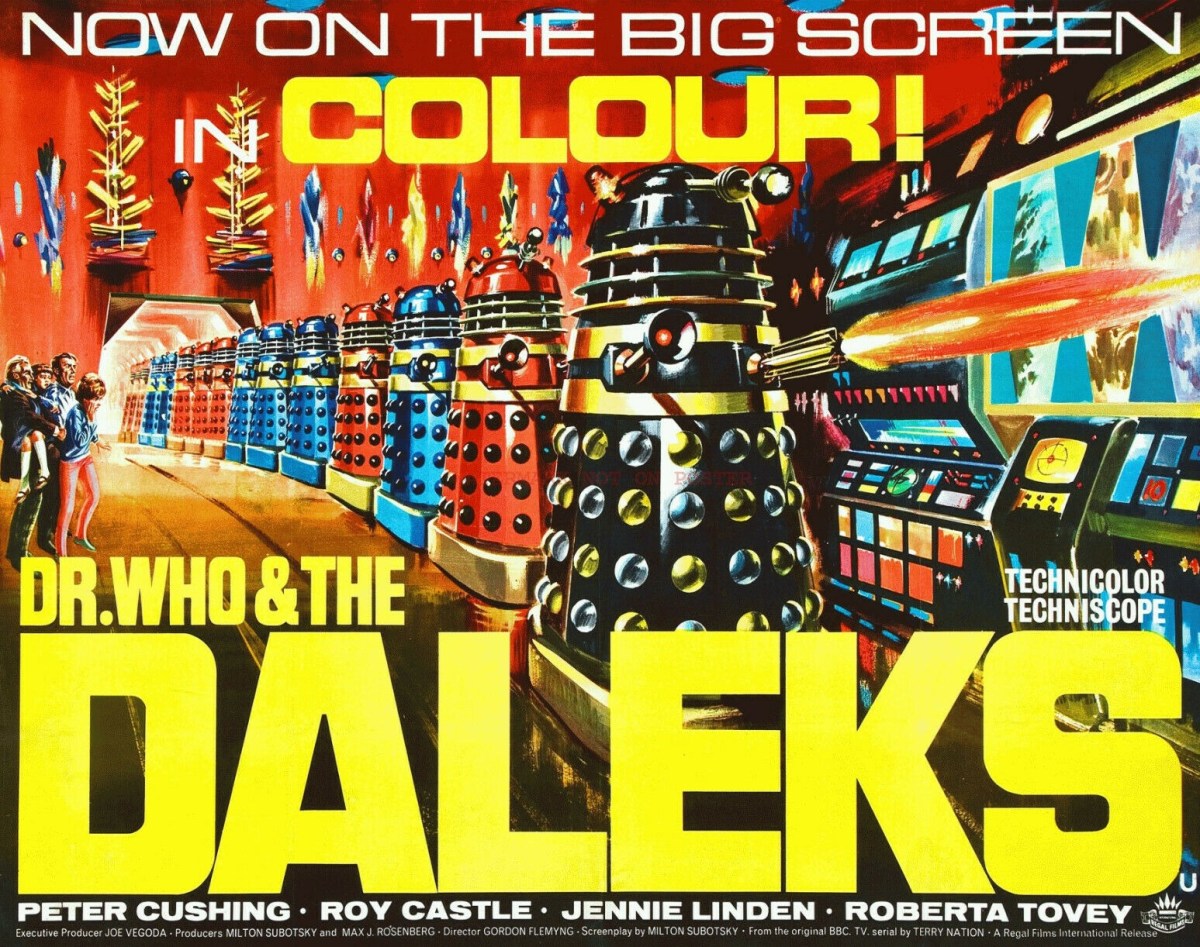
Dr Who and The Daleks (1965) ***

The maiden voyage of the time-travelling Tardis is triggered by some unexpected pratfall comedy. On board are the venerable doctor (Peter Cushing), his intrepid great-granddaughter Susan (Roberta Tovey) and a fearful pair, granddaughter Barbara (Jennie Linden) and accident-prone Ian (Roy Castle). They land on a petrified planet ruled by robotic Daleks with menacing electronic voices.

The malfunctioning Tardis forces them to investigate an abandoned city but they are quickly imprisoned, the steel robots determined to discover why the earthlings should be immune to the radiation that has consumed the planet after nuclear war. Meanwhile, the planet’s remaining inhabitants, the Thals, are planning an uprising.

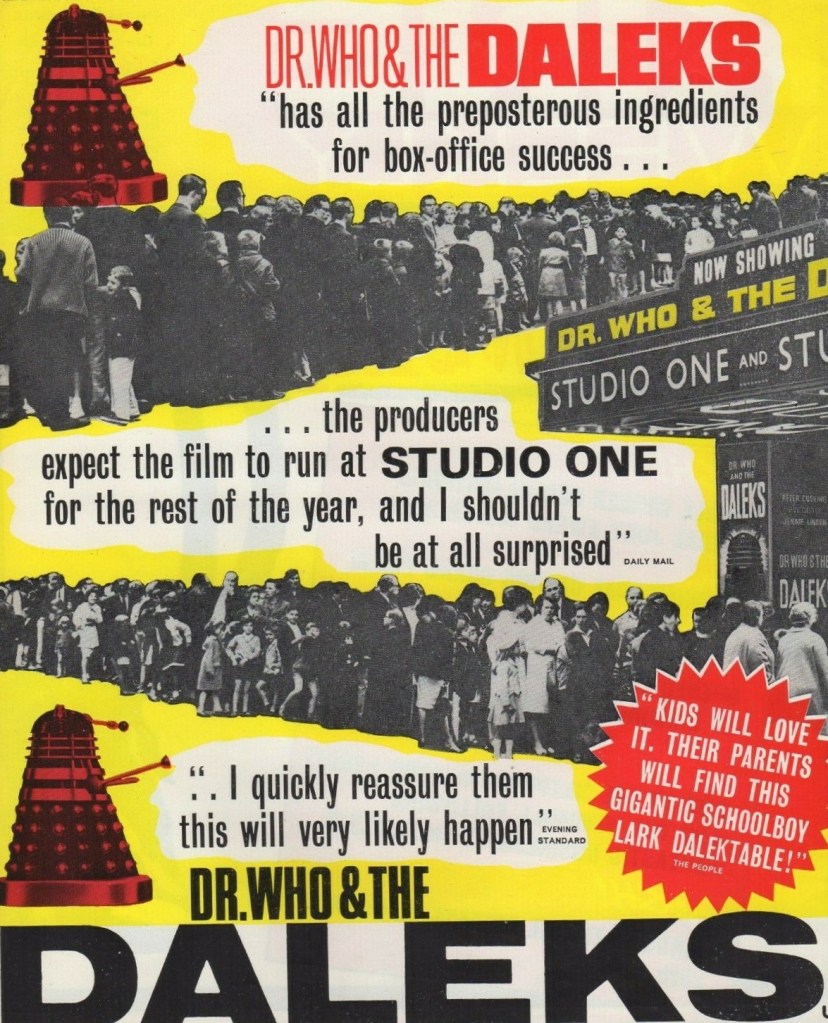
Studio One was one of the smallest cinemas in London’s West End and often used as the launch pad for Disney pictures. Limited capacity ensured that a hit film would run for months and the crowds queueing outside would attract the attention of other passersby.

Budget restrictions ensure that menace is limited, even as the characters endure a heap of traditional obstacles such as swamp and rocky outcrop. Adults who did not grow up in the 1960s when the BBC television series took Britain by storm and apt to come at this without the benefit of nostalgia will certainly look askance at the sets and costumes. And it doesn’t possess the so-bad-it’s-good quality of some 1950s sci-fi pictures. But since it was primarily made for children, then perhaps it’s better to watch it with a younger person and gauge their response – of course, that may be equally harsh from someone brought up on the modern version of the series or already immersed in superheroes.

On the plus side, it does move along at a clip. Roberta Tovey (A High Wind in Jamaica, 1965) charms rather than annoys as the plucky grand-daughter even if her grandfather has mutated from the sterner figure of the television series into an eccentric inventor. Peter Cushing (She, 1965) is only required to ground the production which he does adequately. The innate comic timing of Roy Castle, in his leading man debut, brings a light touch to proceedings as the bumbling boyfriend and generates some decent laughs. Jennie Linden (Women in Love, 1969) has little to do except look scared.

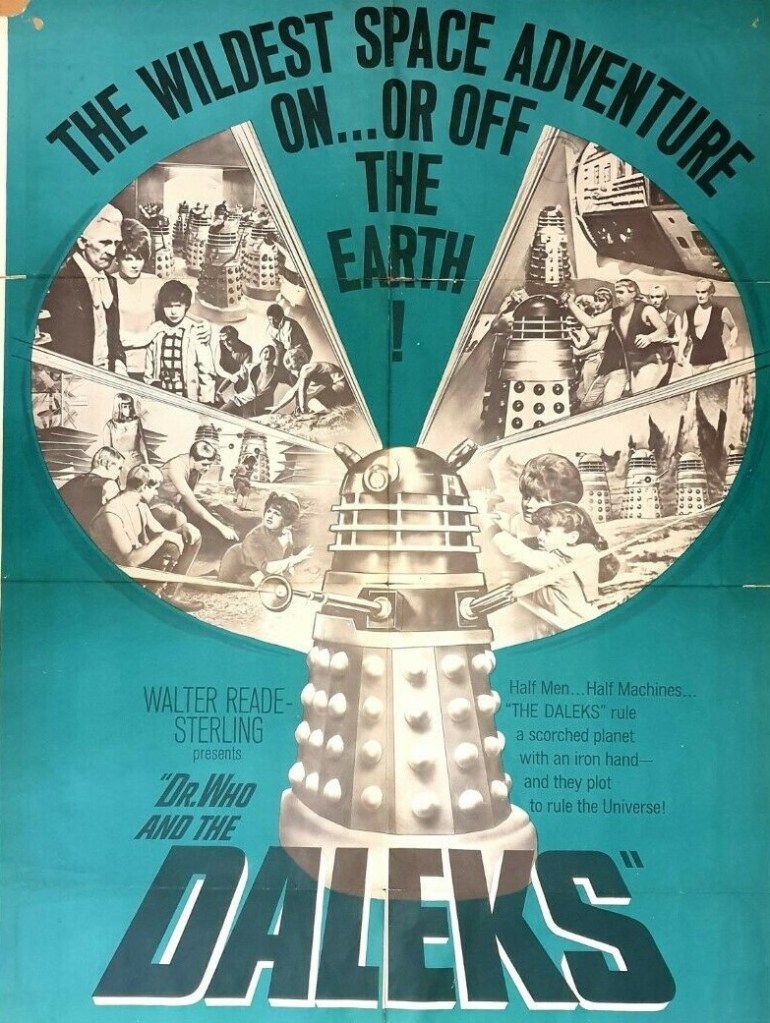
With no built-in audience, the U.S. distributors marketed it in typical fashion – “half men half-machine” – and possibly roped in a bigger adult audience unaware of its origins in children’s television.

Oddly enough, it was American Milton Subotsky who, in opportunistic fashion, brought the project to the big screen, although the BBC had a track record of providing product that might make such a leap, The Quatermass Experiment in the 1950s the leading example. He wrote the screenplay and acted as producer and had previously worked with Cushing on Dr Terror’s House of Horrors (1965) and was about to embark on horror masterpiece The Skull the same year. He has approached the material with some reverence and the fact that the budget allowed for hordes of daleks rather than being seen one or two at a time as on the television probably made some child’s day.

Scottish director Gordon Flemyng (The Split, 1968) would make the leap to Hollywood on the back of this picture and its sequel the following year and you can see what made studios have faith in his ability – he deals with multiple characters, works quickly on a low budget and delivers an attractive picture that was a box office hit.

I suspect that audiences will divide into those who watch the film with nostalgia-colored spectacles, those who think it only as good as a bad episode of Star Trek and those who adore any low-budget sci-fi movie.

You can catch this on Amazon Prime.

Discover WordPress

A daily selection of the best content published on WordPress, collected for you by humans who love to read.

The Atavist Magazine

by Brian Hannan

WordPress.com News

The latest news on WordPress.com and the WordPress community.