The Chairman / The Most Dangerous Man in the World (1969) ****

The sci-fi elements in this tidy paranoia thriller set in Communist China are not the only issues overlooked at the time and worthy of reconsideration now. Anyone who blasted it for supposedly political jingoism conspicuously failed to read a subtext that chimed with young left-wingers for whom Chairman Mao was not, as now, perceived as a tyrant du jour but as a political god. There’s a distinct whiff of Philip K. Dick in the implanting in a spy’s head of not just a tracking/listening device but one laced with explosive that can be remotely triggered for suicidal or murderous gain. Needless to say, the spy, ignorant of this fact, was a de facto sacrificial lamb. And a key plot thread about genetically modified crops as a means of solving world hunger came about four decades too early.  

Widowed Nobel prize winning scientist Dr Hathaway (Gregory Peck) is despatched into China via Hong Kong to contact a missing scientist with a revolutionary formula for an enzyme. A series of crisp flashbacks set up the scenario of the tracking device and a reverse echo of Marooned (1969) where Army chiefs back at base, led by one-eyed Shelby (Arthur Hill,) can listen in but are helpless to intervene – except in sinister manner. Shelby considers Hathaway “the wrong brilliant man” for the task and that they have sent in “a civilian to do a soldier’s job.”
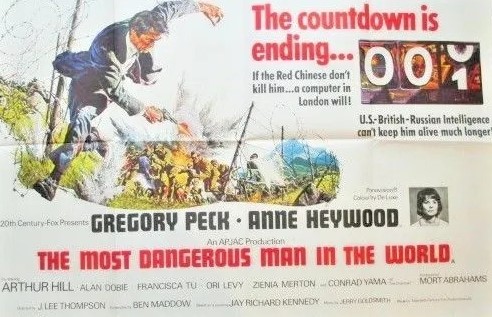
Not able to trust the Brits to know who the title referred to, they came up with a lame alternative. The taglines reveal way too much of the plot.

The hidden transmitter allows Hathaway to keep his superiors posted but the listening device also picks up a creaking bed as Hathaway almost falls into a honey trap in Hong Kong. Amazingly, he doesn’t have to sneak into China but is welcomed with open arms and hustled along to a meeting, and a game of ping-pong (the real thing and the verbal equivalent) with Chairman Mao (Conrad Yama). While spouting some propaganda, Mao is surprisingly open about sharing the secret of the enzyme rather than blackmailing a starving world. Meanwhile, it’s the Americans who are more interested in the double cross, Shelby itching to blow up Hathaway’s head in the assumption the explosion would dispose of the Chinese leader.

Emissions from the transmitter are tangling up the airwaves, making the Chinese secret police highly suspicious of Hathaway as he heads for the secret scientific compound housing Professor Soong Li (Keye Luke), creator of the enzyme, and his daughter Chu (Francesca Tu).

Turns out Hathaway has been summoned by the professor to help find a missing link in molecular chains. Hathaway has to burgle his way to steal the formula, but fails to find it, but when the professor commits suicide and is denounced by his daughter and the Chinese secret police close in, Hathaway has to scarper and head for the Russian border, that country, oddly enough for a spy movie, being on the same side as the Yanks. Meanwhile, Shelby’s trigger finger it itching to blow his man sky high for fear he might give away details of his mission.  
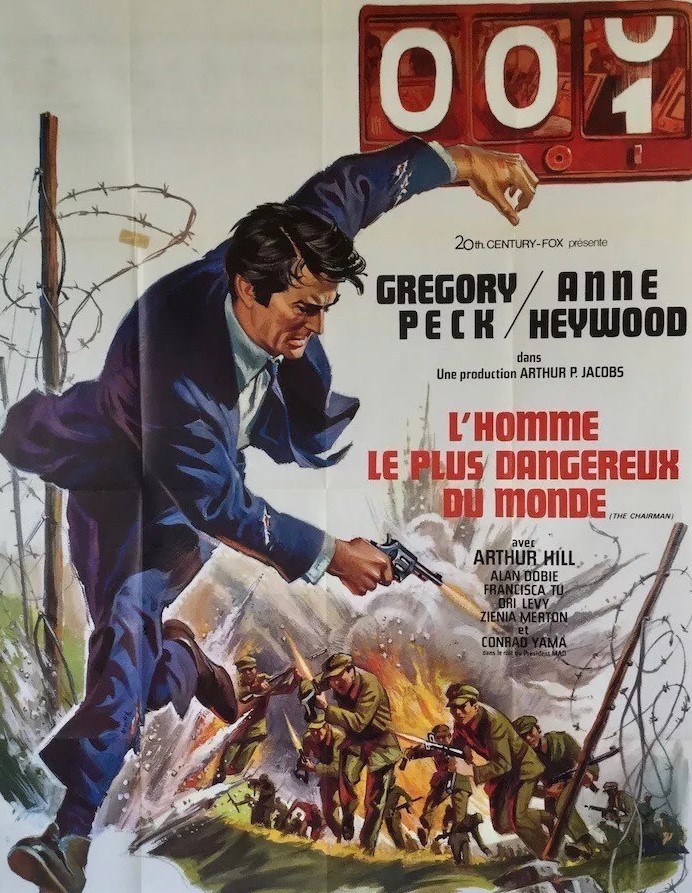
The French, too, had trouble with the original title.

Turns on its head many of the spy film’s truisms: firstly that Hathaway effectively fails in his mission; secondly that patriotism doesn’t blind him to his country’s greed or folly; thirdly that’s he not in constant seduction mode.

Political argument that one point seemed to excessively delay the narrative thrust, now, at half a century’s move, seems more considered and providing an interesting balance between opposing views.

Gregory Peck (Marooned, 1969) is at his quizzical best, deeply-rooted scepticism helping to anchor his character. But if you were attracted by seeing Anne Heywood (The Fox, 1967) second-billed you’re in for a disappointment as she just tops and tails the picture. Arthur Hill (Moment to Moment, 1966) is good value as always.

But it’s testament to J. Lee Thompson (Mackenna’s Gold, 1969, also starring Peck) that his direction brings together diverse political/sci fi/spy/thriller elements in a winning formula, ignoring the obvious. Some interesting detail: someone handing out coffee on a tray to the inmates of the command station; Hathaway’s guilt at his role in the death of his wife barely touched upon, but it explains a lot; Mao’s famous Little Red Book provides a twist.

Occasional flaw: surely the Chinese would have bugged Hathaway’s room and catching him, however soft voiced, filling in his superiors. The idea that the Chinese could be technologically more advanced than the U.S. would have had John Sturges in a fit of fury, but Thompson takes it in his stride. Screenplay by Ben Maddow (The Way West, 1967) and Jay Richard Kennedy (I’ll Cry Tomorrow, 1955).

Reassessment overdue.

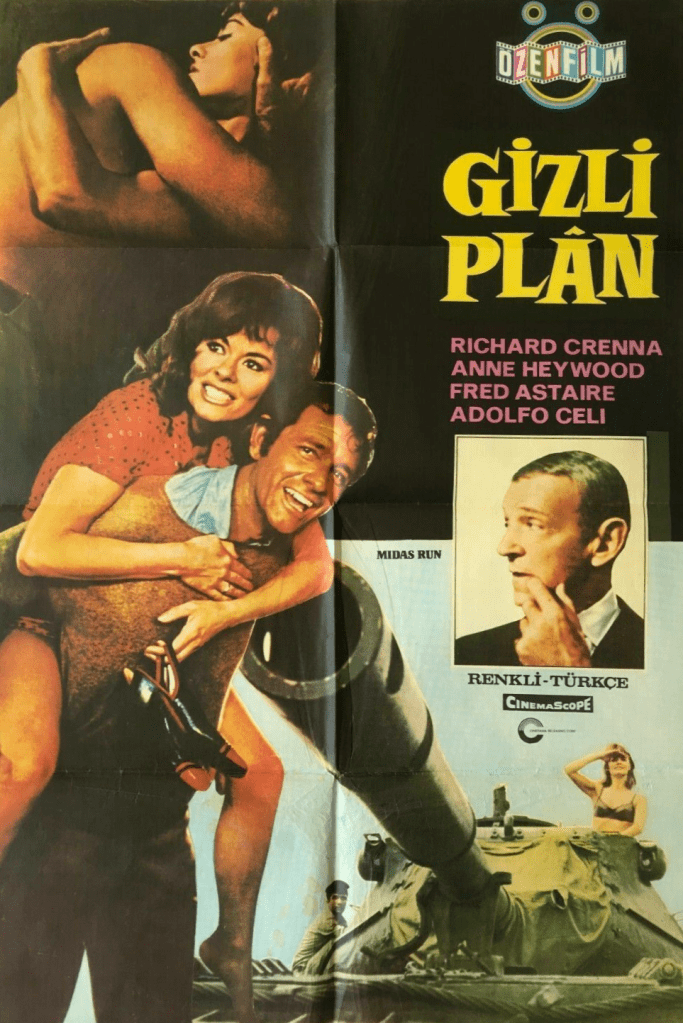
The Midas Run (1969) ***

You ever wonder what triggers criminality? Don’t deny an upper class English civil servant his knighthood, don’t fire an American university lecturer for an anti-war demonstration, don’t humiliate your beautiful wife by making her part of a business transaction. They might all feel robbery is the best revenge.

The highly respected Pedley (Fred Astaire) has talked his superiors in government into the notion that the best way to ship a consignment of gold is by passenger rather than commercial airplane. He recruits wannabe author Mike (Richard Crenna) who, in turn, comes to the rescue of glamorous Sylvia (Anne Heywood) when she is being sold off to sweeten a business deal.

The apparently eccentric casting was based on unfulfilled promise. Fred Astaire, who had not starred in a film for over decade, had made a comeback for Finian’s Rainbow (1968). But that had flopped, putting a dent in his marquee credentials and dramatic roles were hardly the forte of this twinkle-toed dancer. Richard Crenna’s bid for leading man status in Star! (1968) had spectacularly derailed at the box office.

Anne Heywood, the only one of the three principles to have a recent hit, in unexpected sleeper The Fox (1967), found no demand consequently for her services except from lover, future husband and biggest fan, producer Raymond Stross who had bankrolled the lesbian drama, and assigned her female lead here. You could extend your incredulity to the involvement of Swedish director Alf Kjellin,who hadn’t made a picture since Siska seven years before, and like most of his countrymen was seen as producing arthouse fare.

The biggest problem in a gold heist, as anyone watching the current television series The Gold will be aware, is shifting loot that weighs a ton. So Mike and Sylvia hire some Italian crooks to supply a couple of petrol tankers to hide and transport the bullion after the airplane has been forced down over Italian airspace by an Albanian fighter plane, Mike driving the World War Two tank that supplies the ground-based pressure.

As with any heist picture, robbery is only the beginning, double-cross the middle and triple-cross the end. Pedley, who has accompanied the shipment, is delegated by the British secret service to recover the gold, aided by suspicious assistant Wister (Roddy McDowall).  The twist here is that he not only recovers most of the gold, apart from some secreted away by the now romantically-inclined twosome, but points the finger at his accomplices, including the fence General Ferranti (Adolfo Celi).

It then becomes a question of whether the younger crooks can evade his clutches, whether Wister can confirm his suspicions that the investigation has proceeded a tad too conveniently, and discover what the heck the bowler-hatted Englishman is up to. And, of course, whether Mike can trust Sylvia. It wouldn’t be the first – or last (see Perfect Friday, 1970) – grand theft in which the male has been the dupe.

Along the way there is some clever comedy, a play on the British assumption that everyone in the world naturally speaks English, the implicit trust that the upper-classes place in each other, and the stock view that any Italian, law enforcer or crook, can be distracted by a pretty face or comely derriere.

On the downside, the set-up takes too long coming to fruition, especially a mid-movie  interlude that seems intend on channelling the worst romantic notions of the era, idyllic strolls in fields, that I half-expected a burst of slow-motion trotting, or some metaphor for the orgasm. There is some little understood banter about war games. And, for obvious reasons, La Heywood strips down to brassiere in the overheated tank (Mike manages to resist such un-English impulses) though she has previously indulged her innovative ideas about dress, turning a bedsheet into a fashionable toga at a moment’s notice.

There’s nothing particularly new here but Fred Astaire makes a deft impression as a typical upper-class Englishman, accent not found wanting, and successfully reinvents himself as a dramatic actor, that highpoint an Oscar nomination for The Towering Inferno (1974). Anne Heywood, once you realise she is playing all sides against each other, slips easily into the femme fatale role. Richard Crenna’s acting appears limited since his character, despite occasional initiative, is outwitted by all and sundry, and that was scarcely a good look in those days for the leading man to be out-thought by the leading woman.

Effortless, and harmless enough for a matinee.

The Fox (1967) ****

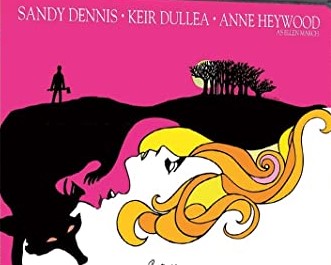
Based on a novella by D.H. Lawrence, The Fox, relocated to contemporary Canada, marked the debut of director Mark Rydell. Originally, Alan Bates (Georgy Girl, 1966), Patricia Neal (Hud, 1963) and Vivien Merchant (Alfie, 1966) were in the frame for the three roles. Instead, the trio were Sandy Dennis, Keir Dullea and Anne Heywood.

Dullea’s career was at a dead end after flops The Thin Red Line (1964) and Bunny Lake Is Missing (1965). Former beauty queen Heywood had been a Rank starlet which resulted in small roles of no distinction until marriage to the film’s producer Raymond Stross improved her prospects. The main marquee attraction was Sandy Dennis who had won the Best Supporting Actress Oscar for Who’s Afraid of Virginia Woolf (1966) and starred in drama Up the Down Staircase (1967). But it was a low-budget enterprise all the way.

Dennis and Heywood play spinsters running a chicken farm in rural Canada, home-body Dennis the more introspective and content, task-oriented Heywood self-sufficient but sexually frustrated. Dullea is a merchant seamen who visits the farm in search of his grandfather, now deceased. Allowed to remain, his presence threatens their lifestyle and forces them to confront the intensity of their suppressed feelings towards each other. Although a real fox is causing trouble, Dullea is the symbolic fox in the symbolic hencoop. Rydell displays considerable confidence in his material.

It is very atmospheric, the natural backdrop, early morning sunsets and wintry chill in the air adding a certain tone, with the isolation providing a thematic template. The tiny cast creates a sense of intimacy as well as tension and the acting is uniformly good. There is no sense of lust, just a gradual emergence of submerged emotion.

Tackling such a bold theme would have brought the movie some attention anyway, but nudity, masturbation and sex brought much more. That such scenes were filmed in good taste and impressed critics was hardly going to deter the salacious. The nervy, whiny Dennis has the showiest role but Heywood’s subdued performance, trapped by her conflicting sexual needs, is the central figure.

George Roy Hill might well have purloined his freeze-frame ending in Butch Cassidy and the Sundance Kid from an idea Rydell employs here, one of only two effective stylistic devices in an otherwise highly-controlled piece. The only directorial downsides are a couple of instances of unnecessary melodramatic music when otherwise Lalo Schifrin’s gentle theme is perfectly in keeping with the picture’s mood. Made on a budget of buttons and reliant entirely on acting skill, this is one of the decade’s low-budget triumphs, not least for its sensitive treatment of its subject matter.

The Fox (1967) ****

Based on a novella by D.H. Lawrence, The Fox, relocated to contemporary Canada, marked the debut of director Mark Rydell. Originally, Alan Bates (Georgy Girl, 1966), Patricia Neal (Hud, 1963) and Vivien Merchant (Alfie, 1966) were in the frame for the three roles.

Instead, the trio were Sandy Dennis, Keir Dullea and Anne Heywood. Dullea’s career was at a dead end after flops The Thin Red Line (1964) and Bunny Lake Is Missing (1965). Former beauty queen Heywood had been a Rank starlet which resulted in small roles of no distinction until marriage to the film’s producer Raymond Stross improved her prospects. The main marquee attraction was Sandy Dennis who had won the Best Supporting Actress Oscar for Who’s Afraid of Virginia Woolf (1966) and starred in drama Up the Down Staircase (1967).

Despite the film-makers attempts to treat the subject matter with subtlety, this did not prevent film reviewers and the most sensational newspapers by pumping up the sex angle.

But it was a low-budget enterprise all the way. Dennis and Heywood play spinsters running a chicken farm in rural Canada, home-body Dennis the more introspective and content, task-oriented Heywood self-sufficient but sexually frustrated. Dullea is a merchant seamen who visits the farm in search of his grandfather, now deceased. Allowed to remain, his presence threatens their lifestyle and forces them to confront the intensity of their suppressed feelings towards each other.

Although a real fox is causing trouble, Dullea is the symbolic fox in the symbolic hencoop. Rydell displays considerable confidence in his material. It is very atmospheric, the natural backdrop, early morning sunsets and wintry chill in the air adding a certain tone, with the isolation providing a thematic template. The tiny cast creates a sense of intimacy as well as tension and the acting is uniformly good.

It was quite a feat for a small budget picture to achieve a circuit release in Britain – in this case on the ABC chain. No doubt in part due to the sensational images used in the poster.

There is no sense of lust, just a gradual emergence of submerged emotion. Tackling such a bold theme would have brought the movie some attention anyway, but nudity, masturbation and sex brought much more. That such scenes were filmed in good taste and impressed critics was hardly going to deter the salacious. The nervy, whiny Dennis has the showiest role but Heywood’s subdued performance, trapped by her conflicting sexual needs, is the central figure.

George Roy Hill might well have purloined his freeze-frame ending in Butch Cassidy and the Sundance Kid from an idea Rydell employs here, one of only two effective stylistic devices in an otherwise highly-controlled piece. The only directorial downsides are a couple of instances of unnecessary melodramatic music when otherwise Lalo Schifrin’s gentle theme is perfectly in keeping with the picture’s mood.

Made on a budget of buttons and reliant entirely on acting skill, this is one of the decade’s low-budget triumphs, not least for its sensitive treatment of its subject matter.

Discover WordPress

A daily selection of the best content published on WordPress, collected for you by humans who love to read.

The Atavist Magazine

by Brian Hannan

WordPress.com News

The latest news on WordPress.com and the WordPress community.