Woman of Straw (1964) ***

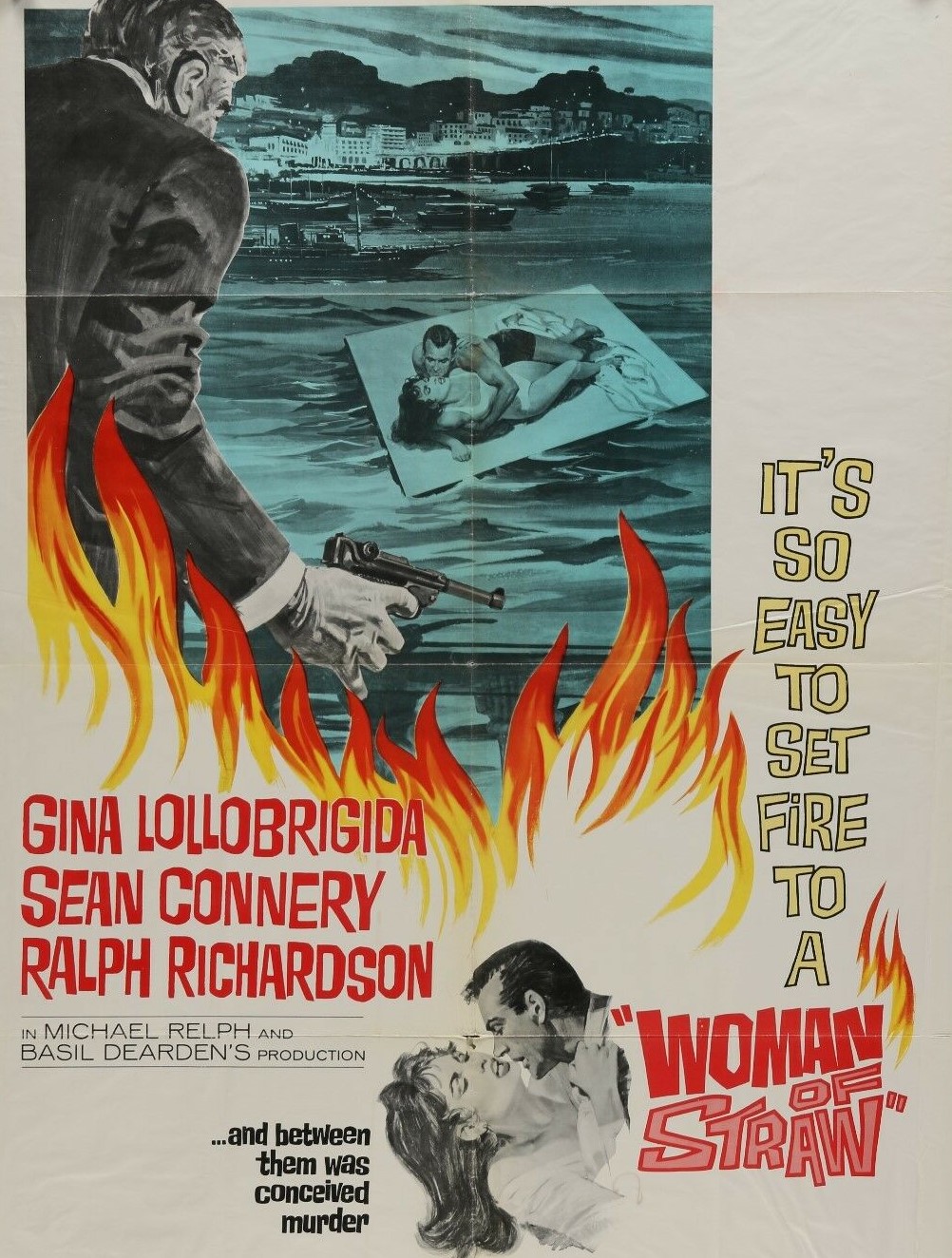
In a plot worthy of Hitchcock without that director’s sly malice, rich playboy Tony (Sean Connery) conspires with not-so-innocent nurse Maria (Gina Lollobrigida) to rid himself of  heinous upper-class racist misogynistic bully Charles (Ralph Richardson), his uncle. Beyond  a savage case of entitlement, Tony has good reason to hate the wheelchair-bound multi-millionaire, blaming him for his father’s suicide and for seducing his widowed mother, now dead. Tony’s ploy, in part by opposing the very idea, is to get Maria to marry Charles, inherit his fortune and provide himself a £1 million finder’s fee when the seriously ill old man dies.

Maria’s refusal to kowtow to the old man and her initial resistance to Tony make her all the more desirable to both. When Maria saves the old man from a potential heart attack, he is moved enough to marry her and draw up exactly the will the pair want. But when he suddenly dies, Maria surprises herself by the depth of emotion she feels.
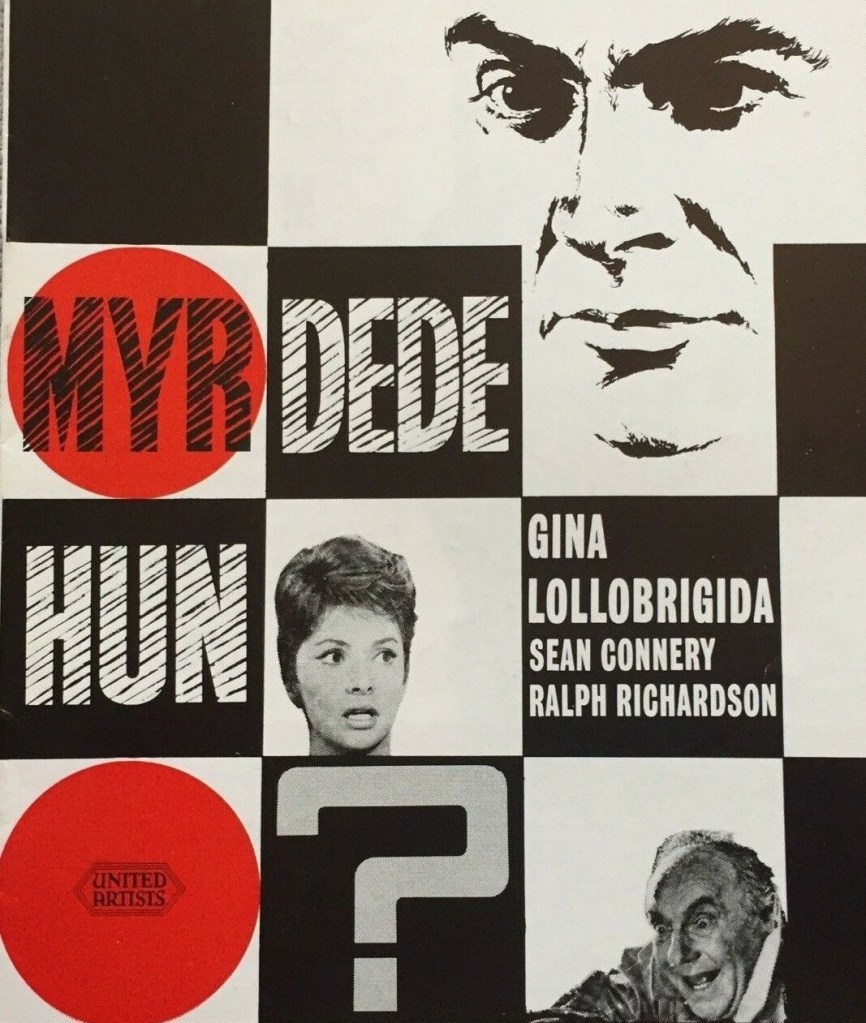
But that soon changes when she comes under suspicion. A bundle of complications swiftly change the expected outcome. A police inspector (Alexander Knox) doubts cause and place of death.

The first half is the set-up, the various figures being moved into place, not quite as easily as might have been anticipated, which adds another element of tension. Charles is such a hideous person nobody could lament his passing, but still his vulnerability, not just his wheelchair confinement but his love of music, his better qualities coming to the fore as the result of Maria’s presence, accord him greater sympathy than you would imagine.

That the otherwise gallant Tony’s entitled life depends entirely on his uncle’s good wishes lends him an appealing frailty. The nurse’s principles safeguard her against being taken in by riches alone, but there is a sense that she has used her physical attraction in the past to her advantage.

After the first two James Bond pictures, this was Sean Connery’s first attempt to move away from the secret agent stereotype and in large part he is successful. As amoral as Bond, he could as easily be a Bond villain, smooth and charming and larger than life and superbly gifted in the art of manipulation, the kind of putting all the pieces in place that Bond villains excelled in.
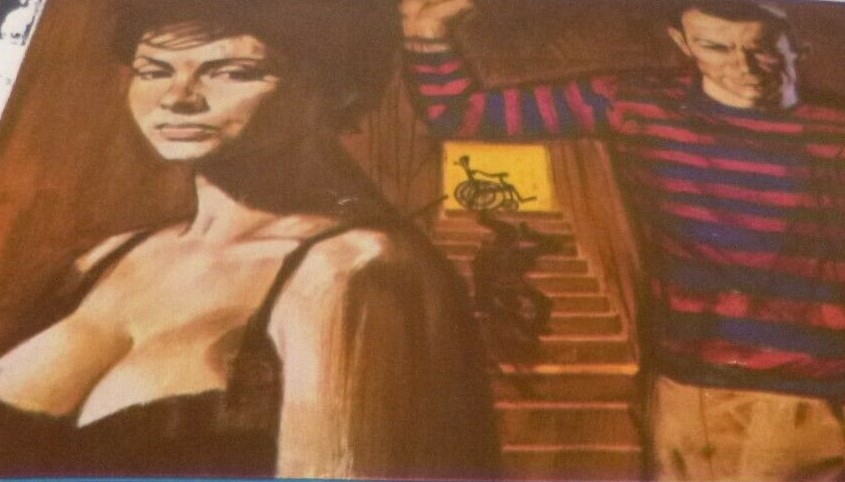
It will come as a surprise to contemporary viewers that he is merely the leading man, not the star. Gina Lollobrigida (Go Naked in the World, 1961) receives top-billing because she carries the emotional weight, initially perhaps as cold as Tony, but her attitude to Charles changing after marriage, meeting a need that Tony would not consider his to fulfill, and beginning to regret going along with any devious plan. That she then discovers she may merely be a pawn rather than a partner creates the dilemma on which the final section of the film depends for tension.

Both actors are excellent, exuding star wattage, the screen charisma between them evident, and audiences craving the pairing of Connery with an European female superstar will be well satisfied. Lollobrigida has the better role, requiring greater depth, but it is romance as duel most of the way. Ralph Richardson (Khartoum,1966) has never been better as one of the worst human beings ever to grace a screen. Johnny Sekka (The Southern Star, 1969) brings dignity to the maligned servant and Alexander Knox (Khartoum) is a crusty cop. 

A slick offering from Basil Dearden (The Mind Benders, 1963), with one proviso – see seaparate article for the racism in this film. Written by Robert Muller (The Beauty Jungle, 1964) and Stanley Mann (The Collector, 1965) based on the novel by Catherine Arley.

Could have done with expending less time on the set-up and getting to the meat of the thriller quicker.

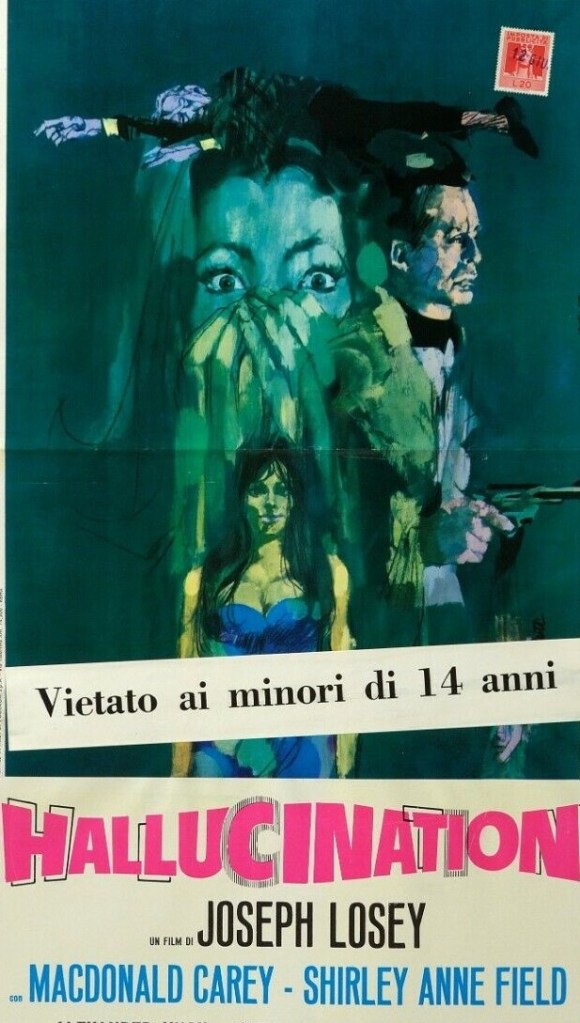
Modesty Blaise (1966) ***

You might well enjoy this if a) you are in a very good mood, b) you love psychedelia, Pop Art and the Swinging Sixties, c) you fancy a spy film spoof or more likely d) you are a big fan of one or all concerned. Otherwise, you might be well advised to steer clear because it either takes the mickey out of a number of genres, not just espionage, or plays merry hell with narrative and character and is only loosely based on the source material by Peter O’Donnell.

Bear in mind it originated in a comic strip – later turned into a series of novels – that had more in common with the likes of Danger: Diabolik than the more straightlaced adventures emanating from DC Comics or Marvel. In particular, Modesty had a neat habit of distracting the villains by appearing topless in moments of crisis – a trick adopted in movies like 100 Rifles (1969) and El Condor (1970).

Fans of the comic strip/book may have been left indignant by the audacity of the filmmakers to introduce romance between Modesty and her sidekick Willie Gavin since in the book their relationship was strictly platonic. There was no place, in either comic strip or book, for the musical numbers that pepper the movie. And – check out The Swinger (1966) – for the notion of a character acting out a fictionalized version of herself.

You should be aware that Modesty is a very rich version of the gentleman sleuth, an idea that belonged to the old school, of a person, such as The Saint, bored with wealth, who takes on dangerous assignments in the eternal battle between good and evil.

Anyways, on with the story.

Modesty Blaise (Monica Vitti) is hired by the British government in the shape of MI5 chief Sir Gerald Tarrant (Harry Andrews), in return for immunity for her previous crimes, to deliver a secret shipment of diamonds, part-payment for oil imports, to Sheik Abu Tahir (Clive Revill). Modesty happens to be the sheik’s adopted daughter. Meanwhile, criminal mastermind Gabriel (Dirk Bogarde), believed to be dead, has his eyes on the consignment.

Meanwhile (again), Modesty upsets current lover Hagen (Michael Craig), Tarrant’s aide, by hooking up with old flame Willie Garvin (Terence Stamp). Meanwhile (again again), Garvin hooks up with another of his old flames, magician’s assistant Nicole (Tina Marquand), who has information on Gabriel.

Various assassins employing a variety of methods are sent to kill Modesty so a good chunk of the picture is her avoiding her demise. Gabriel is a pretty touchy employer, so upset by failure that he assigns his Amazonian bodyguard Mrs Fothergill (Rosella Falk) to eliminate all such assassins. Gabriel, however, is something of a contradiction, very sensitive to violence. And just in case you are not keeping up with the plot, conveniently, the bulk of the conversations between Tarrant and his superior (Alexander Knox) will fill you in.

Through a whole bunch of clever maneuvers on Gabriel’s part, Modesty and Willie are forced to steal the diamonds themselves. And, meanwhile, Hagen is on their tail, infuriated at being jilted.

In between the umpteen shifts in plot, which basically lurches like a ship in a storm, the screen is ablaze with color. Nobody complained much when Raquel Welch found it necessary to change her bikini ever few seconds, or that a musical required continuous costume changes, and Modesty here seems to have fallen into the same pattern, the changes in outfit often so swift you imagine she has a disorder.

And be warned, this is a poster film for Pop Art, so if it’s not clothes that are being swapped, it’s décor. You might put Terence Stamp’s blond barnet in the discordant category. You can’t really complain about the plot because espionage storylines are usually something of a conjuring trick with the impossible little more than a standard mission. There’s much to enjoy if you’re of a mind and subscribe to one of the four ideas outlined in the opening paragraph and like the idea of the otherwise critical darling Joseph Losey (Accident, 1967) giving way to stylistic overkill.

Monica Vitti (Girl with a Pistol, 1968) inhabits the role with the necessary verve though Terence Stamp (The Collector, 1963) looks as if he has walked into a spoof and Dirk Bogarde (H.M.S. Defiant / Damn the Defiant!) appears still in experimental mode, having dumped the British matinee idol, unsure of what his screen persona should be. Evan Jones (Funeral in Berlin, 1966) is generally to be blamed/praised for the screenplay.

A movie for which the word confection was invented.

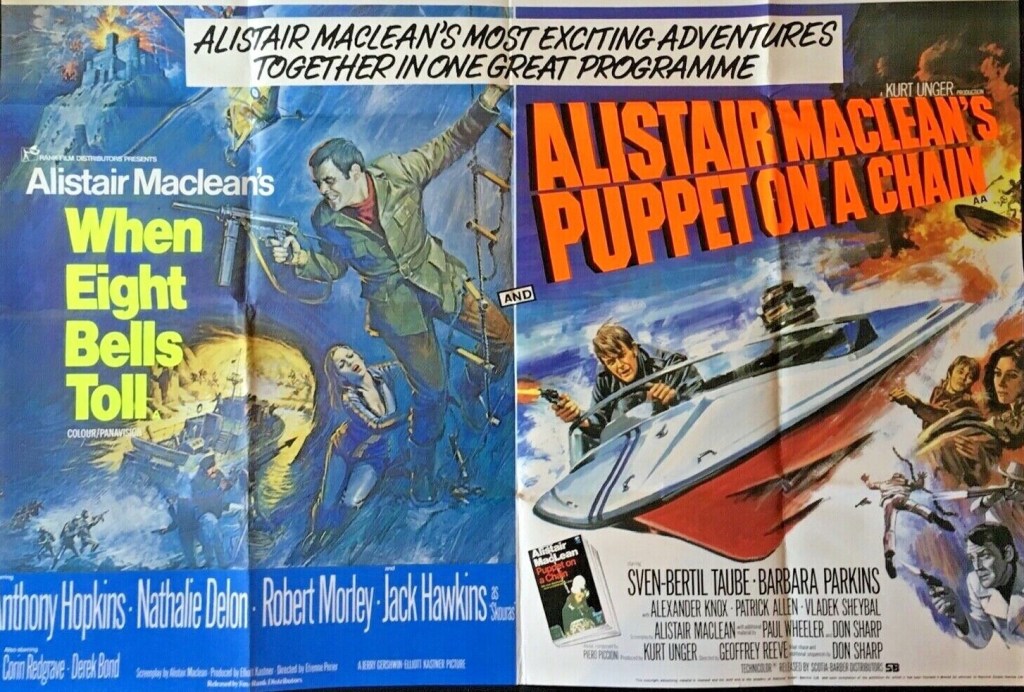
Puppet on a Chain (1970) ****

The spy genre was dying on its feet, even James Bond slipping into spoof territory, and it was left to Alistair MacLean to revive the genre with believable heroes and settings not just chosen for their scenic potential, fitting somewhere between the gritty policiers of Bullitt (1968) and The French Connection (1971) and with an emphasis on violence that Sam Peckinpah would be proud of.

Stylish bullet-ridden opening, crackerjack climax. In between depicting Amsterdam scenery and depravity side by side comes betrayal, duplicity, drugs, heinous deaths, plenty action, and as much as Bullitt (1968) reinvented the car chase this did the same for speedboats.

Tracking point of view follows an assassin into a house where he kills three people and removes something from the pendulums of clocks. U.S. narcotics agent Sherman (Sven Bertil-Taube) flies in to Amsterdam but before he can collect vital information from colleague Duclos he is murdered.

Top Dutch cops Col De Graaf (Alexander Knox) and Inspector Van Gelder (Patrick Allen) are helpless to stop the growing heroin traffic. Van Gelder, with addicted niece Trudi (Penny Casdagli), knows only too well the personal cost.The police force is riddled with leaks, the heroin gang out to stop Sherman from the get-go.

But Sherman has his own nasty medicine to deal out, and hands out beatings and death to those who get in his way. Helped by colleague Maggie (Barbara Parkins) and, inadvertently by Duclos’s girlfriend Astrid (Ania Lemay), the trail leads to the Morgenstern warehouse, which stocks all sizes of puppets, and a church run by shady pastor Meegeren (Vladek Sheybal) which has re-purposed Bibles.

Sherman has no sooner escaped one attempt on his life than he encounters another, so the action never lets up. Meanwhile, clues lead him to a boat in the harbor and he discovers how the heroin is being shipped. Maggie, on hand to offer romantic consolation, shares his tough assignment and questions his methods.

Although revivals were usually sold on the weight of a star, but by this point MacLean was a box office commodity and, let’s face it, neither Hopkins nor Bertil-Taube had much of a calling card.

The trail isn’t that hard to follow but the obstacles are considerable. Meegeren and pals take hanging to the extreme, strangling victim on steel chains, dangling them high as a warning to others. So, mostly, leavened, depending on your point of view, by titillating views of the Dutch capital and a sexy dance troupe that would put Bob Fosse to shame, its fist- and gun-fights all the way.

Except for his dalliance with Maggie, a romance that has to be kept under wraps, Sherman fits the tough Alistair MacLean template with a ruthless streak wide enough to have won plaudits from Where Eagles Dare team He gets a good dousing in the sea and is an unwilling candidate for a brainwashing technique that combines tradition with a personalized version of the sonic boom.

But the highlight without doubt is the high-speed speedboat chase through Amsterdam, beginning in the wider Zuider Zee before racing through the narrow twisty Dutch canals.

For the Dutch Tourist Board it was a game of two halves, organ music aplenty, cobbles and canals, and people dressed in traditional garb promoting the city as a desirable destination but the unsightly addicts and the sex trade as likely to put overseas visitors off (although for many that may well be the icing on the cake).

It was rare at this point, in a polished Hollywood-style picture, to dig so deeply into the seamy side of a city, but his one pulls no punches, nitty-gritty winning out over gloss, and where Easy Rider (1969) and others of that ilk opted to canonize drugs this favored grim consequence. 

It seems particularly difficult to get the casting right for an Alistair MacLean movie of the lone wolf variety – the all-star war pictures by contrast having no trouble attracting major players – and if you turned up your nose at Richard Widmark in The Secret Ways (1961), George Maharis in The Satan Bug (1965) and Barry Newman in Fear Is the Key (1972) you might quibble at Swede Sven Bertil-Taube (The Buttercup Chain, 1970). But he makes a fairly decent stab at the standard dour character.

Barbara Parkins (Valley of the Dolls, 1967), way out of her comfort zone, does well as the tough woman with a soft center. But, all told, you would say it benefits from largely casting unknowns as it prevents the audience arriving with preconceptions. In her only movie Penny Cadagli is the pick of the support, especially as her role in the movie is to play a role.

Although Geoffrey Reeve (Caravan to Vaccares, 1974) hogs the directing credit, the speedboat chase, other action scenes and the tightening up of the picture was the work of Don Sharp (Bang! Bang! You’re Dead, 1966). And Alistair MacLean didn’t, as he might have expected, receive sole screenwriting credit either, sharing it with Sharp and Paul Wheeler (Caravan to Vaccares, 1974).

Not only plenty of bang for your buck, but a riveting chase and one of the first sightings of heroin supply as the key driver of the narrative.

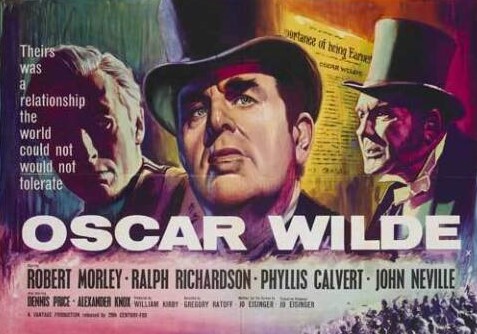
Oscar Wilde (1960) ****

You might be surprised to learn there were two Oscar Wildes. Not the famed writer and a doppelganger of course but two films on the same subject that were released in the same month. This is the low-rent version, costing a fraction of the rival The Trials of Oscar Wilde directed by Ken Hughes. It’s easy to be disdainful of the cheaper effort, with little cash available for scenery and costumes, but somehow it rises above budget limitations. Structurally, both movies focus on the trial – or in the case of The Trials of Oscar Wilde the three trials he endured – but the glossier pictures it has to be said glosses over a great deal.

While I enjoyed it at the time, I now find that in trying to make a modern martyr out of Oscar Wilde, the Ken Hughes picture built him up so much that it was difficult to find any flaw in his character. We never find out what was the actual slur the Marquis of Queensbury made on Wilde, resulting the playwright taking him to court for libel. And that version begins with Wilde and Alfred Lord Douglas (“Bosie”), son of the Marquis, already deep into their affair.

On the other hand, Oscar Wilde, the final film of Hollywood veteran director Gregory Ratoff (Intermezzo, 1939), starts at the beginning of their relationship with greater emphasis on Wilde’s practicality rather than his wit and Bosie’s (John Neville) tortured relationship with  his hypocritical father (Edward Chapman) who, while taking the moral high ground, keeps a mistress. On Wilde (Robert Morley) being described as a sodomite by the Marquis, Bosie’s desire to see his father humiliated in court verges on revenge. “You weren’t looking for a friend,” Wilde astutely tells his lover, “You were looking for a weapon.” Bosie is big on humiliation – he is the one to break the news of Wilde’s duplicity to the author’s wife (Phyllis Calvert). So determined is he on the court case that he fails to tell Wilde that his father has private detectives scouring London to find evidence.

While in court Wilde can keep the jury in stitches with his epigrams, he soon comes up against the Marquis’s formidable lawyer Sir Edward Carson (a quite stunning performance by Ralph Richardson). From Carson we learn a great deal more of Wilde’s practices, some of which nowadays would be termed grooming. Essentially, Carson paints a portrait of a predator, an older man (Wilde was 41) whose uses his wealth and wit to court many lovers, mostly aged around 20, but some as young as 16, barely the age of consent.. And when he felt his secret life was in danger of being exposed, he went so far as to pay for the passage to America of one of his lovers, Alfred Woods, to get him out of the way.

No matter that Wilde at the start can gloss over his promiscuity, complaining that Carson is misinterpreting innocent gestures of friendship, the cunning attorney soon has the author tied in knots as he wheels out one by one information regarding the various lovers.

It’s quite odd to realise that The Trials of Oscar Wilde in presenting the more accurate truth – that the author underwent three trials – fails to provide little more than a surface treatment of  the man’s real-life affairs. Oscar Wilde perhaps delves too deeply for audiences brought up to consider the author a martyr who deserves the free pass allocated all writers of genius. I found Oscar Wilde the more riveting watch because, of course, I already knew the outcome, but the sight of the famed writer, encouraged by the vengeful Bosie,  hung out to dry by his own hubris, and for a man of such wit to be outwitted in the courtroom by Carson was an exceptional watch.

Of course, the imprisonment of Wilde for the crime of being a homosexual is detestable. Even at the point this film was made homosexuality was a crime. So it’s fascinating to see how much The Trials of Oscar Wilde skirts round issues that Oscar Wilde had little problem in spelling out.

I was surprised how much I enjoyed Robert Morley’s performance. I may be wrong, but I think this was the only time he was accorded leading man status. Mostly, he was a supporting actor (The African Queen, 1951, say, or Genghis Khan, 1965) and often just playing a version of his self. Of course, he is outshone by a simply brilliant Ralph Richardson (Khartoum, 1966). John Neville (A Study in Terror, 1965) presents a more in-depth performance than in the rival picture. One-time British box office star Phyllis Calvert (The Golden Madonna, 1949) does well in a small but pivotal role. You might also spot Dennis Price (Tunes of Glory, 1960) and Alexander Knox (Mister Moses, 1965).

Lacking a budget to do much more, Gregory Ratoff sticks to the detail and draws out two superb performances, aided by a tight script by Jo Eisinger (Gilda, 1946; Cold Sweat, 1970) based on the play by Leslie and Sewell Stokes and the work of Frank Harris. As swansongs go, this is hard to beat.

Vastly underrated.

Catch it on YouTube.

NOTE: Oscar Wilde appeared in first run in Glasgow at the La Scala cinema in June 1960 one week ahead of The Trials of Oscar Wilde at the first run ABC Regal and ABC Coliseum.

Mister Moses (1965) ***

The “lost” Robert Mitchum picture, never seen on VHS or DVD, but now turning up on YouTube.

Elephants have little proven appeal for audiences. From Dumbo (1941), Hannibal (1960), Billy Rose’s Jumbo (1962) and Hannibal Brooks (1968) through to Dumbo (2017) and Babylon (2022), the story is one of negative impact on box office. Baby elephants are maybe a different story – see Hatari! (1962)  – but there’s very little that’s cuddly about the adult version and their main purpose appears to be to annoy a major stars initially and then go on a rampage that either hinders or helps said star. If you’re acquainted with elephants, you’ll notice this is of the tameable Asian variety rather than the untamed African.

The unnamed beast here would fall into the former category except the eponymous Mister Moses (Robert Mitchum) – real name Joe – can talk to the animal in a language it understands and persuade it to show off its parlor tricks, enhancing Moses’s status among a small  community in Kenya. Moses is a con-man-cum-diamond smuggler, rescued from a river, specifically the reeds growing there that offer a Biblical connection to the natives.

The Bible plays a significant role here, though the natives don’t fall for the Noah story as explained by missionary (Alexander Knox). They are, like Native Americans, being driven off their land by the arrival of a dam which will flood their traditional grounds. Their cattle have not been included in the grand plan to airlift the entire community. So they refuse government help, hence the need to embark on a 300-mile trek.

Moses, a dodgy character with “an allergy to badges of authority”, is blackmailed by the missionary’s daughter Julie (Carroll Baker) and ends up doing the job of her fiancé, district commissioner Robert (Ian Bannen), to shift the natives off their land. He’s got some parlor tricks up his sleeve, too, including a flame-thrower which, again the old Biblical touch, he can employ to burn a bush, thus endearing himself as a leader.  

Naturally, enough, though staid, Julie finds herself attracted to Moses, a somewhat laid-back character with quite a line in hip patter. But it’s quite a stretch for Julie to be seduced by his knowledge of classical literature, namely the Andromeda-Perseus tale. Not everyone takes to Moses’ leadership, saboteurs steal the map and the compass.  And it’s no surprise when someone finds another purpose for the flame-thrower. There’s a bad witch doctor Ubi (Raymond St Jacques) to be put in his place, and Joe rises out of his lethargy long enough to dispose of a couple of villains.

With the emphasis on the Biblical, Joe is called upon to “part the waters” Exodus-style. Disappointingly, this is a bit of a parlor trick. It had me wondering how the heck he was going to do that,  with just a flame thrower and an elephant at his disposal, and also given that the sole purpose of rivers in African movie vernacular is so that the leading lady can bathe in one. Since the aforementioned river is nothing more than the outcome of another dam, Moses is clever enough to simply persuade the dam superintendent to – miracle of miracles – to turn off the water.

There’s enough going on to maintain interest and the will-she-won’t-she element is well-handled and there’s a good final line, “What’ll I do for laughs?”

Robert Mitchum has been here before (Rampage, 1963) but this time is on the side of the animals. Of course, the main interest is not how well he gets on with the elephant but whether he strikes sparks with a Carroll Baker (Harlow, 1965) eschewing her normal sexy persona. A cross between Hayley Mills and Deborah Kerr, Baker doesn’t quite suggest bottled-up sexual energy fizzing to get out, but then that wouldn’t be in character. It’s not in The African Queen league in terms of screen partnerships but it’s certainly workable enough.

Ian Bannen (The Flight of the Phoenix, 1965) is at his scowling best although Raymond St Jacques (Uptight, 1968) gives him a run for his money. Director Ronald Neame (Gambit, 1966) proved as adept at handling the big-name stars as the animals without it being acclaimed as a famous “lost” work of Mitchum. The screenplay by Charles Beaumont (Night of the Eagle/Burn, With, Burn, 1962) and Monja Danischewsky (Topkapi, 1964) was based on the novel by Max Catto (Seven Thieves, 1960).

A pleasant enough diversion.

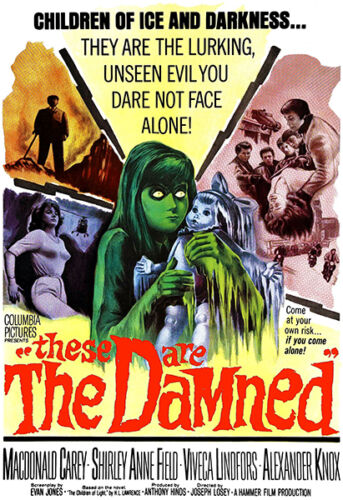
The Damned / These Are The Damned (1963) ****

Nihilism was at a peak in the 1960s. The threat of nuclear war and/or the fallout from radiation was as genuine a fear as the leak of a man-made disease is today. This was a precursor, though initially ignored, of the spate of nuke movies like Fail Safe (1964), Dr Strangelove (1964) and The Bedford Incident (1965) which made the argument not to leave nuclear accessibility in the hands of trigger-happy politicians, scientists and the military.  

The idea that scientists for experimental reasons might welcome radiation was not a notion easily embraced. The Damned (not to be confused with the earlier Village of the Damned, 1960,  and later Children of the Damned, 1964, or, for that matter, Luchino Visconti’s The Damned in 1969) presents a more ruthless scientific approach than audiences might expect.

Three tales eventually dovetail. In a very contemporary nod to English society, tearaways known as “teddy boys” terrorise a seaside town. Led by the snappily-dressed umbrella-wielding King (Oliver Reed) when not causing general mayhem they take pleasure in beating up any male who happens to be enticed by his glamorous sister Joan (Shirley Anne Field). One such unfortunate is Simon (MacDonald Carey), an American tired of the rat race. Joan decides she has had enough of being used as sexual bait and boards Simon’s yacht to apologise, at which point unlikely romance ensues. Not that romantic initially, as Simon assumes she is easy pickings, and comes on a shade too strong. Her thwarted brother sends his gang to spy on the couple.

Scientist Bernard (Alexander Knox) welcomes the arrival of his sculptor girlfriend Freya (Viveca Lindfors) who has a studio in a cottage on the cliffs. Underneath the cliffs is a secret project involving a group of obedient 11-year-old children who appear to have lived there from birth, with whom Bernard communicates via closed circuit television.

Joan and Simon enjoy an evening idyll in the empty cottage until chased out by the gang. Escape leads them down the cliffside where the children offer them a hiding place. The kids think Joan and Simon are their parents coming to the rescue. They believe they are on a spaceship headed to planets unknown. They are as baffled that the incomers have warm skin as the escapees that they have cold skin. Eventually, they are joined by King, rescued from drowning by one of the children.

Eventually, too, all are trapped by Bernard and his men. King, with his violent skills honed, is able to take on the guards and fashion an escape. Bernard allows the couple to leave on Simon’s yacht, knowing they will die of radiation poisoning before too long, a helicopter hovering overhead should they decide to land anywhere.

When Freya discovers the truth, Bernard kills her. The children lived through a radiation leak and are being groomed by Bernard to survive the inevitable future nuclear war in the hope, presumably, that they might breed and create a generation invulnerable to radiation. All that upsets the scientist of this incident is that the children now know they are prisoners.

Small wonder Hammer didn’t know what to do with such downbeat fare. Ruthless scientists like Bernard were usually put in their place by intrepid civilians like Simon and Joan or outsiders like King. The imprisoned always escaped. Humans, never mind children, were not treated as lab rats. A more cynical contemporary audience would not be remotely surprised at the conspiracies of scientists and governments.

If you think The Wicker Man (1973) took an age to achieve cultdom, this took forever, in part because of the later artistic recognition of director Joseph Losey, this scarcely fitting into an oeuvre that contained The Servant (1964) and The Go-Between (1971). Recognition was negated by poor initial distribution, the American version heavily edited, and it wasn’t really until this century that its worth was vindicated.

It’s a brilliantly bold construct, especially as, in retrospect, other characters are imprisoned one way or another. King scarcely lets Joan out of his sight, and while forcing her to strut her stuff to entice men that he can mug is revulsed at the notion of her embracing another man. Freya, too, although she doesn’t realise it, can only enjoy a relationship with Bernard in which he has complete control. The teddy boys, who think they can wreak havoc, are easy pickings for the might of the military.

Some scenes are just superb. Joan picking up Simon. King’s relish of violence. Bernard in avuncular tones addressing the children, who could all be in the running for cute Disney roles. Joan’s shock at the coldness of the children. The children’s innate obedience turning to rebellion at their betrayal. A camera tracking a room to the sound of heavy footsteps, those revealed to belong to a man in a Hazchem outfit. Bernard’s cold-blooded elimination of his lover. Finally, the cries of the children too distant to be heard by tourists on a beach.

Oliver Reed (Hannibal Brooks, 1968), working hard on his steely stare and his breathless tones, is the pick here, but Alexander Knox (Accident, 1967)  runs him close. Sultry-eyed Shirley Anne Field (Saturday Night and Sunday Morning, 1960) does better than B-film regular MacDonald Carey who appears out of his acting depth.  

Genuine cult material.

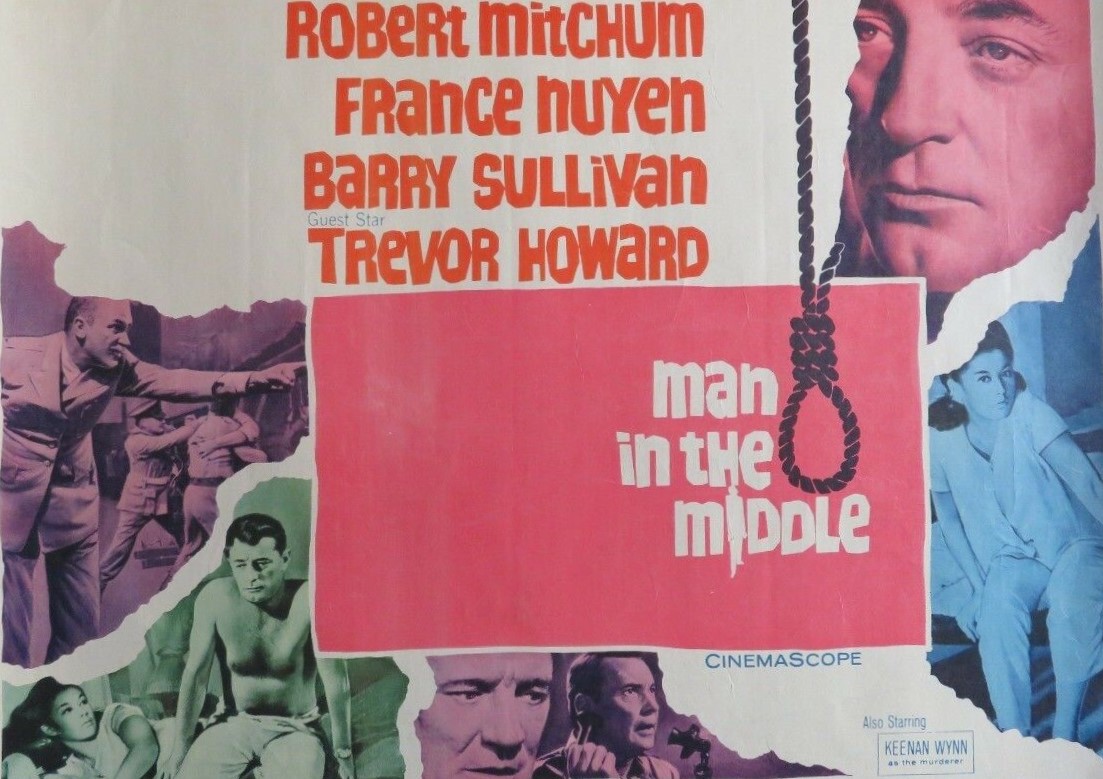
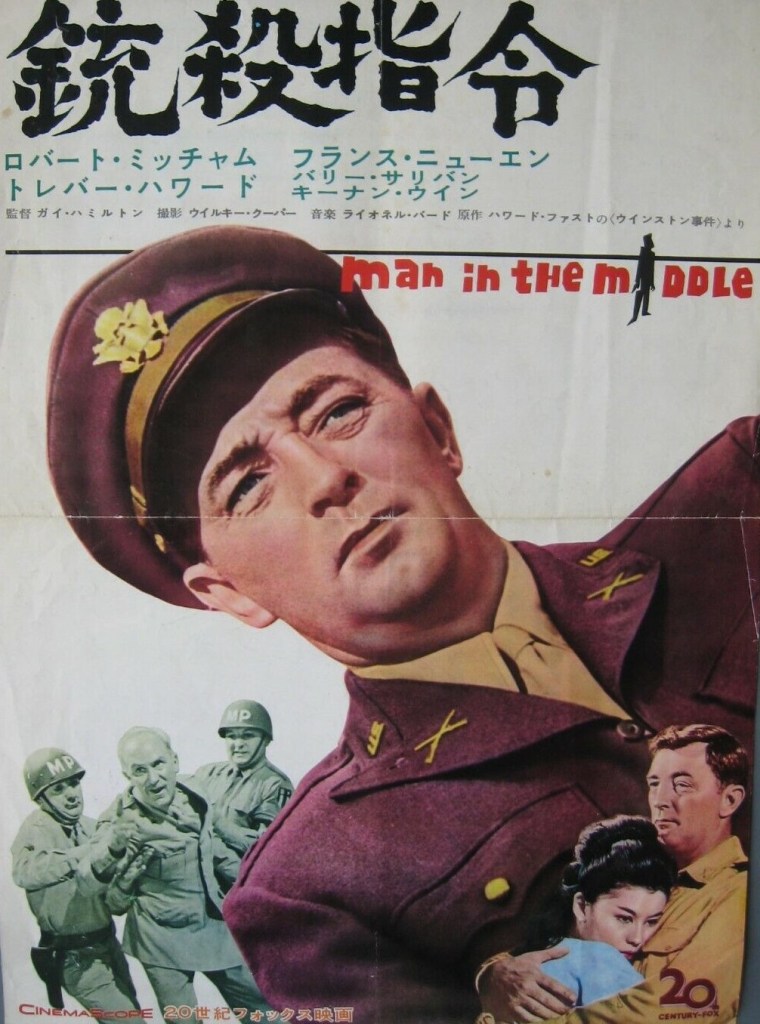
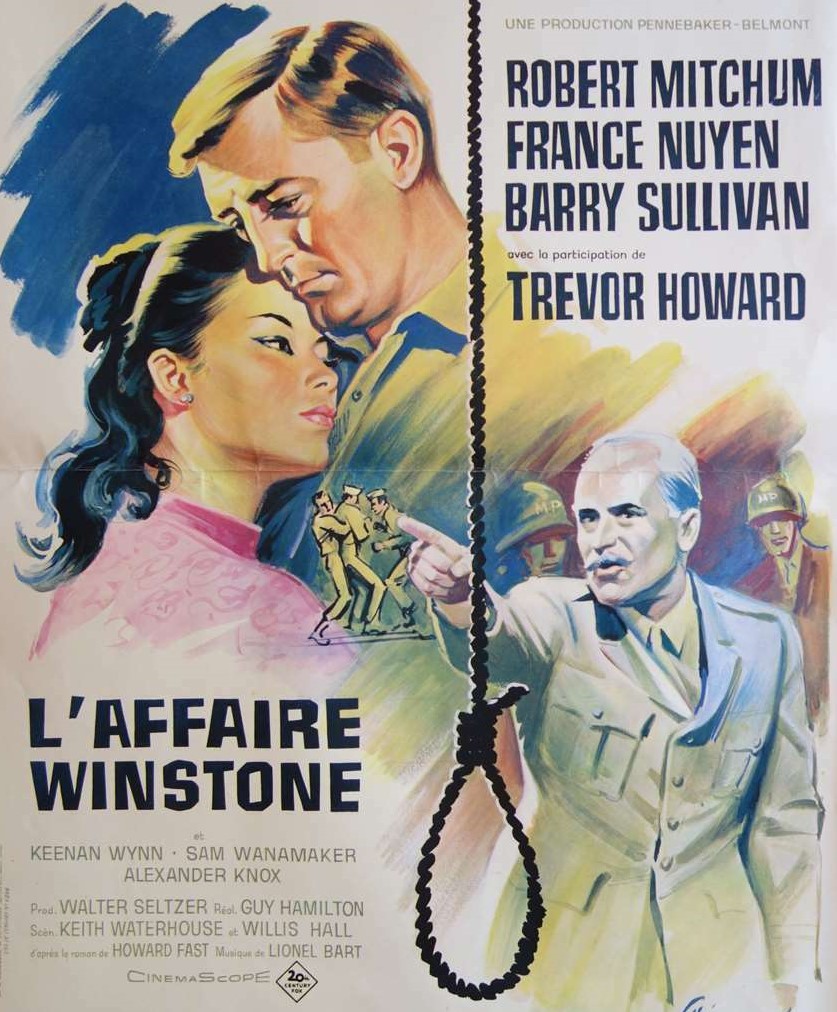
Man in the Middle / The Winston Affair (1964) ***

Scratch a war picture and you often find something more interesting underneath. This creditable courtroom drama makes a pitch for justice for all in the Compulsion (1959) vein while exploring the fragile and occasionally fractious relationship between the Allies during  World War Two. In front of several witnesses American officer Lt. Winston (Keenan Wynn) kills  in cold blood an ordinary British soldier in a remote depot in India.

It’s an open-and-shut case requiring a defence attorney of no great distinction. In fact so little legal ability is required that it’s assigned to Lt. Col Adams (Robert Mitchum), recovering from a war wound, who  hasn’t practised law in 14 years. It doesn’t help that Winston is a racist and psychopath, convinced left-wing conspirators are planning to take over the world. While dutiful, Adams displays no great enthusiasm for the task, taking time out to embark on romance with nurse Kate (France Nuyen), who is a good deal more fired-up about injustice than him. Adam’s superior officers just want Winston found guilty and hanged in double-quick-time to placate the British.

As if the odds aren’t already stacked against Adams, his boss General Kempton (Barry Sullivan) has brought in top prosecutor Major Smith (Paul Maxwell) while saddling Adams with two useless assistants. However, when Adams finally gets going, he discovers that Winston was assessed as mentally ill by psychiatrist Dr Kaufman (Sam Wanamaker) who has, unfortunately, been transferred and his report has vanished. Col Burton (Alexander Knox), who has taken over the case, refuses to accept Kaufman’s diagnosis. And Adams gets around to thinking there’s something fishy going on, the bottom line being that if the Winston is declared insane, then he won’t be hanged, the case neither open nor shut, fears rising of repercussions at a time when Allied unity is under threat.

So then we’re into classic courtroom territory. Kate has a carbon copy of the Kaufman report but as any lawman knows that in itself is inadmissible.  They can call back Kaufman to testify but there’s no allowing for the state of the roads and a driver in a hurry is liable not to make it. Major Kensington (Trevor Howard) might prove a trump card – or he may not. It’s a given that any defence lawyer’s life is filled with obstacles and this is no different. The out-of-practice Adams is in a hell of a pickle, and that’s how it should be.

On top of that, or underlying it, is the fight for justice for all. It’s easy to fight for the innocent but harder to battle for the sick and the mentally ill, however repellent their prejudices. You might despise the Winstons of this world, as Kate puts it, but you wouldn’t want to be his executioner.

And in the background are wartime considerations. What is one man’s life when judged against the uproar that would ensue and disrupt war planning should the self-proclaimed murderer be set free. Also, normally the mentally ill at this stage of Hollywood history are generally appealing characters, not hateful, but it’s only when Adams digs away at the experience of Winston that he realises the reasons for the murder, the hell that the insecure undergo when cleverer minds decide on torment.

Robert Mitchum (Secret Ceremony, 1968) is on excellent form as the attorney initially just going through the motions who determines to fight his superiors rather than toe the party line, even at the cost of losing his much-delayed promotion. France Nuyen (A Girl Named Tamiko, 1962) is somewhat spunkier than Hollywood nurses of this period and refuses to let romance get in the way of truth. Keenan Wynn (Warning Shot, 1967), a stubborn nutcase, is the worst kind of client, constantly shooting himself in the foot.

Trevor Howard (The Charge of the Light Brigade, 1968) has toned down the normal irascible persona and makes a respectable showing. Barry Sullivan (Light in the Piazza, 1962) is as ruthless as he is charming. The solid supporting cast includes Sam Wanamaker (Danger Route, 1967), Alexander Knox (In the Cool of the Day, 1963) and Errol John (The Sins of Rachel Cade, 1961).

This was director Guy Hamilton’s last film before he shot to international fame on the back of Goldfinger (1964). The screenplay by British pair Keith Waterhouse and Willis Hall (A Matter of Innocence/Pretty Polly, 1967) was adapted from the novel by Howard Fast (Mirage, 1965).

Courtroom with depth, giving a glimpse of the politics prevalent among High Command in wartime, almost a companion piece of The Charge of the Light Brigade.

Cinema Archives has a much pricier edition but I reckon this cheaper version will do the job.

Discover WordPress

A daily selection of the best content published on WordPress, collected for you by humans who love to read.

The Atavist Magazine

by Brian Hannan

WordPress.com News

The latest news on WordPress.com and the WordPress community.