House of Cards (1968) ***

American boxer Reno Davis (George Peppard) stumbles on an international conspiracy when hired by rich widow Anne de Villemont (Inger Stevens) in Paris to look after her eight-year-old son Paul (Barnaby Shaw). All roads eventually lead to Rome and a showdown with arch-conspirator Leschenahut (Orson Welles) in this thriller which throws in a couple of measures of Gaslight (1944) and, more obviously, North by Northwest (1959), to the extent of Anne being an icy blonde of the Eva Marie Saint persuasion and the couple, on the run, sharing a compartment on a train.

The boy’s previous tutor has been murdered. After months in a sanatorium, Anne, paranoid about her son being kidnapped, is in virtual house arrest in the family mansion, watched over by arrogant psychiatrist Dr Morillon (Keith Michell) who has diagnosed her as unstable, neurotic and a danger to the boy.

After an assassin on a bridge on the Seine takes potshots at Reno and Paul, Reno is framed for murder but escaping from the police returns to the mansion to find it empty, the furniture covered in dust sheets. I half-expected Reno to be told that the job was all in his imagination and that Anne did not exist, but instead finds out that mother and son have been taken to a castle in Dijon, in reality a fortress with a platoon of armed guards. Only Paul has been already been transported to Italy. So it’s attempted rescue, imprisonment, escape, fistfights, chase, clever moves and countermoves, twists and double twists as Reno and the still icy Anne head for Rome.

In among the mayhem are a few humorous moments, a play on the Trevi fountain scene from La Dolce Vita, a monk mistaken for a killer, a bored girl only too happy to be taken hostage, an over-familiar American who gives away valuable secrets because he mistakenly believes Reno is a co-conspirator, Dr Morillon making the error of treating Reno as a servant. And characters involved in assisting escape extract a high price, one seeking financial reward, another that her husband be killed in the process. There is also a flirtatious but spiky maid Jeanne-Marie (Perette Pradier) and a couple of excellent reversals.
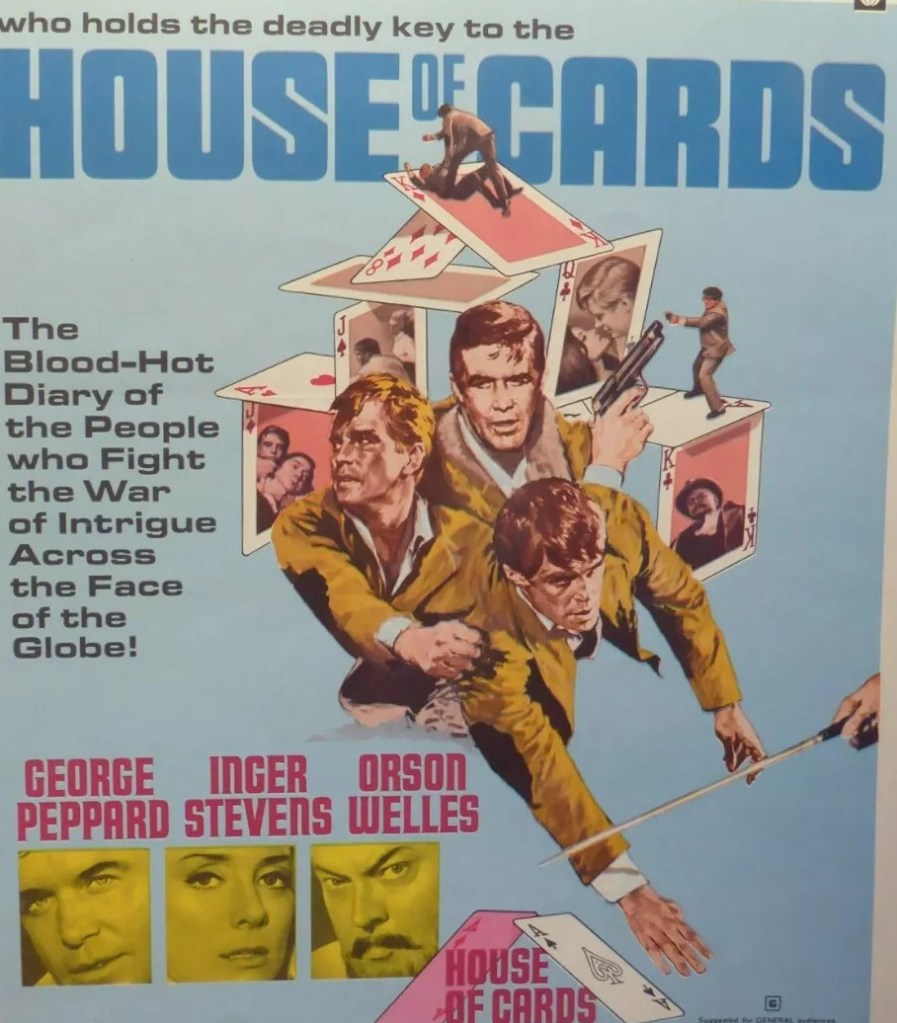
Reno is somewhat innovative in the weaponry department, the hook of a fishing rod, for example, while the son is rather handy with a pistol. But given the opposition are armed with machine guns, knives and swords that seems only fair.

George Peppard seems to have found his niche in this one, dropping the innate arrogance of The Blue Max (1965) and Operation Crossbow (1965), no chip on the shoulder, a good bit more attractive as a screen presence, a nice line with the ladies, more than able to take care of himself, a sprinkling of wit, completely at ease. Inger Stevens comes off well though her psychological problems and concerns for her son get in the way of any burgeoning romance with Peppard. But she has quite a range of emotions to get through, from wondering if she is mad, to dealing with the controlling family, and letting go of her son enough to allow the boy to bond with Reno, and despite her vast wealth down-to-earth enough to see a toothbrush as an essential when on the run.

Orson Welles (Is Paris Burning?, 1966), as ever, looms large over everything, with dialog so good you always have the impression he improvised on the spot. Keith Michell, a couple of years away from international fame in BBC mini-series The Six Wives of Henry VIII (1970), does a very good turn as the psychiatrist.

John Guillermin, who directed Peppard in The Blue Max, has a lot to do to keep the various balls in the air, especially keeping track of a multiplicity of characters. The screenwriting team of Harriet Frank Jr. and Irving Ravetch (Hud, 1963) pulled this one together from the novel by Stanley Ellin. Francis Lai’s memorable score is worth a mention, with distinctive themes for various parts of the story.

Eva Renzi (Funeral in Berlin, 1966) was originally down for the part of Anne and Italian actress Rosemary Dexter (Romeo and Juliet, 1964) has a small part.

Doesn’t quite come off .
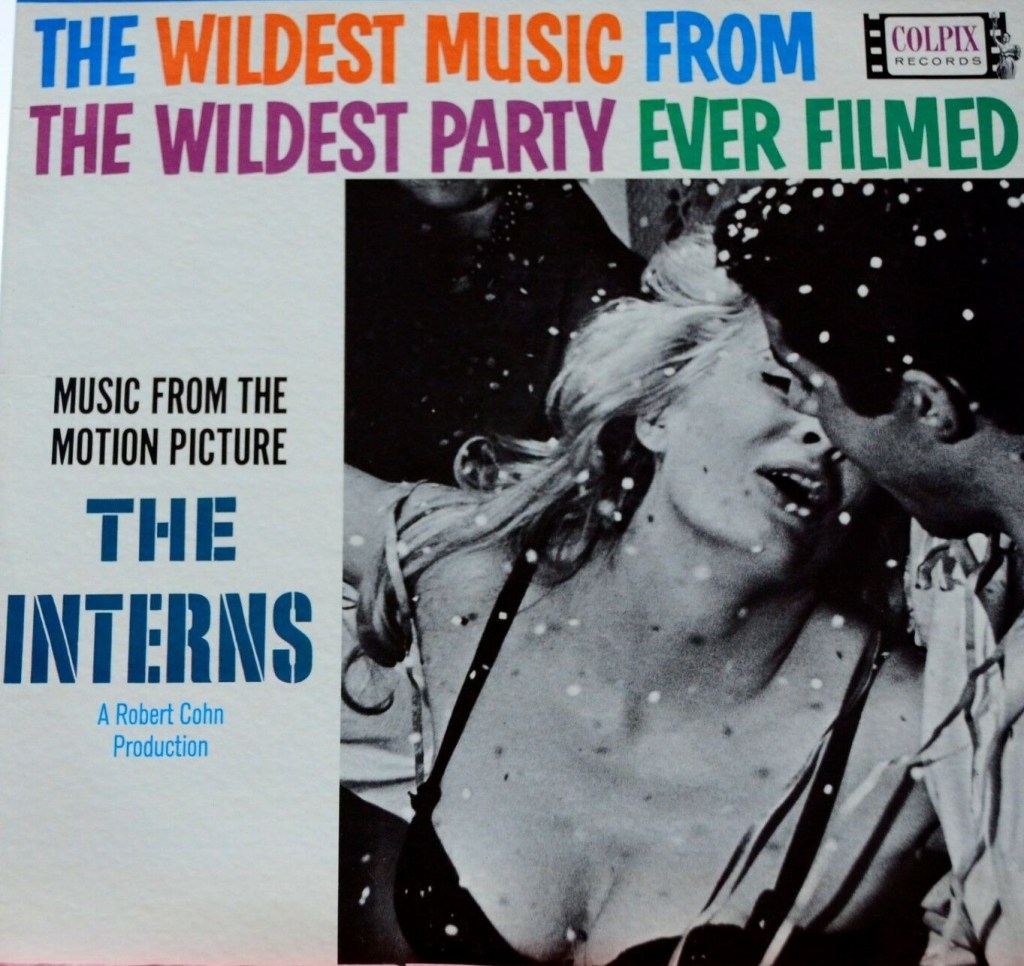
The Interns (1962) ***

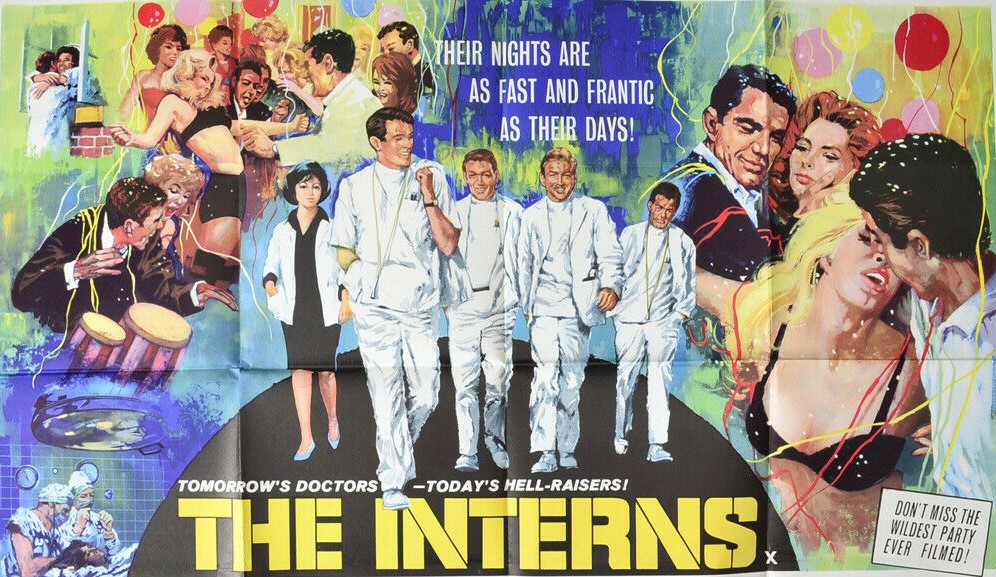
Patients are a nuisance to be tolerated on the route to wealth in this superior soap opera that sees young doctors wrestling with ambition and ethics. Although also concluding that impending lofty status will snare them an attractive bride, they find women less biddable than expected, romance proving the trickiest of all procedures.

The main cast of four men and one woman are played by a roster of hotly-tipped newcomers, including future Oscars winners and nominees and the elusive Haya Harareet (The Secret Partner, 1961). Director David Swift, accustomed to handling multiple characters in the likes of Pollyanna (1961), keeps the pot boiling and although some storylines lead to obvious conclusions the screenwriters bring sufficient imagination to the various strands.

The story unfolds over the one year the doctors spend in a general hospital, where the patients are liable to be drunk and obstreperous, before taking up residencies elsewhere. As you might expect, the main characters divide into the good and the arrogant. Heading the latter are Alec Considine (Michael Callan) who cheats on girlfriend Mildred (Anne Helm) with older nurse Vicky (Katharine Baird) in order to gain through her connections a residency at a highly prestigious hospital.

Matching him in the cocky stakes is John Paul Otis (Cliff Robertson), charming to old ladies but willing to risk his career to bed movie actress Lisa (Suzy Parker). The good guys are Lew Worship (James MacArthur) who is seduced into the supposed backwaters of obstetrics and Sid Lackland (Nick Adams), an all-round good egg who falls for a patient Loara (Ellen Davalos).

The most interesting of the young doctors, however, is single mother Madolyn Bruckner  (Haya Harareet) who takes on surgeon Dominic Riccio (Telly Savalas) at every turn. Riccio spends his time berating his charges and, in particular, has a downer on female doctors. At every encounter, despite his vicious tongue, she refuses to back down.

But it is the patients, in particular Arnold Auer (Peter Brocco) and Loara, who blow a hole in the myth of hospitals. In the best scene in the film, Auer, suffering from a degenerative illness that will turn him into a vegetable, takes over from the doctor in giving his own awful diagnosis. His pleas for clemency from his ordeal, in essence assisted suicide, create an ethical dilemma for the young doctors who did not realize that modern medicine could prolong rather than curtail patient suffering.

Auer’s anguished wife Emma (Angela Clarke) flits in and out of the picture as she buttonholes any doctor willing to listen to a new cure she has discovered. While the more hard-hearted doctors can inure themselves to his agony, a savage turn of events finds them all caught up in a situation that could jeopardize their future careers.

Although Loara has an incurable disease and has more or less given up, Lackland’s effervescent good humor and determination that surgery can resolve all health issues brings her hope and if you were in her condition possibly the last thing you would want would be a cheerleading doctor on your side, but in this instance it brings succor and in the doctor’s case forces him to rethink his priorities.

Probably the last thing the doctors – and the audience – expected was to come up against such stubborn, free-thinking women. While Bruckner appears to fly the flag for female independence, she has solid support from Lisa who spends most of the picture rejecting Otis’s advances on the grounds that even when he becomes rich he will be too poor for her liking. Eventually, Vicky forces Considine to choose. Shy nurse Gloria (Stefanie Powers) shocks Worship by putting global travel ahead of marriage. But she’s not as shocking as the bespectacled inhibited Olga (Carroll Harrison) who loses her inhibitions in style at a wild party.

Theoretically, a film about young doctors having a romp, in reality a thoughtful and thought-provoking picture, tackling issues that would have been taboo at the time and removing the submissive tag that daunted most movie female characters in the movies.

Those who succeeded in later winning Oscar favor were Cliff Robertson, Best Actor for Charly (1968), and Nick Adams and Telly Savalas, both nominated for Best Supporting Actor, the former in Twilight of Honor (1963) and the latter in The Birdman of Alcatraz (1962).

Robertson was the pick of the bunch, a star in his own right graduating from 633 Squadron (1964) and Masquerade (1965) to J.W. Coop (1971) which he also directed. But largely, the stars did not fulfil initial promise. The peak of Michael Callan’s movie career was reprising his role in The New Interns (1964), star in British director Michael Winner’s You Must Be Joking! (1965) and second male lead in Cat Ballou (1965). James MacArthur had a steady movie career before an epic run in television series Hawaii Five-O (1968-1979). Nick Adams switched between film and television before his premature death in 1968.  Haya Harareet made only one more film, The Last Charge (1962). In a bit part here, this is the same Brian G. Hutton who went on to greater things as a director, most notably Where Eagles Dare. (1968).

Although primarily in television, the less-heralded stars enjoyed greater ongoing success. Mainly a strong supporting actor, Telly Savalas had only one stab at a starring role (Land Raiders, 1970) before achieving worldwide fame as Kojak (1973-1978).  Stefanie Powers was television’s The Girl from U.N.C.L.E. (1966-1967) and later Hart to Hart (1979-1984). Buddy Ebsen (who plays the older Dr Sidney Wohl) went straight into a nine-year run of The Beverley Hillbillies

Directed with considerable care and awareness of relevant issues by David Swift (Pollyanna, 1961) who co-wrote the screenplay with Water Newman (The Magnificent Seven, 1960) from the novel by Richard Frede. It spawned sequel The New Interns and a TV series. Some reports have The Interns as the biggest of the year for Columbia, but that would only be correct if you were only able to exclude the massive box office for Lawrence of Arabia.

Still a soap, but an interesting one.

The Trygon Factor (1967) ****

Sublime climax but you need persistence to get through the fog of red herrings. Genre mash-up that flits precariously between whodunit and horror as we slip from a convent of nefarious nuns living in a vast stately home, where half-naked girls pose for photo sessions, and secret messages are smuggled out, to a pre-giallo masked killer with a drowning obsession liable to jump out. Luckily, there’s an equally impressive grand hotel nearby, thankfully minus nuns, but where killers still roam.

I had mistakenly assumed horror because “Trygon” is close to “Tygon,” the British horror outfit taking a more outré approach to the genre than staid old Hammer, and because of the random killings, and a man, Luke (James Culliford), son of the mansion owner Livia Emberday (Cathleen Nesbitt), in the habit of dressing up in weird garb and chopping the heads off flowers with a sword and inclined, in a fit of pique, to smash precious china heirlooms. And because there’s a fair bit of business with a coffin, this being the kind of movie where mourners lean into the casket and kiss the corpse.

If it is, indeed, a corpse. Zombies, anyone? I wouldn’t have been surprised. This is jam-packed with sumptuous misleading incident. Especially, as, for most of the proceedings, it seems like we’re stuck in a detective tale with an inspector who’s clearly never lived a minute in Britain judging from his glowing tan. He’s investigating a missing colleague (Allan Cuthbertson) seen in the opening sequence snooping around the mansion before being passed furtive notes through the gates by a young nun, later rigorously stripped of her habit.

The tan’s probably the giveaway since the immaculately turned-out Supt Cooper-Smith (Stewart Granger) fancies himself as a ladies’ man, first with French receptionist Sophie (Sophie Hardy) who expects a bit of coaxing seduction, and then with Livia’s daughter Trudy (Susan Hampshire), the photographer,  who doesn’t, keener on a speedier route into a man’s affections.

By the time the dust begins to settle, and the top cop harbors suspicions about a dockside warehouse owned by swivel-eyed Hubert (Robert Morley) – although Cooper-Smith’s  investigation technique revolves around plying young women with brandy – we’re drifting between the notion of some mad cult operating in the convent and Luke as the most likely serial killer given his determination to “play” with young women.

But, in fact, just as we’re being lulled into a sense of false security and the idea that we’ve seen this all before, director Cyril Frankel (On the Fiddle, 1961) springs the first of several audacious twists. The idea that the stately home is a front for a gang of thieves might, on the face of it, appear ludicrous except for the skill with which they carry out the heist and that the criminal mastermind is Livia, assisted by equally cunning daughter.

They have imported – in a coffin – a top French safecracker whose tool of choice is the kind of weapon that Thunderbolt and Lightfoot would have envied, if not a villain of James Bond proportions, and although the armament doesn’t spew out laser beams, it has sufficient firepower to render vulnerable the toughest safe. Naturally, Livia organises the break-in to coincide with nearby building works where the thunder of pneumatic drills will drown out any gun fire.

The thieves turn up outside the appointed bank in what appears an official security van, but from the boxes they carry into the target they produce gas masks and proceed to immobilize anyone inside. They’re after gold bullion because, under the guise of manufacturing large candlestick holders for sale to tourists at the stately home, Livia has set up a gold-smelting operation, pouring liquified gold into the base of the candlestick, trademark Trygon. Having re-disguised the French safecracker as a corpse and placed him in a coffin ready for the surreptitious trip home, ruthless Livia instead dumps him into the Thames to drown.

It’s pure luck that our police lothario happens upon the truth and discovers the smelting basement whereupon – twist number two – the delectable Trudy reveals herself to be the serial killer. She kills for “fun” and relishes the prospect of knocking off an “arrogant” male and one too susceptible to her charms to recognize her femme fatale sensibilities

The giallo-esque killings are highlights, one victim drowned in a baptismal font, another in a bathtub. That female’s kicking and screaming isn’t enough, what with the radio turned up loud, to attract the attention of the nubile Sophie next door luxuriating in a bubble bath. But death by piping hot liquid gold takes some beating. And that’s not the sole reason for the X-certificate since the movie taunts the censor in Blow-Up (1966) – minus the attendant hullabaloo – fashion with a brief glimpse of naked female breast.

The prospective audience might have expected a supernatural outcome given director Frankel’s previous outing The Witches (1966) and had they been alerted to the fact that the source material (uncredited) was written Edgar Wallace might have come prepared for some of the twists.   

This is the kind of movie that needs to be viewed backwards because it’s only at the end that you work out what it’s all about and how skilfully the audience has been duped. An object lesson and one that, for example, Zoe Kravitz (Blink Twice, 2024) should have watched to learn how to suck an audience in.

When you consider the movie in reverse, you realize this is really about an exceptionally clever heist and two women who are more than a match for any man. The males here are definitely disposable.

If you wondered why I gave this is a four-star rating rather than the more obvious three stars, it’s because of what’s mostly unsaid, the iceberg of psychology floating beneath the surface, the one that says that British audiences would not tolerate a top-class female criminal gang capable of pulling off a fantastic heist and without compunction killing off any man, including co-workers, who gets in their way. Had it begun from the POV of Lydia and Trudy planning the robbery, and dealt with Cooper-Smith et al as simply hazards of the profession, it might have made a terrific heist picture but then all the fun of the twists and the pulling the wool over audience eyes would be missed.

Susan Hampshire (The Three Lives of Thomasina, 1963) belies her Disney persona with a chilling portrait of an exceptionally smart femme fatale. Stewart Granger (The Last Safari, 1967) looks as if he views the whole boring process of detection as nothing more than the opportunity to try out some chat-up lines.

Cyril Frankel makes no pretence at being a great stylist, but he more than makes up for it by the teasing structure, some of the costumes, the atmosphere and the twists. Derry Quinn (Operation Crossbow, 1965) and Stanley Munro, in his movie debut, devised the screenplay based on a book by Edgar Wallace

Watch – and marvel.

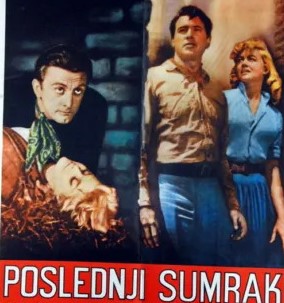
The Last Sunset (1961) ***

Too many hidden secrets turn this into a Peyton Place of a western. When the final unexpected zinger strikes home the movie has nowhere to go and undercuts the climax. Director Robert Aldrich also lets Kirk Duglas off the leash so there’s too much of him festering to put the outcome in any doubt. Strangling a vicious dog with your bare hands is usually a sign of heroism but here it just undermines Douglas’s character.   

Wanted murderer O’Malley (Kirk Douglas) has skipped to Mexico away from the long arm of the American law. Nonetheless, lawman Stribling (Rock Hudson) is in pursuit, presumably hoping to kidnap him and drag him back over the Rio Grande into U.S. jurisdiction. The story, in a major narrative flaw, finds another way to head O’Malley north.

Anyways, O’Malley is in Mexico not just to escape, but for a more sentimental reason, he wants to hook up again with first love Belle (Dorothy Malone). The fact that she’s married to limping ex-Confederate soldier Breckenridge (Joseph Cotten) appears to make no difference. And when O’Malley strikes up a deal to help Breckenridge drive his herd of cattle to Crazy Horse, a town over the Rio Grande, he tells the husband of his romantic intent.  

This would usually spell trouble except the narrative conveniently disposes of the husband. However, by this point the lawman has also thrown his hat into the romantic ring, having signed up to become trail boss. You can see the logic in Stribling’s decision. If O’Malley’s heading in the right direction then it makes it easier for Stribling to get him over the border.

What doesn’t make any real sense is Breckenridge’s hiring of O’Malley in the first place, or the deal the outlaw negotiates. O’Malley would go along in any case for a meal of beans a day just to keep track of Belle who’s the appointed cook for the ride. Instead, and with no cattle herding skills in evidence, he manages to get Breckenridge to agree to give him one-fifth of the herd as a bonus in addition to the normal pay of a dollar a day. Although the audience has already guessed O’Malley’s romantic purpose, he spells it out to the rancher, “I want your wife” the rider to the deal.

O’Malley takes little notice of Belle’s diffidence. The man who was once an enticing prospect to an inexperienced young girl is now presented in a different light. “You carry your own storm wherever you go,” she tells him. She no longer has a hankering to end up just “a survivor,” not convinced by his plan to settle down with the money from the sale of his share of the herd.

As usual, the trail ride has sufficient incident – lightning storm, stampede, a brush with Native Americans, saloon gunfight, a trio of no-goods hitching a ride, a sighting of St Elmo’s Fire and that old trope quicksand – to keep the story moving without the love triangle and what actually turns out to be a revenge tale.

The story takes some unexpected turns. Stribling is a pretty efficient cowboy, seeped in western lore, knows how to keep a herd in shape. He heads off a marauding tribe by trading some of the herd, in compensation for the innocent man O’Malley instinctively shot dead. Belle needs to kill a man to defend herself. And O’Malley, romantic ambitions thwarted by Stribling, starts wooing Belle’s daughter Missy (Carol Lynley) who, no surprises there, reminds him of Belle at a younger age.

As the secrets come spilling out, it becomes apparent that O’Malley has seduced Stribling’s sister whom the outlaw disses as an easy lay – “your sister was a free drink on the house” – and more importantly that his sister has hung herself after O’Malley killed her lover. Double revenge, I guess, to steal Belle and take O’Malley back to face justice.

You might have wondered how Belle ended up with Breckenridge in the first place and it’s not the soldier-wounded-in-battle routine. It’s because he made an honest woman out of her after – or maybe before – Missy was born out of wedlock. And when Belle sees how serious Missy is about O’Malley she reveals that he’s the father. Leaving O’Malley to do the right thing and not load his pistol when he heads for his shoot-out with Stribling once they have crossed the Rio Grande.

The ending smacks of star redemption. Kirk Douglas can play a mean guy better than most and he’s got no problem being tagged an outlaw but to lose a shoot-out would render him the loser whereas noble sacrifice turns him into some kind of winner. That notion doesn’t take into account that Stribling was guaranteed to win the shoot-out anyway since O’Malley’s weapon of choice is the Derringer, ideal for shooting someone standing right next to you, not a lot of good in a shoot-out where your opponent is twenty feet away.

The narrative twists and turns enough to keep you interested but with every secret revealed the flaws are only too apparent. Rock Hudson (Seconds, 1966) wins the duel of the big stars, a wider range of emotions on show but as tough as his rival and with western skills to boot. We’ve seen this brooding Kirk Douglas (The Arrangement, 1969) too many times before. Dorothy Malone (who had partnered Hudson in Douglas Sirk number The Tarnished Angels, 1957) is good as the woman who knows her own mind. Joseph Cotten (The Oscar, 1966) probably signed up not for the chance to show off his limp but for the scene in the saloon where his myth of Civil War heroism is cruelly exposed. Carol Lynley (Bunny Lake Is Missing, 1965) convincingly transforms from dutiful daughter with a Disney-esque affinity with animals to woman.

Robert Aldrich (The Flight of the Phoenix, 1965) looks hamstrung by the Dalton Trumbo (The Fixer, 1968) script based on the novel Sundown at Crazy Horse by Howard Rigsby.

Too convoluted to fly.

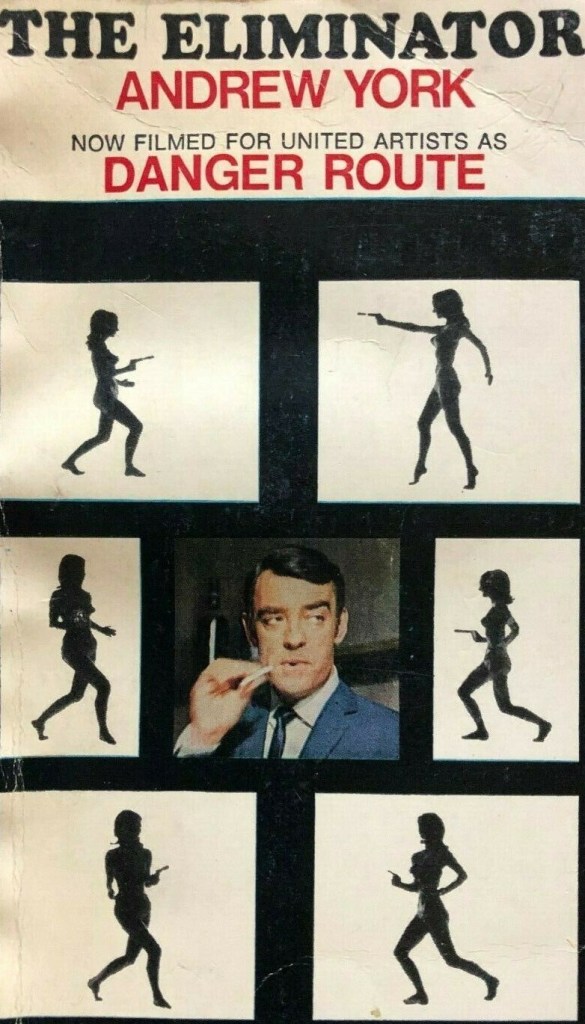
Danger Route (1967) ***

If the producers had not signalled Bond-style ambitions with a big credit sequence theme song by Anita Harris, moviegoers might have come at this with more fitting expectations in the Harry Palmer and John Le Carre vein. So although slipping into the late decade spy boom flourish don’t expect villains planning world domination, gadgets or a flotilla of bikinis.

Seth Holt’s bread-and-butter espionage thriller sets government agent Jonas Wild (Richard Johnson) – on his “last assignment” no less after eight licensed murders in five years – to kill off a defector in the far from exotic location of a Dorset country house not realizing that he is also being set up. That his liquidator will be a woman puts the mysterious Mari (Barbara Bouchet) in pole position.  

Wild gains access to the heavily-guarded mansion by seducing housekeeper Rhoda (Diana Dors) but after completing his mission is captured and tortured by Luciana – pronounced with a “k” – (Sam Wanamaker) who explains he is a patsy and that there is a mole in M.I.5. When his boss Tony Canning (Harry Andrews) disappears and another friend is murdered, Wild goes on the run with Mrs Canning (Sylvia Syms) and eventually makes his way back to his bolt-hole in Jersey to solve the mystery.

There is a decent amount of action, including a fight with a guard dog and a battle on a fog-bound yacht. Clever maneuvers abound – a bug is planted in a bandage. Treachery is always just round the corner and there is no shortage of suspects.

The film’s down-to-earth approach is somewhat refreshing after half a decade of spy thrillers and spoofs. Wild doesn’t employ anything more hi-tech than masquerading as a brush salesman to win over Rhoda. And although that relationship ends up in bed, there is no sex, Wild having drugged her to avoid that complication. Tony Canning is nagged by his wife. Wild’s girlfriend (Carol Lynley) is a sweet girl, sexy in a languid rather than overt fashion.  And Luciana takes enormous pride in telling Wild just how stupid he has been.

But that comes with a caveat. The plot doesn’t quite hang together and the movie sometimes fails to connect.

That said, Johnson (Deadlier than the Male, 1967) is excellent, quite an accomplished actor rather than a brand name. Both Barbara Bouchet (Casino Royale) and Carole Lynley (Harlow, 1965) play against type while Sylvia Sims (East of Sudan, 1964) and Harry Andrews (The Hill, 1965) present variations to their normal screen personas. Sam Wanamaker (The Warning Shot, 1967) has a peach of a role and Gordon Jackson (The Long Ships, 1964) and Maurice Denham (The Long Duel, 1967) are afforded small but critical parts. 

Seth Holt (Station Six Sahara, 1963) directs from a script by Meade Roberts (In the Cool of the Day, 1963) and Robert Banks Stewart (Never Mention Murder, 1965) based on the bestseller by Andrew York.

Competent with interesting touches.

The Chapman Report (1962) ***

In the 1950s new talent was largely bloodied via small parts in big movies. In the 1960s, the easier route was to first build them up as television stars. This picture represents the nadir of that plan – female roles filled with established talent, males roles with actors who had made their names in television. And, boy, does it show, to the overall detriment of the picture.

Warner Bros even had the temerity to top-bill Efrem Zimbalist Jr (hauled in from 77 Sunset Strip, 1958-1964) over more famous actresses. Zimbalist Jr at least had some marquee value after starring in low-budget A Fever in the Blood (1961) and second male lead in the classier By Love Possessed (1961) and Ray Danton (The Alaskans, 1959-1960) had played the title role in B-picture The George Raft Story (1961), but Ty Hardin was unknown beyond Bronco (1958-1962) and Chad Everett drafted in from The Dakotas (1962-1963).

Little surprise, therefore, that director George Cukor (Justine, 1969) concentrated his efforts on the females in the cast. But it was curious to find Cukor taking on this sensationalist project based on the surveys of sexuality that had taken the country by storm. Had it been made by a less important studio than Warner Bros it would have been classed as exploitation.

The bestseller by Irving Wallace on which it was based was a take on the Kinsey Report a decade before and others of the species and, theoretically at least, opened up the dry material of the more scientific reports into how men and women behaved behind closed doors.

Amazing that this was passed by the Production Code since dialog and action are pretty ripe. Interviewed women are asked about “heavy petting” and how often they have sex and if they find the act gratifying. One interviewer crosses the line and has an affair; these days that would be viewed as taking advantage of a vulnerable woman. And there’s a gang rape.

Given the movie’s source Cukor takes the portmanteau approach, four women undergoing different experiences. The problem with this picture is that there’s little psychological exploration. Women are presented by their actions not by their thought patterns or by their treatment by their husband.

In what, in movie terms, is the standout section, Naomi (Claire Bloom), an alcoholic nymphomaniac, is so desperate for attention she throws herself at the delivery boy (Chad Everett), then at a married jazz musician (Corey Allen), with devastating effect, as he hands her over to his buddies, causing sufficient degradation that she commits suicide. Since we first come across her crying in bed, sure signs of depression, these days you would expect more exploration of her psychiatric state.

Similarly, the widowed Kathleen (Jane Fonda) has been tabbed frigid by her husband and nobody thinks to call into question his inadequacies as a sex partner rather than hers. Here it’s put down to daddy issues and growing up in a household heavy with morality.

Kathleen is taken aback by the researcher even asking her about sex, “physical love” the technical term, rather than a purer kind but her consternation at the questions being posed in very cold-hearted manner by an anonymous voice – researcher hidden behind a wall – does reveal how ill-equipped some people are to even talk about sex. Her story develops into some kind of happy ending, despite the fact that her interviewer Radford (Efrem Zimblist Jr) would be busted these days for taking advantage.

Teresa (Glynis Johns) is convinced by the interviewer’s tone that the simple normality of her own marriage must be abnormal and so, determined to fit in, embarks on a clumsy attempt to  seduce footballer Ed (Ty Hardin), coming to her senses when it comes to the clinch.

The interview also has a major impact on the adulteress Sarah (Shelley Winters). After confessing her affair to husband Frank (Harold J. Stone) she rushes off to lover, theater director Fred (Ray Danton), only to find, to her astonishment, that he’s a married man. Her husband accepts her back.

To keep you straight, the “good” women are dressed in white, the “bad” ones in black. The filming is distinctly odd. The man behind the wall is filmed with no ostentation, but the style completely changes when the director turns to the women who often end up in floods of tears.

Claire Bloom (Two into Three Won’t Go, 1969) and Jane Fonda (Barbarella, 1968) are the standouts because they have the most emotion to play around with. Oscar-nominated Glynis Johns (The Cabinet of Caligari, 1962) is the comic turn. Over-eager over-confident Oscar-winner Shelley Winters (A House Is Not a Home, 1964) gets her come-uppance. None of the men make any impact.

The book took some knocking into shape. Perhaps because, of the four names on the credits only one had signal screenwriting experience, Don Mankiewicz (I Want to Live, 1958). For the others, better known for different occupations in the business, this was their only screenwriting credit. Wyatt Cooper was an actor married to Gloria Vanderbilt, Gene Allen art director on many Cukor pictures and production designer on this, and Grant Stuart was a boom operator though not on this picture.

Best viewed through a time capsule.

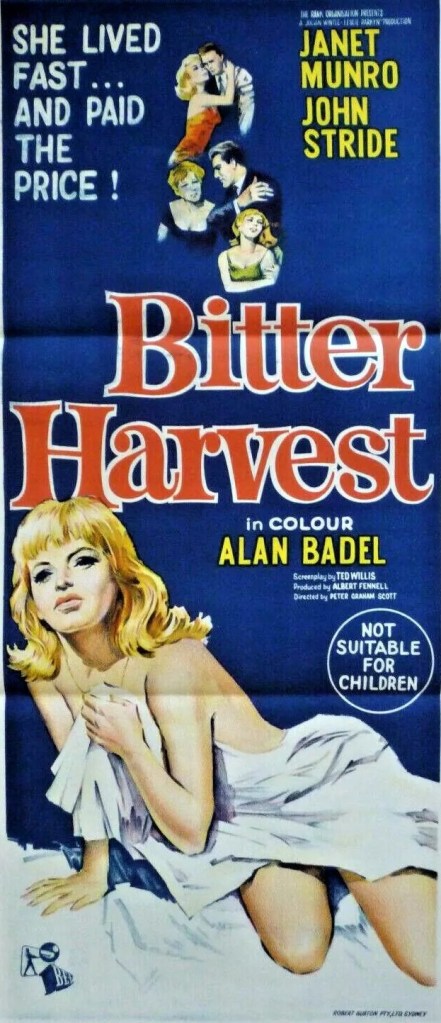
Bitter Harvest (1963) ****

Anyone claiming to be gaslighted will have unwittingly invoked the memory of an English writer who died over 60 years ago. Alfred Hitchcock paid tribute to him in adapting his fiendish play, Rope (1948). Hangover Square (1945) starring Linda Darnell was another of his novels to hit the screen. In all there have been over 50 film and television adaptations of his works.

One of his most famous publications was a trilogy focusing on a London barman and a barmaid in love with him whom he casts aside. I had read it, as I had all of Patrick Hamilton’s novels, with enormous pleasure. The trilogy was published in 1935 under the title Twenty Thousand Streets under the Sky. So it was with some trepidation that I realized Bitter Harvest was based on the middle novel of the trilogy. The DVD had sat, unwatched, in my collection for a couple of years because I was put off by the title, the no-name cast and journeyman director, assuming some routine tale with a sad ending.

Now I’m kicking myself I ignored it for so long. It’s a little gem that packs a punch, climaxing with a stylistic twist, and held together by a virtuoso performance by Janet Munro, one-time Disney ingenue in pictures like Swiss Family Robinson (1960), as she twists the audience and her lover round her little finger. And all the way through, despite the self-imposed travails, she manages to evoke sympathy.

Virgin Jennie (Janet Munro) escapes humdrum life in Wales, running a small shop in a run-down village, looking after her ungrateful father, and about to be dumped as a full-time carer onto a pair of aunts, when she meets smooth salesman Andy (Terence Alexander). He gets her drunk on champagne, whisks her back to his flat where he rapes her. Shame prevents her going home. Friendly barman Bob (John Stride) takes pity on her when she reveals she’s pregnant and lets her sleep, untouched by him, in his bed. Naturally, the relationship progresses, though she makes no move to find a job. But she wants her “share” of the good things in life and a barman isn’t going to provide them.  

Bob soon realizes she isn’t quite the docile waif delighted to be looked after. “When have I taken orders from you?” she snaps. He’s shocked when she reveals that her pregnancy was a ploy, and taken aback when she rejects his marriage proposal. Instead, she’s out on the town with actor neighbor Charles (Colin Gordon) who takes her to a showbiz bash where she wangles an introduction to impresario Karl (Alan Badel). “I’ve got something they want and they can have it and they’ll pay for it,” shows Bob which way the wind is blowing.

The movie begins with a drunken smartly dressed Jennie, long red hair cut in a more fashionable bob, returning to her upper mews apartment. She’s so sozzled she drops her handbag on the steps, only stopping to retrieve her keys before kicking the bag down the staircase. Opening the door, she tosses the key into the street. Inside, she sets about destroying the chintzy apartment, pours whisky over a photo of man later revealed as Karl, smashes bottles, upends furniture, tosses dresses out the window, scrawls something in lipstick on the mirror.

Then we’re into flashback telling the story I’ve just outlined. When she sets herself up to become Karl’s mistress, you think there’s a third act to come. But the movie cuts instead to the mews apartment and the by now dead Jennie.

What distinguishes it is the set-up. Jennie appears initially as the victim until she exerts control, using Bob, and presumably intending to work her way up. Quite how her life came to end in suicide is never revealed. But director Peter Graham Scott (Subterfuge, 1968) has the foresight to realize he doesn’t have to go into the degradation and shame, just show consequence.

And it’s framed with excellent performances. Bob, determined to improve himself, buys a book a month. Barmaid Ella (Anne Cunningham), in love with him, has to endure a scene where he tells her all about Jenny. Bob’s landlady isn’t going to get on a moral high horse about him having a woman in his room when she can rook him for increased rent. You can tell, even if Jenny ignores the obvious, what kind of life she will have as Karl’s mistress when in their first moment of intimacy he slaps her face and rips her expensive dress to make a bandage.

There’s another scene just as shocking and if it was not edited out by the censor at the time it still came as a surprise to see fleeting glimpse of a naked breast, a good year before the U.S. Production permitted similar in The Pawnbroker.  

As I said, the transition of Janet Munro (Hide and Seek, 1964) from victim to predator is exceptionally well-done, her iron fist cleverly concealed for most of the film. And it’s admirable, too, that John Stride, whose career was mostly in television, doesn’t come across as a hapless suitor, though obviously he is gullible. Alan Badel (Arabesque, 1966) only has a couple of scenes but makes a huge impact. Barbara Ferris (Interlude, 1968) has a small part.

Highlight of Peter Graham Scott’s directorial career, well-paced, measured, drawing out good performances all round, especially in the boldness of the closure. Ted Willis (Flame in the Streets, 1961) does an excellent job of updating the novel, though one flaw is that while the early section is set in Wales there’s no sign of a Welsh accent.

Recommended.

It Ends With Us (2024) **** – Seen at the Cinema

Doubt if I’m the target audience for this little number. In truth, I snuck it in between the excellent Alien sequel and the execrable Trap in my weekly cinema outing. They don’t make them like this any more in part because the straightforward romantic drama was overtaken by the quirky rom-com at which the likes of Tom Hanks, Meg Ryan, Julia Roberts, and Hugh Grant excelled. In the Hollywood Golden Age, Clark Gable would hardly have fashioned a career had he not been teamed with a host of top female stars and Spencer Tracy and Katharine Hepburn couldn’t keep their hands off each other.

But come the 1960s the superstar as loner did away with that popular genre. Apart from The Thomas Crown Affair, Steve McQueen scarcely had a screen romance worth noting, nor did Paul Newman, Lee Marvin or Clint Eastwood and although Charles Bronson ensured wife Jill Ireland had a role in virtually all his movies, romance was rarely on his mind. But cast your mind back to The Way We Were (1973), the incredibly popular pairing of Barbra Streisand (billed first you might notice) and Robert Redford and you can see what, for one reason or another, Hollywood tossed away.

Domestic violence wasn’t on the menu back then and while it plays a part here, that’s not to detract from a solid romance with an excellent meet-cute, two hunks, some terrific dialog, and a sparkling supporting cast. This could be dismissed as upmarket Mills & Boon, especially given the three principals are, respectively, a florist, chef and neuro-surgeon, outside of a fireman just about the sexiest professions abounding in the world of fiction.

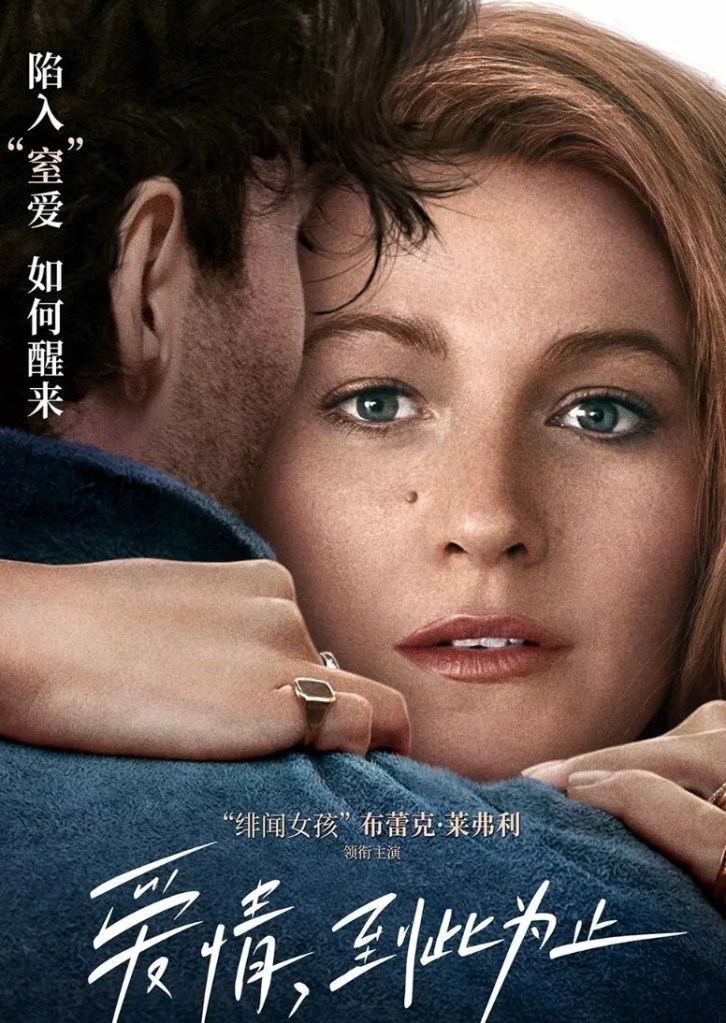
Florist Lily (Blake Lively) has to choose between commitment-phobic top doc Ryle (Julian Baldoni) and childhood sweetheart Atlas (Brandon Sklenar), now a successful chef. Her shop assistant Allysa (Jenny Slate) warns Lily about her lothario brother Ryle, but eventually he wears her down and they embark on a relationship that ends in marriage. But when Atlas pops up again, the perfect marriage begins to wear thin.

The return of Atlas brings back memories of her father who abused her mother and beat up Atlas after discovering him in Lily’s bed. The movie skips over Lily’s failure to stand up to her father and, although Atlas was hospitalized as a result of the encounter with her father, she allows her first proper boyfriend to drop out of her life. Luckily, he bears no grudges and sits on the sidelines offering tacit support should her marriage go sour. Unfortunately, she’s tucked his telephone number away in her mobile phone cover and on finding it the already simmering Ryle kicks off.

We open with a great scene with Lily, called upon to give the eulogy at the funeral of wealthy father (Kevin McKidd), walking out without finding anything good to say. There’s a clever visual, the piece of paper where supposedly she was to write down the five things she loves about the deceased, but all she’s written are the five numerals, and it’s as cleverly reprised later on.

The domestic violence is artfully done, so that, at first, we are inclined to believe that he strikes her on the face or throws her down the stairs by accident, partly from seeing the incidents from her confused point-of-view and partly a mind-set that doesn’t want to accept that her chosen mate may be the  spitting image of her father. The bite on the tattoo on her neck accompanying attempted rape is a different story. While Ryle doesn’t per se have justification for his innate violence, his inhibition is partly explained by guilt over a devastating incident in his childhood.

The title comes from the final scene. Presenting baby to father, Lily asks Ryle what advice he would he would give his daughter should she ever confess she had been smacked around or thrown down the stairs. He’s shamefaced enough to give the correct answer and she’s smart enough to give him the boot. “It” meaning violence from men, “ends with us,” she whispers to the baby.

And although that’s the big supposed big takeaway from the movie, in reality it doesn’t pivot on that element, instead it’s a very satisfactory almost classical love triangle of the kind they used to make, with plenty good lines and packed with interesting scenes.

Blake Lively, as she proved in The Rhythm Section (2022), is very capable of carrying a picture but here she’s swamped by support. Justin Boldoni (Con Man, 2018) is in double-hyphenate form – he directed it (Clouds, 2020, his previous) – stepping up to the plate not just as a prospective candidate to become Hollywood’s next big male sex symbol but making an impressive movie, slow-burn to allow characters to find their feet and for the actors not to rush at scenes or bite off lines. Jenny Slate (I Want You Back, 2022) is superb.  Christy Hall (Daddio, 2023) adapted the Colleen Hoover bestseller. 

Thoroughly satisfying involving drama.

The Lion (1962) ***

For such a harmless picture The Lion raises a couple of troubling issues. The first concerns the titular beast. Doubt if you’d get the authorities these days to greenlight a movie where a pre-pubescent girl was in such close proximity to a full-grown lion. Having as a safety measure two sharpshooters on the sidelines out of camera range, as director Jack Cardiff did here, might not cut it.

Secondly, we’ve got censor double standard. I remember my shocked parents forbidding me from seeing Zulu (1964), a massive hit in Britain, on account of the toplessness of the indigenous females. The censor didn’t slap an X-certificate on that sequence on the assumption that such nudity, in the context of tribal tradition, wouldn’t apparently incite the lewd male gaze. Had this been white breasts on show, in whatever tradition, the censor would not have been so lenient, signifying an inherent racism. Here, surprisingly, we’ve also got female toplessness, somewhat more discreet than Zulu, but coming as a surprise to your reviewer.

Perhaps the oddest feature of the picture is the contradictory message: Africa is wonderful but it’s not the place to bring up a young girl. Certainly not one who embraces the wildness with considerably more conviction than a passing wildlife tourist. As the imdb stub puts it: the young girl Tina (Pamela Franklin) must be brought “back to civilization.”

And there’s a distinctly old-fashioned tint to a storyline that demands the appearance of her father Robert (William Holden), long divorced from wife Christine (Capucine), as the firm male hand required to drag his estranged daughter back to said civilization. Christine’s current partner John (Trevor Howard), grizzled poacher-turned-gamekeeper, former big game hunter now eking out a living as a game warden, appears more sanguine about the girl’s lifestyle but less welcoming to the visitor. Tina has raised the wild lion King from a cub and as their bond is intense she is reluctant to give him up.

Disney would have taken a different approach, buffing up the cuter aspects. That the studio could show adult and child perspective in tandem is instanced by Pollyanna (1960) and in the later The Jungle Book (1967) solved the problem of a young boy becoming too involved with his wild playmates by having an intriguing young girl tempt him away. Or a touch of the Born Free (1966) playbook might have seen Tina simply mutate from childhood to an adult job in the animal preservation business

Instead, playing out in almost literal fashion, are two human male beasts battling it out (though not physically, unfortunately) over the mother with the needs of the child seemingly swept to one side as the love triangle takes hold.

The best scenes concern Robert and Tina, especially her early disinterest in his presence, and her later delight at leading him a wild dance through the jungle and seeing how his terror of her lion pal equates with her complete lack of fear. While John’s role is to keep a grip on poaching, he’s not so friendly to the animals, almost determined to torment them by running his jeep recklessly at or around them to elicit maddened response and alarm the visitor with their wildness rather than their apparent, at a distance, docility.

Perhaps the lack of a punch-up ensures this movie never catches fire. There’s quite a perplexing sub-plot that dictates the outcome. The son  of the local tribal chief has his eye on Tina and during the aforementioned tradition it’s clear the young girl wants to participate in the frenzied dance courtship ritual.

But this kind of tradition is at the polar opposite of civilization as is the tradition that an old man, succumbing to fatal illness, should be left out in the wild to die. Christine intervenes to save him. Meanwhile, believing his father dead, the son sets out to achieve manhood by killing the lion and in the ensuing tangle John kills both young man and lion. The tribal response to the death of their new chief goes unrecorded but Bullit’s action drives Tina towards her parents. With the lion dead, it’s a lot easier to winkle the girl away from Africa and back to civilization.

Plenty of wildlife for your buck, but plot and characters are not a patch on Hatari! (1962) or The Last Safari (1967). William Holden, whose yen for making movies as far away from the U.S. tax authorities as possible was destroying his career, is good value as the estranged father and if you are looking for smouldering then Trevor Howard (The Long Duel, 1967) is your man. Capucine would tee up with Holden – the pair had an affair – again in The 7th Dawn (1964) but she was more effective in the later picture than here.

Jack Cardiff (Girl on a Motorcycle, 1968) directs from a script by Irene and Louis Kamp (The Sandpiper, 1965) based on the bestseller by Joseph Kessel (L’Armee des Ombres/Army of Shadows, 1969).

Might have preferred the Disney version.

The Arrangement (1969) ***

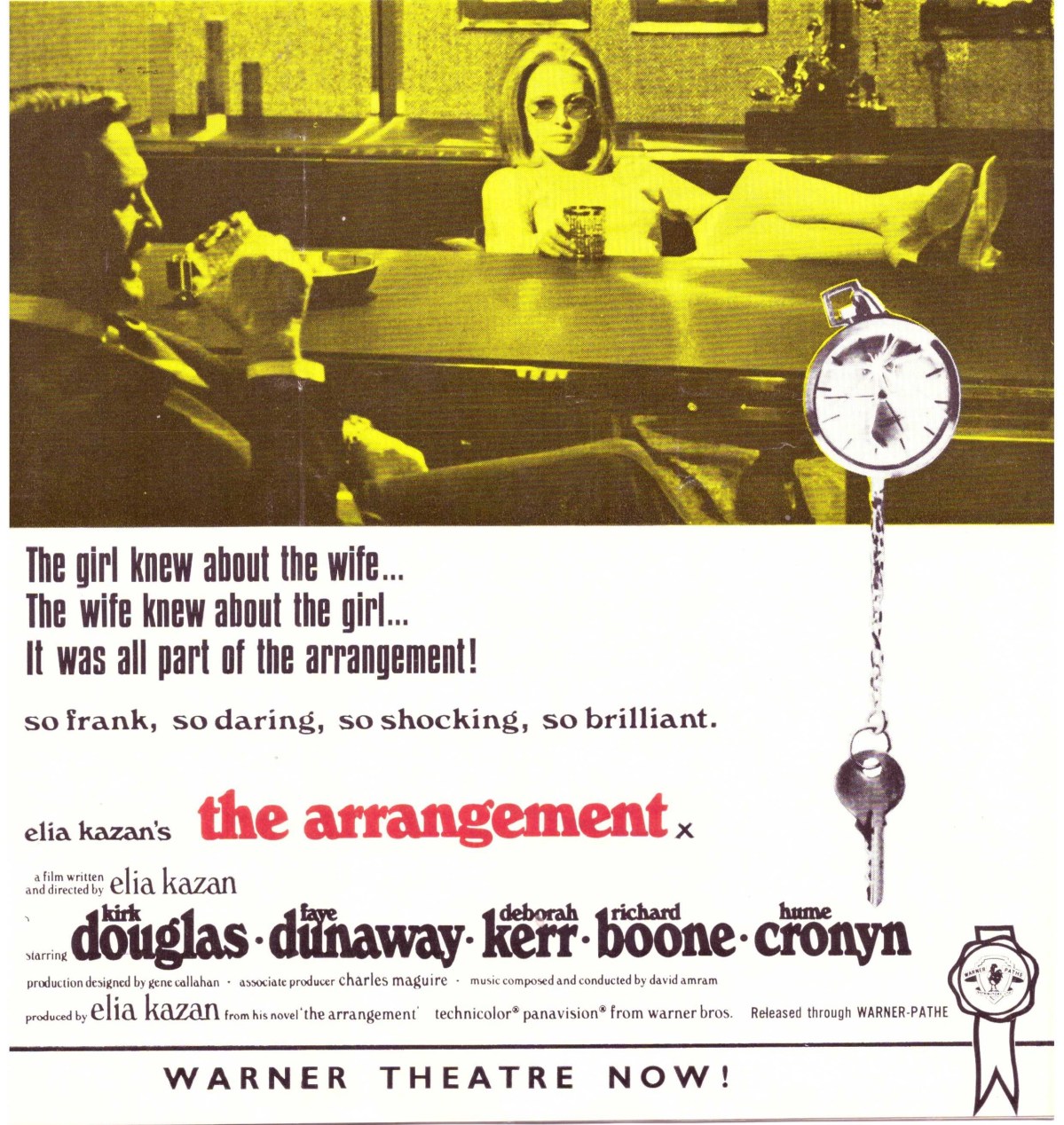
It might have been better if director Elia Kazan had handed over the screenwriting chores for this adaptation of his bestseller about the midlife crisis of advertising man Eddie Anderson (Kirk Douglas). As director he over-angsts the pudding. Anderson’s attempts to juggle wife Florence (Deborah Kerr) and mistress Gwen (Faye Dunaway) coupled with growing disgust at selling a new brand of cigarettes, Zephyr (“The Clean One”), in a way that pointedly avoids their cancer potential, leads to a suicide attempt. 

During convalescence he determines to quit the advertising world and go back to his first love, writing, but in fact he ends up sabotaging his career. Florence represents impossible seduction and conscience. Slinky, in dark glasses, hot-tempered rather than submissive or demure, she accuses him of self-deception in his job. The picture flits back and forth between his various choices – different job, return to wife, settle down with mistress, or what seems his ideal world, cossetted by both Gwen and Florence.

Gwen is an excellent study of the modern woman (of that fast-changing period, I hasten to add), who needs a man for sex but not necessarily love, and can use the opposite sex as ruthlessly as any man. What she actually requires in her real life is quite different to what she seeks in the fantasy love she enjoyed with Anderson, sex on the beach, the buzz of controlling a high-powered man. Florence could be seen as an old-fashioned portrait of the adoring wife except for capturing so well the bewilderment of betrayal.

Kazan conjures up some wonderful images: the tension before the suicide attempt as Anderson plays chicken between two trucks, Gwen emerging wet from the pool to eat dangling grapes or with her legs up on Anderson’s desk, Anderson’s mother lighting votive candles in her house before using the same match for her cigarette, Kerr’s futile attempts to win back her fallen husband, Anderson flying solo.

In parts well-observed and directorially savvy, quick cuts between the present and the past, however it sinks beneath its own self-indulgence. My guess is that author Kazan could not bear to kill off a single one of the characters he had created for his acclaimed novel and the upshot is a vastly over-populated picture, few of whom cast any real light on Anderson’s predicament. So we are not only introduced to mother, dying father, brother, sister-in-law and  analyst but priest and a bucket of clients and guys from the office. And there are some plot oddities – Anderson gets time off apparently to write journalistic pieces – and what is clearly intended as hard-hitting satire of the advertising world does not come off.

Dunaway (Bonnie and Clyde, 1967) is the standout as Gwen, living life according to her own rules, and with an unexpected vision of domesticity but Deborah Kerr (Prudence and the Pill, 1968) does pain like nobody else and is extremely convincing. Strangely enough, I didn’t go much for Douglas (Seven Days in May, 1964). He could have been leading a cavalry charge for all the range of emotions he exhibited. Douglas is no Montgomery Clift (Wild River, 1960), James Dean (East of Eden, 1955) or Marlon Brando (On the Waterfront, 1954) who was Kazan’s first choice. Kazan had not made a picture in six years and it had been eight years since his last hit Splendor in the Grass (1961). Not quite out-of-touch in concept and delivery, nonetheless it was shunned by the Oscar fraternity.

An odd one distinguished by Deborah Kerr and Faye Dunaway.

Discover WordPress

A daily selection of the best content published on WordPress, collected for you by humans who love to read.

The Atavist Magazine

by Brian Hannan

WordPress.com News

The latest news on WordPress.com and the WordPress community.