Siege of the Saxons (1963) ***

King Arthur (plus Excalibur) meets Robin Hood (minus Merrie Men). I wouldn’t have been surprised to see Billy the Kid put in an appearance in this kind of history-defying picture. In case you were unaware, or less of a pedant than myself, there were at least two centuries (possibly eight, depending on your sources) between monarch and outlaw. There’s a princess, but going by the more prosaic name of Katherine, rather than the legendary Guinevere, and for that matter Lancelot and Galahad are excused duty, though the wizard Merlin pops up.

I hate to break it to you, but there is no siege. But there is, as if this more than makes up for that omission, marauding Vikings. Or at least marauders pretending to be Vikings, or that might just be my fault, assuming that those helmets with the rounded pointy bits were the preserve of the Norsemen.

And, presumably, for legal reasons (“passing off” in the jargon and there being a British television series and Hammer film to contend with) Robin Hood isn’t called Robin Hood even though he’s an outlaw in a forest who robs the rich to give to the poor. His moniker is Robert Marshall. You’d need to be well up on your history to work out why the Saxons would be considered bad guys when England was populated by Anglo-Saxons.

But when I explain this is made by the same duo that plundered a stock footage hypermarket for East of Sudan (1964) you’ll probably agree that accuracy was not their strong suit. Which is a shame, because it’s a half-decent tale of treachery and revenge and gives the underrated Janette Scott (Paranoiac, 1963) a strong role.

They couldn’t be bothered with all that Saxon confusion in France and just hyped it as a King Arthur gig, even though far from having an adventure he dies.

Anyways, Edmund (Ronald Howard), dastardly lover of Katherine (Janette Scott), daughter of an infirm King Arthur (Mark Dignam), sets up Robert (Ronald Lewis) to take the fall for his murder of the sovereign via his anonymous henchman known as The Limping Man (Jerome Willis). Katherine is reluctant, naturally, to head off into the unknown with the outlaw, especially when he insists on disguising her (none too cleverly it has to be said) as a boy while they seek out Merlin (John Laurie) in the hope that his wizardry can muck things up for the imposter.

It’s a wasted journey, not because he’s not filled with the requisite wisdom, but if they’d just left things to Excalibur in the first place all would be sorted. You see, the villain hasn’t worked out there was a good reason that Arthur managed to yank said sword out of the stone in the first place. Edmund can pull at the sword until he’s blue in the face but it’s not going to shift out of its scabbard, because, well, he ain’t Arthur. Just as well Edmund deprived Arthur of the bedside dying scene beside the lake where the king could chuck it in to ensure nobody of the dastardly persuasion could take advantage of its magical powers.

But, aha, genetics enter the equation. You could have made an entire new film out of chasing down the King Arthur Code, but luckily we are too many decades away from that kind of malarkey. So – feminist alert – it’s Katherine who’s inherited the genes. And – woke alert – who should ascend to the throne alongside her but the outlaw.

So it’s fairly straightforward stuff, swordfights, chases, a battle or two, bad guys and good guys and resolutely old-fashioned except for the feminist climax. Just a shame that nobody can match Janette Scott’s screen charisma, so though Ronald Lewis (Nurse on Wheels, 1963) can deliver a one-liner with aplomb and cut a swathe through bad guys, he’s not in her league. This is B-picture stuff without the redemptive features of noir or general nastiness or maybe a future star director making an impact.

Nathan Juran (First Men in the Moon, 1964) directed from a script by Jud Kinberg (East of Sudan) and John Kohn (The Collector, 1965) loosely based on the work of Thomas Malory who dreamed up the Camelot repertoire.

Undemanding.

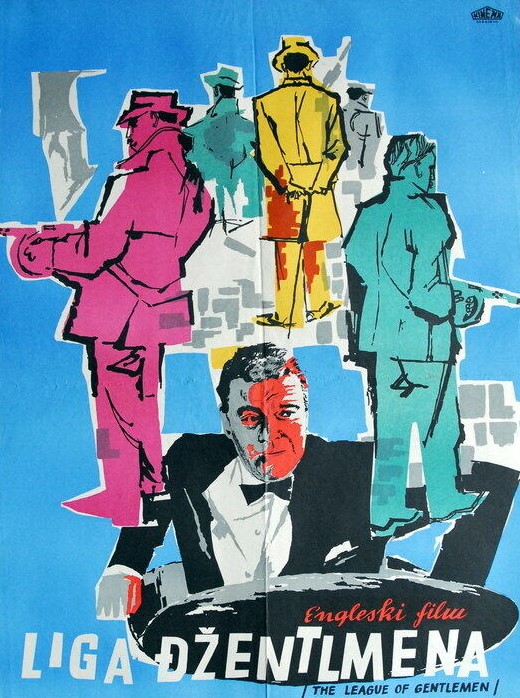
The League of Gentlemen (1960) ****

Cracking British heist film prefiguring titles as disparate as The Dirty Dozen (1967) and Heat (1995). Superb opening scene shows the lid coming off a manhole cover and after a short pause to avoid being drenched by a municipal street cleaner a man in a dinner suit emerges and makes his way to his Rolls Royce. Say hello to Lt-Col Hyde (Jack Hawkins).

Don’t be fooled by early reviews that tabbed this this an “action-comedy,” the humor is only incidental, while serving the important purpose of cutting the grandiose down to size, and not in the vein of, for example, Beverly Hills Cop (1984).

A group of ex-WW2 officers receive a mysterious parcel containing a pulp novel and £50 in notes torn in two, the other halves redeemed if they turn up for a meeting at the Café Royal in London. The opening section is almost a riposte to the recruitment sequence of The Magnificent Seven, out the same year, which strived for effect, and zipped along with one-liners.

This gang are all down-on-their-luck, any courage or leadership displayed during the conflict counting for nothing in peacetime. The sequence is surprisingly risqué for the period, virtually all the characters engaged with disreputable women. So, we have Major Race (Nigel Patrick) running some gambling scam with easy-come-easy-go confederate Peggy (Melissa Stribling), Lt Lexy (Richard Attenborough) a garage mechanic with a sideline in fixing the odds on one-arm bandits and inclined to steal other men’s girlfriends, and Captain Porthill (Bryan Forbes) a pianist playing in seedy dives and living off a middle-aged woman whom he cheats on.

Barely getting by emotionally or financially are Major Rutland-Smith (Terence Alexander) whose glamorous wife (Nanette Newman) takes a string of lovers while ritually humiliating him and Captain Mycroft (Roger Livesey) running a chaplain racket and selling erotic magazines. Hyde lives on his own in a mansion, his absent wife described as “the bitch.”

There’s an undercurrent here that’s barely explored of soldiers who have lost their way, but at the time it could remain underutilized because audiences would be filled with men whose post-war experiences chimed with these characters. Hyde has come up with a stunning plan to relieve a bank of close on a million pounds, the cash split equally, using the various skills his team had acquired through war service.

It’s a bold and, even if carried out with military precision, frankly terrifying exercise that intends to use machine guns and smoke bombs to scare the living daylights out of anyone who dares intervene, bringing New York-style gangsters to the streets of peaceful London. First stop is an army training where, in a ruse similar to that of the later The Dirty Dozen, Mycroft impersonates a commanding officer, inspects troops and deals out humiliation at the drop of a hat. Without doubt, this is an amusing sequence, especially when his superiors in the enterprise, Hyde and Race, are forced to eat disgusting Army slop, but it fulfils the same role as in the Robert Aldrich picture, the least likely soldier allowed to strut his stuff, tension undercut.

The heist itself follows the normal template of planning and execution and it’s brilliantly done, although the crooks are undone by a minor flaw in the procedure. Except for the opening section, and when Hyde exposes, as perhaps community therapy, the criminality of his gang, we learn little more about them, except, as if revisiting the past, how they respond (or not) to the discipline and hierarchy of the Army model on which the group operates. Scoring points off each other, or rebelling, or meting out punishment for misdemeanors, it’s like being back in the Army.

Nobody’s seeking redemption as in The Magnificent Seven or The Dirty Dozen, but it’s still easy to sympathize with an odd bunch whose expectations have been dashed. The scene where Race witnesses Hyde’s stark living conditions, and then offers to wash up the plates piled up in the sink, tells you a lot about how lost some of these men are.

Excellent acting all round from, by British standards, an all-star cast. At one time the number one British star, Jack Hawkins was an occasional Hollywood pick, leading role in Howard Hawks’ Land of the Pharaohs (1955), major supporting roles in Bridge on the River Kwai (1957) and Ben-Hur (1959). Richard Attenborough (The Angry Silence, 1960) had been a top name for over a decade, Nigel Patrick top-billed in director Basil Dearden’s previous outing Sapphire (1959). Kieron Moore (Day of the Triffids, 1963), Bryan Forbes (better known as a writer and director) and Nanette Newman (The Wrong Box, 1966) were rising stars, and you might want to include Oliver Reed (Hannibal Brooks, 1969) in that roster as he makes a camp entrance in a bit part.

Basil Dearden (Khartoum, 1966) is in top form with a script by Forbes from the John Boland bestseller.  

Worth seeing.

Les Biches (1968) *****

Innocence and experience alike are corrupted by the destructive power of love in this elegant and compelling early masterpiece from French director Claude Chabrol. Although he owed much of his later fame to slow-burning thrillers, this is more of a three-hander drama with a twist and it says much for his skill that we sympathize in turn with each of these amoral characters.

Wealthy stylish Frederique (Stephane Audran), in an iconic hat, picks up younger pavement artist Why (Jacqueline Sassard) in Paris. They decamp to St Tropez where Frederique keeps a rather discordant house, indulging in the antics of two avant-garde house-guests. Why loses her virginity to architect Paul Thomas (Jean-Louis Trintignant) who soon abandons her in favor of the older woman. Each is guilty of betrayal and although a menage a trois might have been one solution instead the lovers dance from one to another with Frederique  apparently in control, in one scene stroking Why’s hair with her hand and caressing Paul’s  face with her foot. In an attempt to win the man back, Why dresses like her rival down to hairstyle, make-up and even the older woman’s beauty spot.   

At no point is there angry confrontation, nor does Frederique simply dismiss Why from the household, but the story works out in more subtle insinuation, Frederique clearly expecting either that Why make herself scarce or, alternatively, make herself available for whenever Frederique tires of male companionship. The movie’s focus is the baffled Why. When the older pair disappear to Paris, the camera follows Why through off-season St Tropez, chilly weather replacing glorious sunshine. Frederique and Paul are the sophisticates who expect Why  to know how to play the game. The younger woman has wiles enough to see off the avant-garde irritants.

It looks for a while as if it might be a coming-of-age tale or of young love thwarted but every time Frederique enters the picture her dominance is such that proceedings, no matter how deftly controlled, have an edge and so it becomes a study of something else entirely. At one point, each has power over the other. If Why has learned anything it is restraint, so the movie never descends to tempestuous passion. She also learns, in a sense, to submit, since the impoverished can never compete with the rich. In the end her revolt takes the only other option available, against which the wealthy have no defence.     

Excellent performances from Stephane Audran (The Champagne Murders, 1967), Jean Louis Trintignant (A Man and a Woman, 1966) and Jacqueline Sassard (Accident, 1966) but Chabrol keeps all under control, twisting them round his little finger.

Superb.       

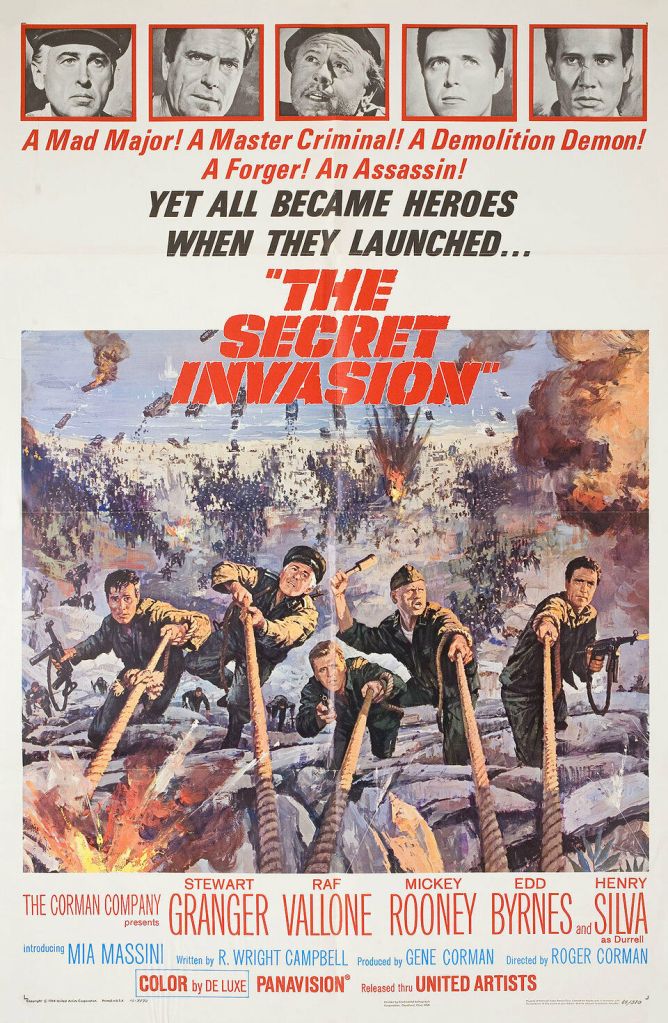
Secret Invasion (1964) ****

Dirty Half-Dozen – cashiered British major, five hardened criminals with particular sets of skills – on a mission to rescue an Italian general and start a second front in the north of Italy just as the Americans are invading the south. Throw in a grand theft of ideas from The Guns of Navarone (shoot-out with German gunboat, scaling a cliff) and The Great Escape (tunneling, although in not out) and the usual bickering and rebellion and a top-class B-list cast bringing their A-game and you have the basis of a very solid actioner.

The classy Raf Vallone (Sidney Lumet’s A View from the Bridge, 1962) is the standout here, not least because he chooses crime, pitting his wits against the authorities, rather than exploiting his university degree in philosophy. But he’s ably supported by Mickey Rooney as an unlikely IRA terrorist and various inmates from Leavenworth and Alcatraz including Henry Silva (Johnny Cool, 1963), of the fashion model cheekbones, Edd Byrnes (77 Sunset Strip), William Campbell (Dementia 13, 1963), and top-billed Stewart Granger. That any appeared in this Corman brothers (Gene directing, Roger producing) spread  suggested careers on the slide.

Still, that’s to the movie’s gain. Forget the occasional dodgy process shots and enjoy the Dubrovnik location complete with ancient fortress, cobbled streets, and tiled roofs, each of which is put to violent use, with shoot-outs in each area, not to mention a cemetery where tombs provide the perfect cover for digging into the citadel. At times, the script is snappy enough that some one-liners stick in the memory and when the characters aren’t acting up they’re doing a lot of brooding, especially Silva, the hired assassin.

This doesn’t go quite the way you would expect, especially the double twist at the end, and a couple of places where the plot gets bogged down, but there’s enough invention, interesting characters and story to see us through and one genuinely heartbreaking moment that could have been the starting point or revelatory denouement of a film all on its own.  Granger lacks Lee Marvin’s icy demeanour but delivers enough leadership in typically British style when it matters.

Silva’s icy demeanour softens enough to allow romance to peak through with local girl Spela Rozia (who you will remember from Hercules the Invincible, 1964). While trying to steal every scene, Rooney, nonetheless adds a couple of imaginative bits of business to his character. Edd Byrnes is nobody’s idea of a forger, nor would his notions, nor equipment, pass muster with the experts of The Great Escape. Vallone is terrific as the imperturbable mastermind.

This is a more hard-edged, realistic endeavor than The Dirty Dozen. In that picture every scheme goes according to plan. Here nothing does and the crew are constantly thrown back on their wits, finding what they require from the most improbable resources, and carrying out a schemed timed to the second, finger-snapping to the beat in the absence of watches. The labored and overlong interrogation sequence slows the plot down until you think it will never get back on its feet, but that complaint aside, it is full of action.

Little gem.

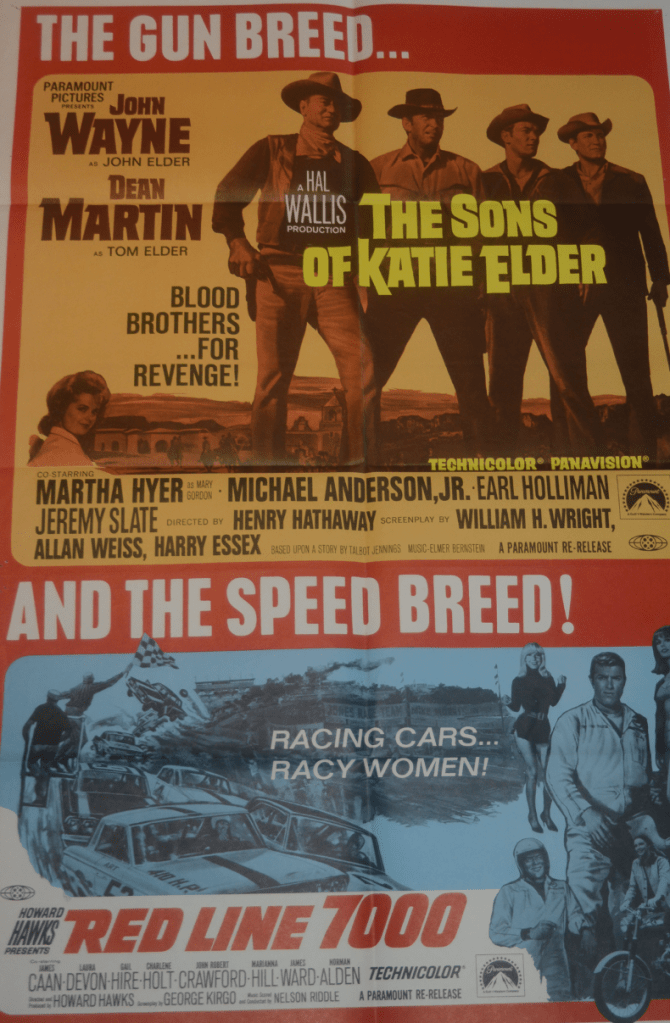
Red Line 7000 (1965) **

Quentin Tarantino is probably alone in preferring this movie mishap to John Frankenheimer’s Grand Prix (1966) – or I have somehow missed a “cult” picture. There was no doubt director Howard Hawks could handle speed. Check out the action in Hatari! (1962) as jeeps battle across tougher terrain than NASCAR racing circuits. But for some reason, he thought he would get away with interspersing footage of races and spectacular crashes with shots of actors behind the wheel. Any time something exciting is about to happen we’re alerted by the commentator saying “oh oh” or “wait a minute” or “hold it.” There’s none of the feverish excitement or authenticity of Grand Prix.

Hawks hired a no-name cast in a bid a) to become a star-maker, b) to prove he did require the marquee wattage of the likes of John Wayne and c) to show he could make a movie cheaply. He failed on all three counts. He probably didn’t think he was taking any kind of gamble at all, as a man approaching 70, in trying to depict the lives of people around 50 years younger. James Caan, in his sophomore outing, comes out best, but that’s not saying much since he has very little to do except growl and look broody. Marianna Hill (El Condor, 1970) is also believable.

While the racing footage has dated in a way that Grand Prix has not, the main problem is just a jumble of characters getting lost in a jumble of stories. No sooner has one character been introduced than we are onto another. There’s none of the cohesive story-telling that marked out The Big Sleep (1946) or Rio Bravo (1959) and, frankly, none of the characters are particularly interesting. And what possessed him to stick in a song sung by a character (Holly, played by Gail Hire) who cannot sing – she talks the lyrics – with a backing group made up of waitresses, I can’t begin to guess.

The most fun to be had is spotting in bit parts people famous for other reasons. Carol Connors, for example, who co-wrote the lyrics to “Gone Fly Now” (Rocky, 1976) appears as a waitress. As does Cissy Wellman, daughter of veteran director William Wellman. Comedian Jerry Lewis has a cameo. It says much for Hawk’s star-spotting abilities that of two female leads, Laura Devon only made five pictures and Gail Hire just two.

Henry Hathaway and Howard Hawks…Together!

Of the main supporting males, this was the beginning and end of John Robert Crawford’s movie career while Skip Hire made a bigger splash as a producer of television series The Dukes of Hazzard. Co-written by the director, George Kirgo (Spinout, 1966) and Steve McNeil (Man’s Favorite Sport, 1964)..

However, the French had a word for it – “genius.” Despite being dismissed as a rare misstep by the bulk of critics worldwide, Cahiers du Cinema decided it was one of the year’s Top Ten pictures. So what do I know?

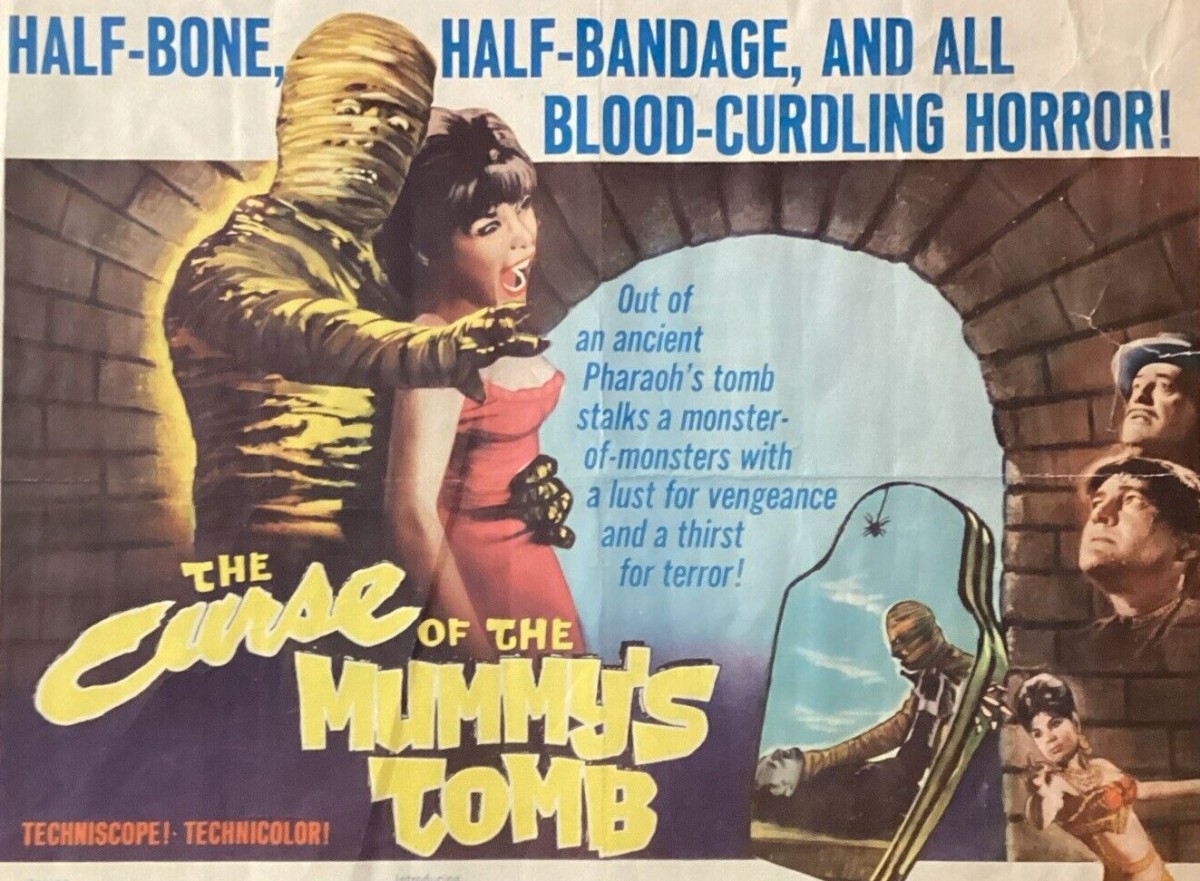
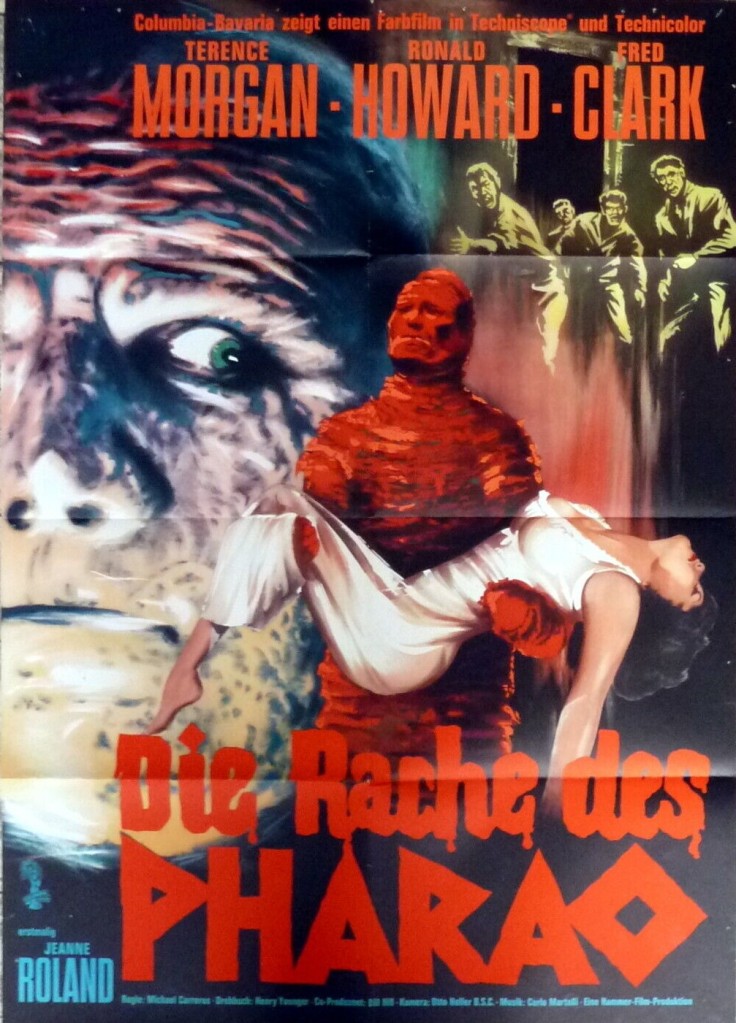
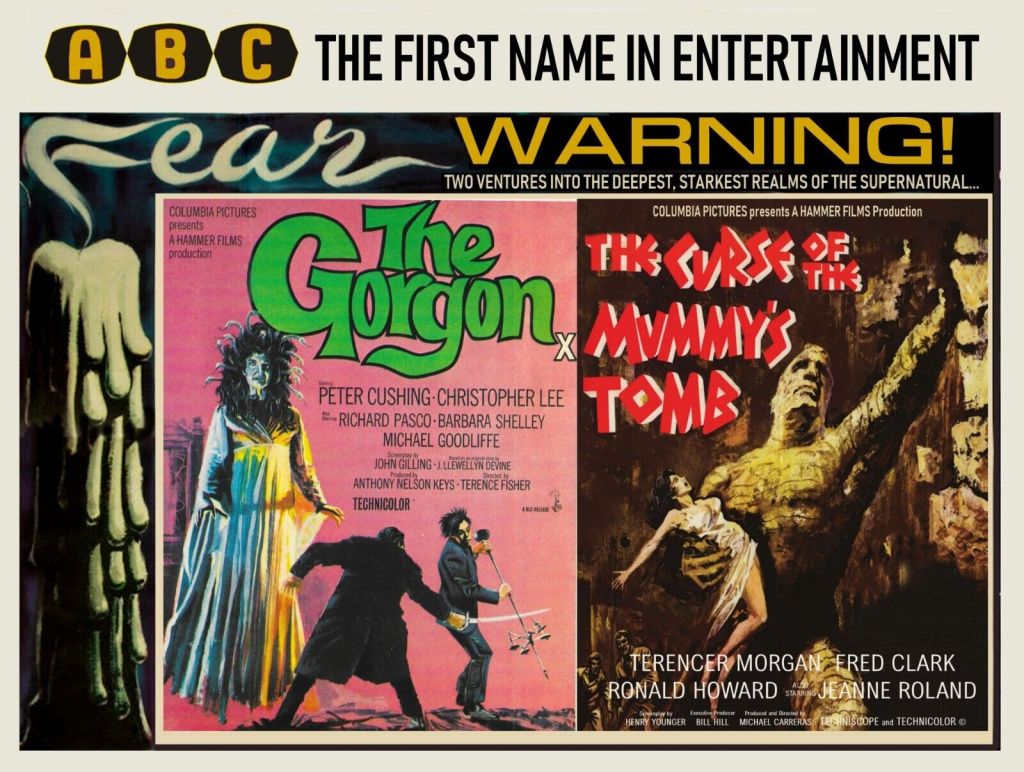
The Curse of the Mummy’s Tomb (1964) ***

Approach with affection and you will be rewarded. This is third tier Hammer, way down the pecking order behind Dracula and Frankenstein and after attracting studio stalwarts Christopher Lee and Peter Cushing for its first venture into this territory (The Mummy, 1959) dumps them for the sequel. And in the absence of the CGI that transformed the Stephen Sommers version in 1999 – and triggered the misguided Universal Monsterverse – struggles these days to prevent audiences laughing at the special effects. The titular beast was little more than a bandaged version of the lurching creature created by Dr Frankenstein so chills were always going to be in short supply, especially minus the plague of scarabs that dominated the later proceedings.

More interesting is the backstory that drives the narrative, warring siblings in ancient Egypt, the death of the rightful monarch and a reincarnation curse that travels down the centuries. Throw in bombastic King Kong-style showman Alexander King (Fred Clark) determined to monetize an archaeological find, shift the story to London, bring in a damsel Annette (Jeanne Roland) infatuated with the villain, and you have the makings of a decent tale. Alternatively, if you’re of a different mind, that could all be to cover up shortcomings in the plot and the wrong reasons for delaying the appearance of said monster.

People tampering with Egyptian graves tend to get their hands chopped off, but that’s as much warning we get of evil afoot although there are hints of malignancy in the flashback that shows the murder of Ra-Antef, son of Rameses VIII. But triumphant returning Egyptologists John Bray (Ronald Howard), Sir Giles Dalrymple (Jack Gwillim) and Annette, daughter of famed Professor Dubois who died in the line of duty, are inclined to take no precautions.

Poetic license – the mummy just ain’t that big in the movie.

Until the mummy is let loose, much of the tale centres around the ruthless grasping King and a love triangle developing between Annette, her fiancé John and the newcomer Adam (Terence Morgan) she met on the voyage home. While John is kept busy by King arranging for the grand public opening of the tomb, Adam slips in to romance Annette, not letting on of course that he possesses the amulet that can revive the sleeping monster. The setting – sophisticated London rather than remote Transylvania – and the delay of the murderous onslaught ensures that most of the picture survives on intelligent conversation, motivations and characters set out in non-cliché manner, and no squads of villagers set up for a marauding.

The monster is pretty effective when he does deign to appear, bursting through windows, picking up the damsel in a pose that I’m convinced Oliver Stone snaffled for Platoon (1986), and making his way to the nearest sewer, unlikely locale for a climax. There’s a propensity for lopping off hands and when that loses its impact stomping on heads.

But it’s not camp, is well-acted and the storyline makes sense. It probably helps that it’s free of Cushing and Lee because with unfamiliar actors the audience has to work harder. Terence Morgan (The Penthouse, 1967) is the pick of the stars because he carries most of the mystery. But Fred Clark (Move Over, Darling, 1963) steals the show by making a meal out of his outrageously greedy businessman. Top marks to Hammer for making Burmese-born Jeanne Roland (You Only Live Twice, 1965 and Casino Royale, 1967) a professional – she is an archaeologist – rather than a cleavage-ridden damsel in distress. And for those of a nervous disposition you will be pleased to know that the monkey is not present just to nibble poison intended for one of the principals.

However, from the outset it was destined for the lower half of a Hammer horror double bill, so the kind of budget that could do it justice was never in evidence. Studio boss Michael Carreras (Prehistoric Women, 1967) always gave the impression of over-extending himself but here  as writer-producer-director he manages to keep the picture on an even keel long enough for the monster to do its worst.

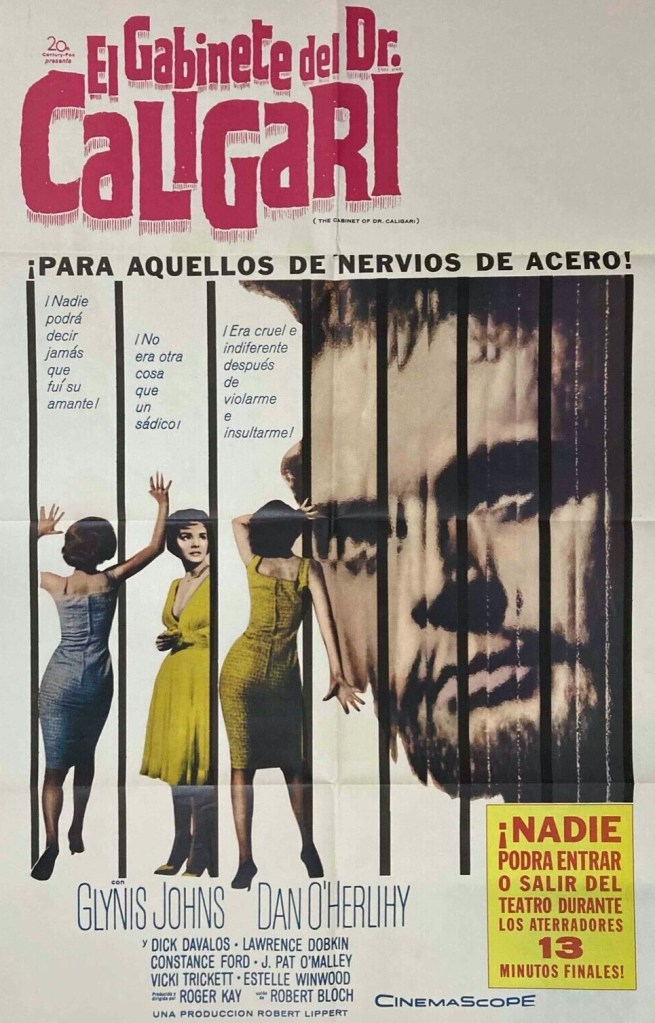
The Cabinet of Caligari (1962) ***

If you’re going to put an English rose through the mill who better than husky-voiced Glynis Johns and except for the giveaway title you might expect from her previous screen ventures that when her car breaks down in a foreign country we’re all set for romance. But you’re probably on the alert anyway after realizing Robert Bloch (Psycho, 1960) wrote the script. The narrative engine runs on twists and the chances would be poor of audiences comprehending the psychiatric devices involved so it’s pretty much a contemporary haunted house mystery with our heroine trapped in an ever-worsening situation and most of the terror emanating from her own mind.

After her tire blowout, and exhausted from trudging along country roads, Jane (Glynis Johns) seeks help from Swede Caligari (Dan O’Herlihy) who owns a large estate in the country. But when she wakes up in the morning, she is unable to leave or telephone for help. There follows a series of disturbing events including (a la Psycho) a peeping tom (bath not shower), being presented with pornographic photographs, interrogated, witnessing torture and being chased by revolving glass. Other images are terrifying, babies baked in ovens, people buried up to their necks, a torture rack. Nothing and nobody are what they seem.

The twist is that she’s in a mental asylum, the car breakdown a fiction to make acceptable to herself her presence there, the other incidents all explained as various versions of psychiatric treatment including electric shock. The central conceit, that she’s trapped, is well-maintained what with other guests dressing in glamorous fashion for dinner and none behaving like inmates. But when Jane tries to make friends with them in order to organize a breakout or escape, she doesn’t know who to trust, and even attempts seduction.

It kind of works and kind of doesn’t. When the camera explains seconds later the reality behind her crazy visions, it ruins the effect. The expressionistic approach helps in presenting the visuals but can’t provide proper insight into her state of mind. The images are odd rather than helping the story. There’s a disjointed feel to the whole thing, as if director and star were on different planets. And there’s a major plot flaw suggesting Jane must be truly out of her mind if she can’t recognize that Caligari and inmate Paul are the same person, give or take a false beard.

It was a bold career choice for Glynis Johns (Dear Brigitte, 1965), generally the sassiest of heroines, to be so out of control. In his only movie, television director Roger Kay makes a bid for the big time with his visuals but too often loses sight of the characters. Of course, it was always going to be a tough ask to match the original German The Cabinet of Dr Caligari (1920) though I doubt many who saw the loose remake would be aware of its existence.

Interesting for the visuals and Glynis Johns losing the rag.

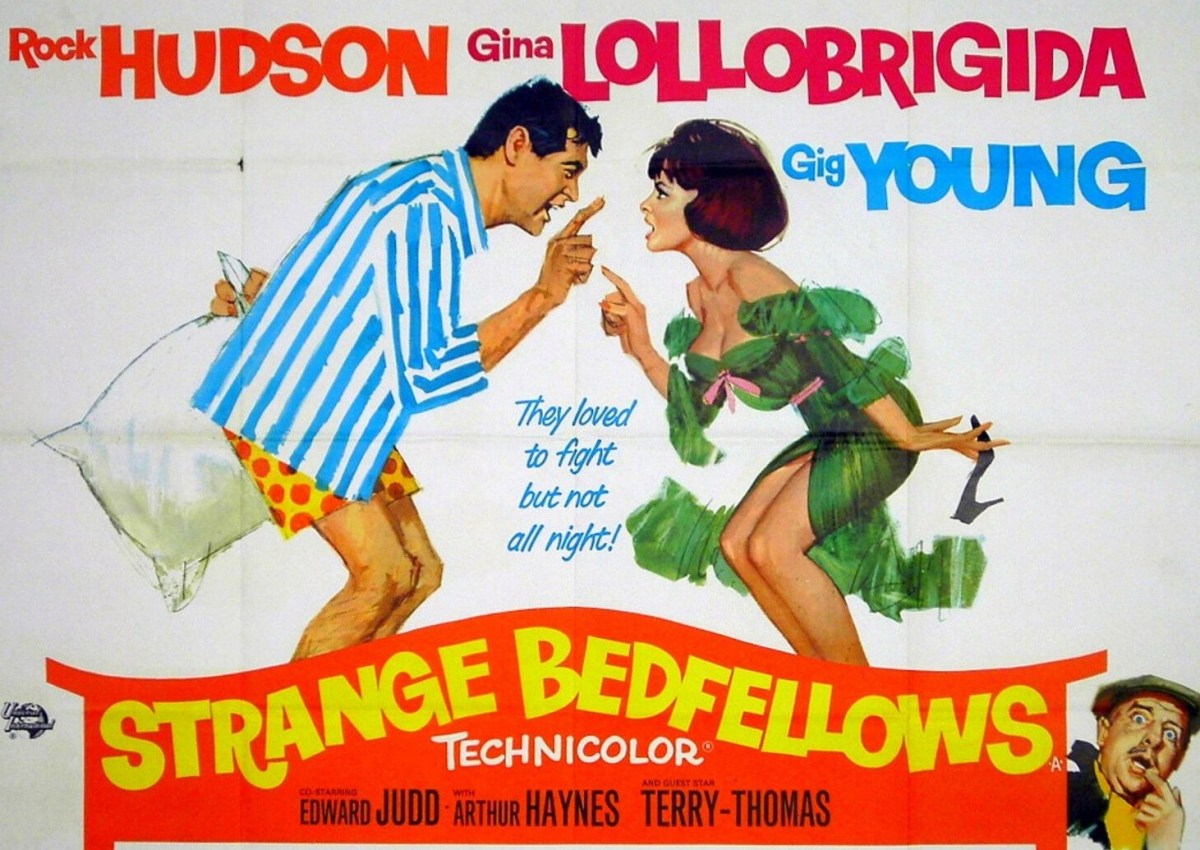
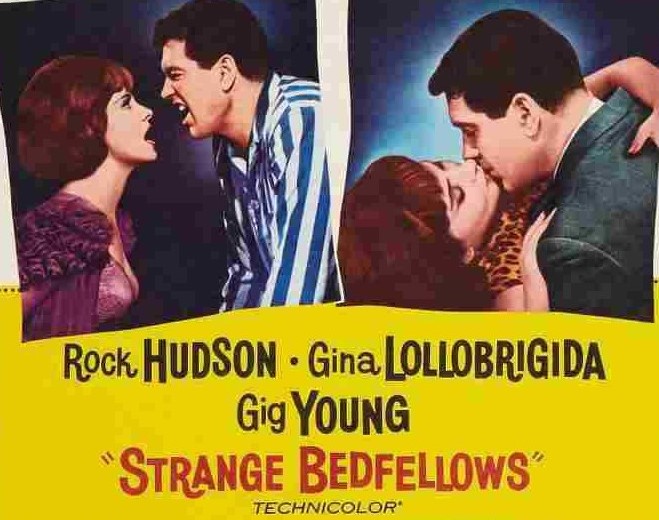
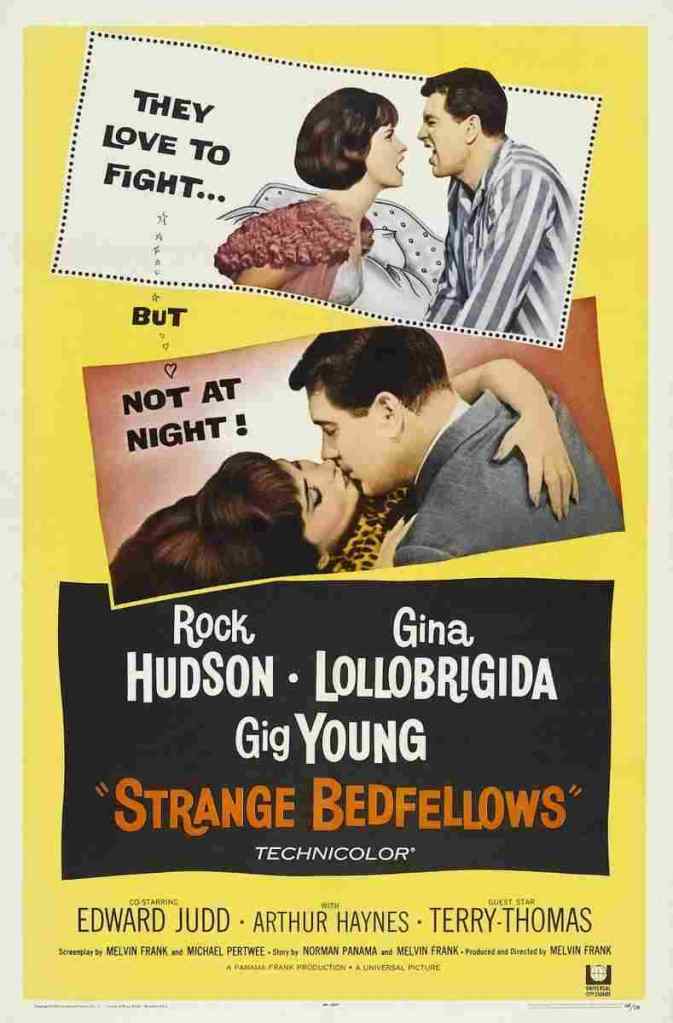
Strange Bedfellows (1963) ****

I had my first belly-laugh within seconds, a wonderful sight gag and was chortling all the way through this London-set battle-of-the-sexes comedy. Carter Harrison (Rock Hudson) is a high-flying businessman who needs to win back long-estranged wife Toni (Gina Lollobrigida) in order to gain promotion at a family-conscious oil company. Initially, Carter re-discovers the reasons he had first fallen in love with her but then, of course, only too bitterly, why they split. Hudson and La Lollo had previously teamed up for Come September (1963) and Hudson had spent most of the 1960s in romantic mishap with Doris Day so he could call on an extensive range of baffled and enraged expressions. Toni is an artist-cum-political-firebrand which sets up hilarious consequence. Richard Bramwell (Gig Young) is on hand to act as referee.

There’s some marvelous comic invention, a conversation between the two principals relayed through taxi controllers turns into a masterpiece of the misheard and misunderstood. Complications arise from Toni’s Lollobrigida’s fiancé Harry  (Edward Judd from First Men in the Moon, 1964), also an activist, but on the pompous side, and an Italian lothario. Taking advantage of the less than congenial London weather, there are jokes aplenty about umbrellas and in a nod to farce occasions for Carter to lose his trousers and share a bed with the fiancé. Smoldering sexual tension also kindles many laughs. By the time the film enters its stride it’s one comedic situation after another. It being England, naturally enough Lady Godiva is involved.

Hudson in suave mode trying to cope with the feisty Lollobrigida is an ideal comedy match. Costume designer Jean Louis has swathed the actress in a stunning array of outfits, some of which leave little to the imagination. When Doris Day got angry you tended to laugh, not quite believing this was anything more than a moderate hissy fit, but if you crossed Lollobrigida you were apt to get both barrels and it never looked like acting, she was a very convincing when she switched on the fury engine, plus, of course, whatever she threw added both to the comedy and her character’s conviction.   Both have terrific comic timing.

Writer-director Melvin Frank was something of a comedy specialist, a dab hand at suiting comedy to screen persona having previously set up Road to Hong Kong (1962) and Mr.  Blandings Builds a Dream House (1948). Terry-Thomas makes an appearance as a comic mortician and there are parts for English comedian Arthur Haynes and Dave King. Hudson and Lollobrigida exude screen charisma and while not in the class of Come September this delivers enough laughs to make you wonder why they don’t make them like that anymore.

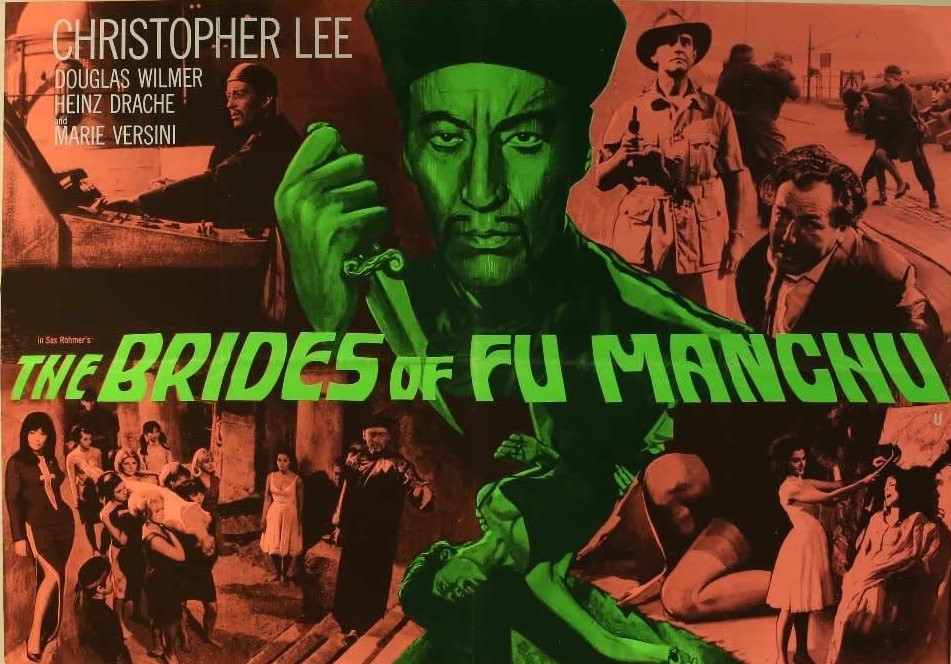
The Brides of Fu Manchu (1966) ***

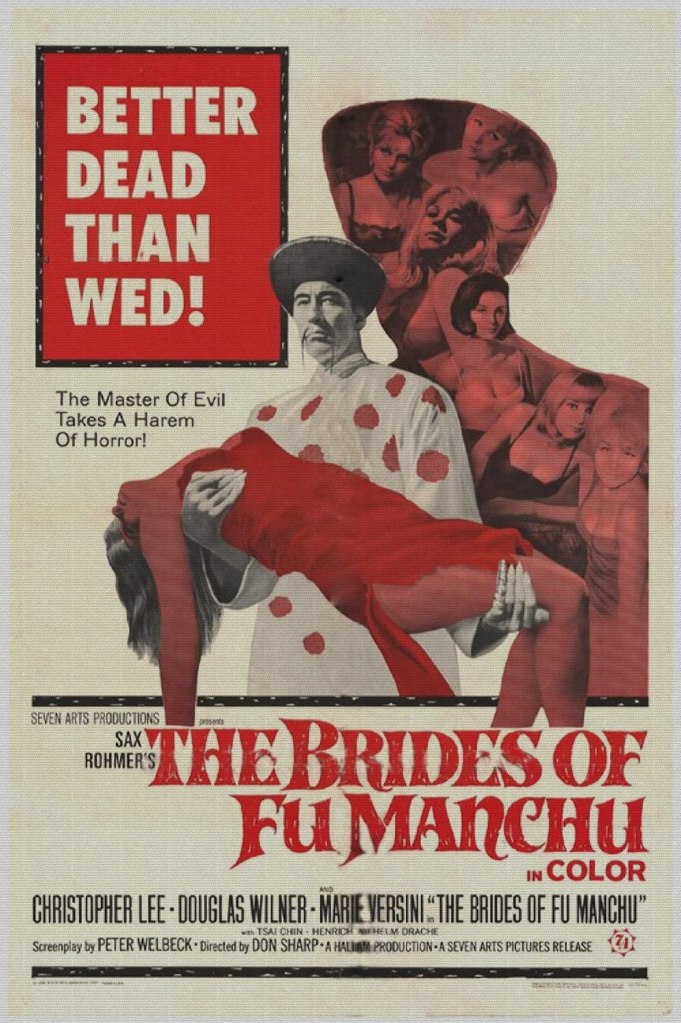
The 1960s was awash with movie megalomaniacs, most courtesy of the spy vogue. You could also count on secret agents for trailing in their wake bevies of beauties. So no surprise then that criminal mastermind Fu Manchu (Christopher Lee) has his own gang, his “brides,” although they are hardly volunteers, being the kidnapped daughters of top scientists. His plan for global domination this time consists of transmitting energy as sound waves, using miniaturization, a sonic death ray, with enough power to destroy a city.

The result is good hokum, a thriller set in the 1920s with a cracking pace, plenty of action, explosions, burgeoning romance, and a plot that gets more complicated by the minute as a tribe of worthies try out to outwit the evil genius. There is a terrific lair – where the disobedient end up in a snake pit – a passable laboratory, chases, truth serums (“the dust that loosens tongues”), hypnotism, bait-and-switch tricks and decent special effects.  Three stories race along in a parallel pell-mell: Manchu needs one more kidnapping to complete his complement of daughters, while the good guys headed by Fu Manchu’s old adversary Nayland Smith (Douglas Wilmer) are trying to locate the bad guy’s secret location while at the same time attempting to find out where he will strike next. 

While Fu Manchu is indestructible – supposed dead after the previous film – his henchmen (and henchwomen) are all too human. It takes three attempts to kidnap Manchu’s next victim. They are easily identifiable by their giveaway cummerbunds and bandanas and their method of assault is not kung fu but brawling so a good solid British punch of the old-school soon sorts them out. Manchu’s daughter Lin Tang (Tsai Chin) is a chip off the old block, delighted at any opportunity to torment the brides.  

The brides, in diaphanous gowns that might have been a job-lot from the set of She, are far from compliant, even rebelling at one point, and employing vicious fight tactics. Fans of director Don Sharp will find him every bit as inventive as in The Devil-Ship Pirates (1964) and  Bang, Bang, You’re Dead  (1966) . It’s another Harry Alan Towers (written under his pseudonym Peter Welbeck) effort so that means an international cast.

Two television cops, British Rupert Davies (BBC’s Maigret) and German Heinz Drache (cop in a Francis Durbridge series), plus Francois Mitterand’s brother-in-law Roger Hanin, provide solid support. Not forgetting Burt Kwouk as a henchman. Brides of the year include French Marie Versini (German western Winnetou, 1963) and Rhodesian Carole Gray (Curse of the Fly, 1965). The film did not prove much of a jumping-off point for other brides such as Ulla Berglin, Danielle Defrere and Anje Langstraat, for whom this debut was as far as their careers went.

Christopher Lee, despite the dodgy moustache, is resplendent, exuding evil, and with a gift for rising again (just like Dracula) as he would do for another three films in the series.

Only When I Larf (1968) ***

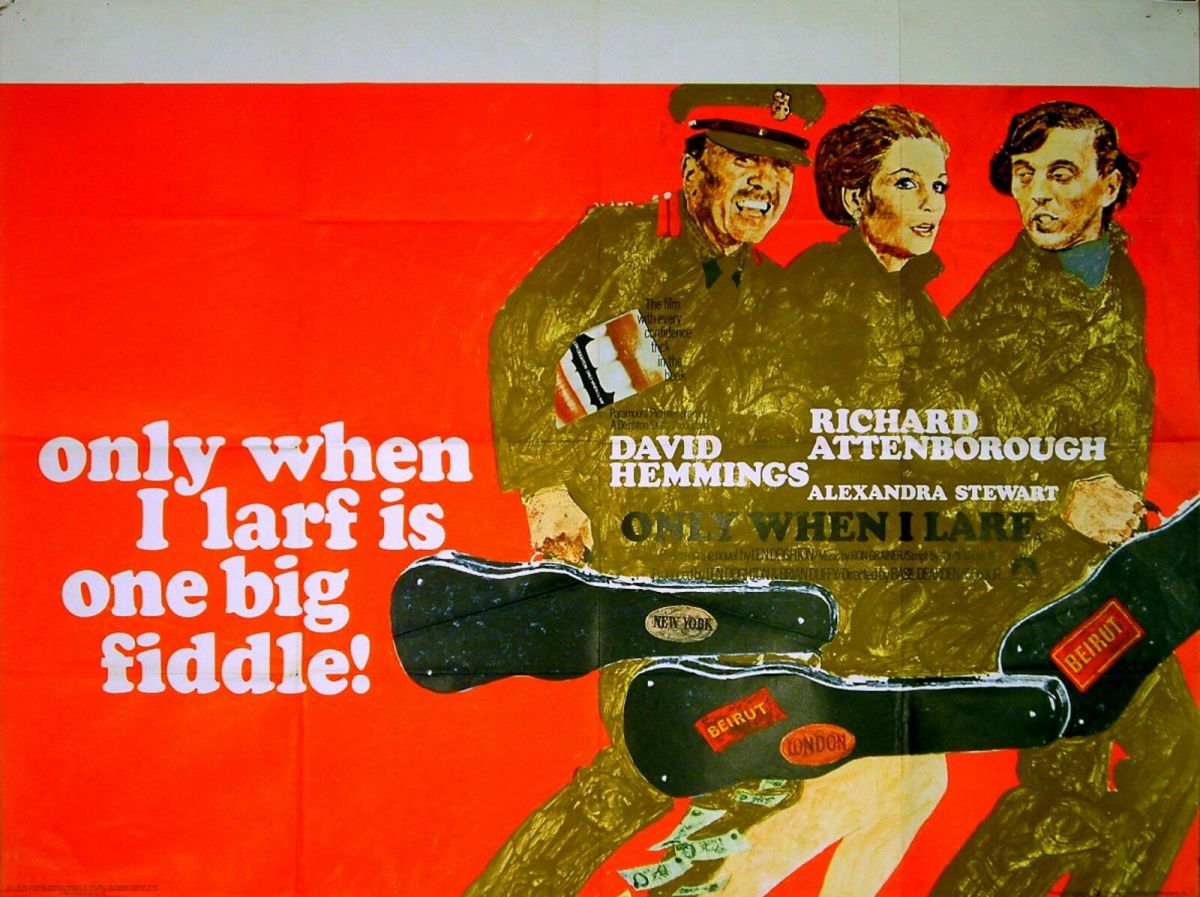
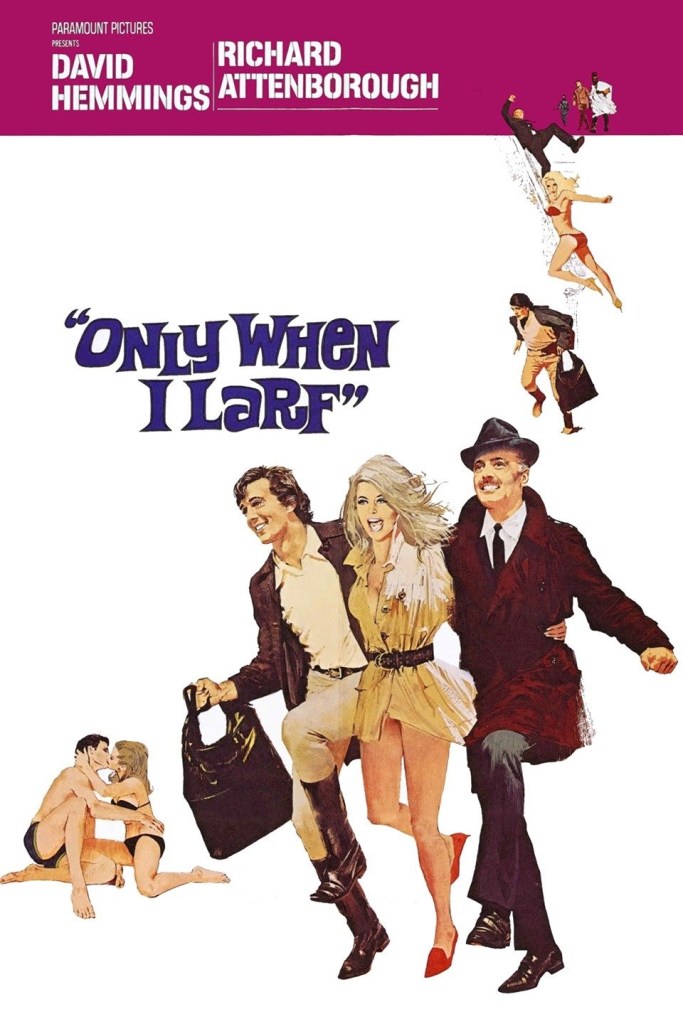
Terrific, elongated, 20-minute pre-credit sequence sets up this brisk con-man thriller as the trio of Silas (Richard Attenborough0, his younger lover Liz (Alexandra Stewart) and apprentice Bob (David Hemmings) fleece a couple of greedy businessmen in New York.  The action moves with military precision, the trio so appealing, the scam so well-worked, you want them to escape.

But when their next sting fails to come off, roles are reversed and it is floppy-haired Bob  who takes charge, organizing the scheme, and making moves on Liz. Meanwhile, Silas is planning to double-cross them. The first and last schemes work a treat but the middle one sags, even allowing for cracks to appear in the relationships.

Attenborough is the pick of the bunch, switching accents and personalities, one minute a suave businessman, the next a nervous Lebanon banker, while at other times his stiff upper lip contends with his sergeant-major attitude. Hemmings’ accents are less convincing, all over the place at times, but the switch from junior partner to operation controller is convincing especially as he clearly enjoys putting Attenborough in his place, forcing him to shave off his moustache and giving him the name Longbottom.

And Stewart is never quite what she seems, willing to indulge either man to suit her purpose. Scottish actress Melissa Stribling, wife of director Basil Dearden, is a late addition to the crew and colder-eyed.

This was Attenborough’s first starring role since Guns at Batasi (1964) – Best Actor at the Bafta Awards – and although he had featured roles in Hollywood productions The Flight of the Phoenix (1965) and The Sand Pebbles (1966) – his screen person was quite confined in those pictures. Here, it feels like he has been let free. Hemmings was coming off three heavy roles in Camelot (1967), The Charge of the Light Brigade (1968) and The Long Day’s Dying (1968) so it felt like he, too, had a spring in his step. This was a distinct mainstream jump for Canadian actress Alexandra Stewart, although she had small roles in Maroc 7 (19670 and Truffaut’s The Bride Wore Black (1968),

Basil Dearden slipped this one in between the more lavish Khartoum (1966) and The Assassination Bureau (1969). There is a slapstick chase reminiscent of the latter but, basically, he keeps to the story and allows character to develop. This being a British film, you might find some outdated British attitudes. This was bestselling author Len Deighton’s first stab at production.


Discover WordPress

A daily selection of the best content published on WordPress, collected for you by humans who love to read.

The Atavist Magazine

by Brian Hannan

WordPress.com News

The latest news on WordPress.com and the WordPress community.