The Chapman Report (1962) ***

In the 1950s new talent was largely bloodied via small parts in big movies. In the 1960s, the easier route was to first build them up as television stars. This picture represents the nadir of that plan – female roles filled with established talent, males roles with actors who had made their names in television. And, boy, does it show, to the overall detriment of the picture.

Warner Bros even had the temerity to top-bill Efrem Zimbalist Jr (hauled in from 77 Sunset Strip, 1958-1964) over more famous actresses. Zimbalist Jr at least had some marquee value after starring in low-budget A Fever in the Blood (1961) and second male lead in the classier By Love Possessed (1961) and Ray Danton (The Alaskans, 1959-1960) had played the title role in B-picture The George Raft Story (1961), but Ty Hardin was unknown beyond Bronco (1958-1962) and Chad Everett drafted in from The Dakotas (1962-1963).

Little surprise, therefore, that director George Cukor (Justine, 1969) concentrated his efforts on the females in the cast. But it was curious to find Cukor taking on this sensationalist project based on the surveys of sexuality that had taken the country by storm. Had it been made by a less important studio than Warner Bros it would have been classed as exploitation.

The bestseller by Irving Wallace on which it was based was a take on the Kinsey Report a decade before and others of the species and, theoretically at least, opened up the dry material of the more scientific reports into how men and women behaved behind closed doors.

Amazing that this was passed by the Production Code since dialog and action are pretty ripe. Interviewed women are asked about “heavy petting” and how often they have sex and if they find the act gratifying. One interviewer crosses the line and has an affair; these days that would be viewed as taking advantage of a vulnerable woman. And there’s a gang rape.

Given the movie’s source Cukor takes the portmanteau approach, four women undergoing different experiences. The problem with this picture is that there’s little psychological exploration. Women are presented by their actions not by their thought patterns or by their treatment by their husband.

In what, in movie terms, is the standout section, Naomi (Claire Bloom), an alcoholic nymphomaniac, is so desperate for attention she throws herself at the delivery boy (Chad Everett), then at a married jazz musician (Corey Allen), with devastating effect, as he hands her over to his buddies, causing sufficient degradation that she commits suicide. Since we first come across her crying in bed, sure signs of depression, these days you would expect more exploration of her psychiatric state.

Similarly, the widowed Kathleen (Jane Fonda) has been tabbed frigid by her husband and nobody thinks to call into question his inadequacies as a sex partner rather than hers. Here it’s put down to daddy issues and growing up in a household heavy with morality.

Kathleen is taken aback by the researcher even asking her about sex, “physical love” the technical term, rather than a purer kind but her consternation at the questions being posed in very cold-hearted manner by an anonymous voice – researcher hidden behind a wall – does reveal how ill-equipped some people are to even talk about sex. Her story develops into some kind of happy ending, despite the fact that her interviewer Radford (Efrem Zimblist Jr) would be busted these days for taking advantage.

Teresa (Glynis Johns) is convinced by the interviewer’s tone that the simple normality of her own marriage must be abnormal and so, determined to fit in, embarks on a clumsy attempt to  seduce footballer Ed (Ty Hardin), coming to her senses when it comes to the clinch.

The interview also has a major impact on the adulteress Sarah (Shelley Winters). After confessing her affair to husband Frank (Harold J. Stone) she rushes off to lover, theater director Fred (Ray Danton), only to find, to her astonishment, that he’s a married man. Her husband accepts her back.

To keep you straight, the “good” women are dressed in white, the “bad” ones in black. The filming is distinctly odd. The man behind the wall is filmed with no ostentation, but the style completely changes when the director turns to the women who often end up in floods of tears.

Claire Bloom (Two into Three Won’t Go, 1969) and Jane Fonda (Barbarella, 1968) are the standouts because they have the most emotion to play around with. Oscar-nominated Glynis Johns (The Cabinet of Caligari, 1962) is the comic turn. Over-eager over-confident Oscar-winner Shelley Winters (A House Is Not a Home, 1964) gets her come-uppance. None of the men make any impact.

The book took some knocking into shape. Perhaps because, of the four names on the credits only one had signal screenwriting experience, Don Mankiewicz (I Want to Live, 1958). For the others, better known for different occupations in the business, this was their only screenwriting credit. Wyatt Cooper was an actor married to Gloria Vanderbilt, Gene Allen art director on many Cukor pictures and production designer on this, and Grant Stuart was a boom operator though not on this picture.

Best viewed through a time capsule.

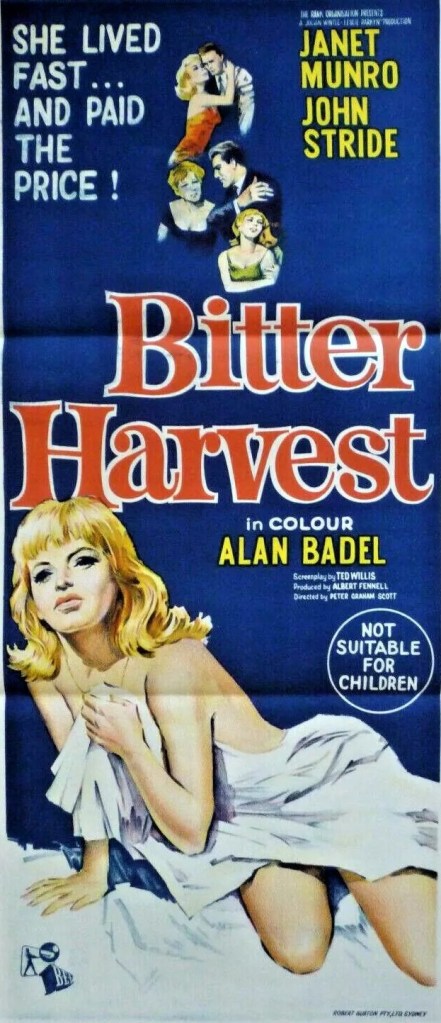
Bitter Harvest (1963) ****

Anyone claiming to be gaslighted will have unwittingly invoked the memory of an English writer who died over 60 years ago. Alfred Hitchcock paid tribute to him in adapting his fiendish play, Rope (1948). Hangover Square (1945) starring Linda Darnell was another of his novels to hit the screen. In all there have been over 50 film and television adaptations of his works.

One of his most famous publications was a trilogy focusing on a London barman and a barmaid in love with him whom he casts aside. I had read it, as I had all of Patrick Hamilton’s novels, with enormous pleasure. The trilogy was published in 1935 under the title Twenty Thousand Streets under the Sky. So it was with some trepidation that I realized Bitter Harvest was based on the middle novel of the trilogy. The DVD had sat, unwatched, in my collection for a couple of years because I was put off by the title, the no-name cast and journeyman director, assuming some routine tale with a sad ending.

Now I’m kicking myself I ignored it for so long. It’s a little gem that packs a punch, climaxing with a stylistic twist, and held together by a virtuoso performance by Janet Munro, one-time Disney ingenue in pictures like Swiss Family Robinson (1960), as she twists the audience and her lover round her little finger. And all the way through, despite the self-imposed travails, she manages to evoke sympathy.

Virgin Jennie (Janet Munro) escapes humdrum life in Wales, running a small shop in a run-down village, looking after her ungrateful father, and about to be dumped as a full-time carer onto a pair of aunts, when she meets smooth salesman Andy (Terence Alexander). He gets her drunk on champagne, whisks her back to his flat where he rapes her. Shame prevents her going home. Friendly barman Bob (John Stride) takes pity on her when she reveals she’s pregnant and lets her sleep, untouched by him, in his bed. Naturally, the relationship progresses, though she makes no move to find a job. But she wants her “share” of the good things in life and a barman isn’t going to provide them.  

Bob soon realizes she isn’t quite the docile waif delighted to be looked after. “When have I taken orders from you?” she snaps. He’s shocked when she reveals that her pregnancy was a ploy, and taken aback when she rejects his marriage proposal. Instead, she’s out on the town with actor neighbor Charles (Colin Gordon) who takes her to a showbiz bash where she wangles an introduction to impresario Karl (Alan Badel). “I’ve got something they want and they can have it and they’ll pay for it,” shows Bob which way the wind is blowing.

The movie begins with a drunken smartly dressed Jennie, long red hair cut in a more fashionable bob, returning to her upper mews apartment. She’s so sozzled she drops her handbag on the steps, only stopping to retrieve her keys before kicking the bag down the staircase. Opening the door, she tosses the key into the street. Inside, she sets about destroying the chintzy apartment, pours whisky over a photo of man later revealed as Karl, smashes bottles, upends furniture, tosses dresses out the window, scrawls something in lipstick on the mirror.

Then we’re into flashback telling the story I’ve just outlined. When she sets herself up to become Karl’s mistress, you think there’s a third act to come. But the movie cuts instead to the mews apartment and the by now dead Jennie.

What distinguishes it is the set-up. Jennie appears initially as the victim until she exerts control, using Bob, and presumably intending to work her way up. Quite how her life came to end in suicide is never revealed. But director Peter Graham Scott (Subterfuge, 1968) has the foresight to realize he doesn’t have to go into the degradation and shame, just show consequence.

And it’s framed with excellent performances. Bob, determined to improve himself, buys a book a month. Barmaid Ella (Anne Cunningham), in love with him, has to endure a scene where he tells her all about Jenny. Bob’s landlady isn’t going to get on a moral high horse about him having a woman in his room when she can rook him for increased rent. You can tell, even if Jenny ignores the obvious, what kind of life she will have as Karl’s mistress when in their first moment of intimacy he slaps her face and rips her expensive dress to make a bandage.

There’s another scene just as shocking and if it was not edited out by the censor at the time it still came as a surprise to see fleeting glimpse of a naked breast, a good year before the U.S. Production permitted similar in The Pawnbroker.  

As I said, the transition of Janet Munro (Hide and Seek, 1964) from victim to predator is exceptionally well-done, her iron fist cleverly concealed for most of the film. And it’s admirable, too, that John Stride, whose career was mostly in television, doesn’t come across as a hapless suitor, though obviously he is gullible. Alan Badel (Arabesque, 1966) only has a couple of scenes but makes a huge impact. Barbara Ferris (Interlude, 1968) has a small part.

Highlight of Peter Graham Scott’s directorial career, well-paced, measured, drawing out good performances all round, especially in the boldness of the closure. Ted Willis (Flame in the Streets, 1961) does an excellent job of updating the novel, though one flaw is that while the early section is set in Wales there’s no sign of a Welsh accent.

Recommended.

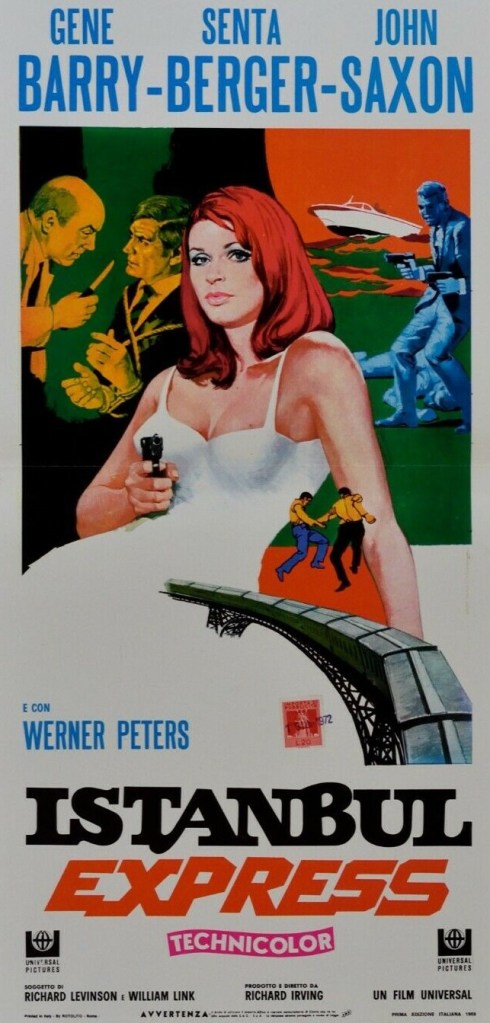
Istanbul Express (1968) ***

Calling this a by-the-numbers spy thriller does this movie no disservice since numbers are crucial to the complicated plot. On the one hand it’s quite a simple set up. Suave high-living art dealer-cum-spy Michael London (Gene Barry) travels from Paris to Istanbul on the Orient Express to bid for secret papers in a secret auction. The complication: he must pick up the auction money from a bank in Istanbul using a code given to him along the way, each number by a different unknown person. On his side are train security chief Cheval (John Saxon), investigative journalist Leland McCord (Tom Simcox) and colleague Peggy (Mary Ann Mobley). Out to get him are Mila Darvos (Senta Berger) and Dr Lenz (Werner Peters).

The numbers business is an interesting addition to the usual spy picture formula of scenic location – Venice and the Eastern bloc as well as the other famous cities – violence and beautiful, sometimes deadly, women. You spend a good time guessing just how the numbers will be passed on and let me warn you it is sometime by inanimate means while the numbers themselves come with a twist.

There’s also a truth serum, bomb threat, a traitor and every obstacle possible put in London’s way to prevent him completing his mission. London is about the world’s worst passenger, always missing the train as it sets off on the next leg of its journey, and requiring alternative modes of transport to catch up. But it’s as much about quick thinking as action and ends with a couple of unexpected twists. And it’s darned clever at times where the numbers are concerned.

Admittedly, the plot is a tad over-complicated but it’s fun to see London wriggle his way out of situations and for Cheval and McCord to turn up unexpectedly to provide assistance.

Gene Barry (Maroc 7, 1967) is little more than his television alter ego from Burke’s Law but he has an easy screen presence, never flustered, tough but charming and a winning way with the ladies. John Saxon (The Appaloosa, 1966) is the surprise turn, on the side of the angels rather than a villain, and equally commanding on screen, and certainly given one of his better roles. Senta Berger (Major Dundee, 1965) is not given as much screen time as you would like – a long way from being set up as the normal espionage femme fatale – but is certainly a convincing adversary.

This was only a movie if you saw it outside of the United States. There it was shown on television. But it had high production values for a television movie and director Richard Irving, who directed the television feature that introduced Columbo (Prescription Murder, 1968), keeps it moving at a healthy clip.  The numbers idea was probably a television device, allowing the opportunity for timed breaks in the action, Writers Richard Levinson and William Link were a class television act, creating Columbo, and prior to that the Jericho (1966-1967) and Mannix (1967-1975) television series. 

Interestingly, Senta Berger, John Saxon, Gene Barry, Levinson/Link and Richard Irving were all at various points involved in the groundbreaking U.S. television series The Name of the Game (1968-1971).

I had not realized Istanbul Express was a made-for-TV picture until I had finished watching it and in that case found it a superior piece of television and a decent-enough rift on the spy movie.

The Beckett Affair / L’Affare Beckett (1966) ***

More down’n’dirty Eurospy than the more pervasive high-gloss alternative and with some interesting directorial touches, especially in relation to POV, a narrative that leads you a merry dance but mostly down the road of grubby international politics, plus an eclectic score from Nora Orlandi. Even with actors I’d never heard of, and no idea how the DVD even ended up in my collection, it works well.

Opening Parisian sequence a standout. Gunman bursts through an office door, marches older occupant towards the exit. Outside, however, it’s the older man who emerges, climbs into a waiting car and again it’s he who comes out of that, leaving slit throats in his wake. The survivor, with a ramrod-stiff demeanor, turns out to be Col Segura (Gianni Solaro), wanted by the authorites for clandestine activites in Cuba in 1961 and for instigating too many apparent suicides.

Agent OS47 Cooper (Lang Jeffries), drafted in to track him down, does so by means of a letter supposedly written to his mistress Claire Beckett (hence the title) who is nowhere to be found. Next best thing is her secretary, blonde bombshell Helen (Nathalie Nort), who is already on Segura’s radar and is promptly kidnapped and then used to lure Cooper to a breaker’s yard where various tough guys want to beat him to death. Beckett, it transpires, ain’t going to be found unless you fancy digging graves.

The good guys are as villainous as the villains, torturing a suspect. As you might expect, there’s a heap of double-crossing, another agent as well as a cop in the pay of the opposition. Cooper’s sidekick Paulette (Krista Nell) is as tough as anyone, her beauty belying her fighting skills. The plot’s somewhat complicated and leads Cooper to being hired by Segura to assassinate a Nicaraguan leader, the notion of liberating Cuba just a front to mislead Segura’s pursuers.

Action sequences are more limited than the normal run of spy pictures, but when they come they pack a punch. The tussle in the breaker’s yard might appeal more than that in Mickey One (1965) for resisting the temptation to go down the existential or metaphorical route. Like the rest of the film it’s a down’n’dirty scrapyard. In the best action sequence, with an idea I’ve seen later stolen, the music playing that you assume to be the film’s score abruptly ends halfway through the fighters destroying an apartment, because they’ve trashed the object emitting the music. That takes a moment to digest so the sudden silence after the loud music strikes a stylistic note.

While Cooper isn’t as active sexually as James Bond, he does, like 007, get intimate with woman who might prove useful. Segura is good bit more normal than your usual espionage supervillain, with more flaws than you’d expect, especially after our introduction to him. There’s also unusual depth in subsidiary characters, Helen jealous of her boyfriend, secondary villains seeking social advancement and not always following orders, Paulette proving more than a second-potato character.

Theoretically set in France, Switzerland and South America, only the first locale appears authentic, with many outdoor shots, but not reliant on steeotypical tourist tapestry.

One of the alternative titles, The Spy Pit, better catches the tone of the picture, everyone caught in an espionage trap, and, ironically, given the constantly changing world of international politics, much of the background here has been superseded by real events. I’m putting the moodiness down as deliberate not just the state of the DVD.

Canadian Lang Jeffries (The Revolt of the Slaves, 1960) is a decent ersatz Sean Connery, Austrian Krista Nell (The Million Eyes of Sumuru, 1967) a capable sidekick, Gianni Solari (Seven Seas to Calais, 1962) comes across as efficient businessman rather than demented villain, Mali-born Nathalie Nort (Succubus, 1968) proves equal to an enlarged supporting role.

While you wouldn’t call it a directorial triumph, and it could do with some narrative clarification, Osvaldo Civirani (Return of Django) has more stylistic flourishes in his armory than you’d expect. Written by veteran Roberto Gianviti (Zorro and The Three Musketeers, 1963) who had over 100 movie credits.

Interesting take on the Eurospy subgenre.

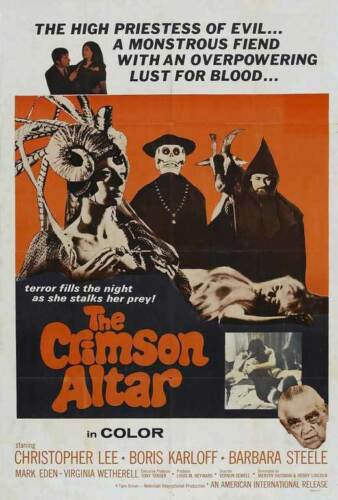
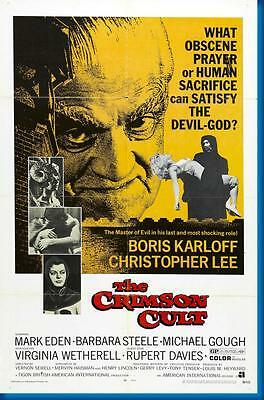
The Crimson Cult / The Crimson Altar/ Curse of the Crimson Altar (1968) ***

Horror is a small world and at any moment you are likely to bump into stars of the caliber of Christopher Lee, Boris Karloff and Barbara Steele – or in this picture all three. Investigating his missing brother Peter sends antiques dealer Robert Manning (Mark Eden) to a remote country mansion where he encounters owner Morley (Christopher Lee), his seductive niece Eve (Virginia Weatherall), the wheelchair-bound authority on witchcraft Professor Marsh (Boris Karloff), deaf mute Elder (Michael Gough) and a centuries-old mystery.

Morley can legitimately deny that Peter has ever set foot on the premises since it was common for the brother to adopt an alias when seeking out significant antiques. By the time Robert amasses sufficient clues to challenge Morley on this particular issue, it appears that further ideas of more sinister goings-on may be illusory. On his first night Robert observes an annual celebration of the Black Witch but although an effigy is burned this festival appears to have more to do with the innocent consumption of alcohol and heady bouts of sex than satanism.

And after a while, Robert indulges in carnal delight with Eve. However, he is plagued by a nightmare that involves a grotesque trial by a jury wearing animal heads. Gradually, he learns Morley, meanwhile, is such a congenial host, and his niece delightful and sybaritic company, that the finger of suspicion points at Elder, who does take a pot shot at Robert, and the professor who has a collection of instruments of torture.

Were it not for veteran director Vernon Sewell (Urge to Kill, 1960) beginning proceedings with some kind of black mass complete with floggings and female sacrificial victim, the audience might have been kept in greater suspense. As it is, the non-violent annual celebration throws us off the scent as does the seduction of Eve and the prospect that Robert’s nightmare is little more than psychedelic hallucination. The denouement is something of a surprise. The ritualistic aspects of the picture are well done and given this is a Tigon film rather than Hammer you can expect harsher treatment of the S&M element, especially for the period.  

The eerie atmosphere and well-staged witchcraft scenes are a plus, but, despite the involvement of a handful of horror gods, the movie’s reliance on lesser players to drive the narrative is a minus. Lee, Karloff and Steele (though in a more minor role) are all excellent as is the demented Michael Gough but Mark Eden (Attack on the Iron Coast, 1968) is too lightweight to carry the picture although Virginia Wetherall in her first big part suggests more promise.  More of Lee, Karloff and Steele would have definitely added to the picture but since this type of film often requires the young and the innocent to take center stage that was not to be.

Directed by Vernon Sewell (The Blood Beast Terror, 1968) from a script by Dr Who writers Mervyn Haisman and Henry Lincoln and Jerry Sohl (Die, Monster, Die, 1965).

Worth a watch.

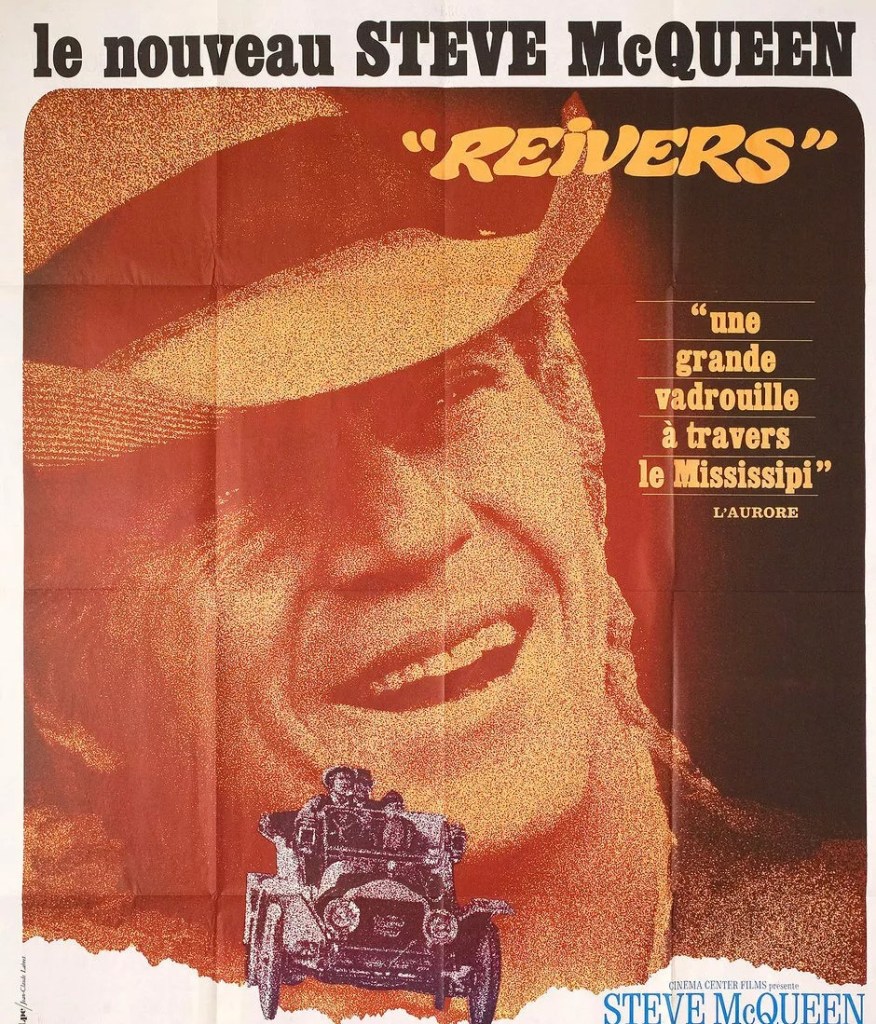
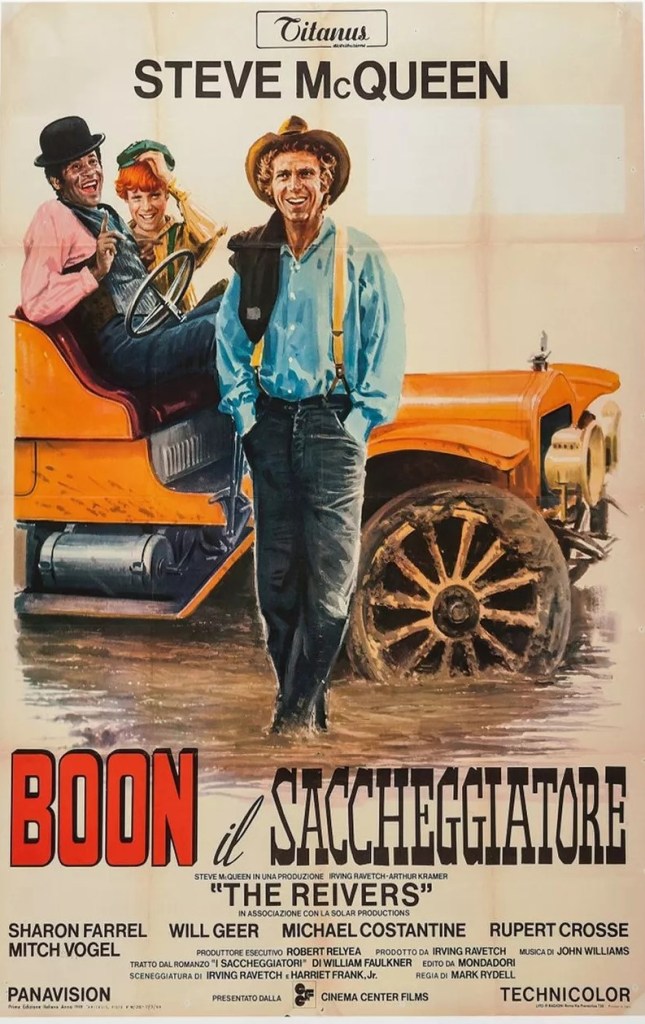
The Reivers (1969) **

Vanity project. Two words to strike fear into the heart of a studio executive. Generally means a star has got the worthy itch. Determined to attach himself to a movie of Shakespearian proportions. Something with literary heft. Wants to break clean away from the persona that made him a star.

Experienced studio honcho, scenting red ink a mile off, rejects the proposal, or agrees to it on the condition said star first makes two, maybe even three, of the studio’s more straightforward movies. (Warner Bros had Steve McQueen on a six-picture contract). On the other hand, out there, in the Hollywood hinterland, there’s always some less well-known producer willing to pony up an enormous fee as the price of making his name. Or, in this case, a nascent mini-major, the kind that thinks it will become an ”instant major” should it sign a contract with the biggest name on the planet after the rip-roaring box office of Bullitt (1968). Step forward Cinema Center, the movie arm of CBS television, desperate to make a Hollywood splash.

Am sure the pitch wasn’t: “comedy about a thief and a sex worker.” More likely the plus point was William Faulkner, America’s most famous living writer (along with John Steinbeck), winner of the biggest award in literature, the Nobel Prize, whose short story provided the source material. Faulkner also, as it happened, had a decent movie pedigree having adapted Bogart-Bacall vehicles To Have and Have Not (1944) and The Big Sleep (1946) while an adaptation of his short stories into The Long, Hot Summer (1958) hit the box office jackpot.

Admittedly, The Sound and the Fury (1959) and Sanctuary (1961) had been less successful, but Fox had also turned The Long, Hot Summer into a television series that ran for two seasons, so the author’s name would be fresh in the audience mind.  

It’s always a worry when an actor changes his hair style. Means he’s going method or “acting.” Here, Boon (Steve McQueen) sports a bushy blond barnet. And spends most of the time in “aw shucks” mode, whirl-winding his arms, contorting his features, doing most of the things a decent director would have told any other actor to cut it out. It would take a lot more acting talent than Steve McQueen, pushing 40, can tap into to successfully convince as a guy in his 20s

At least, he’s acting enough to allow himself to be covered head-to-toe in mud, something a major star would generally avoid. The comedy is as broad as you can get and director Mark Rydell (The Fox, 1967) shows little aptitude for it, not least in knowing when to stop milking a scene.

Biggest problem is that Boon, in narrative terms, is not the star, merely the conduit. The story actually concerns 11-year-old Lucius (Mitch Vogel) growing up, as he’s lured into a scheme hatched by Boon to borrow his employer’s spanking new automobile (this is 1909, by the way) and head off for the local whorehouse. Along the way, the child becomes a jockey riding a race Boon must win.

Sex worker Corrie (Sharon Farrell) has the other major story strand and the biggest element here is the relationship between herself and the boy. When he brings out her mothering instincts, she is ashamed of her profession and she plans to quit. The boy sees a naked woman for the first time – a painting, not in person – loses his worship of Boon and doesn’t “quit” as if he’s in a hard-tack B picture.

Pretty much glossed over is the rape. You can’t have rape in a comedy, can you? But for various reasons Boon and his black buddy Ned (Rupert Crosse) and the ladies from the whorehouse have ended up in jail. Price of freedom is Corrie having sex with corrupt cop Butch (Clifton James). Corrie has the best scene, the look of humiliation on her face, when released from the cell to be raped by the cop. And this was a film sold as “a lark.”

And, of all things, Boon is purportedly in love with Corrie, but not so much that he doesn’t plan on having sex with one of the other girls, given he visits the whorehouse three times a week and Corrie, in a bit of a tizz, has turned him down.

Small wonder this has never been the subject of an anniversary revival. Hard to see how the attitudes reflected here would connect with the contemporary audience. Scarcely believable that McQueen could get himself involved, even for the privilege of being linked, at some remove, with William Faulkner.

Chances are what originated from the Faulkner pen as a more somber coming-of-age tale was altered by screenwriters Irving Ravetch (doubling up as producer) and Harriet Frank Jr (The Dark at the Top of the Stairs, 1960) to fit in with McQueen’s ambitions. The star had not wanted to make Bullitt, having an aversion to cops, and this looks like his attempt to make up for it.

Actually, it did well at the box office, Rupert Crosse and composer John Williams nominated for Oscars and McQueen and Mitch Vogel for Golden Globes.

A different McQueen, to be sure, but the subject matter is objectionable and the comedy is forced.  

Privilege (1967) ****

Considerably more prescient than perceived at the time. Predicts the influence of pop stars – immeasurably magnified now through social media – and instant cancellation as a consequence of inappropriate action or remark, plus the way marketing tie-ins can boost product. Itemizes more succinctly the corporate pressure brought to bear on entertainers as well as the constant public exposure that denies performers any privacy. The radio in a watch was way ahead of its time and you could also argue that it predates A Clockwork Orange (1971) in identifying the attraction of violence and it touches on self-harm.

It’s both daft but realistic, overblown but intimate, mixing gibberish and brilliance so well it’s hard to know which side to come down on. All the obvious targets – Church, Government, big business, the dumb young – are here.

The story is set in a Big Brother style “near future” when control of the masses is the aspiration of Government. Steven Shorter (Paul Jones) is the messianic pop star trapped by fame. His stage act is quite stunning. Imprisoned in a cage, handcuffed, brutally beaten by warders, he sings of freedom to a young, mostly female, audience driven to tears by his ordeal, and occasionally on the point of rioting.

Paul Jones’s performance was criticized at the time because reviewers wanted performer more than puppet, but, at the distance of a half a century, it looks more like the actor has made the correct choice, entombed by the restrictions placed upon his life.There’s scarcely a rebellious pop/rock star alive who hasn’t been in the thrall of big business. Rebellion is the modern equivalent of “bread and circuses,” whatever keeps the young happy and limited to venting their own revolutionary tendencies in a contained situation, and in this case endorsed by the State. The history of music is littered with entertainers taken advantage of by big business and, just as likely, willingly signing a big deal they later regretted – Creedence Clearwater Revival, George Michael come to mind though Taylor Swift found a sweet way of taking financial revenge. And of decades of tours that appeared to benefit as much the sponsors as the entertainers.

While there’s a 1984 vibe here, that element of a single party in eternal control of Britain is as relevant now as then. Some would argue the world, through the dominance of social media, is more vacuous than before. Others, precisely because of social media, less vacuous. Entertainers might be willingly enrolled to sell a variety of products or promote political activity, any one of which could be interpreted as as harmless as being used to sell 600 million apples which will go to rot unless immediately consumed, which is the marketing task in hand here.

Critics at the time were less taken by the principals, the pop star Steven Shorter (Paul Jones) and potential love interest Vanessa (Jean Shrimpton), recruited to paint his portrait but, in effect, presented as a glorified groupie. They wanted the performer to be as charismatic offstage, in the manner of Mick Jagger or John Lennon, as on, as if stage antics could not be separated from reality. But I found the numbing down of Shorter more authentic. He had lost/sold his individuality, he went where his bosses dictated, and although not indicated you could as easily equate his offstage life to being stoned out of his mind, which would accord with the experience of lot more entertainers afterwards than at the time.

If he only comes alive through performance that, too, while taken to an extreme, would be in line with the experience of many performers whose personality only catches fire when performing. Many actors, for example, will insist that fulfillment comes from wearing a variety of stage or screen masks.

And Shorter’s inherent masochism, willingly accepting the blows delivering by his truncheoned guards on stage, his back covered in scars, resonates more strongly today when self-harm in an indicator of poor mental health. Yet, he can rebel, aware of the individual control he exerts, that he chooses to demonstrate almost contemptuously when at a grand dinner party he refuses wine and insists instead that everyone, even his supposed boss, partakes of hot chocolate.

The other notion touched upon, which resonates far more today than then, is the price fame exacts, most importantly loss of privacy. When Vanessa, not unexpectantly, falls for our hero, she declines to take their brief affair further, “we’d never be alone together, not really.” And it’s surely not unintentionally ironic that the theme of his main song is “set me free.”

Bob Dylan embracing the electric guitar, scandalizing his purist folk base, might have provided the impetus for the climactic scenes, when the messianic Steven turns his back on rebellion (“repents” in a brilliantly staged concert) and instead embraces traditional Christian values, providing an opportunity for surprisingly entertaining pop versions of Onward Christian Soldiers and Jerusalem.

I haven’t mentioned that this isn’t a straightforward candidate for the A Star Is Born sub-genre, reporting rise and fall in standard manner, but instead is presented as documentary, but of the kind that would be more easily appreciated today, seductive camera dominant rather than the intrusive presenter, with all subsidiary characters either justifying their behavior or being shown abusing their position.  

Probably most relevant of all is that Shorter’s career comes to a close from inappropriate remark, triggering cancelation and loss of “privilege.”

I can see why director Peter Watkins chose someone who could sing for his main character – Paul Jones had been lead singer of Manfred Mann before going solo, in both guises releasing a string of hit singles – since that kind of veracity is virtually impossible to achieve from miming or imitation. Instead of delivering a poor performance, and elivening every moment with “charisma,” it appears to me that Paul Jones, in his movie debut, is instead correct to follow his intuition or inner truth that offstage an entertainer is a mere ghost of himself. I would hazard that model Jean Shrimpton wasn’t called upon to do much acting, but her own soft-spoken Engish rose personality with just a hint of steel suits her character well.

Watkins, too, resisted the temptation to litter the background with scene-stealing supporting actors, or those hoping for a career break, and of these only Jeremy Child (A Fish Called Wanda, 1988) might be instantly recognizable.

Watkins had made his name with what appeared at the time to be tougher-talking television docu dramas Culloden (1964) and The War Game (1966), the latter so graphically showing the effects of nuclear war it was promptly banned. While Privilege on initial release carried little of the power of the first two, in retrospect it has come into its own. The only screenplay by Norman Bogner, better known for television, from an idea by Johnny Speight (BBC’s Till Death Do Us Part, 1966-1975) which translated to the U.S. as All in the Family, 1971-1979).

Worth reviving.

The Lion (1962) ***

For such a harmless picture The Lion raises a couple of troubling issues. The first concerns the titular beast. Doubt if you’d get the authorities these days to greenlight a movie where a pre-pubescent girl was in such close proximity to a full-grown lion. Having as a safety measure two sharpshooters on the sidelines out of camera range, as director Jack Cardiff did here, might not cut it.

Secondly, we’ve got censor double standard. I remember my shocked parents forbidding me from seeing Zulu (1964), a massive hit in Britain, on account of the toplessness of the indigenous females. The censor didn’t slap an X-certificate on that sequence on the assumption that such nudity, in the context of tribal tradition, wouldn’t apparently incite the lewd male gaze. Had this been white breasts on show, in whatever tradition, the censor would not have been so lenient, signifying an inherent racism. Here, surprisingly, we’ve also got female toplessness, somewhat more discreet than Zulu, but coming as a surprise to your reviewer.

Perhaps the oddest feature of the picture is the contradictory message: Africa is wonderful but it’s not the place to bring up a young girl. Certainly not one who embraces the wildness with considerably more conviction than a passing wildlife tourist. As the imdb stub puts it: the young girl Tina (Pamela Franklin) must be brought “back to civilization.”

And there’s a distinctly old-fashioned tint to a storyline that demands the appearance of her father Robert (William Holden), long divorced from wife Christine (Capucine), as the firm male hand required to drag his estranged daughter back to said civilization. Christine’s current partner John (Trevor Howard), grizzled poacher-turned-gamekeeper, former big game hunter now eking out a living as a game warden, appears more sanguine about the girl’s lifestyle but less welcoming to the visitor. Tina has raised the wild lion King from a cub and as their bond is intense she is reluctant to give him up.

Disney would have taken a different approach, buffing up the cuter aspects. That the studio could show adult and child perspective in tandem is instanced by Pollyanna (1960) and in the later The Jungle Book (1967) solved the problem of a young boy becoming too involved with his wild playmates by having an intriguing young girl tempt him away. Or a touch of the Born Free (1966) playbook might have seen Tina simply mutate from childhood to an adult job in the animal preservation business

Instead, playing out in almost literal fashion, are two human male beasts battling it out (though not physically, unfortunately) over the mother with the needs of the child seemingly swept to one side as the love triangle takes hold.

The best scenes concern Robert and Tina, especially her early disinterest in his presence, and her later delight at leading him a wild dance through the jungle and seeing how his terror of her lion pal equates with her complete lack of fear. While John’s role is to keep a grip on poaching, he’s not so friendly to the animals, almost determined to torment them by running his jeep recklessly at or around them to elicit maddened response and alarm the visitor with their wildness rather than their apparent, at a distance, docility.

Perhaps the lack of a punch-up ensures this movie never catches fire. There’s quite a perplexing sub-plot that dictates the outcome. The son  of the local tribal chief has his eye on Tina and during the aforementioned tradition it’s clear the young girl wants to participate in the frenzied dance courtship ritual.

But this kind of tradition is at the polar opposite of civilization as is the tradition that an old man, succumbing to fatal illness, should be left out in the wild to die. Christine intervenes to save him. Meanwhile, believing his father dead, the son sets out to achieve manhood by killing the lion and in the ensuing tangle John kills both young man and lion. The tribal response to the death of their new chief goes unrecorded but Bullit’s action drives Tina towards her parents. With the lion dead, it’s a lot easier to winkle the girl away from Africa and back to civilization.

Plenty of wildlife for your buck, but plot and characters are not a patch on Hatari! (1962) or The Last Safari (1967). William Holden, whose yen for making movies as far away from the U.S. tax authorities as possible was destroying his career, is good value as the estranged father and if you are looking for smouldering then Trevor Howard (The Long Duel, 1967) is your man. Capucine would tee up with Holden – the pair had an affair – again in The 7th Dawn (1964) but she was more effective in the later picture than here.

Jack Cardiff (Girl on a Motorcycle, 1968) directs from a script by Irene and Louis Kamp (The Sandpiper, 1965) based on the bestseller by Joseph Kessel (L’Armee des Ombres/Army of Shadows, 1969).

Might have preferred the Disney version.

The Arrangement (1969) ***

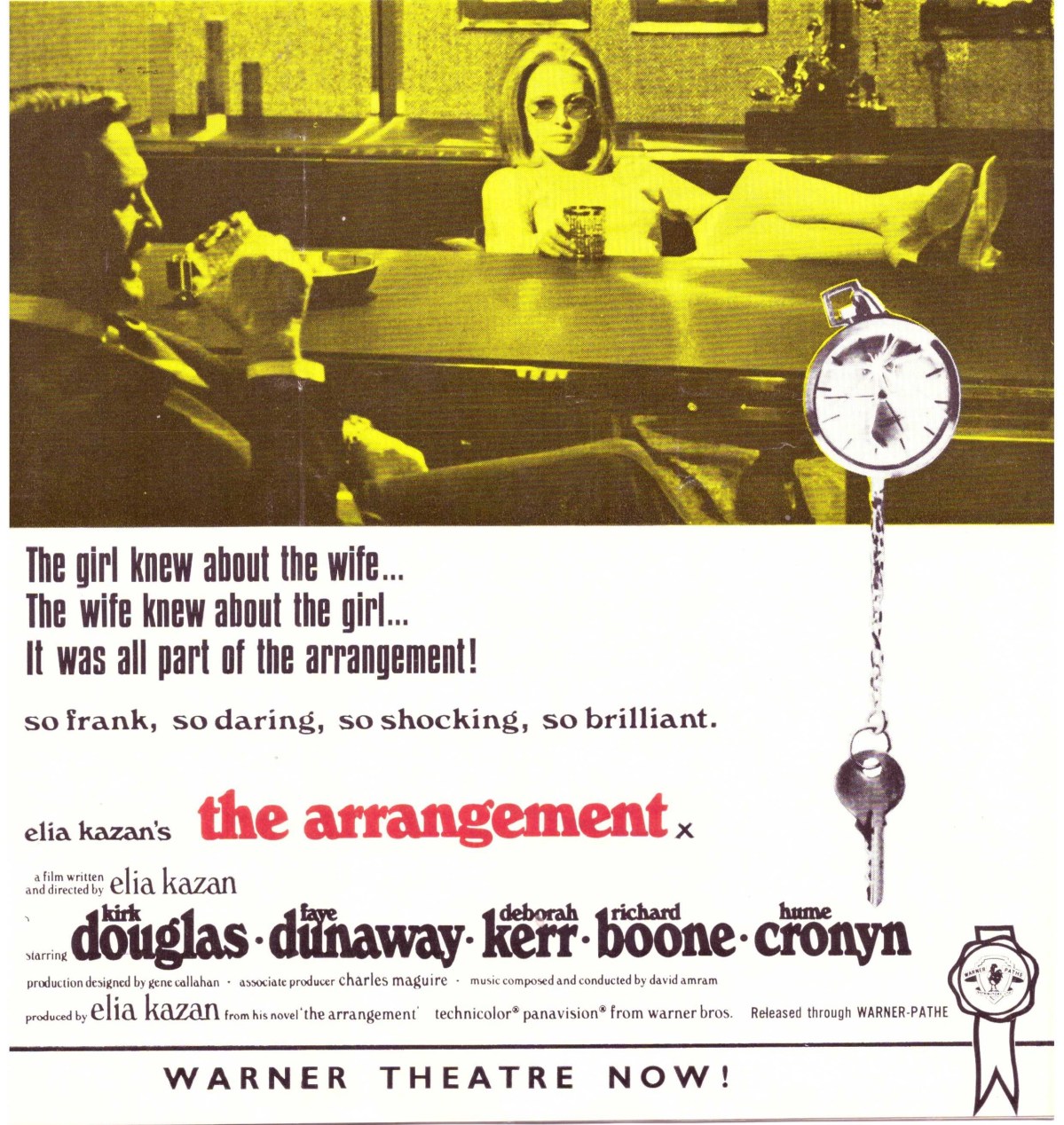
It might have been better if director Elia Kazan had handed over the screenwriting chores for this adaptation of his bestseller about the midlife crisis of advertising man Eddie Anderson (Kirk Douglas). As director he over-angsts the pudding. Anderson’s attempts to juggle wife Florence (Deborah Kerr) and mistress Gwen (Faye Dunaway) coupled with growing disgust at selling a new brand of cigarettes, Zephyr (“The Clean One”), in a way that pointedly avoids their cancer potential, leads to a suicide attempt. 

During convalescence he determines to quit the advertising world and go back to his first love, writing, but in fact he ends up sabotaging his career. Florence represents impossible seduction and conscience. Slinky, in dark glasses, hot-tempered rather than submissive or demure, she accuses him of self-deception in his job. The picture flits back and forth between his various choices – different job, return to wife, settle down with mistress, or what seems his ideal world, cossetted by both Gwen and Florence.

Gwen is an excellent study of the modern woman (of that fast-changing period, I hasten to add), who needs a man for sex but not necessarily love, and can use the opposite sex as ruthlessly as any man. What she actually requires in her real life is quite different to what she seeks in the fantasy love she enjoyed with Anderson, sex on the beach, the buzz of controlling a high-powered man. Florence could be seen as an old-fashioned portrait of the adoring wife except for capturing so well the bewilderment of betrayal.

Kazan conjures up some wonderful images: the tension before the suicide attempt as Anderson plays chicken between two trucks, Gwen emerging wet from the pool to eat dangling grapes or with her legs up on Anderson’s desk, Anderson’s mother lighting votive candles in her house before using the same match for her cigarette, Kerr’s futile attempts to win back her fallen husband, Anderson flying solo.

In parts well-observed and directorially savvy, quick cuts between the present and the past, however it sinks beneath its own self-indulgence. My guess is that author Kazan could not bear to kill off a single one of the characters he had created for his acclaimed novel and the upshot is a vastly over-populated picture, few of whom cast any real light on Anderson’s predicament. So we are not only introduced to mother, dying father, brother, sister-in-law and  analyst but priest and a bucket of clients and guys from the office. And there are some plot oddities – Anderson gets time off apparently to write journalistic pieces – and what is clearly intended as hard-hitting satire of the advertising world does not come off.

Dunaway (Bonnie and Clyde, 1967) is the standout as Gwen, living life according to her own rules, and with an unexpected vision of domesticity but Deborah Kerr (Prudence and the Pill, 1968) does pain like nobody else and is extremely convincing. Strangely enough, I didn’t go much for Douglas (Seven Days in May, 1964). He could have been leading a cavalry charge for all the range of emotions he exhibited. Douglas is no Montgomery Clift (Wild River, 1960), James Dean (East of Eden, 1955) or Marlon Brando (On the Waterfront, 1954) who was Kazan’s first choice. Kazan had not made a picture in six years and it had been eight years since his last hit Splendor in the Grass (1961). Not quite out-of-touch in concept and delivery, nonetheless it was shunned by the Oscar fraternity.

An odd one distinguished by Deborah Kerr and Faye Dunaway.

Do Not Disturb (1965) ***

Takes a good while to come to the boil, perhaps as a result of trying to find the right chemistry between Doris Day and her latest 1960s partner Rod Taylor, after her highly successful pairings with Rock Hudson in three films. Her turn with Cary Grant (That Touch of Mink, 1962) was also successful, but finding another pairing proved dificult. There was a single outing with David Niven (Please Don’t Eat the Daisies, 1960),  a pair with James Garner (The Thrill of It All and Move, Over Darling, both 1963) plus a couple of ventures outside the comedy genre, thriller Midnight Lace (1960) with Rex Harrison and musical Billy Rose’s Jumbo (1962).

One of the curiosities was her billing status, credited below Rock Hudson and Cary Grant, but above all the others. Hudson, Grant, Garner and Niven demonstrated a clear knack for comedy, less so the rest. So one of the elements facing any screenwriter or director was how to make a pairing fizzle. With the top-billed stars, there was more of a guarantee of equal playing time so that they could spark off each other. In the remainder, more reliance on the actress’s pratfalls and slapstick and being some kind of fish out of water.

Here, the Ameican fish is let loose in London waters and good chunk of the opening section is taken up with the oddities of England from an American perspective. First of all, it’s the coinage. A simple transaction with a cab driver soon involves a policeman what with her difficulty in getting to grips with “too many coins”, most of which to add to the confusion often have a nickname, resulting in her paying eight shillings and sixpence for every subsequent ride since that’s the one amount she’s mastered.

Then it’s the problems of driving on the wrong side of the road, using a different gearbox, and the peculiar nature of village names, that either result in a crash or getting lost or both. The difference between electrical plugs lends itelf to electrocution jokes, and the inefficiency of the British telegram system tops off a scene. There’s not much magic even a Doris Day in her prime can add to such standard situations.

She comes into her own somewhat by standing up to the masters of a fox hunt and their snarling hounds. But somehow sheltering a fox appears to give her some affinity with animals and before you know it her country house is awash with unsuitable beasts such as goats.

Still with me? That’s kind of the feeling I had about a third of the way into the picture. So here’s the set-up: businessman Mike (Rod Taylor) and wife Janet (Doris Day) have moved to London. He details her to find an apartment, meaning in central London close to his office. Instead, she lands them in a country cottage, and he immediately resents being so remote from the city and with the extra travelling time plus the evening functions (held in the company flat) in his schedule soon the couple are heading towards estrangement.

He has a pretty secretary Claire (Maura McGiveney) in tow and the functions are meant to be wife-free zones, and when Janet tests out her suspicions she is initially brought down to earth with a thump.

But, of course, suspicion grows horns and with the encouragement of interfering  landlady Vanessa (Hermione Baddeley) she decides to play him at his own game. Once handsome Frenchman Paul (Sergio Fantoni) hoves into view she pretends to take up with him to bring her husband to heel. This involves a romantic trip to Paris where, of course, Doris Day is in her comedic element, desperately trying to avoid the advances of her suitor and getting drunk in the process. Day makes an excellent drunk and inebriation cue for many of her best sequences.

Much of the seduction is driven by the foreigner and the secretary so husband and wife find themselves in one compromising position after the other. However, this narrative ploy means the two stars are often apart and the success of the picture depends on two separate individuals rather than the teaming as with the Hudson and Grant movies. To use the old cliché, it’s game of two halves, three-thirds really since the opening section is mostly the fish out of water stuff. They’re an odd combination from the outset, a wife who does the opposite of what her husband wants then complains when, tied down with business, he doesn’t want to live in the country.

There’s an occasional belly laugh but it seems such routine fare that you wonder why Day got involved in the first place – blame husband Martin Melchior for signing her up.

After original director Ralph Levy (Bedtime Story, 1964) – you could view this as a reversal of Bedtime Story with the principals target for seducation rather than doing the seducing – took ill, George Marshall (Advance to the Rear, 1964) finished it off. Written by Milt Rosen (movie debut), Richard L. Breen (Captain Newman M.D., 1963) and William Fairchild (Star!, 1968)

For completists only.

Discover WordPress

A daily selection of the best content published on WordPress, collected for you by humans who love to read.

The Atavist Magazine

by Brian Hannan

WordPress.com News

The latest news on WordPress.com and the WordPress community.