The boldest role ever undertaken by a major star of Frank Sinatra’s generation – and little thanks he got for it. Not only was he virtually unrecognisable under a slab of make-up that George Hamilton would have envied but the role was a complete reversal of his screen persona. Admittedly, he had flipped that persona for Tony Rome (1967) and as the cuckolded cop in The Detective (1968), but this was on a completely different level.
Sinatra was no Tom Hanks or Daniel Day-Lewis, known for inhabiting different types of characters, and, while he did have a vulnerability that he put to good use in The Manchurian Candidate (1962) and The Man with the Golden Arm (1955), he was best known on screen as the guy in charge.
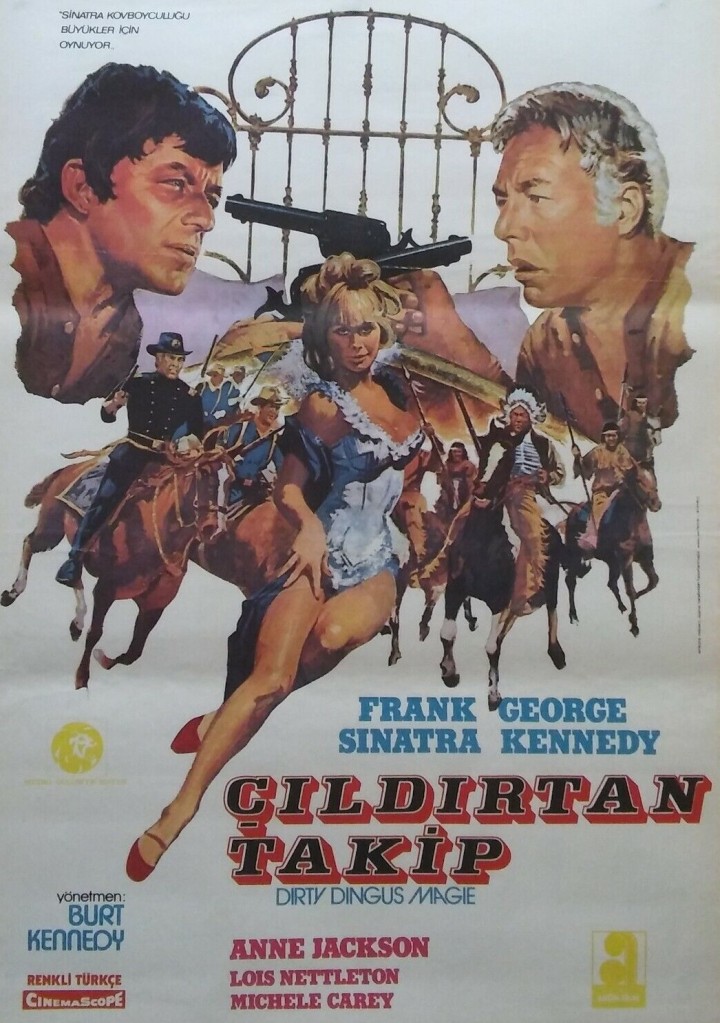
That was far from the case here. Dumb and dumber might be more apposite. Dingus Magee (Frank Sinatra) is a scamp, an outlaw so useless he is worth only $10 in reward money, who steals the stash of old rival Hoke Birdsill (George Kennedy), triggering a revenge caper that is complicated by a host of unnecessary complications by director Burt Kennedy (Welcome to Hard Times, 1967) who has set his heart on some kind of satirical comedy western with a revisionist slant.
So we get a female mayor, Belle (Anne Jackson), who happens to own the local brothel, whose commercial prospects are endangered when the local Cavalry are called away to fight the Native Americans, an Indian chief Crazy Blanket desperate to trade his daughter for a rifle, and when that looks like not working out calling on any available squaw to seal the deal, predatory schoolteacher Prudence (Lois Nettleton) and a running gag involving a Brown Derby hat that results in a gunfighter (Jack Elam) being mistaken for Magee.
It’s a bit long on complications and short on satire and is rescued by the double act of Magee and Birdsill, who constantly get in each other’s way or try to pull a fast one. Birdsill, as it happens, is appointed sheriff, since that’s in the purview of the mayor, and, on the right side of the law for the first time in his life, makes an ill-fated attempt to do good.
Magee tries to help him along. In exchange for the sheriff turning a blind eye for a period of time to Magee’s nefarious activities, the reward for the outlaw will mushroom, permitting greater kudos for the sheriff on his capture.
The main problem is that Kennedy directs with a very heavy hand, very obvious musical cues for a start, and there’s not enough that’s intrinsically funny. Though there is a reversal of an obvious joke of Birdsall being sent to the brothel to locate the mayor, expecting to find a client not the owner.
But both Sinatra and George Kennedy (The Sons of Katie Elder, 1965) are a delight, the latter also playing against type rather than his usual dominating character. Their dumbness takes some beating. Sinatra just about gets the upper hand, but there’s not much in it.
The best thing about the picture is the sense of reality. The U.S. Cavalry spend more time in the brothel than out hunting Native Americans. Law and order can go to hell as long as everyone is having illicit fun. The respectable schoolmarm proves a skilled seductress. Peace is desirable because it is more profitable than war. And the bulk of the outlaws in the Wild West are far from achieving legendary status, just two-bit punks.
Not surprisingly, this was a massive flop and killed off Sinatra’s movie career for the rest of the decade – not that he was overly concerned, “My Way” having reignited his singing career and he was a Vegas regular. But it’s a shame the acting was so vilified, Roger Ebert blamed Sinatra rather than the director for its failure, in particular taking him to task for the one-take approach that Gena Rowlands previously exalted (but what does she know, she’s just an acclaimed actress and knows how a movie works better than a critic).
Well overdue for a reappraisal and if you go in duly warned you might even enjoy it, or at least the Sinatra-Kennedy double act.
Only spaghetti western directed by a woman. Brings a distinctly feminist feel to that most sexist of the subgenres. You tend to forget that the sexy female Europeans imported to Hollywood as co-stars or to add spice further down the credits were actually top-billed stars in their natïve countries and demonstrated a greater range than the American industry allowed.
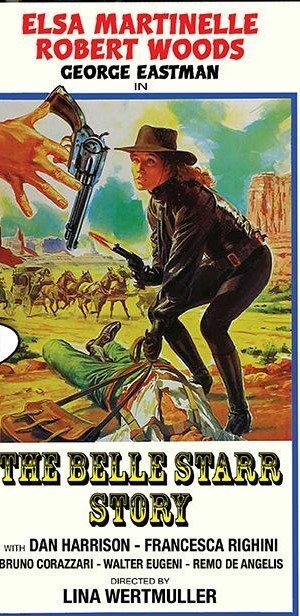
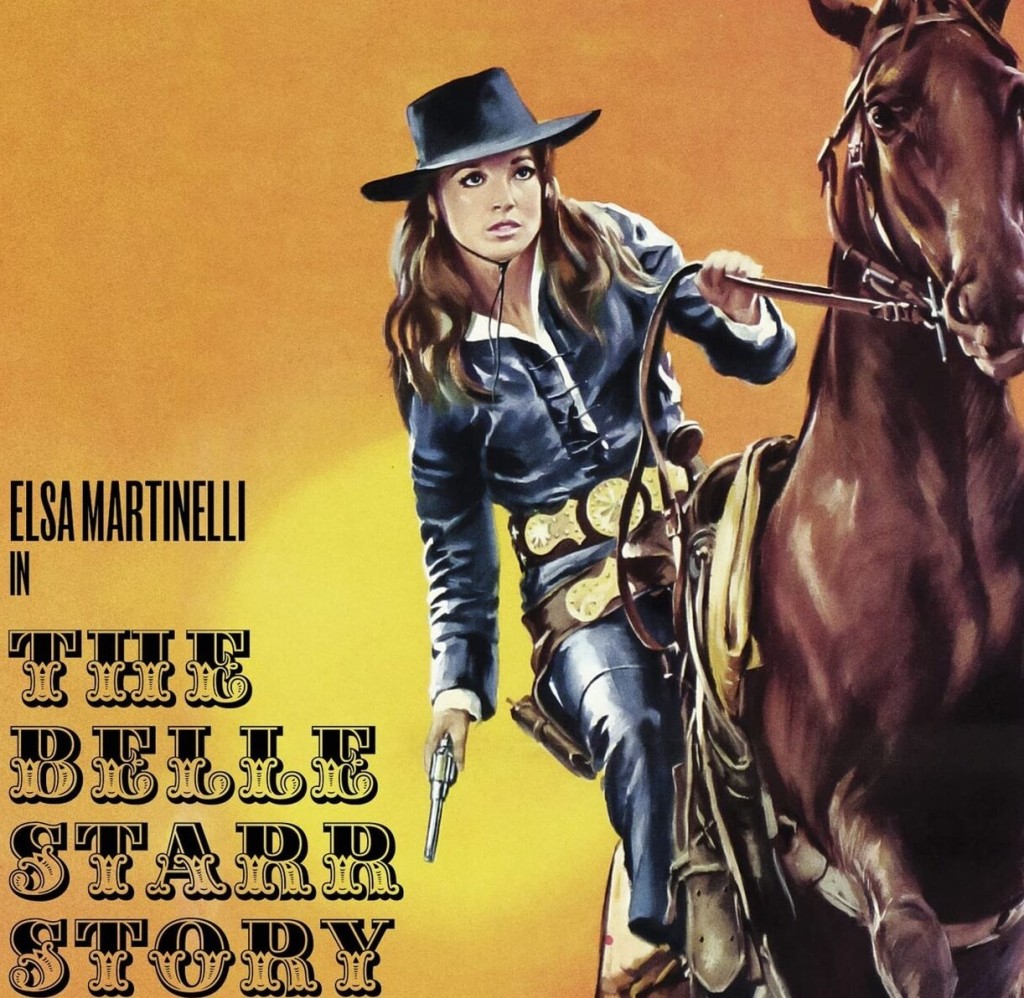
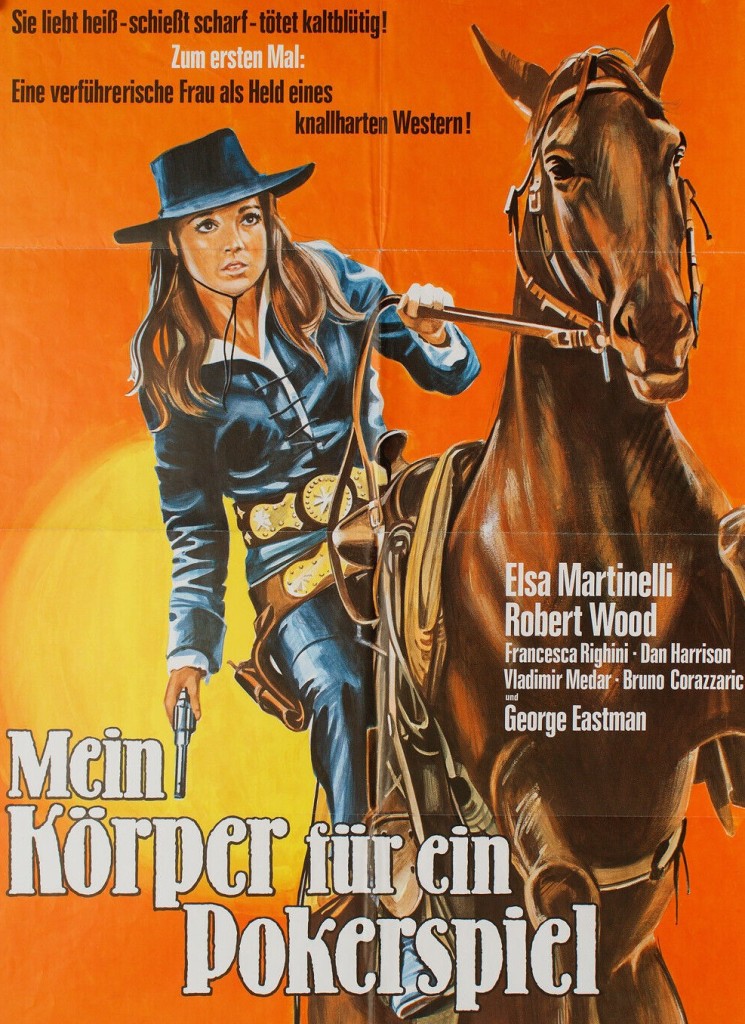
Not only do we have Elsa Martinelli (Maroc 7, 1967) as the leather-clad cigar-smoking titular gunslinger, whose watchword is female independence, but it was helmed by arthouse icon Lina Wertmuller (Swept Away, 1974). There’s a thematic consistency lacking in most Italian-made westerns, for example predating Once Upon a Time in the West (1969) in its water imagery. But any potential for lyricism is undercut by the risk attached to being a lone woman. And there’s a Tracy-Hepburn tone to the endless bickering and battle for superiority in her niggling romance with outlaw Blackie (George Eastman).
And, unusually in that decade, a woman who throws caution to the wind and will even bet her body when the money runs out at the poker table, as twisty a meet-cute as a screenwriter could devise. But thereafter it’s a struggle for dominance between the pair. She won’t take orders from a man. He won’t accept female equality even when she shoots the wooden fence he’s sitting on from under him, making him fall to the ground, and for good measure putting a bullet in his heels.
The first act builds up Belle Starr, cool at the poker table, even cooler in the bedroom, and demonstrating the gunplay that attracted her notoriety. The second act take an odd route, a lengthy flashback that digs deep into feminism, the orphaned Belle Starr running away after being sold into marriage by her uncle to an ugly old rich powerful man, traded, effectively, for political favor.
She returns to save a servant condemned to death for the crime of attacking the uncle when he tried to rape her. Sexual humiliation is a theme. Another outlaw Harvey (Robert Woods), who she regards as a platonic friend, steals her clothes as she swims in a lake, and then, having saved her from a posse, forcibly tries to take his reward.
The third act, like the duel between The Man With No Name and The Man in Black, is a case of double- and triple-cross. She refuses to join Blackie’s gang when he plans a million-dollar jewel heist, but hijacks the concept, recruiting her own gang to beat him to the robbery, and teach him a lesson.
But it backfires. Blackie is waiting. She has inadvertently hired his men. In the subsequence shoot-out he is captured. She rides to his rescue. But with their opposing ideas of a woman’s place in the world part on good terms.
The flashback was more subtly observed in Once Upon a Time in the West, and while she shared with Charles Bronson gunslinging skills he was not at any time viewed as a commodity or a piece of property or a candidate for rape. The flashback here fleshes out for the audience the powerlessness of women. But also the kind of camaraderie that is generally also usually only conferred on male characters.
We are pretty conversant with the notion that the gun rules the West. But less conscious of what happens when you are gun-less. Depriving someone of their fundamental weaponry makes them instantly impotent, as humiliating as denying someone water in a desert.
There are some nice directorial touches, blood dripping from a ceiling onto a dinner table, a saloon door opening to cast sudden light onto a corpse, waterfalls suggest sanctuary whereas open water attracts predatory males, and the finale, as they part, of Blackie, desperate to demonstrate his superiority, shooting off her hat from some distance.
Elsa Martinelli is a revelation as a star working to her own beat rather than playing second fiddle to some Hollywood marquee name. This wasn’t Lina Wertmuller’s first film and she had already made an impact with the Rita the Mosquito series, featuring another rebellious woman. Don’t be fooled by the co-directing credit, she replaced debut director Piero Cristofani after a few days.
It’s somewhat ironic that in a contemporary Hollywood attempt to create a female outlaw leader in Cat Ballou (1965), Jane Fonda was upstaged by Lee Marvin, and that in Bonnie and Clyde (1967), despite taking precedence in the title, Faye Dunaway was not the dominant one in the relationship.
By no means a great western but worth a look to see what Elsa Martinelli can achieve when not slotted in to the Hollywood co-star cliche and to get a preview of what Lina Wertmuller could offer.
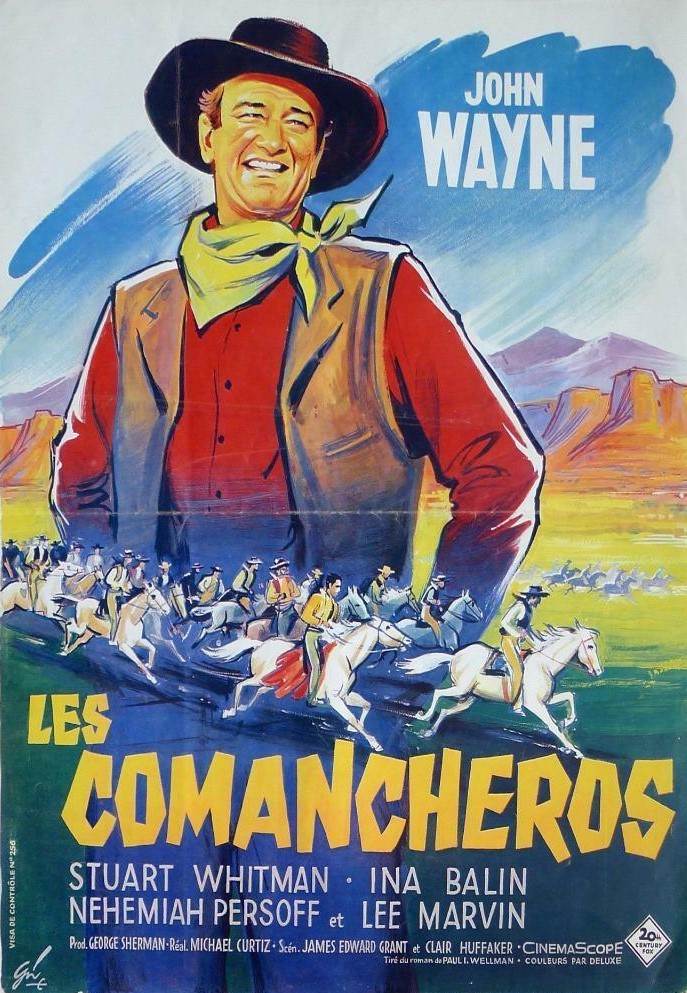
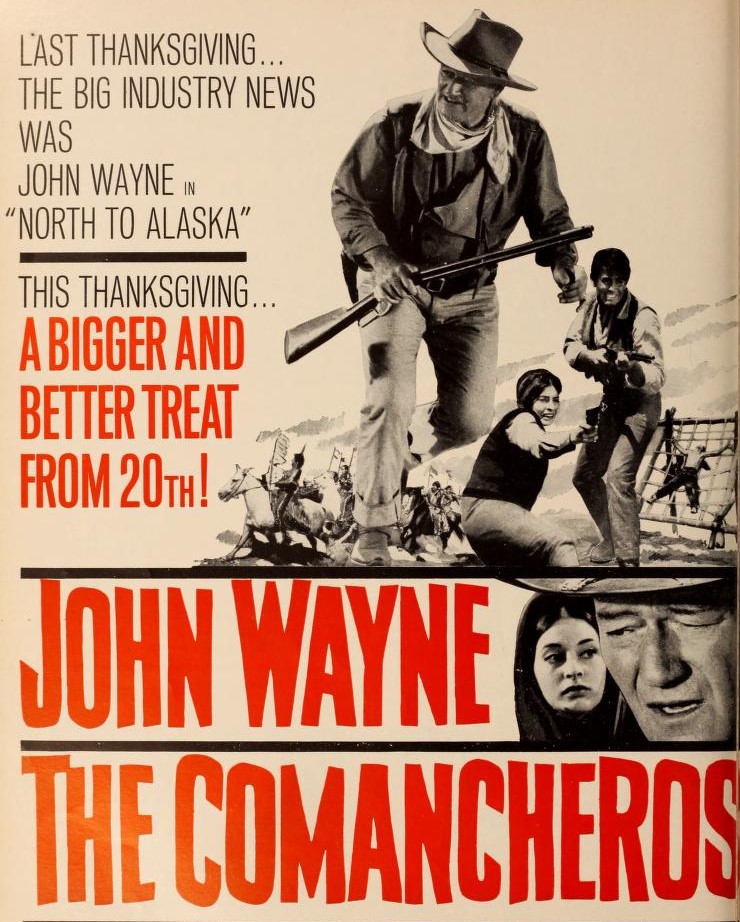
You can always tell a studio is piling a lot behind a rising actor when the top-billed star is absent, except for a fleeting moment during the credits, for the first 10 minutes. In this case, Twentieth Century Fox was showcasing two new talents, Stuart Whitman (Murder, Inc. 1960) and Ina Balin (From the Terrace, 1960).
I’m sticking my neck out a little on this one, not considered as top-notch as Duke’s other great westerns of the decade – The Man Who Shot Liberty Valance (1962), El Dorado (1967) and True Grit (1969) – but it’s an unusual story, hardly following a standard narrative, has a great score by Elmer Bernstein but most importantly because it’s real old-school film-making with the emphasis on the classic long shot and the horizon line.
And it takes a surprisingly feminist approach with gypsy Pilar (Ina Balin) making the running in the seduction stakes. Indeed, should she be willing to surrender an iota of her hard-won independence for a long-term relationship sticks to the view that in love there is always a dominant one and a subservient one, with no question about which she is. Plus, although the nickname “Pilgrim” became a famed element of The Man Who Shot Liberty Valance this is where the nickname notion began when lawman Jake (John Wayne) assigns prisoner Paul Regret (Stuart Whitman) the appellation “Monsoor” because he’s of French heritage.
Meshes effortlessly three storylines – Jake taking prisoner Regret back to base, Regret turning from western tenderfoot to accomplished hand, and Jake and his captive infiltrating the Comancheros of the title, a secret society of white men who utilize Comanche power to its own ends. You could argue this is ushered in the “buddy” movie, the repartee between the two principals a delight. Plus, you would have to take note that legendary director Michael Curtiz (Casablanca, 1942), in his final picture, has done something remarkable in getting the Duke to speak proper, not hi-hat English, but without that Wayne trick of breaking up his sentences so it appears he’s thinking.
Curtiz is pretty nifty when it comes to setting up scenes, interrupting gentle moments with elements of stunning ferocity. When Jake arrives at a ranch, the camera tracks back from his arrival to reveal the corpses hanging upside down under the ranch gateway. Later, Jake is tucking into a meal at the home of another rancher when that man’s pregnant wife in the background suddenly sits up and from her point-of-view we see through a window as big as the entire screen a band of renegades in attack mode charging through a river.
Regret isn’t one to hang around either when he can escape during the ensuing melee, but no sooner has he gone than he returns with a bunch of Texas Rangers, thus redeeming himself in Jake’s eyes. And there’s a great cut between Jake being knocked unconscious in the blazing sun and waking up in the pouring rain.
And it’s chock-full of reversal, not just that Pilar dumps her pick-up Regret when their riverboat docks at Galveston, but Regret, forced to ride a mule in handcuffs to prevent his escape, gets the jump on his captor at the saddest scene in the picture, the burial of a family killed by Comanches. Later, after taking on the alias McBain, he encounters Regret at a poker table and the wanted man does not give him away.
After a bit of legal chicanery, Regret is a free man, although with the proviso he teams up with Jake to go undercover into the Comancheros camp. This doesn’t work out too well, the pair strung up by suspicious crippled leader Graile (Nehemiah Persoff) until rescued by, surprise, Pilar. Love works its mysterious way and soon Pilar is on Regret’s side, resulting in a classy finale.
Along the way we encounter Lee Marvin (Raintree County, 1957) having another scene-stealing ball as the Comancheros contact. Clever screenwriters James Edward Grant (Circus World/The Magnificent Showman, 1964) and Clair Huffaker (Hellfighters, 1968) find an entirely believable method of getting him out of the way. And in passing we learn that Jake’s wife died “two years, two months and 13 days” ago and without an ounce of revealing dialog between them that Jake would like to take up with widow Melinda (Joan O’Brien). Meanwhile, initially presented as a man of such honor that he will fight a duel to protect such notions of nobility, Regret goes from gambler, wanton lover, and prisoner to revert to his original state.
Expect chunks of western lore – don’t give a hot horse water until it has cooled down is one takeaway. And men who swear by an unwritten code. Here, it’s “words are what men live by.” What’s so refreshing is that lore and code alike arequickly punctured. The follow-up to the code annoncement to which Regret shows indiference is a pronouncement from Jake: “You must’ve had a real careless upbringing. ” that’s not forgetting characters remembering to be characters in the midst of all the uproar as with the bedridden pregnant wife instructing her husband to make sure Jake eats off the “best china.”
It’s not only a well-structured movie but it’s filled with moments that reveal character and even when Curtiz feels duty bound to include standard tropes such as the bar-room brawl or the drunk there are enough twists to have you believe the clichés have been bitten in half.
A superb ending to Curtiz’s career, terrific performances all round, great double act from Wayne and Whitman, with the latter afforded considerably more leeway acting-wise than any time in his career, and Ina Balin in a prize role.
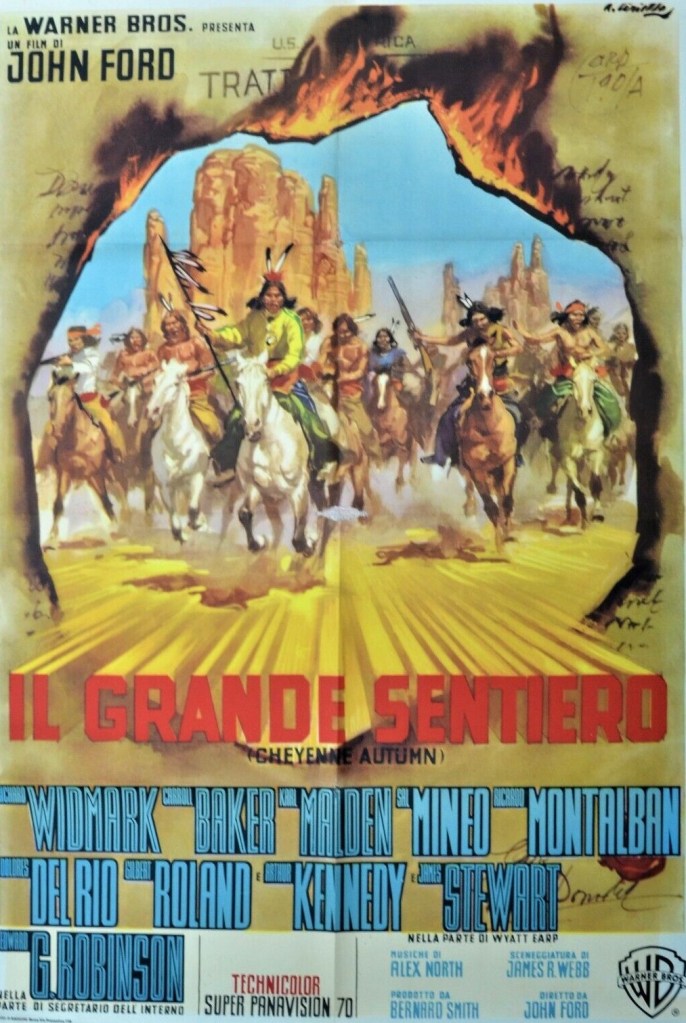
Lack of narrative energy and focus sabotages well-meaning atonement epic. John Ford’s final western, made half a decade before Dee Brown’s seminal Bury My Heart at Wounded Knee was published, is not the epitaph he might have envisioned. For a start, it’s just not rigorous enough. You might accept there’s no mention of the word “genocide” since until Vietnam the United States was hardly capable of mea culpa.
But that we learn very little about the Native Americans trekking 1500 miles from their Oklahoma reservation to their Wyoming homeland beyond that it’s an exhausting trek. Although the Native Americans are treated in a positive manner, and the U.S. Cavalry and Government are seen as inefficient and corrupt, little has been invested in the Native American characters.
The crux of their story is that the two brothers – Dull Knife (Gilbert Roland) and Little Wolf (Ricardo Montalban) leading the journey – eventually go their separate ways, and that a younger headstrong Native American steals one of the brother’s wives. Instead, more attention is paid to a young do-gooding Quaker teacher Deborah Wright (Carroll Baker) who opts to join them on their quest in order to look after the children attending her classes.
Caustic Captain Archer (Richard Widmark), either in person or through voice-over, is the most notable character, fighting his superiors to allow the wanderers unrestricted passage and eventually winning over Secretary of the Interior Carl Schurz (Edward G. Robinson) to ease the last stages of their journey.
The plot diverges from the Exodus-style mission for a totally irrelevant sequence set in Dodge City featuring a gambling Wyatt Earp (James Stewart) and Doc Holliday (Arthur Kennedy) and a spurious bunch of townspeople getting over-excited at the prospect of being attacked. More to the point, when Little Wolf splits from Dull Knife and heads for the sanctuary of Fort Robinson in Nebraska they are imprisoned by authoritative Captain Wessels (Karl Malden), gunning for promotion and in an echo of German apology for the Holocaust “only obeying orders,” with savage consequence.
The couple of action sequences show the fighting skills and tactical ability of the Native Americans but this is undermined by also showing them as sly and cunning, hiding weaponry under campfires and in baby’s clothing.
You might also be asking just how big is Monument Valley for it seems to be the location for about half the picture. Sure, it’s a terrific backdrop and possibly never been better utilized but it’s an example of the creative lethargy not to follow in more authentic manner the actual route of the Cheyenne. Adding to that disgruntlement you might also note the omission of any Native Americans in the leading roles, those parts being taken by Mexicans or dark-skinned Americans.
While John Ford clearly had his heart in the right place, his fans weren’t ready for this kind of revisionist approach – the movie, a 70mm roadshow, was a big flop at the box office – and the result just doesn’t do the subject justice. And in fact a corrective correlative to How the West Was Won (1962) perhaps entitled How the West Was Stolen has yet to be made.
For a long time Bury my Heart at Wounded Knee was considered the landmark historical work depicting the ruthless conquering of the Native Americans but the more recent The Earth Is Weeping by Peter Cozzens, which I read a couple of months back, offers a more authoritative look at the sorry saga, but, without, I hasten to add, a mention of the scary word “genocide.”
I wouldn’t normally be in favor of editing the work of a director as legendary as John Ford but the omission of the Dodge City sequence would have considerably shortened the movie and retained the focus and perhaps improved the picture.
As it stands, a valiant effort. None of the stars is provided with sufficient narrative to make their acting stand out and it feels like they have all stumbled into a documentary.
Never quite considered top drawer John Ford, yet it should rank alongside Stagecoach (1939), The Searchers (1956) and The Man Who Shot Liberty Valance (1962). I’ve been talking recently about a movie completed in a single take (Grenfell, 2023) and the power of a single scene (The Manchurian Candidate, 1962), and now I’m touching upon another piece of cinematic dexterity – the fixed-camera seqeunce.
This is a beauty and it lasts four minutes. Yep, for a four-minute medium-shot scene featuring the two major characters the camera doesn’t move. Lawman Guthrie McCabe (James Stewart) and Cavalry officer Jim Gary (Richard Widmark) take a break from the 40-mile journey back to the fort. You think this is where Gary is going to spring upon McCabe exactly why his presence is so necessary for Army business. But instead, the scene, driven by Gary, is set up to discover why McCabe is so agreeable to taking a temporary leave of absence from an exceptionally comfortable lifestyle back in his small town.
Sure, this scene boasts a bit of business, the waving about of cigars and some pointing and McCabe’s head bobbing around, but otherwise the camera just observes. First of all we discover that McCabe earns $20 a month more than the soldier – that is, when the officer is paid at all, three months since he saw any money – and that McCabe is on the mean side and sarcastic with it. McCabe starts puffing on a long cigar and has to be nudged to offer Gary one. “You can afford matches,” he notes when Gary produces a packet.
McCabe has temporarily upped sticks it transpires because he’s getting unwelcome heat from his hotel owning lover Belle (Annelle Hayes), on the sticky subject of marriage. The subject was brought up with a woman’s “animal cunning” when Belle asked why he was content with just taking 10 per cent of her income when, through entering into a partnership via marriage, he could receive 50 per cent. Gary is taken aback that his old pal is getting a slice off the top. And then somewhat shocked to learn that McCabe takes the same percentage from every business in town. McCabe is surprised to learn this comes as news to Gary. How else could the marshal support his lifestyle.
This mild interrogation is interrupted by a nugget about Belle. She has a stiletto strapped to her leg. That’s not news to Gary. McCabe is perturbed. How did he know. You just told me is the speedy retort. That takes a moment to sink in before McCabe’s suspicions are aroused and then allayed.
In other hands, this scene could have lasted a minute. Some speedy dialog would have got to the point faster. But that’s not the point. You can’t attempt this length of fixed camera scene unless you have two wonderful actors. It might appear indulgent but the director wants us to be sucked in by the affable McCabe.
Not sure where they got the image of the women in red being hanged – must be from another movie.
Because until now it has been all economy. The movie opens with a well-heeled fella dozing on a hotel veranda being woken up by a waiter bringing him beer and a cigar, candle at the ready to light the tobacco. The stage arrives. Two cowboys approach asking where they can get a decent drink. The man pulls back his jacket to reveal his badge. The mention of his name, Guthrie McCabe, is enough to make the pair reconsider staying.
A cavalry troop arrives with Gary at the head. Gary’s uniform is covered in dust, so thick you can hardly beat it off, so thick that unless accompanied by McCabe he would have been forbidden entry to the hotel by the owner. There’s snippy dialog here but it’s all delivered by Belle as she provides a series of sharp observations about men. Uninvited, she joins the pair as they sit down, Gary somewhat vague about his mission. Outside, we encounter McCabe’s dumb deputy, escorting a bunch of prisoners back to the jail because the judge was too drunk to appear in the courtroom – it’s that kind of town. McCabe, seeking re-election shortly for his position, sets them free and buys them a drink. Then we’re off on the 40-mile trip.
Still, we don’t know why McCabe’s presence at the fort is so important. John Ford doesn’t usually fall back on mystery as a narrative device unless it’s some personal secret hidden by a character. So McCabe is astonished to be hailed as a conquering hero, cheered by the people inhabiting an encampment outside the fort. One woman even says she can see his halo. What the…
Inside, it transpires Gary is merely doing his superior’s dirty work. And it’s cynical stuff at that. Major Frazer (John McIntyre) wants rid of the rabble who are giving him grief over their sons and daughters long ago kidnapped by the Commanche. Due to the current treaty, the Cavalry can’t just wade in and collect the kids, grown-up by now some of them. So he needs someone who is on nodding terms with the tribal chief (Henry Brandon) and negotiate their release.
McCabe’s first thought is how much he would be paid, given a cavalry officer’s salary would hardly keep him in cigars, reckoning it would be worth $500 a skull. “Whatever the market can bear,” insists McCabe. Both officers are appalled and even more so when McCabe reckons he’ll screw the money out of the distraught families. And that’s what he does. Affable has suddenly turned callous. The camera in this next scene focuses on Gary’s face, until he can take no more of his old buddy’s blatant greed.
Sucker punch number two. McCabe is as mercenary as the later Man With No Name. but he’s not the only one displaying cynicism. To appease his second wife Henry J. Ringle (Willis Bouchey) will cough up $1,000 if McCabe can bring back any child, not the actual one lost, because the kid was so young when kidnapped that his wife won’t know the difference and he has to get her off his back because it’s interfering with his business.
But there’s more sucker punches to come. McCabe won’t accept Gary’s leadership and won’t even agree to work out their approach together. But when it comes to action, it’s soon pretty clear that McCabe is the tougher character, can anticipate the enemy reaction. And he’s right to be cynical because when Elena (Linda Cristal) is returned to the fold, she is despised, all the fort wives want to know is how many Native American braves she slept with, and why she didn’t commit suicide instead.
There’s a sting in the tale for McCabe when he returns home and finds Belle has taken decisive action in his absence.
McCabe is a superb creation, none of that risking your life for nothing in his game plan, possibly the most realistic character in the Ford oeuvre, who doesn’t care a whit what people think about him, as long as he is paid what he feels is his due. Sure, he puts his life on the line, but you can be guaranteed that’s not much of a gamble, he is so accomplished with the gun and can outwit any foe. As corrupt as he is, he’s a lot more straightforward than the apparently high-principled wives and officers who treat Elena so abominably.
There’s a good bit more to this picture than I’ve described. I’ll pass over the usual punch-up to which Ford appears addicted. Gary’s romance with civilian Marty (Shirley Jones) is well done, she carrying the burden of surviving Indian attack when her younger brother was taken, and she is an accomplished pioneer, in another superb scene Gary congratulates her on pitching her tent out of the wind, far enough for the creek to escape mosquitoes and near a dead tree to get firewood.
And there’s another brilliant scene, revolving around a music box, that could have been a cliché but in another sucker punch takes a different, quite awful, direction.
This is so beautifully written and directed I’m just astonished it wasn’t met with acclaim at the time or since. The typical western has ever been so undercut nor typical action met with such dire consequence, the soft underbelly of life at the fort never so cruelly exposed.
You might think James Stewart was taking a chance in assuming the mantle of the man who killed Liberty Valance in order to advance his political career when in reality he did no such thing. But this character is light years away from that simple theft. His character in that Ford picture was exactly the high-principled guy you had come to expect from Stewart, even if, at the last instant, succumbing to a lie.
In the hands of another director McCabe would have been played by a sleazy Lee Marvin or another actor who could not rise above his bad-guy persona. This must be James Stewart’s finest hour, making an unattractive character appealing, so much so you almost appreciate his point of view in relation to the corruption and his antipathy to matrimony, and taking pains to conceal not the goodness underneath but his understanding of the harsher realities of Western life, at which he is more than adept at dealing.
Richard Widmark (The Secret Ways, 1961) also discards his normal screen persona, his job to act as observer to the Stewart character, to lead audience disapproval, and to be hoodwinked as much as McCabe by the cynical Major while enjoying none of the reward. He is gentler than usual, more resigned to his job, expecting little. Good supporting cast including Oscar-winner Shirley Jones (Bedtime Story, 1964), Linda Cristel (The Alamo, 1960) and especially, in her only movie, Annelle Hayes, as an extremely savvy character who gets the better of her slippery lover.
Brilliant film. And if like me you come to the four-minute scene you might just rewind once or twice to enjoy what Ford, Widmark and Stewart achieve. I was so taken with the entire film, which I’d never seen before, that I watched it again the next night.
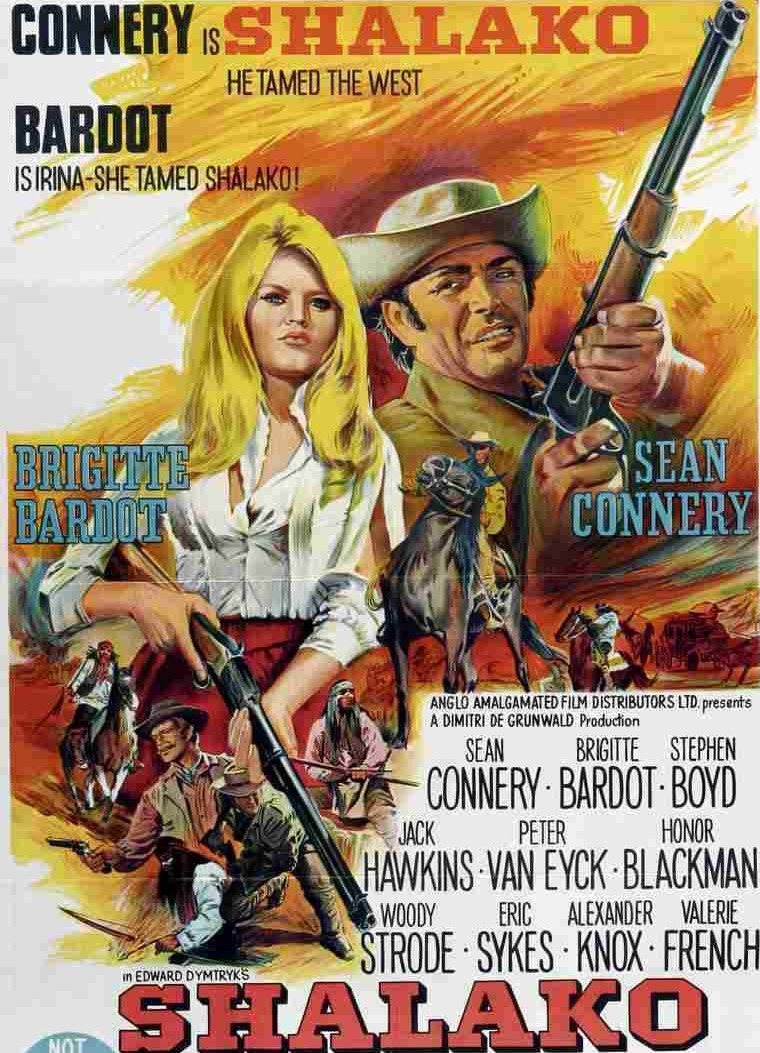
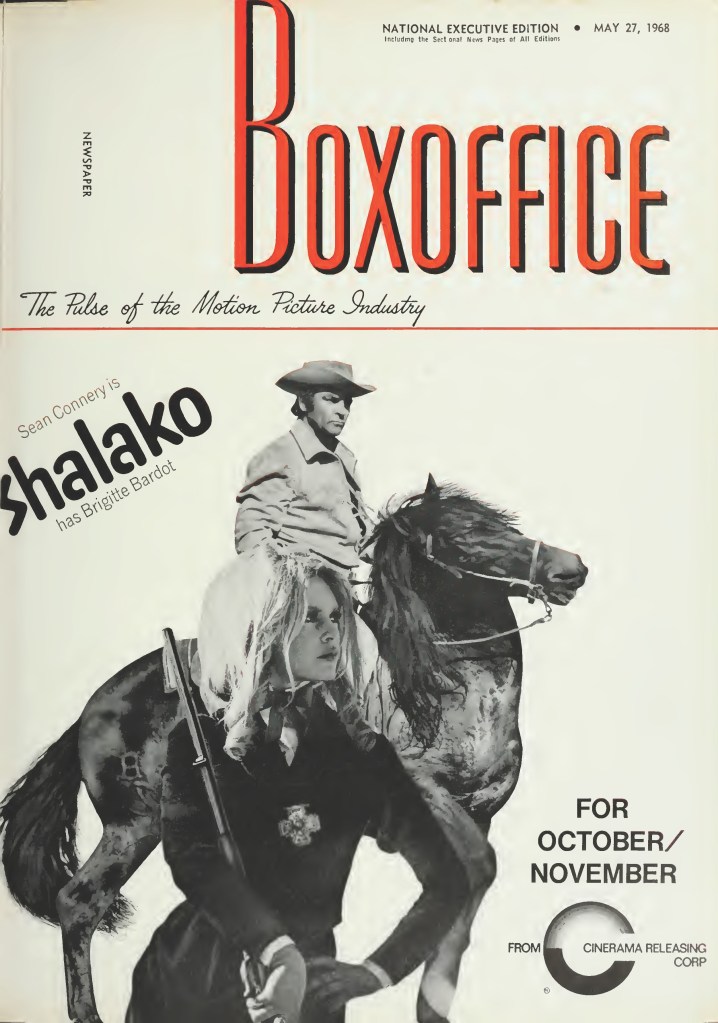
It’s a gripping and unusual opening. The jangling noise of metal beating upon metal. A trapped mountain lion surrounded by a posse of unkempt men. The beast driven into a killing zone. The camera ends up on a classy blonde in a top hat, Irina (Brigitte Bardot), drawing a bead on the animal. But as she shoots so does rugged cowboy Bosky (Stephen Boyd) and you can be sure his aim is more deadly. It wouldn’t do to have an upper-class European lady to be mauled to death by a vicious creature just because her ego got the better of her.
Except that’s not the opening. Instead, that’s sacrificed for a dumb theme tune and a few minutes over the credits watching titular hero Shalako (Sean Connery) doing what exactly? Nothing exciting that for sure. We see him riding I guess to prove he can sit as tall in the saddle as the stars of the genre like Alan Ladd, John Wayne, Gary Cooper, James Stewart, as if nobody expected James Bond to be able to complete such a transition. There’s a bit of waking up, more riding, drinking from a dirty stream, and more riding while composer Jim Dale struggles to find lyrics that rhyme with Shalako.
There’s a bit more exposition before Shalako does anything meaningful. We are introduced to a fistful of Europeans on a hunting party complete with butler (Eric Sykes) and guzzling champagne and escorted by a bunch of mean-looking cowboys looking on in envy though I doubt any would acquire a taste for champagne.
Then the real action starts. A bit’s been missed out explaining just why Irina took off on her own with just one man as escort to continue hunting and nobody thought fit to warn her this was Apache country. We know she’s in trouble because her escort is just about dead and Apaches are gathering. Enter Shalako to save the day. The first piece of dialogue between the most handsome man in the world and the screen’s most beautiful woman, a movie made just so Connery, at his Bond peak, and Bardot, in her most expensive picture, could strike sparks off each other, is hardly something to treasure. It’s almost priceless for its mundanity. “You all right?” grunts Shalako. “Yes,” replies the breathless heroine.
But trust the British to bring that epitome of British moviemaking, the class war, to that most democratic of movie species, the western. It’s ironic that in the country where freedom is a given – slavery long since abolished in the period this movie was set – members of the hunting party are fettered. Irina is little more than bait. You might as well have staked her out, hoping to snare German aristocrat von Hallstatt (Peter van Eyck). Marriage would cure the financial woes of her debt-ridden sister Lady Daggett (Honor Blackman) and husband Sir Charles (Jack Jawkins). Von Hallstatt doesn’t believe in making romantic overtures, it would be, like so many aristocratic marriages, a contract of convenience; he acquires beauty, she gets wealth.
To complicate matters Lady Daggett has a roving eye which has settled on Bosky, and to complicate matters even further, nobody should be firing rifles, even if only for sport, in Apache territory. It’s not long before the Apaches take umbrage and launch an attack. And it takes even less time for Bosky and his buddies to take off, leaving their charges poorly defended in a makeshift fort.
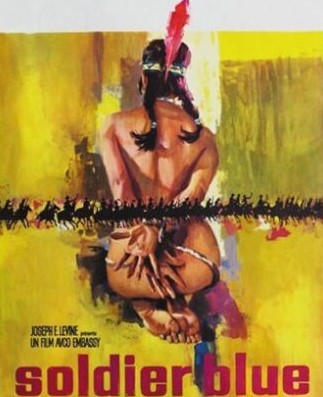
It takes way too long to sort out all these plot machinations and get to the meat of the story which is finding a way of putting Connery and Bardot together and when they are not the movie trundles along without much in the way of screen sparks. It could have done with an entirely different scenario. Something akin to Soldier Blue (1970) would have worked a treat, with roles reversed of course back to the traditional of experienced male tending the inexperienced female as they battle through enemy territory.
You needed to get this pair together – and quick – for the movie to find any steam at all. As it is, it’s somewhat laborious. While the action sequences are well done and Shalako scores in the western lore department, you wouldn’t have thought a mountaineering subplot could have produced so few thrills, its only purpose, plot-wise, to ensure that von Hallstatt acquires some credibility (he’s the mountaineer) and that the group can reach a plateau whose main attraction, as lovers of westerns will already be aware, is a pool where in the great Hollywood tradition a woman can disport herself half-naked. Shalako, in sneaking up on her, comes across like a bit of a peeping tom.
Sean Connery (The Hill, 1965) is convincing enough as a cowboy. He certainly doesn’t look out of place on a horse but it takes far too long for the expected romance to begin. Brigitte Bardot (Viva Maria!, 1965) is better than you might expect as a sharpshooter, but not quite in the fiery class of a Claudia Cardinale (The Professionals, 1966) or even Maureen O’Hara (The Rare Breed, 1965) and she’s not really given the dialog necessary to fully establish the independence of her character.
Director Edward Dmytryk (Mirage, 1965) does his best with an overly-complicated script and some cumbersome set-pieces and it would have worked far better if a few characters and reams of sub-plot had been chucked aside to bring the stars together quicker. While Connery does the riding and shooting well enough he lacks the grizzled lived-in face of his famed western predecessors and I get a sense of him trying too hard. And, as I said, it wouldn’t have taken much to pep up Bardot.
Having complained about the subsidiary characters, they are all well-drawn. Stephen Boyd (The Big Gamble, 1961) makes on helluva mean cowboy, Honor Blackman (Moment to Moment, 1966) is excellent as a predatory female. Aristocratic pair Peter van Eyck (Station Six Sahara, 1963) and Jack Hawkins (Masquerade, 1965) are the kind of actors who can denote fallen status with facial expression rather than requiring lumps of dialog. But Eric Sykes (The Plank, 1967) is really a British in-joke.
James Griffith and screenwriting partner Hal Hopper had previously worked on Russ Meyer epics like Lorna (1965). The original story came from a novel by Louis L’Amour (Catlow, 1971).
Out-with his guise as James Bond, Connery – excepting Robin and Marian (1976) and Cuba (1979) – was not one of the screen’s great lovers so this would have been the perfect chance to hone those particular credentials. But like the entire picture this was a missed opportunity. When the best scene is the brutal suffocation of Honor Blackman and not the two stars canoodling, you can see the target was missed by miles.
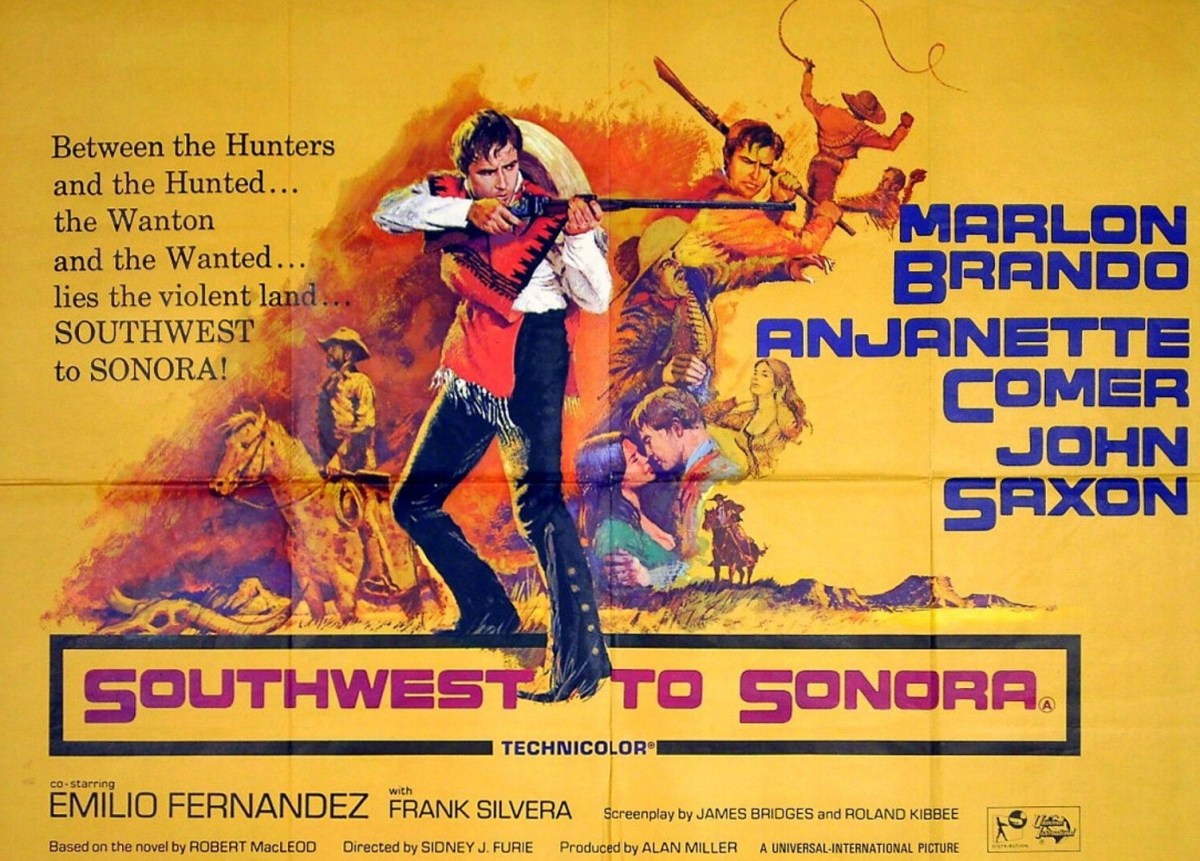
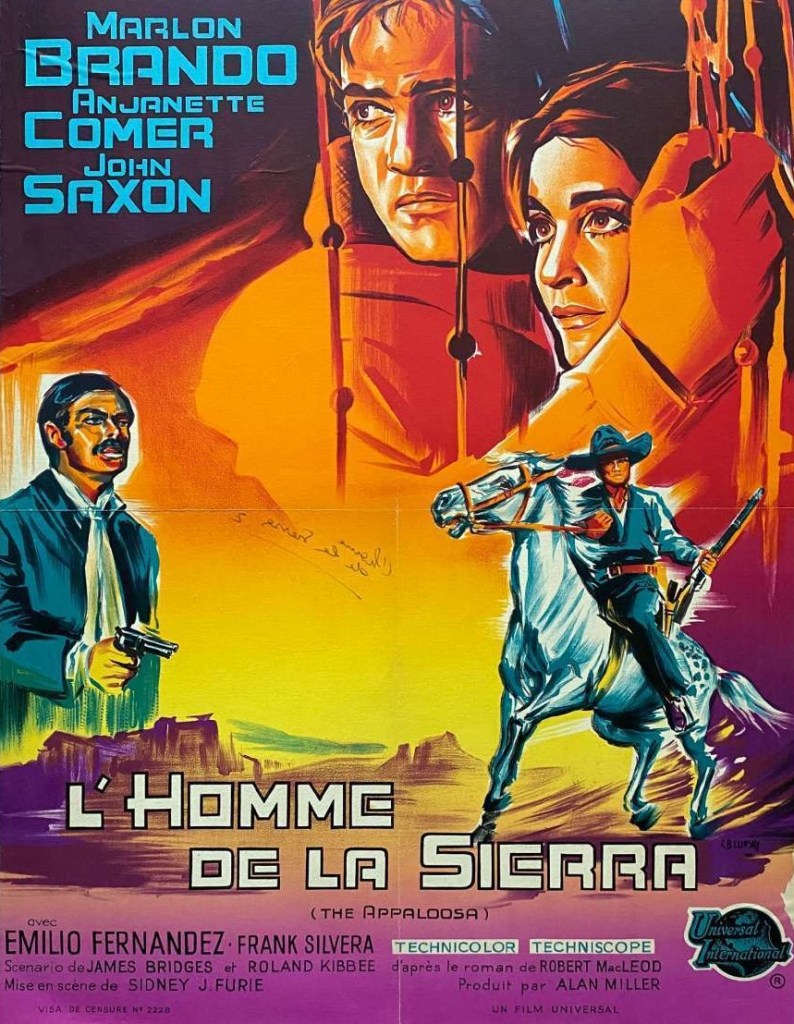
High expectation can kill a picture. Low expectation can have the opposite result. I came at The Appaloosa with the latter attitude in mind. I knew the picture had been a big flop and that critics had carped – as they had done through most of the 1960s – about the performance of Marlon Brando.
Neither was director Sidney J. Furie’s style to everyone’s taste. And it seemed an odd subject – Texan takes on Mexican warlord to recover a stolen horse. It is surely a slow burn, but it certainly worked well beyond my anticipation. There’s not much more to the story than two guys fighting over a horse.
First of all, Brando’s performance came across as natural, not mannered. Secondly, this was a real character. He was not a John Wayne striding into action to protect the underdog or a woman or out of some goddam principle.
At first it did seem odd that Matt Fletcher (Marlon Brando) placed so much importance on the horse given that said warlord Chuy Meena (John Saxon) had offered him a more than fair price for it. But in one brilliant two-minute scene, expertly directed and with virtually no close-ups – the actor caught mostly with his back to the camera or in silhouette – we discover why. Fletcher has been such a disappointment to his father that bringing home such an animal was proof that he had made something of himself. A buffalo hunter to trade, he was on the verge of starting a new life.
The second aspect of this intriguing picture was that Medena placed so much importance on a horse when he could easily buy any horse he wanted. But he was faced with losing face. His wife Trini (Anjanette Comer) had tried to escape from him on the horse and the only remedy was to persuade the watching federales that Fletcher had previously sold him the horse.
When Fletcher refuses, Medena takes the horse by force. Fletcher, in retaliation, and to save his own sense of pride, tries to take it back. He is not represented as a superhuman John Wayne or savage Clint Eastwood, but an ordinary guy who soon finds himself out of his depth. So ordinary that the first time he aims his rifle he misses the target by a mile.
Nor is he burdened with an over-enlarged empathy gland. He not only refuses to help Trini, but steadfastly refuses to take her with him, not even as far as the border, until in another of the film’s lengthy scenes she explains the reasons for her escape attempt.
Few films have exceeded it for atmosphere. This Mexico is grim, pitiless. Hostility and suspicion are endemic. Women are abused and discarded. The standout scene is Medena and Fletcher arm-wrestling over scorpions, played out against a soundtrack of scraping chairs and the poisonous insects scrabbling on the table.
This is a brooding western featuring the actor with the best eye for brooding in the business. Sidney J Furie (The Ipcress File, 1965) is gifted – or afflicted depending on your point of view – with an eye for the unusual camera angle. Here I think the gift not the affliction is on show.
When you watch this and The Chase (1966) together it’s hard to see what on earth got the critics so rattled about Brando’s mid-decade performances. This is realistic acting at his best. Where John Wayne or Clint Eastwood present a superhuman screen persona, even if for part of a picture they are downtrodden, Brando was happy to play very human characters. In both pictures he is just an ordinary joe – forced into action by circumstance.
Except for the visceral violence and the gender reversal almost plays like a traditional western, mismatched pair, army private Honus (Peter Strauss) and white squaw Cresta (Candice Bergen), trekking through Indian Country until finally ending up where they started, he at the cavalry fort, she back with her Native American husband Spotted Wolf (Jorge Rivero). Initially viewed as an allegory of Vietnam, specifically the My Lai massacre of 1968, no less powerful for that element not resonating so much.
From the outset this U.S. cavalry troop has little in common with the polished units of the John Ford era, the alcoholic commander, sex-obsessed soldiers, while the Cheyenne are considerably smarter, knocking off the unit not to rescue Cresta but to steal the money being ferried to the fort in order to buy rifles. The soldiers are so raw they don’t even post “flankers” to warn of imminent danger, are taken by surprise and decimated within minutes.
Cresta, who has a better grasp of the terrain, is first to find safety, later joined by Honus. Usually, it’s the male who is dominant, the female weak, needing rescued, tended and escorted home across perilous territory. There’s nothing innocent about Cresta who shocks Honus with her cursing and the way she strips off underwear that will hold her back over their long journey. While he makes his bones, defeating a Kiowa chief in a knife fight and demonstrating his marksmanship by shooting a rabbit, largely it’s down to Cresta to plot their course, tutor the young man in the ways of the wild, and get them out of scrapes.
There’s not much to the plot except them growing closer, eventually huddling together for warmth, while she fills him in on the genocidal tendencies of the U.S. government and how life on a reservation will ruin the indigenous people. But the preachy stuff takes second place to their relationship, the virginal Honus surprised by his own feelings, made more difficult by the fact that his more worldly companion has a fiancé back in camp.
There’s an interlude of sorts when they are captured by the itinerant Cumber (Donald Pleasance), uncovering and destroying his cache of rifles intended for the Native Americans, and pursued as a result.
Although theoretically, the action takes place after Little Big Horn in 1876, the references are to the Sand Creek Massacre of 1864. We’re given no backstory as to how Cresta came to be welcomed in the Native American camp and was accepted as the wife of Spotted Wolf, and she is regarded almost as a traitor for succumbing. The narrative drives the audience towards Honus as the shocked observer on one side of the battle and Cresta as part of the Native American camp outnumbered by the massed Cavalry and massacred.
The film is more remembered for the violence than the performances which is a shame because Candice Bergen (The Magus, 1968) is particularly good as the far-from-typical Western woman, not just in her defence of the Native Americans, but in her gutsiness and know-how, and in a superb gender reversal becoming the protector of the male rather than the other way round. Peter Strauss (Hail, Hero, 1969) makes the transition from youth to maturity, from staunch defender of American policy to outraged witness of its barbarity.
While you would need to track back in history to get the Vietnamese references, you will need little reminder of the atrocities armies can visit on the defenceless. The movie appeared at the same time as Dee Brown’s non-fiction book Bury My Heat at Wounded Knee, the first major work to take a different perspective on the Indian Wars. I’ve just finished reading The Earth Is Weeping by John Cozzens, published in 2016, who had greater access to historical data and presented the story in less black-and-white terms and which would have challenged a narrative that placed Cresta as a loved and loving wife in a Native American camp.
Whichever version you read, the outcome is still the same – unforgivable genocide.
The U.S. commander here, Col Iverson (John Anderson) is a pitiless creature. Once the main Native American force has been wiped out, he does nothing to prevent the subsequent raping and killing, some of the scenes filmed too strong for audiences weaned on the violence of the spaghetti westerns and The Wild Bunch (1969).
Director Ralph Nelson (Duel at Diablo, 1966) almost employs the bait-and-switch approach, lulling us with minimal violence in a tale of the couple’s journey across the wilderness, before revealing the appalling unstoppable climax. John Gay (No Way to Treat a Lady, 1968) wrote the script based on the Theodore V. Olsen novel Arrow in the Sun.
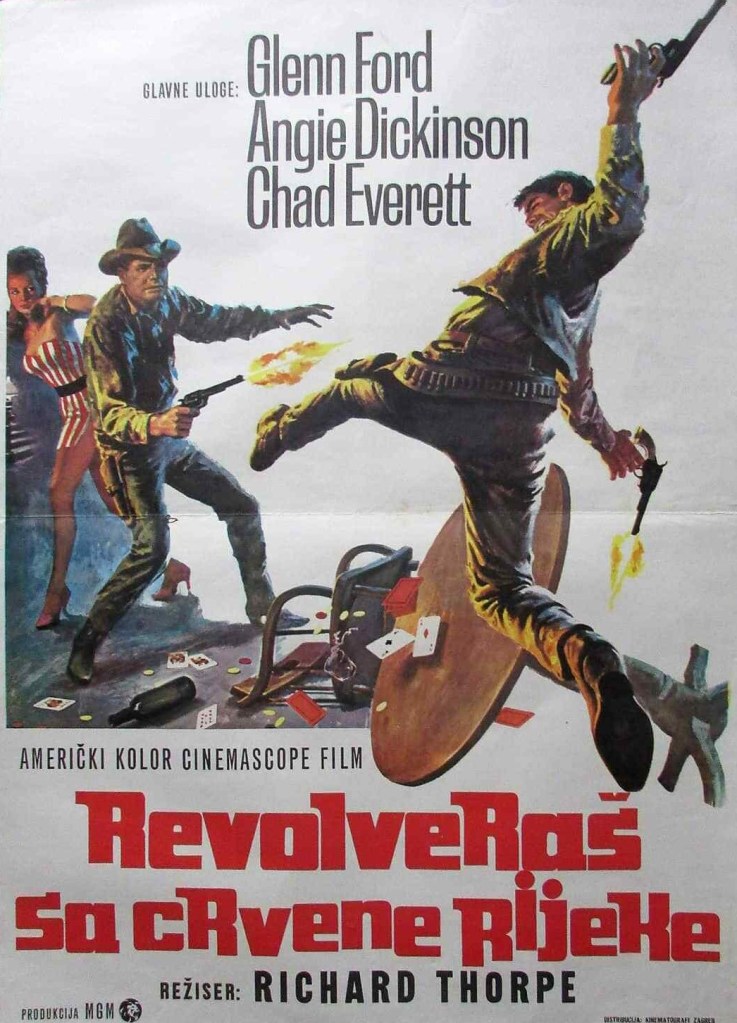
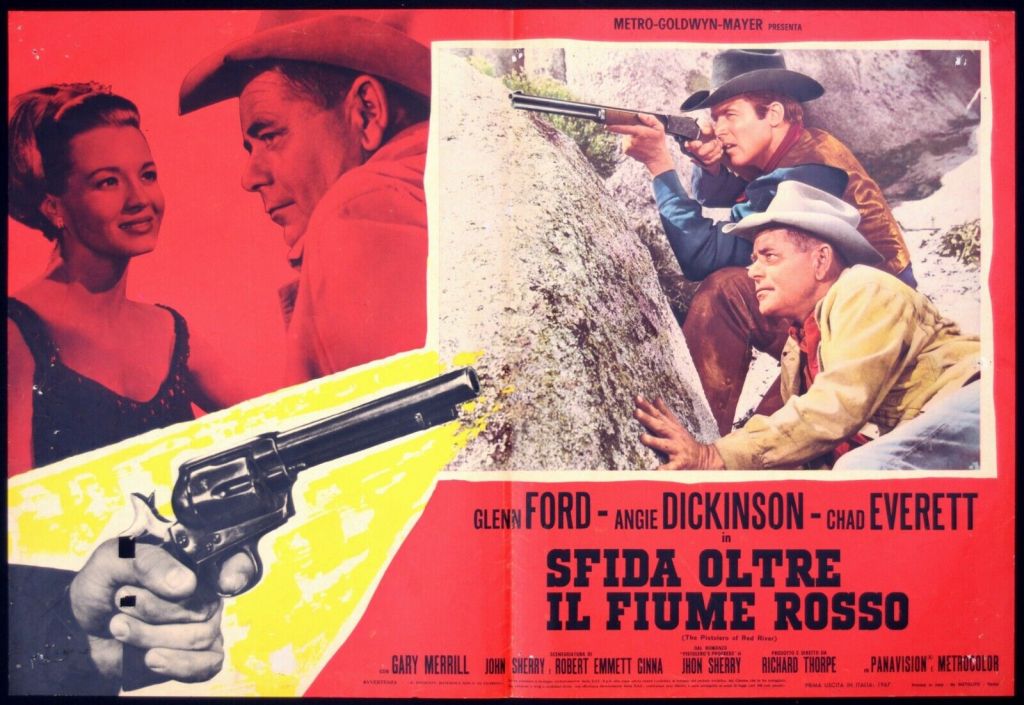
A little gem. Mature, thoughtful, cleverly structured. Plays with expectations. Another assured performance from Glenn Ford (Rage, 1966) with Angie Dickinson (Jessica, 1962) permitted a character of considerably more complexity than normal.
Quite an unusual set-up. Marshal Blaine (Glenn Ford) is an ex-convict, his paramour Lisa (Angie Dickinson) is the local madam. Both are pretty much accepted in this small western town. Some hypocrisy comes Lisa’s way – her money acceptable to a storekeeper who out of earshot refers to her as white trash – but generally the townspeople are happy with an ex-gunslinger as lawman.
But he’s not your standard lawman. He’s very easy-going, not spending all is time upholding the law or out hunting varmints, and she’s not your typical madam either, mothers her employees, keeps unwanted men at a distance, and has made enough money for a fine rig and fancy clothes.
Blaine is sensible but ruthless, taking tough action to prevent a young kid getting into trouble with a dangerous gunman, but having no compunction about shooting the gunslinger. He’s not out for an easy life, but my he does enjoy it, though on a slack day finds fishing more fun than rolling in the hay with Lisa. She knows she has made a good catch, her friend still getting knocked about by her husband, and although Blaine doesn’t seem the marrying kind she has notions of having a baby.
But out fishing Blaine frees a villain Ernest (Jack Elam) who has upset the local Indians. Since they shared a cell way back, Ernest sees Blaine as an easy touch and when told where to go on that score fingers to blackmail Lisa. Meanwhile, this turns out to be an eventful fishing trip. Blaine buddies up with a stranger, Lot (Chad Everett), they fish, cook and drink whisky together until the newcomer reveals he’s on a mission to kill the lawman and take his title of fastest gunman in the southwest.
So you can see where this is headed. Except it doesn’t take that route. Because Lisa, worried that the youngster might well be faster on the draw, hires Ernest to kill him. And when that backfires, it’s only a matter of time before Blaine finds out and you wonder what that’s going to do to their relationship.
There’s some standard stuff, a poker cheat for example, but there’s a lot more going on. Blaine’s young deputy, mostly left to do the chores, tries to throw his weight around with the gunman only to end up with egg on his face. There’s an Native American in jail who we never see and a subplot involving his colleagues that looks like it’s headed in the direction of standard western confrontation until that notion is cleverly nipped away from under the audience’s feet.
Given credence by the worried Lisa is the idea that Blaine is coming to the end of the trail and it’s a testament to the direction that the tension lasts as long as it does. The promotional material gives out that the youngster is a tearaway threatening to shoot up the town, but that’s far from the truth, Blaine trying to talk him out of such rashness while at the same time seeing the boy as a reflection of his younger self.
There’s some brilliant dialog. “Of all the people ain’t worth saving,” Blaine tells Ernest, “you’re the first that comes to mind.” At their first meeting, Lot asks Blaine, “Where’s your tin star?” Retorts Blaine, “You better never see it on me.” As they part, Lot says, “We’ll be meeting again.” Replies Blaine, without aggression, “If that’s the way you want it.”
But there’s quite a lot that’s missed out. There’s no scene of Lisa hiring Ernest, just that he ambushes Lot. The jailed Native American is, as I mentioned, off-camera. There’s none of the usual massive build-up towards a showdown. And even as the shootout approaches, Lisa still doesn’t trust in Blaine’s skill and plans to shoot Lot herself.
That betrayal comes as a helluva shock. When has any lawman’s moll lacked such faith? As for Lot, gunslinging is all that he lives for, the measure of himself, and there’s a purity about him as he rejects countless offers of whisky and women even as he knows he’s making a terrible bed to lie in.
This was very much ahead of its time, especially in thwarting audience expectation not just in the representation of character but in the narrative. It proved a fine last hurrah for veteran Hollywood director Richard Thorpe (The Truth about Spring, 1965). Robert Emmett Gina (Before Winter Comes, 1968) wrote the screenplay based on the John Sherry novel.
As it happened, I watched this back-to-back with Rage so ended with an even better appreciation of Glenn Ford’s talent but was also very taken with Angie Dickinson for the way her character twisted and turned as she attempted to create the outcome she desired. Definitely worth a watch.
Bank robbers ride into town. They pass kids playing a vicious game. There’s something unusual on a roof. Innocents are killed in the resulting shootout.
Remind you of anything?
Sam Peckinpah’s debut is best viewed as an early dummy run for The Wild Bunch (1969) but the title could refer to any of his westerns since there is always malevolence afoot among any of his marauders, be they soldiers, lawmen or outlaws.
By the simple device of waiting a year until “The Parent Trap” had charmed audiences everywhere, UK exhibitors were able to launch “The Deadly Companions” on the back of it, as if O’Hara and Keith were re-teaming for the western rather than the other way round. “The Deadly Companions” wasn’t released in Britain until summer 1962, a year after its launch Stateside, and on the lower half of a double bill.
He’s done no favors by a genuine oddity of a script which has to shoehorn in various odd characters around a basic premise of escorting a woman across Indian Territory. And, it has to be said, more than occasionally the film doesn’t make much sense.
Strangers Yellowleg (Brian Keith), better known as The Man With The Hat since he refuses to take it off in case he reveals his scalped head, gunslinger Billy (Steve Cochran) and Turk (Chill Wills), former Confederate deserter, team up to rob a bank after the first two save card cheat Turk from an impromptu hanging.
But they discover they’re not the first to come up with robbing the new bank and in the shootout with the other robbers Yellowleg inadvertently kills the son of single mum and dance hall hostess Kit (Maureen O’Hara). She decides she doesn’t want to bury the boy in a town where she is openly despised but plans to put him to rest beside the grave of her husband in an abandoned village in Apache country.
Pricked by conscience Yellowleg offers assistance. But Billy goes along with the idea because, and there’s no getting round this, he wants to rape her. Turk goes where Billy goes. At first she resists all offers of assistance and manages to fend off the amorous Billy but of course she’s not able to fix broken wagon wheels or catch a runaway horse. Eventually, it’s just her and Yellowleg, though the other two turn up at the end, Billy not having given up on the notion of bedding her.
The Native Americans they encounter, as in The Pistolero of Red River/ The Last Challenge (1967) are mostly drunk and no threat. In fact, civilization is deadlier, Kit even cold-shouldered at church, and with travelling companions like Billy danger is a constant. Kit might have done better not to get herself wet so often, since that involves either a) being nude behind a wagon to dry off or b) splashing around in full view.
Surprisingly, the hat provides a couple of tender moments. But mostly it’s kept on because Turk is the guy who scalped Yellowleg. There’s an odd presumption that, although his facial features can’t have changed, that only removing it will alert Turk to his true identity. Yellowleg wants to scalp Turk in revenge. He’s only just found him after five years looking. So when he occasionally abandons Kit in dangerous Apache territory it’s to make sure his quarry hasn’t gone far.
There are some nice touches here, although the tendency towards gorgeous sunsets seems out of place. The person on the roof is, for unexplained reasons, Kit’s son playing a harmonica. The town has odd priorities. It may have a new bank but the local saloon has to double as the church, various paintings of nudes on the walls covered up for the occasion, the preacher (Strother Martin) happily challenging our trio to remove their hats in the presence of God. Yellowleg has “something wrong with his shooting arm,” a bullet embedded close to his collarbone that having found his prey he doesn’t have time for the convalescence required after an operation. Authenticity impinges – a rig carrying a coffin and two people is a lot more cumbersome than a single horse dragging a sled, body wrapped in cloth.
Maureen O’Hara (The Rare Breed, 1966) in tempestuous mode is the star attraction here. She’s independent, sassy, tender in turn, and able, for the most part, to defend herself against Billy. It seems a tad inconceivable that she would fall for her son’s killer much as, for purely practical reasons, she might accept his protection.
Brian Keith’s character doesn’t quite come off since it takes too long for his quest to be spelled out. Neither do he and O’Hara gell as they would in their next teaming, The Parent Trap (1961) .
Steve Cochran (Mozambique, 1964) is mostly in scene-stealing mode and it would have helped his character if it had been spelled out whether Kit was a mere dance hall hostess or one who gave out extras for a price. Chill Wills (The Alamo, 1960) also seems to be on a different planet when it comes to acting. But it does seem a shame all the boys put so much effort into trying to steal scenes when Maureen O’Hara without doing very much sneaks away with the entire picture. A.S. Fleischman (The Adventures of Bullwhip Griffin, 1967) wrote the screenplay based on his own novel, O’Hara’s brother produced, and, you might as well know, it’s the actress who sings the theme song.











 The Magnificent 60s