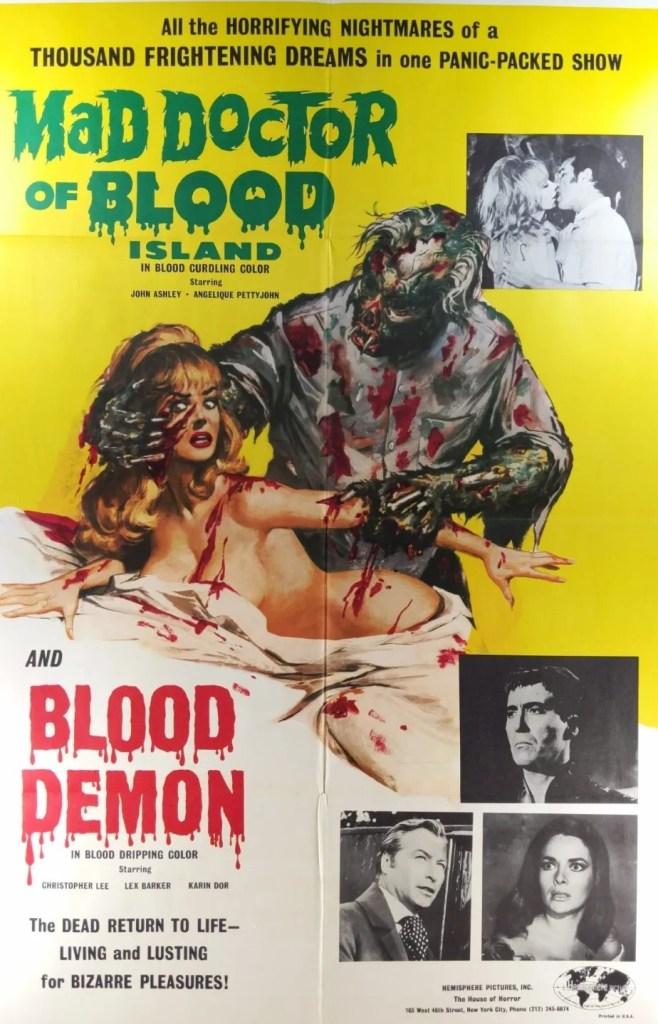
Blood Demon / Blood of the Virgins / The Torture Chamber of Dr Sadism (1967) **

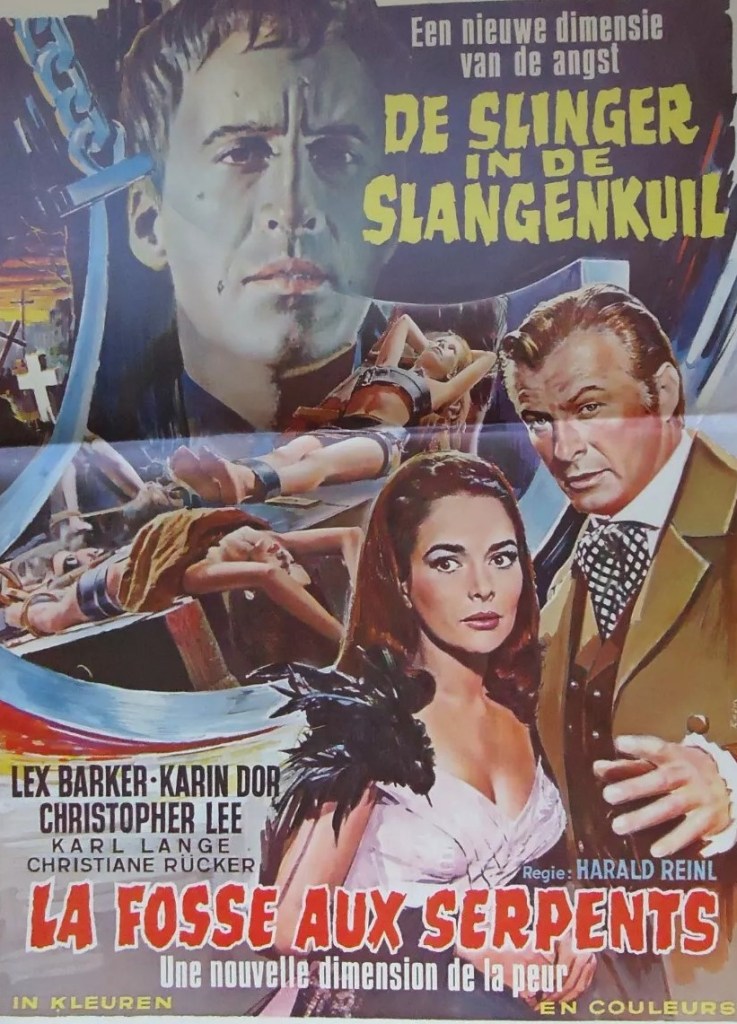
Heavy on atmosphere but not much else, a gender-switch take on the Countess Bathory horror tale (made by Hammer as Countess Dracula, 1971), which sees Count Regula (Christopher Lee) as, oddly enough, being one virgin’s blood short of achieving immortality, thirteen being the vital number, when he is arrested. Condemned to die in traditional fashion, first of all face impaled on a golden iron maiden then body torn apart by a quartet of horses, but not before casting a curse on the prosecutor.

Thirty years later or thereabouts Roger von Marienberg (Lex Barker), son of the prosecutor, turns up seeking the family castle only to find no one will show him the way. And that when he does get going it’s through intermittent fog, past burnt-out buildings and a forest strung with corpses and, it has to be said, a countryside that occasionally takes on an artistic hue, such as one sequence where the coach rides through the countryside with the sky above solid red and the land below solid green.  

Along the way he encounters Baroness Lilian (Karin Dor) – the daughter of the evil count’s intended victim number thirteen – and her maid Babette (Christiane Rucker) who go through a routine of being captured and rescued, captured and rescued. When finally, halfway through, we reach the castle, we find the count in a glass coffin awaiting rebirth.

And then it’s like a reality tv show as the visitors undergo a series of torturous obstacles, Babatte hung over a bed of knives while time runs out, Lilian encountering rats and spiders and potentially dropping into a nest of (rather disinterested) snakes, Roger taking a leaf out of the Edgar Allan Poe playbook and facing either the pit or the pendulum.

The count – his awakening shown in shadow the best sequence in the movie – looks like a survivor from A Quiet Place, face desperately white, and frantic to fulfill his quest, with Lilian designated the unlucky thirteenth. Of course, although it took an iron mask and four stout horses to bring him to heel three decades before, he’s not so familiar with the rules governing the undead and a crucific is all it takes to unhinge him.

Very much horror by the numbers without much pizzazz. Lex Barker (Old Shatterhand, 1964) looks as if he’s more worried about his quiff being out of place than anything else. Christopher Lee (The Devil Rides Out, 1968) isn’t in it often enough and, minus the fangs, hasn’t the wherewithal to drum up a scare. Karin Dor (Topaz, 1969), beautiful though she is, doesn’t quite make it as a Scream Queen.

Atmosphere is the best element here, from the opening march from dungeon to execution through long echoing corridors to the Hieronymous Bosch-inspired backdrop of the castle, and the bodies that appear to have dived headling into trees rather than merely dangling from them.

Lex Varker is the key that this is German-made, directed without requisite suspense or fright, by Harald Reinl (Winnetou, 1963).

But like the fog everything is too strung-out

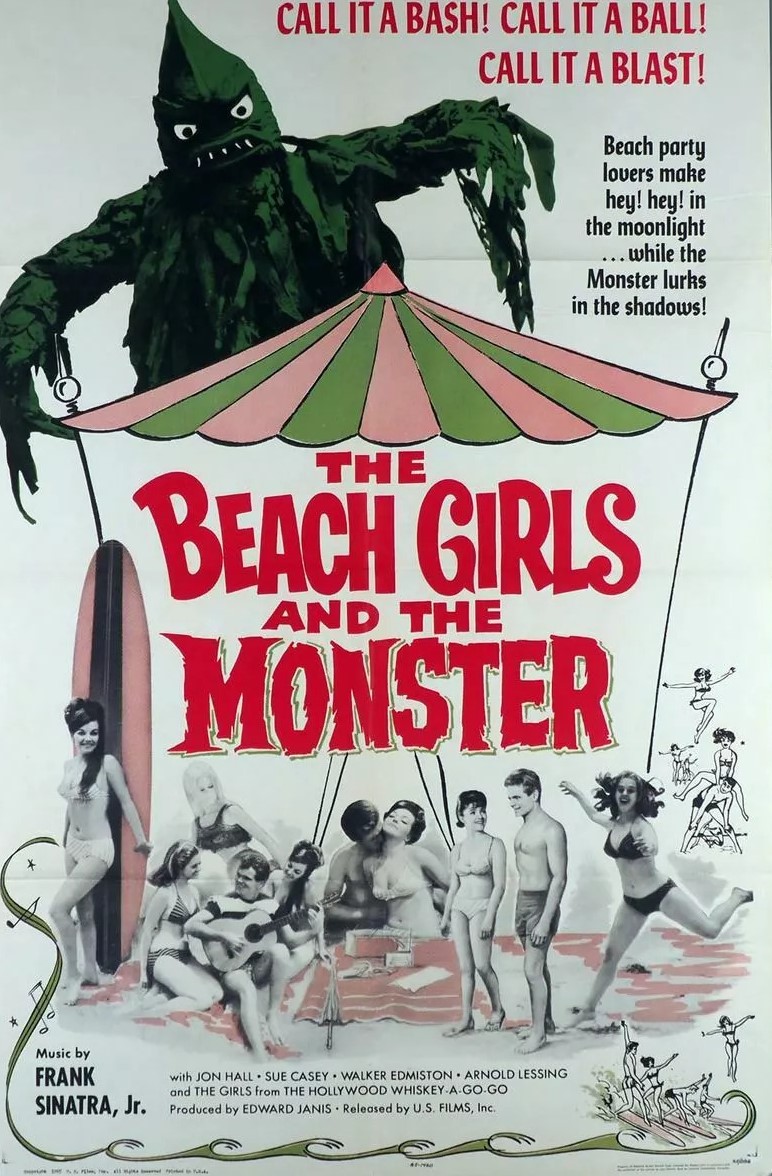
The Beach Girls and The Monster (1965) ***

Interesting curiosity. Peak year for the genre, a dozen films from majors and indies alike, so by now full of alternative scenarios. But let’s start with Jon Hall. In the annals of actors turned director – Kevin Costner, Frank Sinatra, Clint Eastwood, John Wayne, Jon Favreau, Laurence Olivier – there’s nary a mention of one-time Hollywood superstar Hall. You’d never recognize the slim athletic actor in the Errol Flynn mold from the more rounded star of this picture.

Of Tahitian descent, he was a big noise in the 1930s/1940s, not just hot box office alongside Dorothy Lamour in The Hurricane (1937) and Aloma of the South Seas (1941) but a western star (Kit Carson, 1940), swashbuckler (The Prince of Thieves, 1948) and jungle hero after switching to television (Ramar of the Jungle, 1952-1954). But his movie career ground to a halt in the 1950s, and this was his debut as a director.

Tossing a few genres – beach party, noir femme fatale, and horror – into the blender, he comes out with quite an entertaining movie, in part because you don’t know which way it’s going to turn next. One minute the screen’s awash with jiggling and dancing, next minute there’s a monster on the loose, and before you know it we’re treated to some quite astonishing (for the period) surfing footage – a year before The Endless Summer – and a puppet (big hand for Kingley the Lion) plus a climactic car chase.

There’s a creepy stepmother Vicky (Sue Casey) making eyes at stepson Richard (Arnold Lessing) and heading out on adultery binges after telling scientist husband Otto (Jon Hall) that he got what he paid for. There’s a creepy limping sculptor Mark (Walker Edmiston), who hankers after Vicky, and whom you wouldn’t let any prospective model near, the limp a constant reminder to cocky Richard that he should have taken more care driving and not crashed his car.

And while the monster is laughable, actually there’s good reason for that, in a twist you may have seen coming. Pickled through this concoction is plenty family drama, the son who wants to get away from his science-obsessed father (and unspoken guilt for the accident he caused), the girlfriend Jane (Elaine DuPont) who fears he won’t, the sculptor whose relationship with the family is a shade too close, and the wife whose favorite pleasure is to see men wilt when she rejects them.

And this is an equal opportunities monster, victims male and female alike, and, despite the title, not concentrating on murdering innocent beach girls scarpering around in bikinis. 

And this not being a haunted house movie, there’s even a cop involved, investigating the murders, who is detective enough to take a plaster cast of the strange footprints found around the corpse.

And it’s not full of simpering girlfriends either. Jane ain’t no walkover and the monster’s first victim Bunny (Gloria Neil) keeps her boyfriend in his place with her teasing. There’s the usual atomic-growth-spurt nonsense spouted by Dr Otto who contends the murderer is a monster fantigua fish. Monster is responsible one way or another for the deaths of surfer Tom, Vicky, Mark and Otto.

Worth noting: surf footage by Dale Davis (The Golden Breed, 1968); the surf-style score by Chuck Nagle; the dancers were recruited from Whisky-a-Go-Go; and Walker Edmiston did his own sculpting and created the puppet and the monster head. Actress-turned-screenwriter Joan Gardner (A Man for Hanging, 1972) dreamt it all up. Directorial debut for Jon Hall didn’t lead to much, just The Navy vs the Night Monsters (1966).  

One of those films that, for sure, it would be far easier to laugh at if it wasn’t for the noir, femme fatale, surfing, and all the other elements that really should have no place in a beach picture.

Kept me entertained.

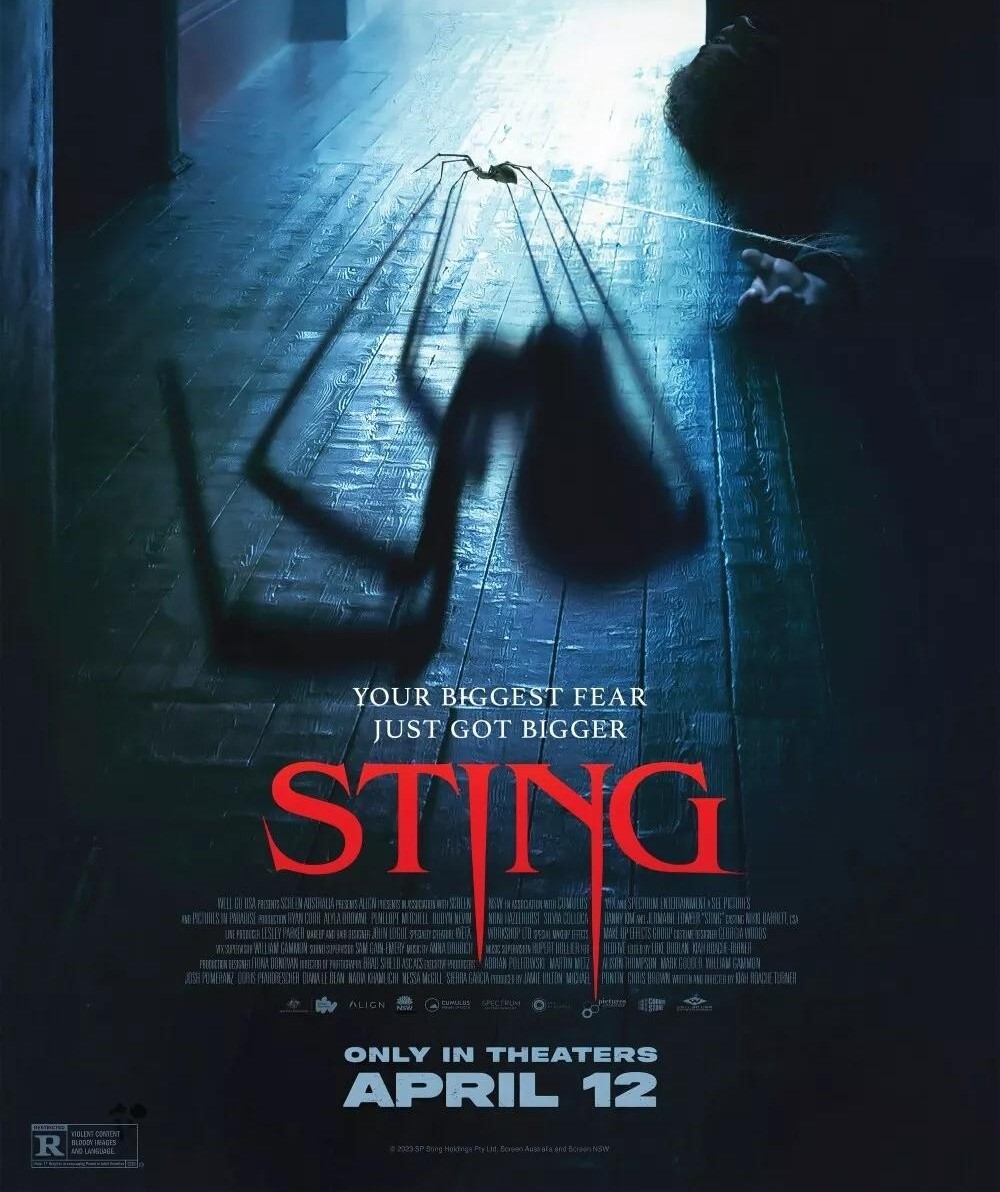
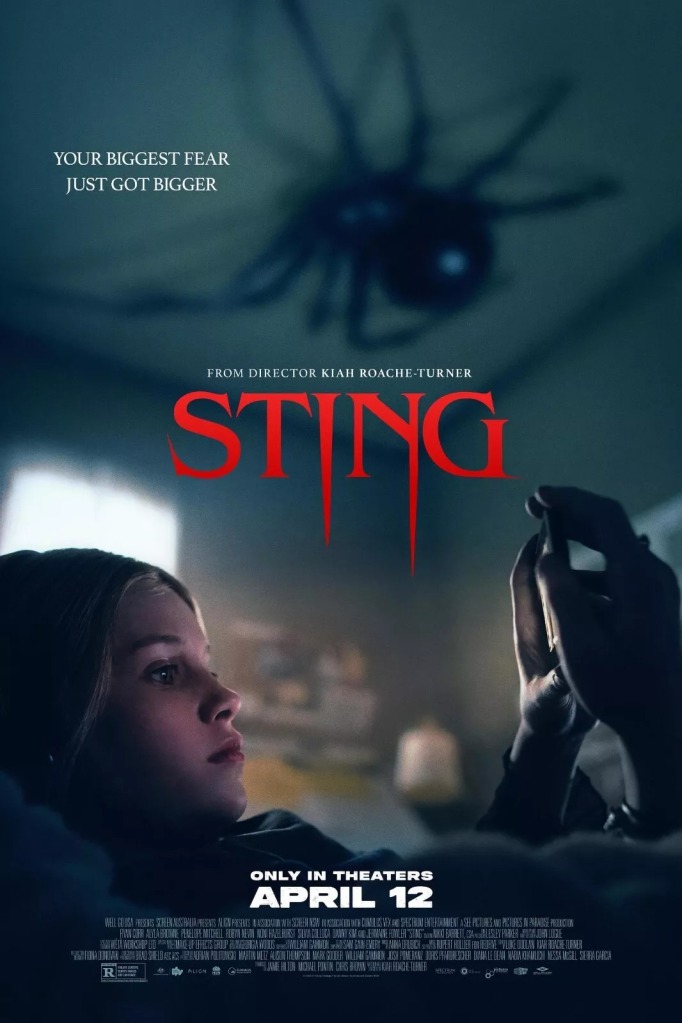
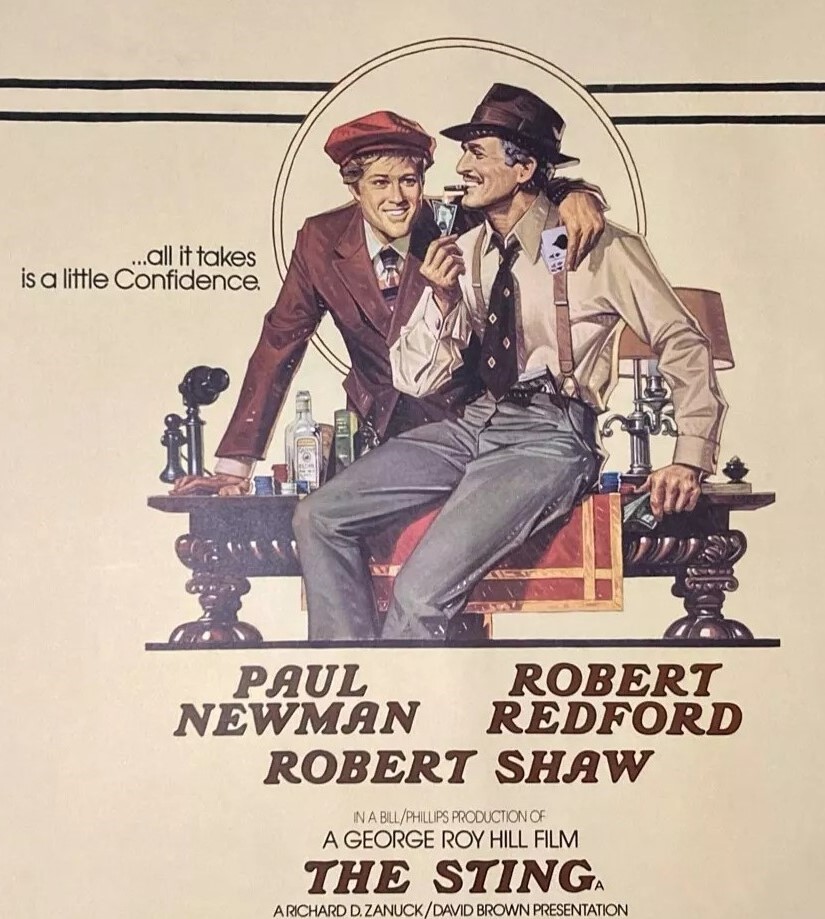
Sting (2024) ****

Once in a while the stars align and, as luck would have it and given we are in stellar mode, a new star is born. Famously, Daniel Day-Lewis owed his instant elevation to arthouse marquee status to the opening on the same day in New York of My Beautiful Laundrette (1985) and A Room with a View (1985) playing such disparate characters that critics were in awe. While not necessarily on that scale I had the privilege of watching a new young talent unfold on my Monday double bill when taking in Sting and Furiosa. The common denominator being Alyla Browne (The Secret Kingdom, 2023), main character in the horror picture and the young Furiosa in the George Miller epic, who, again, essays completely different characters in an extremely convincing manner.

Quite why the horror picture acquired its title is something of a mystery, since nobody actually gets stung and there’s not a bee in sight and any other creepy-crawlies are limited to cameo appearances as lunch for our star creature, a giant spider. Quite why, too, our monster has to come from outer space is anyone’s guess given the Australian filmmakers must be well acquainted with giant spiders hiding in the dunny or other more conspicuous spots in their homeland.

And if you’re going to pretend your movie is actually set in Brooklyn, you’d better not give the game away by the credits forewarning that the picture is part-funded by the authorities in Australia and New South Wales which are hardly likely to pony up for a movie made six thousand miles away, or for suggesting that the country is awash with giant spiders. Setting aside the kind of nit-picking you get on imdb – doorknobs wrongly positioned, for example – this is prime horror.

The genre has shifted away from the dysfunctional family or teenagers high on sex and drugs to settled habitats which allows for more interesting and occasionally subtle character development. There a couple of neat twists, for starters wannabe young illustrator Charlotte (Alyla Browne) is an arachnaphile and her nose is put out of joint by the arrival of a new baby, a half-brother, and accommodating her mother’s new partner Ethan (Ryan Corr) in their lives. They should bond over their joint love of illustrating – he’s a semi-pro – but he’s a tad too critical.

Not to be confused with the 1970s blokcbuster.

Mother Heather’s (Penelope Mitchell) extended family adds complication, mean demanding immigrant aunt and dementia-ridden grandmother living in the same building.

Biggest complication is that when a spider appears out of nowhere, Charlotte adopts it as a pet, catching it live morsels, watching it grow, nicknaming it (presumably because the screenwriter was struggling for a snappy title) Sting and using it as model for her artwork. The creature is unaware that its role is to be fantasy and doesn’t take long to show its true nature, clever enough to twist the cap off the jar it’s contained in, then, after outgrowing such confinement, taking off into the crawl space and hunting down the building’s inhabitants.

That this is a good notch above recent offerings owes much to writer-director Kiah Roache-Turner (Wyrmwood: Apocalypse, 2021). He moves the camera confidently and often slowly, providing panorama where another helmsman would have opted for the cheap shot and quick shock. He takes time to develop the family dynamic, recognizably frazzled at the seams but not coming apart, with the older members exerting dominance through overt power or vulnerability, and there’s some neat comedy involving Frank (Jermaine Fowler) the cocky foul-mouthed pest controller.

The monster munching is well done, nothing that’s going to strain the low budget, carnage mostly kept off-screen, sightings of the beastie limited early on, consequence rather than action the draw.

But the real treat here is Charlotte, the most well-rounded teenage horror character in a long time. She’s hormonal, untidy and passionate, fights with her mother, tries to make peace with both newcomers, Ethan and infant, but is just this side of being creepy, catching beasties for her pet, delighted in its destructive power, but then having to confront all her angst and hostility as it falls to her to turn into rescuer. Alyla Browne is surely a talent for the radar. And there’s a good twist, alien-style, as the dead spider has just time to pop out a few eggs, so, hey, sequel alert, and one that shows all the signs of being more interesting than anything in the vein of The Strangers.

Worth a look.

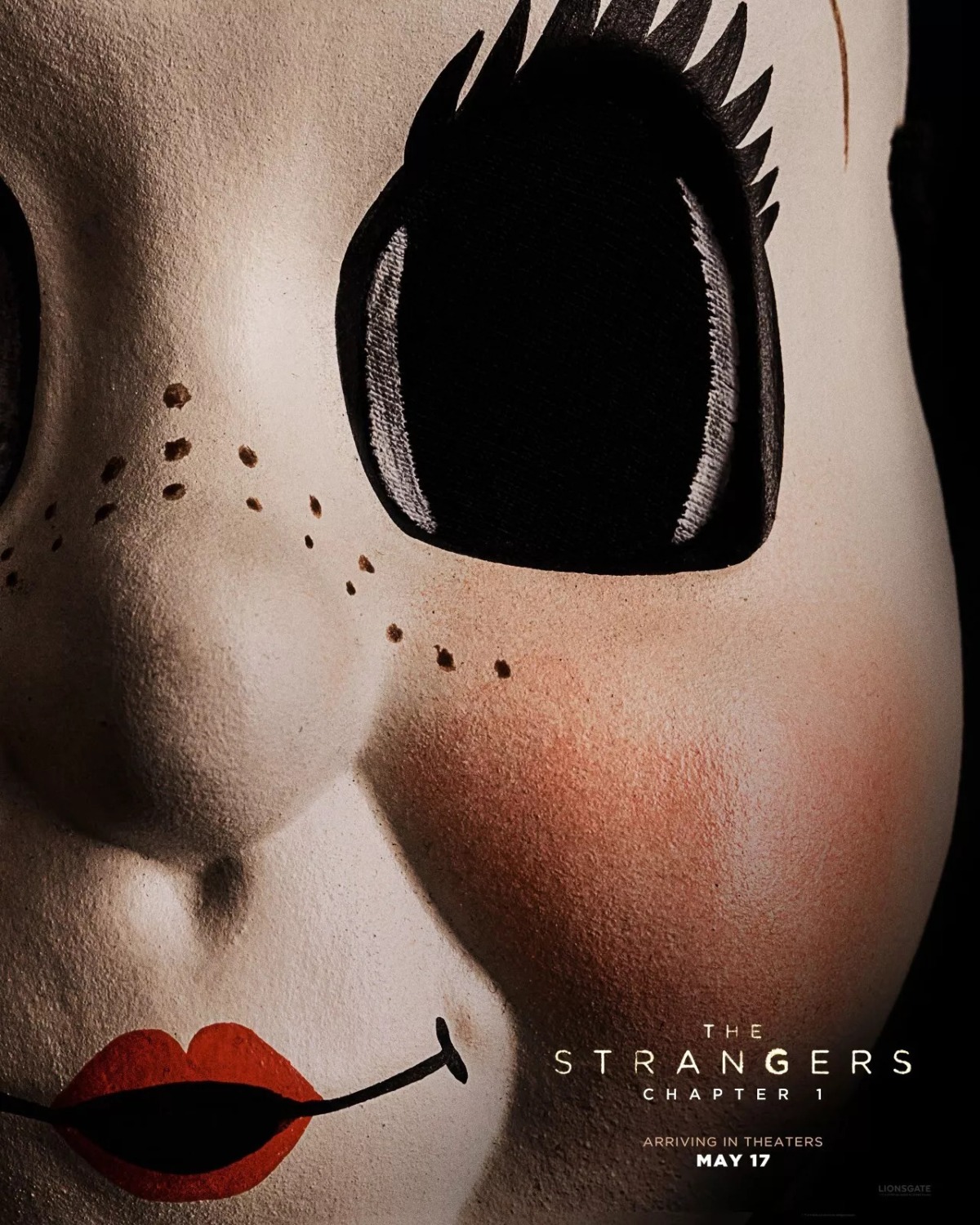
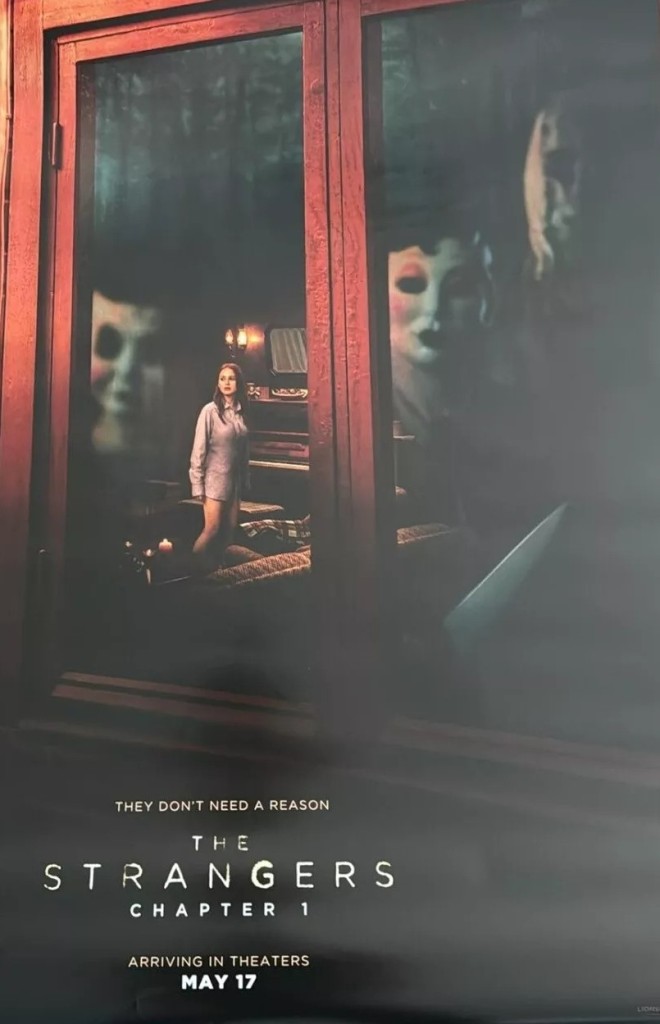
The Strangers Chapter 1 (2024) **

Enough already. Dumb as ditchwater, virtually no thrills and they think we’re going to be queuing up for the next one? Have they gone crazy? Could I care less who is behind the masks? And what’s happened to the horror genre? This should be relatively safe territory, every now and then we’d get a gem like Megan or The Black Phone and someone would invariably reimagine one of the old standards, but even remakes of The Omen and The Exorcist have been tired and lacking any spark.

I’m not a huge horror fan but in the last few years in the absence of anything else been happy to top my weekly cinemagoing habit with a dose of the scary stuff. But this looks like it’s going as swiftly off the boil as MCU. Am astonished to find one-time uber-director Renny Harlin (Cliffhanger, 1993) behind this weak sauce, and apparently there’s going to be no let-up because the next two chapters are already in the can.

This might prove the all-time horror hubris as there’s virtually nothing here to suggest any reason for a sequel, and setting aside the question of artistic merit, the box office doesn’t sound like it commands anything except a quick turnaround into streaming. Miscalculation and misconception on a massive scale. Nothing more than a one-set horror outing with elements that have been better done elsewhere and really the dumbest of the dumb participants.

It’s only when you lock yourself in the toilet you realize you might have been better to stop in the kitchen and hunt for a weapon? Though, this being America, you can be sure of finding a shotgun in the shed. Your car’s broken down but there’s a motorcycle sitting outside your Airbnb with its keys in the ignition? You don’t even have the sense to employ the rusty nail you’ve pulled out of your hand while down in a cellar (you went into a cellar, have you no sense?) as a weapon as if you’re incapable of taking lessons from other onscreen heroes.

How can even get lost in the first place? Your mobile phone signal is what brings the cops in the end and yet it doesn’t work enough in the area to get you home in the first place?

You’ve got asthma but you constantly misplace your inhaler. You don’t whack the one member of the masked gang around the head with your shotgun but allow her to hold their knife high up in the air so it’s going to reflect the moonlight and let her confederates know where she is.

These inconsistences would all be acceptable was there any element of menace. This is just all handled so badly you can’t believe Harlin is an experienced director, 40-plus projects on his call-sheet.

So we’re in semi-Deliverance territory, though Oregon rather than hillbilly country, but the kind of place where they seriously look askance at vegetarians and unmarried couples and are constantly thrusting religious pamphlets at you. Loved-up couple Maya (Madelaine Petsch) and Jeff (Ryan Brown) get, as I said, lost and stop at a Nowheresville diner long enough to be made to feel uncomfortable. Then, blow me down if Jeff can’t get his fancy vehicle to start, so they’ve got to spent the night in a cabin.

Someone keeps knocking at the door. Jeff has to leave Maya on her lonesome because he left his inhaler in said car, now residing in a repair garage, and the motorcycle lacks a pillion to accommodate her (nope, he just goes off on his own, otherwise we won’t be treated to the lonely woman in the old dark house where, yep, the lights go off).

Three people in masks, one a cut-price Leatherface number, the other two dollfaces, come a-calling with axes and knives and then…snoresville. If you stay on to watch the credits, there’s meant to be a chilling twist, but by then I guess most people are just happy to get out of the place.

I know there aren’t many like me who still religiously go to the cinema once a week. I’m not a paid-up critic who gets in for free. I’m just your ordinary cinema-lover and in the course of a year I’m expecting a few turkeys, but we are now dredging rock bottom, last year’s various strikes hammering studio output, so that even the traditional Memorial Day, that’s meant to launch the summer season, has been very poor. Hollywood was struggling enough post-Covid with the encroachment of the streamers and it in part depended on ordinary punters like me who would plug movies that fell beneath the radar to other less-compelled movie fans.

Avoid.  

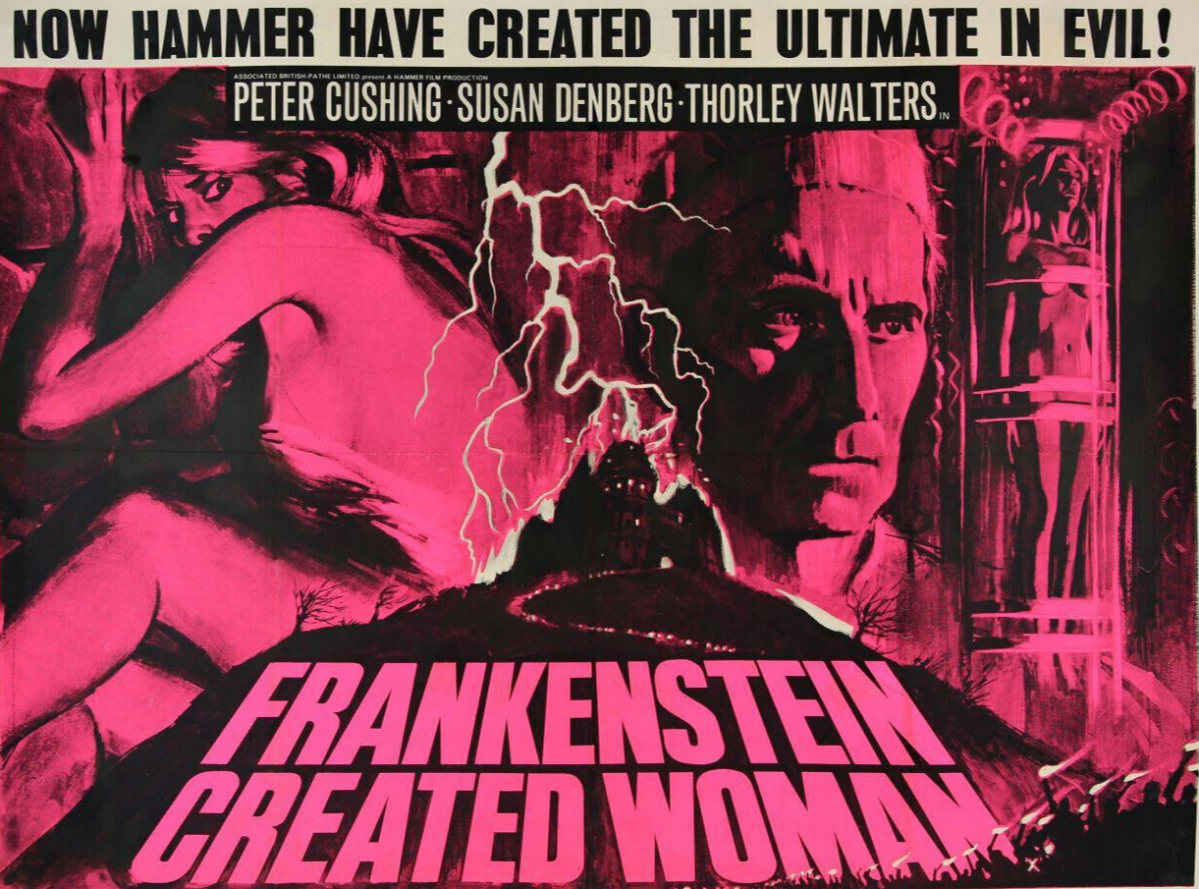
Frankenstein Created Woman (1967) ***

Custom-made for a contemporary audience. How can you fail with a tale about a male brain taking over a female body. Male soul if you want to be strictly correct and metaphysical about it or if you are Martin Scorsese for whom discussion about whether the soul leaves the body after death and exists on some other plane was of the greatest interest. But, yes, so although our hero/villain Baron Frankenstein (Peter Cushing) does create a female instead of a male, and not just with the misogynistic purpose of supplying a monster with a mate, unfortunately in the act of creation the poor woman is saddled with the soul/brain of a man, and, even worse, one with  bloody revenge on his mind.

These days for sure audiences would not have any trouble with female stars carving a swathe through any populace and nobody would require transplanting of  male hormones-soul-brain-whatever to take off on a rampage. But, back in the day, before Hammer went full-tilt-boogie down the lesbian vampire route, it was rare, outside of film noir and exploitationer pictures, for a woman to be so savage. So her actions are viewed with regret rather than roars of approval. But, for once, nobody is taking a torch or axe to the good old Baron.

That’s not all that takes the audience by surprise. The use of a guillotine, ideal for a post-task  dripping of blood, turns out to be widely used in central Europe in the 19th century, hardly surprising since it was a German invention. The movie opens with a young boy, Hans, witnessing his father’s execution on such a device, a point that seems arbitrary but proves pivotal.

The grown-up Hans (Robert Morris) assists Dr Hertz (Thorley Walters) assisting the Baron in some kind of resurrection experiment, the guinea pig being Frankenstein himself. Naturally, for purely metaphysical purposes you understand, the Baron would like to experiment on as barely-dead a cadaver as possible to prove his theories. That this takes a good while to materialize is largely because the narrative has to go all around the houses.

Hans’s lover, disfigured and lame innkeeper’s daughter Christina (Susan Denberg), is taunted by a trio of young swells that results in Hans attacking them. Later, for no particular good reason, the toffs kill the innkeeper, but Hans gets the blame and is sentenced to death. After he is  guillotined, Christina commits suicide by drowning. Both bodies turn up in Frankenstein’s lab at roughly the same time. Complication of course being that a guillotine doesn’t deliver a body intact. Quite how Frankenstein achieves his soul-body transplant is left up to your imagination – the scene promised in the poster is a marketing fiction.

And there’s a touch of Poor Things about the result as Christina wakes up minus scars and disfigurement but with no recollection of her past and needs to be taught who she is. Not that she requires much education in the feminine wiles department and is soon stalking the three young toffs, seducing them with hints of sexual promise before taking savage revenge.

There also a Curse of the Undead element when villagers discover her grave is empty. In fairness to the Baron, he soon realizes what fate had befallen her and tries to ensure that, once her revenge is complete, she can live a different life, although in the way of horror films a happy ending is rarely an option. And in fairness to the Baron the villagers aren’t queueing up to set him alight.

With various subplots to get through, this leaves the Baron out of the picture for considerable periods of time. From a contemporary perspective, there’s a freshness here that will appeal, especially the creation’s desire to discover her purpose in life, her not being bred to fulfil a romantic purpose, and the battle of the male-female will.

Peter Cushing (The Skull, 1965) is as usual splendid, Thorley Walters (Sherlock Holmes and the Deadly Necklace, 1962) presents as an inebriated and impecunious assistant while Austrian Susan Denberg (An American Dream, 1966) does well in the dual role.

Fourth outing in the Hammer series, directed with occasional verve by the reliable Terence Fisher (The Devil Rides Out, 1968) from a screenplay by Anthony Hinds (The Mummy’s Shroud, 1967).

Contemporary appeal and can never go wrong given that it is purportedly one of Martin Scorsese’s favorite films.

Eight for Silver / The Cursed (2021) ****

Restraint in a horror picture? Nary a scream? Scarcely a close up? More bloodletting in surgery than in the woods? Use of candlelight evocative of Stanley Kubrick? The classical composition of John Ford, long shot beloved of Henry Hathaway, in camera (minus the juddering cuts) treatment favored by Christopher Nolan? Where has this little gem been hiding?

Set in rural France in the nineteenth century, positing a Biblical reimagining of the werewolf legend, every scene so carefully measured by British director Sean Ellis (Anthropoid, 2016) that you would think this is a master sprung to life. Even more tantalizing, given the genre, is the ensemble acting. This isn’t one of those horror efforts where you’re trying to work out (or hope) who’s going to be bumped off next.

Marketing team do this picture a disservice with this poster which more or less gives the game away, even though this forms a tiny fraction of a classy film.

And you think – although the participants remain baffled – that you know what’s going on, so you let down your guard, until the feet are swept out beneath you by the late twist, that, too, with Biblical connotation. The first Biblical allusion seems far-fetched, I have to admit, linking Judas Iscariot’s 30 pieces of silver to the silver bullet traditionally used to kill werewolves, vampires and the like. But then it twists into left field, both thematically and intellectually, covering such wider ground as betrayal and confession. The second Biblical reference we are all familiar with – reaping what you sow.

Technically, the narrative revolves around a gypsy curse. Nothing unusual in that you might think. Gypsies – and teenagers for that matter – are known for handing out curses for any minor breach or discrepancy. In this case, you wonder how the curse was set, given every single gypsy within the vicinity has been slaughtered, buried alive or, hands and feet chopped off, turned into a human scarecrow.

But the gypsies, suspecting imminent malevolence, have fashioned from their horde of silver coins (maybe thirty, we are not told), a pair of silver false teeth, which are buried, but then found by the local children, directed to them by dream/nightmare. These aren’t of the distinct vampiric molar kind, but seemingly more akin to those employed by wolves for savaging purposes. It’s the children who are turned into werewolves or, as here, that rarer mythical entity shamans (though not in the strict understanding of the word).

Stuck for another poster – which shows how little of an initial release “Eight for Silver / The Cursed” received – I’ve taken the easy way and added the movie with which Kelly Reilly first attracted attention.

Victims appear chosen at random, and not for illicit sexual behaviour as was once the norm, and  gradually a more apparent truth emerges. Eventually pathologist McBride (Boyd Holbrook) takes center stage, but that’s a slow time coming, and mostly what we have is nobody taking center stage, or focus shifting around a variety of characters, landowner Seamus (a traditional French name, don’t you know) Laurent (Alistair Petrie), submissive wife Isabelle (Kelly Reilly), their daughter Charlotte (Amelia Church) and a variety of young teenagers including Timmy (Tommy Rodger) and servants.

But, as I said, restraint is the watchword, and there are three just outstanding scenes. The movie opens – didn’t I mention this – in World War One, a field surgeon extracting bullets from a wounded soldier. The bullets don’t even, as would be the usual cliché, clang when tossed into a metal bowl. The surgeon finds two. The third is unusual. It’s much bigger for a start than your normal machine gun ammunition. And it’s silver.

And here’s the genius. Nobody exclaims, oh my goodness, a silver bullet, whatever can that mean, it just sits there dripping with blood from the operation, and the image filters down into the audience brain. Then we’re into flashback and gypsies making such a nuisance of themselves claiming ancient ownership of land that good old Seamus decides to call in the mercenaries. And that entire scene, of terrible slaughter, people shot and skewered and burned alive, is shown in extreme long shot, the camera never moving.

Third terrific scene. The Laurent’s son Edward is missing. Father, mother and daughter sit at the kind of long table you get in mansions, mother at one end father at the other. Mother is weeping scopiously, father is silently eating his dinner. Long shot again, no cuts, just the measured camera.

Virtually the only color in most scenes is a candle or a torch, and you would have to say a less showy and more effective treatment of light than in Kubrick’s Barry Lyndon (1975).  And in audio terms it’s the same, scarcely a raised voice. And when McBride’s family tragedy is revealed, it’s done so visually and discreetly, though for the dumber audience member the ground is covered with dialog later on.

No showboating required from the actors so in that sense it’s the very best type of acting, as if everyone had learned from Anthony Hopkins how little you had to do to be effective. So top marks to Boyd Holbrook (Indiana Jones and the Dial of Destiny, 2023), Kelly Reilly (Yellowstone, 2018-2022) and Alistair Petrie (Rogue One, 2016). Sean Ellis didn’t just write and direct this but he handled the cinematography too. Had this been an arthouse number, Ellis would be praised to the skies.

If you require jump-out-of-your-seat moments and copious gore, then this isn’t one for you, but if you want to appreciate a story superbly told by a director in command of his craft, then seek this out. Strangest of all it’s turned up on Netflix, not known for harvesting little gems, and probably scarcely aware of what it has uncovered.

A marvellous surprise.

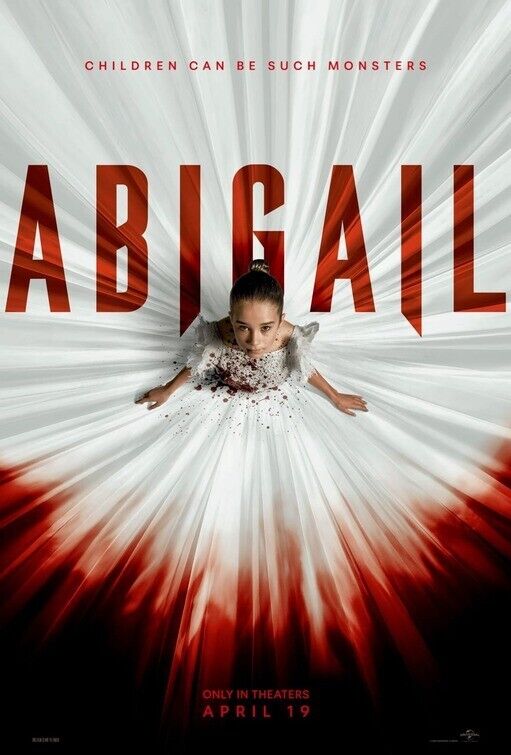
Abigail (2024) ** – Seen at the Cinema

Someone hasn’t pointed out to the directors (there’s two of them) – or they’ve decidedly to pointedly ignore – the crazy notion that you need someone to root for in a horror film, even if it’s someone you start out disliking. Nor has anyone seemingly touched upon the grating error of the premise. You’re planning a $50 million kidnap, so you hire a team of top professionals, who turn out not to be able to control their liquor, get drunk or stoned within an hour of a 24-hour shift, and can’t even keep to their own basic rules which include not mentioning each other by name or revealing their faces to the victim.

The twist – that somehow they’re the ones trapped – would have a chance of succeeding if the principals were capable of extracting an ounce of sympathy from the audience. We’ve got an ex-junkie single mom too keen on playing the victim, an ex-cop, a muscle man from the Dumb and Dumber Selection Box, a sociopath, a rich girl looking for kicks and a guy who may be more mainstram but acts dodgy.

The other twists – that the kidnapped girl is actually a vampire and that her dad is some feared villain – don’t count for much unless it’s the girl we’re supposed to be rooting for because (twist number 22) vampires aren’t born that way but need to be bitten and guess who did that indoctrination, yep, the bad dad, so, technically, this counts as child abuse. So, technically, little Abigail would get my sympathy vote except she’s caught up in one awful movie.

What with exploding bodies, decapitated corpses, a lake of dead people, mirrors with miracualous properties and the usual stakes, garlic and crosses failing to work it’s a blood-drenched hotch potch that wears out its welcome very quickly. Not even worth it to see posh Downton Abbey alumni Dan Stevens and Matthew Goode sharpening their fangs.

Saw this on a double-bill with Challengers. This kind of counter-programming has worked in the past. But not here, sadly.

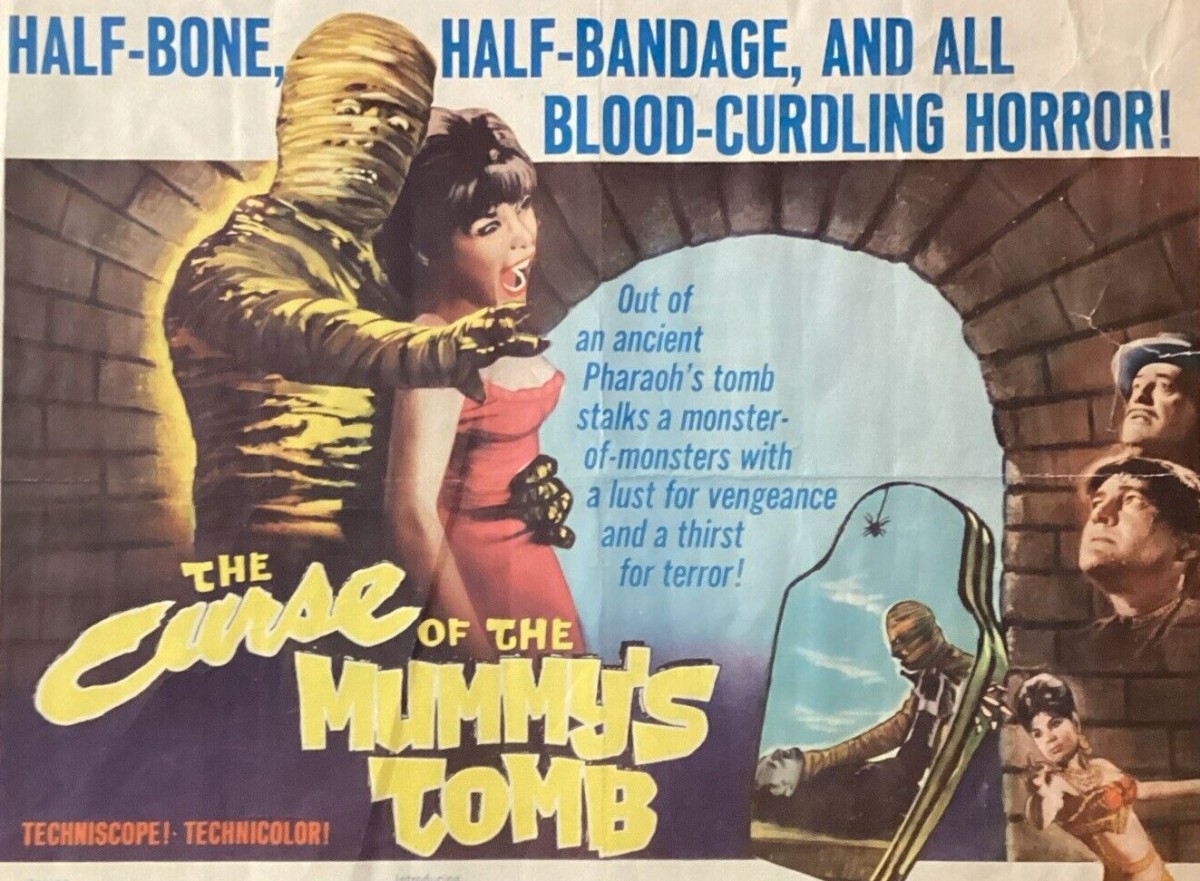
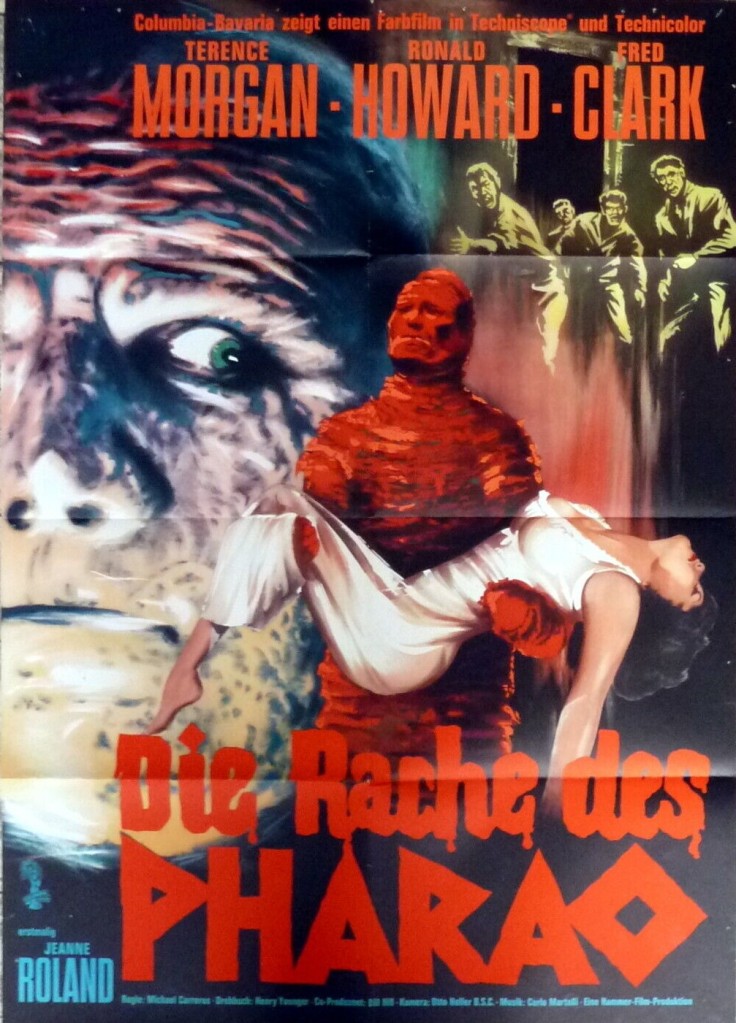
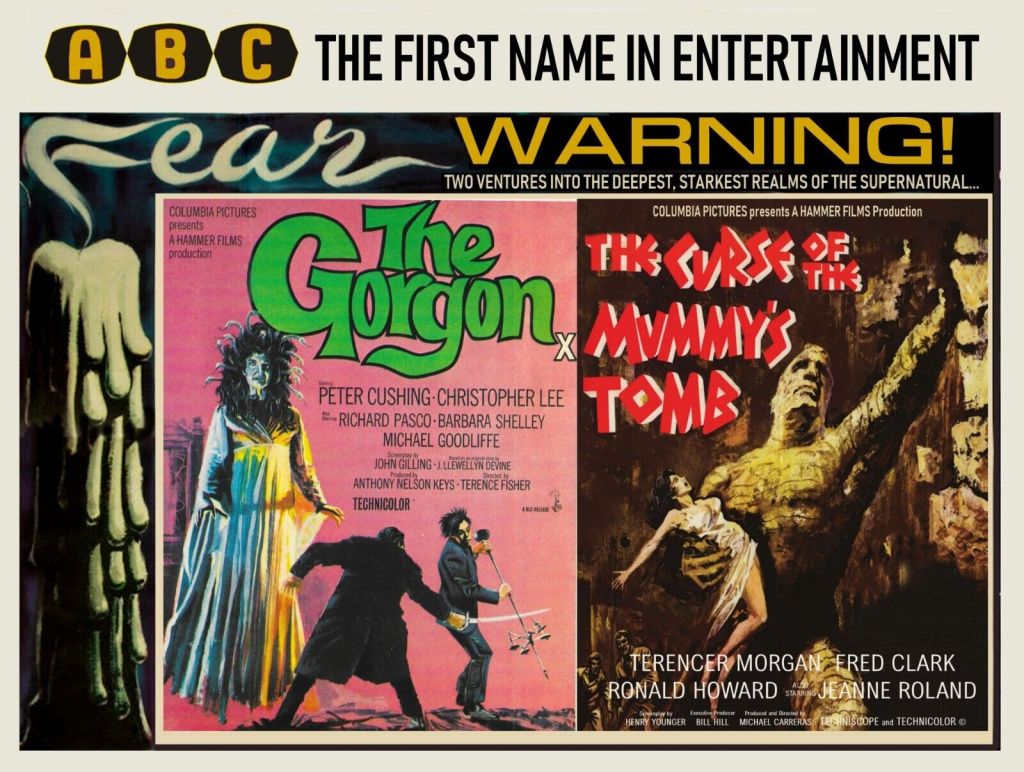
The Curse of the Mummy’s Tomb (1964) ***

Approach with affection and you will be rewarded. This is third tier Hammer, way down the pecking order behind Dracula and Frankenstein and after attracting studio stalwarts Christopher Lee and Peter Cushing for its first venture into this territory (The Mummy, 1959) dumps them for the sequel. And in the absence of the CGI that transformed the Stephen Sommers version in 1999 – and triggered the misguided Universal Monsterverse – struggles these days to prevent audiences laughing at the special effects. The titular beast was little more than a bandaged version of the lurching creature created by Dr Frankenstein so chills were always going to be in short supply, especially minus the plague of scarabs that dominated the later proceedings.

More interesting is the backstory that drives the narrative, warring siblings in ancient Egypt, the death of the rightful monarch and a reincarnation curse that travels down the centuries. Throw in bombastic King Kong-style showman Alexander King (Fred Clark) determined to monetize an archaeological find, shift the story to London, bring in a damsel Annette (Jeanne Roland) infatuated with the villain, and you have the makings of a decent tale. Alternatively, if you’re of a different mind, that could all be to cover up shortcomings in the plot and the wrong reasons for delaying the appearance of said monster.

People tampering with Egyptian graves tend to get their hands chopped off, but that’s as much warning we get of evil afoot although there are hints of malignancy in the flashback that shows the murder of Ra-Antef, son of Rameses VIII. But triumphant returning Egyptologists John Bray (Ronald Howard), Sir Giles Dalrymple (Jack Gwillim) and Annette, daughter of famed Professor Dubois who died in the line of duty, are inclined to take no precautions.

Poetic license – the mummy just ain’t that big in the movie.

Until the mummy is let loose, much of the tale centres around the ruthless grasping King and a love triangle developing between Annette, her fiancé John and the newcomer Adam (Terence Morgan) she met on the voyage home. While John is kept busy by King arranging for the grand public opening of the tomb, Adam slips in to romance Annette, not letting on of course that he possesses the amulet that can revive the sleeping monster. The setting – sophisticated London rather than remote Transylvania – and the delay of the murderous onslaught ensures that most of the picture survives on intelligent conversation, motivations and characters set out in non-cliché manner, and no squads of villagers set up for a marauding.

The monster is pretty effective when he does deign to appear, bursting through windows, picking up the damsel in a pose that I’m convinced Oliver Stone snaffled for Platoon (1986), and making his way to the nearest sewer, unlikely locale for a climax. There’s a propensity for lopping off hands and when that loses its impact stomping on heads.

But it’s not camp, is well-acted and the storyline makes sense. It probably helps that it’s free of Cushing and Lee because with unfamiliar actors the audience has to work harder. Terence Morgan (The Penthouse, 1967) is the pick of the stars because he carries most of the mystery. But Fred Clark (Move Over, Darling, 1963) steals the show by making a meal out of his outrageously greedy businessman. Top marks to Hammer for making Burmese-born Jeanne Roland (You Only Live Twice, 1965 and Casino Royale, 1967) a professional – she is an archaeologist – rather than a cleavage-ridden damsel in distress. And for those of a nervous disposition you will be pleased to know that the monkey is not present just to nibble poison intended for one of the principals.

However, from the outset it was destined for the lower half of a Hammer horror double bill, so the kind of budget that could do it justice was never in evidence. Studio boss Michael Carreras (Prehistoric Women, 1967) always gave the impression of over-extending himself but here  as writer-producer-director he manages to keep the picture on an even keel long enough for the monster to do its worst.

Immaculate (2024) ***

As you know we live in a Big Brother pampered society and even going to the movies comes with a health warning. But, I have to tell you, Dear British Censor, “strong bloody violence” doesn’t cut it. Now, I’m as happy to be scared out of my wits as the next guy, jump-out-of-your-seat shocks are part of the fun of horror pictures. But having to close your eyes to plain sadistic action – tongues cut off, feet branded, bellies of pregant women cut open, babies stoned to death – sorry that’s a bit more than “strong.” Maybe torture porn should have a category of its own.

Which is a shame because this is a clever twist on the old trope of the demonic child as proferred by Rosemary’s Baby (1968) and The Omen (1976) – possibly no coincidence either that’s beaten the Omen remake to the punch. Instead of satanic satanists it’s satanic priests and nuns mainlining on some kind of more scientific genetic Da Vinci Code.

And thanks to the runaway success of last year’s Anybody But You, there’s another element at play here, the breakout star’s follow-up picture to gauge if breakout picture was fluke or welcoming a new star into the firmament. Julia Roberts followed up massive hit Pretty Women (1990) with tepid thriller Sleeping with the Enemy (1991) and the soppy Dying Young (1991) but nobody cared how indifferent the follow-ups were and both turned into big hits and wow a star is born. Sandra Bullock arrives out of nowhere in Speed (1994) and follows up with ropey romance While You Were Sleeping (1995) and tepid thriller The Net (1995) and bingo a star is born.

So this is breakout star Sydney Sweeney’s follow-up – excluding Madame Web of course – and I’m not sure if it will sweep up that many of her newfound followers in its wake. Not because it doesn’t deliver the horror goods because outside of the torture porn it’s pretty creepy and with effective twists and if you want to see a bloodied Sydney creep out of a hole in the ground and give birth and then, as if confounding her newfound bubbly screen personality, beat the baby to death then this one is for you.

Anyway, let’s backtrack. Cecilia (Sydney Sweeney), a young American who had a near-death experience, hives off to an Italian convent filled mostly with the devout, the lost and the broken. It’s not Nun of Monza, and it’s not terribly strict either and even though she couldn’t be bothered learning Italian (don’t these nuns speak English?) there’s always someone on hand to help translate. She makes one friend and one enemy, but, hey, like any boarding school that’d be par for the course.

So, here she is settling in, becoming a bride of Christ, taking vows of chastity, obedience and poverty when suddenly charming Fr Tedeschi  (Alvaro Monte) comes over all nasty, questioning whether she is a vigin or not. Just when that is established to everyone’s content comes the zinger – she’s pregnant by what is known in Catholic Church parlance as immaculate conception. Quite how this occurred is never explained, except the convent has an artefact claimed to be one of the nails that stuck Jesus to the cross and therefore containing remants of blood (we’re going Jurassic Park here) and thus his genetic code.

You won’t be surprised to learn that she’s not the first victim of this kind of conception. Things start to get fairly nasty after this – someone tries to drown here and then we’re in for the tongue-cutting, branding etc – and Cecilia goes from docile to vengeful. She comes up with a clever trick to escape and when that doesn’t work has to find another way out of her dilemma and if that involves strangling someone with rosary beads that seems nicely ironic in the circumstances.

It was certainly a day of mean mothers in my Quadruple Bill on Monday, this being the last of my quartet. It was certainly well done and the concept no more barmy than any of the demonic baby tropes, if a bit more up-to-date medically, and there was enough of the claustrophic creepiness that comes with the convent territory and the throwback barbarity of the Church (Spanish Inquisition, anyone?). Apart from the torture porn, a good entry into the genre but, despite Sweeney’s performance, this would not have put her in the break-out league. So I think this will just be put behind her as she charts a new rom-com course. Incidentally, like Anna Hathaway and Jessica Chastain in Mother’s Instinct, she was the producer.

Worth seeing for Sweeney, though, and the clever plot ploy.

The Cabinet of Caligari (1962) ***

If you’re going to put an English rose through the mill who better than husky-voiced Glynis Johns and except for the giveaway title you might expect from her previous screen ventures that when her car breaks down in a foreign country we’re all set for romance. But you’re probably on the alert anyway after realizing Robert Bloch (Psycho, 1960) wrote the script. The narrative engine runs on twists and the chances would be poor of audiences comprehending the psychiatric devices involved so it’s pretty much a contemporary haunted house mystery with our heroine trapped in an ever-worsening situation and most of the terror emanating from her own mind.

After her tire blowout, and exhausted from trudging along country roads, Jane (Glynis Johns) seeks help from Swede Caligari (Dan O’Herlihy) who owns a large estate in the country. But when she wakes up in the morning, she is unable to leave or telephone for help. There follows a series of disturbing events including (a la Psycho) a peeping tom (bath not shower), being presented with pornographic photographs, interrogated, witnessing torture and being chased by revolving glass. Other images are terrifying, babies baked in ovens, people buried up to their necks, a torture rack. Nothing and nobody are what they seem.

The twist is that she’s in a mental asylum, the car breakdown a fiction to make acceptable to herself her presence there, the other incidents all explained as various versions of psychiatric treatment including electric shock. The central conceit, that she’s trapped, is well-maintained what with other guests dressing in glamorous fashion for dinner and none behaving like inmates. But when Jane tries to make friends with them in order to organize a breakout or escape, she doesn’t know who to trust, and even attempts seduction.

It kind of works and kind of doesn’t. When the camera explains seconds later the reality behind her crazy visions, it ruins the effect. The expressionistic approach helps in presenting the visuals but can’t provide proper insight into her state of mind. The images are odd rather than helping the story. There’s a disjointed feel to the whole thing, as if director and star were on different planets. And there’s a major plot flaw suggesting Jane must be truly out of her mind if she can’t recognize that Caligari and inmate Paul are the same person, give or take a false beard.

It was a bold career choice for Glynis Johns (Dear Brigitte, 1965), generally the sassiest of heroines, to be so out of control. In his only movie, television director Roger Kay makes a bid for the big time with his visuals but too often loses sight of the characters. Of course, it was always going to be a tough ask to match the original German The Cabinet of Dr Caligari (1920) though I doubt many who saw the loose remake would be aware of its existence.

Interesting for the visuals and Glynis Johns losing the rag.

Discover WordPress

A daily selection of the best content published on WordPress, collected for you by humans who love to read.

The Atavist Magazine

by Brian Hannan

WordPress.com News

The latest news on WordPress.com and the WordPress community.