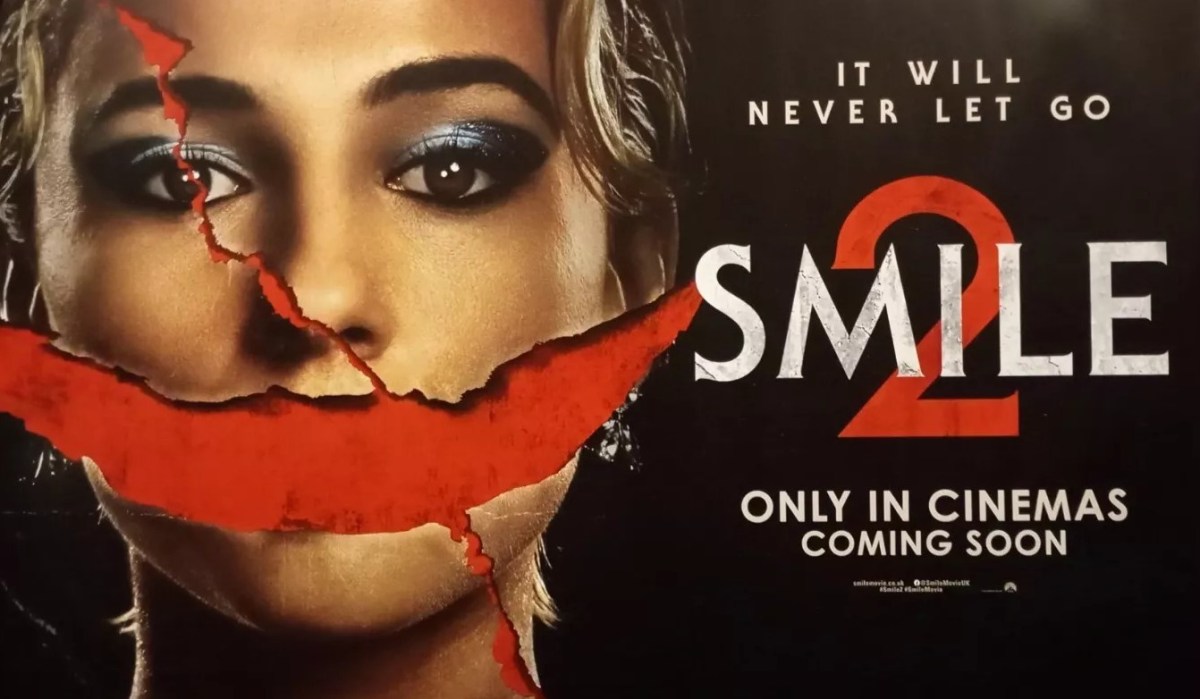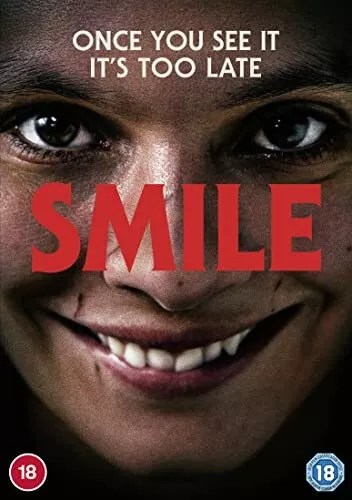
Smile 2 (2024) ****

Striking an original note in a sequel is tough. Especially if you’re not returning to the character that made the idea buzz in the first place. But Smile 2 overcomes every obstacle in spades and a quite brilliant climax sets up part three.

That it does so with such style is quite unnerving. The confidence of the direction by Parker Finn, who helmed the first episode, takes your breath away. Because pretty much this whole thing relies on star Naomi Scott whose movie experience is limited to the lightweight Jasmine in Aladdin (2019) and a flaccid Charlie’s Angels reboot (2019). Talk about rebirth. A more experienced actress would not have gone full-on from the outset. But without overacting, Scott does a superb job of a woman on the edge.

There’s a heck of a lot at stake. A record company’s millions for a start, and a helicopter mamma (Rosemarie DeWitt) only too conscious that failure to turn in a knockout performance on her upcoming tour will spell the end of daughter Skye’s (Naomi Scott) career.

We’ve already had plenty real-life evidence of pop star burn-out and Skye’s on the precipice. Not only is she ridden with guilt for causing the death of her boyfriend in a car accident, but she’s put far too much up her nose, and although clean now, with the pressure mounting there’s every chance she’ll crumble. She didn’t come out of the accident physically free, either, some awful long scars mar her body, and such injuries impede her ability to carry out the dancing that’s a requirement with every chanteuse these days. You can’t just sidle up to a mic like Ella Fitzgerald and scarcely move a muscle for two hours.

But when strange things start happening she’s headed for a nervous breakdown.

One of the problems with the horror overload we’ve had in the past few years is finding original ways for people to die. So if you’re going to run out into a street and not look where you’re going and be mown down by a vehicle, it’s no longer enough to expect sudden impact to carry the visceral weight. So here, we follow a trail of blood. Not merely a trail, the kind with aesthetically pleasing drops here and there, but what looks like a flood, as if someone had cleaned the road with blood. And along the way we see innards and the few remaining bits of a mangled body.

This piece is sometimes so gory I had to avert my eyes. And if it had just been full-on gory it wouldn’t have worked. But it’s full-on subtle as well. What disturbs Skye most turns out to be very disturbing.

She hears glass break. Her water bottle is in pieces on the floor, though it wasn’t teetering on a coffee table, and she’s alone in the apartment. She begins to freak out but then screws on her sensible head and goes to the cupboard to fetch a brush. Before she can clean up the mess, she realises there’s no breakage, no spilled water.

Someone is messing with her head. But you’d be a bit on edge if you’d just watched old buddy Lewis (Lukas Gage) commit suicide in front of you by beating his brains in with a metal weight. You can’t report the incident to the police because he’s a junkie and your visit would be interpreted as having gone over to snort some coke. So now you’re terrified you’ve left unusual evidence of your presence. So now you start googling – can the police detect your DNA from your vomit?.

There’s a terrific sequence where she’s invited to address pop hopefuls and the Teleprompter goes awry and she starts babbling on to a shocked hush about the pitfalls of the business. Her smile is lopsided because she smeared her lipstick trying to bat away a fly. Shame she didn’t give her talk the full works because music wannabes these days haven’t spent years on a tour apprenticeship, trundling around from town to town in a clapped-out old van, gigging their lives away and so, if they strike lucky, well acquainted with the grind of the road. Rather than plucked out of nowhere and thrown into an unforgiving industry.

Another great scene has her confronted by the sometimes freaky or over-friendly fans in a meet-and-greet. And those smiles. Step away now, Mr Joker, your trademark has been stolen. And, as I said, in considerable style, plenty inventive ways here where it goes beyond creepy and topples into threatening.

And I don’t know who invented what I think is going to be a future horror trope. Skye has a way of scuttling back like a scalded cat, with her feet hammering the ground, that makes you jump every time.

Only gradually does she come to understand that she’s been infected with a parasitical demon. The way to get rid of it? Die!

A wee bit heavy on the gore but otherwise a more than accomplished sequel. Writer-director Parker Finn in top form. Naomi Scott is mesmerising. She pretty much starts at 10 and then stretches up ways beyond 11. Plus she can actually sing.

Bring on Part III.

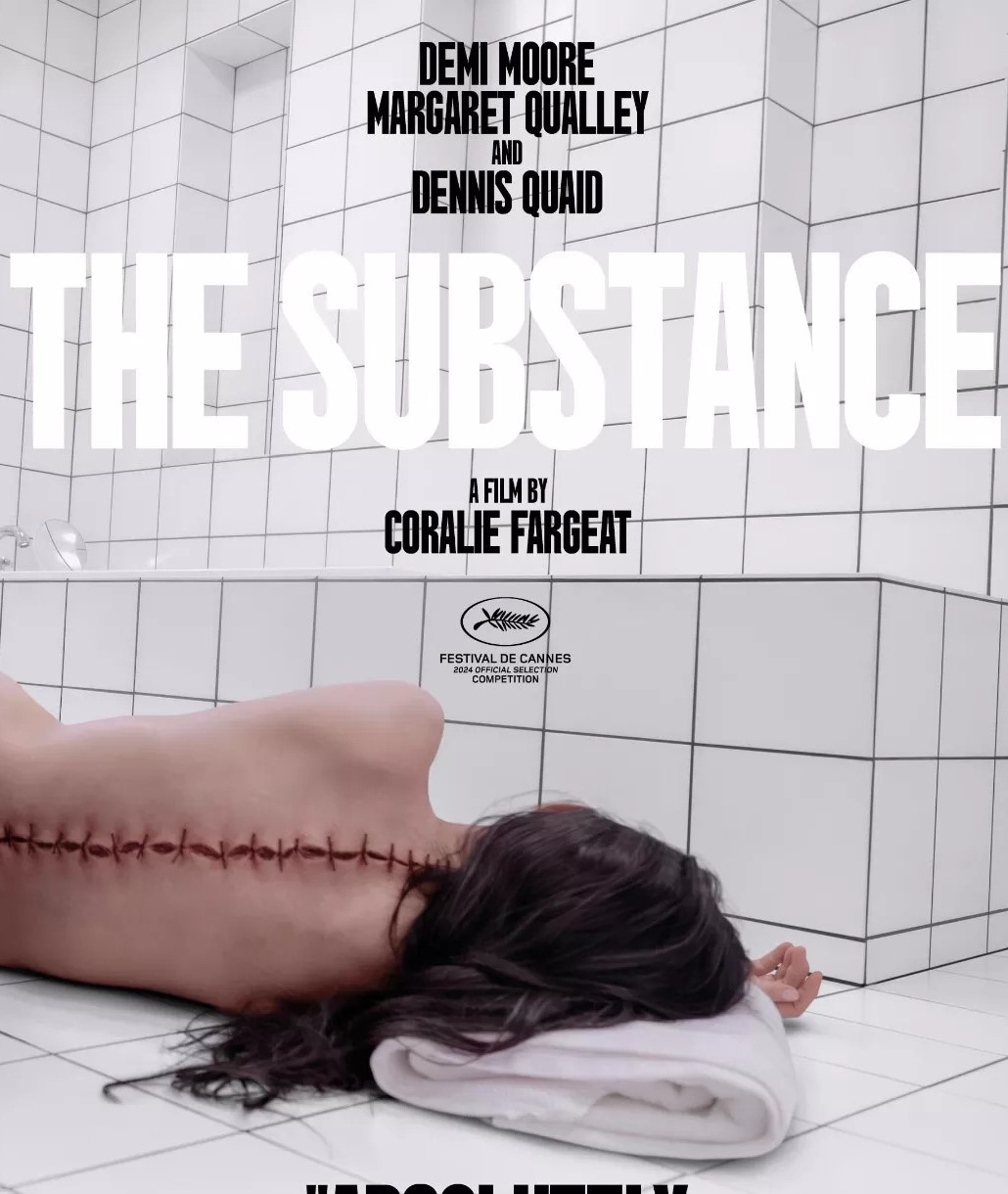
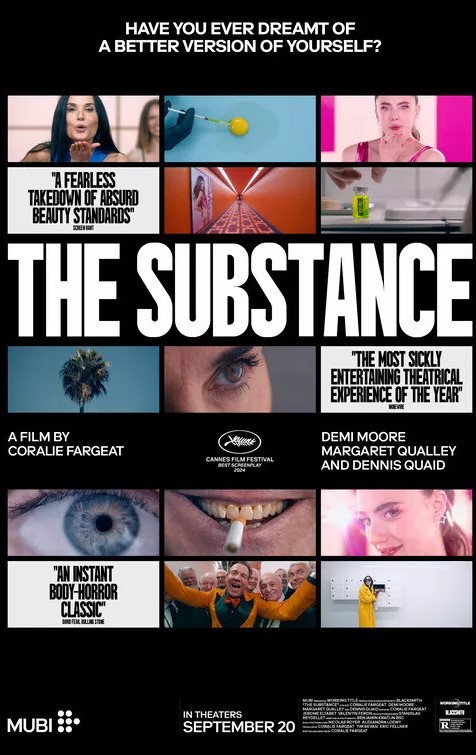
The Substance (2024) **** – Seen at the Cinema

Like Tar (2022) suffers from stylistic overkill and outstays its welcome by a good 30 minutes, but otherwise a perfect antidote to Barbie (2023). While not entirely original, owing much to the likes of The Picture of Dorian Gray and The Stepford Wives and the doppelganger and split personality nrrative nonetheless a refreshing take on the ageing beauty syndrome. Shower fetish might be a homage to Brian DePalma and except that the movie is directed by Frenchwoman Coralie Fergeat (Revenge, 2017) we might be lambasting its rampant nudity for misogynistic reasons.

On the plus side, everything else about it feels new. The whole story plays out like a demonic fable, the participants only caught out because, in their greed, they refuse to play by the rules. But like all the best horror films this occupies its own world. Whoever offers this free drug and the chance to relive your life through the best possible you is a monosyllabic voice at the end of a telephone. Not only is there gruesome rebirth but a stitching-up process. The black market drug at the center of the tale can only be accessed in a deadbeat part of Los Angeles by crawling under a door, but then, suddenly we’re in a pristine room and the various constituent parts of the substance are laid out on the Ikea model with easy-to-follow instructions.

After surviving a horrific automobile accident, onetime movie star Elizabeth (Demi Moore), reduced to breakfast television exercise guru, is passed a mysterious note by an incredibly good-looking young man that takes her down this particular rabbit hole. Like Eve’s forbidden fruit or Cinderella’s toxic midnight, there’s a catch to reliving her beautiful youth. She must switch back “without exception” to her original persona every seven days.

Of course, that’s too much to ask, and as the double named Sue (Margaret Qualley) steals minutes then hours and days the effect is seen on Elizabeth, a monstrous aged finger appearing in her otherwise acceptable hands first sign that these rules cannot be broken. Warning that there are two sides to this singular personality goes ignored. Instead of acting in concert each prt of the split personality conspires againt each other until entitlement spills over into abhorrent violence.

Apart from the initial rebirth squence, and the toothless section, the best scenes are more toned down, in one Elizabeth is faced with an alternative future, the other when she re-does her make-up four times for a date, unable to decide on which face she wishes to present.

Demi Moore (Disclosure, 1994) is being touted as a shoo-in for an Oscar nomination, but that’s mostly on account of her willingness to appear without makeup and for long sections without clothing. I’m not convinced that there’s enough heartfelt acting beyond the bitterness that was often her trademark. Margaret Qualley (Poor Things, 2023) isn’t given much personality to deal with except for exuding shining beauty and horror when it starts to go wrong.

All the males are muppets, it has to be said, wheeler-dealer Harvey (Dennis Quaid) the worst kind of obnoxious male. But this doesn’t feel much like a feminist rant but a more considered examination of refusal to accept oncoming age. Everyone has the kind of vacuous personality that’s endemic in presenting the best face (and body) to the viewing (television, big screen) public.

The movie plays at such a high pitch that most of the time you can ignore the deficiencies, but the 140-minute running time is at odds with hooking a contemporary horror audience and the gore at odds with hooking the substantial arthouse crowd required to generate the returns needed to pay back acquisition rights. None of the characters has any depth, little backstory, virtually nothing in the way of the usual confrontation with others in their lives, but then Elizabeth already lives a life of isolation, clearly lamenting her longlost fame and the attention it brings.

This won at Cannes for the script and  not the direction and that feels about right. Great idea in ultimately the wrong hands, too much of the repetition that was so annoying in Tar and the determination to make every single shot different, a movie beaten into style every inch of its running time.

Coralie Fergeat has a triumph of some kind on her hands, but one that might struggle, due to excessive length, to find an audience. Not sure, either, why tis is being sold as comedy-horror, a peculiar sub-genre in the first place to make work, but I don’t remember laughing once.

However, like Saltburn (2023) this has a good chance of attracting the young crowd via word-of-mouth, the kind who are just waiting to find their own cult material.

Both facinating and repellant.

The Trygon Factor (1967) ****

Sublime climax but you need persistence to get through the fog of red herrings. Genre mash-up that flits precariously between whodunit and horror as we slip from a convent of nefarious nuns living in a vast stately home, where half-naked girls pose for photo sessions, and secret messages are smuggled out, to a pre-giallo masked killer with a drowning obsession liable to jump out. Luckily, there’s an equally impressive grand hotel nearby, thankfully minus nuns, but where killers still roam.

I had mistakenly assumed horror because “Trygon” is close to “Tygon,” the British horror outfit taking a more outré approach to the genre than staid old Hammer, and because of the random killings, and a man, Luke (James Culliford), son of the mansion owner Livia Emberday (Cathleen Nesbitt), in the habit of dressing up in weird garb and chopping the heads off flowers with a sword and inclined, in a fit of pique, to smash precious china heirlooms. And because there’s a fair bit of business with a coffin, this being the kind of movie where mourners lean into the casket and kiss the corpse.

If it is, indeed, a corpse. Zombies, anyone? I wouldn’t have been surprised. This is jam-packed with sumptuous misleading incident. Especially, as, for most of the proceedings, it seems like we’re stuck in a detective tale with an inspector who’s clearly never lived a minute in Britain judging from his glowing tan. He’s investigating a missing colleague (Allan Cuthbertson) seen in the opening sequence snooping around the mansion before being passed furtive notes through the gates by a young nun, later rigorously stripped of her habit.

The tan’s probably the giveaway since the immaculately turned-out Supt Cooper-Smith (Stewart Granger) fancies himself as a ladies’ man, first with French receptionist Sophie (Sophie Hardy) who expects a bit of coaxing seduction, and then with Livia’s daughter Trudy (Susan Hampshire), the photographer,  who doesn’t, keener on a speedier route into a man’s affections.

By the time the dust begins to settle, and the top cop harbors suspicions about a dockside warehouse owned by swivel-eyed Hubert (Robert Morley) – although Cooper-Smith’s  investigation technique revolves around plying young women with brandy – we’re drifting between the notion of some mad cult operating in the convent and Luke as the most likely serial killer given his determination to “play” with young women.

But, in fact, just as we’re being lulled into a sense of false security and the idea that we’ve seen this all before, director Cyril Frankel (On the Fiddle, 1961) springs the first of several audacious twists. The idea that the stately home is a front for a gang of thieves might, on the face of it, appear ludicrous except for the skill with which they carry out the heist and that the criminal mastermind is Livia, assisted by equally cunning daughter.

They have imported – in a coffin – a top French safecracker whose tool of choice is the kind of weapon that Thunderbolt and Lightfoot would have envied, if not a villain of James Bond proportions, and although the armament doesn’t spew out laser beams, it has sufficient firepower to render vulnerable the toughest safe. Naturally, Livia organises the break-in to coincide with nearby building works where the thunder of pneumatic drills will drown out any gun fire.

The thieves turn up outside the appointed bank in what appears an official security van, but from the boxes they carry into the target they produce gas masks and proceed to immobilize anyone inside. They’re after gold bullion because, under the guise of manufacturing large candlestick holders for sale to tourists at the stately home, Livia has set up a gold-smelting operation, pouring liquified gold into the base of the candlestick, trademark Trygon. Having re-disguised the French safecracker as a corpse and placed him in a coffin ready for the surreptitious trip home, ruthless Livia instead dumps him into the Thames to drown.

It’s pure luck that our police lothario happens upon the truth and discovers the smelting basement whereupon – twist number two – the delectable Trudy reveals herself to be the serial killer. She kills for “fun” and relishes the prospect of knocking off an “arrogant” male and one too susceptible to her charms to recognize her femme fatale sensibilities

The giallo-esque killings are highlights, one victim drowned in a baptismal font, another in a bathtub. That female’s kicking and screaming isn’t enough, what with the radio turned up loud, to attract the attention of the nubile Sophie next door luxuriating in a bubble bath. But death by piping hot liquid gold takes some beating. And that’s not the sole reason for the X-certificate since the movie taunts the censor in Blow-Up (1966) – minus the attendant hullabaloo – fashion with a brief glimpse of naked female breast.

The prospective audience might have expected a supernatural outcome given director Frankel’s previous outing The Witches (1966) and had they been alerted to the fact that the source material (uncredited) was written Edgar Wallace might have come prepared for some of the twists.   

This is the kind of movie that needs to be viewed backwards because it’s only at the end that you work out what it’s all about and how skilfully the audience has been duped. An object lesson and one that, for example, Zoe Kravitz (Blink Twice, 2024) should have watched to learn how to suck an audience in.

When you consider the movie in reverse, you realize this is really about an exceptionally clever heist and two women who are more than a match for any man. The males here are definitely disposable.

If you wondered why I gave this is a four-star rating rather than the more obvious three stars, it’s because of what’s mostly unsaid, the iceberg of psychology floating beneath the surface, the one that says that British audiences would not tolerate a top-class female criminal gang capable of pulling off a fantastic heist and without compunction killing off any man, including co-workers, who gets in their way. Had it begun from the POV of Lydia and Trudy planning the robbery, and dealt with Cooper-Smith et al as simply hazards of the profession, it might have made a terrific heist picture but then all the fun of the twists and the pulling the wool over audience eyes would be missed.

Susan Hampshire (The Three Lives of Thomasina, 1963) belies her Disney persona with a chilling portrait of an exceptionally smart femme fatale. Stewart Granger (The Last Safari, 1967) looks as if he views the whole boring process of detection as nothing more than the opportunity to try out some chat-up lines.

Cyril Frankel makes no pretence at being a great stylist, but he more than makes up for it by the teasing structure, some of the costumes, the atmosphere and the twists. Derry Quinn (Operation Crossbow, 1965) and Stanley Munro, in his movie debut, devised the screenplay based on a book by Edgar Wallace

Watch – and marvel.

Blink Twice (2024) ** – Seen at the Cinema

Makes one good point about sexual abuse but takes forever to make it. Undone by two bizarre twists at the end and being more arthouse than horror, though that’s been a something of an annoying trend. And way too many cameos. Christian Slater (True Romance, 1993) is easy to spot. But, wait, is that Haley Joel Osment (The Sixth Sense, 1999) hiding behind that bushy beard? And Geena Davis (Thelma and Louise, 1991) as the klutzy personal assistant forever dropping bright red gift bags? And an immaculately spruced Kyle McLachlan (Dune, 1984)?

Buddies, for all I know, of star Channing Tatum, losing all the brownie points he accumulated for his cameo in Deadpool and Wolverine (2024) – although as with that picture he might just be showing an unwelcome predilection for the unintelligible. Or they could all be, out of the goodness of their hearts, just helping out novice director Zoe Kravitz. In general critics have been kind, possibly because it’s a movie debut, but more likely because the movie makes a point that sexually abused women and/or the victims of domestic abuse are likely to suppress or deliberately forget their experiences for the sake of keeping their relationship on an even keel or fear of not finding another.

It Ends With Us (2024) covered the same ground but at least took the trouble to fill it with properly-drawn characters. It’s not just that these people are ciphers and the set-up is fairy tale – poor woman meets billionaire who whisks her away to the holiday of a lifetime on a luxury  exotic island – but that ordinary logic doesn’t seem to apply. I don’t mean the kind of logic required to cover up holes in the plot. But really standard stuff. Like, as one of my readers pointed out of Trap (2024), would the cops really set out to ensnare a serial killer in a concert hall packed with teenage kids?

Here, the flaw is simpler. Would women decide not to communicate? Would, they, beyond a shallow surface skein, just not want to know everything about the lives of the women they meet on this island or, alternatively, can’t wait to bore them to death with every detail of their own lives. And if they are so sedated, what’s the drug that manages to switch off that chatterbox tendency because, forgive this sexist notion, you could make a fortune selling it.

So, rather than go to all the bother of writing real characters, we are not so much in blink twice territory as rinse-and-repeat. We are shown endless episodes of the same scene, women in billowing white Greek-style gowns running across the lawn, raspberries being popped into fizzing champagne glasses, some nutjob raving on about the exquisite meals.

At the end of course you try to unravel it to discover the visual clues you assumed the director has dropped. But still you’ve no idea. Are these women all sedated by something in the raspberries, or by the flashbulb of the instamatic cameras, or the food, or by the bottles of scent left in every room? Maybe’s there’s something in the swimming pool. Or could it be the supposed snake venom drained from local snakes by a housekeeper who takes the Channing Tatum approach to her lines so that her every word is unintelligible. The venom that has somehow been so cleverly diluted that although it looks like toilet cleaner that appears to be a selling point as does that it tastes so vile you need to mix it with tequila.

And is there really only one lighter in the place? That a magnificent house on a desert island replete with servants and everything you ever need has come up short on the one element essential to light up all the dope smokes in constant supply. But, wait, we need a sole lighter and some stuff about everyone stealing it from its owner so that said owner Jess (Alia Shawkat) has to write her name on it so when she goes missing that’s the only proof she was ever here.

So, when billionaire Slater (Channing Tatum) whisks off waitperson Frida (Naomi Ackie) to a desert island she discovers they’re not alone, they are accompanied by his assorted buddies  of varying ages and an equally assorted bunch of women all young and all gorgeous. You expect them to pair off and Frida is somewhat disappointed, even in this age of consent requiring to be expressly given not assumed, to find Slater making no moves beyond some old-fashioned hand-holding and neck nibbling.

So after you are bored rigid with the endless insight into how rich people live – drinking champagne, smoking joints, inhaling or swallowing whatever, eating food cooked to within an inch of its life – eventually, and that eventually is a hell of a long time coming, Frida smells a rat.

Spoiler alert – unknown to them because Slater has invented a forgetting drug – at night time  they are raped or tied up to a tree (presumably with silken cords that leave no mark) or beaten up (presumably with the bag of oranges from The Grifters, 1990, because beyond a rare bruise no physical traces are left) and the reason they race across the grass during the day is some memory blip because that’s what they do at night to escape their tormentors.

Anyway, spoiler alert, the women get to turn the tables on the men so it’s a slaughterhouse at the end, some clearly taking inspiration from The Equalizer (2014) and turning a bottle opener into a weapon, others making do with knife or gun or rock or whatever phallic object comes to hand.

Anyways, spoiler alert and big point, women treated badly always come back for more. In a bizarre twist, this is Frida’s second time on the island, and bereft on the miainland of whatever amnesiac drug they’re taking on the island, has managed to bury any memory of the experience although she must occasionally wonder how she got that scar on her temple. In an even stupider twist, instead of handing Slater over to the authorities, he’s somehow in her power and she controls his billions. Sweet revenge, apparently.

Clocks in at what felt like a bum-numbing epic length but turned out to be only just over 100 minutes. However, if you had trimmed the arthouse excess you’d scarcely have enough to cobble together a television episode.

Seems to me there was quite a good drama in there somewhere revolving around Frida and Jess about having some fun while making ends meet – their East-West routine scores points – but that didn’t fly with the studios so the two engaging stars were thrown into this heavy-handed horror.

Makes a point. But once would be enough, thanks.  

The Crimson Cult / The Crimson Altar/ Curse of the Crimson Altar (1968) ***

Horror is a small world and at any moment you are likely to bump into stars of the caliber of Christopher Lee, Boris Karloff and Barbara Steele – or in this picture all three. Investigating his missing brother Peter sends antiques dealer Robert Manning (Mark Eden) to a remote country mansion where he encounters owner Morley (Christopher Lee), his seductive niece Eve (Virginia Weatherall), the wheelchair-bound authority on witchcraft Professor Marsh (Boris Karloff), deaf mute Elder (Michael Gough) and a centuries-old mystery.

Morley can legitimately deny that Peter has ever set foot on the premises since it was common for the brother to adopt an alias when seeking out significant antiques. By the time Robert amasses sufficient clues to challenge Morley on this particular issue, it appears that further ideas of more sinister goings-on may be illusory. On his first night Robert observes an annual celebration of the Black Witch but although an effigy is burned this festival appears to have more to do with the innocent consumption of alcohol and heady bouts of sex than satanism.

And after a while, Robert indulges in carnal delight with Eve. However, he is plagued by a nightmare that involves a grotesque trial by a jury wearing animal heads. Gradually, he learns Morley, meanwhile, is such a congenial host, and his niece delightful and sybaritic company, that the finger of suspicion points at Elder, who does take a pot shot at Robert, and the professor who has a collection of instruments of torture.

Were it not for veteran director Vernon Sewell (Urge to Kill, 1960) beginning proceedings with some kind of black mass complete with floggings and female sacrificial victim, the audience might have been kept in greater suspense. As it is, the non-violent annual celebration throws us off the scent as does the seduction of Eve and the prospect that Robert’s nightmare is little more than psychedelic hallucination. The denouement is something of a surprise. The ritualistic aspects of the picture are well done and given this is a Tigon film rather than Hammer you can expect harsher treatment of the S&M element, especially for the period.  

The eerie atmosphere and well-staged witchcraft scenes are a plus, but, despite the involvement of a handful of horror gods, the movie’s reliance on lesser players to drive the narrative is a minus. Lee, Karloff and Steele (though in a more minor role) are all excellent as is the demented Michael Gough but Mark Eden (Attack on the Iron Coast, 1968) is too lightweight to carry the picture although Virginia Wetherall in her first big part suggests more promise.  More of Lee, Karloff and Steele would have definitely added to the picture but since this type of film often requires the young and the innocent to take center stage that was not to be.

Directed by Vernon Sewell (The Blood Beast Terror, 1968) from a script by Dr Who writers Mervyn Haisman and Henry Lincoln and Jerry Sohl (Die, Monster, Die, 1965).

Worth a watch.

Blood Demon / Blood of the Virgins / The Torture Chamber of Dr Sadism (1967) **

Heavy on atmosphere but not much else, a gender-switch take on the Countess Bathory horror tale (made by Hammer as Countess Dracula, 1971), which sees Count Regula (Christopher Lee) as, oddly enough, being one virgin’s blood short of achieving immortality, thirteen being the vital number, when he is arrested. Condemned to die in traditional fashion, first of all face impaled on a golden iron maiden then body torn apart by a quartet of horses, but not before casting a curse on the prosecutor.

Thirty years later or thereabouts Roger von Marienberg (Lex Barker), son of the prosecutor, turns up seeking the family castle only to find no one will show him the way. And that when he does get going it’s through intermittent fog, past burnt-out buildings and a forest strung with corpses and, it has to be said, a countryside that occasionally takes on an artistic hue, such as one sequence where the coach rides through the countryside with the sky above solid red and the land below solid green.  

Along the way he encounters Baroness Lilian (Karin Dor) – the daughter of the evil count’s intended victim number thirteen – and her maid Babette (Christiane Rucker) who go through a routine of being captured and rescued, captured and rescued. When finally, halfway through, we reach the castle, we find the count in a glass coffin awaiting rebirth.

And then it’s like a reality tv show as the visitors undergo a series of torturous obstacles, Babatte hung over a bed of knives while time runs out, Lilian encountering rats and spiders and potentially dropping into a nest of (rather disinterested) snakes, Roger taking a leaf out of the Edgar Allan Poe playbook and facing either the pit or the pendulum.

The count – his awakening shown in shadow the best sequence in the movie – looks like a survivor from A Quiet Place, face desperately white, and frantic to fulfill his quest, with Lilian designated the unlucky thirteenth. Of course, although it took an iron mask and four stout horses to bring him to heel three decades before, he’s not so familiar with the rules governing the undead and a crucific is all it takes to unhinge him.

Very much horror by the numbers without much pizzazz. Lex Barker (Old Shatterhand, 1964) looks as if he’s more worried about his quiff being out of place than anything else. Christopher Lee (The Devil Rides Out, 1968) isn’t in it often enough and, minus the fangs, hasn’t the wherewithal to drum up a scare. Karin Dor (Topaz, 1969), beautiful though she is, doesn’t quite make it as a Scream Queen.

Atmosphere is the best element here, from the opening march from dungeon to execution through long echoing corridors to the Hieronymous Bosch-inspired backdrop of the castle, and the bodies that appear to have dived headling into trees rather than merely dangling from them.

Lex Varker is the key that this is German-made, directed without requisite suspense or fright, by Harald Reinl (Winnetou, 1963).

But like the fog everything is too strung-out

The Beach Girls and The Monster (1965) ***

Interesting curiosity. Peak year for the genre, a dozen films from majors and indies alike, so by now full of alternative scenarios. But let’s start with Jon Hall. In the annals of actors turned director – Kevin Costner, Frank Sinatra, Clint Eastwood, John Wayne, Jon Favreau, Laurence Olivier – there’s nary a mention of one-time Hollywood superstar Hall. You’d never recognize the slim athletic actor in the Errol Flynn mold from the more rounded star of this picture.

Of Tahitian descent, he was a big noise in the 1930s/1940s, not just hot box office alongside Dorothy Lamour in The Hurricane (1937) and Aloma of the South Seas (1941) but a western star (Kit Carson, 1940), swashbuckler (The Prince of Thieves, 1948) and jungle hero after switching to television (Ramar of the Jungle, 1952-1954). But his movie career ground to a halt in the 1950s, and this was his debut as a director.

Tossing a few genres – beach party, noir femme fatale, and horror – into the blender, he comes out with quite an entertaining movie, in part because you don’t know which way it’s going to turn next. One minute the screen’s awash with jiggling and dancing, next minute there’s a monster on the loose, and before you know it we’re treated to some quite astonishing (for the period) surfing footage – a year before The Endless Summer – and a puppet (big hand for Kingley the Lion) plus a climactic car chase.

There’s a creepy stepmother Vicky (Sue Casey) making eyes at stepson Richard (Arnold Lessing) and heading out on adultery binges after telling scientist husband Otto (Jon Hall) that he got what he paid for. There’s a creepy limping sculptor Mark (Walker Edmiston), who hankers after Vicky, and whom you wouldn’t let any prospective model near, the limp a constant reminder to cocky Richard that he should have taken more care driving and not crashed his car.

And while the monster is laughable, actually there’s good reason for that, in a twist you may have seen coming. Pickled through this concoction is plenty family drama, the son who wants to get away from his science-obsessed father (and unspoken guilt for the accident he caused), the girlfriend Jane (Elaine DuPont) who fears he won’t, the sculptor whose relationship with the family is a shade too close, and the wife whose favorite pleasure is to see men wilt when she rejects them.

And this is an equal opportunities monster, victims male and female alike, and, despite the title, not concentrating on murdering innocent beach girls scarpering around in bikinis. 

And this not being a haunted house movie, there’s even a cop involved, investigating the murders, who is detective enough to take a plaster cast of the strange footprints found around the corpse.

And it’s not full of simpering girlfriends either. Jane ain’t no walkover and the monster’s first victim Bunny (Gloria Neil) keeps her boyfriend in his place with her teasing. There’s the usual atomic-growth-spurt nonsense spouted by Dr Otto who contends the murderer is a monster fantigua fish. Monster is responsible one way or another for the deaths of surfer Tom, Vicky, Mark and Otto.

Worth noting: surf footage by Dale Davis (The Golden Breed, 1968); the surf-style score by Chuck Nagle; the dancers were recruited from Whisky-a-Go-Go; and Walker Edmiston did his own sculpting and created the puppet and the monster head. Actress-turned-screenwriter Joan Gardner (A Man for Hanging, 1972) dreamt it all up. Directorial debut for Jon Hall didn’t lead to much, just The Navy vs the Night Monsters (1966).  

One of those films that, for sure, it would be far easier to laugh at if it wasn’t for the noir, femme fatale, surfing, and all the other elements that really should have no place in a beach picture.

Kept me entertained.

Sting (2024) ****

Once in a while the stars align and, as luck would have it and given we are in stellar mode, a new star is born. Famously, Daniel Day-Lewis owed his instant elevation to arthouse marquee status to the opening on the same day in New York of My Beautiful Laundrette (1985) and A Room with a View (1985) playing such disparate characters that critics were in awe. While not necessarily on that scale I had the privilege of watching a new young talent unfold on my Monday double bill when taking in Sting and Furiosa. The common denominator being Alyla Browne (The Secret Kingdom, 2023), main character in the horror picture and the young Furiosa in the George Miller epic, who, again, essays completely different characters in an extremely convincing manner.

Quite why the horror picture acquired its title is something of a mystery, since nobody actually gets stung and there’s not a bee in sight and any other creepy-crawlies are limited to cameo appearances as lunch for our star creature, a giant spider. Quite why, too, our monster has to come from outer space is anyone’s guess given the Australian filmmakers must be well acquainted with giant spiders hiding in the dunny or other more conspicuous spots in their homeland.

And if you’re going to pretend your movie is actually set in Brooklyn, you’d better not give the game away by the credits forewarning that the picture is part-funded by the authorities in Australia and New South Wales which are hardly likely to pony up for a movie made six thousand miles away, or for suggesting that the country is awash with giant spiders. Setting aside the kind of nit-picking you get on imdb – doorknobs wrongly positioned, for example – this is prime horror.

The genre has shifted away from the dysfunctional family or teenagers high on sex and drugs to settled habitats which allows for more interesting and occasionally subtle character development. There a couple of neat twists, for starters wannabe young illustrator Charlotte (Alyla Browne) is an arachnaphile and her nose is put out of joint by the arrival of a new baby, a half-brother, and accommodating her mother’s new partner Ethan (Ryan Corr) in their lives. They should bond over their joint love of illustrating – he’s a semi-pro – but he’s a tad too critical.

Not to be confused with the 1970s blokcbuster.

Mother Heather’s (Penelope Mitchell) extended family adds complication, mean demanding immigrant aunt and dementia-ridden grandmother living in the same building.

Biggest complication is that when a spider appears out of nowhere, Charlotte adopts it as a pet, catching it live morsels, watching it grow, nicknaming it (presumably because the screenwriter was struggling for a snappy title) Sting and using it as model for her artwork. The creature is unaware that its role is to be fantasy and doesn’t take long to show its true nature, clever enough to twist the cap off the jar it’s contained in, then, after outgrowing such confinement, taking off into the crawl space and hunting down the building’s inhabitants.

That this is a good notch above recent offerings owes much to writer-director Kiah Roache-Turner (Wyrmwood: Apocalypse, 2021). He moves the camera confidently and often slowly, providing panorama where another helmsman would have opted for the cheap shot and quick shock. He takes time to develop the family dynamic, recognizably frazzled at the seams but not coming apart, with the older members exerting dominance through overt power or vulnerability, and there’s some neat comedy involving Frank (Jermaine Fowler) the cocky foul-mouthed pest controller.

The monster munching is well done, nothing that’s going to strain the low budget, carnage mostly kept off-screen, sightings of the beastie limited early on, consequence rather than action the draw.

But the real treat here is Charlotte, the most well-rounded teenage horror character in a long time. She’s hormonal, untidy and passionate, fights with her mother, tries to make peace with both newcomers, Ethan and infant, but is just this side of being creepy, catching beasties for her pet, delighted in its destructive power, but then having to confront all her angst and hostility as it falls to her to turn into rescuer. Alyla Browne is surely a talent for the radar. And there’s a good twist, alien-style, as the dead spider has just time to pop out a few eggs, so, hey, sequel alert, and one that shows all the signs of being more interesting than anything in the vein of The Strangers.

Worth a look.

The Strangers Chapter 1 (2024) **

Enough already. Dumb as ditchwater, virtually no thrills and they think we’re going to be queuing up for the next one? Have they gone crazy? Could I care less who is behind the masks? And what’s happened to the horror genre? This should be relatively safe territory, every now and then we’d get a gem like Megan or The Black Phone and someone would invariably reimagine one of the old standards, but even remakes of The Omen and The Exorcist have been tired and lacking any spark.

I’m not a huge horror fan but in the last few years in the absence of anything else been happy to top my weekly cinemagoing habit with a dose of the scary stuff. But this looks like it’s going as swiftly off the boil as MCU. Am astonished to find one-time uber-director Renny Harlin (Cliffhanger, 1993) behind this weak sauce, and apparently there’s going to be no let-up because the next two chapters are already in the can.

This might prove the all-time horror hubris as there’s virtually nothing here to suggest any reason for a sequel, and setting aside the question of artistic merit, the box office doesn’t sound like it commands anything except a quick turnaround into streaming. Miscalculation and misconception on a massive scale. Nothing more than a one-set horror outing with elements that have been better done elsewhere and really the dumbest of the dumb participants.

It’s only when you lock yourself in the toilet you realize you might have been better to stop in the kitchen and hunt for a weapon? Though, this being America, you can be sure of finding a shotgun in the shed. Your car’s broken down but there’s a motorcycle sitting outside your Airbnb with its keys in the ignition? You don’t even have the sense to employ the rusty nail you’ve pulled out of your hand while down in a cellar (you went into a cellar, have you no sense?) as a weapon as if you’re incapable of taking lessons from other onscreen heroes.

How can even get lost in the first place? Your mobile phone signal is what brings the cops in the end and yet it doesn’t work enough in the area to get you home in the first place?

You’ve got asthma but you constantly misplace your inhaler. You don’t whack the one member of the masked gang around the head with your shotgun but allow her to hold their knife high up in the air so it’s going to reflect the moonlight and let her confederates know where she is.

These inconsistences would all be acceptable was there any element of menace. This is just all handled so badly you can’t believe Harlin is an experienced director, 40-plus projects on his call-sheet.

So we’re in semi-Deliverance territory, though Oregon rather than hillbilly country, but the kind of place where they seriously look askance at vegetarians and unmarried couples and are constantly thrusting religious pamphlets at you. Loved-up couple Maya (Madelaine Petsch) and Jeff (Ryan Brown) get, as I said, lost and stop at a Nowheresville diner long enough to be made to feel uncomfortable. Then, blow me down if Jeff can’t get his fancy vehicle to start, so they’ve got to spent the night in a cabin.

Someone keeps knocking at the door. Jeff has to leave Maya on her lonesome because he left his inhaler in said car, now residing in a repair garage, and the motorcycle lacks a pillion to accommodate her (nope, he just goes off on his own, otherwise we won’t be treated to the lonely woman in the old dark house where, yep, the lights go off).

Three people in masks, one a cut-price Leatherface number, the other two dollfaces, come a-calling with axes and knives and then…snoresville. If you stay on to watch the credits, there’s meant to be a chilling twist, but by then I guess most people are just happy to get out of the place.

I know there aren’t many like me who still religiously go to the cinema once a week. I’m not a paid-up critic who gets in for free. I’m just your ordinary cinema-lover and in the course of a year I’m expecting a few turkeys, but we are now dredging rock bottom, last year’s various strikes hammering studio output, so that even the traditional Memorial Day, that’s meant to launch the summer season, has been very poor. Hollywood was struggling enough post-Covid with the encroachment of the streamers and it in part depended on ordinary punters like me who would plug movies that fell beneath the radar to other less-compelled movie fans.

Avoid.  

Frankenstein Created Woman (1967) ***

Custom-made for a contemporary audience. How can you fail with a tale about a male brain taking over a female body. Male soul if you want to be strictly correct and metaphysical about it or if you are Martin Scorsese for whom discussion about whether the soul leaves the body after death and exists on some other plane was of the greatest interest. But, yes, so although our hero/villain Baron Frankenstein (Peter Cushing) does create a female instead of a male, and not just with the misogynistic purpose of supplying a monster with a mate, unfortunately in the act of creation the poor woman is saddled with the soul/brain of a man, and, even worse, one with  bloody revenge on his mind.

These days for sure audiences would not have any trouble with female stars carving a swathe through any populace and nobody would require transplanting of  male hormones-soul-brain-whatever to take off on a rampage. But, back in the day, before Hammer went full-tilt-boogie down the lesbian vampire route, it was rare, outside of film noir and exploitationer pictures, for a woman to be so savage. So her actions are viewed with regret rather than roars of approval. But, for once, nobody is taking a torch or axe to the good old Baron.

That’s not all that takes the audience by surprise. The use of a guillotine, ideal for a post-task  dripping of blood, turns out to be widely used in central Europe in the 19th century, hardly surprising since it was a German invention. The movie opens with a young boy, Hans, witnessing his father’s execution on such a device, a point that seems arbitrary but proves pivotal.

The grown-up Hans (Robert Morris) assists Dr Hertz (Thorley Walters) assisting the Baron in some kind of resurrection experiment, the guinea pig being Frankenstein himself. Naturally, for purely metaphysical purposes you understand, the Baron would like to experiment on as barely-dead a cadaver as possible to prove his theories. That this takes a good while to materialize is largely because the narrative has to go all around the houses.

Hans’s lover, disfigured and lame innkeeper’s daughter Christina (Susan Denberg), is taunted by a trio of young swells that results in Hans attacking them. Later, for no particular good reason, the toffs kill the innkeeper, but Hans gets the blame and is sentenced to death. After he is  guillotined, Christina commits suicide by drowning. Both bodies turn up in Frankenstein’s lab at roughly the same time. Complication of course being that a guillotine doesn’t deliver a body intact. Quite how Frankenstein achieves his soul-body transplant is left up to your imagination – the scene promised in the poster is a marketing fiction.

And there’s a touch of Poor Things about the result as Christina wakes up minus scars and disfigurement but with no recollection of her past and needs to be taught who she is. Not that she requires much education in the feminine wiles department and is soon stalking the three young toffs, seducing them with hints of sexual promise before taking savage revenge.

There also a Curse of the Undead element when villagers discover her grave is empty. In fairness to the Baron, he soon realizes what fate had befallen her and tries to ensure that, once her revenge is complete, she can live a different life, although in the way of horror films a happy ending is rarely an option. And in fairness to the Baron the villagers aren’t queueing up to set him alight.

With various subplots to get through, this leaves the Baron out of the picture for considerable periods of time. From a contemporary perspective, there’s a freshness here that will appeal, especially the creation’s desire to discover her purpose in life, her not being bred to fulfil a romantic purpose, and the battle of the male-female will.

Peter Cushing (The Skull, 1965) is as usual splendid, Thorley Walters (Sherlock Holmes and the Deadly Necklace, 1962) presents as an inebriated and impecunious assistant while Austrian Susan Denberg (An American Dream, 1966) does well in the dual role.

Fourth outing in the Hammer series, directed with occasional verve by the reliable Terence Fisher (The Devil Rides Out, 1968) from a screenplay by Anthony Hinds (The Mummy’s Shroud, 1967).

Contemporary appeal and can never go wrong given that it is purportedly one of Martin Scorsese’s favorite films.

Discover WordPress

A daily selection of the best content published on WordPress, collected for you by humans who love to read.

The Atavist Magazine

by Brian Hannan

WordPress.com News

The latest news on WordPress.com and the WordPress community.