Carrie (1976) *****

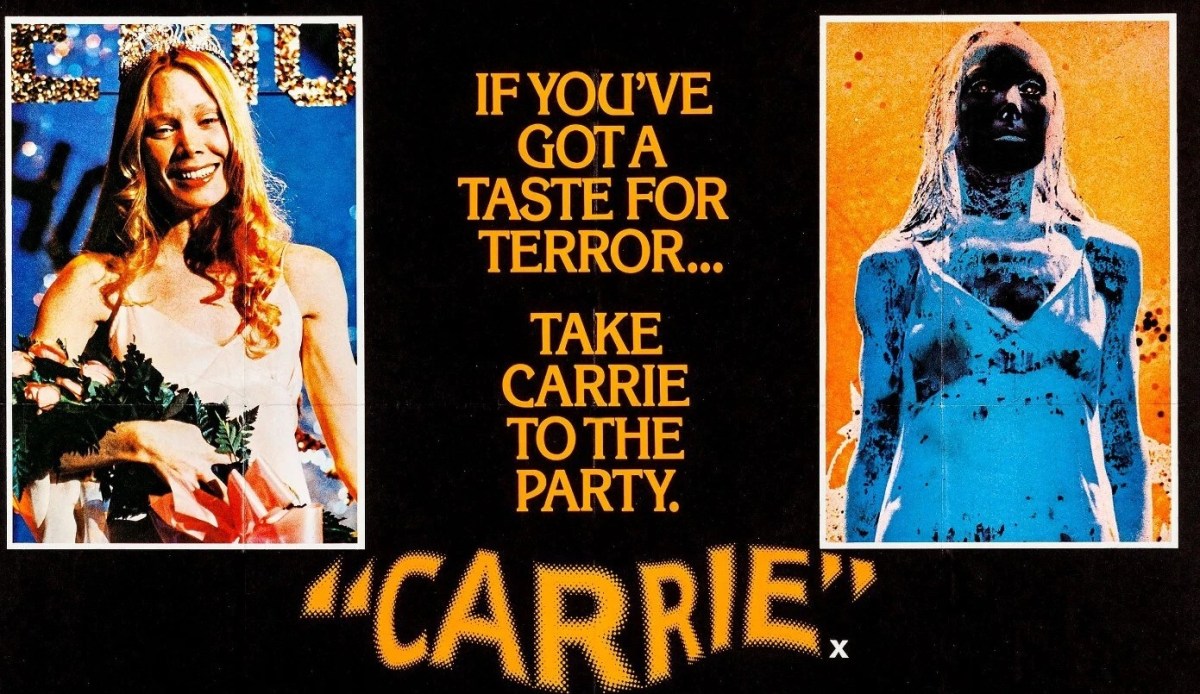
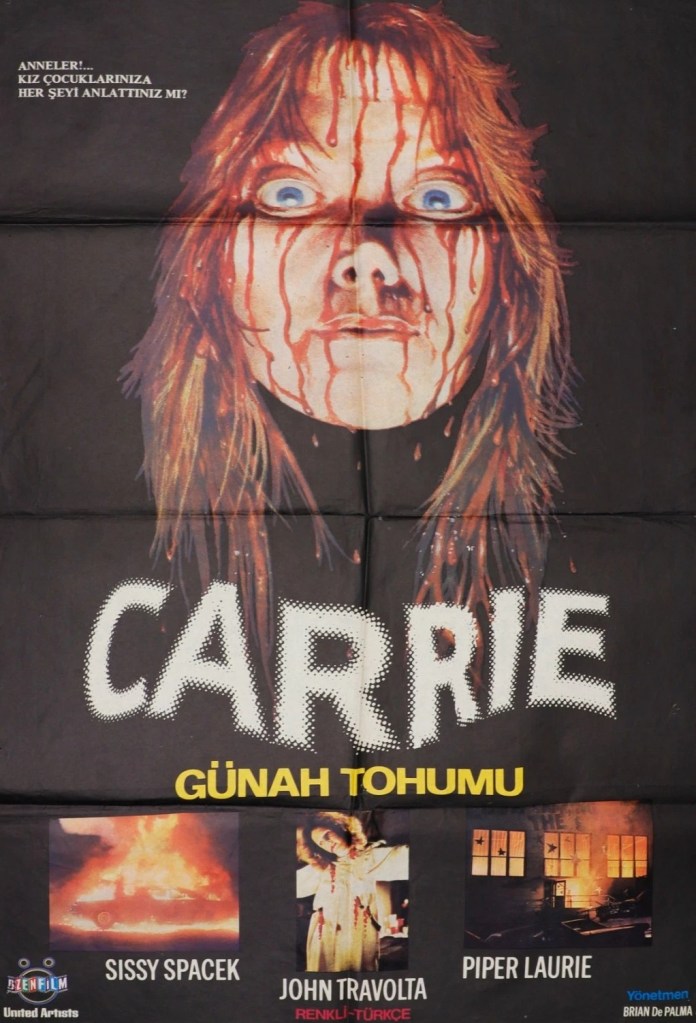
Could have easily gone so badly wrong. You got Mean Girls vs Teen Romance. Demented Mother of Elmer Gantry vs Demented Daughter of Psycho. Why did nobody ever think before that slow-mo that used to be the preserve of lovers gambolling in fields and cowboys being bloodily gunned down could be as easily employed to watch naked girls in the shower. Throw in split-screen and a couple of other technical devices. And the shock ending which triggered a new cycle.

There’s a heck of lot of face-slapping that wouldn’t pass muster today and not exclusively male either, hard-ass teacher Miss Collins (Betty Buckley) setting about venal pupil Chris (Nancy Allen), Chris giving as good as she gets from boyfriend Billy (John Travolta). And if you were a rising star like John Travolta you might think twice about the effect on your career of battering a pig to death with a sledgehammer. Try those capers now and you’d run into the woke police.

But it’s surprisingly feminist. Women twist their men round their little finger, the headmaster does the bidding of Miss Collins, All-American Boy Tommy (William Katt), decked out in a super perm, accedes to the barmy request of his girlfriend Sue (Amy Irving), attempting to assuage her guilt over her role in bullying Carrie (Sissy Spacek), to give up her place at the Senior Prom to the nerd, and Chris has no problem getting Billy to go along with her scheme for humiliating vengeance.

In another movie, Carrie, an eternal victim, would have been the Final Girl but such is her wrath nobody’s left standing to qualify for that position. Nobody escapes, innocent and guilty alike, put to the sword. There’s sex in all its disguises, ranging from a virgin’s first tender kiss to a blowjob to sin to rampant voyeurism.

That it works so well is in part due to the malevolence of all concerned, the above mentioned whacking, the mother locking the child in a closet, the gleeful girls tormenting Carrie, and Carrie spiteful in her blood-soaked vengeance. The telekinesis on which the tale depends is cleverly introduced, a few minor incidents hinting at this unnatural power, Carrie herself doing the research rather than consulting a specialist and weighting the picture down with turgid exposition.

The neat running time – barely topping 90 minutes – eliminates any slack. And director Brian De Palma (The Untouchables, 1987) has sufficient command of the tension and occasional moments of bravura that it’s touched on the ironic climax before you realize quite where it’s going. Atmospheric score by Pino Donaggio (Don’t Look Now, 1973) guides us along, the haunting melody that wouldn’t be out of place as a love theme lets us know there’s more to the shower scene than we might expect while the sharp chords accompanying the slaughter reminiscent of Psycho (1960).

Announced to the world Stephen King as writer of immensely cinematic books, and made De Palma a commercial name. Sissy Space (Prime Cut, 1972) and Piper Laurie (The Hustler, 1961) were nominated for Oscars and the movie served as launch pad for several of the cast, most notably John Travolta (Saturday Night Fever, 1977), including Nancy Allen (Dressed to Kill, 1980), William Katt (Big Wednesday, 1978) and Amy Irving (Micky +  Maude, 1984). Written by Lawrence D. Cohen (Ghost Story, 1981).

Still a terrific watch.

Frankenstein (2025) **** – Seen at the Cinema

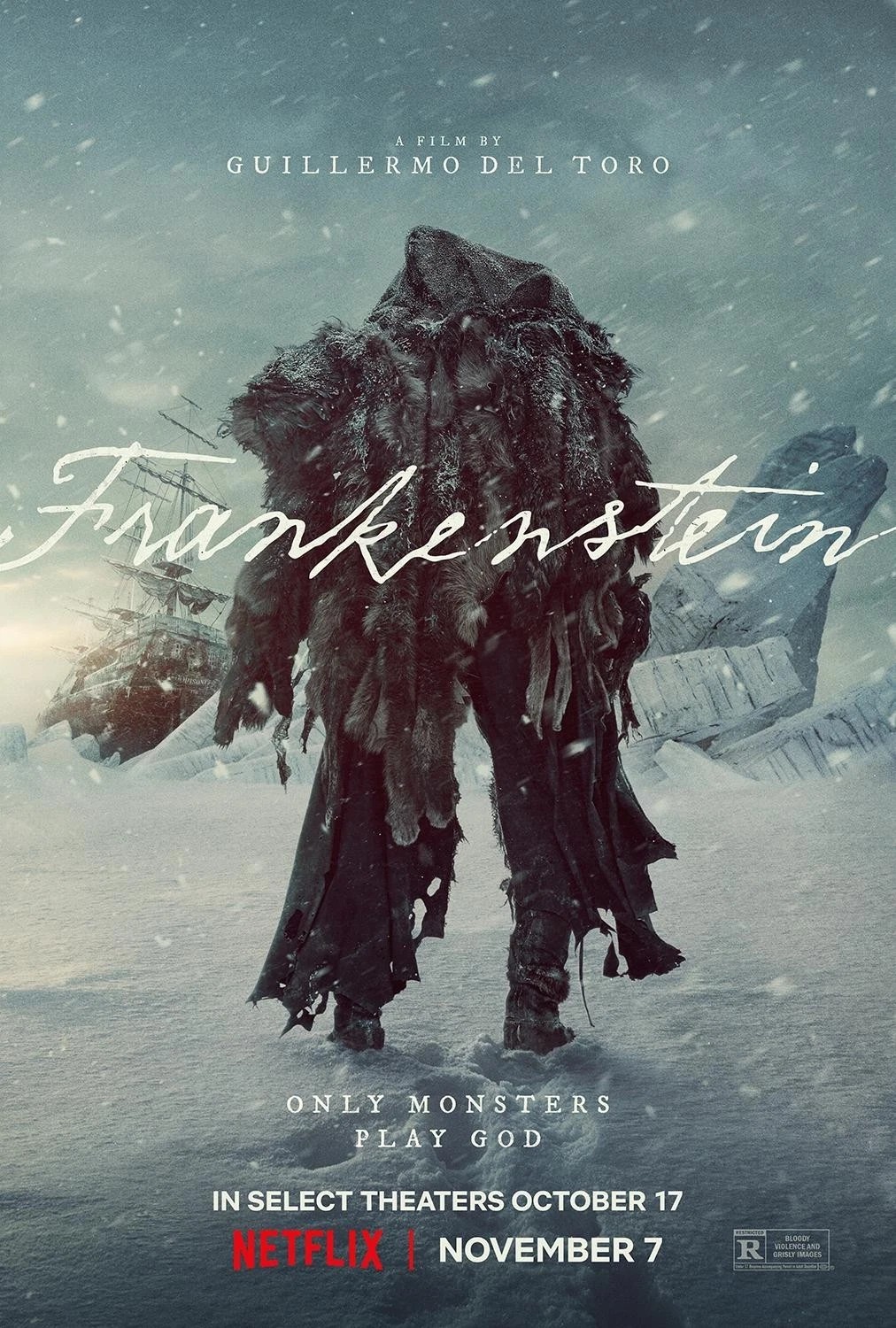
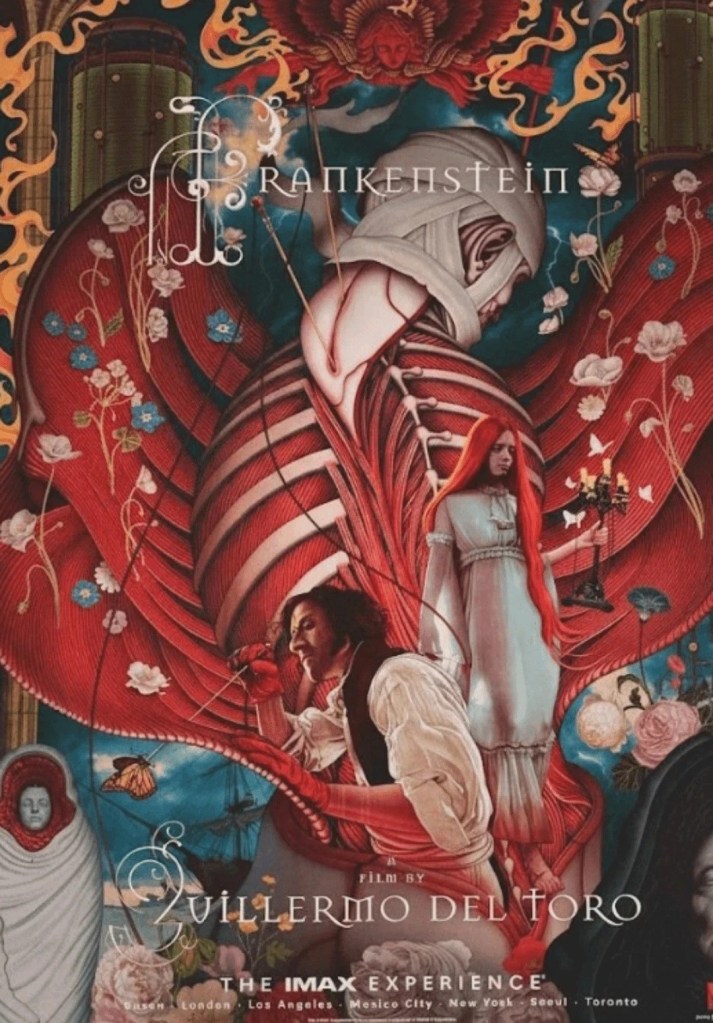
I came at this with a bucketload of reservations. First was the length. I grew up with versions of this tale that were around a good hour shorter. Ninety minutes seemed to be the ideal length not a stonking 150 minutes. Secondly, I’m not a huge fan of director Guillermo del Toro and excepting Pacific Rim (2013) – an outrider in his portfolio – and The Shape of Water (2017) felt his reach was not matched by his grasp. He was the kind of director whose work I was supposed to like and invariably responded less well than I had expected. And third of course was, even with the trend for reimaginations and remakes and in the hands of a “visionary director” (a vastly over-used term), I had seen this story so often before I wondered what else he could bring to it.

So I was very pleasantly surprised to find an emotionally satisfying thoroughly enjoyable work that did not outstay its welcome. Moreover, it doesn’t rely on the tropes of outraged villagers carrying torches and as far as I can gather without me going back to the sacred text whatever changes have been made to the original appear logical and true. Both the creator and the monster at various points will touch your heart.

One of the aspects I most enjoyed was the creation. The detail involved was in keeping with heist movies where robbers work out their plan in minute detail or war films where the audience is filled in on the strategy and tactics involved in battles as though they were adults who could understand the importance of long scenes of dialog rather than treating them as children who preferred to go straight into the action regardless of whether they understood what was going on or not.

Here, we begin in the Arctic where an exploration vessel trapped in ice comes upon a very ill Victor Frankenstein (Oscar Isaac) who is being pursued by the monster (Jacob Elordi) of his creation.

Then we’re in flashback mode. Victor is son of a famous but tyrannical surgeon (Charles Dance) whose adored mother dies in childbirth giving birth to a more favored brother William (Felix Kammerer).

Then we shift to a medical disciplinary court where Victor is on trial for his experiments in reanimating corpses, for playing God in a society where the Supreme Being was still considered in charge of everything on Earth. But no matter how clever the corpse appears, capable of apparently playing catch, the case goes against him and his dreams, and career, would be in tatters except for the intervention of wealthy arms dealer Harlander (Christoph Waltz), uncle of Elizabeth (Mia Goth) the fiancée of William.

She’s intellectually advanced for a woman of the era, studying insects, and more than a match for Victor and for a while it looks like we’re in for an awkward love triangle. Meanwhile, Victor is harvesting bits and pieces of fresh corpses from battlefields and stitching them together in a way that maintains the body’s unique nervous system while Harlander happily stumps up the enormous cost.

The experiment, which takes place in a remote castle and costs the life of Harlander, is a success but given the monster’s size (Jacob Elordi) Victor keeps him in chains in the castle’s vast cellar. But he soon becomes exasperated by the creature’s lack of intellect, speech limited to repeating his creator’s name (and his own as it turns out).

When Elizabeth discovers the creature, she falls in love with it and turns against the scientist and keeps the gift of a leaf the creature has given her pressed inside the pages of a book. Since the creature is fit for no more than a circus exhibit rather than acclaimed as an experiment, and needing someone to blame for Harlander’s death, Victor fits up the monster, blaming him for setting fire to the castle.

Victor escapes, takes refuge in a cottage where he is educated by a blind man, and discovers his own emotions. Hounded out of there, he sets out to find Victor who is attending his brother’s wedding. The monster’s plea for a female companion is derided by Victor and in a melodramatic moment he accidentally shoots Elizabeth. The monster carries the dying woman out of the wedding pieta style.

So the hunt is on. Victor flees to the frozen north and eventually when the monster engineers a confrontation, he is able to attempt reconciliation with his creator.

The question asked – who is the monster? The creator or the result of his tampering with nature?

The acting is top notch, Jacob Elordi (Saltburn, 2023) should have walked off with the acting plaudits except that Oscar Isaac (Dune, Part One, 2021) elicits our sympathy and then our horror and Mia Goth (Maxxine, 2024) excels in a role where she is not called upon, as so often before, to overact. As far as Christoph Waltz (No Time to Die, 2021) and Charles Dance (The First Omen, 2024) are concerned their roles are minor variations of characters both have played before.

Praise is very much due to writer-director Del Toro for not losing my interest for a minute.

Since this is a Netflix production I could have saved myself a few bucks and waited till it appeared on the small screen. But unlike other big budget works by “visionary” directors, this will work very well on the smaller screen because, despite some arresting visuals, it’s essentially a chamber piece involving a handful of characters.

The highest praise I can give any director of an epic is the ability to not lose my interest for a single minute. So all praise Del Toro.

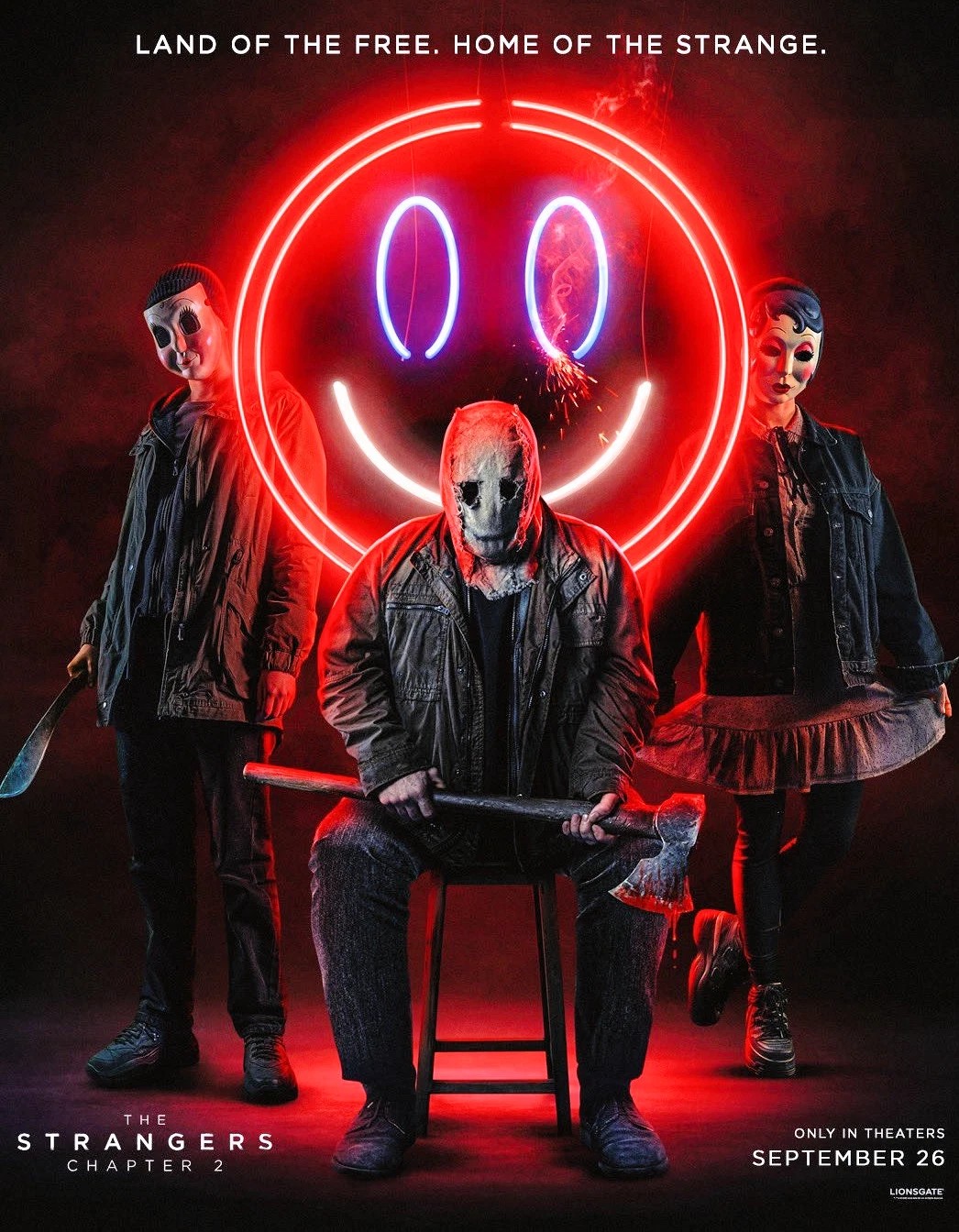
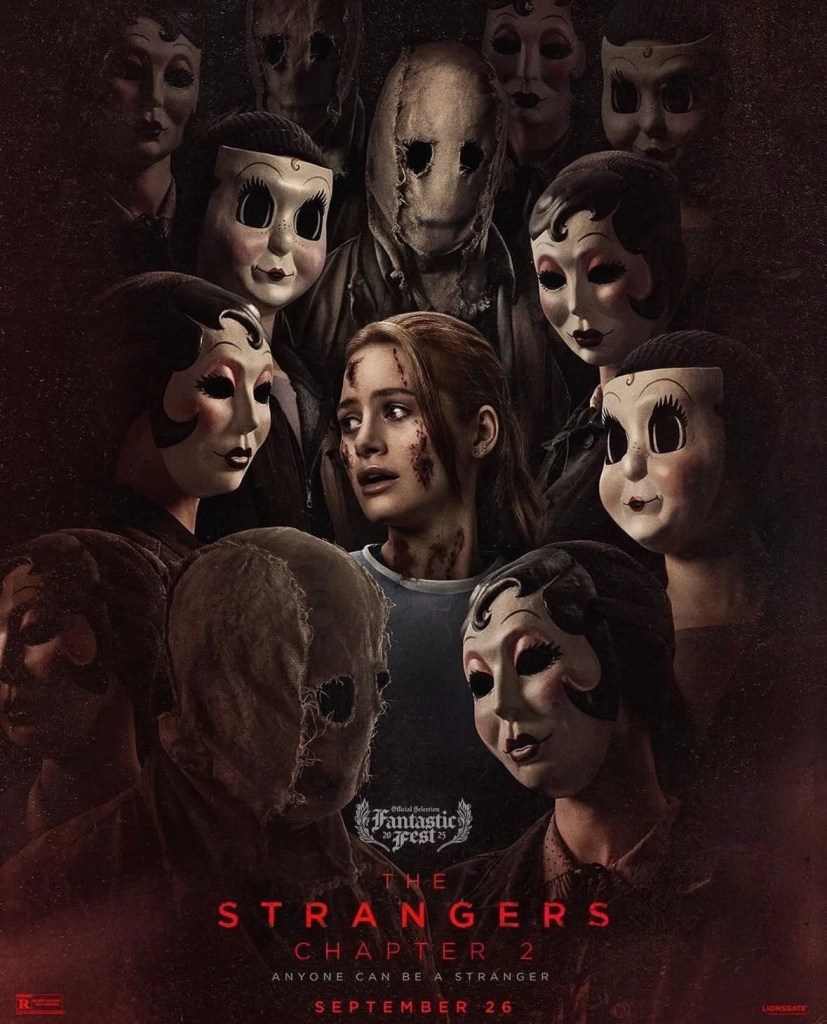
The Strangers Chapter 2 (2025) *

Or The Running, Whimpering and Screaming Film. The laziest horror picture I have seen in a long time and possible even worse than Orgy of the Dead (1965) which at least did not take itself seriously. When the wild boar appeared you were just praying for it to finish off hapless heroine Maya (Madelaine Petsch) with one bite and I was convinced the look in her eyes signalled dread that she would have to return for another sequel. Someone has ideas way above their station imagining this tripe could seriously work as a trilogy.

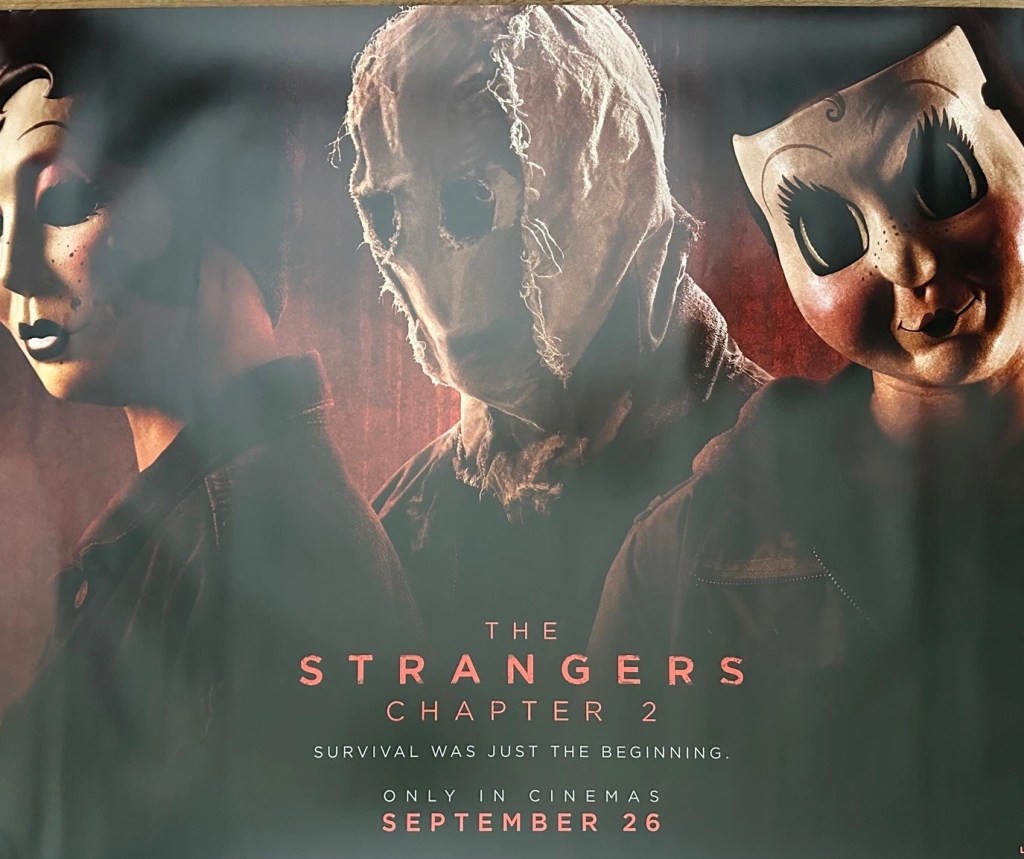
It’s pretty obvious that director Renny Harlin is far more interested in exploring the backstory of the killers – axe-wielding male decked out in scarecrow mask, crossbow-armed females with doll faces – and making the lamentable error of thinking the audience cared, especially when the origin tale amounts to nothing more than sibling jealousy. This picture stops abruptly, as if he didn’t want to give too much away.

Survivor Maya – boyfriend slaughtered in the previous episode after they inadvertently rented a house in the wrong neck of the woods – wakes up in a hospital, inexplicably deserted. That is simply a device so she can begin her marathon of running, whimpering and screaming while being chased along long corridors or trying to prevent herself being heard while hiding in cupboards, lift shafts and sharing a drawer with a corpse in the morgue.

There’s nothing worse than a dumb heroine – Maya manages to toss away (for narrative purposes you understand) any weapon – gun, knife – that comes her way. Or a dumb bad guy for that matter – he opens a stack of drawers in the morgue but draws the line at opening hers. And soon she’s running barefoot in the rain (which never seems, thank goodness, to soak her flimsy top, so the only sensible directorial decision is to steer clear of blatant leering).

Naturally, she’s suspicious of everyone and runs away from people who can help her, though help is only fleeting because the axe- and crossbow-marauders are on a spree. The wild boar might well, hints a flashback, have been reared by the killers in their childhood, but there’s nothing cute about it now.

This could almost be dialog-free because all Maya does is scream. A couple of cops put in an appearance so the director can hint at a shady past but, unlike the paramedic, they are spared slaughter. I couldn’t quite make out the significance of the ending but I know it was significant because the camera lingered on it. Presumably, Renny Harlin (The Strangers: Chapter 1) thought he was ending on a cliff-hanger because it ended so abruptly.

I felt sorry for Madelaine Petsch (Jane, 2022) because unless she was planning to become the next Scream Queen or auditioning for a marathon she has nothing to do except whimper, run and scream. This was light years from her production debut (Jane) and as many steps backwards.

Please, no more!

**This was the second part of my Monday triple bill that began promisingly with The Lost Bus (see yesterday’s blog). Although this was a dud I had high hopes for the final movie of the day – the highly-acclaimed One Battle after Another which I’m reviewing tomorrow.

Death Curse of Tartu (1966) **

Absolute hoot. I often think it’s a shame we can’t admit to enjoying a really good bad picture and here we have a gem in the So Bad It’s Good category.

If you have a notion for the kind of movie where actors have to wrap rubber snakes around their necks and pretend to strangle themselves, or do a passable imitation of being eaten alive by a non-existent shark, manage to position themselves in a tree so they can fall into the open mouth of a stationary model alligator, or foolishly go where even devils fear to tread, this one is for you.

This wasn’t even the kind of schlocky picture that scraped out onto the release circuit in flea-ridden cinemas – it had a one-week engagement at the ABC Regal in Glasgow city centre, Scotland, one of the city’s two main first run venues.

It’s the Florida Everglades version of the Old Dark House and comes replete with umpteen warnings. Already people have gone missing in this particular area of interest, reputedly an ancient Native American burial ground. But that doesn’t stop explorer Sam Gunter (Frank Weed) continuing his solo expedition against the advice of local guide (Bill Marcus) who warns of ghostly chants and drums and of finding the imprint of tiger feet.

Sam’s pretty chuffed with himself to uncover an archaeological find, a stone whose significance is unclear. Anyways, poor Sam has not taken into account the presence of deadly snakes that can slither through the undergrowth and (holy moly!) overturn a kettle and then climb a tree and ambush him and suffocate him to death – though who wouldn’t be suffocated if instead of trying to remove said creature from around your neck your task as an actor was to pull the damn reptile as tight as possible so it looks like it’s impossible to escape. This is a mighty predatory creature and must just be protecting its territory because it makes no effort to eat its prey.

Sam’s disappearance doesn’t put off archaeology lecturer Ed Tison (Fred Pinero) and wife Julie (Babette Sherrill) who are escorting four students on their first dig. Luckily, the youngsters – Johnny (Sherman Hayes), Tommy (Gary Holtz), Cindy (Mayra Gomez) and Joan (played by Maurice Stewart!! according to imdb) –  are already paired off, so there’s time for a bit of necking and dancing.

But it’s not long before the larking about turns into peril. Frolicking in the water ain’t such a good idea when there’s a stray shark about (presumably culled from stock footage) and the actors, who have presumably taken thrashing-about lessons, manage to churn up the water sufficiently to suggest they have been attacked.

Meanwhile, every now and then, we have been favored with shots of some gruesome creature coming to life. Given that, according to legend, he was capable to turning himself into a tiger, it’s a fair enough conclusion that he was the marauding shark, whose appearance in the Everglades would otherwise be too mysterious this side of chemical pollution or atomic accident.

The monster takes human form and begins pursuing the remaining intruders. Although Ed has a bolt-action rifle he’s not much of a marksman so their pursuer is able to happily maraud and his target hasn’t enough wits about her to snatch the knife he has embedded in a tree – and thus defend herself – so naturally enough she ends up in quicksand (or gradually going down on her knees in a patch of sandy water so it looks like she’s sinking). It’s lucky there is quicksand because that provides the narrative solution as to how Ed is going to escape the monster. The girl can be given a helping hand to get out of the quicksand, but the monster, after being thrown in, is denied assistance. But before he can be sucked under, he turns into a skeleton.

This has some historical significance in the horror genre, being at the forefront of what was known as the “regional” subgenre where movies were made in remote spots on miniscule budgets often with amateur actors. Writer-director William Grefe (Sting of Death, 1966) conjured up enough of these pictures to enter the esteemed halls of cult, but he was significant for another reason. At a time when movies were in short supply, the exhibitors had decided to enter the production game and funded The Checkered Flag (1963), directed by Grefe, under the auspices of Motion Picture Investors.

Nothing more was expected of the actors than that they could put on a good show of dying. Fred Pinero, Gary Holtz and Babette Sherrill had appeared in Sting of Death, but that was the extent of their acting careers. Frank Weed made one other movie. It was another decade before Mayra Gomez made another picture but by then she was on her way to a career as a television presenter, for which she received a Spanish lifetime achievement award.

If there was a separate ranking system for So Bad It’s Good films this would be hitting at least the four-star mark. As it is under my current system, it has to be marked down, which is a shame because there’s a heck of a lot of fun to be had here.

Bring Her Back (2025) ****

Reincarnation gets a bad rep. You could say the same for belief in angels. And of all the weird things to repurpose is the word “grapefruit.”

It used to be easy to define entries to the horror genre as old school (legacy creatures like vampires and werewolves and legacy situations like the old dark house and its modern equivalent). But now in addition we’ve had decades of torture porn, sexuality equating to grisly murder, and more recently high concept and arthouse. The latter two occasionally intertwine, which generally means slow-burn rather than shock jump.

Given Hollywood’s dependency on superheroes and their ever-increasing budgets, no surprise enterprising directors have been turning to the low-budget attractions of horror, where reduced cost equates to limited financial exposure, and creatives are given their head often to devastating effect – witness The Black Phone (2021), Smile (2022) and M3gan (2022).

But we’ve also been introduced to a new generation of sadistic villains, some who wreak havoc through the best of intentions, others, such as Heretic (2024) charmingly demented.

There’s been nobody quite as psychotic as award-winning counsellor Laura (Sally Hawkins) who’s in the kidnapping and fostering business for nefarious purpose. There’s no point trying to work out what’s going on in her head, though we are provided with enough tantalizing clues, because the only person it makes any sense to is Laura.

The title, unfortunately, gives too much away and you can guess from the outset that Laura is in the revival game. Her daughter has drowned and she seeks a replacement. Into her lap fall orphan brother-and-sister Andy (Billy Barratt) and Piper (Sora Wong) struggling to get over the gruesome death of their father.

While ostensibly bonding with the pair through a night of partying, in reality she’s setting up Andy for humiliation (she pours her own urine on him while he sleeps so she can accuse him of wetting the bed), disorientation (playing upon his fears) and ultimately turning his sister against him (Piper believes her brother whacked her in the eye while asleep) and if none of that works then just plain doing away with him. Piper is only partially sighted so her idea of what’s going on is restricted.

But while Andy wrestles with all this and visitations from his dead father, in the background is mute kid Oliver (Jonah Wren Philips) and with his every appearance he steals the show, and that’s despite a convincing performance by double Oscar-nominee Sally Hawkings (The Shape of Water, 2017).

Shaven-headed, mute and locked in his room he resembles an angelic lost boy. But he’s starving and is apt at a moment’s notice to start chomping through wood or his own arm. He’s been fed some demonic nonsense and will not cross over the white painted circle surrounding the remote house. And when he can’t escape he turns turtle and has convulsions.

I’m not sure what rules surround kids in horror films and Jonah is way too young to be able to see the result but standing and crawling around drenched in blood with open scars and teeth missing I’m wondering just how he would be able to go to sleep at night (though, I guess he’s aware it’s prosthetic blood and obviously make-up completing the illusion). So the most demonic child since The Exorcist (1973) and it’s his image that will stick in your mind long after you’ve escaped the cinema.

There are plenty neat touches, the best being that Piper escapes a drowning by calling out “mom”, the title Laura has wanted to hear ever since her daughter passed away.

But slow-burn and certain arthouse aspects might put off the general horror fan.

Sally Hawkins and Jonah duke it out for most memorable turn and if you were going purely on the acting Sally would win, but movies are as much about the image as the word and on that score the boy wins hands down.

The Philippou twins, Danny and   Michael, (Talk to Me, 2022) direct with the former responsible for the screenplay along with Bill Hinzman, his regular collaborator.

An Angel for Satan / The Devil’s Angel (1966) ***

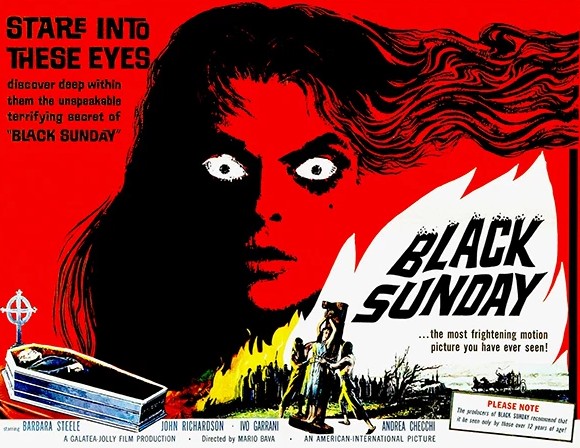
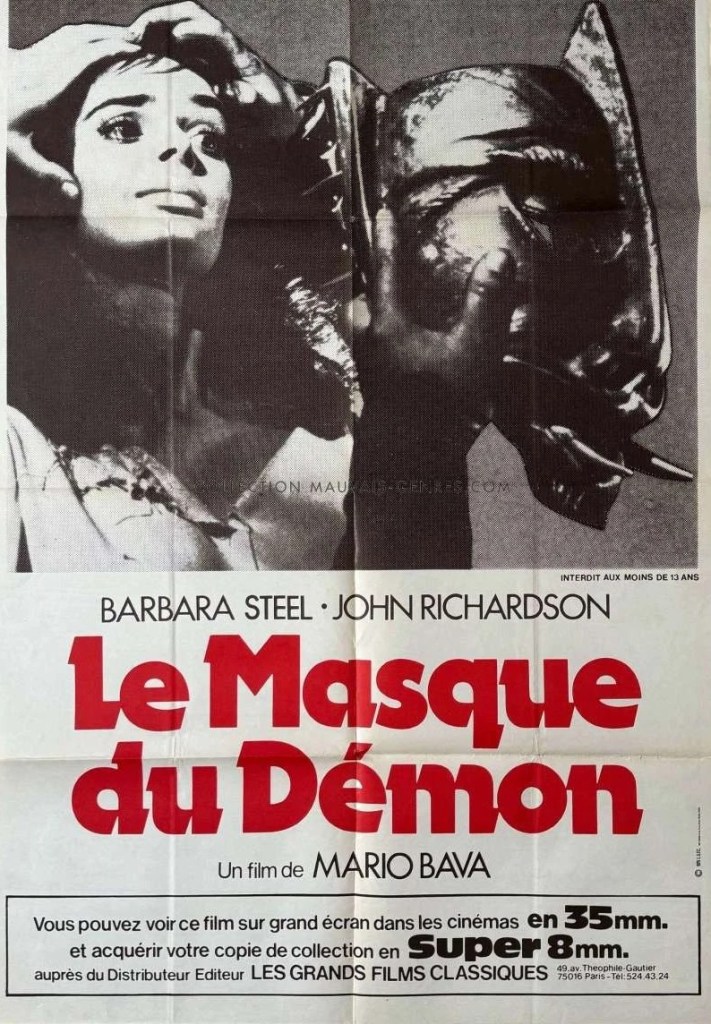
Scream Queen Barbara Steele (The Crimson Cult / Cult of the Crimson Altar, 1968) is the big attraction in this heady brew of witchcraft, ancient curse, hypnotism and plain ordinary seduction, with an ingenious double twist. And elegantly mounted, crisply photographed as if a Hollywood picture of the 1940s.

After a drought lowers the water level, a 200-year-old statue of the beautiful Countess Melena is recovered from the seabed. The locals fear it carries a curse. Artist Roberto (Anthony Steffen),  hired to restore the artwork, arrives only days before the young countess Harriet (Barbara Steele) returns to claim her inheritance. With some clever sleight-of-hand, veteran Italian director Camillo Mastrocinque (Crypt of the Vampire, 1964) misleads the audience into thinking this is all about secret love affairs, Harriet’s uncle the Count (Claudio Gora) in an illicit relationship with housekeeper Ilda (Marina Berti), maid Rita (Ursula Davis) tempting timid schoolteacher Dario (Vassilli Karis), nascent love between Harriet and Roberto hitting a stumbling block and various shades of unshackled lust from woodcutter Vittorio (Aldo Berti) and village strong man Carlo (Mario Brega).

But pretty quickly, the picture takes a different turn. Turns out it’s not Melena who’s the problem – but her jealous ugly cousin Belinda who threw the statue into the water in the first place. Whatever the cause, there’s an outbreak of malevolence, mostly emanating from Harriet.

She strips naked for Carlo then savagely beats him for daring to stare at the nude body. She seduces Dario, looks like she’s making a play for Rita, goads Roberto and tells him she likes violence and has Carlo in her thrall.

In short order a female villager is raped and murdered, another barely escaping a similar fate, the schoolteacher commits suicide, several villagers are axed to death,  the strong man sets fire to his cottage, killing wife and seven children, and the woodcutter is speared by pitchforks.

You can tell this is a classier number because the violence is minus any gore and there’s little attempt at deliberate shock, more of a slow burn as Harriet torments those around her. Roberto is permitted small touches of investigation, and there’s a clever special effect of a painting appearing to talk.

The traditional horror elements – lightning, slamming windows, storms – are primarily employed to nudge Harriet and Roberto together;  it just so happens that she is scared of lightning and he’s the person most conveniently placed to comfort her. There’s a hint of the narcissism found in Hammer’s later lesbian horror pictures, and only the censor or the director’s discretion prevents more full-blown nudity as a prelude to seduction of both male and female. Harriet’s a dab hand at inveigling males to be in the wrong place at the wrong time invariably with her clothes in disarray to lend substance to her claims of being attacked.

While, as regular readers will know, I’m generally in favour of the climactic twist – the more the merrier – here I’m not so sure this was the road to go down. As Roberto already knows that the curse applies to wicked cousin Belinda rather than Melena, it would have been enough for him to declare this and find a way of removing it, most likely adopting the simple solution of chucking the statue back in the sea, which is what the villagers have been demanding all along.

It’s quite clear that much of the rape and killing is down to hypnotism by Harriet, but once we discover she’s being hypnotized by the Count, in one fell swoop what had been an intriguing horror story transforms into a more run-of-the-mill crime tale since if Harriett is committed to an asylum then he can continue to rule the roost.

But he’s in the thrall of Ilda who turns out to be the ancestor of Belinda. So not quite the satisfactory ending unless the criminal element had been introduced earlier on.

I doubt if Barbara Steele fans will care as the actress is very much in her element and, although in the end a victim, for the bulk of the picture she is in total – and seductive – command. Nobody’s going to compete with her and sensibly nobody tries. Anthony Steffen didn’t need any help with his career because had had already headed down the spaghetti western route.

Classically directed – excellent composition and camera movement – from a script by Mastrocinque and Giuseppe Mangione (Anzio / Battle for Anzio, 1968) from a novel by Antonio Fogazarro.

Superior stuff in which Barbara Steele shines.

Hand of Death (1962) ***

Unless you go by the name of Dr Jekyll, you don’t want to become a guinea pig for your own scientific experiments. Niftily done, memorable opening and finale, minimum expenditure on special effects ensures the shock value is limited until it counts as our hero/villain goes on accidental rampage.

In an echo of Village of the Damned (1960), a mailman, drawing up in front of some gates, falls to the ground. The camera pulls back revealing some senseless sheep. Two guys in Hazchem suits rush out of a building which turns out to be a laboratory. It’s not even a top secret lab although it’s buried in the desert. Dr Alex Marsh (John Agar) is supposed to be engaged on harmless experiments on cacti. Instead, he’s stumbled upon a nerve gas with military potential.

Our mailman and the sheep aren’t dead only unconscious so, through happenstance, Marsh has successfully conducted both animal and human tests, such results an improvement on what went before when the subjects died.

Marsh can’t wait to tell boss Dr Ramsay (Roy Gordon) and his girlfriend Carol (Paula Raymond) the good news. All scientists are mad scientists given the right circumstances. So Marsh has gone from anodyne to dangerous. In Army hands, the nerve gas can not only immobilize the enemy but when they wake up they are under hypnotic influence and will do what the victors tell them thus nullifying the risk of rebellion.

James Bond villains would be queuing at his door. Leaving Ramsay to drum up financial support from legitimate sources, Marsh returns to the lab to further develop the prototype, except too much leaks out and he’s not as immune to its effects as he originally believed. And beyond being cursed by a nightmare, it doesn’t look, initially, as if Marsh is in danger. Just everyone else. Touch him and you’re fried.

While he doesn’t mean to kill anyone, nonetheless heading for the morgue are a colleague and a gas pump attendant. He hides out in Ramsay’s house where serums are concocted to cure him. They fail. Marsh moves from not wanting to hurt anybody to threatening violence. And it’s soon clear he’s not at all immune. Contemporary audiences might enjoy the transformation as he turns into a cross between Hulk and The Thing from The Fantastic Four, with the addition of the kind of raincoat for which Columbo later expressed a preference and Frank Sinatra’s hat.

And you might be giggling at the look except that strange things begin to happen. You pity him. He’s not some monster lurching around terrorizing the populace. He’s lurching all right but in the kind of bent-over fashion where you think he’s going to topple over any minute. He turns up at  Carol’s beach house but so do the cops. He heads towards the water but when he turns back at Carol’s call the police interpret that as threat and shoot him dead.

There are some other nice touches, reaction shots from the supporting cast, some sparkling bit parts, a small child who is within seconds of touching him out of curiosity, and an incentive for his other colleague Tom (Stephen Dunne) to win over Carol should he fail to come up with the serum.

John Agar (The St Valentine’s Day Massacre, 1967) was never going to get within a mile of an Oscar but his playing of the monster triggers pity. Paula Raymond (The Flight That Disappeared, 1961) adds some depth to a thankless role.

Directed by Gene Nelson (Kissin’ Cousins, 1964) from a screenplay by producer Eugene Ling in his final work.

I came at this with one big advantage. I hadn’t seen the poster so I had no idea what the monster looked like. Which is just as well because otherwise I might have not bothered.

Tight, short, occasionally clever, surprisingly moving.

Mill of the Stone Women (1960) ****

Character has generally been replaced by gore or slaughter in the modern horror film. Ever since Hammer ruled the roost, blood-letting has assumed greater and greater significance, and ever since The Exorcist (1973) the genre has traded on shock values. Current box office sensation Sinners (2025) has gone some of the way to re-aligning the balance with its emphasis on character and thematic symmetry.

So it’s somewhat reassuring to discover that prior to those developments there could be an absolute chiller of a tale where nonetheless character, and not just for the two principals, was all. I should tell you right away that there is a vampiric element in the drawing of blood but that is carried out in the more refined scientific manner of medical blood transfusion. And the undead do rise again, just to get that story point out of the way, but it’s not because an evil count refuses to be put to sleep, but out of a father’s love for his daughter.

Quite the most fearful element here is the preponderance of unrequited love. The man whose medical skills saves a woman’s life is rejected by her, she in turn is ultimately rejected by an unforeseen suitor while he, in turn, for a time turns his back on his long-term girlfriend. The father also shows he has little loyalty to the man who deserves that most of all.

But let’s start at the beginning. In nineteenth century Holland, land of canals and dykes you will recall,  student Hans (Pierre Brice) arrives at the watermill owned by Professor Wahl (Herbert Bohme) to write a report on the macabre carousel he has devised, a feat of engineering running on levers and gears and wheels, that present a “theater of death” populated by very lifelike inanimate statues. While there, he espies a beautiful woman.

Hans’s girlfriend Liselotte (Dany Carrel) is immediately jealous and unsure whether he loves her as much as she, a childhood friend, loves him. Back at the mill, Hans encounters smug Dr Bohlem (Wolfgang Preiss) who is on constant call to look after the professor’s very ill daughter Elfie (Scilla Gabel), the aforementioned beauty.

Although for mysterious reasons Elfie’s life depends on the doctor’s ministrations she rejects his overtures with haughty disdain. Meanwhile, she seduces Hans. Although initially smitten, Hans soon realizes the error of his ways. But Elfie, who it turns out has seduced many male visitors, becomes obsessed with him. Before he can break off their relationship, she collapses and dies.

Hans is accused of murdering the girl. Out of his wits, he’s sedated by the doctor and when he wakes up is convinced he has seen Elfie alive and another woman trapped in a room. He is persuaded by the professor and the doctor that he is going mad and he flees the mill, in theory never to return. The professor and doctor have kidnapped local girl Annelore (Liana Orfei), sometime life class model and chanteuse, and revive Elfie via a blood transfusion from the captive. The pair don’t need to get rid of the body, the professor transforming it into one of his very lifelike sculptures by covering it in wax.

Liselotte’s jealousy evaporates when she has Hans all to herself, nursing him back to health, and he asks her to marry him. Though nagged by his visions, he manages to dismiss them until he sees a photo of Annelore, whom he previously never met, and whom he glimpsed tied up in the mill.

Meanwhile, the doctor has discovered a serum by which Elfie can live a proper life, and it only requires one final transfusion. To that end he’s kidnapped Liselotte. But the doctor is determined to extract a price. Knowing that Elfie will no longer be dependent on him, he demands her hand in marriage. Despite what she owes him, she still, as high-and-mighty as before, rejects him. Using the same argument, the doctor appeals to the professor who is even more outraged at the idea, given the doctor was thrown out of his profession for malpractice and is an ex-convict.

The professor is even less grateful than his daughter and kills the doctor. Having witnessed the transfusion so many times, he begins to carry it out himself. But at the critical moment, he can’t find the serum. And it’s gone. When the doctor fell, the bottle of serum in his pocket smashed.

Hans rescues his fiancé while the mill burns to the ground, the wax melting from the sculptures betraying the skeletons underneath.

Most of the horror is left to audience imagination. There’s no gore, no throats slashed, very little blood, not even a scream. It’s the most discreet horror picture you’ll ever see and all the more effective for it. We probably didn’t need the scene of the conspirators gloating and giving away their evil plan but otherwise it works a treat.

All the characters are given clear identities, father and daughter gripped by obsession, doctor by the delusion of marriage as reward, Hans wayward in his affections but sensible enough to recognize stifling love when he sees it, and even Liselotte is best defined as overly jealous.

It’s handsomely mounted too, and the mill interiors have all the eerie trappings of the normal castle. Pierre Brice (Old Shatterhand, 1963) and Scilla Gabel (Sodom and Gomorrah, 1962) are given license to overact, and while Dany Carrel (Delphine, 1969) works through gritted teeth, Wolfgang Preiss (The Train, 1964) and Herbert Bohme (Secret of the Red Orchid, 1962) are the epitome of the cultured villain.

Unable to call upon a vast cauldron of blood to splatter, this is a more intelligent horror picture, directed with measured cadence by Giorgio Ferroni (The Lion of Thebes, 1964) from a script by the director, Ugo Liberatore (The Hellbenders, 1967) and Giorgio Stegani (Death on the Fourposter, 1964).

Rewarding watch.

Dangerous Animals (2025) *** – Seen at the Cinema

Steven Spielberg made his reputation dangling human bait to sharks and audiences lapped it up. I’m surprised it’s taken this long for a psychotic serial killer to understand the visceral thrill of watching victims die screaming as they are torn apart by sharks and churn up the sea in a froth of blood and guts. As you know I’m partial to a sharkfest and though this isn’t on the same epic scale in terms of destruction as Sharks under Paris (2024), given I was pretty fed up watching the dire Ballerina (let’s hope she’s excommunicated from the John Wick universe), I toddled off to see this without much in the way of expectation.

It’s pretty much in the Old Dark House line of horror pictures, good-looking young men and women imprisoned by a nutcase of the intelligent version of the species that recently surfaced in Heretic (2024). Aussie boat skipper Tucker (Jai Courtney) has a legitimate business taking tourists out shark-watching in a cage. And he’s got a side hustle in picking up vulnerable tourists – on gap years and the like or trying to escape the confines of the past or hiding out from consequence. He either catches his unwitting prey on land or waits till they turn up on his boat singly or in couples and not part of an organized tour from which their absence would be automatically noticed.

Heather (Ella Newton) and Greg (Liam Greinke) fall into the unannounced category. They get the shark experience but then Greg makes more intimate acquaintance with the predators after he’s knifed in the throat and tossed overboard.

Not only does Tucker like to watch he likes other victims to watch – someone dying. In full Spielberg mode he films the deaths. So he goes on the prowl for another victim, kidnapping the  more sassy Zephyr (Hassie Harrison) in the middle of the night. She’s got a good deal more fight in her than the hapless Heather and manages to find a device to unlock the handcuffs chaining her to a bed, makes a makeshift shank from a broken piece of plastic and is adept at wielding a frying pan or harpoon or any other device that comes within range.

In between delivering homilies on the wonder of the shark, Tucker indulges in his dangling, the screaming Heather chopped to ribbons while Zephyr, strapped to the best seat in the house, is unwilling witness.

Luckily for Zephyr, she has smitten Moses (Josh Heuston), a one-night stand, and he has more detection skill than the cops who are not really interested in yet another beach bum who’s gone off without telling anyone. He tracks down the boat and invites himself to the party. Turns out between them they have more than a smattering of shark lore and when Josh is lowered into the water knows that the sharks will leave him alone if he doesn’t thrash about.

But drugged and chained up the pair have little chance of escape unless the doughty Zephyr goes full tilt escapologist boogie and gnaws off her thumb off to facilitate the cuffs slipping over her hand.

Unfortunately for her this picture is so full of twists there’s very little chance of a clean getaway and even when she makes it to the shore by swimming Tucker, thanks to a dinghy with an outboard motor, is on top of her.

It’s not as gruesome as it sounds, though you will want to avert your eyes when Zephyr starts gnawing on her thumb, and director Sean Byrne (The Devil’s Candy, 2015) emulates his idol Spielberg by turning less into more, ratcheting up the tension through anticipation and some terrific footage of marauding sharks. It helps that he doesn’t have a lascivious bone in his body, there’s no sexual assault, no drooling over half-naked women, no wet t-shirt nonsense.

Hassie Harrison (Yellowstone, 2020-2024) is the latest in a bunch of feisty women who refuse to conform to the scream queen norm. Jai Courtney (The Suicide Squad, 2021) is exceptionally creepy as the learned soft-spoken psychopath. Written by Nick Leppard in his debut.

Sean Byrne knows how to turn the screws.

Children of the Damned (1964) ***

I wasn’t aware that celebrated sci fi author John Wyndham had written a sequel to his iconic novel The Midwich Cuckoos, filmed as Village of the Damned (1960). And it turned out he didn’t (he did make an attempt but abandoned it after a few chapters).  So he had nothing to do with the sequel. But the original had proved such a hit MGM couldn’t resist going for second helpings.

And there was nothing the writer could do about it, it being standard procedure that when you sold your novel to Hollywood the studio retained all the rights and could commission a remake, sequel, turn it into a television series, without consulting you.

The only drawback for a potential sequel was that main adult character Professor Zellaby (George Sander) and all the kids had died in the original, though the final image of eyes flying out of the burning house might have suggested the children had actually survived. And, as we know these days, just when your main character dies it doesn’t prevent him miraculously returning to life should box office dictate.

So screenwriter John Briley (Oscar-winner for Gandhi, 1982) was handed the sequel. And what we get is a lot of atmosphere, a chunk of running around in empty London streets (the result not of mass evacuation but filming in early morning when roads are clear), a very slinky turn from Alan Badel (Bitter Harvest, 1963) showing what he can do when hero not villain, and a twist on the previous problem – how to vanquish the kids – which is whether to  weaponize them. Mostly, we are reminded of how better telekinesis was dealt with in the original picture and how poorly this compares to the likes of Brian De Palma’s later Carrie (1976) and even his The Fury (1978).

Apart from the title, there’s barely a nod to the previous incarnation, except that discerning the children’s paternity proves impossible. An United Nations project has tracked down six kids with incredible intellects. Like Professor Zellaby, British psychologist Dr Tom Llewellyn (Ian Hendry) and geneticist Dr David Neville (Alan Badel) want to study the kids while the more shadowy figure of Colin Webster (Alfred Burke) appears to have more sinister purpose in mind.

In any case none of the three achieve their goals because the kids escape and take refuge in an abandoned church, defending themselves against the authorities and the military by their brain controlling abilities and by the devising of a sonic weapon. Immediately under their thumb is the aunt, Susan (Barbara Ferris), of the young boy Paul (Clive Powell) who initially excited the interest of the British scientists.

Opinion varies as to whether the children are a genetic freak of nature, aliens or an advanced human race. The authorities can’t decide whether they are a threat or a wonder and decide to eliminate them, then change their mind, while the children decide to fight back then change their minds. The ending is quite a surprise.

Although the kids still have the fearful eyes, they are generally a lot less effective a scare than when the small gang of them stood side by side in the previous picture and stared at adults until they did the childrens’ bidding or killed themselves. There’s way too much discussion among adults. In the previous picture, those kinds of conversations had more emotional impact, since it was the villagers who were left distraught. Here, you couldn’t care less about the adults.

Interestingly enough, the standout isn’t any of the kids at all, but Alan Badel, who comes over as the libidinous sort, but very charming, and views any woman as fair game, but it’s fascinating to see how his usual screen persona here makes him a hero whereas in most other films exhibiting much the same characteristics he comes across as shifty, mean or downright villainous.

Ian Hendry (The Hill, 1965) was a rising British star but isn’t given much to get his teeth into. Barbara Ferris (Interlude, 1968) has a vital role.

Directed by television veteran Anton M. Leader (The Cockeyed Cowboys of Calico County, 1970) who makes his screen debut.

Not a patch on the original.

Discover WordPress

A daily selection of the best content published on WordPress, collected for you by humans who love to read.

The Atavist Magazine

by Brian Hannan

WordPress.com News

The latest news on WordPress.com and the WordPress community.