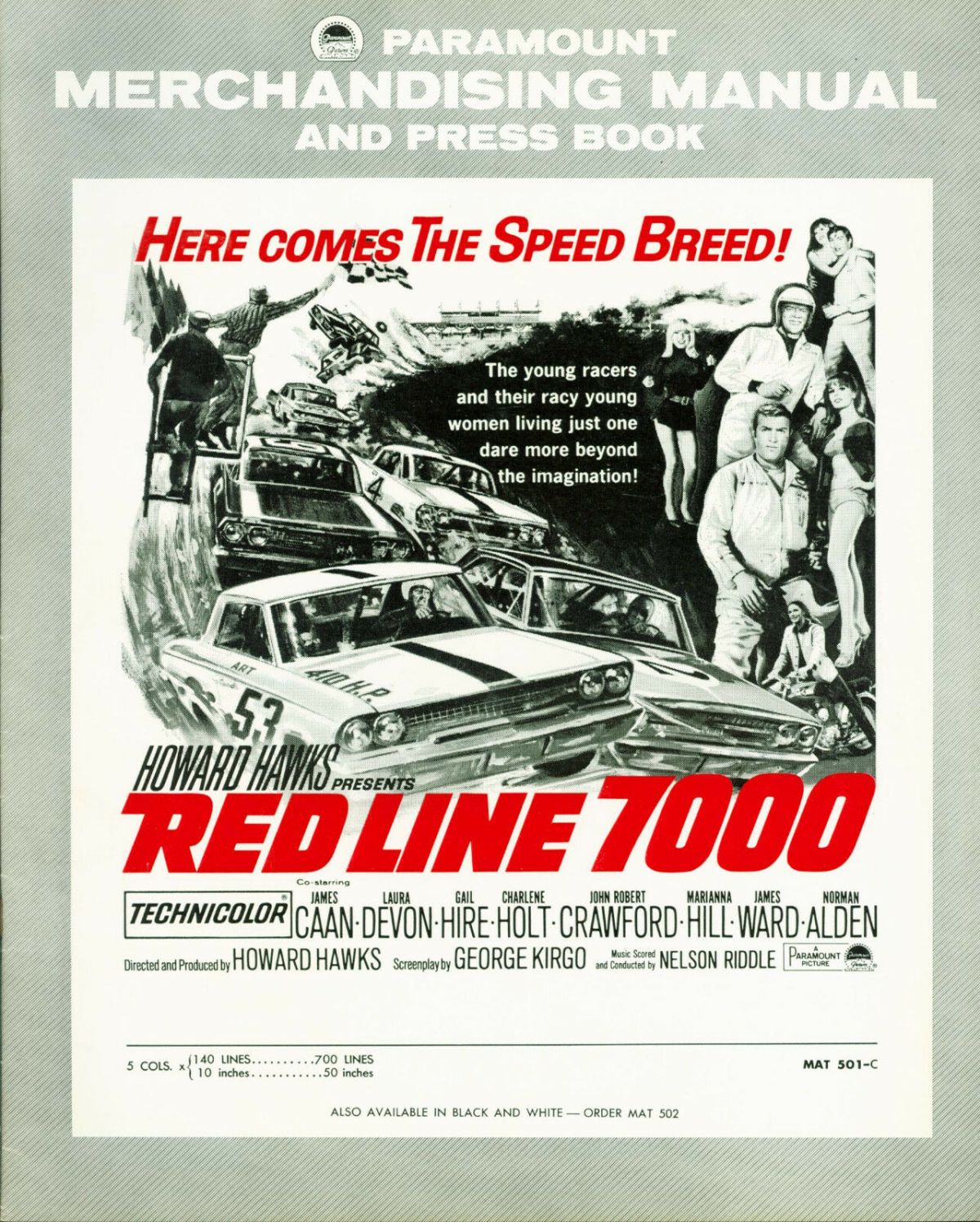
Quentin Tarantino is probably alone in preferring this movie mishap to John Frankenheimer’s Grand Prix (1966) – or I have somehow missed a “cult” picture. There was no doubt director Howard Hawks could handle speed. Check out the action in Hatari! (1962) as jeeps battle across tougher terrain than NASCAR racing circuits. But for some reason, he thought he would get away with interspersing footage of races and spectacular crashes with shots of actors behind the wheel. Any time something exciting is about to happen we’re alerted by the commentator saying “oh oh” or “wait a minute” or “hold it.” There’s none of the feverish excitement or authenticity of Grand Prix.
Hawks hired a no-name cast in a bid a) to become a star-maker, b) to prove he did not require the marquee wattage of the likes of John Wayne and c) to show he could make a movie cheaply. He failed on all three counts. He probably didn’t think he was taking any kind of gamble at all, as a male approaching 70, in trying to depict the lives of people around 50 years younger. James Caan, in his sophomore outing, comes out best, but that’s not saying much since he has very little to do except growl and look broody. Marianna Hill (El Condor, 1971) is also believable.
While the racing footage has dated in a way that Grand Prix has not, the main problem is just a jumble of characters getting lost in a jumble of stories. No sooner has one character been introduced than we are onto another. There’s none of the cohesive story-telling that marked out The Big Sleep (1946) or Rio Bravo (1959) and, frankly, none of the characters are particularly interesting. And what possessed him to stick in a song sung by a character (Holly, played by Gail Hire) who cannot sing – she talks the lyrics – with a backing group made up of waitresses, I can’t begin to guess.
The most fun to be had is spotting in bit parts people famous for other reasons. Carol Connors, for example, who co-wrote the lyrics to “Gonna Fly Now” (Rocky, 1976) appears as a waitress. As does Cissy Wellman, daughter of veteran director William Wellman. Comedian Jerry Lewis has a cameo. It says much for Hawk’s star-spotting abilities that of two female leads, Laura Devon only made five pictures and Gail Hire just two. Of the main supporting males, this was the beginning and end of John Robert Crawford’s movie career while Skip Hire made a bigger splash as a producer of television series The Dukes of Hazzard.
However, the French had a word for it – “genius.” Despite being dismissed as a rare misstep by the bulk of critics worldwide, Cahiers du Cinema decided it was one of the year’s Top Ten pictures. So what do I know? Make up your own mind – catch it on Amazoon Prime.
Thoroughly involving potboiler with alcoholic novelist Paul Newman turning unlikely detective to uncover murky double-dealings at the annual Nobel Prize ceremony. Based on the Irving Wallace bestseller set in Stockholm, director Mark Robson (Von Ryan’s Express,1965) strings together a number of different stories that coalesce in a gripping climax. Screenwriter Ernest Lehman (North by Northwest,1959) brings alive what could have been a very soggy adaptation of a beefy bestseller with witty and literate dialog and a plot that hovers just the right side of hokum.
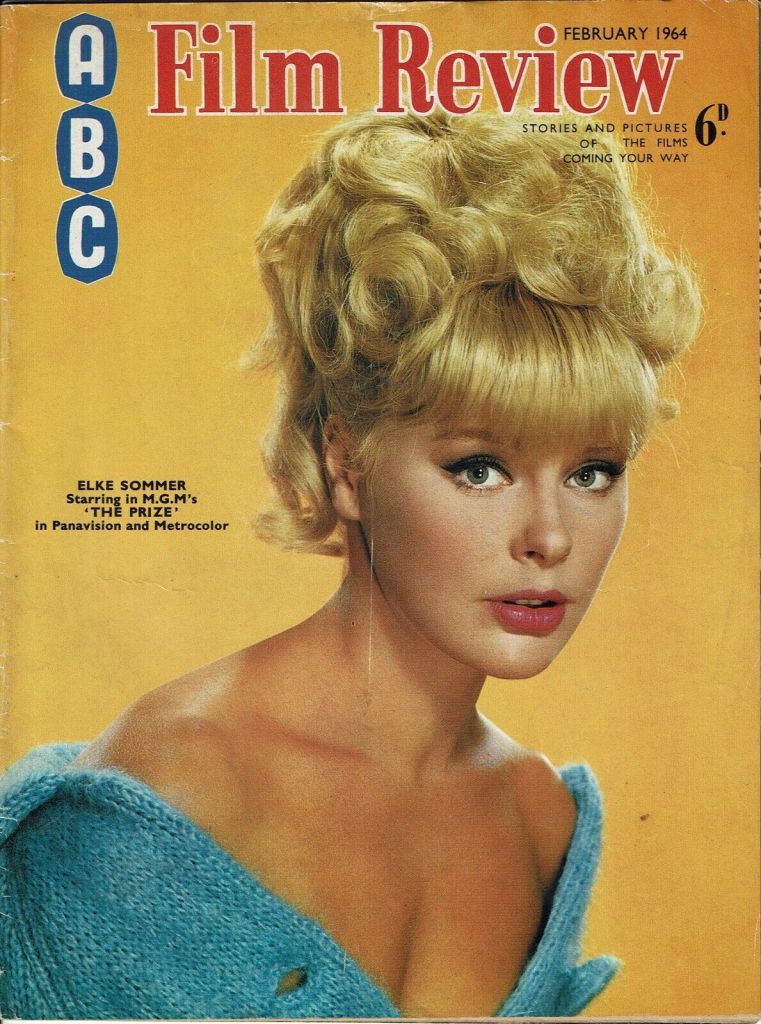
Elke Sommer, delegated to look after Newman, starts out as stuffed shirt not sexpot, allowing Newman’s attention to drift towards Emily Stratman (Diane Baker) – daughter of another winner Dr. Max Stratman (Edward G. Robinson) – while he is also dragged into romantic entanglement with neglected wife Dr Denise Marceau (Micheline Presle). Mostly, Newman just wants his next drink and his almost continual inebriation sparks some good comedy and he is gifted good lines to extricate himself from embarrassment. Simmering in the background are warring winners – the Marceau husband-and-wife team and Dr John Garrett (Kevin McCarthy) convinced that Dr Carlo Farelli (Gerard Oury), with whom he is sharing a prize, has stolen his research.
There are sufficient character clashes and plots to be getting along with if you were just intent on taking a Valley of the Dolls approach to the material, that is, cutting between various dramatic story arcs, but, without invalidating the other subsidiary tales, the movie takes quite a different turn, providing the potboiler with considerable edge.
Turns out that Newman is so impoverished that he has been writing detective novels under a pseudonym and suspecting that Dr Stratman is an imposter he starts investigating. So in some respects it’s a private eye procedural played out against the glamorous backdrop of the awards. But the clues are inventive enough and there is a femme fatale and once Sommer comes along for the ride and with Newman a target the picture picks up an invigorating pace. Echoing the humorous auction scene in North by Northwest is a sequence set in a nudist colony where Newman seeks refuge to avoid villains while another terrific scene plays out in the docks.
Newman looks as if he is having a ball. In most of his pictures he was saddled with seriousness as if every part was chosen with an eye on the Oscars. Here, he lets rip with a lighter persona, and even if he mugs to the camera once too often, the result is a screen departure that lifts the picture. Inebriation has clearly never been so enjoyable. Sommer is a delight, showing great dramatic promise. Edward G. Robinson (Seven Thieves,1960), more renowned for his gangster roles, convinces as a scientist. Diane Baker (The 300 Spartans, 1962), Kevin McCarthy (Invasion of the Body Snatchers,1956) and Leo G. Carroll (North by Northwest) provide sterling support.
Robson directs with dexterity, mostly with an eye on pace, but it is Lehman’s script with occasional nods to Hitchcock that steals the show.
Catch-Up: Previously reviewed in the Blog – Paul Newman in Torn Curtain and Cool Hand Luke; Diane Baker in Marnie and The 300 Spartans; Elke Sommer in The Corrupt Ones and Mark Robson picture The Lost Command.
Remembering this picture as a summer holiday matinee of stiff-upper-lip-ness entangled in all sorts of Khartoumery, I came at this film with low expectations. Given producer Charles H. Schneer’s (First Men on the Moon, 1964) involvement, there were no Ray Harryhausen magical special effects. I was only aware of star Anthony Quayle as a bluff supporting actor in epics like Lawrence of Arabia (1962) and The Fall of the Roman Empire (1964) and Sylvia Syms as a willowy supporting actress (The World of Suzie Wong, 1960). So I was in for a pleasant surprise. Take away the back projection, stock footage and the unlikely zoo of wild animals and there is a fairly decent action film set in the Sudan on the fringes of the Mahdi uprising (that story filmed as Khartoum the following year).
Quayle is a former army sergeant awaiting court martial when he escapes from a battle near Khartoum, ends up saving governess Syms, her charge Jenny Agutter (making her debut), officer Derek Fowlds (BBC Yes, Minister) and a wounded soldier. The motley crew flees down the Nile in a boat. You know you are in for something quite different when the soldier dies and Quayle wants to toss him overboard. Overruled by prim Syms and stiff upper lip Fowlds, this good deed is rewarded by losing their beached boat while burying the dead. A picture like this only survives on twists. Burning the remainder of their boat to attract the attention of the British relief force only brings in their wake a mob of Arabs, who we are informed, in a spicy exchange, don’t know the ten commandments, especially “thou shalt not kill.” It turns into a battle of the sexes, with Syms’ innocence and good breeding quickly eroded in the face of danger, her natural antipathy towards a scallywag like Quayle softening. Lacking due deference, said scallywag is given some choice lines which spark up proceedings. It being Africa, the animals have nothing better to do than torment them, so cue snakes, crocodiles, charging rhinos, hippos, elephants without even an entertaining monkey to lighten proceedings. Quayle sets his ruthless tendencies to one side to take a tender, paternal interest in young Agutter. Ongoing action prevents the usual male-female meet-cute African Queen-style banter and it’s all the better for it.
Capture by African tribesman takes the story on an interesting detour. Quayle, attempting to make friends, shouts out despairingly (and without irony), “Don’t any of you even speak English?” only for chieftain Johnny Sekka (The Southern Star, 1969) to stride out of the bushes with the reply, “I speak, English, Arabic and Swahili.” Quayle explains, “We come in peace.” Sekka retorts, “With gun in hand?” Game on! The plot goes offbeat when we become involved in Sekka’s life. A former slave, his village presents an unusually realistic alternative world not least for Agutter, ill by this time, saved by an African witch doctor. There are further surprises, clever ruses to foil the enemy, revelations about Syms and a surprising but very British ending.
Quayle is convincing, reveling in the opportunity to create a fully-formed character rather than confined to a small chunk of a picture. Syms, too, with more on offer than normal, Agutter (Walkabout, 1971) not a precocious Disney cut-out, and Fowlds revealing what did for all those years before turning up on television as puppet Basil Brush’s sidekick. As a British B-picture making do on a small budget, it overcomes this particular deficiency with some sparkling dialogue and attitudes that go against both the time in which it was set and the era in which it was made.
NOTE: Khartoum, The Southern Star, The Fall of the Roman Empire, The Southern Star and First Men in the Moon (with Harryhausen effects) have all been reviewed on this blog.
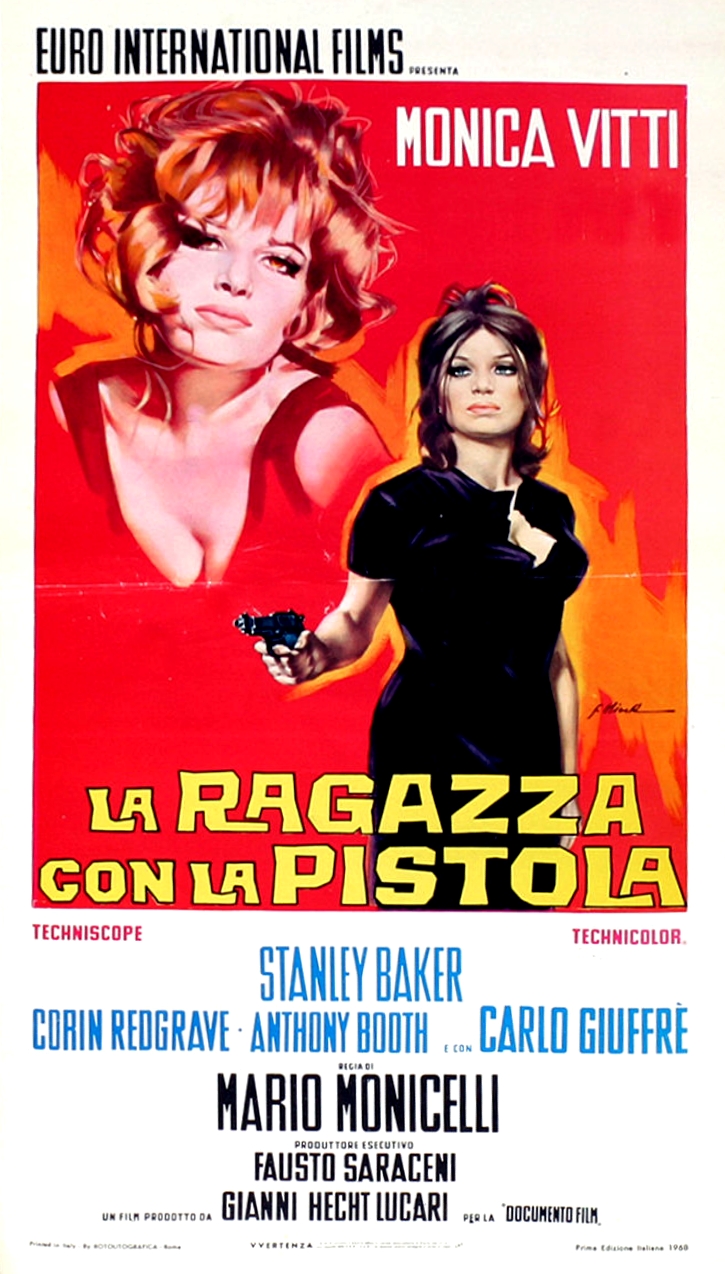
Off-beat Oscar-nominated comedy-drama that is both a marvelous piece of whimsy and a slice of social realism set in the kind of Britain the tourist boards forget, all drizzle and grime. It zips from Edinburgh to Sheffield to Bath to London to Brighton to Jersey as if the characters had been dumped from an If It’s Tuesday It Must Be Belgium sketch. If your idea of Italy was Fellini’s glorious decadence or Hollywood romance amid historic ruins and fabulous beaches, then the upbringing of Assunta (Monica Vitti) is the repressive opposite. All women in her small Sicilian town wear black. Men are not allowed to dance with women and must make do with each other. A man like Vincenzo (Carlo Giuffre) desiring sex must kidnap a woman, in this case Assunta, to which she will consent as long as he marries her. When instead he runs off to Scotland, she is dishonored and must kill him, armed with the titular pistol.
Pursuit first takes her to Edinburgh and a job as a maid, has a hilarious encounter with a Scottish drunk, and various other cross-cultural misinterpretations – in a bar she cools herself down with an ice-cube then puts it back in the bucket. Then it’s off to Sheffield where she falls in with car mechanic Anthony Booth (television’s Till Death Do Us Part) because he is wearing Italian shoes. She can’t imagine he can watch sport for two hours. “You’re a man, I’m a woman, nobody in the house and you look at the television.” Although tormented by images of being attacked back home by a screaming mob of black-robed women, she begins to shed her inhibitions, wearing trendier clothes, although an umbrella is essential in rain-drenched Britain and given the Italian preference for shooting exteriors.
In between sightings of Vincenzo there are episodes with a suicidal gay man (Corin Redgrave) and a doctor (Stanley Baker). She becomes a nurse, then a part-time model, sings Italian songs in an Italian restaurant, drives a white mini, wears a red curly wig and more extravagant fashions. It turns out she can’t shoot straight. Gradually, the mad chorus of home gives way to feminist self-assertion as she becomes less dependent on men and a world run by chauvinists. It’s a starling mixture of laugh out loud humour and social observation. And while the narrative at times verges on the bizarre, Assunta’s actions all appear logical given her frame of mind.
Vitti was Italian director Michelangelo Antonioni’s muse (and companion) through L’Avventura (1960), La Notte (1961) and L’Eclisse (1962) to Red Desert (1964). She had a brief fling with the more commercial, though still somewhat arty, movie world in Joseph Losey’s Modesty Blaise and the nothing-artistic-about-it comedy On the Way to the Crusades (aka The Chastity Belt, 1968) with Tony Curtis. Director Mario Monicello had two Oscar nominations for writing but was best-known for Big Deal on Madonna Street (1958) and Casanova ’70 (1965). The Girl with a Pistol was nominated in the Best Foreign Language film category at the Oscars.
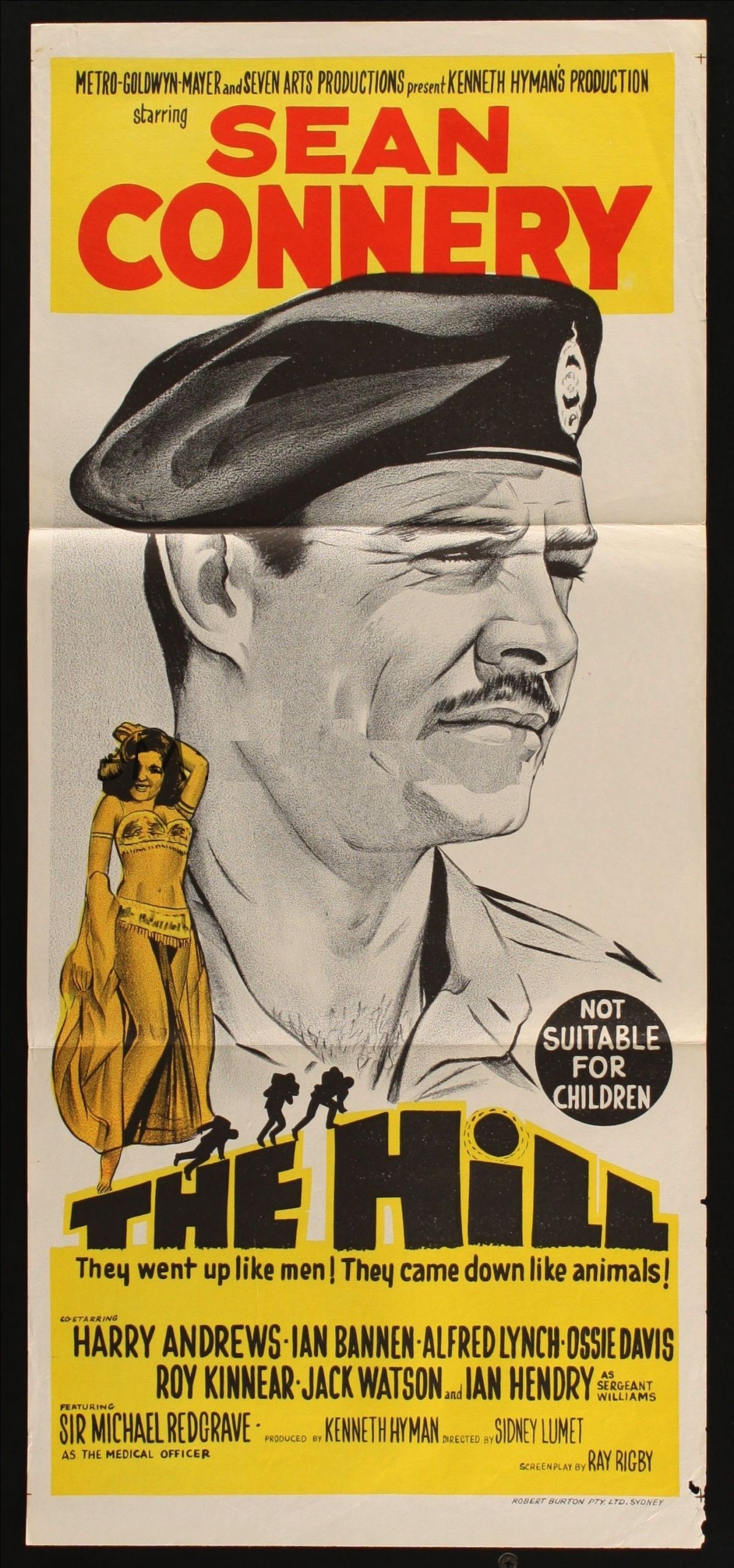
Set in a British Army prison camp in North Africa during World War Two ruled by sadistic Sergeant Wilson (Harry Andrews) who believes himself above the regulations he forces others to follow, The Hill is a parable about the hypocrisy of totalitarian rule. And much of what is shown would be offensive to modern sensibilities. Although the commandant (Norman Bird) and medical officer (Michael Redgrave) are his superior officers, Wilson runs the unit by force of personality. He believes his ruthless treatment of the prisoners turns them into proper soldiers. Into his fiefdom come five new prisoners including coward Joe Roberts (Sean Connery), spiv Monty Bartlett (Roy Kinnear), African American Jacko King (Ossie Davis), another Scot Jock McGrath (Jack Watson) and weakest link George Stevens (Alfred Lynch).
Most films about prisons emphasize imprisonment, most scenes taking place in cells or other places of confinement. Sidney Lumet (The Pawnbroker, 1964) directs this film as though it is a paeon to freedom with incredible shots of the vista within which the men are contained. He uses some of the most bravura camerawork you will ever see outside of David Lean. The film opens with a two-minute crane shot credit sequence that begins with a prisoner collapsing on the titular hill and pulls back to reveal the entire encampment and follows with a one-minute reverse tracking shot of Andrews striding through his domain. And while the camera controls what we see, our ears are constantly assailed by the constant drumbeat of other marching prisoners.
Climbing the hill in full pack would break any man and those who collapse are roused by pails of water. The first to crack is Stevens who is constantly tormented by homophobic jibes. Continuous racist abuse is heaped on Jacko King until driven to the point of madness he begins to behave like a gorilla which frightens the life out of his superiors. Obeying orders, says Joe Roberts, is “like a dog picking up a bone.” RSM Wilson is out of control, the commandant spending his nights with a prostitute, the medical officer clearly sent here as punishment for some previous misdemeanor. Of the senior staff only Harris (Ian Bannen) comes away with any dignity, constantly trying to thwart the worst bullying.
When Stevens dies suddenly, the film changes tack and becomes a battle for survival among those who could be blamed for causing his death and those who dare to point the finger. Wilson has no problem stitching up his colleagues and blackmailing the medical officer while Roberts is beaten up for his effrontery in standing up to authority. But the astonishing presence and self-confidence and, it has to be said, courage of Wilson lords it over everyone, and there is an extraordinary scene where he forces the entire battalion of prisoners to back down when they are on the brink of open rebellion.
Connery as Roberts is superb in what is his first dramatic role in a bread-and-butter dramatic production rather than the glossier Marnie (1964) and Woman of Straw (1964) and while he has his moment of defiance he gives enough glimpses of vulnerability and fear to ensure we do not mistake him for his alter ego James Bond. Ian Bannen delivers a touching assured performance far removed from the nasty sarcastic personalities he portrayed in his other desert pictures, Station Six Sahara (1963) and the Flight of the Phoenix (1965). Ossie Davies, as defiant as Connery, is brilliant as the man who works out a way to beat the enemy by confusing them; the scene in the commandant’s office where he treats the officer as his inferior is a tour de force.
Although the Army is meant to run according to established regulation, where obedience to a superior is paramount, it is equally apparent that it can also become a jungle if those who are the fittest assume control. Sgt Wilson demands unquestioned discipline even as he is breaking all the rules in the book. But he retains his authority not just by bullying, but by intelligence, exploiting weakness, coolness under pressure and by welcoming confrontation, his personality as dangerous as any serial killer.
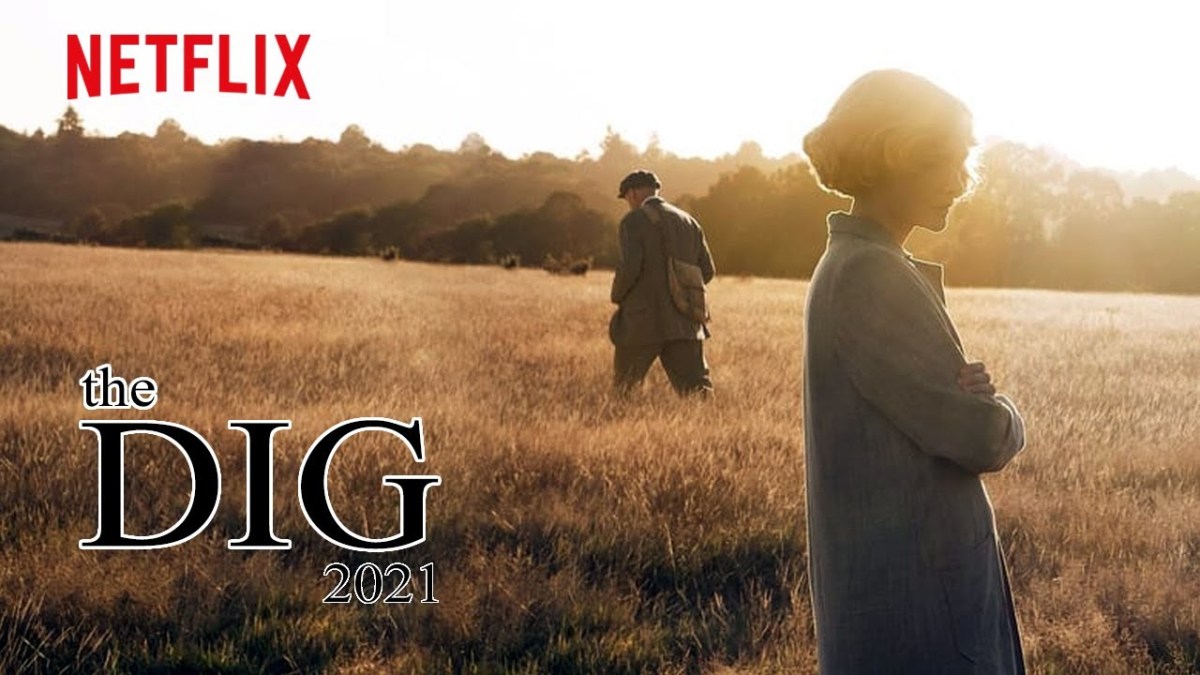
When stuck in a plot hole, crime writer Raymond Chandler used to send in a new character with a gun. Director Simon Stone has employed the same concept, minus weaponry. People just keep turning up in The Dig, adding very little to the story, which in itself, setting aside National Trust hype, is on the slim side. A sixth-century Suffolk burial site (thought it does cast new light on the Dark Ages so we are told) is not in the same archeological class as a velociraptor or an Egyptian tomb. Mostly, we are misled. For the first third it looks like we are heading for Lady Chatterley’s Lover territory with posh lady (Carey Mulligan) eyeing up the digger (Ralph Fiennes) until his wife turns up. Then it looks like it’s going to be a battle royal between Fiennes and the Establishment, but that is headed off.
It’s 1939 so the Second world War is on its way. Cue the arrival of wannabe pilot (Johnny Flynn). A top archaeologist (Ken Stott) also appears but that doesn’t go anywhere either, bringing with him Ben Chaplin and Lily James fresh from their honeymoon. James gets the hots for Johnny Flynn and there’s just enough time before the credits roll for them to get at it.
This is the kind of film that has money to spend on an old WW2 aeroplane or maybe a CGI version of one but not enough for decent sound recording equipment. Most of the time conversations are over the shoulder or in long shot. It’s not just words, it’s expressions, faces that tell a story, and being denied these seems bizarre. It may be an artistic decision, some critic thought we were being made to “dig” for the story. But it’s hard enough to work up any enthusiasm without being made to work harder.
Ralph Fiennes is excellent, a son of the soil, self-taught, but no shrinking violet either. His scenes with posh lady’s son (Archie Barnes) are very touching, the young lad having invented a whole world for himself. Carey Mulligan just looks as though she’s about to burst into tears, probably wondering how she managed to be talked into playing (at age 34) a woman who was actually 56 at the time of the dig and wishing Nicole Kidman and Cate Blanchett (closer to that age) who were at one point attached had not left her to it.
The dig itself is interesting – but only for about five minutes. We know all we need to know about the boring sifting and brushing and digging from other films and we don’t learn more from this except how easy it is for a wall to suddenly collapse and nearly kill someone.
The most intriguing part of the film came at the end when we discovered that the burial ship dug up was buried for the duration of the war in an Underground station in London. How did they manage that, I wondered. Whereas I didn’t wonder much about anything else in this film.
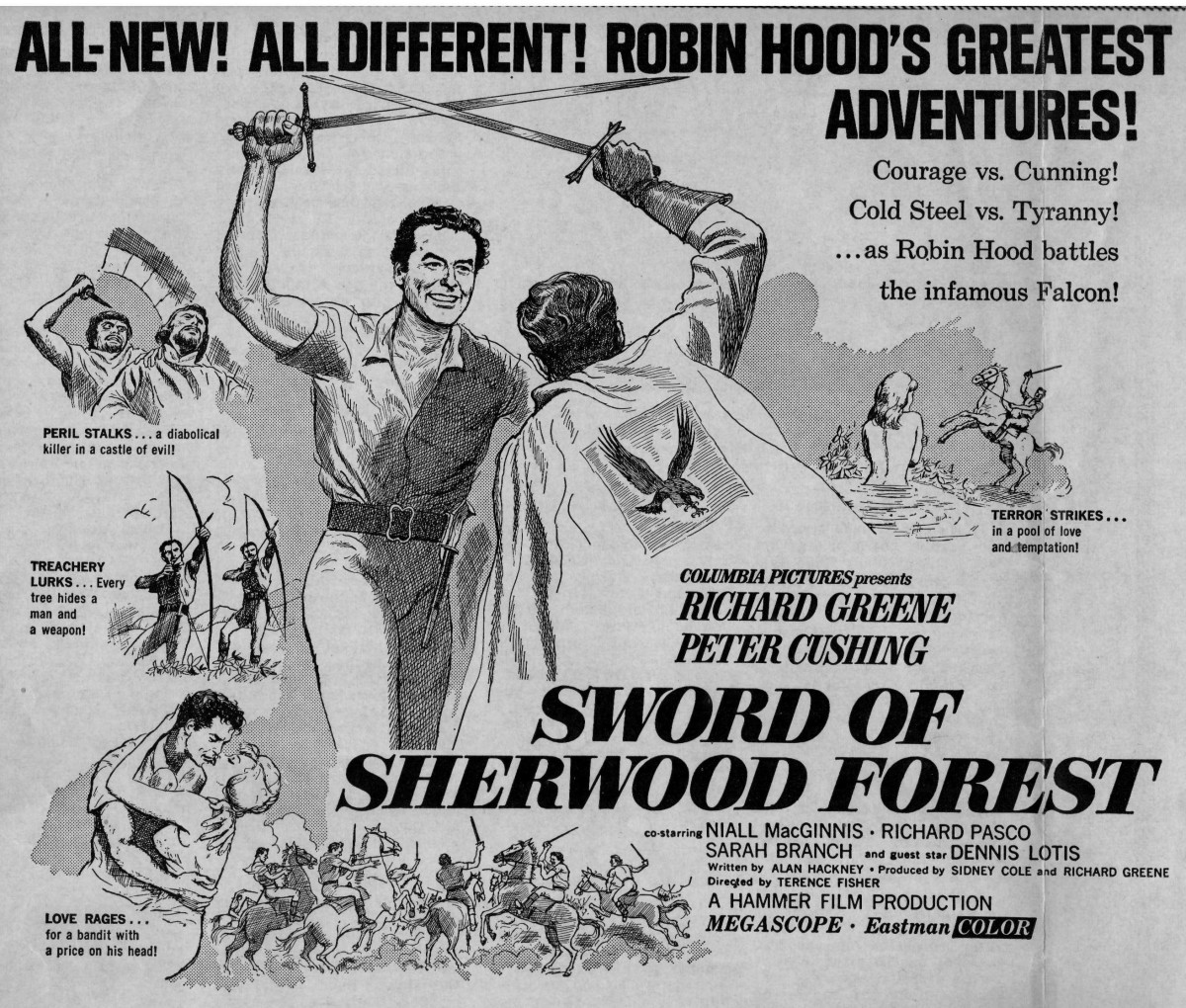
The last swashbuckler to cut a genuine dash was The Crimson Pirate (1952) with an athletic Burt Lancaster romancing Virginia Mayo in a big-budget Hollywood spectacular. The chance of Hollywood ponying up for further offerings of this caliber was remote once television began to cut the swashbuckler genre down to small-screen size. Britain’s ITV network churned out series based on Sir Lancelot, William Tell and The Count of Monte Cristo and 30-minute episodes (143 in all) of The Adventures of Robin Hood. So when Hammer decided to rework the series as a movie, their first port-of-call was series star Richard Greene.
And to encourage television viewers to follow the adventures of their hero on the big screen, Hammer sensibly dumped the small screen’s black-and-white photography in favour of widescreen color and then lit up the canvas at the outset with aerial tracking shots of the glorious bucolic greenery of the English countryside (actually Ireland). Further temptation for staid television viewers came in the form of Maid Marian (Sarah Branch) bathing naked in a lake. Robin Hood is soon hooked.
Sarah Branch was given the cover girl treatment in British fan magazine “Picture Show and TV Mirror” but this preceded “Sword of Sherwood Forest” and instead was for “Sands of the Desert” (1960), a Charlie Drake comedy in which she plays a travel agent kidnapped by a sheik. Branch only made four pictures, with Maid Marian her final film role.
Two main plots run side-by-side. The first is obvious. The Sheriff of Nottingham (Peter Cushing) is quietly defrauding people through legal means. The second takes a while to come to fruition. Robin Hood is hired by for his archery skills by the Earl of Newark (Richard Pasco) – he shoots a pumpkin through a spinning wheel, a moving bell and a bullseye through a slit – before it becomes apparent he is being recruited as an assassin. Oliver Reed and Derren Nesbitt put in uncredited appearances and the usual suspects are played by Niall MacGinnis (as Friar Tuck) and Nigel Green (as Little John).
There is sufficient swordfighting to satisfy. Director Terence Fisher, more at home with the Hammer horror portfolio, demonstrates a facility with action. Richard Greene makes a breezy hero and the picture is ideal matinee entertainment.
Many of the films from the 1960s are to be found free of charge on TCM and Sony Movies and the British Talking Pictures as well as mainstream television channels. Films tend to be licensed to any of the above for a specific period of time so you might find access has disappeared. But if this film is not available through these routes, then here is the link to the DVD and/or streaming service.
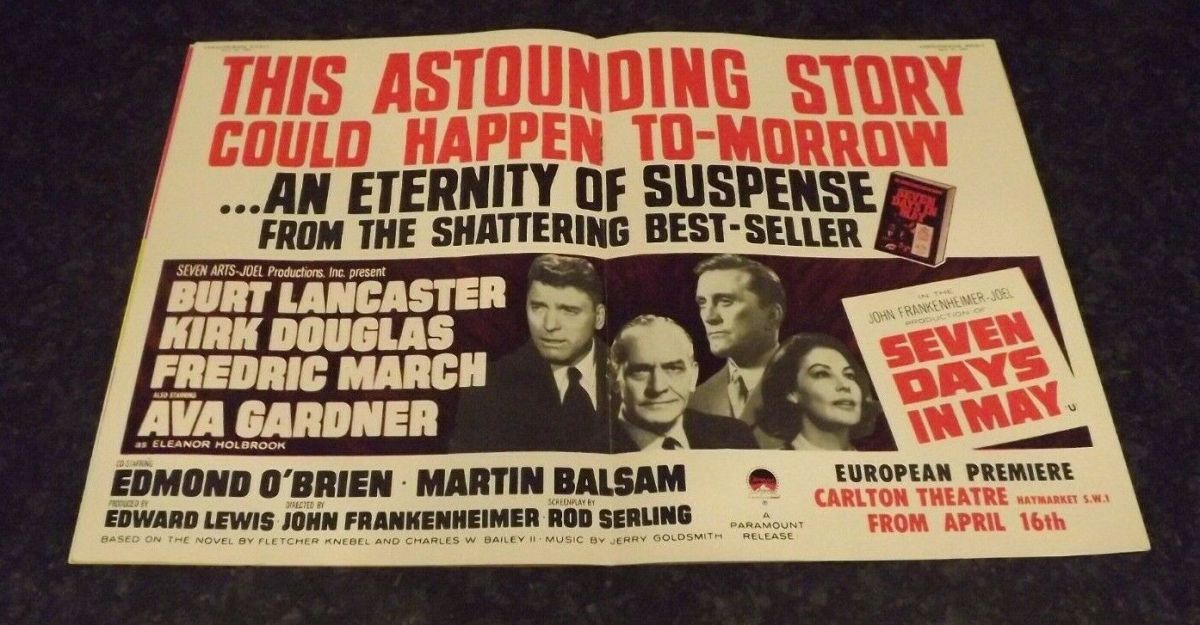
Donald Trump and the recent insurrection bring this picture bang up to date. Democracy is a dangerous weapon in the hands of the people. Can they be trusted to make the correct decision? That’s in part the thematic thrust of this high-octane political thriller that pits two of the greatest actors of their generation in a battle to decide the fate of the world. This was the era of the nuke picture – Dr Strangelove (1962), Fail Safe (1964), The Bedford Incident (1965) – all primed by the real-life Cuban Missile Crisis and the growing threat of the Cold War. But since that threat has never gone away – if anything it has worsened – the movie is as relevant today.
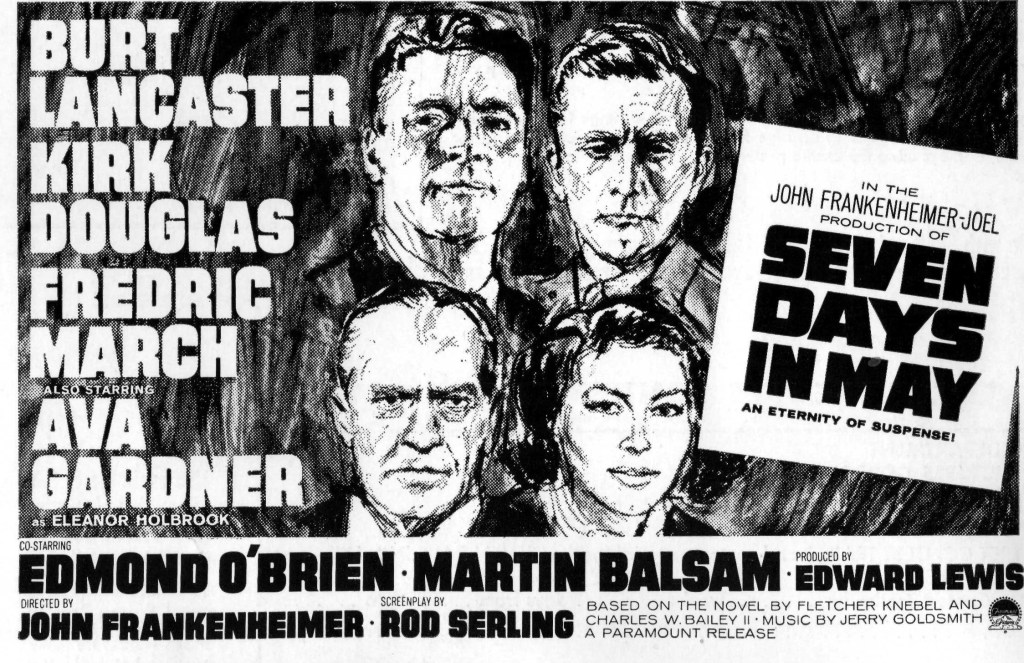
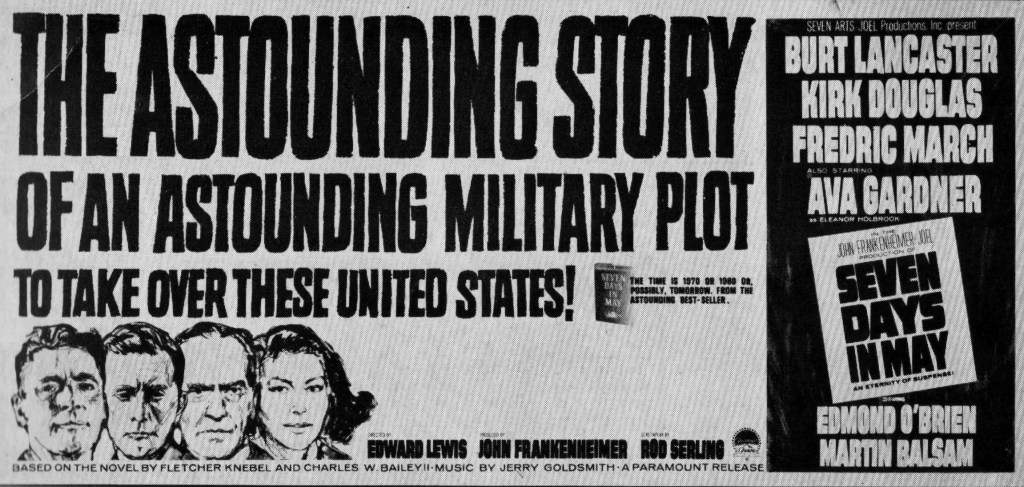
Promoting a male-oriented film about politics was always going to be a hard sell despite the distinguished cast. One route Paramount marketeers went down was a massive tie-in with publisher Bantam’s bestseller paperback . Over 1.5 million copies of the book had been rolled out and Bantam had arranged cross-over publicity in supermarkets, five-and-dime stores, booksellers and wholesalers stocking the book. “Look” magazine ran a six-page article by one of the book’s authors Fletcher Knebel.
Just as the President (Fredric March) is about to sign a nuclear treaty with the USSR, much to the fury of the majority of Americans judging by opinion polls, Colonel Jiggs Casey (Kirk Douglas) uncovers signs of a military coup headed by hawk General James Mattoon Scott (Burt Lancaster).
The movie divides into the classic three acts. In the first, Douglas investigates the existence of a secret army unit in El Paso comprising 3,600 men trained to overthrow the government and needs to persuade the President the country is in danger. The second act sees the President hunting for proof of the imminent coup and identifying the conspirators. The third act witnesses showdowns between March and Lancaster and Lancaster and Douglas.
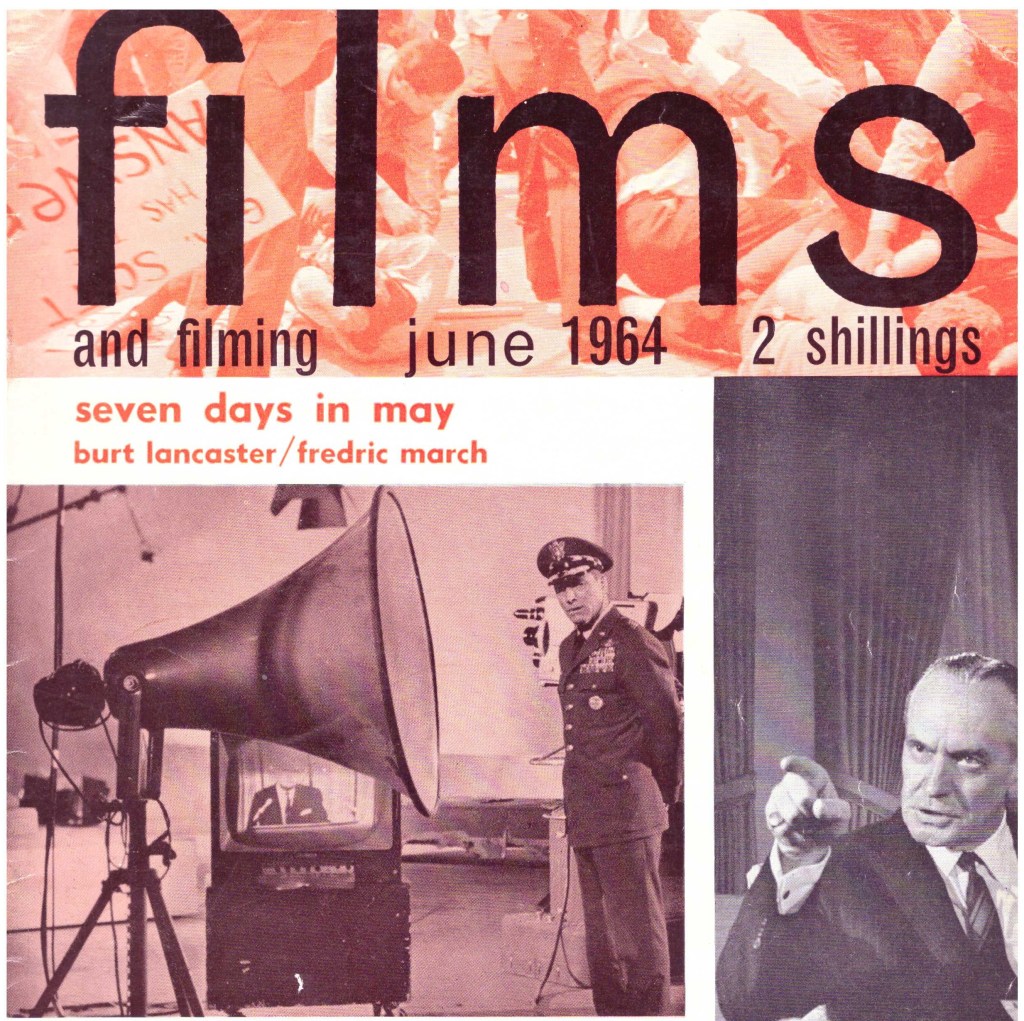
About $65 million out of the U.S. national budget of $90 million was allocated to the military, according to director John Frankenheimer writing in the above magazine. Frankenheimer combined with Kirk Douglas’s company to purchase the book and hire writer Rod Serling. The original script was too long so, without losing a scene, the director went through it cutting phrases and sentences here and there till it was down to the required two-hour length. Paramount put up extra money to get Ava Gardner join the cast.
At the heart of the story is betrayal – Lancaster of his country’s constitution, Douglas of his friend when he takes on the “thankless job of informer.” Douglas proves rather too ruthless, willing to seduce and then betray Ava Gardner, Lancaster’s one-time mistress. Both Gardner and March prove to have higher principles than Douglas. For both Douglas and Lancaster who operate at a high threshold of intensity and could easily have turned in high-octane performances the tension is even better maintained by their apparently initial low-key confrontations. Douglas has a trick here of standing ramrod straight and then turning his head but not his body towards the camera.
As a pure thriller, it works a treat, investigation to prove there is a conspiracy followed by the the vital element to conspiracy theory – the deaths and disappearances of vital people – and finally the need to resolve the crisis without creating public outcry. The only flaw in the movie’s structure is that Douglas cannot carry out all the investigations and when presidential sidekicks Martin Balsam and Edmond O’Brien are dispatched, respectively, to Gibralter and El Paso the movie loses some of its intensity. But the third act is a stunner as March refuses to take the easy way out by blackmailing Lancaster over his previous relationship with Gardner.
Of course, there is a ton of political infighting and philosophizing in equal measure and speeches about democracy (“ask for a mandate at the ballot box, don’t steal it”), the American Constitution and the impact of nuclear weapons on humanity. But these verbal volleys are far from long-winded and pack a surefire punch. The coup has been set up with military precision and must be dismantled by political precision.
A hint of the future: one unusual aspect of the picture was the use of closed-circuit television which was seen as being used as method of general communication between politicians and the Pentagon.
The film is awash with Oscar talent – Burt Lancaster, Best Actor for Elmer Gantry (1960) and, at that point, twice nominated; thrice-nominated Kirk Douglas; Fredric March, twice Best Actor for Dr Jekyll and Mr Hyde (1931) and The Best Years of Our Lives (1946) plus three other nominations besides; Ava Gardner nominated for Best Actress (Mogambo, 1953); and Edmond O’Brien named Best Supporting Actor for The Barefoot Contessa (1954).
None disappoint. March is especially impressive as a weak President tumbling in the polls who has to reach deep to fight a heavyweight adversary. Lancaster and Douglas both bristle with authority. Although Lancaster’s delusional self-belief appears to give him the edge in the acting stakes, Douglas’s ruthless manipulation of a vulnerable Ava Gardner provides him with the better material. Edmond O’Brien as an old soak whose alcoholism marks him out as an easy target is also memorable and Ava Gardner in recognizing her frailties delivers a sympathetic performance.
Fashion might have seemed to offer limited marketing opportunities for such a picture but that did not stop Paramount’s publicists. On the back of one of the subsidiary characters being seen combing her hair with an Ajax comb the manufacturer was inveigled into a nationwide campaign. Director John Frankenheimer was pictured wearing a custom-made Cardinal suit in an advert in “Gentlemen’s Quarterly” and designer Mollie Parnis created a suit for women which could be simply altered every day to provide enough outfits for seven days.
Rod Serling (The Twilight Zone) does a terrific job of distilling a door-stopper of a book by Fletcher Knebel and Charles W. Bailey II. But the greatest kudos must go to director John Frankenheimer – acquainted with political opportunism through The Manchurian Candidate (1962) and with Burt Lancaster through The Birdman of Alcatraz (1962) – for keeping tension to the forefront and resisting the temptation to slide into political ideology.
Many of the films from the 1960s are to be found free of charge on TCM and Sony Movies and the British Talking Pictures as well as mainstream television channels. But if this film is not available through these routes, then here is the link to the DVD and/or streaming service.
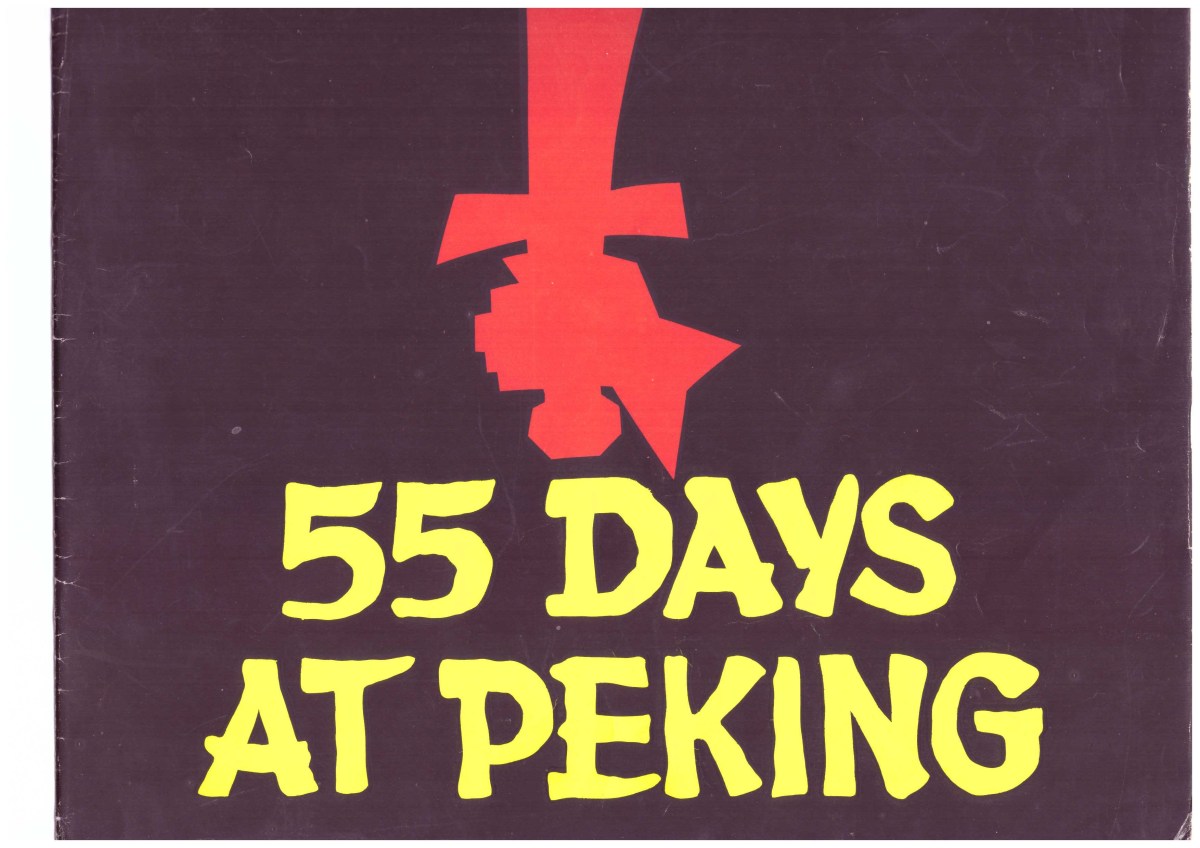
Imperialism is hard to stomach these days but at the start of the twentieth century it was rampant and as shown in this picture not just restricted to the main culprit, the British. China was Imperialism Central, round about a dozen nations including the USA and Russia claiming control of sections of the country or its produce. So they had all set up diplomatic shop in Peking. And the film begins with an early morning roll call of national anthems before this domination by outside interests in shattered by rebellion.
Just as hard to stomach, of course, was the movie mainstream notion in those days that all rebellions must perforce be put down regardless of how put-upon the peasant classes were. Audiences had to rally round people in other circumstances they would naturally hate. So one of the problems of 55 Days at Peking is to cast the rebels (known as Boxers) and the complicit Chinese government in a bad light while ensuring that those under siege are not seen as cast-iron saints. There’s no getting round the fact that the rebels are shown as prone to butchery and slaughter while the Chinese rulers are considered ineffective and traitorous.
Producer Samuel Bronston built his Peking set on a 250-acre site at a ranch 16 miles from Madrid, Spain, near the foot of the Sierra Guadarrama mountains. To ensure authenticity, a canal was enlarged to supply 15,000 gallons of water a day from a specially-prepared reservoir holding half a million gallons. Over 1.3 million feet of tubular steel – all the scaffolding available in Madrid, Barcelona, Seville and Valencia – was used in the set construction.
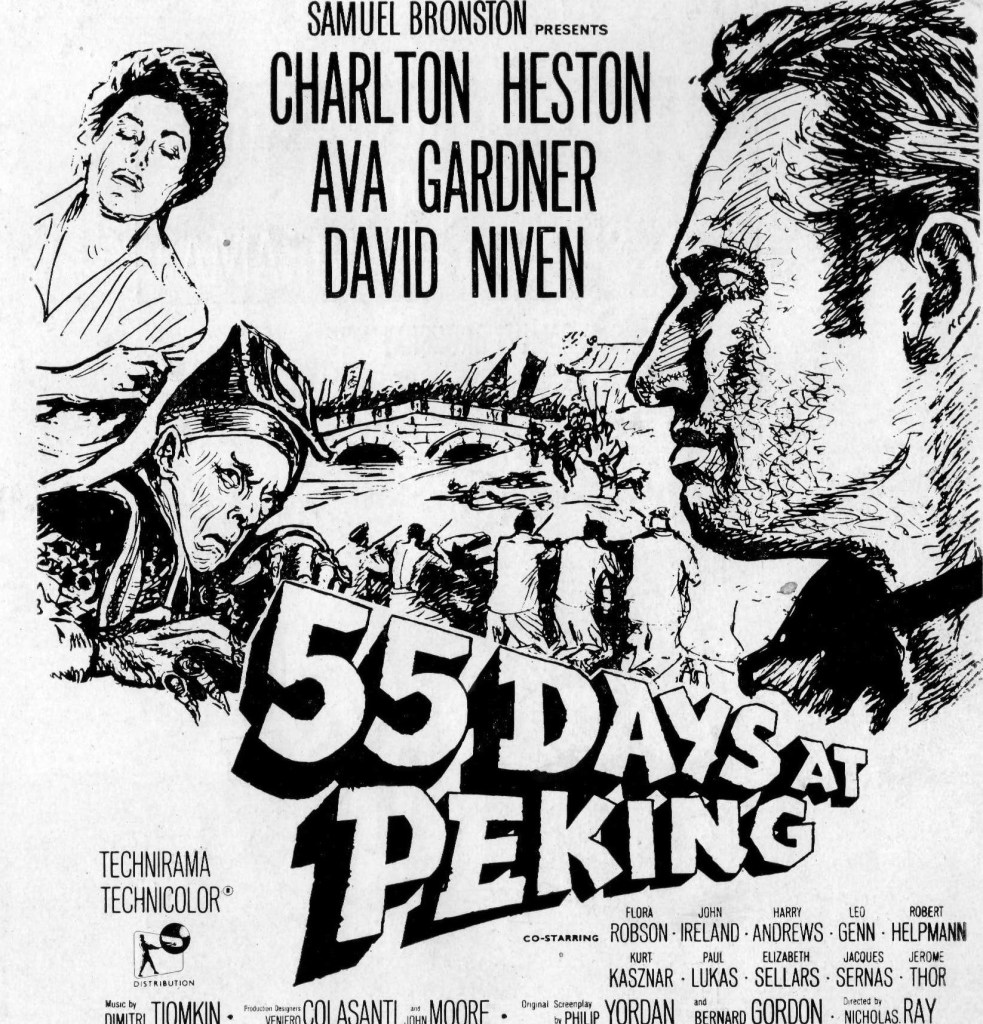
So it’s left to the likes of Charlton Heston as the leader of U.S. Marines stationed in the city to bring some balance to proceedings. “Don’t get the idea you’re better than these people because they can’t speak English,” he expounds. David Niven plays the British Consul trying to keep this particular league of nations onside while negotiating with one hand tied behind his back – “we must play this game by Chinese rules” – with the Chinese Dowager Empress (Flora Robson) while knowingly endangering his wife (Scottish actress Elizabeth Sellars, a one-time big British star) and two children. Ava Gardner is an unscrupulous Russian baroness with little loyalty to her home country.
To ensure journalists provided authentic coverage of the siege, press materials included a copy of the detailed map printed in the Saturday October 13, 1900, edition of British daily newspaper “The Times” and its account of the action. Producer Samuel Bronston claimed that some of the costumes worn by Flora Robson in her role as the Dowager Empress were actual ones worn by the empress and purchased from an Italian family who had connections in the Italian embassy during the siege.
The picture is one-part action, one-part politics and one-part domesticity, if you include in the last section Heston’s romance with Gardner, Niven’s guilt when his son is wounded in an attack and Heston’s conflict over a young native girl (Lynne Sue Moon) fathered by one of his own men who is then killed. Two of the best scenes are these men coping with parental obligation, Niven coping with a wounded son, Heston finding it impossible to offer succour to the child.
The action is extremely well-handled. The siege goes on longer than expected when the expected troops fail to arrive, tension rising as casualties mount and supplies fall low. As with the best battle pictures, clever maneuvers save the day. Two sections are outstanding. The first has Heston marshalling artillery to prevent the Chinese gaining the high ground. The second is a daring raid – Niven’s idea, actually – through the city’s sewers on the enemy’s ammunition dump. Personal heroism is limited – Heston volunteers to go 70 miles through enemy territory to get help but has to turn back when his men are wounded or killed.
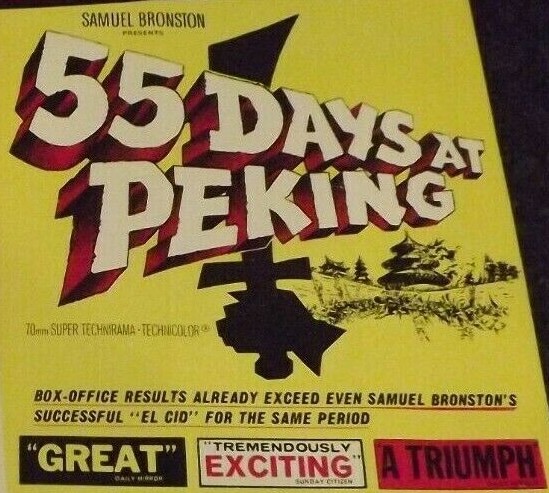
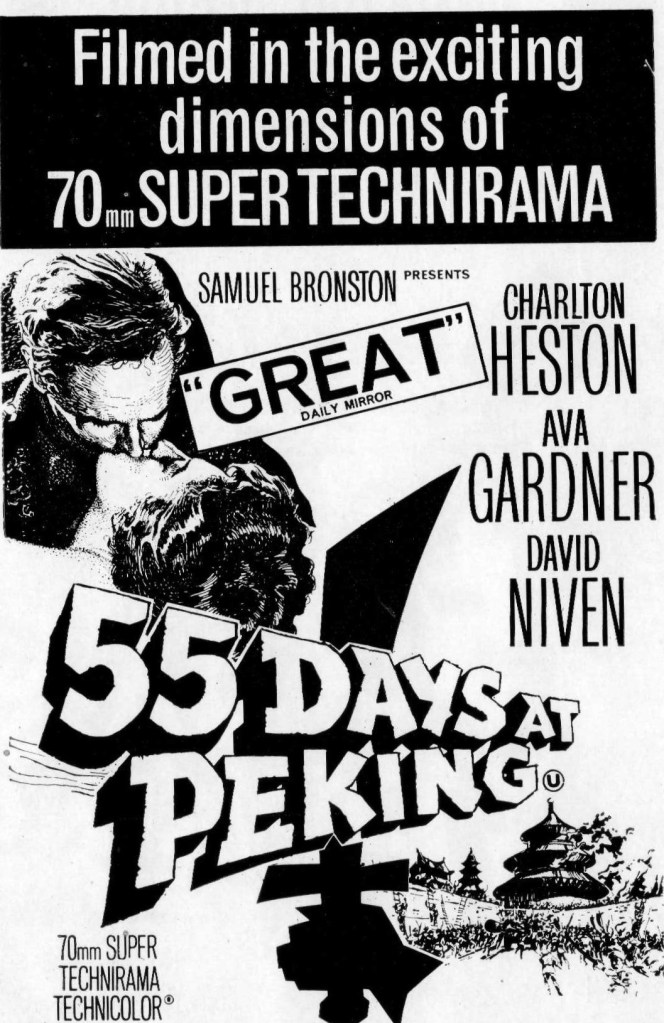
The film was not released in 70mm roadshow in the United States as originally planned but like “El Cid” went straight into general release in a 35mm version. but it was seen in 70mm in Europe. Among suggested promotional activities were a “guess-the-flag” competition since 11 nations were involved. The tie-ins included a Corgi paperback, the original soundtrack by Dmitri Tiomkin and four singles – Andy Williams singing the theme song “So Little Time,” The Brothers Four with “55 Days at Peking” (also recorded by Kenny Ball and his Jazzmen) and Tommy Riley with “Peking Theme.”
There’s a fair bit of stiff upper lip but while Heston, in familiar chest-baring mode, has Gardner to distract him, Niven is both clever, constantly having to outwit the opposition and hold the other diplomats together, and humane, drawn into desperation at the prospect of his comatose son dying without ever having visited England. Gardner moves from seducer to sly traitorous devil to angel of mercy, shifting out of her beautiful outfits and glamorous hats to don a nurse’s uniform, at the same time as shifting her outlook from selfish to unselfish. All three stars acquit themselves well as does Flora Robson in a thankless role.
This was the third of maverick producer Samuel Bronston’s big-budget epics after King of Kings (1961) and El Cid (1961) with a script as usual from Philip Yordan and directed by Nicholas Ray.
All in all it is a decent film and does not get bogged down in politics and the characters do come alive but at the back of your mind you can’t help thinking this is the wrong mindset, in retrospect, for the basis of a picture.
Many of the films from the 1960s are to be found free of charge on TCM and Sony Movies and the British Talking Pictures as well as mainstream television channels. This one I noticed is available on YouTube at the point where I was reviewing it. But if this film is not available through these routes, then here is the link to the DVD and/or streaming service.
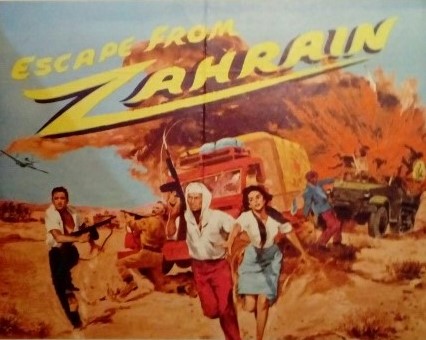
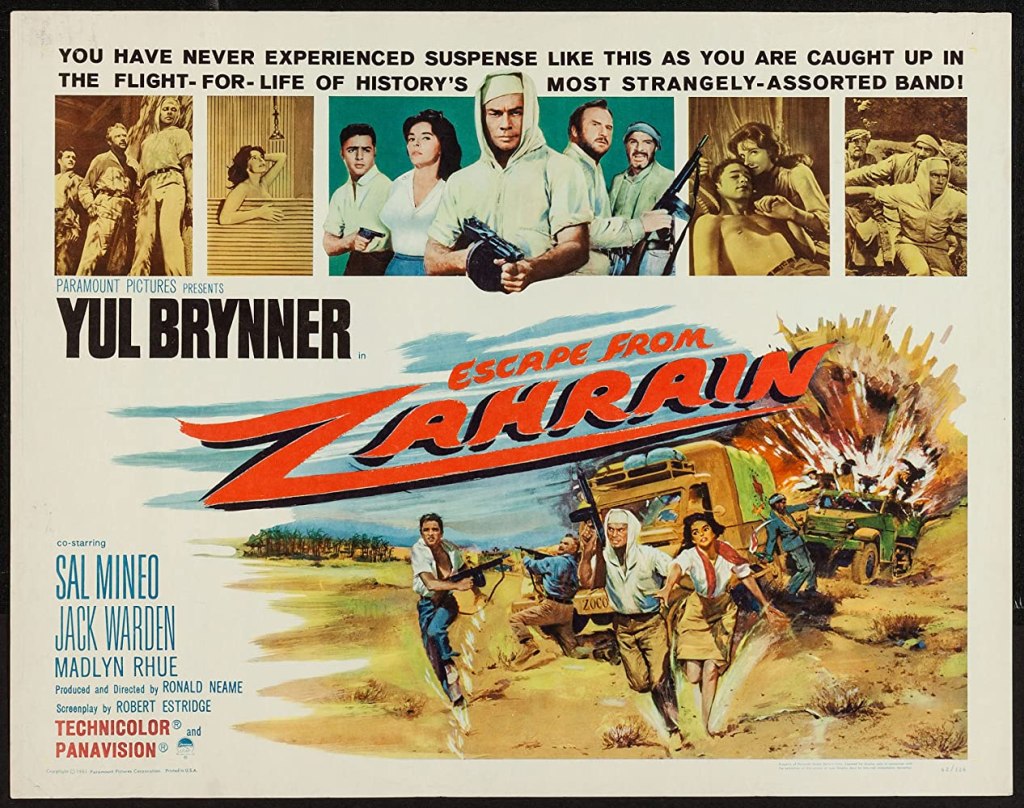
After being attacked by armored cars and strafed by airplanes, stranded in the desert, and overcome various tensions within the small group of escapees, there is still considerable life left in this picture at the end as Jack Warden, making his departure, comes up with a classic last line: “We must do this again sometime.”
In truth, the picture has far more going for it than a mere outline would suggest. In rescuing rebel leader Yul Brynner from a lorry bound for jail, the escapees led by Sal Mineo (Exodus, 1960) in a stolen ambulance also scoop up three convicts including American fraudster and loudmouth Jack Warden (That Kind of Woman, 1959) and all-purpose thug Anthony Caruso (a television regular) plus a nurse Madhlyn Rhue (A Majority of One, 1961) as a hostage. Like most desert films, the storyline is on who will survive and how.
Action is one constant. The threat of failure is another. Supplies are rationed and, of course, someone steals more than their fair share. The members regularly switch allegiance. At various points someone is about to give up Yul Brynner. Their gas tank is punctured so, thanks to Warden’s engineering skills, they just make it to a remote pumping station where James Mason pops up in a cameo as a maintenance man. Their numbers diminish and despite his recalcitrance Warden’s engineering skills save them again when they reach an oasis.
This was originally intended as a starring vehicle for Clark Gable with Edward Dmytryk in the director’s chair.
What makes the film different is that the characters all change. In a country where “half the wealth is stolen by Europeans and half by corruption,” Brynner is the altruistic leader whose ideals are shattered. Rhue, a Muslim, drinks alcohol and questions the number of deaths necessary for a revolution but declines to leave when the opportunity arises. Mineo who thinks “women should be as free as men” reacts badly when Rhue enjoys such freedom. Warden, who has embezzled $200,000, and has loyalty to no one stands by the shambolic crew.
I had always believed Brynner had enjoyed a rare case of beginner’s luck when he won the Oscar for his debut in The King and I (1956) and that once Hollywood became wise to his acting schtick he would never be nominated again – as proved the case. But after watching Brynner in The Magnificent Seven (1960) and its sequel and Invitation to a Gunfighter (1964) and Flight to Ashiya (1964) I have become convinced he is under-rated as an actor. He acts with his eyes and his delivery is far more varied than I had supposed. Here, clothed in Arab costume, there is no bald pate to distract.
British director Ronald Neame (Tunes of Glory, 1960) holds the enterprise together, keeping to a tidy pace but allowing tension and character to emerge.
Many of the films from the 1960s are to be found free of charge on TCM and Sony Movies and the British Talking Pictures as well as mainstream television channels. Films tend to be licensed to any of the above for a specific period of time so you might find access has disappeared. But if this film is not available through these routes, then here is the link to the DVD and/or streaming service.





 The Magnificent 60s