Roofman (2025) **

This sounds like one of those scams you’re always reading about. Too-good-to-be-true handsome hunk Jeffrey Manchester (Channing Tatum) arrives in the life of struggling single mom Leigh (Kirsten Dunst). Only difference is he’s not ripping her off for cash, but demolishing her emotions and the faith in goodness of her two innocent kids, Jade (Kirana Kulic) and Joselyn (Gabriella Cila).

Another movie glorifying some dude you’ve never heard of, just because, at least in the movie version, he’s cute to the point of goofyness and for some reason has been left behind by society. And like Smashing Machine (2025), there’s virtually no narrative to hang onto or even that makes sense, beyond the delusion inflicted on the God-fearing family who can’t see past the armloads of gifts and fall too easily for the notion that’s he’s some kind of undercover government agent.

Maybe you can live for six months on peanut M&Ms, great piece of promotion for M&Ms should that be the case, and maybe the manager, Mitch (Peter Dinklage),  of the Toys’R’Us store you’re hiding out in is so dumb he doesn’t realize boxes and boxes of the stuff is leaving the store without registering on his till. Or that his store is also being looted of all its computer game inventory.

And it’s true that Jeffrey has an unusual set of skills, and that if he stopped stealing for a moment and found an ordinary job anywhere someone would soon cotton on the fact that he’s a walking encyclopedia of observation and surely it wouldn’t be long before he could bring added-value to any business simply by pointing out such facts.

You could start off with the fact that he’s found a weak spot in the security of most businesses. Most stores have ample security at the front, but nobody’s given a thought to how accessible they might be from the roof for a guy armed with little more than a hammer.

But, wait, Jeffrey isn’t a bad guy’s bad guy, he’d be rejected by the likes of Martin Scorsese, he’s only turning to crime because he can’t afford to buy a bike for his kid. So bringing those observation skills to the fore, he works out that McDonalds is relatively easy prey and before he’s caught he’s collected tens of thousands of dollars in his own version of Happy Meals.

In prison he turns once more to his specific set of skills and in the only interesting scene in the entire picture escapes through an ingenious method, then holes up in a Toys’R’Us where he constructs a little hidey-hole, switches off the security alarms (another set of skills), and comes out to play every night when the store is closed.

Mitch is a hardass and makes life hard for that nice single mom Leigh so Jeffrey intervenes and amends her work schedule to better suit her domestic life. And when Mitch refuses to pony up with a donation for the toy charity event she’s hosting at the local church, Jeffrey steps in.

You wouldn’t know it but these little churches are packed full of single moms just gagging for it. No sooner has Leigh coaxed our hero out on a date than she’s having first-date sex and then, armed with armfuls of gifts, he’s pretty much invading the home, younger daughter delighted with his attention, older daughter a tougher nut to crack.

Are you still interested? I wasn’t. I sat there like a member of the famed Disgruntled Audience, wondering what made anyone imagine this no-story story was worth a good two hours of my time.

So criminals are actually ordinary guys at heart, wanting a home life like the rest of us, and not all going around abusing their wives or beating up on their kids of sitting home stoned?

That’s about as much insight as we’re going to get as long as we (the audience) go in for the delusion that it’s somehow going to have a happy ending.

I’m reminded of the Richard Pryor character in one of the Superman pictures who, despite some genius, was so dumb he was always going to get caught and couldn’t think of a single way outside of criminality to find a home for his set of special skills.

Sure, Channing Tatum (Blink Twice, 2024) is watchable but soon wears out his welcome in  a tale that doesn’t go anywhere fast and Kirsten Dunst’s (Civil War, 2024) character has some surprising aspects. But really?

Derek Cianfrance has a decent track record for interesting drama – Blue Valentine (2010), The Place Beyond the Pines (2012) and The Light Between Oceans (2026) – but this is a serious miscalculation of audience endurance. Kirt Gunn (Lovely By Surprise, 2007) wrote it.

Dud.

Sands of the Kalahari (1965) ****

You know the score: plane crashes in inhospitable territory (in this case a desert), personalities clash as food/water is rationed, tempers run high and/or depression sets in as attempts to attract attention fail, someone goes for help, someone else has an ingenious idea and eventually everyone rallies round in common cause. That template worked fine in The Flight of the Phoenix (1965).

It doesn’t here. This is not quite as inhospitable. There is water. Caves offer shelter from the blazing sun. There is food – lizards trapped, game hunted with telescopic rifle. But the food is lean, not fattened through farming for human consumption.  And you have to watch out for marauding baboons not to mention scorpions. And this group is split, two alpha males intent on exerting dominance with little interest in common cause.

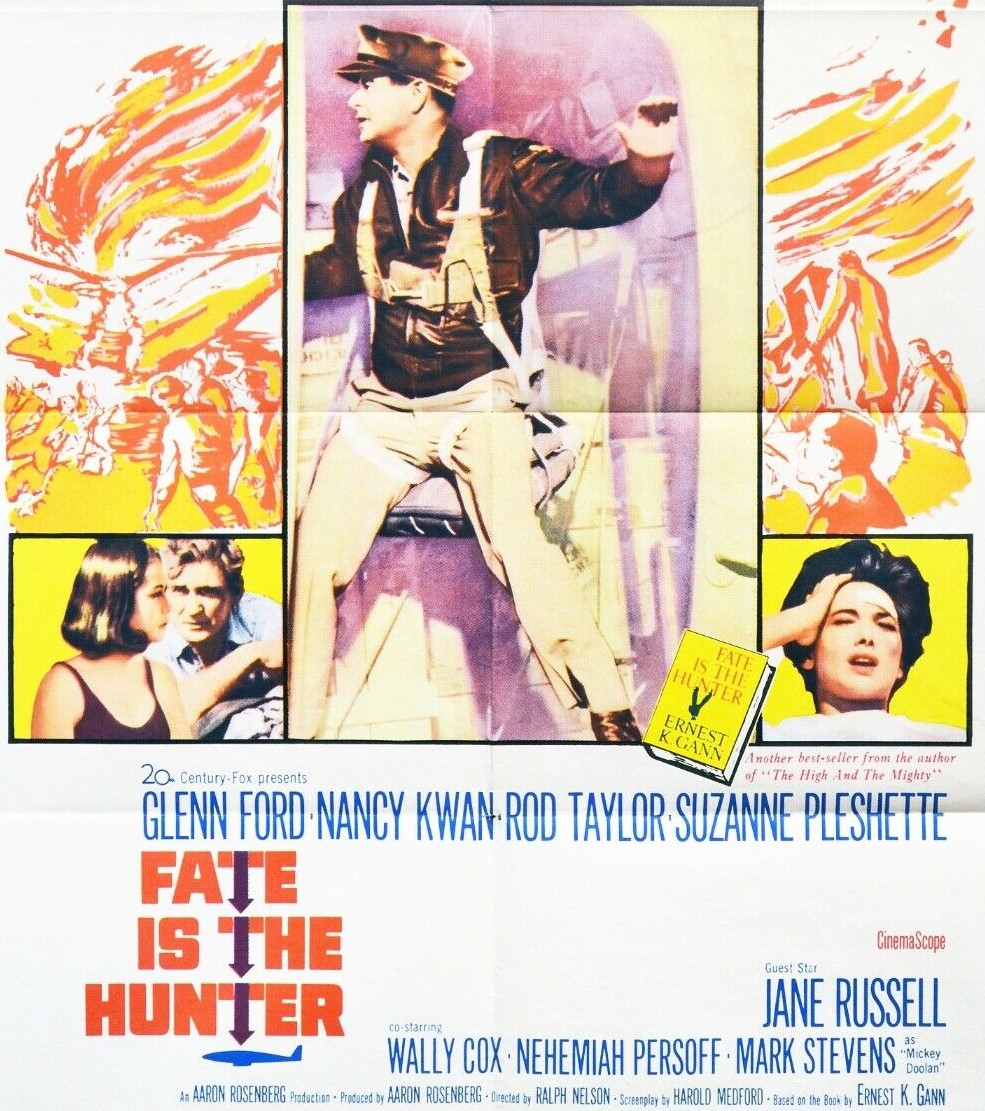
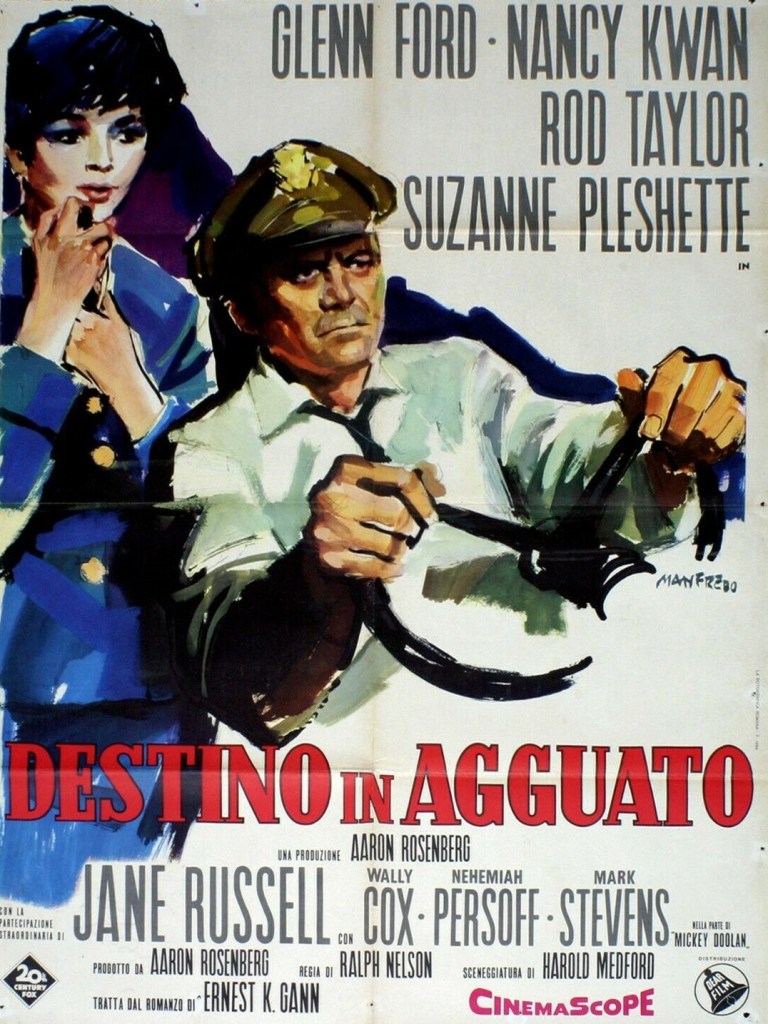
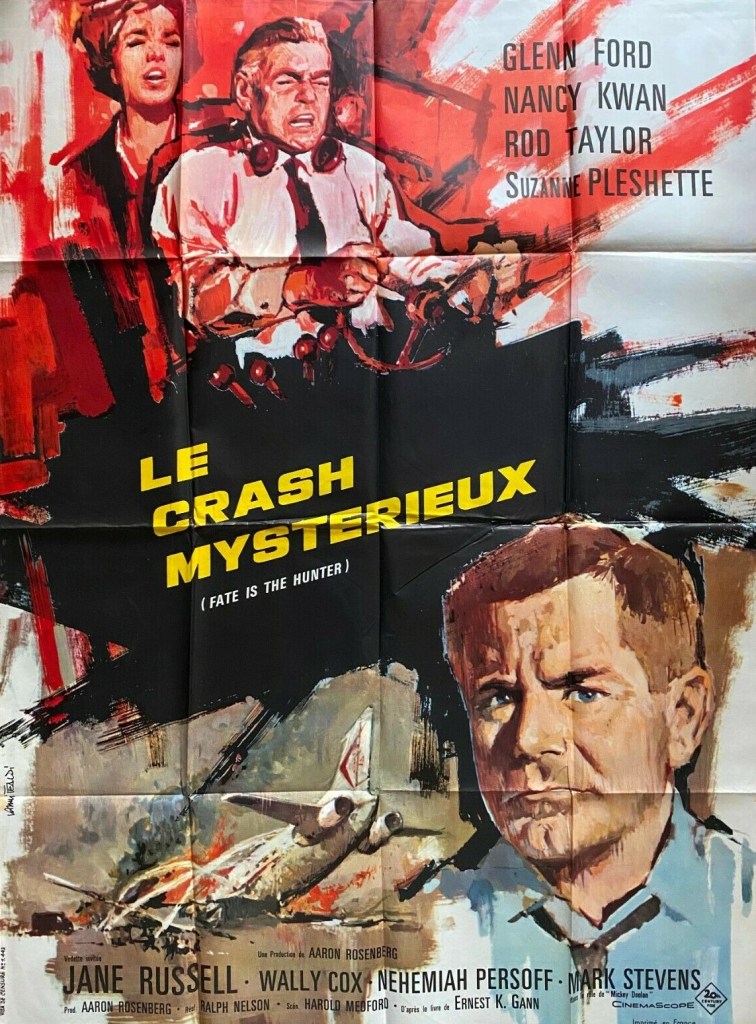
Producer Joseph E. Levine came up with the poster
without close examination of the picture’s content.

Of the six survivors of this crash, Sturdevan (Nigel Davenport) decides his leadership status entitles him to sole claim over the only woman, Grace (Susannah York). But when he accepts the genuine responsibilities of leadership, he sets off across the desert to get help. That leaves Grace to fall into the hands of O’Brien (Stuart Whitman), so alpha he could be auditioning for Tarzan, shirt off all the time.

It soon transpires O’Brien has a rather unusual idea of survival – getting rid of his companions so that he will have no shortage of food until rescue arrives. It takes a while for the others to catch on to his plan. And then rather than common cause and camaraderie, it becomes every man/woman for himself, a battle for individual survival, a return to the primeval.

The most likely challenger to O’Brien’s authority is Bain (Stanley Baker), but he has been badly injured in the crash and no match for the other man’s brawn or his weapon. So it becomes a game of cat and mouse. Except it’s in the desert, it’s the law of the jungle and the rule of autocracy brought home with sudden force to people accustomed to the comforts of civilization and democracy.  

The movie’s structure initially takes us down the obvious route of common purpose – Grimmelman (Harry Andrews) knows enough survival lore to devise a method of water transportation that would permit the group to escape the desert, Dr Bondrachai (Theodore Bikel) formulates  a method of trapping lizards, and O’Brien, at least at first, appears willing to take on the role of protector, warding off baboons with his gun.

The change into something different is subtle. While the others are desperate to escape, it becomes apparent that O’Brien has found his metier. We discover little about the lives of each individual prior to being stranded. Whatever O’Brien’s standing in society, it would not have been as high as here, where his superior skills stand out. Reveling in his supremacy, he doesn’t particularly want to go home.

Like any psychopath Bain knows how to manipulate so at first it seems his decisions are for the greater good. And only gradually does it emerge that he blames others for his own mistakes and intends to eliminate his rivals for the food supply one by one. Because he is so handsome, it is impossible to believe he could be so devious or so evil.

The three principals all play against type. Stanley Baker (Zulu, 1963) and Stuart Whitman (Murder Inc., 1960) made their names playing heroic types. Here Baker is too ill for most of the picture to do any good and Whitman plays a ruthless killer. But Susannah York (Sebastian, 1968) is the big revelation. Audiences accustomed to her playing glamorous, perhaps occasionally feisty, gals will hardly recognize this portrayal of a coward, not just abjectly surrendering to the alpha male but seeking him out for protection and guilty of betrayal.

Even though this picture is set in the days before gender equality and the independent woman was a rarity, Grace’s acquiescence to the powerful male is disturbing, in part because it takes us back to the days when a woman was impotent in the face of male dominance. Such is York’s acting skill that rather than despise this woman, she earns our sympathy.

While for the most part Harry Andrews (Danger Route, 1967) and Nigel Davenport  (Sebastian, 1968) appear in their usual screen personas of strong males, here their characters both are changed by the circumstances. Theodore Bikel (A Dog of Flanders, 1960) has the most interesting supporting role, the only one who takes delight in the adventure.

Director Cy Endfield (Zulu) – who also wrote the screenplay based on the William Mulvehill novel – delivers a spare picture. There is virtually no music, just image. Aerial shots show tiny figures in a landscape. The absence of character background frames the story in the present. As a reflection on the animal instinct, how close to the primordial a human being still operates, no matter how enlightened, this works exceptionally well, and melds allegory with thriller.

Birdman of Alcatraz (1962) ****

It always helps a prison picture if your character has been wrongfully convicted (The Shawshank Redemption, 1994) or is incarcerated through an unfortunately set of circumstances including self-destructive tendencies (Cool Hand Luke, 1967). Whatever the case, the malevolence of the wardens or the emergence of his own engaging personality will ensure that your character is sprinkled with enough sympathy to transform into our hero.

But that’s not the case here and it takes a strong chunk of bravura acting from Burt Lancaster (Elmer Gantry, 1960) to pull this off.

Oddly, this works in the main not because it’s your typical prison picture with endless confrontations with guards and preventing your dignity being sliced and diced by a ton of humiliating actions. Walt Disney couldn’t have done a better job of hooking the audience with its nature true-life approach. I guarantee you will be chuckling to watch a newborn chick trying to shuck off the top half of its egg.

Robert Stroud (Burt Lancaster), a pimp, was certainly no innocent, a two-time killer, who only escapes execution through the efforts of his mother (Thelma Ritter) in persuading U.S. President Woodrow Wilson to commute his sentence. However, there is an evil Catch-22 which infuriated prison governor Harvey Shoemaker (Karl Malden) invokes. While awaiting sentence, and assuming execution is inevitable because he murdered a prison guard in front of hundreds of witnesses, the local judge has decreed that Stroud should be kept in solitary confinement.

Shoemaker, nettled by Stroud’s defiance, interprets that as being able to keep the prisoner in solitary confinement for the rest of his term – which amounts, as it happens, to 40 years. None of this bugs Stroud that much. He’s averse to human companionship, as likely to bully a cellmate and cause ructions elsewhere, and certainly not ever going to give in to the prison system with its endless rules.

The marketeers have taken some liberties with the title. But Alcatraz is certainly a bigger lure to moviegoers than Leavenworth. By the time Stroud reaches Alcatraz he’s devoid of birds. All the breeding activity takes place in Leavenworth.

And while there are aspects of Stroud’s character you will never warm to, he’s got us hooked the minute he embarks on the bird breeding, in part because it’s the antithesis of his character to be so humane, and in part because the dedication involved in painstakingly building cages or other toys (a little wooden chariot a bird is taught to drive) from nothing but wooden boxes with rudimentary tools he has fashioned himself is wondrous to behold. That section of the movie is just enthralling.

Although he’s rescued a chick from a broken nest that lands in the prisoner courtyard during a storm, it takes him a while to cotton on that the bird needs fed, which he does with his version of a toothpick. He coaxes the frightened bird to fly and eventually starts breeding the damn things, persuading a new governor to allow him to buy birdseed and encourages his hobby, so much so that after extensive study Stroud becomes a noted ornithologist with a couple of publications to his name. His case became widely known after a bird researcher Stella Johnson (Betty Field) publicizes his activities and eventually marries him.

But when he’s shifted to Alcatraz, he encounters Shoemaker who forbids the birds. So Stroud starts to write a history of the U.S. penal system. Despite being prone to violence, he is instrumental in ending a prisoner uprising. He is never released, despite various petitions.

So while there’s no happy ending it’s an absorbing picture. Burt Lancaster is at the top of his form, winning another Oscar nomination. Telly Savalas (Crooks and Coronets, 1969), playing another prisoner, was also nominated. Karl Malden (One Eyed Jacks, 1961) is an excellent foil and any time Thelma Ritter (A New Kind of Love, 1963) pops up she steals the show.

While it’s on the long side for a prison picture and lacks the epic quality that the 150-minute running time would suggest, director John Frankenheimer (The Manchurian Candidate, 1962) takes an almost documentary approach to his subject. You might call it an intimate epic. Screenplay by Guy Trosper (The Spy Who Came in from the Cold, 1965) from the book by Thomas E. Gaddis.

Standout show from Lancaster.

The Sins of Rachel Cade (1961) ***

In her first top-billed role Angie Dickinson (Jessica, 1962) delivers a strong performance as an American nurse/missionary in the Belgian Congo at the start of the Second World War. The usual Hollywood trope of “heathens” needing to be educated by imperialists – from The Bitter Tea of General Yen (1933) and The Keys of the Kingdom (1944) through to The Nun’s Story (1959) – was to some extent turned on its head here.

Just as Rachel Cade (Angie Dickinson) arrives at a hospital in a small village, resident Dr Bikel  (Douglas Spencer) dies. Not only does the hospital have no patients, the local Belgian commissioner Col Derod (Peter Finch) wants her to leave, believing her presence will act as provocation to the local high priest Kalanumu (Juano Hernandez) and witch doctor Muwango (Woody Strode). After standing up to all three, Rachel embarks on refurbishment of the hospital aided by assistant Kulu (Errol John).

Patients remain non-existent until she cures a small boy of appendicitis, as a result of which Muwango places a curse on her that she will lose her Protestant faith and promises the local god will take his revenge on anyone who supports her. Of course, her skills are not infinite and not only is there another boy who dies in her care but she cannot cure – and does not attempt to cure – the infertile third wife of the local chief.

While she warms to her patients and they to her, she cannot come to terms with their acceptance of incest (if a husband is called away, his brother must make love to his wife), polygamy, vaginal mutilation, the sexuality of their dancing and the fact that sin does not exist in their culture. Meanwhile, she distrusts the visions seen by the most convinced of her converts, Kulu.    

When the sexually repressed Rachel rejects Derod’s advances in favour of the  dashing but money-oriented Dr Paul Winton (Roger Moore), thus violating her own teachings, she becomes enmeshed by the principles she holds so dearly and which the Africans refute. A twist in the tale pivots the picture on whom she will marry, the sensible Derod, the cavalier Winton, or retain her own independence in defiance of the standards of the time.  

A battle of the hierarchies – the female nurse and her supporters versus male supremacy – maintains the tension but underneath is a philosophical struggle between the two faiths. The Christian religion which boasts of forgiveness is in the end unforgiving of those who break its moral code, while the African religion does not force onto its believers such ludicrous rules. On top of that is Rachel’s acceptance of her own passion, the realization that love cannot be restrained by commandment, and that men are more likely to betray her.

The reality of imperialist rule is not underplayed but since this predates the Mau Mau uprising in Kenya in the 1950s that precipitated widespread rebellion and Derod can call on soldiers for protection in the Belgian colony and is in fact a generally tolerant (though at times patronising) overseer, political issues remain in the background.

Angie Dickinson gets the movie star build-up in this British trade advertisement.

Director Gordon Douglas (Claudelle Inglish, 1961) keeps the focus on the transition of the naïve American while not ignoring nor appearing to ridicule the rituals and beliefs of the tribe – although a cynic might consider that the sexuality of the dancing, while repellant to Rachel, might be included more with an eye to attracting an audience. Overall, it appears an honest even-sided presentation, with the high priest getting the better of Rachel in arguments over the frailties of Christianity. Angie Dickinson brings conviction to a role that sees her start out a shade saintly until brought back down to earth by human weakness. Peter Finch, by coincidence the leading man to Audrey Hepburn role in The Nun’s Story, fills out his normal stoic screen personality with touches of grief. Roger Moore (Vendetta for the Saint, 1969) had not yet mastered the art of the raised eyebrow and so brought a more rounded performance to his role and is entirely believable as the lover with the mercenary streak.

The pick of the supporting parts is Mary Wickes (Sister Act, 1992) as Derod’s wisecracking housekeeper. Woody Strode (The Professionals, 1966), Scatman Crothers (The Shining, 1980),  Juano Hernandez (The Pawnbroker, 1964) and Errol John (The Nun’s Story)  provide stiff opposition for the incomers.  Edward Anhalt (The Satan Bug, 1965) based his screenplay on the bestseller by Charles Mercer.

CATCH-UP: Featured in the Blog so far are the following Angie Dickinson pictures: Ocean’s 11 (1960), A Fever in the Blood (1961), Jessica (1962), The Chase (1966), Cast a Giant Shadow (1966) and Point Blank (1967).

The Picasso Summer (1969) ***

Must-see for collectors of cinematic curios. A treatise on entitlement, bullfighting, Picasso, the impact of celebrity on everyday lives and the hermaphroditic qualities of snails? Or an innovative piece of moviemaking through its use of a jigsaw split-screen, an audacious reimagining of the painter’s work, documentary and animation. Or despite the involvement of top talent like Albert Finney (Tom Jones, 1963), Yvette Mimieux (Dark of the Sun, 1968), composer Michel Legrand (The Thomas Crown Affair, 1968) and writer Ray Bradbury (Fahrenheit 451, 1966), rightly consigned to the vault and never given a cinema release.  

George (Albert Finney), a disenchanted San Francisco architect who designs warehouses, and wife Alice (Yvette Mimieux) take a holiday in France to rekindle his love of Picasso and set out to find and – in in a severe case of early onset entitlement – talk to the legendary painter. So they fly to Paris, take the train to Cannes and cycle around.  Romance, it has to be said, in that idyllic countryside is the last thing on his mind, although George does pluck a guitar and sing a love song on a riverbank and they do dally in the sea. And he is far from a stuffed shirt, in one scene stealing a boy’s balloon to prevent the kid hogging a telescope.

Not even Barbra Streisand singing the title track provided the movie with any momentum.

There are barely ten lines of meaningful dialog, though Alice’s frustration at her husband’s obsession is soon obvious. The best sequences are the reimagining of Picasso paintings as animation. Picasso broke down the world, so we are told, and represented it as his own so by this token it seems pretty fair to do the same to the artist’s work. In the best scene George turns toreador (not sure the budget ran to stuntmen) facing up to a real bull. But there is plenty Picasso to make up, including a candlelit walk along the “Dream Tunnel” displaying the artist’s War and Peace murals, a lecture on the painter’s ceramics and his self-identification with death in the bull ring.

And there is a twist at the end, as the couple on a beach do not loiter long enough to see a man resembling the famed artist make Picasso-like drawings on the sand. But mostly it’s a story about American entitlement, that a painter should not shut himself off from the world in order to prevent the world stopping him getting on with painting. When George, denied entrance or even acknowledgement of his bell-ringing, stands at the gate to the Picasso villa, it is almost as he is the one imprisoned by his need for celebrity. Half a century on, the need for ordinary lives to be validated by contact with celebrities has become an insane part of life. The fact that the impossible mission ends in defeat (“everything is still the same”) lends a tone of irony.

Work out in your own mind what resemblence the guy who appears briefly at the end bears to Picasso.

Finney’s box office status at this point in his career allowed him to retain his thick Lancashire accent – Sean Connery managed that trick for his entire career. As in Two for the Road (1967) he does a trademark Bogart impression and eats with his mouth open. And he is game enough to stand in a bull ring with a raging bull. Yvette Mimieux is scandalously underused, insights into her thoughts conveyed by lonely walks through night-time streets, although she is the only one to fully appreciate art when she comes across a blind painter (Peter Madden). The best part goes to Luis Miguel Dominguin playing himself, a bullfighter and renowned friend of Picasso. In the incongruity stakes little can match Graham Stark (The Plank, 1967) as a French postman.

As you might have guessed this had a somewhat complicated production. Three directors were involved: Robert Sallin, Serge Bourguignon and Wes Herchendsohn. It was the only directorial chore for Sallin, better known as the producer of Star Trek II: The Wrath of Khan (1982). It brought a temporary halt to the career of Oscar-nominated director Bourguignon (Sundays and Cybele, 1962) whose previous film was Two Weeks in September starring Brigitte Bardot. Herchendsohn was primarily an animation layout artist/supervisor credited with episodes of Star Trek: The Animated Series (1973-1974). 

There is some stunning cinematography from Vilmos Zsigmond (Deliverance, 1972) and a superb score by Michel Legrand.  This was the beginning and end of the movie career of Edwin Boyd who shared screenwriting credit with Bradbury. And it was the beginning and the end of the movie as a viable film for general release, Warner Brothers promptly shelved it.

In the hands of a French or Spanish arthouse moviemaker, with a tale of protagonists going nowhere, this might have gained more critical traction. It’s hardly going to fall into the highly-commended category, but in fact from the present-day perspective says a lot about celebrity obsession and entitlement. Despite the oddities – perhaps because of them – I was never bored.

The Smashing Machine (2025) ***

I’m sorry to have to break this to you but it’s a sob story. Top fighter loses in his bid to become world champion – in fact, he doesn’t come close. Sure, he recovers from addiction but his love life takes a beating because like any other careerist he’s too focused on job and the girlfriend is an unwelcome distraction.

Apart from that it’s a paean. But to the unknowns, the pioneers in a sport now worth billions. Admittedly, the rules keep changing so it’s hard to keep track – and our hero has joined the Japanese version of the UFC so he’s not even a god of the UFC – but basically the sport seems to consist of hauling your opponent to the canvas and then beating the daylights out of him until he taps out.

And we’re also into another risky trope – the movie equivalent of the comedian who wants to play Hamlet. We’ve had various iterations over the last few years (Demi Moore in The Substance, 2024, Pamela Anderson in The Last Showgirl, 2024) and here we’re served up global megastar Dwayne Johnson (Black Adam, 2022) with hair, a thin thatch on top, eyebrows and belatedly a little goatee.

And sure he’s light years away from his normal screen persona – as though that’s doesn’t take acting and is merely an extension of his WWE persona The Rock – and his Mark Kerr is certainly an interesting character, determined not to be riddled with doubts, keeping emotions at a distance and becoming addicted to painkillers. But there’s just not enough narrative for a gripping story. I’d never heard of Mark Kerr and I’ve never heard of the Japanese version of the UFC and director Benny Safdie (Uncut Gems, 2019) makes it hard for me to care.

A whole raft of supporting characters shuffle in and out, introduced only by an unseen commentator, whose voice strangely never rises to any peak of excitement and who comes across like he’s delivering a movie voiceover rather than being integral to the plot. So there’s a whole bunch of fights featuring characters who you’ve never heard of appearing for a minute or so.

The better story concerns Mark’s buddy, Mark Coleman (Ryan Bader), a family man and making a comeback.

But really this can’t make up its mind what approach to take – the blood and thunder a la Raging Bull (1980), the behind-the-scenes work a la Rocky (1975), or exploring a relationship set on edge by vulnerabilities, girlfriend Dawn (Emily Blunt), all cleavage and tight trousers, a walking touch-paper, oozing volatility. Mark Kerr was a former wrestler who transitioned into this sport, but there’s little attempt to explore the background in the way of The Iron Claw (2023).

Sometimes the wrong kind of hype can kill off a picture’s commercial prospects. Judging by the dismal opening weekend, the star’s built-in audience has opted out of a movie that features Johnson in a potentially Oscar-winning performance while the arthouse bunch, which would normally steer clear of any Johnson vehicle, has shown little interest in finding out whether he can act. Perhaps, more critically, the burgeoning UFC audience, preferring the overt to the subtle, has turned its nose up.

And the ironic thing is, yes, this would be an interesting performance, whoever played the character, because Mark Kerr isn’t your normal sportsman. But apart from his obvious emotional reticence revealed in scenes with his girlfriend, too much of his character is revealed in interviews with journalists rather than through the drama.

I don’t know where the dough went on this one. It cost $50 million but mostly takes place on confined sets. We are told that Mark Kerr fights in front of thousands of people but you barely see about fifty and way in the background.

Written by the director.

Interesting rather than involving.

Bus Riley’s Back in Town (1965) ***

Given Ann-Margret receives top billing I had automatically assumed she was the Bus Riley in question. Although decidedly the female lead, her role is secondary to that of a sailor returning to his small town. The backstory is that Bus – no explanation ever provided for this nickname – Riley (Michael Parks) had been too young to marry the gorgeous Laurel (Ann-Margret) before he joined the U.S. Navy and in his absence she married an older wealthy man.  

Bus dithers over his future, re-engages with his mother and two sisters and finds he has not lost his attraction to Laurel. Although a handy mechanic, he has his eye on a white collar  career. An initial foray into becoming a mortician founders after sexual advances by his employer (Crahan Denton). Instead he is employed as a vacuum salesman by slick Slocum (Brad Dexter).  

While his sister’s friend Judy (Janet Margolin) does catch his eye, she is hardly as forward or inviting as the sexy Laurel who crashes her car into his to attract his attention. But the easy sex available with Laurel and the easy money from exploiting lonely housewives trigger a crisis of conscience.

Perhaps the most prominent aspect is the absence of good male role models. Bus is fatherless, his mother (Jocelyn Brando) taking in boarders to meet her financial burden – including the neurotic Carlotta (Brett Somers) – and while younger sister Gussie (Kim Darby) adores Bus the other sister Paula (Mimsy Farmer) is jealous of his freedom. Judy’s father is also missing and her mother (Nan Martin) a desperate alcoholic. The biggest male players are the ruthless Slocum and Laurel’s husband who clearly views her as a plaything he has bought. The biggest female player, Laurel, is equally ruthless, boredom sending her in search of male company, slithering and simpering to get what she wants.   

Scandal is often a flickering curtain away in small towns so it’s no surprise that Bus can enjoy a reckless affair with Laurel or that a meek mortician can get away with making his desires so quickly apparent, or that behind closed doors houses reek of alcohol or repression. A couple of years later and Hollywood would have encouraged youngsters like Bus and Laurel to scorn respectability in favor of free love. But this has a 1950s sensibility when finding a fulfilling job and the right partner was preferred to the illicit.

In that context – and it makes an interesting comparison to the more recent Licorice Pizza that despite being set in the 1970s finds youngsters still struggling with the difference between sex and love – it’s an excellent depiction of small-town life.

While Michael Parks (The Happening, 1967) anchors the picture, it’s the women who create the sparks. Not least, of course, is Ann-Margret (Once a Thief, 1965), at her most provocative but also revealing an inner helpless core. And you can trace her screen development from her earlier fluffier roles into the more mature parts she played in The Cincinnati Kid (1965) and more especially Once a Thief (1965).

In her movie debut Kim Darby (True Grit, 1969) is terrific as the bouncy Gussie and Janet Margolin (David and Lisa, 1962) invests her predominantly demure role with some bite. Jocelyn Brando (The Ugly American, 1963) reveals vulnerability while essaying the strong mother. Mimsy Farmer (Four Flies on Grey Velvet, 1971) also makes her debut and it’s only the second picture for David Carradine (Boxcar Bertha, 1972). Brad Dexter (The Magnificent Seven, 1960) is very convincing as the arrogant salesman.

It’s also the first film for Canadian director Harvey Hart (The Sweet Ride, 1968) and he has some nice visual flourishes, making particular use of aerial shots. The scenes of Bus trudging through town at night are particularly well done as are those of Laurel strutting her stuff.

It was also the only credit for screenwriter Walter Gage. That was because Gage didn’t exist. Like the Allen Smithee later adopted as the all-purpose pseudonym for pictures a director had disowned, this was the name adopted when playwright William Inge (Oscar-winner for Splendor in the Grass, 1961) refused to have anything to do with the finished film.

One Battle after Another (2025) **

Sorry to be a party-pooper but I didn’t take to this critically-acclaimed shaggy dog story heavy on the satire. It’s partly redeemed by the performances – Sean Penn, in particular – but there’s not much to say that hasn’t already been said, and far more succinctly, about immigration and the rising right-wing influence in America. I’m sure Leonardo DiCaprio’s $20-$30 million standard remuneration fee might account for a good chunk of the $130 million budget but unless rates for extras have soared I can’t see where the rest of the money has gone.

Perhaps Warner Bros, having lost out on cult box office hotshot Christopher Oppenheimer, was hoping to replace him with Paul Thomas Anderson, who while generally a critical darling, has none of Oppenheimer’s box office clout. Though let’s not forget Anderson’s highly rated by his peers, otherwise how to explain his three Oscar nominations for direction and four for writing. He should be a good fit for the wild unwieldy sprawling works of Thomas Pynchon, another cult darling, and his previous effort Inherent Vice (2014) made a reasonable stab at capturing, albeit on a smaller scale, the author’s idiosyncrasy, though the writer as often took the blunderbuss approach to his subject.

The only element of directorial bravura that I detected here was the Cinerama effect of mounting and falling down hills in the car chase.

The tale is just lame. Revolutionaries grow old or turn snitch to save their skin. White old guys belong to some secret racist organisation going by the name of the Santa Claus Club or some such. Black gals get to kill people and rattle off machine guns. The nuns, as you might guess, are  another secret organisation. The main element of the narrative appears to be whether racist Col Slackjaw – I mean Lockjaw (Sean Penn) – but I mean, who cares, when you give the bad guy such an improbable name you’re stating from the outset that he’s a joke and not the threat he’s meant to be

Anyway, improbable as it sounds, the avowed racist has a thing for dominant Black women – check out his erection at first sight of gun-toting Perfidia (Teyana Taylor) and his predilection for being anally probed by her. She’s sometime revolutionary, sometime aforementioned snitch, sometime boyfriend of revolutionary-cum-hophead Bob (Leonardo DiCaprio), and definitely not maternal material given she walks out on new-born Deandra (Regina Hall) leaving the hophead to bring her up.

The Santa Claus Club gets wind of the fact that Lockjaw might not be as racist as he pretends so that sets it at odds with its very own top racist as he embarks on a scorched-earth quest to find out if he should have a paternal bone in his body.

All sorts of chases ensue, mostly revolving around one-dimensional characters though Benicio del Toro makes a fair stab at humanizing his revolutionary.

It just went on and on, like a latter-day Anora (2023), making same point over and over again, albeit that presumably it is aimed at the intelligent section of the cinematic audience who shouldn’t need to be battered over the head with the message. This is the kind of picture which complains about the treatment of people by the Santa Claus Club but then expects audiences to burst into a round of applause when the club meets out punishment to one of its own.

File under major disappointment.

Leonardo DiCaprio (Killers of the Flower Moon, 2023) is good, but there’s not much for him to get his teeth into, we’ve seen this deadbeat character so many times before, even ones that form emotional ties with their children.

The Lost Bus (2025) ****

What a blast! Director Paul Greengrass (he of the shaky camera) has revived the 1970s disaster movie – and how! I’m not a huge fan of Matthew McConaughey (Interstellar, 2014) but he puts in a terrific shift as an ordinary joe. But you’re going to have to hurry to catch this in cinemas – where it absolutely belongs – because it hits the streamer on Oct 3. And without doubt Apple has made a major blunder in not sticking a huge wodge of dough behind the cinematic release and finding a few Imax screens. The special effects won’t have anything like the required impact on the small screen.

It’s generally considered that The Towering Inferno (1974) was the biggest of the disaster cycle at the box office because it paired superstars Paul Newman and Steve McQueen. But, actually, the real reason was fire. Any other disaster – cyclone, tsunami – doesn’t just spring  out of nowhere. No matter that these are natural disasters, they do follow a largely designated path and through for cinematic purposes twisters can shift around a bit, generally they are not going to switch direction dramatically.

Fire is a primal fear. Smoke itself is bad enough, it can suffocate you in an instant, but fire will just rip through you and destroy everything in its path. And of all the terrible aspects of nature, it’s the most horrific visually – the thick clouds of smoke rising ominously and the red red – bad enough in the distance but close-up looking like some mad archer has unleashed a thousand bolts in a hundred different directions all at once. Backdraft (1991), by comparison, largely dealt with containable fires rather than wildfire.

This doesn’t follow the usual template of sticking a bunch of disparate people in jeopardy and allowing character exposition to suck up a good chunk of the running time. Instead, almost documentary style, we follow harassed fire chief Martinez (Yul Vazquez) as he sets about the impossible task of getting enough waterpower up into the mountains to quell the flames and in the end decides to switch off the hoses and concentrate on getting 30,000 people to safety. There’s an interesting amount of detail on the strategy of containing a fire, but mostly you can see that once the fire takes hold they are fighting a losing battle. We don’t learn a single thing about the personal life of Martinez or any other fireman, so it’s action, action, action.

School bus driver Kevin McKay (Mathew McConaughey) isn’t exactly loaded down with trauma, but he does have an ailing mother and a disaffected son, Shaun (Levi McConaughey), whose unexplained illness can be treated by over-the-counter medicine so he’s not on the point of death. Kevin has clearly relied too much in the past on his charm to get him out of sticky situations and here he’s trying to wheedle his way round boss Ruby (Ashlie Atkinson) whose giving him a hard time for his lack of attention to managing his vehicle.

But he doesn’t really come into the story until he’s given the job of rescuing a bunch of stranded schoolkids who, thankfully, don’t have any back stories either and we’re e not having to worry about kids who’ll die without expert care. And they come with eminently sensible teacher Mary (America Ferrara), who, despite the immediate threat of fire, has them line up in twos to board the bus. Mostly, the kids contribute a soundtrack of squealing while Mary spends her time calming them down and acting as navigator.

Eventually, Kevin finds himself stranded in the heart of the fire, but that looks like the best place to be, like the calm at the heart of a storm, until it doesn’t.

It’s a heck of a terrifying ride and I found myself gripping my seat on occasions. Of course, I knew they’d get out, nobody’s going to barbecue a bunch of small kids on screen, but Kevin’s maneuvers and the storm of flame all round was a very scary experience.

Apparently, this is based on a true story and there’s some unnecessary virtue-signalling at the end when it turns out the fire wasn’t caused by a careless camper but by a careless energy company which was fined billions.

McConaughey is superb. He’s flustered throughout, initially by domestic issues, and then by the task. For the most part he looks worn down to the bone and it’s not heroics but sheet determination that gets him through. And the director avoids the temptation of trying to add romance into the equation. America Ferrara (Dumb Money, 2023) is pretty good, too, as the nit-picking schoolteacher and Yul Vazquez (Tin Soldier, 2025), a new name to me, certainly lends strength to his role. But this picture belongs to Paul Greengrass (The Bourne Ultimatum, 2007), shouldering a disaster tour de force. Screenplay by the director, Brad Inglesby (Mare of Easttown, 2021) and Lizzie Johnson in her debut.

Catch it before it hits streaming.

The Sundowners (1960) ****

I kept waiting for Deborah Kerr to turn up and it was a good 20 minutes before I realized that the actress had so immersed herself in the dowdy Ida Carmody that she was turning in what would be recognized as an Oscar-nominated performance. I was less convinced by Robert Mitchum’s Oirish accent but after a time, he, too, buried his normal screen persona under a feckless wanderer. And I was expecting some meaningful point-making stuff from director Fred Zinnemann given he had nursed home such purposeful features as High Noon (1952), From Here to Eternity (1953), A Hatful of Rain (1957) and The Nun’s Story (1959) and would soon be heading back in that virtue-signalling direction with Behold a Pale Horse (1964) and A Man for All Seasons (1966). However, like Day of the Jackal (1973), though for other reasons, this is very much an outlier in the Zinnemann portfolio.

It’s groundbreaking work from the stars. In the first place, Deborah Kerr does the unthinkable for a star of her magnitude – five Oscar nominations so far and a string of hits including From Here to Eternity, The Proud and the Profane (1955) opposite William Holden, The King and I (1956) top-billed ahead of Yul Brynner, An Affair to Remember (1957) opposite Cary Grant and Heaven Knows, Mr Allison (1958) leading Robert Mitchum a merry dance. Here, she is shorn of make-up. Her freckles are everywhere and her cheekbones look as if they are there from hunger not for reasons of fashion. These days, that down-to-the-wire approach would suggest an actress desperately trying to revive her career – Demi Moore in The Substance (2024) or Pamela Anderson in  The Last Showgirl (2024) – rather than a star at the top of her game.

Robert Mitchum, too, dumps his screen persona, and provides his most relaxed and naturalistic performance.

The story is pretty straightforward. Ida wants to settle down, husband Paddy (Robert Mitchum), a born drifter, does not. Paddy enjoys drinking and gambling and wandering through the Australian Outback and ekes out enough as a drover to keep them solvent. The plot, therefore, is episodic. But what could have been a series of loosely-linked sequences is held together by a concentration of the reality of an existence revolving around sheep – droving, shearing, rearing – and trundling along in a horse-drawn caravan, putting up a tent at night, cooking over an open fire, other aspects bordering on the primitive. You can be sure that every minor triumph will be torpedoed.

You could be forgiven for thinking that Wyler had set out to make a western what with the preponderance of sweeping location. Make it sheep instead of cattle and you have Red River (1948) in a minor key with the usual shenanigans once the drover makes his destination.

Livening up proceedings are equally responsibility-resistant itinerant Rupert Venneker (Peter Ustinov), whose more basic skills including pugilism belie his posh accent, and innkeeper Mrs Firth (Glynis Johns) who makes a good stab at trying to hold onto him.

The bulk of the emotion plays through the eyes of Ida, desperately trying to save up enough money to buy a house. A bushfire that temporarily separates the couple unexpectedly acts to strengthen their relationship. While Ida is helping deliver a baby, Frank is getting roaring drunk. The tension between the pair is also a metaphor for growing civilization out of a wilderness, the men who tamed the land becoming redundant, a new educated class taking over. Ida wants to be settled to provide her ambitious son Sean (Michael Anderson Jr) with an education as much as she doesn’t want to be a traveller in her old age.

Offers much about a civilization in the making still relying on the old-timers to put in the hard yards while the guys doing all the work don’t have the sense to seek greater or more stable reward. What’s life if it doesn’t go wrong once in a while? Freedom is its own reward. As Paddy points out, he has no restrictions, the entirety of Australia is his bailiwick.

Wyler makes much of what he’s got, the tensions between the couple undercutting the strength of their affection for each other, and just when it looks as if Ida has got her way Paddy manages to cut loose and destroy her dreams.

There’s drama a-plenty, not just the terrifying bushfire, but a pretty engrossing horse race or two. Paddy’s idea of heaven is to hold court in a saloon singing old Irish songs. Sometimes Ida has little but heartbreak to nurse her along.

And while the various episodes make it a tidy drama, really it’s what one critic described as “a no-story movie – an observation of life” and in that regard more concerned with fallibility and vulnerability. Had it been made by a European director, it would remain one of the most talked-about movies of the decade.

Wyler keeps up a tidy pace. Deborah Kerr (The Arrangement, 1969) steals the show and her peers agreed, putting her up for an Oscar, but it was a close-run thing because Glynis Johns (The Cabinet of Caligari, 1962) was also nominated. Peter Ustinov (Topkapi, 1964) was equally impressive, as was Robert Mitchum (El Dorado, 1967). Wyler was also nominated as was screenwriter Isobel Lennart (Fitzwilly / Fitzwilly Strikes Back, 1967) adapting the Jon Cleary bestseller.

I caught this on Amazon Prime.

Thoroughly involving.

Discover WordPress

A daily selection of the best content published on WordPress, collected for you by humans who love to read.

The Atavist Magazine

by Brian Hannan

WordPress.com News

The latest news on WordPress.com and the WordPress community.