We Live in Time (2024) ****

Approached this with some trepidation as I’m not a huge fan of either star and since, frankly, I was only there because I go to the pictures every Monday and this was all that was on. In fact, I adored the acting. An intelligent adult movie to sit nicely alongside this year’s Conclave, Juror #2 and It Ends with Us without the artsy-fartsy frills that have put me off so many similar. Kept me absorbed even as I noted in passing the several flaws that should have brought me up short. And you should know it’s narrative as mosaic, not an admittedly complicated one, but a series of vignettes over a few timeframes  and backstory chucked in at various points.

But there’s no grandstanding, no auteur forcing an annoying style down your throat, no desperately cute scenes, and none of that will-they-won’t-they that’s virtually impossible to achieve these days outside of Anyone But You (2023). The main characters are ordinary people, stranded loveless in their mid-30s, driven chef Almut (Florence Pugh) out of choice, Tobias (Andrew Garfield) dumped by a more ambitious wife and now living out of cardboard boxes with his widowed father.

There’s major illness brewing but it doesn’t go down the sickly route, nor, despite the couple agreeing to make the most of life, is it a whirl of bucket list activities. In fact, the main source of friction is that that she ignores family duties in favor of entering an upmarket Strictly Come Cooking competition.

But, as I said, the pleasures are all in the acting. The twists are in the dialog. She doesn’t respond to his sudden declaration of love, as she would, gushing like billy-o, in any other picture. He doesn’t have a marriage proposal off pat but has to refer to notes. He’s pretty damn staid, she’s, as you’d expect in an imaginative chef, more free-wheeling. And I did learn the correct three-bowl method to crack eggs, the rest of the cookery malarkey thankfully not entering the angst-ridden territory of The Bear or The Boiling Point or the she-made-it cock-strutting of so many movies about a woman battling her way to the top.

There are a heck of a number of grace notes of infinite shades. Tobias is absolutely delighted, not resentful, that his father (Douglas Hodge) cuts his hair. An asleep cancer patient has her wig adjusted by a nurse to cover her bald patch. A woman giving Tobias the thumbs-up signs constantly through a job interview is never seen again – wife/lover perhaps? A guy at a dinner party looks sour but we never learn why. Almut keeps from Tobias and everyone else that she was a world-class amateur ice skater in her earlier life, giving it up when her father died, unable to continue in the absence of his presence. We could almost have dispensed with how Tobias won Almut back after initial rejection because we know he must have done somehow otherwise we wouldn’t be where we are in the story.

The very ordinariness grounds this. The couple eat Jaffa Cakes in the bath – from a giant-sized packet – and miniature chocolate bars from one of those selections you used to just get at Xmas. And then compare what they selected – he goes for Twix, she Bounty.

Some bits don’t work so well. The meet-cute has been robbed of originality by Australian television comedy Colin from Accounts. I’m not sure if we were meant to laugh at the birth scene. But the sequence you saw in the trailer when Tobias whacks two parked cars in order to get out of a tight parking spot actually has deeper meaning. Tobias, remember, is the kind of guy who takes notes, who examines himself in front of a mirror not out of vanity but to make sure there’s nothing wrong with his attire, a guy, in other words, roughly in command of his emotions, and this is one of the few scenes where that characteristic slips.

Nor are we in for a wheen of sibling rivalry or parental displeasure, so it’s not tumbled-full of repressed anger, but there’s still time for snippets of Tobias standing like an idiot in a roomful of her more excitable friends at a party, something holding him back from even trying to join in.

There was a great ending that was ignored: Almut waving in the distance to husband-and-daughter. The ending chosen luckily worked as well, proving that Tobias, in his lifelong note-taking fashion was a good learner, and was determined to fulfil a promise.

This could have fallen down on some narrative choices, the illness trope or the cooking, but generally these are incorporated into the story in a character-led way. But mostly it works because it is not highwire sturm und drang nor a will-they-won’t-they approach, and especially because their bucket list appears to extend only so far as a trip to a carnival ride. Everyone holds back. No over-playing at all.

I had recently praised Nicholas Hoult in Juror #2 for using his eyes rather than his entire face to express his feeling and Andrew Garfield (Spiderman to you)  here works along the same lines. Florence Pugh (Oppenheimer, 2023) is every bit as good, a quiet inner grit, forthright when required without biting your head off. Douglas Hodge (Joker, 2019) and Adam Jones (Wicked, 2024) have nice turns.

I have to confess I wasn’t too keen on director John Crowley’s previous outings – Brooklyn (2015) and The Goldfinch (2019) – but here he has the sense to stand back and let the actors act. Written by Nick Payne (The Last Letter From Your Lover, 2021).

Worth a punt. A good piece of counter-programming.

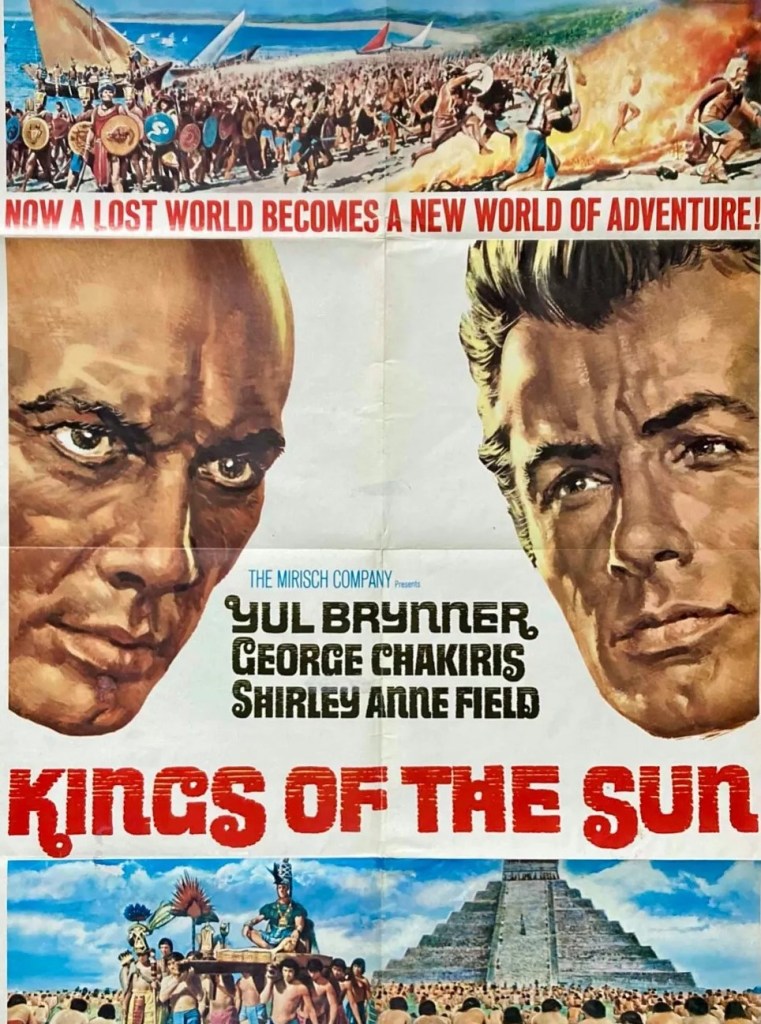
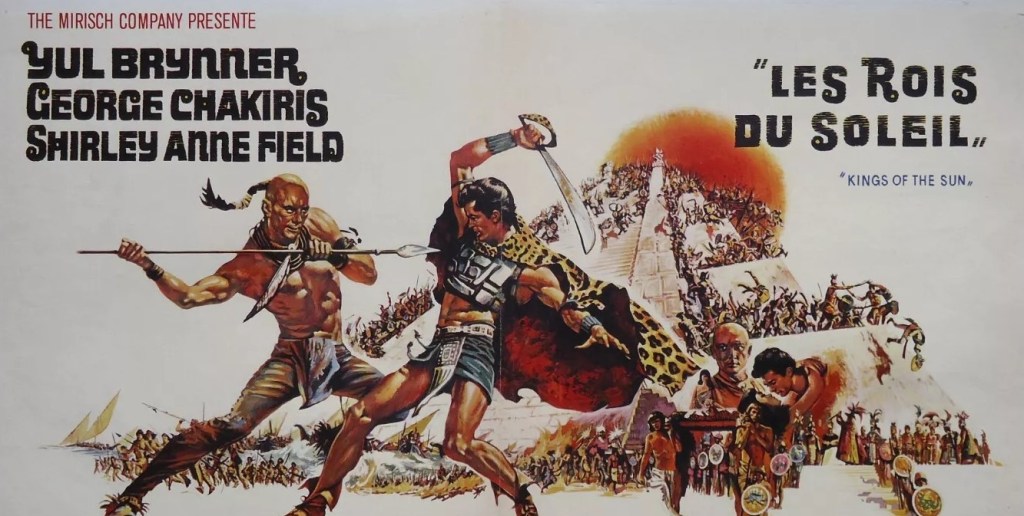
Kings of the Sun (1962) ****

With the current Conclave  bringing the subject of organized religion to the fore, no better time to examine a religion that Christianity put to the sword back in the day. While Christianity centers on unwelcome crucifixion transformed into willing sacrifice, in other cultures sacrifice was viewed as the highpoint of a life. And as demonstrated here, not a cruel expression of power, but a person executed in order to carry a message to the gods.

Of course, that could still be interpreted as barbarity and state vs religion is one of several themes here. Sold as an action picture but actually a thoughtful discussion of contemporary issues and worth viewing alone for an extraordinary performance by Yul Brynner, whose screen persona is turned completely upside down. As epitomized by The Magnificent Seven (1960), Brynner was Mr Cool. He was rarely beaten, and if he couldn’t talk his way out of trouble then guns or fists would do the job for him. For the most part here, he’s a prisoner, setting up the kind of template that Clint Eastwood would later inherit, of the brutally battered hero, except in this case there’s no murderous revenge.

And the movie cleverly switches perspective, so we move from sympathy with a defeated fleeing Mayan tribe and their efforts to rebuild their lives in a foreign land to the problems their unexpected incursion creates among the inhabitants of the new country.

Forced out of his homeland by invaders, King Balam (George Chakiris) leads his tribe across the seas of the Gulf of Mexico, trying to prevent high priest Ah Min (Richard Basehart) giving in to a predilection for sacrifice every few minutes. In order to keep the peace between two warring elements of the tribe, an unwilling Ixchel (Shirley Anne Field) has been promised in marriage to the king.

The Mayans adapt quickly to their new circumstances, fishing, building houses, diverting rivers to grow crops and building a pyramid. When they capture Black Eagle (Yul Brynner), a local Native American chief, they plan to sacrifice him to the gods.

Complicating matters is that Ixchel has taken a shine to the prisoner. As a potential sacrificial victim, living like a king for a day, the prisoner is entitled to impregnate any woman he pleases. Although Black Eagle has also taken a shine to Ixchel, he rejects her when she doesn’t come to him with open arms. She, equally, takes against Balam because, while he can’t prevent such congress (to use a Biblical expression), he doesn’t express his dissatisfaction in the process.

While a prisoner, Brynner has been impressed with the Mayan diligence, their ability to extract a living from what appeared harsh soil, and Balam, for his part, was hoping the two tribes could work out a way of co-existence. Where Black Eagle is voluble, Balam suppresses his emotions. It turns out that Ixchel, while responding to Black Eagle’s ardent wooing, would rather it was the more monosyllabic king uttering such words.

The action is kept to the minimum, probably accounting for initial audience disinterest. And the fact that it seems to be hewing towards peaceful co-existence rather than open warfare ensured that the expected battle took a long time coming. Sure, there’s a duel of sorts between the two leaders, but the more important battle of wits concerns who wins the woman.

In the end, Balam turns against this religion and sets Black Eagle free which is convenient because the armies which have chucked Balam out of his native land have pursued him across the seas and now attempt an invasion. Balam and Black Eagle unite to drive back the invaders. However, Black Eagle dies in the conflict, removing the love triangle.

From the moment Black Eagle was captured, I was expecting a different outcome. There’s some allegorical mischief at play here, with the prisoner splayed out in crucificial fashion,  arms and legs tethered by rope. But I was expecting such an obvious muscle-bound angry hero to escape and wreak revenge. However, that scenario avoided, it permits considerable discussion on co-existence as well as the nature of marriage, the old-fashioned manner (to prevent war or build a dynasty) vs the more liberated version (for true love).

Brynner is easily the standout, provided with far more opportunity for emotion than usual. George Chakiris (Diamond Head, 1962), range of expressions limited through both emotional incontinence and immaturity, appears sulky rather than majestic. Shirley Anne Field (Saturday Night and Sunday Morning, 1960) would appear miscast except she can convey so well inner feelings through her eyes.

No idea why anyone thought a disquisition on ancient religion and morality, with an anti-war sub-theme, would play with audiences of the period brought up on blood and thunder, and even when presented with notions of peaceful co-existence, as with any number of westerns featuring stand-offs between settlers and Native Americans, could rely on gun-runners to kickstart the shooting.

The action scenes, when they come, are good but it’s what happens in between that makes this perhaps more worthy of comment now than on initial release. Directed by J. Lee Thompson (The Guns of Navarone, 1961) with a screenplay by James Webb (How the West Was Won, 1962) and Elliott Arnold (Flight from Ashiya, 1964)

Carries surprising contemporary heft and Yul Brynner as you’ve never seen him before.

Three (1969) **

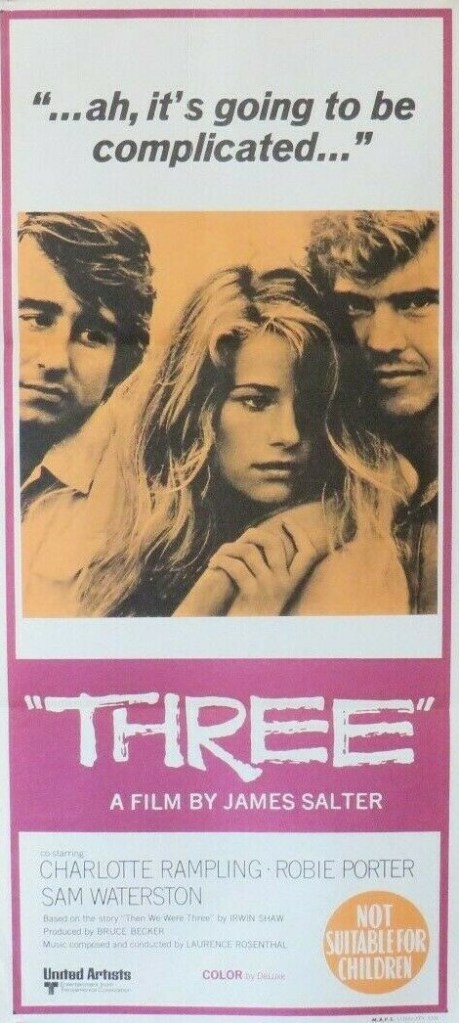
More interesting for the personalities involved – Sam Waterston, Charlotte Rampling, an ex-fighter pilot, an Australian pop star and a model – than the film itself, which presents a European arthouse take on youngsters freewheeling around Europe looking for their share of the free love purportedly available everywhere.

There’s not really any story, mostly it’s scenery, and whatever tension there is rarely rises to the point of drama. However, it is refreshing to see a picture not steeped in angst that reflects the normality of life rather than superficially-imposed heightened confrontation. On a tour of Italy, American college buddies Taylor (Sam Waterston), the shy, gawky one, and Bert (Robie Porter), the better-looking confident one, take up with British girl Marty (Charlotte Rampling). The guys make a pact not to compete for the girl’s attentions, but that idea doesn’t last long. The title suggests she might end up with one – or both. In trying to sell the film, the marketeers felt obliged to make that idea more implicit.

The guys make plays for other girls they meet but seem to find little genuine action and in that sense it is more true to life than other films of the period which suggested sex was there for the asking. But none of the characters are particularly interesting and while that is also more realistic it diminishes enjoyment. The highlight is a naked Taylor attempting to save a girl from drowning in the sea, but in keeping with the film’s tone he is beaten to it by a boat.

There’s not much sign here of the intense dramatic style Oscar nominee Sam Waterston would later bring to the movies. This was his third film after small parts in The Plastic Dome of Norma Jean (1966) and Dick Van Dyke vehicle Fitzwilly (1967) and he wouldn’t hit his stride until The Great Gatsby (1974).

Perhaps the oddest movie fate befell Charlotte Rampling, also a later Oscar nominee. How else to explain that she followed up this picture with Luchino Visconti’s The Damned (1969) and preceded it with Roger Corman’s Target: Harry (1969). With a career that at this point appeared to follow no particular pattern, after making an impact in Georgy Girl (1966) as a libidinous flatmate, she took a small role in The Long Duel (1967) before reaching leading lady status opposite Franco Nero in Italian thriller Sequestro di Persona (1968). Her languid screen persona was turned on its head with The Night Porter (1974). And then she was swept up in Alistair MacLean thriller Caravan to Vaccares (1974).

Who was Robie Porter you might very well ask and why did he only make two pictures, the other being The Carey Treatment (1972)? He was an Australian pop star, specializing in instrumentals on a steel guitar, with a series of hits including two at number one. He chanced his arm in Britain, without repeating that success, then moved to the U.S. and landed parts in television series Daniel Boone and Mannix. After Three, he returned to the music business, as part-owner of record label Sparmac and producing for the band Daddy Cool.

Other names in Three, in bit parts only, none making any discernible impact in the picture, included model Edina Ronay, daughter of celebrated food critic Egon Ronay, who had appeared in A Study in Terror (1965) and Prehistoric Women (1967). Equally as celebrated, if for other reasons, was Gillian Hill, best known as one of the girls cavorting naked with photographer David Hemmings in Blow Up (1966).

Writer-director James Salter was a genuine Hollywood curiosity. He hit a peak of cinematic activity in 1969, with two screenplays filmed – Downhill Racer (1969) and The Appointment (1969). This is pretty much a companion piece to Downhill Racer (1969) which has a bunch of professional skiers on a similar scenic tour and often sitting around with not much to do although that film builds in confrontation and more standard love affair.

Generally considered a “writer’s writer” – i.e. adored by his peers more than the public – his first novel The Hunters (1958), based on his Air Force experiences, was turned into a movie starring Robert Mitchum. He dabbled in documentary film-making, whose impact can be seen in his feature films, but was better known for a short erotic novel A Sport and a Pastime set in Europe. None of his 1969 trio were hits, he ended up in Hollywood limbo, and he didn’t reappear on the movie credits list until Richard Pearce’s sci-fi Threshold (1981) starring Donald Sutherland.   

Toys in the Attic (1963) ***

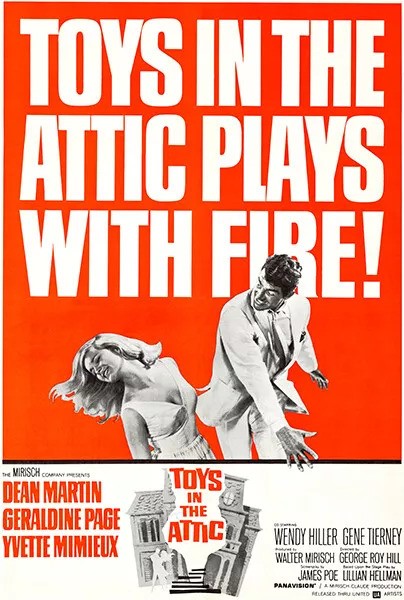
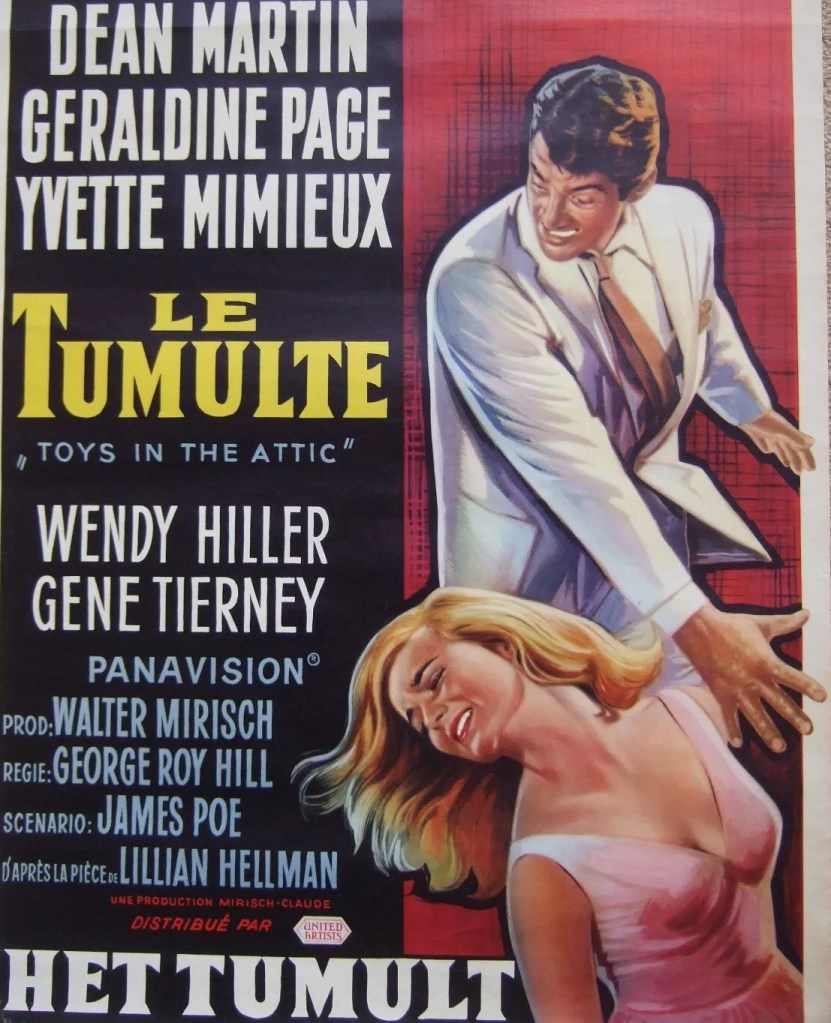
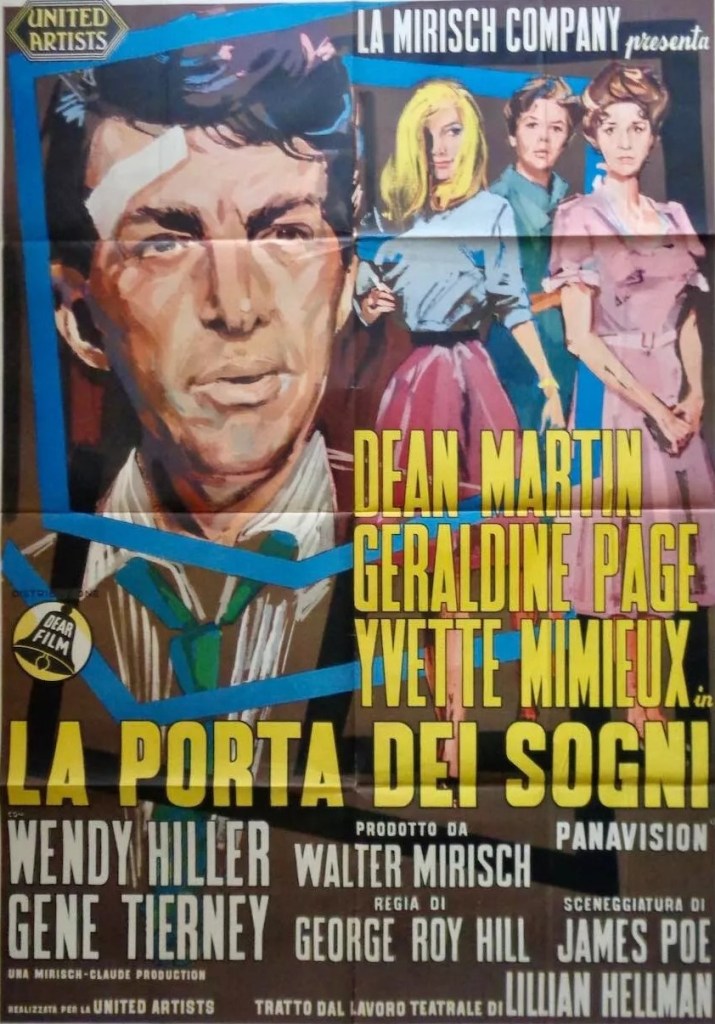
Dean Martin is at his best when he’s not playing the character you expect. Coming over as big and brash came to define his screen persona, and that just wasn’t, unless a comedy job where he was being set up to be taken down a peg or two, as interesting as his quieter, slow-burn performances in Rough Night in Jericho (1967) or Five Card Stud (1967). To some extent Geraldine Page was known for over-the-top performances, generally quivering on the edge of some emotional disaster. Even in Dear Heart (1964), which I adored, despite her lively exterior, that was her character.

So you match that pair with relatively raw director George Roy Hill (Butch Cassidy and the Sundance Kid, 1969) and you can see the problems he has reining them in, especially as the movie is based on a topline Broadway drama written by the highly-venerated Lillian Hellman (The Chase, 1966). Screenwriter James Poe (Riot, 1969) accommodates some scenes outside the smothering atmosphere of the home of sisters Carrie (Geraldine Page) and Anna (Wendy Hiller).

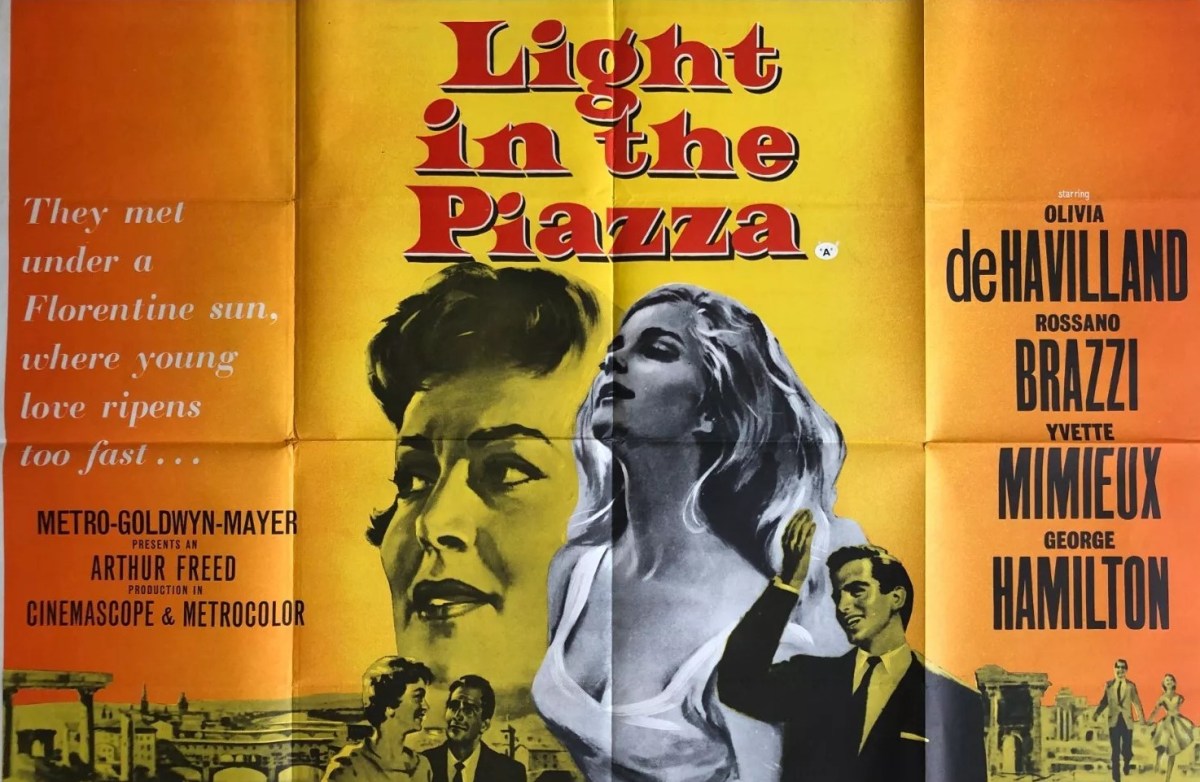
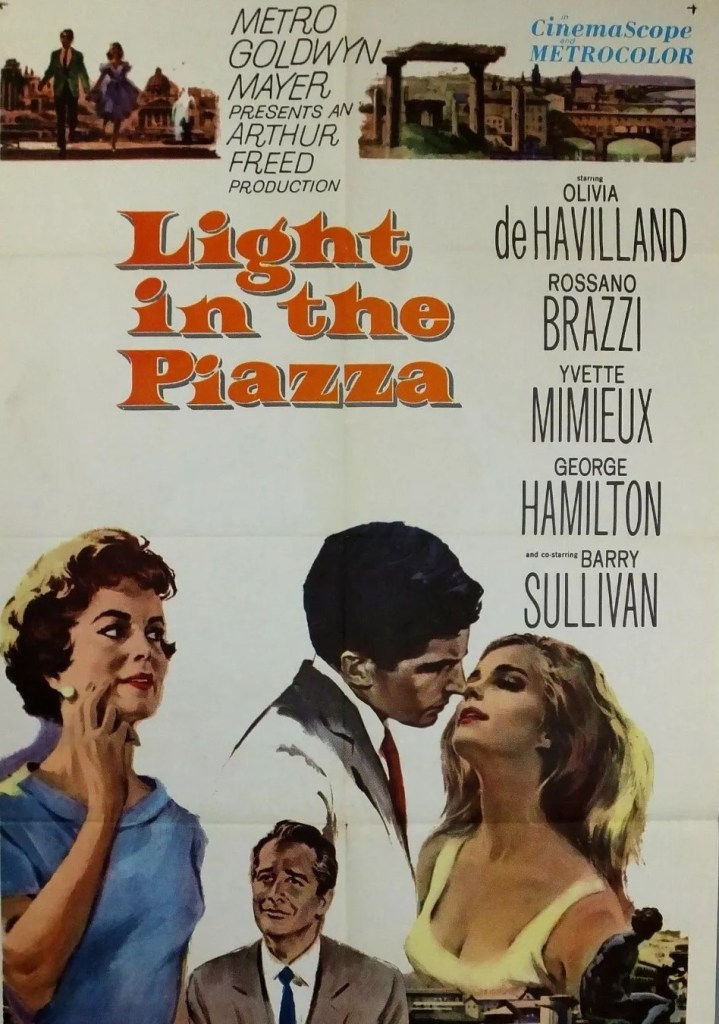
Given it’s set in sweaty muggy New Orleans, the shadow of Tennessee Williams hangs heavily over the picture, though the Deep South twangs are not fully in evidence. Throw in that their brother Julian (Dean Martin) has brought home a child bride Lily (Yvette Mimieux), suspicious not just of her newfound environment but of her possibly already-straying husband, plus that he returns a wealthy man, when normally his entrepreneurship has usually dealt a losing hand, and you have the making of a rather predictable tale of home truths, overheated emotions and a hint of incestuous longing.

This is the kind of tale, reverberating with unhappiness and frustration, that requires an unlikely trigger to get going. It’s not as dumb as the murderer in the recently-reviewed “five-star” so-bad-it’s-good Doctors Wives (1971) who funds an escape from police custody by blackmailing his wife’s extensive band of lovers and getting a colleague to momentarily pretend to take on his identity.

This time it’s an overheard phone call and the conniving Carrie who suggests to the new bride that Julian has taken up with old lover Charlotte (Nan Martin), the source of his newfound wealth by helping him buy up cheaply land that her husband Cyrus (Larry Gates) needs for his business. This not only puts the marriage in danger but, when Cyrus realizes he has been duped by his wife, Julian’s life is threatened.

This is one of those films where the plot threatens to run away with the story which is essentially that the two sisters have come to expect that their wastrel brother is dependent on them and cannot accept it when he is not. Whereas dealing with a depressed loser maintains the family status quo, coming to terms with a winner takes some doing and jeopardizes existing relationships.

The sisters are equally jealous of each other, so there’s constant niggling. Escape is in the offing for too many of the characters. Julian, from his down-at-heel existence, the sisters from their poverty, Charlotte from her clearly over-dominant husband and Lily from what seems like an ill-chosen husband. That, in several instances, escape pivots on revenge makes the situation sweeter.

The sisters have the best scenes, but that’s a limitation. While audiences watching a stage play might remain in rapt awe at actresses dealing with their frustrations, within the confines of a movie, it weighs the picture down, two old maids quarrelling is hardly a concept that would have movie fans signing up.

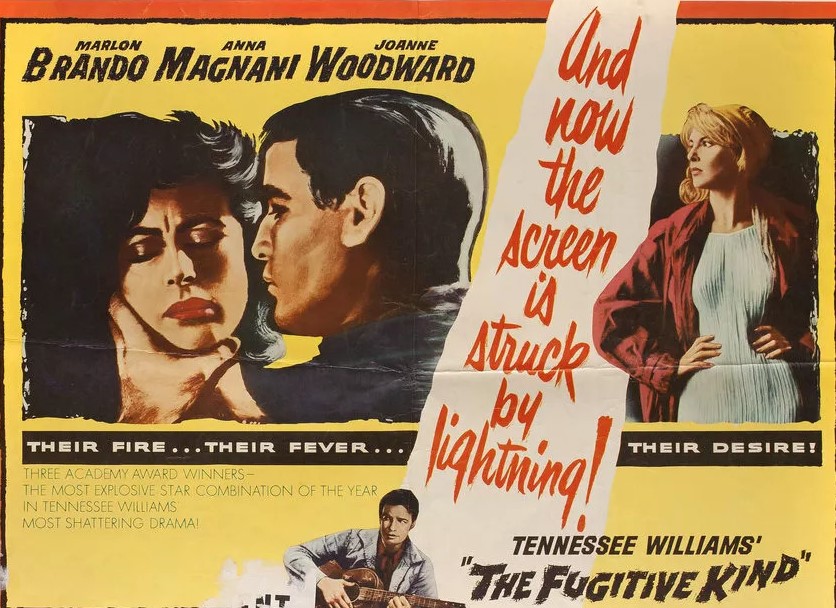
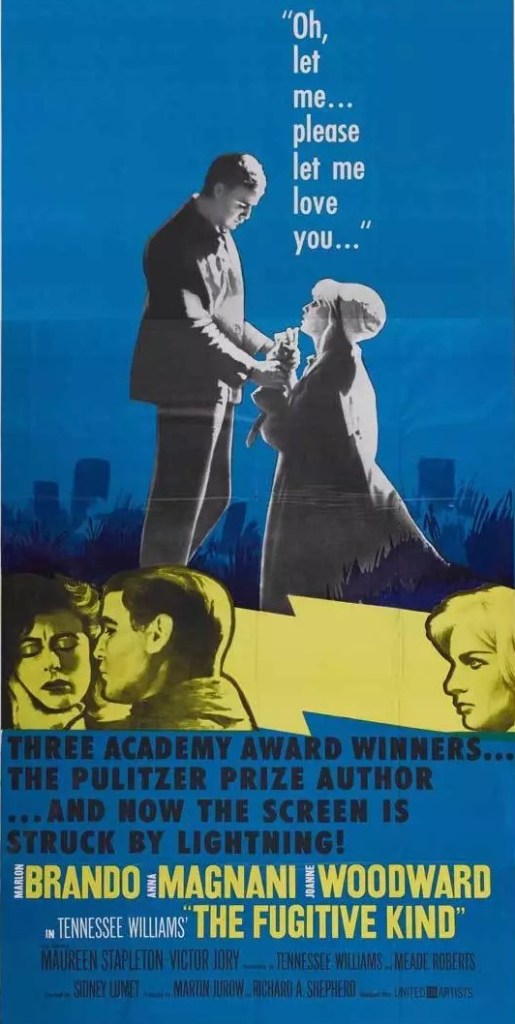
Stage plays often suffered from translation to screen, if the characters were not sufficiently louder than life. It’s significant that none of the works of Arthur Miller, not even his masterpiece Death of a Salesman, managed this. Tennessee Williams was more successful because of leading characters with explosive temperaments. The Glass Menagerie (1950), A Streetcar Named Desire (1951), The Rose Tattoo (1955), Cat on a Hot Tin Roof  (1958) and Suddenly, Last Summer (1959) were showered with Oscar wins and nominations and generally hit the box office mother lode.

Lillian Hellman was largely in the Arthur Miller category when translating her stage plays to the screen. While The Dark Angel (1935) and These Three (1936) had enjoyed some success, The Children’s Hour (1961) had stumbled at the box office.

Fans of Dean Martin didn’t enjoy him going all hi-hat and in truth he comes up short compared to Wendy Hiller (Sons and Lovers, 1960) and Geraldine Page, both nominated for Golden Globes. Yvette Mimieux (Diamond Head, 1962) continues to show promise and Gene Tierney (The Pleasure Seekers, 1964) puts in an appearance.

For fans of Broadway adaptations.

Anora (2024) *

This poses two questions. Am I so out of touch with modern film-making that I consider this a terrible film? Or are the jurors at the Cannes Film Festival and a whole raft of critics so out of touch with modern film-making that they think it’s a great film.

One of the problems for proper critics – that is the people who see every single film that comes out as part of their job and are hired to offer their opinions in eminent media as opposed to the self-styled critics who have podcasts and blogs but pick and choose what they watch   – is the sheer volume of product.

From speaking over the years (over the decades) I know that one of the perennial problems facing the critic is boredom. They see so much dreck and are equally turned off by earnest movies or by seeing the same old same old that they tend to get extremely excited when they come upon something that’s new, refreshing, different. Added to that they want to champion new invigorating film-makers rather than poke holes in the latest Hollywood disaster.

So there’s a tendency to over-champion and to patronise, pumping up films which critics feel audiences should see. And over the years there’s been no shortage of forgettable movies that enjoyed a moment in the sun, picked out by a critic as the next best thing in a very dull week, and over-praised, or by a critic who simply wanted to get behind home-grown product or a particular favored director or star.

There’s a sense that critics feel they are needed more than ever in order to steer audiences in the right direction, forgetting that moviegoers are perfectly capable of making up their own minds. The Cannes Film Festival hasn’t usually had an iffy reputation. Sure, for every game changer like Easy Rider (1969), Sex, Lies and Videotape (1989) or Pulp Fiction (1994) and solid successes like The Piano (1993) or The White Ribbon (2009) or Blue Is the Warmest Colour (2013) there are king-sized stumbles. Let’s not hear it for the likes of Elephant (2003) or Tree of Life (2011) – efforts to buff up fading reputations – and Triangle of Sadness (2022) which took a long time going nowhere. But poor choices are a relatively minor phenomenon.

This is worse than any of them. The worst of the worst. It’s not even redeemable like yesterday’s Doctors Wives (1971) which is one of the best so-bad-it’s-good pictures you’ll come across. Some clever dick tagged this as a contemporary Pretty Woman (1990) but it bears as much resemblance to that picture as Donald Trump to Joe Biden.

If you’re aiming for a Cinderella story involving a sex worker you’re going to need the oodles of narrative charm and screen charisma that proved Pretty Woman’s major selling point or you disguise the commercial instincts of the female lead beneath a sheen of “presents” as in Butterfield 8 (1960) and Breakfast at Tiffany’s (1961).

Even better, you just learn how to tell a story. And that doesn’t mean repeating the same scene with minor variations for nearly half an hour. Stripper Ani (Mikey Madison) is hired for a week of sex by juvenile Russian playboy Vanya (Mark Eidelstein). When they’re not having sex in every possible position and she’s subtly trying to make him last longer, he’s off his head with drink and drugs and playing computer games. That’s basically it for a full hour. Initial lap dances, off to his amazing mansion, then sex, drugs, computer game, sex, drugs, computer game, sex, drugs, computer game. Am I boring you yet?

Yes, there is some mild backstage bickering at the strip club and partying with his friends but that’s just minor interruption to sex, drugs, computer games, sex, drugs, computer games, sex, drugs, computer games. Vanya is so out of it he asks Ani to marry him, which she does, in Vegas, possibly with the ulterior motive of him getting a green card. But he doesn’t seem to have a single thought in his head beyond sex, drugs, computer games, and that kind of conniving would require a more competent brain.

Anyway, of course, mom and pop back in Russia get wind of their son marrying a sex worker and send Toros, a Russian Orthodox priest, to sort out the mess. Best scene in the film is Toros, carrying out a baptism in a crowded church, taking a text message in the middle of the ceremony and dumping the unbaptized baby in the arms of the astonished parents and rushing off. If the rest of the film were up to the originality of that scene, we might be onto something.

Maybe there were great scenes to come. I couldn’t tell you. And maybe I shouldn’t be reviewing this at all because I walked out just after the baptism.

Nobody comes out of this well, least of writer-director Sean Baker whose last effort Red Rocket (2021) was similarly concerned with sexual low-lifes. Mikey Madison (Scream, 2022) and Mark Eidelstein get their kits off to no avail.

A mess.

Conclave (2024) ****

No great surprise that the political thriller has made a return – all subgenres resurface after a while. The surprise here is the context. The Catholic Church hardly seems a fitting setting, given it’s been wracked for decades by accusations of child molestation, Oscar-winning Spotlight (2015) taking it down over historic malfeasance in Boston, though that was more in the line of another subgenre, the fearless journalistic expose.

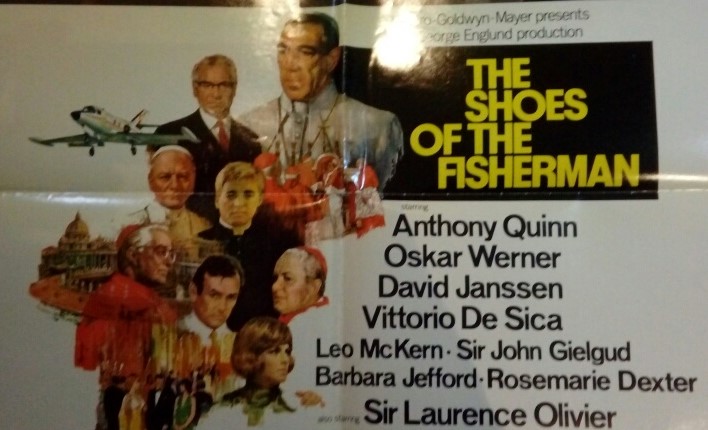
Nor would you expect the drama of the election by all the Cardinals of a new Pope to turn into a riveting thriller, with a stunner of a twist at the end which carries considerable contemporary heft. The last time the goings-on in the Catholic Church attracted the attention of Hollywood was in Otto Preminger’s The Cardinal (1963) and The Shoes of the Fisherman (1968), which were cut from a more traditional cloth. Except for some interesting procedural background and some argument about the future direction of the Church, the bulk of this picture concerns the horse-trading and corruption that threatens to envelop the election.

Our guide through the shenanigans is Lawrence (Ralph Fiennes), the dead Pope’s righthand man, who, although filled with his own doubts, is in charge of managing the actual election. He’s so self-effacing that it comes as something of a shock to him to discover that he’s one of the candidates. It’s a blind-voting system and continues until one person has secured 72 votes. As you might expect there’s wheeling-and-dealing with the liberal elements set against the more entrenched right-wing groups.

The main contenders are: Bellini (Stanley Tucci), favored by Lawrence, Tremblay (John Lithgow), Adeyemi (Lucian Msamati), a black African who would be a popular winner except for his stringent views on homosexuality, Tedesco (Sergio Castellito) who wants to cancel all the liberal developments of the Church in the last half century, and surprise packet Benitez (Carlos Diehz) from Afghanistan who represents the downtrodden that the rest of the high-living Cardinals appear to have forgotten.

You’re going to remember the twists more than any moral message. But it does allow time for debate of the major moral questions, mostly handled with subtlety. The Cardinals are all sequestered away from the outside world for the duration of the election. Turns out the deceased Pope was trying to rig the election to suit his own ends, conspiring against those Cardinals he felt were too ambitious, self-obsessed or had unsightly, but secret, stains on their characters.

For a holy fellow the dead Pope set some remarkable traps which leave Lawrence reeling. And as the election proceeds, Lawrence is revealed, on the one hand, to be quite a tough egg, like a good journalist determined to uncover the truth, but on the other hand given to bouts of crying as the weight of duty and expectation and, I guess, shock at the findings get to him.

This is quite an adult movie. Not in the sense that we’re dealing with a particularly controversial subject matter, but it’s a kind of courtroom drama in all but name, and except for the sprinkling of revelations, and the inherent tension of an election, apt to be slow moving, allowing characters time to breathe and to put various points across. The structure makes no concessions to the MCU generation. Nor to the traditional Hollywood approach which would have allocated a certain amount of time to tourist Rome. A couple of cheats – hidden documents, access to a computer when access to anything was denied – don’t get in the way.

I’m always worried when trailers concentrate on the number of Oscar winners or nominees involved because generally that suggests to me a weak narrative. But, in fact, two-time nominees Ralph Fiennes (No Time to Die, 2021) and John Lithgow (Interstellar, 2014), and one-time nominee Stanley Tucci (The Hunger Games, 2012) deliver terrific, largely understated performances, while director, also a nominee, Gerard Berger (All Quiet on the Western Front (2022) brings it together with a stately majesty.

He’s allowed himself a certain amount of self-indulgence. The overhead shot of the lines of Cardinals moving through the rain and carrying white umbrellas bears no narrative weight but is visually splendid. As if escaping from a more offbeat movie, turtles appear from time to time. The rigmarole of ritual is compelling.

Some scenes are conducted in Latin, with subtitles of course. Thank goodness, I know now what “in secula seculorum” now means. But you didn;t need to know back in the day. That was the point. It was like joining a secret society. The Catholic Church once had an unique ID that it threw away – the fact that all Masses were spoken in Latin, and therefore universally appreciated, and you could go to a Church in any country and understand what was going on, whereas now you’d need Google translate.

Screenwriter Peter Straughan (Tinker, Tailor, Soldier, Spy, 2011) is on something of a roll at the moment, his teleplay for Wolf Hall: The Mirror and the Light just out. Robert Harris, who’s not had much luck at the box office with the various movie interpretations of his bestsellers Enigma (2001), The Ghost Writer (2010), and An Officer and a Spy (2019) – banned pretty much everywhere because of Roman Polanski’s involvement –  gets his just reward here for laying down such a superb template. The music by Volker Bertelmann was particularly striking. Oddly enough his Oscar win for All Quiet on the Western Front didn’t warrant a mention in the trailer.

Thoroughly absorbing.

Doctors Wives (1971) ***

Five-star so-bad-it’s-good. Every now and then, especially approaching the annual touting of earnest films for Oscar consideration, we need reminded of just how good Hollywood is at producing hugely enjoyable baloney. Excepting the proliferation of recent MCU disasters, cinematic train wrecks don’t come along nearly often enough. Such botched jobs are always better if they are stuffed full of the worthy – Oscar recipients or nominees. Gene Hackman, Dyan Cannon, Rachel Roberts, Ralph Bellamy and screenwriter Daniel Taradash fulfil that requirement here.

A cross between Sex and the City and ER, with a third act that takes off like a rabbit desperately seizing on any convenient narrative hole. And a first act that pulls the old Psycho number of killing off the star before the picture really gets going. That old murder MacGuffin works every time.

“I’m horny” is about the third line in the movie, announced by sex-mad Lorrie (Dyan Cannon) to a tableful of over-refreshed doctors wives playing sedate poker in a country club at one table while at another table where you would expect the doctor husbands to be telling dirty jokes and whispering inuendoes they are boring each other with shop talk.

Unable to get the others to engage in revealing snippets about their sex lives, Lorrie rounds off the evening by informing the ladies that she plans to have sex with all their husbands to tell them where they are all going wrong, meanwhile gaily proclaiming she’s halfway there already. Which, of course, sets off a round of suspicion and accusations from wives to husbands.

Just to keep you straight on the who’s who: Lorrie is married to Dr Mort Dellman (John Colicos), Dr Peter Brennan (Richard Crenna) to Amy (Janice Rule), Dr Dave Randolph (Gene Hackman) to Della (Rachel Roberts), and Dr Paul McGill (George Gaymes) to Elaine (Marian McCargo) while Dr Joe Gray (Carroll O’Connor) and his ex- Maggie (Cara Williams) still hang around with the group.

As you might expect, every marriage is already in trouble, except, apparently, Lorrie’s because her husband, equally sex-mad Mort, appears to indulge his wife’s whims. Except, he’s not so easy-going, given he puts a bullet in her back when he discovers her making love to one of his colleagues.

Exactly which one remains a mystery for just long enough for the wives to rack up the suspicion level, and all the audience has to go on is the naked arm waving limply trapped under the naked dead weight of the corpse.

You might think, what with Dyan Cannon’s name being top-billed and she quite the rising star after an Oscar nomination for Bob & Carol & Ted & Alice (1969), that we’re going to flip into a series of flashbacks to accord her more screen time. But, no, all we get is that opening risqué scene and her naked corpse.

Before ER’s creator Michael Crichton came calling a couple of decades later, the surgical profession was mostly represented in formulaic soap opera of the Dr Kildare small screen or The Interns (1962) big screen variety. But author Frank G. Slaughter, himself a practising physician,  had made his name with a series of bestsellers that went into the intricacies of surgery and involved genuine medical jargon. So, before the identity of the illicit lover can be revealed, his life has got to be saved – after all he’s got a bullet in his heart. Cue even bloodier surgical shenanigans than kept fans of Mash (1970) hooked.  

By the time we discover the victim was Dr McGill any chance of his wife stomping around in a huff at his infidelity is already off the menu because she’s been dallying with an intern.

I won’t go into all the all-round marital strife – triggered by alcoholism, drug addiction, infertility, ambition – that allows Oscar winners and nominees to try and act their way out of trouble because this picture has another absolute zinger to throw at you.

The murderer blackmails all four doctor pals for having a fling with his wife. To that cool $100,000 he adds quarter of a million from Lorrie’s wealthy dad Jake (Ralph Bellamy) for agreeing to make no claim on his wife’s estate. You kind of wonder what the heck use is all this dosh going to be in the slammer or Death Row. But that’s before you consider the zinger.

Mort’s a specialist and there happens to be a young patient desperate for his surgical skills. Young lad is son to head operating nurse Helen (Diana Sands) who is having an affair with Dr Brennan. So, a deal is done – you can’t wait for this humdinger, can you – wherein the D.A. is agreeable to release Mort from custody so he can perform this emergency operation while Dr Brennan and Jake – wait for it – agree to help him escape abroad.

As everyone knows you can’t tell one masked surgeon from another, so the first part of the plans works and while the cops keep a close eye on the fake Mort as he emerges from the operating theater the real Mort escapes in a parked car with the keys in the ignition. Except Jake isn’t quite a dumb or gullible as Dr Brennan and removes the keys so the killer can’t escape. Which was a shame because this picture could have gone on for another bonkers 20 minutes or so watching Mort outwit the cops.

As it is, there’s more than enough to fill in the time. Amy, something of a clothes horse with an extraordinary array of clothes and especially hats, goes all slinky in what looks like day-glo leggings to perform a bizarre seduction on her husband. Which elicits the movie’s best line, Nurse Helen complaining, “I don’t appreciate you sleeping with your wife.”

Unbeknownst to her, Lorrie has a female disciple who seduces every male in sight for research purposes, tape-recording every moment of the activity, so her victims are pretty much always in the coitus interruptus position.

And I can’t let you go without mentioning that Lorrie was also bisexual and counted among her conquests Della.

Except for the unlikely success of The French Connection later in the year which offered a different route in top-billing, Gene Hackman, had he continued taking on roles like this,  might have ended up a perennial third potato. Bear in mind he already had two best supporting actor nominations in the bank when, third-billed, he took this on. Maybe he never read the whole script. Maybe this was the best offer going.

He’s not even the best thing in it. Too earnest for a start. Husband-and-wife murderer-victim tag team John Colicos (Anne of the Thousand Days, 1969) and Dyan Cannon take the honors. Directed by George Schaefer (Pendulum, 1969) and scripted by Daniel Taradash (Castle Keep, 1969). .

An absolute hoot.

Juror # 2 (2024) ****

Last hurrahs are rarely as sweet. But I’m beginning to wonder if the Warner Brothers very restricted U.S. domestic release isn’t a clever publicity ploy. You know the kind, attract the ire of critics who like nothing better than painting studios in a bad light and hope for a tsunami of social media outpourings. It’s now beginning to look more like a standard platform release, the kind employed to win Oscar favor.

Directors are often declared geniuses because they have a particular facility with visuals, can use the sweep of the camera or a particularly vivid composition, tackle controversial subjects, or build up a distinctive oeuver by returning again and again to a theme or genre. This is well outside Clint Eastwood’s comfort zone. For a start he’s not acting in it, it’s not a western and it doesn’t concern on-screen violence of any kind. His most common screen persona was of the man with a past trying to live a quiet life who is roused into anger and violence.

WB has been sparing on the poster front but you may notice a certain visual
similarity between this old poster and the new one.

There’s none of that here. In fact, this all seems deliberately damped down. The tale is not told in faux documentary style and there’s no grandstanding. And yet this is one of the best directed movies I’ve ever seen. With no scene-stealing, it flies, and when it lands it’s with a thoughtful air. Just when you think it’s going to head off in he direction of one of two cliches – the high-risk pregnant wife giving birth at a dramatic juncture in the trial, or some zealous cop undertaking an equally dramatic last-minute investigation that tips the trial ass over tip – it damps down on those two.

The set up is ingenious. Recovering alcoholic Justin (Nicholas Hoult) discovers in the course of the murder trial on which he is a juror that he not only knows more about the incident in which the girlfriend of accused is killed, he may even be the accidental cause of her death. On the night in question he was nursing a drink in a bar and noticed the couple having an argument. Driving home on a wild and stormy night, he has a recollection of hitting something, knows it’s not, as he told he told partner Allison (Zooey Dutch), a deer.

Because, after several years of sobriety,  he should never have been in a bar in the first place, and because there’s no evidence to the contrary – a field sobriety test should he have reported the incident – it’s automatically assumed that he would have consumed the whisky he bought in the bar. The hint of DUI would condemn him to 30 years in prison and not the new life as a father he has fought hard for.

Hello darkness would be the design theme.

So, in a ironic twist on Twelve Angry Men (1957), he’s the only person who stands up for the accused, but out of guilt rather than as with Henry Fonda an uplifted sense of morality. Guilt has certainly struck deep. For it’s insane for him to fight for the man’s innocence, to even raise questions of doubt, when everyone else is convinced he’s the killer.  If the man is convicted, Justin will be let off. A hung jury might be a better outcome. A second trial would likely still end in conviction, as the circumstantial evidence and the accused’s drug-running background count against him, but at least Justin will not blame himself for sending an innocent man to prison.

The thing is, we don’t want Justin to be guilty. It’s an accident. Could have happened to anyone. At worst, had he fessed up at the time he would be cleared of any accusation of DUI, given the benefit of the doubt, what with the driving conditions and the fact that the victim was inebriated. He’s turned his life around. He adores his wife and looks forward to fatherhood.

He’s not the only one conflicted. Some of the jurors just want the trial over as fast as possible to get back to more pressing domestic issues. One character is dead set against anyone with anything to do with drugs. Overworked prosecutor Faith Killibrew (Toni Collette) is more concerned with a political future, running for district attorney. Ex-detective Harold (JK Simmons) commits the grievous sin – for a juror – of doing a bit of investigation on his own and is chucked off the jury.

What little information he does collect ends up with Faith. As a prosecutor she wants people put away, not let off. And she’s amassed sufficient evidence against the accused to get him sent down. So she’s not inspired with a desire for justice, the kind of firebrand character that would turn up in any other courtroom drama, digging away for an eternity, refusing to accept guilt as presented. She’s not a beacon for doing the right thing. Rather, the kind of person who doesn’t like the idea of nagging doubt upsetting her well-ordered life.

Given how many Clint Eastwood pictures end in violent showdown, perhaps his biggest directorial coup here is finishing the picture without that episode, it’s more reminiscent of the scene in American Gangster (2007) where Denzel Washington emerges from church to be confronted by a battalion of cops.

Couple of flaws – forensics so derelict there’s no suggestion that the blunt instrument that killed the victim could be a car is explained away by overworked scientists. That Faith doesn’t notice the photos of Justin sprayed around the house of Allison during her investigation reveals just how cursory a box-ticking exercise the detection is in her eyes.

Most of this plays out in the tortured eyes of Justin and in the unseen mind of Faith. With Justin, conflict is upfront, with Faith buried deep, laboriously roused from slumber.

Apart from Toni Collette and Nicholas Hoult, reunited after over two decades from their mother-and-son turn in About a Boy (2002), there is some distinctive playing – though under-playing would be more appropriate – from JK Simmons (Whiplash, 2014) and Kiefer Sutherland (The Lost Boys, 1987).

The boldness of the narrative – debut from screenwriter Jonathan Abrams – takes your breath away, avoiding the obvious route of concentrating on the innocent man, or on devious counsellors (all is played straight here) and the usual courtroom theatrics.

Absolutely superb performance from Hoult, who virtually has to do everything through his eyes. Had he been more over-the-top, Oscar would certainly have come calling, but deprived of that it’s an even more convincing performance. The low-ball direction swings this into a different class of courtroom picture, putting the audience in the situation of wanting the “bad guy” to get off.

Go see. Let Clint make you day (for likely) one last time.

The Cincinnati Kid (1965) ****

Steve McQueen had little trouble identifying with this role. He was the Hollywood contender, trying to knock current kingpin Paul Newman off his perch, and in Norman Jewison’s tense, often heart-stopping, drama he has the ideal vehicle. For the most part this is a winner-take-all face-off, as much a showdown as any western shootout, in darkened rooms under the harsh light of a New Orleans poker table between a rising star always referred to as The Kid (Steve McQueen) and the unofficial world champion, the urbane cigar-smoking Lancey Howard (Edward G. Robinson).

Broadened out in the initial stages to include scenic diversions – the Mississippi at dawn, a cockfight, some jazz – plus romance and intrigue, this is essentially pure sport, a game of stares, where bluff holds the ace and women exist on the perimeter only to fill in the time before the next hyped-up encounter. There’s no trophy to be won, not even glory, just the right to call yourself “the man.” The Kid feels the pressure of punching above his weight, Lancey of getting old.

Farmer’s daughter and arty-wannabe Christian (Tuesday Weld) is the Kid’s main squeeze until she gets between him and his game. When she takes off, he makes do with Melba (Ann-Margret), girlfriend of dealer Shooter (Karl Malden) somewhat preoccupied with giving the Kid more than a helping hand to satisfy the vengeful Slade (Rip Torn), a rich businessman.

Although it finally comes down to a confrontation between the Kid and Lancey, subordinate characters like sweating poker player Pig (Jack Weston) and stand-in dealer Ladyfingers (Joan Blondell) help dissipate the tension. But in fact anything that occurs only seems to increase the tension as it comes down to the one big final hand. 

This is McQueen (The Magnificent Seven, 1960) in transition, from the loner in The Great Escape (1963) to an actor exuding charisma and on top of his acting game. While on the face of it little more than a sporting lug, the Kid is an appealing character, engaging with a little shoeshine boy, winning over Christian’s truculent parents with what appears a card trick but is actually a demonstration of the phenomenal memory necessary to excel in his chosen field. There’s a winsome child in there among the macho persona. The poker face that McQueen developed would become one of his acting traits over the years.

Edward G. Robinson (Seven Thieves, 1960) gives a rounded performance as the reigning poker champ accepting emotional loss as the price for all his financial gains. Tuesday Weld is an appealing waif. Karl Malden (Pollyanna, 1960) essays another tormented soul and Rip Torn (Sol Madrid, 1968) a sleazy one. Also look out for a host of great character actors including Jack Weston (Mirage, 1965), Oscar nominee Joan Blondell (Advance to the Rear, 1964) and Jeff Corey (Once a Thief, 1965) plus composer and bandleader Cab Calloway.

Ann-Margret (The Swinger, 1966), all eye-shadow and cleavage, is in her best man-eater form. But, thankfully, there is more to her character than that. It is unclear whether she simply latches on to a potential winner or is pimped out by Shooter, but just hooking up with him makes her interesting, since looks are far from his attraction. Her ruthlessness is spelled out in simple fashion. She is determined to win, even at solitaire and she slams the wrong pieces into a jigsaw just for the satisfaction of making it look complete. You can sense depth in this character which the film does not have time to fully explore.

Although often compared to The Hustler (1962), and in many eyes considered both its inferior and a crude rip-off, this is in some respects a greater achievement. At least in The Hustler, there actually was action, players moving around a pool table, clacking balls racing across the surface.  Poker is all about stillness. Any gesture could give away your thoughts. Unlike any other sport, poker requires silence. There is no roaring crowd, just people slotted round the room, some with vested interest if only through a wager, some wanting to say they were there when a champion was toppled.

So the ability to maintain audience interest with two guys just staring at each other, interspersed with minimal dialog, takes some skill. Building that to a crescendo of sheer tension is incredible.

The first four pictures of Canadian director Norman Jewison (Send Me No Flowers, 1964) did not hint at the dramatic chops, confidence, composure and understanding of pacing, especially as he was a last-minute replacement for Sam Peckinpah, to pull this off. That he does so with style demonstrated a keen and versatile talent that would come to the boil in his next three films: The Russians Are Coming, The Russians Are Coming (1966), In the Heat of the Night (1967) and The Thomas Crown Affair (1968). 

The former blacklisted Ring Lardner Jr. (Tracy-Hepburn comedy Woman of the Year, 1942) was credited with his first screenplay since The Forbidden Street in 1949 and he shared the chore with another iconic figure, Terry Southern (Dr Strangelove, 1964), basing their work on the original novel by Richard Jessup. Mention should be made of a terrific score by Lao Schifrin.

Gripping.

Check out the Blog for both a Behind the Scenes article on this film and a Book into Film article.

Nothing but the Best (1964) ***

Hardly surprising Denholm Elliott comes a cropper in this delicious British upper class black comedy – he steals the show from denoted star Alan Bates. Had he kept going any longer you would hardly have noticed Bates even featured, such was the clever impact of Elliott’s insiduous playing.

The toff version of Room at the Top (1958) meets Alfie (1966) as “ambitious young yob” Jimmy Brewster (Alan Bates) manipulates his way to the top. Too many people not coming up to scratch for his upwardly mobile purposes are cast aside – or strangled. Arrogance and bluff are the key to getting ahead in the upper-class world towards which he pivots. Doing absolutely nothing at all also works wonders in high society as does dismissing one’s hugely expensive education.

Jimmy is initially helped on his way, given an insider’s guide, by dissolute layabout toff Charles (Denholm Elliott) with a marked predilection for forgery, and other minor criminal schemes, but whose chief skill appears to be sponging off everyone else. Jimmy is a lowly executive in an upmarket estate agent, fighting for promotion against people with silver spoons rattling around every part of their anatomy and who have the genuine class their business appears to call for.

Every now and then the satire still contains contemporary bite, the difference between universities still relevant, as is that most people are not swayed by actual knowledge but by the fact that you can toss out the names of various academics. But, mostly, it’s bluff that opens the doors. Jimmy misses an appointment with an important banker, a dereliction that should have scuppered his chances of negotiating a better deal for his client. But, in fact, the banker takes this as Jimmy having gone elsewhere and immediately offers a better deal.

When confronted by a colleague for ignoring another appointment, Jimmy merely vaguely waffles on about being detained by “Sir Charles,” true identity left shrouded in mystery, contentious colleague silenced by either not being on speaking terms with the person mentioned or unwilling to admit his ignorance.

Having seduced every secretary within reach – none of whom meet his lofty standards – Jimmy manages to wangle his way into catching the eye of wealthy boss Horton (Harry Andrews) and his attractive daughter Ann (Millicent Martin), whom he marries.

While this would have been sharp as a tack in satirical terms back in the day, most of that weaponry is now out-dated. Suffers because none of the upper-class characters show any sense whatsoever – they can’t all be duffers and most seem to have tumbled out of central casting’s idea of an upper class twit. Charles is the exception, but even he is something of an innocent, not quite aware of what ruthlessness he has unwittingly set afire.

The lower classes aren’t much better. Secretaries and switchboard girls fall at Jimmy’s feet, handsome beggar that he is, though his landlady Mrs March (Pauline Delaney) appears to have his measure and is not above indulging in hypocrisy.

The voice-over works to the detriment of the picture. Because that device is doing so much of the heavy lifting, filling in the audience on Jimmy’s true feelings, the actor doesn’t have to do much acting and we’re presented with a kind of wooden figure who hides behind a mask. Of course since he’s masking his feelings, you might be inclined to give Alan Bates the benefit of the doubt.

And it would work very well if there wasn’t Denholm Elliott giving a master class in duplicity. He exhibits genuine charm.

I’m guessing that the voice-over was already there in Frederic Raphael’s script and not added to compensate for Alan Bates’s one-note performance. So if it was, that certainly presented a problem for the actor since most of what made his character interesting was at one remove, not presented in dialog or confrontation as would be the norm.

Alfie solved the problem by breaking the fourth wall – all the rage these days – and having the character directly address the audience, which allowed Michael Caine to present his own case.

So, if Alan Bates felt limited in what he could show on screen, he certainly does a good job of maintaining the façade. But Denholm Elliott (Station Six Sahara, 1963) steals the show. Harry Andrews (The Charge of the Light Brigade, 1968) is permitted no nuance to his normal bluff persona, singer Millicent Martin (Alfie, 1966) sparkles, and a bunch of British character actors including James Villiers (Some Girls Do, 1969) and Nigel Stock (The Lost Continent, 1968) put in an appearance.

Directed with some glee by Clive Donner (Alfred the Great, 1969) from a script by Frederic Raphael (Darling, 1965) adapted from a short story by Stanley Ellin (House of Cards, 1968).

Not as coruscating now as originally intended.

Discover WordPress

A daily selection of the best content published on WordPress, collected for you by humans who love to read.

The Atavist Magazine

by Brian Hannan

WordPress.com News

The latest news on WordPress.com and the WordPress community.