Prime Cut (1972) ****

Unusually nuanced thriller. Unusually lean, too, barely passing the 90-minute mark. There’s a Hitchcockian appreciation of the danger lurking in wide open spaces. And the background is the Middle America of annual fairs, marching bands, pie-eating competitions, rural pride in farming and marksmanship.

But there’s an undercurrent that will strike a contemporary audience. The contempt of big business for its customers. The sex trafficking, too, will sound an all-too-common note especially as the young women come from an orphanage set in the heart of homespun America in what appears to be a streamlined service.

In the actual screen credits, Hackman was not above the title.

We shouldn’t at all take to hitman Nick (Lee Marvin) except that he’s got a code of honor and sparing with words. He’s been sent from Chicago to Kansas to sort out with what would later be termed “extreme prejudice” Mafia boss and meat-packer Mary Ann (Gene Hackman) who’s been skimming off the top. As back-up Nick is handed a trio of young gunslingers anxious to prove themselves while his faithful chauffeur owes Nick his life.

Mary Ann doesn’t just have a factory, he has a fort, a posse of shotgun-wielding henchman standing guard. So Nick has to plunge right in and confront the miscreant. As well as dealing with animal flesh, Mary Ann has a side hustle in sex trafficking, displaying naked women in the same straw-covered pens as his beef.

Responding to a whispered “help me” by Poppy (Sissy Spacek) Nick buys her freedom, but Mary Ann isn’t for knuckling down to the high-ups in Chicago and since he’s already despatched a handful of other hoods sent on a similar mission as Nick he’s intent on turning the tables.

The action, when it comes, is remarkably low-key and all the more effective for it. Swap a crop duster for a combine harvester and the head-high prairie corn for the usual city back streets and you realize someone has dreamed up a quite original twist on the standard thriller. No need for a car chase here to elevate tension, it’s already a quite efficient slow burn.

By the time this came out Hackman had won an Oscar for “The French Connection” (1971), Marvin already in that exalted league thanks to “Cat Ballou” (1965)

This could be an ode to machinery. The entire credit sequence is devoted to the way machines chew up cow flesh and turn it into strings of sausages and the like. The combine harvester chews up and spits out an entire automobile, grinding the metal through its maw. And then there’s the machinery of business, the ability, at whatever cost, to give the public what it wants, in whatever kind of flesh takes its fancy.

You’ll remember the combine harvester sequence and the shootout in the cornfields, but you will come away with much more than that. Remember I mentioned nuance. Sure Mary Ann is an arrogant gangster and you’d think with hardly an ounce of humanity, but that’s until you witness his relationship with his simple-minded brother Weenie (Gregory Walcott). That could as easily have fallen into the trap of cliché sentimentality. Instead, there’s roughhouse play between the pair and it’s all the more touching for being realistic.

There’s a tiny scene where one of the young hoods asks Nick to meet his mother, in the way of a young employee wanting to show off that he was working for a top man. And Nick also goes out of his way to praise what’s on offer at the fair from a couple of women anxious for praise.

One of the tests of a good actor is what they do when they enter an unfamiliar room. Your instinct and mine, like ordinary people, would be to look around not just lock eyes on the person you’ve come to meet. So when Poppy wakes up in a luxurious hotel room she doesn’t go into all that eye-rubbing nonsense, but instead marvels at her surroundings. And although she hangs on his every word – and his arm – Nick isn’t in the seduction business, instead spoiling the young woman with expensive clothes.

There are several other scenes elevated just by touches. The credit sequence ends with a shoe appearing among the meat being processed – Mary Ann’s victims don’t sleep with the fishes but with the sausages. Poppy recalls a childhood spent in a rural wonderland, squirrels, rabbits, the splendors of nature, and reveals a lesbian relationship with another orphan Violet that is the most innocent description of love and sexual exploration you’ll ever hear.

Violet is the victim of multiple rapists. Weenie has passed her onto a bunch of down-and-outs for the price of a nickel. When Nick unclenches her clenched fist you’ll be horrified to see how many nickels tumble out.

Lee Marvin (Point Blank, 1967) is at his laconic best and Sissy Spacek (Carrie, 1976) makes a notable debut but Gene Hackman (Downhill Racer, 1969) overplays his hand.

Director Michael Ritchie (Downhill Racer) was on a roll, following this with The Candidate (1972), Smile (1975), The Bad News Bears (1976) and Semi-Tough (1977) before the execrable The Island (1980) badly damaged his career.

Written by Robert Dillon (The French Connection II, 1975).

Well worth a look.

The Organization (1971) ***

Just Stop Drugs would have been the title had the movie come out today. A bunch of urban guerillas, each scarred by personal or family-related experience with drugs, on the basis that the authorities are doing too little and cops in any case too open to corruption, decide to take the battle to “the man.”  

Starts with an excellent heist opening, conducted for the most part in silence, and pretty inventive at that. One guy pole-vaults over the gate of a factory. The rest of the gang turn up with what these days is called an aerial work platform but is most recognizable to the rest of us as a version of a fireman’s turntable ladder. So they hoof it up the ladder to the fourth or fifth floor, bringing with them a captive who’s got the keys to a safe. When he refuses to cooperate, they dangle him out the window.

Every now and then we cut to a woman in the street. At first she looks like a witness, but when she doesn’t go racing to call the police, it’s clear she’s either a fascinated observer or a lookout. From what’s otherwise a very ordinary factory, the gang remove millions of dollars worth of heroin and blow up the gates.

When eventually Det Lt Virgil Tibbs (Sidney Poitier) appears on the scene, it’s not to investigate a robbery but a homicide. The captive is dead. It looks like suicide until they discover he’s been shot by two different guns. Tibbs is also puzzled by the timescale. There were also 20 minutes between the gates being blasted open and the cops arriving. It takes longer to run up and down the stairs.

But then Tibbs gets a break. The gang calls him in, want him to work with them to bring down “the organization.” Which puts the detective in a tricky spot. He’d be conniving with known thieves, possibly murderers.

After this excellent and intriguing start, the movie doesn’t so much go downhill but tie itself up in knots. In the first place Tibbs doesn’t do much actual detection. Pretty much all the legwork is done by the gang who put themselves out there as bait to try and snag the Mr Bigs of the drug world.

The gang are a do-gooder version of The Magnificent Seven. Tibbs ends up doing little more than following their leads. Most of the time the movie focuses on the various members of the gang, who are variously beaten up, tortured or killed. Just to keep us on edge and promote the notion that the force is riddled with corruption a police captain commits suicide.

Tibbs is more interesting when he’s being outsmarted by his son who’s on the verge of learning the facts of life. The child’s got the best line in the picture. We are introduced to him coming out of a lecture at school on sex in which he declares no interest. Dad and Mum (Barbara McNair) get into a minor tizz over who’s best suited to fill him in on the realities of life. Later, Tibbs discovers an erotic magazine in the boy’s belongings. When confronted, the boy explains he isn’t bored by sex just by a lecture on it.

Anyways, the gang proves more successful in luring out the mobsters, Juan (Raul Julia) especially adept at coming up with the game plan. Naturally, the bad guys don’t play by the rules he’s set down and Annie (Lani Miyazaki), the only female member of the gang, ends up in the drink. The nightwatchman (Charles H. Gray) is the victim of a drive-by shooting.

When Tibbs does get down to working things out on his own, his investigation leads him to the alcoholic wife (Sheree North) of the nightwatchman who is independently wealthy of her husband.

When, finally, Tibbs gets his hands on two of the Mr Bigs this being the Cynical 1970s there’s no happy ending, the pair when arrested rubbed out by a sniper.

So interesting stuff, but, unfortunately, most of the interest doesn’t lie with Tibbs. He’s pretty much an onlooker. As a story, the movie would have done better to leave him out altogether and set up the narrative as the urban revolutionaries trying to take down the drug dealers.

But you’ll enjoy some talent spotting. Raul Julia (Kiss of the Spider Woman, 1985) and Ron O’Neal (Super Fly, 1972) lead the pack ahead of Daniel J. Travanti (Hill St Blues, 1981-1987) and Bernie Hamilton (Starsky and Hutch, 1975-1979).

Sidney Poitier, in his final outing as Tibbs, is fine with not much to do and Barbara McNair, (Stiletto, 1969) as usual is underused.

Directed by Don Medford (The Hunting Party, 1971) from a screenplay by James R Webb (Alfred the Great, 1969) based on the John Ball bestseller.

An oddity in the genre and more enjoyable if you ignore the central character.

They Call Me Mister Tibbs (1970) ***

United Artists had reinvented the sequel business, shifting it away from the low-burn low-budget Tarzan adventure or Gene Autry western or any inexpensive picture movie capable of maintaining a series character, to bigger-budgeted numbers like James Bond (four sequels so far), The Magnificent Seven (two), The Beatles (four) and The Pink Panther (two). Even Hawaii (1966) spawned The Hawaiians (1970). So when the company hit commercial and critical gold – five Oscars including Best Picture and Best Actor – with In the Heat of the Night (1967) it seemed too good an opportunity to miss not to try for a repeat.

You might have expected UA to continue with the pairing of Sidney Poitier and Oscar-winner Rod Steiger and locate a sequel again in the Deep South. Instead, Steiger was junked and the Poitier character Virgil Tibbs relocated from his Philadelphia hometown to the more snazzy environs of San Francisco, recently popularized by such items as Bullitt (1968).

But minus the racism element what you’re left with is pretty much a standard detective tale with domestic issues thrown in. Tibbs isn’t the kind of cop we’ve come to expect, sinking into alcoholic oblivion or having thrown away a marriage. Instead, and this would strike a contemporary chord, he’s struggling with fatherhood. His son comes off best in arguments and at one point Tibbs resorts to giving the child a few slaps. That looks initially as if emotions will quickly heal and the repentant dad quickly administers a comforting hug, but any bonding is blown apart when the resentful boy complains, as if this represents betrayal, that his father made him cry.

Tibbs is also the old-fashioned kind of male who believes the only way to teach his son not to fall into bad ways like smoking and drinking is to force him to puff on a big cigar and knock back a stiff one until the child throws up.

But Tibbs does do a diligent enough job of detection, evidence relating to the murder of a high-priced sex worker hinging upon whether the killer had long fingernails. The most obvious suspect is street preacher Rev Logan Sharpe (Martin Landau), who visited the prostitute in his capacity as spiritual adviser and who’s heading up a campaign to clean up the streets. But his alibi holds up.

Next in line is building owner Woody Garfield (Ed Asner), exposed, to the shame of wife Marge (Norma Crane) as being a client of the prostitute, and then a janitor of low intelligence called Mealie (Juano Hernandez) and pimp Weedon (Anthony Zerbe), the kind of hood who enjoys taunting cops.

While Tibbs doesn’t indulge in the blatant maverick approach to the job of the earlier Madigan (1968) or the later Dirty Harry (1971) he’s not above putting the squeeze on witnesses.  

Rather foolishly, but perhaps feeling this has now become de rigeur, there’s a car chase which hardly compares to Bullitt. In fact, we’re stuck in an automobile rather too often but these only result in desultory conversations between Tibbs and his sidekick. While in some respects it’s refreshing that Tibbs isn’t subject to any racism, and the picture doesn’t head down the blaxploitation route, the result lacks edge.

Tibbs’ reactions to his child bring him down sharply from the ivory tower of sainthood from the previous picture, and the family stuff, while building up his character, doesn’t make up for what the story lacks.

Gordon Douglas, who had previously excelled in this genre via Tony Rome (1967), The Detective (1968) and Lady in Cement (1968), found out the hard way that Frank Sinatra was more appealing as an investigator and cop than Sidney Poitier and, without steaminess or wise-cracking to fall back on, the sequel quietly runs out of steam.

Screenplay by Alan Trustman (The Thomas Crown Affair, 1968) and James Webb (Alfred the Great, 1969) from the bestseller by John Ball. Not a patch on the original

The Doomsday Flight (1966) ***

Early entry to the hijack subgenre – this one pivoting on the bomb-on-a-plane. Could almost deem it a template for what to do and not do in this particular field. Airport (1970) was the most obvious beneficiary although Speed (1994) could be reckoned to be something of a homage. And though “what if” was largely the preserve of sci fi, this posed very scary questions for audiences only beginning to enjoy the benefits of cheaper international travel. A quartet of excellent twists and three examples of men under pressure heat up the concept.

Unusually, the writer was the main selling point, Rod Serling (Seven Days in May, 1964) being more famous than most screenwriters thanks to The Twilight Zone (1959-1964) scaring the pants off viewers in ways that nobody thought television would dare to do.

Propped up by an interesting cast – Jack Lord (The Name of the Game Is Kill!, 1968), former major league movie star Van Johnson (Wives and Lovers, 1963), Edmond O’Brien (Rio Conchos, 1964), John Saxon (The Appaloosa, 1966), Ed Asner (The Satan Bug, 1965) and Michael Sarrazin (They Shoot Horses, Don’t They, 1969).

Unusual in that the two main characters lose it and the movie is probably the first to touch upon PTSD in Vietnam. While Special Agent Frank Thompson (Jack Lord), leading the task force on the ground, appears to be in complete control, in fact he’s hidden the fact that his wife is on the hijacked plane. That’s only revealed in the final climactic twist, so you have to cast your mind back over the movie and reassess Jack Lord’s apparently unflappable performance.

The anonymous hijacker (Edmond O’Brien) is a pretty cunning individual. He’s set a bomb to explode on the plane’s descent and removed the easy option of making a speedy landing by forcing the jet to remain above a certain height otherwise an altitude-sensitive trigger will blow the passengers to kingdom come. He demands a $100,000 ransom which the airline is only too willing to pay.

Meanwhile, Capt Anderson (Van Johnson), who had appeared the insouciant handsome epitome of the airline pilot of the kind you saw in advertisements, is sweating profusely under the pressure as the cabin crew begin to search for the bomb. The passengers are not quite as terrified as you’d expect, most sitting in their seats, and i’ts left to celebrity George Ducette (John Saxon) to kick up a ruckus until put in his place by an anonymous army corporal (Michael Sarrazin) who has a distinct aversion to bombs and so far has sat rigid in his seat.

The hijacker keeps everyone on their toes by constantly moving from phone to phone. There’s a hiccup when the delivery van carrying the ransom has an accident and the cash is obliterated. By this point the hijacker, in a bar, is getting drunk and his iron control is tested by the news. The plane, meanwhile, is running out of fuel and Capt Anderson has long run out of patience.

Turns out the bomber isn’t the evil genius you expect. He’s been cast aside by the American dream, his considerable talents overlooked, and he wants everyone to know that he’s worth more. Unfortunately, he doesn’t get his moment in the sun, either literally having made off with the money, or by having his face splashed over the front pages of newspapers.

When he dies of a heart attack, the plane still circling and fuel levels dangerously low and now unable to locate the bomb, that’s a heck of a fabulous twist. But what Rod Serling takes away with one hand, he gives with the other, and the pilot soon works out that if he lands at a high altitude airfield he’ll prevent the bomb exploding.

Safely on the ground, we come to the third twist. The hijacker had deposited the bomb in Capt Anderson’s flight bag, carelessly left lying around at the airport. The final twist is the revelation that Thompson’s wife was on board.

What had every opportunity of becoming a run-of-the-mill thriller, especially since we are light on passenger drama (no pregnant women about to give birth, no kids or nuns to claw at our sentiments), segues into something more interesting as it delves into the cracking up of the hijacker and intimation that soldiers returning from Vietnam do not feel like heroes.

Edmond O’Brien is the pick, but Van Johnson possibly the most courageous in filleting his screen persona. You wouldn’t have predicted Michael Sarrazin’s later success from this performance, nor that Jack Lord would hit a home run in television’s Hawaii Five-O (1968-1980).

Ably directed by William Graham (Waterhole #3, 1967) and although, technically, all he has to do is point the picture in the direction of the twists, he brings more by allowing Edmond O’Brien to humanize his character.   

I saw this as the supporting feature to Carry On Doctor and as a youngster never came out of a cinema more scared. Originally it was a made-for-television number though yanked after only one screening after airlines, not surprisingly, objected, so, as with many hard-to-find pictures it entered the cult zone in the USA.

As YouTube is often the curator of cult you can find it there.

Harper / The Moving Target (1966) ****

Inventive screenplay by William Goldman (Masquerade, 1965), the ideal combination of witty lines and others that strike to the heart, and Paul Newman’s most naturalistic performance, and a family at each other’s throats, create a genuine addition to the private eye genre. Punch-ups are limited, generally the sleuth comes out worse, his skull an easy target apparently for any villain wanting to give him a good biff.

Most people remember the celebrated credit sequence. But, in fact, most people do not. They remember that this is a guy who will reuse old coffee grinds, which is as good a character definition as you’re going to get. But the opening sequence says much more – he sleeps in a pull-out couch, he falls asleep with the television on, dunking his face in ice suggests a hangover, and – the killer – he sleeps in his office. You won’t forget the ending either, the freeze frame, as fed-up Harper (Paul Newman) just gives up on the stupidity of mankind. And just before that there’s a delicious moment when crippled mother Elaine Sampson (Lauren Bacall) trills to the daughter she loathes Miranda (Pamela Tiffin) in a voice that would denote happiness but is anything but, “I’ve got some news for you,” as she looks forward to informing the child that the father she adores and that Elaine equally loathes is dead.

Not surprisingly, Harper’s on the verge of divorce from wife Susan (Janet Leigh), but he still hankers after being a knight in shining armor, those few days every year when he puts the world to rights rather than chasing down errant husbands in seedy hotel rooms.

The tale is a tad convoluted, involving initially tracking down Elaine’s estranged missing millionaire husband that turns into kidnapping and then murder with a side order of a fake cult headed by Claude (Strother Martin) that’s a front for an illegal immigrant operation, and going through the gears, character-wise, with malicious wife, an extremely flirtatious Miranda who gets her come-uppance when she tangles with Harper, faded alcoholic star Fay Estabrook (Shelley Winters) and junkie Betty (Julie Harris) sometime lover of lothario pilot Allan Taggert (Robert Wagner).

Two distinctive thugs Dwight Troy (Robert Webber) – Fay’s husband – and Puddler (Roy Jenson) offset the dumbest of dumb cops led by Sheriff  Spanner (Harold Gould) and lovesick attorney Albert Graves (Arthur Hill), Harper’s longtime buddy, who pines for Miranda.

Torture comes in two guises – the junkie gets the treatment from Dwight and Harper is put through the wringer listening to the endless whining of Fay as he tries to pump her for information. Harper avoids beatings and takes beatings and various characters bounce through doors with a gun – both Taggert and Graves save Harper from being shot.

Harper’s got a slick way about him, but mostly his charm is used to weasel information. He hasn’t got enough of it left to work on his wife.

When Harper’s not racing his sports car along twisting mountain roads, the action shifts to a cult temple, the docks and an abandoned oil tanker. Even when Harper works out who’s in on the kidnapping, it turns out he’s now got a murder to solve since someone’s bumped off the kidnappee.

Despite the endless complications, this whizzes along, helped enormously by Paul Newman’s (Cool Hand Luke, 1967) winning characterization. He’s brought a new trick to his acting arsenal, mastering a method of not listening to a conversation by tilting his head away from the speaker, and there’s a number of novel gestures. The scene where he rejects Miranda is a cracker. Tough guy running short of a soft center, he makes a very believable human being. And he’s got his work cut out because Lauren Bacall (Shock Treatment, 1964) is on scene-stealing duties. As is Pamela Tiffin (The Pleasure Seekers, 1964) though she can hardly match the older woman for arch delivery.

It’s a top-notch cast all the way down. Fans of Strother Martin (Cool Hand Luke) will enjoy his fake healer, Arthur Hill (Moment to Moment, 1966) is engaging, Robert Wagner (Banning, 1967) adds another notch to his rising star bow while Robert Webber (Don’t Make Waves, 1967) emanates menace with his “old stick” routine. Shelley Winters (The Scalphunters, 1968) is a great lush, Julie Harris (The Split, 1968) a junkie trying to pretend she’s not and Janet Leigh (Psycho, 1960), having kicked her husband out, still hoping he might come back in more acceptable form.

Jack Smight (The Third Day, 1965) directs with some zap. This should have had everyone singing the praises of crime writer Ross MacDonald, who in inventing the character (Lew Archer in the original) had inherited the Raymond Chandler mantle, but instead they came away whistling Dixie for screenwriter William Goldman.

Class act.

Tiger by the Tail (1968) ***

Back to those ingénues – or whatever-happened-to-Tippi Hedren. Christopher George’s villainous turn in El Dorado (1967) brought him as much immediate attention as James Caan and though he quickly achieved leading man status he never parlayed it beyond the likes of low-budget numbers such as The Thousand Plane Raid (1969).

But there was a more interesting ingénue on show here. Tippi Hedren had made the instant stardom type splash as Alfred Hitchcock’s go-to leading lady in The Birds (1963) and Marnie (1964). She reckoned she could do better without Hitchcock’s patronage, the director reckoned she was more trouble than she was worth, so there was a relatively amicable parting of the way.

Hedren didn’t find other directors queuing up for her services. Two small screen appearances and a supporting role in A Countess from Hong Kong (1967) were all she had to show for her stand of independence or hubris. Whereas in other circumstances signing up for this picture would have been seen as slumming it, this turned into more of an audition for a steady place in the B-movie division.

In the end she isn’t the stand-out any more than Christopher George is. The movie is too humdrum for that. But it’s the kind of narrative with murder, revenge, robbery, double-dealing and a sadistic villain that in the hands of bigger names with established screen charisma – say George Peppard and Jill St John – might have sparked more substantial interest.

There are three villainous schemes afoot. Vietnam war hero Steve (Christopher George) returns to his home town where his brother runs a race track. No sooner has Steve checked in than the brother is murdered during a million-dollar robbery. The murderers are then bumped off in an airplane explosion by heist mastermind Polk (Dean Jagger), the inside man.

Following on from that, the other four stockholders of the race course plan to ease out Steve, who’s inherited the majority stake from his brother, and buy the racetrack on the cheap, circumstances and the company’s own rules tilting the odds heavily in their favor. Sheriff Jones (John Dehner) also figures Steve for the murder of his brother, so he’s first of all got to prove his own innocence before going after the guilty.

He does a fair bit of running around, aided by barmaid-cum-singer Carlita (Charo) trying to put the jigsaw in place. He’s got some cute ideas how to winkle out the potential bad guys, one of which fingers stockholder Ware (Lloyd Bochner) who gets taken out before he can spill the beans.

Former girlfriend Rita (Tippi Hedren), one of the stockholders, runs hot and cold. Initially discouraging, she eventually warms to her old flame, then turns down the heat when she realizes he considers her a suspect in the robbery. Steve takes a good thrashing every now and then, but proves assiduous and occasionally spot-on in his deductions, though most of his investigation relies on fishing expeditions. Some of the finger-pointing is obvious but the denouement is not.

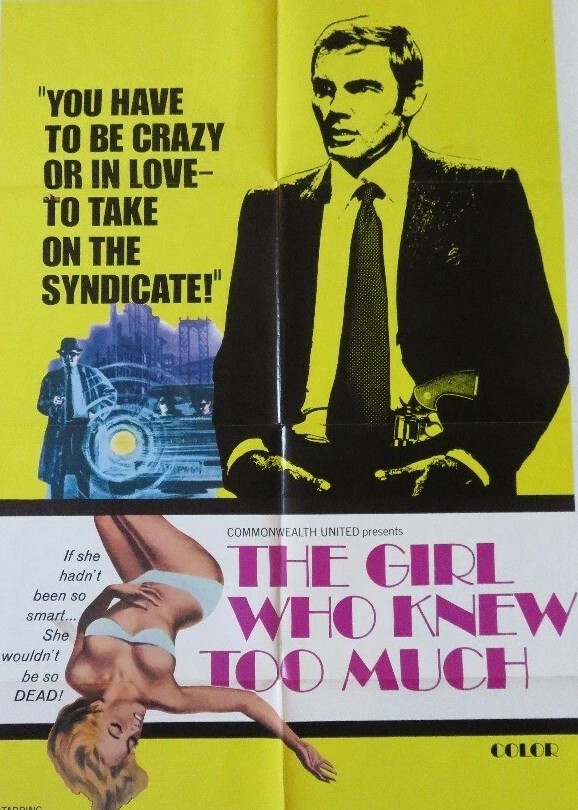
There was another ingénue here. Commonwealth United intended going down the “mini-major” or “instant major” route as exemplified by United Artists and Avco Embassy, where a new production outfit set up a hefty portfolio of movies, aiming for a release strategy of 6-12 a year, sufficient to be recognized by cinema owners desperate for product as a potential player. Established by real estate supremo Milton T. Raynor, it kicked off in 1968 with Tiger by the Tail and A Black Veil for Lisa starring John Mills and Luciana Paluzzi, followed by a heftier slate of seven pictures the following year.

Big-budget items packed with marquee names such as Battle of Neretva with Yul Brynner and Sylva Koscina, The Magic Christian headlined by Peter Sellers and Raquel Welch, and Oscar-winner Sandy Dennis in Robert Altman’s That Cold Day in the Park were mixed in with low-budget thrillers Paranoia starring Carroll Baker, Tippi Hedren comeback The Girl Who Knew Too Much and It Takes All Kinds with Vera Miles plus a pair of Jess Franco exploitationers, 99 Women and Venus in Furs. The project foundered almost immediately and by 1971 was $80 million in debt.

Whether Tippi Hedren ever acknowledged her debt to Hitchcock, it’s pretty clear here that she owed a ton to the way he presented her, not just the glossy façade, but bringing out the best of her acting. Her trademark fragility is little in evidence here without anything notable taking its place. Away from center stage, she doesn’t light up the movie.

Final picture of  R.G. Springsteen (Operation Eichmann, 1961) from a screenplay by Charles A. Wallace (The Money Jungle, 1965).

Run-of-the-mill crime picture or whatever-happened-to Tippi Hedren.

The Waterfront (2025) ***** – Netflix

I’m no casting director but in the absence of anyone with any degree of actual menace (in the De Niro/Pacino/Willis vein) stepping up to the plate, you could do worse than Holt McCallany, star of this engrossing number. You might remember him from the short-lived Mindhunter (2017-2019) series and as head of the wrestling clan in The Iron Claw (2023). But mostly he’s second (often third and fourth) banana or wasted in a series of supporting roles – he turned up in The Amateur (2025) and Mission Impossible: The Final Reckoning (2025).

He doesn’t always get to exude menace, but to my mind that is his forte. He’s got a helluva mean stare and he’s built like a pro football player. Plenty actors around bristle with six-packs and muscle but very few look as though in real life they could actually hurt you. Holt sure does.

Creator Kevin Williamson has come a long way from the slasher genre.

While there are a bunch of twists here, most of the spade work is emotional, characters engaging in activities you might not expect and the set up is a lulu. Harlan Buckley (Holt McCallany) runs a fishing empire in North Carolina. His dad was a gangster but went legit and Harlan has kept away from crime. Except he’s run the business into the ground, what with his drinking and womanizing.

So wife Belle (Maria Bello) and son Cane (Jake Weary) have started a side hustle in drug running, acting as seaborne mules. But Cane is double-crossed and now owes some Mr Big $10 million. So no matter how much he tried to keep himself out, Harlan is drawn back in, and proves to have a natural aptitude for the business.

Meanwhile, Cane’s sister, recovering addict Bree (Melissa Benoist) is acting as an informant for DEA agent Marcus (Gerardo Celasco), also a recovering addict, with whom she is having an affair. She’s a piece of work, not only in the past burning her house down but estranged from her son (she sees him only under supervision) and also having such a beef against her brother that she’s intending to hang him out to dry for the DEA.

Belle has a second side hustle, trying to sell off for development a piece of land that holds such enormous sentimental value for her husband that he has resisted overtures to sell it. And besides, she’s snookered by the seduction technique of real estate agent Wes (Dave Annable).

Melissa Benoist has come a long way from caped crusader activity.

Adding further complication is the reappearance of Cane’s high school squeeze Jenna (Humberly Gonzalez), supposedly happily married as for that matter is Cane (to Peyton). The final piece of the jigsaw is a new bartender Shawn (Rafael L. Silva) acting so weird Belle suspects he’s a DEA plant.

But the soap opera setup is driven by character, the various twists usually by someone acting out of character or haunted by the past. There’s plenty confrontation and punchups for your buck and Harlan shows that he’s inherited a fair chunk of his old man’s criminal smarts, though he does sometimes thinks with his fists.

But the narrative is confident and springs the surprises in regular fashion. You think it’s the son gone a bit wild and trying to earn some extra pocket money running drugs ($100,000 per delivery) until you learn his mother’s in on the deal. You think Bree is just a nutcase mum until you find out she’s hellbent on revenge. The DEA agent as an ex-addict you didn’t see coming though Cane rekindling his affair with Jenna you could spot a mile off.

But each episode ends with major revelation/twist. In the first episode, Harlan has to rescue his son and dip his toes in the waters of criminal enterprise. The second has three stingers – Mr Big is revealed as the local sheriff Clyde (Michael Gaston), the suspicious-acting barman is Harlan’s son and gangsters torch Peyton (Danielle Campbell). That last still has me shaking my head.

Holt McCallany is easily the star turn but Maria Bello (A History of Violence) runs him close. I’m unfamiliar with others in the cast but Melissa Benoist was TV’s Supergirl for six seasons, Jake Weary was in Animal Kingdom for the same length of time and Humberly Gonzalez appeared in Tarot (2024).

Created by Kevin Williamson, inventor of the Scream and I Know What You Did Last Summer horror movie franchises, who reverts to his Dawson’s Creek (1998-2003) persona but twists away from straight soap opera by injecting the criminal element.  

Two episodes in and I’m hooked.

PS I wrote this review before Topher Grace turned up as a psychopathic gangster and the whole endeavor ratched up a notch. On the basis of the first two episodes I had ranked this as four-star, but now, with all the complications twisted the characters in knots, it’s in the solid five-star category.

Catch it on Netflix.

The Amazing Transplant Man (1960) ***

Sci fi film noir. Anything that involves cult director Edgar G. Ulmer (Hannibal, 1960) tends to put an unusual twist on a tale and here he takes the kind of mad scientist who would be perfectly at home in the MCU and turns him inside out. In fact, Major Krenner (James Griffith) is pretty close in intent to Valentina Allegra de Fontaine (Julia Louis-Dreyfuss) in the asterisk version of Thunderbolts (2025) in wanting to build an indestructible army.

His is going to be invisible. (Presumably, this would have been called The Invisible Man had Universal been more obliging.)

It was quite the thing as we have seen from I Aim at the Stars out the same year for the U.S. after World War Two to purloin German scientists, and here Krenner is one step ahead of the Government by snaffling Dr Ulof (Ivan Triesault).

The good doctor is given something of a free pass here because he’s been coerced into working for the major on account of his daughter being held hostage. And because he accidentally killed his wife during one of his experiments. But given he was working for the Germans in a concentration camp and his experiments, had they been successful, would have resulted in the creation of an invisible army for the enemy, maybe we shouldn’t be so lenient.

Ulmer isn’t so lenient with the rest of the bunch and there’s double cross all the way. Safecracker Joey (Douglas Kennedy) doesn’t show the gratitude you’d expect after being sprung from jail by Krenner and his moll Laura (Marguerite Chapman). Being amply rewarded for being a guinea pig isn’t enough and he reckons that if he can walk unnoticed into a government facility and steal nuclear materials, then he could just as well walk into a bank unnoticed and make off with the kind of cash that would fund retirement.

Laura begins to warm to the notion of sharing her bed with a hunky action man rather than a weedy pedant and even more to the idea of sharing the loot and the retirement. There’s also a resident thug Julian (Boyd Morgan) who’s been duped by the major into adding muscle to the operation.

Clever publicity stunt. Joey is going to appear invisibly in person at every performance.

So instead of the usual set-up of good guy, and a girl he met on the way (or vice-versa), intent on stopping the mad scientist, you’ve got the complete opposite, bad guy and hook-up planning to keep on being bad.

There’s a heap of good old-fashioned fun with the invisibility. Some trick photography to make Joey disappear but it’s more fun to watch the other actors throw themselves around to simulate being punched in the face or stroke an empty space and pretend they are touching a real human being, and to see vault doors miraculously open, or onlookers agape at watching a bag of loot hovering in midair. Or even better to see parts of Joey’s body unexpectedly materialize in the middle of a robbery.

You can’t build tension in normal heist fashion. You don’t need to endlessly go over an elaborate plan or hold your breath to see if a guard or some such is going to appear at an awkward moment or another obstacle get in the way, not when you can just walk in and walk out and nobody even know you’re there. So Ulmer doesn’t bother with that aspect, concentrating more on the personalities involved, each as mean and calculating as the others.

Even free pass Ulof, who could sabotage the project at any opportunity, decides it would be better if a hunky action man rather than another weedy individual took on that task. So he lets on to Joey that just as invisibility wears off so does his lifespan courtesy of the radiation which is slowly poisoning him. So it’s Joey who does the needful, not out of a hero’s ambition to save mankind, but out of pure revenge.

Thanks to the characters involved this is never corny. Old-fashioned maybe in an enjoyable old-fashioned way before it cost the world to create special effects.

It says a lot about the marquee quality of the stars that Marguerite Chapman (The Seven Year Itch, 1955) as the femme fatale is top-billed when she hadn’t been in a movie in half a decade and wouldn’t be in another one ever again. Douglas Kennedy (The Destructors, 1968) was a bit-part player and this was as close as he’d get to playing a leading man. Ditto James Griffith (Heaven with a Gun, 1969). But since mostly what they’ve got to show is malevolence nobody is being asked to step outside their comfort zone.

Ulmer filmed this back-to-back with Beyond the Time Barrier, with the two films forming a double bill.

Good fun.

Tornado (2025) **** – Seen at the Cinema

Cult’s a strange creature. Try to cultivate it from the outset and chances are you’ll strike out – the days of Quentin Tarantino hitting a bulls-eye are long gone. So, basically, what you’re left with these days is a picture that flopped on initial release but gradually developed exceptional word-of-mouth and maybe found a welcome home in streaming or on the retrospective circuit if that still exists. But that process takes several years, and the best hope these days is that it gives the director or star a lift. In this case, the door’s been left open for a sequel.

And on paper this sounds an awful conceit. Samurai swordsmen on the loose in antique Scotland? We’re talking 1790, for goodness sake. Were they shipwrecked, enslaved? We never find out. Back story here is in short supply and that’s all to the good because tension never dissipates.

There are only a couple of tropes – a pair of mewling nepo babies suffused with entitlement is as far as that goes.

The rest is original, intriguing and directed with authority. You’ve got gangsters, puppeteers, a circus troupe, and skeletons playing the violin. Twists are in short supply – the expectation that a knife thrower might turn into a male lead is dashed, and dust settling on the top of a piano which should give away the presence of a fugitive is ignored.

The tale is one of greed. And of the greedy feeding upon the greedy. By chance, travelling samurai puppeteer Tornado (Koki) spots the theft of a thieves’ haul of gold by a young pickpocket (Nathan Malone). She helps the boy secrete the two bags of gold in the caravan of her father Fujin (Takehiro Hira). But then she tosses him out of the moving caravan with only one gold piece for his trouble.

When the thugs led by Sugarman (Tim Roth) catch up, her father, unaware of his daughter’s complicity in the theft, is killed protecting her. So the girl and the boy go on the run. There’s none of the usual bonding of thieves.

Sugarman’s son Little Sugar (Jack Lowden) knows the girl has stolen the gold and in rebellion against his father determines to have it all to himself and not above killing off a colleague who gets in his way. Sugarman is a ruthless thug, setting fire to the encampment of the circus troupe for hiding the girl, and not above knifing his son to death.

Tornado doesn’t show the slightest sign of remorse at being the reason for her father and the boy and a strongman who protected her being killed nor for being the cause of the circus troupe being rendered homeless. She’s as amoral as the rest of them. But in the end she does put them all to the sword.

So, theoretically – and this is how it’s being marketed – it’s a revenge thriller or a samurai western (which has already been done with Red Sun, 1971) and both attempts at categorization are way off the mark. It has much more in common with Tarantino, of infighting among gangsters, but it’s so splendidly done, with terrific composition and use of the widescreen that it touches the cult mother lode, in that it is indescribable, creating a world of its own, set in a lawless world where the strong dominate and the weak run for cover. And it’s also a world where you better not get wounded, because that will be cue for someone else to take advantage.

Tornado transitions from rebellious daughter – “who put you in charge” she complains to her father – moaning about being bored and can’t take the job of being a puppeteer seriously, and she’s not that good either at paying attention when her old man tries to teach her more swordfighting. And, of course, she’s to blame for the death of her father. Her instinct is to run and hide and wait till the brouhaha dies down. And it’s only when she realizes that she can’t effectively carry two heavy sacks of gold that she decides to cut and run – with the emphasis on the cutting, slicing and dicing the gang till there’s only Sugarman left and he’s, ironically, dying anyway from a wound inflicted by her father.

So not your ideal heroine. In the old days she’d have been an innocent, guiltless, only taking up the sword or gun after her father was killed by ruthless villains. It’s all the more interesting for not going down that route.

The choices director John MacLean (Slow West, 2015) doesn’t make define the picture. There’s no love interest, Little Sugar and Tornado could as easily have conspired to make off with the dough, or some narrative device could have thrown them together. But both want all the gold for themselves. The knife expert you think is being introduced to come to her rescue. But no go there either.

Tim Roth (Rob Roy, 1995) is superb as the cold-eyed gang boss and Jack Lowden (Slow Horses, 2022-2024) as his shifty son and MTA Koki makes a startling debut.

It’ll be gone from cinemas by the time you read this review but look out for it on a streaming platform and I hope it will prick your interest as much as mine.

Impasse (1969) ***

The kind of desultory B-movie Burt Reynolds was relegated to before Deliverance (1972) sent him on his way into the superstar stratosphere. And you could see why he might as easily have ended up at the lower level. This was his third stab at top billing and he’d have another two goes before Hollywood gave up on him and he tried again (he’d been in the shortlived Hawk series in 1966)  in television as Dan August (1970-1971). In what could have been a career breakout – 100 Rifles (1969) – he was left trailing the wake of the incendiary combo of Raquel Welch and Jim Brown.

When you’re at this lowly level in the Hollywood pecking order, you are destined just to take what comes your way. This is set up as mission-picture-cum-heist but it takes way too long to get under way and there’s little tension on what passes for the heist.

More time is spent on chief thief Pat Morrison (Burt Reynolds) organizing his love life with main squeeze Mariko (Miko Mayama) who happens to be the wife of one of his recruits Jesus (Vic Diaz). He’s on board because he was present at the World War Two secret mission on Corregidor where the Yanks stashed away $3 million in gold. Morrison has tracked down two others who were present – Apache Draco (Radolfo Acosto) and racist Hansen (Lyle Bettger). But there’s a complication – they were blindfolded during the operation.

Morrison could have found the gold just through the medium of Jones (Clarke Gordon) who led the expedition. But there’s a complication. He’s too ill to make the trip. And just when Morrison needs him there’s a further complication – he’s kidnapped by The Wombat (Jeff Corey) who wants his share.

Meanwhile, to further delay the team getting going, there’s a further complication. Jones’s daughter Bobby (Anne Francis), a tennis champ, becomes involved. But there’s a complication and we’ve got wait a while till she sorts out how she’s going to deal with hippie tennis groupie-cum-stalker Penny (Joanne Dalsass) and we find out whether she swings both ways. That factor is never properly determined but just to complicate things further – and set up the climax – Morrison beds Bobby much to the anger of Mariko. And the fact that Morrison was in a relationship with Mariko sets up another complication when, once the trip gets underway, Jesus finds out.

There’s some colourful background to while away the time in between Morrison getting his shirt off and the various fisticuffs and shootouts that delay the mission getting started. Eventually, the reach their destination. The loot is hidden in a tunnel and is found by the trio re-enacting the previous circumstances, blindfolded as before and counting off the individual number of steps each took in the tunnel. There’s another complication – what did you expect? – because before the final steps are completed they hit a wall and it does take them way too long to work out that the edifice must have been constructed after the gold was hidden.

And just when they’re making their getaway there’s a complication. Philippine soldiers are waiting and they’re all shot except Morrison who is captured. And it’s then he discovers the price of his two-timing Mariko, in revenge she’s informed on him.

Way too complicated to be set up as a star-making vehicle for Burt Reynolds (Sam Whiskey, 1969), but he does exhibit some of the persona that would later be his trademark, the smug grin and the naked chest, easy with fists and charm. Anne Francis (The Satan Bug, 1965) adds sparkle but she’s not in it long enough and she’s distracted by father and groupie. Jeff Corey (Seconds, 1966) is otherwise the pick.

Directed by Richard Benedict (Winter a Go-Go, 1965) from a script by John C. Higgins (The File of the Golden Goose, 1969). The complications don’t have the black comedy feel of The Hellbenders (1967) and mostly hold up the story up rather than adding tension.

Come at it as a supporting feature and it would be more enjoyable than if you had paid your hard-earned dollar to see it as the main feature.

Discover WordPress

A daily selection of the best content published on WordPress, collected for you by humans who love to read.

The Atavist Magazine

by Brian Hannan

WordPress.com News

The latest news on WordPress.com and the WordPress community.