I rarely feel inclined to dig around the two streamers – Netflix and Amazon – available to me what with a vast backlog of 1960s DVD/VHS still to plough through and interest in contemporary cinema sated though a weekly visit to the multiplex. It’s rare that I can sit through more than five minutes of the movies funded or picked up by streamers, so poor is their quality control. So this came as a surprise.
The acting’s not the best and just when you are beginning to run out of patience suddenly the real twist kicks in and it makes terrible, terrible sense and a situation that has spiralled out of control ends up in a bottomless pit. I say the real twist because I had guessed the first twist, an obvious consequence of the set-up of these kind of films. But the real twist is much darker and eminently more savage.
So, the basic story is rock musician Jay (Peter Sarsgard), estranged from wife Rebecca (Mireille Enos), takes teenage daughter Kayla (Joey King) to dance camp and on the way picks up her best pal Trini (Dani Kind) and somewhere in the middle of an ice-bound wilderness said friend needs the toilet. Kayla and pal go off but only Kayla returns, admitting she has pushed friend off a bridge into icy river.
Jay’s now got to decide how to protect his murderous daughter, hide any evidence of Trini being in the car etc. He confides in Rebecca, and protecting their daughter brings the couple closer together. Meanwhile, Kayla is acting as if what’s all the fuss about. This is dysfunctional on the rocks.
Luckily, it turns out Trini has a record of running away and her dad Sam (Cas Anwar) has a terrible temper and may be abusing her so it’s relatively easy to get the police to consider him the main suspect, especially as he’s very lax in reporting the child missing. Plus, Rebecca seems to know her way about the police and Sam makes the mistake of causing a scene in the street.
But, of course, nothing goes according to plan, the situation gets worse, as the innocent parents try to fabricate something that will make the police go away. There’s a lot of other subtle stuff that complicates the situation. But essentially it’s two parallel stories diverging along psychological lines.
With those malevolent eyes, Peter Sarsgard (The Batman, 2022) has some difficulty passing for innocent, and of course his character is not exactly saintly, so that muddies the waters, as I guess is the intention, while the casting of Mirielle Enos (best-known as the detective in the U.S. television adaptation of Nordic hit The Killing, 2011-2014) also suggests the director is hoping to mislead the audience.
Joey King (Bullet Train, 2022) is so sulky and petulant from the outset that you wouldn’t be remotely surprised that her teenage hormones could escalate into murder and then for her sit back and enjoy watching her parents try to deal with the consequences.
And you might nitpick and wonder exactly what kind of town this is when there’s not a single neighbour to appear at the sound of an argument or a fight or a car accident, and no cameras on the streets. But generally, this is a tight mostly three-hander with tension quietly building, wrong decisions taken by people who think they are cleverer than they are, a finely balanced pyramid of parental attitudes to children and vice-versa and throwing out the one question every parent hopes to avoid: how will your react if your beloved child commits a heinous crime? What lengths will you go to protect them?
So in the context of the shattering ending, everything makes far worse sense.
A very neat thriller and almost a made-for-streamer feel about it, in the old made-for-television sense.
Writer-director Veena Sud (The Salton Sea, 2016) keeps a keen grip on a tale that is a remake of German picture Wir Monster (2015).
Enigma and irony are hard enough to pull off in a drama never mind an intellectual thriller that plays around with reality. So full marks for a terrific performance by Guy Pearce (The Seventh Day, 2021) holding together a relatively simple tale of paranoia, and writer-director Andrew Hunt (The Miles Between Us, 2016) for teasing it out.
Author Bruce (Guy Pearce) has written a bestseller that triggered sociopath Dwight Tufford (Alex Pettyfer) into carrying out a mass killing. Hiding out in a remote cabin away from any feeding frenzy, and drowning in alcohol, he’s nonetheless being stalked by obsessive fan William Dukent who sends him daily missives by post, conveniently attaching a contact number but infuriatingly never answering his phone. Aware how obsession can end (for example, in mass murder), he’s none too keen on meeting said fan, and is armed against intruders.
That his mental health is imperilled suggests some deeper psychological problem since beyond irritation there is no obvious threat. Ad bearing in mind he’s an alcoholic, there’s always a possibility his nemesis is himself. Before he achieved fame he was your standard creative writer teacher so we’re regaled in flashback or voice-over with some of the rules of writing, but what appears mere filler material takes on deeper meaning in the third act.
What makes this transparently different from your standard paranioa thriller is that Bruce is hardly equipped to hunt down bad guys, possessing none of the “particular set of skills” possessed by the likes of Bryan Mills (Taken, 2008), and no military background to call on. It takes him forever to even work out that the name of his antagonist is actually a clue.
Eventually, he is assisted in his endeavors by cop Officer Higgins (Alice Eve) but nothing makes much sense and he deteriorates further into an alcoholic haze. Even while every step forward turns into a step back, at least he is on the case. And then the twists come thick and fast.
I’m a pretty big fan of twists and because I generally watch twist-ridden pictures am inclined to go with the flow, though not without trying to figure the puzzle in my own mind. But when the final parts of this particular jigsaw unfold they are of the unexpected variety. If I tell you any more I’ll give the game away.
So, primarily, it relies on a somewhat incoherent fellow trying to find coherence in a world that has to all extents and purposes betrayed him. After years of rejection, he has finally grasped the brass ring (if that’s what you do with brass rings) filled with awards and a mass of cash (enough at least to fund this retreat and heroic alcohol consumption). Whatever his book has triggered in the mind of an assassin is never made clear; the novel is about a priest who disproves the existence of God. And given it’s impossible to understand the deranged mind, that could just leave him a victim of circumstance, in a perfect storm of angst, and all the while trying to determine how, as befits a writer, this chimes with his own personal narrative, every individual being the hero of his own tale.
Except for the title, this has got nothing to do with the film under review but I was stuck for another illustration and this came to hand.
As I said, it all hangs on the performance of Guy Pearce who’s been here before in Memento (2000) and he creates a believable contradiction, intelligent enough to try to make sense of his stalker but at the same time arguing with a telephone answering machine.
Only a couple of sections are questionable, how to engineer an escape from a super-maximum security prison and how Bruce would know the capabilities of a bullet when not fired from an actual gun. But by that time you’re already along for the ride.
Andrew Hunt doesn’t give much away until he has to and it’s to his credit that we care so much for an isolated character minus the standard wife or daughter there to generate audience empathy. Given the hero is not a particularly likeable character, it’s no mean feat to get us on his side, especially when he dips into philosophy and tips on writing. Hunt devised the screenplay from a story by Louis Kornfeld, who originated the source material, the wonderfully-titled The Hilly-Earth Society, for a podcast.
Just about hits the balls-eye (sorry, bulls-eye) but falls short through miscalculating its target audience. A little bit of rejigging in the inevitable sequel could see this shine. Roughly, Die Hard meets Home Alone. That’s putting it a bit crudely, but swap skyscraper for billionaire’s mansion and a little boy for little girl and you get the drift.
What gets this very much over the line are the little bits of magic, as appealing as they come, and Santa has a get-out clause (literally, and no pun intended) because in dire emergency he can vanish up any nearby chimney and though he’s aware there’s magic involved he has no idea how it’s done. Plus he has a scroll to hand, a cribsheet that separates the good from the bad.
Bad moon rising? Less of the ho-ho-ho and more of the bah humbug and it just goes to show that a man and his hammer should never be parted.
Home Alone defensive techniques have escalated since Macauley Culkin’s day, and though “You Filthy Animal” is referenced young Trudi (Leah Brady) has a mouthful of real cuss-words, plus nails her weapon of choice. It’s cleverly done how she links up with the inebriated self-pitying Santa (David Harbour) and there’s a grimace-inducing finale – the true spirit of Xmas and all – that sails close to the wind for a hardnosed thriller but par for the course for a soppy Xmas saga.
So that’s really the only problem. The picture can’t quite make up its mind in which direction it’s headed. Hard-ass with a soft center is clearly the aim, but there’s just too much gore to pull that off. Sure, some of the killings are comic, but they’re helluva bloody too. And there’s a weird backstory – even weirder than John Wick’s assassin commandments that shalt not be broken – involving (I think) something to do with Vikings and a guy who can’t die, not exactly a zombie because he’d already be dead, and thankfully he doesn’t need blood to slake his thirst, but still he’s been around for a millennium, though, truth be told, the actual date Father Christmas first appeared is not exactly set in stone.
On the other plus side, the family whose home is being invaded by villainous “Scrooge” (John Leguizamo) – color and city pseudonyms all taken by previous fictional gangsters – are just plain venal, toadying up to ruthless matriarch Gertrude (Beverly D’Angelo) whose vault bulges with gazillions of illicit dollars. Her potential heirs, Jason (Alex Hassell) and Alva (Edi Patterson), are a cringe-worthy pair. While Jason at least is attempting to sever connections to malicious mama, Alva has named her son Bertrude in a bid to curry favour. And when push comes to shove, most of that family will sacrifice every last one of their nearest and dearest.
So, basic story, family in the sh*t, drunken Santa and little girl to the rescue.
There’s some clever twists. Jason isn’t quite the dolt you think, Alva’s macho boyfriend-cum-actor turns out to have muscular chops while Jason’s partner Linda (Alexis Louder) is quite the vengeful one.
Endearing to the last, Trudi channels her inner Macauley Culkin with a side-serving of her grandmother’s ruthlessness and, taking Home Alone as her template, effectively slices and dices her opponents. And my guess is that’s the vibe the producers were chasing – fun slaughter. They don’t miss by miles, but they do miss. And an audience that would have happily lapped up the outrageously vicious Trudi will probably not relish the rest of the gory goings-on while a John Wick audience will feel hard-done-by that even a sliver of cuteness has penetrated their hardcore world.
And it’s that rarity, an action comedy with a good few belly laffs rather than the usual situation where you see what they’re trying to do but don’t actually burst out laughing.
David Harbour (Black Widow, 2021) isn’t left to carry the picture but his cynical manner, catchphrases, and surprisingly gentle approach certainly bring it home. Leah Brady, graduate of the Umbrella Academy (2022), is New Wave Cute, soft with a hard center. Beverly D’Angelo (National Lampoon’s Vacation, 1983) can;t believe her luck at sinking her teeth into such a vicious character.
Director Tommy Wirkola (Hansel and Gretel: Witch Hunters, 2013) just about gets it right, especially unusual to be able to marry action and comedy, working from a screenplay by Pat Casey and Josh Miller who co-wrote Sonic the Hedgehog (2020) which was also a matter of getting the balance right.
Great fun all round. Not sure what the title would be for a sequel but look forward to it.
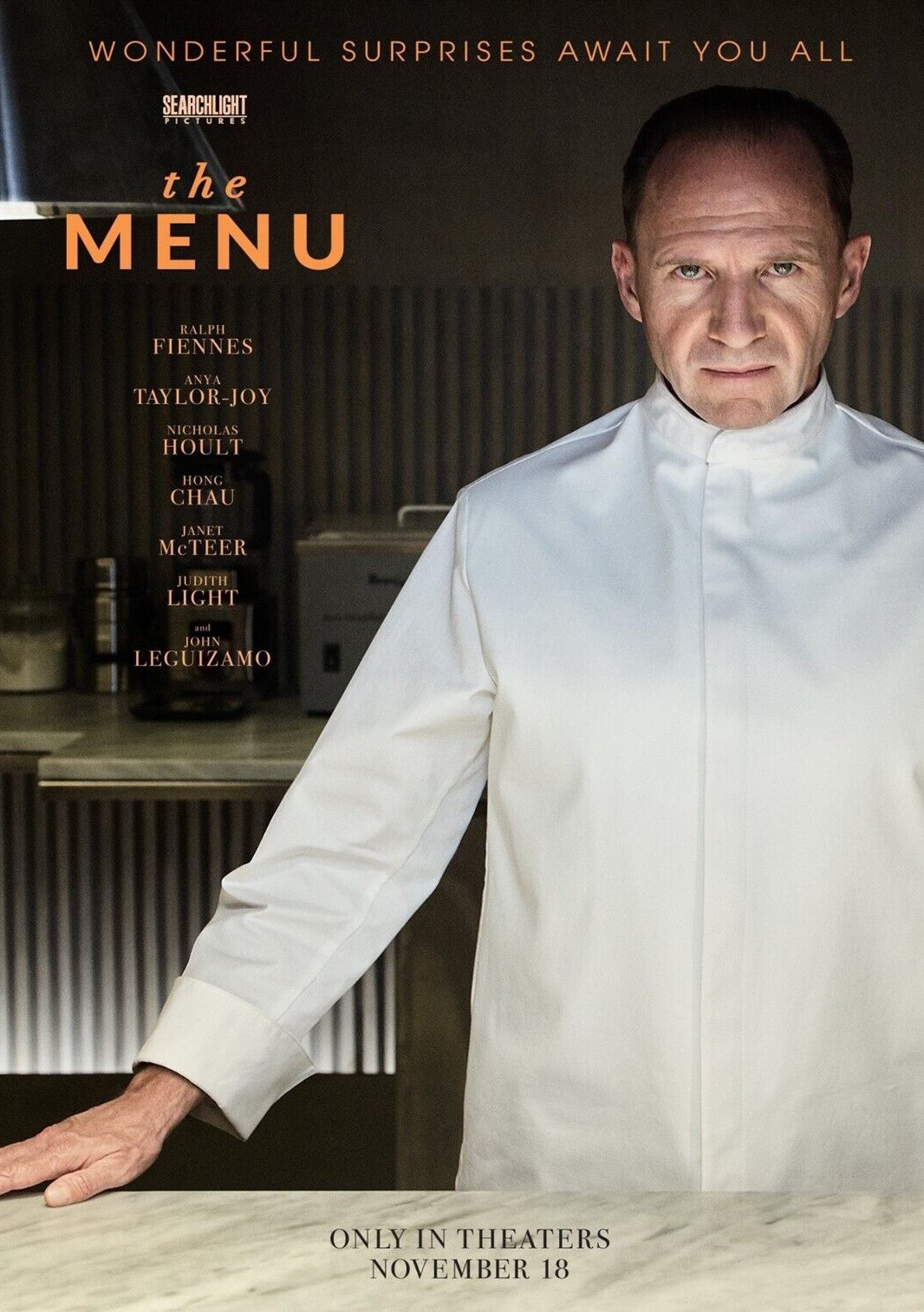
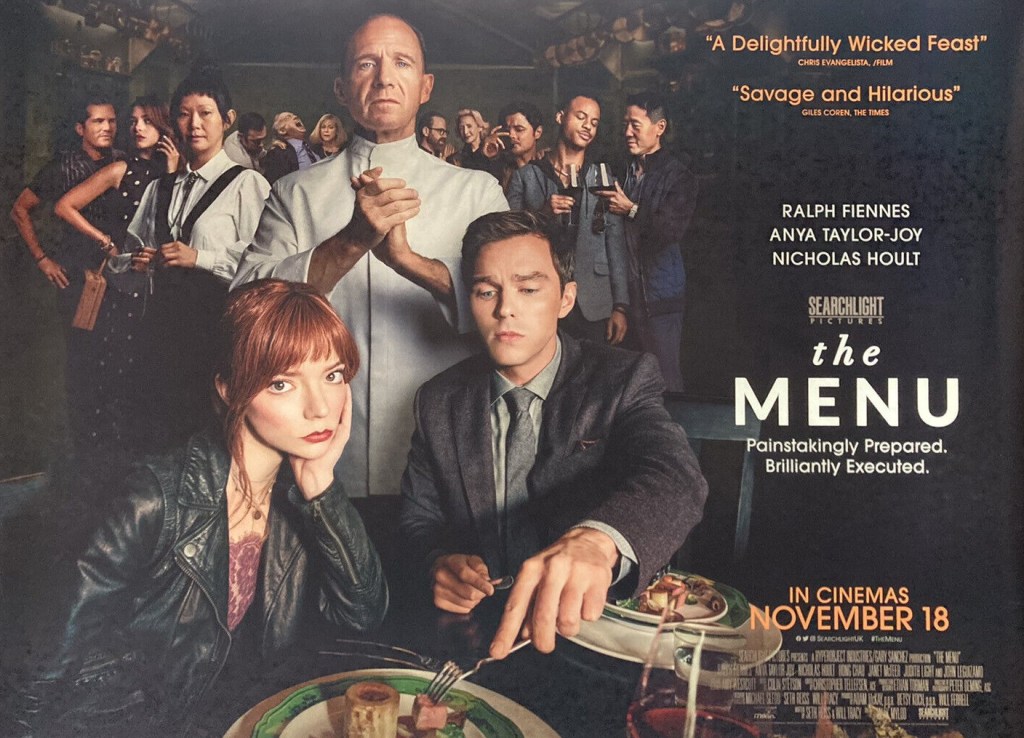
Hitchcock would have adored the apocalyptic flavour of this quasi haunted house psychological thriller. Setting aside its intellectual pretensions this is pure pedal-to-the-metal material. You never know what’s going to happen next in a tense environment created by dictatorial celebrity Chef Slowik (Ralph Fiennes) in whose eyes the entitled are likely to get their just desserts.
In most thrillers of this nature, the assorted bunch of potential victims usually attempt some kind of fightback, and they’re usually younger and sexier, but this crew are trapped in the headlights because they find it impossible to believe they could possibly be in the middle of a revolution.
The beauty of their dilemma is that Chef is trapped, too, by his desire for fame, suffocated by pursuit of perfection, but yet, as they soon come to realise, accepting punishment for his own sins (attempted rape for one). You might be fooled by the trailer into thinking there is a way out, if only a perilous one, but that’s a bit of a red herring, and as the tension grows you realise it’s heading for an incredible conclusion.
Only the rich can afford to visit this expensive restaurant on a secluded island. Most of the guests aren’t even interested in the food – that’s one strike against them – but for the experience of having said they’d been there or to, as is the prerogative of the wealthy, be pampered within a whim of their life, or to find something minute to complain about, a niggle guaranteed to cause grief.
Creepy though they are, Chef’s thunderclapping hands that demand guest attention, the cries of “Yes, chef” from his slave-like adoring workers, the detail of high-falutin’ cooking, history and ecology lessons, a ramrod sergeant-major of a maitre’d Elsa (Hong Chau), and occasional ironic twists – a bread course that contains no bread for example – are mere hors d’oeuvres for the main event.
Chef knows a tad too much about his guests’ peccadilloes – infidelity, financial irregularity – for their liking and as the evening out begins to turn into a cul de sac and shocking incident follows shocking incident, cowardice and lack of the kind of retinue that could come to their rescue, the guests can only watch as they are served up on a platter to a madman’s ideology.
Certainly, the format is exceptionally cinematic, sequences chapterized as menu courses, and the intellectual discussion that divides the world into the servers and the served well observed, but driving the thriller engine is the most refined nutcase this side of Hannibal Lecter, a thin-lipped specter at a feast of his own devising , a creator at the end of his tether, seeking revenge on those who quibble with his talent. And yet there is something universal about this individual, a man scrabbling so hard to stay ahead of the game that he is almost on a par with Arthur Miller’s famed salesman. Is Chef doing much more than the culinary equivalent of “riding on a smile and shoeshine?”
The guests are the usual high priests of pamperdom, food critic Lillian (Janet McTeer), movie star (John Leguizamo) planning to revive his career by fronting a food show, simulating orgasm with every taste, a trio of young financiers, a couple who have come several times but can’t recall a single dish they’ve eaten, and foodie Tyler (Nicholas Hoult) accompanied by a mysterious woman Margot (Anya Taylor-Joy) who turns out to be in a different branch of the service industry.
British director Mark Mylod (Ali G in Da House, 2002, anyone?) has learned from helming episodes of Game of Thrones and Succession how to match reaction to incident. As much as Chef is in control in the restaurant, Mylod is in control of exactly what we see. There is none of the over-acting that appears to come with the territory, certainly no screams or titillation, not a whiff of cleavage, the usual recourse of a horror film run out of ideas, though, as with that genre, it is the sexually compromised who suffer first.
Mylod’s tight rein ensures shock is just an element of the overall effect, rather than its signature dish, and that all the ruffley-truffley culinary dialog only serves to heighten morbid sensation.
Ralph Fiennes (The Forgiven, 2021) may well have delivered a career-best performance it is so constrained. Given equally little room to manoeuvre, little time for eye-rolling or exacerbated action, Anya Taylor-Joy is back to her The Queen’s Gambit (2020) best, while Nicholas Hoult (Those Who Wish Me Dead, 2021) adds sly deviance to a screen persona that plays on innocence. It’s an astonishing screenwriter debut for television writers Seth Reiss and Will Tracy.
As it happens, I’m very familiar with the lives of chefs, having spent three decades working with them, initially as a cossetted observer, as journalists often are, being the fawned-upon editor of Caterer & Hotelkeeper, the hugely profitable industry trade weekly in Britain, with massive sales at a time when print was the dominant media, so much so that during my time we produced a world record (for a weekly) issue of 524 pages. But when I later set up the Scottish Chefs Association, whose board comprised all the top chefs in the country, and its offshoots the Scottish Chef Awards and a cookery school for chefs, I became privy to the fears and wonders of the cooking business. So I can attest to the fear and loathing for some customers and most critics, who seemed determined in the days before social media to spoil anything they could, or demand preferential treatment.
Certainly, the restaurant is a unique kind of business, food being cooked to order, “a la minute” as the saying went, and customers disrupting a tight ecology by simply turning up late, or early, or not at all. Customers were prone to theft, teaspoons in particular replaced on a titanic scale, and the litany of complaints could outweigh a Bible. Then, as now, reputation was everything, and could be destroyed by a food critic or word-of-mouth. It wasn’t just chefs who sought perfection, but customers, any deviation from expectation harshly dealt with.
Successful chefs with investors would find that somehow they saw little share of the profits. Chefs minus investors lived a precarious existence. Good reviews would bring in bad customers, the kind who pored over every detail, like Tyler wanting to share their paltry culinary knowledge with the expert, needed extra attention, and came to say they had been there. But I can sympathise with Margot who felt she was being experimented upon rather than fed and can recall several times buying fish and chips immediately after dining in a Michelin-starred establishment.
I remember, too, industry astonishment that celebrity-chef-du-jour Anton Mosimann began the day by walking round the kitchen shaking hands with every chef, no matter their rank, rather than starting off their day with a rant. Kitchens are organised on a brigade system, obedience imperative, no questioning of authority. But rather than derogating talent as occurs here, many top chefs proved apt talent-spotters. The Roux Brothers, for example, created a magnificent template, finding backers among their appreciative wealthy customers for the young talent in their kitchens, which resulted in a new generation of chefs setting up in business without the usual financial woes.
In Britain and Europe, however, perfection could be achieved. If you reached the highest standards set by the Michelin Guide inspectors and were awarded the coveted three stars, the highest culinary accolade that could be bestowed, you had reached the top of the tree. You couldn’t relax because one or more of the stars could be taken away, but the kind of personal obsession that afflicts Chef here would be lessened. However, since very few chefs hit the three-star mark you have hundreds if not thousands beavering away trying to achieve it.
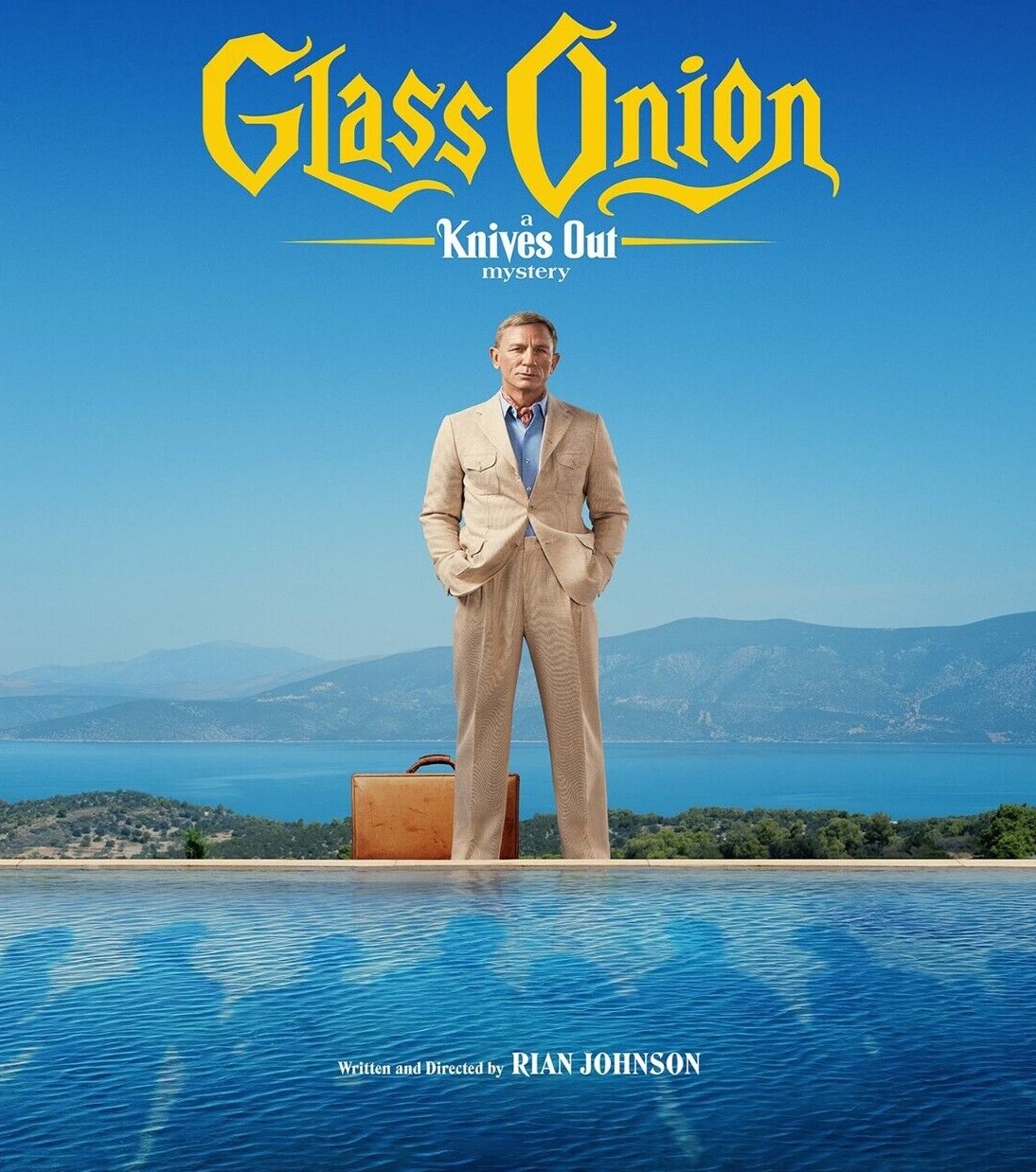
Another triumphant entry in the casebook of Benoit Blanc, self-style world’s greatest detective and easily the most flamboyant in the genre since Hercule Poirot. Writer-director Rian Johnson’s invention offered Daniel Craig an immediate opportunity to shed the typecasting curse of James Bond and the actor rises splendidly again to the occasion, some hints of his inner life offered, signs of depression and a cameo by Hugh Grant as flatmate, helpmate, whatmate.
But in the main it’s another twisty picture that plays with audience expectation even though, if only we were as clever as its creator, the truth is in plain sight, beginning with the title.
Victims – or suspects – assemble.
You have to peel through layer upon layer of an ordinary onion, but a glass onion you can see straight through. It would not occur to the audience, lured by mystery, arriving with a different sort of anticipation, counting on this glass onion to be a mere architectural folly atop a majestic building on a remote island off the cost of Greece, that everything could be actually straightforward and that the need for complicated crime is a figment of our own imagination.
There’s only one twist you may guess and the movie certainly takes a while to spark into life as we are introduced to a variety of unlikeable characters, ideal candidates you might think to be a victim, through the device of them all receiving an extremely puzzling puzzle in an apparently impenetrable wooden box.
Right from the get-go, the audience is sucked in. Are they the type of people who are determined to solve the riddle, with endless patience, or in collaborative effort expend energy and time on a fiendish enigma that seems to change shape every few minutes, layer by layer like a veritable onion? Or do we just work out that a box made of wood ain’t going to have no defence against something as simple as a hammer?
Anyway, enough with the philosophizing and on with the show. During Covid a bunch of disparate characters with no connection except a link to billionaire Miles (Edward Norton) are invited for a murder mystery weekend to his island home. Miles, being the show-off to top all show-offs, has invited Benoit on the basis that his mystery will fox the detective, score one for an uber-clever magnate.
He is so unbelievably wealthy and ridiculously endowed with genius from thinking outside the box that he has managed to secure a loan of the Mona Lisa painting from the Louvre in Paris, paid through the nose for it of course, taking advantage of the museum’s lack of income from the paying tourists, Covid having dried up that moneywell. The artwork will form the centerpiece of his cleverness as he presents to a posse of investors later on his newest invention, Klear, an idea that, however dangerous and untested, will solve the world’s energy supply problems.
Anyway, Benoit is way too smart for him and solves the murder mystery in a trice, only for there, as you might have expected, to be another real murder or two, leaving the private eye with the unusual accent a classic closed room mystery.
Under suspicion are Miles himself of course, plus one-time model turned fashion designer Birdie Jay (Kate Hudson), the dumbest cluck in the coop, aspiring politician Claire (Kathryn Hahn), Miles’ former business partner Andi (Janelle Monae), macho male Duke (Dave Bautista) and girlfriend Whiskey (Madeline Clyne), Miles’ sometime lover, scientist Lionel (Leslie Odom Jr) and Peg (Jessica Hanwick). What they share with Miles is vanity, an overweening sense of their own importance and entitlement.
Actually, one of them doesn’t qualify as a suspect because as you may have guessed that would be the victim. Two of them, since I’ve already kind of given away that there are two dead. Anyway, you’re not going to guess any of this since you’re all dupes to the infinite ingenuity of Rian Johnson.
Sure, the director takes pot-shots at the rich and the wannabe wealthy and the wannabes that trail along in their wake, but mostly he takes aim at the genre itself, turning the whole idea of the mystery picture on its head, that we expect something pretty intricate the moment we are presented with a movie puzzle, and motivation being the engine of all mystery start delving headlong into that morass without thinking the answer might be something a lot simpler.
Whatever Rian Johnson is doing he’s got the elan to carry it off. Sequels often disappoint. This won’t. Not quite the caliber of cast as Knives Out (2019) but that’s actually to the film’s advantage, no need for the star-stalking that afflicted the recent Death on the Nile (2022).
Thoroughly entertaining, ingenious and devious, what more could you ask for, apart from Netflix not having snapped up the golden goose, since this will be infinitely more enjoyable in the company of an audience responding en masse to the trickery, as I discovered when watching it on its brief foray to the cinema.
And there’s certainly a dichotomy here. What is the point of the Netflix sop to the movie theatre? Sure, it’s going to rack up a ton of reviews but they’re all going to be posted a month before the picture opens on Netflix rather than the weekend before. Anticipation may not last that long. Anyway, given all the turkeys Netflix has foisted on movie fans, this will be one Xmas when it delivers.
PS: Apologies for the goof on Behind the Scenes: “Bandolero.” That blog is coming on Saturday but I pressed the wrong button and sometimes when you press the wrong button there’s just no going back.
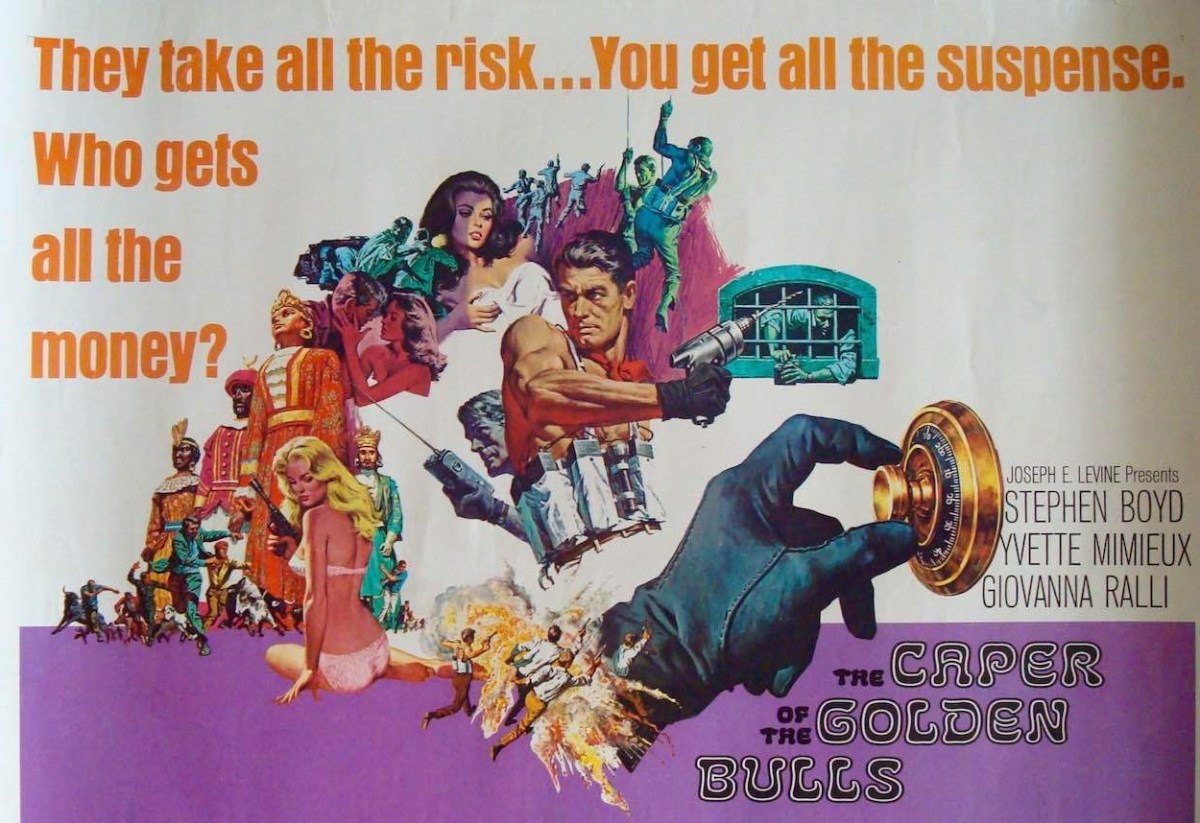
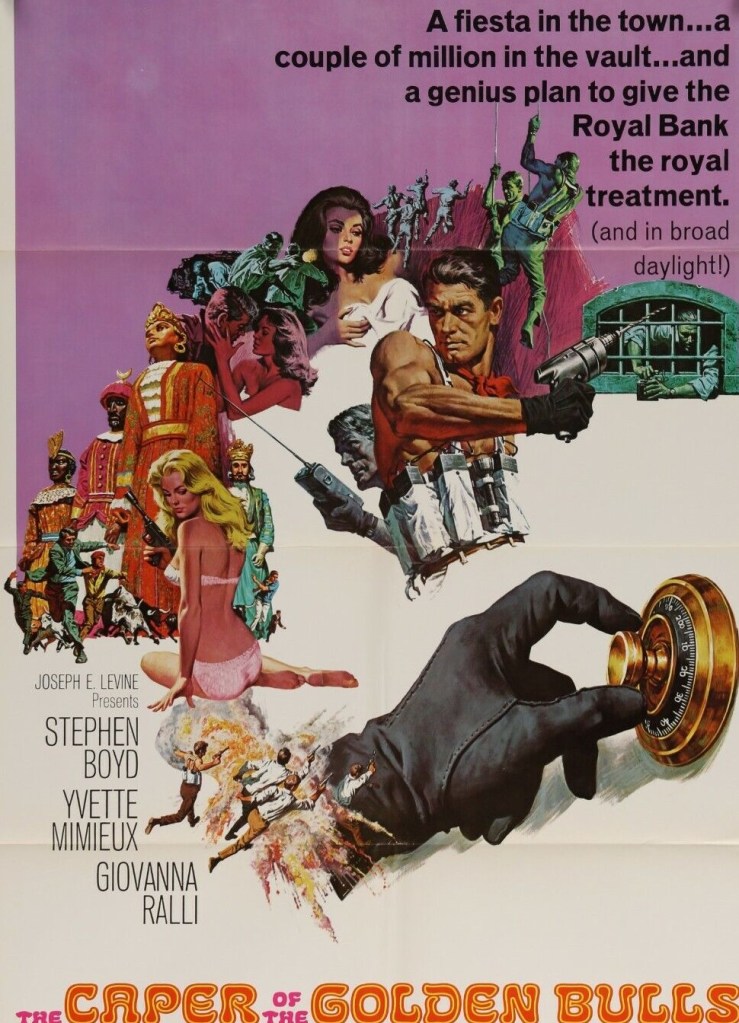
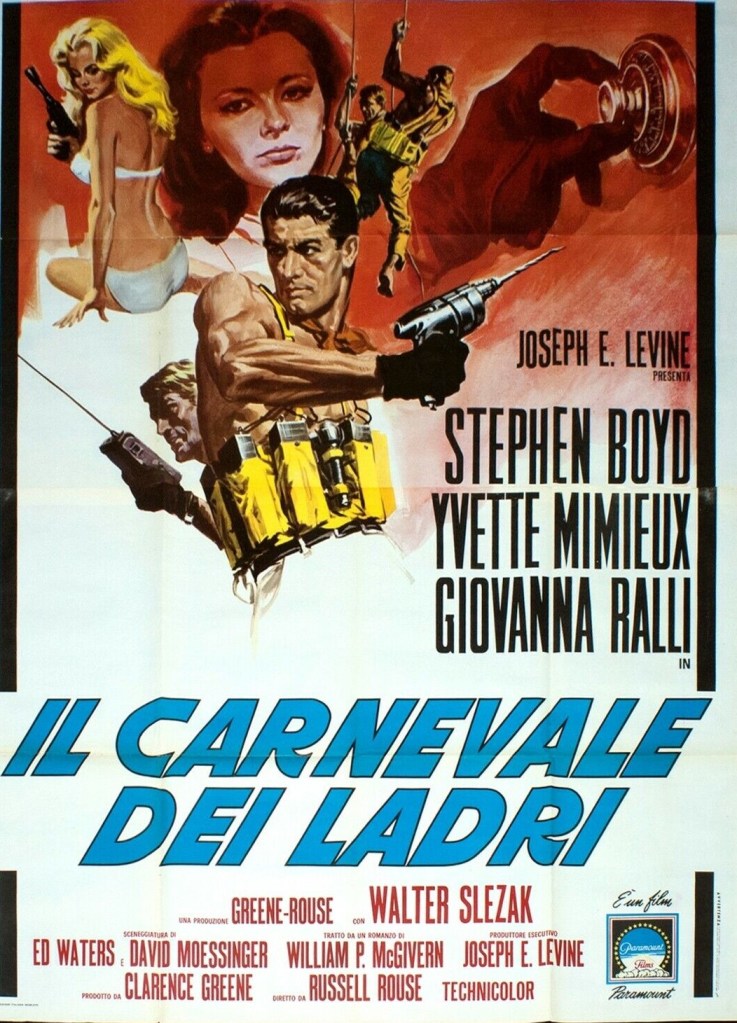
Just to be clear. Nobody is stealing a golden bull, though the annual running of the bulls in Pamplona in Spain is a plot element. No, this gang, led by former bank-robber Churchman (Stephen Boyd) is only going to break into an impregnable bank (par for the course) and steal priceless royal jewels.
There’s an audacious, certainly unorthodox, plan, tension throughout between Churchman’s sexy former lover Angela (Giovanna Ralli) and current more demure squeeze Grace (Yvette Mimieux), a couple of unexpected comedy sequences, a silent heist and a superb final twist.
Just to be clear – there’s no bikini blonde with a pistol.
Churchman is not your ordinary robber. He only hit banks to make reparation for, while a World War Two pilot, mistakenly dropping bombs on a French cathedral, donating the loot to the reconstruction. Angela, with no such ideals, has spent her share of the dosh and intent on a financial top-up blackmails Churchman, now a respected businessman, into the one-final-caper scenario.
Key to getting the jewels out is becoming involved in the annual fiesta, of which the bull-running is a minor part. The bull-running, too, shifts the dynamic of the job, and what appears an irrelevant sub-plot of former resistance fighters hunting a traitor provides an essential pay-off.
When moral Grace uncovers the plot she is inveigled to participate, ensuring some spicy bitchy dialog between herself and the more obviously immoral Angela. Unwittingly helping out is Spanish cop (Walter Slezak) and with Churchman committed the only person Angela needs use her wiles on is a giant, friendlier by the minute as he responds to her seductive smiles.
While this lacks the panache, guile or gloss of a Topkapi (1964) or Gambit (1966), it’s certainly well-done enough. It’s one of those films you appreciate more after you’ve watched it than during, the structure of the screenplay most of all, as all the little pieces of a finely-tuned jigsaw lock into place.
There’s a couple of excellent reversals, an ambush where firecrackers pass for bullets, imminent discovery of explosives thwarted by a quick-thinking Grace, and some split-second timing. Explosives, timed to match the firing of a cannon, allow a bystander cop to remark, “that cannon gets louder every time.” At first the fiesta appears standard time-filling tourist-fodder but both the parade and the bull-running are allocated genuine spots in the narrative.
The sensuous, devious Giovanna Ralli (Deadfall, 1968) is the pick, a femme fatale straight out of film noir, with a knowing twist in her main seduction scene. Fans of Stephen Boyd (Assignment K, 1968) will enjoy seeing him dally with conscience rather than rely on a straight down the line hardman, albeit with more than an ounce of charm. What Yvette Mimieux (Dark of the Sun, 1968) ultimately brings to the occasion is hidden until the end so her character has more depth than initially surmised.
There was a sense here, though, of three stars still trying to make their mark on Hollywood, establishing their marquee credentials. Although Boyd had enjoyed box office success in Fantastic Voyage (1966) and The Bible (1966) he was not seen as the main element in those film’s hitting the target. Other films relying on his star potential to pull in an audience had flopped.
Outside possibly of Disney confection Monkeys, Go Home! (1967) and The Time Machine (1960) Yvette Mimieux had yet to enjoy a proper hit. Giovanna Ralli was the latest in a string of European imports, a low-level gamble since they were cheaper than Hollywood alternatives even though most never made the grade or did so only fleetingly.
You wouldn’t pick this picture to put either of the trio back on the very top since for the sake of later twists the screenplay plays around with motivation and the very lack of gloss limits the movie’s potential. But although we’ve seen much of this before, it’s still suspenseful enough.
Russell Rouse (A House Is Not A Home, 1964) directs from a screenplay by David Moessinger (Number One, 1969) and Ed Waters, who had form in this area with Man-Trap (1961).
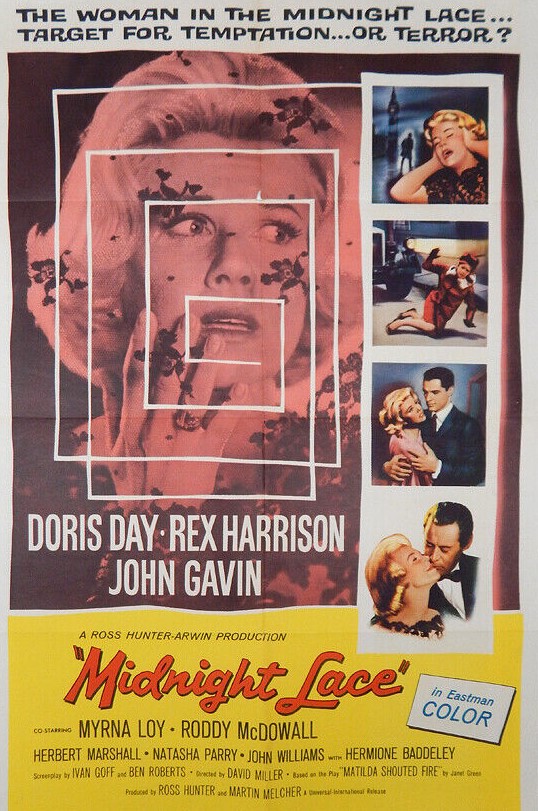
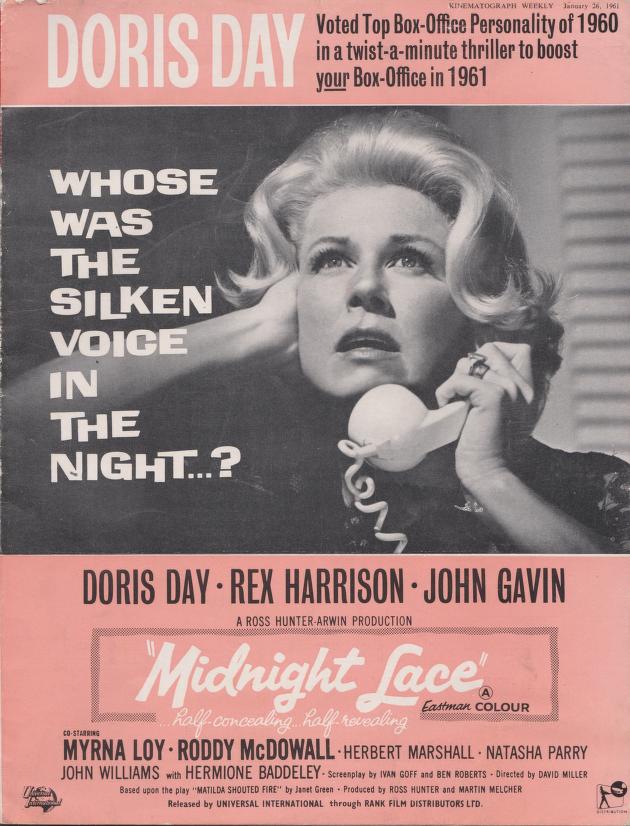
Works for the very reason that it shouldn’t – Doris Day’s off-the-scale hysteria. The actress junks her usual screen persona of spunky occasionally lovelorn heroine and channels her abundant physical energy into an exceptionally good portrayal of a woman on the verge of a nervous breakdown.
And, unlikely as it sounds, this a companion piece to David Miller’s later Lonely Are the Brave (1962),which equally presents a discordant character at odds with their surroundings whose inability to settle into the norm precipitates downfall.
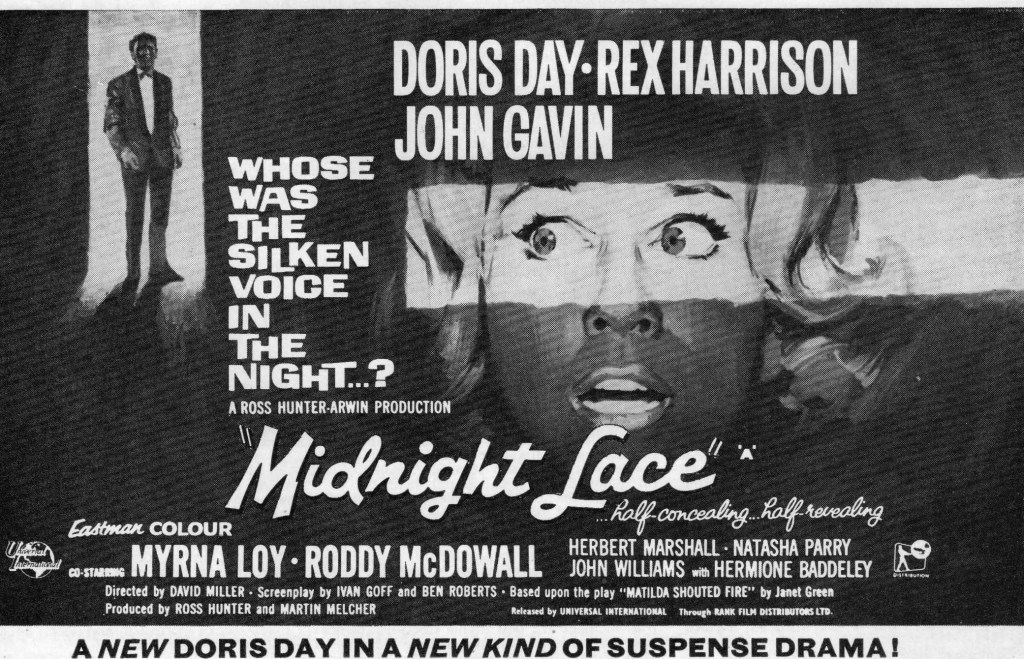
Heiress Kit (Doris Day) is being hounded mainly over the telephone by a creepy stalker with a high-pitched voice, threatening to kill her. Before you can say Gaslight, you are casting a suspicious eye on millionaire businessman husband Anthony (Rex Harrison). But that only lasts for as long as it takes for a whole bunch of other suspects to hove into view.
The sinister man in black hat and coat appears too obvious a contender. Others have something off about them or appear at the wrong time and wrong place. Unemployed ne’er-do-well Malcolm (Roddy McDowell) who sponges off his mother, attempts unsuccessfully to tap Kit for funds and makes it plain he won’t be doffing his cap to her. Builder Brian (John Gavin) is over-friendly and, we overhear, makes a lot of phone calls.
And you wouldn’t count out gambler Charles (Herbert Marshall), an executive in Anthony’s firm, which, by the way, has uncovered a bit of fraud. Nor happily-married Peggy (Natasha Perry), Kit’s friend, who turns up in a bus queue the very moment Kit nearly ends up under the wheels of a London bus. And then there’s Aunt Bea (Myrna Loy) who’s arrived from America and seems determined not to take Kit’s side.
Naturally, nobody can allay Kit’s suspicions. The police are the first to suggest she’s going off her head, seeking attention because neglected by her husband.
But this is so well done, Kit jumping at the slightest noise, that you are pretty much convinced it’s going to be one of those films where every incident is imagined, especially since that would be a helluva coup to have an actress of the lightweight caliber of Doris Day to play her.
Whenever anyone else answers the phone it’s to an innocent caller. And when Kit persuades Peggy to pretend she heard the voice, discovery of that ruse appears to seal her doom.
When we’re not stuck in Kit’s head, there are sufficient tense moments to keep the plot ticking along, trapped in an elevator, shadows on a ceiling, faces glimpsed in windows, voices appearing out the fog, whispers behind her back, friends turning against her, every police ploy a dead end.
Quite why she’s such a giddy character to begin with is never explained, except of course being a millionairess, three months married, with nothing better to do with her time than waltz around in one stunning fashionable outfit after another, life a succession of expensive treats, and whisked off her feet, when he can spare the time, by adoring hubby.
So maybe it’s something as simple as a loved-up wealthy woman finding cracks appearing in her perfect life and in trying to ascertain the cause whirling round faster and faster. There’s certainly no sense of a solid character who could sit down and give herself a good talking-to or transform herself into an amateur sleuth. When the façade breaks, it’s a dam burst.
If at the beginning Doris Day seems already too-wound-up it doesn’t really matter, her lust for life turns very quickly into abject fear as the terrorization becomes only too real. This is a fantastic performance from the actress, woefully under-rated, and the scene where she collapses on the stairs is only too believable.
Rex Harrison (The Happy Thieves, 1962) is excellent in a custom-made role, handsome adoring husband, but every time he clasps her in a sympathetic embrace, the camera lingers on his eyes showing growing fear at her condition. The roster of supporting stars each brings something distinctive to their role, from the wheedling Roddy McDowell (Five Card Stud, 1968), in only his second movie role after eight years of solid television, the too-good-to-be-true John Gavin (Back St, 1961) and old-timers Myrna Loy (The Thin Man, 1934) as the doubting aunt and Herbert Marshall (The Letter, 1940) as the impecunious gambler.
Director David Miller (Captain Newman, M.D., 1963) moves the camera in disconcerting fashion. You think you’re settled in for a stage-style scene when suddenly the camera whirls away and focuses on one character. The scene in the elevator is exceptionally well-done as is the finale, but possibly his biggest attribute is encouraging Doris Day to just go for it rather than reining in her character the way Hitchcock did for The Man Who Knew Too Much (1956).
The team of Ivan Goff and Ben Roberts (Portrait in Black, 1960) put together the screenplay from the hit Broadway play Matilda Shouted Fire by Janet Green.
I came at this with low expectations, not imagining Doris Day could pull off such a difficult role, and I came away wondering why she had not in consequence been given other opportunities to show off her dramatic skills.
Not since Basic Instinct (1992) has there been such an obvious connection between sex and murder. Slow-burn French film noir throwback, every twist, unusually, is matched by emotional resonance. Over six episodes this turns into an absolute cracker with several shocking scenes and, for once, a post-credits scene in the final episode worth waiting for.
You do however need to give this time. The first episode is mostly confusing as it sets up the three main strands. But episode two contains such a revelatory twist thereafter you’re on a rollercoaster.
In the present day ex-con acclaimed but impoverished novelist Adrien (Nicholas Duvauchelle) takes up a not particularly well-paid ghost-writing job listening to grizzled old fella Albert (Niels Arestrup) recount his memoirs. Adrien, on the jealous side, has a tangled relationship with partner Nora (Alice Belaidi). Also in the present day a couple of cops, Carrell (Sami Bouajila) and Mathilde (Marie Denarnaud), are working on a cold case, the death of renowned photographer Steven Powell.
Running parallel with these two tales we go delving into the romantic past of Albert and in particular his relationship with Solange (Alyzee Costez) back in the 1970s when the entire world was on a massive experimental binge. A couple of other elements pop up from time to time, a small boy and his mother, Adrien and his stepfather, and an artist/tattoo artist Catherine (Lola Creton).
Eventually, it all comes together and when it does it packs an incredible punch, a real emotional wallop, as the lives of all concerned are turned upside down.
And while there is most definitely twist upon twist upon twist, what raises this above most movies/programs that rely just on twists, is the emotional impact of such changes, and above all, characters seeking identity, trying to work not just who they are but whether they like or are repelled by the characters they have become.
Chock-full of atmosphere, this will have you hooked from the incredible second episode which tumbles full-tilt boogie into a dazzling mysterious past. Mostly, it takes place in France but just for the hell of it we race to Brussels and Genoa, and timewise, there’s an important element that takes place at the conclusion of the Second World War.
Everyone is damaged one way or the other and as the series progresses you realize just how damaged. And one of the best parts of the series is that lives that should collapse under the weight of such heavy emotions find themselves taking an alternative route that occasionally provides solace and occasionally dodges the issues enough to keep them steady. But, of course, nobody can escape the past.
While this is definitely on the raunchy side, it does set out to show the part sex plays in the lives of the characters, whether emotional crutch, expressing the full joy of falling in love, or desperate measure.
The characters are well-drawn, and as new personality details emerge, they take the story in different directions. In some respects it’s grounded by Albert, the kind of old guy who really knows how to smoke, slipping the cigarette into his mouth old-style, sucking the life out of it, and for all his obvious dodginess a genuine human being seeking respite and redemption.
What Adrien discovers relates only too well to what he suspects about his own instincts and so he is as much disgusted as revelling in each new discovery. An ex-kick boxer, one of the running motifs is not so much being up for the fight, or in true private eye mode being able to hold your own in the fisticuffs department, but willing to accept physical punishment. That is matched by an understanding of the toll emotions can take on your life, especially if you lack the mental capacity to defend yourself against such intrusions.
And at the heart of the story is the mysterious, seductive, beautiful Solange, a different kind of femme fatale, perched atop beguiling innocence, at times unaware of the passions she unleashes, and yet, trying to find a way out of her own spiralling emotions, internal conflict typified by undergoing various abortions while so desperately wanting a child that she plays interminably with a doll’s house, her own reaction to the sexual act buried deep in her past.
I’ll admit the first episode is at timse heavy-going as writer-directors Olivier Abbou (Get In, 2019) and Bruno Merle (The Lost Prince, 2020) set out their complex stall, but the second episode is such a humdinger it more than makes up for it. The contrast between the free-wheeling free-spirited 1970s and the grungy contemporary look where responsibility brings an edge to everything is very well done. But while the violence would do Tarantino proud, contemplation of the creative process is as considered.
It probably helps that I’m unfamiliar with any of the actors because for me they carry no screen baggage. Nicholas Duvauchelle (Lost Bullet, 2020) carries off his first top-billed role superbly, making a terrific transition from a character almost playing a part to one who wishes he had done a better job of remaining an ordinary guy. On the basis of this, Hollywood should come calling for veteran Niels Arestrup (A Prophet, 2009) any time they’re looking for a crusty supporting actor.
Alyzee Costee, in her biggest role to date, certainly announces her presence, presenting the most complicated character of the lot, daughter, lover, mother, possibly the most intriguing female character of all time, beauty matched with fragility matched with toughness matched with an agility to switch persona at dizzying speed. This is what Netflix is best at, investing in foreign television programs, or just sticking their name on them, to bring them to global attention. This is definitely worth a wider audience
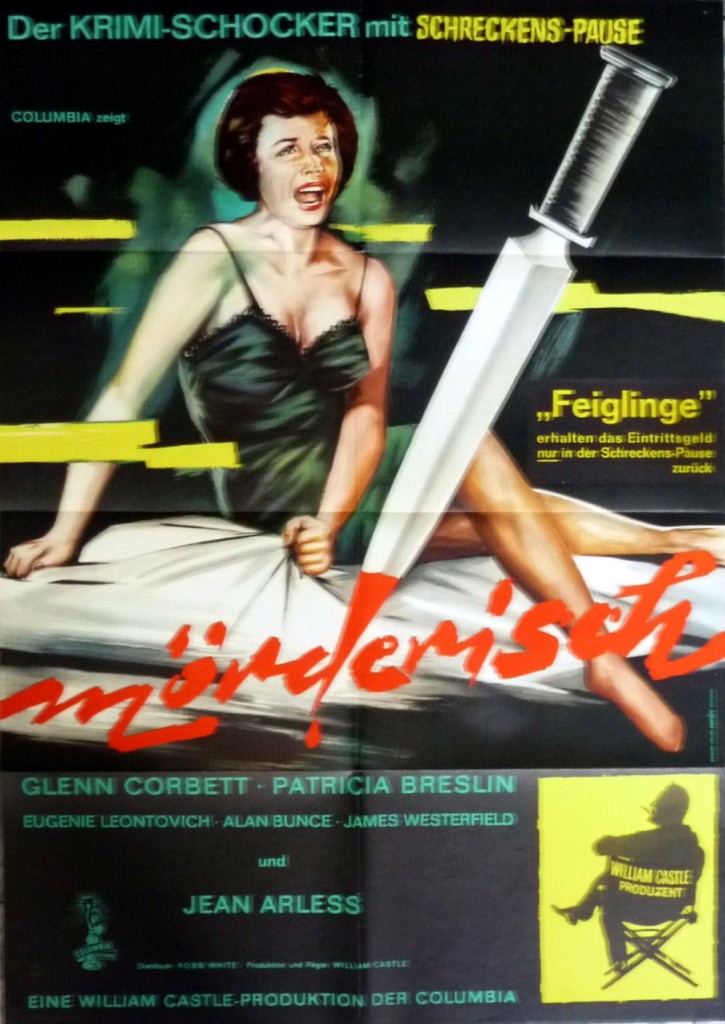
William Castle (The Tingler, 1959) was always a cult director but 60 years later this hits a contemporary bullseye with uncanny accuracy. It couldn’t be more Hitchcockian, down to the director making an appearance at the start and adopting the same lugubrious tones as Alfred Hitchcock did for his television series.
Bookended by two brilliant scenes, one of mystery, the other revelation, it’s only when you go back and unravel the way this has been put together you realise how fiendishly clever – and heartrendingly awful – it had been. Gender identity, in case you hadn’t guessed, is a central theme.
Castle wasn’t known for concentrating on any emotion beyond fear but this goes back to the most basic of all emotions. Who am I? How do I figure myself out? And even the acting – almost as black-and-white as the picture with one over-the-top character and one so weak he almost drains the picture of any life – makes more sense in retrospect.
Stunning blonde Miriam Webster (Jean Arless) checks into a hotel and offers bellhop Jim (Richard Rust) $2,000 to marry her that night on the understanding the marriage will immediately be annulled. Puzzled, and of course fancying his chances of sex as a tip, he drives her to local Justice of the Peace Alfred S. Adrims (James Westerfield) who demands an increased fee for getting dragged out of bed. In short order, Miriam murders him and his wife and escapes.
Turns out she’s not Miriam Webster. That’s the name of a florist in the town where Emily, her real name, looks after mute invalid Helga (Eugenie Leontovich). The real Miriam (Patricia Breslin) is half-sister to businessman Warren (George Marshall), returning home after a lengthy absence to claim his inheritance. At the age of 21, in a couple of days’ time, he falls heir to a $10 million fortune. Helga was his Danish nanny whom he resolved to provide care for after a heart attack.
But it’s soon clear that Emily hates her charge who can only communicate, and only to draw attention, by using a clacker to batter against her wheelchair. When Miriam visits Helga, Emily skips out, promising to return shortly, only to tell Miriam’s boyfriend Karl (Glenn Corbett) that she’s been detained and won’t be free to join him for a picnic.
Then she proceeds to smash up Miriam’s flower shop, in particular destroying anything that points to a wedding, and tearing up a photograph of Miriam’s half-brother. When Carl pops in, she knocks him out.
So what’s with all the wedding malarkey? You won’t be surprised to learn it’s something of a red herring, especially as Emily is already married to Warren, news that comes as a shock to Miriam.
Warren has the constitution of a weakling and looks the kind of boy who would have been trampled over as a child. Except, it turns out, he was bullied by his father, a driven businessman, and whipped by Helga to turn him into someone a lot sturdier, able to stand on his own two feet, and not get knocked around. If anything, he was inclined to be the bully.
Emily should have murdered the bellboy when she had the chance because of course he goes and rats on her and now there’s an illustration of her in the newspaper and the cops are on her trail having tracked down a Miriam Webster living in her town.
Naturally, Warren rejects the notion, but Miriam isn’t so sure. There was an incident in her bedroom and she had lied to Miriam about nipping out for a few minutes and something had been dropped among the debris in the florist shop that linked its destruction to Emily.
So if Emily’s married to a man who’s about to become a multi-millionaire and by far the richest guy in town and with who knows what influence that could buy…You see where this is going? Or if the deeply-in-love Warren could tolerate a wife with homicidal tendencies? Or if she would inherit should Warren have a nasty accident? You see where else this could be heading?
Well, it goes to none of those places. And I’m not going to spoil the climax by telling you exactly where it goes, but it’s a shocker for sure and just superbly done.
And once that revelation’s out in the open everything else makes sense – and doesn’t. For what is at its heart is something so jarring real and troubling, an emotion with consequence, that it neatly fits into one of the most compelling controversies of today.
Otherwise, it’s a perfectly good straight-up thriller, owing much to Psycho (1960), especially the knife-wielding killer, but with some thrilling moments and, in another contemporary salute, busting open the fourth wall with the “Fright Break” gimmick where at the height of proceedings the director literally stops the clock and gives the audience 45 seconds to get out of the theater if they can’t take any more.
If you think William Castle has managed some sleight-of-hand I’m going to have to fess up and say I’ve done the same but you’ll only understand what if you watch the film. Anyone who guesses it can let me know.
There’s a prize. A copy of my latest book, shipped to anywhere in the world, 1960s Movies Redux, Volume 1 – printed copy available now, e-book shortly.
Luckily I had been fortified in my weekly cinema outing by the wonderful Living (2022) before entering dudsville for this double bill. Both Deus and Watcher have all the hallmarks of direct-to-DVD productions which have, to use the old parlance, “escaped” into cinema distribution.
I’m probably a bit rusty about the cost of making the kind of giant spacecraft shown in Deus, billions of dollars surely, so am assuming that big projects like this will encounter budget overruns which would account for the rationing of electricity on board, resulting in the murky lighting. And there’s not an alien in sight unless you count the robotic crew who speak in strangely monotonous tones.
Like most sci-fi films this involves a crew on a mysterious mission awaking from hibernation to investigate a distant object, in this case a sphere. The title assumes this might be about someone playing God and so it transpires, taking a leaf out of The Avengers: Infinity War (21018) playbook with a plot to wipe out three-quarters of the Earth’s population in some kind of eco good deed.
Not only has an evil genius Vance (Phil Davis), who appears only as a hologram (natch), gone to all this bother and created a heavenly apparition but in order to achieve his ends he has had to go to all the clever bother of killing off the family of Karla (Claudia Black) in a car crash so that he can have the opportunity to insert a chip in her brain to infiltrate her imagination.
Former hitman Ulph (David O’Hara) forms part of the crew and the only measure of excitement comes when, mercifully, parts of the mother ship explode. Any action or suspense is purely theoretical with writer-director Steve Stone (In Extremis, 2017) responsible for this monstrosity.
It’s a terrible thing to say I know but I was praying for the serial killer to get a move on and wipe out dull lifeless heroine Julia (Maika Monroe) in Watcher. A former actress, now unemployed, who has moved to Bucharest with advertising executive partner Francis (Karl Glusman) she spends all her time moping around crying wolf. Naturally, everyone ignores her if only for the fact that when she claims to be watched by a man from across the street she has facilitated such voyeurism by leaving her curtains wide open.
The serial killer is known as The Spider for obvious reasons – I guess he has either a hairy back, six arms, climbs up the outside of buildings, or is the type of arachnid who bites the head off his victims or all of the above or because newspaper headline writers had run out of murderer nicknames or were simply devoid of imagination.
As with Matt Damon in Stillwater (2021) her sense of isolation, what with hubby working all hours, is increased because only a tiny minority of the population have the courtesy to speak English. Location-wise you know where this is going to end up because next door neighbor Irina (Madalina Anea) keeps a gun in a drawer in case her ex gets antsy, making him of course the first red herring.
For a time it looked as if this was going to turn into something a lot more interesting, a twist on a twist, for in fact she is as much a watcher as the man (Burn Gorman) – a cleaner in a strip club who stares out of the window in a break from the relentless task of caring for his aged father – accused of this crime. In a very foolish gesture she appears to be encouraging him.
You begin to hope that, to redeem this picture, the upshot is going to be that a paranoid woman shoots an innocent man. Instead, the climax is straight of Hancock’s Half Hour, a legendary British television comedy series, where the heroine survives after losing more than a good armful of blood, probably enough to fill all arms, legs and the bulk of her body.
Maika Monroe (It Follows, 2014) has gone with the erroneous assumption that the less acting she does the more she will appear withdrawn. I felt sorry for Karl Glusman (Greyhound, 2020) in his first leading man role, given nothing to do. Oddly enough, Burn Gorman (Pacific Rim, 2013) has the best scene, demanding an apology from his accuser.
I’m not quite sure what debut director Chloe Okuna did to the original screenplay of the more experienced Zack Ford (Girls’ Night Out, 2019) to grab the main writing credit but it was far from enough.
Like The Banshees of Inisherin, too much appears to be expected of both writer-directors who might have benefitted from a stronger producer challenging their concepts and helping shape the finished material.