Robbery (1967) ****

The explosive gut-wrenching high octane car chase that kicked off this thriller – and provided British director Peter Yates (Bullitt, 1968) with a Hollywood calling card – is somewhat out of place in this intriguing documentary-style fictionalised account of the British heist of the century, the Great Train Robbery of 1963. Setting aside that the chase would have been better employed as the climax, it does provide the cops with enough leads to keep tabs on some of the criminals, ensuring the authorities become aware of the gigantic theft planned.

But Yates’ unusual approach takes us away from the usual crime picture. You can say goodbye to the cliched villain for a start. Mastermind Paul Clifton (Stanley Baker) dresses like a suave businessman. Wife Kate (Joanna Pettet) rails against him for betrayal, not sexual infidelity, but for pretending he had given up the life of crime. And there is any amount of nuance. We don’t discover that Clifton lives in a huge mansion with a massive drive until the very end, we don’t know who else the police are tailing until they are picked up, we are not let in on the secret of Clifton’s escape until suddenly he is taking off in a light airplane. And there is the unexpected. A suspect is identified in a line-up by a witness slapping his face, a message sent to Kate from Paul via a dog.

Cop James Booth questions gangster’s moll Joanna Pettet.

Nor, beyond the basics, are we let in on the details of the plan, more time spent on recruitment, and not the usual suspects either, Robinson (Frank Finlay) – broken out of prison for this specific job – brought unwillingly on board because, as a former bank employee, he can check the stolen notes. I should point out, which may not be obvious to a contemporary audience, that banks shifted money over the weekend via the London-Glasgow night train that carried the mail. Given the £3 million being transported, the train is staffed not by a regiment of security guards but by postal workers sorting letters.

There’s nothing desperately clever about the plan anyway beyond its audacity. Signals are changed to make the train stop at the allotted point, the robbery takes place in military fashion, timed to the minute, some sacks left behind when time is up.

What’s cleverest is the hideout, an abandoned airfield, with underground passages. The gang doesn’t intend to run while the heat is at its hottest but some time later, the cash divvied up, Clifton’s share sent as cargo overseas. Clifton knows the consequences will involve road blocks, house searches, cars impounded, arrests but “without the money they can’t prove anything.” A junkyard owner is paid – too handsomely as it transpires – to clean the vehicles used of fingerprints and other potential giveaways (not much else in the days before DNA). And no matter Clifton ruling with a rod of iron, there is always the idiot who doesn’t quite stick to the plan.   

Most of the picture is detail, not just the meticulous planning but the equally meticulous hounding by the cops, interrogating getaway driver Jack (Clinton Greyn), identity parades, telephones tapped (or a crude version of it), with only the occasional hunch to keep the police, led by the dogged Inspector Langdon (James Booth),  on the right track. A few years before cops in movies were uniformly identified as either corrupt or useless, sometimes both, this bunch are shown to be relatively efficient, though still prone to underhand means.

Dominating proceedings is the moustached figure of Stanley Baker (Sands of the Kalahari, 1965) whose brusque no-nonsense manner sets the tone. He’s a cut above the normal criminal not just in ambition but ingenuity and while he rules the roost in the gang he’s less at home at home where Kate gives him a hard time. James Booth (Fraulein Doktor, 1969) is impressive as the pursuer, well-versed in gangland lore, inclined to look beyond the obvious. With only  a few scenes Joanna Pettet (The Best House in London, 1969) makes a mark.

In supporting parts you will spot Barry Foster (The Family Way, 1966), who seems to have the knack of catching the camera’s attention with a look or the turn of his head, and Frank Finlay (A Study in Terror, 1965), and a host of British character actors like George Sewell (The Vengeance of She, 1968) and Glynn Edwards (The Blood Beast Terror, 1968).

But the honors go to Peter Yates (Summer Holiday, 1963), not just for the stunning car chase which Hollywood would forever emulate, but the constant tension, the cutting back and forth between cops and robbers, and between the overtly dramatic and the subtle. He also had a hand in the screenplay along with George Markstein (The Odessa File, 1974) and in his only movie Edward Boyd (The View from Daniel Pike, 1971-1973).

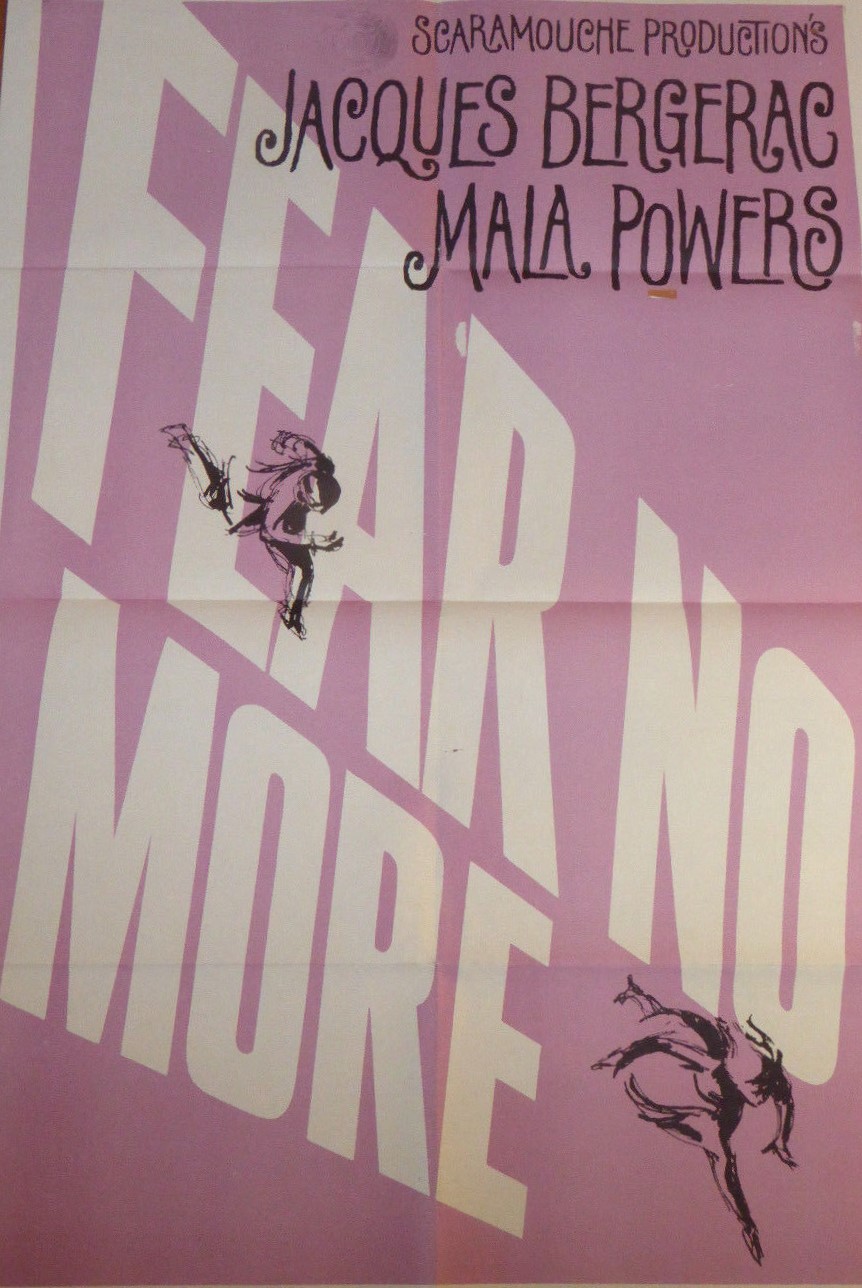
Fear No More (1961) ****

Had Alain Resnais taken the paranoia/gaslighting B-movie route for the esoteric Last Year in Marienbad he might well have ended up with a twisty concoction like this. Whereas Marienbad struggles to get anywhere near a third act, Bernard Wiesen’s unheralded under-rated debut thriller has a stonker of one. It’s the last 15 minutes when the unravelling from an unexpected source takes place that makes this well worth watching. So, I’m sorry to say, spoiler alert, as I take you through why this is so good.

It’s a twist to top all the previous twists, of which there have been many. Movies like this generally rely on story much more than character, but here we see the two main characters substantially alter, almost, psychologiclly-speaking, changing places.

Secretary Sharon (Mala Powers) on an overnight business trip by train discovers a male killer and a female corpse in her cabin. Knocked out, she regains consciousness to find herself accused of murder by cop Joe Brady (Robert Karnes). Managing to escape, she is almost run down by handsome divorced Frenchman Paul (Jacques Bergerac), delivering his son back to wife Denise (Anna Lee Carroll), who gives her a lift to Los Angeles.

Paul, an erstwhile alcoholic it later transpires, pursues her with romantic notions in mind, but she gives him the brush-off. Back in her apartment she finds sozzled ex-lover Keith (John Baer). Paul, not the kind to be so easily brushed off, persuades her to go for a coffee but when she returns to her apartment Keith is dead. Chased by the killer, she is rescued by Paul.

Gradually, she reveals that she once had a nervous breakdown and was committed to a mental institution. But when she goes to see her employer Milo (John Seymour) to explain she has lost the package with which she was entrusted, quite a different scenario awaits.

Brady is there and denies all knowledge of ever having met her. Milo denies sending her on a trip. Worse, Keith is not dead and the package she was carrying contains $3,000 stolen from Milo’s safe, to which she has access.

No wonder the most likely reason for all this confusion is that she is losing grip of her mental faculties. But, if nothing else, Sharon is quick-witted and concludes that too many pieces of this jigsaw are missing and in the absence of Milo’s wife and chauffeur Steve (Peter Brocco) that he has murdered his wealthy partner and is setting up her up to take the rap. That idea only lasts as long as it takes for wife (Helena Nash) and chauffeur to turn up.

Worse, Sharon was committed for killing the woman in her care. She pleaded self-defence and got away with it but her mind crumbled with guilt.

So just when we’re going along with the notion that this is one crazy woman and that “recollections may vary” not as much as she would like and that she is not inhabiting a parallel universe, the Frenchman does a bit of investigating on his own and finds Keith’s corpse.

In more prosperous times in her career, Powers was the female lead here.

Now here’s when it turns very tricky indeed. Although by this point Sharon should be dead in the water, mentally at least, she sparks into life, continues along the line of Milo killing his wife (the body on the train), and begins to point to all the flaws in his plan, beginning with his bungling associates. Milo, who had initially appeared in complete control, now begins to lose his temper and snap at his employees.

Milo and his associates take her to a cabin in the woods. The stronger she grows, the weaker Milo becomes, as she continues her barrage of accusation, picking more holes in his grand plan, until he realises that the police are not going to do his job for him, in condemning Sharon for his wife’s murder. The supposed wife turns out to be Milo’s sister and she, too, begins to crumble with the fear of being found out and her beloved brother going down.

So it’s heading for a complete turn-around, the supposed maniac having been gaslighted, the supposed upright employer turning shadier by the minute and unable to deal with the consequences of an action that has gone so badly wrong. Milo ends up the gibbering idiot with Sharon regaining the faculties she thought she had lost.

The Frenchman comes to the physical rescue and even though at one point the doting sister has the drop on him, she falls to pieces at the thought of what she would have to do to safeguard her deluded brother.

Quite a third act.

But there are a couple of other interesting sequences. When Paul rams on the brakes to prevent his car running over Sharon, that sends his son sitting in the front seat, in the days before seat belts, straight into the dashboard, a rather overly realistic event as regards kids in those days. Picking up Sharon and pacifying his son means Paul is late bringing the boy home to his mother and she lets rip, refusing him any future access. But, unexpectedly, later she turns up in his apartment, asking forgiveness, realising her son was so excited spending time with his father that it would not be right to deny him that.

And with all great B-films this is short and snappy, barely 80-minutes long, and hardly one of those minutes going by without a twist. Sharon is a very interesting character from a psychiatric perspective. Although cleared of killing the woman in her charge, she clearly feels enormous guilt that she allowed it to happen, and once you start falling into a mental trap of your own making it’s pretty hard to get out.

You can always pick holes in movies like this, but the two main characters, Sharon and Milo, seem to me very believable, lost in their own fantasies, especially Milo, who saw his perfect plan falling to pieces.

Unfairly, this was pretty much a dead end for all concerned. Mala Powers (Daddy’s Gone A-Hunting, 1969), the object of Cyrano de Bergerac’s affection in Cyrano (1950) and star of Rose of Cimarron (1952), had lost her way in Hollywood and not been in a movie for three years since The Colossus of New York (1958). Despite giving an excellent performance, Fear No More didn’t prove the answer to her Hollywood prayers and she only had three further movie roles in the 1960s.

Jacques Bergerac – better known for marriage to Ginger Rogers – made his final picture in 1966 but didn’t rise much above the likes of Taffy and the Jungle Hunter (1965). Prior to this director Bernard Wiesen was a producer-director on television and after it that’s what he went back to.

Catch it on YouTube.

Amsterdam (2022) **** – Seen at the Cinema

Shaggy dog story wrapped up in paranoia thriller. A shade overlong, with too many characters and too much plot but such flaws should not detract from that rare cinematic animal, a truly original movie. Brilliant screenplay, believable characters and superb acting prove an irresistible combination.

Though you can see why this sank like a stone at the box office, the all-star cast generally acting against type, idiosyncratic director given vast sums to play with, a tale that goes in too many directions at once, and the unconstitutional events of January 6, 2021, bringing this too close to home for fractured American audiences.

You don’t get this kind of writing much anymore. When individuals come together on a project – to save the world the most likely reason these days – their individuality is usually subsumed to the plot. Here, instead, the reactions of the characters remain distinct and no matter what is going on there is always time for individuality. And some of the invention is just deliciously insane, the nonsense songs for example.

Touching on the World War One aftermath of recovering from mental and physical wounds plus profiteering glee, a sense of a country racked by the Depression on the brink, mind-inducing experimentation of the political and pharmaceutical kind. A trio of war veterans, soldiers Burt (Christian Bale) and Harold (John Davidson Washington) and nurse Valerie (Margot Robbie) investigate a mysterious death, an illegal autopsy uncovering poison, only to find themselves framed for murder.

Burt is not a prime-time player according to wife Beatrice (Andrea Riseborough), and her wealthy family had dispatched him to the war in the hope he would return with bankable glory, but generally treat him as an unwanted black sheep. Valerie now makes art out of war debris, bullet shells and shrapnel, her charming brother Tom (Rami Malek) and his wife Libby (Anya Taylor-Joy) embedded in malevolence. Harold is a lawyer, for whom racism is a constant.

American and British secret service operatives, Norcross (Michael Shannon) and Canterbury (Mike Myers), float in and out. The moneyed business elite, despising White House incumbent Roosevelt, cast envious eyes at the dictatorial economic miracle of Mussolini in Italy.

On everyone’s dance card is General Dillenbeck (Robert De Niro), sought out by our intrepid trio and a mysterious cabal. All he has to do is make a speech at a veteran’s dinner. Make the right kind of speech and the trio are vindicated. Make the wrong kind and he could be assassinated.   

Like Chinatown (1974), Amsterdam is representative, a state of mind, but of freedom rather than endemic corruption. This is an intricate piece and a bit slow for today’s fast-paced generation and with more dialog than might sit well with a modern audience and flights of fancy that are far more original than anything you would find in the MCU. But it’s a hell of an intelligent thriller driven by a bunch of deadbeats.

It never goes down the obvious route. Instead of a love triangle – Valerie and Harold a pair – it’s an evocation of friendship. You don’t need umpteen clues to find the villains, they’re upfront, and they don’t think they are baddies, but cleverer people coming to the aid of the dumb masses putting too much blind faith in democracy. While this is based on a true story, in reality it’s based on the constant of the rich trying to get richer and the wealthy believing they are the best, even if unelected, candidates to run the world.

All that political stuff could have been a big turn-off if it had gone down the preachy route, but it doesn’t, instead it’s almost a miracle that it arrives at any conclusion given in whose hands the narrative has been placed. The Three Stooges would have done a better job of getting there quicker, but then you wouldn’t have had so much fun.

Not only are all the stars on their A-game but acting-wise it delivers some career-reviving turns not least from Christian Bale (Ford v Ferrari, 2019), devoid of a lifetime’s acquisition of irritating tics, John David Washington (Tenet, 2020) called upon to develop a character rather than an action-driven hero. I had to check the end credits to find out it was Mike Myers (Bohemian Rhapsody, 2018) playing the understated Canterbury and hogging the screen with none of the acting pyrotechnics that dogged previous attempts at mainstream work. Ditto Robert De Niro (The Irishman, 2019) and Rami Malek (Bohemian Rhapsody), no grandstanding this time round – don’t worry I recognized both from the off – and Anya Taylor-Joy finally delivering on the promise of The Queen’s Gambit (2020).

Margot Robbie (The Suicide Squad, 2021) is already on the rise and this will add to her growing portfolio of fascinating characters. And if you’re fed up watching any of these stars in brilliant form, there are other distractions in the form of Chris Rock (Spiral, 2021), Taylor Swift (Cats, 2019), Andrea Riseborough (The Electrical Life of Louis Wain, 2021) and Alessandro Nivolo (The Many Saints of Newark, 2021).

You often hear the term “visionary director” thrown about with indiscriminate regard, but this is the right kind of visionary, director David O. Russell (Joy, 2015) with his own way of seeing the world, and delivering it in distinctive fashion, with less of an eye on camera movement and more on dialog and motivation and staying true to a coterie of original individuals.  

I guess the money was spent on atmosphere, this is 1930s USA regurgitated in enormous detail. But you’ll forget the background, the costumes and sets, and be dazzled instead by the script and the acting, and the enveloping tale of friendship.   

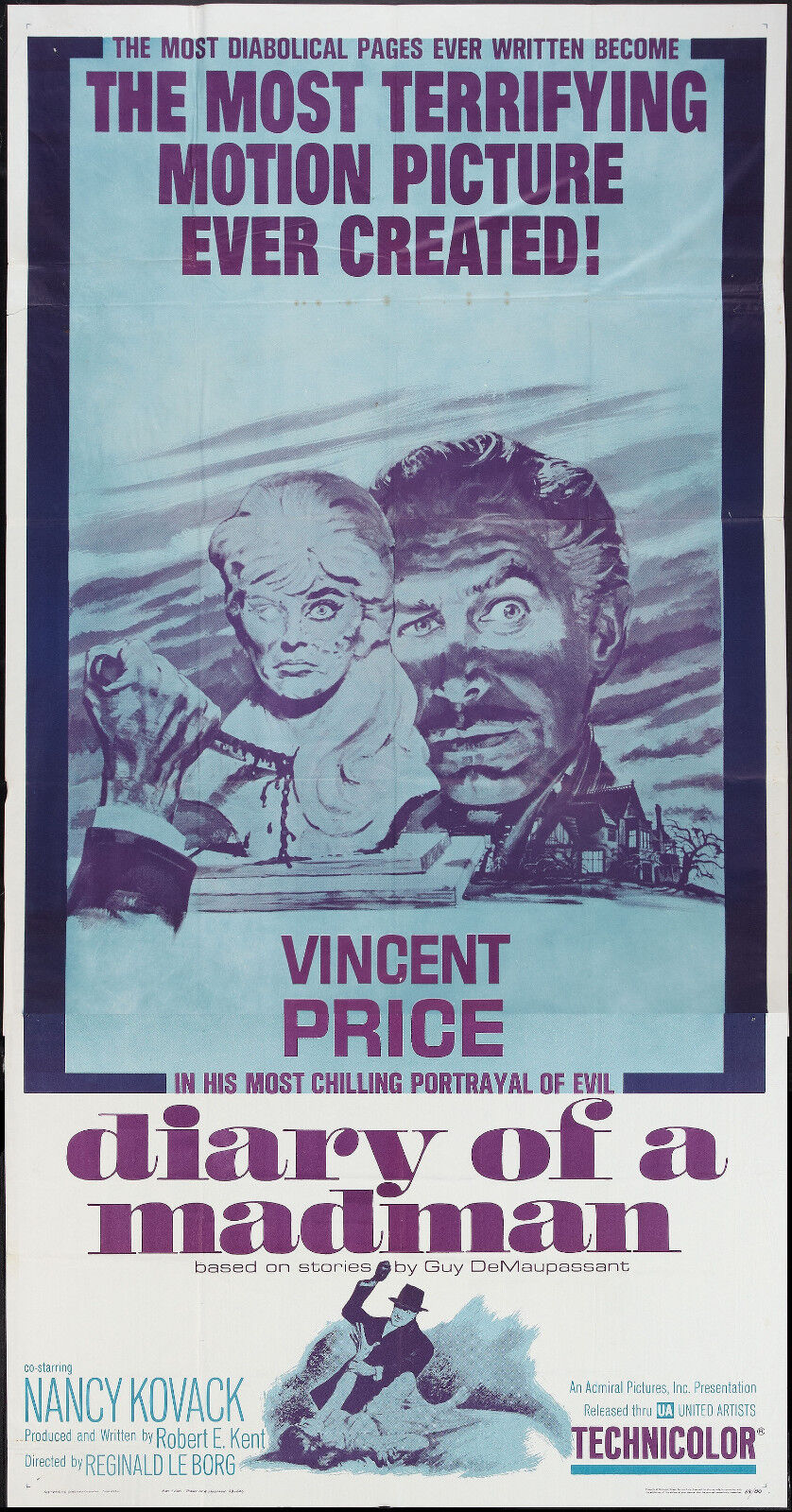
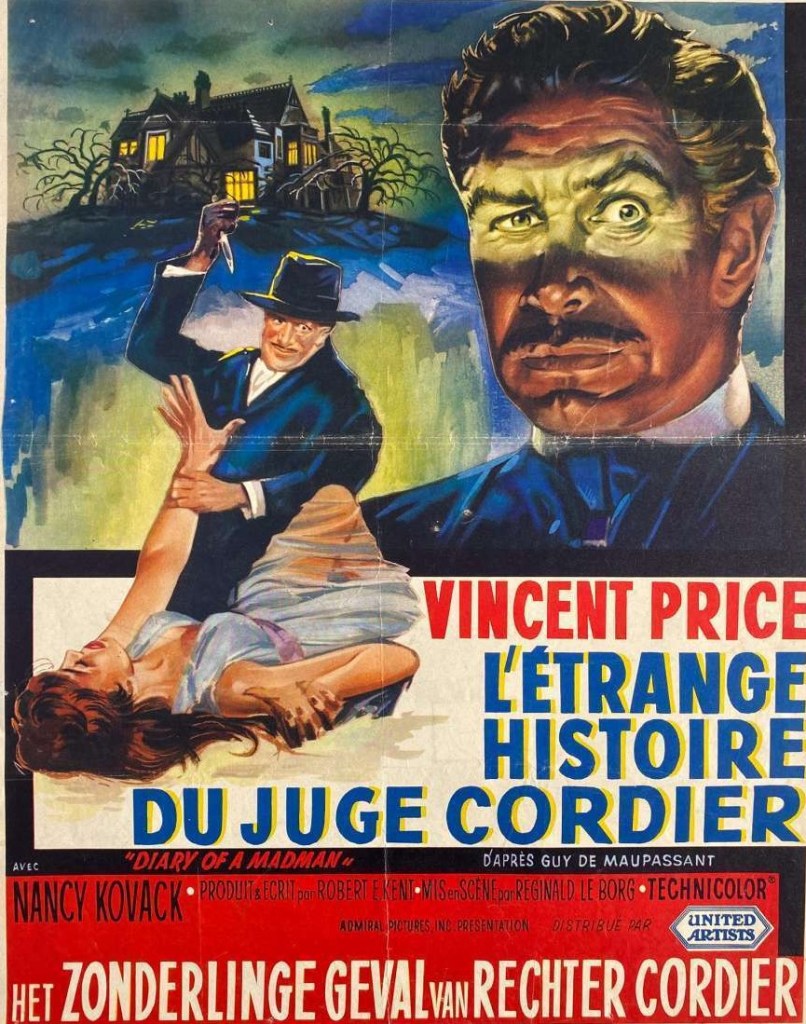
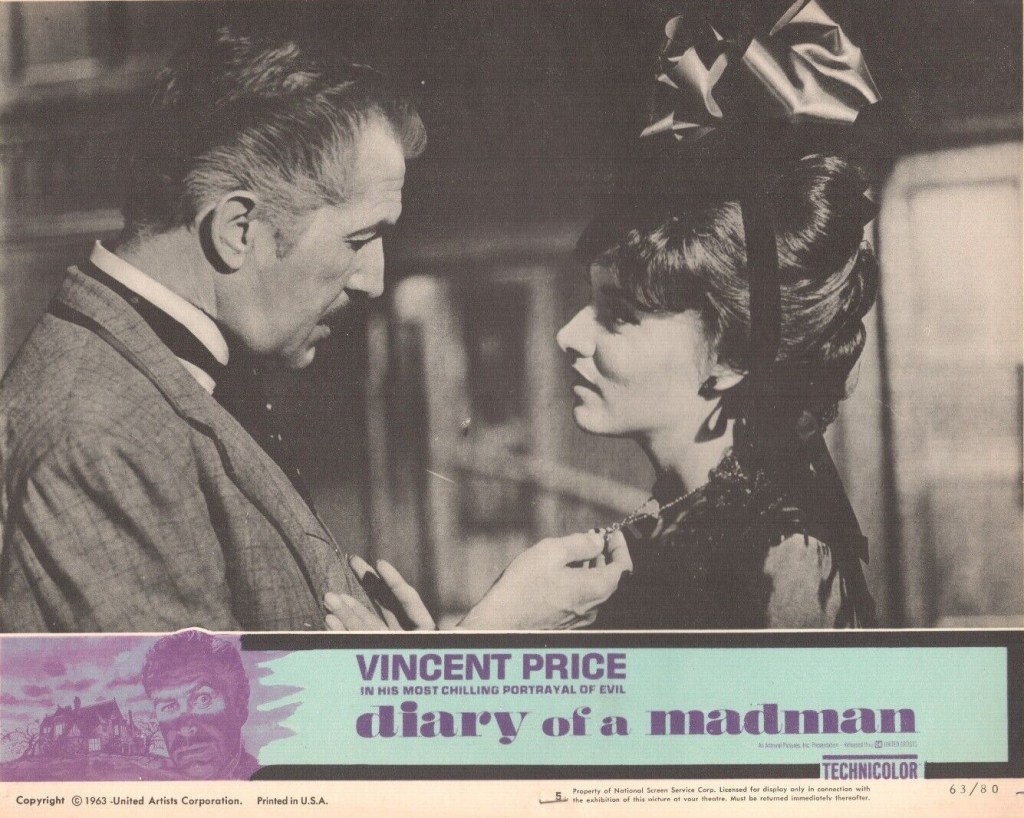
Diary of a Madman (1963) ***

Contemporary perspectives occasionally raise a film in the estimation. Here, our knowledge of the psychology behind serial killers sheds quite a different light. The idea that a killer can blame outside forces over which he has no control was one of the original tenets when the ordinary mind could not take in that some folks just enjoyed the act of murder so much they were inclined to do it over and over again.

Where I come there there’s a saying – “a big boy did it and ran away” – a device used by small boys in big trouble. And that’s pretty much the idea here. The innocent can be taken over by an evil entity, rather than admitting to surrendering to their most heinous desires.

A prisoner condemned to death in 19th century France confides in magistrate Simon Cordier (Vincent Price) that his murdeorus acts were the result of direction by the mysterious and, unhelpfully, invisible “Horla.” Naturally, Cordier dismisses the notion until, in self-defence, he kills the prisoner. Disturbed by his action, he seeks counsel and is advised by a psychiatrist (an “alienist” as such a person was known at the time) to spend more time on his hobby, sculpting.

Although Cordier appears to be a model citizen, there lurks in his past a suicidal wife who killed their child, and the notion that somehow he was responsible. Into his world comes woman-on-the-make Odette (Nancy Kovack) who earns more money as an artist’s model than her husband Paul (Chris Warley) does for his paintings. Unaware  that she is already committed, Simon proposes marriage. It doesn’t take long for him to suspect she is not what she seems and he does away with her only for Paul to become the main suspect and be condemned to death.

Cordier, discovering by accident that the Horla, is frightened of fire, lures the entity into his deserted house (servants sent away) and plans to destroy the entity but in the process the fire melts the door handles and Cordier can’t escape, dying in the process.

Price and Kovack.

A modern reading of course would set it up a different way, putting greater emphasis on the past, trying to uncover what drove Cordier’s wife to suicide. That he gives in to overwhelming urges might well be followed by periods of guilt until he realises that the only way out is his own suicide.

But the 1960s moviegoer – possibly still recovering from the murderous goings-on at the Bates Hotel, and grateful that it was fiction, and The Boston Strangler only just getting into his stride – was not quite ready to put any faith in a landscape filled with predators and victims, so it would make more sense for outside forces, voices or the like, to be controlling the ordinary person.

An eerie glowing light comes over the eyes of Cordier (and the earlier convict) any time the urge to kill dominates. But if you were going to set this up as a picture of innocence driven to dark deed you would not populate it with Vincent Price (Witchfinder General, 1968), who had form for dastardly deeds. Nor is Price quite able to pull it off, those sepulchral tones always seeming to indicate something lurking, and he’s hardly in the debonair category so at the very least he belongs to the caste of entitled rich taking advantage of a poor woman to press his case for marriage.

Nancy Kovack (Jason and the Argonauts, 1963) is more convincing as the manipulative object of his desire. I half-expected her to turn into a murderer in order to rid herself of her the husband getting in the way of her chance at a new, wealthier, life. Chris Warfield (Dangerous Charter, 1962) is the talentless dupe, whichever way you cut it, and you have to admire his wife for sticking with him for so long.

Given that director Reginald Le Borg’s career dated back to the 1940s and he had been lumbered with the Joe Palooka series and any number of B-movies, it was perhaps surprising that horror, although still strictly on B-movie budgets, became a forte – The Black Sheep (1956) and Voodoo Island (1957). While this one was clearly filmed on a studio backlot, he does a good job of bringing a bit of lushness to the proceedings.

Perhaps the most interesting element is that the idea originated in the mind of famed French short story writer Guy de Maupassant – you might be surprised to learned that nearly 300 movies and television adaptations have been made from his works, a dozen alone in 1963 including Mario Bava’s Black Sabbath. Worth comparing with Maniac out in the same year where the idea of the mad killer is exploited for a different end.

Very old-school, but with passable sfx.

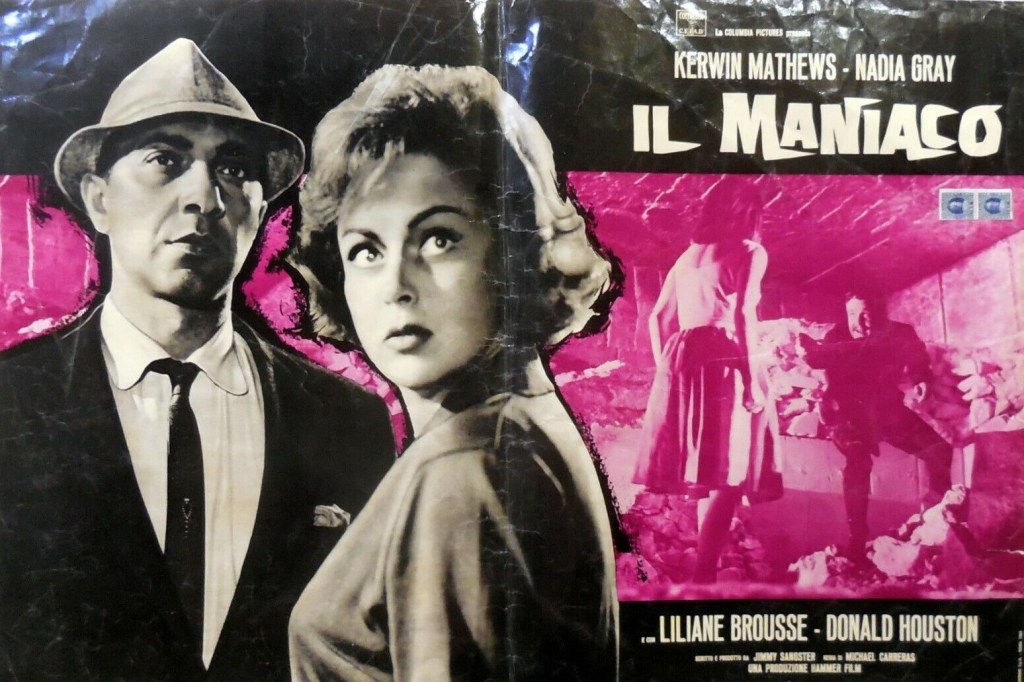
Maniac / The Maniac (1963) ****

Such an ingenious thriller you just have to applaud. Opening with a close-up of a predatory eye, this scarcely draws breath as it dashes through a latter-day film noir maze, spawning out auditory and visual cues, beautiful woman luring dupe, twisting the expected narrative round her little finger.

Artist Jeff (Kerwin Mathews) setting up his easel in the Camargue, hardly one of the most tourist-friendly spots in France, eyes up Annette (Liliane Brousse), the daughter of a hotelier Eve (Nadia Gray), but, in extremely opportunistic style, settles for the mother. In true noir fashion she is using him, seducing him into a scheme to free her husband George (Donald Houston), incarcerated in a mental asylum for torturing and killing with a blowtorch the aforementioned predator who raped Annette four years before.

Eve convinces Jeff that in return for his freedom the madman will effectively give his blessing to their affair. It’s a deal only a besotted dupe would fall for. George has an ally inside the asylum, assisting his escape, but when George turns up, and Jeff drives him to Marseilles, he leaves behind the corpse of his criminal associate in the boot. Jeff dumps the body in the river.

Cue the start of a series of strange events. A fired-up blowtorch is discovered in the garage where Georges committed his initial crime. Annette, jealous of her mother’s relationship with Jeff, plans to leave and go with her father.  

And I’m sorry to say that in order to explain the attraction of this neat little picture I’m going to delve into SPOILER ALERT territory.  

All the while of course you are wondering whether George will keep to his side of the bargain, especially as Eve starts to get antsy with Jeff, and the investigating police inspector seems overly suspicious. And it being this kind of picture you expect a twist.

But not one this clever.

George, blowtorch at the ready, traps Jeff in the garage. He has fished the corpse out of the river. He plans to burn the garage to the ground, leaving behind two dead bodies, assuming the police will imagine that in a further bout of psychotic behavior the murderer gave in to his desires and killed again, but in the process accidentally killed himself.

But that’s not the final twist.

One of the victims survives. But which one? He is so badly mutilated as to be rendered unrecognisable and lies in a hospital bed covered head to foot in bandages. Has Eve’s plan backfired? Has she accidentally killed her lover?

But that’s not the final twist.

Eve knows who the man in the bed is. It’s not her lover. Because Jeff is just the dupe. The body dumped in the river was George. All the time Eve was visiting her husband in the mental asylum she was carrying on an affair with one of the guards. The guard killed George after the escape, retrieved the body from the river, left it in the garage and planned to kill off his competition at the same time.  If you’re going to be tabbed a maniac, you better behave like one.

It’s a shame you can’t see the shock on the face of poor Jeff because he is encased in bandages. And this isn’t just the clever villain unable to stop herself boasting about how clever she has been. This is Eve getting into the murder racket. She switches off his oxygen.

But that’s not the final twist.

Jeff ain’t dead. He wasn’t even on a life-support machine. He was just trussed up to tempt Eve in revealing herself. He had escaped the garage inferno and told the police what was going on. So you can guess the rest, but even then there’s one other ironic twist. Just like Jeff, the imposter George is as taken with the daughter as the mother.

The twists are so well done, the narrative so compelling, that would be enough to make a convincing case for entry into the category of cult. What makes an undeniable case is the directorial style. Sights and sounds drive the story as much as anything. The eerie bright light in the garage, the sound of blood dripping on the floor, the bold close-up of the eye, the advancing blow torch, setting it in a bleak rather than scenic area of France, are cinematic notions belonging to classic movies, not to a tawdry B-picture.

Although The Devil Rides Out (1968) is generally considered the top Hammer picture of the decade, I would argue this runs it a close second, and possibly even tops it.  Taking time off from his studio job Michael Carreras (The Lost Continent, 1968), later Hammer’s managing director, delivers a little masterpiece working to an effortlessly clever original screenplay by future director Jimmy Sangster (The Horror of Frankenstein, 1970).

It’s enough that Kerwin Mathews (The 3 Worlds of Gulliver, 1960) is playing against his screen persona as upright hero. The biggest advantage in casting Nadia Gray  (The Naked Runner, 1967) was that she was unknown and didn’t have the kind of onscreen presence that might have you doubting her motives from the start.  Liliane Brousse (Paranoic, 1963), in her penultimate movie, is initially too much all-arched-eyebrow and pout, only coming into her own when she becomes dutiful daughter rather than wannabe seducer. The pretend George, real name Henri, Donald Houston (A Study in Terror, 1965), hidden beneath dark glasses most of the time, is a dab hand at a pretend psychopath.

Surprisingly effective little gem.

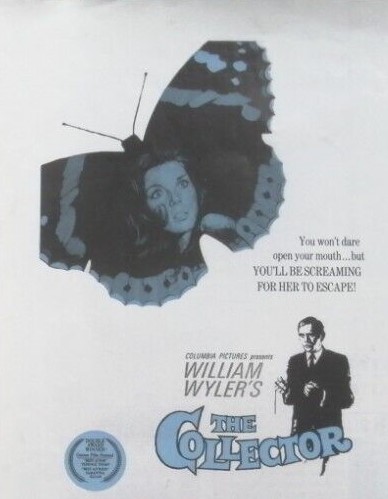
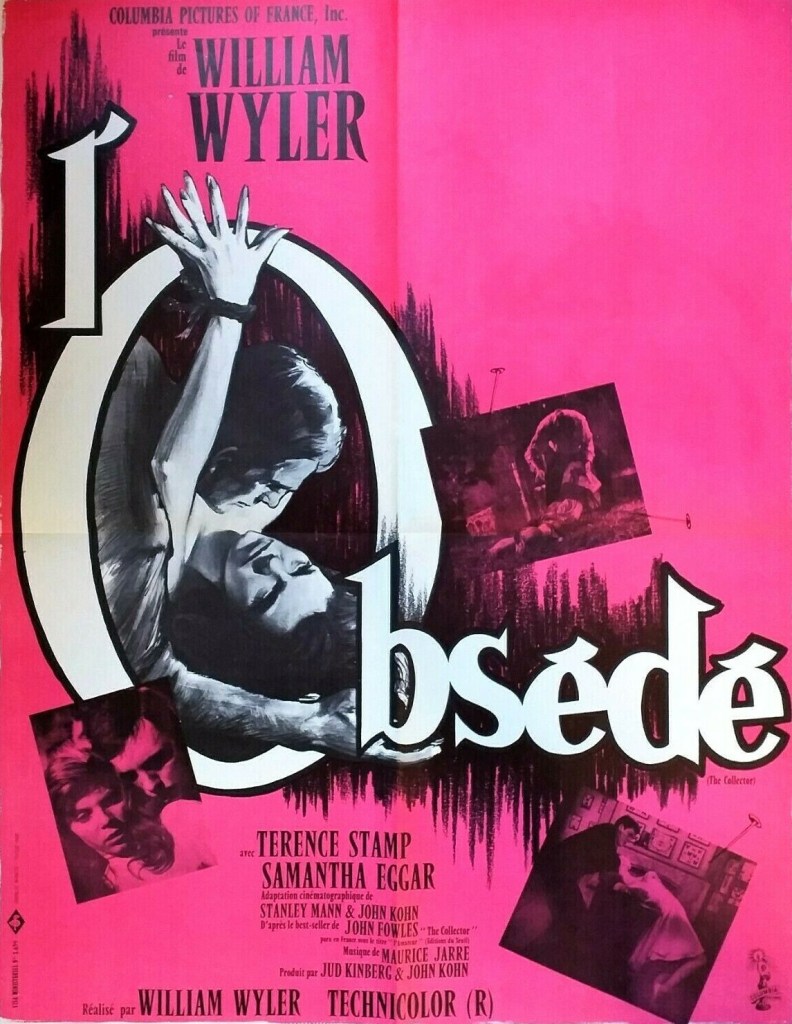
The Collector (1965) *****

William Wyler’s paean to Incels strike such a contemporary note it’s hard to believe it was made over 60 years ago. An insightful study of male entitlement, female submission and    novice serial killer that showcased two emerging British stars, this is as much about the psychological make-up of the victim as the captor.

Following a lottery win (see Note), lonely bank clerk Freddie (Terence Stamp) kidnaps the woman of his dreams, flame-haired art student Miranda (Samantha Eggar) in the hope that once she gets to know him she will fall in love. He has found a large cellar beside the secluded mansion he bought with his winnings. But this is no dank dungeon with a prisoner chained to the walls, but a comfortable abode with lighting, heating, clothing, food, and art materials. However, it is locked.

In turn angry, puzzled and submissive, Miranda tries to work out what she needs to do to achieve her liberty without realising that no matter what she does she will never fulfil his dreams. Despite his shyness, it wouldn’t be hard in other circumstances to fall for a guy as good-looking as this, if only for an affair. She is sexually experienced, but has just been rejected by an older man (Kenneth More), and love on the rebound is hardly uncommon.  

Unfortunately, Freddie lives such a soulless, empty, existence, no interests beyond an obsession with butterflies, of which he has amassed a collection large enough to supply a complete museum, that the chances of finding common ground are remote and the circumstances of their meeting pretty much douse the potential for any spark.

At first, once she has expended her anger at her incarceration, she is grateful not to be murdered or raped – even pleads that if he is going to take her by force sexually not to drug her – and soon her mind turns to ways of escape, especially once he invites her into the big house, allows her to bathe, cooks her a meal and shows the world she could enjoy as his willing partner.

With every step, Freddie dares to dream more, that his insane idea will come to fruition, that a beautiful princess will love the lowly commoner. And as much as this focuses on male domination, it is also an examination of female independence, Miranda being in the foreground of that generation to espouse personal freedom, not viewing marriage as an ultimate destination, but seeking a fulfilling career with love almost a perk on the side.

Even without going to extent of kidnapping a woman, males of the period still expected a female to cater to their every whim, wife-beating hardly considered a crime, and, ironically, it would be a rare woman who would not enjoy the worship a more ordinary Freddie planned to bestow on his beloved.

It being set in the England of a particular period, Freddie blames the gulf between them on “class,” that where or to whom you are born creating an unattainable barrier between young men and young women, despite considerable evidence to the contrary. But, of course, to the thwarted, there is always someone to blame.

You will be very familiar with the cinematic tale of the imprisoned female attempting to escape by wiles and ingenuity, but even so, this will take you by surprise, in part because the idea of being forcibly detained was a rare event back then, so Miranda does not spend her time trying to chisel through loose cement using a stolen fork or other ideas along the same lines. That she has even managed to negotiate the length of her prison term makes her initial custody tolerable, especially as, in terms of material things, she wants for nothing.

Unfortunately, although Freddie is immune to normal feelings, he is alert to the slightest nuance, and would feel it an insult to his intelligence should she just play along and pretend to fall in love with as a means of engineering her escape. That the audience is probably more aware of this than Miranda makes the tension virtually unbearable.

This is a duel of the highest caliber between captor and detainee. At several moments it looks as if the tide will turn. A terrific scene with overflowing bath water fails to make a nosy neighbor suspicious. She even at one point manages to whack her assailant over the head with a shovel and attempt a genuine escape. You are left to wonder if making a sexual sacrifice, even taking the initiative with a virgin, will make the necessary difference. But one look into those implacable eyes would have told you exactly where you stood without having to wait until you were dragged by the hair across the lawn in a rainstorm.  

Audiences more familiar with the director through late-career roadshows like Ben-Hur (1959) and Funny Girl (1967) or the earlier rom-com Roman Holiday (1953) would be forgiven for forgetting how adept Wyler was at racking up the tension from his early thrillers or dealing with unattainable love (Wuthering Heights, 1939) or entitlement (Jezebel, 1938). He evokes such a claustrophobic atmosphere, ingrained with pure Englishness, and plays with ironies of character beauty – Freddie’s eyes and cheekbones, that should have attracted women by the score, instead lending him devilish menace while Miranda’s sensational looks that would have most men begging for just a minute of her company prove insufficient to enslave this particular creature.

That there is genuine sexual tension, not just whether he will end up raping her, but whether she might see his more attractive version of himself and come to give him what he wants without being repulsed, brings a surprising sexual tension. You wouldn’t say there was chemistry between the characters in the normal sense, but the situation is electrifying.

This was a career high for Terence Stamp (Term of Trial, 1962), minus many of the acting foibles and vocal tics that peppered his later work, and the same went for Samantha Eggar (Walk, Don’t Run, 1966). But the performances are of such a high quality, especially when you think she has breached his defences sufficiently, that at times it is an unbearable watch. John Kohn (Caprice, 1967) and Stanley Mann (The Naked Runner, 1967) based their screenplay on the bestselling – and highly praised – novel by John Fowles, author of later cult work The Magus.

This would have stood the test of time anyway as a pure thriller but since it digs into what has now become a counter-culture it carries even greater significance today.

NOTE: He didn’t win the lottery. That didn’t exist then. Instead he won on the “Football Pools,” but that concept – it began in 1923 –  is so hard to explain to non-British people that I took the easy way out. However, the “pools” was a gambling phenomenon of the times, the entry fee so low, at its peak played by 14 million people in the UK every week in the hope of winning a jackpot akin to lottery cash. In essence, you had to guess out of all the soccer games being played on a Saturday (all games in those days kicked off at 3pm on a Saturday) how many would end in draws.

The Ceremony (1963) ***

Actors taking the hyphenated route were quite a fad in the 1960s. Mostly, primarily for tax purposes, they turned themselves into actor-producers. But some went all-out for artistic glory, saddling themselves with the task of directing the movies in which they starred, by this point in the decade John Wayne (The Alamo, 1960) and Marlon Brando (One-Eyed Jacks, 1961) the most celebrated examples. Despite lacking that pair’s box office pulling power, Laurence Harvey (Butterfield 8, 1960) threw his hat into the ring with this often compelling, atmospheric, but occasionally pretentious, offering.

Irishman Sean McKenna (Laurence Harvey) is in prison in Tangiers – “a city of money” – for one crime he did commit (bank robbery) and one he did not (shooting a guard dead during the robbery). Although facing an imminent death penalty for the murder, he refuses to name the killer. Local prosecutor Le Coq (Ross Martin)  is intent on making him an example while the prison warden (John Ireland) pleads for clemency, especially as it is suspected the inmate is innocent.

Astonishing to imagine now but this went out on general release in Britain
as the lead film in a double bill with “Lilies of the Field.”

Meanwhile, McKenna’s girlfriend Catherine (Sarah Miles) and his brother Dominic (Robert Walker Jr) plan an audacious escape. The brother is not altogether altruistic. His price is half the hidden loot and Catherine, that part of the deal sealed when she submits to sex with him.

Dominic gains entry to the prison disguised as a priest, swapping clothes with his brother, so that when sirens sound to announce potential intrusion by Dominic’s sidekick Nicky (Lee Patterson), Sean can simply walk out unharmed. However, when Seans learns of the price to be paid he doesn’t thank Catherine for her noble sacrifice but turns against both. Dominic, now on the run and chased by the police, is virtually burned alive when his car explodes.

My apologies but in order to properly discuss this picture I’m going to have to take you through to the end. So SPOILER ALERT.

Dominic is so badly burnt in fact that he is unrecognizable and the police (decades before DNA would disprove such an assumption) believe he is actually his brother. Dominic is faced with  “the ceremony” – an ironic tittle if ever there was one – in which he is strapped to a wooden throne and shot by firing squad. Despite his brother’s betrayal, and the fact that his death would set Sean free, Sean decides it would better to “prevent the unjust killing of an innocent man” and gives himself up, too late, as it happens, to spare Dominic, but allowing Sean, in a Pieta-style gesture, to carry the corpse into the prison courtyard and announce “my brother died for me.”

Not quite the ending you would expect, not least because religious allegory has been distinctly missing from the proceedings unless you count the somewhat dotty Father O’Brian (Jack MacGowran) who spends most of his time delivering soliloquies unless you count cars, cows and mules as potential conversationalists.

You get the impression the ending was what attracted the director to the tale, and though it is quite a stunning climax, cinematically as well as thematically, Harvey has, like so many debutants, determined to make a big point. “There’s a little bit of God in everyone,” pronounces Fr O’Brian with a saintly air, which would beg the question of when the Good Lord channelled his inner bank-robber.

For all the film’s flaws there are several pluses. The atmosphere “of chilly hell” (to steal a quote about another book) is well done, footsteps echo off stone floors and cobbles, nobody in this black-and-white feature is seen without a dose of noir lighting, resulting in long shadows and aerial shots of tiny figures swarming. While everyone else over-acts for no apparent reason except directorial inexperience, when Sarah Miles (Term of Trial, 1962) overacts, lips constantly a-quiver, words delivered in gasps, she has every right to, since her character has succumbed to the most evil kind of temptation for the best sort of reason.

The only other interesting character, beyond the stock ones populating the prison, is lonely landlord Ramades (Carlos Casaravilla) who has outlived his four lives and whose rooms abut the prison and where Catherine takes refuge while the escape is going on. He senses her tension, but mistakes the cause, assuming she is here to wait for the shots announcing her husband’s death as a means of “sharing his punishment,” quite a piece of psychological insight for an ordinary guy. And there’s also a creepiness about the whole scene, a sense that she might have to give herself to him as well in order to prevent him wandering too far from the bedroom where he might discover Dominic putting into action a crucial part of the escape plan.

Among the flaws: no real tension, especially in terms of the escape, not enough directorial understanding that much more could be gained from greater focus on Catherine’s dilemma, the obvious lack of a body in the burning car, the fact that the Irishman shows no signs of an Irish accent, the priest’s scenes which provoke hilarity more than reverence, and as much as it is a strength the ending appears out of nowhere.

Robert Walker Jr (The Happening, 1967) is too much of a lightweight for this role, but John Ireland (55 Days at Peking, 1963) and Ross Martin (Experiment in Terror, 1962) excel. Look out for Fernando Rey (The French Connection, 1970).

Valiant effort by Harvey who only directed one other time, on his last film Welcome to Arrow Beach / Yellow-Head Summer (1973), plus a stint filling in for Anthony Mann who died during the filming of A Dandy in Aspic (1968). For The Ceremony Harvey was a quadruple hyphenate –  actor-producer-writer-director – for he also contributed enough dialogue to claim a screen credit along with Ben Barzman (The Blue Max, 1966) who adapted the novel by Frederic Grendel.

Deadfall (1968) **

“The Big Reveal” comes too late to save this heist-cum-melodrama. It can’t make up its mind whether it wants to join the canon of superlative 1960s caper pictures – in which case it needed to make a greater effort on the cat burglary front – or whether it’s an odd addition to the menage a trois category, in which case it needed characters you could actually believe. Worst of all, it contains one of the great artistic follies, a robbery carried out in time with an  orchestra playing one of the great John Barry compositions, “Romance for a Guitar and Orchestra.”

The only problem, there’s no dramatic reason for this. Since the concert is miles away from the robbery, it’s not as if the music drowns out the shenanigans. Director Bryan Forbes (King Rat, 1965) shoots himself in the foot. It’s too clever a device by half, even if the music is intended as a counterpoint to the  robbery’s more dramatic themes or the silence which had become a trope.

Cat burglar Henry (Michael Caine) forms a business partnership with elderly safecracker Moreau (Eric Portman) and falls for his wife Fe (Giovanna Ralli). The husband-wife relationship is off to begin with, he preferring males, and the wife admitting she doesn’t always find men attractive, though quite what she is hinting at is never made clear. The target is millionaire Salinas (David Buck), whom Henry is investigating to the point of pretending to be an alcoholic so he can get to know Salinas in a sanatorium.

Any other movie would get straight to the point – draw up plans and get on with it. But here, for no real reason except delay, Moreau wants them to do a trial run,  a safecracking job on the mansion of the kind of couple who drive off in a posh car to attend a concert. The effort put into the planning isn’t really up to scratch, not when compared to the likes of Topkapi (1964) – to which every heist film of the era was measured – or Gambit (1966) or even the less well-known The Happy Thieves (1960) or Seven Thieves (1960).

Apart from some cat burglary skills the whole episode is perfunctory, guard dogs knocked out by drugs. The background music, the aforementioned John Barry opus, just about kills off any prospect of tension. It only sparks into life when Moreau admits the safe is beyond him and Henry has to prise it out of the wall and cart it to the waiting car.

The second heist would have been far more interesting had we known from the start that Salinas welcomes burglary attempts, seeing it as some kind of duel of wits with malfeasants.

In between the two robberies there is time enough – too much time in fact – for Henry and Fe to get it together, for Fe to run off and then return only to learn in The Big Reveal the kind of despicable man her husband is. The movie can’t even deal with the incestuous sub-plot and just lets it hang there. But by that stage you couldn’t care less. Fe isn’t the type of femme fatale to bother crossing the road for, the romance seems too prescribed and the downbeat ending makes no sense.

I’m only giving this any points at all really because it stars Michael Caine (Hurry Sundown, 1967) and features a lengthy slice of John Barry music. Caine has been in enough duds for sure, but this doesn’t have the ring of one of his doing-it-for-the-money numbers or a stab at the Hollywood big-budget scene. Caine is good enough and Eric Portman (The Bedford Incident, 1965) is an interesting study. But it just doesn’t gel, not just let down by Giovanna Ralli (The Caper of the Golden Bulls, 1967) but by the pretentious direction and dramatic miscalculation of Bryan Forbes.

Forbes’ wife Nanette Newman (The Wrong Box, 1966) makes a puzzling appearance in a small role with no dramatic credibility. Leonard Rossiter (Deadlier than the Male, 1967) provides another cameo. For many the high spot will be to see John Barry in the flesh, conducting the orchestra playing his composition.

Hide and Seek (1964) ***

Too many peculiarities for a small British B-picture that just about makes it over the line after “The Big Reveal.” You can start with the fact that, ostensibly, this was director Cy Endfield’s follow-up to his blockbusting Zulu (1964). In fact, it had been made long before, but sat on a shelf for a year, and only released to cash in on Zulu. And you can see why studio British Lion didn’t know what to do with it.

Diving down a 39 Steps thriller-sized rabbit hole, baffled professor saddled with adventurous female go on the run searching for answers to, wait for it, a crime which hasn’t actually been committed. There’s action on a train, some comedy as the worlds of academia and the sophisticated fast set collide, romance on a barge,  Cold War skullduggery,  too much chess, a bit of welcome role reversal, a cliff-top fight, and some dry wit that might have fitted better into a straightforward romantic comedy. And it ends with a twist of such audacity that it would either come as a relief to a bewildered audience or send them home frustrated at such a denouement.   

Rocket scientist David Garrett (Ian Carmichael) becomes embroiled in not even really a plot when he attempts to return a box, containing an inordinate amount of loot, to its owner,  chess grandmaster Dr Melnicker (George Pravda). Luckily, a clue in the form of a chess move takes him to a posh London house in fashionable Chelsea where he encounters the slinky Maggie (Janet Munro) and after hiding in a sandpit in a children’s playground to evade pursuers he ends up on a train with her heading north to a place called Flamboro.

But, wait, his pursuers are also on the train, so naturally the couple have to jump off, fall into a river and hitch a lift on a passing barge whose owner Wilkins (Hugh Griffith) proves most obliging. Indeed, Maggie is even more obliging, taking the lead in bedding the shy professor.  Things get interesting when Maggie, at a road sign, takes David in the completely opposite direction to Flamboro. That works for about ten seconds until a henchman Paul (Kieron Moore) captures them at gunpoint.

Rather than just shooting David dead he decides it would be cleaner to chuck him over a cliff. Luckily, David is a shade pluckier than you might expect. After winning this cliff-top tussle and shocked at having chucked a man over a cliff he is even more astonished to discover he is stranded, Maggie having made off in the car. Luckily, a passing policeman on a bicycle ensures David makes it safe to Flamboro, which turns out to be a huge mansion perched on a cliff.

My guess is by now you are so hooked by this story that you’ll want me to reveal The Big Reveal. Well, the whole thing turns out to be a trap. Melnicker, the pursuing thugs, Paul (who,  you’ll not be too astonished to learn, ain’t dead) and even Maggie have all been plotting to bring David here so that he can be kidnapped and handed over to a submarine arriving the following day. You see, David has been so outspoken (has he?) against his masters that everyone will put his disappearance down to defection. It’s all been a cleverly worked-out chess move as chief baddie Hubert (Curd Jurgens) takes pains to point out.

But our David isn’t exceptionally brainy for nothing and finds a way to outwit the bad guys with Maggie, by now repenting of her bad ways and fallen in love, along for the ride.

So what’s gone wrong? The casting, unfortunately, for one thing. Star Ian Carmichael (School for Scoundrels, 1960), better known for comedy, doesn’t quite make the switch to more straightforward thriller. And Curd Jurgens (Psyche ’59, 1964), whom you might expect to add some gloss, doesn’t appear till the end.

Worse, the film doesn’t find the right tone, too much comedic British observation, and not enough of the hero being in genuine jeopardy. Only a clueless professor would run from the thugs. If the big twist had occurred halfway through and the audience had time to wonder whose side Maggie was on and feel David was in in genuine danger it might have hit the bullseye because, oddly enough, the romance is believable in a Hot Enough for June (1964) kind of way, where innocent male is scooped up by a more worldly female way above his league.

But the role reversal is fun. She’s the one who goes to his rescue when he falls in the river, she’s the seductress, and gets to tell him he looks better “when he’s cross” (a line more typically with slight variations falling to the male) and delivers the movie’s one cracker: “Being a man you have no respect for a mink coat.” She would be an ideal candidate for femme fatale if only the director had let us in on the story quicker, but she’s certainly an astute lure.

Because I wasn’t expecting much, I have probably been a shade less critical than if I was viewing it as a follow-up to Zulu. In the end, it’s passable enough, especially if you are willing to see how clever it’s been.  

As I mentioned Ian Carmichael (Lucky Jim, 1957) is the weak link but former Disney protégé Janet Munro (Swiss Family Robinson, 1960), now blossomed in sexy fashion, steals the show and on this performance you might be surprised she  did not have a more illustrious career but she had a heart condition and died prematurely at the age of 38. Curd Jurgens was at the early stages of inventing his villainous persona. The other characters are merely pawns in the plot so end up as stock villains. Cy Endfield’s genuine follow-up to Zulu was worth seeing – Sands of the Kalahari (1965).

You can catch this on YouTube.

https://www.youtube.com/watch?v=w3zj_VcTdBM

Orphan First Kill (2022) *** – Seen at the Cinema

Evil meets its match” would have been a good tagline for this neat B-picture, a slow burn that starts off as horror before swerving into a more straightforward thriller. A prequel to surprise hit Orphan (2009) and a perverse take on the origin theme so beloved of the MCU/DC movies, this begins in Estonia where Leena (Isabelle Fuhrman) is an inmate at a psychiatric institute.

At first it looks like the tale is heading in the direction of Leena’s relationship with new art therapist Anna (Gwendolyn Collins). But that is quickly stymied when Leena, having orchestrated an escape through her manipulative and seductive powers, knocks off Anna as well, pausing only long enough to harness the woman’s computer to find a lookalike missing girl, the American Esther Albright, she could pretend to be. The wealthy Albrights, mum Tricia (Julia Stiles), devastated artist husband Allen (Rossif Sutherland) and spoiled brat son Gunnar (Matthew Finlan) live in a huge mansion in Connecticut.

And at first again, we go down another rabbit hole, this time the question of whether Esther can maintain her disguise, coming up shy at times in the old memory department. A psychiatrist is initially a bit suspicious and there’s a cop, Inspector Donnan (Hiro Kanagawa) lingering in the background. But Esther bonds with Allen over their shared interest in painting and the husband believes he has unearthed a new shining talent.

We also go down a rat-hole, so to speak, when Esther befriends a rat (an unlikely inhabitant in such a deluxe property, but there you go) whose only purpose you guess right away is to die, poisoned in one way or another. You imagine the poisoner is going to be Esther just wanting to maintain her killing skills.

Not so. The poor old rat is killed by mistake by Tricia who is, it turns out, trying to rid herself of this imposter, a lass she knows only too well cannot be her missing daughter for one very unsavoury reason which I won’t divulge but certainly took me by surprise.

So then the film switches onto a completely different tack, and one that is far more satisfying than just a deranged maniac, as in most horror pictures, going round slaughtering everyone in sight.  Donnan has re-entered the frame by this point, continuing his investigations to the point of sneakily snatching Esther’s fingerprints so he can try and do a match.

So now it’s game on and Esther is out- numbered, up against a pretty dangerous mother-and-son combo, with only the dim husband as ally. And no matter what clever stunts Esther dreams up to rid herself of this infernal duo and live happily ever after with the doting father, the equally tough Julia is quietly setting her own snares.

We were already expecting trouble the moment we set eyes on Esther, who, with her baby-faced features and size, that was a given, if ever there was a monster-in-disguise it was her. But beautiful socialite Tricia is a different story and so if there’s a “secret” this time round it’s to do with Tricia’s family, the pair involved maintaining an ongoing masquerade with the unwitting father.

Esther’s survival depends not so much on killing her way out of here but on winning over the father sufficiently should that, inevitably, if her plans work out, bereft of wife and son he will turn to her for consolation.

Isabelle Fuhrman (Orphan) is even better than she was before. Then she was a young actress playing a young maniac. Now she’s over a decade older and having to act more than a decade younger and that certainly takes some doing. But Julia Stiles (Hustlers, 2019) is the revelation, the cold-as-ice beauty, barely holding her family together after the previous tragedy, on the one hand welcoming Esther because it revitalizes her almost-dormant husband, on the other needing to exert considerable control otherwise their carefully constructed lives are going to explode. Although the surname is not new to me, the actor is, and Rossif Sutherland (The Middle Man, 2021) gives a touching performance as the grieving, brooding father finding himself, especially good in his scenes in his studio with Esther. In only his second picture Mathew Finlan (My Fake Boyfriend, 2022) isn’t given much scope as a spoilt brat son nor is Hiro Kanagawa, best known for the Star Trek: Discovery TV series.

Director William Brent Bell (The Boy, 2016) does a decent job, especially given he has to stradde the twin genres or horror and thriller with a nod in the direction of film noir. The scenes between Esther and Julia, where they realise they are adversaries, are especially well done. There are enough twists to keep the plot spiralling along and clever use of doubles to make you believe Fuhrman is a little girl.

Far from a great picture, but enough to be getting along with in the absence of a blockbuster. The hardier of the moviegoer species, people like me who pop along to their local cinema every week regardless and find something to watch, will be less picky about this kind of fare than those who get in for nothing or are sent a streamer due to their status as critics. Exhibitors have complained for over a century now that the best movies are never spread out over the year, but clustered into various time zones. Their livelihood, after all, depends on a constant string of winners. It’s a different story for cinemagoers. We just want to sit in the dark and see a film and as long as it’s reasonable enough we’re not going to complain.

In what should have been an indifferent week for moviegoing – given I had already seen Bullet Train, Nope, Top Gun: Maverick etc – I managed quite a nice triple bill on my weekly outing. This was the sandwich between the charmingly tolerable Fishermen’s Friends: One for All and documentary Girls Can’t Surf.    

Discover WordPress

A daily selection of the best content published on WordPress, collected for you by humans who love to read.

The Atavist Magazine

by Brian Hannan

WordPress.com News

The latest news on WordPress.com and the WordPress community.