Candy (1968) **

Ode to the male gaze. Once a cult vehicle, this will struggle to find favor these days what with its backward attitudes. Virtually impossible to excuse the rampant self-undulgence. The sexually exploited naïve Ewa Aulin in the title role didn’t even have the benefit of being turned into a star. The satire is executed with all the finesse of a blunderbuss. And while, theoretically, picking off a wild range of targets, if this movie has anything to say it’s to point out how easy it is for men to deify themselves at the slightest opportunity.

Not much of a narrative more a series of sketches slung together with the slightest connecting thread. Most its appeal lies in watching huge marquee names make fools of themselves. Or, if you’re that way inclined, seeing how much nudity will be imposed on the star, intimacy  rarely consensual, clothes usually whipped off her.  

Teenager Candy (Ewa Aulin) has father issues, daddy (Jack Austin) being a dumb angst-ridden teacher. Randy poet McPhisto (Richard Burton) drives a class of schoolgirls into a frenzy with his lusty reading, inveigles Candy into his chauffeur-driven car, ends up in her basement drunkenly humping a mannequin while Mexican gardener (Ringo Starr) with an accent as coruscating as that of Manuel from Fawlty Towers assaults her on pool table.  Scandalized father packs her off to his twin brother in New York, that notoriously safe haven for nymphettes, while on the way to the airport they are almost driven off the road by the gardener’s vengeful biker sisters (Florinda Balkan et al).

For no apparent reason she is hitching a lift on a military plane commanded by randy Brigadier Smight (Walter Matthau) who, on the grounds that he hasn’t had sex for six years, commands her to remove her clothes for the good of the nation. In the Big Apple, rock star surgeon Dr Krankheir (James Coburn), entering the operating theater to the same kind of waves of acclaim as McPhisto, finds an excuse to have her undress and submit to him, this just after she’s managed to avoid the attentions of her randy uncle. It should come as no surprise that Krankheit treats women as his personal property to the extent of branding them like cattle.

In due course, she encounters a gang of mobsters, an underground movie director and a hunchback (Charles Aznavour) who, in return for her showing pity for his condition, proceeds to rape her. She is arrested. Guess who wants to frisk her. Naturally, when she escapes she runs into a bunch of drag queens.   

Then she finds sanctuary in a semi-trailer truck, home to guru Grindl (Marlon Brando). He’d be convincing enough as a mystic except he, too, finds an excuse to rip her clothes off. There are more cops to contend with and another guru, facial features obscured by white clay. If they’re going to have sex then naturally it must be in a Hindu temple. Turns out the latest person to take advantage of her is her father but he’s been handed a get-out-of-jail-free card because by now he’s brain damaged.

This might all be a dream/nightmare. Candy might even be an alien. It’s dressed up in enough psychedelia to sink a battleship and its highly likely that any lass as gullible as Candy will find herself at the mercy of any man, so in that context it carries a powerful message. I’m sure many beautiful young girls will attest to the truth that men feel they have the right to paw anyone who comes their way without asking permission. And the other message is just as powerful – how many young actresses have been seduced by thoughts of fame to disport themselves in this fashion only to find that all the industry wants is their nudity not their acting talent.

You might say that the target is so obvious it hardly needs pointing out but the MeToo campaign will beg to differ and you would hope that Hollywood has wised up. It’s just a shame that the satire is so heavy-handed. The military and the medical profession are sorely in need to answering tough questions. Unfortunately, this picture doesn’t ask any. It’s like an endless casting couch.

Directed by Christian Marquand (Of Flesh and Blood, 1963) in, thankfully, his final picture, from a screenplay by Buck Henry (The Graduate, 1967) and Terry Southern (Dr Strangelove, 1962) based on the novel by Southern and Mason Hoffenberg. Nobody comes out of this well and it’s rammed full of cameos from the likes of Elsa Martinelli (The Belle Starr Story, 1968), John Huston (Myra Breckenridge, 1970), Anita Pallenberg (Performance, 1970), Marilu Tolo (Bluebeard, 1972) and boxer Sugar Ray Robinson.

Ewa Aulin (Start the Revolution Without Me, 1971) isn’t given much of chance, her character whimsical, pallid and submissive and she didn’t become a major marquee name.

A mess.

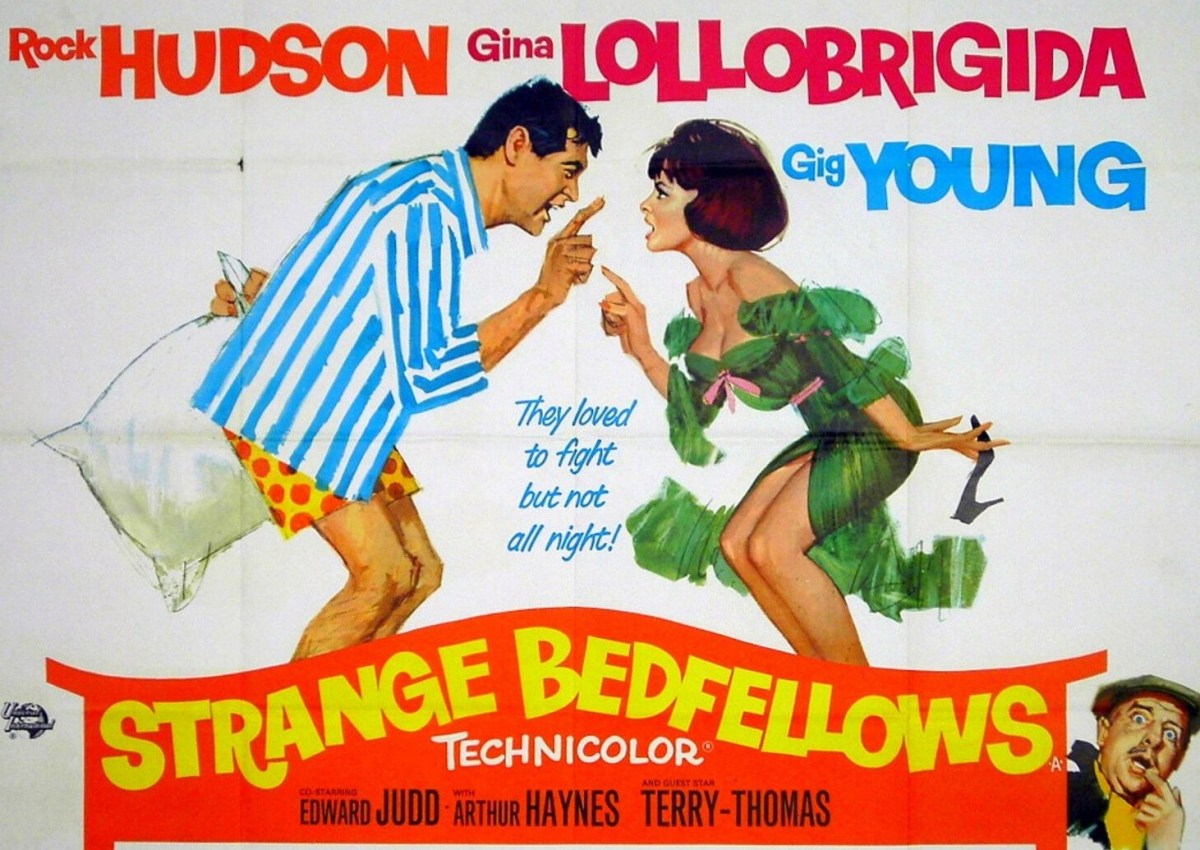
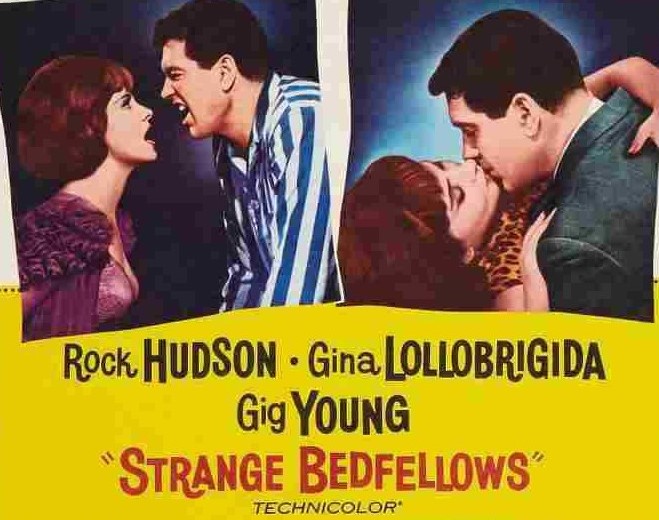
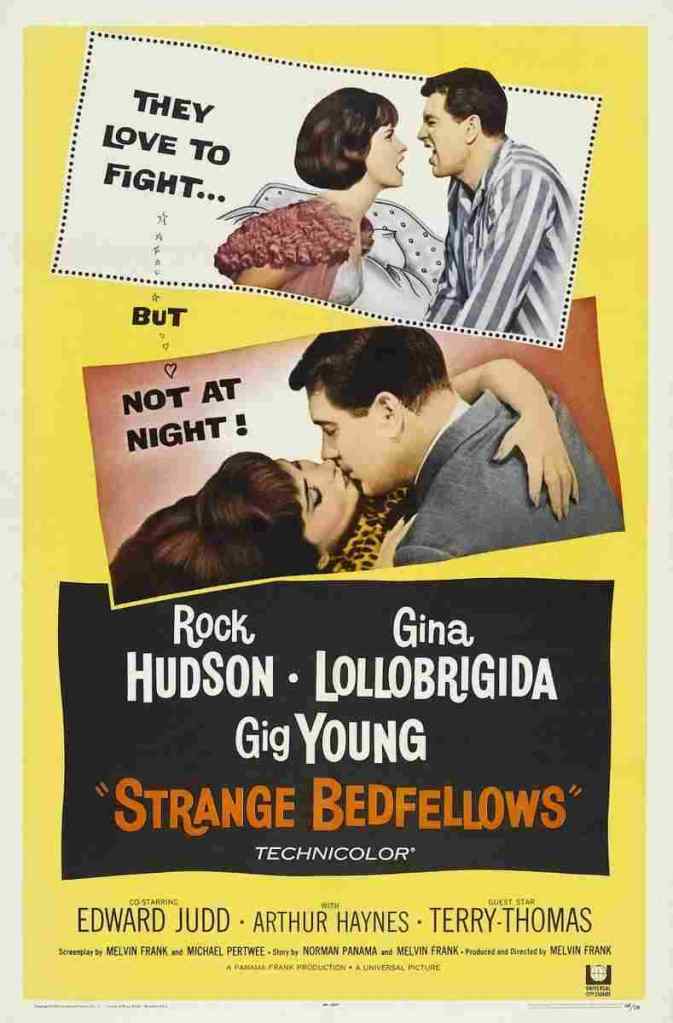
Strange Bedfellows (1963) ****

I had my first belly-laugh within seconds, a wonderful sight gag and was chortling all the way through this London-set battle-of-the-sexes comedy. Carter Harrison (Rock Hudson) is a high-flying businessman who needs to win back long-estranged wife Toni (Gina Lollobrigida) in order to gain promotion at a family-conscious oil company. Initially, Carter re-discovers the reasons he had first fallen in love with her but then, of course, only too bitterly, why they split. Hudson and La Lollo had previously teamed up for Come September (1963) and Hudson had spent most of the 1960s in romantic mishap with Doris Day so he could call on an extensive range of baffled and enraged expressions. Toni is an artist-cum-political-firebrand which sets up hilarious consequence. Richard Bramwell (Gig Young) is on hand to act as referee.

There’s some marvelous comic invention, a conversation between the two principals relayed through taxi controllers turns into a masterpiece of the misheard and misunderstood. Complications arise from Toni’s Lollobrigida’s fiancé Harry  (Edward Judd from First Men in the Moon, 1964), also an activist, but on the pompous side, and an Italian lothario. Taking advantage of the less than congenial London weather, there are jokes aplenty about umbrellas and in a nod to farce occasions for Carter to lose his trousers and share a bed with the fiancé. Smoldering sexual tension also kindles many laughs. By the time the film enters its stride it’s one comedic situation after another. It being England, naturally enough Lady Godiva is involved.

Hudson in suave mode trying to cope with the feisty Lollobrigida is an ideal comedy match. Costume designer Jean Louis has swathed the actress in a stunning array of outfits, some of which leave little to the imagination. When Doris Day got angry you tended to laugh, not quite believing this was anything more than a moderate hissy fit, but if you crossed Lollobrigida you were apt to get both barrels and it never looked like acting, she was a very convincing when she switched on the fury engine, plus, of course, whatever she threw added both to the comedy and her character’s conviction.   Both have terrific comic timing.

Writer-director Melvin Frank was something of a comedy specialist, a dab hand at suiting comedy to screen persona having previously set up Road to Hong Kong (1962) and Mr.  Blandings Builds a Dream House (1948). Terry-Thomas makes an appearance as a comic mortician and there are parts for English comedian Arthur Haynes and Dave King. Hudson and Lollobrigida exude screen charisma and while not in the class of Come September this delivers enough laughs to make you wonder why they don’t make them like that anymore.

Father Came Too! (1964) ***

The gentlest of British comedies – a fading subgenre after the infiltration of the genre by the unsubtle Carry On pictures – that on the face of it appears a sequel to the very successful The Fast Lady (1962), featuring the same cast with the exception of Julie Christie. And with both Stanley Baxter (on television) and Leslie Phillips subsequently outpointing James Robertson Justice in the stardom stakes, contemporary audiences tend to come at this from a mistaken perspective.

James Robertson Justice was at the time very much a British institution and if not the star you cast him at your peril as he was likely to steal the picture from better-remembered actors such as Dirk Bogarde in the Doctor series, Margaret Rutherford in Murder, She Said (1961), David Niven in Guns of Darkness (1962) and Omar Sharif in Mayerling (1969). He was a big burly man with a bushy beard and a loud hectoring style, more Brian Blessed (Flash Gordon, 1960) than Robert Morley (Oscar Wilde, 1960).  

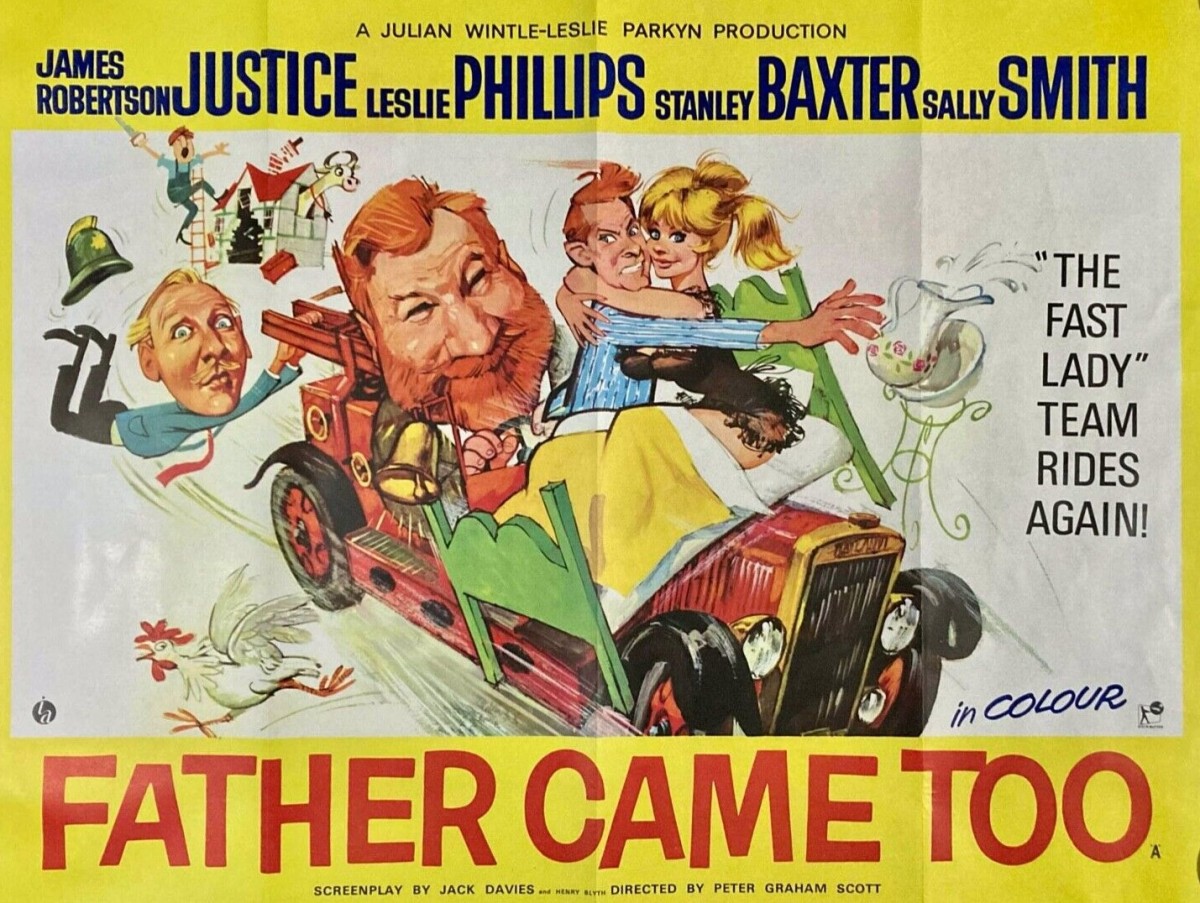
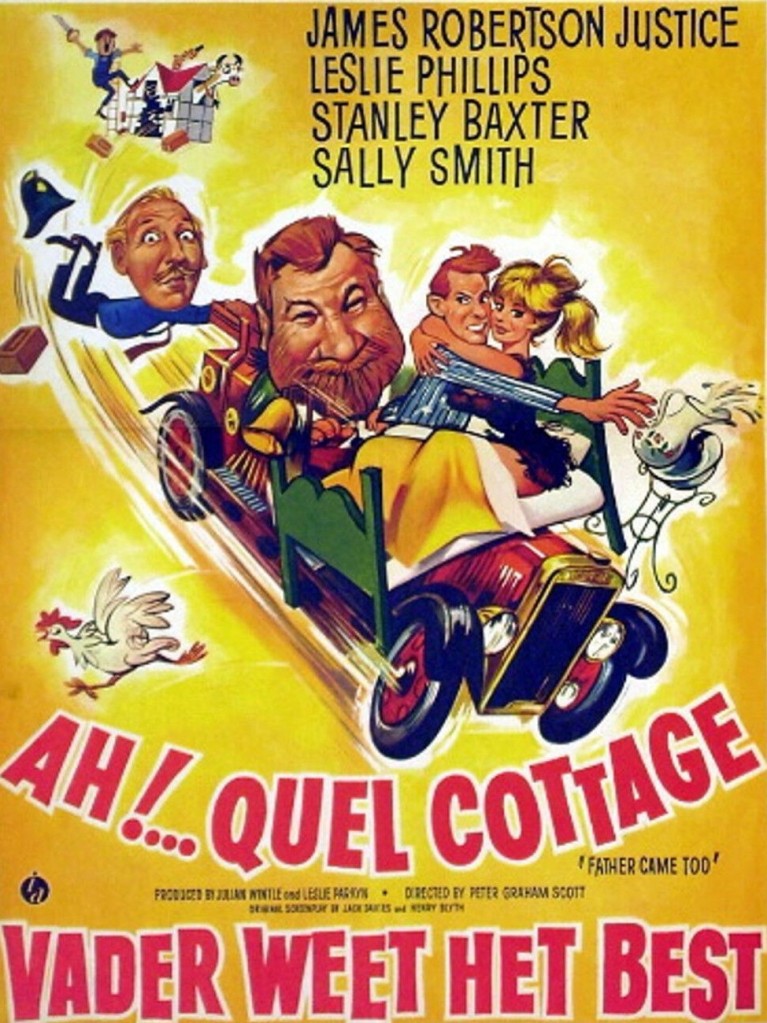
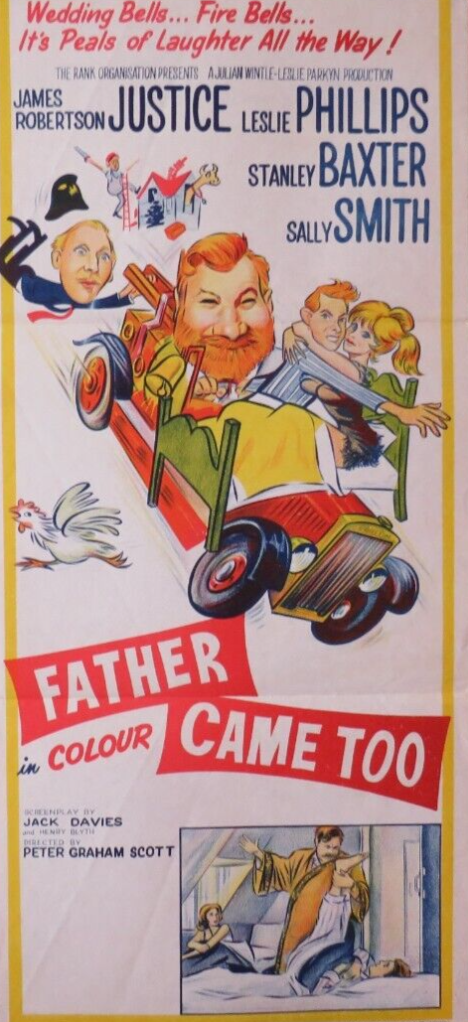
Misleadingly, the posters suggest another motor-centered tale.

He wasn’t the star of The Fast Lady and if it hadn’t been for the presence of Julie Christie (In Search of Gregory, 1969) he would have stolen that movie too. But when he was the denoted star, as here, the picture is built around him, so it’s not, actually, the tale of a young couple buying a money pit of a house, but of the male version of the interfering mother-in-law who makes their life merry hell.

Just married Dexter (Stanley Baxter) and Juliet (Sally Smith) purchase what appears an idyllic cottage in the countryside only to discover it requires a great deal of work. Renowned actor Sir Beverly Grant (James Robertson Justice) resents losing his daughter to a man he distrusts and to her moving out of his very grand home (named Elsinore, though I wonder how many viewers got that connection).

His attempts to take over the re-building programme are rebuffed by his son-in-law who hires the kind of builders, led by Josh (Ronnie Corbett), who give builders a bad name, tearing more tiles off the roof than they replace, creating more work for themselves or proving incompetent wherever they go. There’s a subplot involving real estate agent Roddy (Leslie Phillips), a budding thespian, desperate for the actor’s seal of approval.

But mostly, it’s everything going wrong and the father getting in the way and making things worse. But the tale doesn’t revolve around the hapless hero but around the domineering father and audiences back in the day would have recognized this, revelling in the father’s performance rather than trying to get on the side of the son-in-law.

Mostly, too, the comedic trick is slapstick, foot in paint pots, falling through floors, ceilings and roofs, an invasion of cows (one with the inevitable bonnet), being drenched by as much water as you could get on a set, and Dexter wringing his hands as the calamities – and the budget – mount.

Usually, the young couple taking on the world scenario just results in them encountering trouble from neighbors or various representations of authority and generally the focus from the outset is on them. But, here, it’s the opposite, audiences of the time waiting, not so much to see what new disaster will befall the couple, but to enjoy the carnage the father visits upon them. And viewed from that perspective it becomes far more enjoyable.

He’s far removed from the interfering mother-in-law cliché because that element of any comedy was usually a subplot played by a character actor who rarely evoked any audience sympathy. But audiences came to a James Robertson Justice picture to enjoy the mayhem he caused. He had screen charisma in spades, and especially when the screenplay was tilted in his favor, was apt to totally dominate a movie. And this is him at his best.

Stanley Baxter was somewhat miscast as a whiny incompetent husband – or, rather, he was not given a part which best utilized his uncanny skill for impersonation as later shown in his eponymous hugely successful television show. Leslie Phillips plays against type, more of an ingratiating Uriah Heep type than the uber-confident lady killer. Sally Smith (Naked You Die, 1968) hasn’t a hope of emulating Julie Christie. A slew of television comics – apart from Barker you can spot Terry Scott, Hugh Lloyd, Fred Emney and Kenneth Cope – put in an appearance.

Director Peter Graham Scott (Subterfuge, 1968) lacks prequel director Ken Annakin’s madcap zest but keeps it going none the less. Jack Davies (North Sea Hijack, 1980) and Henry Blyth (The Fast Lady) are as inventive as the idea permits.

Good old-fashioned fun but requires to be viewed from the correct character perspective.

How Sweet It Is (1968) ***

You’d have thought by now leading men would be running shy of Debbie Reynolds, aware just how easily she would steal the picture out from under the top-billed star (witness Goodbye Charlie, 1964). But she had producers clamouring for the fizz she brought. Her comic skills, and willingness to entertain slapstick, were matched only by Doris Day. Especially helpful when she’s saddled with a convoluted plot that’s one-third generation gap comedy, one-third If It’s Tuesday It Must Be Belgium and one-third the kind of creative thinking that determines that somehow or other the female star must end up in a brothel. Throw in some flower power, split-screen, stills montage and slow-mo and you’ve covered all the bases.

In this hit-and-miss line-up, by far the most amusing element is that it’s the adults – photographer Grif (James Garner) and wife Jenny (Debbie Reynolds) – who are sex-obsessed, sneaking away at every opportunity for a bit of hanky-panky, trying to avoid the disapproving eyes of their virginal teenage son Davey (Donald Losby).

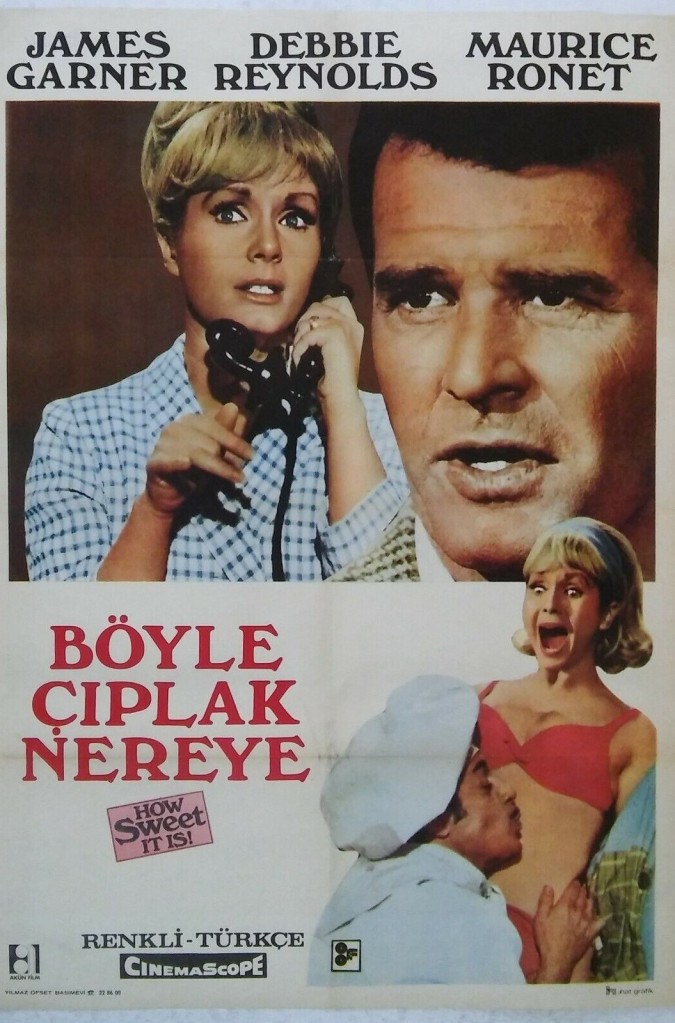
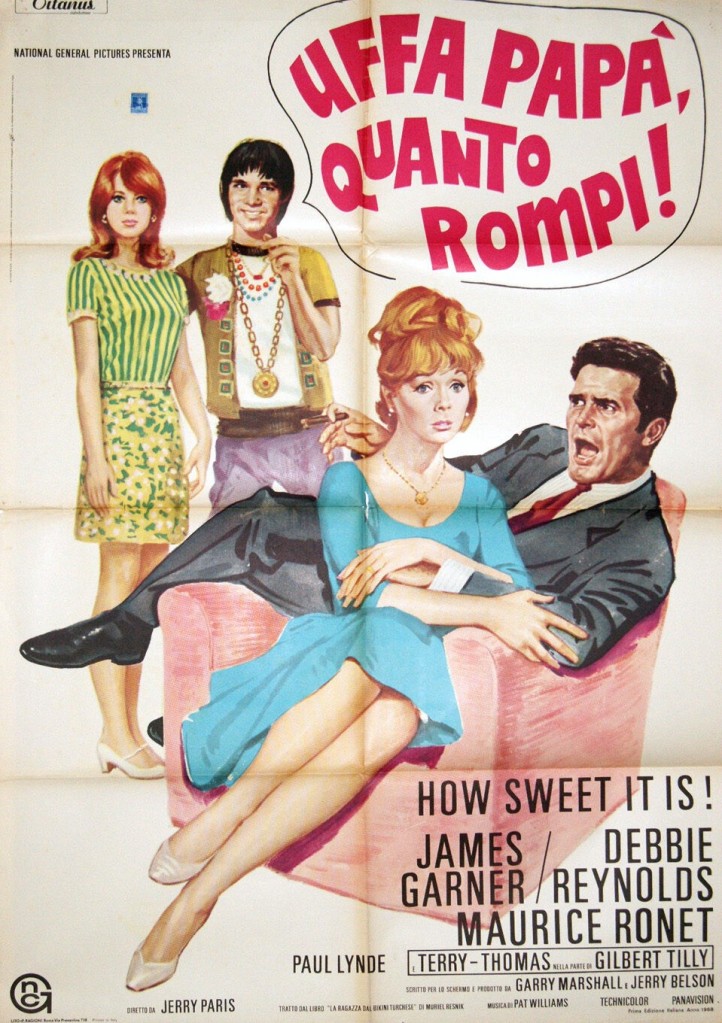
An odd example of creative license here. Poster designers had decided that red was the color no matter what. In the last section of the movie Debbie Reynolds parades in a blue – not red – bikini and the book on which it is based is called “The Girl in the Turqoise Bikini.” I’m not sure the color of the bikini is that much of a plot point unless it’s to hook readers of the original novel, but it’s mighty strange for the poster people just to change the color.

The narrative determines that Davey joins girlfriend Bootsie (Hilarie Thomson) and her lithe gal pals on a tour of Europe accompanied by Grif who has been commissioned to photograph the trip. Much to Grif’s horror, Jenny decides she’s going to follow them and hires out a swanky pad where the grown-up lovebirds can make a nest at some undetermined point.

The picture quickly loses interest in Grif and the girls, beyond an attractive tour guide making a pass at Grif and of course their bus getting stuck in the mud. Not only is the Jenny segment more intriguing – turns out she’s been conned by Gilbert Tilly (Terry-Thomas) into handing over a thousand bucks for a chalet he’s not entitled to hire out – because she gets romanced in high French style (champagne and flowers in case you’re bursting to know) by legal lothario Philippe (Maurice Ronet) and every now and then finds herself wearing little more than a bikini and sometimes nothing at all.

Takes a heck of a long time for the two stories to dovetail so that Grif can flounce off in a huff, punch the living daylights out of the Frenchman, and give the screenwriter the excuse to plonk Jenny down in a brothel (that part, I have to admit, is neatly done). There’s also some unusual class comedy at the chateau, Philippe initially being mistaken for a butler, then having to bunk down with his servant because (guess what) this mansion has only one main bedroom.

For no apparent reason there’s an odd section at the start. Instead of flying to Europe, they take the ship and for no apparent reason they’re stuck on C-deck with a lip-pursing purser (Paul Lynde) who insists males and females must sleep apart and share cabins with strangers. Slot into the miss department the opening with the old trope of the husband coming home to find his wife in bed with another man, except it’s Davey and the parental lovers are enjoying some afternoon delight, though quite how you can stretch that to Davey taking a carving knife up the stairs beats me.

James Garner is no more convincing a photographer than he was in The Pink Jungle (1968) and he hardly gives Debbie Reynolds a run for her money, as if he doesn’t know how to bring this character to life. Except for excelling at the risqué, and she a willing accomplice, he’s coming over like the straight man to her comedienne. Debbie Reynolds is superb, reactions honed to the bone, throwing herself into the part, undergoing whatever humiliation will snare a laugh.

Garner briefly resurrected his career with Support Your Local Sheriff (1969) before he hit the slide (see the previous Behind the Scenes article) and to my astonishment this signalled pretty much the end of Reynolds’ screen career, nothing for the next decades except What’s the Matter with Helen (1971) and a bit part (as herself) in The Bodyguard (1992). You can hardly blame her for screenwriters not coming up with the right material to take advantage of her supreme comedic gifts. Alexandra Hay (The Model Shop, 1969) is wasted, you might just as well have dabbed her role “the sexy blonde.”

Director Jerry Paris (Never a Dull Moment, 1968) throws everything he can at the screen without much success. Future director Garry Marshall (Pretty Woman, 1990) and producer Jerry Belson (Fun with Dick and Jane, 1977) in his movie debut formulated the screenplay from the bestseller by Muriel Resnik.

Far from the last comedy hurrah you would have wished for the actress, but all you’re going to get.  

A Touch of Larceny (1960) ****

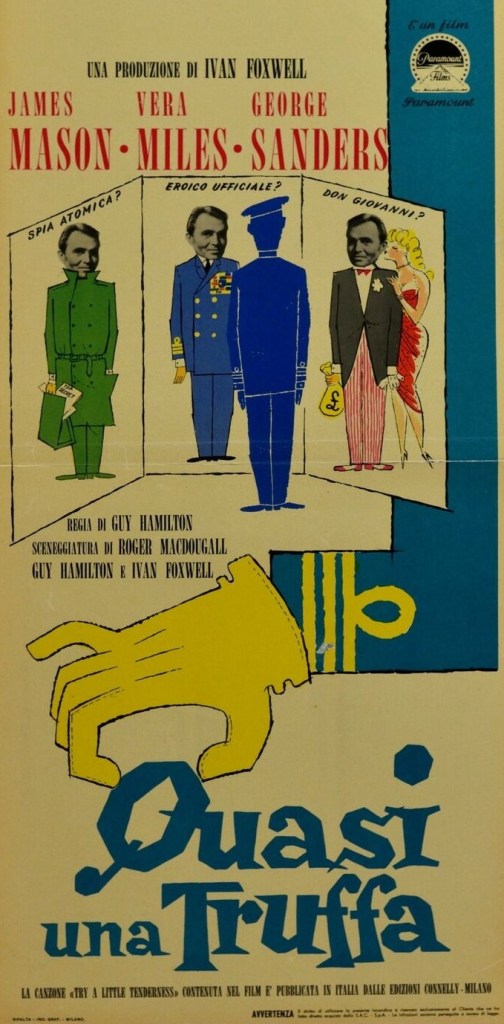
Magically fits into the “lost” film category that I’ve been banging on about recently, films, for a variety of reasons, denied cinematic release. Or at least that’s according to Rotten Tomatoes which declares “there are no featured reviews…because the movie has not (been) released yet” despite the fact that it was a big hit in cinemas over six decades ago.

Happening upon this nugget of information in a casual trawl of RT I thought I’d see if this “lost” movie was as good as The Appointment (1969) perhaps or Fade In (1969) or whether it should never be seen.

Imagine my surprise to find a highly entertaining picture best described as a one-man caper that takes aim at the Establishment and the Media, wrapped in a very witty rom-com, and helped along by the kind of Whitehall characters making a meal out of doing nothing as lampooned in BBC TV series Yes, Minister

The central conceit sounds so lame from the outset that you think this confection is going to collapse the minute it is put into practice, but, in fact, a good few twists inflate the idea until it floats along quite merrily towards a happy conclusion. And if you only remember James Mason from dour turns in The Deadly Affair (1967) or as the smarmy villain in North by Northwest (1959), you’re in for a treat.

For this is the actor at his most winning, so charming he almost edges into the adorable class, and this while playing a rake, the seducer’s seducer, but with the quickest of quick wits to get him out of any scrape. We begin and end with a demonstration of such speedy thinking.

Surprised by the return of his latest conquest’s husband, Commander Max “Rammer” (the nickname nothing to do with sexual prowess) Easton simply dons his naval uniform, whisks up the woman’s dog, his presence explained as delivering a poor creature lost in the street. As easy as pie.

His life is one of ease. When he says he works at the Admiralty, “working” might be a stretch, although “lolling about” would hardly be in the job description, the sole purpose of his desk somewhere to lay his feet, and has an airy dismissal at hand for any Whitehall buffoon inclined to pepper their language with Civil Service gobbledegook.

Bumping into an old war chum Sir Charles Holland (George Sanders), now an ambassador,  they were submarine commanders in World War Two, allows him brief acquaintance with American widow Virgina (Vera Miles). Naturally, he snaffles one of her gloves so as to have an excuse to return it. Realizing his game, she bats him back with effortless repartee, saving for the last the fact that she is engaged to be married to Sir Charles.

Given he is so practised at this game, he manages to inveigle his way into her life – Sir Charles away on urgent business – determines that her fiance’s main attraction is his dosh, and comes up with a barmy scheme to put himself in the wealthy category. His notion is to pretend to be a spy, drop a top secret document down behind a filing cabinet, vanish to a remote Scottish island, wait for his colleagues to raise the alarm, someone discover the document is missing, and the newspapers to brand him a traitor, at which point he will pop back up and sue the media for libel, and become rich enough to suit Virginia.

Yep, it seems a crazy notion, especially as Virginia, though clearly enjoying his company, has kept him at a decided arm’s length. Unfortunately, once the hue-and-cry is raised, Virginia makes the mistake of telling her husband it’s all a big con. But that puts Sir Charles in a bind, because to fess up might put his fiancé, and by extension himself, in a difficult position.

So they do nothing. Meanwhile, on his deserted tiny island off the coast of Scotland, Easton is living it up, dining off his ample supplies, occasionally catching a fish or a lobster, certainly enough booze to keep up his spirits, tuning into the radio to keep up with the news, waving half-heartedly at any passing ship, rehearsing his lines for when he is rescued. He’s even brought along a canister of petrol so he will have no trouble lighting damp driftwood and seaweed to make the bonfire he will require to attract attention.

So far, so barmy. But now the first twist. He chucks into the sea all evidence of his high living. He slips on a rock, falls into the water and the precious fuel sinks to the bottom. Now, he is a genuine castaway, soaked, starving, freezing. Second twist, the passengers on the boat that turns up to rescue him greet him by name.

So now we’re in for a devilish third act, the cops tipped the nod without getting the full story, Virginia the obvious culprit, Easton, back to the wall, requiring some fiendish ingenuity to get himself out of the mess. After a bundle of twists coming quick and fast, the romantic entanglement is disentangled, Easton still set to be rich by selling his tale (“the real true story” i.e. fictional hogwash) to the media who no doubt toss in a sweetener in gratitude for not being sued.

Not only is it delivered in effortless style by director Guy Hamilton (The Battle of Britain, 1969), and Mason at the top of his game, matched by Vera Miles (Psycho, 1960), but it is very short, clocking in at just over 90 minutes.  Roger MacDougall (The Man in the White Suit, 1951), Ivan Foxwell (Tiara Tahiti, 1962) and the director concocted the screenplay from the novel by Paul Somers.

Great fun, the repartee and the final third an absolute treat while poking gentle fun at the Establishment.

Rather than belonging to the “lost” category, it sits comfortably in the “they don’t make ‘em like that anymore” section.

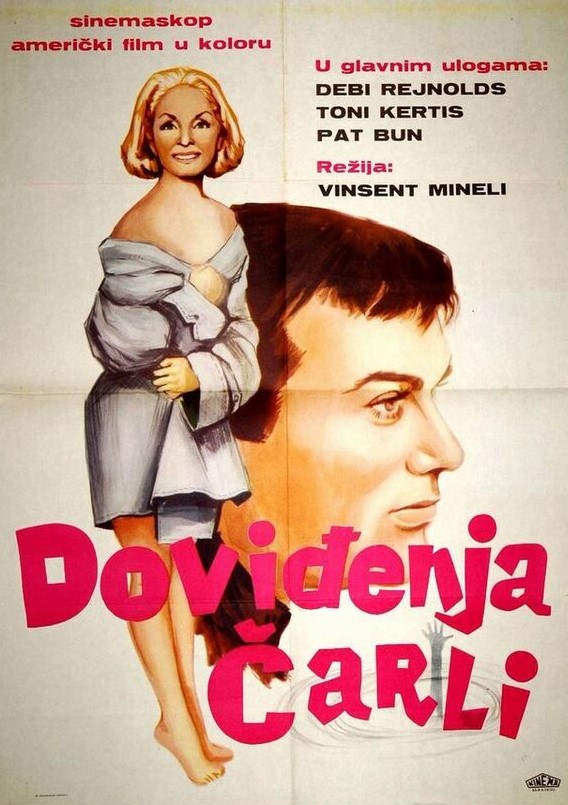
Goodbye Charlie (1964) ***

Gender switch comedies were a rarity in Hollywood at this point though of course Billy Wilder had scored big with Some Like it Hot (1959) and I’m guessing the possibility of Tony Curtis repeating his drag act was an audience lure for this one. Alas, that wasn’t to be. This goes the other way. Or several other ways. A woman playing a man who is a woman. That would be catnip these days were it a transgender thing, but it ain’t.

Confused? So sex predator Charlie (a male) drowns while escaping enraged husband Sir Leopold (Walter Matthau) only to reappear, re-born or reincarnated (as the producers decide after googling it, sorry, after they look it up in a book) as a naked woman walking along the highway, rescued by the wealthy Bruce (Pat Boone) and delivered to the nearest house, Charlie’s own pad, now occupied by old buddy George (Tony Curtis).

There’s some light comedy as George tries to safely manhandle the unknown woman, clad only in Bruce’s coat (necessitating his later return of course) and gradually the surroundings seem over-familiar to the woman and then, shazam, George works out from what she knows about him that actually she must have returned as a man, also called Charlie (Debbie Reynolds).

A cosmic joke, in other words. The man who preyed upon women returning as a woman. See how he likes it to be on the receiving end of misogyny. But, mostly, he/she lolls around with legs spread like a man, gulps down whisky and is a dab hand at cards. But that’s not where the humor lies, apparently, because the movie moves on quickly from the woman acting the man and into the man-woman discovering all the female tricks of the trade, visiting a beauty parlor and the hairdresser. Charlie discovers it’s not the same fun slapping a woman’s backside – what a revelation – if you’re a woman.

But, basically, the female Charlie decides to become a female version of the male Charlie, the predator, ripping off friends, chasing the big money, trying to seduce Bruce.  So, mostly, it’s one odd plot device after another.

But the sizzle is Debbie Reynolds, not so much the man-woman stuff, but turning into a mean Bette Davis character before your eyes, all hard-edge and shifty moves. There’s sexual tension as well, George initially resisting the woman he knows is or was a man, before finding the attraction too much, and the same going for Bruce. There’s a fair whack of sexual confusion, as the newborn Charlie still finds herself ogling women.

In those far more innocent times, it doesn’t know what it wants to say and lacks the narrative to say it. Audiences had terrific fun with Jack Lemmon and Tony Curtis in Some Like it Hot, but that narrative ploy was bang on, and Lemmon enjoying dressing up as a woman and Curtis having to keep his male instincts at bay while ogling Marilyn Monroe was pure catnip.

Here, Curtis is mostly the foil for Debbie Reynolds and by the time it looks as though they might get it together she is way past behaving like a man and is most definitely a desirable woman so it’s kind of difficult to make this work romantically or humorously.

Perhaps the oddest element is that the signs were already there that it wouldn’t work that well. It started as a Broadway play written by George Axelrod (The Seven Year Itch, which was a Broadway smash) but it barely lasted a dozen weeks on stage. By that time, though, Twentieth Century Fox had splashed out $150,000 for the rights. Still, bigger sums have been buried in the annual accounts.

And I guess when Vincente Minelli (Two Weeks in Another Town, 1962) came on board with a pretty decent cast it seemed at least doable. Like many a lightweight comedy from the decade – Dear Brigitte (1965) for example – it’s keep afloat by a terrific performance by the principal star, in this case Debbie Reynolds (Divorce American Style, 1967). You might spot Ellen Burstyn (The Exorcist, 1973) in an early role.

Take away Debbie Reynolds and it would limp along.

Anyone But You (2023) **** – Seen at the Cinema

Hey, I’m going back to Anyone but You because I went back to see it again. Blame Oppenheimer, or its lack thereof –  the reissue had been scheduled for showing on Monday but was pulled presumably because it was already on streamer and not enough customers showed up over the weekend – so I took a chance on this substitute. If you recall, I’ve already reviewed it and gave it three stars. But on re-view, I’m upping that to four stars. As is often the case on first viewing, you get snagged down by the narrative, but for second viewing, once you know which way it’s headed you can sit back and enjoy the other ingredients.

I’m not alone in thinking this has been under-rated – in the U.S., box office has gone up by over 11 per cent rather than down in the third weekend of release – and, in fact, the take has increased every weekend – indicating strong word-of-mouth.  

The rom-com has kind of faded away from the glory days of Tom Hanks-Meg Ryan / Richard Gere-Julia Roberts / Hugh Grant-A.N. Other  and if you find it at all these days it’s likely to be wrapped in an adventure or thriller. In truth it’s been on a sticky wicket for over five decades when studios preferred straight-out romance or straight-out comedy rather than a hybrid, but more importantly because, for it to work, you need stars of equal importance who can generate that extremely rare onscreen chemistry.

And not either male or female stars so big that nobody cares who plays the leading man or leading female opposite them. While movie pairings ain’t so unusual – think Tracy-Hepburn, Rock Hudson-Doris Day, Burton-Taylor, Bogart-Bacall, Clark Gable-Lana Turner – it’s worth remembering that it’s only the first two of these teamings that fitted the rom-com mold, the rest being more high octane dramas or thrillers.

Most comedies that have hit the contemporary button have been raunchy boozed-up affairs whose characters have been waylaid by self-destructive tendences, insecurity and body shaming. This one is a throwback to Hollywood gloss. Nobody’s out of work, even temporarily, nobody’s poor, nobody’s moaning about their bodies, nobody’s out of their mind on drink or drugs. The male members may have a predilection for displaying torso, ass and, er, members, and the gals are equally fit, prancing about as likely as not in bikinis or even just the bottom half.

It’s woke enough, it’s a gay wedding they’re attending, they all do yoga and are fit enough to undertake a hike into the wilderness, you can take a break (a la Friends) from a relationship and hook up with someone else, and the worst that can be said is that the older guys like an occasional joint while someone takes peppermint tea with sugar and the male lead, despite being buffed-up-to-hell, is scared of flying and swimming. But it’s a very nifty script, with a bucket of little character-defining cameo moments, the brides-to-be compete to place plates in the correct position on a table, one boyfriend too keen on booze, helicopter parents.

And you could say it is as contemporary as they come, pivoting on effectively tittle-tattle, what otherwise might be an indiscreet comment on social media that turns the world upside down is here just overheard. And it’s a pretty intelligent picture that puts the ability to have a decent fight in a marriage above peace and harmony, reality in other words over romantic fiction gibberish.

The basis of any rom-com is of course meet-cute followed by any number of reasons to keep the couple apart. Most of those ideas have been used up already, so the chances of digging up anything original is rare. What they come up with here is pretty fair, and plays on the necessity of a warring couple required to cosy up in order not to cause chaos at the wedding.

But a rom-com ain’t going to work unless the audience takes to the central couple. And my first question after seeing Glen Powell (Top Gun; Maverick, 2022) and  Sydney Sweeney (The Voyeurs, 2021) is when are they going to team up again? They’re far from cloying or schmaltzy, but believable human beings. Individually, they are stars in the making. Together, they are dynamite..

I’m not sure you’d go for the other Sydney (the one in Australia) as your ideal wedding venue unless Australia was helping you foot the movie production bill, and although interesting use is made of the harbor I’d not be keen on a river so shallow that boats can’t turn around in it (a plot point) but if you’re going to stage a Titanic homage (not the sinking I hasten to add but the King of the World malarkey) probably this is as good a place as any.

Anyway, the story focuses on the disgruntled participants of a one-night stand forced to pair up at a wedding where they encounter an abundance of exes and various interfering family members. While skipping the raw rudeness of its immediate predecessors, there are still a couple of slapstick moments centering on the discarding of items of clothing, but mostly the narrative follows the dictat of the will-they-won’t-they scenario, cleverly finding ways to  keep them apart just when they look set.

Apart from Powell and Sweeney, worth looking out for Hadley Robinson (The Boys in the Boat, 2023), Alexandra Shipp (Barbie, 2023), MTA Charlee Fraser in her movie debut, and old-timers Dermot Mulroney (My Best Friend’s Wedding, 1997), Rachel Griffiths (Muriel’s Wedding, 1994) and Bryan Brown (Cocktail, 1988). Directed by Will Gluck (Friends with Benefits, 2011) from a script by himself and Ilona Wolpert (High School Musical: The Musical, 2021-2023) but pretty much drawn from Shakespeare’s Much Ado about Nothing.

Has charm in abundance, and the script has plenty of bite especially when the couple are trading bitter remarks.

An updated version of the old-fashioned enjoyable rom-com.

Dear Brigitte (1965) ***

In the same year as his momentous turn in Shenandoah, James Stewart at his exasperating best has the time of his life in this throwback comedy that takes its time getting all its ducks in a row while taking a tilt at nuclear energy, computers and the eternal battle between the arts and science with a fair chunk of whimsy thrown in.

Surprisingly contemporary nod to this whole business of actors speaking directly to the camera, with the ramblings by the Captain (Ed Wynn) in this capacity constantly being interrupted by passersby in the vein of “you talking to me?” or “stop talking to yourself.” Professor Leaf (James Stewart), a distinguished poet constantly at odds with Dean Sawyer (Howard Freeman) at the local college where he teaches – on the few times when he’s not handing in his resignation – and which has a nuclear power station next door, tries to espouse the arts at every opportunity, including a family four-piece outfit playing classical music, only to discover son Erasmus (Bill Mummy) doesn’t have an artistic bone in his body.

Surprisingy, in the UK down-graded to supporting feature in this kid-centric double bill. The marketing men pulled another fast one in the poster, leading audiences to believe that was BB in the bikini when it was only the usually-nude model of an artist neighbour attempting to be decent.

What Erasmus has, for some reason only now coming to the fore although he must be about ten or so, is that he’s a mathematical prodigy, able to work out complicated sums faster than a computer and pointing out errors in the calculations of the local bank. Leaf’s wife Vina (Glynis johns) doesn’t have a great deal to do except rein in the professor but she has a wonderful scene where she brings the local bank manager to book.

Anyway, eventually, Erasmus gets hooked into helping the boyfriend Kenneth (pop singer Fabian) of Leaf’s daughter Pandora (Cindy Carol) guess the winners of horse races as a way of assisting the couple in raising enough money to get married. By this time, Leaf has finally resigned and worked out he won’t pick up easy cash from the Government – another terrific scene – and is hoodwinked by con artist Peregrine Upjohn (John Williams) into setting up a charity to help disadvantaged students by employing his son’s skills.

Anyone familiar with horse racing will be aware how preposterous the conceit that anyone, no matter how scientifically skilled at working out the odds, can consistently pick winners. But this all flies by since it’s that kind of movie, one that not only defies belief, but basically sucks you into believing the whole thing, the way the untalented youngsters always managed in Hollywood times gone by to muster a great stage show or turned any kind of loser into a winner.

Still, all this goes on before we get close to the nub of the title. Erasmus has fallen in love with Brigitte Bardot and because he’s basically the family’s sole breadwinner eventually dad takes son to France to meet the real-life superstar who is far more charming than you would expect, the sexpot on hold for the occasion.

So, mostly, as I said, it’s an old-fashioned confection, the kind you could still get away with in the mid-1960s before the changing times demanded that comedies take on a harder edge. And with James Stewart in top form and husky-voiced English star Glynis Johns (who had her own television series in the U.S.) jumping in now and then to prevent him from making things worse it works a treat. Stewart exaggerates all those mannerism you might have thought mildly irritating before – he’s all limbs and sentences cut off in their prime and telling people to leave their own houses. But if he had toned any of that down, the air would have quickly escaped the balloon, for really he’s the only thing keeping it afloat.

But that’s stardom for you. A vehicle comes along that in total isn’t really worthy of the involvement of a marquee attraction like Stewart, who could be lending his talents to more solid fare like Shenandoah and The Flight of the Phoenix (also released the same year). While he’s crucial to both those other pictures, giving one of his best performances in the former, perhaps surprisingly, U.S. audiences, voting with their dollars, felt his performance here trumped that of the Aldrich picture.

Ir’s usually believable roles that attract the greatest critical plaudits for stars, but actually their most notable contribution is in making fly movies that should never work on paper but somehow with their magical injection not necessarily makes the screen sizzle but turns doughy material into something lighter and more easily digestible.

Henry Koster (Mr Hobbs Takes a Vacation, 1962) directs with occasional flair from a screenplay by Hal Kanter (Move Over, Darling , 1963) and Nunnally Johnson (The Dirty Dozen, 1967) based on the bestseller by John Haase.

As under-rated as The Trouble with Angels (1966) as lightweight comedies of the decade generally were, this is worth a look for Stewart alone.  

https://amzn.to/3RiMcjX

The Trouble with Angels (1966) ****

Shocking Fact No 1: director Ida Lupino was the only female director working in Hollywood at this time. And she hadn’t worked in features for over a decade. Her previous picture, The Bigamist (1953), was her fifth. And while she had continued to find work in television, the movie business shunned her. What was perhaps more shocking, as I pointed out in my book When Women Ruled Hollywood, was that in the period 1910-1919 more women worked as directors in Hollywood than at any time since and that it was a woman, Alice Guy, rather than Melies, who actually made the first narrative movie. Worst of all, despite being a major box office hit, this was Lupino’s last picture.

Shocking Fact No 2: this didn’t turn Hayley Mills into a major adult star. Oh yes, she made the transition – and how – in The Family Way later that year, a British romantic drama that saw her shed her clothes. Big hit in Britain, not so well-received in the USA. Her career then took an odd turn, into thrillers like Twisted Nerve (1968) and Endless Night (1972).

Not exactly demure. Marching band outfit takes the grey out of the convent uniform.

I say an odd turn because if there was any better demonstration that the actress had properly developed her comedy chops I’d yet to see it. Sure, Disney had used her in comedy, but that was mostly routine stuff. Here, she revealed an emotional maturity lacking in her previous work and, to some extent, in her future movies.

And, in part, because Lupino keeps her away from big dramatic moments, relying entirely on her facial expression to reveal character development. I am surprised that, at this point, with Doris Day’s box office allure dimming, that nobody saw Mills as her natural successor. She had the same puckish demeanor and she deftly handled comedy. Give her a few years and she would have been a natural for such polished items as Barefoot in the Park. You get the feeling there was more natural ability that was left untapped.

Anyway, on with the show.

This is just a delight. It shouldn’t work at all, certainly not for a modern audience accustomed to sharply-honed laugh lines. But it’s so cleverly constructed, in covering a three-year period, it could easily have been a string of loosely-connected episodes rather than a picture with an underlying narrative that mostly takes place beneath the surface.

Orphan Mary (Hayley Mills) has been dumped by rich playboy uncle (Kent George) in a  convent boarding school that looks more like a medieval fortress than anything else. She teams up with the equally unhappy Rachel (June Harding), whose parents are at least indulgent, and together they torment the life out of the nuns and other kids, pouring detergent into tea-pots, setting off fire alarms, charging their schoolmates for an illicit guided tour of the convent, developing their smoking habits, breaking everything in sight. One scheme goes so badly awry the nuns have to take shears to a face mask.

Throughout all of this, she comes up against a tough Mother Superior (Rosalind Russell) who comes across like Miss Jean Brodie, minus her dangerously progressive side, but ever ready with a quip, able to tackle any emergency, though Mary drives her to distraction. While set in her ways, the nun does sail close to the wind, kitting out the girls in red cheerleader outfits in order to give them an unfair advantage in a marching band competition.

Any other director would have made the marching band competition the climax of the movie. I was fully expecting it to take up the final third, as pupils with little musical ability work hard and discover they can improve enough to win the competition and in so doing find out some platitudes about themselves. Instead, every episode is kept short and sweet, often the pay-off delivered in unexpected manner, for example, that we discover the girls have won when Mother Superior takes the opportunity to gloat over her rival headmaster (Jim Hutton). Or a section where teenage girls sent to buy their first bra go wild trying on all sorts of outrageous outfits that in other hands could easily have been expanded is ended sharply by Mother Superior holding up the plainest item and ordering two dozen of them.

It fairly skates along. But every now and then it dramatically slows down. And for what? Pretty much nothing at all. Just Mother Superior taking a quiet moment to herself amid all the hurly burly of running a school and dealing with mischief. But gradually, in those quiet moments, she is joined, at a distance, by a staring Mary, wondering about the nun’s inner  calm.

Ida Lupino’s color palette is extraordinary. Sure, it’s nuns, so we can expect a lot of black and white. But Lupino avoids the temptation to compensate with huge swathes of color. Instead, for most of the film, the girls are decked out in grey. So when splashes of yellow or pink or red appear they are distinctive. Only as the girls grow older does more color emerge.

The wry Rosalind Russell (Gypsy, 1962) is on top form. Instead of attempting to dominate, she nips in and steals scenes with her dry delivery. She shifts from indominable to maternal and eventually engages the psychological attention of Mary in a superb scene about her own life.

In that sense Hayley Mills has her work cut out to hold her own against such an accomplished professional, which she achieves through her own delivery, but much more through facial expression. This was June Harding’s only movie. But look out for Camilla Sparv (Assignment K, 1968) in her movie debut and a cameo from Gypsy Rose Lee.   

Terrific direction for Ida Lupino – watch for example how the camera closes in on characters – from screenplay by Blanche Hanalis (Where Angels Go Trouble Follows! 1968) from the bestseller by Jane Trahey.

As old-fashioned as they come and a joy to watch.

Catch it on YouTube – the first link is rent or buy, the second one is free but punctuated by adverts.

https://www.youtube.com/watch?v=37FnvNp2EYc

The Assassination Bureau (1969) ****

A couple of decades before “high concept” was invented came this high concept picture – a killer is hired to kill himself. Ivan Dragomiloff (Oliver Reed) is the assassin in question and Sonya Winter (Diana Rigg) the journalist doing the hiring. So Ivan challenges the other members of his murderous outfit to kill him before he despatches them. The odds are about ten to one. Initially involved in shadowing Ivan, Sonya becomes drawn to his aid when it transpires there is a bigger conspiracy afoot.

Set just before World War One, the action cuts a swathe through Europe’s glamor cities – London, Paris, Vienna, Venice – while stopping off for a bit of slapstick, some decent sight gags and a nod now and then to James Bond (gadgets) and The Pink Panther (exploding sausages).

Odd a mixture as it is, mostly it works, thanks to the intuitive partnership of director Basil Dearden and producer (and sometime writer and designer) Michael Relph, previously responsible this decade for League of Gentlemen (1960), Victim (1961), Masquerade (1965) and Khartoum (1966).

Playing mustachioed media magnate Lord Bostwick, Telly Savalas (The Scalphunters, 1968)  has a decent chomp at an upper-class British action. It’s easy to forget was one of the things that marked him out was his clear diction and he always had an air about him, so this was possibly less of a stretch.

Ramping up the fun is a multi-cultural melange in supporting roles:  Frenchman Phillipe Noiret (Night of the Generals, 1967), everyone’s favourite German Curt Jurgens (Psyche ’59, 1964) playing another general, Italian Annabella Contrera (The Ambushers, 1967) and Greek George Coulouris (Arabesque, 1966) plus British stalwarts Beryl Reid (The Killing of Sister George, 1969) as a brothel madam, television’s Warren Mitchell (Till Death Do Us Part), Kenneth Griffith and Clive Revill (Fathom, 1967).

The action flits between sudden danger and elaborate set pieces. When Ivan announces his proposal to his board he promptly fells a colleague with a gavel just as that man throws a knife. Apart from folderols in a Parisian brothel, we are treated to a Viennese waltz and malarkey in Venice. There are disguises aplenty, donned by our hero and his enemies. Lighters are turned into flame throwers.

And there is a lovely sly sense of humour, an Italian countess, wanting rid of her husband, does so under the pretext of Ivan gone rogue. Oliver Reed (Hannibal Brooks, 1969) and Diana Rigg (On Her Majesty’s Secret Service, 1970), adopting her best Julie Andrews impression, are in excellent form and strike sparks off each other. Their verbal duels are a joy to watch. Basil Dearden, in his second-last picture, invested the movie with considerable panache. It takes more skill to carry off this kind of movie, as much satire and spoof as anything else, than a straightforward action or crime picture.

Relph conjured up the screenplay based on an unfinished Jack London novel published posthumously in 1963 with the assistance of crime writer Robert L. Fish.

Shouldn’t work as well as it does. Surprisingly enjoyable.

https://amzn.to/49R8RMy

Discover WordPress

A daily selection of the best content published on WordPress, collected for you by humans who love to read.

The Atavist Magazine

by Brian Hannan

WordPress.com News

The latest news on WordPress.com and the WordPress community.