Couldn’t be more excited and thought I would share my excitement with you as the idea that someone has finally written a book on The Great Escape – one of the quintessential movies of the 1960s – has filled me with delight. The book isn’t out till November 7 but I thought I’d give you all a bit of advance notice in case you wanted to buy it yourself or alert someone to the prospect of a Xmas present.
This was the film where Steve McQueen really took on the trappings of Mr Cool. The fantastic motorbike escape will forever be an action highlight. Many of the supporting cast went on to movie or television stardom including Charles Bronson (Death Wish), James Coburn (Our Man Flint), David McCallum (The Man from Uncle) and Gordon Jackson (the butler Hudson in Upstairs, Downstairs). Director John Sturges marshalled the various story strands with dexterity and delivered an iconic picture high on tension. And of course there was the fabulous theme tune by Elmer Bernstein.
Can’t wait to read what author Dana Polan makes of it all. His name might be unknown to you but he has published books on The Sopranos, Pulp Fiction and director Jane Campion.
It’s decently priced, too – University of California Press has this at £20/$24.95 as an ebook and £20/$24.95 for the paperback but I see that Amazon is offering it for less.
Scrolling down the credits for The Satan Bug (1965) you might have been surprised to discover that the film was based not on a book by Alistair MacLean but by one Ian Stuart. Yes, this turned out to be a pseudonym but you might be asking yourself why on earth did a world-famous thriller writer need to employ a pseudonym.
Pseudonyms were generally used for two reasons, and most often in genre fiction. Firstly, they were utilized by authors who were far from world-famous and needed to churn out four or five books a year to make a living. In those days only the likes of Agatha Christie or Simenon could get away with producing three or four books annually without the public getting fed up with their output. Long before the likes of the prolific Danielle Steel or James Patterson showed publishers that the public would devour anything they produced, it was considered ruinous to your career to be seen to be turning out more than one book a year.
Salvatore Lombino wrote under the pseudonyms of Ed McBain (the 87th Precinct series), Evan Hunter (The Blackboard Jungle etc), Richard Marsten, and Hunt Collins. Most famous under his own name, British author John Creasey (The Toff series) had 27 pseudonyms including J.J. Marric (the Gideon books) and Anthony Morton (The Baron series) as well as a number of different names for his westerns and romances. A famous author wanting to dip a toe into a new genre was the other common reason a pseudonym came into play, the outstanding recent example being J.K. Rowling who turned to crime under the name of Robert Galbraith.
Alistair MacLean fell into neither of these categories. An unexpected success, the Scottish schoolteacher hit the jackpot with his debut HMS Ulysses in 1955, a straightforward war novel, and two years later bestseller The Guns of Navarone which was turned into a movie. He followed up with another four thrillers in four years under his own name, the last being Fear Is the Key (1961).
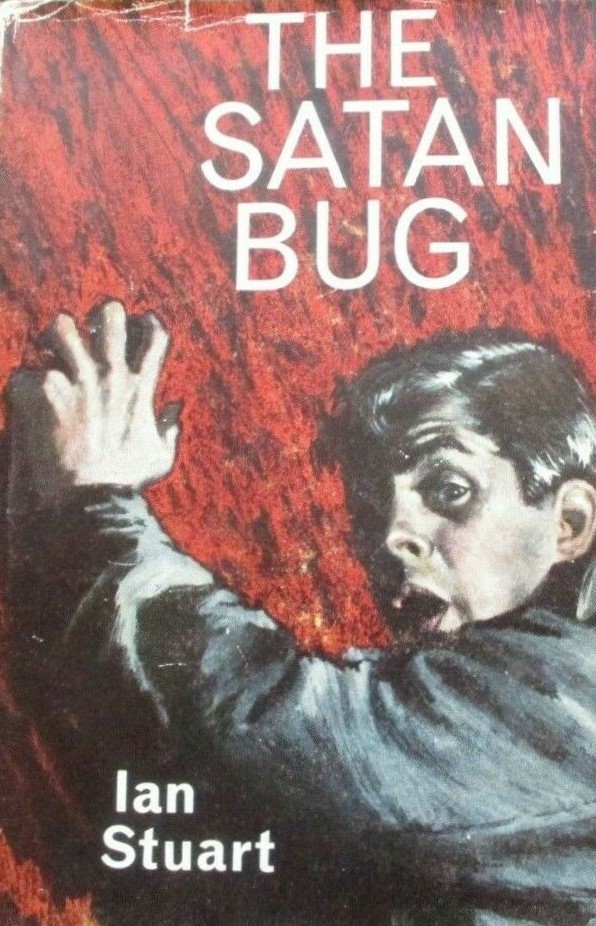
The reissued 1969 hardback while retaining the Ian Stuart name on the cover links the book to Alistair Maclean in the inside flap.
By this point, MacLean, a somewhat touchy individual, had become exceedingly annoyed at the treatment his manuscripts received at the hands of his publisher Collins. In particular, he was often taken to task by editors for making simple errors like confusing “of” with “off.” But more importantly, editors treated his books as if they should be met with a rejection slip – in fact it was strongly suggested that the author set aside his third book South by Java Head in favor of something else – rather than slung out to an adoring public. As his biographer Jack Webster put it, he felt “very much like a pupil under severe pressure from a master.” It would have been humiliating for an English teacher to be told off for his use of English. The editors also complained there were too many incidents which made the books hard to read rather than enrapturing the reader.
While no doubt every author gets picked up for momentary lapses or for elements of the story that need reconsideration, it was clear to MacLean that his publishers were taking a very snobbish attitude to his output rather than falling over themselves to have in their possession such a cash cow. MacLean also felt that his books only sold so well because his name was attached. Every book was “by the author of HMS Ulysses” or, after the fantastic success of the movie, “by the author of The Guns of Navarone.” He was beginning to feel more of a unwelcome commodity than a cherished asset. And he had already made so much money from his millions of books sales and additional revenues from film studios -£30,000 for HMS Ulysses for example – that he did not need to listen to his publishers.
In fact, matters had come to a head with Fear Is the Key (1961), his least successful book. Clearly this provided his enemies in the publishing house with the opportunity to gloat and to attempt to force him to listen to their superior wisdom and toe their line But for MacLean Fear Is the Key was an experiment, a deliberate change of writing style. “What I’m trying to do is develop a technique of completely impersonal story-telling in the first person” – in essence the reader would see action unfold as if through the eye of a camera. His publishers, who appeared to view sales as the only measure of a book’s success, felt otherwise. After one too many clashes with the Collins hierarchy, he took himself off to renowned agent Curtis Brown who welcomed him with open arms and none of the niggling that marked his dealings with the publishers. While Collins would remain his British publisher, Curtis Brown took on the task of invigorating foreign rights.
Having snared what they expected was a golden goose, you can imagine Curtis Brown’s astonishment on being told that the first book they were to sell under this new deal would not bear the name of Alistair MacLean. It would be by an unknown author – Ian Stuart. The Dark Crusader (retitled The Black Shrike for U.S. readers) was set in Australia and concerned a hunt for missing scientists. Never mind previous antipathy between author and publisher, Collins hated this book, complaining about over-complicated plot, boring characters, and improbable action. It was “a thoroughly bad book.” MacLean was incensed: “If the book is as bad as you say and you obviously lack faith in it, can you genuinely imagine that I believe you will honestly and sincerely get behind it in promotion, publishing and selling?”
Desperate to retain the author and hoping that this experiment would be short-lived, especially if sales showed a marked downturn from the MacLean books, Collins agreed to publish it. Naturally, the only way to ensure that it reached any kind of sales peak rather than vanish into the chasms of oblivion that faced most new authors, Collins gave the book “by a new author” a heavy publicity campaign. The poorer sales did not dampen MacLean’s ardour for his pseudonym and he went to produce The Satan Bug by Ian Stuart, his faith in his decision justified when a Hollywood director of the caliber of John Sturges (The Magnificent Seven, 1960), clearly seeing far greater potential in the novel than the publishers, snapped it up for production.
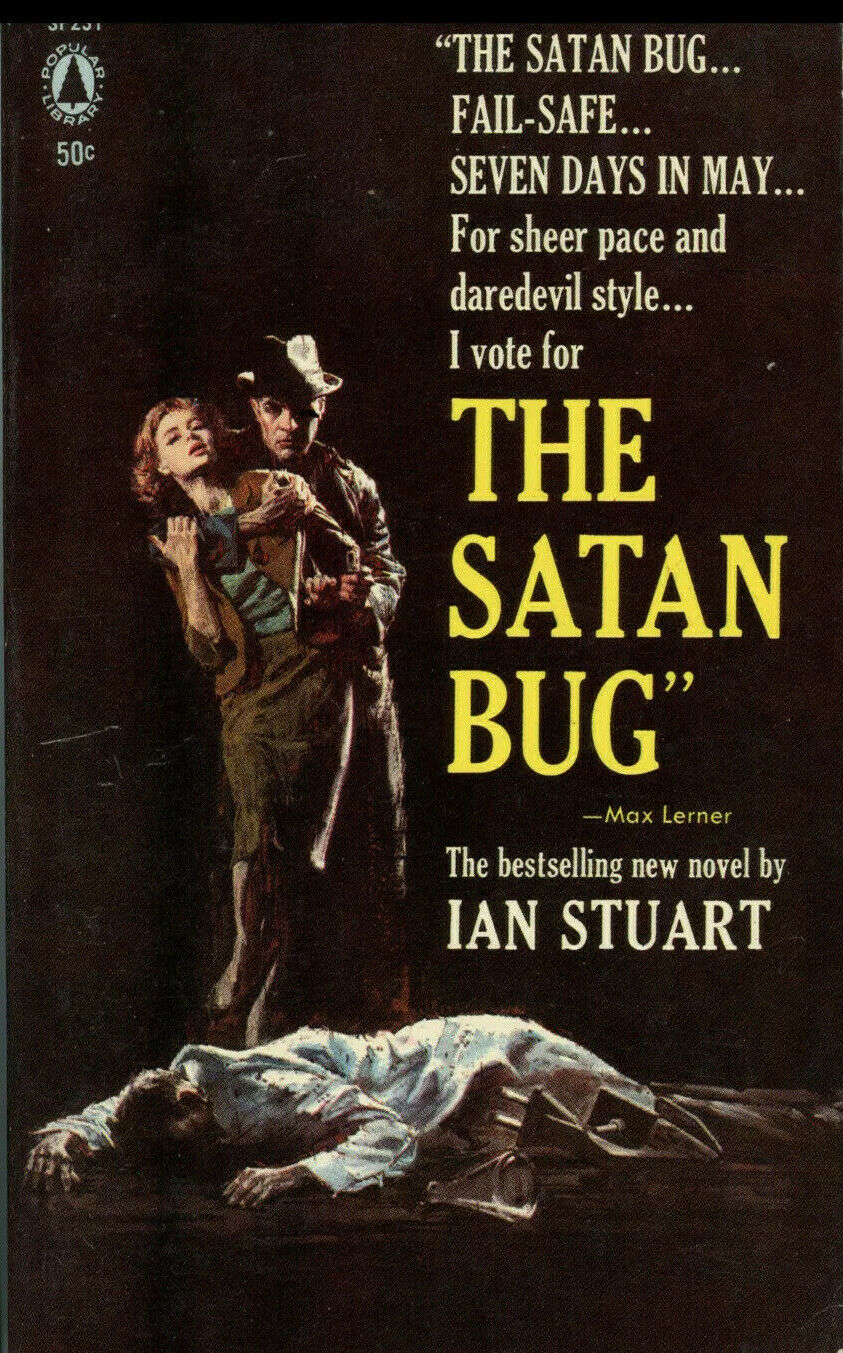
The rule breaker – the back cover of the 1962 U.S. paperback gives the game away and clearly, judging by the quote from King Features, the true author’s identity must have been in the public domain.
Myth has it that both The Dark Crusader and The Satan Bug played by the rules laid down by the author. But that did not turn out to be the case. The paperback edition of The Satan Bug published by Popular Library in 1962 on the back cover reveals the true author. In any case in due course the book was reissued under the MacLean moniker and is a far better example of the cinematic style the author was attempting to achieve than The Dark Crusader and became the template for his later books.
But, as it turned out, this was not the first time that Alistair MacLean would go on strike.
Catch Up: movies made from Alistair MacLean novels featuring in the Blog are The Guns of Navarone (1961), The Secret Ways (1961) and The Satan Bug (1965).
SOURCES: Alistair MacLean by Jack Webster (Chapmans Publishing, 1962, paperback edition), pages 73, 89-90, 94-96, 112-117.
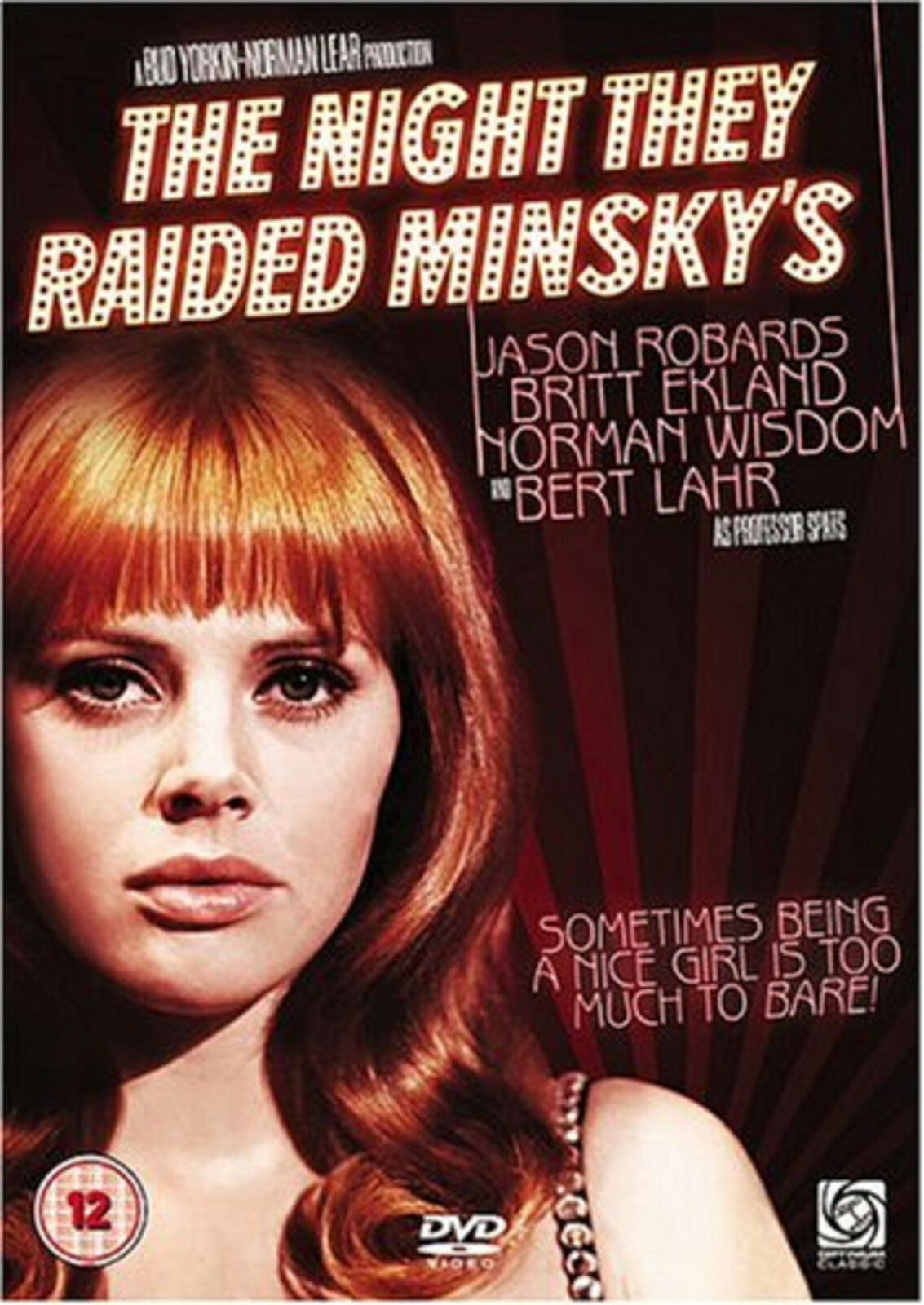
Why films are flops is sometimes more interesting than why they become hits. That’s assuming no one’s memory plays them tricks. Originally, according to Tony Curtis, he was going to produce The Night They Raided Minsky’s and at that point it was more focused on the strippers working there. “Each stripper thought she was going to end up being a star like Gypsy Rose Lee” he wrote in his autobiography. However, in the star’s memory this film was going to be made after the completion of You Can’t Win ‘Em All (1970) and Suppose They Gave a War and Nobody Came (1970) when he was a dead duck Hollywood-wise – he did not appear in another picture until Lepke in 1975. The fact that The Night They Raided Minsky’s was made in 1968, two years before You Can’t Win ‘Em All, appears to have escaped his attention or that of the book’s editors and publishers and, strangely enough, also of Michael Munn whose later biography of the actor Nobody’s Perfect equally oddly attributed his involvement in Minsky’s to after You Can’t Win ‘Em All.
Director William Friedkin has a better recollection, but, also strangely enough, nothing like as detailed as that for the film that made his name The French Connection (1971). He had met Bud Yorkin at a private screening at the house of producer David L. Wolper (The Devil’s Brigade, 1968). Yorkin and partner Norman Lear had a two-picture deal at United Artists. (In his autobiography Friedkin called United Artists “newly-formed” which was a hell of a miscalculation since that studio had been on the go since 1919 and even the modernized UA had come into being in 1951 – he was probably referring to the takeover of the studio in 1967 by Transamerica). Even though at that point Friedkin’s only picture had been the Sonny and Cher flop Good Times (1967) he was offered $100,000 to direct on the grounds that he could “bring something original and contemporary to an older subject.” He was honest enough to admit the fee probably swayed him since he found the script “thin, superficial, not funny.”
Friedkin makes no mention of Tony Curtis potentially being involved on the production side. The first actor to be approached, Curtis agreed to do the film if the script was rewritten. According to Friedkin, Curtis was “at the peak of his popularity.” That was wishful thinking. According to Variety, Curtis was one of the least successful stars in the business, his last four pictures averaging a lamentable $1.77 million in U.S. rentals. Curtis did not like the rewrite. He complained that between the two drafts, his role had “shriveled” and quit the production “due to differences in the concept of the male star role.” Or it could have been that he dropped out in favor of The Boston Strangler (1968).
For a while it seemed his departure might benefit the planned production. Two rising Broadway stars – Alan Alda and Joel Grey – showed interest. Alda was in The Apple Tree directed by wunderkind Mike Nichols and Grey was attracting fabulous notices for his performance in the stage version of Cabaret. “It was a real coup to land those guys,” purred Friedkin. But it was a coup too soon – they could not get out of their stage contracts. “Unbelievably,” commented producer Norman Lear, whose job presumably it was to read the fine print, “nobody read the fine print.”
All roads then led to Jason Robards (“my first choice anyway” according to Lear) third-billed in Yorkin and Lear’s Divorce American Style (1967). Although Norman Wisdom had primarily a British moviegoing following, he had just finished a run in the Broadway comedy Walking Happy, so he was not entirely unknown. Bert Lahr fell ill a third of the way through production and died within a week so the pivotal role he was to play, “as a kind of tour guide to burlesque…left a hole in the film’s emotional center.” To try and minimize his loss, the producers “included every frame of Lahr including test footage.”
Worse, according to the director, Robards and female lead Britt Ekland proved a mismatch and had “no chemistry as lovers.” Danny Daniels took over the staging of the burlesque routines and Friedkin came close to being fired.
At least Friedkin was honest about the film’s failings. The biggest problem, he admitted, “was my own ineptitude…I was in over my head….Each time I set up a shot or talked to an actor about a scene I was filled with uncertainty….much as I’d like to absolve myself of blame for the film, I see my handiwork all over it, especially in the documentary approach to many of the scenes.” He didn’t help matters by almost sabotaging the release when he told a late-night talk show host that the picture was “terrible” and advised viewers not to “bother to see it.”
But for all Friedkin’s later downplaying of the picture, at the time he was giving it big licks, anticipating some kind of artistic breakthrough in part through innovative use of the hand-held camera. He aimed to achieve a “Brechtian flavor of casual seediness.” It was the biggest production ever filmed in New York with a budget in the $3 million-$4 million region. Friedkin had rejected the New York streets available on Hollywood studio lots in favor of the real thing. The producers found a block on the Lower East Side scheduled for demolition that fitted exactly the art director’s exterior design and successfully campaigned Mayor Lindsay to postpone demolition until shooting was completed. Friedkin confidently boasted to Variety that the Lower East Side so closely resembled what it was like half a century before that “all you have to do is rip out the parking meters and conceal the air conditioning” and line the streets with vintage cars.
Cameraman Andrew Laszlo had developed a special camera that permitted much steadier handheld photography than before which would facilitate “Friedkin’s improvisational directorial style.” Friedkin called it “the most expensive movie ever made with a hand-held camera.”
The picture finished shooting at the end of 1967 but that it did not appear in theaters until the tail end of the following year indicated the problems facing the producers. You might think Xmas an odd time to launch a movie about what was effectively a tawdry subject no matter how affectionately filmed. In a bid to shine a light on the more successful aspects of burlesque, United Artists publicists gave a major push to Dexter Maitland, a 40-year veteran of the business who had a small part in the picture.
SOURCES: Tony Curtis with Peter Golenbock, American Prince: My Autobiography (Virgin Books – paperback, 2009) p279 ; Michael Munn, Tony Curtis, Nobody’s Perfect (JR Books, 2011) p214; William Friedkin, The Friedkin Connection, A Memoir (Harper Perennial, 2014) p115-120; Lee Beaupre, “Rising Skepticism on Stars,” Variety, May 15, 1968, p1; “Tony Curtis, Britt Ekland To Co-Star in Minsky’s,” Box Office, June 26, 1967, p12; “A Minsky Burlecue Theme Needs N.Y.,” Variety, August 2, 1967, 18; “Tony Curtis Withdraws from Minsky’s Pic,” Box Office, August 7, 1967, pW-2; “Wreckers Refrain,” Variety, September 27, 1967, p28; Lee Beaupre, “Costliest Ever on Hand Held Camera; UA’s Calculated Risks As To Minsky’s,” Variety, December 6, 1967, 3; “Norman Lear Digs ABC,” Variety, December 4, 1968, p22); “Dexter Maitland Is Alive and Real,” Variety, December 11, 1968, 4.
William Friedkin’s autobiography pictured below is immensely informative of the director’s somewhat controversial career.
Behind-the-scenes books generally benefit from as much scandal as possible. Using that criteria, Dolls! Dolls! Dolls! by Stephen Rebello leaps to the top of the list. Rebello had been primarily responsible for turning Valley of the Dolls (1968) into a camp classic by hosting repeated showings of the picture from the 1990s onwards and making it number one in his book Bad Movies We Love.
The novel Valley of the Dolls by Jacqueline Susann was a record-breaking bestseller on the “sex/sin/salvation literary rodeo” but nothing that came out of the fevered imagination of Harold Robbins could match the Susann book, an insider’s look at the murky goings-on in Hollywood with drug abuse at the top of the heap. Unfortunately for Susann, Twentieth Century Fox struck a deal for the film rights pre-publication, long before it became a sensation, so she earned only $85,000 upfront, a quarter of what was paid for Peyton Place which sold far fewer copies. Mark Robson who had brought Peyton Place to the big screen was hired as director.
Stars clamoring for roles included Natalie Wood, Bette Davis, Debbie Reynolds and Kim Novak. The list of those who turned it down was longer: Lee Remick, Jane Fonda, Julie Christie, Raquel Welch, Candice Bergen. Christopher Plummer and James Garner were screen-tested. Sharon Tate, Barbara Parkins, Judy Garland and Patty Duke won the main roles.
Movies had done away with the “any similarity” disclaimer but it was upfront in all ads for the film as well as in the pre-credits on the film, whether as a publicity ploy or to head off potential legal action is unknown.
The screenwriters were as appalled at the material as the censor. But that was just the beginning of strife central. The personal enmity between Duke and Parkins rivalled that of Bette Davis and Joan Crawford. Screaming matches and hissy fits abounded. Duke suffered from drug and alcohol abuse, mood swings and nervous skin conditions and constantly clashed with the director. Plus, despite cutting some singles and albums, she had to mime. Tate was forced into take after take for the normally economic director. The three young stars, believing this was a career-making picture, took no prisoners. Robson used a stopwatch when filming, as if he was already editing the film in his head, pushing the actresses to speak the lines faster, or undertake actions exactly on a time cue, a humiliating procedure in one scene for Tate. She refused to cry in case it messed up her make-up, which would cause further delay and further infuriate Robson. Tate was also embarrassed by publicity photos taken during her pornographic scene.
Garland was in no fit state to make a movie. She was drinking wine by the bucketload, dropping pills, slurring her lines, missing her cues and turning up late for work. Finally, it got too much and she was fired. Fans bombarded the studio with irate messages. Ginger Rogers rejected the role on account of the language. Robson put in a personal phone call to Susan Hayward, who had quit Hollywood, and turned down several comeback roles including Mrs Robinson in The Graduate. When Hayward was finally persuaded for a hefty fee, the producers had to shred Garland’ s costumes. They were different sizes. Hayward’s wardrobe was redesigned from scratch. The last straw on the troubled production was producer David Wiesbart dropping dead. That wasn’t quite the last straw. Critics trashed the picture. Luckily, audiences didn’t and lined up in droves.
This is the second volume of The Gladiators vs Spartacus opus, published separately to the tome I reviewed on February 24, 2021. Reading Abraham Polonsky’s screenplay is like having a piece of history in your hands. And it is a fascinating read. Polonsky’s take on the Spartacus legend was quite different to that of Dalton Trumbo for Stanley Kubrick’s 1960 Spartacus. Based on works presenting alternative visions, Polonsky’s on the book by Arthur Koestler and Trumbo’s on the Howard Fast novel, suggested there would be differences.
The most initial significant departure is that Polonsky gives considerably less emphasis to Roman politics. It’s a classic three-act film, the first section revolt and escape, part two battle against pursuing Romans, the final segment betrayal and defeat. Rather than viewing the uprising as a glorious event, Polonsky concentrates (as does Koestler) on conflict among the escapees. Where the relationship between Kirk Douglas and Jean Simmons follows a pure Hollywood arc, the female lead here, Lydia, is a more unusual character and for most of the time Spartacus fends her off.
Top pic: Variety, June 24, 1959, p44; above Variety, February 12, 1958, p3. Ira Wolfert was a “front” for the blacklisted Polonsky.
And the revolt kicks in right away. Within 25 minutes (allowing one minute of screen time for every screenplay page), Spartacus spares the life of rival gladiator Crixus and together with their compatriots they rise up against their oppressors and escape to Vesuvius. Immediately, the differences between Spartacus and Crixus become apparent, the former wanting to press on, while Crixus wants to stop at an inn (“half-brothel, half resting place”), eat his fill, get drunk and have sex. To Spartacus, self-indulgence risks turning the men into a drunken horde, but to others (as expressed by the poet Fulvius) “this is freedom…the first thing a man wants back is his vices.”
But unexpected freedom brings a rebellion “without leaders, without plans, without hope” and the gladiators have attracted a rag-tag of other slaves. Crixus wants to discard these camp followers, head south, steal a ship and get home. Addressing the horde, Spartacus is brutal in his assessment, “I see a host of dead men” unless they submit to his authority and “swear by the gods never to surrender.” Crixus refuses and leads his Gauls away. With the Roman legions in pursuit, and blocking the one path up the mountain, Spartacus begins to train his horde. In a brilliant scene, the slave army, “faces and bodies blackened with charcoal,” descend on vine ropes on the outside of the crater in the darkness to surprise the Roman encampment.
When Crixus returns, he sees not a rabble but a proper army, Spartacus the undisputed commander. Spartacus plans to build a Sun City in alliance with the “old Greek cities conquered by Rome.” But such coalitions require compromise, forcing Spartacus to return to the Greeks slaves who have run away to join his army. “Every road has its detours,” says Spartacus. Naturally, his decision causes dissension, especially from Crixus. In order to win, Spartacus is willing to become a tyrant. (“It’s survival. It’s a detour. It’s a way around what we can’t go through.”)
Divisions within the army lead to a showdown. Crixus and Spartacus fight, at one point Crixus sparing his opponent’s life, to repay the debt from their skirmish in the arena, and, reprieved, Spartacus kills him. But, eventually, Rome exerts its power, the slaves are betrayed, Spartacus refusing an opportunity to save himself, and in the final battle overwhelmed by superior forces, resulting in “eight thousand slaves on eight thousand crosses, all the way from Capua to Rome.” The screenplay ends in mythical fashion (i.e. true Hollywood). Spartacus’s body cannot be found. “They say the ground opened beneath him and swallowed him up. And some say he’ll be back.” The final scene is of Spartacus’s infant son in the desert of Qumrum “empty, formidable, immense, the barrenness everywhere and yet here the spirit and first sign of modern man.”
Polonsky’s epic (two hours forty minutes by page count) is driven by conflict, not just against the pursuing Romans, but by different attitudes within the slave army as to the best way to achieve – and enjoy – freedom. The Crixus approach would be to loot every city. Spartacus adopts a policy of the end justifying the means. These “detours” were crucial to Koestler’s assessment of the true cost of revolution (taking the Russian revolution as his starting point). This is not a story of an impotent leader, driven to destruction by more powerful forces, but one where an individual, taking up the mantle of leadership, must make cruel decisions. This is the battle commander as politician. He faces a chorus of dissent from his own chief supporters – the poet Fulvius, the priest and scribe John, and his “wife” Lydia – who challenge his rulings, each with their own idea of how the revolt should fulfill its destiny. Spartacus himself is under little illusion, resisting attempts at deification, far more realistic than your standard Hollywood revolutionary. He does not believe in the gods or destiny and, ultimately, considers the revolt has little chance of success.
Polonsky, too, ignores the rules of the Hollywood romance. There is no meet-cute, Spartacus distrusts the willful and obsessive Lydia, possessor of mysterious powers, and, unlike the Hollywood standard attraction of opposites, there is no happy reconciliation. “I would never pick a wife who wanted to rule all men, the gods, and the world,” he tells her, “I would never choose a superstitious woman like you, with a tongue like a snake.” As for many a slave, the only freedom he enjoys, beyond a brief period unshackled, is the freedom not to die in servitude. From reading the screenplay, this is very much a movie I would have liked to see take its place on the big screen as an intelligent and challenging epic.
However, the actual screenplay only forms part of this 500-page-plus volume. Dr Fiona Radford provides extensive annotations and a critical commentary to the screenplay, drawing on both historical and literary sources and on Koestler’s book and Polonsky’s own notes. The commentary is worth reading in itself. Also included are draft scenes omitted from the revised script, lengthy excerpts from Polonsky’s Journal (which touches upon the screenplay and the blacklist) plus a survey of Roman gladiators in fiction and film from 1822 (Susanna Moodie’s Spartacus: A Roman Story) to 2020 and an examination of how Polonsky’s screenplay drew upon the source material, what he left out and what he invented. Henry Macadam and Duncan Cooper contributed the background essays. The combined volumes of The Gladiators vs Spartacus come to around 1,000 pages and a thousand more informative and highly readable pages would be hard to find. Dr Radford, by the way, along with Dr Peta Greenfield, runs a fascinating podcast-driven website “The Partial Historians” focusing on ancient Rome.
Note: I have not previously awarded marks to book reviews, in part since some are mine, modesty forbids, but if I ever there was a case for a five-star review, both these volumes fall into that category.
As with volume 1, The Gladiators vs. Spartacus Vol 2 is published by Cambridge Scholars Publishing.
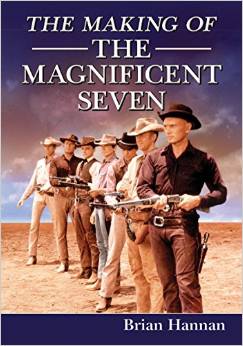
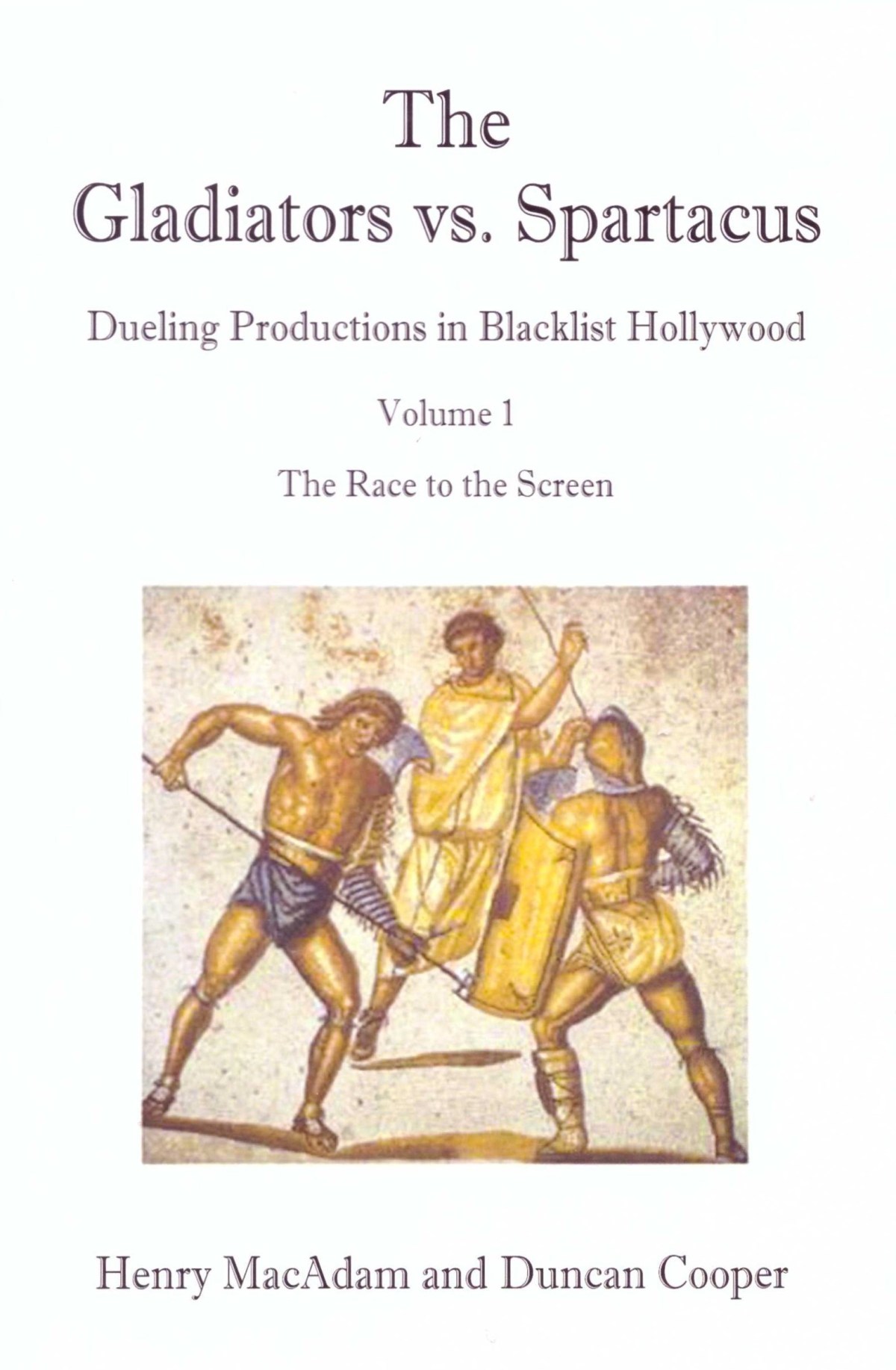
When I wrote my book some years back on the making of The Magnificent Seven (1960) I was aware that Yul Brynner had attempted to set up a project called The Gladiators in direct opposition to rival Kirk Douglas venture Spartacus. What I didn’t know until I came across this fascinating new book, telling the untold story of The Gladiators vs. Spartacus, Dueling Productions in Blacklist Hollywood by Henry MacAdam and Duncan Cooper, was just how close Brynner came to derailing the Douglas production. Indeed, at first it appeared Brynner’s The Gladiators, based on the novel by Arthur Koestler (Darkness at Noon, The Ghost in the Machine), was a cinch to be first past the post. After winning the Best Actor Oscar for The King and I (1956) and starring in box office behemoth The Ten Commandments (1956), Brynner was set to become a movie mogul after being handed a record $25 million – $230 million at today’s prices – from United Artists for 11 pictures. His first project was The Gladiators on a $5.5 million budget, Meanwhile, Douglas, rejected for the title role in the forthcoming Ben-Hur, his picture Paths of Glory (1957) producing dismal returns, struggled to find funding for Spartacus, based on the book by Howard Fast.
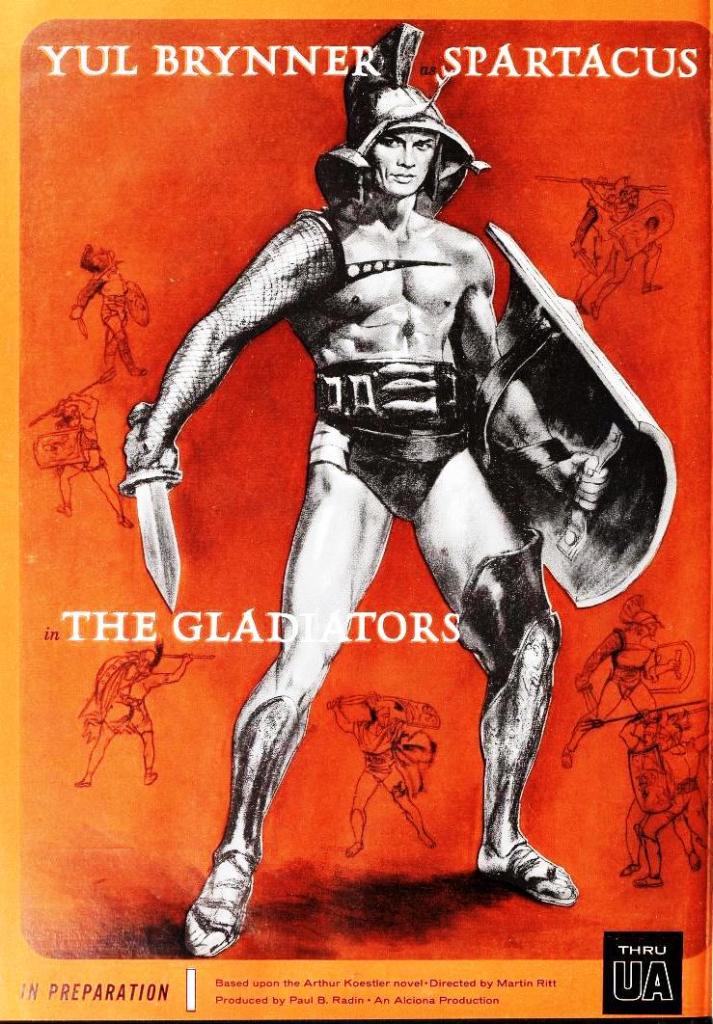
Promotional ad in 1958 for Yul Brynner as Spartacus in ‘The Gladiators.’
There are instances of two studios embarking on similar projects at the same time – sci fi adventures Deep Impact and Armageddon appeared within months of each in 1998 but Warner Bros and Twentieth Century Fox decided to combine competing movies about a skyscraper on fire into The Towering Inferno (1974). Here, as much as efforts were made to combine the projects both actors were determined to continue the battle despite the potential competition. At another point, Brynner sought to recruit Douglas for The Magnificent Seven. The race to the screen went back and forth for a couple of years, Brynner unable to choose between the historical drama and the western, while Douglas had the luck to have as his agent Lew Wassermann, in the process of buying up Universal who determined that Spartacus would be the ideal prestige vehicle to relaunch the studio.
What gives this volume special significance is that the films were being produced against the backdrop of the blacklist, the anti-Communist hysteria stirred by HUAC in the late 1940s/early 1950s. Screenplays for both films were the work of blacklisted writers, Abraham Polonsky on the Brynner side and Dalton Trumbo for Douglas. Polonsky was writer-director of Force of Evil (1948) as well as writer of another quintessential film noir Body and Soul (1947), for which he was Oscar-nominated, before his career was prematurely interrupted. Trumbo was held in even greater esteem, Oscar-nominated for Kitty Foyle (1941), and with A Guy Named Joe (1943) under his belt. While blacklisted, both wrote under “fronts”, Trumbo responsible for the Oscar-winning screenplays for Roman Holiday (1953) and The Brave One (1956), Polonsky successfully switching for a time to television. Both productions proceeded with the need to keep secret the real screenwriters, Ira Wolfert fronting for Polonsky, author Howard Fast unknowingly doing the same for Trumbo.
The parallel tales of two ambitious producers dueling for supremacy and of two blacklisted writers fighting for survival make a thrilling read. At any moment, either production could be killed by revelations about the screenwriters, while the planned films faced a succession of what seemed sometimes insurmountable obstacles. Both movies pursued, for example, the same three stars – Laurence Olivier, Charles Laughton and Peter Ustinov. Martin Ritt, initial director for The Gladiators, dropped out while Anthony Mann, in the same position for Spartacus, was fired. Script problems dogged both pictures. Rivalry was conducted openly in the trade press while the productions clashed over the title. Even when Spartacus nudged ahead in the production process, the spiraling budget almost put paid to the endeavor, while The Gladiators hovered in the background, intent on capitalizing should, as appeared for a long time the most likely outcome, the Douglas film flop at the box office.
The third riveting element of this book is a scoop. The authors have located the original Polonsky screenplay for The Gladiators, believed lost for over 60 years, and so are able to contrast the different approaches to the subject of the Spartacus revolution. (In a separate volume, the entire screenplay has been published with annotations and critical commentary by Fiona Radford and background essays by MacAdam and Cooper). Koestler was a cult figure, far better known than Howard Fast, and has remained in the literary consciousness ever since his suicide in 1983. With The Gladiators failing to reach the screen, Polonsky remained under the Hollywood radar for several years before his career revived with the screenplay for Madigan (1968) and as writer-director of modern western Tell Them Willie Boy Is Here (1969) starring Robert Redford. The revelation that Trumbo had written Otto Preminger’s Exodus (1960) and the involvement of Polonsky in The Gladiators helped break the blacklist. Trumbo went on to enjoy a successful official comeback, biopic Trumbo (2105) depicting the tribulations he suffered as a blacklistee.
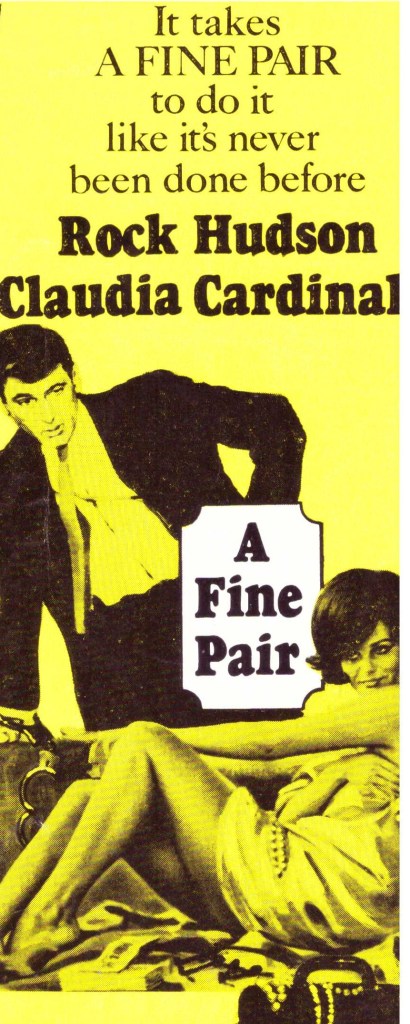
Essentially an Italian take on the slick glossy American thriller in the vein of Charade (1963), Arabesque (1966) and of course Blindfold (1966) which previously brought together Rock Hudson and Claudia Cardinale. Produced by Cardinale’s husband Franco Cristaldi, directed and co-written by Francesco Maselli (Time of Indifference, 1966), it is a cute variation on the heist picture.
Fans accustomed to seeing the more sultry side of the Italian actress (as in The Professionals, 1966) might appreciate how effective she is in more playful mood apart from one scene where she strips down to bra and pants. The other major difference is that in her American-made films, Cardinale is usually the female lead, that is, not the one driving the story, but here she provides the narrative thrust virtually right up until the end.
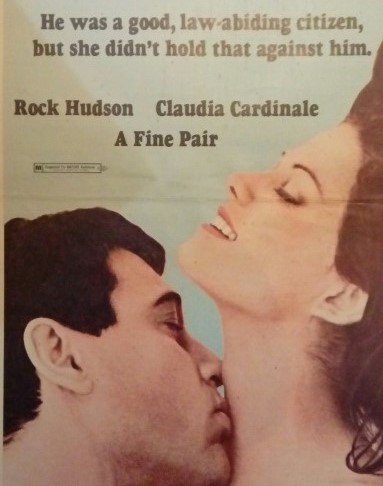
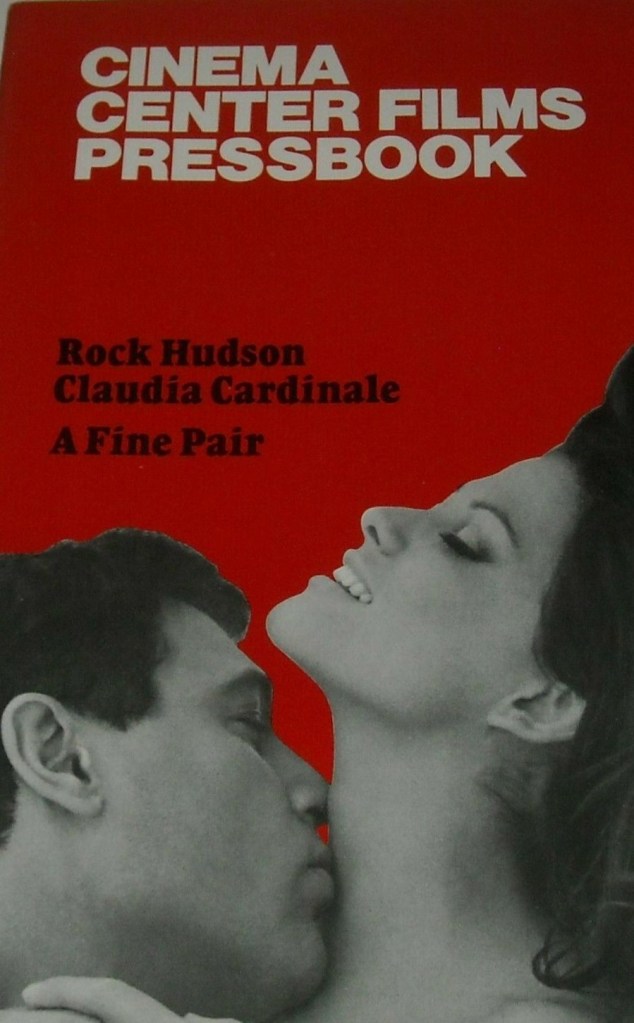
The American marketing campaign focused on the romantic element.
The British marketing campaign (top) took a different slant, not surprising since the film flopped in America. Even in Britain, however, it went out on the lower part of a double bill.
The twist here (as in Pirates of the Caribbean nearly four decades later) is that the bad guy (in this case bad girl) wants to return stolen treasure. Cardinale arrives in New York to seek help from old family friend Rock Hudson, a stuffy married American cop, so rigid he even uses a timer to regulate cigarette consumption. She has come into jewels stolen by an internationally-famous thief and wishes to return them to a villa in the Alps before the vacationing owners discover the theft. The bait for Hudson is to try and apprehend said thief.
The audience will have guessed the twist, that she is not breaking in to return jewels, but once Hudson, though his police connections has been shown the alarm systems, to deposit fakes and steal the real thing. So Hudson has to work out an ingenious method of beating three alarm systems, one of which is heat-sensitive, the whole place is “one big safe.”
Most of the fun comes from the banter between the principals and the is-she-telling-truth element essential to these pictures. “I lied – and that’s the truth,” spouts Cardinale at one point. I disagree with a common complaint of a lack of chemistry between Hudson and Cardinale. What the film lacks is not enough going wrong to lighten up such a hidebound male character such as occurred in Man’s Favorite Sport (1962), which makes the audience warm to the otherwise upright Hudson, or as seen in Gambit (1966) where Michael Caine played a similar stand-offish character. Cardinale is terrific in a Shirley Maclaine-type role, as the playful foil to the uptight cop, and who, like Maclaine in Gambit, knows far more than she is letting on.
What does let the film down is that it is at cross-cultural cross-purposes. As mentioned, this is an Italian film with Italian production values. The color is murky, way too many important scenes take place outside. Italians filmmakers of this generation never bothered with sound engineers for exteriors, simply dubbing and lip-synching back in the studio. More importantly, the actual heist lacks sufficient detail, and post-heist, although there are few more twists, the film takes too long to reach a conclusion. But for the first two-thirds it is a perfectly acceptable addition to the heist canon, the script has some very funny lines, Cardinale is light, charming and sexy.
The American title of this film was Steal from Your Neighbor, which is weak. A Fine Pair while colloquial enough in America has, however, an unfortunate meaning of the double-entendre kind in Britain.
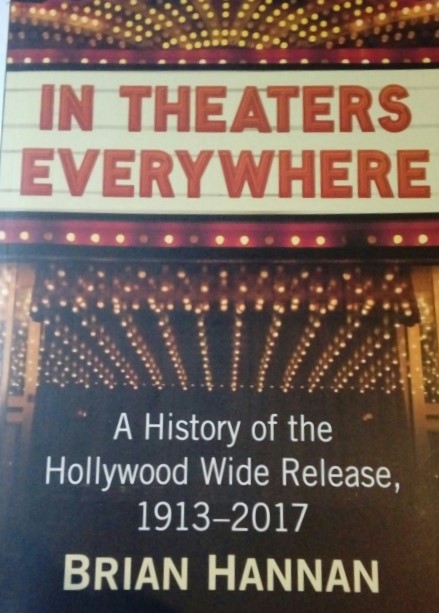
Lack of films being released – these days due to the pandemic – is not new. “A Fine Pair” was made during a time of chronic low production. But there was a sickening irony to the story of this film’s production. It was financed by the short-lived Cinema Center owned by the American television network CBS. When television was in its infancy, American studios had been barred by the Government from becoming involved in the new media. CBS got into movie production after studios had suffered from another governmental policy reversal. In 1948 the Paramount Decree prohibited studios from owning cinemas, a move which led to the end of the studio system and decimated production. The most sacrosanct rule of American film regulations was that studios could not own movie houses. Everyone assumed that applied the other way until in the early 1960s cinema chain National General challenged the ruling. By this point, production was so low that exhibitors were crying out for new product so the Government relented, much to the fury of the studios. That opened the door for television networks like CBS and later ABC (“Charly,” 1968) to enter movie production. I found all this out while writing my book “In Theaters Everywhere: A History of the Hollywood Wide Release 1913-2017.” And now, of course, studios have re-entered the exhibition market as have, once again, television companies.
Rather than write about the best films I have seen this year, I thought I would look at the four best books about films that I have read over the last twelve months. However, I’m beginning with an older book. I was so taken with Kirsten Stewart’s portrayal of actress Jean Seberg in the biopic Seberg (2019) that I sought out Garry McGee’s Jean Seberg – Breathless, Her True Story first published in 2007 and reprinted in 2018 in time for the movie.
The film concentrates on Seberg’s mental disintegration as she discovers she is on J. Edgar Hoover’s hit list. But the biography has a far wider remit.
This is a startling and ultimately a very sad book of the star as an American tragedy who shot to the heights in her first film and spent the rest of her life with a couple of exceptions falling earthwards. She took her own life, aged 40, in 1979. She was seen as both calculating and a victim, a woman of great strength and immense vulnerability, who used her popularity to espouse unpopular causes.
Her career followed no pattern anyone could understand, least of all Hollywood. Thrust into the limelight as a teenager when hand-picked as Saint Joan (1957) by director Otto Preminger – an experience that scarred her physically and mentally – she quickly shifted to France where she was enshrined in Jean-Luc Godard’s New Wave masterpiece Breathless (1960), but remained in France too long appearing in less prestigious productions. She was a vivid Lilith (1964) in Robert Rossen’s dissection of mental illness, but disappeared off the Hollywood map again until reappearing at the end of the decade in roadshow musical Paint Your Wagon (1969) – in which she stole the show from Lee Marvin and Clint Eastwood. After blockbuster Airport (1970) and western Macho Callahan (1970) she departed Hollywood for good, her final films being made in Europe.
Why her career was so apparently topsy-turvy is explored in this excellent biography, the final departure from America propelled by the discovery that she was under investigation by the FBI.
Chinatown (1973) is one of the greatest noir thrillers ever made but with its director Roman Polanski now persona non grata in Hollywood, it remains to be seen whether the film will retain its high status. Sam Wasson’s The Big Goodbye, Chinatown and the Last Years of Hollywood leaves any discussion of the director’s sexual mores until the last chapters when the shock of the allegations against him threaten to overwhelm the entire book. That said, up till then, it is a riveting book, not just the convoluted process of making this particular movie, but especially fascinating when discussing the screenplay, the working methods of writer Robert Towne, and the tangled dealings with agents.
After The Godfather (1972), Paramount was on a high and studio boss and wunderkind Robert Evans was apparently untouchable – the studio had given him his own production company – but his wife Ali McGraw had run off with Steve McQueen and he was at war with studio president Frank Yablans. Jack Nicholson, however, was approaching a box office peak. Polanski was hot and if his touch was anywhere as good as Rosemary’s Baby (1968) it would be a slam dunk. But as the movie approached its premiere, it was looking more like a stinker. Preview audiences hated it. The original score was dumped, Jerry Goldsmith brought in to make the music more evocative of the period.
The author takes a wider view than the normal “making of” book and his portrayal of Hollywood at a time of massive change and the corrosive and often self-destructive nature of many of the personalities involved gives the subject material greater bite. A film of this book is being greenlit with Ben Affleck’s involvement.
According to Stephen Rebello, Valley of the Dolls (1968) is in a class of its own. It was top of the class in Bad Movies We Love, the book he co-wrote with Edward Margulies. Rebello has now accorded to his “making of” one of the longest book titles in history – Dolls! Dolls! Dolls!, Deep Inside Valley of the Dolls, The Most Beloved Bad Book and Movie of All Time. Rebello, of course, is famous for his opus on Psycho. Valley of the Dolls was based on the bitchy bestseller by Jacqueline Susann and the movie itself fell into a similar category. Director Mark Robson had been twice Oscar-nominated, once for his adaptation of Peyton Place, a novel occupying the same trashy ground as Valley of the Dolls. Although Natalie Wood, Lee Remick, Bette Davis and Kim Novak were at various times in the running, the book was such a huge bestseller that Twentieth Century Fox thought it would get away with a less-than-stellar cast. The best known of the stars Judy Garland was fired over her alcoholism. Rebello has an irreverent style, but a forensic eye for detail and has produced a highly-readable book of a film now termed a camp classic.
If Valley of the Dolls was in a class of its own, then so too was Ryan’s Daughter (1970), filmed on location in Ireland. In the David Lean canon, none of his pictures have been so maligned. While not approaching the sensational box office of Doctor Zhivago (1965) it was still a massive audience favorite. In Glasgow, where I lived, it ran as a 70mm roadshow presentation at the first-run ABC2 for an entire year. But it was mauled by the critics who felt it was clearly within their rights to dole out to Lean a public humiliation after inviting him to a meeting of the National Society of Film Critics where Pauline Kael and Richard Schickel in particular tore his film to shreds.
Quite why the book has taken so long to be published is another mystery given the author says he did the bulk of the research in 1999-2003. Maybe the publishers were counting on a 50th anniversary revival. Certainly, he has no shortage of material from the drunken and pot-smoking shenanigans of star Robert Mitchum to the miscasting of Christopher Jones and the director’s own haphazard personal life. MGM, which was going through a financial tsunami, backed the director to the hilt even as the budget continued to soar -it ran 135 days over schedule. Because of the overages Jones took home more than this £200,000 contracted salary and John Mills nearly double his original $200,000. Lean’s legendary perfection endangered the lives of the crew and actors during the storm sequence while the sex scene between Jones and Sarah Miles caused particular problems. The author alleges that Jones’ food was spiked. For some reason the author has dubbed this “one of the great movie follies” and while I would not agree with that estimation it remains an interesting read.
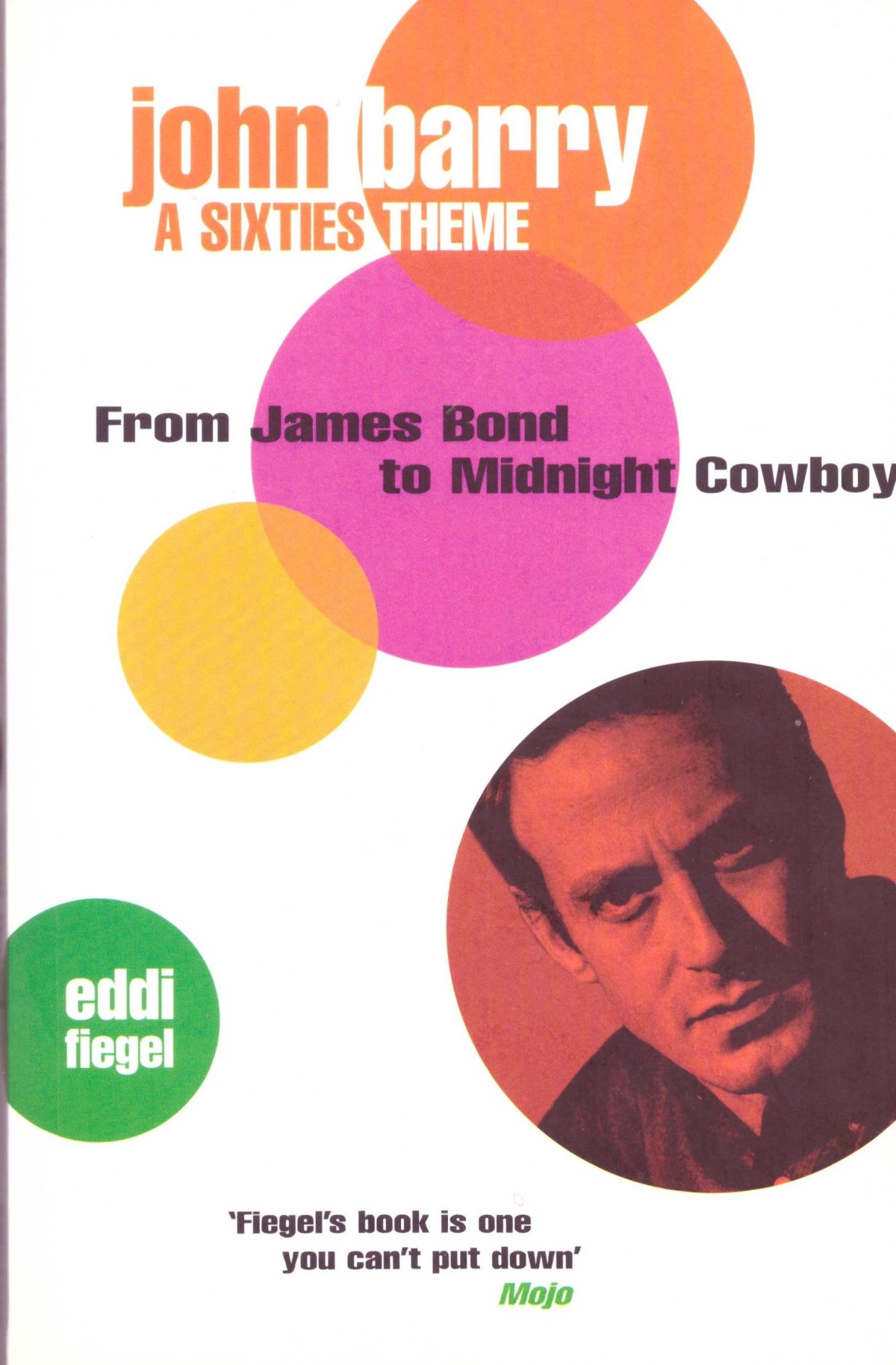
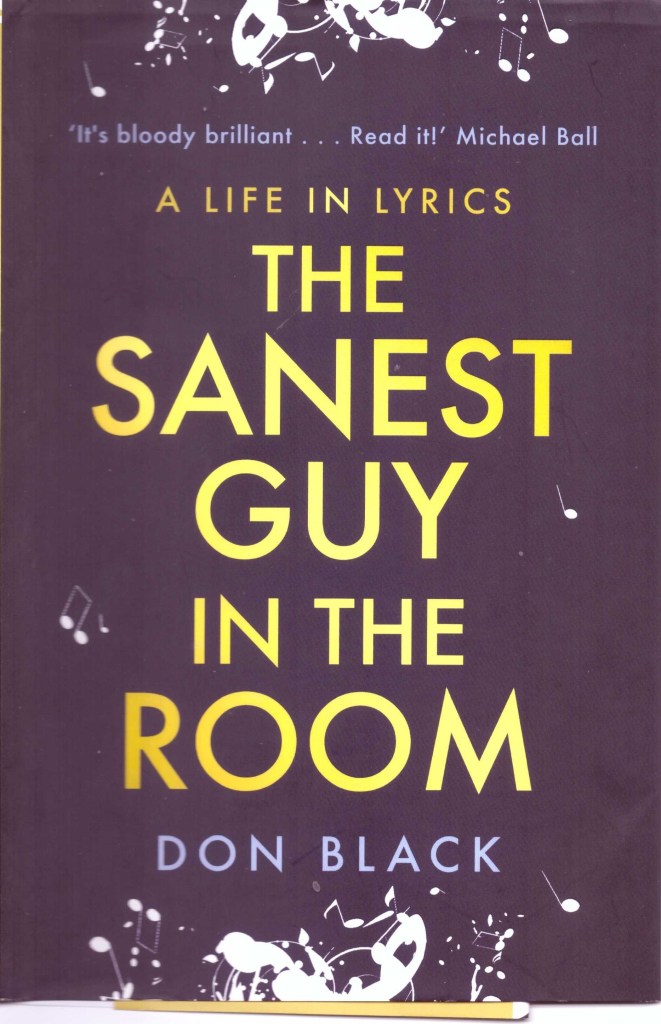
You can’t really write about 1960s films without making some reference to the revolutionary composers and lyricists who penned so many of the decade’s finest music. Rather than concentrate on the films to which the pair made vital contributions, I thought I would point you in the direction of a Eddi Fiegel’s biography of John Barry and this year’s autobiography of Don Black.
Barry, the son of a Yorkshire cinema owner, was a true child of the Sixties, a handsome man in handmade suits, living in Chelsea, driving an E-type Jaguar or a white Maserati, and friend of Michael Caine and David Bailey. He squired some of the most glamorous women of the era like Britt Ekland and Charlotte Rampling and was married to one its most enigmatic actresses Jane Birkin (Wonderwall, 1968, and co-conspirator of the hit single “Je T’Aime”).
After forming jazz outfit the John Barry Seven, regulars on TV program the 6.5 Special, he scored and arranged singles for pop singer Adam Faith who proved his passport to the movie business with Beat Girl (1959). But Dr No (1962) for which he was only paid £250 changed his life and he became the most in-demand film composer in British cinematic history. He followed up with successes such as Zulu (1963), Goldfinger (1964) and The Ipcress File (1965) and although his music sold in enormous quantities in terms of singles and soundtrack albums, his work had not come to the notice of the Oscar voters.
Born Free (1966) changed all that when he linked up with lyricist Don Black. Columbia had initially insisted that an American folk group would write and perform the theme song. But Barry was determined to do it himself. While the theme for Goldfinger had taken many days and nights to complete, Born Free was a different story: “I wrote the whole thing from beginning to end in about ten minutes,” said Barry. He had previously worked with Black on Thunderball (1965). The collaboration clicked from the outset. “John’s very word-conscious,” commented Black, “and that’s unusual for most composers.” However, Black’s socially-conscious lyrics did not initially go down well with producer Carl Foreman and Barry had continuous problems over the way the music should be handled in the film. The theme went to number one in America and Barry picked up two Oscars, for original music and, shared with Black, for best song.
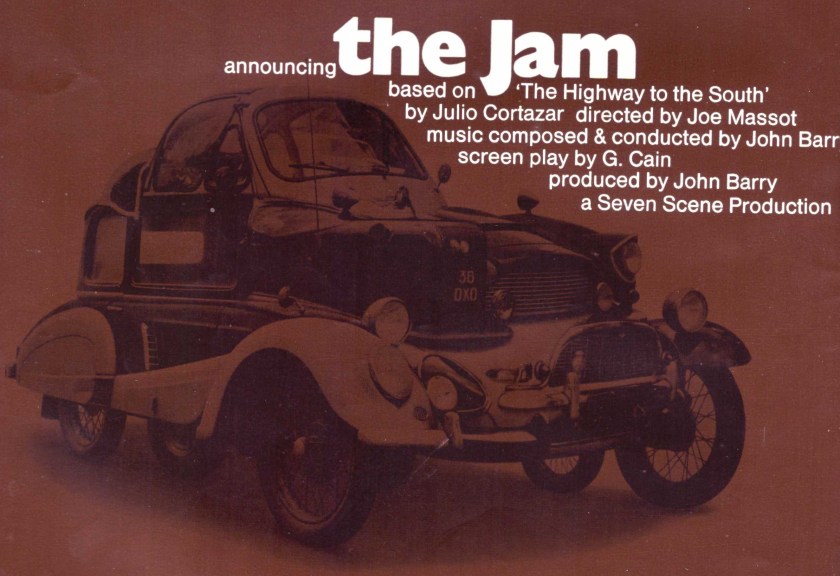
Talking of John Barry, here’s a mystery someone might be able to solve. I came across this advert in “Films and Filming” magazine which listed John Barry as a producer. Joe Massot went on to direct Wonderwall (1968) but George Harrison did the music for that. Any ideas?
Even so, Barry was not welcomed in Hollywood. “I remember in Hollywood,” noted composer Leslie Bricusse, “the fraternity of film composers there being very condescending towards John, talking about him as this pop musician who’d been in a band…the top brass…saw John as this kind of upstart. ” That changed with heist movie Deadfall (1968) – the “Romance for a Guitar and Orchestra” section my favorite piece of Barry music – and The Lion in Winter (1968) for which he won his second Oscar.
The bulk of Fiegel’s book covers the music Barry wrote in the 1960s and it is full of riveting detail about the circumstances surrounding various films. This is not a new book but it’s one I go back to again and again to remind me of John Barry’s genius.
By comparison The Sanest Guy in the Room: A Life in Lyrics by Don Black was published this year. “The first thing you learn as a lyric writer,” says Black, ” is not to waste a syllable” and that is the mantra for this delightful book, full of interesting anecdotes, insights into the work of other famous lyricists, and containing many of his own lyrics. He worked with singers Shirley Bassey and Barbra Streisand, a string of top composers including Maurice Jarre, Francis Lai, Lalo Schifrin, Quincy Jones, Elmer Bernstein and Henry Mancini and wrote musicals including Tell Me on a Sunday with Andrew Lloyd-Webber.
He grew up in council house in Hackney, London. But his initial attempts to become a songwriter floundered and he worked on the weekly music paper New Musical Express before becoming a “plugger” – a publicist – for a music publishing company and then a stand-up comedian.
However, he had become good friends with crooner Matt Monro – whom he would later manage – and the singer encouraged him to give songwriting another chance. When Barry approached him to write the lyrics for Thunderball, his career took off. Normally he wrote the lyrics once the composer had completed the tune. But To Sir, With Love was written first. Canadian Mark London supplied the music. British pop star Lulu, who was in the film, recorded it and it topped the charts in the United States.
But his closest collaborator remained John Barry. “It was easy writing with John – he would hand me a melody and I would go home and put words to it…If you write the words first there is a tendency to ramble, but if you only have a limited number of notes they provide you with a rigid framework.”
You can’t be a lyricist without versatility as proven by some of the songs he wrote in the 1960s – for films as diverse as Yul Brynner adventure The Long Duel (1967), A Matter of Innocence (1967) starring Hayley Mills, Peter Sellers comedy The Party (1968), Burton and Taylor drama Boom! (1968), biopic Isadora (1968) with Vanessa Redgrave, spy thriller Some Girls Do (1969), George Segal-Ursula Andress adventure Southern Star (1969) and The Italian Job (1969) starring Michael Caine.
As well as the Oscar for Born Free, he was nominated for best song for True Grit (1969), Ben (1972), Gold (1974) and The Pink Panther Strikes Again (1976). More recently he has been presenting a show on BBC Radio Two. His autobiography is a very spirited read, whizzing you from one anecdote to the next, and as promised no word wasted.








 The Magnificent 60s