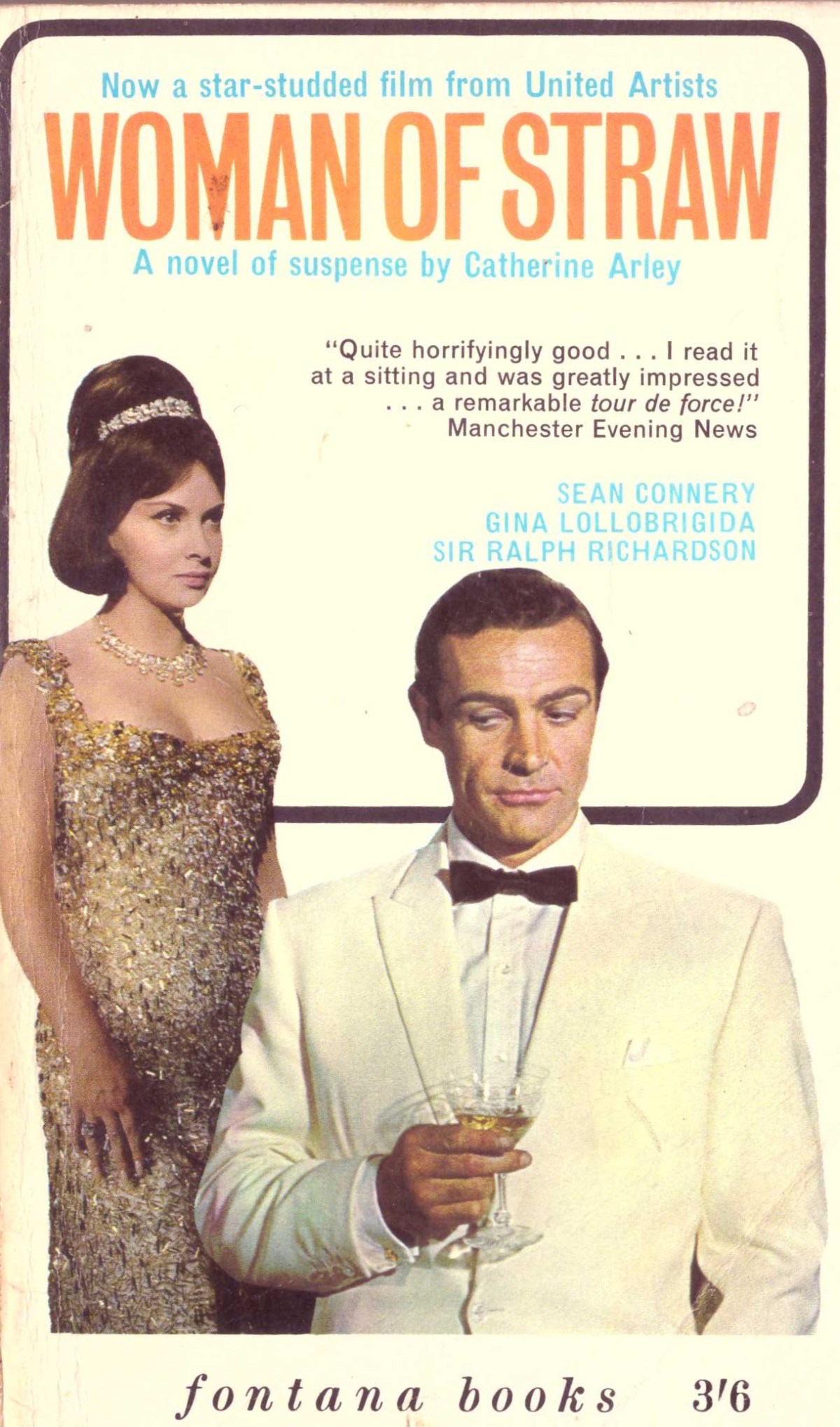
You can blame one of the screenwriters, either Robert Muller (Contest Girl, 1964) or Stanley Mann (The Collector, 1965), for coming up with the scene in Woman of Straw where the grotesque millionaire Charles Richmond (Ralph Richardson) forces his two black servants to pretend to be dogs to show his own dogs how to jump over each other. It’s not in the book. However, in fairness to the screenwriters they must have thought this preferable to the scene in the original book by Catherine Arley where Richmond offers a gold watch to the best imitation of a dog by his servants. This includes them getting down on all fours and eating food like a dog. Disgusting though this is, it is tempered by being a competition with a more than decent reward (a gold watch) for the winner.
The offensive scene in “Woman of Straw.”
And now we get into a difficult position since one of the most highly-praised episodes of Succession involved employees of grotesque millionaire Logan Roy (Brian Cox) being forced to get down on the floor and pretend to be boars and eat sausages like a boar (Boar on the Floor, Succession, Season Two, Episode Two). This sequence has a 94% rating on Rotten Tomatoes, the critical accumulation website. The episode won an Emmy for director Andrij Parekh. Scott Tobias of Vulture gave it five stars and Randall Colburn of The A.V. Club an A-minus. Various commentators referenced the Stanford Experiments, the culture of fear inherent in working with wealthy individuals, and the animalistic collapse of civilization.
So that has left me wondering if my objection to Woman of Straw was merely on racist grounds and to wonder if there would have been an outcry if the Succession episode had featured a black person grovelling on the ground.
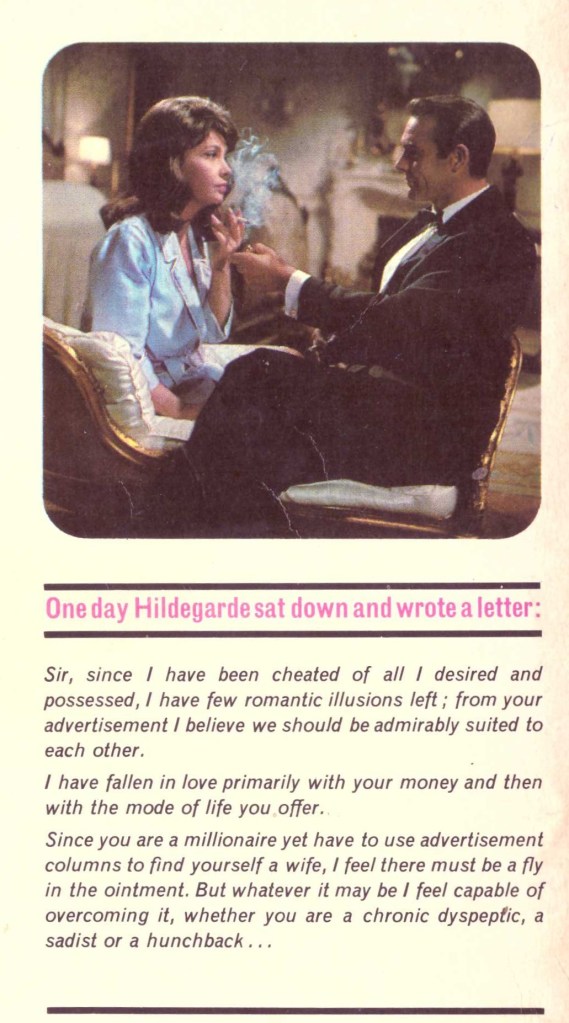
The screenwriters made significant changes to the source novel. For a start in the book both the woman and the millionaire were German. Hildegarde Meiner in the book becomes the Italian Maria (Gina Lollobrigida) in the film. But Hildegarde is not a relatively innocent nurse as in the film. Instead, she is an out-and-out gold-digger, determined to marry a wealthy man in order to make up for a desperate life in the aftermath of the Second World War.
Back cover of the movie tie-in edition of the British paperback.
In the book the villain of the piece is also German, Korff, not British like Sean Connery. And he is simply the millionaire’s secretary not his nephew. The pivotal element of the story is the same, Tony Richmond (Connery) feeling he is owed much more of the old man’s fortune than the pittance provided for him in the will. Korff is also 60 years old and although Hildegarde makes a play for him, any romantic liaison is out of the question because the secretary wants to adopt her as his daughter. Korff sets Hildegarde up as the nurse and instructs her to play it aloof and principled. Hildegarde does not fall into the category of beauty but, with better clothes and professional make-up, oozes class.
The rest of the story plays out much like the film except there is no rescue at sea and the millionaire does not listen to classical music. The novel narrative, while not in the first person, is told from the woman’s perspective. However, Korff is more devious than Anthony Richmond, ensuring in several ways that the nurse will take the rap.
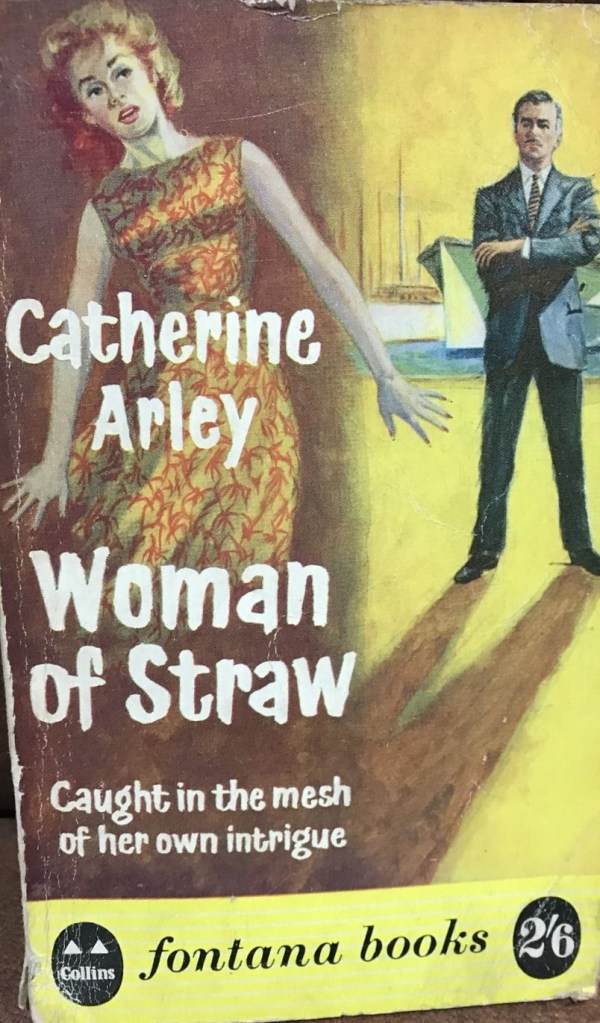
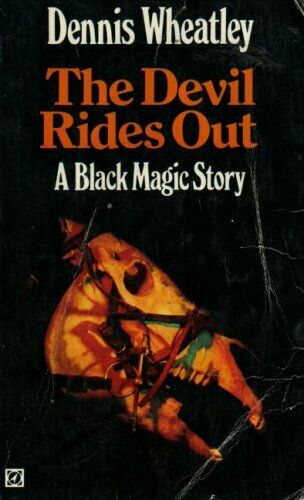
Front over of earlier British paperback, not a movie tie-in.
The film’s ending is driven by the need for some kind of happy resolution, for the guilty to be brought to justice, the dupe exonerated to some extent. But the book belongs more to the film noir genre and the ending is quite different, the villain getting away with and Hildegarde seeing no way out but to commit suicide.
The deprivations that Hildegarde has undergone as a consequence of her Hamburg family being killed during the war and her struggle for survival thereafter and her desperation to find a wealthy white knight make her a more sympathetic character.
The book is an excellent thriller in its own right.
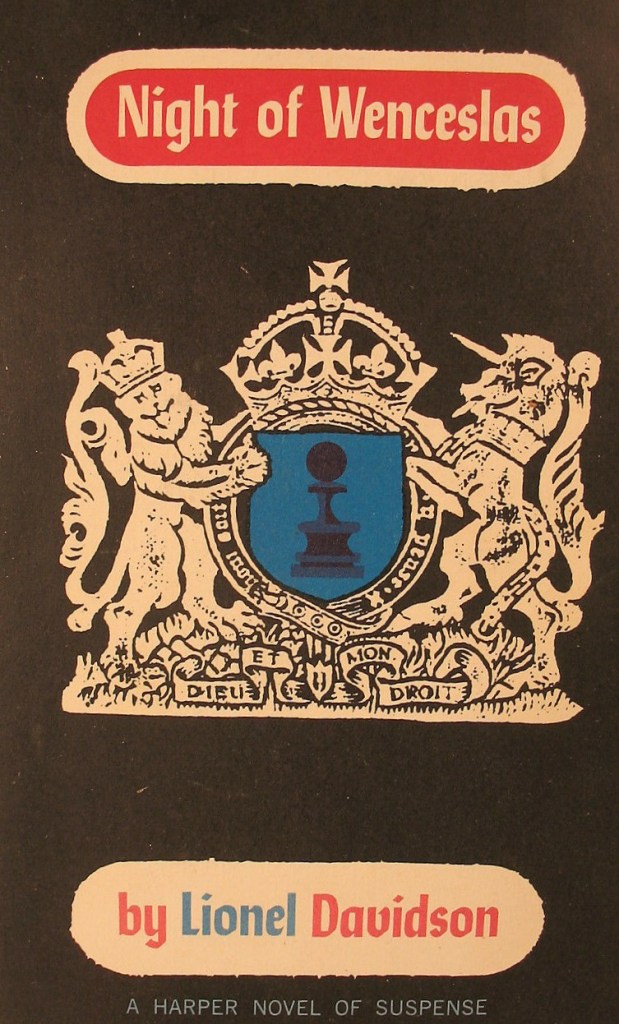
Timing is everything in the movie business. Had British film studio Rank shifted into top gear to adapt the best-selling thriller TheNight of Wenceslas by Lionel Davidson soon after its publication in 1960 it would probably have been a completely different film to Hot Enough for June which took four years to reach the screen. Davidson had produced a ground-breaking espionage thriller that had critics reaching for the superlatives and putting him in the same bracket as Graham Greene and Eric Ambler. A film appearing, for example, in 1961 would not have been lost in the box office tsunami, in Britain at least, that greeted Dr No on its movie debut in 1962.
But by the time Hot Enough for June was released a second Bond – From Russia with Love (1963)- had changed public attitudes to spy films and in addition readers were reeling from two blockbuster spy novels, Len Deighton’s The Ipcress File (published in 1962) and John Le Carre’s monumental bestseller The Spy Who Came in from the Cold (published 1963). In preproduction in May 1963, minus any cast, the projected film was still being known as TheNight of Wenceslas. Star Dirk Bogarde dithered so much about his involvement that at one point he was replaced by the considerably younger Tom Courtenay (Billy Liar, 1963).
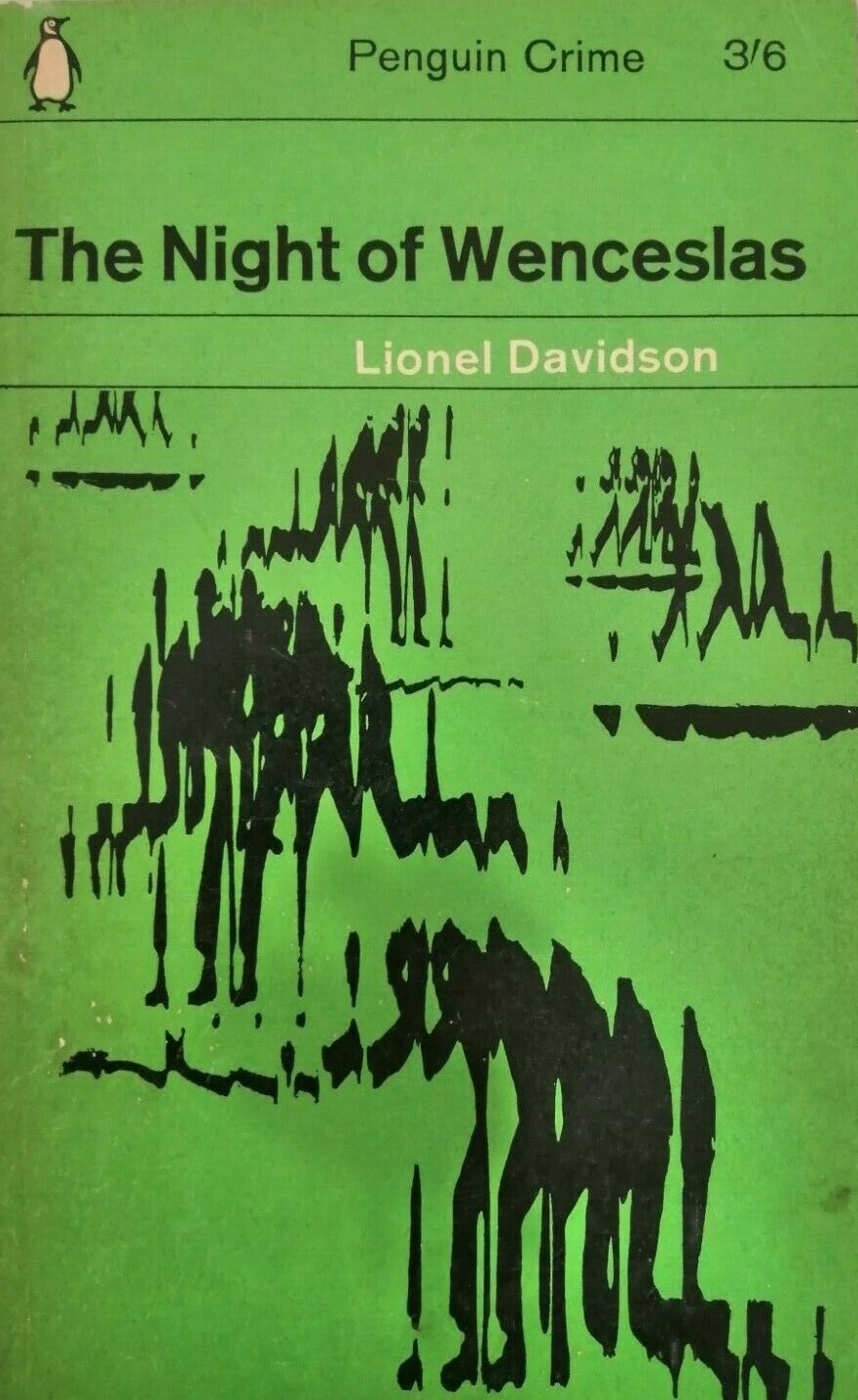
U.S. cover of the Davidson novel.
As was often the case in adaptations of best sellers, the screenwriter, in this instance Lukas Heller (Whatever Happened to Baby Jane, 1962) both added to and subtracted from the original material. For example, the Nicholas of the Lionel Davidson novel was not a particularly attractive character, truculent, snippy, with a bad case of self-entitlement, a bit of a ne’er-do-well, scrounging to pay bills, with expensive tastes and far from charming in his relationship with his girlfriend. He is also employed, rather than unemployed and with hankerings to be a writer as in the film, and comes into the orbit of Cunliffe (Robert Morley in the film) who dupes him into thinking an uncle has left him an inheritance.
Sensibly, Lukas Heller dispenses with Nicholas’s back story which posits him as a Czechoslovakian exile, albeit leaving his native land at the age of six, and various other complications concerning that country. He is sent to collect a formula for unbreakable glass. The “hot enough for June” password is a Heller construct and feels as if belongs to an earlier era of spy pictures. In the book all Nicholas has to do is leave his guide book lying around in the factory for the contact to write there the formula. However, rather than discovering he is working for the British Secret Service, the novelist employs a different twist, that the young man is, unknowingly, in the pay of foreigners plotting against Britain.
Davidson envisaged a different kind of Czech girl, more of a Valkyrie, statuesque (“her breasts stood out like bombs”) rather than the slimmer Sylva Koscina. It is Heller who adds the complication of her father heading up the secret police. In the book, her father is merely a musician and conveniently absent for most of the time, freeing up his house for romantic interludes. And the book has none of the James Bondesque features since the first of the series had not been written when The Night of Wenceslas was published.
However, the film having established the alternative world of rival secret agencies, of the girl being under suspicion and of her father being a senior official in the espionage business, the screenwriter then follows the bulk of the novel’s romance and the thrilling episodes involving Nicholas on the run. The swimming pool, cigarette burn, the parade and the milkman can all be found in the book.
There is one element that had to be changed. In the book, Nicholas makes two trips to Prague. But it is a golden rule of screenwriting that a character visits a location only once. Davidson ends his book with a touch of irony: Nicholas is swapped for Cunliffe.
At whose behest, it was decided to insert the comedy is anybody’s guess. Possibly the feeling that the book as written would be too unsophisticated for audiences accustomed to the rattling action and glamour of a James Bond. The Bond-style connections at the beginning of the film are clunky and the later references to espionage at the highest level also seemed to have been slotted in with no regard to retaining the essence of the book.
Watching King of the Roaring 20s (1961) and Murder Inc (1960) and struck by the number of similarities to The Brotherhood (1968) that could be found in The Godfather (1972) induced me to examine how well the original novel by Mario Puzo survived the often dangerous transition onto the screen.
There could not be a more textbook example of how to turn a big bestseller into a compelling motion picture. Although director Francis Coppola added texture and style to the bestseller, the film owes far more to the memorable characters created by author Mario Puzo. Apart from some slight structural changes and the elimination of a couple of subplots, the movie follows Puzo’s brilliant structure almost to the letter. And except for a few lines, virtually all the dialogue and many of the most unforgettable lines come directly from the book.
The opening wedding feast is an excellent example of the screenplay approach. The order of the action occasionally alters but the novel’s structure is strictly adhered to. The film’s striking opening line “I love America” by the undertaker is a slight but significant adaptation of that character’s line “I believe in America” in the book. But the screenwriters junk the book’s actual opening section which gives the background to the issues the three characters appealing to Vito Corleone (Marlon Brando) for intervention against perceived injustice from Vito Corleone (Marlon Brando) and goes straight to the book’s wedding. Here, too, the various elements are taken directly from the book with slight changes. For example, to the FBI men taking down car number plates in the novel the screenplay adds in photographers so that, to demonstrate his temper at an early stage, Sonny Corleone (James Caan) can smash a camera.
Straight from the book: fat Clemenza (Richard S. Castellano) dancing, wiping his brow and calling for wine from Paulie (John Martino); Sonny whispering in the ear of bridesmaid Lucy (Jeannie Linero); the frightened undertaker being told off by Vito; the Luca Brasi story Michael Corleone (Al Pacino) tells Kay Adams (Diane Keaton); Sonny and Lucy having sex and being interrupted by Tom Hagen (Robert Duvall); and the screams that greet singer Johnny Fontane (Al Fontane) and the subsequent scene where Vito shouts at the singer to act “like a man.” Additions are slight: in the book Sonny’s wife is in the kitchen not at a wedding table in dumbshow making jokes about her husband’s manhood, and Luca Brasi rehearsing his speech.
Indicative of the ruthlessness with which the screenplay treats the book is the elimination of a moving scene at the tail end of the wedding where Vito goes to see his dying partner Genco. As indicative of the author’s brilliance is that he invented degenerate film producer Jack Woltz (John Marley) and the decapitated horse in his bed. But the storyline, the film’s core, from the attempted murder of Vito, Michael’s assassination of the Turk Solozzo (Al Lettieri) and corrupt cop McCluskey (Sterling Hayden), the exiled Michael struck by the “thunderbolt” falling in love, the ambush of Sonny and the stricken Vito suing for peace, is pretty much exactly that of the book. In some case, it’s clear that actors have drawn from Puzo’s characterizations, the chilling way Michael takes control of the Family, how Fredo goes from useless gangster to hotel dandy.
There are occasional additions. In the book Enzo’s hand outside the hospital is shaking but Michael lighting his cigarette is the movie shorthand to demonstrate his icy calm, Sonny’s “bada-bing” isn’t in the book nor is Luca Brasi sleeping with the fishes, though there is something similar “Luca Brasi is sleeping on the bottom of the ocean.”
Occasionally, in the novel, for technical reasons, Puzo drifts away from the central characters to provide some more background or detail about a subsidiary person and in this manner we enter into the minds of Paulie, Carlo (Gianni Russo), Kay, Clemenza, McCluskey and Albert Neri just as they are about to play a significant role in forthcoming action. Other subsidiary characters featured more prominently in the novel, in particular Johnny Fontane whom the book reveals develops from Oscar-winning actor to successful movie producer and from manic seducer to more considerate male.
Fontane also helps revitalize the career of another singer Nino who does not appear in the movie at all and plays a role in developing the Family’s interests in Las Vegas. Lucy, who disappears entirely from the film after the wedding, is more significant in the book, finding romance after Sonny’s death with a surgeon and there’s a part of their relationship that would only now be permissible to film. Sicilian shepherd Fabrizio, instrumental in the attempted assassination of Michael, also reappears in the book. The book also devotes more attention to Michael’s new breed, Alberto (Richard Bright) and Rocco (Tom Rosqui).
The death of Vito in the garden is almost identical to the book with the grandson present except for Marlon Brando’s improvisation of stuffing his cheeks with orange to frighten the boy. And Michael’s betrayal by Tessio and the subsequent mass murder of all his enemies is also drawn from the book except for Moe Green having been killed earlier (Fabrizio the shepherd slotting into his place in the book’s action). Some slight detail is changed – Barzini (Richard Conte) killed beside his waiting car not on the steps, Tattaglia (Tony Giorgio) murdered in a chalet not an apartment block. Somewhat surprisingly the image of acolytes paying homage to Michael as briefly viewed by Kay has its origins in the book. The two final scenes in the book, both concerning Kay, are excluded from the film, in the first, having run away, she is challenged by Hagen and in the second she prays for Michael’s soul in church just as (in the book) Michael’s mother had prayed for his father
A lengthy chapter on Vito’s beginnings, explaining his early relationships with Clemenza, Tessio (Abe Vigoda) and Luca Brasi, was wisely held over for The Godfather Part II.
Having by now read a number of books that were subsequently filmed, my over-riding impression was that in many cases (The Secret Ways, Arabesque) little survived of the original tale or that characters, locations and timescales (The Detective) were substantially altered. In some instances the book’s length precluded a straightforward adaptation. Occasionally, subjects easily dealt with on the printed page were not so welcome on the screen. But, for whatever reason, change appeared inevitable for a bestseller being translated into a movie.
The Godfather almost stands alone as a novel that made the transition with virtually no alterations. All the main characters are present as described by Puzo and the storyline entirely reflects the book. The bulk of the dialogue was originally written by Puzo. While there is no doubting the Coppola’s achievement in putting the book on film, there is equally no doubt that the book leant itself to easier adaptation than most bestsellers.
Regular readers will know that this blog occasionally turns its attention to what comes under the generic title of “Other Stuff.” In the main and still covering movies I’ve reviewed this comprises behind the scenes looks at movies, examines pressbooks or marketing materials and analyses how books were shaped into films. I also focus from time to time on important issues that shaped Hollywood in the 1960s and write book reviews.
Behind the Scenes – The Guns of Navarone (1961). The ultimate template for the men-on-a-mission war picture with an all-star cast and enough jeopardy to qualify for a movie of its own.
Book Review – The Gladiators vs Spartacus Vol 1. Stupendous research by Henry MacAdam and Duncan Cooper explains how close Yul Brynner’s version of the Spartacus legend came to beating the Kirk Douglas movie into production.
Behind the Scenes – The Satan Bug (1965). The problems facing director John Sturges in adapting the Alistair MacLean pandemic classic for the big screen.
Box Office Poison – 1960s Style. Actors and actresses who had been big box office draws at the start of the decade were floundering by its end. This examines which stars while pulling down big salaries were not pulling their weight.
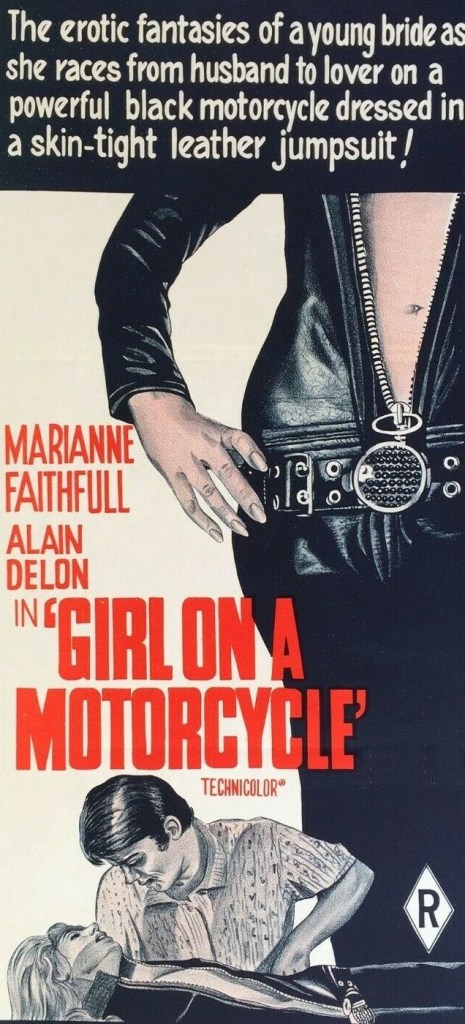
Behind the Scenes – The Girl on a Motorcycle (1968). Cult classic starring Marianne Faithful and Alain Delon had a rocky road to release, especially in the U.S. where the censor was not happy.
The Bond They Couldn’t Sell – Dr No (1962). Despite the movie’s later success and the colossal global box office of the series, American cinema owners were very reluctant to spend money renting what was perceived as just another British film.
When Alistair MacLean Quit: Part One. Rankled by his treatment by his publishers, the bestselling author gave up his bestselling career. And not once, but twice (see When Alistair Quit: Part Two).
Book Review – Dreams of Flight: The Great Escape (1963) in American Film and Culture. Dana Polan’s definitive book on the making of the POW classic starring Steve McQueen.
Behind the Scenes – Genghis Khan (1965). A venture into epic European filmmaking with an all-star cast led by Omar Sharif.
Bronson Unwanted. By the end of the 1970s Charles Bronson was one of the biggest stars in the world, but at the end of the 1960s, although highly appreciated in France, his movies could not get a box office break elsewhere.
Pressbook – Dark of the Sun (1968). How MGM sold the action picture starring Rod Taylor and Jim Brown. Fashion anyone?
Selling Doctor Zhivago (1965). MGM’s efforts to create huge audience awareness of the David Lean epic prior to its British launch.
Behind the Scenes – The Night They Raided Minskys / The Night They Invented Striptease (1968). The convoluted background to the attempts by neophyte director William Friedkin to make a movie celebrating America’s vaudeville past.
Advance Buzz. How Hollywood began to take on board the need for publicity long before the opening of a picture.
Behind the Scenes – Topaz (1969). Detailing the problems facing Alfred Hitchcock in turning the Leon Uris bestseller into an espionage classic featuring a non-star cast.
Book Review – The Gladiators vs Spartacus Vol 2. Abraham Polonsky’s longlost screenplay about Spartacus is brought to light.
The Miracle of Mirisch. The Mirisch Bros were the top independent producers in the 1960s – the first of the mini-majors – and while releasing classics like The Magnificent Seven and The Great Escape were also responsible for a pile of turkeys.
Book into Film – Dr No (1962). How the filmmakers adapted the Ian Fleming original to create the James Bond template.
Behind the Scenes – Cast a Giant Shadow (1965). Producer Melville Shavelson wrote a book about his experiences and this and other material relating the arduous task of bringing the Kirk Douglas-starrer to the screen are related here.
Book into Film – A Cold Wind in August (1961). The novel was a lot sexier than the film, since publishing did not face the same restrictions as Hollywood, and this examines how far the movie went to retain the spirit of the book.
Many liberties have been taken with the work of Alistair MacLean but there is little to match the arrogance of director John Sturges in deciding that the author’s original ending just wasn’t good enough. Setting aside the achievements of The Magnificent Seven (1960) and The Great Escape (1963), he was known for lapses of cinematic judgement, namely in switching completely the tone of The Satan Bug (1965) and assuming audiences shared his sense of humour with The Hallelujah Trail (1965).
According to Glenn Lovell, Sturges’ biographer, the director had “cringed” when presented with the Chayefsky screenplay, claiming the book had no “finish.” Closer, in Lovell’s words, to Agatha Christie than Ian Fleming. You have to ask if Sturges, or Lovell for that matter, had ever read Alistair MacLean’s astonishing tour de force of an ending.
The MacLean version climaxes in the submarine not on shore. And it takes to the ultimate the problems of confinement. You would have thought Sturges would have had little problem with the deadly incarceration of the MacLean climactic chapter given that had been a main element of The Great Escape, especially in the scenes with the claustrophobic Charles Bronson.
What Sturges passed up was what films like Das Boot (1981) later did so well – the sheer terror of being trapped underwater. MacLean’s book envisages the survivors of the fire at Ice Station Zebra rescued and returned to the submarine with the knowledge in the mind of David Jones (Patrick McGoohan in the film) that among them is a murderer, a Russian spy who caused the fire. The vessel is then subjected to further sabotage. A fire in the engine room causes the submarine to stop. That in turn causes the temperature to plummet, leaving the men in an “ice cold tomb.” Worse, they are running out of oxygen. Carbon monoxide is poisoning the atmosphere. In a short time a hundred will be dead. And to top it all, they have lost their bearings, the compasses don’t work, they are going round and round in a circle.
Can you imagine the possibilities? Absolute chaos. Not just thick acrid smoke everywhere, men strewn unconscious, the fire still burning, panic, terror. A submarine that was slowly becoming an underwater grave with still a killer on the loose.
Sturges could not imagine the possibilities. Perhaps he had not read the book either and Chayefsky had skipped through that part of the novel to get to the “trial,” the uncovering of the traitor that had been deemed too much like Agatha Christie. But The Guns of Navarone, one of the most successful movies of all time, had enjoyed a similar scene, when a surprise traitor was unmasked.
The ending Sturges slapped on the picture had its genesis in a couple of lines from the book where the British secret agent explained that Russian airplanes had come to the Arctic in the guise of helping the rescue but in reality looking for the film from the satellite. All the stuff about the new type of camera being stolen by the Russians and of film containing sensitive information about American missile sites needing to be recovered had come from the book. In the MacLean version, the traitor would dump the film out into the sea via the sub’s garbage chute but tagged with a floating device and a yellow marker so it could be picked up by a Russian vessel.
Instead, Sturges went for some kind of direct confrontation with the Russians, a shoot-out on the ice. It seemed a mighty odd decision, given the opportunities in 70mm Cinerama for a full-scale panic on board an immobilised submarine drifting to its doom.
In order to make his version work, Sturges had to draft in a squad of marines eventually led by Capt Anders (Jim Brown). The introduction of Russian defector Boris Vaslov (Ernest Borgnine) makes less sense, especially as, snooping around the submarine, he is obviously up to no good, but that might be for sound cinematic reasons since otherwise the traitor would only turn up once the movie reached Zebra and even then would need to come to the fore for some obvious reason.
Interestingly, the screenplay omits one element. Heading the Zebra Arctic operation is the older brother of the British secret agent, giving him a secondary reason for his mission, and the potential for emotional reaction on finding his sibling dead.
Sometimes screenwriters just seem to earn their keep by changing names for no apparent reason. So the book’s Commander Swanson becomes Ferraday (Rock Hudson) and British agent Dr Carpenter is renamed David Jones minus medical degree. All the initial sabotage comes from the fertile mind of the author and long before Tom Clancy, beginning with The Hunt for Red October, invented a brand-new publishing genre concentrating on military detail, MacLean reveals an extraordinary grasp of every detail of a nuclear submarine, the Arctic, the weather and what exactly might go wrong from a fire on board or should the vessel lose speed.
Neither would you recognise Rock Hudson in MacLean’s description of the submarine commander as “short, plump…(and) a pink cherubic face.” MacLean’s British agent is less arrogant and acerbic, keeps much more to himself, revealing his character at appropriate moments spaced through the book, than does the film’s David Jones. That Dr Carpenter, the narrator, knows massive amounts about everything means that he does not need to showboat like the filmic David Jones to prove he is in charge.
The book is a turbo-charged thrill ride. That the final piece of sabotage and its consequences last nearly 50 pages is proof of MacLean’s skill as a page-turner. Much as I enjoyed the film as it stands, it’s just a shame that Sturges did not follow the author into his astonishing climactic sequences.
You might ask yourself why star Richard Widmark bought the rights to Alistair MacLean Cold War thriller The Last Frontier (title changed to The Secret Ways for American publication and the film) if he was going to ignore so much of the author’s brilliant story. In the original version hero Reynolds (the Widmark character) does not simply fly into Vienna as in the film, but has already crossed the Austrian border into Hungary in a blizzard after hitching a lift in a truck but now is stranded on foot in sub-zero temperatures, 30 miles from Budapest. This is not the only change authorized by Widmark, wearing his producer’s hat.
His Reynolds is a freelance gun for hire clearing a gambling debt and hired by an American spy ring compared to MacLean’s British secret service agent, intensely trained for 18 months for this mission. The mission in MacLean’s book is to rescue/kidnap British scientist Professor Jennings, the world expert on ballistic missiles, with the help of Hungarian resistance leader -Hungary at the time part of the Soviet bloc – Jansci (Wolf Rilla). Widmark eliminated all mention of Jennings. Instead, the task facing his Reynolds is to get Jansci out of Hungary. Widmark’s Jansci is still a resistance leader but doubling up as the professor albeit a straightforward scholar with nothing to do with missiles.
Cover of the Doubleday U.S. hardback edition in 1959.
Combining characters was not unusual in the movie business and Widmark may have deemed it necessary to streamline the plot. But if the idea was to simplify the plot, that hardly explained the existence of Elsa (Senta Berger). She was not in the book. Her sole purpose may have been to provide Widmark with casual romance – a testament in Hollywood terms to his irresistible attraction – early in the story.
This was Alistair Maclean’s first shift away from the trio of war novels, including The Guns of Navarone, which had rocketed him into the bestseller class, and it proved to be a major change of style that created the non-stop thriller template that would underpin the later Fear Is the Key (published in 1961), When Eight Bells Toll (printed in 1966) and Puppet on a Chain (1969 publication), all of which were filmed, which saw loners or secret agents enduring horrific physical abuse as they battled the odds.
MacLean’s Reynolds enters Budapest a captive, rather than as in the Widmark version merely catching a train. Widmark meets Jansci’s daughter Julia (Sonia Ziemann) in Vienna. But in the book the secret agent meets Julia, along with her father, after he is captured by the resistance. In the book Reynold’s kidnap occurs in the first 20 pages, in the film at the halfway mark. From the outset Maclean thrusts his hero pell-mell into action with nary a let-up but in the film the action is punctuated by romance and various political meanderings.
Giving the game away No 1: the back cover of the Fontana paperback movie tie-in explains the plot – and it’s different from the one Widmark filmed.
Perhaps Widmark shied away from the MacLean plot due to budget constraints for the novel is certainly more intense and continually action-packed. Starting with the blizzard and ending with a perilous river crossing, the novel has several scenes which would have looked stupendous on screen. The story Widmark ignored involved the scientist in danger of being removed from Hungary to be returned to the Soviet Union, forcing Reynolds to effect a rescue on board a train, in a devil-may-care episode worthy of James Bond, by separating one car from the rest. There follows a 400-kilometer chase to the Austrian border where, pursued by Hungarian secret police, they cross the river Danube. In a final twist, while the professor and Julia are safe, Jansci refuses to leave his native country.
In various blogs covering the transition of novel into screenplay, I have mostly understood why a screenwriter would delete, alter or embellish plot, characters, time scale and even locale. Sometimes the screenwriter simply comes up with a more believable plot (as in Blindfold) or is required by the sheer length of the novel to make considerable changes. It’s rare for me to think that the screenwriter has taken the wrong approach. I thought The Devil Rides Out could have done with more of the occult background in the Dennis Wheatley novel. Here, it’s quite obvious that Maclean had a far better storyline than the film Widmark chose to make, the blizzard, train and river crossing scenes far more exciting than anything in the finished picture. As I noted, money may have been the issue.
Giving the game away No 2: the back cover of the Pocket Books paperback movie tie-in explains that Reynolds is a British secret service agent – but that’s not how Widmark played him.
However, it’s just as interesting that Widmark and Co. managed to make an enjoyable picture by not following the original story. The role of gambler-gone-bad was more appropriate to the Widmark screen persona than a secret service agent (outside of the humorous Our Man in Havana, there were not many of those around until a few years later). The film did introduce Senta Berger to a wider audience and the plot as it stands made a lot of sense.
The book was published in Britain in 1959 as The Last Frontier. In America the same year Doubleday renamed it The Secret Ways. There was a Victor Mature western called The Last Frontier in 1955 – and the title had also been used in 1932 and 1939 – so unless Richard Widmark had purchased the film rights prior to American publication and announced a name change, then I have no idea why the book title changed.
Sometimes you just have to scratch your head. Hollywood had a habit of buying a bestseller first without working out whether it would translate to the screen or not (Blindfold a classic example). Jessica was one of its most idiotic purchases.
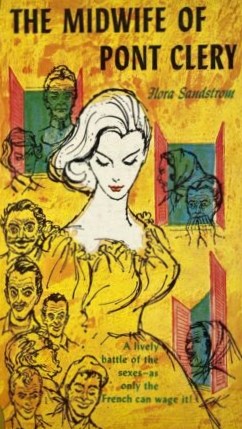
It was based on The Midwife of Pont Clery by British novelist Flora Sandstrom published in 1954. As the title gives away, it was set in France not Italy. The heroine rides a bicycle not a Vespa. Nor is she an American, transplanted into Italy by ill-fated romance. She is French, originating from Brittany, not far from the village in Normandy where she now plies her trade as a midwife. Her name is Suzette Quimpernay not Jessica. Yes, as with the film, her husband did die on their wedding day, but not in a car accident but rather falling from a boat while alcoholically impaired and drowning.
But like the book, she is introduced by the way she attracts the unwanted attention of the local male population, farmers for the most part, who rhapsodize about her shapely ankles, “moist lips and the sheen on her eyelashes…small chin made to be cupped by a hand,” and curly brown hair. “Everything about her was innocent,” wrote Sandstrom, “and yet she drew the eye and the heart and made the pulses tingle…she was rounded, even a little plump, but she seemed to walk on air.”
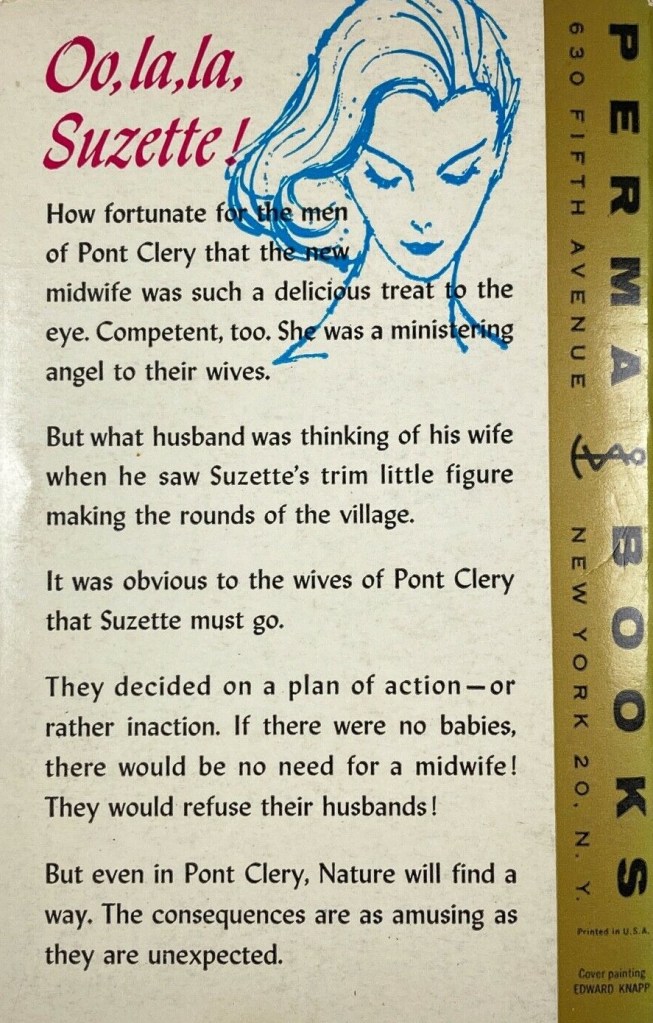
Back cover of the paperback.
Reading the book, I was waiting with bated breath for the singing guitar-strumming cleric to make an entrance knowing this was unlikely, and that Father Boneval in the book was made to sing in the film simply because was being played by crooner Maurice Chevalier.
The other changes are obvious. Bride-to-be Nicolette in the book is transformed into Nicolina (Danielle De Metz) for the film. The book’s interfering busybody Marie easily becomes Maria (Agnes Moorehead). While the film’s count (Gabriele Ferzetti) owns a fishing fleet and the book’s count is a scholar, they have in common fighting for the resistance in the war.
Although in the film it’s obvious that Jessica is too easily distracting the men leaving the women resentful, the idea of taking any action against the midwife takes some time to formulate. However, in the book only six pages elapse before Marie is thinking of ways of getting rid of the midwife. Her first notion is to act as matchmaker, hitching her to the 44-year-old widow Boniface. But Boniface’s sister Virginie, his long-time housekeeper, fears being cast out and resists the idea. Then Marie gets village women to agree on the sex ban – without sex there would be no babies and therefore no midwife – the central theme of the movie.
In the opening section of the book, also, the midwife is seen only through the eyes of the other characters who make all sorts of excuses to go out of their way to spend time with her. It is nearly 30 pages until the reader enters the innocent head of Suzette. She sees the good in everyone and everything and is complimented on her midwifery skills.
In the film, Suzette gets to know the count (who gives a false name) at the wedding feast but in the book she is not invited to that celebration and only meets the count in the course of attending other general nursing duties. Of course if the film had followed the book, that would have eliminated one highlight, the wedding singing and dancing.
The book follows a different line. When Suzette complains about a shopkeeper’s cheeses she is banned from the village shop. The sex ban quickly whittles down her presence in the village and she considers buying a piece of land from the count. Their romance is conducted off-page, his feelings for her revealed in a letter to his mother and his marriage proposal is welcomed, unlike the book.
It is only when Nicolette and Madame Tuffe (Tuffi in the film, played by Sylva Koscina) become pregnant that they go begging to the midwife. But in a final twist she cannot attend as she is being married.
So, basically, the book lacks the movie’s second act when Jessica takes revenge on the village women by flirting outrageously with the men. It’s difficult in any case to make this idea work. Although Jessica (Angie Dickinson in the film) dresses in a more provocative manner – tight sweater and jeans – than in the book, there’s nothing particularly brazen about her. In the book, though puzzled, she accepts her exile. She is too innocent to suspect underlying motives. The film does not quite work because a character presented as a flower of innocence cannot suddenly turn into a minx.
Nor is there really any place in a movie for a singing priest, no matter how charming. In the book, the priest’s role is minimal. But because he is played by Maurice Chevalier the character and storyline shift to make him more important. The movie romance is overplayed, too, with drama when none is required.
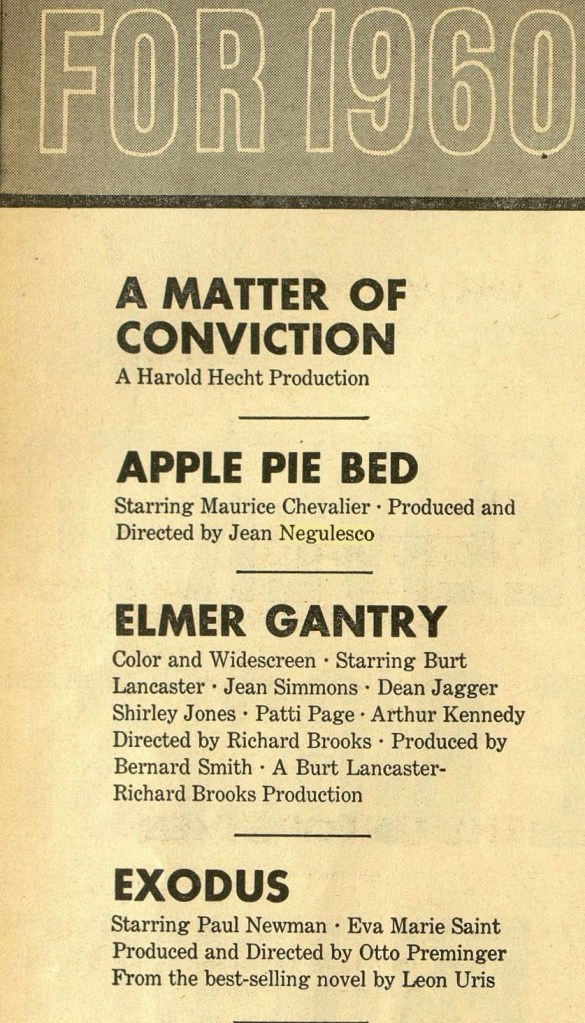
The film was originally titled “Apple Pie Bed.”
It was likely that the involvement of Romanian director Jean Negulesco ensured this French-set piece came to be relocated to Italy following the success of Three Coins in a Fountain (1954) set in Rome. But this was not a given. He had remained true to the Paris locale of Francoise Sagan’s novel A Certain Smile (1958), although importing Italian Rossano Brazzi and American Joan Fontaine for his co-star, and to Boy on a Dolphin (1957) set in Greece, albeit with an Italian female lead in Sophia Loren. Possibly it came about when Jean Negulesco set up his own company and announced Apple Pie Bed with Maurice Chevalier – advertised in 1960 as part of the United Artists release schedule (see above) – as his first picture, based on the Sandstrom novel.
The screenplay was announced as being written by H. Hugh Herbert, then Sandstrom then John Dighton before Edith Sommer, with whom Negulesco had worked on The Best of Everything (1959), took over. The success of Gigi (1958) might well have inspired the director to give Chevalier a singing part. This was Negulesco’s first film since The Best of Everything having left The World of Suzie Wong in 1960. The importance of Chevalier was such that the film’s release was held up until the singer’s version of the title song penetrated the charts.
SOURCES: “Negulesco: Zest of Crews Favors Europe’s Studios,” Variety, April 3, 1957, 12; “Flora Sandstrom,” Variety, January 21, 1959, 9; “Negulesco’s Own Firm,” Variety, October 14, 1959, 3; advert, Variety, January 6, 1969, 24; “Negulesco UA Picture Awaits Song Penetration, “ Box Office, January 29, 1962, E1.
Dennis Wheatley was a prolific bestseller producing three or four titles a year, famous for a historical series set around Napoleonic times, another at the start of the Second World War and a third featuring the “four modern musketeers” that spanned a couple of decades. In addition, he had gained notoriety for books about black magic, which often involved series characters, as well as sundry tales like The Lost Continent. Although largely out of fashion these days, Wheatley set the tone for brisk thrillers, stories that took place over a short period of time and in which the heroes tumbled from one peril to another. In other words, he created the template for thriller writers like Alistair MacLean and Lee Child.
The Devil Rides Out, his fourth novel, published in 1934, featured the “musketeers” involved in his phenomenally successful debut The Forbidden Territory (1933), and introduced readers to his interest in the occult. Although of differing temperaments and backgrounds his quartet – the Russian-born Duke De Richleau (Christopher Lee in the film), American aviator Rex Van Ryn (Leon Greene) and wealthy Englishmen Richard Eaton (Paul Eddington) and Simon Aron (Patrick Mower) – are intrepid. And while screenwriter Richard Matheson stuck pretty much to the core of the Wheatley story, the film was hampered by the actors. The laid-back Paul Eddington hardly connects with the Wheatley characterization and Patrick Mower is too young for Aron.
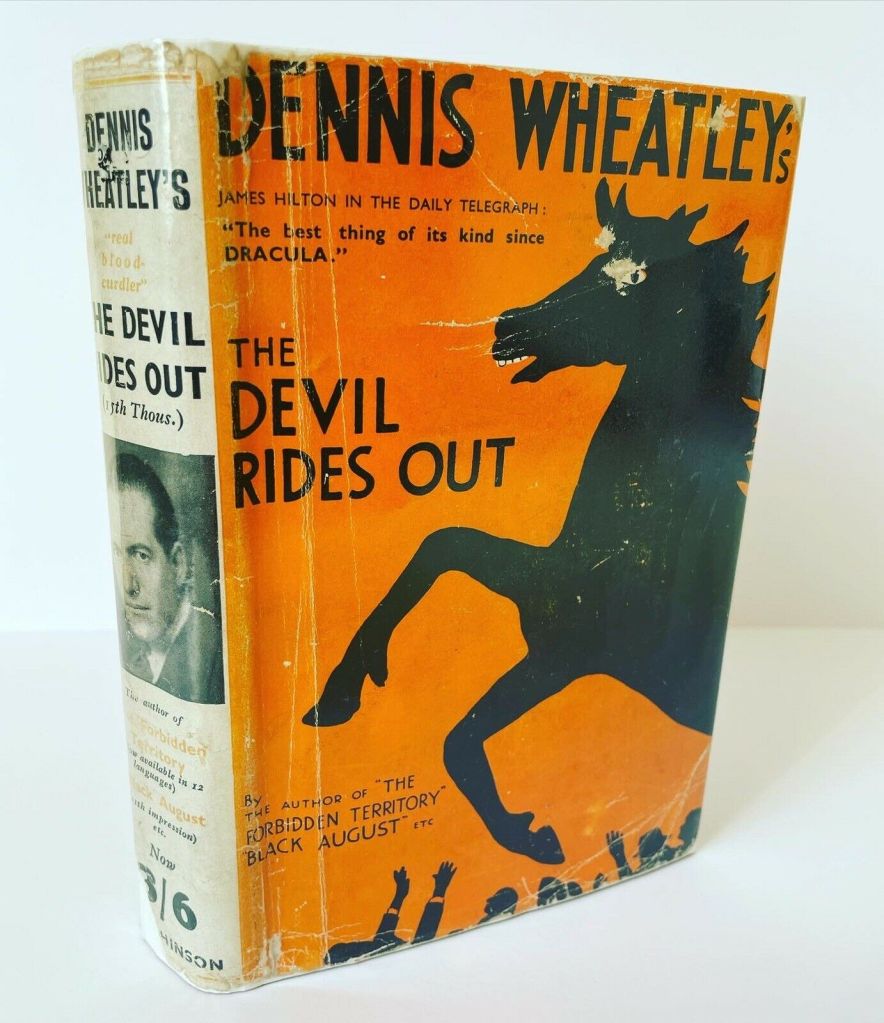
Original British hardback cover.
As with the book, the story moves swiftly. Worried that Aron is dabbling in the black arts, De Richleau and Van Ryn go haring down to his country house where they meet black magic high priest Mocata (Charles Gray) and discover tools for satanic worship. And soon they are embroiled in a duel of wits against Mocata, climaxing in creating a pentagram as a means of warding off evil.
In order not to lose the audience by blinding them with mumbo-jumbo the script takes only the bare bones of the tale, bringing in the occult only when pivotal to the story, and that’s something of a shame. A modern audience, which has grown up on enormously complicated worlds such as those created for Game of Thrones and the MCU, would probably have welcomed a deeper insight into the occult. While out-and-out thrillers, Wheatley’s novels often contained copious historical information that he was able to dole out even when his heroes were in harm’s way. The Devil Rides Out is not a massive tome so it’s a measure of the author’s skill that he manages to include not just a condensed history of the occult but its inner workings. Every time in the film De Richleau goes off to the British Library for some vital information, his departure generally leaves a hole, since what he returns with does not always seem important enough to justify his absence.
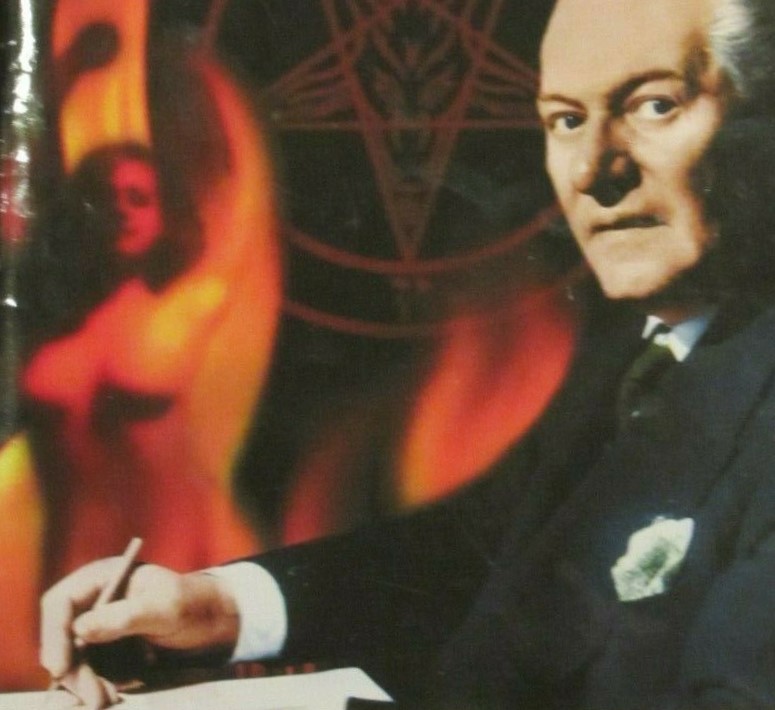
Author Dennis Wheatley.
But then the screenwriter was under far more pressure than a novelist. In some respects, this book like few others demonstrates the difference between writing for the screen and writing for a reader. With just 95 minutes at his disposal, Matheson had no time to spare while Wheatley had all the time in the world. Wheatley could happily leave the reader dangling with a hero in peril while dispatching De Richleau on a fact-finding mission, the action held up until his return. It’s interesting that Matheson chose to follow Wheatley’s characterization of De Richleau, who didn’t know everything but knew where to look. Matheson could easily have chosen to make De Richleau all-knowing and thus able to spout a ton of information without ever going off-screen.
But here’s where the book scores over the film. The reader would happily grant Wheatley his apparent self-indulgence because in the book what he imparted on his return, given the leeway to do so, was so fascinating. There are lengthy sections in the book which are history lessons where De Richleau supplies readers with the inside track on the satanic. In the opening section, once De Richleau and Van Ryn have rescued Aron, the author devotes a full seven pages to a brief introduction to the occult that leaves the reader more likely to want more of that than to find out how the story will evolve. He has hit on a magic formula that few authors ever approach. To have your background every bit as interesting as the main story is incredibly rare and it allowed Wheatley the opportunity to break off from the narrative to tell the reader more about the occult, which in turn, raised the stakes for the characters involved.
Effectively, there was too much material for a screenwriter to inflict upon an audience ignorant of the occult. Some decisions were clearly made to limit the need for lengthy exposition. But these often work against the film. For example, Mocata wants the Talisman of Set because it bestows unlimited power with which he can start a world war, but in order to accomplish that he needs to find people with the correct astrological births, namely Simon and Tanith. But this element is eliminated from the story, making Mocata’s motivation merely revenge. Matheson also removed much of the historical and political background, replaced the swastika as a religious symbol with the more acceptable Christian cross, and deleted references to Marie’s Russian background. Her daughter Fleur becomes Peggy. Matheson also treats some of the esoteric light-heartedly on the assumption that seriousness might be too off-putting.
Overall, the adaptation works, you can hardly argue with the movie’s stature as a Hammer classic, but the more you delve into the book the more you wish there had been a way for much of the material to find its way onscreen and to inform the picture in much the same way as the depth of history and character backstory adds to Game of Thrones.
Thought-provoking drama with a surprisingly contemporary slant set against the grandeur of the Vatican amid geo-political turmoil. At a time of global crisis, dissident Russian archbishop Lakotov (Anthony Quinn) is unexpectedly freed from a labour camp by the Russian premier (Laurence Olivier). Arriving at the Vatican, he is promoted to cardinal by the dying Pope (John Gielgud) before becoming an unexpected contender for Papal office.
The spectacular wealth of the Catholic Church is contrasted with the spectacular poverty of China, on the brink of starvation due to trade sanctions by the United States, nuclear war a potential outcome. The political ideology of Marxism is compared to the equally strict Christian doctrine, of which Lakotov’s friend Father Telemond (Oskar Werner) has fallen foul. There is a sub-plot so mild it scarcely justifies the term concerning television reporter George Faber (David Janssen) torn between wife Ruth (Barbara Jefford) and younger lover Chiara (Rosemary Dexter).
Lakotov is drawn into the Russian-Chinese-American conflict and the battle for the philosophical heart of the Christian faith while bringing personal succour to the lovelorn and performing the only modern miracle easily within his power, which could place the Church in jeopardy, while condemned to the solitariness of his position.
The political and philosophical problems addressed by the picture, which was set 20 years in the future, are just as relevant now. The film’s premise, of course, while intriguing, defies logic and although the climax has a touch of the Hollywood about it nonetheless it follows an argument which has split the Church from time immemorial.
You would not have considered this an obvious candidate for the big-budget 70mm widescreen roadshow treatment, but MGM, after the Church not surprisingly refused access to the Vatican, spent millions of dollars on fabulous sets, including the Sistine Chapel. The roadshow version of the picture, complete with introductory musical overture and an entr’acte at the intermission, is leisurely and absorbing, held together by a stunning – and vastly under-rated – performance by Anthony Quinn (The Lost Command, 1966) who has abandoned his usual bombastic screen persona in pursuit of genuine humility and yet faces his moments when he questions his own faith.
Ruth has a pivotal role in bringing Lakotov down to earth but George has the thankless task, setting aside the quandaries of his love life, of talking the audience through the sacred ceremonies unfolding sumptuously on screen as the cardinals bury one Pope and elect another.
You wouldn’t think, either, that Hollywood could find room in such a big-budget picture for philosophical discussion but questions not only of the existence of God but whether he has abandoned Earth are given considerable scope, as are discussions about Marxism and practical solutions to eternal problems. None of these arguments are particularly new but are given a fair hearing. There is a hint of the Inquisition about the “trial” Telemond faces. Oskar Werner (Interlude, 1968) carries off a difficult role.
David Janssen (Warning Shot, 1967) is mere window dressing and Rosemary Dexter (House of Cards, 1968) mostly decorative but Barbara Jefford (Ulysses, 1967) is good as the wounded wife. Laurence Olivier (Khartoum, 1966) is the pick of the sterling supporting cast which included John Gielgud (Becket, 1964), Burt Kwouk (The Brides of Fu Manchu, 1966), Vittorio de Sica (It Happened in Naples, 1960), Leo McKern (Assignment K, 1968), Frank Finlay (A Study in Terror, 1965), Niall McGinnis (The Viking Queen, 1967) and Clive Revill (Fathom, 1967). In a small role was Isa Miranda, the “Italian Marlene Dietrich,” who had made her name in Max Ophuls Everybody’s Woman (1934) and enjoyed Hollywood success in films like Hotel Imperial (1939) opposite Ray Milland.
Michael Anderson (Operation Crossbow, 1965) directed with some panache from a script by veteran John Patrick (The World of Suzie Wong, 1960) and Scottish novelist James Kennaway (Tunes of Glory, 1960) based on the Morris West bestseller.
I found the whole enterprise totally engrossing, partly because I did not know what to expect, partly through Anderson’s faultless direction, partly it has to be said by the glorious backdrop of the Vatican and the intricacy of the various rites, but mostly from the revelatory Quinn performance. And even if the plot is hardly taut, not in the James Bond clock-ticking class, it still all holds together very well. From the fact that it was a big flop at the time both with the public and the critics, I had expected a stinker and was very pleasantly surprised.
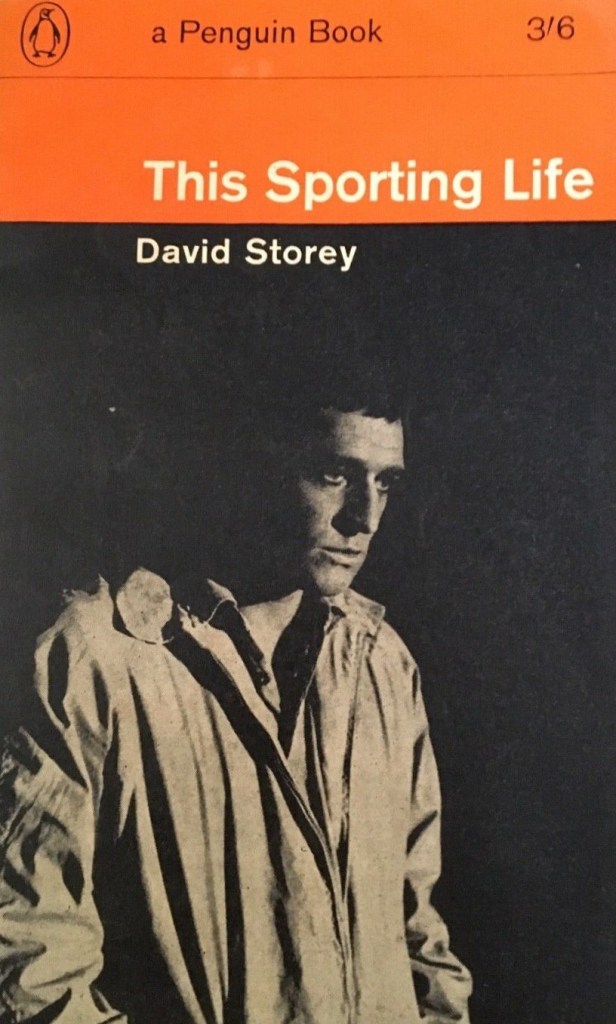
Star Albert Finney and director Karel Reisz of Saturday Night and Sunday Morning (1960) turned it down. Director Lindsay Anderson, screenwriter David Storey, author of the novel on which the film was based, and star Rachel Roberts all suffered from massive doubt in their own abilities.
Anderson was the last of a generation that included Reisz and Tony Richardson (Tom Jones, 1963) to make a movie. He was better known as film critic and theatre director. As far as the screen went, he had got only as far as five episodes of The Adventures of Robin Hood for television, and some documentaries and shorts. If he was going to make a movie it almost certainly depended on finance from British production outfit Woodfall which had backed Reisz and Richardson. However, Woodfall was outbid for the rights to This Sporting Life and Anderson only came into the frame when Reisz rejected the idea of directing the movie in favor of turning producer and giving Anderson his opportunity.
Cover of the Danish program.
“I was not sure I was up to it,” confessed Anderson. Theoretically a tale of a rugby footballer Frank Machin’s (name changed from the Arthur Machin of the book) rise and fall, Anderson wanted to explore the novel’s “dark poetry” and the ambiguities of the a central character who was by turn overbearing and sensitive and involved in a “tortured, impossible relationship.”
However, Storey, also making his movie debut, struggled with the script. Until the sudden success of This Sporting Life, the aspiring artist had lived a debt-ridden life as a supply teacher (17 schools in three-and-a-half years) in poverty-stricken London boroughs, writing his novels on train journeys north to fulfill his contract to play professional rugby. Reprinted prior to publication This Sporting Life, his debut novel, received excellent reviews and won the inaugural U.S. MacMillan Award worth $7,500.
When the film industry came sniffing Storey took tea with Stanley Baker at the Dorchester Hotel, lunched with Tony Richardson at the Trocadero and was wooed by director Joseph Losey at his Knightsbridge flat. Initial expectations were that the rights would go for £3,000, but a bidding war between Woodfall and Rank sent the bill up to £10,000 with the latter emerging victorious. Karel Reisz agreed to become producer on condition he could choose director, writer and cast. He introduced Storey to Anderson and to an initially interested Albert Finney.
Cover of the first edition of the British hardback.
Storey, a working-class son of a coal miner, and Anderson stood at different ends of British class divide. Initially suspicious of each other, they had opposite temperaments. “Lindsay was an optimist,” explained Storey,” I was a reclusive, and when in doubt, morbid.” Even after Storey completed a treatment and the pair went north to scout locations, the project remained in doubt, in part because Anderson did not understand the book and had a “curious lack of confidence” and in part because Storey resisted reshaping the material into something “new.” In fact, Anderson’s lack of confidence was so deep it took several months before he actually signed his contract.
Storey, too, suffered from revisiting the area where he had grown up. The death of a sibling cast a devastating shadow over the rest of his life, the Wakefield rugby ground in fact “scarcely a stone’s throw “from the child’s grave. “Wakefield was being opened up to me in a way I had never known before,” explained Storey, referring to the grand houses visited as possible locations whose exteriors he had glimpsed while working as a marquee laborer.
Despite “exhaustive consultations” with Anderson and Reisz, the script failed to gell. “I felt the authority I wanted was not there,” commented Anderson. Although actors are often decried for interfering with the script, in this case it was star Richard Harris who arrived at the solution.
British paperback film tie-in.
Anderson had been attracted to Harris from seeing him in the stage adaptation of J.P. Donleavy’s The Ginger Man. The director flew off to Tahiti where Harris was filming Mutiny on the Bounty (1962) to be met at the airport at five in the morning by the actor, “ his 18th century seaman’s hair down to his shoulders, bursting to tell me what he thought of the script we had sent him.”
Anderson recalled, “Within ten minutes we were at it…we talked and argued right through the day. I quickly realized he was right…we had lost what was most unique and brilliant in the novel…it was Richard, who, with passionate intransigence, brought us back to the book…in the evening after his shooting on the Bounty we sat in his bungalow going through the script and his own heavily-annotated copy of the novel…and slowly a conception emerged which began to satisfy us.”
Storey agreed with the new look which basically followed a subjective point-of-view rather than being cluttered by the novel’s flashbacks. “With an unequivocal endorsement of the book and the rejection of a script which had wearied me more than I’d imagined, I found rewriting the script in the manner in which the book had been written, from the inside looking out rather than the outside looking in, a surprisingly exhilarating task…Once Richard Harris had become identified with the part …the material was no longer a problem.”
Retaining that subjectivity was Anderson’s biggest issue An Oxford scholar, he had little innate understanding of Frank Machin’s world and in consequence “was liable to slip into an objective view of scenes that needed to be presented through Machin’s own temperament.” Harris proved instrumental in keeping the director on course.
Rachel Roberts twice turned down the role – Mary Ure (Look Back in Anger, 1959) was also in the frame with four other actresses – and failed to turn up for a screen test. Karel Reisz once commented how odd it was that “the two films that made this great-hearted flamboyant woman best-known (the other being Saturday Night and Sunday Morning) were ones in which she played withdrawn, bleak, ungiving women. Rachel’s great talent was to sink her personality into the part without losing access to her own sensuality. You felt the tension.”
Of This Sporting Life, Reisz added, “She had great doubts about her ability to play Mrs Hammond because she’s a very held back, undemonstrative woman. A passionate person, certainly, but someone who’s turned puritanical through so much constant repression of her feelings. Rachel was afraid of this: she didn’t know out of which part of herself to play the role.”
Lindsay Anderson was as unsure as Roberts: “She didn’t appear to me to be the Mrs Hammond character…Rachel was anything but repressed.” Actress Sybil Williams remembered finding a whole sheaf of notes in Rachel’s script about “the Mrs Hammond character she appeared to be playing so intuitively.” Said Anderson, “Richard Harris was bit awed by Rachel. She could acquit herself with a first-rate reading in just a couple of takes. Richard took a few more to feel he had got it right. Rachel’s security as an actress made him feelmore respectful towards her.”
The scenes between Harris and Roberts were endlessly rehearsed, involving a full 10 days prior to shooting and then during evening and weekends while in production. Roberts was playing a woman “whose feelings, though fierce, are almost continually suppressed: the relationship deepens without self-explanation…through incessant conflict…It called for an actress of exception ‘interior’ quality with real wildness within as well as the capacity for an iron restraint.”
Somewhere in the BBC archive is a programme, never aired, about the making of the film shot for its Monitor arts strand, although Storey was interviewed later on the show by Huw Wheldon, later BBC managing director.
Although Lindsay Anderson only made four more movies, the most memorable being If…(1968), and David Storey never wrote another screenplay, the pair achieved considerable success together when the author turned to writing plays such as Home (1970) and The Changing Room (1971), set in a rugby club.
If This Sporting Life appears to have two main characters driven by demons, part of the explanation as to how such creatures emerged from David Storey’s imagination can be found in his riveting memoir A Stinging Delight which traces a core of depression from his earliest days through to the times in later life when he was in and out of mental hospitals. Rachel Roberts also suffered from mental illness and committed suicide in 1980.
SOURCES: Lindsay Anderson, “Sport, Life and Art,” Films & Filming, February 1963, pages 17-20; David Storey, A Stinging Delight (Faber, 2021), pages 217-218, 221-223, 227-231, 233, 240-242; No Bells on Sunday, The Journals of Rachel Roberts, Edited with a documentary biography by Alexander Walker, Pavilion, 1984, pages 37, 55, 56, 58.







 The Magnificent 60s