Behind the Scenes: When Bestsellers Ruled Hollywood

Originality was rarely the key to open the box office door in the 1960s. Though considerably more expensive than original screenplays, books and Broadway musicals were viewed as a better bet, in part because they came with a perceived built-in audience of readers and theatergoers. And the figures prove that, for once, Hollywood got it right.

All except one, the top ten movies for the decade at the box office derived from bestsellers or stage hits. The exception was Guess Who’s Coming to Dinner (1967), an original screenplay by William Rose who received a then-record sum for his efforts. The decade’s out-and-out winner, The Sound of Music (1965) was based on both a book, The Story of the The Trapp Family Singers and a West German film The Trapp Family (1956), as well as the Rodgers and Hammerstein musical.

The biggest bestseller since “Gone with the Wind.”

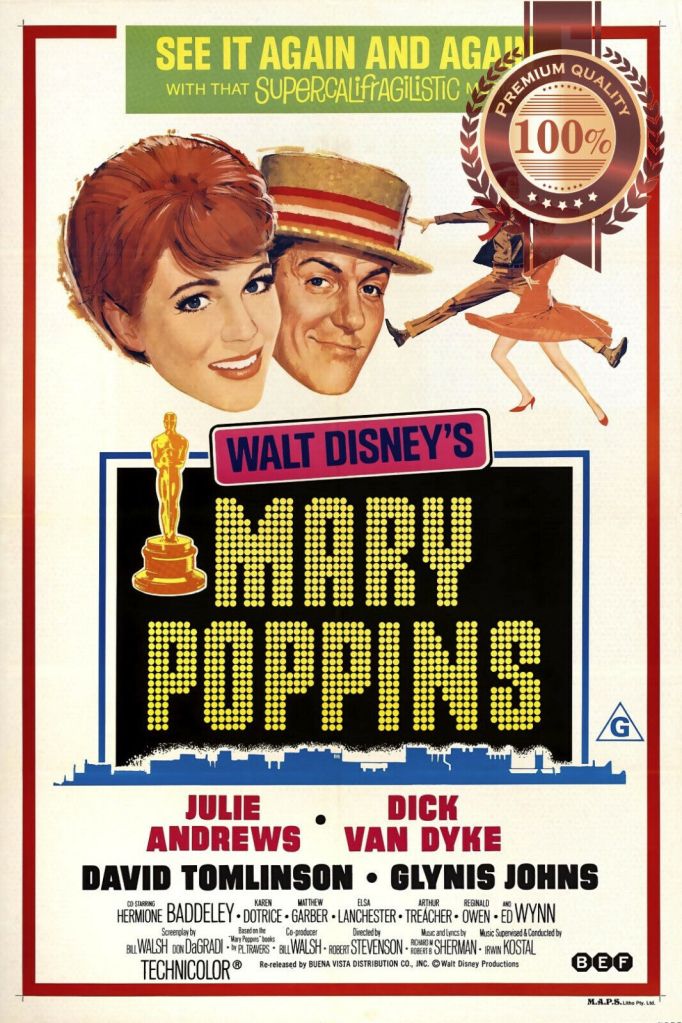
Though substantially altered for the screen, runner-up The Graduate (1967) was based on the bestseller by Charles Webb. Doctor Zhivago (1965), Gone with the Wind (1939)* and Ben-Hur (1959) ** were based on bestsellers by, respectively, Boris Pasternak, Margaret Mitchell and Lew Wallace. Mary Poppins (1964) which placed sixth for the decade, despite the musical additions of the Sherman Brothers, was based on a series of much-loved children’s books by P.L. Travers, who didn’t much care for the Disneyfication.

Multiple Oscar-winner My Fair Lady (1964) followed The Sound of Music template, based on a 1913 play Pygmalion by George Bernard Shaw, and a subsequent film of the same name a quarter of a century later, before falling into the hands of Broadway team Lerner and Loewe. The biggest box office surprise was that it didn’t beat The Sound of Music at the movie box office because it had trounced it on Broadway, racking up nearly double the performances. The Sound of Music wasn’t even the best performing of the Rodgers and Hammerstein Broadway portfolio, lagging in third place, a long way behind South Pacific and Oklahoma!.

British author Ian Fleming was the single-best argument for buying novels over screenplays. Books could be purchased for relatively small sums, if the well was tapped early on, and thanks for the development of the sequel business, Thunderball (1965) snapped up ninth spot. You might imagine Cleopatra (1963), especially with its emphasis on the racy Elizabeth Taylor-Richard Burton romance, was an original work, but that, too, was based on previous publications of the non-fiction variety.

William Rose’s original screenplay was as instrumental in Guess Who’s Coming to Dinner reaching tenth place as he was in It’s A Mad, Mad, Mad, Mad World (1963) becoming one of only two original screenplays to feature in the next ten movies on the box office chart, that madcap comedy targeting eighteenth. Robert Benton and David Newman’s original screenplay (with a little help from Robert Towne) helped Bonnie and Clyde (1967) after a faltering start to cling on to 13th spot.

You might also imagine James R. Webb delivered an original screenplay for the Cinerama roadshow How the West Was Won (1962) – which finished 12th in the rankings – but while not based on a bestseller it was adapted from an extensive series of non-fiction books on The Old West published by Time-Life.

Of the other films registering in the top 20, five originated as novels, and two were first seen on the stage.  The fiction quintet featured another deuce from the pen of Ian Fleming – Goldfinger (1964) and You Only Live Twice (1960). Jacqueline Susann was responsible for the bestseller Valley of the Dolls (1967), E. M. Nathanson for The Dirty Dozen (1967) and  E.R. Braithwaite for To Sir, With Love (1967). West Side Story (1961) was another adaptation  of a Broadway musical while The Odd Couple (1968) was from prolific playwright Neil Simon.

It probably escaped your notice but this iconic image is taken from the scene where they die.

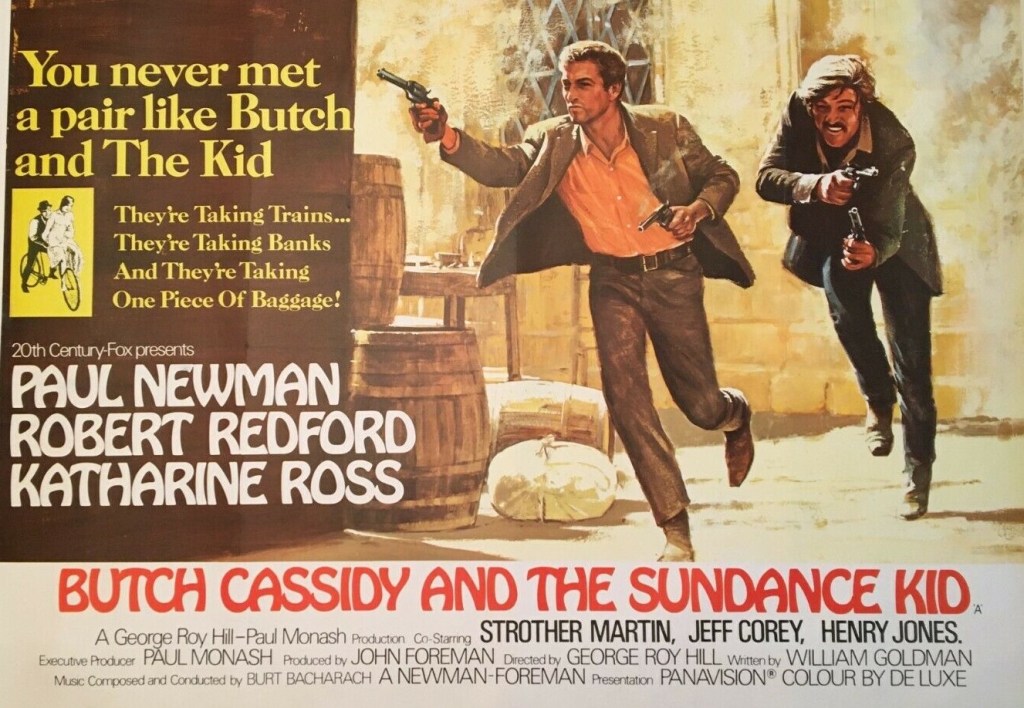
There was similar reliance on proven hits in the next 20 movies. Only two pictures  – Those Magnificent Men in their Flying Machines (1965) by Ken Annakin and Jack Davies and Butch Cassidy and the Sundance Kid (1969) – were original screenplays, though Twentieth Century Fox shelled out a record $400,000 to secure the rights to the latter from writer William Goldman.

Even movies like The Love Bug (1968) and Bullitt (1968) were originally novels. The bulk of these next twenty came from publishing, though Funny Girl (1968), Romeo and Juliet (1968), Who’s Afraid of Virginia Woolf (1966) and Thoroughly Modern Millie began on stage, the latter not from Broadway but the British West End.

Of course, not much has changed. Half this year’s Best Picture Oscar candidates are based on published works. Poor Things was based on the book by Scottish novelist Alasdair Gray, Zone of Interest from the novel by Martin Amis, Killers of the Flower Moon by the non-fiction work by David Grann, Oppenheimer on the biography American Prometheus by Kai Bird and Martin J. Sherwin, American Fiction from Percival Everett’s novel Erasure.

*Gone with the Wind was reissued in 1967 as a 70mm roadshow and, coupled with a 35mm wider release the following year, cleaned up at the box office, making more money than it any of its previous four revivals put together.

**Ben-Hur (1959) ran in Nov-Dec 1959 in only a select number of cinemas, collecting, by my calculations no more than $1 million in rentals. Therefore, I deduced that in reality the vast bulk of its box office was taken in the 1960s and therefore in any accounting of that decade’s movie rentals was more fairly to be included then than in the previous decade.

SOURCE: The Magnificent 60s, The 100 Most Popular Films of a Revolutionary Decade by Brian Hannan (McFarland, 2019).

Behind the Scenes: Hollywood Bloodbath, 200 Movies Shelved or Scrapped

I’ve covered quite a few films now with top stars – The Appointment (1969), The Picasso Summer (1969), The Extraordinary Seaman (1969) – denied cinematic release but I didn’t realize just how endemic the problem was. The bloodbath that followed the financial collapse of major studios at the end of the 1960s you could perhaps understand but, with exhibitors crying out for new movies at a time when supply had stalled, I was astonished to discover that over 120 movies had been shelved in the U.S. long before studios felt the pinch at the end of the decade.

Once the squeeze began to bite, studios threw away over a hundred projects in which they had already invested upwards of $20 million in screenplays, fees for principals and extensive pre-production. Movies for which advertising campaigns and posters had already been designed – such as Avco Embassy’s A Small Town in Germany based on the John Le Carre bestseller were closed down.

Only one of these Avco Embassy movies was made.

It’s always hard to get a grip on what studios have already spent on movies that continue to miss out on actually entering production. But it was estimated that over three decades MGM and another producer had shelled out over $750,000 in a vain effort to bring to the screen the Mildred Cramm bestseller Forever, published in 1940.

As the 1970s beckoned, nobody knew what worked any more. The situation was similar to now. For comic books and multiverses, read roadshows. Audiences had fallen out of love with big-budget all-star-cast pictures that relied on audiences stumping up for increased ticket prices to view movies in 70mm in initial run – equivalent to the IMAX uptick these days. But they hadn’t particularly fallen in love with what studios thought might be adequate replacements.

While box office went some way to pointing out where the industry had catastrophically got it wrong, it didn’t quite explain why so many movies were deemed unfit for cinematic screening in the U.S. even after they might have been given a release (such as American-funded European films) in their country of origin. A PhD student called Norman Kagan (who later published a book on Stanley Kubrick) uncovered a list of 127 movies that had been shelved by American studios.

As well as The Picasso Summer headlined by Albert Finney (Two for the Road, 1967) and The Extraordinary Seaman toplining Faye Dunaway (Bonnie and Clyde, 1967) and David Niven (The Impossible Years (1968), Kagan discovered a whole raft of films that had fallen foul of the U.S. distributor that in previous decades would have easily been double bill fodder. These included: Burt Reynolds in Fade In (1968), Ray Milland in Hostile Witness (1968), Anthony Quinn in The Rover (1967), Rita Hayworth in Sons of Satan (1968), Claudia Cardinale in The Adventures of Gerard (1970), Marcello Mastroianni and Rita Tushingham in Diamonds for Breakfast (1968), Geraldine Chaplin in I Killed Rasputin (1967) and Stephen Boyd and Gina Lollobrigida in Imperial Venus (1962).

Good enough for British audiences – but not American.

The list went on – Ann-Margret in Criminal Symphony/Criminal Affair (1968), Jean Seberg in The Road to Corinth (1967), Ginger Rogers in The Confession (1964), Richard Widmark in A Talent for Loving (1969), and Catherine Deneuve in French Mistress/Manon 70 (1968). And on – there were over 100 other pictures that never saw the light of day in an American cinema – and  proved just how fragile the marquee value of top stars who at one time or another had solidified their box office status with a string of hits.

You could add to that list a bunch denied release by Warner Brothers such as Sophie’s Place/Crooks and Coronets (1969) starring Telly Savalas, Hammer sci fi Moon Zero Two (1969), Crescendo (1970) with Stefanie Powers, Rabbit Run (1970) starring James Caan and The All-American Boy (1969) with Jon Voigt, all of which, like The Appointment, were first screened in America on television. Some movies, initially apparently as tough a sell, like Performance (1970), gained cinematic exposure.

In 1969 the studios collectively made losses of over $100 million. MGM, the worst-hit, $35.3 million in red, went into meltdown, closing down prestigious projects like Man’s Fate to be directed by Fred Zinnemann (A Man for All Seasons, 1966) and Martin Ransohoff’s production of Tai-Pan with Patrick McGoohan in the lead which between them had budgets approaching $20 million, including $8 million spent on pre-production. Also dropped was She Loves Me to star Julie Andrews and directed by Blake Edwards.

Warner Brothers, facing a $25 million loss, called time on 50 projects including Andrej Wajda’s Hollywood debut Heart of Darkness, William Dozier’s The Well of Loneliness, Edward Dmytryk’s Act of Anger, Nunnally Johnson’s The FrontiersmanGod Save the Mark based on the Donald Westlake bestseller, Sentries based on the Evan Hunter thriller and Paradise from the Edna O’Brien story. Two Samuel Peckinpah movies were axed – North to Yesterday and Diamond Story. Mervyn LeRoy saw his pair – musical 13 Clocks based on the James Thurber bestseller and Downstairs at Ramsay’s – go the same way.

Also culled – Bryan Forbes’s Napoleon and Josephine, Joseph L. Mankiewicz’s Shakespeare biopic The Bawdy Bard and Bud Yorkin’s Hubba Hubba. Some later resurfaced but with different principals – Martin Ritt no longer attached to The Man Who Would Be King (1975) nor Sidney Lumet to 99 and 44% Dead (1974). WB was ruthless and also called time on Francis Coppola ventures Santa Rita and Vesuvius, Stuart Rosenberg’s Julie in Love, Elia Kazan’s Puerto Rico Story, and on adaptations of Robert Heinlein sci fi classic Stranger in a Strange Land, William Faulkner’s Wild Palms and Edna O’Brien’s August Is a Wicked Month as well as a movie based on Crosby and Nash’s song Wooden Ships. Universal scrapped 15 movies whose screenplays or book rights had been purchased just months bore.

Good Times, Bad Times, dead in the water in 1968, was reactivated two years later. Despite strenuous efforts and Elliot Gould and Kim Darby on A Glimpse of Tiger replaced by Barbra Streisand and Ryan O’Neal plus Peter Bogdanovich at the helm that one failed to pass muster  though the last-named trio later collaborated on What’s Up, Doc? (1972).

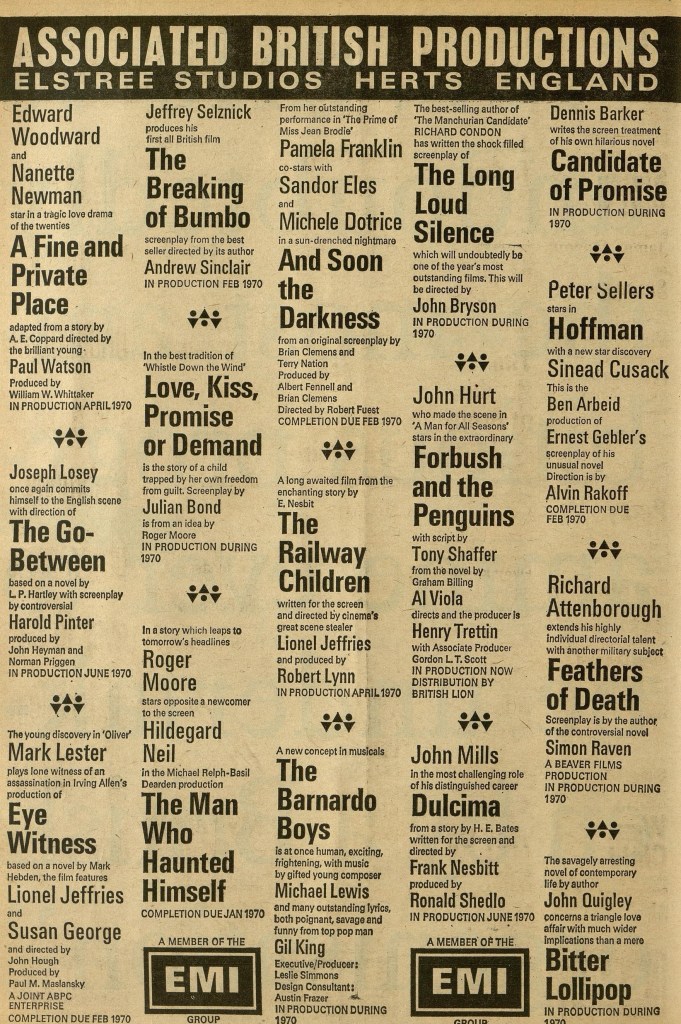
As well as A Small Town in Germany, Avco Embassy curtailed development of The Inheritors from the Harold Robbins bestseller, Willie –  a biopic of Somerset Maugham – Little Me from the Neil Simon musical and When the Lion Feeds from the Wilbur Smith novel. In Britain, ABPC scratched A Question of Innocence starring Roger Moore and Feathers of Death directed by Richard Attenborough.

Some of the shelved films were released abroad – Crooks and CoronetsDiamonds for BreakfastMoon Zero Two and Crescendo finding cinema distribution in the U.K. – but as we have seen from MGM executives dismissing foreign interest in The Appointment there was clearly a two-tier system at work with Hollywood determining that countries abroad had lower standards than the U.S. Equally, Hollywood studios argued that if a film didn’t deliver in a test run in a big city it was “pointless to chase additional bookings beyond the initial engagement and sometimes unwise to open at all.”

PREVIOUSLY REVIEWED IN THE BLOG: What it says about the Blog or my ability to find old lost films I don’t know but the following films have been reviewed in the Blog: The AppointmentThe Picasso SummerFade InThe Extraordinary SeamanHostile WitnessCriminal Symphony/Criminal Affair. And I will endeavour to chase up more.

SOURCES: Advert, Kine Weekly, Dec 21, 1968, “Deferred Film Deals of W7,” Variety, July 23, 1969, p5; “Projects Scratched at Warners,” Variety, October 22, 1969, p6; “Ransohoff Lacks Word on Tai Pan,” Variety, October 29, 1969, p4; “Red Sunset on Write-Downs,” Variety, November 26, 1969, p3; “Universal Bathes in Youth Fountain,” Variety, December 10, 1969, p3; “WB’s 29-To-Come,” Variety, January 14, 1970, p7; “Unsalvageable Cupboard Item,” Variety, August 19, 1970, p3; “ABPC Suspends,” Variety, October 21, 1970, p25; “Picker on Flop Loss-Cutting,” Variety, August 26, 1970, p3; “Glimpse of Tiger Buried 2d Time,” Variety, May 12, 1971, p4; “In Shortage Era, 127 Lost Features, Unsellable Edsels of Celluldoi Mart,” Variety, December 22, 1971, p21; “TV-Bearish WB Cupboard,” Variety, May 29, 1972, p3.

Behind the Scenes: “The Appointment” (1969)

When the Cannes Film Festival in 1969 gave The Appointment the honor of being the first film invited to compete it looked like an exercise in kudos. Quite how that turned into a humiliation that would deny the Sidney Lumet picture a U.S. release was one of the oddest stories of the decade.

Lumet, it has to be said, was not exactly flying high. After the double whammy in 1964 of The Pawnbroker and Fail Safe, his career had stalled, The Group (1966) not delivering the expected box office, fired from Funny Girl (1967) and The Deadly Affair (1967), Bye Bye Braverman (1968) and The Seagull (1968) all misfires. So it probably seemed like the ideal career fillip to recharge his creative batteries in Italy, with a movie starring Omar Sharif and Anouk Aimee, both Oscar-nominated and still bathing in the warm afterglow of worldwide successes via Doctor Zhivago (1965) and A Man and a Woman (1966), respectively.

Aimee had made the list of female stars dominating the box office along with the likes of Barbra Streisand, Faye Dunaway, Jane Fonda, Catherine Deneuve, Julie Christie, Mia Farrow, Julie Andrews and Joanne Woodward.  Although producer Martin Poll had a spotty record – just rom-com Love Is a Ball (1963) and thriller Sylvia (1965) on his dance card – that would change with  his most ambitious project to date, The Lion in Winter (1968) pairing Peter O’Toole and Katharine Hepburn.

In truth, Lumet thought the original screenplay by the distinctively offbeat James Salter – undergoing a highly productive period, Three (1969) and Downhill Racer (1969) also on the launch ramp – “a silly story” but one that “could be salvaged with careful creation of mood, texture and dialog.” But he was virtually the only American on the project, Sharif Egyptian, Aimee French while the rest of the cast (excepting Austrian Lotte Lenya) and crew was Italian.

Shooting began at the end of February 1968. Martin Poll had been already working for seven months on the project ensuring it didn’t suffer from the production mishaps that had blighted another, bigger, MGM production, The Shoes of the Fisherman (1968). Interiors were shot at the Palatino studios (now fully soundproofed) in Rome, with a key sequence filmed at Lake Bolsena 100km to the north, and Poll had gained permission to shoot in key locations in the capital including Via Condotti leading to the Spanish Steps.

But the lake proved a trial. High in the mountains, located in a crater, it was prone to sudden squalls. First day of shooting coincided with “maverick” winds on the lake. The 40ft boat hired to transport the crew three kilometres across the lake to the tiny island was wrecked. A helicopter flew in two smaller replacements, and helped ferry passengers across, but only if they signed disclaimers absolving Poll of any redress should there be an accident.

Contract never fulfilled although it formed part of Avco embassy’s 20-page advert
in Box Office magazine in November 1968.

Poll had also granted the director a week’s rehearsal time with the full cast, the movie was filmed with direct sound, rather than the traditional Italian post-production synching. And he had been hard at work on a fashion promotion campaign, highlighting the 40 haute couture designs that designer Ghelardi had created for one sequence.

A fashion show was being programmed as part of the world premiere in Rome on April 2, 1969, with the expectation that newspaper and television coverage would drive up global media interest. Poll had also set up 26 openings worldwide as the first wave of an ambitious release program to start a few days later to capitalize on the Easter break. It was all looking good – the movie had even come in under budget and a week ahead of schedule.

But the world premiere and the global release pattern were cancelled when, out of the blue, the movie was invited to compete at Cannes. The showing there would constitute the world premiere. The existing strategy was shelved in the hope that victory at the festival would provide a bigger marketing hook. Cannes had already suffered controversy that year after Carl Foreman quit the jury following censorship in France of his big-budget Cinerama roadshow western Mackenna’s Gold (1969), incidentally also starring Sharif.

Nothing went according to plan at Cannes. Festival audiences booed and whistled and waved white handkerchiefs in a sign of their disapproval. Variety called it a “flimsy love story” while condemning Sharif’s performance as “laughable.” What should have been a triumph turned into a disaster. MGM pushed back release a year until further work was done on the film.

But even as MGM was considering what to do to produce a version that might satisfy U.S. exhibitors, audiences in other parts of the world had decided there wasn’t much wrong with the version shown at Cannes. In fall 1969, the movie registered “sensational grosses.” In Japan rentals topped $1 million, in Manila there was an “unusually long run” and it broke records in Buenos Aires. Even so, Stateside executives were dismissive, “abroad, speed doesn’t mean that much,” they declared and set about changing the movie.

Under the terms of Lumet’s contract his right to final cut should have prevented any tampering with the picture. Unfortunately, he had gone along with the general consensus that the Michel Legrand score, minimalist though it was, required changing. But substituting John Barry music took the movie past its agreed completion date, thus negating Lumet’s contract and allowing MGM free rein.

At first, following a “disappointing” sneak preview in the U.S. in 1969, Lumet was involved in the editing but the studio found it easier to move forward if the original director was not looking over its shoulder. A new editor, Margaret Booth, was called in. She sliced 25 per cent out of the picture and added stock Italian footage to give the movie what MGM guessed would pass for “authenticity”, a more sun-kissed version of the country. MGM’s assessment was that  the new version was “much better, much faster, playable.”

Lumet disagreed, “The MGM version now makes no sense. Characters appear and disappear, plot elements emerge and then are dropped. It’s ridiculous.” Being enraged was as close as the director came to affecting the outcome. It wasn’t the only box office disappointment facing MGM at the time. Much of the $20 million invested in four pictures – The AppointmentGoodbye Mr Chips (1969), Zabriskie Point (1970) and Captain Nemo and the Underwater City (1969) – was lost.

A “disappointing” test date in April 1970 in San Francisco confirmed what the studio feared. The movie was unreleasable. It might have been a different story if the two stars had unassailable box office track records. But Omar Sharif’s career had dipped. Mayerling (1968) though a success abroad barely hit the million-dollar mark in the U.S., while Mackenna’s Gold , Che! (1969), The Last Valley (1970) and The Horsemen (1971) were all expensive flops.

Anouk Aimee had done little better, pulling out of The Mandarins with James Coburn,  Fox’s big-budget Justine (1969) a spectacular flop, Jacques Demy’s The Model Shop (1969) – “a really bad movie” according to Vincent Canby of the New York Times – also tanking and Columbia failing to find a release slot for One Night A Train (1968).

Lumet remained in a commercial wilderness. He was touted in a two-page advertisement as lining up two features for Avco Embassy, but they never appeared, nor did The Confessions of Nat Turner and We Bombed in New Haven, based on the Joseph Heller play, while Last of the Mobile Hot Shots (1970) with James Coburn flopped. He only managed an unexpected return to form with hit crime caper The Anderson Tapes (1971).

The 100 prints made by MGM – half in the original version, half the recut version – sat on the shelf as new studio management pondered whether the film was worth any further investment in the advertising and marketing required to shape a launch or even worth wasting any more time. In the end, it took the easier option, and without permitting any more cinematic screenings, sold it to CBS for its Late Movie slot – “the film buff graveyard” – which played host to such other lost pictures as The Picasso Summer starring Albert Finney and John Frankenheimer’s The Extraordinary Seaman (1969) with Faye Dunaway.

Beyond the abortive sneak preview and the test showing, the first anyone in America caught glimpse of The Appointment was on July 20, 1972 – three years after its Cannes disaster – on the small-screen on CBS.

SOURCES: “Roman Settings for Appointment,” Variety, February 28, 1968, p25; “Appointment Has Quick Dates with Squall,” Variety, March 20, 1968, p28; “Elated Poll Completes Appointment,” Variety, June 2, 1968, p22; Advertisement, Variety, November 13, 1968, p54-55; Shelagh Graham, “Film Industry in New Garbo Epoch as Femme Stars Dominate B.O,” Variety, January 8, 1969, p1; “Anouk of the Scram,” Variety, January 29, 1969, p26; “Holdbacks Explained,” Variety, February 26, 1969,   p21; “Set Appointment Preem in Rome,” Variety, February 26, 1969, p38; “MGM Cancels Italo Appointment So As To Qualify at Cannes,” Variety, March 19, 1969, p5; “Appointment in Cannes,” Variety, April 16, 1969, p13; “Booing of Metro’s Appointment,” Variety, May 28, 1969, p28; Review, Variety, May 28, 1969, p34; “Re-edit Appointment After Cannes Booing,” Variety, July 9, 1969, p5; “Lumet Ponders Slave Revolt,” Variety, September 3, 1969, p6; “Capsized in Cannes,” Variety, September 19, 1969, p5; “Appointment Does Big Biz O’Seas,” Variety, October 8, 1969, p5; “MGM Delayed Appointment Pic,” Variety, January 20, 1970, p5; “MGM Write-Downs,” Variety, April 22, 1970, p5; “Cannes-Jeered Pic,” Variety, July 19, 1972, p7.

Behind the Scenes: 1967, The Year The Oscars Went Sour

Setting aside diversity and inclusion issues and the invasion of streamers, the integrity of the Oscars have been under attack for a good few decades. Most observers put this down to the influence of the Weinsteins who began to use the awards as a major plank of their marketing, often spending more on that element of publicity than anything else.

The submission rules are simple: a movie has to play for one week in Los Angeles before the end of the year. That accounts for the rush of prestige-related product in the Xmas period. Occasionally, an entry would be rejected because it was shown outside the strict geographical confines of the city. But mostly movies appeared in this fashion to test the waters.

Oscar upfront and central.

Even before the nominations were announced, critics and observers would be garlanding various pictures with high praise, anointing them certainties for recognition, which, in the era of social media, was often as good as, if not better than, actually gaining a nomination. And nowadays there’s even mileage if a favorite falls at the last hurdle, endless articles doing the rounds on movies that were “snubbed,” such manufactured outrage bringing extensive media coverage.

In Britain, where I grew up, I distinctly remember a flurry of distinguished movies being released in March/April, capitalizing on nominations and/or wins. In the U.S. the release pattern tended to be more fluid, studios holding back on wide release until nominations were in the bag.

The Weinsteins changed all that by aggressively targeting Oscar voters, helping build the Golden Globes as an indicative precursor to the bigger awards, and creating a marketing tsunami behind any of their movies that got a sniff of a nomination. Eyebrows were certainly raised at these tactics, but, Hollywood turned a blind eye mostly especially in years when box office gross could be achieved by appealing to the lowest common denominator and Oscar bait was viewed as an acceptable route for financially weaker studios or mini-majors.

Although there had always been a few winners that appeared to come out of left field – Marty (1955), the classic example – and the industry displaying a penchant for awarding a best actor/actress award to a neophyte – step forward Yul Brynner (The King and I, 1956) and Julie Andrews (Mary Poppins, 1964) – or to a veteran deemed worthy (John Wayne for True Grit, 1969), it was generally accepted that awards were always genuine and reflected the mood of the time.

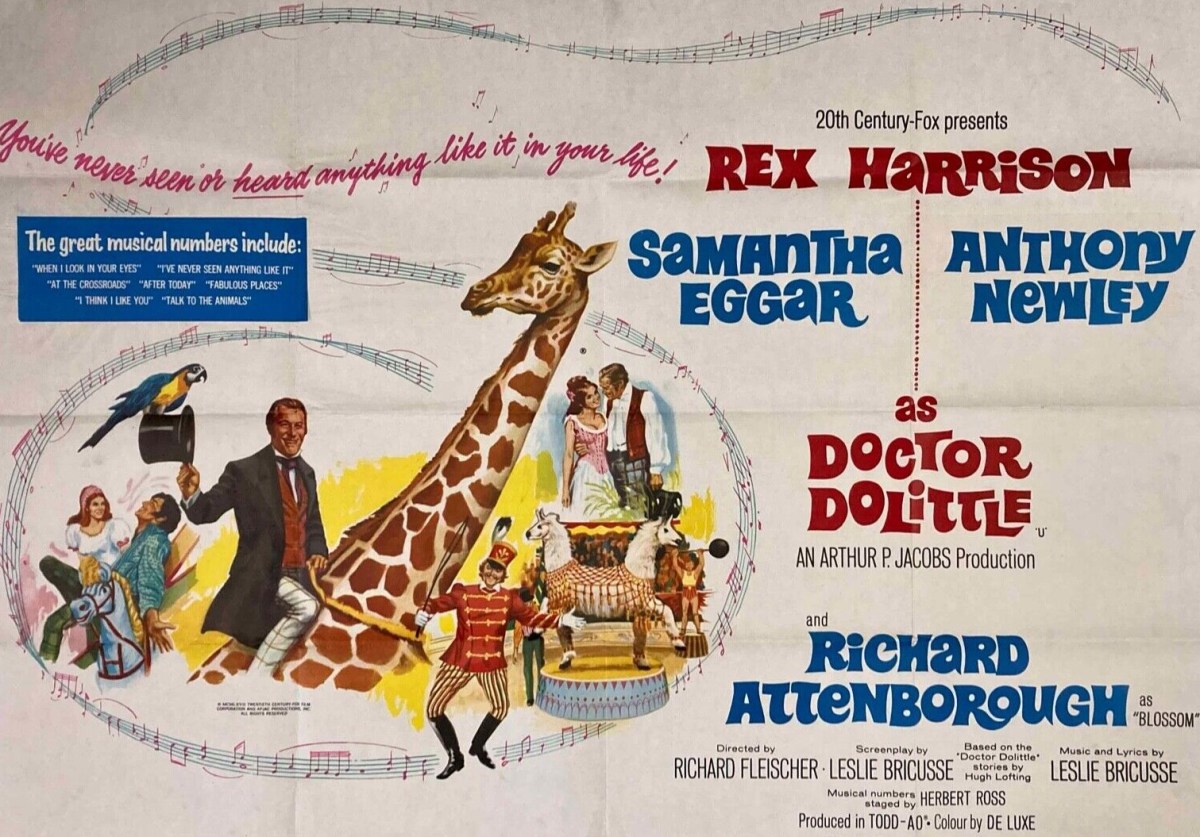
There was no hint of overt machination, of tweaking the system, until observers started questioning just how musical Doctor Dolittle managed to leapfrog into the Best Film category in 1967 ahead of more obvious candidates like Cool Hand Luke and In Cold Blood not to mention Wait until Dark, Point Blank or Accident. Or even better-reviewed and better-performing musicals such as Camelot and Thoroughly Modern Millie.

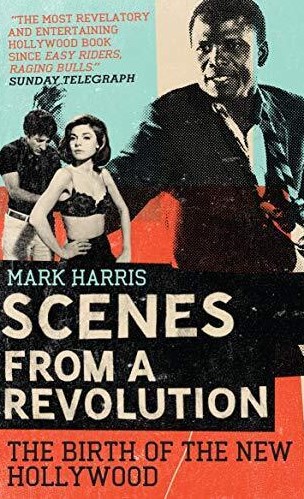
And it might well have remained just an anomaly until investigative journalist Mark Harris dug out the truth for his book Scenes from a Revolution (2008) which, on focusing in the other, more worthy candidates for Best Picture – Bonnie and Clyde, The Graduate, In the Heat of the Night and Guess Who’s Coming to Dinner – used that to frame his argument that Hollywood had finally come of age in terms of addressing racism, violence and sex and  welcoming new talent. 

Except that loading Doctor Dolittle into the equation blew a hole in his brilliant thesis, unless he was making a diversity pitch for talking animals. There had to be an explanation. It made no sense that Hollywood denizens who had voted for Bonnie and Clyde and The Graduate could be equally enamored of the musical.  But, of course, that’s not the way nominations work. At this stage voters aren’t voting for all the pictures, they are voting for an individual favorite.

So, clearly, what had occurred was a major division. It could easily ascribed to a difference in taste. Those who voted for the other quartet clearly shared similar sensibilities. Those who opted for Doctor Dolittle were going against the grain. It was easily explainable as old-timers hitting out as much as older audiences did against a tide of sex and violence, rewarding a return to more innocent times. Or perhaps some kind of recognition that since the musical – The Sound of Music (1965), Mary Poppins – was deemed in some circles to have saved Hollywood then it was only fitting that a new musical should be honored in some fashion.

The truth was darker and left a bitter taste. Twentieth Century Fox, the studio which had put $31 million in production and marketing fees behind Doctor Dolittle and was heading into the same budget stratosphere for Star! (1968), wanted to use Oscar leverage to box office advantage, reviving a picture that was headed for the flop counter and reversing perceived critical disapproval.

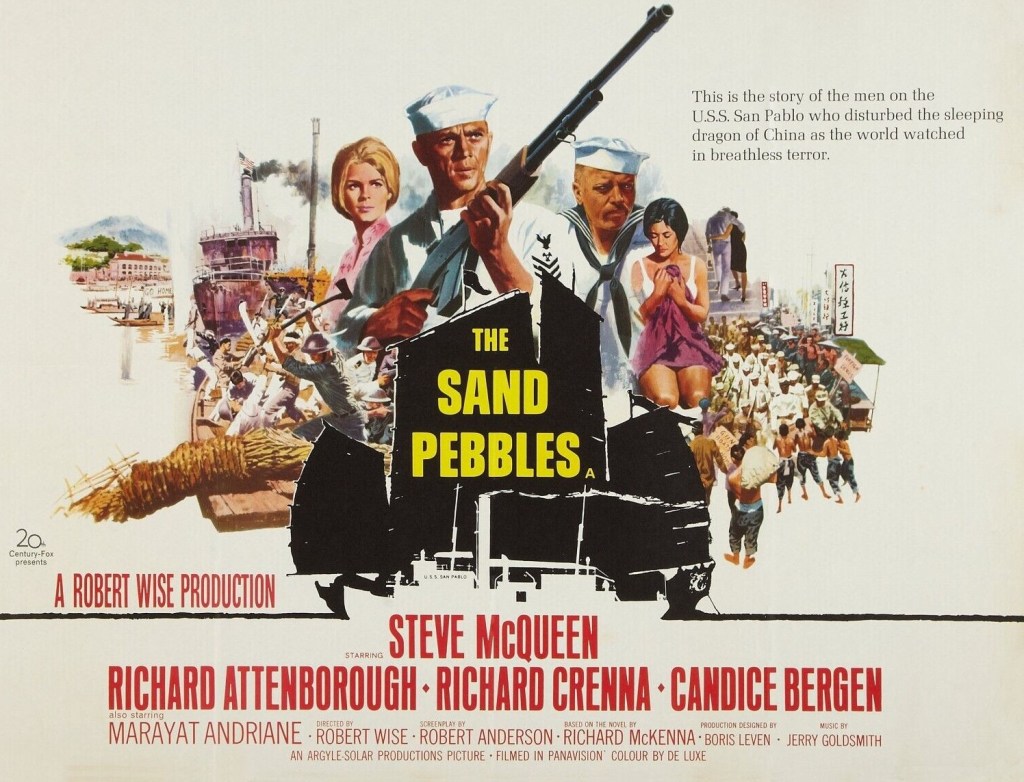
In short, it put the screws on any employees who had a vote. There was the usual public campaign that in those days revolved around ads in the trades, but there was also a behind-the-scenes crusade, calling in favors and debts, putting the squeeze on anyone whose career had depended on or might in the near future depend on the studio. Harris argued that Fox had previously adopted this ploy, pointing to nominations for The Longest Day (1962), Cleopatra (1963) and The Sand Pebbles (1966) but, when compared to Doctor Dolittle, these seemed works of cinematic genius.

In the days before VHS, DVD and digital, the only way for voters to get a first or second look at a prospective candidate was for studios to line up showings in private screening rooms or to hire out a cinema for evening, though it would be pretty safe to assume that if your movie was of the blockbuster variety – as in The Longest Day, Cleopatra and The Sand Pebbles – most voters would have already seen it at least once.

To ease access to Doctor Dolittle, Twentieth Century Fox booked out its own theater, plusher than most movie houses, at its studio for 16 consecutive nights. It threw in free dinner and champagne and presumably there was a high-ranking executive, if not the overall boss, to gladhand his way around the post-screening dining tables to ensure the guests knew just how much the studio was counting on them to do the right thing.

While the ploy worked as a method of finding the movie a place at the nominations high table it didn’t appear to sprinkle magic box office dust on the movie. U.S. rentals only came to $3.5 million, less than 15 per cent of its cost. But, probably, in reality it did. Since there was a considerable gap between U.S. and foreign release, it was often foreign distributors who benefitted most from the Oscar aftermath. In this case, Doctor Dolittle’s foreign box office – $12.8 million – far exceeded domestic. It didn’t mean the movie turned a profit, far from it, but it certainly limited the damage.

The damage, in other ways, could not be measured. A studio had interferered with the sacrosanct. Instead of being lambasted, and this being Hollywood, what could you expect except that in future years other studios would take a similar route, resulting in the kind of questionable nomination still going on today, in fact even more pervasively as a result of an upsurge in pressure groups producing often unlikely candidates.

Behind the Scenes: “The Pink Jungle” (1968) and the James Garner Conundrum

Like many an actor during the 1950s and 1960s – and it’s still going on – James Garner wanted to take greater control of his career. But he’d been doing that since he started out in the business, going on such an almighty tantrum with Warner Brothers, whose television arm had provided his big break via Maverick (1957-1962), that it resulted in a heavily-publicized spat that ended up in court. Garner objected to the kind of square-jawed roles in relatively lightweight movies (Up Periscope, 1959, Cash McCall, 1960) that his employers deemed most suitable to build his screen persona. He hankered after for more complex material.

Mirisch came to the rescue, hiring him for The Children’s Hour (1961), though only in a third-billed capacity, but thereafter offering him a three-picture deal, an action that appeared to provide him with professional sanctuary and when he received $150,000 for The Great Escape (1963) his actions seemed justified and he was “pegged as the natural successor to Clark Gable.”

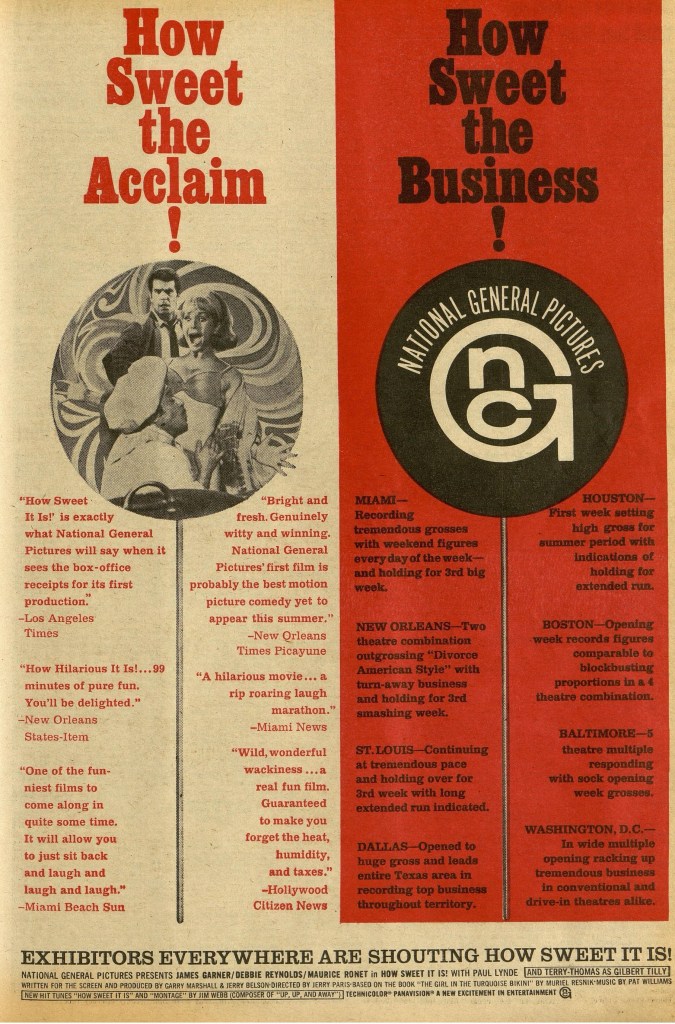
Advert for “How Sweet It Is.”

But his notion of what might appeal to audiences, the kind of amiable almost knowing-wink characters, didn’t go down as well at the box office as he might have imagined. And when he was cast as the lead – though, critically, not guaranteed above-the-title status – in 70mm roadshow Grand Prix (1966) his presence was blamed for the movie not doing as well as expected. And it was soon apparent to all that he was far from a box office high-flyer. In fact, on the domestic market, his movies always made a loss.

Except for The Art of Love (1965), where you could equally argue Dick Van Dyke was the main attraction after the success of Mary Poppins, the movies in which he had been the star (excluding the likes of Move Over, Darling, 1963 and The Americanization of Emily, 1964 where he played second string to Doris Day and Julie Andrews, respectively) took in an average rental of $1.5 million, way below what they cost to make.

He was viewed as a perennial loser in the hard-nosed world of Hollywood that took earnings as its sole measure. Worse, Variety held up to scrutiny his choices, complaining he had “forsaken tough guy roles for indifferent comic assignments and two misjudged roles as a tormented amnesiac” (36 Hours, 1964, and Buddwing/Mister Buddwing, 1966)

Sensing which way the wind was blowing, Garner set up his own production company. He was in good company – Burt Lancaster, John Wayne, Dean Martin, Frank Sinatra among that coterie. Cherokee Productions was intended to be the vehicle by which he would control his own career and prove, once again, that he was better at it than any studio. His final movie as a purely salaried performer was Hour of the Gun (1967) the last picture in his Mirisch deal, which paid him “not much.”

Cherokee announced two pictures to be made in spring and summer 1967, Doll from the Ed McBain thriller and Buffalo Soldiers based on the John Prebble book and with director Ralph Nelson already in tow. Neither saw the light of day.

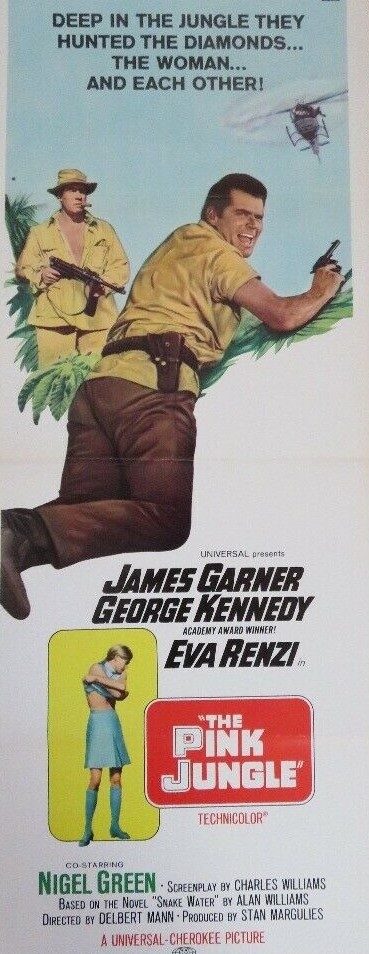
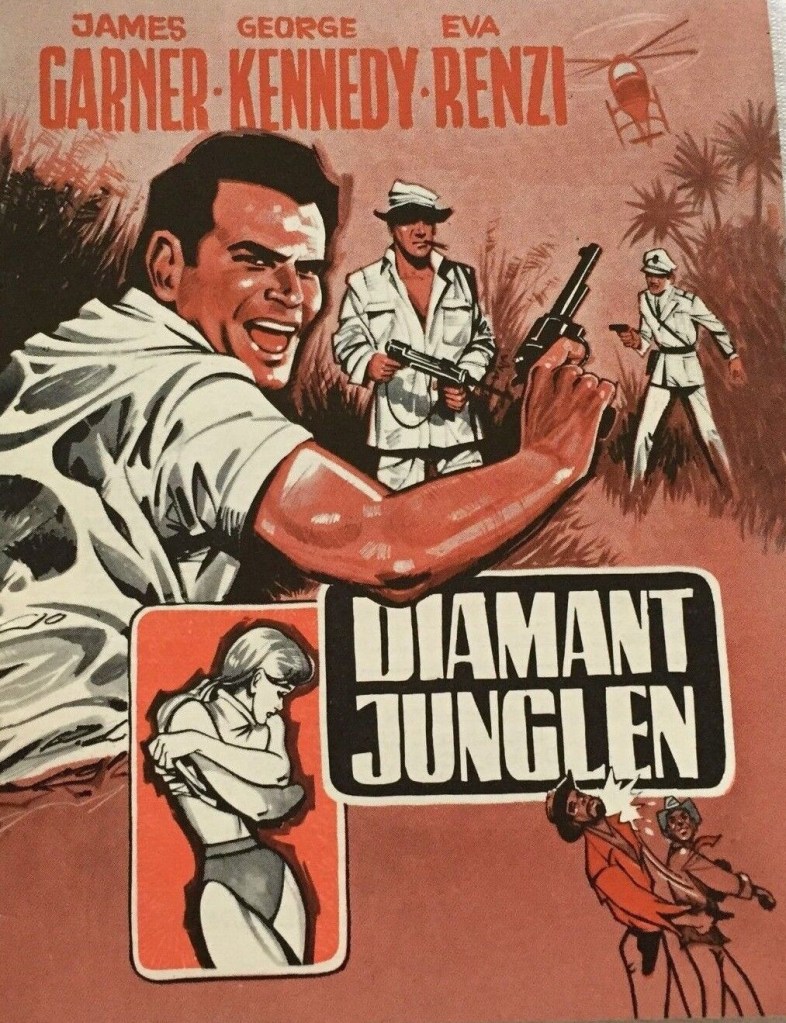
Undeterred, he tried again. This time the slate was more ambitious and achievable as it transpired: comedy How Sweet It Is (1968) co-starring Debbie Reynolds for nascent production company National General, adventure The Jolly Pink Jungle (thankfully retitled The Pink Jungle, 1968), The Sheriff (which became Support Your Local Sheriff, 1969) for United Artists and Buffalo Soldiers (still unmade).

The reason for original title for the “Jungle” picture might have been to avoid confusion with a musical earlier in the decade by Leslie Stevens called The Pink Jungle. According to some sources, it was originally intended to pair Garner with Shirley MacLaine. I never found any mention of her in my research and it seems an unlikely teaming, much as you could see how well it could play, since the actress’s asking price was $750,000 and that would make her the star rather than Garner and I’m guessing the script would be rewritten to tilt in her direction.

Given Universal was intent on not going anywhere near a live jungle it sounded, budget-wise, well out of the MacLaine league and more appropriate for the likes of rising – and cheap – West German star Eva Renzi (Funeral in Berlin, 1966).

The most studio Universal was willing to spend was to enlarge its jungle backlot by seven acres to 20 acres. Renzi had been due to make her Hollywood debut with House of Cards (1968), another Universal picture, opposite George Peppard but when she fell pregnant was replaced by Inger Stevens. The Pink Jungle didn’t get a good rep from anyone, least of all the critics. Garner complained about Renzi, and, even though he was the prime mover behind the picture, said he only did it “for the money” while for her part Renzi ragged Oscar-winning director Delbert Mann.

Neither of the first two Cherokee offerings did much to pep up Garner’s marquee value. How Sweet It Is, budgeted at $3.2 million, only returned $2.7 million in rentals in the U.S. and finished a mediocre forty-third in the annual box office league. The Pink Jungle didn’t feature at all which meant it took in less than $1 million.

Garner redeemed himself with Support Your Local Sheriff, made for a miserly $1.6 million but a worldwide hit, his best-ever performer as star. But oddly enough, it didn’t do that much for Hollywood perception. MGM initially rejected him for his next movie Marlowe (1969), another flop. Cherokee’s next two features, Italian co-production A Man Called Sledge (1970) and Support Your Local Gunfighter didn’t deliver either.

So Garner went back to television. And Warner Brothers. The upshot was J.G. Nichols (1971-1972), another western. The WB deal included movies but only one was made – Skin Game, 1971 –  and neither that nor They Only Kill Their Masters (1972) for MGM or Disney pair One Little Indian (1973) and The Castaway Cowboy (1974) made much of an impact at the box office. And it wasn’t until, ironically enough, The Rockford Files (1974-1980), produced by Cherokee for Universal, that Garner really re-established his position in the industry.  

SOURCES: “James Garner Moves from Actor Towards Future Producer Status,” Variety, October 5, 1966, p5; “James Garner’s Own Plot: Performer to Producer,” Variety, November 1, 1967, p18; “Peak Production Year for Universal Studio,” Box Office, 1967, p5; “Rising Skepticism on Stars,” Variety, May 15, 1968, p1; “Big Rental Films of 1968,” Variety, January 8, 1969, p15; “Garner Weaver Set,” Variety, March 26, 1969, p7; “20-Acre Set Prepared for Jolly Pink Jungle,” Box Office, July 24, 1969, p9; “Garner Kennedy Re-Team in Co-Prod for UA,” Variety, June 10, 1970, p4; “WB-TV Dealt Stake in Garner Series for NBC,” Variety, August 5, 1970, p28.

Behind the Scenes: Dear Mr Scorsese…or Mr Nolan

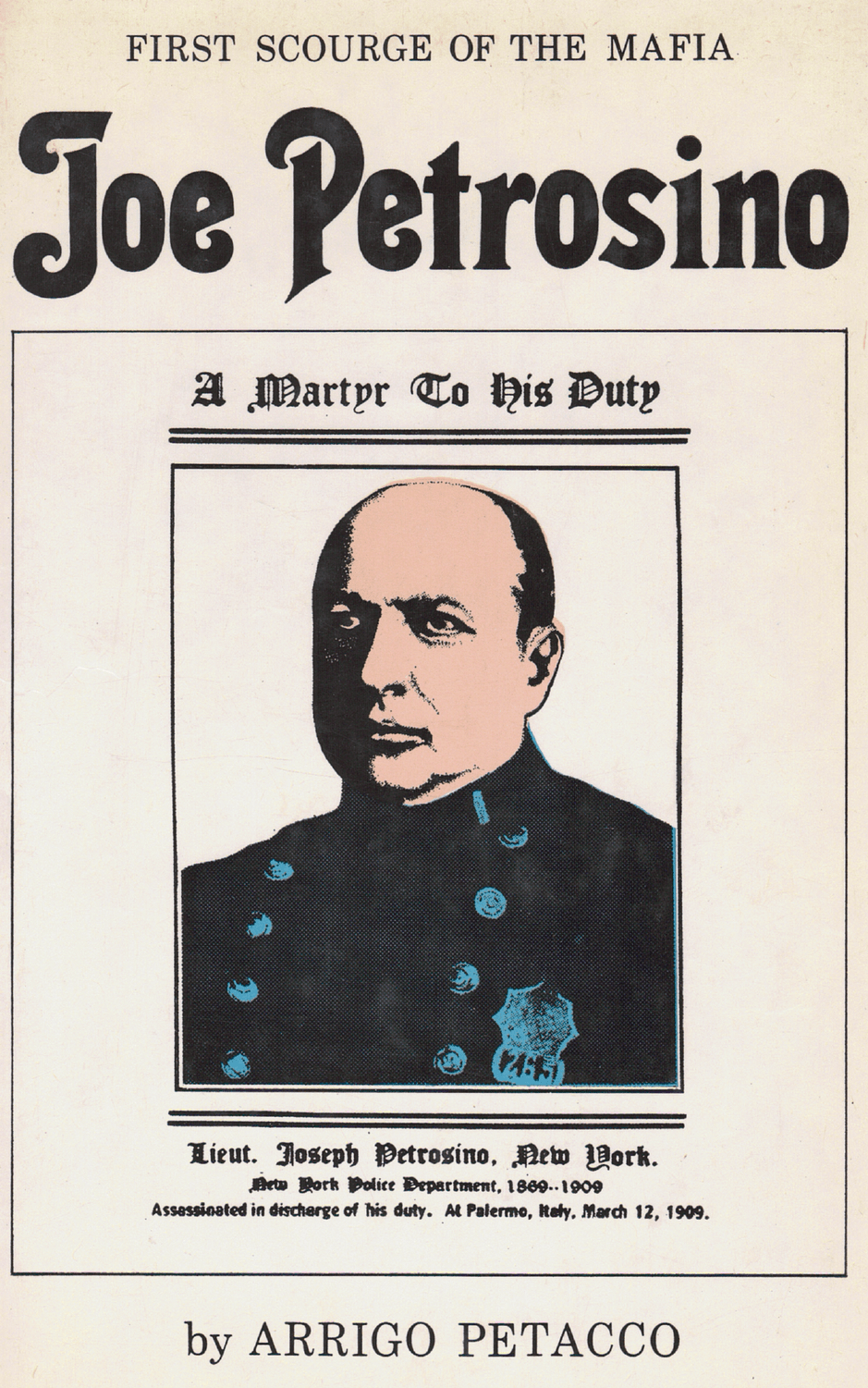
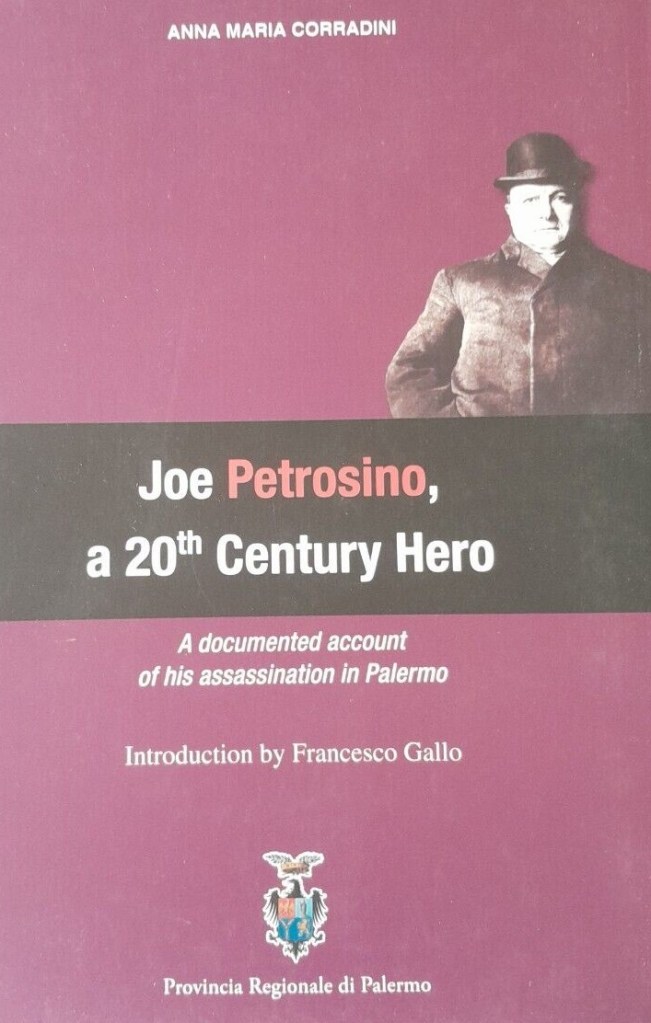
Should you be in the mood for atonement after a lifetime of deifying gangsters, Mr Scorses, you might wish to consider a biopic of the greatest cop, outside of Elliott Ness and Serpico, in American history. I’m sure Leonardo DiCaprio, who was at one time attached to a filmization of the bestseller The Black Hand (2017) by Stephen Talty, has brought the subject matter to your attention. Although Pay or Die (1960) covered similar territory, its budget and restrictions of length denied it the opportunity to properly explore the historical depth and social comment, for which in Killers of the Flower Moon (2023) you now seem more at home.

After the success of Oppenheimer (2023) audiences might be receptive to a true story about a cop who took on the Mafia a.k.a. the Syndicate a.k.a. the Cosa Nostra before it was known by any of those names and there is, to boot, a heart-rending romance that the Ernest Borgnine picture barely touched upon.

I’ve even dreamed up an opening.

A horse pulls a wagon laden with oranges and apples through a congested New York street circa 1883. As the driver pauses to make a delivery, a child, Claudia, watches from the window of her father’s shop – F. Fellini Jeweller. The horse collapses. The fruit scatters. Malnourished kids race to scoop up the merchandise. Claudia races out and strokes the horse’s mane.

We cut to a man in brown overalls striding towards the camera armed with a cleaver. The crowd parts. The child clings to her father in terror. The man raises the cleaver high over his head and slams it into the horse’s haunch. The child screams. The jeweller remonstrates with the man. The man removes his cleaver and says, “Not dead enough.”

As the credits roll, we see Claudia chasing away the flies that gather over the corpse, being pushed away by a man chiselling out the horse’s hoof, another sawing off its tail. Some days later as she is trying to pick off wriggling maggots, the man returns, this time driving a wagon. She hides behind her father.

His cleaver flashes in the sun as he hacks away at the horse. By now decomposition is so bad that the legs easily part from the body and the man is able to drag the horse bit-by-bit onto the back of his cart. Claudia watches as he leaves with the steaming carcass. We follow the wagon through the streets down to the river. A boat is waiting. The man heaves the meat onto the boat. The boat sets sail. Far out in the channels, the man begins chucking the meat overboard.

Back on dry land, the man cleans his cleaver and removes his brown overalls. Underneath he is wearing the uniform of a cop.

This is Joe Petrosino.

In those days cops also ran the Sanitary Dept in New York. Removing dead horses – they were too heavy to lift manually so you had to wait till the meat rotted sufficiently to fall from the bones – was a job for new recruits.

When Petrosino reaches the police precinct you’ll notice two things about him. He is short, well below the standard police requirement, and all the accents except his are Irish. In fact, he’s the only Italian cop on the force and only recruited because he can speak Italian and get information from all those immigrants who still can’t speak a word of English.

But he’s also very unusual especially to a contemporary audience because we’ve all been acclimatized to thinking that all Italians of this and successive generations accepted the Mafia rather than as Petrosino hating them and all they stood for. So this is effectively the tale of a silent majority who came from the same locale as the Mafia, understood their position in society in the home country, but loathed the fact that they had been allowed to infiltrate American society in part at least because they spoke a secret language (Italian) that few Americans understood or made an effort to understand with all the underlying racism that suggested.

But Petrosino’s not like a contemporary cop, forced to work within the tight constraints of the law and he’s not even like the cops of the 1930s-1960s who might have lawyers breathing down their necks and in the later decades accused by the media of breaching civil liberties. Petrosino was a good old-fashioned two-fisted cop, think James Cagney or Lee Marvin or Clint Eastwood but on the side of law and order. He thought nothing of beating up hoods, humiliating them in public as a way of showing that society was not going to stand by and let them terrorize the public.

Eventually, Petrosino was able to set up a specialist Italian-speaking squad to tackle The Black Hand/Mafia.

But he was also a superb detective. The Black Hand’s main line of business was kidnapping – little Claudia would come back into the story as a victim. Don’t pay the ransom and your business or your house would be blown up, the kidnappee killed. You may remember from old kidnapping movies that the kidnappers always cut out words from newspapers to write their demands.

Well, the only reason they ended up doing that was because of Petrosino. Prior to that, they just wrote out their demands in pen and ink. But he started to round up suspects by the hundreds and find an excuse to get samples of their handwriting. And then using the samples on file, whenever a new demand appeared he would scout the files to match the samples and go an arrest an astonished hood. So the gangsters wised up and started using newspapers.

He was also the guy who worked out that immigrants didn’t suddenly take up crime on arriving in America but they may well have criminal records back home and therefore could be extradited.

On top of that was the heart-rending love story. Petrosino had fallen for the daughter, Adelina, of a restaurant owner. Every night he dined in the restaurant. But she had been married before. She was a widow. Her husband had died young and she couldn’t contemplate marrying again to someone who was in such constant peril. So it took years of wooing, nightly meals, before she agreed to marry. The marriage lasted a year, ended by his death. He was assassinated while going into the lion’s den, the Mafia strongholds of Italy.

And all this is before you deal with the social issues of immigrant integration, of racism, of finding the new world as guilty of betrayal of trust as the old, of those complicit in murderous actions of the Mafia by turning a blind eye.

I’m suggesting Martin Scorsese because he’s covered this ground before but on second thoughts this might appeal more to the likes of Christopher Nolan who is comfortable with complexity and constantly seeks a wider perspective and who, whether through the Batman chronicles or Oppenheimer, is happy for his principal character to be in the main an upholder of justice.

Behind the Scenes: “The Swiss Conspiracy” (1976)

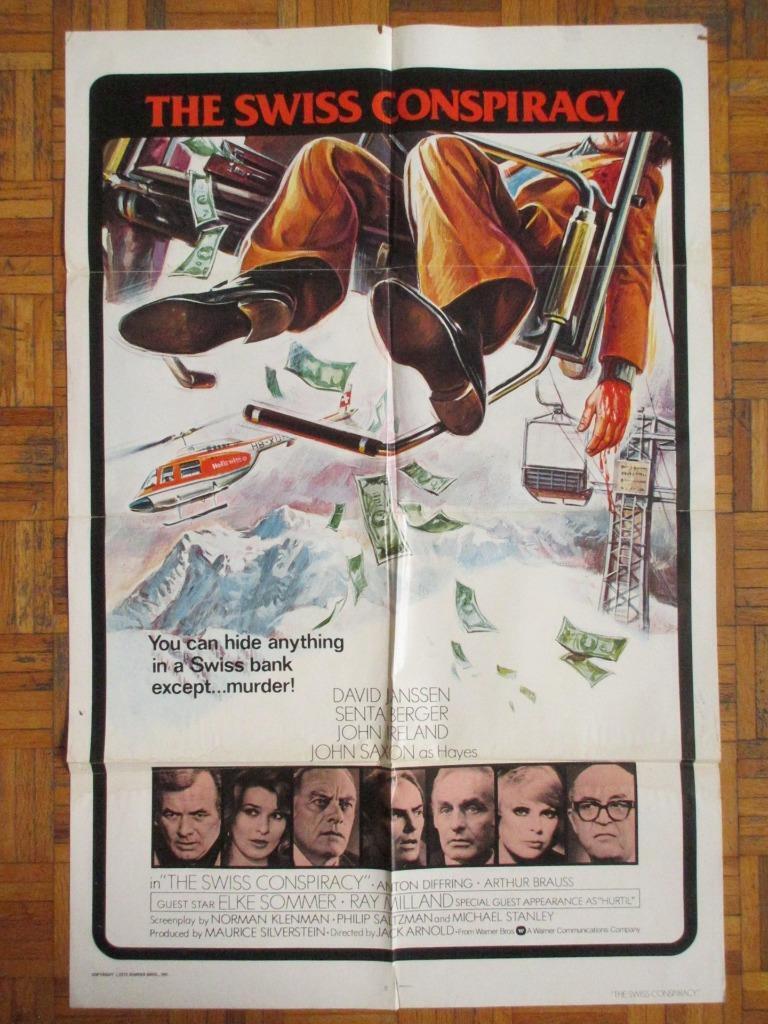
Not an obvious candidate for a Behind the Scenes feature, but important for four reasons. It ushered in the sub-genre of financial thriller, raised issues about tax-shelter funding, brought Hollywood back into European financing and was another example of how desperate the industry was for product that it would fund new entries from untried producers.

Banks were rarely a subject matter for movies except as the object of a heist or if they were foreclosing on a poor farmer or business, but former banker Paul Erdman, who had written his thesis on Swiss banks and the Nazis, single-handedly created substantial interest with a series of thrillers exposing the business. The Billion Dollar Sure Thing was a 1973 bestseller, as was the following year’s The Silver Bears. The latter, filmed in 1977 with Michael Caine, was beaten to the punch by The Swiss Conspiracy, an original screenplay.

Making acerbic comment about money has become critically-applauded big business ever since. Think Alan J. Pakula’s Rollover (1981) with Jane Fonda and Kris Kristofferson, Michael Douglas’s Oscar-winning role in Wall Street (1987), Oscar-nominated The Wolf of Wall St (2013) and The Big Short (2015) and more recently Dumb Money (2023). Hardly so successful or lauded, The Swiss Conspiracy nonetheless started a trend.

In the mid-1970s, cinemas were clamoring for product. Despite gigantic hits like The Godfather (1971), The Sting (1973) and The Towering Inferno (1974) – and with Jaws (1975) on the horizon –  studios had not returned to the production levels of the 1960s never mind the golden days of the previous decades. Cinemas had made do with cheap fillers, blaxploitation, sexploitation, four-walled nature documentaries, and kung fu. But with such an obvious gap to be filled, it was relatively easy for new producers to seduce banks and other investors into backing new pictures.

Raymond Homer had come from film processing. He had been a laboratory chief before moving into production. He set up his Durham Productions with the aim of exploiting opportunities for cheap moviemaking in South Africa. For The Swiss Conspiracy He partnered with former distributor Maurice “Red” Silverstein and the German producer Lutz Hengst (King, Queen, Knave, 1972) and Warner Brothers.

This proved part of a major development for the Hollywood studio which, like most of its breed, had either pulled out of funding European movies entirely or continued on nothing like the scale of the previous decade. The cutbacks were as much to do with ongoing financial fears as the losses engendered in European investment during the roadshow splurges of the 1960s.  

WB now pursued an “aggressive” European funding policy, setting aside $12 million for investment in 13 pictures. These included the thriller Inside Out (1975) with Telly Savalas and James Mason, Permission to Kill / The Executioner (1975) starring Dirk Bogarde and Ava Gardner, Peter Collinson’s The Sellout (1976) with Oliver Reed and Richard Widmark, Trial by Combat / A Dirty Knight’s Work (1976) toplining John Mills and Barbara Hershey and The Swiss Conspiracy. United Artists and Columbia had also triggered substantial European funding.

Shooting on The Swiss Conspiracy began in May 1975 on location in Switzerland and in the Bavaria Studios in West Germany. The cast was decidedly dicey. David Janssen (The Warning Shot, 1967) had only made one movie in five years. Senta Berger, though still in demand in Europe, had not starred in an American production since The Ambushers (1967). She may even have been cast out of convenience as she lived round the corner from the Munich studio. The other cast members – John Ireland and John Saxon – were either supporting players or like Ray Milland long past their peak.

Co-producer Maurice Silverstein was every bit ambitious as Homer. The next movie on his dance card was intended to be an adaptation of the John Le Carre bestseller A Small Town in Germany. But he was also lining up The Left Hand of the Law with James Mason and Stephen Boyd, Blood Money and The Jumbo Murders.  

The Swiss Conspiracy was first released in Britain. In May 1976 it opened in first run at the Warner multiplex in London’s West End, doing so well at the 132-seat Warner 1 it was shifted for the rest of its four-week run to the larger 434-seat Warner 4, for reasonable returns but not enough to win a circuit release in either of the two major chains.

Despite its funding, however, Warner Brothers’ rights did not include the US/Canada. So while the movie went out in Europe in 1976, it took another year to reach America, via distributor S.J. International which released the movie first (minus any kind of premiere or particular fanfare) in Denver in August 1977 across five screens. There was no national saturation release but eventually 400 prints found their way across America between August and December.

The best results in first run were a “tasty” (in Variety parlance) $3,000 from two cinemas in Portland and a “neat” $7,000 in Boston. Otherwise results registered as “dismal,” “dull,” “slow,” “soft” and similar.

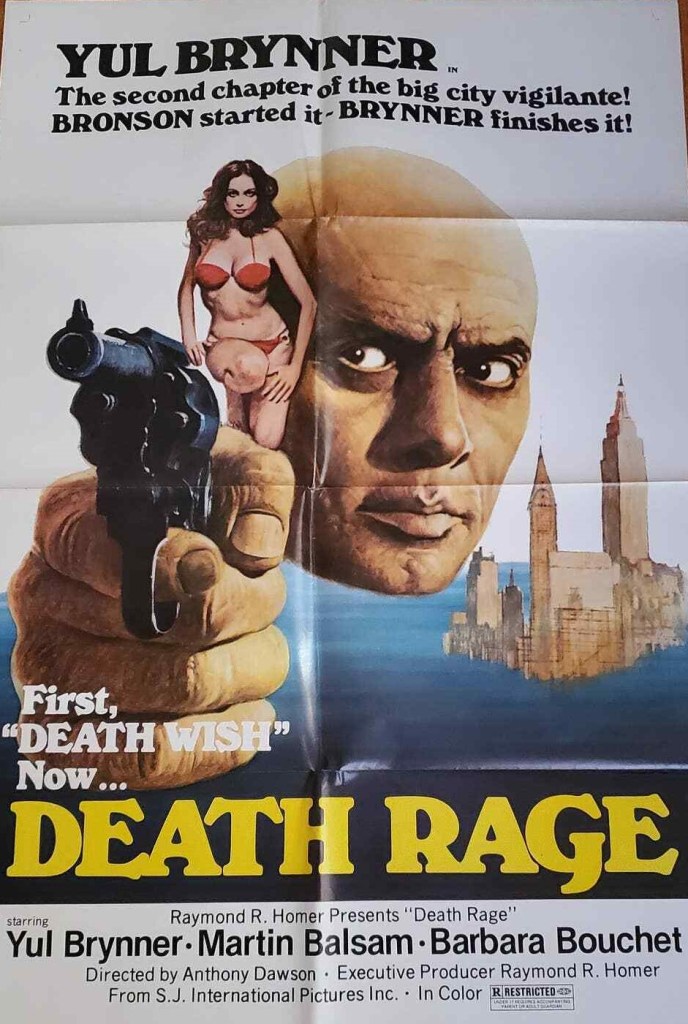
Despite the movie’s less-than-stellar U.S. box office Homer, now considered a fully-fledged producer, announced a slate of eight pictures. Sharpies was set to star Stella Stevens (The Poseidon Adventure, 1972) and Camilla Sparv (Downhill Racer, 1969). The Inheritance was headlined by Anthony Quinn (Guns for San Sebastian, 1968), Shadow Killer by Yul Brynner (Westworld, 1973), For the Love of Anna by British actress Lynne Frederick (Phase IV, 1974), The Naked Sun by Roger Moore (Live and Let Die, 1973), Queen of Diamonds by French star Olga-Georges Picot (Day of the Jackal, 1973) and The Great Day by Sophia Loren (Man of La Mancha, 1972). Compared to The Swiss Conspiracy, these movies had stars with considerable marquee value.

But the wheels came off the nascent production efforts of Homer and Silverstein when they were sued by investors for $45 million. Turned out their productions were in large part funded by a group of mid-West tax shelter investors who had not quite grasped, it would appear, how risky motion picture investment could be.

By and large, the biggest recipients of investor largesse are the cast and crew, followed by the producers, with actual investors last in line to receive any monies. Even if a movie wasn’t a hit, and there were no profits to re-distribute, a producer would still, at the very least, receive a production fee and most likely cream other monies off the top, accommodation, entertainment, transport and the like.

While tax shelter investors were looking to minimize taxes or avoid paying them altogether, they did not expect to see their cash just disappear. One of the big problems for a movie producer was that it was virtually impossible to bury results in the accounts. Box office was too transparent for that. Simply by following the weekly box office reports in Variety or Screen International in Britain you could determine a picture’s performance.

What was soon obvious to the investors was not just that the likes of The Swiss Conspiracy had done poorly, but that some of the other pictures appeared not to have been even released – or made (The Naked Sun, The Great Day, Sharpies). And that attempts to secure releases were limited by the lack of trade showings (only one in New York, for example), those being the most direct way, screening the picture to potential buyers, to secure bookings. The result of that being that none of the slate received any New York bookings.

Variety commented: “Such U.S. funded films seem to disappear almost completely here after appearing initially in the production charts.”

And eventually the sad tale that did emerge was how easily investors were duped by the thought of instant riches and just how tricky it was, even in a product-starved business, for movies produced by unknowns to gain any traction, and that names (emblazoned across full-page advertisements in Variety’s bumper Cannes editions, for example) that seemed to scream box office potential would struggle to deliver without distribution.

Turned out Raymond Homer did have a strategy, or he evolved one, though not one that would have enticed initial investors. Homer stated that he expected his main source of revenue to come from outright European sales and television and cable in the U.S. In theory, this was a sensible approach. Sell a picture outright country-by-country and you avoided the further expense of advertising and distribution. You could reap a reward without further risk and even if those returns were relatively small the cumulative effect might be profit. Joseph E. Levine would become the poster boy for such an approach – his A Bridge Too Far (1977) was in profit before filming began but then he had a top-line all-star-cast and, critically, received the cash in advance.

Theoretically, you could make money if you sold your picture outright country-by-country but only if you had box office figures somewhere to justify the amount you were asking.  Homer estimated that his movies had to gross $3 million in the U.S. just to break even and that seemed unlikely so he planned to sell them off to television and cable. But again, sums handed over by small-screen buyers depended also on box office.

The producers encountered myriad problems. Sharpies was not completed due to lack of funds. The Inheritance, for which Dominique Sanda had been named Best Actress at Cannes, found an Italian distributor. After losing 18 minutes for U.S. release and with the addition of a new prolog, it was handled in the U.S. by S.J. International and of all the films seems to have achieved the widest release.

Queen of Diamonds, also directed by Homer, was acquired for U.S. release by Peppercorn-Wormser Inc and while receiving some European exposure was actually made with television in mind as a six-part series. Shadow Killer, renamed Blood Rage, received a very limited released – just 200 prints – in the U.S. in 1978. For the Love of Anna was reshot and released in the U.S. as Until  Tomorrow in 1977 and acquired for Japanese release.

None of Silverstein’s planned productions saw the light of day. Homer produced one more picture, Mister Deathman (1983) starring David Broadnax and Stella Stevens, which may have been a re-edited and re-shot version of Sharpies.

On the other hand, the financial thriller became a sub-genre and tax shelters became a major source of funding for movies.

SOURCES: “Silverstein Bows As Conspiracy Producer,” Variety, April 30, 1975, p27; “Swiss Conspiracy Begins Shooting,” Variety, May 28, 1975, p33; “Maurice Silverstein To Produce 2nd film,” Variety, June 25, 1975, p37; “Warner Bros,” Box Office, October 6, 1975, pMC2; “Leider’s O’Seas Dozen for Warners,” Variety, October 10, 1975, p3; “Swiss Conspiracy Rights Acquired,” Box Office, February 7, 1977, p9; “Doctoring For Pics for U.S. Public,” Variety, May 17, 1978, p9; “Raymond Homer Durham Co. Schedules 8 Features,” Box Office, May 30, 1977, p5; “Swiss Conspiracy Bows in Denver,” Box Office, July 4, 1978, p8; “9 Tax Shelter Pix Face Legal Autopsy,” Variety, September 17, 1080, p5; Box office figures for The Swiss Conspiracy drawn from Screen International May 29, 1976-June 26, 1976 and from Variety in various issues August-December 1978.

Behind the Scenes: Ingmar Bergman

My first cinema all-nighter, back in the early1970s, comprised five Ingmar Bergman films. You try watching back-to-back The Seventh Seal (1957), Wild Strawberries (1958), The Virgin Spring (1960), Through a Glass Darkly (1961) and Winter Light (1963) and stumble out into a cold Edinburgh morning without your brain ringing from exposure to one of the greatest filmmakers of all time.

I’m not sure how Bergman would pass muster these days, if he would verge on cancellation, given his predilection, in his private life, for infidelity, often seducing younger actresses – Bibi Andersson, Liv Ullman, Harriet Andersson et al – working on his films for the first time. He had five wives, nine children (not necessarily in wedlock) and countless lovers. He was very much an absentee father, devoting his time to theater and cinema.

The Knight plays chess with Death – iconic image from “The Seventh Seal.”

Nor was I aware that cinema accounted for barely one-quarter of his creative output. For most of his productive career he spent three-quarters of the year working in the theater, on a huge variety of plays, none of which, that being the essence of that genre, are available to posterity. And he was the first – and possibly the only – famous director to develop television as a serious medium – Scenes from a Marriage (1974) and the Oscar-winning Fanny and Alexander (1982) were truncated versions of much longer mini-series first shown on television. The former was a spectacular success, watched by half of Sweden’s population.

He was also a best-selling author. His autobiography The Magic Lantern attracted an advance of $700,000 (equivalent to $1.8 million now) and sold over 100,000 copies in hardback in Scandinavia alone. His screenplays sold in vast quantities at a time when that area of publishing attracted only minority interest.

With a director as prominent as Bergman there were many interesting what-ifs. Barbra Streisand was slated to star in The Merry Widow, but that came apart after a first meeting, when the director recoiled at her personality. Movies were mooted with Fellini and Kurosawa. Richard Harris was to have starred in The Serpent’s Egg (1977) rather than David Carradine.  

At one time he fielded offers from major studios like Paramount and Warner Bros and some of his later movies were funded by mini-majors – The Touch starring Elliott Gould (1971) by ABC and From the Life of the Marionettes (1980) by Sir Lew Grade’s ITC shingle. He was on the shortlist to direct Jesus of Nazareth, eventually made by Franco Zeffirelli.

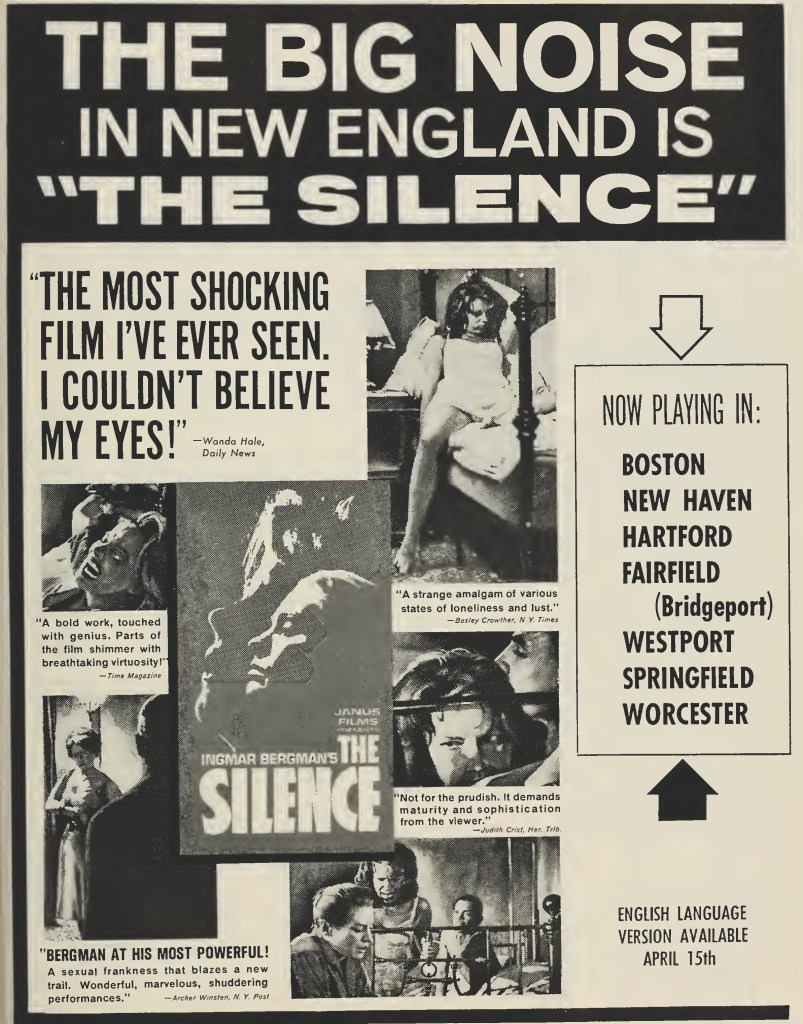
The Seventh Seal, considered his greatest film, despite critical raves, was a flop, The Silence (1963) a whopping success, the biggest box office hit in West Germany for example since the war.  

Peter Cowie’s biography, a Xmas gift which I’ve just devoured, has an apt title God and the Devil, for these were the underlying (not to say often obvious) themes of his movies, man giving in to temptation, deity not there to come to the rescue. His films showed the coruscating reality of relationships gone sour, imitating his own experience, even without his constant infidelity (or perhaps because of it) he had a fraught time of it with wives and lovers.

With so many projects – and so many lovers – on the go, his life lurched from professional triumph to personal disaster. Luckily, he could meet child support payments because he was by far the biggest earner in cinema in Sweden, and when wooed by Hollywood, even more able.

Peter Cowie, who founded and edited The International Film Guide for 40 years and ran The Tantivy Press for a quarter of a century, is to film criticism what Bergman is to the movies, someone who moves in the upper pantheon. It was he who interviewed Bergman on stage at the NFT. He claims to come from a generation whose life was changed after seeing The Seventh Seal.

Without being a no-holds-barred work, he does hold Bergman up to scrutiny, the personal life covered in as much depth as the professional. “Bergman’s childhood was clouded by a terrible fear of punishment and humiliation,” writes Cowie, which in essence could have been the template for his movies. He was beaten by his father, a pastor, and bullied by his elder brother. One time, locked in a cupboard, he feared someone was gnawing at is feet.

A cinema buff from an early age, the stage was his first calling and by 1938 had directed his first play. His first movie was Crisis (1946). By Hollywood standards all his movies until quite late in the day would be considered low-budget numbers and it was only when Swedish studios managed to attract international distribution for their films – mostly because of their perceived sexual content – that budgets increased.

While initially The Seventh Seal was considered his greatest cinematic achievement, Wild Strawberries and Persona (1966) have overtaken it in terms of critical approval. In the Sight and Sound Critics Poll of 1972 Persona was fifth and Wild Strawberries tenth. But neither film ever did so well again from the critical perspective though in the Directors Poll of 2022, Persona placed tenth.  

A fascinated read and reminder of a director who dominated the cinematic landscape for over two decades.

Behind the Scenes: All-Time Top 20

The “Behind the Scenes” articles have become increasingly popular in the Blog. As regular readers will  know I am fascinated about the problems incurred in making certain movies. Perhaps one of the more interesting aspects of this category is that every now and there is out of nowhere massive interest in the making of a particular movie and it shoots up the all-time tree. Most of the material has come from my own digging, and sources are always quoted at the end of each article, but occasionally I have turned to books written on the subject of the making of a specific film. 

  1. (4) Waterloo (1970). No doubting the effect of Ridley Scott’s Napoleon in racketing up interest in this famous flop.
  2. (5) Ice Station Zebra (1968). A complete cast overhaul and ground-breaking  special effects are at the core of this filming of an Alistair MacLean tale.
  3. (2) The Satan Bug (1965). The problems facing director John Sturges in adapting the Alistair MacLean pandemic classic for the big screen. One of three Alistair MacLean titles in the top 20.
  4. (11) In Harm’s Way (1965). Otto Preminger black-and-white epic about Pearl Harbor and after.
  5. (1) The Girl on a Motorcycle (1968). Cult classic starring Marianne Faithful and Alain Delon had a rocky road to release, especially in the U.S. where the censor was not happy.
  6. (3) The Guns of Navarone (1961). The ultimate template for the men-on-a-mission war picture with an all-star cast and enough jeopardy to qualify for a movie of its own.
  7. (14) Battle of the Bulge (1965). There were going to be two versions, so the race was on to get this one to the public first.
  8. (6) Cast a Giant Shadow (1965). Producer Melville Shavelson wrote a book about his experiences and this and other material relating the arduous task of bringing the Kirk Douglas-starrer to the screen are described here.
  9. (7) Spartacus (1961). How Kirk Douglas sank a proposed Yul Brynner version.
  10. (New Entry) Sink the Bismarck! (1962). Documentary-style WW2 classic with Kenneth Mills with the stiffest of stiff-upper-lips.
  11. (New Entry) Man’s Favorite Sport (1964). Howard Hawks back in the gender wars with Rock Hudson and Paul Prentiss squaring off.
  12. (New Entry). The Bridge at Remagen (1969). John Guillerman WW2 classic with George Segal and Robert Vaughn.
  13. (New Entry). Tora! Tora! Tora! (1970). Richard Fleischer dispenses with the all-star cast in favor of even-handed verisimilitude.
  14. (12) Genghis Khan (1965). A venture into epic European filmmaking with an all-star cast led by Omar Sharif.
  15. (8) Secret Ceremony (1969). How director Joseph Losey persuaded uber glam-queen Elizabeth Taylor to go dowdy in this creepy drama.
  16. (10) The Ipcress File (1965). The other iconic 1960s spy picture that brought Michael Caine fame.
  17. (13) The Biggest Bundle of Them All (1968). Raquel Welch, and release delay controversy.
  18. (New Entry). The Collector (1963). William Wyler’s creepy adaptation of John Fowles’ creepy bestseller with Terence Stamp and Samatha Eggar.
  19. (New Entry) They Shoot Horses, Don’t They (1969) Desperate Depression set drama with Jane Fonda and Michael Sarrazin.
  20. (New Entry) Night of the Living Dead (1968). Zombies rule in George A. Romero horror classic.

Behind the Scenes: Raquel Welch, Unknown Actress, 1964-September 1966, Gets The “Big Build-Up”

As demonstrated in Madison Avenue (1961), the “big build-up” was code for inflicting on an unsuspecting public an unlikely candidate for acclaim. Of course, for decades, Hollywood hacks had been bombarding fan magazines, weeklies, glossy monthlies and dailies with beefcake and cheesecake photos of promising new talent. But the hook was that these actors were shortly appearing, albeit in a bit part, in a few months’ time in a forthcoming movie.

Modelling was another device to attract the attention necessary to generate a screen career. Sometimes, these (predominantly female) models would be making their first throw of the dice, hoping that some producer in an idle moment might catch a glimpse. Or, they could be women who made a living from selling such snaps to such media.

But, usually, it was one thing or the other: gratis photos handed out by grateful studio marketing teams or photos that an editor paid for in the hope they would increase circulation (in the days when there was no such thing as a giveaway magazine). La Welch appears to have fallen into the latter category.

But it was a heck of a long-term build-up given that with the exception of the virtually unseen Swingin’ Summer (1965), in which she has a bit part, Raquel Welch did not appear in a movie until September 1966. By that point, modelling a skintight number in Fantastic Voyage  – it was December before that iconic fur bikini in One Million Years B.C. set male hearts pumping – it seems that magazine editors the world over were prone to giving her space in the years prior covering 1964-1966 when she was effectively an unknown.

Esquire splash.

Which would go some way to explaining why by the time her first movies hit the screen she was already a familiar face (and body, it has to be said) to many (and not exclusively male) in the audience. The promotional push was supplied by Twentieth Century Fox which had signed her to a five-picture contract, making her, perhaps in their own words, one of the most sought-after actresses in Hollywood.

But deals with studios for new talent were ten a penny, no guarantee the studio would keep its side of the bargain, nor that the contract would run to term, nor that the actress would be handed anything but bit parts. Still, it probably cost relatively little to start pumping out promotional photos with “new rising talent” as the lure. Magazines seemed happy to accept on face value that she was a rising star even though there was no proof that she had the talent to match.

Life magazine proved something of a stepping stone. She was featured in a bikini in its Oct 2, 1964, issue. But you could just as easily have caught her in a leopard-skin dress draped across a cocktail stool, one of several cheesecake pictures taken to promote the starlet.  Parade magazine, in Britain, something of a lower-grade male magazine, far removed from the likes of the glossier Playboy, was among the first to take the bait, in December 1964 (see above) handing the young potential star its front cover. (Her surname was misspelled as Welsh – and her Christian name was misspelled as Rachel when she featured again in March 13, 1965.)

Five of the 10 chosen Deb Stars of Tomorrow. See if you can spot our gal.

But the real boost came at the end of December 1964. That month she was one of ten potential female stars featured in the Dec 27 issue of New York Journal-American under the title “TV’s Magic Wand Taps Girls As Stars of Tomorrow.” She had been chosen to appear on ABC TV’s “Debs Stars of 1965” programme. This show claimed an 85 per cent success rate in picking potential stars, with Kim Novak, Tuesday Weld and Yvette Mimieux among previous winners.*

In April 1965, the distinctly more upmarket – and not male-appealing – McCalls in the U.S. came calling, but that front cover dispensed with the sexy look, presenting her wearing spectacles. By September 1965, the Fox marketeers had been hard at work and won for her – a full year before Fantastic Voyage opened – the front cover and an inside spread in the British edition of movie fan magazine Photoplay. The next month brought another iconic photograph, the “nude” spread in U.S. upmarket monthly Esquire, accompanied by a full-page interview that treated her as the next big thing, again on the word of Fox, nobody having as yet seen so much as an inch of the footage of the sci-fi picture.

The same month in trademark bikini she was on the front cover of U.S. Camera and Travel magazine (surname again misspelled), photographed by Don Ornitz and described as “a rising young actress with many screen and TV credits to her name” without specifying that in fact these were mostly uncredited or in bit parts. Also during 1965 she featured in Turkish magazine SES and Portuguese magazine Plateia.

But there was also the grind. She advertised Wate-On slimming in Screen Stories in 1965,  was the cover model for True Love in September 1965 while for Midnight magazine – and surely this was a story dreamed up by a publicity hound – her front cover picture was accompanied by the heading “Adultery Can Save Your Marriage” and inside she was quoted as saying “A Wife Should Let Her Husband Cheat.”

The big build-up went into overdrive in 1966. She modelled bikinis in two more front covers in Parade (all name errors corrected) in January and July. Australians preferred a more demure – or at least non-bikini – look. In Australian Post (June front cover) she was photographed wearing a “dress of ten thousand beads” from her unnamed next picture (neither Fantastic Voyage nor One Million Years B.C. obviously). There was a slinky pink number for the Australian edition of Photoplay (August, front cover and full-page photo inside) and a quote “I think its important for a girl to exploit her physical attractions – but with restraint.”

She also graced Hungarian magazine Filmvilag and Showtime, both in August. Perhaps the most prescient feature ran in Woman’s Mirror in April 1966. For once she was not granted the cover, but featured on a two-page spread inside under the heading “A Star Nobody Has Seen But Everybody Is Looking For.”

Most of her figure was hidden on the front cover of Pageant (July). SES had something of a scoop in its April edition with some behind-the-scenes photos of Welch in her fur bikini for One Million Years B.C. and she made the cover of German magazine Bunte (June).

Exactly how busy and successful Welch – and her promoters – had been could be gauged from the photo that appeared in the Aug 26, 1966, issue of Life, in which she was pictured in front of a wall of over 40 of front covers she had adorned in the previous two years. Pictorial proof that she was in demand and that magazine editors, long before the public had the chance to witness her screen performance, could recognize a certain kind of charisma. (She was featured in Life again in Dec 1966, in a bikini, but seen sideways, bent over and with her hair in pigtails – and on the cover of its Spanish edition on Nov 21.)

And there was another kind of accolade coming her way in Britain. She was chosen as the first cover model for the first issue of men’s magazine Mayfair in August 1966, the same month as she was positioned in the same prominent spot on Adam, another men’s magazine, and in the more sedate British magazine Weekend, in which she was promoting Fantastic Voyage.  

But she would soon be forever associated with the fur bikini, posters of which were soon plastered over the walls of teenage boys. The fur bikini more than anything else broke the mold in the presentation of a new star, and luckily for Welch, the ground work had been done courtesy of the long-range big build-up.

*The other nine Deb Stars of Tomorrow were Barbara Parkins (Valley of the Dolls, 1967), Mary Ann Mobley (Istanbul Express, 1968),  Margaret Mason (no movies but some television), Wendy Stuart (couple of bit parts), Beverley Washburn (Pit Stop, 1969), Tracy McHale (nothing), Laurie Sibbald ( a few television episodes), Janet Landgard (The Swimmer, 1968) and Donna Loren (a few television episodes). No prizes for guessing who won that particular Deb Star competition.

Discover WordPress

A daily selection of the best content published on WordPress, collected for you by humans who love to read.

The Atavist Magazine

by Brian Hannan

WordPress.com News

The latest news on WordPress.com and the WordPress community.