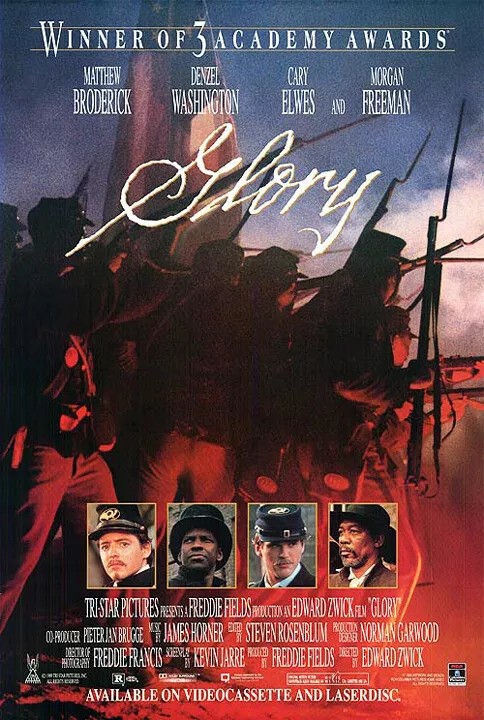
Behind the Scenes: “Glory” (1989)

Want to hire Matthew Broderick? Then you better be prepared for his mother. Worse, there was no get-out clause. Tri-Star Pictures, an offshoot of Columbia, was only making the movie because of Broderick, whose marquee value was based solely on a completely different type of picture, namely Ferris Bueller’s Day Off (1986). Yes, he had won a Tony aged 21, and this was his sixth picture, of which only War Games (1983) hit the box office mark.

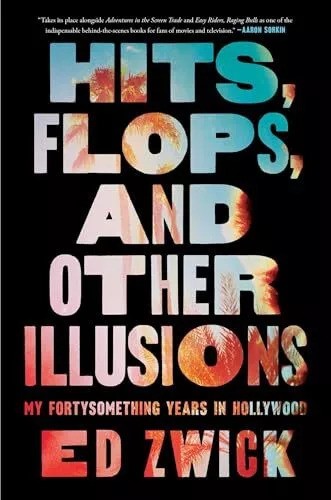
But the actor had a great deal to contend with in his personal life, grief and guilt as a result of driving his car into the wrong lane, crashing into an oncoming vehicle, killing two and seriously injuring himself and his passenger Jennifer Grey. His mother had been seriously ill, also. Glory proved another ordeal. “Nothing I might have done could possibly rival Matthew’s role in the theater of cruelty that was about to begin,” wrote director Ed Zwick in his memoir, Hits, Flops and Other Illusions (2024).

The same accusation of being a lightweight could as easily been levelled at Zwick, his only movie being About Last Night (1986), which though with serious undertones, was basically a modernized rom-com. He was best known for television, as writer-producer on thirtysomething (1987-1991), that “despite its success was an intimate, whiny talkfest.”

Broderick’s mother, Patsy, made her presence felt almost immediately. Before shooting commenced, the actor quit. Patsy didn’t like the script. By this point, Zwick hadn’t even met Broderick. Zwick received the news while on holiday in a cabin in the mountains. Communication was primitive, virtually walkie-talkie style. Eventually, Zwick agreed to look at the actor’s notes on the screenplay.

The script issues should have warned Zwick what he was taking on. At that time the film was called Lay This Laurel, the title of a monograph by Lincoln Kirstein, about the assault on Morris Island by the 54th Massachusetts Regiment, the project initially on the slate of Bruce Beresford, Oscar nominated director of Tender Mercies (1983). Kevin Jarre, with just a ‘story by’ screen credit, for Rambo: First Blood Part II (1985), to his name, had written the screenplay. “The script is perfect,” averred Jarre when Zwick demanded a rewrite. Beyond a slight polish and a shifting around of some scenes, Jarre wouldn’t budge. So Zwick took on the rewrite.

Broderick’s notes were within the realm of expectation, mostly to do with his character. But then he sent the script to Horton Foote (To Kill a Mockingbird, 1962), whose daughter he was dating. Then to Bo Goldman (One Flew over the Cuckoo’s Nest, 1975). Neither writer took on the script and Goldman assured Zwick the script was fine. Then, the final bombshell. At her son’s insistence, Patsy was to work on the script. “I’m sure she was capable of warmth,” noted Zwick, “but I was never treated to that side of her, from the moment we met,” going through the script page by page, “she was contemptuous, demeaning and volatile,” her son sitting in silence. Amendments suggested by Patsy were readings from Ralph Waldo Emerson and Harriet Beecher Stowe, and a scene where Broderick’s character was persuaded to take command of the regiment by his screen mother, to be played by his real mother.

As it happened, long before Broderick turned up, Zwick had been shooting footage from the 125th anniversary of the Battle of Gettysburg where 20,000 men in full uniform and weapons re-enacted the conflict. On a $25,000 budget, Zwick shot 30,000 feet including a cavalry charge, and created what was known in Hollywood parlance as a “sizzle reel.” Many of the re-enactors turned up as extras.

Cary Elwes (The Princess Bride, 1987) took a salary cut for his role. Zwick had been impressed by Denzel Washington in A Soldier’s Story (1984) and Cry Freedom (1987) but couldn’t afford him until producer Freddie Fields chipped in some of his fee. Morgan Freeman’s career was on an upward turn after an Oscar nomination for Street Smart (1987). Zwick found acting chemistry between this pair and Jihmi Kennedy and Andre Braugher. The actors “were hearing music I couldn’t even imagine,” wrote Zwick, “yet during each session, a transcendent moment, usually unwritten, could occur.”

Initially, however, Zwick felt he was making a disaster, “the lighting was too bright, the costumes were too new, and Matthew (Broderick) seemed uncomfortable in his role.” Luckily, a storm intervened. Not to provide rest or for Zwick to regroup. A mere storm wasn’t sufficient cause to postpone the scene of the regiment’s arrival in Readville. In the attendant fog, they were bedraggled, ankle-deep in mud, shoulders hunched against the lashing rain. Zwick realized that was the look he was after. He approached cinematographer Freddie Francis to shoot “without lights” in order to capture a similar mood. “Why didn’t you say so, dear boy?” was Francis’s encouraging response.

The next day, the first tent scene, provided another surprise. “I stared open-mouthed at the utter transformation that had taken place. Overnight he (Denzel Washington) has become Trip. Volatile. Funny. Mesmeric…it was impossible to take your eyes off Denzel…I had been in the presence of greatness. I’d never seen an actor command the focus by doing so little.”

Andre Braugher, in his debut, was also a revelation, after he’d mastered the art of hitting his marks. Once, during rehearsal for a scene, Zwick noticed that Morgan Freeman never looked Broderick in the eye. “Just as I was just about to move the camera to catch his look, I realized he was making a point of not looking at him…as a black man who had lived a lifetime wary of being punished.” Despite the traumas over the script, Broderick’s performance was “pitch perfect.”

The most emotionally powerful scene is the whipping. Twice, Zwick filmed Washington receiving three lashes. “But there was something more to be mined.” Making an excuse, Zwick asked Washington to re-do the scene, but then told John Finn, applying the whip, not to stop until Zwick called “cut.” Finn had delivered eight strokes before Zwick found what he was looking for. “The shame and mortification were real now… and in the magic of movies…a single tear appeared, catching the light at the perfect moment.”

Directorial sleight of hand in the battle scene compensated for limited budget and insufficient extras. Taking note of Kurosawa’s Ran (1985), Zwick filmed one “big image of each significant moment of the battle using the entire contingent.” The trick was to go back and shoot it all over again with a smaller group but each time filling the frame top to bottom with soldiers fighting. “When it’s cut together, the larger image stays in the audience’s mind as long as they’re never allowed to see blank space at the peripheries of the frame.”

To add to the battle, they let loose rockets and explosions on the night sky, almost losing a $300,000 camera car in the process. Much of the exposition, including the Patsy Broderick scenes, ended up on the cutting room floor. While Kevin Jarre had become a “cheerleader” for the film, Broderick and his mother walked out of a preview with the actor demanding to do his own cut of the movie. Zwick refused.

Released in December 1985, Glory was nominated for four Oscars including best director. Washington won Best Supporting Actor, Freddie Francis for Cinematography and Donald O. Mitchell, Greg Rudloff, Elliot Tyson and Russell Williams II for sound. Tri-Star refused to advertize in Black media. Zwick considered any “pushback” of Broderick’s character being perceived as a “white-savior narrative” as a “left-wing canard.”

SOURCE: Ed Zwick, Hits, Flops and Other Illusions, My Fortysomething Years in Hollywood (Gallery Books) 2024, pp69-105.

Behind the Scenes: The Rise and Fall of the Mini-Majors

Commonwealth United, the makers of A Black Veil for Lisa (1968) reviewed yesterday, was one of a flood of new entrants to the movie business in the middle to late 1960s. Variety, which always liked to put an easy label on things, tabbed them “mini-majors,” “near majors” or “instant majors” in the belief that any outfit that could string together a substantial annual output was worthy of being considered a contender to become a major player in the great movie game.

A caste system had operated in Hollywood since the 1930s. The “Little Three” of United Artists, Universal and Columbia were considered inferior to the likes of the “Big Five” of MGM, Paramount, Twentieth Century Fox, RKO and Warner Bros. By the  1960s the smaller units had been promoted and Disney had taken the place of RKO. But with product at an all-time low, the U.S. Government was inclined to rethink its stance on monopoly and permit cinema chains to enter the business – the Paramount Decree of 1948 having expressly forbidden the opposite, of studios owning cinema circuits.

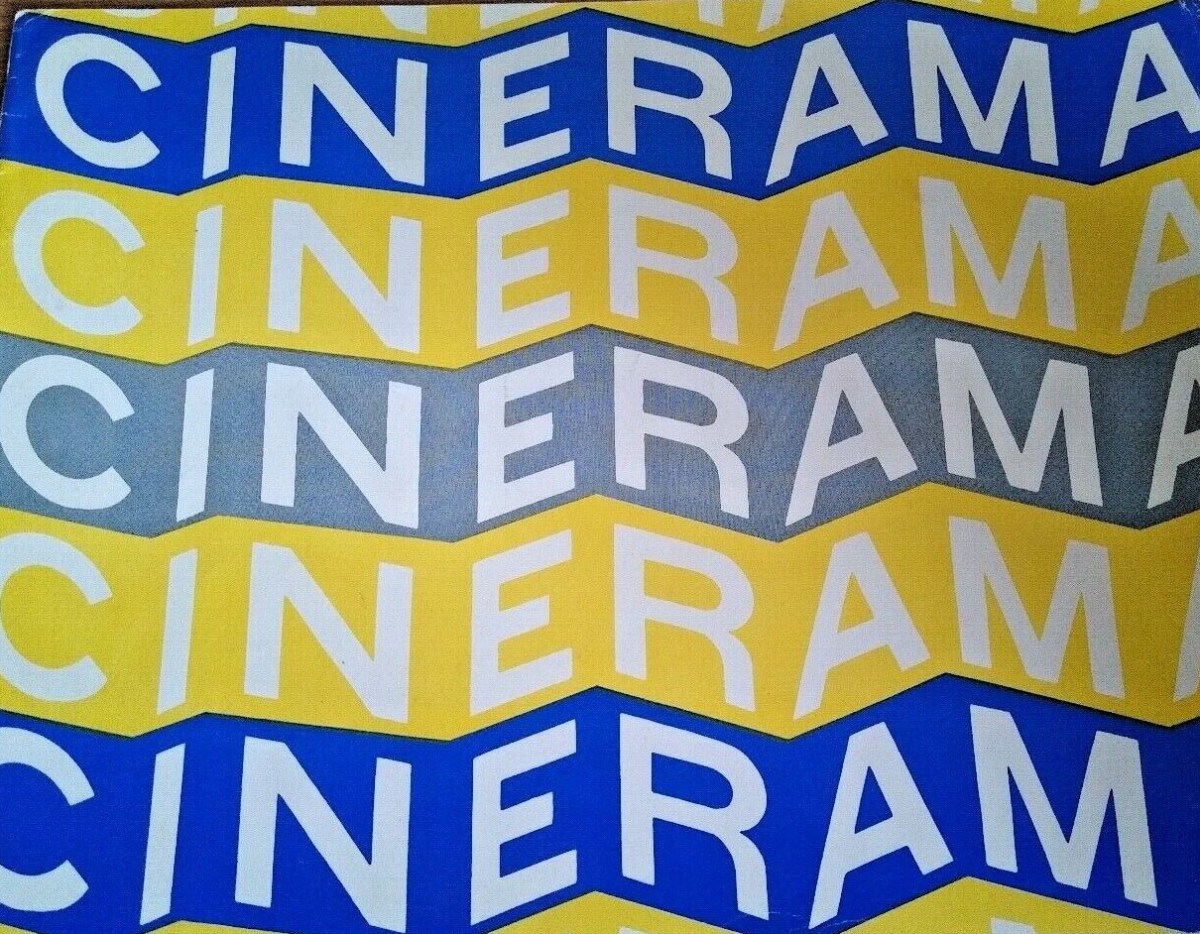
National General was the first to challenge the government dictat. The Government in the 1940s had prevented Hollywood studios from becoming involved in television but now did something of a U-turn in permitting television giants ABC and CBS to invest in movies made under the aegis of ABC-Cinerama and Cinema Center, respectively.  More legitimate operations, by original Government standards, were the likes of Commonwealth United, American International (AIP), Embassy Pictures, and smaller units like Sigma 3 (in which producer Marty Ransohoff had a stake), Independent-International, Continental (backed by the Walter Reade arthouse chain) and Cinema 5.  

The mini-majors could make movies much faster than the established studios which had millions of bucks tied up in projects, books and plays, paid for and never made, deals with talent that didn’t work out, as well as bigger overheads and interest on loans running at $2 million a year per studio. For a short period the newcomers did well in the box office sweepstakes, in 1970, for example, Cinema Center beat Warner Bros in market share. And with the product well running dry and big studios being more selective about release dates, that still left considerable “playing time unused by big companies” that could be filled by “low-voltage commercial product.”

I’ve covered the National General tale before so suffice to say it did most of the heavy lifting in challenging the Paramount Decree and made such pictures as The Stalking Moon (1968) with Gregory Peck and Eva Marie Saint, Elvis in Charro! (1969), El Condor (1970), and James Stewart and Henry Fonda in The Cheyenne Social Club (1970) and was influential in the distribution of films made by other mini-majors.

Commonwealth United began as a real estate company formed in 1961 that took over the Landau-Unger movie production company in 1967 and began the serious business of creating a large enough movie roster that would make it welcome to the distributor. In these product-famine  times, anybody who could produce a movie could get a distributor, but the terms of the deal, if you were a one-off, favored the distributor. To achieve any kind of box office parity, you needed to show substantial intended output. Its initial entry into the business was as a distributor, in 1968 handling the U.S. release of spy thriller Subterfuge (1968) with Gene Barry, jungle picture Eve (1968), The Angry Breed (1968) mixing bikers and the movies, and heist picture Dayton’s Devils (1968), before biting the bullet with Italian-made A Black Veil for Lisa with British star John Mills top-billed.   

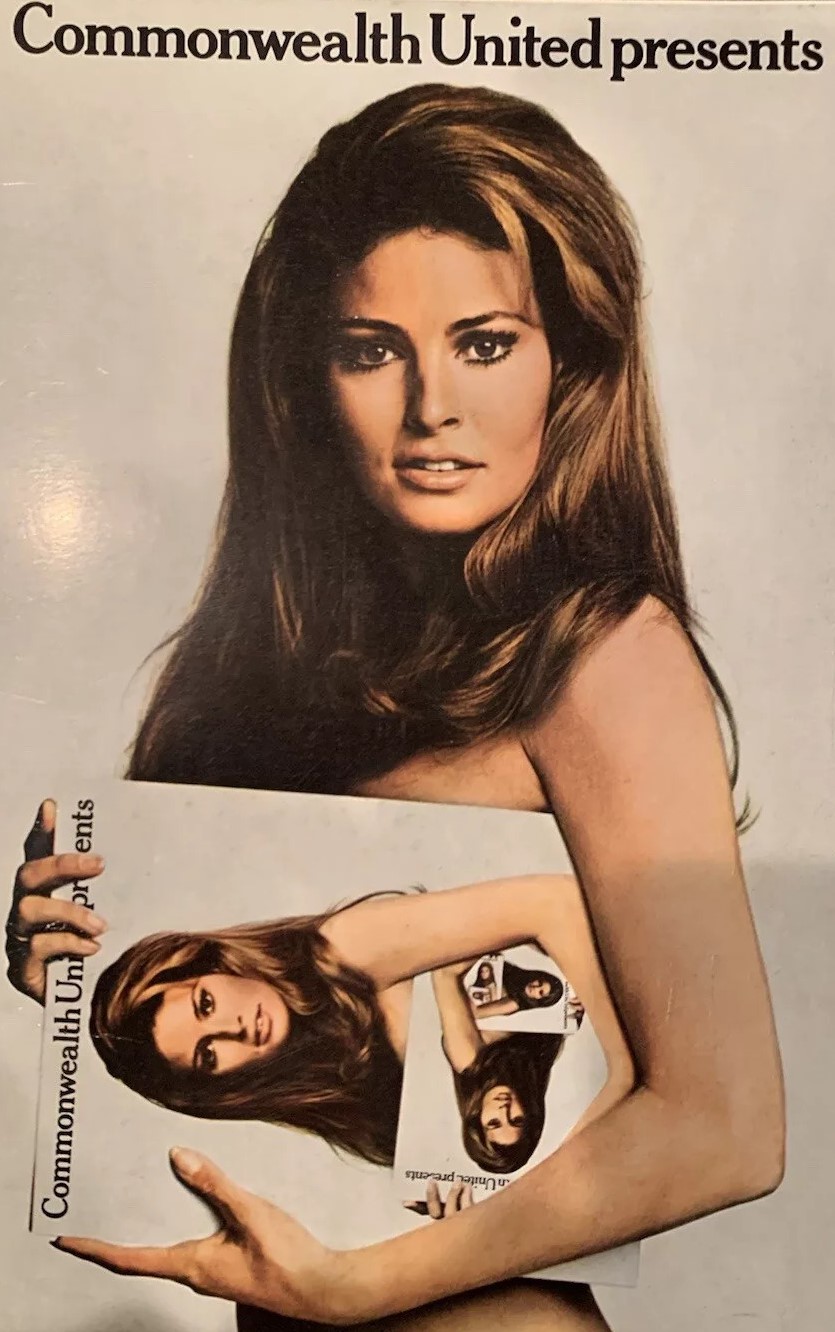
Commonwealth United couldn’t quite make up its mind whether to go down the A-movie or B-movie route. Its follow-ups to A Black Veil for Lisa were women-in-prison epic 99 Women (1969) and erotic thriller Venus in Furs (1969). But when it headed into the mainstream, it hit a box office barrier. Yugoslavian epic The Battle of Neretva (1969) with Yul Brynner flopped. Peter Sellers and Raquel Welch – snookered into fronting its lavish brochure, see photo above – couldn’t save The Magic Christian (1969). Robert Altman’s That Cold Day in the Park (1969) with Sandy Dennis, Julius Caesar (1970) starring Charlton Heston and The Ballad of Tam Lin (1970) with Ava Gardener all went down the tubes. The company closed down in 1971.

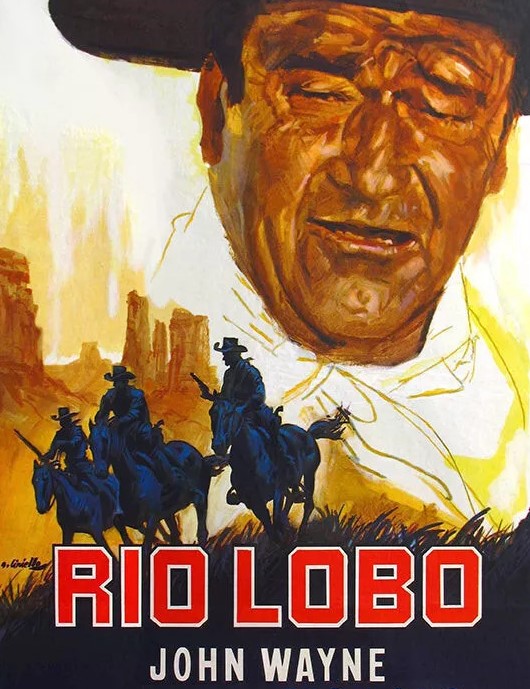
The bigger hitters, at least initially, promised more. Cinema Center, set up in 1967 using National General for distribution, and headed up by ex-Fox chief Gordon T. Stulberg, snagged deals with the likes of Doris Day, Jack Lemmon and Steve McQueen. Launch item  With Six You Get Eggroll (1968) starring Day and Brian Keith was followed by some potential box office bonanzas – The Reivers (1969) and Le Mans (1971) with McQueen, John Wayne in  Rio Lobo (1970) directed by Howard Hawks and Big Jake (1971), Richard Harris as A Man Called Horse (1970), Arthur Penn’s Little Big Man (1970) with Dustin Hoffman and Faye Dunaway, William Holden in The Revengers (1971) and Lee Marvin and Gene Hackman in Prime Cut (1971).

But there was a high end price to pay. As with United Artists in the 1950s, Carolco in the 1980s and streamers today, big stars and directors took advantage of ambitious smaller companies. The price of even playing the game was high. Sure, there was reward. Little Big Man took in $15 million in rentals, The Reivers $8 million, Big Jake $7.5 million, A Man Called Horse $6 million. But that couldn’t stop the flow of red ink on calamities like early Michael Douglas vehicle Hail Hero (1969), Rod Taylor as a private eye in Darker than Amber (1970), Who Is Harry Kellerman (1971), Joseph Losey’s existential thriller Figures in a Landscape (1971) and a over a dozen more. Twenty out of 27 movies made a loss, the cumulative total running at £30 million. By 1972 CBS had had enough and closed shop.

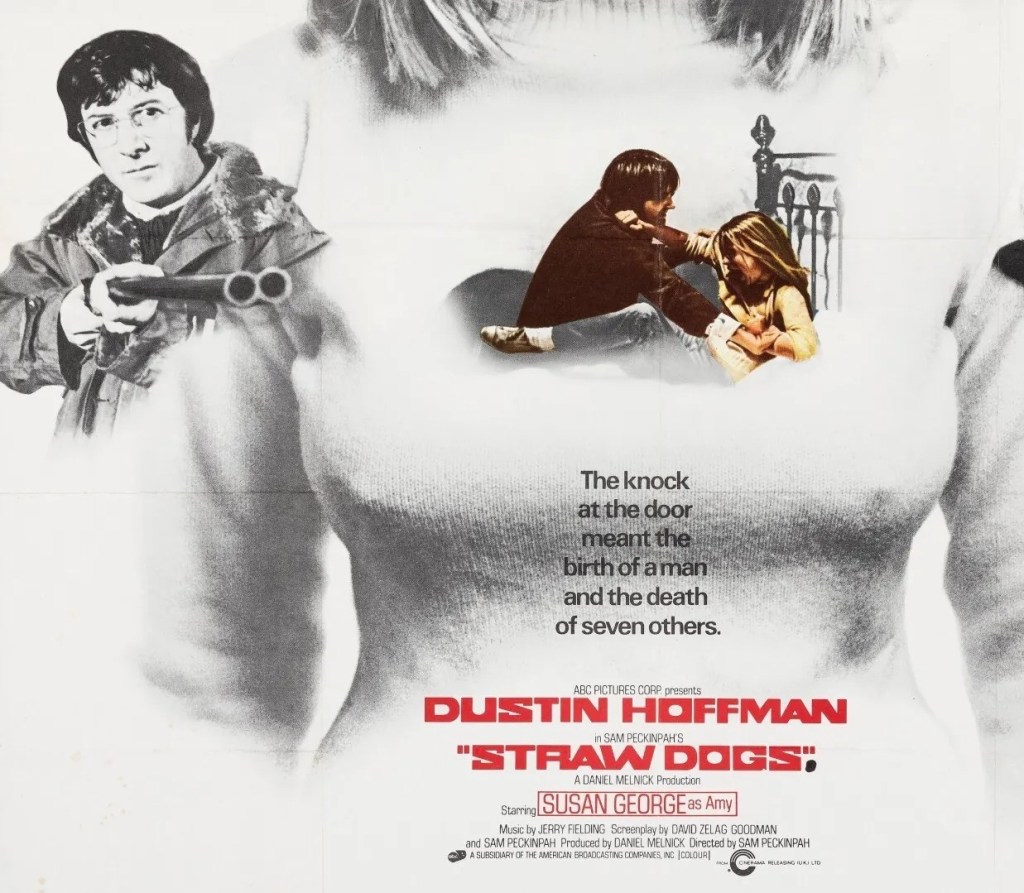
ABC released its pictures through an offshoot of Cinerama called Cinerama Releasing Corporation. It, too, struck occasional gold. Charly (1968) won an unexpected Oscar for Cliff Robertson. They Shoot Horses, Don’t They (1969) did the same for Gig Young and helped Jane Fonda be recognized as a serious actress. And big names signed on: Ingmar Bergman for The Touch (1971), Sam Peckinpah and Dustin Hoffman for Straw Dogs (1971). Robert Aldrich made three – The Killing of Sister George (1969), Too Late the Hero (1970) and The Grissom Gang (1971). With its biggest hit They Shoot Horses only picking up $5.5 million in U.S. rentals and For Love of Ivy (1968) with Sidney Poitier $5 million and the bulk of the others striking out, ABC pulled out of the movie business in 1971.

Cinema owner-turned-distributor Joe Levine had been a thorn in the side of Hollywood for many years especially after his imported Hercules (1958) showed you could sell anything to the American public if you put enough advertising dough behind it – a notion he signally undercut when all the money in the world couldn’t turn Jack the Ripper (1959) into a hit. He turned more legit, in Hollywood eyes at least, by teaming up with Paramount for The Carpetbaggers (1964) and Nevada Smith (1966) and funded Zulu (1964) – a hit most places except the U.S. After the critical and financial success of The Graduate (1968) and The Lion in Winter (1968) he sold Embassy to one of those conglomerates that had started sniffing around the business, Textron, and the company was renamed Avco Embassy. Kept on as president, he quit in 1974 and Avco Embassy pulled out of movies a year later only to re-enter the fold in 1977 and under Robert Rehme shift into lower-budgeted numbers like The Fog (1980) and Time Bandits (1981). He increased turnover fourfold. In later years, the company changed owners and names several times.

Some of the less well-publicized orgaizations lasted longer. Independent-International, set up by Sam Sherman, Dan Kennis and Al Adamson in 1968, kept budgets down to an average $200,000 a picture and reckoned that even with limited opportunity could pull in rentals of $300,000. After the success of biker picture Satan’s Sadists (1968), the company put 13 movies in circulation without troubling the New York first runs. Typically, a movie would garner 4,000-6,000 playdates. That company is still in existence.

Going back to where we started with Commonwealth United, you’re probably very familiar with American International for its Edgar Allan Poe, beach party and biker pictures. But in 1969 after co-founder James Nicholson quit and the company went public with the aim of entering the Hollywood mainstream, it relied on Commonwealth for distribution, releasing 31 pictures in this fashion. Beginning with adaptations of classics like Wuthering Heights (1971) and Kidnapped (1971) and moving onto big-budgeters like Force 10 from Navarone (1978) and still dipping into horror and exploitation AIP coninued in one guise or another until 1980.

SOURCES: “Nat Gen Readying 7th Film,” Variety, November 16, 1966, p4; “Instant Majors: A Short Cut,” Variety, October 25, 1967, p5; “Same Upper Uppers,” Variety, October 30, 1968, p12; “Commonwealth: Near Major,” Variety, February 19, 1969, p5; “Commonwealth Full Sell,” Variety, May 7, 1969, p7; “Nat Gen Rolling Six,” Variety,  October 8, 1969, p6; “Topheavy Film Studios Fade,” Variety, October 29, 1969, p1;  “Nat Gen Denies Phase-Out,” Variety, August 12, 1970, p5; “1970 Domestic Theaters Sweepstakes,” Variety, January 13, 1971, p38; “Today’s Majors As Instant,” Variety, July 21, 1971, p7; “American Int Expected Inheritor of Cinerama Releasing,” Variety, July 31, 1974, p3.

Behind the Scenes: “The Chairman / The Most Dangerous Man in the World” (1969)

Had things run according to the original plan, we could have seen Frank Sinatra return to a Communist country for the first time since The Manchurian Candidate (1962). But if you had wanted to write a script about the guy who wrote The Chairman, you couldn’t have invented a more interesting character than Samuel Richard Solomonick. He was one of those guy who held every job under the sun before reinventing himself as an anticommunist going by the name of Jay Richard Kennedy and subsequently entering the fields of real estate, radio and brokerage, then landing a gig managing Harry Belafonte and writing the screenplay for I’ll Cry Tomorrow (1955).

By the time he ended up as an executive at Sinatra Enterprises he had a couple of ideas to sell. Forming Jade Productions in 1966 with director Richard Quine (How To Murder Your Wife, 1965), the pair hooked Sinatra’s interest in two projects, Follow the Runner (which would have co-starred Sammy Davis Jr) and The Chairman plus William Holden eyeing the lead in The Wordlings about the population explosion.

That’s Gregory Peck trapped on the wrong side of the Russian border with Chinese soldiers closing in.

Sinatra was known for falling out with directors, shunting Mark Robson off The Detective (1968), so whether Quine would have lasted the pace is anybody’s guess. After success with Tony Rome (1967), Twentieth Century Fox briefly toyed with the prospect of pairing Sinatra and new wife Mia Farrow in The Chairman. Originally scheduled to begin shooting on January 1967, that later shifted to early 1968. The notion that the movie also had parts for Spencer Tracy and Yul Brynner was one of those puff pieces that some journalists swallowed.

Despite some enticing projects – he was first name down to direct Catch 22, after Columbia had spent $150,000 buying the novel, and to helm the screen translation of Broadway hit The Owl and the Pussycat – Richard Quine’s career teetered after the flop of Hotel (1967). Making no headway with Sinatra he made instead another flop, Oh Dad Poor Dad (1967) and was effectively put on furlough for three years after failing to finance a movie to star Alex Guinness and Lee Radziwill.

Quine exited The Chairman in May 1967 when former PR bigwig Arthur P. Jacobs took over the production and with Sinatra in absentia turned to British director  J. Lee Thompson who had helmed the producer’s debut picture What a Way to Go (1964).  And that proved a lucky break for Thompson who had yet to match the success of The Guns of Navarone (1961).  

The book cover.

After successive flops – Return from the Ashes (1965) and Eye of the Devil (1966) – Thompson had plenty projects on the boil including a musical remake of Alexander Korda’s The Private Life of Henry VIII (1933) with a score by Richard Rodgers and Peter Ustinov playing the lead. Also on his slate was High Citadel based on the Desmond Bagley bestseller; The Harp That Once for Columbia; an adaptation of James Clavell bestseller Tai Pan; a sequel to The Guns of Navarone called After Navarone that would reunite the director with star Gregory Peck and writer-producer Carl Foreman; and Planet of the Apes (1968) to which he and Jacobs held the rights.

While none of these projects – except Planet of the Apes and minus Thompson – came to fruition, the Navarone connection would lead to Mackenna’s Gold for Foreman. In the meantime he had helmed a modest drama, Before Winter Comes (1968) starring Broadway star Topol. When Arthur P. Jacobs greenlit The Chairman, he hired Thompson who looked no further than Peck, connection re-established via the Navarone sequel.  They were a four-time pairing – Cape Fear (1962) and Mackenna’s Gold and The Guns of Navarone. Peck was a controversial choice from the Twentieth Century Fox perpsective given he had broken a contract with the studio in 1960 to star in Let’s Make Love. But Jacobs smoothed ruffled studio feathers and paid his star $500,000 plus a percentage. With Jacobs on hands-on duty with Planet of the Apes (1968) –  Mort Abrahams oversaw the production of The Chairman  and immediately engaged in a budget dispute with the director. Jacobs had initially stipulated $4 million, Thompson believed he required another million. They didn’t quite split the difference, Fox had the film come in at $4.9 million.

Thompson recognized the problems of the script, pointing out that “the hardest thing for Americans about the film’s concept is accepting that China has some competent scientists.” Rather ingenuously, he averred that the movie would have “no political overtones,” while Abrahams retorted that it might have “some political overtones.” It would been obvious to anyone that a picture featuring Mao was bound to have political repercussions, his Little Red Book a massive bestseller on the campus, an album cut of recitations from the book and Edward Albee in 1968 premiering a play called Quotations from Chairman Mao Tse-Tung.

Denied access to China, the production team spent four months “reading everything we could get our hands on.” At one point they considered dropping the scene featuring Chairman Mao and lengthening the sequence relating to Peck’s arrival in Hong Kong. In any case, different versions of the Hong Kong environs were shot, some with nude shots of girls in a house of pleasure.

The British Colonial Office in Hong Kong blocked filming there after fears of riots due to the production daring to portray Mao Tse-Tung on screen. Taiwan substituted for China although the locals there were also incensed, so much so they burned an effigy of Peck. Wales, funnily enough, was another location as was London University. Filming began on August 28 and finished on December 3.

Although it might appear that Ben Maddow (The Way West, 1967) wrote his script based on Jay Richard Kennedy’s novel, in fact the novel appeared after the screenplay with Kennedy writing the novelizaton, and it’s more likely that what Maddow adapted was the original Kennedy screenplay. Interestingly enough, around this time Maddow had first crack at the Edward Naughton western novel that became McCabe and Mrs Miller (1971).

It wasn’t the first time Variety got a prediction wrong: “powerful box office attaction” fell far short of the actual results. This proved an annus miserabilis for Gregory Peck. In fact, he had four films, not three, released in 1969. By release date The Stalking Moon technically belonged to the previous year, but it only played a handful of cinemas in 1968, its general release taking place in 1969.

Despite pocketing a total of over $2 million, Peck’s marquee value was in clear decline. Of the Peck quartet, Marooned did best, placing 33rd on the annual box office chart, with $4.1 million. Mackenna’s Gold (31st) took $3.1 million in rentals (the amount returned from the gross once a cinema has taken its cut), The Stalking Moon (38th) on $2.6 million, and The Chairman (41st) with $2.5 million.

SOURCES: Gary Fishgall, Gregory Peck (Scribners, 2002) p267; James Caplan, Sinatra: The Chairman, (Doubleday, 2015), p724;  “7 from 7 Arts,” Variety, March 3, 1965, p4; “Richard Quine,” Variety, July 7, 1965, p20; “Return of Advances,” Variety, October 6, 1965, p7; “Form Jade Prods,” Variety, December 15, 1965, p4; “J Lee Thompson Nearly Finished on 13,” Variety, February 2, 1966, p28; “Catch As Catch 22 Can,” Variety, February 23, 1966, p4; “Rodgers and Hammerstein’s Musical Henry VIII,” Variety, Mar 16, 1966, p1; “Inside Stuff – Pictures,” Variety, March 30, 1966, p22; “Lee Thompson Busily Blueprints His Musical Version of Henry VIII,” Variety, April 27, 1966, p17; “Jay Kennedy Script,” Variety, July 6, 1966, p5; “After Navarone,” Variety, April 19, 1967, p14; “Scripting Red Chinese,” Variety, May 21, 1967, p4; “”Personality Chemistry,” Variety, May 24, 1967, p4; New York Soundtrack,” Variety, Sep 20, 1967, p27; “Pat Hall Noel to Col,” Variety, December 27, 1967, p5; “N.Y. Indie Label Grooves Chairman Mao’s Thoughts,” Variety, April 10, 1968, p56; “Man About Town,” Variety, July 17, 1968, p68; “Jas Clavell to Roll Siege,” Variety, August 21, 1968, p7; “Thompson Wraps Up,” Variety, August 28, 1968, p29; “New York Soundtrack,” Variety, October 23, 1968, p18; “British Bar Fox’s Chairman,” Variety, December 4, 1968, p17; Big Rental Films of 1969,” Variety, January 7, 1970, p15; “Big Rental Films of 1970,” Variety, January 6, 1971, p11.

Behind the Scenes: Top 40 Movies at the 1950s Box Office

One of my pet peeves is how film history (what audiences wanted) has been hijacked by movie academics who rearrange history according to their favorite theories and directors. Film stars generally play little part in academic circles and box office is swept under the carpet as though the most popular of the artistic mediums has no right to discuss anything so base as popularity. The public doesn’t know what’s good for them and needs to be told what is,  was the pervasive mantra.

Even since Andrew Sarris with his “pantheon” dismissed the vast majority of directors, critics, tumbling down even worse rabbit holes, have attempted to turn film history on his head. To find out what movies were all about there’s no surer measure than box office. In one of my random explorations of Variety magazine (“All-Time Film Rental Champs,” Variety, January 5, 1977, p16) I happened across its list of box office topper from the 1950s and thought I’d share it with you to provide a better perspective on that decade’s moviegoing.

A four-year run at the Dominion in London’s West End delayed the movie’s general release in the U.K.

Note how much Hollywood relies on Broadway and hit novels for source material. Several big stars were very big indeed judging by their repeat success at the box office.

  1. The Ten Commandments (1956). Cecil B. DeMille’s immaculately research homage to sin and religion was far and away the decade’s biggest hit, with Charlton Heston hitting his Biblical stride and newcomer Yul Brynner in the first of a trio of hits that year. Based on the biggest bestseller of all time.
  2. Ben-Hur (1959). William Wyler’s multiple Oscar-winning epic heralded the roadshow era, set new standards for thrilling action with the chariot race and the battle at sea, while still maintaining Biblical sobriety. Charlton Heston was again the star. Based on an all-time bestseller by Lew Wallace.
  3. Around the World in 80 Days (1956). The most star-studded venture into the all-star-cast fraternity, much imitated in roadshows in the following decade, had a suprisingly British flavor with David Niven as star and directed by Michael Anderson. The premature death of producer Mike Todd, husband to Elizabeth Taylor, may have contributed to a sympathy vote to win the movie the Best Picture Oscar. Cemented  Jules Verne cinematic reputation.
  4. The Robe (1953). Audiences got their first view of Cinemascope, the process which would dominate the 1950s, in another Biblical epic based on a massive bestseller and again Brit-heavy in the casting – Richard Burton and Jean Simmons. From Lloyd C. Douglas bestseller.
  5. South Pacific (1958). The influence of Broadway on Hollywood should not be underestimated. You wouldn’t need Scope to attract an audience to Rodgers and Hammerstein’s long-running musical with many classic tunes. Directed by Joshua Logan, starring Italian export Rosanna Brazzi and Mitzi Gaynor. Ran a record four years in London. Adapted from James Michener novel.
  6. Bridge on the River Kwai (1957). William Holden top bills but Brits steal the glory, Oscars for director David Lean and star Alec Guinness, in World War Two drama. Snagged a record $3 million when sold to U.S. television. Based on Pierre Boulle novel.
  7. This Is Cinerama (1952). A whirligig of technology took audiences on a dazzling heart-pounding triple-screen experience and ushered in the less expensive Cinemascope. Merian C. Cooper of King Kong fame, Lowell Thomas of Lawrence of Arabia fame and Mike Todd were involved.
  8. The Greatest Show on Earth (1952). Cecil B. DeMille (again), Charlton Heston (again) and star-studded cast including James Stewart, Dorothy Lamour and Betty Hutton in circus drama. Won Best Picture Oscar.
  9. The Lady and the Tramp (1955). Disney animated feature that would be reissued time and again.
  10. Quo Vadis (1951). Historical Roman drama with biblical undertones and spectacular scenes starring Robert Taylor and Brits Deborah Kerr and Peter Ustinov. Directed by Mervyn LeRoy and Anthony Mann. 
  11. Seven Wonders of the World (1956). Cinerama travelogue takes another huge bite out of the box office. Given the limited of screens able to show this, an amazing achievement.
  12. The Shaggy Dog (1959). Fred MacMurray reinvented his darker screen persona in the first of the Disney live action comedies to strike gold at the box office.
  13. From Here to Eternity (1953). Massive James Jones bestseller set during Pearl Harbor in World War Two. Multiple Oscar-winner. Terrific cast included Burt Lancaster, Deborah Kerr, Montgomery Clift, Frank Sinatra (reviving a defunct movie career) and Ernest Borgnine. Directed by Fred Zinnemann.
  14. Samson and Delilah (1949). Cecil B. DeMille (again) fillets the Bible (again). Man mountain Victor Mature tempted by sensual Hedy Lamarr. Released in the last two weeks of the previous decade but included here because it made the vast bulk of its money in 1950.
  15. 20,000 Leagues under the Sea (1954). Disney gives warning of mainstream live-action intent. Kirk Douglas battles mysterious Captain Nemo and convincing giant squid. Action spectacular from Richard Fleischer. Jules Verne rules.
  16. Sayonara (1957). Marlon Brando in doomed Japanese-set romance dealing with racism and prejudice. Joshua Logan directs from James Michener novel. 
  17. Cat on a Hot Tin Roof (1958). Elizabeth Taylor and Paul Newman spar in marital drama directed  by Richard Brooks. Based on Tennessee Williams Broadway smash.
  18. Old Yeller (1957). Disney (again) minting gold from cutesy canine tale. Brit Robert Stevenson directs. Based on novel by Fred Gipson.
  19. Auntie Mame (1958). Rosalind Russell reprises her Broadway role. Based on bestseller by Patrick Denis that was turned into a hot Broadway play and in the following decade a hit musical.
  20. Shane (1953). Iconic George Stevens western starring Alan Ladd. Jack Palance won the Oscar for his eye-catching supporting role. From the Jack Schaefer bestseller.
  21. The Caine Mutiny (1954). Oscar nomination for Humphrey Bogart as wayward ship’s captain. Directed by Edward Dmytryk from Herman Wouk bestseller.
  22. Mister Roberts (1955). Might come as a shock to academics to learn that this was far and away John Ford’s most successful picture. Name of a ship rather than a character. Henry Fonda reprises Broadway role. Also stars James Cagney and Jack Lemmon. Novel and subsequent play by Thomas Heggen.
  23. The King and I (1956). Rodgers and Hammerstein (again) Broadway hit won Oscar for Yul Brynner (again) although Deborah Kerr (again) was top-billed. Directed by Walter Lang.
  24. Sleeping Beauty (1959). Disney mines another fairy tale for box office gold.
  25. Battle Cry (1955). Surprise hit for Raoul Walsh. World War Two drama starring Ven Heflin. From Leon Uris bestseller.
  26. Some Like it Hot (1959). Marilyn Monroe and cross-dressing Tony Curtis and Jack Lemmon in Billy Wilder’s classic comedy.
  27. The Glenn Miller Story (1954). James Stewart (again) in Anthony Mann (again) biopic about bandleader who vanished in World War Two.
  28. No Time for Sergeants (1958). The power of Broadway. Screen unknown Andy Griffiths reprises Broadway role as recruit who causes chaos in the US Air Force.  Originally a novel by Mac Hyman turned into a hit play by Ira Levin. Directed by (again) Mervyn LeRoy.
  29. Pillow Talk (1959). Launches the Rock Hudson-Day comedy partnership. Original screenplay directed by Michael Gordon.
  30. How to Marry a Millionaire (1953). Intended as showcase for new Cinemascope process, Marilyn Monroe (again) stole the show from Betty Grable and Lauren Bacall. Another original screenplay. Directed by Jean Negulesco.
  31. Gigi (1958). Multiple Oscar-winning musical starring French duo Leslie Caron and Maurice Chevalier. The Lerner and Loewe hit Broadway show adapted a novel by Colette. Directed by Vincente Minnelli.
  32. Trapeze (1956). Burt Lancaster (again), Tony Curtis (again) and Italian export Gina Lollobrigida in another circus drama. Directed by Brit Carol Reed from the Max Catto novel.
  33. Oklahoma (1955). Another Rodgers and Hammerstein Broadway hit brought to the screen by Fred Zinnemann (again). Adapted from an original straight play by Lyn Riggs.
  34. Gone with the Wind (1939). Legendary Civil War epic makes this list purely on the strength of its 1954 reissue. (Did even better in its 1967 revival).
  35. The Country Girl (1954). Grace Kelly won the Oscar in movie drama co-starring Bing Crosby and William Holden (again). Directed by George Seaton and based on Broadway play.
  36. Imitation of Life (1959). Douglas Sirk weepie starring Lana Turner, remake of 1934 picture.
  37. North by Northwest (1959). Alfred Hitchcock classic. Cary Grant and Eva Marie Saint find romance among the crop-spraying plane and Mount Rushmore.
  38. Suddenly, Last Summer (1959). Top-heavy Tennessee Williams (again) drama starring Elizabeth Taylor (again), Montgomery Clift (again) and Katharine Hepburn. Directed by Joseph L. Mankiewicz. From Williams’ Broadway hit.
  39. Picnic (1955). William Holden (again) and Kim Novak in adaptation of Broadway play. Directed by Joshua Logan (again).
  40. The Vikings (1958) Richard Fleischer reteams with Kirk Douglas for action adventure also starring Tony Curtis and then-wife Janet Leigh.

Behind the Scenes: Selling Jeopardy in Space – Pressbook for “Marooned” (1969)

You could come away from the Pressbook/Exhibitors Manual wondering if some of the actors were in the wrong profession, given the number of accomplished pilots on the roster.  James Franciscus held a commercial license for multi-engine planes and had logged three thousand flying hours in three years. Gene Hackman not only had a private flying license but was in the process of building his own biplane.

Producer Mike Frankovich had flown with the US Air Force during World War Two, clocking up 7,000 hours flying time and ending up a colonel. Technical expert George Smith had ejected at 6,000 feet from a plane flying at 800 mph.

Another less well-known fact, Natalie Wood (who was appearing in producer Mike Frankovich’s Bob and Carol and Ted and Alice, 1969) was fluent in Russian and was brought in to translate for a showing of the movie to visiting Russian spacemen. Nancy Kovack, by the way, was equally talented, speaking Persian and other languages.

As much as the main function of the Pressbook was to provide exhibitors with a range of adverts in every conceivable size that they could cut out and take along to their local newspaper, its secondary function was to provide cinema owners with promotional ideas and to provide snippets and articles that could be passed on to a local friendly reporter.  But pickings were slim for jouranlists. Not surprisingly, Gregory Peck didn’t have much say, since whatever he did have to say he’d said already as promotion work for the two other features preceding Marooned this year. And nobody’s spilling the beans on the special effects.

Due to the bulkiness of their space suits, the three actors playing astronauts couldn’t sit down between takes and instead the production employed “the slanted boards usually leaned against by elaborately-gowned female stars to protect their costumes.” (You learn something new about the business every day!). Never mind the bulkiness, the actors spent a chunk of their time in the air and the one day James Franciscus expected to meet acting hero Gregory Peck (they had no scenes together) it proved impossible as when the star visited the capsule set Franciscus was 60 ft in the air.

Richard Crenna got a better response from his young son, who had little concept of what an actor did. But after seeing his dad floating around in space high above him, he reckoned his father was actually a hero

For such a male-oriented picture, Columbia made a big play for the female audience. “The Ladies Love Marooned,” boasted one advert in the 16-page A2 Pressbook/Campaign Manual aimed at exhibitors. Pulling on quotes from critics nobody had really heard of, it managed to present the notion that the picture was as exciting, fascinating, “ingeniously-devised,” and suspenseful for women as much as men, at the same time as focusing on the feminine aspects of the movie – “Lee Grant is a knockout.”

The Pressbook itself allocated editorial space to the three female stars. For Lee Grant the slant was that her talent had been recognized by a host of awards – Emmy, Obie, Best Actress at Cannes plus an Oscar nomination (she would later win an Oscar for Shampoo, 1975). But you have to wonder how an actress would respond to be called, in print, “an egg-head with sex” as was the case with Nancy Kovack. In between turning out such pictures as Tarzan and the Valley of Gold (1966) and this, Kovack had been resident in Iran where she made Diamond 33 (1967) and Night of the Angels (1968). By comparison, Mariette Hartley got off lightly, thanks to her Shakespearian training.

A separate 4-page A2 insert promoted the three Oscar nominations for cinematography, sound and visual effects. “Nominated for 3 Academy Awards,” was the slug accompanying the ads. Never mind the reviews from female critics, much bigger space was devoted here to a rave review form Rex Reed, one of the most famous critics of the day (and star, if that’s the right word, of Myra Breckenridge, 1970), who claimed Marooned was “as exciting, spirited and suspenseful as any spy movie or any cops-and-robbers movie ever made.”

As you might expect, the bulk of the promotional ideas were science-based. Exhibitors were told to target the country’s 2,500 science clubs, the armed forces, the industries that supported the space program and, of course, schools and colleges. Tie-ins had been achieved with 4,500 A&P stores, Jane Parker Donuts, and Philco-Ford dealers.

From a contemporary marketing standpoint, the surprising tie-in was with Omega watches, tagged “the first watch on the moon,” the company’s Speedmaster brand not just worn by the astronauts who did land on the moon in July 1969 but seen in the picture on the wrists of Gregory Peck, Richard Crenna, David Janssen, Gene Hackman and James Franciscus. Over 4,000 dealers were backing the movie.

Model kit manufacturer Revell was offering space suits as prizes in a competition. It distributed more than 42,000 standees and posters and printed five million entry forms. Bantam books was promoting the original novel by Martin Caidin.  That exhibitors would be eager to equip a staff member with an astronaut’s garb and have him/her parade through the streets went without saying. Using lift-off sound effects in a cinema lobby was another idea or turning the entire lobby into a space set.

Rather disconcertingly, the marketing bigwigs thought it would be a clever idea to propose a discussion program on radio or local television on the subject of what would happen if spacemen were marooned, a rather tetchy subject when that became reality.

Unusually, but not surprisingly, the posters stuck with the one tag line: “Three marooned astronauts. And only 55 minutes left to rescue them. While the whole world watches and waits…” and buttressed by some thumbs-up quotes from the likes of reviewers from the New York Times, Redbook, Los Angeles Times and Los Angeles Herald Examiner. In fact, the advertising department took such a shine to Charles Champlin of the LA Times that they cut up his review and stuck snippets of it in three separate ads.

You’ll have seen from the variety of adverts I’ve used to support the review and the Behind the Scenes article earlier in the Blog, that there was a wider range, initially, of adverts, some showing the capsule stuck out in the middle of space. By the time it came to printing this Pressbook, the one for the picture’s general release, all of those were jettisoned in favor of the insipid “thumbs-up” poster with faces to the foreground and the launch in the background, attendant quotes and the “3 Academy award Nominations” slug.

Behind the Scenes: The All-Time Top 20

The “Behind the Scenes” articles have become increasingly popular in the Blog. As regular readers will  know I am fascinated about the problems incurred in making certain movies. Perhaps one of the more interesting aspects of this category is that every now and there is out of nowhere massive interest in the making of a particular movie and it shoots up the all-time tree. Most of the material has come from my own digging, and sources are always quoted at the end of each article, but occasionally I have turned to books written on the subject of the making of a specific film. 

As with the All-Time Top Movies section, the top 20 comprises the choices of my readers. Alistair MacLean still exerts an influence, which is reassuring because my next book is about the films made from his books.

While Waterloo remains firmly out in front there are some interesting new entries such as The Cincinnati Kid, The Appointment, Mackenna’s Gold, The Train, The Sons of Katie Elder and The Trouble with Angels while Man’s Favorite Sport has made a steady climb upwards.

  1. (1) Waterloo (1970). No doubting the effect of Ridley Scott’s Napoleon in racketing up interest in this famous flop.
  2. (2) Ice Station Zebra (1968). A complete cast overhaul and ground-breaking  special effects are at the core of this filming of an Alistair MacLean tale.
  3. (3) In Harm’s Way (1965). Otto Preminger black-and-white epic about Pearl Harbor and after.
  4. (7) The Guns of Navarone (1961). Alistair MacLean again, setting up the template for the men-on-a-mission war picture with an all-star cast and enough production jeopardy to qualify for a movie of its own.
  5. (6) The Satan Bug (1965). The problems facing director John Sturges in adapting the Alistair MacLean pandemic classic for the big screen.
  6. (9) Man’s Favorite Sport (1964). Howard Hawks back in the gender wars with Rock Hudson and Paul Prentiss squaring off.
  7. (4) Battle of the Bulge (1965). There were going to be two versions, so the race was on to get this one to the public first.
  8. (5) Cast a Giant Shadow (1965). Producer Melville Shavelson wrote a book about his experiences and this and other material relating the arduous task of bringing the Kirk Douglas-starrer to the screen are told here.
  9. (10) The Girl on a Motorcycle (1968). Cult classic starring Marianne Faithful and Alain Delon had a rocky road to release, especially in the U.S. where the censor was not happy.
  10. (8) Sink the Bismarck! (1962). Documentary-style British WW2 classic with Kenneth More with the stiffest of stiff-upper-lips.
  11. (11). Tora! Tora! Tora! (1970). Richard Fleischer dispenses with the all-star cast in favor of even-handed verisimilitude.
  12. (New Entry) The Cincinnati Kid (1965). Once Sam Peckinpah was fired from the poker epic, Norman Jewison took over. Steve McQueen, Ann-Margret and Edward G. Robinson are top-billed.
  13. (New Entry) The Trouble with Angels (1966). Hayley Mills causes trouble at a convent school where Rosalind Russell tries to rein her in.
  14. (13). The Bridge at Remagen (1969). John Guillerman WW2 classic with George Segal and Robert Vaughn
  15. (17). The Collector (1963). William Wyler’s creepy adaptation of John Fowles’ creepy bestseller with Terence Stamp and Samatha Eggar.
  16. (New Entry) The Train (1964). Another director fired, this time Arthur Penn, with John Frankenheimer taking over in this cat-and-mouse WW2 struggle between Burt Lancaster and Paul Schofield.
  17. (New Entry) The Appointment (1969). Sidney Lumet has his hands tied in Italian drama with Omar Sharif and Anouk Aimee.
  18. (20) The Way West (1967). Kirk Douglas and Robert Mitchum face off in pioneer western.
  19. (New entry) Mackenna’s Gold (1969). Producer Carl Foreman has his work cut out bringing home western Cinerama epic starring Gregory Peck and Omar Sharif.
  20. (New entry) The Sons of Katie Elder (1965). Long-gestating Henry Hathaway western with John Wayne and Dean Martin as brawling brothers.

Behind the Scenes: The Reissue Saves the Day (Again)

Apparently to everyone’s surprise the extended version of Lord of the Rings: Fellowship of the Ring (2001) broke into the box office top ten the weekend before last with The Two Towers (2002) not far behind. Already cinemas are gearing up for a swathe of 1999 reissues (25th anni don’t you know) including The Matrix and American Pie and IMAX is already setting aside screens for the 10th anniversary re-release of Interstellar (2014) later in the year.

With the demise of the DVD and the domination of the streamers, you would have thought there was no room anywhere for old movies returning to the big screen. But, historically, reissues always returned to save the day, most commonly when the industry was low on product. That was generally the most obvious reason and splurges of revivals occurred in the early 1920s, late 1930, post WW2 and the mid-1950s.

But there were other reasons. I could give you chapter and verse about the reissue since I wrote a book about it, but to save you ploughing through those 250,000 words, I’ll stick to the salient points. Mary Pickford and Charlie Chaplin kicked off the revival business. In the silent era there were few prints of any new picture, often less than 100, so theaters which couldn’t afford the price of the new offerings of the King and Queen of Hollywood just brought back their old ones.

For a time, in the 1920s and 1940s, studios just retitled pictures and brought back oldies as newbies until the law caught up with them. And in another dodgy piece of business, just before Hollywood sold a bunch of titles to television, they were inclined to throw them out for one last roll of the box office dice, infuriating exhibitors and moviegoers alike.

But the big boom in reissues was nothing to do with shortage and more the realization that, as we are more fully aware these days, punters will go back again and again to see a favorite. The James Bond bandwagon kicked off this particular spree but by the 1970s many films – Butch Cassidy and the Sundance Kid (1969), Billy Jack (1971) and Jeremiah Johnson (1972) – made more on revival than they did first time around. Studios began to build into a film’s release a reissue – they even invented a phrase for it “the wind-up saturation.”

And when those particular wells began to run dry as ancillary – video, cable – took over, the art film rode to the rescue. Neglected masterpieces like Abel Gance’s Napoleon (1927) or Fritz Lang’s Metropolis (1927) were revamped while disgruntled auteurs of the caliber of David Lean found new audiences for different versions of Lawrence of Arabia (1962) and Ridley Scott took this notion to the extreme with endless iterations of Blade Runner (1982). Then Imax and 3D came into play and scooped up gazillions for further airings of Pixar or Disney classics or Titanic (1997). 

However, the reissue heyday looked dead and buried once movie lovers cottoned on that old movies were constantly were only being brought back for a one-day showing because they had gone through the 4K loop, but with DVDs able to add buckets of extras, commentaries and histories, that became the de facto location for revivals.

But then Covid struck and cinemas, bereft of product, looked once again to oldies. While nobody was partying like it was 1999, it was both astonishing and satisfying to studios that older movies could take up some of the product slack. While most of the movies taking a second bite were made this century and some coming back not long after initial release, there have been a good few surprises in the mix, not least that the anniversary marketing tag was not always in play.

Take the 2020 revivals for example. Topping the list was Mamma Mia (2008) with a whopping $84.6 million gross worldwide – plus $7.2 million for the 2018 sequel – followed by Harry Potter and the Sorcerer’s Stone  (2001) scooping up a wizard $31.5 million. Gravity (2013) with Sandra Bullock adrift in space notched up $24.8 million. You’d be taking something of a marketing gamble to reckon American election year could boost an old political movie but that was the case for The Post (2017), sterling cast of Meryl Streep and Tom Hanks aside unless Streep was surfing a Mamma Mia wave, which blocked out $13.9 million. Bohemian Rhapsody (2018) continued to clock up the bucks, with $7.1 million.

The traditional upswell for U.S. animated classics was long gone but Moana (2016) cleared another $21.7 million while The Lion King (1994) chomped through another $5.6 million in the wake of the remake.

Avatar (2009) was the big noise of 2021, lifting $57.9 million a year ahead of the long-awaited sequel. Harry Potter and the Sorcerer’s Stone kept going, an extra $15.5 million and, guess what, there was a welcome audience for Lord of the Rings: Fellowship of the Ring with $8.9 million.

And the original Avatar wasn’t done. In fact the following year – 2022 – it did even better, an awesome $76 million in the kitty.  Given that James Bond was the original source of so much reissue wealth it was fitting that 10th anniversary status was bestowed on Skyfall (2012), with the studio rewarded by a healthy $33 million. In true Martin Scorsese style, that is by not fitting with convention, The Wolf of Wall St (2013) celebrated its ninth anniversary and plundered $15 million.

James Cameron and Christopher Nolan in 2023 went head to head for the title of reissue king. Titanic – again – won with $70 million. Interstellar – another ninth anniversary celebrant – took home $44 million. The original Toy Story (1995) resurfaced with $27.5 million and in a 30th anniversary gesture The Nightmare Before Xmas (1993) romped off with $10.4 million.

And what of this year? Star Wars: Episode 1 – The Phantom Menace (1999) leads the pack with $19.4 million. As I mentioned 1999 is getting fair old fist-pump, some marketeers with little in the way of cinematic memory going so far as to claim it was cinema’s best-ever year. That kind of all-encompassing revival branding was rolled out for Columbia’s 100th Anniversary celebrations which saw a bundle of old pictures brought out under that aegis for a total $6 million gross. The second part of Dune brought further viewings for Dune (2021) and $3.9 million. Shrek 2 (2004) was 20th anni fare – a further $2.4 million.

Yet another revival of Alien (1979) – 45th anni if you’re interested – snapping up $2.3 million – ahead of the latest in the series was no surprise but a return for Hereditary (2018) was, this Toni Collette number reflecting its growing cult status with an extra $2.4 million.

The Lord of the Rings trilogy this year has already snagged a collective $7.8 million, Fellowship in front with $3.4 million, Two Towers on $2.4 million and Return of the King with $2.2 million.

So it looks like, at least for the time being, and as long as anniversaries provide marketing heft, the reissue will keep going,

Next up, as part of the Columbia reissue juggernaut, Lawrence of Arabia (1962). As it happens, there’s a Behind the Scenes on that one on the blog.

SOURCES:  Brian Hannan, Coming Back to a Theater Near You, A History of Hollywood Reissues 1914-2014 (McFarland, 2016); Box Office Mojo.

Behind the Scenes: “Barbarella” (1968)

Two trends came together to create the ideal climate for the movie. The first was a fashion for filming comic books. By the mid-60s, Italy was at the forefront of this development thanks to the fumetti craze.

Mandrake, created in 1934 and first filmed in 1939, was being prepped by Duccio Tessari (My Son, the Hero, 1962). Though that stalled on the starting grid Dino De Laurentiis had bought the rights to Jean-Claude Forest’s Barbarella. He was also prepping Diabolik – at that point to be directed by Brit Seth Holt (Station Six Sahara, 1963) and fronted by Catherine Deneuve (Belle de Jour, 1967). Monica Vitti was being lined up to play Modesty Blaise (1966). For Barbarella De Laurentiis initially favored Franco Indovina (The Oldest Profession, 1967) in the director’s chair and Brigitte Bardot as the star.

The other element driving forth the venture was the involvement of Hollywood major Paramount in European production. Paramount had turned to Europe to “replenish its dwindled film vaults.” Formerly almost exclusively committed to U.S. production, by 1967 the studio was in the middle of a $60 million European spending spree, the cash spread over 30 movies made in the U.K. or mainland Europe where Italy took the lion’s share. Paramount struck a deal with De Laurentiis for Barbarella and Danger: Diabolik (1968) – eventually helmed by Mario Bava with John Philip Law and Marisa Mell – plus Arabella (1967) and Anzio (1968).

Paramount’s involvement should have excluded Vadim. He was persona non grata with the studio, having reneged on a previous three-picture deal, which he was paying off in $20,000 instalments. The budget of $3 million should have put the picture out his league. The Game Is Over had cost only $900,000 and none of his previous work suggested he might have the necessary skill to handle the special effects. And he was well known for declaring his opposition to studio interference.

But in terms of delivering sexy fare Vadim was in a class of his own. And God Created Women (1956) was the top-earning foreign picture in the U.S. He had made stars of Brigitte Bardot and Annette Stroyberg (Dangerous Liaisons, 1959) and he was in the process of turning the earnest Jane Fonda (In the Cool of the Day, 1963) into a sex symbol after plastering her nude body over billboards promoting La Ronde/ Circle of Love (1964) and stills from La Curee/The Game Is Over in Playboy.

Still, she was far from first choice. Following Bardot’s refusal, De Laurentiis approached Sophia Loren, but she was pregnant, and he did a screen test of Ira von Furstenberg (Matchless, 1967). Fonda was not as nailed-down a star as you might expect. Her affair with Vadim kept her out of the country, making the kind of picture that was generally perceived as salacious arthouse material and not likely to raise her marquee value in the U.S. Cat Ballou (1965), which should have propelled her to the very top, instead performed that trick for Lee Marvin after he won an Oscar for the dual role. After meaty roles in The Chase (1966) and Hurry Sundown (1967) and top-billed in comedy hit Barefoot in the Park (1967), she should have been able to write her own ticket. But she did demonstrate independence in choosing to align with Vadim for Barbarella and though it didn’t win her any acting accolades it smoothed the path towards They Shoot Horses, Don’t They (1969) and Klute (1971), for which she won the Oscar.

Vadim was smarting from damage done to his reputation by censors and the authorities. “I have become a black sheep for censors and I’m paying the penalty in everything I make. Anything I direct is automatically suspect. I believe I’m the only director who must get censor clearance before I can begin filming.” He wasn’t – technically, this applied to every director working Hollywood since all scripts had to be cleared in advance of filming by the Production Board. But in Italy even when films like The Circle of Love (1964) and The Game Is Over (1966) cleared censorship obstacles, the films were seized by the police and threats laid of obscenity charges.

However, he believed this time round he would be immune from threat since the film would contain “no reference whatsoever to moral concepts as we know them. We’re dealing with life in the year 40,000. It would be difficult in the realm of science fantasy for any censor to discover objectionable scenes.” Clearly, he assumed mere nudity would not raise eyebrows.

Vadim admitted, “When I made Barbarella, I found the most difficult thing was the detail.”

Attracted by the “wild humor and impossible exaggeration” of the original material, he “wanted to make something beautiful out of eroticism” and intended to film it as if “a reporter doing newsreel…as though I had just arrived on a strange planet.” And had a camera on his shoulder. He viewed the character as a “lovely average girl” though not so average in that she possessed “a lovely body.”

Fonda was determined to keep her character “innocent,” rejecting the idea of playing her as a vamp, “her sexuality was not measured by the rules of our society,” and neither “promiscuous” or “sexually liberated.”  Vadim interpreted her role somewhat differently, viewing it through the prism of a “shameless exploitation of her sexuality.”

With multiple writers on the project, the question of who wrote what has been open to argument. Impressed by their work on Danger: Diabolik – which employed a total of eight screenwriters – De Laurentiis parachuted in British pair Tudor Gates and Brian Degas. Original writer Terry Southern (Candy, 1968) claimed responsibility for the opening striptease and the doll robots.  Uncredited screenwriter Charles B. Griffiths (The Wild Angels, 1966) came up with the notion of the millennia of peace, Barbarella’s clumsiness and the suicide room. Even co-star David Hemmings got in on the act, claiming he inspired the nonsense Fonda spouted during their sex scene.

Southern suggested Anita Pallenberg for the role of the Black Queen after encountering her while working with The Rolling Stones – her voice was dubbed by plummy English actress Joan Greenwood. Jane Fonda brought John Philip Law into the equation after working with him on Hurry Sundown (1967).

The director employed some sleight-of-hand. Just like the later Ridley Scott on Alien, he didn’t inform his actors in advance what was about to happen in some critical scene, such as those involving the Excessive Pleasure Machine. Vadim wanted a natural response from Fonda and Milo O’Shea so omitted to tell them “what a big explosion there would be. When the machine blew up, flames and smoke were everywhere, and sparks were running up and down the wires.” Fonda was “frightened to death” and O’Shea was convinced he “was being electrocuted.

And Vadim summoned his inner Hitchcock for the scene when Fonda was attacked by the hummingbirds (actually, substitute wrens and lovebirds). Not getting the effect he wanted,  Vadim used a powerful fan to blow the flock onto the actress whose outfit was peppered with birdseed.  There was an unexpected two-week hiatus between filming the bird attack and the striptease. Fonda contracted a fever, forcing the movie to shut down halfway through its 12-week schedule. On her return, Vadim filmed the striptease to be shown over the credits which was intended to “camouflage censorable flesh.” The set for the strip was upside down, Fonda performing on a pane of glass facing a camera in the ceiling.

The sensational aspects of the movie had attracted exceptional media interest. Over 200 journalists visited the set including representatives from Vogue, Playboy, Time, Life, McCall’s, Seventeen, Paris Match and UPI and AP. Paramount kept the pot boiling with some advertisements that were exceptionally full-on for the times: “It’s the year 40,000 A.D. A scantily-clad space adventuress battles 2,000 hummingbirds who rip off her clothes, two dozen shark-toothed dolls who rip off her clothes, 100 purple rabbits who don’t rip off her clothes and an army of leather giants who attempt to whip her to death. In between she makes love a lot.”

By the time the movie appeared, Paramount had invested in another development. It was the first studio to set up a marketing department, not just a catch-all under which promotional and advertising efforts were undertaken, but a unit that took a systematic, research-based, approach to release strategy. As a result Barbarella was one of the first movies to achieve a global simultaneous release, the bulk of movies taking a step-by-step approach, U.S. first and then major countries overseas, following a pattern that could take up to 18 months to complete.

According to research undertaken by the marketing department it was “judged as a picture which would have a sensational first few weeks everywhere it played because of the impact of the subject matter, star (Jane Fonda) and promotional pizzazz. But research indicated word-of-mouth might be poor. The decision was made to open the picture everywhere at once – and that meant worldwide since there was fear that any ‘bad word’ on such a highly-touted pic could spread from country to country. Here, too, the prognosis proved letter-perfect. As any exhibitor will confirm, Barbarella was the film this fall which started out great then dropped off. In view of this Paramount is thought to have maximized its gross via the global saturation playoff pursued.”

In the U.S. Paramount ordered a record number of trailers and space age fashion shows, like one at Alexanders Department Store in New York, were the order of the day. In Britain, there was a phenomenal ad spend (the second-highest ever), Mary Quant boots, tie-ins with shoe stores, and both a hardback and paperback book.

But Barbarella proved to be a slow-burn at the box office. Initially, it was deemed to have ranked a lowly 46th in the annual U.S. rentals chart with just $2.5 million in the kitty, falling far short of Paramount’s box office smashes that year – The Odd Couple (ranked fifth) with $18.5 million in rentals and Rosemary’s Baby (ranked seventh) on $12.3 million. But, in fact, it more than doubled its rentals the following year and ended up with a highly-respectable $5.5 million at the U.S. box office. (And I hereby apologize to anyone whom I challenged on these figures).

The global release paid off. It ranked eighth in France, seventh in Switzerland, third in  Britain, 14th in Hong Kong and a big hit in Italy. However, the content denied it a sale to U.S. television. The movie was reissued in 1977 in the wake of Star Wars, and took a “handsome” $175,000 gross from 65 houses in New York. It was revived again after Flash Gordon (1980) and the following year when Paramount entered the laserdisk business among the first 30 oldies released it was the only one from the 1960s.

A sequel’s been on the cards since the film opened. Possibly rather tongue-in-cheek and with an element of the risqué sauce of the times, Paramount’s Robert Evans planned to trigger a second episode called Barbarella Goes Down, the title apparently relating to underwater adventures. Terry Southern was asked to write a sequel in 1990 while in the aftermath of Sin City (2005) director Robert Rodriguez came close to an $80 million version and Nicolas Winding Refn toyed with a television series. As of now, Sydney Sweeney (Anyone But You, 2023) appears most likely to hit the sequel button.

SOURCES: Patrick McGilligan, Backstory 3: Interviews with Screenwriters of the 60s, (University of California Press, 1997); Lisa Parks, “Bringing Barbarella Down to Earth”. In Radner, Hilary; Luckett, Moya (eds.). Swinging Single: Representing Sexuality in the 1960s, (University of Minnesota Press, 1999); Gail Gerber,and Gail Lisanti, Gail (2014). Trippin’ with Terry Southern: What I Think I Remember. McFarland, 2014);  Roberto Curti,  Diabolika: Supercriminals, Superheroes and the Comic Book Universe in Italian Cinema (Midnight Marquee Press, 2016); .Brian Hannan, Coming Back to a Theater Near You, A History of Hollywood Reissues 1914-2014 (McFarland 2016) p252; “Comic Strip Character Film Trend,” Variety, June 9, 1965, p23; “Vadim’s Autonomous Views,” Variety, August 24, 1966, p2; Gerald Jonas, “Here’s What Happened to Baby Jane,” New York Times, January 22, 1967;  “Paramount Getting 6 Pix from Italy in Bid to Build Prod,” Variety, February 1, 1967, p16;  “Par O’Seas Hatch By Dozen,” Variety, April 26, 1967, p5; “Italo Film Boom,” Variety, June 7, 1967, p20; “Barbarella Laid Low By Jane Fonda Virus,” Variety, August 16, 1967, p2; “I’ve Been A Black Sheep To Censor,” Variety, July 19, 1967, p22;  Marika Aba, “What Kind of Supergirl Will Jane Fonda Be as Barbarella?” Los Angeles Times, September 10, 1967; Roger Ebert, “Interview with Jane Fonda,” October 15, 1967; “Paramount Stressing Sex and Visual Fantasy,” Variety, October 18, 1967, p26; “Space Age Fashion Show,” Box Office, September 2, 1968, pA2; “Record Teaser Trailer,” Box Office, September 9, 1968, p13; “Eyebrows Up – Here’s Barbarella,” Kine Weekly, October 19, 1968, p23; “Big Box Office Winners of 1968,” Kine Weekly, December 14, 1968, p6; “What Makes a Director?”, Variety, January 8, 1969, p26; “Big Rental Films of 1968,” Variety, January 8, 1969, p15; “Swiss B.O. Race,” Variety, January 15, 1969, p41; “Shaws Dominate HK,” Variety, January 15, 1969, p41 “Par Puts the Science into Sell,” Variety, February 5, 1969, p33; “Int’l Filmgoing Tastes Tres Complex,” Variety, February 5, 1969, p35; “CBS Bid for Baby Doll,” Variety, October 29, 1970, p78; “All-Time Film Rentals,” Variety, January 7, 1970, p27; “New York Showcases,” Variety, November 2, 1977, p8; “Paramount’s Home Video to Market Viddisks,” Variety, April 29, 1981, p54.

Behind the Scenes: “Compulsion”(1959)

Controversy breeds controversy. Convicted killer Nathan Leopold was furious when author Meyer Levin reneged on his deal to write a book concentrating only on the murderer’s prison time, instead churning out a fictionalized account of the “crime of the century.” Levin’s novel, published in October 1956 by Simon & Schuster in the U.S., was snapped up by Darryl F. Zanuck for an upfront fee of $150,000 and the same again when the movie appeared.

A play, also ensnared in controversy, preceded the movie. Broadway producer Michael Myerberg was so dissatisfied by Levin’s script that he called in Robert Thom as co-writer. For his efforts Thom was due one-fifth of Levin’s share of the stage royalties. The play opened at the Ambassador in New York on 24 October 24, enjoying a healthy 18-week run.

There was contemporary feel to the cast given that, like now, Broadway was recruiting big names from Hollywood including Rex Harrison, Richard Burton, Walter Pidgeon, Anne Baxter, Joan Blondell, Paulette Goddard and for Compulsion rising star Dean Stockwell (Gun for a Coward, 1956). Actually, there was a heck of cast. As in the movie Stockwell played Judd. Roddy McDowell (Five Card Stud, 1968) played Arthur. But the big sensation was an “obscure actor” understudy Michael Constantine (Beau Geste, 1966), thrown into the limelight by illness, in the key role of the defense attorney. Also in small roles were Ina Balin (The Commancheros, 1961), Barbara Loden (Fade In, 1968), Suzanne Pleshette (Nevada Smith, 1966) and John Marley (The Godfather, 1972).

Levin complained he had been forced “under duress” to take on Thom as a co-writer and refused to pay him. The case went to court. Levin lost but he won a victory of a sort in writing Thom out of the play when it made its London West End debut. Meanwhile, Leopold was intent on his own revenge, on release from prison on parole in 1958 and having published his own autobiography, suing Levin and Zanuck, among others, for $1.5 million. He, too, was a loser in court.

In an early version of the nepo baby, Darryl F. Zanuck gave son Richard a leg-up by assigning him to be producer of the movie.

When  director Richard Fleischer entered the equation Orson Welles was already cast as the defense attorney modelled after Clarence Darrow. The director might well have signed up on the strength of the script by Oscar-nominated Frank Murphy (Broken Lance, 1954). “It was the best I ever read,” he said. Among other things, Murphy had tightened up on the action of the play, removing scenes set in prison long after event, and taking a documentary-style approach to the film.

On hearing Welles was involved, “my tongue was hanging out,” admitted Fleischer. Given Welles’ murky finances, time was always going to be of the essence. Tax problems limited the amount of time – ten days exactly – he was available for shooting. And nobody was going to waste any of that valuable time on rehearsals. He arrived from Mexico on the day of the shooting and was booked onto a voyage to China the night filming finished.

Welles always supplied himself with a false nose, and that was the director’s first astonishing encounter with his star, on the first day of shooting. Welles explained his real nose was “just a button” and only once had appeared with it in a movie. He claimed Laurence Olivier was prone to the same insecurity. That wasn’t the actor’s only peccadillo.

He had trouble remembering lines. To cover this up he would claiming he was “reaching” for the words, actorspeak for showing thinking on camera. Fleischer discovered the way to challenge the actor over this was to tell him his reaching was so “realistic” it looked like he had forgotten his lines. In addition, Welles hated having anyone in his eye line, couldn’t cope with eye contact at all. So when it came for his part of a two-person scene he would play it to a blank wall, but with pauses, laughter, “exactly as though there were someone speaking to him.”

In the normal course of filming such a problem could be accommodated. It was a different story when it came to the movie climax, an 18-minute speech, the longest uninterrupted monologue in movie history. It was impossible to film it in one take. Apart from anything else, a movie camera only held ten minutes of film. So it needed broken down into smaller sections, some of which  were quite long in themselves. As some of the speech was directed in general terms to the courtroom that didn’t demand eye contact so Welles was safe there.

But other sections had to be directed to the prosecutor (E.G. Marshall) and his team. To get round the problem of maintaining eye contact, Welles had a simple solution. All the other actors had to keep their eyes closed. And that’s what they did. Fleischer recalled as “a ludicrous but memorable sight” seeing all the actors “line up, listening intently, with their eyes closed.”

Only four days were left for the speech. So the director pointed his three cameras in one direction and shot every section of the speech that applied to, then moved the cameras around until he had completed a 360-degree rotation. However, the last section was filmed in one complete, technically complicated, three-minute section. It was rehearsed to fulfil the technical criteria and then Welles was left alone on the set for a couple of hours to do his own rehearsal. He didn’t want Fleischer to see any of his performance beforehand, just come in and film it. In other words, trust the actor. A dangerous proposition given this was the second last day Welles was available. However, Welles delivered a virtuoso performance captured by intricate camerawork.

To save money, the studio had revamped a set from another picture, dressed up with “a little paint, some different trim…a set for almost no cost.” Fleischer had redressed an older that set lacked one wall. Welles, clearly unaware of budgetary problems, wanted to make his exit from the scene through the side that had no wall. Told that was impossible, Welles noted that, if director, he would have stood up to the studio, forced them to build a wall so he could exit in the manner that seemed most appropriate. “That’s why I’m directing this picture and not you,” was the director’s prompt reply.

Needless to say, Welles was not always on his best behaviour. Sometimes, he was playing to the gallery, especially if the producer hove into view, or if he was feeling narked that a director with conspicuously lesser directorial skills was in charge. Among those to receive both barrels were a hapless stills photographer and a publicity man guilty of an imaginary slight. Both these incidents could be brushed off, the collateral of tension on any movie. It was a different story when the director was in the legendary actor’s sights, as occurred when Welles had the opportunity to view dailies. He took the film apart, “a total disaster from beginning to end.” Explanation for the unexpected explosion came from the fact that his salary had been “garnished” by a tax official, meaning he wouldn’t be paid.

At Cannes the three stars shared Best Actor honors. Fleischer was nominated for a Bafta and a DGA. Despite fears that to avoid stirring up old controversy Chicago would be denied a release, that city proved one of the earliest to show the movie. It did well in the big cities, less well elsewhere. Rentals were a disappointing $1.8 million, ranking it 48th for the year. In London, exhibitors exploited the old gimmick of denying patrons entrance once Orson Welles lumbered to his feet for his big speech.

Despite success in the big-budget adventure field with movies like 20,000 Leagues under the Sea (1954) and The Vikings (1958), Fleischer hankered after independence. He set up his own shingle Nautilus but complained that with so many “properties” tied up by the studios, and likewise marquee names, he was reduced to “combing library shelves and finding properties major studios had missed.” He had three projects on his planned indie slate – Willing Is My Lover, an original screenplay by Frank Murphy, an adaptation of Tolstoy’s Resurrection and Trouble in July by Erskine Caldwell. But none ever saw the light of day.

SOURCES: Richard Fleischer, Just Tell Me When To Cry, Carroll & Graf, 1993, p161-175; “Writers Harvest,” Variety, December 5, 1956; “Compulsion Producer,” Variety, September 25, 1957, p1; “Legit Increasingly Recruits Players from Film,” Variety, October 9, 1957, p63; “Shows on Broadway,” Variety, October 30, 1957, p82; “Levin Withholds Thom Royalties for Compulsion,” Variety, December 11, 1957, -p73; “Meyer Must Pay,” Variety, March 12, 1958, p73; “Meyer Levin to London,” Variety, December 28, 1958, p49; “Old Gimmick, New Pic,” Variety, May 13, 1959, p12; “Properties, Stars Monopolized,” Variety, July 22, 1959, p10; “Now-Free Slayer Sues on Privacy,” Variety, October 7, 1959, p21.

Behind the Scenes: “By Love Possessed” (1961)

Call it friendly persuasion. After The Magnificent Seven (1960), producer Walter Mirisch wanted to keep director John Sturges on-side. Other potential projects were falling by the wayside and Sturges needed, for financial reasons, to keep working while Mirisch wanted to ensure that when they finally licked the script for The Great Escape, still three years off as it happened, they would have a grateful director all set.

Especially, they did not want him to fall into the hands of rival producer Hal Wallis who was making a second attempt to set up The Sons of Katie Elder. Sturges had been the original director in 1955 with Alan Ladd in the leading role but a dodgy script. Although the script was in better shape, Wallis couldn’t get Paramount to bite (and wouldn’t until 1965). Another Sturges prospect was a remake of Vivacious Lady (1938) teaming Steve McQueen and Lee Remick in the Ginger Rogers-James Stewart roles, but that also fell through.

“I didn’t want John to go elsewhere and get tied up in another film,” admitted Mirisch. Partly as a means of finding a vehicle for Lana Turner, Mirisch had struck a deal with Seven Arts to make By Love Possessed by James Gould Cozzens, a 1957 bestseller for which producer Ray Stark had forked out $100,000 as a means of finessing his television-dependent company into the movies.  

Essentially, Mirisch picked up the picture on the rebound. Seven Arts had fallen out with United Artists which had financed the acquisition of three expensive properties: Broadway hits West Side Story and Two for the Seesaw and the novel By Love Possessed, all of which fell into the Mirisch lap. Mirisch enthused about the two stage productions, interesting Robert Wise in the musical and Billy Wilder, at least initially, in the romantic drama. Prior to The Magnificent Seven, Mirisch had tied Sturges down to a long-term deal and now handed him the script for By Love Possessed. “He read it and said he would like to do it.”

Lana Turner had revived her career with an Oscar-nominated turn in Peyton Place (1957), a huge hit, and had hit gold with remake Imitiation of Life (1959). She seemed the ideal candidate for another adaptation of a seamy besteller. At this point the Mirisch company was still trying to make it way in Hollywood. Its prime method of getting its foot in the door was to pay stars over the odds and allow them greater say in their movies, sometimes backing pet projects. The price of working with big marquee names was often a lot of grief.  

Like any other major producer, Walter Mirisch saw himself as a star-maker. Hiring talent on a long-term contract for a low fee was one way of ensuring he could ride on their inexpensive coat-tails in the future. Efrem Zimbalist Jr was the star of hit television series 77 Sunset Strip and the producer “hoped that casting him with Lana in our picture would make him a motion picture star.” He viewed the likes of Jason Robards and George Hamilton as merely supporting actors and not potential stars in their own right, although both would go on to have more stellar careers than Zimbalist.

Ketti Frings, Oscar-nominated for Come Back, Little Sheba (1952), had been paid $100,000 plus a percentage to write the screenplay of what was perceived as a difficult novel to adapt, given it was riddled with flashbacks and introspection. “If we told the book on the screen, we would be making an 18-hour picture,” said Sturges, derisively, as if blockbuster novels (From Here to Eternity etc) were not filetted all the time. Oscar-winner Charles Schnee (Red River, 1948) was drafted in for a rewrite – he had worked on Jeopardy (1953), though uncredited, a Sturges thriller starring Barbara Stanwyck.

Now the screenwriter was dogged with script changes demanded by Lana Turner. According to Mirisch, the actress “never let up” wanting script alterations. But Schnee’s work didn’t meet the director’s expectations and was doctored to such an extent the screenwriter removed his own name from the credits and substituted the pseudonym John Dennis. Mirisch initially brought in Isobel Lennart, who was adapting Two for the Seesaw, for a polish but eventually her version departed significantly from the Schnee original.

Novels could get away with a lot more blatant sexuality than books, though Peyton Place (1957) had made a very good stab at scorching the screen. But the finished script didn’t manage to match the novel’s carnality except in the character of Veronica (Yvonne Craig), the one-night stand who triggers the family downfall. Whatever the problems the script couldn’t nail, Sturges was clearly not the director to get round them with hot onscreen love scenes. Much as he admired strong women, couples getting it on were not his speciality.

The movie was filmed on the Columbia lot with a week on location.

“You get talked into it…or you need the money,” said Sturges. “I knew I had no business making that picture. Sure it was well-acted and staged …but I couldn’t care less about these people. I didn’t like ‘em, didn’t understand ‘em. And if you don’t understand people in a given situation, and you don’t like what’s happening, you shouldn’t try to make a movie out of it.”

Mirisch was as philosophical. “John Sturges was more at home with male-oriented, action pictures than soap opera. I was well aware of that, but I was guilty of ignoring my own misgivings and of wanting to keep him involved in one of our projects while we were doing the script preparation for The Great Escape.” The failure of the movie was, for Mirisch, “a psychological and emotional blow,” one that wasn’t softened by success at the box office.

SOURCES: Glenn Lovell, Escape Artist, The Life and Films of John Sturges (The University of Wisconsin Press, 2008) p218-220; Walter Mirisch, I Thought We Were Making Movies, Not History (The University of Wisconsin Press, 2008) p99, 114-116, 119-120;  

Discover WordPress

A daily selection of the best content published on WordPress, collected for you by humans who love to read.

The Atavist Magazine

by Brian Hannan

WordPress.com News

The latest news on WordPress.com and the WordPress community.