As you may be aware, this blog is quite unusual, you might say unique (although to prove it I’d have to check a gazillion sites) in paying attention to the way films are made rather than just the movie itself. Casting issues, directorial squabbles, source material, the myriad on-set dramas are all covered here.
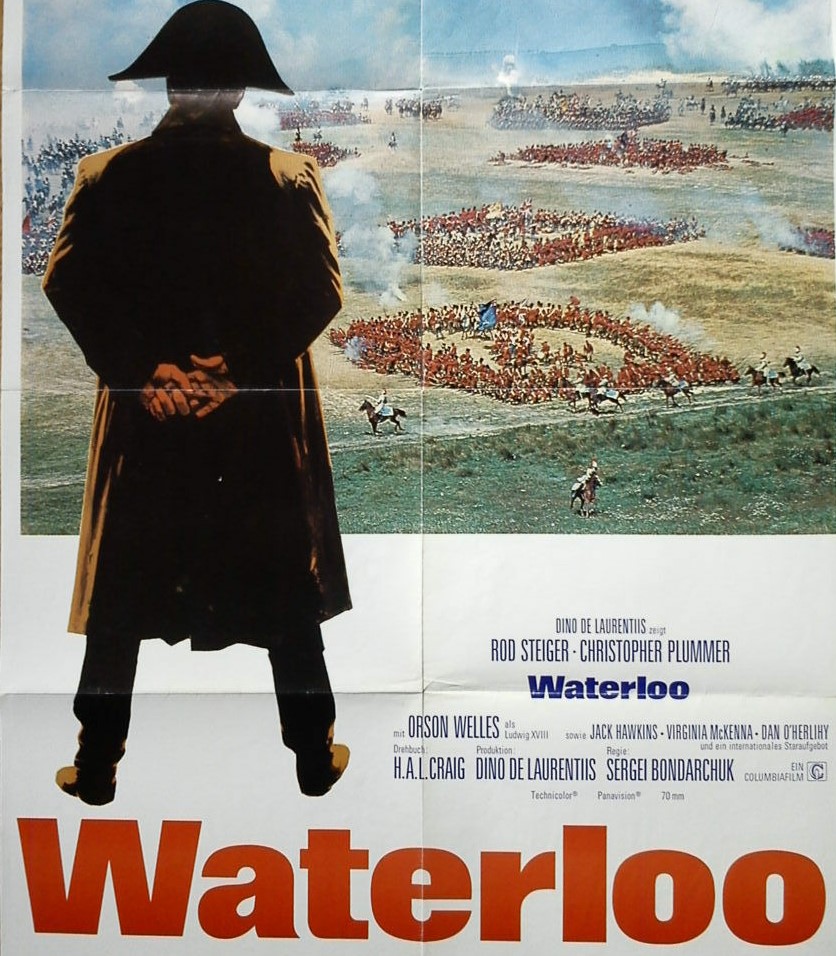
Waterloo (1970). The making of the film was more fascinating than the film itself.
Ice Station Zebra (1968). Alistair Maclean’s Arctic thriller went though a ton of casting changes and embraced new techniques to get to the screen.
In Harm’s Way (1965). No Otto Preminger picture is without incident but with one of his most top-notch casts including John Wayne and Kirk Douglas it was always going to be an incendiary set.
The Satan Bug (1965). Director John Sturges got into all sorts of tangles trying to film Alistair MacLean plague thriller.
Cast A Giant Shadow (1966). Melville Shavelson, better known for comedies, risked his reputation on this Israeli biopic, re-teaming John Wayne and Kirk Douglas with Angie Dickinson and Senta Berger as the love interests.
Spartacus (1961). Not the version you know so well but the one Yul Brynner attempted to make at the same time.
Naked Under Leather / The Girl on a Motorcycle (1968). The erotic, the psychedelic and controversial clashed in Jack Cardiff drama starring Marianne Faithfull and Alain Delon.
Battle of the Bulge (1965). The epic Cinerama production had to see off a rival production before encountering horrendous weather in Spain.
The Guns of Navarone (1961). After first choice stars dropped out, the production was nearly cancelled when it was scheduled to film in a war zone. David Niven nearly died, the biggest set was destroyed, the budget muschroomed and producer Carl Foreman battled Columbia in an attempt to win a prestigious roadshow release.
100 Rifles (1969). Never mind the miscegenation, the violence caused an uproar as Raquel Welch and Jim Brown teamed up in more ways than one to topple a ruthless Mexican regime. Also starring Burt Reynolds. Hot sex and an even hotter shower scene.
When Global Box Office Didn’t Exist. In the 1960s movies lived or died by the U.S. box office figures. In an exclusive report, I reveal how movies actually fared when you took overseas box office into account.
Sink the Bismarck (1962). British World War Two drama overcomes endless obstacles.
The Deadly Companions (1961). The producers were so dismissive of Sam Peckinpah’s maiden effort that the only way they could think of selling it was on the back of a nude dip in a pool by star Maureen O’Hara.
The Cincinnati Kid (1965). Another Peckinpah disaster. He was fired for filming an unscripted nude scene. Steve McQueen was sent to Las Vegas to gamble with the studio’s money while they found a replacement.
Night of the Living Dead (1968). Poster boy for the low-budget shocker. Astonishing that it ever saw the light of day.
The Shoes of the Fisherman (1968). MGM roadshow that tried to fuse the Vatican and the Communists.
Top of the Box Office Flops – box office figures were much harder to come by in the 1960s. Here, I exclusively reveal the extent of the films made by United Artists between 1965 and 1969 that bit the dust.
They Shoot Horses, Don’t They (1969). Originally mooted in the 1930s, various previous developments were halted in their tracks for financial or artistic reasons.
The Bridge at Remagen (1969). The location of the actual bridge for the famed World War Two battle was long gone, but when the production opted to film in Yugoslavia it hadn’t counted on being caught up in an uprising.
The Borgia Stick / F.B.I. vs Gangsters (1967). How one of the earliest movies specifically made for American television won a cinema release overseas. Rather than investing in occasional one-offs, Universal wanted to create a brand, the “World Premiere” series, but it had to rely on up-and-comers like Inger Stevens and fading stars like Don Murray.
Richard Burton was first choice. Sean Connery second. Jack Lemmon a distinct possibility. A suave Frenchman such as Jean-Paul Belmondo (Breathless, 1960) was briefly entertained. Brigitte Bardot a certainty for the female lead. Thoughts of entertaining Steve McQueen for the male lead were so far beyond left field as to have entered the outer limits. He played down’n’dirty working characters clad in nothing more sophisticated than denim. Faye Dunaway’s screen persona – violent slutty bitch – was the opposite of the character depicted.
Producer Walter Mirisch was well versed than most about McQueen, having hired him for The Magnificent Seven (1960) and The Great Escape (1963). But when Burton rejected the part, “we determined to try to interest Sean Connery in the role.” The Scottish actor was receptive to any movies that would instantly take him away from the typecasting of the James Bond series. Lunch at the Regency Hotel was followed by further conversation “for most of a Saturday afternoon.”
But to no avail. “We were crestfallen when we failed to convince Sean Connery,” who was, after all, the biggest star in the world, and looked immaculate in a suit.
Even Steve McQueen acknowledged he was an odd choice. He told a film school class in January 1967 that he was a “limited actor, I mean my range isn’t very great.” But after the possibility of crowning his acting career with Oscar glory for The Sand Pebbles (1966) had faded and with motor racing epic Day of the Champion in cold storage but with a six-picture with Warner brothers promising a hefty $700,000 per, he had the pick of projects.
Maybe too many came his way, over 100 in a few months. He took a meeting with Twentieth Century Fox over a proposal to star with Audrey Hepburn in Two for the Road (1967). He was mooted, along with Paul Newman, for In Cold Blood (1967) and was wooed by John Huston for The Kremlin Letter (not made till 1970).
Eventually, director Norman Jewison, who had worked with McQueen on The Cincinnati Kid (1965), another change to the actor’s screen persona, after much badgering, agreed to let him see the script. “Norman and I both felt that Steve was completely wrong to play Thomas Crown,” commented Mirisch, especially over the demand that “he should to wear a necktie on the screen.”
Although Jewison and McQueen shared the same agency, William Morris, the notion of the actor being tapped up for the role didn’t come from there. McQueen heard about it from a friend Steve Ferry who had seen the screenplay. Jewison came straight to the point when he took a telephone call from McQueen: “If it’s Thomas Crown, forget it. You’re not right. I love you and respect you as an actor. But I’ll never tell you lies. You can’t have the part.”
Jewison went further, listing the actor’s shortcomings, explaining McQueen was prone to “looking down at the ground or squinting up into the sun…What’s going to happen when you have to look people in the eye?” Only after three hours on the director’s back lawn did Jewison’s obstinacy relent. “The more he talked, the more I saw him as Thomas Crown. Now we had the problem of turning him physically into Thomas Crown.”
“He’s a rebel like me,” surmised McQueen, “Sure, a high society rebel, but my kinda cat.” Jewison kept telling him he “wasn’t right for it.” It was “unlike anything Steve had ever done” and casting him still seemed a risk. McQueen was aware of the damage miscasting could do to this career. “I don’t have any illusions on that score…If people laugh at me, my ass is gone.”
McQueen explained his enthusiasm for the role. “I had thought of changing my screen image for more than a year. I felt it was time to get past those tough upright types. When Norman showed me the Crown part I grabbed it.”
It was an odd movie from the beginning, not churned out by a seasoned professional. An experienced Hollywood type would never have considered writing a heist picture where the mastermind was a slick millionaire with a string of successful businesses behind him, who, rather than being a professional criminal, was drawn to crime from sheer boredom.
Alan R. Trustman was a legal eagle, partner at the law firm of Nutter, McClennen and Fish. “I had never written a line, except for law briefs. One Sunday afternoon I got bored watching TV and suddenly, for no apparent reason, I thought it would be fun to write a screen story…in two months The Crown Caper was done.” But it was nothing like the polished movie that ended up on screen. “It had a lot of dialogue, a lot of description and a lot of prose,” recalled Mirisch, and at thirty pages long was more of a treatment than a script. “But it had a great germ of an idea.”
Mirisch was an early advocate of Faye Dunaway, having seen her on stage in a play, Hogan’s Goat (1965), recognized her potential and “always had in mind that, one day, a role would come along.”
Mirisch had McQueen on some sort of a financial string. Their multiple-picture deal with him dated back to The Magnificent Seven (1960), at a time when he was a rising rather than established star. In the way of such pacts, initial remuneration was pretty low, rising with each successive picture, and relying on the actor having become, somehow, a success.
“His agent and manager made a big fuss about the nominal salary provided for in our second option. To settle the argument,” stated Mirisch, “I agreed to pay him the salary called for in the third option as well as to cancel that last option. I recognized that we really should be paying him more than the price stipulated in the option. Also I felt that trying to enforce the third option would be difficult if not impossible.”
If Walter Mirisch thought he was getting a bargain, it wasn’t much of one. McQueen still pulled in $650,000 plus $1,000 a week living expenses and a ton of perks – including it later transpired the dune buggy (worth about $50,000 at today’s prices), all the tailor-made suits, and the shoes and a swag-bag of props. The actor called on his Beverley Hills tailor Ron Postal to deck him out in $400 suits (over $3,500 now), had his hair transformed by celebrity stylist Jay Sebring (later murdered along with his girlfriend Sharon Tate by the Manson gang) and learned to play polo “until his hands literally bled.”
Dunaway, by contrast, with Bonnie and Clyde (1967) in the bank and wanted by every studio in town, was paid a larger salary (though McQueen made up for it by his profit share). Out of the $4.3 million budget around a third was spent on the salaries of the two principals.
Dunaway proved terrific casting for another reason. She was as tough, single-minded and independent as the character she played. She had an inner strength McQueen’s previous leading ladies and contemporary amours lacked. In person “she threw him off-balance” and she “did the same thing on camera” which provided the anchor of their relationship. She was far from the typical Hollywood “love interest.”
Mirisch’s pact with Jewison had proved wildly successful, among the best financial deals the company had ever achieved, the hot box office of The Russians Are Coming, The Russians Are Coming (1966) exceeded by In the Heat of the Night (1967). Jewison rehired many of the crew from his previous picture, including two budding directors, cinematographer Haskell Wexler (Medium Cool, 1969) and editor Hal Ashby (Shampoo, 1975).
Aside from the sensational screen charisma of the leading actors, the screenplay’s originality was enhanced by a huge step forward in the use of technology, the innovative split-screen process, executed by visual designer Pablo Ferro, who had devised the credit sequence for The Russians Are Coming, The Russians Are Coming.
Multiple image was used in three principal area – to introduce six characters and establish their relationship during the initial robbery, for the polo game, and in the final caper. The polo game employed “not only out-of-focus and soft effect panels but also at some point involved over fifty separate panels on the screen simultaneously,” said Jewison. For the second robbery “the amount of film used in relationship to the amount of screen time was probably in the ratio of four-to-one.”
In other words, not only was it incredibly stylish, but it vastly compressed screen time, reducing the running length by fifteen or twenty minutes, ensuring that the audiences concentrated on the evolving relationship between McQueen and Dunaway.
McQueen could ride, of course, what Hollywood star, with westerns in high demand, could not. “But he hated horses and he hated polo, but he wasn’t about to give up.” Thanks to his dedication, he proved a worthy competitor. Jewison only believed in McQueen once he witnessed him in action playing polo. “That’s when I realized how much he was giving for the film. Polo was symbolic of all the reasons why he wanted to play Thomas Crown.” The snobs at the club might sneer but they could not ignore “his sensational back hand.”
McQueen had never used the English saddle, a prerequisite for polo. He trained at the Myopia hunt club from morning till night until he mastered the art of riding using his knees not his arms (essential to be kept as free as possible to swing the mallet) as well as becoming such a “proficient player” he received a standing ovation from the members.
The F.B.I. refused to cooperate. Rejecting a request to film in its Boston office, the crime buster operation complained about what it perceived as “an outrageous portrayal of the Bureau” especially as the film ended with Thomas Crown outwitting the organization.
McQueen turned up for shooting as if he had swallowed the Method. “Call me Tommy,” he told the crew. But there was limited time to knock the character into shape, the actor having only signed up for a week of pre-production.
The twelve-week shoot was marred for McQueen by “some letters of a threatening nature that he had received.” That meant posting a security guard on his rented house to ensure the safety of his children. “It preyed on his mind a great deal during the shooting,” said Mirisch.
According to Jewison, McQueen’s security concerns evolved into paranoia, itself driven by his drug-taking. As well as a 24-hour security detail and surveillance on the front of his house, he demanded the same facility for the back of his house which between him and the Atlantic Ocean consisted only of a private beach. “Who the hell did he think was going to get in from there?” mused the director. Off-screen McQueen never exhibited his on-screen confidence. Jewison observed, “He was tortured.”
Filming was, as Jewison put it, best described as “bittersweet.” Producer Robert Relyea recalled “refereeing” a few incidents between actor and director. McQueen’s unease or the eternal power battle between director and actor resulted in one opportunity missed. For the dune buggy scene, said Jewison, “we had everything lined up for a scene on the beach at Magic Hour just as the sun was going down. Beautiful… conditions were perfect, everyone was ready except Thomas Crown Esq who was out in the surf in his dune buggy not answering his radio.”
Oddly enough, McQueen objected to the director speaking to him snippily when the actor returned and after that their relationship wasn’t the same, McQueen nibbling away at the director’s confidence, objecting to scenes or lines, until Jewison at one point ended up in tears. McQueen became a consummate actor, expressing emotion with the slightest lift of an eyebrow, or tightening a facial muscle, because “he couldn’t get his tongue around a lot of words.”
The producer was delighted to return to Boston, the movie’s main location, because he had attended college there a quarter of a century previously. Locations used included Old Copp’s Hill Cemetery, the Boston commons, the Little Italy outdoor markets, Anthony’s Pier 4 restaurant, and the sand dunes near Crane’s Beach and Provincetown. The St James Ballroom of the Jordan Marsh mansion provided the setting for the ballroom while the chess game was shot at the Goldwyn Studio. The initial bank robbery was filmed using hidden cameras at the National Shawmut Bank.
For the chess game “ we were hoping to get inspired moments that could give us more than dialog could.” Inspiration didn’t stop there, the fashionable outfits adorning Dunaway helped enormously and, of course, the movie hit pay dirt with the Oscar-winning theme song, “The Windmills of Your Mind” composed by Michel Legrand with lyrics by Marilyn and Alan Bergman, a huge success in the global singles charts.
The original title of The Crown Caper was changed for a time to Thomas Crown and Company before setting finally on The Thomas Crown Affair.
Although initially criticized as being primary style over substance, and now recognized as a work of inspired genius, one of the few times when everything falls into place on a movie, according to Mirisch, it was more “an exhibition of style…we hoped to dazzle the audience with the multiple panels and the chess game, the photography and the music.”
It proved a smash at the box office, rentals of $6.25 million in the U.S, nearly matched by $5 million abroad.
SOURCES: Walter Mirisch, I Thought We Were Making Movies, Not History (The University of Wisconsin Press, 2008) p265-270; Penina Spiegel, Steve McQueen, The Untold Story of the Bad Boy of Hollywood (Collins, 1968) p201-209; Christopher Sandford, McQueen, The Biography (HarperCollins Entertainment, 2002) p196-198, 202-206.
It would have been a different movie entirely with Kim Novak (The Legend of Lylah Clare, 1968) in the lead and directed by Sidney J. Furie (The Ipcress File, 1965). He was one of three directors – the others being Arthur Hiller (The Americanization of Emily, 1964) and Michael Anderson (Operation Crossbow, 1965) – to pass on the picture (then known as 13) before it ended up in the lap of J. Lee Thompson (Return from the Ashes, 1965). Terry Southern (Dr Strangelove, 1964) also hnded the screenwriting torch over to Robin Estridge (the author under a pseudonym of source novel Day of the Arrow) and Dennis Murphy.
Possibly because of the potential involvement of Hiller, and that Martin Ransohoff, producer of The Americanization of Emily, was funding this film through his Filmways shingle, Julie Andrews was mooted for the lead. Instead, the part went to Kim Novak, who had just finished another British production The Amorous Adventures of Moll Flanders (1964). She had signed a three-picture deal with Ransohoff who was firming up productions with a number of Hollywood studios
According to co-star David Niven (The Extraordinary Seaman, 1969), Novak was insecure about acting the part. “I don’t think I’m betraying any confidences,” said Niven, betraying her confidence to a reporter, “if I said that Kim often told me ‘I think I’m not right for this part. I think I’m a sex-pot.’ ” Given she was playing a mother-of-two, it’s doubtful that she was intended to be overtly sexy, although that would certainly provide a different reading for the role.
Some of Novak’s concerns could be ascribed to any Hollywood-trained actress. “While highly professional,” observed Niven, “Kim worried about her looks, her scenes, her individual lines, everything.” Novak’s professionalism included arriving at the studio at 4.30am and often doing her own make-up accompanied by an “entourage of dialog coach, press agent and personal secretary, with whom she rehearsed her lines before going on set.” (I’m sure she practiced her lines with her dialog coach rather than secretary.)
As if British actresses prepared for a movie with ease and turned up on the set without a care in the world. However, that was Niven’s conclusion. As if little preparation was involved, “Deborah Kerr,” said Niven, “just walked before the camera and did them (her lines); stand-in Esmee Smythe would occasionally hear her lines – very occasionally because she always knew them – and once in a while would help out if the dresser was not on the spot.”
Four-fifths of the picture was completed when Novak pulled out. The standard reason given was because of a back injury. Initial filming had taken place in fall 1965 in France at the main location of Chateau de Hautefort in Dordogne before Novak fell from her horse. Production was suspended for two weeks. But the actress proved unfit to rejoin the unit.
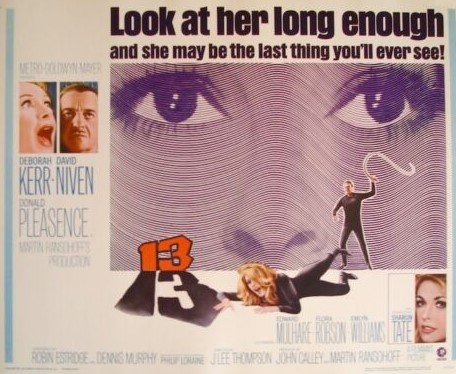
Title changed to “13.” It’s worth noting that the main images of the poster refer to Sharon Tate. It’s her eyes that are hypnotic and she’s the one being whipped.
Supporting star David Hemmings (The Charge of the Light Brigade, 1968) offered a different reason for her departure. This was the actor’s first big-budget international full-scale picture. His career was in reverse, from starring in Be My Guest (1964) he had tumbled to fourth billing in Two Left Feet (1965). As if forever destined to be the ingenue, here he was billed eighth.
Hemmings knew the director from No Trees in the Street (1959) and had worked with Donald Pleasance in Wind of Change (1961). He recalled “the comparatively unknown but totally ravishing Sharon Tate who was the same age and had done about as much as I did.”
Given his lack of knowledge of American television it was understandable he believed he was in the same bracket as Tate. In fact, she was such a hot prospect, coming off a role in the wildly successful series The Beverly Hillbillies she was given an “introducing” credit and had far the superior part.
“ I loved the setting and my part which demanded skills in riding and toxophily (archery),” said Hmmings. He found all the time wasted in playing darts in pubs assisted him in his archery training. “But I found it quite odd that a young lad of 24, dressed in black leather and riding a white horse, albeit with my toxophilic advantages, should have been thrown together with such a distinguished cast.”
The fact that he presented such a visual treat in his blonde curls and black leathers appeared not to occur to him. “The older actors were astonishingly kind to me. Niven’s charm was profound and genuine.”
One of the older stars who reached out to him proved to be Kim Novak. Although only eight years older she had been a star for more than a decade, leading lady to William Holden in Picnic (1955), Frank Sinatra in the Man with the Golden Arm (1955) and Pal Joey (1957), James Stewart in Vertigo (1958) and Bell, Book and Candle (1958) and Kirk Douglas in Strangers When We Meet (1960) while in most of her films in the 1960s she had received top billing ahead of the male star.
When Hemmings took to riding his white horse through the French countryside Novak became his companion. “We would stop somewhere to sit and chat. Easily and at great length almost about everything…and to begin with no hint of physicality…after a while I began to detect that strangely attractive wicked look in her eye that an experienced woman gives to an inexperienced man.”
One day, though staying in different hotels, she asked to meet him in a large park in the centre of Brive. “It wasn’t a suggestion, it was a command,” he recollected, “and being the young man it was a command I knew would lead inevitably to possibilities.” The assignment in the park led to a short affair conducted in her hotel room.
Shorty afterwards, at a press conference, “I can’t recall what Marty (Ransohoff) said to upset Kim or if it justified her reaction but I have an indelible vision of her stubbing out a cigarette in his one good eye which led to an ugly scene…and Kim being sacked.”
But it would be hard to convince the completion guarantee bonding companies and the insurance company that a back injury had been faked to cover the embarrassment of the producer. Original budget of £1 million was supplemented by another £600,000 from the insurers to complete the movie. Deborah Kerr had been holidaying at Klosters in Switzerland when she received the call and began work as a replacement at the Borehamwood studio in Britain over Xmas 1965.
Since Novak had not been in every scene, the opening scenes and the beguiling of the children by Sharon Tate, for example, it wasn’t a case of starting completely from scratch. And the director and cinematographer would have the advantage of already having made decisions regarding camera placement, while the other actors would be well-rehearsed. However, weather for the previous filming had been cold so there would have been a worry about matching exteriors since conditions in France in January-February 1966 were “like summer.”
It was Niven who had suggested Deborah Kerr as the replacement. This was the third of the five pictures they made together, preceded by Bonjour Tristesse (1958) and Separate Tables (1968), followed by Casino Royale (1967) and Prudence and the Pill (1968). Niven welcomed her presence. “Playing opposite Deborah is as delightful an experience as an actor can have,” he said. “I’ve always felt I won my Academy Award (Best Actor Oscar for Separate Tables) because she made me look so good. That sort of thing makes for a warm and relaxed screen relationship.” Niven was clearly ignoring the fact that, although happily married, the relationship of the couple on Eye of the Devil was tense and strained.
But the France reshoot took place at a different location, Brives Les Gaillards in Perigord, an overnight train journey from Britain. Perhaps in a bid to save money, Esmee Smythe was eliminated from the personnel intended to be shipped abroad. After a few words from Kerr – who otherwise would effectively be acting as her own stand-in for scenes involved horse-riding, driving and standing on the parapets – Ransohoff changed his mind. Despite the pressures to complete and ensure that Kerr’s work – a “daunting job of re-shooting” – would fit in with what had come before, shooting was deemed “pleasant.” Kerr again stood up to the producer when informed further work in Borehamwood would begin immediately on the morning of the overnight train journey home.
The original stars were paid twice, for Hemmings “the most lucrative job I’d ever done.” Nonetheless, there was clealry doubt about its box office potential and, unsually for a film with denoted stars, it sat on the shelf for over a year.
Despite MGM’s best marketing efforts the movie fizzled out in the United States where it opened in fall 1967. Prospects proved poor. It waited another seven months before a British premiere at the Ritz in London’s West End in March 1968, that showing possibly the result of the unexpected success for MGM with David Hemmings’ breakout movie Blow-Up (1966).
But the West End opening counted for nothing when it came to general release it the UK. On the ABC circuit it was only the supporting feature to The Heroin Gang (1968) starring David McCallum and Stella Stevens. It might have done better had it been delayed further and taken advantage of the successful comedy pairing of Kerr and Niven in Prudence and the Pill.
Like many a horror movie, the production was considered jinx. Filming on Prudence and the Pill was delayed when Kerr, who “had never had a day’s illness in her life,” was diagnosed with labyrinthitis, a condition which destroyed her sense of balance. While she recovered, others involved in Eye of the Devil were not so fortunate. Not only was Sharon Tate slaughtered by the Manson gang but a member of the location crew was crushed by a car and the chateau burned down a few years later.
SOURCES: Eric Braun, Deborah Kerr (WH Allan, 1977) p198-202; David Hemmings, Blow-Up and Other Exaggerations (Robson Books, 2004) p123-126.
Hungarian Andre de Toth’s somewhat cavalier career had become ultra-cavalier during the 1960s. Best known for westerns such as Ramrod (1947) with Joel McCrea, Springfield Rifle (1952) starring Gary Cooper and The Indian Fighter (1955) headlined by Kirk Douglas plus House of Wax (1953), he was not, you might have imagined, riding high in the critical stakes. Hollywood considered him a journeyman. Esteemed French magazine Cahiers du Cinema, which had championed Hitchcock in the face of mainstream indifference, believed otherwise and interviewed him for a 1967 issue.
He might have been the name of everyone’s lips for more hard-won commercial reasons had attempts in the late 1950s come to fruition of filming the Ian Fleming portfolio beginning with Dr No. Instead, he was deemed a spent force and during the ensuing decade limited to only four films: Man on a String (1960) and the Italian-funded Morgan The Pirate (1960), The Mongols (1961) and Gold for the Caesars (1963).
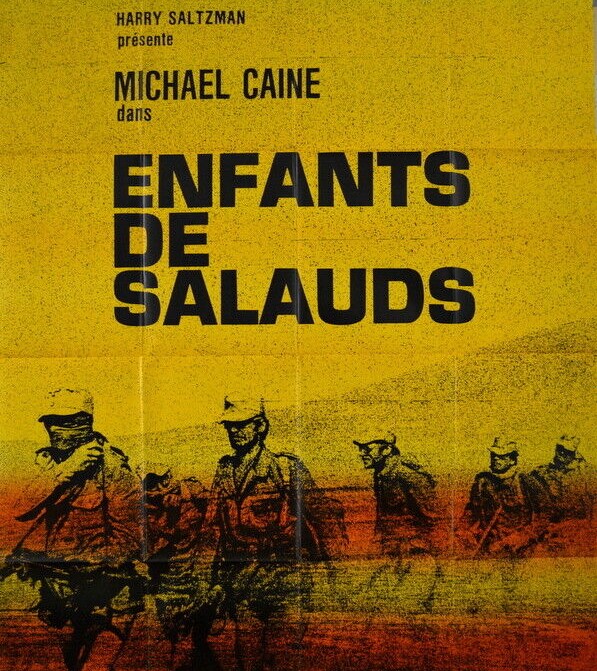
The Fleming enterprise had put him into the orbit of Harry Saltzman which led to a producing gig on Billion Dollar Brain (1966). Saltzman was also involved in The Deadly Patrol – the basis of Play Dirty – with French director Rene Clement (Rider on the Rain, 1970). According to de Toth, Saltzman wanted to elevate himself in movie circles. He “looked down on the Bond pictures” and wanted to make more serious movies.
And the pair clashed on style. “Genteel Rene wanted to make ‘a poetry of war.’ Harry wanted blazing guns and roaring tanks.” Saltzman feared Clement’s version “was going to be some kind of art movie.”
Play Dirty was originally set to be shot in Israel – even though insurance was impossible – as a favor to Arthur Krim, head honcho at United Artists which was providing the finance. In the end filming was switched to Spain, even though neither Saltzman nor Clement was familiar with the terrain of Almeria, and the reality fell far short of the Lawrence of Arabia landscape both envisaged.
De Toth, by now part of the Saltzman entourage, was again assigned production duties with a new script to be written by de Toth, John McGrath (Billion Dollar Brain) and Melvyn Bragg (Isadora, 1968) as long as the credits made room for Lotte Colin, Saltzman’s mother-in-law. Shuttling pages to Saltzman, de Toth had little conviction the revised screenplay was being passed on to the Frenchman.
Michael Caine, already contractually committed, was keen to make a movie “good, bad or indifferent” with Clement. Richard Harris, on a salary of £150,000, pulled out of the role of Capt Leach after script rewrites eliminated four of his major scenes. “I wasn’t going to play second fiddle to Caine,” raged Harris. (Nigel Davenport, originally in a supporting role, was upgraded to take his place). Caine didn’t like the script. But it was either go ahead or Saltzman lose out on all the money already spent. Sets were built with still no guarantee from Clement that he would actually turn up.
The inducement of receiving the final chunk of his salary, payable on completion of the picture, did the trick. At first Clement appeared fully committed, altering the script, and “observant and meticulous about details.” But soon mere tinkering escalated into demanding to “revamp the set, find new locations maybe in North Africa; in short, shoot another film.” When de Toth turned up on set, Clement vanished. Then the director went sick but refused to admit a doctor to his hotel room. A three-day enforced hiatus ended after De Toth was subjected to a barrage of abuse down the telephone by Saltzman and then instructed to get on the set and start shooting.
“It was a strange way to get the directorial assignment,” noted de Toth. “I would have been a hypocrite to deny I wasn’t happy. I had wanted to do a story like Play Dirty since I had wallowed in the blood of futility in Poland.” But that combat experience came in handy. “I had learned in Poland how to crawl under barbed wire with fishhooks dangling on it and if you were caught and the tin cans rattled you had no chance to start your last prayer.” De Toth’s acquaintance with the realities of war inform the film. Location manager Andrew Birkin, brother of actress Jane Birkin, described de Toth as “more of a sergeant-major and he made the picture that way which was probably the right way to do it.”
“Michael Caine was probably more disappointed than I and I understood him and his resentment of the film. He felt uncomfortable, insecure, in the film without Clement, which made his portrayal in Play Dirty so remarkable, considered by many one of his very best…My respect for his professionalism grew as we drilled.”
Unexpectedly in the desert, rain came to the aid of the already hard-pressed production. The downpour turned the sand into a flower garden. Shooting was postponed for two weeks allowing the cast and crew to bond and iron out the script.
Since the beginning of the decade Almeria, decidedly smaller than it usually appeared, was a an in-demand location, favored by King of Kings (1961), El Cid (1962), Lawrence of Arabia (1962), Cleopatra (1963) and, following the success of A Fistful of Dollars (1964) hugely popular for westerns. The local authorities had regulations in place regarding usage, limiting employing of the sand dunes made famous by Lawrence of Arabia. “You got them for two weeks because another picture was coming in.” Even so, competing movies often got in each other’s way.
Michael Caine recalled that one scene requiring German tanks to advance over the desert sands were “confronted round one of the dunes by a horde of American Indians in full battle cry in pursuit of a nineteenth-century stagecoach” for the western Shalako (1968). The noise of the tanks made the horses rear up, throwing off their riders, and the war picture production was delayed while all evidence of the western, including, of course, mounds of horseshit, were cleared away.
Caine remembered the experience more for the opportunity to meet Brigitte Bardot, the female lead on Shalako. One afternoon his peace was disturbed by the arrival of Bardot who uttered the immortal words, “I have been looking for you everywhere.” Caine leapt to his feet, knocking over a table of drinks.” Caine’s assumption that the French sex goddess had her eyes on him was wide of the mark. Instead, it was Bardot’s assistant, Gloria who was keen to make Caine’s acquaintance, the actor falling far short of Bardot’s taste in men, extremely young and very dark.
Despite disgruntlement about not working with Clement and over the picture in general, there was a happy ending for Caine. For his 35th birthday present, Saltzman presented him with an envlope containing his contract torn up into small pieces.” From being beholden to Saltzman, albeit his salary on a seven-year contract signed in 1965 was incrementally increased on an annual basis – the fee for The Ipcress File was just £6,000), Caine was now a free man.
Lotte Colin hated the end result and tried convincing Saltzman to shelve it – unlikely given the millions involved and the commitment to a distributor and not least because Caine’s name attached guaranteed audience interest . But she did succeed in removing elements of the Michel Legrand score. And she did replace de Toth on the screenplay credits.
Play Dirty disappointed at the U.S, box office bringing in a miserly $650,000 in rentals (the amount returned to studios once cinemas have taken their cut of the gorss). It did better overseas with $2 million in rentals. but since it cost $3 million it incurred a loss.
“Play Dirty” managed to offset some of its losses by being a regular on the reissue scene – though it would probably have been hired for a fixed fee rather than a percentage. It later showed up as the support to “Beach of the War Gods” (1973).
This proved to be de Toth’s last directorial assignment. But it might not have been. The bosses of new production shingle National General were ardent pacifists and wooed de Toth. Offered the choice of producing or directing western El Condor (1970) he chose the latter.
Nowadays de Toth is best described as a director’s director, an “unsung hero,” by the likes of Martin Scorsese who confesses to being “fascinated” by the “underlying anger and determination” that often makes the director’s movies “very disturbing.”
“Take Play Dirty for instance,” he observes. “The characters have no redeeming social value; they don’t think, they just act. They have a job to do and they’re going to do it. The nihilism, the pragmatism – it’s at least unsettling. Disguise becomes a way to survive that brings doom at the end.”
SOURCES: Andre de Toth, Fragments: Portraits from the Inside (Faber and Faber, 1996) p390-391, 399, 416,433-447; Michael Caine, What’s It All About? (Century, 1992) p247, 256; Michael Caine, From Elephant to Hollywood, The Autobiography ( Hodder and Stoughton, 2010) p142-144; Robert Sellers, When Harry Met Cubby, The Story of the James Bond Producers (The History Press, 2019) p182-184; De Toth on de Toth (Faber and Faber, 1997) p151, 158; “United Artists Corporation and Subsidiaries, Motion Picture Negative Costs for Pictures Released in the Year Ended January 3, 1970” (University of Wisconsin).
The making of this could have been a movie in itself. The novel, published in 1952, suffered from a long gestation involving four directors with seven actors at various points either signed up or mooted for the two top main roles.
Journalist-turned-author Paul Wellman specialized in westerns and historical non-fiction with a western bent. The Comancheros was the last of the half-dozen of his near-30 novels to reach the screen, following Cheyenne (1947) with Jane Wyman, The Walls of Jericho (1948) with Cornel Wilde and Linda Darnell, Alan Ladd as Jim Bowie in The Iron Mistress (1952), Burt Lancaster as Apache (1954) and Glenn Ford as Jubal (1956).
Originally earmarked by George Stevens as a follow-up to his Oscar-nominated Shane (1953), it was scheduled to roll before the cameras on completion of Giant (1956) in a Warner Bros production that contemplated re-teaming Vera Cruz (1954) pair Gary Cooker and Burt Lancaster. When that failed to gel, next up were Gary Cooper and James Garner. That was kind of a tricky proposition given that Garner had taken on the might of Warner Brothers in a lawsuit in a bid to extricate himself from his contract.
But the producer didn’t seem to care as the day the actor won the lawsuit he received the script. “I didn’t like it, I didn’t want to do it,” recalled Garner, “but a couple of days later I heard Gary Cooper was going to do it,” resulting in a speedy change of heart. However, despite his verbal acceptance, no contract appeared and never hearing from Fox again assumed foul play from Warner studio head Jack Warner.
Meanwhile, Stevens’ interest had cooled and after settling on The Diary of Anne Frank (1959) he sold the film rights off to Twentieth Century Fox for $300,000, more than he had originally paid the author. Fox hired Clair Huffaker (Hellfighters, 1968) to write the script with Cooper’s sidekick role assigned to the up-and-coming Robert Wagner (Banning, 1967). But Cooper’s ill-health prevented that version going ahead.
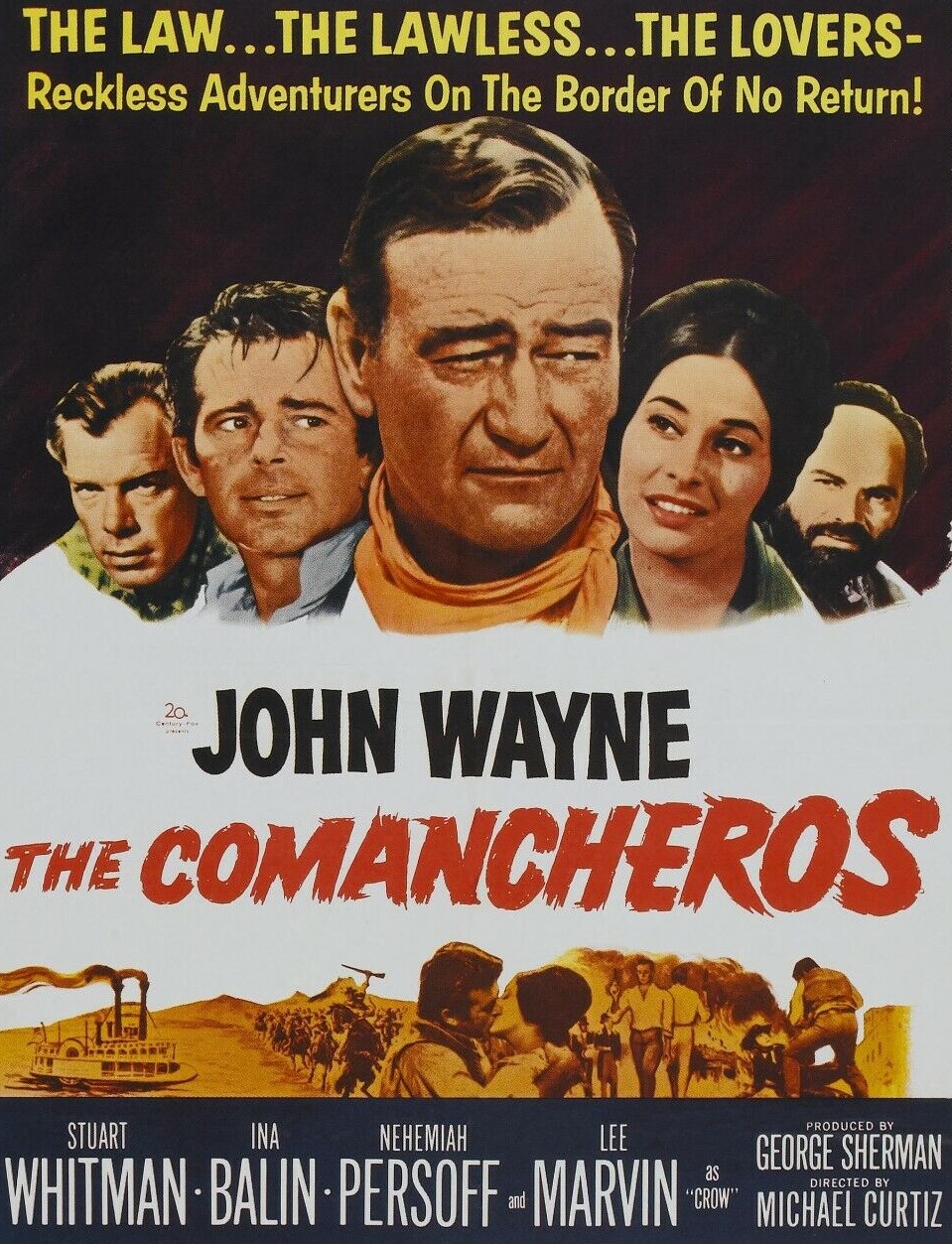
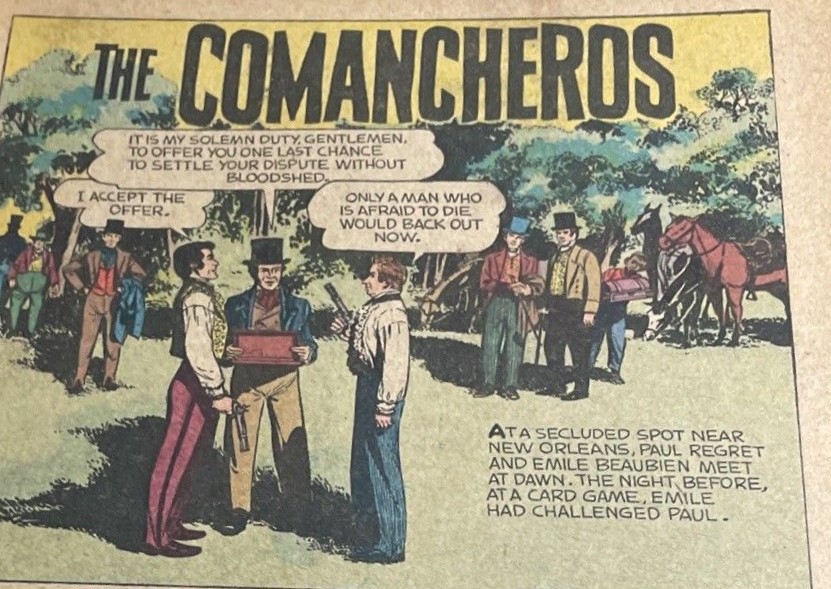
Comic specialist Dell was a bit slow on the uptake, it’s tie-in copy (Issue 1300) not appearing until three months after the movie opened.
Television director Douglas Heyes (Beau Geste, 1966) was set to make his feature film debut with the plum cast of John Wayne and Charlton Heston, fresh off global monster hit Ben-Hur (1959). Ironically, Wayne could have made this movie years before, in 1953 having been sent the novel by then-agent Charles Feldman (who had clearly also contacted Stevens).
Wayne had come back into the equation after signing a three-picture deal with Fox. But Heston, on reflection, decided it would not be in the interests of his career at this point to take second billing and dropped out.
Wayne’s involvement meant re-shaping the script. In the novel the main character was Paul Regret, the Louisiana gambler wanted for murder for killing a man in a duel. Wayne was too old to play him so to puff up his part the Huffaker script was rewritten by James Edward Grant, better known originally as a short story writer, who had begun working for Wayne on The Angel and the Badman (1947) and would continue to do so for another 11 projects ending with Circus World (1964).
Another newcomer, Tom Tryon (The Cardinal, 1963), was lined up to play Regret. Then Heyes dropped out leaving the way clear for the final teaming of Hungarian director Michael Curtiz (Casablanca, 1942), now a freelance after decades with Warners, and John Wayne.
Stuart Whitman (Murder Inc, 1960) arrived from left field. While starring as Francis of Assisi (1961) he was shown the script by that film’s director, Curtiz. Tryon was eased out after Whitman managed to secure an interview with Wayne and the pair hit it off.
That Curtiz was already suffering from cancer was obvious to Whitman. Whatever sympathy his illness might have attracted was scuppered by the director’s rudeness. He had a predilection for sunbathing in the nude and blowing his nose on tablecloths, the actions of a powerful figure letting everyone know he could get away with it. His illness meant he restricted working to the mornings. After lunch he fell asleep in his chair, the crew placing umbrellas over his head to protect him from the sun.
While the director dozed, Wayne took over the directorial reins. When Curtiz was hospitalized, the actor finished the picture. It is estimated that he filmed over half of it, including the climactic battle.
Ina Balin, a Method actor, found her acting style cut little ice with Wayne. When she demanded rehearsals and long discussions about her character, he simply shot the rehearsal. “Cut. Print. See how easy this is,” explained the actor after wrapping her first scene with him using the rehearsal take.
“Duke was a terrific director,” observed Stuart Whitman, “as long as you did what he wanted you to do. Shooting with him was very easy although Ina Balin…pissed him off. Before each shot, she’d dig down and get emotional and he was a little impatient: get the goddam words out, he’d mutter to himself.”
Jack Elam, playing one of the heavies, had won in a poker game with their handler a pair of camera-trained vultures. The daily fee for the birds to sit on a branch was $100. Elam thought he’d get cute and ramp up the price to $250. That notion didn’t sit well with Wayne and he soon reverted to the original price.
While on the set, Curtiz fired third assistant Tom Mankiewicz, later a screenwriter, but currently just a lowly nepo, owing his job to the fact he was son of director Joseph L. Mankiewicz. Tom’s downfall was arguing with Curtiz over his plans for the stampede scene for which he had rented dozens of Wayne’s prized longhorns. Asking the cattle to go over a 5ft drop and scramble up the other side was a good way of breaking their legs. Having informed Wayne of the director’s proposal, he was told by the star to turn up for work the next day, by the time the actor had finished chewing out the director that would be the least of his problems.
Despite friction with Curtiz, Wayne was surrounded by old friends and colleagues, including producer George Sherman, cinematographer William Clothier and screenwriter James Edward Grant. “Duke and George Sherman grew up together working at Republic for $75 a week and all the horses you could ride,” explained Clothier. “They were old friends. Duke didn’t understand old Mike Curtiz very well and I must say he didn’t try very hard. Mike was just plain out-numbered and I felt sorry for him.”
Although set in Texas in 1843, parts of the film were shot in Utah and the cast used weapons such as the Winchester lever-action rifles and the Colt Peacemaker which were not in production for another three decades.
Michael Curtiz, after nearly half a century directing movies, died shortly after the film’s release. The Comancheros, a box office smash, helped balance Wayne’s finances after the financial hit of The Alamo and solidified the notion that as far as is career went he was better concentrating on westerns than anything else.
For some reason, U.S. box office figures are sketchy but it was a huge hit around the world, finishing seventh for the year at the British box office for example, and re-emphasizing the Duke’s resounding global popularity.
SOURCES: Scott Eyman, John Wayne, His Life and Legend, (Simon and Schuster paperback, 2014) p352-357; Howard Thompson, “Wagner Steps Up Work In Movies,” New York Times, January 21, 1961, p18; Lawrence Grobel, “James Garner, You Ought To Be in Pictures,” Movieline, May 1, 1994
A seminal example of the art of screenwriting, setting aside for the moment that in the future disgruntled novelist Elmore Leonard deemed it “an awful movie.” Which it isn’t, by the way. Not great, but far from awful.
Screenwriter Robert Dozier (The Cardinal, 1963) had his work cut out trying to make something cinematic out of the author’s debut crime novel. At that point Leonard had not been acclaimed as inheriting the mantle of Raymond Chandler and Dashiell Hammett. In fact, as far as critical acceptance went, he was pretty much an unknown. Six novels in nigh on two decades was not guaranteed to attact attention. If he had any reputation at all it rested on providing the source material for the Paul Newman hit Hombre (1967).
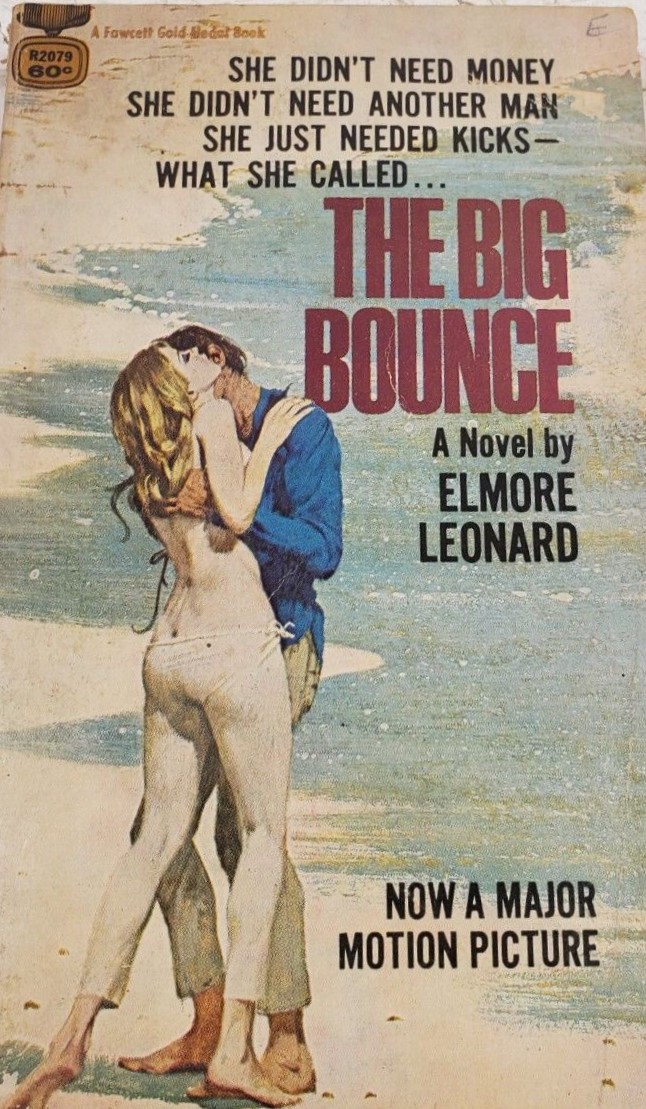
One of the reasons he remained so much under the critical radar was that he hadn’t written a novel in eight years, and all his previous output fell into the western category, a genre staunchly ignored by critics, and heavily reliant, commercially, on the pulp paperback. The Big Bounce wasn’t heralded on arrival, no hard cover printing, just a paperback movie tie-in that didn’t even go to the trouble of using a scene from the film or pictures of the stars.
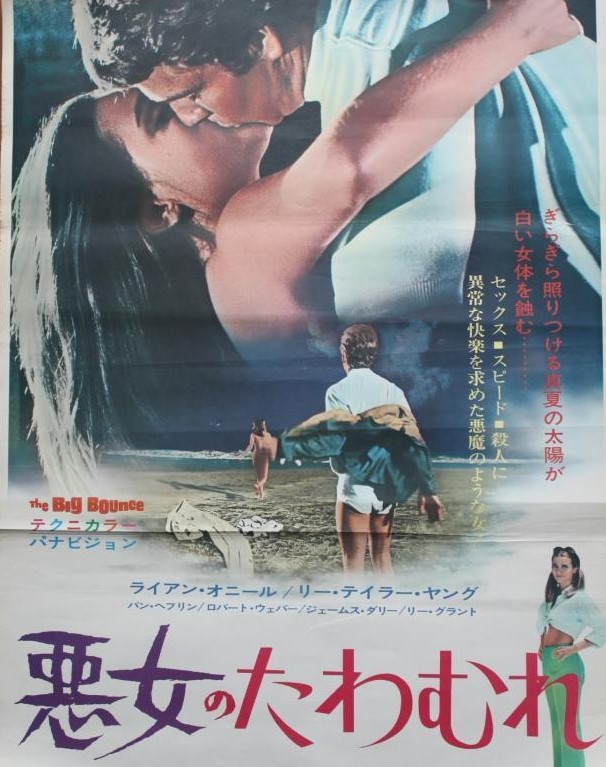
Once again, the foreign distributor produces a better title than the original.
It was up to Robert Dozier to make the source material acceptable to the moviegoer. The book, as written, would never fly. Leonard’s novel lacked a Vietnam veteran, sex in the graveyard, and a nude statue. They were all Dozier’s inventions to bring a character to life who for the most part existed in the novelist’s backstory.
When the novel opens Nancy (Leigh Taylor Young) is due in court to answer the charge of dangerous driving. So rather than leaving that in her backstory, to be dealt with by dialog, Dozier makes that a key element of the film, the episode where Jack (Ryan O’Neal) wonders if he is in over his head as Nancy, annoyed by some pranksters, proceeds to drive a car off the road.
Nor in the book does Jack enjoy a brief dalliance with Joanne (Lee Grant), the single mother renting one of cabanas at the hotel where Jack works as a handyman. In fact, once he knows she has a child in tow, he pointedly avoids making any moves on the mother. His target, as far as the female holidaymakers go, is a single woman Virginia whose look of terror as he seduces her he mistakes for wild passion. The act isn’t consummated as she is struggling too much and it’s only on reflection that Jack, misreading the signals, realizes he had been on the point of raping her.
Jack has been fired from his job as pickle laborer, but he has no Army record. So all the talk about what it’s like to be at war is the screenwriter’s invention. Jack is a failed baseball player (a movie cliché – so that’s left out) and when he loses his job on the pickle farm and prior to hotel handyman turns to a spot of burglary.
He does get a job with hotel owner Sam (Van Heflin) who is also the Justice of the Peace. But Sam’s surname is not Mirakian. It’s – wait for it – Mr Majestyk. Hold on, was there not another movie featuring a guy with that name, starring Charles Bronson? Yep, that appeared in 1974, with Bronson as a melon farmer taking on The Mob. Maybe Robert Dozier thought it was too odd a name for a supporting character, maybe Leonard thought it too good a name to let go. Whatever, Mr Majestyk was left to fight another day.
Where Dozier has been exceptionally clever – rather than just sexing up the movie – is to take sections of the book (as with the car crash scene) and replant them to greater effect. In the book Nancy isn’t pimped out to a Senator by her wealthy lover Ray, but the line that it would take him “oh, a week” to find a replacement mistress comes from the book. In the book Nancy doesn’t swim naked in front of lustful married man Bob (Robert Webber). But she does swim naked in front of a character in the novel who is trying to blackmail her and he envisages holding out a towel to her naked body as she wraps her arms, to pay off her blackmailing debt, around him, rather than that being further teasing of the hapless Bob as in the film.
Dozier has rightly worked out the blackmailing angle would be a sub-plot too many. But it’s the blackmailer she shoots instead of Jack rather than the Comacho (Victor Paul) that Jack has hospitalized at the start of the movie and comes, rather late in the day in the movie, looking for revenge.
Quite a lot of dialog – because Leonard was hot on dialog, and it’s where much of his reputation derives – was taken intact from the book. But there was no way without lots of tedious dialog telling us what we already knew from her teasing Bob and running naked through a graveyard and driving cars off the road that Nancy was a piece of work who took enormous pleasure out of using her sexuality to get the better of men.
The novel explains that as a teenage babysitter she used to come on to the fathers driving her home and if they responded in any way she would blackmail them. One other time when there weren’t enough kicks in letting the neighbors’ kids see her naked, she took fifty bucks apiece from them to have sex with her. And she was always on the look-out for the “big bounce,” the action that would both be exciting and risky and also make her rich.
The Jack in the book is good bit less dumb than in the movie. He is aware that she is using him. He balks at the idea of carrying a gun because that would turn a simple burglary or heist into armed robbery for which, if caught, the sentence was much stiffer.
So, going back to Elmore Leonard’s critique of the movie, I’d be inclined to revise that to an “awful difficult book” to turn into a movie.
Should have been, as you might have guessed, Cary Grant (Charade, 1963) in the lead. Should have featured, which you won’t have guessed, Ursula Andress (She, 1965). Should have run, which you’d be amazed to learn, for 145 minutes, almost as long as your standard epic. Should have appeared, like Hatari! (1962), under the Paramount banner.
In fact, the most likely studio destination was Columbia. Hawks’s agent Charles Feldman had spent 16 months trying to thrash out a very good deal for his client. Feldman, who owned the rights to Casino Royale, was also keen on Hawks directing a James Bond picture. That got as far as discussing Cary Grant as the handsome spy and Hawks’ enlisting the aid of his favorite screenwriter Leigh Brackett (Hatari!).
But instead of moving studios, Hawks decided to stay put, sitting on a three-picture deal worth a hefty $200,000 plus a 50 per cent profit share. First item on the new agenda could have been reuniting Rio Bravo (1959) alumni John Wayne and Dean Martin for The Yukon Trail. But that was before Hawks expressed interest in a romantic short story, The Girl Who Almost Got Away, published in Cosmopolitan magazine, and an ideal fit for Cary Grant.
But Grant, something of the entrepreneur himself, would only sign up if Hawks in turn agreed to direct one of the actor’s pet projects, The Great Sebastian. But the director didn’t like the idea of being a gun for hire and Grant’s attention meanwhile had wandered in the direction of Charade. Rock Hudson, borrowed from Universal, was seen as an ideal replacement. For the female lead Hawks initially enthused about Joanna Moore (Walk on the Wild Side, 1962) until he chanced upon Paula Prentiss (Where the Boys Are, 1960), an MGM contract player.
Paramount balked at a relative unknown. Hawks balked at anyone balking at his choice and switched the project to Universal. While toying with Casino Royale, Hawks had a sneak preview of Dr No (1962) and espied a natural for the second female lead in Ursula Andress. But her management team reckoned the Bond movie would open bigger doors. Instead, Hawks plumped for Austrian blonde Maria Perschy (The Password Is Courage, 1962). Charlene Holt (If A Man Answers, 1962) made such an impression on Hawks that she not only won the part of Rock Hudson’s fiancée but the role of regular girlfriend to the director and parts in his next two pictures.
Leigh Brackett was brought in to pep up the original script by John Fenton Murray (It’s Only Money, 1962) and Steve McNeil (Red Line 7000, 1965). Unusually, she was rewriting on the hoof, earning $1,000 a week to refashion the lines scene by scene as production unfolded. Everything except the opening scene set in San Francisco was shot on the Universal backlot. Even then, neither Hudson nor Prentiss was transported to San Francisco, their close-ups while driving cars filmed at the studio and inserted as process shots. Hawks didn’t leave the studio either, entrusting that initial footage to associate producer Paul Helmick and cinematographer Russell Harlan.
Like Otto Preminger, Hawks liked a lot of takes. Paula Prentiss didn’t, in part because she felt he was trying to mold her into a screwball comedy heroine of the past, and in part because every take not printed impinged on her confidence. Although Hawks lacked the reputation as a bully of the Otto Preminger variety, nonetheless the inexperienced Prentiss found herself in tears more than once. Cary Grant dropped by one time for a friendly chat. He was made welcome. Angie Dickinson, expecting a similar welcome, received a curt put-down, Hawks making it clear he preferred as a brunette.
While the credit sequence by photographer Don Ornitz was deemed sexist since it comprised 33 models in sports or beach gear, it was actually the opposite because the women were proving how superlative they could be at sports generally considered the preserve of men. But there was no doubt the reaction Hawks expected when he spent $20,000 on black scuba outfits for Prentiss and Perschy, using molds made from their bodies to achieve the skin-tight effect. Hawks was notoriously slow, the picture taking three and a half months.
The initial version of the film attracted at a sneak preview the most positive responses the studio had ever received. The only problem was – it ran 145 minutes, considered an impossible length for a light romantic comedy. Although the next version was shorter, the audience response was decidedly worse. Even so, Universal insisted on further cuts until the movie came in at the two-hour-mark.
Not everyone went along with the official Hawks version of events. Others remembered the response to the various cuts not being so different. The film wasn’t released until six months later and there is no evidence that Hawks fought hard to retain his edit. Although he would later complain that the movie was “sabotaged,” that may have been his automatic default position once the movie proved a relative commercial failure, with only $2.35 million in U.S. rentals
Leigh Brackett had more right to feel disgruntled. She was denied a credit by the Writers Guild of America who contended her work was a polish rather than an original contribution.
I have to say I’m out of step with some of the critical opinion. Molly Haskell reckoned the film was actually some kind of Adam and Eve deal with Hudson “a virgin who has written a how-to book on sex while harbouring a deep fastidious horror of it.” The Haskin critique allows that fish are phallic symbols, therefore giving sexual credence to the scene about learning to handle a fish.
It might just be more straightforward to say that, of course, this isn’t as good as Bringing Up Baby but then, nothing ever was, and just enjoy what Hawks did manage to conjure up with very likeable leads.
SOURCES: Todd McCarthy, Howard Hawks, The Grey Fox of Hollywood (Grove Press, 1997), p595-603; Joseph McBride (editor), Focus on Howard Hawks (Englewood Cliffs); Molly Haskell, “Howard Hawks: Masculine Feminine,” Film Comment, March-April 1974.
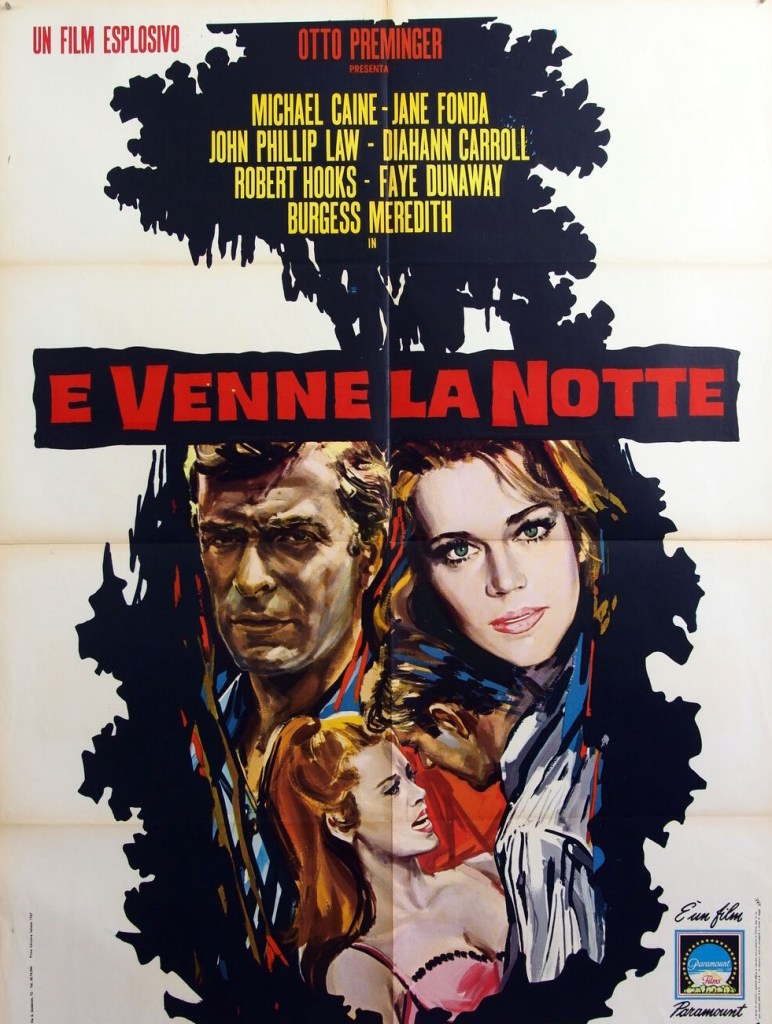
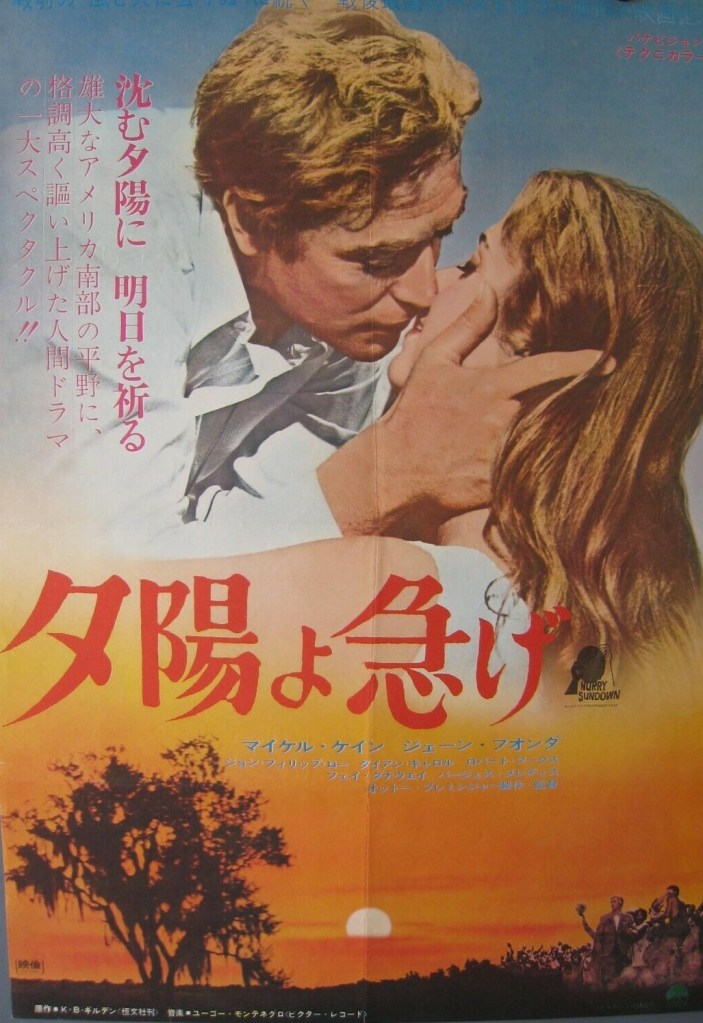
It was rare for Otto Preminger to make a miscalculation on the business aspects of moviemaking. But when in 1964, in the middle of shooting In Harm’s Way (1965), he purchased for $100,000, pre-publication, the rights to K.D. Gilden’s epic novel (1046 pages) he anticipated filming a bestseller of Gone With the Wind proportions. Buoyed by the projection of book sales in the millions, he anticipated making the longest-ever commercial movie, running, in roadshow, for an unprecedented 270 minutes, with admission prices set at a record high.
That notion was scuppered when sales scarcely broached 300,000, the alternative, non-roadshow, was a slimmer picture that would come in at under 150 minutes. If you were going to make a picture set in the Deep South the obvious choice for screenwriter was Horton Foote, Oscar-winner for To Kill a Mockingbird.
The writer spent his months on the project, breaking down the unwieldy novel into manageable basic plot and structure. Although describing Preminger as “wonderful,” Foote’s vision clashed with the director’s and he was replaced by the less-experienced Thomas C. Ryan (The Pad and How To Use It, 1965).
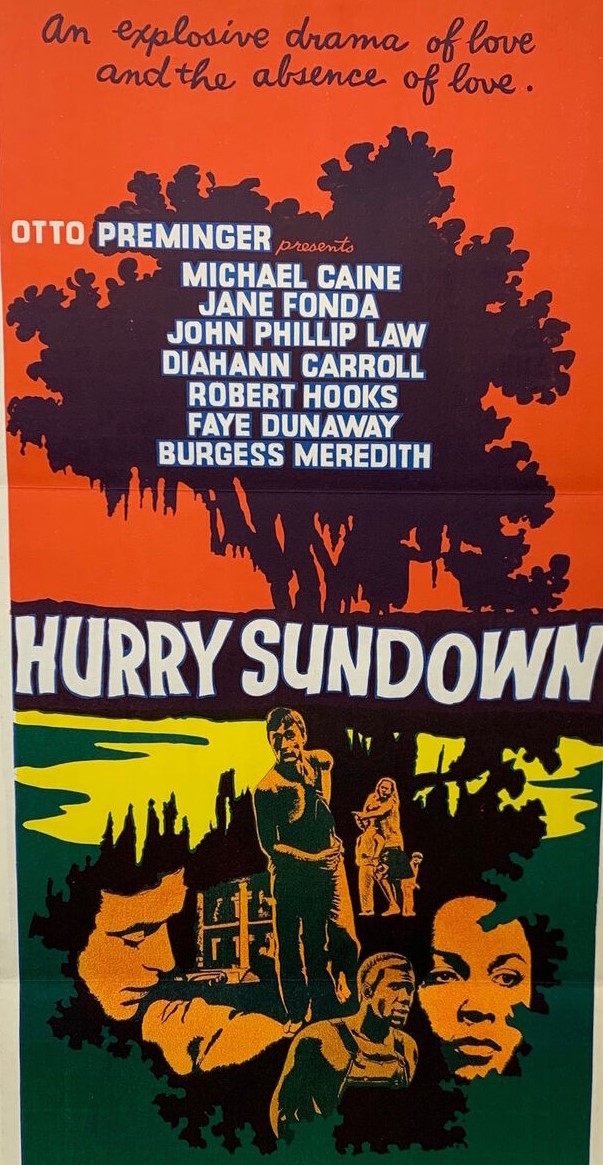
The husband-and-wife principals were initially cast as Michael Caine – enjoying a golden period at the U.S. box office as explained in a previous article When Caine Was King – and Candice Bergen (Soldier Blue, 1967). When the latter dropped out, Jane Fonda (The Chase, 1966) was her replacement. Faye Dunaway was signed to a six-picture deal after Preminger saw her on Broadway in Hogan’s Goat and gave her a screen test. He also signed up, to a three-picture deal, John Philip Law (The Russians Are Coming, The Russians Are Coming, 1966). After Sidney Poitier turned down the role of Reeve, he was replaced by Robert Hooks. The rest of the casting was relatively plain sailing, Burgess Meredith as a bigot, Diahann Carroll as a teacher.
Initially, Preminger planned to shoot in Georgia but, put off by union demands, switched to an area around Baton Rouge, Louisiana. As production designer Gene Callahan hailed from that town his local knowledge and connections helped overcome other obstacles. The house inhabited by Caine and Fonda was an actual Baton Rouge residence while the farms shown in the picture were on land rented from the state prison farm at St Gabriel. St Francisville provided the courthouse, hardware store, and various other locations.
Shooting began on June 6, 1966. For the first third of the shoot, Oscar-winning Loyal Griggs (In Harm’s Way) was director of photography, thereafter it was Milton Krasner (The Venetian Affair, 1966). The New York Times ran a story that Griggs had been fired, but was forced to print a rebuttal to the effect that he had asked to be taken off the picture following a back injury.
This being a Preminger production there was no shortage of tension, the director tending to weigh in on the less experienced or weaker actors. Michael Caine (Gambit, 1966) had accepted the role without reading the script because he was “so flattered and excited” to be asked. He learned to speak with a Southern accent. He received a tip from Vivien Leigh, who told him she recited the phrase “four door Ford” until it came out as “Foah Doah Fohd.”
Aware of Preminger’s reputation, Caine, at the outset, told Preminger that he was very shy and “if anybody ever shouted at me, I would burst into tears and go into my dressing room and not come out for the rest of the day.” Whether Preminger took this seriously, or understood the actor’s little joke, is unknown, but the director responded gently with, “I would never shout at Alfie.”
Others were not so lucky. John Philip Law received “merciless” treatment. This was in spite of the actor liking the director and believing the feeling was mutual, based on the notion that Law “was interested in European culture and other film-makers.” Nonetheless, the actor made few overtures. “He was intimidating enough that he wasn’t a guy I would seek out for a conversation.” Even so, Law appreciated his direction, often minor technical tips like not moving so fast or not to bend down.
In one scene Preminger turned on Law, “tearing him apart and the words were stinging.” Not content with that, he brought wrath to bear on the hapless hairdresser. When Dunaway raced to his defence, “Otto turned on me like a mad dog…I didn’t say anything, I just watched him…it was the only time I’ve really looked into the face at somebody’s who’s just gone into that sort of complete state of rage…I just froze.”
Her kissing scene with Law went to 16 takes, the director only getting the passion he required by literally banging their faces together, resulting in the actress receiving a fat lip. “She just went berserk,” said Law, “I was livid too (but) just gritting my teeth because if you added fuel to the fire he’d just blow.”
Enraged, Dunaway complained that she never wanted to work with him if he was going to behave like this, he muttered that was all right with him, words that she clung onto and sued as the basis for a court suit to end her contract.
But the numerous takes demanded were not confined to Dunaway. The kissing scene between Carroll and Hooks took longer – 20 takes. A scene in the judge’s house required 23 takes, and the scene in the diner a further six. (Though sometimes, the faulty takes were the result of actors not giving the correct line reading rather than Preminger’s imperiousness.)
But there was an overt tension that could not dismissed as the result of a director inclined to bullying. The racism the crew experienced was not an undercurrent. “You can cut the hostility here with a knife,” noted Diahann Carroll. “Down here the terror has killed my taste for going anywhere.” Robert Hooks observed, “You can feel the eyes watching you behind lace curtains…like they could cut your heart out.
Matters were not helped by the cast, ignoring the traditional perspective, jumping into the swimming pool at the motel. That an African American had deigned to join in resulted, according to Jane Fonda, in “reverberations all the way to New Orleans.” Preminger rented out the entire motel to minimize upsetting the locals. Even so, a bomb exploded one night in the pool and trailers were shot at.
Other incidents brought out the notorious Preminger temper. When the soundman switched off the air conditioning during a scene shot in a real hospital the sprinklers drenched the entire cast. Recalled Caine, “I have near seen anyone so near apoplexy. His eyes bulged out of his head.”
For Faye Dunaway, the role of a dirt farmer’s wife waiting for her husband to return from war, resonating too strongly. Her mother had done exactly the same. Dunaway felt “caught in this time warp from my past.”
The last day of shooting was August 13. The critics, almost in revenge for Preminger’s treatment of his actors, were venomous and he received some of the worst notices of his career.
SOURCES: Chris Fujiwara, The World and Its Double, The Life and Work of Otto Preminger (Faber and Faber, 2008), p342-349; Foster Hirsch, Otto, the Man Who Would Be King (Alfred A Knopf, 2007) p410-424; , Michael Caine, What’s It All About? (Arrow Books, 2010), p269-280; Faye Dunaway with Betsy Sharkey, Looking for Gatsby, My Life (Simon and Schuster, 1995) p28, 109, 113-114; Thomas Kiernan, Jane (GP Putnam and Sons, 1973) p200; “Preminger buys Sundown novel,” Film Daily, November 18, 1964, p3; “Conversations with Horton Foote,” On Writing 15, May 2002, p3.
You had to be a mean son-of-a-bitch to cast your alcoholic wife in a movie about an alcoholic wife. The title of Douglass K. Daniel’s biography of director Richard Brooks, Tough As Nails, did not specifically refer to The Happy Ending but it might as well have. But on top of what you might from the outside consider a somewhat callous attitude, you would also have to reflect on the movie’s message: that a man might be implicit in the woman turning towards the bottle and that a woman can break free of a stultifying marriage.
Marriage to Brooks in 1960 meant Jean Simmons, until then a huge star, leading lady to opposite Marlon Brando (Desiree, 1954), Frank Sinatra (Guys and Dolls, 1956), Gregory Peck (The Big Country, 1958), Burt Lancaster (Elmer Gantry, 1960) and Kirk Douglas (Spartacus, 1960), dialled back on her career, opting instead for wifedom and motherhood. Six movies in eight years, compared to 14 pictures in the previous comparable period, spelled the extent of her commitment.
Both had been riding high at the time of their marriage. Despite the setback of Lord Jim (1965), Brooks regained favor through the commercial and critical success of The Professionals (1966) and In Cold Blood (1967). But Simmons tumbled down the pecking order with little compensation on the marital side. As single-minded a director as Brooks spent far more time on his movies than his marriage. The long separations caused by his work took their toll. Like the middle-aged character she played in The Happy Ending, “I started sitting around,” Simmons told her husband’s biographer, “looking in the mirror, feeling sorry for myself a lot. I was slugging down a lot more than anyone should. Sometimes it would bring out the ugly side – when you want to hurt people. And who do you want to hurt? Why, it’s always the one who is closest to you.”
Recognizing she was an alcoholic Simmons began a battle against the disease. Her husband came up with an unusual way of helping, one that would, in some senses, help bridge the gap between them, by writing a movie in which she would star and he would direct. I doubt if she was so far down the pecking order by that stage that if a director of Brooks’ commercial caliber had decided to cast her in a more commercial project, his heist picture $ (1971) for example, I would be surprised if he did not get his way.
However, he had set his mind on a more personal project. Though he was writer-director to trade, had tended to adapt other people’s novels or plays, he hadn’t come up with an original screenplay in nearly two decades, since Deadline U.S.A (1952). So it was odd in some respects that it was his wife’s alcoholism that fired up his creative juices.
“He was trying to help me understand alcoholics,” explained Simmons. “and he would go to (AA) meetings, too, just to find out what people talk about and what people do and didn’t do.” Even so, it was a hard part to envisage. There was too much of herself in the script, Brooks using words she had spoken in real life. “It suddenly hit me as more personal – and it hurt quite a bit to feel so exposed. It was too close to home.”
But the movie proved an original piece of therapy. “He pulled me out of it, made me straighten up, so to speak.” And it was certainly a courageous role to play, knowing that this was something you had experienced yourself and that audiences, should her alcoholism become public knowledge, might judge her as they judged the character.
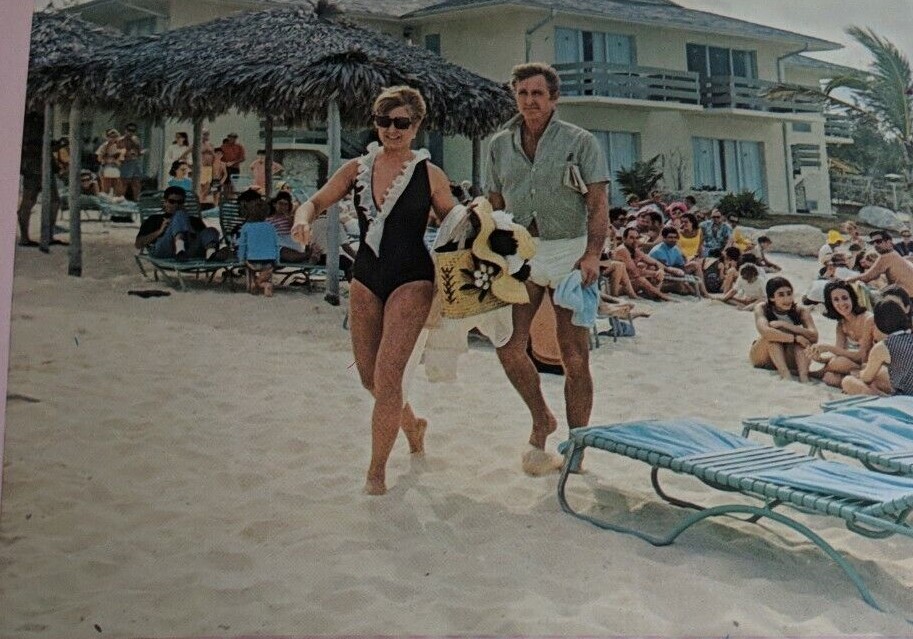
Brooks softened the potential risk for a major studio by keeping the budget low – incredibly low, in fact, just $1.7 million in the end. The movie was made mostly on location in Denver and the Bahamas, deliberately steering clear of Hollywood back lots. The cast was solid rather than costly – John Forsythe still best known for Hitchcock’s The Trouble with Harry (1955), Shirley Jones (Two Rode Together, 1961) another fading star, Teresa Wright (Shadow of a Doubt, 1943) in only her second movie in a decade, television star Lloyd Bridges in only his fourth movie in 11 years, comedian Dick Shawn, out-of-favor Bobby Darin (Pressure Point, 1962) and Tina Louise (The Warrior Empress, 1960).
Simmons had to endure worse than she had suffered as an actual alcoholic – Brooks filmed her going through having her stomach pumped. The director employed a trick to get a reaction from Forsythe at the movie’s end. He has Simmons ask Forsythe an unexpected question and his response, in character, was just right.
Brooks saw the movie as a critique of marriage rather than a rallying call for feminism. “All I wanted to say was that marriage was not for everybody and, by itself, certainly isn’t a solution to anything,” said Brooks, clearly unaware of the impact the harm that putting such a point-of-view on screen might do to his wife.
By and large critics murdered the movie, it was cited as one of the ten worst of the year by the New York Times. Only Charles Champlin in the Los Angeles Times and Rex Reed were its only champions. Even though the Academy members recognized the strength of Simmons’ performance to give an Oscar nod, the movie, despite the meagre budget, still proved a flop.
Astonishingly, even today it is routinely ignored, only a handful of review for example on Imdb and a 33 per cent score on Rotten Tomatoes.
SOURCES: Douglas K. Daniels, Tough As Nails( University of Wisconsin Press, 2011) p187-190
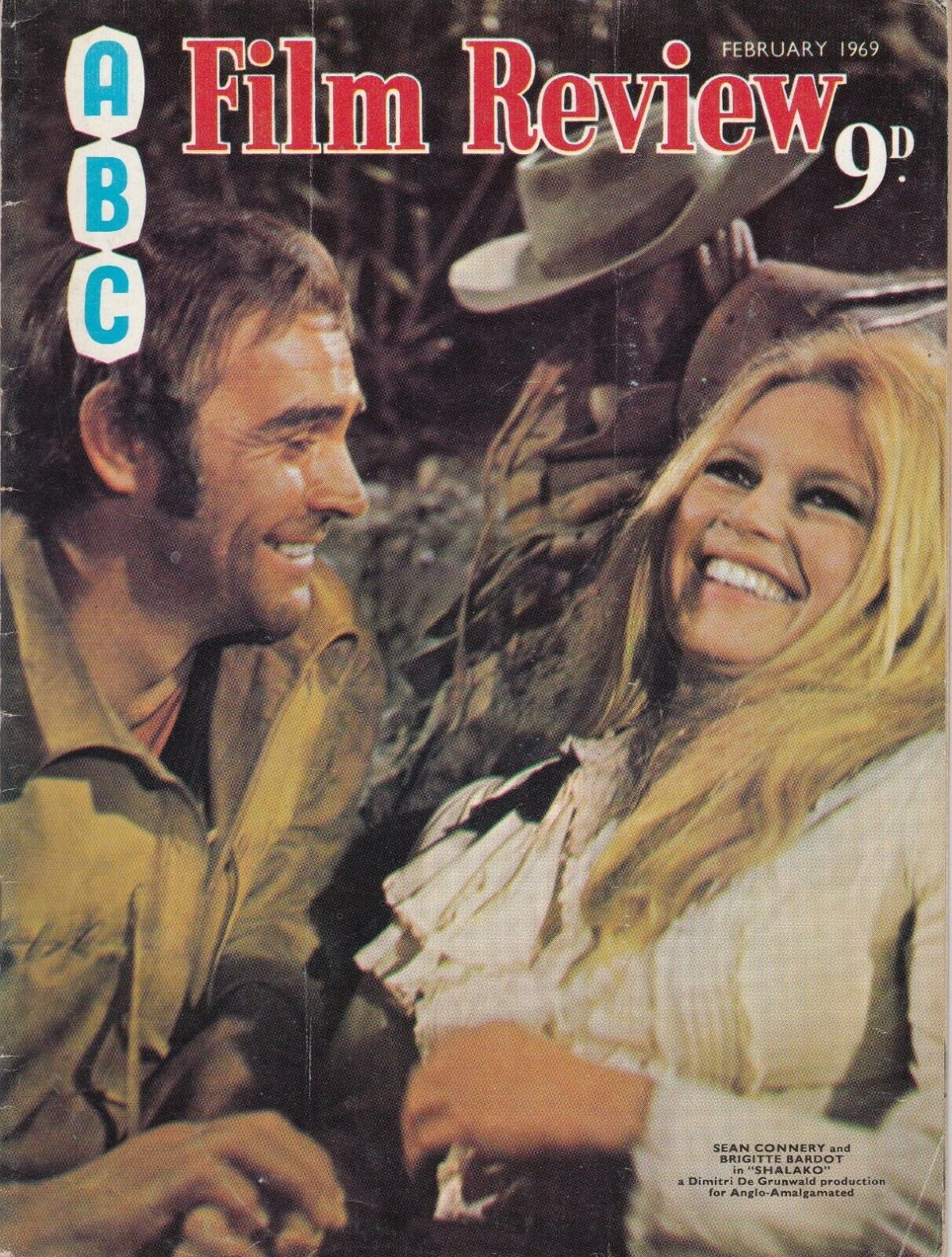
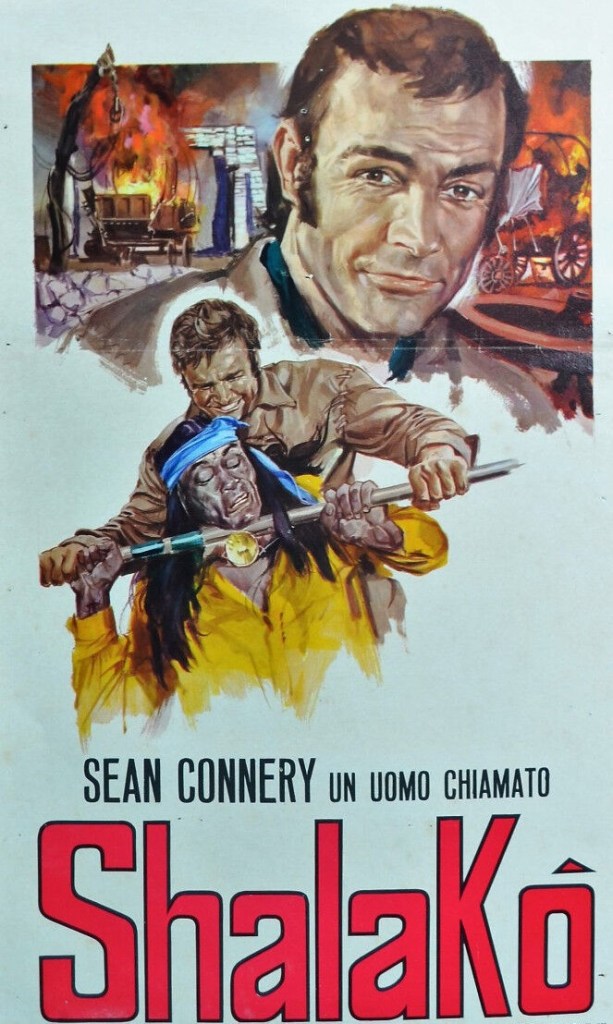
If you ever wondered just how a producer earns his crust, the convoluted process to make Shalako would provide a test case. British publicist turned producer Euan Lloyd had little on his calling card to gain entry to Hollywood, not even with the stars in tow for the project. Having worked for several years as a production assistant with Warwick Films, the British-based outfit headed by Cubby Broccoli and Irving Allen, he transitioned to associate producer on The Secret Ways (1961) but didn’t earn the moniker of producer until he pulled together an all-star cast for The Poppy Is Also A Flower (1966). Although released theatrically in Europe it was in reality a made-for-television number and screened as such in the United States.
So, actually, he was very much a neophyte producer. But early in his career he had become fast friends with Alan Ladd (Shane, 1953) and since they shared a love of westerns the actor had put him in touch with bestselling western author Louis L’Amour who was so taken with the Englishman’s enthusiasm he granted him a free option on any one of his un-filmed novels. Lloyd chose Shalako. “I could identify with that subject as it’s about a bunch of Europeans on safari in the West,” said Lloyd. (In fact, though as yet unfilmed, it was not as though nobody had tried. A report in Box Office magazine dated August 19, 1963, stated that Richard Carr was working on a screenplay for producer George Golitsin set for Universal).
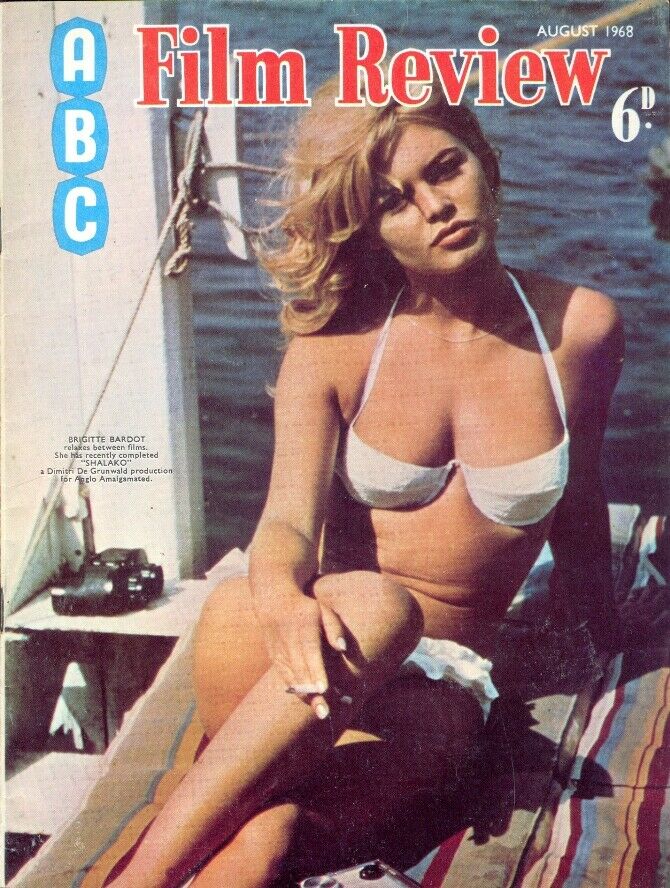
No connection to Shalako but little excuse necessary to showcase BB’s figure apparently.
On the production side, it would give him the excuse he required to put together a cast of non-Americans, stars from different nationalities who could open the distribution doors to significant European countries like France and Germany. His original starring pair were Henry Fonda (Firecreek, 1968) and Senta Berger, whom he knew from The Secret Ways and The Poppy Is Also A Flower. “Privately, she was the antithesis of the character she played in The Secret Ways…she came to mind as a very likely countess.”
He recruited Edward Dymytrk (Mirage, 1965), having got to know the director, a fugitive from the Communist witch hunt in the U.S., on the set of the British-made So Well Remembered (1947). Dmytryk had worked with Fonda on Warlock (1959). While appreciating Lloyd’s interest and keen to work again with Dmytryk, Fonda warned that he was not a strong enough marquee name to get the project off the ground.
To cover his back and using the names of his two stars and director, Lloyd set about pulling together finance from European sources. Although such co-productions were becoming more common, Lloyd must have set some kind of record by pre-selling the movie, in the end, to 36 different bodies. But still it wasn’t enough. Without an American partner, the movie was no-go. Fonda proved the sticking point and in 1967 Lloyd decided to go for broke with a bigger cast (Fonda was pretty gracious about being dumped, “I did warn you,” he said).
Sean Connery was not even initially on the list of proposed stars until Louis L’Amour alerted Lloyd to the length of the queues to see the latest Bond blockbuster (quite how a producer didn’t know that might be considered a mystery). Connery was incommunicado, filming a documentary in Scotland, but Lloyd managed to get in touch and seven weeks later he had what he believed, based on the Bond box office, was the biggest star in the world.
Part of the attraction for Connery of course was that for the first time he was receiving a salary ($1.2 million in total) commensurate with his box office. But it turned out as far as Hollywood was concerned, Connery had been taken in by his own publicity, studios pointing out that his non-Bond movies, Marnie (1964), The Hill (1965) and A Fine Madness (1966) had not approached his Bond box office.
Nor was Brigitte Bardot a golden name on the U.S. cinema scene. Until the mid-decade reissue of La Dolce Vita (1960), her first starring role And God Created Woman (1956) held the record for the biggest imported movie. But since them, except for Viva Maria (1966), her movies had been relegated to arthouses, hardly worth risking for a $400,000 salary – she was in Variety’s list of Top Ten Overpriced Stars.
Three major studios rejected the movie. Assuming all the majors would take the same view that “Connery will never make it away from Bond,” Lloyd targeted a mini-major, the kind of neophyte outfit that might pony up to get a big name on its forthcoming schedule, a way of proving it could play with the big boys. ABC, an offshoot of the television network, was hooked, paying $1.4 million for the privilege.
Trevor Howard, Karl Malden, Claire Bloom and Ingrid Pitt was all considered for roles. Even without them, as well as Bardot, the movie, in terms of credits, had the look of one of those all-star epics so beloved in the 1960s: Jack Hawkins (Lawrence of Arabia, 1962), Stephen Boyd whom Lloyd knew from being associate producer on Genghis Khan (1965) and German star Peter van Eyck (Station Six Sahara, 1963). And if Bardot wasn’t enough to get journalist tongues wagging, Connery would also be reunited with Honor Blackman from Goldfinger (1964). The cast also included Woody Strode (The Professionals, 1966), famed 1940s western star Don ‘Red’ Barry (The Adventures of Red Ryder, 1940) and English comedian Eric Sykes (The Plank, 1967).
Mexico was first choice of location until the devalued peso rendered it too expensive. Almeria in Spain, location of choice of many a spaghetti western, was the alternative. The biggest problem pre-shooting was that, to get into character, Connery had decided to grow a Mexican moustache, presumably not aware that moustaches were verboten for stars after The Gunfighter (1950) sank at the box office reputedly because Gregory Peck wore one. In the end, without the subject becoming a thorny issue, Connery shaved it off. He spent two weeks learning to ride under the tuition of Bob Simmons, a stunt arranger on the Bond pictures, so he could, indeed, sit as tall in the saddle as the great western stars. “He was a very proficient horseman by the time we started,” commented co-star Eric Sykes, “He looked as if he had been riding all his life.”
Meanwhile, Jack Hawkins (Masquerade, 1965) had undergone an operation for throat cancer and though he could speak his words were accompanied by a kind of belch and the voice for which he was so famous had disappeared. By coincidence Lloyd heard what he thought was Hawkins voicing a beer commercial. The distinctive tones belonged to Charles Gray (The Devil Rides Out, 1968) and he re-voiced Hawkins’ lines.
Despite Connery’s assertions to the contrary – his famous quote “she’s all girl but…all on the outside” was viewed as a detractory statement – Lloyd insisted it was a happy set. “I had absolutely no trouble from the cast during shooting and Sean and Brigitte performed perfectly and in harmony. Eddie Dmytryk was a man who knew exactly what he wanted and how to get it. The co-stars liked him enormously.”
Other sources paint a different picture, pointing to tension between Connery and Bardot over who was the bigger star, between Bardot and former lover Boyd, and between Connery and Dmytryk over the script. According to Eric Sykes, sitting beside Connery in between takes, the actor “would tear half a page or even a whole page of dialog out of his script…He was editing his part as he went along, apparently without reference to the director…One scene in particular with him and Brigitte Bardot, a long scene where they were sitting around a pool….it went on and on for about eight minutes…Sean’s editing turned it not a slick two- or three-minute scene…Eddie (Dmytryk) did not challenge it because when he saw what Sean had done he knew it was right.”
A big success in UK and Europe, it was a flop in the U.S. where ABC recorded a $1.2 million loss, but since every area was sold separately it is doubtful this shortfall would need to be repaid by the producer so counting the income from other sources it would have gone into profit. Incidentally, Connery was pictured wearing a moustache when the movie had its premiere and he was actually one of the few major stars who regularly wore a moustache in pictures and there are those who attribute his career longevity to cultivating a beard while still in his prime.
SOURCES: John Parker, Sean Connery, 1930-2020, The Definitive Biography (Bonnier Books, 2020) p171-176; Mac Mcsharry and Terry Hine, “The Way West,” Cinema Retro, Issue #2 May 2005, p38-42.












 The Magnificent 60s