Monkey Man (2024) ***

I can tell you right away why this hasn’t proved the box office breakout predicted. Way too slow, way too many ideas, way too much repetition, the obvious flaws of a debut director who nobody had the sense to rein in. Dev Patel (The Green Knight, 2021) is writer-producer-director and clearly took control of the editing suite because this should have seriously been pruned of about 20 minutes.

It’s a revenge thriller and supposedly the protagonist is better motivated because somebody didn’t kill his dog (John Wick, 2014) or his bees (The Beekeeper, 2023) but his mom. But this revenge is insanely slow-burn. It’s taken him the best part of two decades to take any action. And in the meantime, he’s had plenty of time to dwell on an idyllic childhood, and the bad guy who murdered his mom, because every two minutes whatever action there is stops dead so we can have another interminable flashback.

If you want a crash course on Indian mysticism and gods and religion, this one’s for you, but my guess if that wouldn’t be a priority for anyone turning up expecting the next John Wick or Beekeeper. And it that’s not enough side issue, there’s some malarkey involving a corrupt politician, corrupt cop and corrupt guru and a land-grab to boot plus the need to set free a whole bunch of sex workers. So, sub-plot mania.

I’m not sure I’m convinced either by the bongo-drum keep-fit technique that turns a loser in the ring into a top combatant, especially after, having spent an age demonstrating how much our hero has improved his pugilistic skills he fells his first opponent with a kick. Cage fighting without the cage, I guess.

But there are pluses, once the director sees fit to get to the action and not ramble on about philosophical mumbo-jumbo and there are a couple of fascinating characters, venomous brothel-owner Queenie (Ashwini Kalsekar) who has the best lines, and the low-life Alphonso (Pitobash) with a souped-up tuk-tuk. But mostly, we’re stuck with Kid aka Monkey Man (Dev Patel) as he takes an age to work out how he’s going to get his revenge and makes the audience labor over working out what happened to his mom and why he got his hands so badly burned. Put those two ideas together and the audience has worked it out in a trice, but the director didn’t think so, so fed it in very slowly bit by bit.

Anyway, Kid is the kind of boxer who makes a poor living being fed to the kings of the ring, he gets paid more if he bleeds. And he’s not doing this for just the money, but, purportedly, to punish himself for his mother’s death and relieve the pain inside, some kind of insane self-harming, that only stops when a guru (the good one not the bad one) tells him he has to direct his inner violence to good purpose.

There’s some nifty stuff about how he manages to get a job in the club/ restaurant (it’s never clear) owned by Queenie whose only connection to the tale is that his mother’s killer, police chief Rana (Sikander Kher), is that he was carrying a box of matches with her logo. I’m sure he could have just gunned the police chief down in the street since this is the kind of guy who swaggers around as if he owns the street, but the narrative dictates he needs to gain access to the club/brothel’s inner sanctum and that’s where Alphonso comes in.

Once it gets going it’s satisfying stuff and with some excellent occasionally innovative fight scenes. Not so sure about the soundtrack, “The Rivers of Babylon” as a throat is cut, “Roxanne” when we reach the brothel. But there’s too much sub-plot to wade through before the action gets core.

When Netflix, hardly an arbiter of taste, rejects your movie, you should take note of their objections which I guess would be the same as mine rather than trying to foist those flaws on the public via cinema release, no matter if Jordan Peele is your staunchest supporter. It’s no surprise to me this hasn’t won a release in India either – blamed on its political stance, apparently – because the same problems would apply.

So that’s a shame. A director with too much to say and decides he might only get the one chance to say it so dumps it all into his debut picture. Let’s hope he gets a second chance and is mature enough to listen to an editor.

Excellent action but, boy, you have to wait.

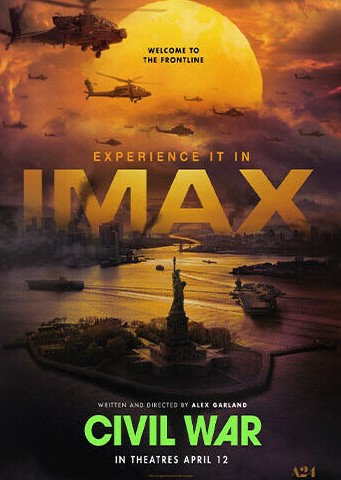
Civil War (2024) **

Of all the problems facing America right now, it can do without this simplistic mess. Good idea, poor executed. Sure, I guess it’s meant to trigger intense debate about a divided country but seeing it through the prism of callous glory-hunting war reporters for whom you can’t extend a shred of sympathy isn’t the way to do it. And it’s as if these decades of alien invasion, with scenes of thousands of abandoned cars and the wanton destruction of every sacred man-made edifice, never existed.

It’s like a slasher movie. You got four candidates – make that six when two other guys join our little team with the sole purpose you quickly realize of being victims – for the slaughter and you can guess from the outset who’s not going to make it. We’ve seen these characters a hundred times before, in the more mainstream war picture, the hardened veteran trying to show the rookie the ropes while we know that more likely than not the newcomer is going to get the oldster killed.

By the time that happens we’re so inured to the sensitivities of these desensitized human beings that we’re hardly surprised when said youngster is only too delighted to take a snap of the person being killed and then, shock be hanged, I’m a true professional now, I’m just going to leap past her corpse because there’s the photo of the lifetime just waiting, the execution of the President.

The rights of war reporters I’m sure are enshrined in the Geneva Convention or in the Rules of War and it’s clearly every soldier’s duty to prevent them getting killed when they put themselves in harm’s way. There’s no doubt about the many famous war photographs but there’s equally been an ongoing debate about why a photographer deems it more important to take a picture of someone dying rather than to stop them dying.

They are meant to be neutral, that elusive get-out-of-jail-free card denied combatants, only in this case they break that golden rule and under threat themselves revert to killing.

The details of this war are pretty vague. For supposed switched-on journalists they don’t seem to have much idea of what exactly is going on, so the audience is just kept in the dark. And because they are neutrals, they can switch sides without the enemy noticing and, what’s more, manage to inveigle themselves with the troops about to storm the White House, said soldiers seemingly trained in the art of hand signals required to keep reporters from giving away their position and getting them all killed.

So we got three veterans, Lee (Kirsten Dunst), Joel (Wagner Moura) and Sammy (Stephen McKinley Henderson) who decide in the midst of this conflict to drive from New York to Washington (D.C. as we’re constantly reminded in case we think it’s the other city thousands of miles away) because Joel, who must be more famous than in his own head, wants an interview with the President because, in the midst of this conflagration, he’ll have nothing better to do than try and appease the “press” (as they’re in old-fashioned fashion known here rather than the contemporary “media”).

War photographer wannabe Jessie (Cailee Spaeny) cadges a ride and proceeds virtually the entire journey to venture into more dangerous territory, first up finding some looters strung up and bleeding to death and nothing to do for it but take a photo of the people who strung them up. There’s various shoot-outs and whatnots and it takes an age for the one character to appear that the trailer had us sold on, the racist Jesse Plemons, who forces them to take sides while digging a mass grave.

If this all meant to be a heavy-handed satire on the role of war journalists it pretty much succeeds, Joel determined not to let the President die before he gets the killer quote for which both will be remembered.

There’s not much any of the actors can do with such tightly prescribed roles. Kirsten Dunst (The Power of the Dog, 2021) does her best, tight-lipped and scrubbed clean of make-up to show she’s a serious actress when portraying a burnt-out character is always a shoo-in for an Oscar nomination. Poor Cailee Spaeny (Priscilla, 2023) has to go from shock to delight in seconds, but that twist is so unbelievable or so heinous, take your pick, it blows her character to hell.

In theory, this is sold as some kind of dystopian action picture in near-apocalyptic America, but that’s hardly going to work when every two seconds the action stops for, wait for it, a grainy black-and-white (black-and-white!!!) photo of the combatants. Written and directed by Alex Garland (Ex Machina, 2014)

This promised much but ended up as a dubious snore-fest.

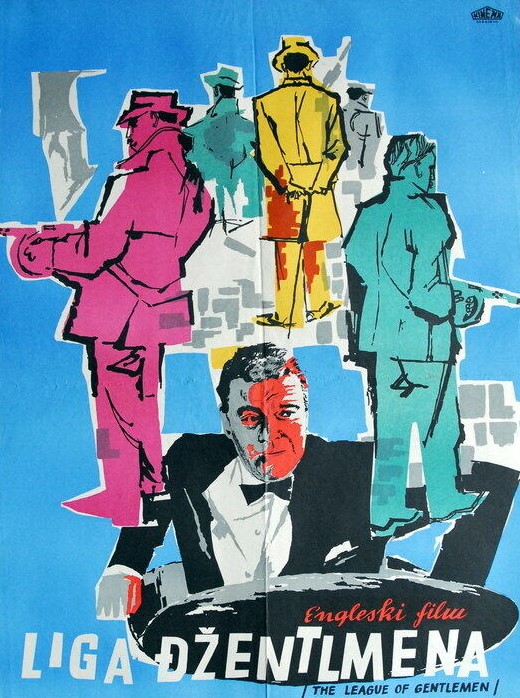
The League of Gentlemen (1960) ****

Cracking British heist film prefiguring titles as disparate as The Dirty Dozen (1967) and Heat (1995). Superb opening scene shows the lid coming off a manhole cover and after a short pause to avoid being drenched by a municipal street cleaner a man in a dinner suit emerges and makes his way to his Rolls Royce. Say hello to Lt-Col Hyde (Jack Hawkins).

Don’t be fooled by early reviews that tabbed this this an “action-comedy,” the humor is only incidental, while serving the important purpose of cutting the grandiose down to size, and not in the vein of, for example, Beverly Hills Cop (1984).

A group of ex-WW2 officers receive a mysterious parcel containing a pulp novel and £50 in notes torn in two, the other halves redeemed if they turn up for a meeting at the Café Royal in London. The opening section is almost a riposte to the recruitment sequence of The Magnificent Seven, out the same year, which strived for effect, and zipped along with one-liners.

This gang are all down-on-their-luck, any courage or leadership displayed during the conflict counting for nothing in peacetime. The sequence is surprisingly risqué for the period, virtually all the characters engaged with disreputable women. So, we have Major Race (Nigel Patrick) running some gambling scam with easy-come-easy-go confederate Peggy (Melissa Stribling), Lt Lexy (Richard Attenborough) a garage mechanic with a sideline in fixing the odds on one-arm bandits and inclined to steal other men’s girlfriends, and Captain Porthill (Bryan Forbes) a pianist playing in seedy dives and living off a middle-aged woman whom he cheats on.

Barely getting by emotionally or financially are Major Rutland-Smith (Terence Alexander) whose glamorous wife (Nanette Newman) takes a string of lovers while ritually humiliating him and Captain Mycroft (Roger Livesey) running a chaplain racket and selling erotic magazines. Hyde lives on his own in a mansion, his absent wife described as “the bitch.”

There’s an undercurrent here that’s barely explored of soldiers who have lost their way, but at the time it could remain underutilized because audiences would be filled with men whose post-war experiences chimed with these characters. Hyde has come up with a stunning plan to relieve a bank of close on a million pounds, the cash split equally, using the various skills his team had acquired through war service.

It’s a bold and, even if carried out with military precision, frankly terrifying exercise that intends to use machine guns and smoke bombs to scare the living daylights out of anyone who dares intervene, bringing New York-style gangsters to the streets of peaceful London. First stop is an army training where, in a ruse similar to that of the later The Dirty Dozen, Mycroft impersonates a commanding officer, inspects troops and deals out humiliation at the drop of a hat. Without doubt, this is an amusing sequence, especially when his superiors in the enterprise, Hyde and Race, are forced to eat disgusting Army slop, but it fulfils the same role as in the Robert Aldrich picture, the least likely soldier allowed to strut his stuff, tension undercut.

The heist itself follows the normal template of planning and execution and it’s brilliantly done, although the crooks are undone by a minor flaw in the procedure. Except for the opening section, and when Hyde exposes, as perhaps community therapy, the criminality of his gang, we learn little more about them, except, as if revisiting the past, how they respond (or not) to the discipline and hierarchy of the Army model on which the group operates. Scoring points off each other, or rebelling, or meting out punishment for misdemeanors, it’s like being back in the Army.

Nobody’s seeking redemption as in The Magnificent Seven or The Dirty Dozen, but it’s still easy to sympathize with an odd bunch whose expectations have been dashed. The scene where Race witnesses Hyde’s stark living conditions, and then offers to wash up the plates piled up in the sink, tells you a lot about how lost some of these men are.

Excellent acting all round from, by British standards, an all-star cast. At one time the number one British star, Jack Hawkins was an occasional Hollywood pick, leading role in Howard Hawks’ Land of the Pharaohs (1955), major supporting roles in Bridge on the River Kwai (1957) and Ben-Hur (1959). Richard Attenborough (The Angry Silence, 1960) had been a top name for over a decade, Nigel Patrick top-billed in director Basil Dearden’s previous outing Sapphire (1959). Kieron Moore (Day of the Triffids, 1963), Bryan Forbes (better known as a writer and director) and Nanette Newman (The Wrong Box, 1966) were rising stars, and you might want to include Oliver Reed (Hannibal Brooks, 1969) in that roster as he makes a camp entrance in a bit part.

Basil Dearden (Khartoum, 1966) is in top form with a script by Forbes from the John Boland bestseller.  

Worth seeing.

Les Biches (1968) *****

Innocence and experience alike are corrupted by the destructive power of love in this elegant and compelling early masterpiece from French director Claude Chabrol. Although he owed much of his later fame to slow-burning thrillers, this is more of a three-hander drama with a twist and it says much for his skill that we sympathize in turn with each of these amoral characters.

Wealthy stylish Frederique (Stephane Audran), in an iconic hat, picks up younger pavement artist Why (Jacqueline Sassard) in Paris. They decamp to St Tropez where Frederique keeps a rather discordant house, indulging in the antics of two avant-garde house-guests. Why loses her virginity to architect Paul Thomas (Jean-Louis Trintignant) who soon abandons her in favor of the older woman. Each is guilty of betrayal and although a menage a trois might have been one solution instead the lovers dance from one to another with Frederique  apparently in control, in one scene stroking Why’s hair with her hand and caressing Paul’s  face with her foot. In an attempt to win the man back, Why dresses like her rival down to hairstyle, make-up and even the older woman’s beauty spot.   

At no point is there angry confrontation, nor does Frederique simply dismiss Why from the household, but the story works out in more subtle insinuation, Frederique clearly expecting either that Why make herself scarce or, alternatively, make herself available for whenever Frederique tires of male companionship. The movie’s focus is the baffled Why. When the older pair disappear to Paris, the camera follows Why through off-season St Tropez, chilly weather replacing glorious sunshine. Frederique and Paul are the sophisticates who expect Why  to know how to play the game. The younger woman has wiles enough to see off the avant-garde irritants.

It looks for a while as if it might be a coming-of-age tale or of young love thwarted but every time Frederique enters the picture her dominance is such that proceedings, no matter how deftly controlled, have an edge and so it becomes a study of something else entirely. At one point, each has power over the other. If Why has learned anything it is restraint, so the movie never descends to tempestuous passion. She also learns, in a sense, to submit, since the impoverished can never compete with the rich. In the end her revolt takes the only other option available, against which the wealthy have no defence.     

Excellent performances from Stephane Audran (The Champagne Murders, 1967), Jean Louis Trintignant (A Man and a Woman, 1966) and Jacqueline Sassard (Accident, 1966) but Chabrol keeps all under control, twisting them round his little finger.

Superb.       

The Burglars (1971) ****

First half pure Walter Hill of The Driver vintage – virtually silent heist, blistering car chase – second half rachets up tension with corrupt cop, femme fatale, getaway stymied and a payoff you won’t see coming.

French jewel thieves led by Azad (Jean-Paul Belmondo) using electronic wizardry crack open a safe in Athens full of emeralds while the owner is away. Passing cop Abel (Omar Sharif) happens by but after conversing with Azad, who claims his car has broken down, seems to be satisfied nothing untoward is going on inside the house. But getaway plans are momentarily foiled when the ship they are due to leave on is unexpectedly berthed for repairs, leaving them with five days on their hands.

Azed’s disappointed girlfriend Helene (Nicole Coffen), who acts as watch for the gang, lolling about a swimming pool with too much time on her hands, attracts unwanted male gaze. Azad, followed by the cop, decides to outrun him, fast car style, and soon they are hurtling through the streets of Athens. Thinking that he’s shaken off his pursuer, and seeking a bit of relaxation himself, Azad chats up glamor model and night-club stripper Lena (Dyan Cannon) without realizing she is in cahoots with Abel.  The cop wants in on the action and is willing to trade by letting Azad off scot-free while dumping the crime onto his confederate Ralph (Robert Hosein).

So, mostly, it’s cat-and-mouse stuff between Azad and Abel, as the latter closes the doors, and the former is unaware of just how cunning a corrupt cop can be. There’s some hair-raising action as Azad has to jump between two buses, and a pursuit in a fairground, Abel naturally on horseback, and as if this was one of those cheap films that always had a shoot-out in a quarry, Azad ends up in one, though, thankfully, not for climactic reasons. The climax takes place in a wheat warehouse (I guess the makers of the later Witness, 1985, took a few clues from this.)

Mostly, it’s the character interplay. Two big stars in one film often results in scenes involving  both kept to a minimum – think Paul Newman and Steve McQueen in The Towering Inferno (1974) or Robert De Niro and Al Pacino in Heat (1995) –  but here’s it’s the opposite and watching Belmondo and Sharif dancing around each other, one or other always in the ascendancy or with a neat trick in the back pocket or a get-out-of-jail-free card for later, works a treat.

Sharif, especially, had widened his scope, running away from the matinee idol tag and this came at the end of an impressive stint that included the villain in Mackenna’s Gold (1969), The Appointment (1969), The Last Valley (1971) and The Horsemen (1971). As shabby as Columbo, but with a bit more chic, he knows he’s got to keep one step ahead of Azad, though he could indulge in a few smirks, since he’s so far ahead of the criminal, Abel won’t know what hit him when he realizes he’s been played for a dupe by Lena.

Dyan Cannon (Bob and Carol and Ted and Alice, 1969) plays her role to perfection, hints of sadness that her life is not as glamorous as she might want, possibly considering betraying her real partner, but as seductive as all-get-out. This was a bold career choice, because she had mostly been allotted wife/girlfriend parts rather than, as here, central to the machinations.

Jean-Paul Belmondo (Breathless, 1960) never appealed as much to the American audience as countryman Alain Delon, mostly because he refused to take the Hollywood coin, preferring to do his own thing in France, but he is excellent here and he would have been ideal in plenty mainstream U.S. pictures.

Hats off once again to Henri Verneuil (Guns for San Sebastian, 1968). The heist is deftly done, running a full 24 minutes, give or take a few moments for tense  conversation with the nosey cop. The second unit filmed the chase, of course, but Verneuil is a master at this particular tune. He co-wrote the script with Vahe Katcha (Two Weeks in September, 1967) from the novel by David Goodis (Shoot the Piano Player, 1960). Bonus of an Ennio Morricone score.

Sizzling set pieces, cracking characters.

Behind the Scenes: The Box Office Bump Part Two – Foreign Saves the Day

In previous decades, box office outside of the U.S., while a growing part of the ancillary equation, only in very rare circumstances outscored domestic. The general expectation, in part due to tougher competition for screens and extra distribution costs, was on average studios could expect to earn about half of domestic revenues.

There was one obvious exemption to this rule. James Bond overseas blew all the competition out of the water. And so it proved in the early 1970s from an examination of United Artists books for the period. Live and Let Die (1973) was the standout performer, knocking up $27 million in rentals (the studio share of the overall box office gross) from foreign cinemas compared to $16.4 million at home. Diamonds Are Forever (1971) did equally well – $22 million abroad, $20 million domestic.

James Bond was such a cash cow that surprised no one. Last Tango in Paris (1973) was considered an anomaly, controversy stoked by UA four-walling the picture when it couldn’t find enough screens. It came in third in the foreign market league, adding $16 million to domestic $21 million.

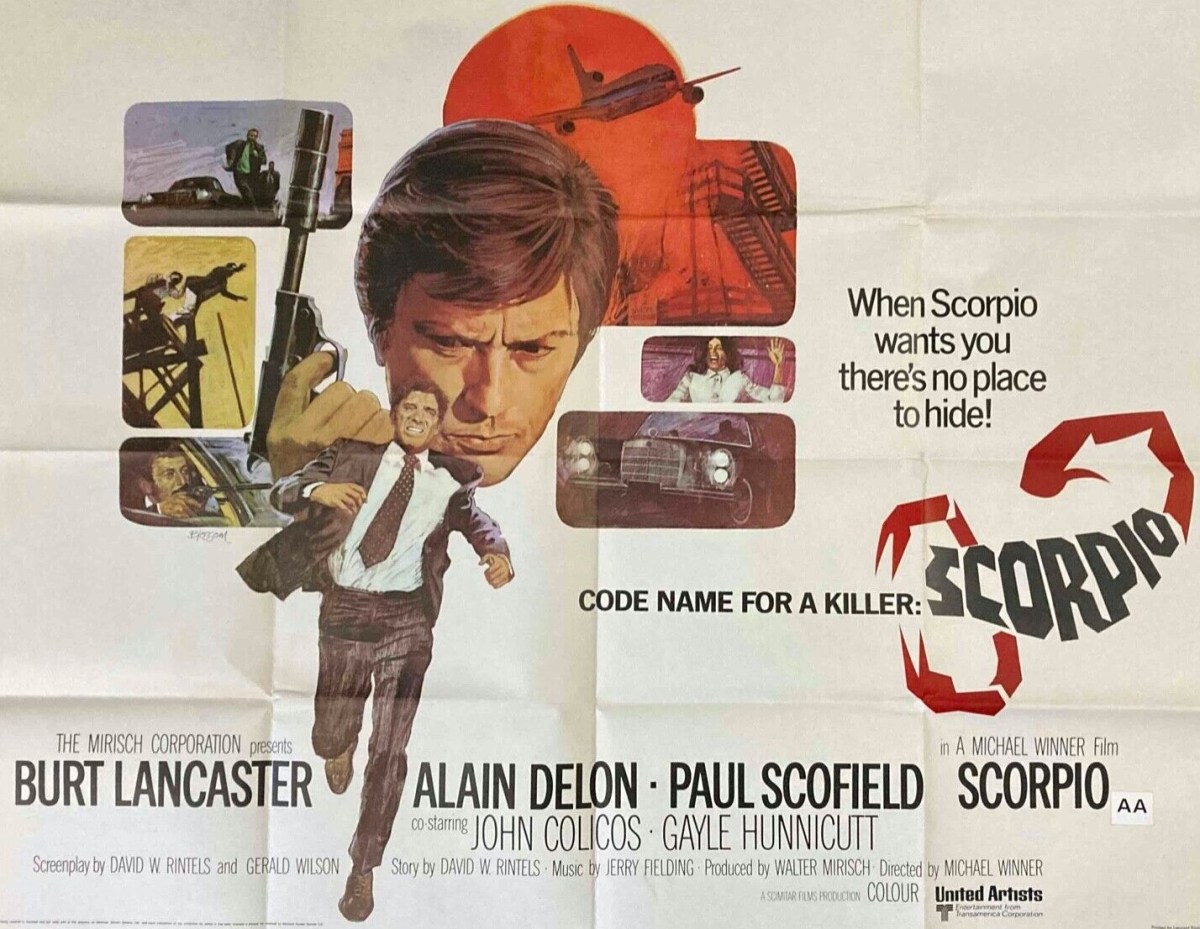
What did take Hollywood’s breath away was how often under-performers – flops even – at the U.S. ticket wickets did gangbusters elsewhere. The biggest winner was the aptly-named Michael Winner, director of westerns Lawman (1971) and Chato’s Land (1972), hitman thriller The Mechanic (1972) and spy drama Scorpio (1973). Total American rentals a shade over $7 million, total foreign rentals three times as much a colossal $21.8 million.

There was hardly a greater example of the disparity between American audience tastes and the rest of the world. And it made Hollywood studios more adventurous when it came to choosing subject matter, and in backing stars, aware that they could make their investment back – and more – from foreign markets.

It was probably astonishing to any studio executive that Burt Lancaster – for over two decades a high-flying marquee name from action-oriented fare like The Crimson Pirate (1952) and controversial drama From Here to Eternity (1953) to his Oscar-winning turn as Elmer Gantry (1960) and hardnosed western The Professionals (1966) – had lost his domestic audience especially after he had fronted up disaster movie smash Airport (1970).

But Lancaster could only scrape up $1.35 million at home for Scorpio, $2.1 million for Lawman and $2.8 million for another western Valdez Is Coming. Scorpio was the biggest hit abroad, with a massive $7 million, over five times domestic, while Lawman shot up $3.2 million (50 per cent above domestic) and Valdez Is Coming $2.65 million.

Charles Bronson was another beneficiary of foreign largesse. The Mechanic, too, targeted $7 million abroad, nearly three times the domestic tally of $2.6 million. Chato’s Land (1972) only delivered $1.27 million in the U.S. but $4.6 million abroad.

Westerns were a mixed bag. Oliver Reed-Candice Bergen-Gene Hackman number The Hunting Party (1971) was an almighty flop at home, just $800,000 in the kitty, but rallied somewhat abroad, not enough to turn profit but at least add a sheen of respectability, with $2.4 million elsewhere, three times domestic. The Magnificent Seven Ride! (1972), proof the sequels had outstayed their welcome, brought in just $750,000 domestically but again did triple the business abroad with $2.15 million and given the paltry budget enough to sit in the black.

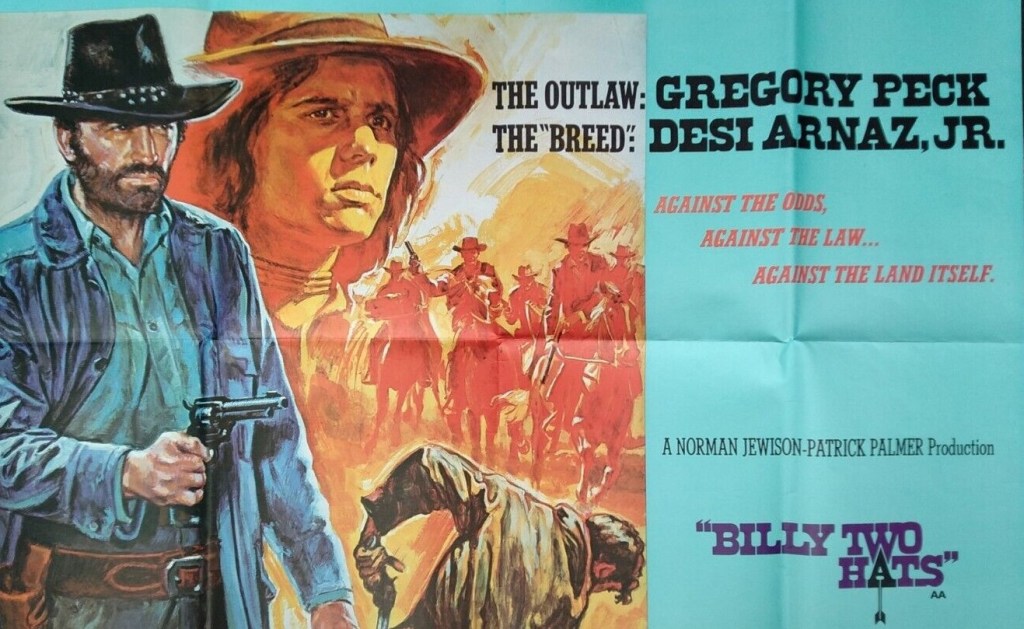
Revisionist effort Billy Two Hats (1974) starring Gregory Peck added $900,000 abroad to a miserable $440,000 at home – foreign revenues not enough to save it from flop. But foreign couldn’t save the second remake of the Gunfight at the OK Corral legend, Doc (1971) with Stacy Keach and Faye Dunaway which moseyed along to $1.35 million abroad to add to $1.8 million domestic. And another western sequel Support Your Local Gunfighter (1971) notched up just $970,000 abroad compared to $2.1 million. Modern western The Honkers (1972) with James Coburn managed just $550,000 abroad and $1 million at home.

It didn’t really matter that Michael Caine comedy thriller Pulp (1972) did better abroad, figures everywhere nothing to write home about, $600,000 in total, five-sixths of that abroad. Fiddler on the Roof (1970), for other reasons, underwhelmed but nobody was going to complain too much when foreign audiences stuck $10 million in till, about a quarter of domestic.

There were some conundrums in the foreign-domestic share-out. Typically, American comedies didn’t travel. But Billy Wilder’s Avanti! (1972) starring Jack Lemmon, perhaps because of the Italian setting, did better abroad – $2.5 million to $1.6 million. Glenda Jackson British-made menage a trois Sunday, Bloody Sunday (1970) not surprisingly did better abroad, but only just, $1.8 million to $1.77 million.

Sidney Poitier in second sequel The Organization (1971) tapped into $2.9 million abroad and $2.45 million at home but generally too-specifically-American features struggled overseas, The Hospital (1971) snaring only $1.9 million compared to $9 million, White Lightning (1973) snagging $1.8 million compared to $6.9 million, Fuzz (1972) holstering $1.7 million against $3.1 million.

Secret Invasion (1964) ****

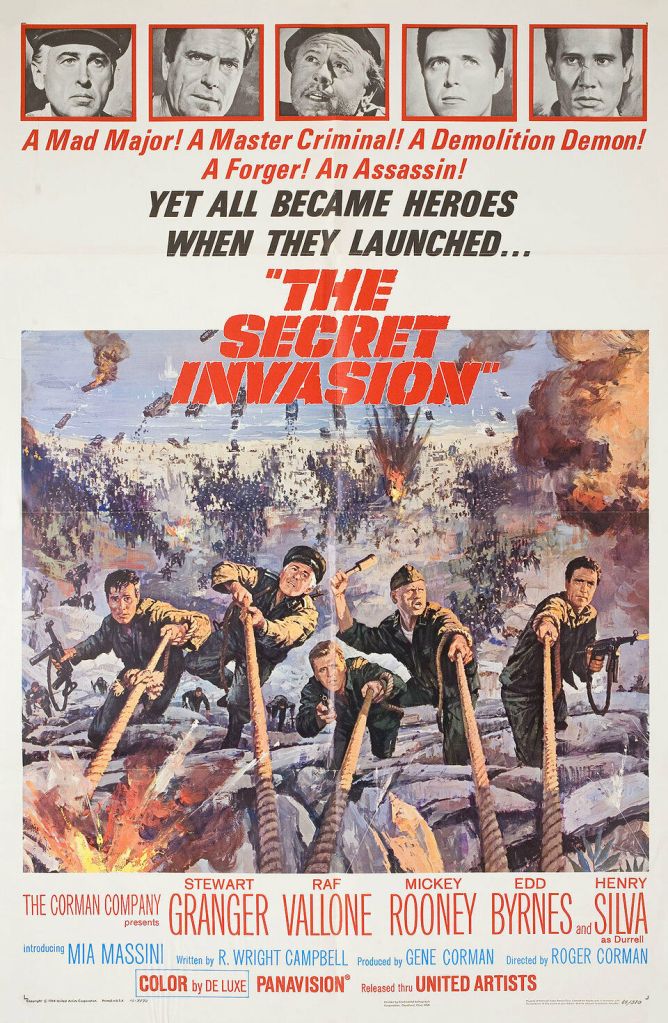
Dirty Half-Dozen – cashiered British major, five hardened criminals with particular sets of skills – on a mission to rescue an Italian general and start a second front in the north of Italy just as the Americans are invading the south. Throw in a grand theft of ideas from The Guns of Navarone (shoot-out with German gunboat, scaling a cliff) and The Great Escape (tunneling, although in not out) and the usual bickering and rebellion and a top-class B-list cast bringing their A-game and you have the basis of a very solid actioner.

The classy Raf Vallone (Sidney Lumet’s A View from the Bridge, 1962) is the standout here, not least because he chooses crime, pitting his wits against the authorities, rather than exploiting his university degree in philosophy. But he’s ably supported by Mickey Rooney as an unlikely IRA terrorist and various inmates from Leavenworth and Alcatraz including Henry Silva (Johnny Cool, 1963), of the fashion model cheekbones, Edd Byrnes (77 Sunset Strip), William Campbell (Dementia 13, 1963), and top-billed Stewart Granger. That any appeared in this Corman brothers (Gene directing, Roger producing) spread  suggested careers on the slide.

Still, that’s to the movie’s gain. Forget the occasional dodgy process shots and enjoy the Dubrovnik location complete with ancient fortress, cobbled streets, and tiled roofs, each of which is put to violent use, with shoot-outs in each area, not to mention a cemetery where tombs provide the perfect cover for digging into the citadel. At times, the script is snappy enough that some one-liners stick in the memory and when the characters aren’t acting up they’re doing a lot of brooding, especially Silva, the hired assassin.

This doesn’t go quite the way you would expect, especially the double twist at the end, and a couple of places where the plot gets bogged down, but there’s enough invention, interesting characters and story to see us through and one genuinely heartbreaking moment that could have been the starting point or revelatory denouement of a film all on its own.  Granger lacks Lee Marvin’s icy demeanour but delivers enough leadership in typically British style when it matters.

Silva’s icy demeanour softens enough to allow romance to peak through with local girl Spela Rozia (who you will remember from Hercules the Invincible, 1964). While trying to steal every scene, Rooney, nonetheless adds a couple of imaginative bits of business to his character. Edd Byrnes is nobody’s idea of a forger, nor would his notions, nor equipment, pass muster with the experts of The Great Escape. Vallone is terrific as the imperturbable mastermind.

This is a more hard-edged, realistic endeavor than The Dirty Dozen. In that picture every scheme goes according to plan. Here nothing does and the crew are constantly thrown back on their wits, finding what they require from the most improbable resources, and carrying out a schemed timed to the second, finger-snapping to the beat in the absence of watches. The labored and overlong interrogation sequence slows the plot down until you think it will never get back on its feet, but that complaint aside, it is full of action.

Little gem.

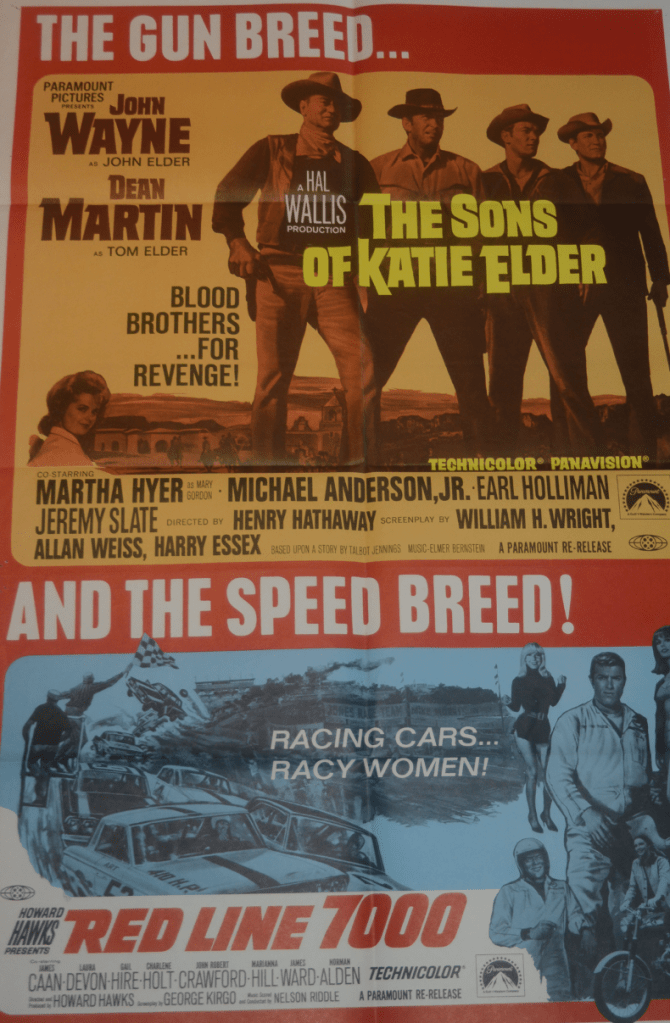
Red Line 7000 (1965) **

Quentin Tarantino is probably alone in preferring this movie mishap to John Frankenheimer’s Grand Prix (1966) – or I have somehow missed a “cult” picture. There was no doubt director Howard Hawks could handle speed. Check out the action in Hatari! (1962) as jeeps battle across tougher terrain than NASCAR racing circuits. But for some reason, he thought he would get away with interspersing footage of races and spectacular crashes with shots of actors behind the wheel. Any time something exciting is about to happen we’re alerted by the commentator saying “oh oh” or “wait a minute” or “hold it.” There’s none of the feverish excitement or authenticity of Grand Prix.

Hawks hired a no-name cast in a bid a) to become a star-maker, b) to prove he did require the marquee wattage of the likes of John Wayne and c) to show he could make a movie cheaply. He failed on all three counts. He probably didn’t think he was taking any kind of gamble at all, as a man approaching 70, in trying to depict the lives of people around 50 years younger. James Caan, in his sophomore outing, comes out best, but that’s not saying much since he has very little to do except growl and look broody. Marianna Hill (El Condor, 1970) is also believable.

While the racing footage has dated in a way that Grand Prix has not, the main problem is just a jumble of characters getting lost in a jumble of stories. No sooner has one character been introduced than we are onto another. There’s none of the cohesive story-telling that marked out The Big Sleep (1946) or Rio Bravo (1959) and, frankly, none of the characters are particularly interesting. And what possessed him to stick in a song sung by a character (Holly, played by Gail Hire) who cannot sing – she talks the lyrics – with a backing group made up of waitresses, I can’t begin to guess.

The most fun to be had is spotting in bit parts people famous for other reasons. Carol Connors, for example, who co-wrote the lyrics to “Gone Fly Now” (Rocky, 1976) appears as a waitress. As does Cissy Wellman, daughter of veteran director William Wellman. Comedian Jerry Lewis has a cameo. It says much for Hawk’s star-spotting abilities that of two female leads, Laura Devon only made five pictures and Gail Hire just two.

Henry Hathaway and Howard Hawks…Together!

Of the main supporting males, this was the beginning and end of John Robert Crawford’s movie career while Skip Hire made a bigger splash as a producer of television series The Dukes of Hazzard. Co-written by the director, George Kirgo (Spinout, 1966) and Steve McNeil (Man’s Favorite Sport, 1964)..

However, the French had a word for it – “genius.” Despite being dismissed as a rare misstep by the bulk of critics worldwide, Cahiers du Cinema decided it was one of the year’s Top Ten pictures. So what do I know?

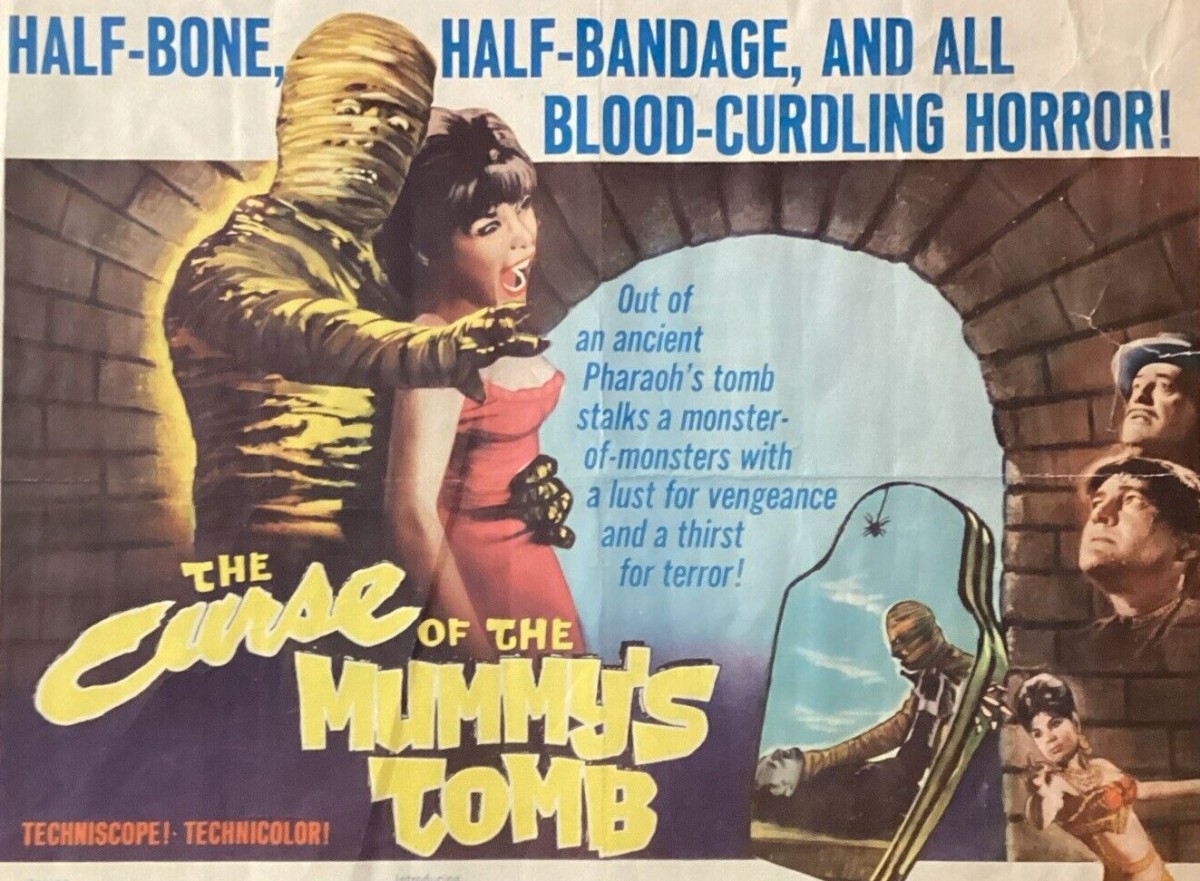
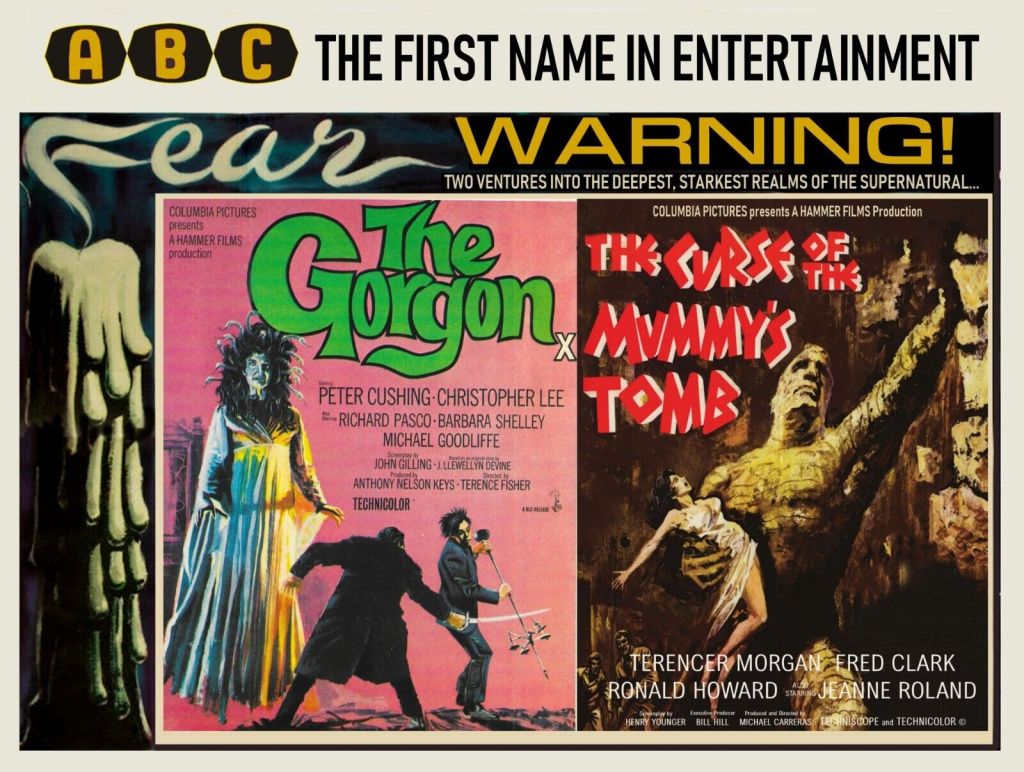
The Curse of the Mummy’s Tomb (1964) ***

Approach with affection and you will be rewarded. This is third tier Hammer, way down the pecking order behind Dracula and Frankenstein and after attracting studio stalwarts Christopher Lee and Peter Cushing for its first venture into this territory (The Mummy, 1959) dumps them for the sequel. And in the absence of the CGI that transformed the Stephen Sommers version in 1999 – and triggered the misguided Universal Monsterverse – struggles these days to prevent audiences laughing at the special effects. The titular beast was little more than a bandaged version of the lurching creature created by Dr Frankenstein so chills were always going to be in short supply, especially minus the plague of scarabs that dominated the later proceedings.

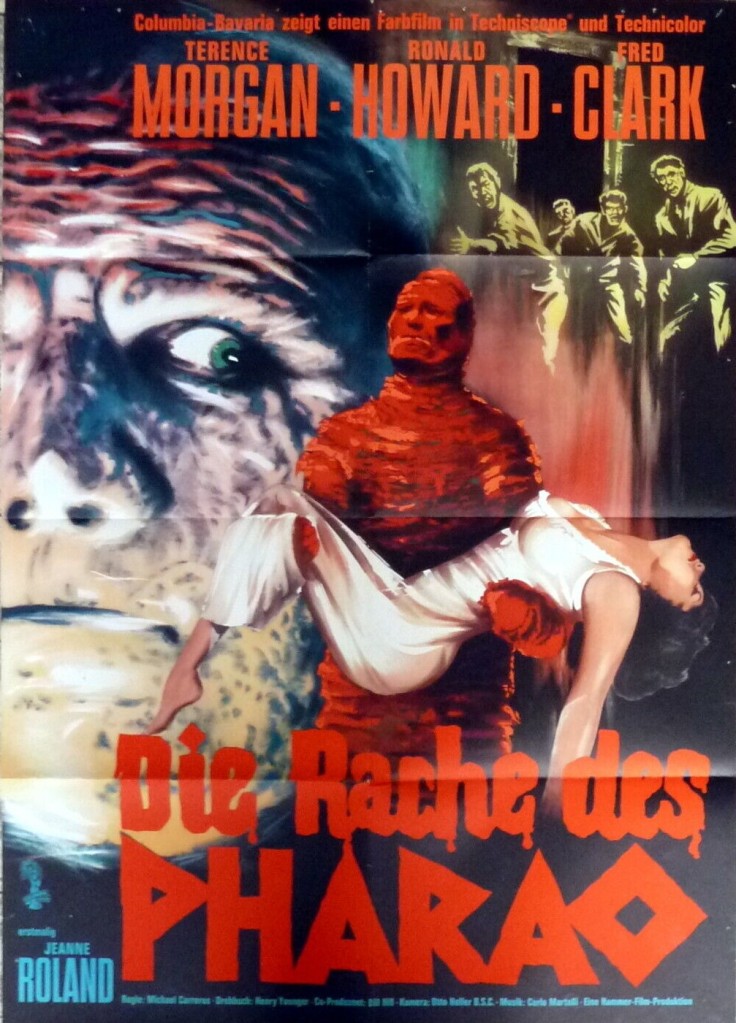
More interesting is the backstory that drives the narrative, warring siblings in ancient Egypt, the death of the rightful monarch and a reincarnation curse that travels down the centuries. Throw in bombastic King Kong-style showman Alexander King (Fred Clark) determined to monetize an archaeological find, shift the story to London, bring in a damsel Annette (Jeanne Roland) infatuated with the villain, and you have the makings of a decent tale. Alternatively, if you’re of a different mind, that could all be to cover up shortcomings in the plot and the wrong reasons for delaying the appearance of said monster.

People tampering with Egyptian graves tend to get their hands chopped off, but that’s as much warning we get of evil afoot although there are hints of malignancy in the flashback that shows the murder of Ra-Antef, son of Rameses VIII. But triumphant returning Egyptologists John Bray (Ronald Howard), Sir Giles Dalrymple (Jack Gwillim) and Annette, daughter of famed Professor Dubois who died in the line of duty, are inclined to take no precautions.

Poetic license – the mummy just ain’t that big in the movie.

Until the mummy is let loose, much of the tale centres around the ruthless grasping King and a love triangle developing between Annette, her fiancé John and the newcomer Adam (Terence Morgan) she met on the voyage home. While John is kept busy by King arranging for the grand public opening of the tomb, Adam slips in to romance Annette, not letting on of course that he possesses the amulet that can revive the sleeping monster. The setting – sophisticated London rather than remote Transylvania – and the delay of the murderous onslaught ensures that most of the picture survives on intelligent conversation, motivations and characters set out in non-cliché manner, and no squads of villagers set up for a marauding.

The monster is pretty effective when he does deign to appear, bursting through windows, picking up the damsel in a pose that I’m convinced Oliver Stone snaffled for Platoon (1986), and making his way to the nearest sewer, unlikely locale for a climax. There’s a propensity for lopping off hands and when that loses its impact stomping on heads.

But it’s not camp, is well-acted and the storyline makes sense. It probably helps that it’s free of Cushing and Lee because with unfamiliar actors the audience has to work harder. Terence Morgan (The Penthouse, 1967) is the pick of the stars because he carries most of the mystery. But Fred Clark (Move Over, Darling, 1963) steals the show by making a meal out of his outrageously greedy businessman. Top marks to Hammer for making Burmese-born Jeanne Roland (You Only Live Twice, 1965 and Casino Royale, 1967) a professional – she is an archaeologist – rather than a cleavage-ridden damsel in distress. And for those of a nervous disposition you will be pleased to know that the monkey is not present just to nibble poison intended for one of the principals.

However, from the outset it was destined for the lower half of a Hammer horror double bill, so the kind of budget that could do it justice was never in evidence. Studio boss Michael Carreras (Prehistoric Women, 1967) always gave the impression of over-extending himself but here  as writer-producer-director he manages to keep the picture on an even keel long enough for the monster to do its worst.

Ripley (2024) ***

I’m not sure I can take eight episodes of this especially in this trendy audience-alienating black-and-white version. Going all monochrome is like a bit like a novelist never deigning to describe the weather or what clothes their characters are wearing and I don’t go for the argument that the B/W is to prevent audiences being distracted by glorious Italian scenery when that’s the exact reason Dickie Greenleaf (Johnny Flynn), spoiled son of shipping mogul, went there.

I don’t know what time of year the tale was set because even the Italian seaside, warm enough presumably for Greenleaf and girlfriend Marge (Dakota Fanning) to go for a swim (Ripley remaining on the beach because his parents drowned, maybe), just looks gloomy. Anyone who can render Italy gloomy needs their head examined.

This isn’t Schindler’s List (1993) – which director Steve Zaillian wrote – that used B/W to sensible artistic effect or even Belfast (2021) where it was employed to depict the grimness of life.

I’m not even convinced by Ripley (Andrew Scott). Sure, the grifter was much more charming and personable, if occasionally awkward, as portrayed by Matt Damon (The Talented Mr Ripley, 1999) or John Malkovich (Ripley’s Game, 2002). This Ripley is just glum. Sure, his little cons don’t always work, but he can’t be as doom-struck as this.

Anyway, the story (eventually) starts when Greenleaf’s father pays Ripley, whom he believes to be a university chum of his son, to bring the errant boy, wasting his time on painting, writing and general idling, back from Italy, presumably to take on the role of inheriting the family business instead of living off his trust fund.

Like Sydney Sweeney’s character in Immaculate (2024) it hasn’t occurred to him that not everyone in Italy can speak English and so is thwarted trying to find directions to his prey’s pad. There’s a seemingly endless scene of Ripley climbing endless flights of stairs (how unfit can he be, Denzel Washington in The Equalizer 3 at least had a decent excuse) and this Ripley seems incapable of worming his way in (at least in Episode One) to his prey’s affections.

Yes, there are a couple of interesting scenes, Ripley changing seats on the subway because he sees a man staring at him on a different train. But most of the directorial art is devoted to snippets of images that have no relevance to the story or even the mood. There’s quite a barmy opening scene, too, of Ripley bumping a corpse down a flight of stairs in a tenement, not, to minimize noise,  wrapping it up in a carpet or hoisting it on his shoulders. But that is clearly a denouement and it could be an awfully dull time away.

All build-up and not much else so far.

Discover WordPress

A daily selection of the best content published on WordPress, collected for you by humans who love to read.

The Atavist Magazine

by Brian Hannan

WordPress.com News

The latest news on WordPress.com and the WordPress community.