I am a published author of books about film - over a dozen to my name, the latest being "When Women Ruled Hollywood." As the title of the blog suggests, this is a site devoted to movies of the 1960s but since I go to the movies twice a week - an old-fashioned double-bill of my own choosing - I might occasionally slip in a review of a contemporary picture.
Columbia sold this as if Nancy Kwan was a Bond girl with massive images of the star in a bikini (see above) – the advert in the trade magazine comprised a drop-down A2 pull-out i.e. three times the size of a normal page. But anyone expecting a salacious time would have been in for surprise. For although Kwan swam underwater during the credits (not Helen Mirren style as in The Age of Consent, 1969) and did reveal a naked posterior, you could not have imagined a more innocent, joyous, movie.
Tahitian teenager Tamahine (Nancy Kwan) wreaks havoc on the British stiff upper lip when after the death of her father she is sent to the all-male English public school run by his cousin Poole (Dennis Price), a widower. But it’s not a sex comedy with all the misunderstandings and double entendres that genre normally entails. Instead, it’s a clash of cultures, free love and expression versus prudery and repression. Poole has trouble enough on the female front, his daughter Diana (Justine Lord) inclined to enjoy a gin-soaked afternoon and in the middle of an affair with art master Clove (Derek Nimmo).
The advertising department, however, could not resist the temptation to stick a double entendre in the poster.
Without mischievous intent, Tamahine causes chaos, assuming an artist’s model would be naked she scandalizes the petrified Clove and egged on by a gaggle of schoolboys whose hormones are off the scale she jams a chamber pot on the school weather vane. The plot, if there is one, is mostly Tamahine fending off suitors, Clove and Poole’s son Richard (John Fraser), and attempting to persuade Poole to take a paternal interest in her well-being.
But mostly it’s about how a sweet-hearted woman struggles to survive in a world where attitudes to sex remain Victorian and in which the avowed aim of education is to build character through manly pursuits such as beating the living daylights out of each other rather than teaching them to express emotion. And certainly the movie takes a more benevolent view of public schools than the later, brutal, If…(1968).
While endorsing free love, Tamahine draws the line at crossing the line in the matter of Richard, whom she deems a relation, no matter how distant. Challenging all conventions, she takes part in sports day.
But the comedy is so gentle and Tamahine so charming that this is best described as a delight. I found myself chuckling throughout and I felt I had just watched a genuine feel-good movie. On paper it certainly doesn’t sound so potentially good, especially when you consider the clichéd portrayals you might expect from the supporting cast, but in reality it exerts an extraordinary appeal.
Hardly off-screen, Kwan (The World of Suzie Wong, 1960), in only her fourth film, easily carries the movie as if she scarcely felt the weight of stardom on her shoulders and is a revelation as the imparter of tender wisdom. What aids the film enormously is that Dennis Price and Derek Nimmo play more interesting parts than their movie personas suggest. Price (Tunes of Glory, 1960), in a far cry from his Ealing comedy heyday, dispenses with his wry delivery and cynical demeanor. Unusual for a character actor, his character actually has a story arc and turns what could have been a stereotypical role into a moving performance. Before his strangulated vowels got the better off him, Derek Nimmo (The Liquidator, 1965), too, delivers probably his best performance.
Justine Lord (Night after Night after Night, 1969) is good as the rebellious daughter but James Fox offers none of the intensity he brought to the screen a year later in The Servant (1964) and neither does John Fraser (El Cid, 1961) light up the screen. In small parts you can spot Michael Gough (Batman, 1985) and Coral Browne (The Killing of Sister George, 1968).
Full marks to director Philip Leacock (The War Lover, 1962), himself a former public school boy, for not taking the easy way out with loutish comedy but instead crafting a film full of sensitivity and sensibility. Denis Cannan (Why Bother to Knock, 1961) based his screenplay on the Thelma Nicklaus novel.
You might be surprised at the four-star rating and I do confess it is a shade optimistic but it is worth more than three stars. It’s worth taking a moment to examine the whole issue of ratings. You might be asking how can Tamahine be given four stars, the same as The Battle of the Villa Florita and a tad below the very few I deem five-star pictures. The answer is I compare like with like. If the best films in your opinion must concern social comment or excel technically, then there will be little place in your world for a sheer confection like Tamahine. But if you watch a wide variety of films and recognize those that contain a high enjoyment factor then you will want to draw attention to such. Hence, the rating.
It’s true that sometimes we do want movies to tackle difficult issues or take us into other worlds, but other times there is nothing to beat an old-fashioned good-hearted picture like this.
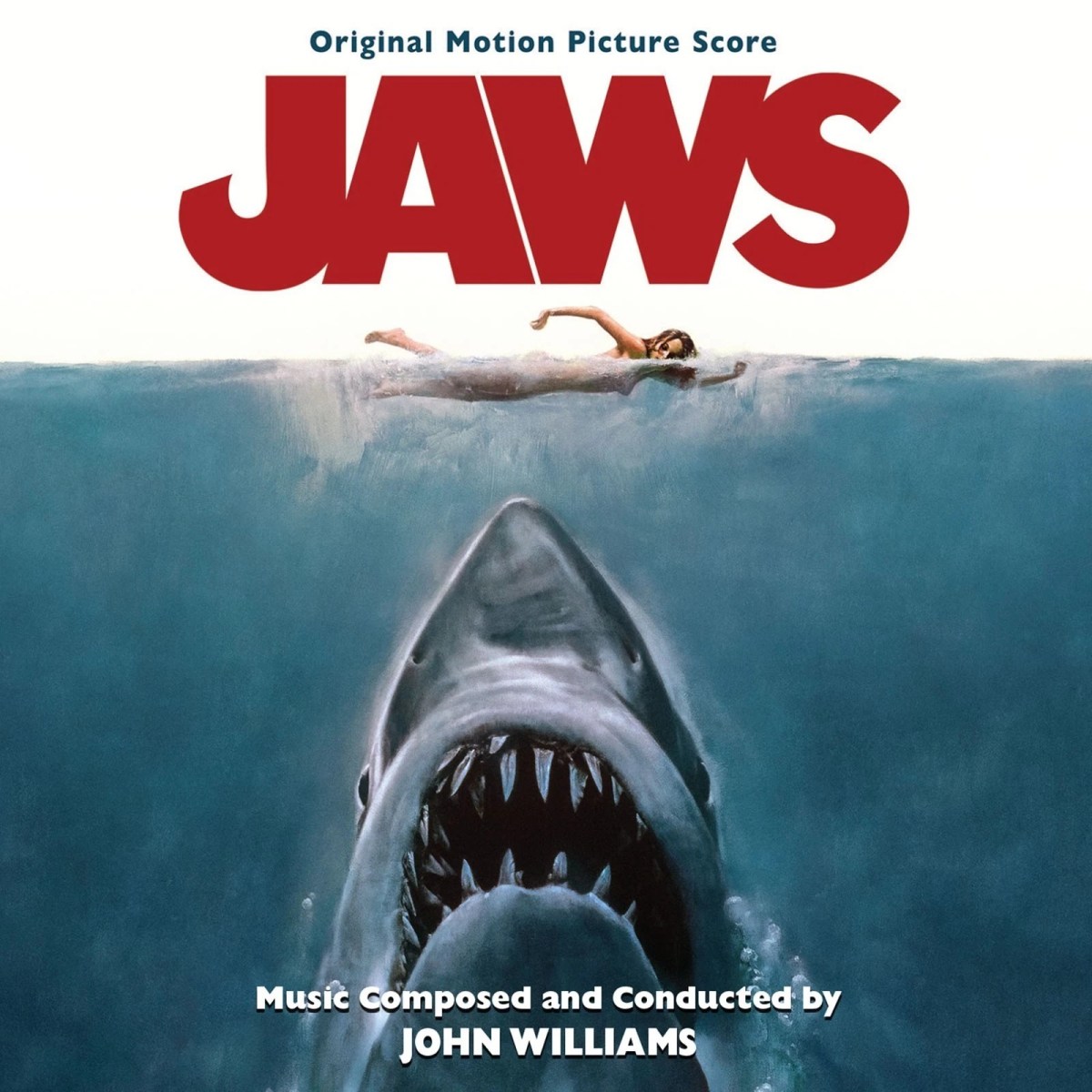
I hadn’t planned on a Jaws triple-bill but the new biography of John Williams popped through my door yesterday and I dug in.
I was astonished to discover first of all that movie music was in his blood. His grandfather had been involved in accompanying silent music films and then, dipping his foot in Hollywood, had snagged a gig with Shirley Temple. His father went one better – he had been instrumental in the radio revolution and eventually moved to Hollywood to become a session musician in movie studios recording film scores.
Film composers don’t lend themselves that easily to biography – I still have a treasured copy of the book on John Barry – and what has appeared hasn’t been on the same scale as, say, a major account of the career of John Ford or Clint Eastwood and certainly nothing approaching the 200,000 words Tim Greiving has amassed. I’d never heard of this author although it shouldn’t have surprised me that there was a university course on movie music run by him and that he describes himself as a “film music evangelist.”
By the time Jaws (1975) came around, Williams was a Hollywood veteran, 10 Oscar nominations to his name and, having made his debut in 1958 with Downbeat, had already composed over 30 scores including The Rare Breed (1966) and The Towering Inferno (1974). But you wouldn’t call him a household name. While his name would be familiar to the aficionados, the general public did not go around whistling his tunes the way they might with the James Bond theme.
And although movie music was his bread-and-butter, Williams had a hankering for Broadway, where composers were top of the bill not way down the credits. So since 1973 he had been working on a musical about the relationship between King Henry II and Becket, which had been the subject of plays by T.S. Eliot and Jean Anouilh and the film Becket (1964) starring Richard Burton and Peter O’Toole. He already had musical experience, though of the movie variety, and uncredited, having worked on Goodbye Mr Chips (1969).
In fact, Thomas and the King was scheduled for the British equivalent, London’s West End, to open in October 16, 1975 at the 1200-seat Her Majesty’s Theatre and starring Australian Jim Smillie and former Bulldog Drummond Richard Johnson. The critics weren’t impressed. One described it as the kind of show where you came out “humming the costumes.” It folded after 27 performances in a mere two weeks.
Luckily, salvation in the form of a certain shark was at hand. Williams had scored Steven Spielberg’s 1973 debut Sugarland Express (Duel, though released theatrically abroad, was strictly a made-for-tv number Stateside). The director had in mind “avant-garde horror music” along the lines of the “freaky cerebral score” Williams had composed for Robert Altman’s Images (1973).
Williams had enough confidence in himself to tell the director that approach was wrong. He went instead for something that was “all instinct.” Explained Williams, “meaning something that could be very repetitious, very visceral, and grab you in your gut not your brain.” Since the movie itself was a masterclass in suggestiveness – the shark remains largely unseen for the first part of the picture – the music was able to infer its presence.
The two notes – a bass ostinato – could be played softly to suggest the shark was far away. “You can keep playing it louder and louder,” said Williams, “there’s no shark there but you can feel it. It can be deafening – it can accelerate as it comes towards you…You can paint a whole choreography without seeing anything.”
Spielberg wasn’t convinced. He thought it “too primitive”, favoring something “more melodic” for the shark. In due course, the director succumbed. Williams was integral to the movie in another way – deciding when the music should appear, “spotting” being the technical term. “The art of film composition,” said Spielberg “is the placement of that composition.”
And while Jaws set a new template not just for box office but for scaring the pants off moviegoers, the impact of those two notes went far beyond the movie business. Hans Zimmer summed it up, “The scary thing about Jaws is those two notes.” The soundtrack reached No 32 in the Billboard chart and Williams won the Oscar. In Time magazine he was named the most influential composer of the 20th century. American conductor Leonard Slatkin said, “In classical music if you say I can name that tune in four notes” everybody knows Beethoven’s Fifth, “but with John he had it with two notes. There’s somebody whose legacy is assured.”
I have to confess this isn’t a proper book review in the sense that I’ve read it from beginning to end. I didn’t want to rush it just for the sake of a book review. But I’ve dipped in and out enough to be knocked out.
John Williams, A Composer’s Life, by Tim Greiving is published by Oxford University Press.
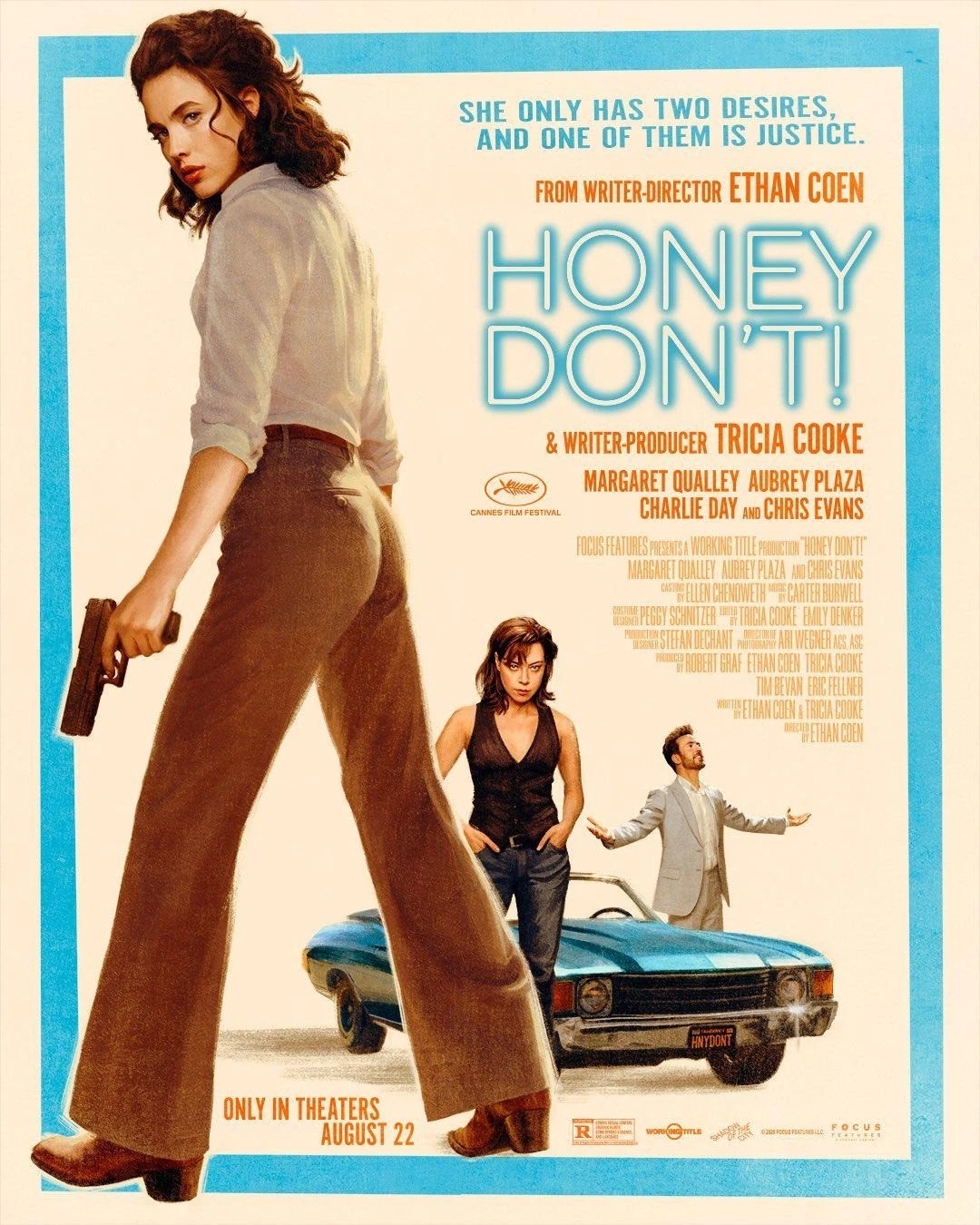
Had I still been in the magazine business I would have welcomed this with open arms because it would have provided an ideal headline – “Honey, Don’t Go.”
I’m not sure what Ethan Coen (True Grit, 2010) thought he was making and even if it was a shaggy dog story as often were the tales he concocted with his brother this has turned out more like a dog’s breakfast. Which is a shame because it’s about time Margaret Qualley (The Substance, 2024) was elevated from indie product to mainstream. She’s certainly got a screen presence and if someone could only fit a movie around what she has to offer she’d be on her way.
Excepting some salty dialog, this comes up short on every front. The narrative is so thin it’s disappeared down every convenient rabbit hole, the characters are equally lacking (though my guess is they’re meant to be slices of cliché, that’s the game) and there’s a deliberate emphasis on keeping emotion to the bare minimum.
The two main characters, private eye Honey Donohue (Margaret Qualley) and cop M G Falcone (Aubrey Plaza), congratulate themselves on being so completely self-centered that all dalliances are strictly confined to one-nighters, such restrictions imposed before the other person gets all weepy and emotional. Honey and MG, both being lesbians, are able to get away with such notions. Imagine a male attempting to classify all females as just too emotional.
I say Honey is a private eye but it’s kind of hard for her to keep clients because they keep on being bumped off before she can take any action. And when she does, she doesn’t prove much cop. In fact, she’s actually that old film noir fallback – the dupe. And she only realizes she’s been played for a patsy when she sees – another old fallback – two cups on a table (it’s an old-fashioned house hence the teacups).
It’s a strange construct. The audience knows what’s going on but poor Honey is kept in the dark and at the climax it looks very much like she’s setting herself up to be the dupe again.
So what the audience knows that Honey doesn’t is that a woman who died in a car accident has had a distinctive ring stolen by a woman on a moped, Chere (Lera Abova), who in another old-time fallback can’t pass a pool without skinny dipping. The ring has a logo that ties in with that of the religious scam being run by uber hunk preacher Rev Drew Devlin (Chris Evans).who uses the church as a cover for some drug-running for Chere and to provide him a harem of submissive females.
A sub-plot that then becomes a main plot sees Honey putting in some time helping out her aunt’s wayward daughter Corinne (Talia Ryder) though you suspect she’s there just to let Honey beat the bejasus out of her niece’s abusive boyfriend.
There’s also an old creepy homeless fella hanging around that starts out as a red herring, looks as though it could dovetail into an emotional scene, but then shies well clear of that because, well heck, Honey doesn’t do emotion.
I’ve got a sneaky feeling that the director wasn’t trying to make a Coen Bros movie so much as a Tarantino one. There’s a helluva lot riding on the word “Macaroni” for example. And the application of lipstick. And there’s a helluva lot of nudges towards the hardcore – in the way of sex not music – a dishwashing scene and a bar sequence come to mind.
Sure, Honey snaps off a few one-liners but mostly you’re going to remember her sashaying along in a tight skirt and clackety high heels – which may well have the director’s intention for all I know.
This feels like a clumsier retread of Drive-Away Dolls (2024), a similar dive into lesbian-led crime, also starring Qualley, directed by Coen and co-written by Tricia Cooke, who performs the same service here.
More a collection of mismatched sequences with a myriad of oddball characters none distinctive enough to make you sit up than anything in the way of a coherent plot.
Just to follow on yesterday’s reissue of an article of mine regarding the box office of Jaws, I thought it might be timely to ressurect an older article which sets the record straight on some aspects of the movie’s release.
This was in response to the publication of movie critic Richard Schickel’ s Spielberg: A Retrospective which continues to perpetuate the Jaws release myth. I can hardly expect Mr Schickel’s due diligence to cover my own modest tome, In Theaters Everywhere, A History of the Hollywood Wide Release, 1913-2017 (McFarland, 2019), which is now (apparently) the standard text (in case you didn’t know) for all questions relating to wide release, saturation, call it what you will.
Jaws was not a phenomenon in the normal sense. It did not belong to the realm of the unexplained. In fact, mystery was the least part. It was eminently explainable, despite realms of academics and observers regarding its explosion at the box office in tones of wonder. Hollywood loves a legend, especially one of its own making, and the movie did conform to two attractive narratives, that of the tyro director Steven Spielberg coming good and of the movie overcoming a massive budget over-run (from $3.5 million to $8 million) that could have sunk the enterprise at the outset.
Jaws did not not invent the wide release, summer release or the event movie.
To start with the biggest myth – the wide release – that had been around since the 1930s. The Wizard of Oz (1939) debuted on 400-plus. Warner Brothers signed up 400 for This is the Army in 1943. David O. Selznick created a new phrase for wide release, “blitz exhibitionism,” for Duel in the Sun (1946). In 1948 Twentieth Century Fox opened Iron Curtain, Republic Bill and Coo and Allied Artists The Babe Ruth Story at over 500 cinemas. Fast forward to 1960 and The Magnificent Seven’s initial theater haul was 750. Earlier in 1975, studios had gone for saturation broke with The Master Gunfighter opening on 1,000-plus with Breakout starring Charles Bronson claiming the record of 1,400 houses for the opening week.
In fact, far from inventing saturation or the summer blockbuster or even the event movie, the Steven Spielberg picture, was merely an extension, albeit a wildly successful one, of what had gone before. The problem with the scenario of “Jaws the Legend” is that too few people, academics and journalists alike, placed it against the backdrop of not just the previous few years but the prior decades during which saturation/wide release had flourished.
Long before Jaws came onto the scene, the 1970s had changed and the two conditions that had marked out the previous decade, the reduction in studio output and the increase in saturation, were the prime movers. Jaws was not the beginning of a new era, but very much the opposite, the triumphant culmination of an old one.
It owed a great deal to the other 1970s box office phenomena – Airport, Love Story, The Godfather, Towering Inferno, The Poseidon Adventure and The Exorcist. Their most obvious common thread was that they were based on bestsellers and successful books enjoyed a publicity life and after-life all of their own, as well as providing marketing tie-up benefits and journalistic opportunity.
But turning bestsellers into films was not unusual, Gone with the Wind in 1939 the most obvious example. The top three movies of 1953 – The Robe, From Here to Eternity and Shane – were based on bestsellers as were 1958’s leading trio, Bridge on the River Kwai, Peyton Place and Sayonara. The Guns of Navarone (first in 1961), Spartacus (first in 1962), The Carpetbaggers (first in 1964), Thunderball (first in 1966), The Dirty Dozen (first in 1967), and The Graduate (first in 1968) were all taken from bestsellers. Airport, Love Story, The Godfather and The Poseidon Adventure were the number one films of their respective years, The Exorcist second in its.
The subject matter of The Godfather and The Exorcist attracted a mass of newspaper headlines, Love Story because it was such an unexpected hit, while Jaws afforded endless journalistic opportunity. The Godfather, The Exorcist and Jaws all had in common budget and shooting problems. Like Jaws, the theme tunes to Love Story, The Godfather and The Exorcist were million-sellers. Airport apart, none of the biggies boasted established stars, Marlon Brando, although a giant of the 1950s, no longer a box office attraction while Gene Hackman was a potential one-hit wonder prior to The Poseidon Adventure. Ryan O’Neal and Ali McGraw (Love Story), James Caan and Al Pacino (The Godfather), Ellen Burstyn (The Exorcist) and Roy Scheider and Richard Dreyfuss (Jaws) were virtually unknowns.
The idea that summer was a release desert had not been true for more than a decade, Paramount launching ‘a powerhouse of important product’ – a total of eight pictures – in 1970 – Norwood had 1,400 bookings between May 27 and July 8 in four waves of 450 theaters – more, incidentally, than the number of theaters showing Jaws in its opening week – each running the picture for two weeks. In 1973 Twentieth Century Fox, MGM and Columbia opened a total of 19 movies during the season.
The Twentieth Century Fox schedule comprised the long-awaited reissue of The Sound of Music, Robert Aldrich’s The Emperor of the North,Battle for the Planet of the Apes (the fifth in the series), Jeff Bridges as The Last American Hero (with a tie-up with over 16,000 gas stations) based on articles by Tom Wolfe, and The Legend of Hell House, the whole shebang kicked off in late June by a featurettes on ABC and an eight-day television campaign.
Columbia reckoned it would need a company record 3,150 prints to meet demand for George C. Scott and Faye Dunaway in Oklahoma Crude, Burt Reynolds as Shamus, Charles Bronson in The Valachi Papers, romantic comedy Forty Carats, remake Lost Horizon, and concert documentaries Let the Good Times Roll and Wattstax.
The MGM septet included Yul Brynner in Westworld, Burt Reynolds in The Man Who Loved Cat Dancing and Shaft in Africa. In 1974, Twentieth Century Fox targeted summer with ten movies including Richard Lester period romp The Three Musketeers, heist drama 11 Harrowhouse, chase picture Dirty Mary Crazy Larry, Spys, and the ‘Ape-athon’, a quintuple bill of all the Planet of the Apes pictures, plus another outing for The Sound of Music. Substantial radio advertising was added to usual television/newspaper marketing mix, with stations in 30 key cities running an eight-week campaign.
The studio cleared $35 million over 13 weeks, up $5 million on its previous best summer in 1970. Paramount’s high voltage program included The Longest Yard and Chinatown. But it was not just the majors who recognized the importance of summer, Crown International and American International both reported record business for summer 1974.
The $1.8 million Universal spent marketing Jaws was both a large and modest amount. In proportion to production costs, it was less than Joe Levine devoted to Hercules or to the promotional budgets for four-wallers, and a lot less, than was allocated The Culpepper Cattle Companyor Breakout. That television accounted for 38percent was not astonishing either since research proved that newspaper advertising was more effective.
Although claiming to be the largest amount spent in television spot advertising, compressed into the three days prior to opening and opening day (June 20) itself, it was rather last-minute compared to the selling of The Man with the Golden Gun for which United Artists ran 700 prints of a teaser trailer in theaters six months prior to launch and 30-second advertisements on the ten top-rated television shows well in advance of opening.
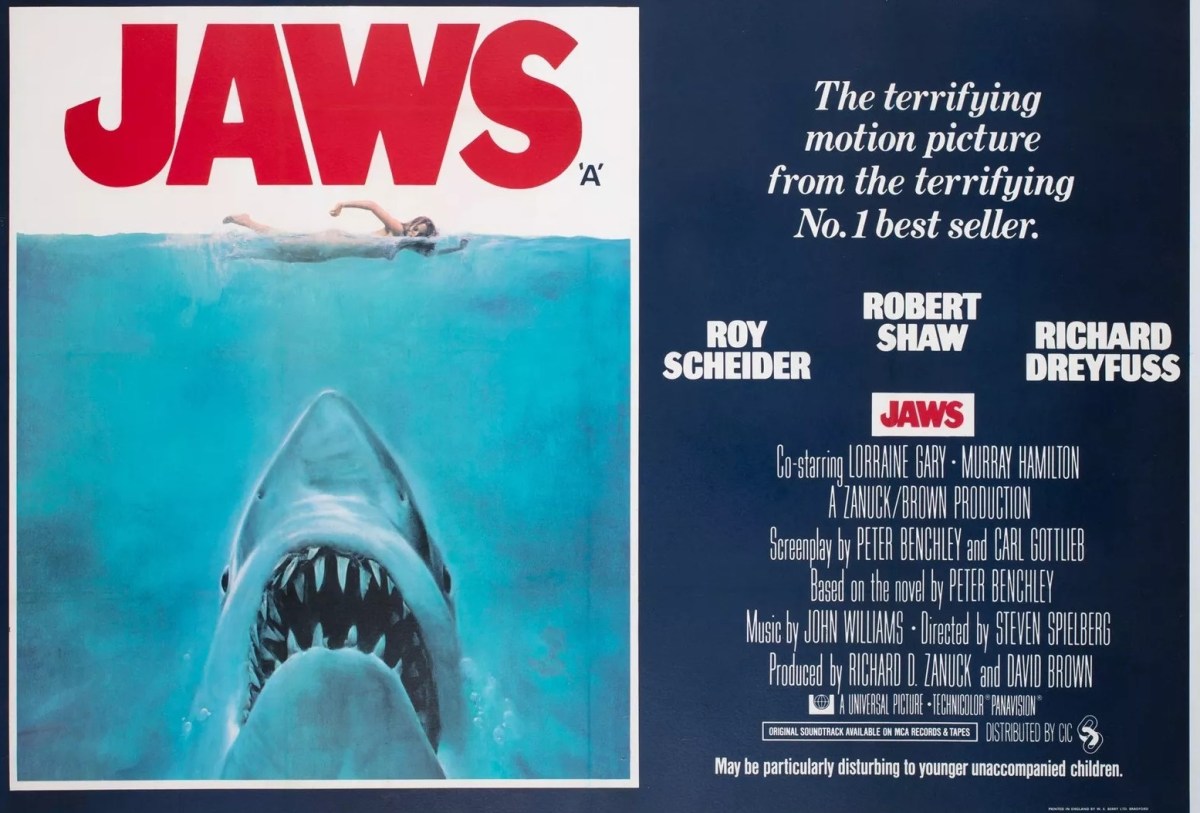
The tactic of specifying which television slots of movie would advertise on, as Jaws did, was far from rare, four-wallers specializing in this, and Breakout had done the same. In fact, the record that Universal claimed for Jaws, too, was questionable since Breakout had 42 30-second spots compared to 23 for Jaws. Disney, overall, spent a lot more. Nor did Universal knowingly aim for a summer launch – only shooting delays prevented it opening at Xmas 1974. Nor did publisher and studio jointly adopt the same visual for Jaws from the start – a March 1974 trade advertisement in Box Office differed substantially from the iconic poster.
The marketing device of reporting grosses week-by-week was not novel either. Most the big hitters of the 1960s did not pull in money at top speed. Love Story changed all that. Paramount kept the industry and the wider newspaper planet up-to-date on a weekly basis of the movie’s unprecedented progress. Its $2.46million (actually $2.36million) in three days from 165 was the biggest in history and it set the seal on the industry reporting the weekend rather than weekly gross. The second weekend was $2.49million, the third $2.4million, the fourth $2million and the fifth $2.3million. That the second and third weekends both out-grossed the first, and the fifth weekend out-grossed the fourth, were publicity bonuses. The first five weeks topped $17.5million. Four weeks later, theater count risen to 231, it totaled $28.4million and two weeks further on, on 282 theaters, the gross stood at $35.4million.
When in 1972 The Godfather so quickly gunned down Love Story, it set in motion an ongoing marketing story, and the question facing each new hit, from The Poseidon Adventure to The Exorcist and The Sting, was box office speed and whether it could topple the reigning champion.
By 1975 accelerated grossing had become common: The Trial of Billy Jack hoisted $9 million in five days, The Man with the Golden Gun $5.1 million in a week, The Sting $7 million in two weeks, Papillon $11.25 million in three weeks, Airport ’75 $10 million in a month, Earthquake $7.3 million in a month, The Godfather Part II $22.1 million in under five weeks, Magnum Force $18 million in five weeks.
So when Jaws showed the potential to reach the very top, Paramount raced out of the traps with a series of advertisements showing the gap closing between the new movie and the title holder. This tack in itself was nothing new – The Robe, hoping to catch up on Gone with the Wind, had made a big hullabaloo of reporting opening week’s grosses day-by-day in the trade press and Twentieth Century Fox had capitalized on The Sound of Music’s overhauling of Gone with the Wind.
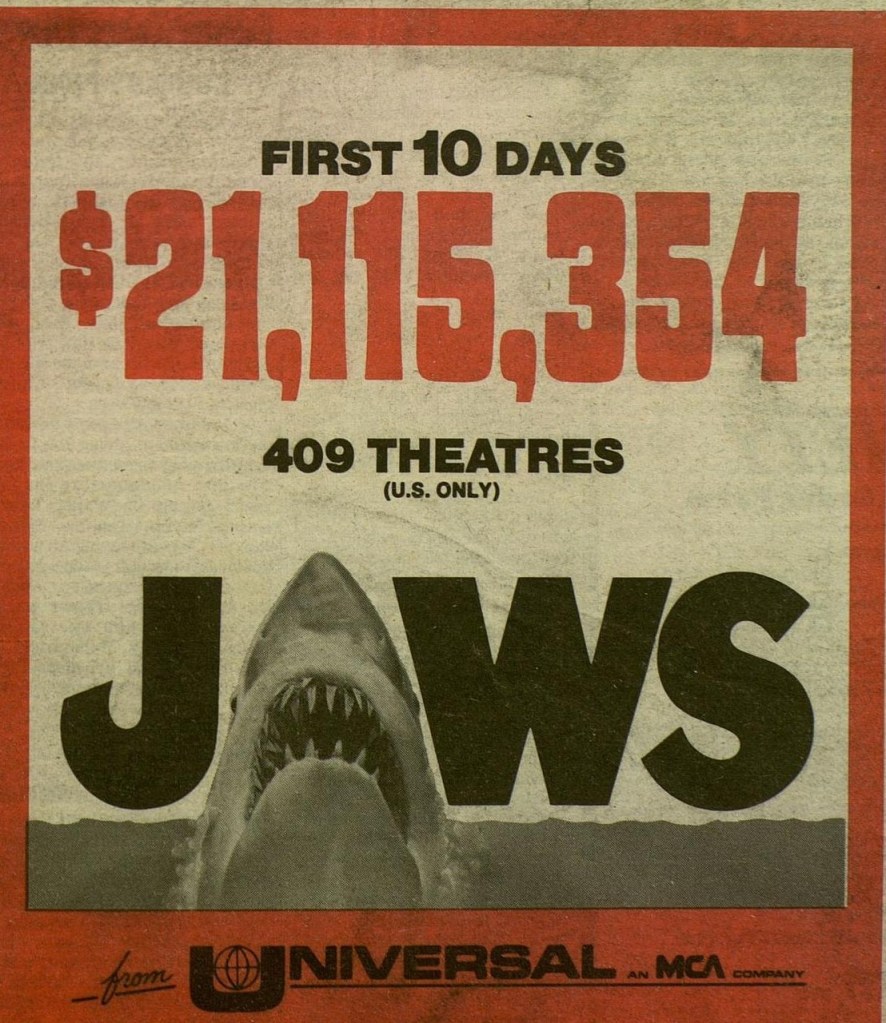
Jaws simply took advantage of a media ready-and-waiting for an accelerated box office story. Since money was made faster than ever before, box office records fell faster than ever before. It made news precisely because it was sustainable – week after week – an ‘immediate stampede’ at the box office – $14.3 million ($34,900 per theater average) in the first week, $33.8 million in two weeks and three days, $69.7 million in five weeks and three days, $100 million in eight weeks and three days, $150 million in twenty-three weeks. (It did not venture overseas until November, first stop Australia, and then it was a major Xmas release in seven hundred theaters in forty-four countries.)
Substantial questions remain about the Jaws saturation. Although history proved the Universal strategy to be a success, I am not convinced it was as deliberate as suggested nor that Universal had any idea of the winner it had on its hands.
There had been much larger saturations going back two decades and both Trial of Billy Jack in 1974 and Breakout in 1975 had debuted in over 1,000. The number of theaters involved in the Jaws launch was, I shall argue, proof of the studio’s lack of confidence not the opposite.
Studios with what they believed were guaranteed winners had consistently used a different scenario. The Exorcist opened in 24 theaters, Earthquake in 62, Papillon in 109 and The Godfather Part II in 157. Movies that opened in the Jaws range and above – Magnum Force in 418, The Man with the Golden Gun in 635, The Trial of Billy Jack, Breakout and The Master Gunfighter in 1,000-plus – were not expected to last as long. Statistics proved that for features with high box office expectation the slower limited roll-out was the more effective approach. The question really to be asked is whether Universal realistically expected Jaws to bring in rentals in the region of The Exorcist ($66million), The Sting ($68million) and The Godfather Part II ($128.9million) or whether its expectations were more in the Magnum Force ($18.3million) ballpark. I would argue that circumstantial evidence pointed to the latter. No other studio would throw away a prospective gold-plated opportunity on a saturation of the Magnum Force variety unless it reckoned grosses around the Dirty Harry sequel mark would count as a good return on its investment.
I would also challenge whether Universal actually deliberately limited the number of original theater participants. I would suggest it is much more likely that the studio encountered considerable resistance from exhibitors to being asked to hand over 90percent of the gross, agree a 12-week run and contribute to the national television campaign for a movie with an unknown director and no stars. Also, the movie did not, like The Exorcist or The Godfather, open in engagements exclusive to one city, but went multiple from the start, 46 in New York, 25 in Los Angeles; even Airport 1975 only opened in five theaters in New York.
More likely, I would venture, is that the original theater count declined over the blind-bidding controversy and/or when Universal and exhibitors reached a negotiating impasse. Negativity could also have been sparked by the recent experience of Breakout which fell short of box office targets. It certainly strikes of wisdom-after-the-event for Universal to claim this was a deliberate strategy. Nobody spends $1.8million on launch advertising in the hope that it would carry the picture all through summer since that would suggest a paltry $225,000 per week over an eight-week season.
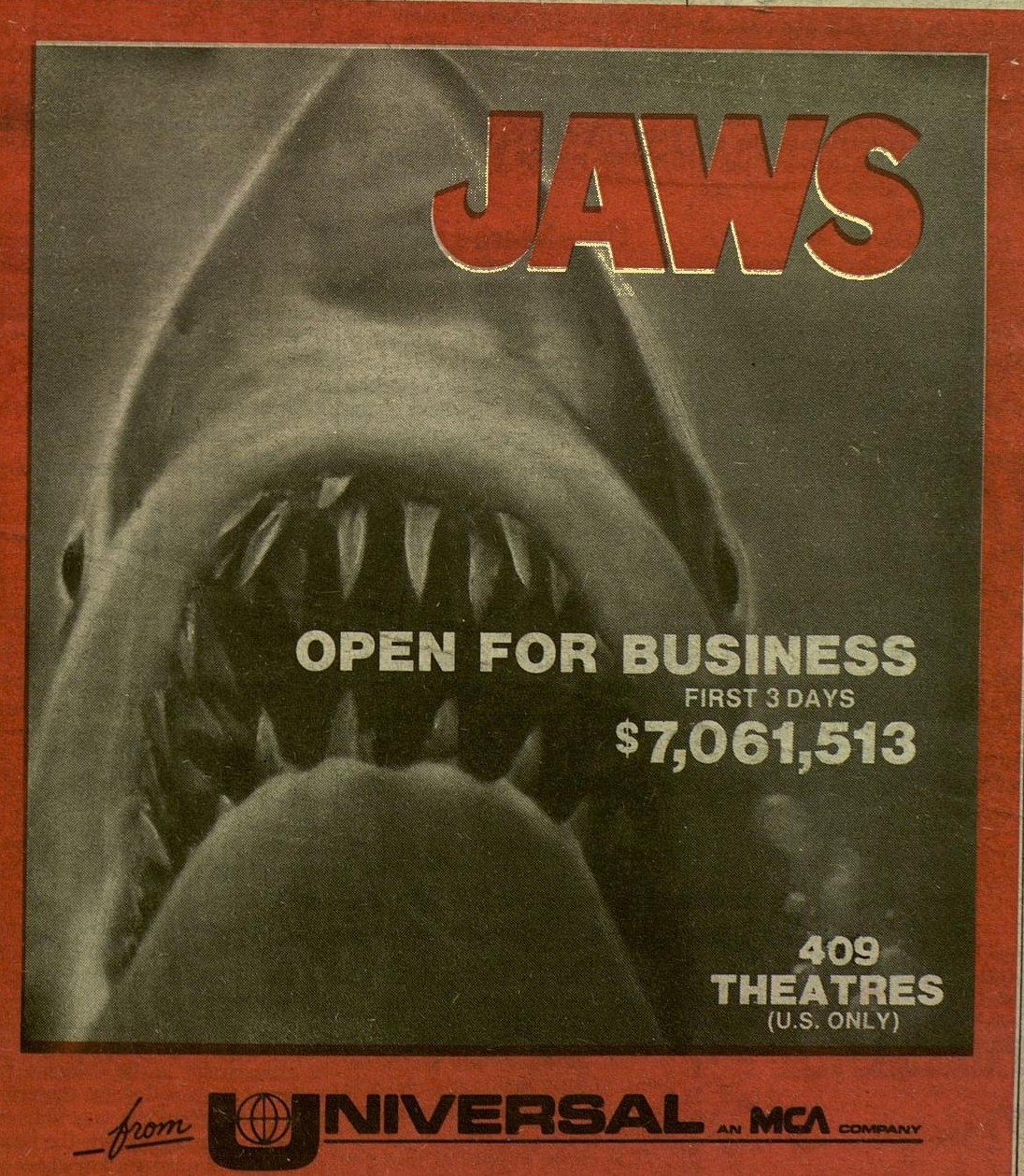
Universal spent nearly two-fifths of the film’s production budget on that kind of launch because they wanted big opening grosses. For the first month, Jaws was restricted to 409 theaters in the U.S., the number increasing to 700 after five weeks and then to 900 after another three weeks, suggesting that exclusivity was part of the deal for initial exhibitors.
A tougher business take on the limited opening was that Universal shot itself in the foot.
With an 800-theater launch, grosses would have been stratospheric, even higher than the movie actually achieved. Ironically, it was roadshow precedent and practice that created the opportunity for Jaws to break all box office records. Without the guaranteed run that roadshows traditionally enjoyed, theaters would have dumped the movie, regardless of grosses, because they were already committed to another feature. Longevity, not opening week grosses, was the key to the Jaws record-breaking.
So if it was not a unique development in saturation that precipitated the Jaws success, or a new way of latching onto summer as an unrealized opportunity, or a breakthrough in publishing or record sales, or a novel approach to television advertising, to what else can you ascribe the movie’s unprecedented success?
Well, the answer is the simplest, the oldest, of all. The public just liked it. It hit a chord the way a raft of movies as different as Gone with the Wind, The Sound of Music and The Godfather before it. And it also benefitted from the public reappraisal of reissues, the idea that you could go back to see a movie you enjoyed again and again. Jaws broke no saturation rules and did not set new saturation boundaries. All the hard work on that had already been done. But it certainly reaped the reward.
SOURCE: Brian Hannan, In Theaters Everywhere, A History of the Hollywood Wide Release, 1913-2017 (McFarland, 2019) p192-195.
Given the surprising success of the reissue of Jaws this weekend – it came in second at the U.S. ticket wickets ahead of such new films as The Roses and Caught Stealing – I thought you might like a second look (or a first one) at exactly how Universal created box office history. And it was not the way you would expect. It did not follow the template set out by previous juggernauts.
Naturally, the hoopla surrounding the 50th anniversary of Jaws concentrates on the budget overruns, director Steven Spielberg’s problems and the mechanical shark, and no one gives a hoot about the most important aspect of the picture – the box office. Sure, it’s always mentioned in passing, because otherwise the movie would have had little impact on pop culture, the driving force of the water cooler effect when so many people see the same movie at the same time it drives word-of-mouth into the stellar regions.
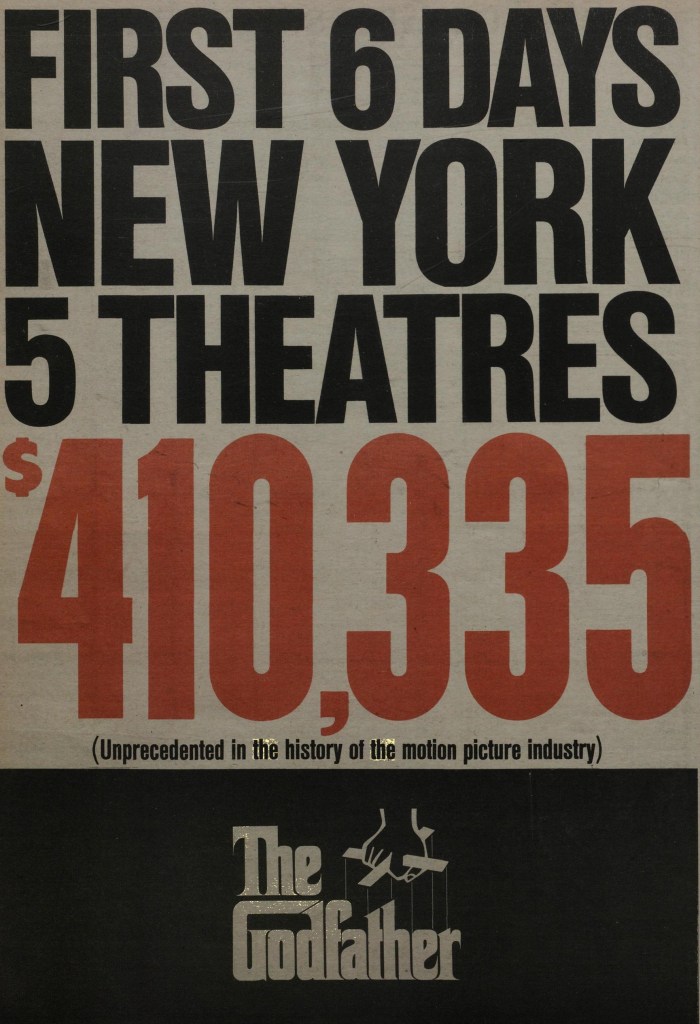
What is little known is how Jaws changed the release system forever. Even The Godfather (1972), its predecessor in topping the box office firmament, while spreading the goodies amongst nabes and the showcase houses did not ignore first run. In fact, for The Godfather Paramount used five New York first run houses – the 1025-seat Orpheum, 1175-seat State I, 1174-seat State II, 599-seat Cine and 588-seat Tower East – to create a pre-emptive strike. This quintet screened the movie exclusively for the first week, permitting the studio to trumpet the record-breaking results.
The other 350-odd cinemas had to wait a further week to get their hands on the gangster saga.
For Jaws, on the other hand, Universal completely froze out New York first run. Not a single first run house was given access to the picture on its initial release on this weekend 50 years ago.
Instead, in New York, Universal went down the showcase route and clocked up just over $1 million in the first three days at 46 cinemas. Prior to Jaws, the only pictures that would open first in showcase in New York and ignore that city’s vibrant first run were those that first run would most likely have declined to show.
With Jaws, across the country Universal was as ruthless in squeezing out first run if it could make a better deal in the nabes and drive-ins. So while Jaws set house records at all the first run houses that were deemed up to standard, it also creamed the nabes and drive ins. Significantly, not all the first run houses chosen would have been the first choice of most studios for a major picture. You wouldn’t have expected this behemoth to end up at the 925-seat Gopher in Minneapolis where it took in $47,000. Similarly, the 900-seat Charles in Boston ($55,000 take) would not have been your first choice (and it’s worth noting that it was only in this city that the movie did not top the week, beaten into second place by Woody Allen’s Love and Death at the 525-seat Cheri Three).
By and large, Universal picked off those first run cinemas that were so delighted to be asked they agreed to the tough terms – a 90/10 split in the studio’s favor and a 12-week run.
Other first run destinations included the 800-seat Cooper in Denver ($53,000 for openers), the 1670-seat Coliseum in San Francisco ($68,000), the 900-seat Southgate I and 550-seat Town Center II in Portland ($55,000 total), the 1836-seat Gateway in Pittsburgh ($70,000) and the 1287-seat Midland in Kansas City ($55,000). In these cities, the premiere outing was restricted to first run.
But while in Chicago the 1126-seat United Artists hauled in $116,000 in the opener, Universal played it canny by screening it simultaneously at four other nabes which brought in another $260,000. It was the same in Cleveland where the 455-seat Severance II was the only first run house among the five cinemas that hoovered up a total of $84,000. The first run 500-seat Goldman in Philadelphia was the only first run location among the total of 15 cinemas that knocked up $312,000.
Elsewhere, echoing the New York approach, first run cinemas were frozen out in Detroit, Buffalo and San Francisco. In Detroit seven nabes gobbled up $350,000, in Buffalo a deuce of nabes snatched $50,000, in San Francisco a trio set about $75,000.
We’ve all seen movies driven to opening weekend box office heights on the back of heavy advertising or hyperbole only to take a dive in the second week. And the fact that Universal was not making an “event” out of its movie by restricting it to first run meant that the sophomore weekend could easily have brought disaster.
Instead, receipts at virtually all the cinemas either beat the first week or fell only fractionally below. The opening weekend appeared to set the tone, every successive day better than the previous one.
Universal immediately set its sights on taking down The Godfather and began posting weekly advertisements in the trade papers hyping its performance at the box office. But in nudging first run out of the equation, it triggered the slow decline of first run houses.
Tomorrow, you can catch on my article that sunk many of the other myths surrounding Jaws, “Behind the Scenes: Exploding The Myth of Jaws.”
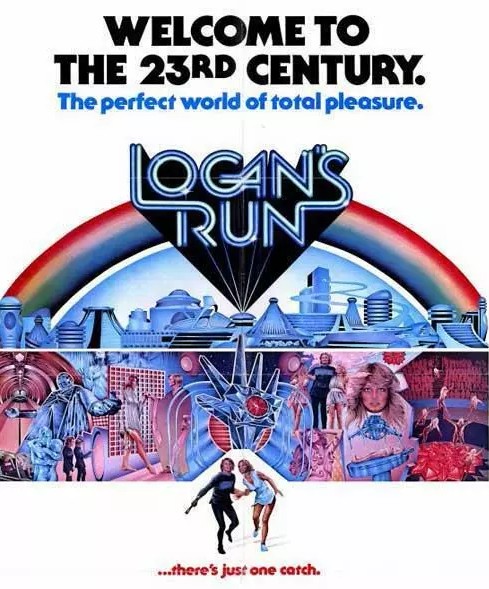
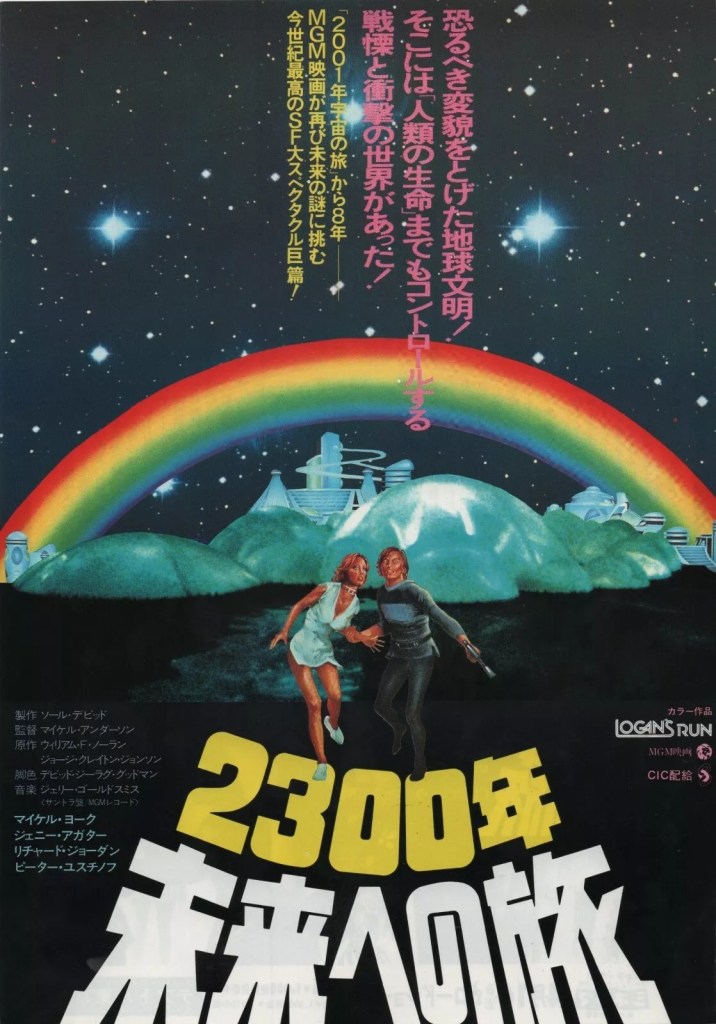
Shortly after this appeared the movie sci fi world imploded/exploded with the release of Star Wars (1977), followed by Close Encounters of the Third Kind (1977) and Alien (1979), which probably accounts for why this is such a throwback joy to watch and now very much a cult item. Takes in ageism, obsession with youth, death cult, the pleasure principle written in capital letters, some kind of primitive Tinder (where women place themselves on “the circuit”), Terminators, runaways, dystopia, escapees, eco-friendly food, mobile phones, computers in charge, lasers, plastic surgery, cannibalism, robots, an icy tomb, nuclear holocaust and the Lincoln Memorial.
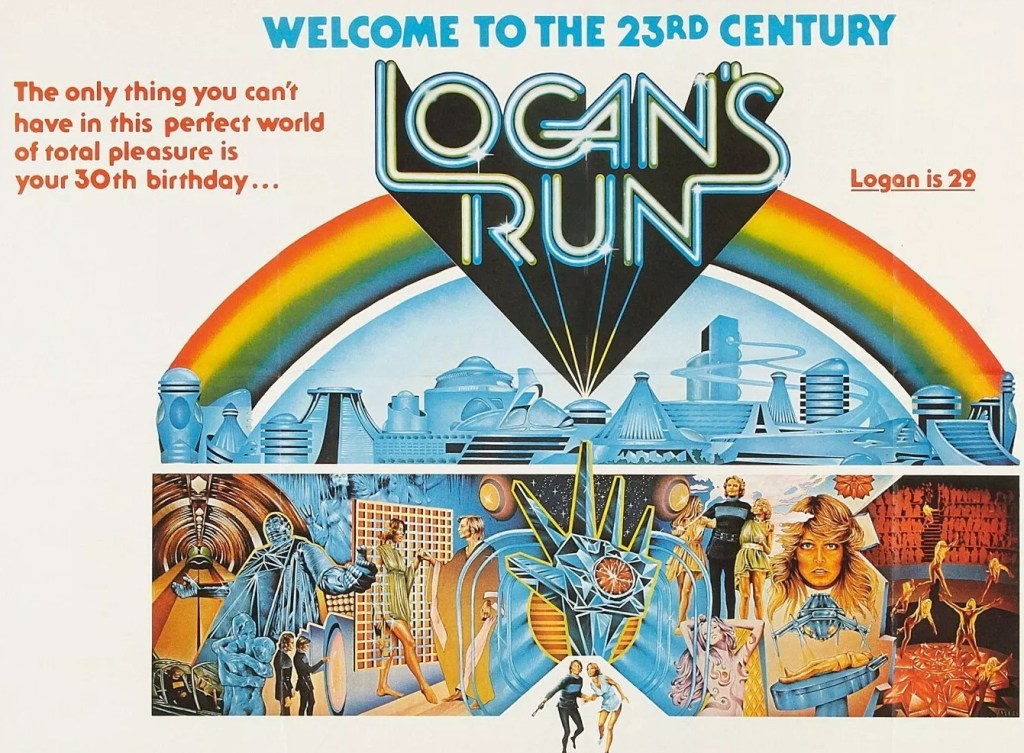
There’s some shooting with futuristic weaponry but these handguns are virtually useless given how poor their accuracy – though that may be down to the incompetence of their users – and a couple of fist fights. And while the remainder of Earth’s population enjoys an idyllic life in a series of sealed domes, there is, as the posters point out, a catch. When you reach the age of 30 you are killed, although this occurs in the guise of rebirth in a ritual known as the Carrousel.
There’s no individual responsibility. Children are separated at birth from their parents and brought up in communal fashion. They eat, drink and have sex – there’s even a section set aside for sexual pleasure, full of naked writhing bodies. But generally, sex is on tap, any woman signing up to be on “the circuit” literally delivered to your door.
In this fashion Logan 5 (Michael York) encounters Jessica 6 (Jenny Agutter). He’s a terminator, chasing after runaways, she’s a virgin and much to his annoyance proves not an easy conquest, in fact sex doesn’t take place at all. However, she wears an ankh. And he’s just picked up an ankh from a runaway he just totaled. So he asks the computer for advice about the emblem. Turns out it’s worn by a rebel group – there are over 1,000 of them living in a “sanctuary” in the city – and Logan is delegated to pretend to be a runaway and with Jessica’s help infiltrate the radical organization. Unfortunately, his buddy Francis 7 (Richard Jordan) is suspicious and follows him.
After many adventures and escaping from Francis and the robot Box (voiced by Roscoe Lee Brown) who wants to freeze them, they emerge into a land that while it shows signs of devastation is not uninhabitable. They meet an old man (Peter Ustinov) and realize that it’s possible to live beyond the age of 30 and that somehow their apparent utopia is actually a dystopia. Furthermore, once outside the tomb, the internal clocks that dictate the date of their death automatically switch themselves off.
The prisoners of the dome are freed shortly afterwards.
There’s a kind of innocence about the sci fi world portrayed. Everyone dresses in primary colors, both sexes wear flimsy outfits all the easier to remove when pleasure appears imminent. Taking place three centuries on from the date of the movie’s release, the world is the kind that would be dreamed by illustrators imagining the future for an Exposition with everything streamlined.
There’s no time and really no effort to make a serious point about any of the issues raised and it’s more a smorgasbord of ideas – quite a few of which have come to fruition. The two main characters are likeable rather than charismatic and the onset of sudden romance appears narrative contrivance rather than “across a crowded room.” Logan’s dilemma, that he is switched from having four years to live to being at death’s door, gives him incentive to escape, not to complete his mission. And at times the dialog is cumbersome but equally often just flies – that cats have three names, for example.
I never saw this on initial release and didn’t hire it on VHS or DVD but gradually it acquired cult status and I was keen to see why.
It works, is the real reason for that. It exists outside the Star Wars/Close Encounters/Alien dynamic. I liked the jigsaw nature of the ideas and that they are thrown together and at you like you were on a rollercoaster, and you can pick and mix. The conversations with the computer sound very contemporary.
Michael York (Justine, 1969) and Jenny Agutter (East of Sudan, 1964) are pleasant company to spend time with. While Richard Jordan (Valdez Is Coming, 1971) is not much short of an eye-rolling villain, Peter Ustinov is remarkably good value in a role that could easily have been cliché. You might spot Farrah Fawcett-Major (newly-inducted as one of Charlie’s Angels, 1976-1980).
Directed by Michael Anderson (The Shoes of the Fisherman, 1968) and written by David Zelag Goodman (Straw Dogs, 1971) from the novel by William F. Nolan and George Clayton Johnson.
Any notion that it was intended to be groundbreaking was knocked on is head by Star Wars et al, and it’s for that very fact that it’s so watchable, as in, the direction sci fi could have gone had lightsabers and Death Stars, creatures phoning home and monsters erupting from stomachs, not entered the Hollywood universe.
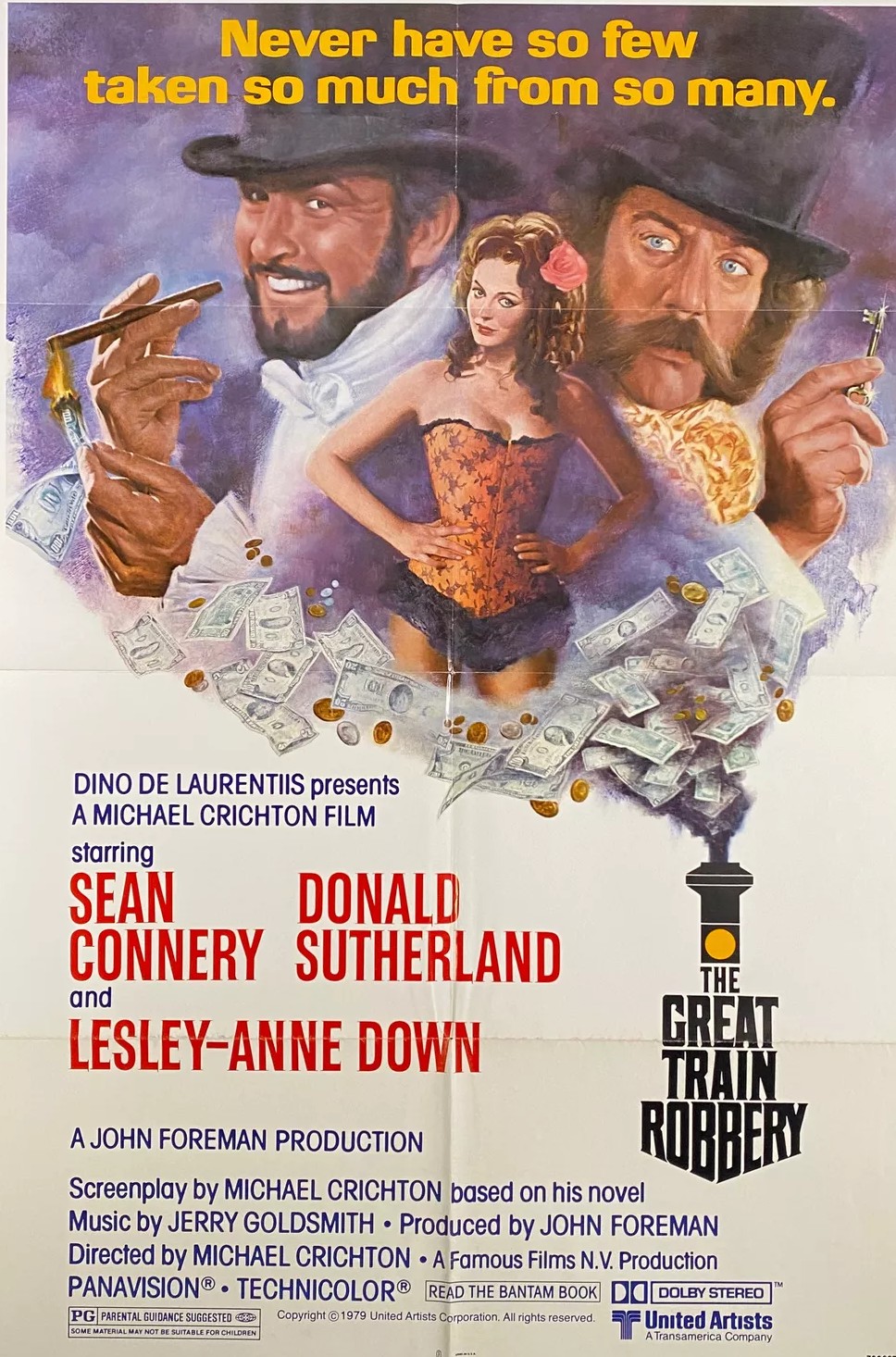
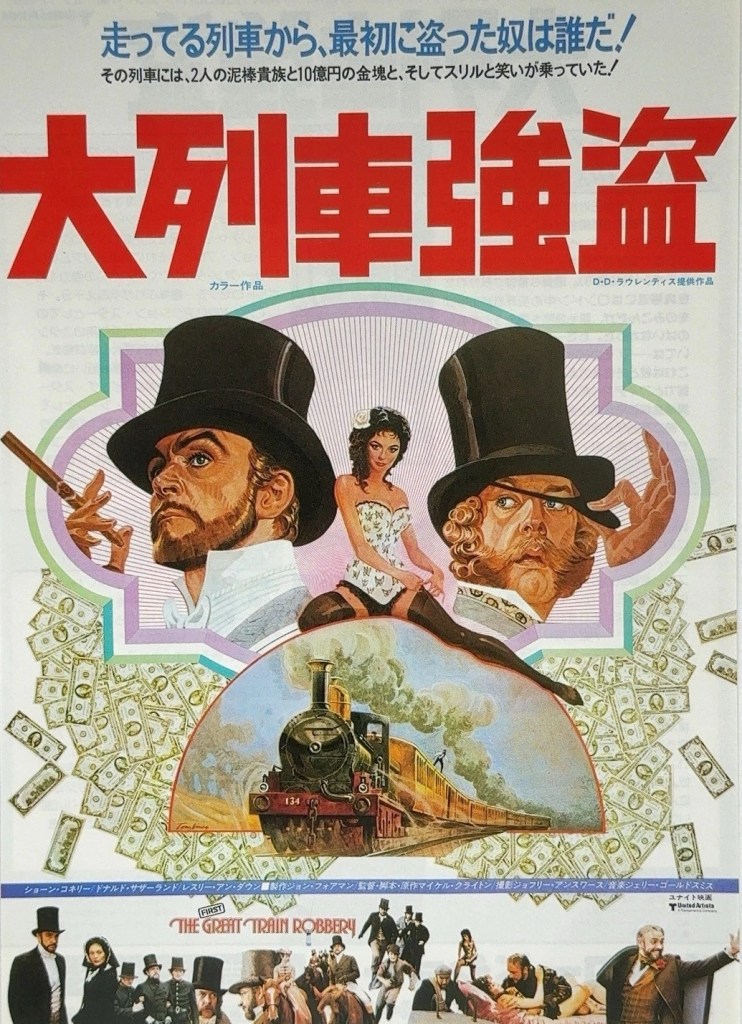
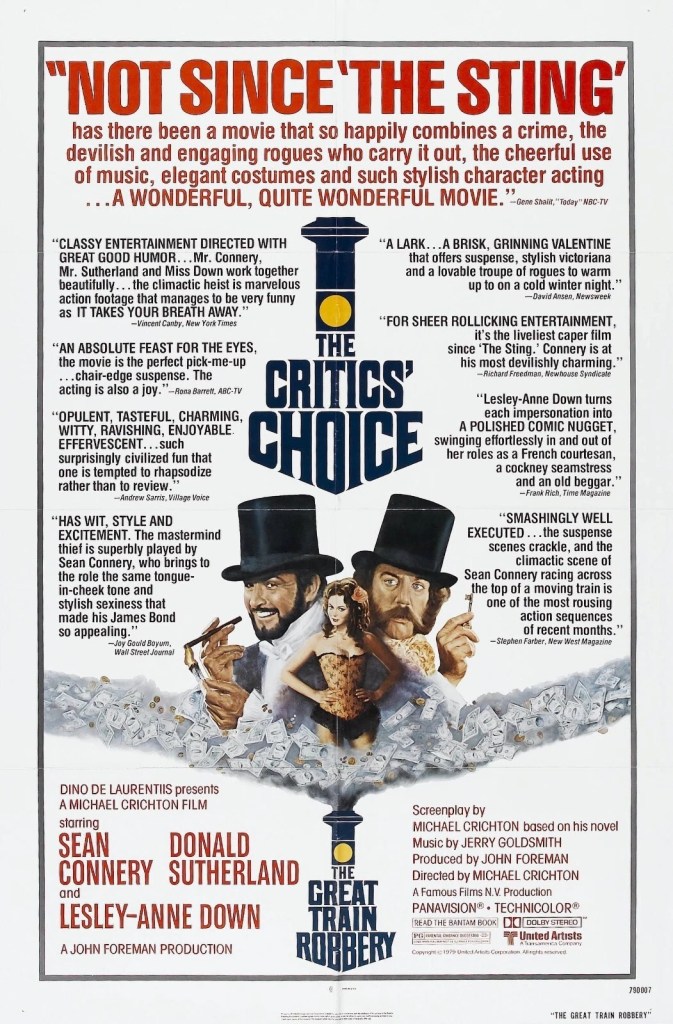
Back in the day your IP was the star. And here Sean Connery (The Hill, 1965) is the essence of that belief. The camera homes in on him. He steals every scene with an effortlessness that takes your breath away even as co-star Donald Sutherland (Don’t Look Now, 1973), complete with bizarre sideburns and winks to the audience, is huffing and puffing to compete.
Come at it as the standard heist movie and you will struggle to enjoy it because it is made up of too many different components. But approach it from a different perspective, that of The Sting (1973) as one critic suggests, and it takes on a different complexion and the getting there becomes a whole lot of fun. The background, Victorian England of the 1850s, doesn’t help so much as the sets look like they’ve been plundered from Oliver! (1968) and dirtied up a bit.
It’s worth remembering that in an era when the Mission Impossible series has been constantly sold on Tom Cruise undertaking his own stunts that Sean Connery did something much more dangerous than anything attempted by Cruise which was to race along the top of a train travelling at 55 miles an hour.
And if you need some contemporary analogy, look no further than the rich get richer and mostly through plundering. The ending presents the notion of a Robin Hood outwitting the forces of law and order to the acclaim of the public. But that would be to overlook the fact that chief thief Pierce (Sean Connery) is already so wealthy from previous nefarious dealings that he hobnobs with the rich, so accepted in their world of male clubs and high society that, like a financial trader, he is able to pick their pockets of vital information.
Though it’s not quite that easy. The target is a trainload of gold bullion heading for the Crimean War. And the two safes containing the dosh require four keys, each under the control of a different high-up official, requiring several separate audacious thefts. This involves some play-acting from the principals, dressing up in the main from female accomplice Miriam (Lesley Anne Down), clever duping by Pierce and old-fashioned burglary from pickpocket Agar (Donald Sutherland) who waves his fingers around like a demented Fagin, and whose main job is make wax impressions of stolen keys.
So Pierce pretends to be the ardent wooer of the daughter of one of the key holders, and Miriam essays a prostitute to relieve a key holder of the precious possession he wears around his neck. But the other two keys require a more professional approach which involves first of all the springing from prison of cat burglar Clean Willy (Wayne Sleep) to break into the guarded railway premises in a time-dependent operation.
But the cops get wind of the plan and increase security on the train, including adding a new padlock to the outer door. “Find me a dead cat!”, while not quite in the league of “The name’s Bond, James Bond” might well count as one of the best lines ever uttered by Sean Connery.
Said deceased animal is brought in to supply the necessary stink for a corpse should the cops consider opening the casket containing Agar which is to travel on the train, providing the team with the necessary inside man. But Agar and Miriam as the weeping widow of the supposed dead man have very little to do compared to Pierce who has to climb on top of the train, racing along the speeding top, drop down the side in an improvised harness and pick the padlock, then do the whole thing in reverse.
I may be wrong, and I’m sure someone will correct me if I am, but if this wasn’t the first time running along the top of a moving train was employed in a movie it certainly set a new standard, especially in the willingness of the actor to carry out his own stunts.
Pretty much all that remains after that is the twists that see Pierce captured and then escape. You could pick a few holes in it if you wish. The fact that after Pierce swapping coats (the one that had lain beside a dead cat for hours and provided sufficient stink to convince the lawmen) with Agar, nobody noticed the smell seems unlikely. The same would apply to bank manager Fowler (Malcolm Terris) who fails to spot that the widow he shares a compartment with for the entire journey is the prostitute who duped him, though that prospect does increase the tension.
If you’re expecting a standard heist movie then this takes way too long to come to the boil, but if you go along with the conceit and enjoy the playing especially of Sean Connery and ignore the mugging of Donald Sutherland it is in the forefront of the best robbery pictures.
And it’s worth noting the little gems in Connery’s acting. There’s a scene where Lesley Anne Down is berating him for making her become a prostitute (implicit is her fear she might actually need to have sex with the client). He’s eating an orange. Ignoring her complaints as just part of the job, he offers her some of his fruit as if his main worry is being seen to be rude hogging the fruit to himself.
Connery proves exactly why you hire a star. He carries the picture. There’s a lightness to his overall performance, notwithstanding the few times he needs to take a tougher line, that makes the film a joy. Whereas Donald Sutherland is either too heavy-handed or overacting. This proved a breakthrough role for Lesley Anne Down (British television’s Upstairs, Downstairs, 1973-1975).
Director Michael Crichton (Westworld, 1973) cuts himself too much slack in the first half of the picture which could have been considerably tightened up but comes into his own with the tension and twists of the heist and he has the good sense to rely on Connery’s interpretation of Pierce. He also wrote the script based on his own novel, a fictionalization of the actual original robbery attempt.
There already had been an incredibly famous Great Train Robbery in Britain in 1963, hence the need to differentiate this from that by inserting the prefix “First” to the advertising in Britain.
I’m amazed I sat through this without complaint as a kid. This was a rare outing for me, given I grew up in a town without a cinema and the only time I went was for a roadshow musical at Xmas or if we were away on holiday for the summer in towns that were bursting with picture houses. No doubt my parents, of Irish descent, were seduced by the last word of the title while assuming that the second word would be enough to keep us kids happy.
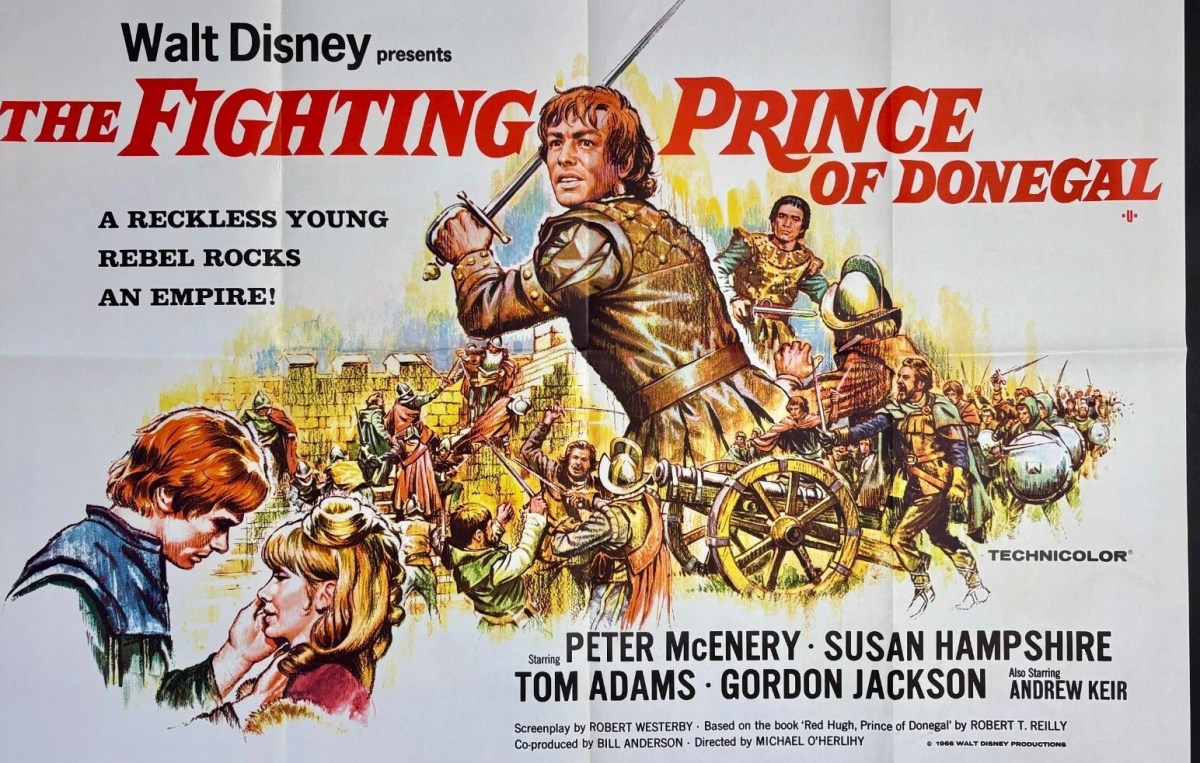
Unfortunately, the title is something of a misnomer. The titular character Hugh O’Donnell (Peter McEnery) spends more time sitting on his backside in a prison than he does engaging in any form of fighting. And in another annoying dupe, swords are scarcely in evidence, the weapon of choice being a wooden club of sorts, so it hardly qualifies as the swashbuckler the poster suggests.
Where Walt Disney was happy to play fast and loose with other aspects of history in other movies, here he cleaves close to the truth – though Hugh didn’t marry a McSweeney and his father didn’t die – so what we get is some kind of rebellion story, as the Irish attempt to rise up against the occupying English in the 1580s. If you are aware of your history, you will know that Oliver Cromwell is to blame for the English re-conquest of Ireland. Various rebellions followed, of which this is one.
It starts off promisingly enough with a nice bit of myth, that when Hugh becomes chief of the Clan O’Donnell he triggers a prophecy that insists the Irish will become free. That’s easier said than done due to the lack of a cohesive rebellion force thanks to infighting and historical distrust between the clans. And when Hugh does attempt to stand up against the British he’s promptly imprisoned – again and again.
A better title would be The Escapologist of Donegal because that’s mostly, except for the beginning and final sections, what this is about. He escapes, is betrayed and recaptured, or escapes, racing through the streets of Dublin, and remains free and then manages to gather the clans under his banner and take on the English.
And, actually, Hugh is not that keen on the use of force to win freedom. He prefers negotiation. So you can imagine how exciting that is for the kids in the audience. He wants to unite all the clans and hope the English will see sense. Luckily, for the frustrated kids in the audience, the English are not inclined to sit around a negotiating table. So, at last, we get a battle.
To save it from just being a history lesson, a romance is sneaked in between Hugh and Kathleen McSweeney (Susan Hampshire), daughter of another clan chief, and who already has an ardent admirer. A wedding is the easiest way to create unity between clans, but, luckily, this isn’t just the political matchmaking that occurred in England and Europe.
But that nascent romance is put on the back burner for most of the picture while Hugh sits in jail or runs around the country in escape mode.
So, a few fights with cudgels and fisticuffs, some bonding with other prisoners, some wooing of the clans until at last at last there is the semblance of a battle.
Nearly 60 years on from first viewing I am not won over. The politics and maneuvering is certainly more interesting to an adult, but I am still miffed at the absence of much actual swordplay – and you know how fond I am of a swashbuckler. It’s just too earnest in setting up a rebellion tale and the escapes have none of the ingenuity we have come to expect from such.
Peter McEnery (The Moon-Spinners, 1964) looks distinctly uncomfortable as a matinee idol of the kind groomed by Disney, especially when you see what he was capable of a few years later in the more scandalous Negatives (1968). Susan Hampshire (The Trygon Factor, 1966) only tops and tails the picture and her entire Disney experience was clearly so miserable she excised it from her biography.
Directed by Michael O’Herlihy (Smith!, 1969) from a screenplay by debutant Robert T. Reilley based on the Robert Westerby novel.
It’s a Hollywood trope that successful screen comedians invariably want to test their mettle in more dramatic circumstances. Studios tend to cave in to such self-indulgence, usually with the proviso that the star makes another couple of laff fests with them, but audiences tend to give such enterprises the thumbs down. Dick Van Dyke (Divorce American Style, 1967), on a commercial roll for most of the decade, took the, theoretically at least, easier option of limiting the drama on this one.
Silent films were also on a commercial roll, the oldies having made a comeback via compilation reissues and through slapstick homages such as It’s A Mad, Mad, Mad, Mad World (1963) and The Great Race (1965) so setting the picture in that era in Hollywood’s history seemed a sure thing.
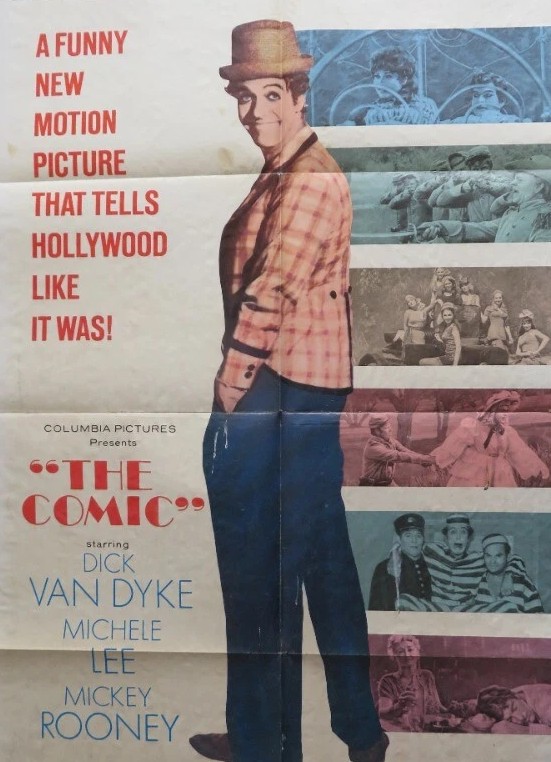
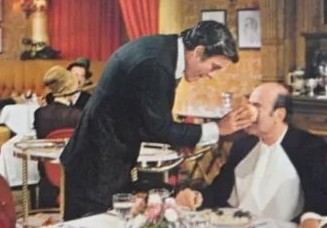
And it starts off bang on the money. A eulogy delivered at a funeral is interrupted by a pie in the face and (as seen above) that device can be utilized at any point.
I’d be telling you to give this complete misfire a miss if it wasn’t for an exceptional final third. The first two-thirds is made up of far too many silent film sequences starring Billy Bright (Dick Van Bright) who goes from vaudeville clown to major star complete with, at the height of his fame, being accorded the honor of a having a clockwork toy made of him.
When it’s not diverted into yet another silent movie sequence, which only serves to show that a modern comedian lacks whatever smarts the silent movie comedians had, the drama takes roughly the same approach, with scenes that could have come from a silent movie if not quite to the utmost.
Thanks to a multitude of affairs Billy burns his way through marriage to Mary (Michele Lee) and thanks to an overfondness for the bottle nearly kills off his career before the arrival of the talkies does that for him.
Eventually, and suddenly, we switch to an entirely different picture, a proper drama, very bold indeed for the time for its portrayal of old age and loneliness – a representation that would chime very much with today’s audiences. You don’t quite warm to this old fella because he wasn’t particularly sympathetic to begin with, but still, in its rawness, this section exerts a very emotional pull.
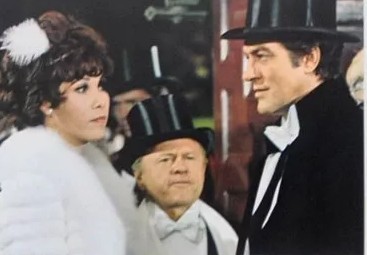
And, indeed, for Dick Van Dyke it was an incredible piece of acting. He morphs from young, tall, and fit with a head full of hair to an old bloke, bent over, shuffling and with the kind of comb-over that would put Bobby Charlton to shame. He’s been abandoned by everyone except sidekick Martin (Mickey Rooney) whose career has also gone south. They tell lies to each other to keep up their spirits.
The highlight of Billy’s life is getting a set of false teeth and setting the alarm for 4.30am so he can get up and watch reruns of his old movies on television. He lives on boiled eggs and milk.
And he’s still dumb enough to be rooked by a gold-digger. He’s placed an ad in Variety, drawing attention to the fact that he’s still alive, which wins him a spot on a TV chat show which turns into a gig for a commercial which leads a much younger woman to think he must be loaded. He ends up marrying her while in an oxygen tent, but she vanishes when she discovers his newfound fame has led to nothing.
In theory, this is about the side effects of fame, the temptations which few can avoid, and the sudden collapse in income and public awareness when the well runs dry. But, in reality, setting aside the Hollywood overtones, the last third could have been about any lonely old man.
A film of three thirds for the star, in the first two there’s nothing much to hold onto, in the last one he excels. Nobody else has much to do. Directed by Carl Reiner (The Jerk, 1979) and written by him and Aaron Ruben. Reiner had been the writer of The Dick Van Dyke Show so presumably that played a part in him getting the gig.
Died an absolute death at the box office. Not released outside America for decades and then only on DVD.
If it hadn’t been for the final third this would have been rated a one-star effort, it’s such an ill-conceived concept, and disastrous in its execution, but that final third makes it very worthwhile indeed if you can stick with it.
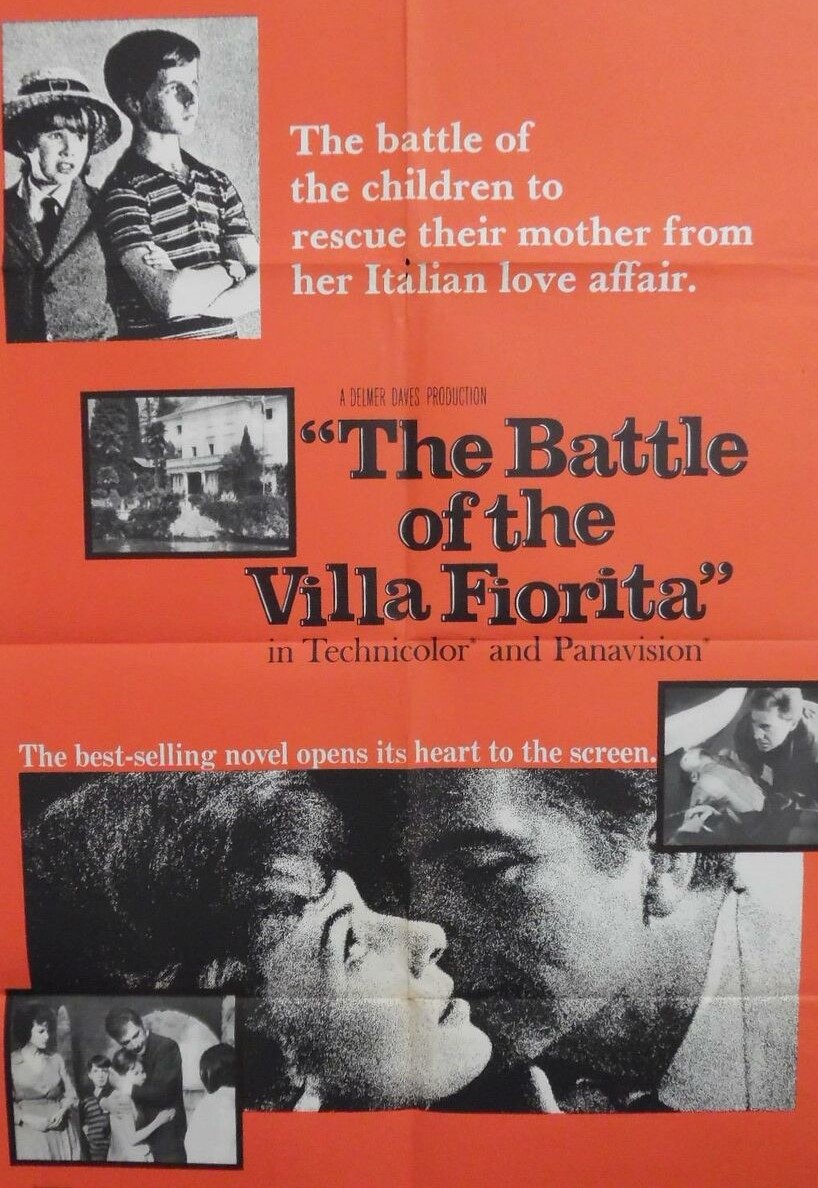
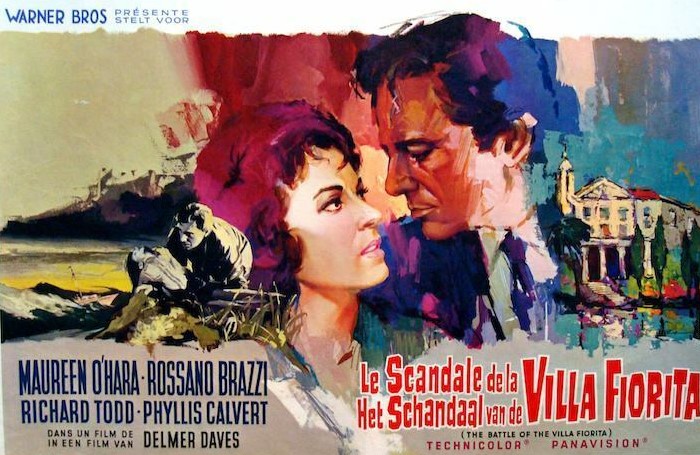
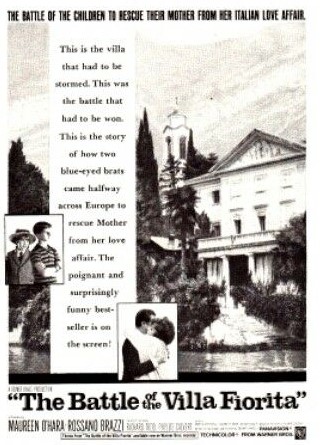
One of the few romantic comedies of the 1960s to resonate today. Neglected wife Moira (Maureen O’Hara) abandons her two children to fly to the eponymous villa on Lake Garda in Italy to take up with composer Lorenzo (Rossano Brazzi). While husband Darrell (Richard Todd) accepts the fait accompli, kids Michael (Martin Stephens) and Debby (Elizabeth Dear) set out to bring her back. Although Disney had created a hit on the similar theme with The Parent Trap (1961) – also starring O’Hara – this failed to find an audience primarily because it sailed too close to comfort regarding the reality of the effect of separation and impending divorce on children.
Nor are these kids Disney cute. While Debby occasionally calls upon her internal winsomeness to tug at heartstrings, both she and Michael are made of sterner stuff. Unwilling to use comedy as a means of bringing the errant adults to heel, the movie gets deeper and deeper into darker territory, as the kids embark on a war of attrition, disruption the cushy love-nest and forcing their mother to accept her maternal responsibilities. And the ending is far from what you would term happy.
Moira injects some nascent feminism into her role, determining that she is entitled to happiness rather than merely fulfilling the part of a good mother, running a household, looking after her offspring and enjoying the life of a well-to-do matron marred by a husband too often away on business and the too-familiar company of boring respectable friends. A Disney picture would have seen the kids relying on the kindness of strangers or harmless subterfuge to make the trip from Britain by boat and train to Italy. Here, they fund the journey by selling Debby’s horse. The trek is not only dull but on their miserable budget they spend most of the time famished, unable to afford food on the train, resigned to watching adults in their compartment stuff their faces (Disney would have had the grown-ups share out the tasty fare).
Arriving at the palatial villa, where Moira is waited on hand and foot, spoiled by presents and ardently wooed, the children are under no illusion about the uphill battle they face especially when Moira is not immediately stricken enough by conscience to give in to their entreaties. Lorenzo’s initial solution is to fly the children home. Adult fortitude begins to waver when the English offspring join up with Lorenzo’s estranged daughter Donna (Olivia Hussey) on a hunger strike. Lorenzo shows a sharper side to his temperament, Moira a weaker. The children’s solidarity is, however, sorely tested by their own differences.
That there is no easy solution – the kids perhaps joining their mother full-time in Italy or some kind of child-sharing scheme – is what gives this movie its power. The classical idea of a repressed woman finding redemption in the arms of an Italian lover (as with Summertime, 1955, also starring Brazzi) is turned on its head as reality intervenes. It’s as well the kids don’t kill us with cuteness, but instead present a realistic example of what it’s like for adoring children to be abandoned. As the film progresses, and the children turn the screw, they soon face adult realization that, even if they win, the mother they will bring back will not be the mother they knew.
After turns with James Stewart (Mr Hobbs Takes a Vacation, 1962) and John Wayne (McLintock!, 1963), Maureen O’Hara had regained her marquee appeal, and although feisty enough in those outings, this was a different, and more courageous, performance than her fans might have expected. Her conflict is mostly internalized and especially when her children fail to see her point of view, that feistiness vanishes from view, replaced by a more somber, thoughtful individual. Brazzi is excellent as the lover whose paternal responsibilities he takes lightly compromised by a woman forced to come to terms with motherhood. Martin Stephens (The Innocents, 1961), Elizabeth Dear (The Pumpkin Eater, 1964) and, making her debut, Olivia Hussey (Romeo and Juliet, 1968) make convincing, conniving, children still dealing with their own hormonal and emotional growth.
Adapting the bestseller by Rumer Godden (Black Narcissus, 1947), this proved to be final movie for veteran director Delmer Daves (Spencer’s Mountain, 1963 – also starring O’Hara.).







 The Magnificent 60s