I am a published author of books about film - over a dozen to my name, the latest being "When Women Ruled Hollywood." As the title of the blog suggests, this is a site devoted to movies of the 1960s but since I go to the movies twice a week - an old-fashioned double-bill of my own choosing - I might occasionally slip in a review of a contemporary picture.
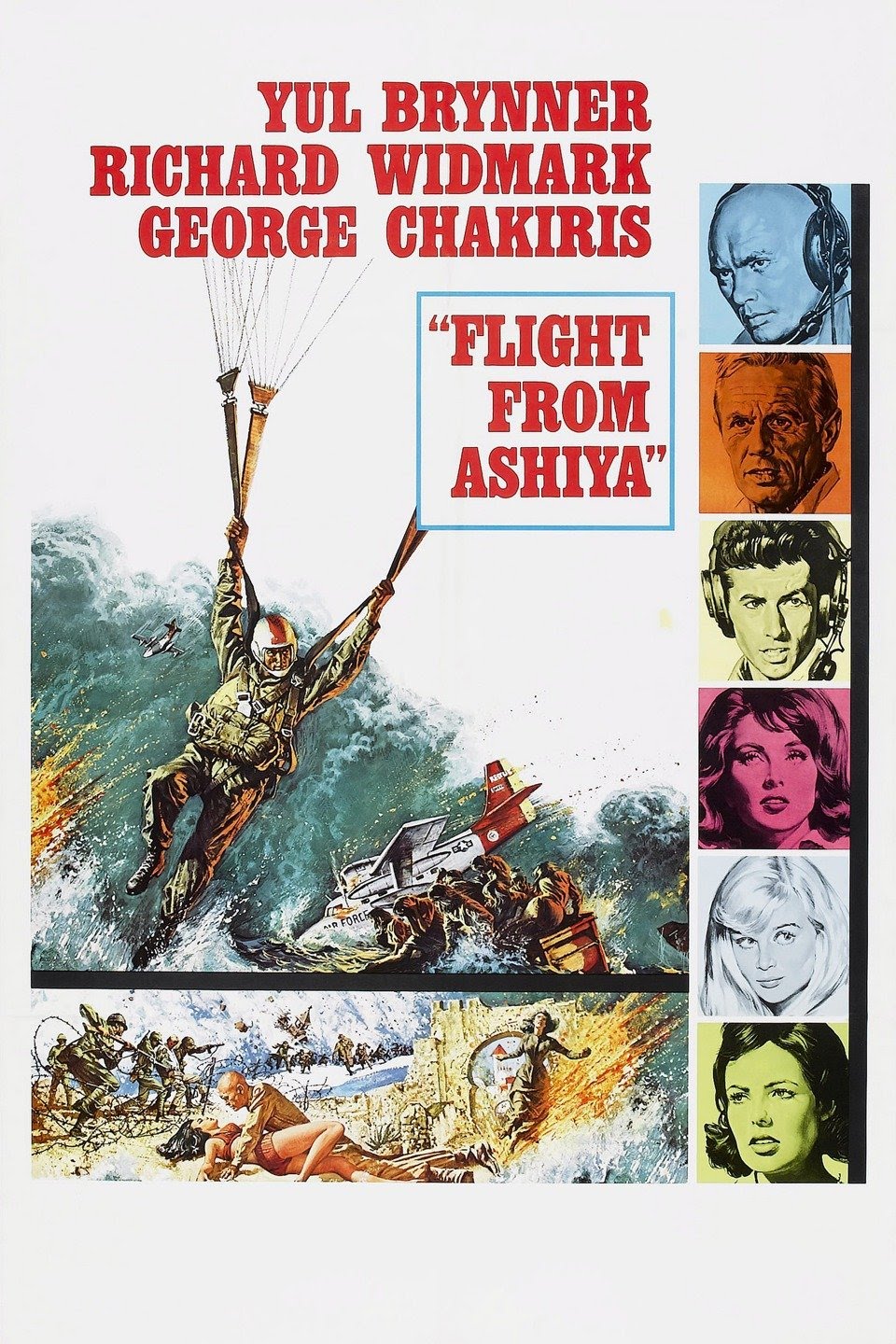
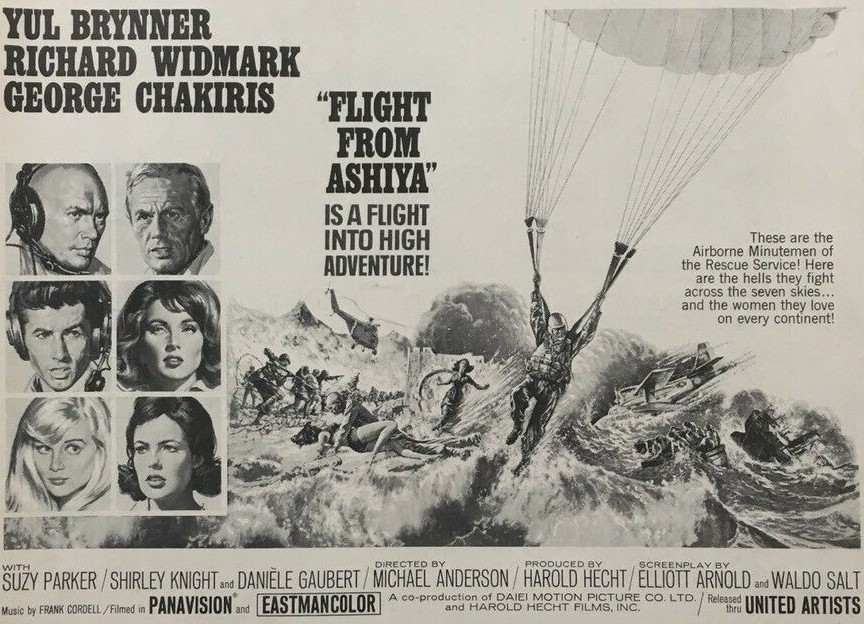
A post-WW2 operation to save a handful of Japanese adrift at sea in a storm is endangered when three members of the U.S. Air Force Air Rescue Service confront conflicts from their past. Despite tense rescue action, this is basically a three-hander about guilt and how men deal – or fail to deal – with emotions. Extended flashbacks illuminate the tangled relationships between Yul Brynner, Richard Widmark and George Chakiris.
So really it’s like one of those portmanteau films that were occasionally popular – like Trio (1950) made up of Somerset Maugham short stories or the more recent The VIPs (1963) or The Yellow Rolls Royce (1964). Each of the episodes stands up in its own right, actions taken in the past having a direct bearing on the present situation. Chakiris is haunted by causing an avalanche after flying his helicopter too close to a mountain and by having to leave behind many of the victims, due to restricted capacity on board, and now he is terrified of flying solo.
As a consequence, Widmark has no faith in abilities as a pilot. Widmark has an ongoing hatred of the Japanese – colleague Brynner of Japanese ancestry also bears his wrath – because his ill wife (Shirley Knight) and child died in a Japanese prisoner-of-war camp where medical supplies were reserved for the Japanese. Faced with rescuing Japanese, he is enraged. For his part, Brynner, as a paratrooper during the war, inadvertently caused the death of his Algerian girlfriend.
It’s not so much an examination of tough guys under pressure as about their inability to deal with the consequences of action. There’s certainly a sense that the only way men like these have of dealing with trauma is to throw themselves further into harm’s way. Unusually, at a time when product was in short supply and for a film boasting a strong cast, the picture was shelved for two years after completion. Michael Anderson (Around the World in 80 Days, 1956) directed.
The title’s a bit of a misnomer, suggesting someone is trying to escape from Ashiya when, in fact, that is just the name of the air base where the rescue team are located. Critics complained it was neither one thing nor the other, but in fact I found it a perfectly satisfactory combination of action and drama, especially as it dealt with rarely-recognised male emotions.
Many of the films from the 1960s are to be found free of charge on TCM and Sony Movies and the British Talking Pictures as well as mainstream television channels. But if this film is not available through these routes, then here is the link to the DVD and/or streaming service.
Twisty Carol Reed thriller pivoting on emotional entanglement that keeps you guessing right up to the end. In revenge for losing his business after an insurance company failed to cough up for his crashed plane, entrepreneur Laurence Harvey (Butterfield 8, 1960) fakes his own death and flees to Malaga in Spain.
But when girlfriend Lee Remick (Days of Wine and Roses, 1962) joins him she finds he has assumed the identity of an Australian millionaire whose passport he has purloined and completed the transformation by changing his black hair to blond. Harvey has a mind to repeat the experiment by killing off himself (under the new identity) and claiming the insurance. Remick, complicit in the original scam, not only balks at this idea but finds disconcerting his change of personality and clear attraction to the opposite sex.
Tensions mount when mild-mannered insurance investigator Alan Bates (A Kind of Loving, 1962) appears on the scene. Anyone watching the film now has to accept that in the days before social media every face was not instantly tracked and accept that Bates is unaware of what Harvey looks like.
The couple cannot run because they are awaiting a bank draft. Bates immediately sets the tone for suspicion when he pronounces that their vehicle “looks like a getaway car.” Forced to follow “The Godfather” dictum of keeping your enemies closer, the pair befriend Bates with the intention of finding out what he knows and what are his intentions. Harvey and Remick have to pretend they have only just met, and have separate bedrooms, leaving the door open for Bates to gently woo Remick, an action endorsed by Harvey. They are caught out in small lies. Harvey’s Australian accent falters. Bates keeps on making notations in a notebook. Harvey foils Bates’ attempts to photograph him.
The ensuing game of cat-and-mouse is complicated by Bates pursuit of Remick. Is this as genuine as it appears? Or is he trying to get her on her own to admit complicity? Both Harvey and Remick are, effectively, forced to adopt the new identities they have forged to dupe Bates with unforeseen results. There are red herrings aplenty, a race along mountainous roads, and some marvelous twists as the couple find the tale they have woven is turning too tight for comfort until murder appears the only solution.
As with his international breakthrough The Third Man (1949), Reed grounds the whole Hitchcockian enterprise in local culture – this being unspoiled Malaga prior to the tourist deluge – Spanish churches, a wedding, a fiesta, the running of the bulls, with an occasional ironic twist – “gypsy” musicians watching ballroom dancing on television. Reed resists taking the material down a darker route – Hitchcock would undoubtedly have twisted the scenario in another direction until Remick came under threat from Harvey – but instead allows it to play out as a menage-a-trois underwritten by menace.
The acting is sublime. Harvey wallows in his part, Remick quietly anxious scarcely coming to believe that she had played a part in the original crime, Bates with a pleasant inquisitive demeanor the ideal foil to Harvey. Unusually, they all undergo change, Harvey uncovers a more ruthless side to his character, Remick responds to the gentler nature of Bates, while Bates shrugs off his schoolmasterly aspects to become an attractive companion. It all leads towards a thrilling conclusion.
A couple of footnotes – special mention to Maurice Binder for the opening credits and this was the final score of British composer William Alwyn (The Fallen Idol, 1948).
Many of the films from the 1960s are to be found free of charge on TCM and Sony Movies and the British Talking Pictures as well as mainstream television channels. But if this film is not available through these routes, then here is the link to the DVD and/or streaming service.
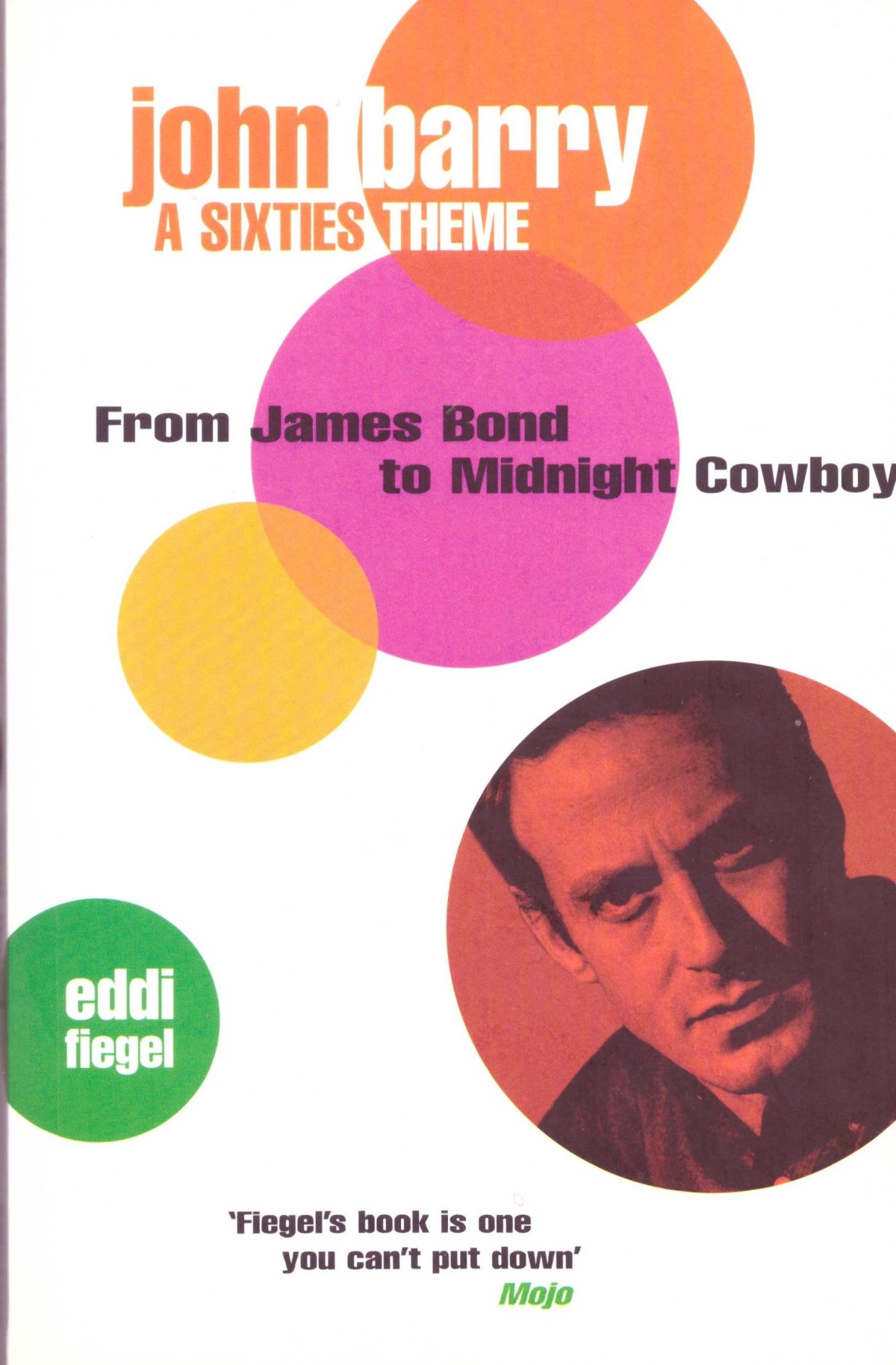
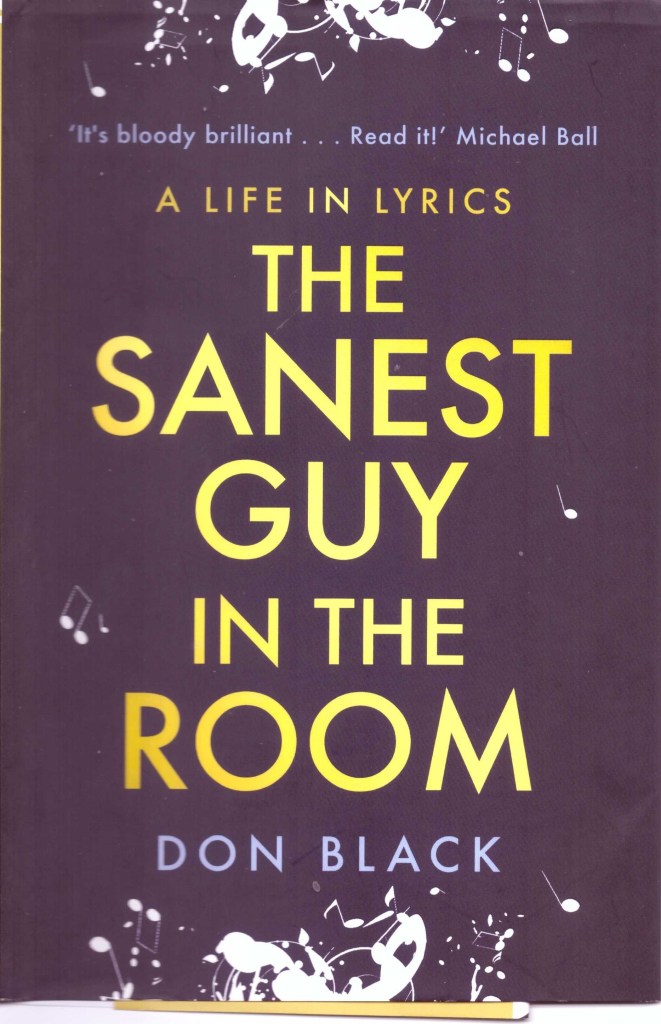
You can’t really write about 1960s films without making some reference to the revolutionary composers and lyricists who penned so many of the decade’s finest music. Rather than concentrate on the films to which the pair made vital contributions, I thought I would point you in the direction of a Eddi Fiegel’s biography of John Barry and this year’s autobiography of Don Black.
Barry, the son of a Yorkshire cinema owner, was a true child of the Sixties, a handsome man in handmade suits, living in Chelsea, driving an E-type Jaguar or a white Maserati, and friend of Michael Caine and David Bailey. He squired some of the most glamorous women of the era like Britt Ekland and Charlotte Rampling and was married to one its most enigmatic actresses Jane Birkin (Wonderwall, 1968, and co-conspirator of the hit single “Je T’Aime”).
After forming jazz outfit the John Barry Seven, regulars on TV program the 6.5 Special, he scored and arranged singles for pop singer Adam Faith who proved his passport to the movie business with Beat Girl (1959). But Dr No (1962) for which he was only paid £250 changed his life and he became the most in-demand film composer in British cinematic history. He followed up with successes such as Zulu (1963), Goldfinger (1964) and The Ipcress File (1965) and although his music sold in enormous quantities in terms of singles and soundtrack albums, his work had not come to the notice of the Oscar voters.
Born Free (1966) changed all that when he linked up with lyricist Don Black. Columbia had initially insisted that an American folk group would write and perform the theme song. But Barry was determined to do it himself. While the theme for Goldfinger had taken many days and nights to complete, Born Free was a different story: “I wrote the whole thing from beginning to end in about ten minutes,” said Barry. He had previously worked with Black on Thunderball (1965). The collaboration clicked from the outset. “John’s very word-conscious,” commented Black, “and that’s unusual for most composers.” However, Black’s socially-conscious lyrics did not initially go down well with producer Carl Foreman and Barry had continuous problems over the way the music should be handled in the film. The theme went to number one in America and Barry picked up two Oscars, for original music and, shared with Black, for best song.
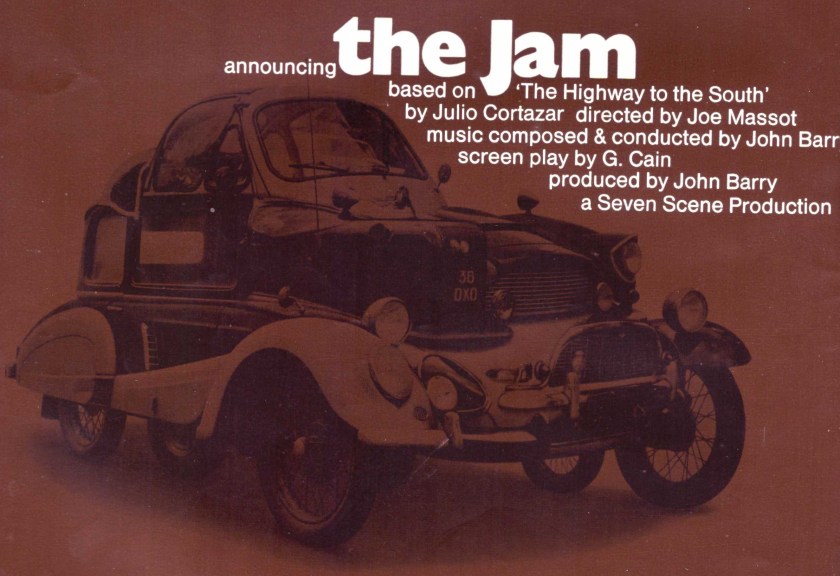
Talking of John Barry, here’s a mystery someone might be able to solve. I came across this advert in “Films and Filming” magazine which listed John Barry as a producer. Joe Massot went on to direct Wonderwall (1968) but George Harrison did the music for that. Any ideas?
Even so, Barry was not welcomed in Hollywood. “I remember in Hollywood,” noted composer Leslie Bricusse, “the fraternity of film composers there being very condescending towards John, talking about him as this pop musician who’d been in a band…the top brass…saw John as this kind of upstart. ” That changed with heist movie Deadfall (1968) – the “Romance for a Guitar and Orchestra” section my favorite piece of Barry music – and The Lion in Winter (1968) for which he won his second Oscar.
The bulk of Fiegel’s book covers the music Barry wrote in the 1960s and it is full of riveting detail about the circumstances surrounding various films. This is not a new book but it’s one I go back to again and again to remind me of John Barry’s genius.
By comparison The Sanest Guy in the Room: A Life in Lyrics by Don Black was published this year. “The first thing you learn as a lyric writer,” says Black, ” is not to waste a syllable” and that is the mantra for this delightful book, full of interesting anecdotes, insights into the work of other famous lyricists, and containing many of his own lyrics. He worked with singers Shirley Bassey and Barbra Streisand, a string of top composers including Maurice Jarre, Francis Lai, Lalo Schifrin, Quincy Jones, Elmer Bernstein and Henry Mancini and wrote musicals including Tell Me on a Sunday with Andrew Lloyd-Webber.
He grew up in council house in Hackney, London. But his initial attempts to become a songwriter floundered and he worked on the weekly music paper New Musical Express before becoming a “plugger” – a publicist – for a music publishing company and then a stand-up comedian.
However, he had become good friends with crooner Matt Monro – whom he would later manage – and the singer encouraged him to give songwriting another chance. When Barry approached him to write the lyrics for Thunderball, his career took off. Normally he wrote the lyrics once the composer had completed the tune. But To Sir, With Love was written first. Canadian Mark London supplied the music. British pop star Lulu, who was in the film, recorded it and it topped the charts in the United States.
But his closest collaborator remained John Barry. “It was easy writing with John – he would hand me a melody and I would go home and put words to it…If you write the words first there is a tendency to ramble, but if you only have a limited number of notes they provide you with a rigid framework.”
You can’t be a lyricist without versatility as proven by some of the songs he wrote in the 1960s – for films as diverse as Yul Brynner adventure The Long Duel (1967), A Matter of Innocence (1967) starring Hayley Mills, Peter Sellers comedy The Party (1968), Burton and Taylor drama Boom! (1968), biopic Isadora (1968) with Vanessa Redgrave, spy thriller Some Girls Do (1969), George Segal-Ursula Andress adventure Southern Star (1969) and The Italian Job (1969) starring Michael Caine.
As well as the Oscar for Born Free, he was nominated for best song for True Grit (1969), Ben (1972), Gold (1974) and The Pink Panther Strikes Again (1976). More recently he has been presenting a show on BBC Radio Two. His autobiography is a very spirited read, whizzing you from one anecdote to the next, and as promised no word wasted.
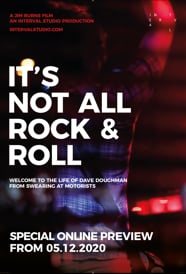
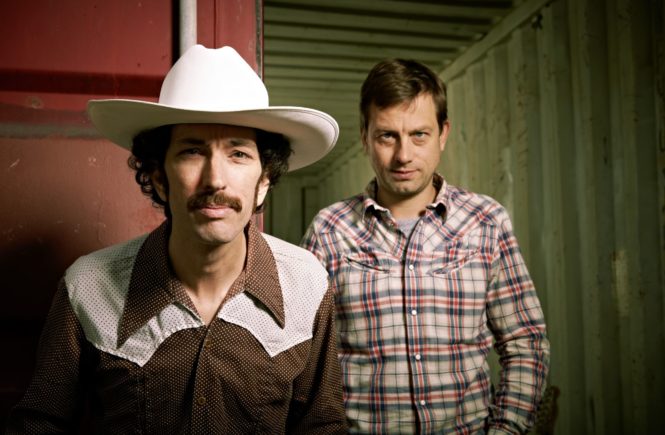
I’ve never heard of the rock band Swearing At Motorists but like everyone else I’ve got misconceived notions about the rock’n’roll lifestyle of excess and how if you live long enough and are lucky enough you might find redemption at the end of the highway. So Jim Burns’ touching documentary It’s Not All Rock’n’Roll redresses that balance. Band frontman Dave Doughman has been a recording artist since 1995, making eight albums and about to set off on a tour where, if he’s unlucky, his audience might comprise six people, or an irate customer might insist on playing pool during the performance.
Dave’s the one in the hat.
He even does his own washing-up, takes his boy to school and has a day-job as a forklift truck driver. He doesn’t do it for the money or the fame – just as well since none has come his way – but because he wants to be a working rock musician. Since the band consists of Dave and a drummer, it’s up to him to put on a show, and, by golly, he’s the best one-man show in town, leaping up and down, playing the guitar on his back, burning off energy like gas is a dime a gallon, and keeping the tempo way above eleven.
We catch up with him in Hamburg where he’s living. He’s single and trying to become the dad his dad wasn’t, developing a relationship with his young son, his life revolving around taking his son to and collecting him from school, fitting in songwriting and recording in between. Trying to make money when you are not particularly famous is the hard part if you want to remain a working musician, so he’s the one also selling records and memorabilia at concerts. Publicity is scant. He’s delighted when he is the February selection for a local calendar and there’s a hilarious sequence where, echoing the famous Coppertone advert, he is photographed on the beach with a dog pulling down his pants.
On stage – energy encapsulated.
But it’s one version we get of him in Germany and another when he goes on tour back to homeland America and we find out that he was on the excess express for 27 years and has only recently cut out drink and drugs and sought out treatment for depression in order to become the responsible father his father was not. I wondered what kind of tour this would be since he is relatively unknown, although John Peel has played his records and he was part of the Dayton, Ohio, music scene at one point. The answer is he plays bars and if he is invited to a festival he has the opening slot – at 10.30am. But none of that matters to Dave. He treats every gig as if he is playing Madison Square Garden or headlining Glastonbury. It’s like the Field of Dreams of rock. Waiting for people to come, even if not many always do. But he gives the kind of performance nobody who does come will ever forget, as some concert-goers testify, and as we can see for ourselves.
The forklift truck driver shows us the way.
This being a documentary and me never having heard of this guy I had no idea where the story was going to go. I certainly didn’t think I would be totally engrossed, not so much by the later revelations, but by the guy’s honesty. In a business where artifice is often everything he is under no illusions. Even if the music doesn’t grab you by the balls, Dave Doughman has an unusual charisma. The camera loves him. And he’s not even mugging to the camera, this isn’t an act like so many other documentaries on rock stars. This is the real thing. And even when he’s electric on stage you’re still left thinking of his dichotomy – how is he going to bring up his son if he has to be thousands of miles away touring? This is an insider’s look at the genuine life of a rock musician – and not to be missed. That rare thing – a rock documentary with soul.
You can catch this on demand at Vimeo. Check out the trailer below.
Ever since Broadway had produced an elegy to a man broken on the rack of the American Dream in Arthur Miller’s Death of a Salesman, Hollywood had been searching for an equivalent, but had only managed to come up with tales of men self-destructing through drugs (The Man with the Golden Arm, 1955) and alcohol (Days of Wine and Roses, 1962). The Swimmer, with its physical and mental dereliction, filled that void. It was the bravest choice of Burt Lancaster’s career – William Holden, Paul Newman and George C. Scott turned it down – the athletic prowess that had carried him through a host of films from The Flame and the Arrow (1950) to The Professionals (1966) now virtually redundant.
The final scene when, in the pouring rain, clad only in swimming trunks, he crouches, broken, on the steps of his abandoned house, as if seeking sanctuary in a church, was a stunning image. But it was more than that. Few actors of his generation would have been willing to stoop so low. Yes, the likes of Marlon Brando were often beaten to the point of humiliation (The Chase, 1966), but that was in the course of duty, not in pursuit of the American Dream. That Lancaster, a touchstone to Hollywood virility, the man-god with the dazzling style, was the one to come apart made the drama even more powerful.
The under-rated Frank Perry had struggled to find a footing in Hollywood even after the (minor) success of David and Lisa (1962), but he was one of the few directors willing to tackle the uncommercial subject matter. It was such a troubled production that producer Sam Spiegel, never one to shy away from publicity, did not put his name on it and Sydney Pollack who had directed Lancaster in The Scalphunters (1966) was called in to re-edit the rough cut. Eleanor Perry, the director’s wife, fashioned the script from one of the most acclaimed short stories of all time, by John Cheever.
The story is a simple one. Lancaster plans to swim across the county via the swimming pools of his upmarket neighbors to reach home. At the start he is vigorous, powerful, with a terrific dive and swimming stroke. He names the journey “the Lucinda river” after his wife. But he is like Ebenezer Scrooge, meeting ghosts from his past, facing up to the present, and left with only a desolate future. With each successive visit to a swimming pool, another part of his life unfolds. From the outset we can tell something is wrong – couples exchange odd looks and occasionally he is met with sympathy or hostility, neither of which he comprehends, and persists with a rose-tinted version of his life. And gradually, his physique deserts him and he limps, can’t pull himself effortlessly out of a swimming pool and instead of being warmed by the sun begins to shiver.
Stylistically, the movie begins with the idyllic, a camera tracking through the countryside from Lancaster’s point-of-view, his footsteps on the soundtrack, deer, a rabbit and an owl popping into view. As a counterpoint to long tracking shots of Lancaster trotting down a sunlit avenue of trees, Perry employs the zoom camera (an innovative technique at the time) to go so deeply into his eyes it must pierce his camouflaged soul. Harsher music and slower movement by Lancaster prefigure the onset of dangerous reality. And it is not the end of summer as Lancaster imagines (making reference to flowers or trees) but the beginning of autumn as the drifting leaves show.
By focusing so much on the actor’s physicality – he is never out of swimming trunks – we see at once his strength and his eventual weakness. There is one glorious sequence where he races a horse. In another, he leaps a five-barred fence. This is as the character perceives himself, a triumphant physical specimen.
But what we see, as he is pitifully stripped of dignity, is something else. Scenes that start brightly end ominously. For part of his adventure he is accompanied by former babysitter Julie (Janet Landgard). Initially, this is a picture of lost innocence, a three-minute sequence of Lancaster and Landgard mostly in longshot walking in dappled sunshine through the trees, as if they belong in a fairytale, with their voices detached from the images. But when she professes an adolescent crush (stealing one of his shirts, for example) and he begins to act in overprotective paternal fashion she takes it the wrong way and although nothing untoward occurs it clearly creeps the girl out and makes us realise that Lancaster is living in the past.
The present he could – and should have – enjoyed is tantalizingly all around. Every pool he visits belongs to the rich. There is alcohol aplenty. The houses are fabulous. As well as swimming pools, people own horses. Middle-aged neighbors sit out, ignoring the attractions of the pool, enjoying what their wealth has brought.
It is not a descent into madness for he must already have been unhinged to embark on his excursion but a nightmare that never ends. There is no safety harness for the American Dream. Once you fall, there is nothing to stop the plummet. Nothing left but, to mix the metaphors, swimming on empty.
The Swimmer is on Amazon Prime. Incidentally, there is an excellent documentary, directed by Chris Innis, The Story of the Swimmer (2014) which you can find on YouTube.
Since this is my 100th blog, I am in celebratory mood and hope to convince you that The Undefeated is one of the most under-rated westerns of all time. (Be warned – this is longer than my normal reviews.)
While John Wayne was at a career peak, Rock Hudson was in a trough. Wayne had just posted his biggest-ever box office figures for True Grit, which had opened in the summer, the first western ever shown at the Radio City Music Hall, the country’s biggest auditorium with nearly 6,000 seats, although it was advertised as an ‘outdoor adventure.’ He had appeared on the covers of both “Time” and “Life” magazines, and was being talked-up as a genuine Oscar contender. True Grit was proving to have such popular appeal that, in the year of Midnight Cowboy and Easy Rider, it would finish sixth on the annual box office rankings, just shading the former and well ahead of the latter.
Rock Hudson had ended up nearly at the top of another list – of the worst-performing stars at the box office, according to Variety his last five pictures tallying a total of $8.5million. After a decade at the top of the trees, segueing from Douglas Sirk melodramas to Doris Day comedies, he had come unstuck with John Frankenheimer’s black-and-white experimental Seconds (1966), derided at the Cannes Film Festival and ignored by ticket buyers, and thereafter gone downhill fast with Blindfold (1966), Tobruk (1967), A Fine Pair (1968), and MGM’s big-budget Cinerama Ice Station Zebra (1968).
This blog is a shorter version of one chapter of “The Gunslingers of ’69” for which I watched the 40-plus westerns released during that year. The book was published by McFarland and print and ebook versions are available from Amazon.
Director Andrew V. McLaglen, son of Victor McLaglen (The Informer, 1935), got his break on John Ford’s The Quiet Man (1952). Wayne provided the guarantee four years later for McLaglen Jr. to make his first foray into direction, the western Gun the Man Down. After making a splash in television – over 200 episodes of Have Gun Will Travel and around 100 of Gunsmoke – his career moved into higher gear with McLintock (1963), Shenandoah (1965) and The Rare Breed (1966). Three further westerns followed – The Way West (1967), The Ballad of Josie (1967) and Bandolero! (1968) – before diversifying into oil wildcatting adventure Hellfighters (1968).
McLaglen was the victim of two erroneous assumptions. The first was that he was happy to be type cast as a director of westerns. He refuted this notion in an interview for Conversations on Film and claimed that “it’s the way my course was laid out for me,” suggesting that, in the early days at least, he had little control over the kind of projects for which he was deemed most suitable. Secondly, he was unfairly condemned as a “journeyman” director, an unworthy successor to John Ford, although Christopher Frayling put it more kindly when he asserted that McLaglen was a “figurative painter when everyone else had gone abstract,” indicating that the director was out of keeping with the times.
However, this was equally unfair, since in the 1960s, until Sam Peckinpah produced The Wild Bunch, there had been no real contenders for the Ford crown apart from a critic-driven revival of the 1950s films of Budd Boetticher long after he had stopped making them while Anthony Mann’s decade-long love affair with the western had ended with the dismal Cimarron (1960). U.S. recognition of Sergio Leone was slow in coming. Other directors considered as candidates such as John Sturges (Gunfight at the O.K. Corral, 1957; The Magnificent Seven, 1960) proved too erratic, while the likes of Henry Hathaway had only consistently turned to the genre in the 1960s. McLaglen was underrated as a director of westerns, McLintock hugely enjoyable, Shenandoah belonging close to the top rank, and, as I shall attempt to prove, The Undefeated a far better movie than given credit for. While not in itself a masterpiece in the category of Once Upon a Time in the West or The Wild Bunch, it is McLaglen’s masterpiece.
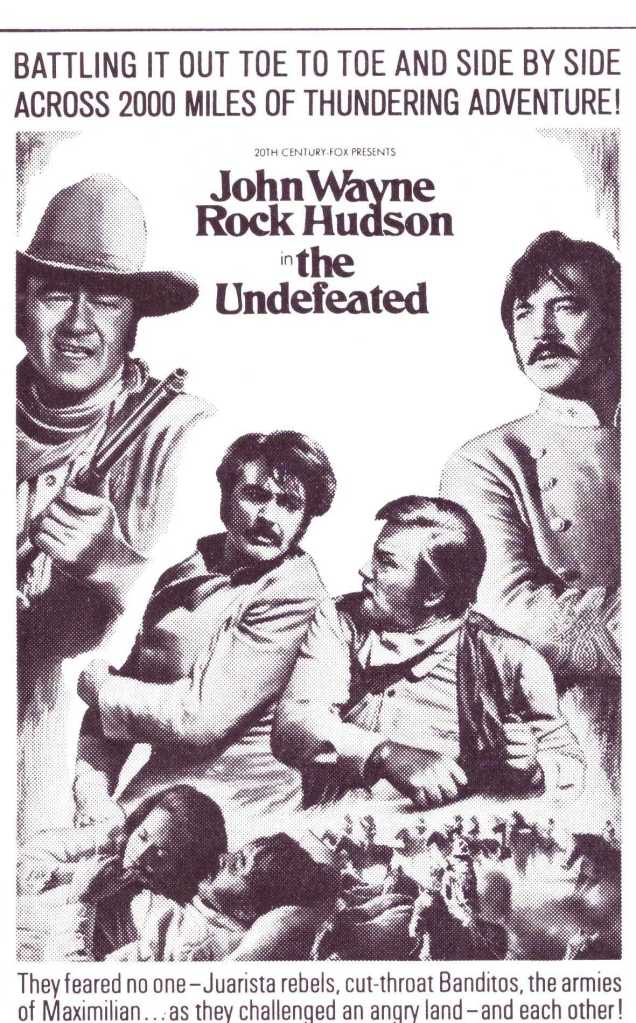
Most movies in the 1960s arrived with more than one advertisement. A variety of ads featured in the movie Pressbook – the marketing manual sent to exhibitors – and cinema managers would choose they one they felt most suited to their audience.
Wayne played Unionist colonel John Henry Thomas and Hudson his opposite number in the Confederacy Col. James Langdon. The rest of the cast was composed of newcomers like Michael (later Jan Michael) Vincent and Melissa Newman (not the daughter of Paul), pro-football players Merlin Olsen and Roman Gabriel of the Los Angeles Rams, members of the John Ford stock company like Ben Johnson and Harry Carey Jr, and Mexican actor-singer Antonio Aguilar. The movie was filmed on a 1,600 acre plantation in Louisiana and in and around Durango in Mexico. Nonetheless, at $7.2 million, it had a bigger budget than Butch Cassidy and the Sundance Kid (1969), Valley of the Dolls (1967) and Planet of the Apes (1968), which cost $6.8 million, $4.6 million and $5.8 million, respectively.
I don’t usually begin a discussion of a film by examining its composition but I am making an exception with The Undefeated. I had come to this picture with vague memories of having seen it on original release in second- or possibly third-run at my local theater. I do not recall being particularly impressed, although at that age I had not formed any critical faculties for the evaluation of the western, nor any movie for that matter, being only 16 or 17 at the time. As a result, I did not hold out much hope for the movie when it came to the current re-evaluation, in part because it lacked the critical status of The Wild Bunch or Once Upon a Time in the West, which I had viewed many times since their original release, and in part because it had not been a box office or critical hit and therefore subject to the theatrical reissue, continuous television programming and re-evaluation that had accompanied The Wild Bunchor Once Upon a Time in the West.
What struck me most was how Andrew V. McLaglen constructed the movie on screen. A substantial number of scenes were in long shot, but, unlike, say True Grit, the director made more consistent use of the divisions between background, center and foreground. Most often by using the 3,000 horses as the long distance focal point in the middle of the screen, or a line of cavalry, the director achieved a fine separation of elements that, to me, at least appeared to show a mastery of composition. The screen, lengthways, was consistently divided into three, or four. Sometimes the entire action took place in the bottom half of the screen, the upper part reserved for sky or sky peering through mountains. Like a traditional landscape painter, McLaglen would work with the horizon line, sometimes with a vanishing point. It seemed to me that an artist, in the most ordinary sense of the word, was at work. This conceptual approach is apparent from the very start. When a rider arrives to announce to the Union troops that the Civil War is over, half the screen is sky.
What does let the movie down is the story. The basic concept – the reconciliation of deadly enemies – is an intriguing one and more than enough to carry the picture, but, the plot is overly complicated and the ending, while in one respect emotionally satisfying, is an anti-climax. In post-Civil War America, a group of ex-Union soldiers and a contingent of former Confederate soldiers (plus families) both converge on Mexico, but for different reasons. The Union soldiers, led by Col Thomas, are intent on selling a herd of 3,000 wild horses to the Mexican army, while Col. Langdon’s Confederates are taking their weapons and money in the same direction but in the hope of setting up a second front in order to continue the fight against the Unionists.
On the way, both groups encounter double-dealing, the Mexicans attempt to renege on the agreement to buy the wild horses, while the rebels are taken hostage by, ironically enough, forces in opposition to the existing Mexican government. The Unionists come to the rescue of the Confederates twice, once in a rousing battle against bandits, and, at the climax, by trading their horses (and their futures) for their former enemies’ lives. But this is an unsatisfactory conclusion since, to complete the circle, it should have been the Confederates baling the Unionists out of trouble, and therefore, honors even, they can come to a peaceful accommodation.
The movie opens with a battered Confederate flag. The camera tracks left along lines of grey-uniformed soldiers waiting for the expected attack. Almost immediately, their ranks are decimated by cannon fire followed by a Union cavalry charge, sabers cutting the defending soldiers to ribbons, Colonel John Henry Thomas (John Wayne) in the thick of the action, a Confederate flag abandoned on the ground. As a rider brings news of the cessation of hostilities, the camera, from Thomas’s point-of-view lingers on the dead. Thomas seeks out the enemy to accept their surrender.
To his astonishment, the Confederates already know that peace has been agreed when they continued fighting and, as far as the rebel commanding officer is concerned, the war is not over. “Are you telling me,” asks an incredulous Thomas, “that you intend to keep fighting?” The officer replies, “Haven’t we just proven it?” A few minutes into the picture, the entire concept is established, emotional sides taken, Unionists exhibiting disbelief, Confederates appearing resolute.
Mustachioed and resplendent in a Southern uniform that incorporates a cape and a hat with a feather in it, the dashing Colonel James Langdon (Rock Hudson) spells out his post-war secret mission to his troops, a 2,000-mile trip to Mexico, arms and ammunition and uniforms hidden at the bottom of wagons, their rendezvous, 500 miles south of the border, in Durango leading to being escorted by representatives of Emperor Maximilian to the country’s capital. Langdon sets fire to their grand mansion as a romantic subplot unfolds involving two juveniles, Langdon’s daughter Charlotte (Melissa Newman) and the slightly older Bubba Wilkes (Michael Vincent).
Thomas hands in his resignation, explaining that the 10 men remaining out of the 75 he recruited three years prior takes priority over continuing as a soldier. “Those left deserve more than a pat on the back from some newspaper editor and I’m gonna see they get it,” he snaps, as he leads his men away on their mission, to round up 3,000 horses to sell to the U.S. Army. What do men do while they wait around, capture flies as in Once Upon a Time in the West, or bicker as The Wild Bunch? Like Peckinpah’s squad, these men like to make fun of each other and, reminiscent of the scene when Warren Oates is teased over a bottle of whiskey, the ex-soldiers toss a chew of tobacco around until one stops after catching sight of approaching Indians.
In a mild twist, these are not enemies, but a group led by Blue Blood (Roman Gabriel), who, in another twist, we learn later, is Thomas’s adopted son – a major twist, in fact, if we are the homage business, given The Searchers (1956) when Ethan Edwards is dedicated to hunting down and killing Debbie (Natalie Wood) simply because she has lived with Indians after being kidnapped. The arrival of the riders is typical of McLaglen’s compositional skills: the men appear in long shot below the horizon. The screen, in reality, is divided into two – sky at the top, land at the bottom. Crammed into the middle is a tiny stretch of men.
We cut the first rousing adventure scene, a two-minute scene of the lassoing, capture and breaking-in of thousands of horses, the screen filled with images of the racing animals. As Col. Langdon’s wagon train sets off, Charlotte tells her beau that she is “looking for something more substantial” in a man than this lovelorn youth, as if she has quickly grown up during the war. Thomas and Short Grub (Ben Johnson) head off to a staging post for a meeting with the agents who buy horses for the government but instead they come into contact with a “couple of popinjays” representing Emperor Maximilian and willing to buy the entire herd. The loyal Thomas rejects their offer out of hand until, in an attempt to defraud him, the government agents offer him $10 less per horse than the going market rate, and for a fraction of the herd.
Summary justice, in the form of a punch, is meted out to the agents. In the middle of a fog we learn that the Confederates are being pursued by Union Cavalry intent on turning them round. When Langdon hears the Union horses he orders his wagon train to race the enemy to the Rio Grande. Once across, there is a close-up of the Confederate flag and McLaglen pulls back to reveal the train of wagons which takes up only the bottom half of the screen, the upper half entirely sky. Thomas faces the same dilemma and only a massive stampede of the horses sees them safely across.
John Wayne in The Undefeated also featured on the cover of “Cinema Retro” magazine. I wrote the cover story and also wrote an article on Albert Finney (which you can also find elsewhere in this blog). If you’ve never come across Cinema Retro it is well worth a look. Concentrating only on movies from the 1960s and 1970s it is minus any advertising and packed with fascinating articles and memorabilia.
As 1969 westerns are filled with dreamers (Butch Cassidy filling his head with ideas of Bolivia and, later, Australia; Omar Sharif’s bandit in Mackenna’s Gold dreaming of Paris), there is a short scene among Thomas’s men when they talk about what they will do with the money they will earn. Most of their notions are relatively mundane but one entertains a vision of a small library under a big elm. Thomas is in no mood for such frivolities, going to sleep with his guns cocked, telling his men, “We’re Americans in Mexico taking horses to a very unpopular government.”
Blue Blood, who has been scouting ahead, returns the next morning to inform Thomas that he has found a box canyon four miles ahead where there is forage and water for the horses. But he also warns that he came across two trails, the first of wagons and horses, and the second, following the first, about 40 riders. “I’d suspect an ambush,” says Thomas. When Blue Blood and Thomas go off to investigate they find the Confederates. In a nod to the opening shot, McLaglen gives a close-up of the rebel flag, this time in pristine condition. Approaching the wagon train, arranged in a circle, they explain the situation to Langdon, who asks what the bandits could be after. “Gold, horses, women,” replies Thomas, at which point Langdon’s wife Margaret (Lee Meriwether) and sister-in-law Ann (Marian McCargo) Ann look up.
This is another twist, or will be, for what happens to captured women has been a constant theme of westerns, especially in 1969, the treatment of white women at the hands of Indians forming a central plank of The Stalking Moon and Mackenna’s Gold, and any women taken by any men in 100 Rifles, The Wild Bunch and True Grit. Hatred for an enemy being subsumed by Southern hospitality, Langdon shares a whisky with Thomas who learns that Langdon’s son was killed at Shiloh, an engagement in which Thomas participated. Meanwhile, Blue Blood who has been making eyes at Charlotte, is send by Thomas on an errand.
Next day the night picket returns, strapped to his horse, and dead. Captain Anderson (Edward Faulkner) suspects Blue Blood is involved, but Thomas reveals Blue Blood is his adopted son, information that receives a glance from Ann as she cocks her rifle. As Thomas gives her some advice, “Windage and elevation” we suspect this may be the beginning of a romance. But the Mexican leader is not open to negotiation. “We want everything,” he says, “We want wagons, horses, guns, and gold and you also have some women.”
Bearing in mind that Thomas is a soldier rather than a frontiersman or a citizen of the West who, in confrontation, would not, in the grand Hollywood tradition, shoot first, it still comes as a surprise when Thomas simply kills the Mexican as a solider would employ the element of surprise. Back at the wagons, Thomas is upbraided by Ann, “Why did you have to shoot him?” His dry response, “Conversation kind of dried up,” would not have been out of place in Butch Cassidy and the Sundance Kid, and while there are many other funny quips, and while McLaglen has an eye – and ear – for comedy as demonstrated in previous films, there is a big difference in audience response between lines delivered by the amiable Butch Cassidy and those uttered by the no-nonsense Thomas.
Maintaining compositional discipline, the battle begins with McLaglen creating a shot that places the wagons horizontally in the bottom quarter of the screen, the line of charging bandits above them but still below the screen’s halfway point, with the rest of the picture taken up with two huge rocks on either side of the screen with the sky peeking through them. The bandits are beaten off. Ann says to Thomas, “Tell me they’re leaving.”
If romance is brewing,McLaglen’s shorthand method of showing it is simply to put them in the same frame without resorting to anything more intimate. “No, ma’am,” replies Thomas, “they’re reforming to charge again.” He pauses, “At least that’s their plan.”
What follows is easily the best action scene in the picture, especially as it is entirely done in long shot and not, as others would be tempted to do, with lots of close-ups of individual pieces of action. As the bandits race away to reform, they head for the shelter of rocks where they are ambushed by the rest of Thomas’s outfit. When they twist away to escape the relentless gunfire, Blue Blood leads his band of Indians in a charge against them and the Mexican bandits are routed.
The symmetry of the action as the bandits race from one side of the screen to the other, encountering conflict at every turn, is stunning. Following the battle, Thomas confides in Langdon that he was at the battle where Ann lost her husband. In part, this is further shorthand, Thomas expecting such a revelation, which clearly he expects the Confederate to pass on, to kill off any incipient romance, but, in the wider emotional context, it binds the former enemies together, not in conflict, but in sadness for what they have all lost. Winners and losers, McLaglen appears to point out, all suffer the same losses. Meanwhile, Charlotte and Blue Blood are getting closer, the Indian having waved his hat in her direction on his triumphant return, the girl’s eyes lighting up at the sight.
No sooner has Thomas returned to his own camp than his men are invited back to join the Confederates to celebrate the Fourth of July. One of the reasons for Thomas to grow closer to Ann is a technical one, so that he can unburden himself. Romance, if it is that, is not advanced one iota except for the way the woman listens to the man, who recounts his own tale without prompting and without being accused of being uncommunicative and without it being beaten out of him.
It turns out that Thomas was once married but his wife left him. “She was so busy being a lady that she forgot to be a woman.” She objected to him going off hunting but, most of all, she did not want children so he adopted Blue Blood and is “as proud of him as if he were my own blood.” The adoption of the Indian was not as odd as all that in 1969 western iteration, Glenn Ford brought up by Indian in Smith! (1969) and, two years before, in Hombre (1967) Paul Newman’s character nurtured by Indians, but those were matters of chance not individual decision, a child has no say in who brings it up, but for an adult male to choose to adopt an Indian boy is a different story altogether.
Nothing more is made of Blue Blood’s adoption, but, as loyal viewers of many westerns over many years, audiences will have grown accustomed to romances between an Indian and a white woman hitting the skids.
But just as the movie clicks into gear, with two incipient romances and bandits thwarted, the question of the Confederate dream still unresolved, issues regarding the acceptance of Indians into society under discussion, former enemies halfway to reconciliation by fighting together against a common foe, both groups still to conclude their missions, the script almost destroys the fine work so far by introducing a western stereotype – the fistfight. As usual, there is no good reason, plot-wise, Thomas and Langdon dragged in, until the unnecessary fracas (with the usual side helping of low comedy) is halted by Ann firing a rifle.
Thomas and his men take their and comes across buzzards scavenging the French troops[i] sent by Emperor Maximilian to meet the Confederates. Blue Blood races off to warn the Confederates and, invited to stay the night, kisses Charlotte and, as a consequence, is beaten up by Wilkes and Captain Anderson who send him away. Later, the Indian spots Mexican troops. Meanwhile, Thomas, awaiting a rendezvous with the Mexican agents, is annoyed that his team have lost 500 horses on the journey (none of this has been dramatized) and worried that Blue Blood is three days late.
There is a nice exchange worthy of the self-delusion exhibited in Butch Cassidy and the Sundance Kid between Thomas and Short Grub. The latter says, “I’d be thinking that he’s made off with that little Reb girl and he’d be just about by Rio Grande by this time.” Thomas replies, “That’s what I’m thinking.” Short Grub continues, “He wouldn’t do that.” Thomas agrees, “He wouldn’t do that,” while his expression shows the opposite. The agents count 2,505 horses and promise money is on its way.
Langdon’s party reaches Durango to the Confederate flag being raised and a local band playing Dixie. Host General Rojas (Antonio Aguilar) lays on a welcoming banquet. But it is a trap they are surrounded by gunman on the rooftops. “Consider yourselves prisoners of the revolution,” explains Rojas. Now Langdon’s contingent are held hostage until Thomas’s herd is brought in exchange. This is the worst possible dilemma for a Southerner. “I’m not asking any Yankee for anything,” blusters Langdon, at which point one of the Confederates is dragged in front of the firing squad, and Langdon has no option but to capitulate. Rojas sets a deadline of “noon tomorrow” or all will be shot. Blue Blood is in the crowd, and at night, when Charlotte is set upon by Mexicans he rushes to her rescue.
At the cowboy camp, Langdon explains the situation. The Unionists agree to help. But the Mexican government has no intention of paying for the herd when they can as easily steal it by force of arms. A regiment of cavalry will do the enforcing. Seizing the initiative, Thomas sets the herd on collision course with the Mexicans, leading the stampede two wagons bristling with guns.
The attack takes the Mexicans by surprise, the wild horses punching through the cavalry line, rifles picking off the enemy, Langdon slashing with his sabre. In Durango, with time running out, the General begins selecting Confederates to face the firing squad but just at that moment Rojas hears approaching hooves. All are saved. Blue Blood kisses Charlotte. Thomas, Langdon and Rojas drink to Juarez, the Mexican rebel leader.
Now comes the final twist for students of the American western of 1969. Many of the key pictures of the year had involved escape of one kind or another. The Wild Bunch take refuge in Mexico, Butch Cassidy and the Sundance Kid in Bolivia. All the refugees have no intention of returning home. Only in The Undefeated do the would-be escapees return home, having resolved their differences rather than running away from them. While that is an intriguing ending – Langdon resolving to run for the House of Representatives, Charlotte determined to go with Blue Blood to his home, the romance between Thomas and Ann remaining, unusually for a western, unresolved – the incidents leading up to this are, for many, anti-climactic.
Whether the ending has been truncated for reasons of running time or because McLaglen believed a longer scene showing the herd racing towards Durango and the clock ticking away was redundant is unknown. As it stands, the ending convinces me, although, to Hollywood, the idea of Americans helping foreigners overthrow their government always provides an easy get-out clause, and, as I mentioned before, in order for the picture to run full circle, it should be the Confederates who save the Unionists’ skin.
Nonetheless, it is a bold decision to end the picture in this fashion, and although the movie is not seen as having a political point to make, what could be more political, at the height of the Vietnam War, than of finding a way for bitter enemies to put aside their enmity and resolve to work together in the future? The film ends in compromise, riding out, returning as companions not enemies, to the U.S., they play “Yankee Doodle Dandy” instead of, in an echo to an earlier scene, the divisive “Battle Hymn of The Republic” or “Dixie.”
This is another impressive performance from John Wayne, especially as his character is fully-formed by his experiences in the Civil War, where, unlike the traditional western, the good guy does not need to wait for the other fellow to draw first and an astute commander will take the enemy by surprise. This is Wayne in a more thoughtful register, looking after his adopted son and the soldiers he has equally “adopted,” able to speak openly about regret and accepting the part he played, courtesy of the war, in inflicting grief on others. Gung-ho is long gone.
The actor cracked a couple of ribs during filming so for some weeks could only be filmed from one camera position, but that appears to have been no limitation on his performance, which is considerably more rounded than in the past. Had there been no True Grit between this and Hellfighters, his performance might have been praised. For a country still rooted in bigotry and inflamed by race hatred at the end of the 1960s, Wayne, taking on a role where he espoused racial appeasement and where he accepted the sadness war inevitably inflicts on families regardless of which side they are on, sounds like the opposite to his character in The Green Berets.
Rock Hudson is a shade over-the-top in his portrayal of Colonel Langdon but movies work best with opposites and it would not do if he was as reflective as Wayne. Nobody came within a mile of Oscar consideration but spare a thought for Marian McCargo’s quiet dignity as the widow.
As I mentioned at the outset, what impressed me most was McLaglen’s cinematic handling, the consistent way in which he used the screen, a discipline he maintained right up to the end when the screen is divided in two by the Rio Grande with in the bottom half the wagon train itself splitting the screen by going up the its middle. Should anyone decide to celebrate the 50th anniversary of The Undefeated by showing it on the big screen, then take the opportunity of seeing exactly why Andrew V. McLaglen should not be denigrated as a “journeyman” director.
Two subjects dominate Covid-ridden Hollywood – the abject lack of new releases and the role of old films in keeping the movie pipeline flowing.
Films like Inception (2010), Hocus Pocus (1993), Jurassic Park (1993), The Nightmare Before Xmas (1993) and Star Wars Episode V – The Empire Strikes Back (1980) among a host of others have come to the rescue of beleaguered exhibitors.
But this is not the first time that old films saved Hollywood. Reissues have been doing this trick for over a century. I wrote a 480-page book about it called Coming Back to a Theater Near You: A History of the Hollywood Reissue 1914-2014 (McFarland 2016) and since the subject was ripe for discussion I was invited to become the sole guest on a hour-long podcast by Pete Turner of Oxford Brookes University.
The average price paid by television for movies by 1966 was $350,000-$400,000 so the $2million ponied up by ABC Television for two showings set by far a new high mark. the film made more again from television when put on the auction block again. ABC made a profit of $1 million when Ford paid $3 million to be the sole sponsor. the network and the sponsor were suitably reward when the television screening netted a record 60 million viewers.
The golden age of the reissue came in the 1960s – the true starting point being 1964 – and therefore is very relevant to this blog.
But re-releases had been part of the Hollywood landscape since 1914 and for the same reason as now – a shortage of product. At that time exhibitors scrambled to show again older films from the two dominant stars of the era – Mary Pickford and Chaplin. For the next half-century, whenever production slumped, cinema owners turned to old films. But re-releases were a battleground between studios and exhibitors. Studios complained that each rental of an old film took away revenue that should be accruing to a new picture. Even so, there was no avoiding the need to use older films to fill out programs during years of production crisis such as the arrival of sound and especially the late 1940s and early 1950s.
But by the early 1960s with television eager to devour whatever old films were available, it seemed that the days of older movies generating any decent revenue were over. Ironically enough, it was television that hastened in a new attitude to reissues. The amount of money television was willing to pay for films depended on their box office on initial release. This issue became tricky when attempting to assess the demand for films that had been big in their day like Oscar-winner Bridge on the River Kwai (1957). Television argued that interest in seeing the film on television would not be high and that should be reflected in the price it was willing to pay. Columbia begged to differ.
To prove its point, in 1964 Columbia reissued the film. It became after Gone with the Wind the second-biggest reissue of all time, generating $2.19 million in rentals (what the studio receives once exhibitors have taken their cut) which placed the film in 32nd spit in the annual box office rankings -ahead of such star-laden vehicles are The Fall of the Roman Empire with Sophia Loren and Alec Guinness, Circus World with John Wayne and Frank Sinatra and Dean Martin in Robin and the Seven Hoods. But the icing on the cake was the sum now offered by the networks – a record $2 million. That set a precedent for blockbusters like The Ten Commandments (1956) and The Longest Day (1962) to press the reissue button later in the decade prior to a television sale.
The success of Goldfinger (1964) had exhibitors crying out for repeat showings of the first two bonds. demand was such that United Artists were able to demand 60% of the box office – an extraordinary amount for a reissue. Only Mary Poppins, the Sound of Music, Goldfinger and My Fair Lady beat the combo at that year’s box office.
But the 1960s reissue bonanza was just beginning. In 1965 the double bill of Dr No (1962)/From Russia with Love (1963) ranked fifth in that’s year’s annual box office rankings. From then on the release of every new James Bond picture was marked by a reissue double bill. The same held true of the Pink Panthers, the Matt Helm series and the Clint Eastwood westerns. The Oscars also provided a new reissue bonus. After Sidney Poitier won the Oscar for Lilies of the Field (1963), that poorly performing picture went out again with the Oscar-nominated Hud (1963). Columbia repeated the successful format by doubling up Oscar-bait Cat Ballou (1965) and Ship of Fools (1965) both starring Lee Marvin.
Horror specialist American International surprisingly snapped up the reissue rights. It was originally shown with subtitles as a way of the censors trying to prevent cinemagoers more intent on the lascivious than artistic merit attending. It was dubbed into English for the reissue to make it more easily accessible and also to make it more attractive to television.
It was soon open season on reissues – Lili (1953) starring Leslie Caron, Bayou (1957) now renamed Poor White Trash, the dubbed version of La Dolce Vita (1960) and the serial compendium An Evening with Batman and Robin were among the disparate successes jumping on the re-release bandwagon. Originally a flop Bonnie and Clyde (1967) only became a success when it was reissued in 1968. Disney, which had brought back its animated features on a regular basis, now turned to its live-action portfolio, cleaning up with re-runs of Swiss Family Robinson (1960) and In Search of the Castaways (1962).
Alfred Hitchcock became reissue royalty with highly profitable re-releases of Psycho (1960) and North by Northwest (1959) and double bills Marnie (1964)/The Birds (1963) and Vertigo (1958)/To Catch a Thief (1955). After box office powerhouse Who’s Afraid of Virginia Woolf (1960), two previous Elizabeth Taylor plums Butterfield 8 (1960)/Cat on a Hot Tin Roof (1958) hit reissue box office gold. There were also unsung heroes like One Million Years B.C (1966) with Raquel Welch and Steve McQueen-Faye Dunaway romantic thriller The Thomas Crown Affair (1968). Despite being readily available on television, Humphrey Bogart and Greta Garbo oldies played in a repertory system in arthouses while MGM launched its “Perpetual Product Plan” which saw a season of older favorites like Nelson Eddy-Jeanette MacDonald musicals playing once a week for six-to-eight-weeks.
But the decade’s biggest re-run accolades were reserved for the 70mm version of Gone with the Wind (1939). Already seen earlier in the decade in 1961 where it notched up $6million in rentals, the revamped version played in roadshow for over a year before hitting the general release trail and in total generated the phenomenal $35 million in rentals.
As my book shows, the reissue story did not end there. It simply opened the floodgates. The launch of the Director’s Cut and the restoration of lost classics like Metropolis (1927) and Abel Gance’s Napoleon (1927) took the reissue business down a different commercial route while 3D and Imax would not have shown such commercial potential except for the reissues in those formats of films like The Wizard of Oz (1939)and Titanic (1997) not forgetting the current trend for sing-a-long revivals and films shown with an accompanying live orchestra.
A new documentary on Hollywood icon Audrey Hepburn – Audrey: More Than an Icon – provides the perfect excuse to look back at some of her work. I have already reviewed her performance in an untypical role in John Huston western The Unforgiven (1960) in which she played “a skittish teenager on the brink of adulthood, on a spectrum between gauche and vivacious.” Perhaps more typical of her appeal is romantic comedy How to Steal a Million in which she once again tops the chic league.
This is her third go-round with director William Wyler after similar romantic shenanigans in Roman Holiday (1953) and the more serious The Children’s Hour (1961) and the French capital had previously provided the backdrop to Paris When It Sizzles (1964). Hepburn plays the daughter of a wealthy art forger who hires burglar Peter O’Toole to recover a fake sculpture which her father has donated to a museum unaware that its insurance package calls for a forensic examination.
Compared to such sophisticated classics as Rififi (1955), Topkapi (1964) and Gambit (1966) the theft is decidedly low-rent involving magnets, pieces of string and a boomerang. But the larceny is merely a “macguffin,” a way of bringing together two apparently disparate personalities and acclaimed stars to see if they strike sparks off each other. And they most certainly do but the romance is delightful rather than passionate.
Written and directed by Helen Coan who made Chasing Perfect (2019)
Of course, it’s also a vehicle for the best clothes-horse in Hollywood. While some actresses might occasionally stir up a fashion bonanza (Faye Dunaway in Bonnie and Clyde, for example), Hepburn’s audiences for virtually every film (The Unforgiven a notable exception) expected their heroine attired in ultra-vogue outfits. De Givenchy, given carte blanche to design her wardrobe, begins as he means to go on and she first appears in a white hat that looks more like a helmet and wearing white sunglasses. Her clothes include a pink coat and a woollen skirt suit dress and at one point she resembles a cat burglar with a black lace eye mask and black Chantilly lace dress. As distinctive was her new short hairstyle created by Alexandre de Paris. Cartier supplied drop earrings and a watch. Her tiny red car was an Autobianchi Bianchina special Cabriolet.
As much as with his charisma, O’Toole was a fashion match. He looked as if he could have equally stepped from the pages of Vogue and drove a divine Jaguar. He appeared as rich as she. He could have been a languid playboy, but imminently more resourceful. But since the story is about committing a crime and not about the indulgent rich, their good looks and fancy dressing are just the backdrop to an endearing romance. Although there are few laugh-out-loud moments, the script by Harry Kurnitz (Witness for the Prosecution, 1957) remains sharp and since Hepburn’s first responsibility is to keep her father out of jail there is no thunderclap of love. An Eli Wallach, shorn of his normal rough edges, has a supporting role as an ardent suitor, Hugh Griffith with eyebrows that seemed poised on the point of take-off is the errant father while French stars Charles Boyer and Fernand Gravey put in an appearance.
Paris endured a four-year “lockdown” during the Second World War, under a brutal Nazi regime, and this is the story of the battle to lift it.
Politics didn’t usually play a part in war films in the 1960s but it’s an essential ingredient of Rene Clement’s underrated documentary-style picture. Paris had no strategic importance and after the Normandy landings the Allies intended to bypass the French capital and head straight for Berlin. Meanwhile, Hitler, in particular vengeful mood after the attempt on his life, ordered the city destroyed.
Resistance groups were splintered, outnumbered and lacking the weaponry to achieve an uprising. Followers of General De Gaulle, the French leader in exile, wanted to wait until the Allies sent in the troops, the Communists planned to seize control before British and American soldiers could arrive. When the Communists begin the fight, seizing public buildings, the Germans plant explosives on the Eiffel Tower, the Louvre, other famous buildings and the bridges across the River Seine.
The German commandant Von Choltitz (Gert Frobe), no stranger to slaughter having overseen the destruction of Rotterdam, holds off obeying his orders because he believes Hitler is insane and the war already lost. The Gaullists despatch a messenger to persuade General Omar Bradley to change his mind and send troops to relieve the city. Sorry for the plot-spoiler but as everyone knows the Germans did not destroy the city and the liberation of Paris provided famous newsreel and photographic footage.
Line-drawings from the extended poster – the all-star cast included Orson Welles, Glenn Ford, George Chakiris, Yves Montand, Leslie Caron, Kirk Douglas, Robert Stack, Jean-Paul Belmondo and Alain Delon. At $6 million, it was the most expensive French film ever made. It had a six-month shooting schedule and was shot on the streets of the city including famous locations like Etoile, Madeleine and the Louvre. It was a big hit in France but flopped in the United States, its box office so poor that Paramount refused to disclose it.
Director Clement was also aware he could not extract much tension from the question of whether von Clowitz will press the destruct button, so he takes another route and documents in meticulous detail the political in-fighting and the actual street battles that ensued, German tanks and artillery against Molotov cocktails and mostly old-fashioned weaponry. The wide Parisian boulevards provide a fabulous backdrop for the fighting. Shooting much of the action from above allows Clement to capture the action in vivid cinematic strokes.
Like The Longest Day (1962), the film does not follow one individual but is in essence a vast tapestry. Scenes of the utmost brutality – resistance fighters thrown out of a lorry to be machine-gunned, the public strafed when they venture out to welcome the Americans – contrast with moments of such gentleness they could almost be parody: a shepherd taking a herd through the fighting, an old lady covered in falling plaster watching as soldiers drop home-made bombs on tanks.
This is not a film about heroism but the sheer raw energy required to carry out dangerous duty and many times a character we just saw winning one sally against the enemy is shot the next. The French have to fight street-by-street, enemy-emplacement-by-enemy-emplacement, tank-by-tank. And Clement allows as much time for humanity. Francophile Anthony Perkins, as an American grunt, spends all his time in the middle of the battle trying to determine the location of the sights he longs to see – before he is abruptly killed. Bar owner Simone Signoret helps soldiers phone their loved ones. Gore Vidal and Francis Coppola fashioned the screenplay with a little help from French writers whom the Writers Guild excluded from the credits.
Like The Longest Day and In Harm’s Way (1965), the film was shot in black-and-white, but not, as with those movies for the simple reason of incorporating newsreel footage, but because De Gaulle, now the French president, objected to the sight of a red swastika. Even so, it permitted the inclusion of newsreel footage, which on the small screen (where most people these days will watch it) appears seamless. By Hollywood standards this was not an all-star cast, Glenn Ford (as Bradley), Kirk Douglas (General Patton) and Robert Stack (General Sibert) making fleeting glimpses. But by French standards it was the all-star cast to beat all-star casts – Jean-Paul Belmondo (Breathless, 1960), Alain Delon (Lost Command, 1966), Yves Montand (Grand Prix, 1966), Charles Boyer (Gaslight, 1944), Leslie Caron (Gigi, 1958), Michel Piccoli (Masquerade, 1965) , Simone Signoret (Room at the Top, 1959) and Jean-Louis Trintignant (A Man and a Woman, 1966). Orson Welles, in subdued form, appears as the Swedish ambassador. Director Rene Clement was best known for Purple Noon (1960), an adaptation of Patricia Highsmith’s The Talented Mr Ripley starring Alain Delon.
The score by Maurice Jarre is one of his best. The overture at the start is dominated by a martial beat, but snuck in there is the glorious traditional theme that is given greater and greater emphasis the closer the Parisians come to victory.
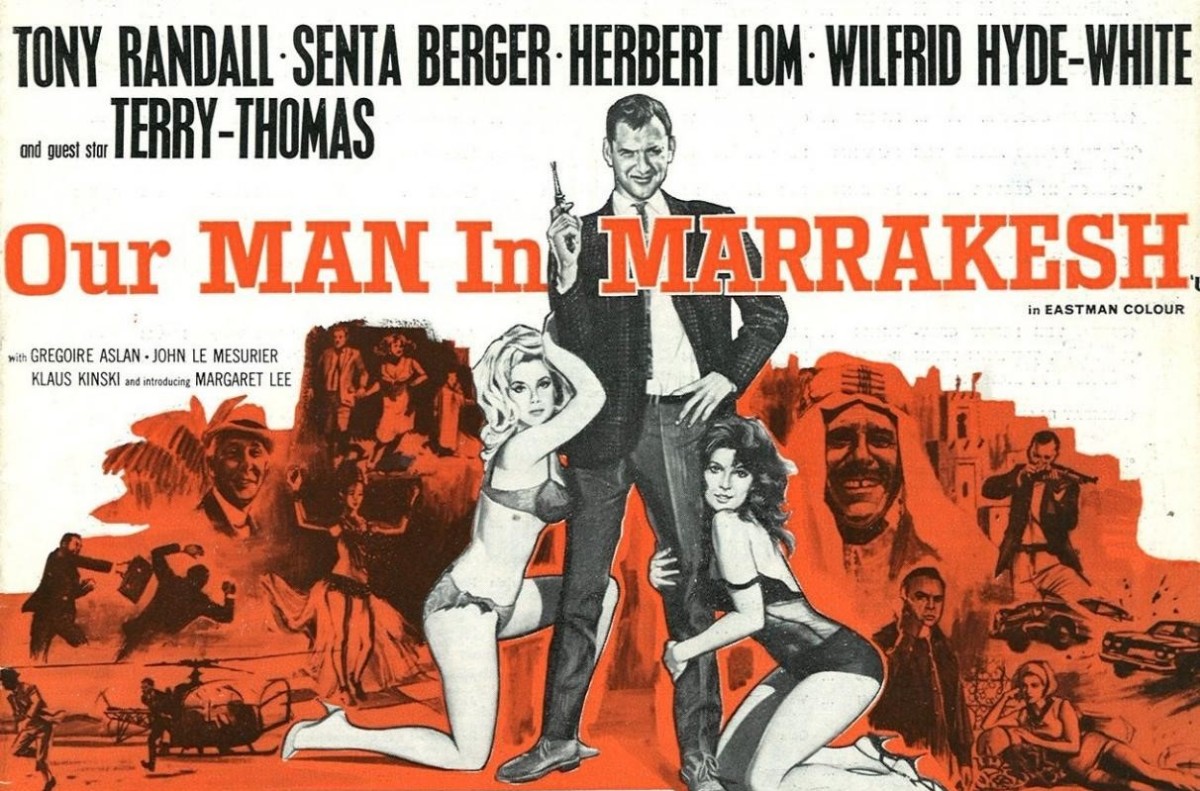
All hail Senta Berger! Another from the Harry Alan Towers (Five Golden Dragons, 1967) portfolio, this is a spy-thriller mash-up with a bagful of mysteries and a clutch of corpses. At last given a decent leading role, and although you wouldn’t guess it from either poster, Senta Berger steals the show from the top-billed Tony Randall (as miscast as Robert Cummings in Five Golden Dragons) and a smorgasbord of European talent including Herbert Lom (The Frightened City, 1961), Terry-Thomas, Klaus Kinski (Five Golden Dragons), John Le Mesurier and Wilfred Hyde-White (Carry On Nurse, 1959). In this company, the glamorous Margaret Lee (Five Golden Dragons), as Lom’s cynical lover (“you are never wrong, cherie, you told me so yourself,” she tells him) is an amuse-bouche.
A more comedic approach to the movie when it was re-titled for U.S. release. At least here it did not try to sell itself as a Bond-type picture.
Six travellers – including oilman Randall, travel agent Le Mesurier, salesman Hyde-White and tourist Berger, meeting her fiancé – board a bus from Casablanca airport to Marrakesh. One is carrying $2 million as a bribe to ease through a vote in the United Nations, but bad guy Lom doesn’t know which one it is. When Berger’s fiance’s corpse tumbles out of Randall’s cupboard, the pair become entangled. Berger is a marvellous femme fatale, trumping Randall at every turn.
With no shortage of complications, the tale zips along, directed on occasion with considerable verve by Don Sharp (The Devil-Ship Pirates, 1964). There are some inventive double-plays – with a body in the boot Berger and Randall are stopped by a cop who tells them their boot is open. An excellent rooftop chase is matched by a car chase. And there’s a terrific shootout. Kinski is at his sinister best and Terry-Thomas a standout in an unusual role as a Berber.
The film was shot on location including the city’s souks, the ruined El Badi Palace and La Mamounia hotel (featured in The Man Who Knew Too Much, 1956). But Berger seamlessly holds the whole box of tricks together, at once glamorous and sinuous, practical and tough and exuding sympathy, and it’s a joy to see her for a large part of the picture leading Randall by the nose. Quite why this did not lead to bigger Hollywood roles than The Ambushers (1967) remains a mystery.








 The Magnificent 60s