I am a published author of books about film - over a dozen to my name, the latest being "When Women Ruled Hollywood." As the title of the blog suggests, this is a site devoted to movies of the 1960s but since I go to the movies twice a week - an old-fashioned double-bill of my own choosing - I might occasionally slip in a review of a contemporary picture.
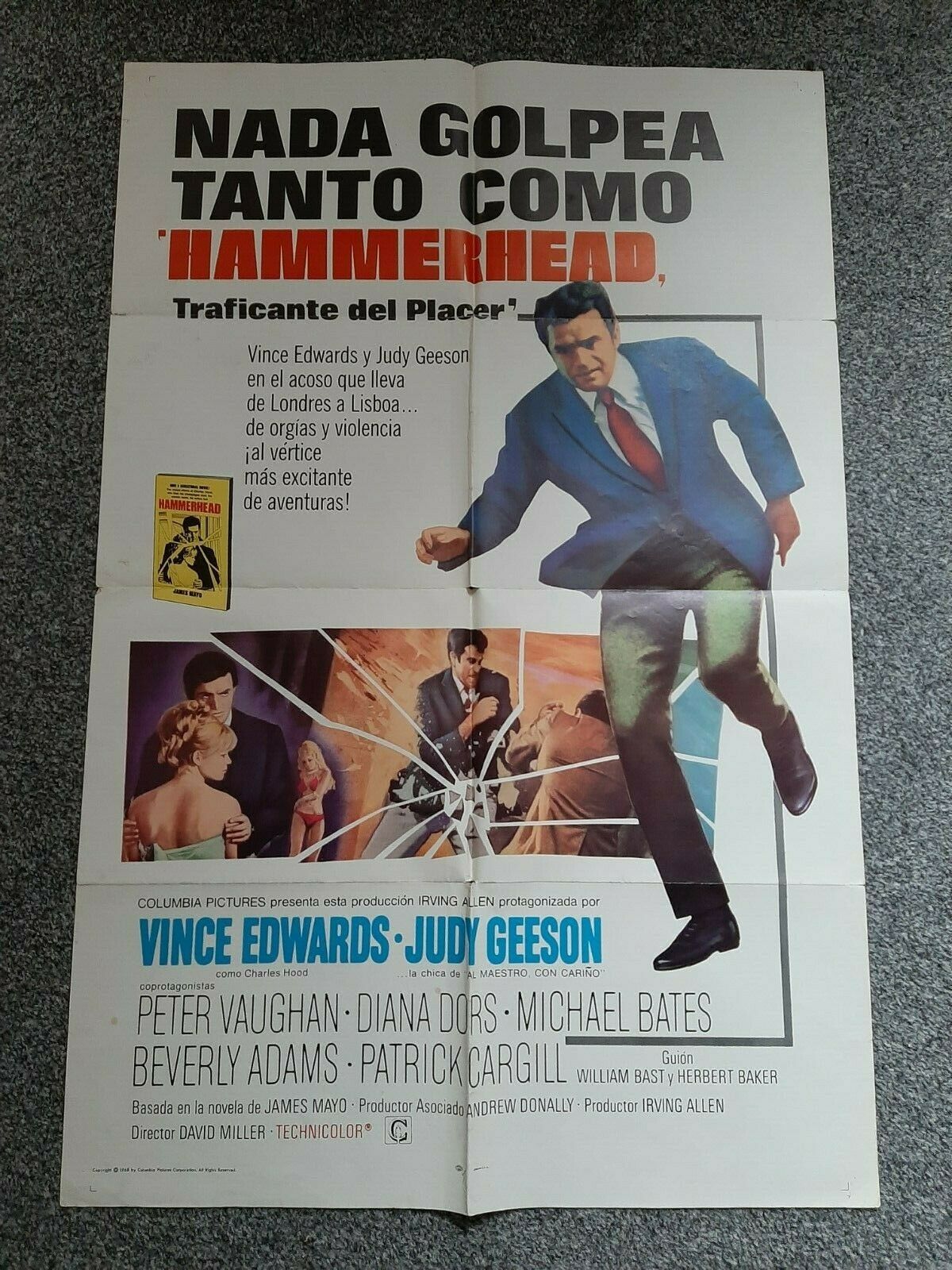
Zest and Zero might be a more appropriate title for this late “so-bad-it’s-good” addition to the 1960s spy cycle. Judy Geeson (Here We Go Round the Mulberry Bush, 1967) is the firecracker to Vince Edwards’ (television’s Ben Casey) fizzle. It’s colorful vs. colorless. Edwards, as art connoisseur Charles Hood (from the James Mayo book series), is meant to be a cut above the normal spy when in fact he hardly makes the cut. Hood is on the trail of the evil Hammerhead (a white-gloved Peter Vaughan). Sue Trenton’s (Geeson) lust for life takes her from participation in uninhibited art spectacle to classier cabaret, at various points leaping headfirst into the story, sorely disappointed to discover that Hood is not the international jewel thief of her imagination but a mere spy.
A far cry from the audacity of James Bond or the spoofery of Matt Helm or Derek Flint, nonetheless you can’t imagine this was ever taken seriously. But Geeson’s light touch is trampled all over by the ponderous Edwards. Quite how director David Miller went from Back Street (1961), Lonely Are the Brave (1962) and Captain Newman M.D. (1963) straight into this is anyone’s guess. He ran out of ideas pretty quick, the wardrobe budget minimal, Geeson much of the time restricted to a towel or bra and panties, an entire scene of Ivory (Beverley Adams) gyrating in a bikini, other sequences set against a backdrop of scantily-clad females.
The plot is non-existent. Hood doesn’t even know what he’s chasing – a “secret report” of some kind. Halfway between camp and incompetent, the picture scores in unintentional ways. Hammerhead makes a grand entrance – lowered in a cradle from a helicopter! The big chase involves a hearse. Trenton, who can’t sing, gets to sing. Occasionally the comedy is intentional, a taxi driven onto the shore a few scenes later is stranded by the incoming tide. Needing somewhere to screen some stolen footage, Hood invades a blue movie club. Avoiding a villain in a post office, Trenton plays a version of pass-the-parcel. The monosyllabic steal the picture – in reply to Hood’s pestering, a manservant’s inevitable reply is “it depends” and that of the dancing Ivory “louder.” But the biggest opportunity for Bond-style gags, Hood and Trenton trapped in a coffin, is wasted, although there is a nod to Thunderball in the harpoonery department.
Perhaps what best passes the time is the opportunity for star-spotting. British sexpot Diana Dors, complete with lipstick transmitter, puts in an appearance. There is a flock of British television actors in Patrick Cargill (Father, Dear Father), Michael Bates and Windsor Davies (both It Ain’t Half Hot, Mum), William Mervyn (All Gas and Gaiters), Tracy Reed (Doctor Finlay’s Casebook) and Kenneth Cope (Randall and Hopkirk, Deceased). Dave Prowse (Star Wars) makes his movie debut and former top British star Kathleen Byron (Black Narcissus, 1947) has a small role. Beverly Adams is almost a spy film mascot, with The Silencers (1966), Kiss the Girls and Make Them Die (1966), Murderer’s Row (1966) and The Ambushers (1967) in her locker. The gaggle of gals includes future Hammer star Veronica Carlsen (Dracula Has Risen from the Grave, 1968), Maggie Wright (Sex and the Other Woman, 1972) and former Slaygirl and 2001: A Space Odyssey stewardess Penny Brahms (The Games Lovers Play, 1971).
You half expect Judy Geeson to turn out to be a femme fatale or at least a decoy or there to provide a plot twist. But, no, she is just an adventuress, at times inventive and resourceful. Just a shame that an outing with the dull Edwards would put anyone off adventure for life.
The success in 1968 of such disparate movies as The Graduate (1967), Valley of the Dolls (1968) and 2001: A Space Odyssey (1968) with no discernible stars got Hollywood thinking whether they needed stars anymore. Stars were viewed as insurance. Their names were attached to pictures in the hope that they would bring a sizeable audience.
But for some time that had proved not to be the case. Certainly actors with the box office clout of Paul Newman, Julie Andrews, Elizabeth Taylor, Lee Marvin, John Wayne, Richard Burton and Elvis Presley justified their extravagant salaries. But exhibitors had begun to complain that studios were forcing them to carry the cost of stars who did not deliver, the salaries inflating “the terms that theatres must pay for films.”
Big names viewed as box office poison in 1968 included Marlon Brando, Tony Curtis, William Holden and Natalie Wood. An investigation by trade magazine Variety uncovered the fact that in each case the last four pictures of each star – who earned $250,000 or more per movie – had flopped. Average movie budgets by now had climbed to $3-$4 million not counting marketing costs so most movies had to bring in over $10 million at the global box office to break even
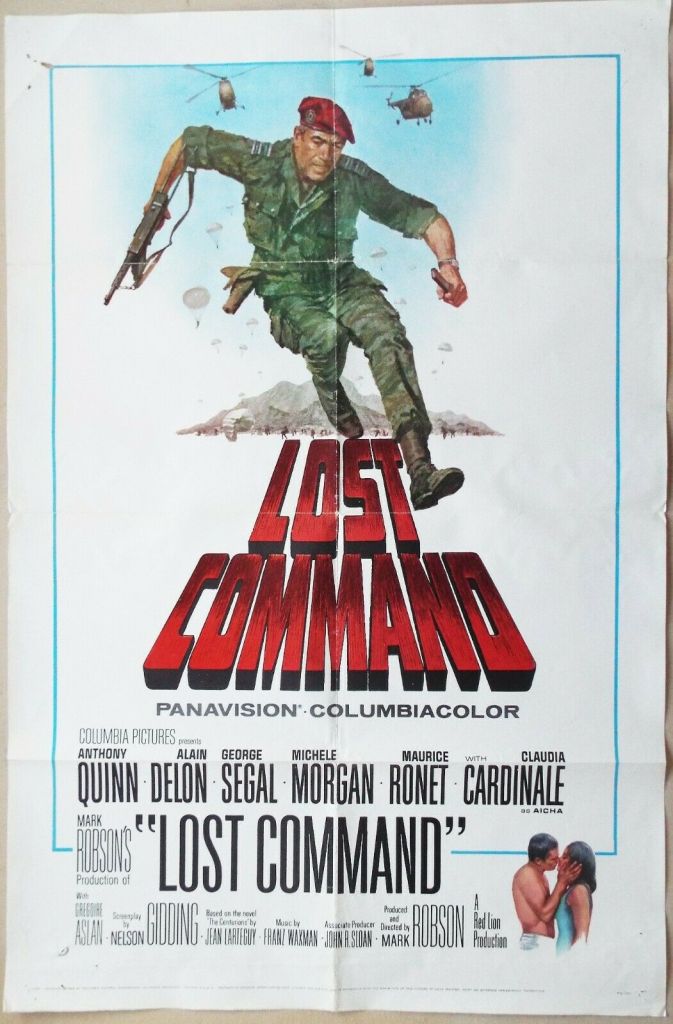
The star with the worst track record was Anthony Quinn. Average rental for his past four pictures – $800,000. While Zorba the Greek (1964) had been an unexpected hit, what followed was anything but. Discounting a cameo in Marco the Magnificent (1965), the box office duds comprised adventure A High Wind in Jamaica (1965), Lost Command (1965), war film The 25th Hour and misconceived hippie comedy The Happening (1967).
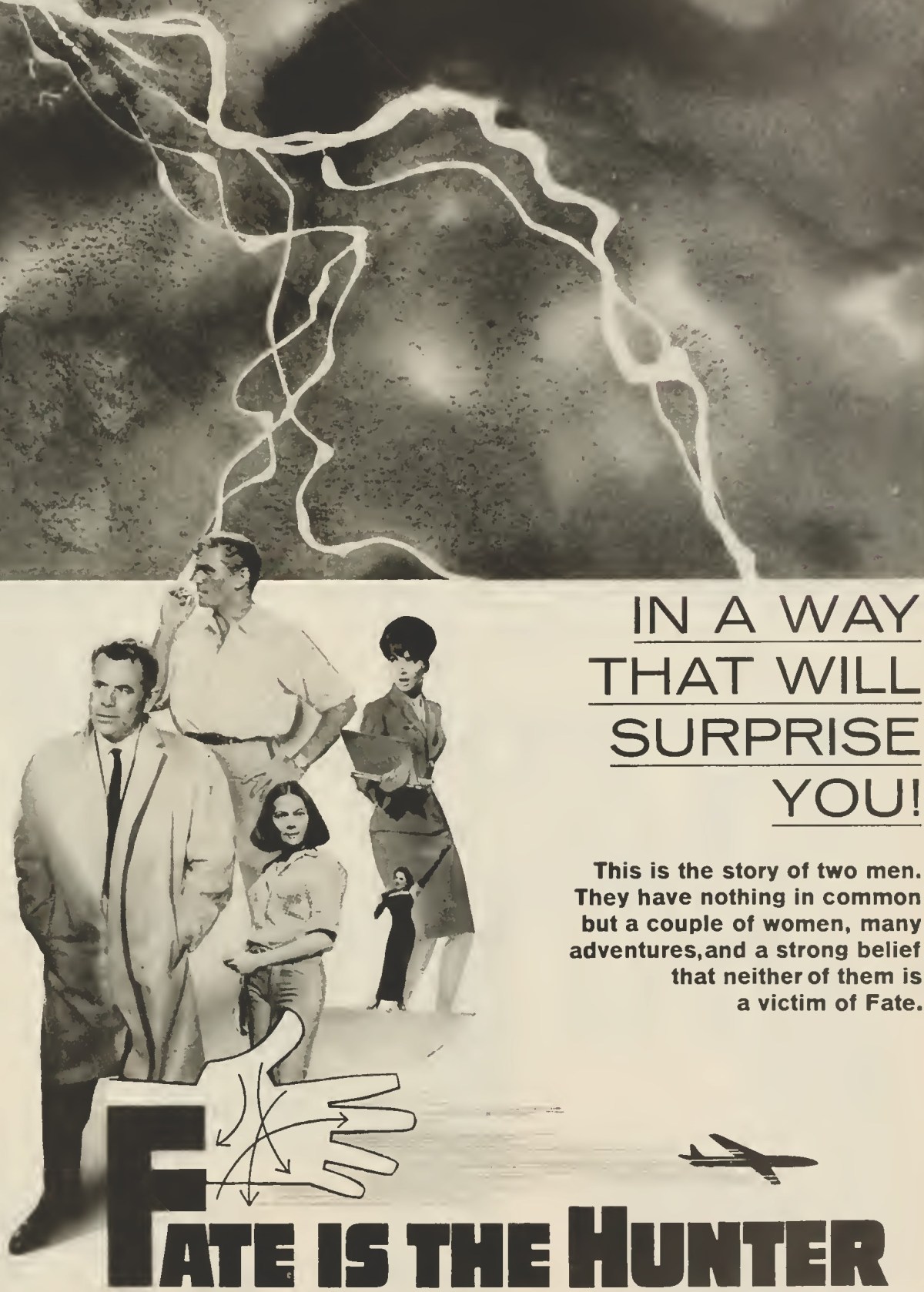
Not far behind was Glenn Ford, a star from the days of Gilda (1946), The Blackboard Jungle (1955) and The Sheepman (1958). He had begun the current decade badly with big-budget losers Cimarron (1960) and The Four Horsemen of the Apocalypse (1962) and his career never recovered. His last eight pictures brought in an average of less than $1 million apiece in rentals. The sad bunch were: comedy western Advance to the Rear, Dear Heart and aerial drama Fate Is the Hunter (all 1964) followed by western The Rounders and thriller The Money Trap (both 1965) as well big budget war epic Is Paris Burning? (1966), rabies drama Rage (1966) and western The Long Ride Home (1967).
Scarcely any better was William Holden, star of David Lean Oscar-winner Bridge on the River Kwai (1957), John Ford western The Horse Soldiers (1959) and The World of Suzie Wong (1960). His last four efforts – The Lion (1962), romantic comedy Paris When It Sizzles (1964), war drama The 7th Dawn (1964) and Civil War western Alvarez Kelly (1966) – returned an average of $1.05 million in rentals. Variety reckoned he was struggling with the problem of how to “gracefully mature his screen image.”
James Garner, once seen as the natural successor to Clark Gable, had failed to capitalize on the success of John Sturges’ The Great Escape (1963). Five of his last seven films had dredged up a mere $1.3 million average. Making up the awful quintet were thriller 36 Hours (1964), comedy thriller A Man Could Get Killed (1966), western pair Duel at Diablo (1966) and Hour of the Gun (1967) plus drama Mister Buddwing (1966). Quite why comedy The Art of Love (1965) had done better – $3.5 million in rentals – nobody could ascertain and even though roadshow Grand Prix (1966) was a hit Garner, who was billed below the title, was not considered a reason for it, with some insiders claiming his name had held it back and it would have done much better with someone else in his role.
Morituri (1965), Cast a Giant Shadow (1966), The Poppy Is Also a Flower (1966), western sequel Return of the Seven (1966), Triple Cross (1966) and The Long Duel (1967) had mustered an average of $1.4 million leaving observers to the conclusion that Yul Brynner’s “brand of sex appeal” no longer attracted audiences in America.
Marlon Brando had generated just $8.4 million in total rentals – an average of $1.6 million – for his previous six films. No matter what he did, regardless of genre, he had lost his box office spark whether it was comedies like Bedtime Story (1964) and The Countess from Hong Kong (1966), dramas like The Chase (1966) and Reflections in a Golden Eye (1967), western The Appaloosa (1966) or thriller Morituri (1965). From the industry perspective he was by far the worst performer since his movies cost so much in directors (Charlie Chaplin, John Huston), co-stars (Elizabeth Taylor. Sophia Loren) and sets.
A string of comedies had sounded the box office death knell for Tony Curtis. Boeing, Boeing (1964), Not with My Wife You Don’t (1966), Arrivederci, Baby! (1966) and Don’t Make Waves (1967) delivered a lamentable $1.77 million on average.
Rock Hudson had fallen far from the pedestal of being the country’s top male star in the early 1960s. Two romantic comedies Strange Bedfellows (1965) and A Very Special Favor (1965), a brace of thrillers Blindfold (1966) and Seconds (1965) plus war film Tobruk (1967) did nothing to restore his standing with just $1.86 million in average rental.
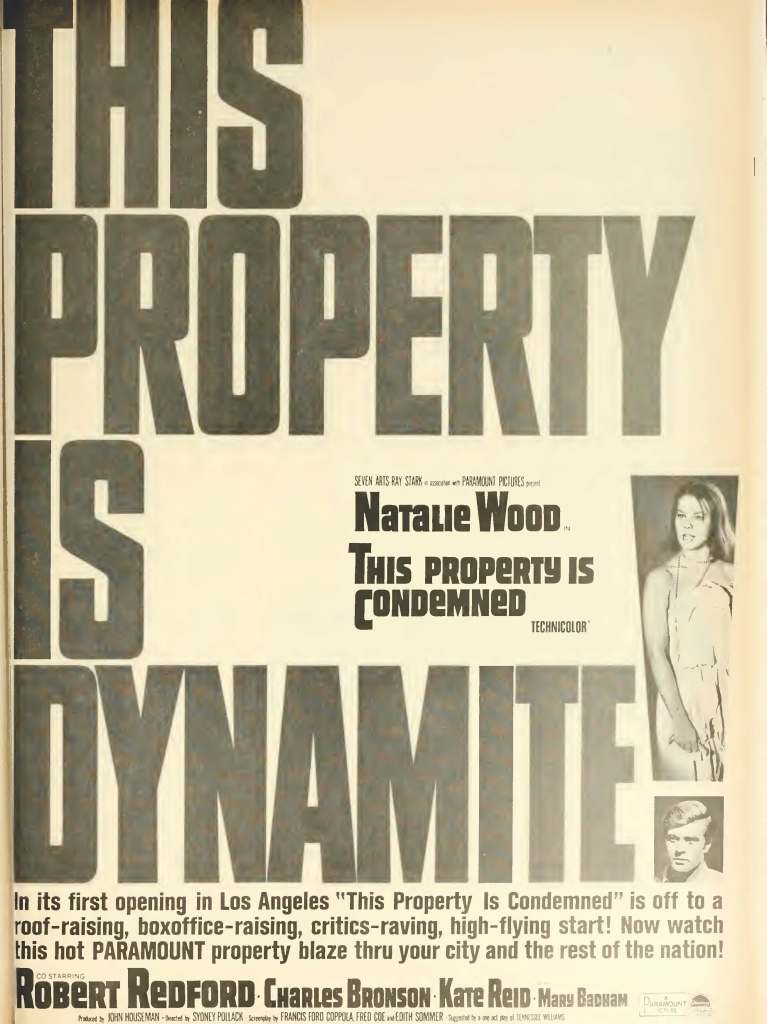
Added to the list of dubious stars was Natalie Wood whose career was considered to be in such jeopardy that she had not made picture in two years. Small wonder after dramas Inside Daisy Clover (1965) and This Property Is Condemned (1966) and crime caper Penelope (1966) which averaged $2.2 million.
Whether anybody’s career could be resuscitated after these disasters was anybody’s guess.
Strangely enough, some did regain at least a measure of their former glory, Marlon Brando the obvious example after The Godfather (1972). James Garner had his biggest-ever hit with Support Your Local Sheriff (1969). Tony Curtis revived his fanbase with The Boston Strangler (1968). William Holden returned to favor after the double whammy of The Devil’s Brigade (1968) and The Wild Bunch (1969). Natalie Wood hit the spot in Bob and Carol and Ted and Alice (1969) and Yul Brynner as a robotic gunslinger turned his career around in Westworld (1973).
But Glenn Ford’s career was coming to an end and Anthony Quinn followed up this bunch of flops with two more of the same ilk in the Shoes of the Fisherman (1968) and The Magus (1968) although he would still be offered starring roles for more than a decade.
Of course, luckily, decades on, we are not so much guided by the box office various films had and many pictures that were once dubbed flops are now being re-evaluated by a new generation of film fans.
SOURCE: Lee Beaupre, “Rising Skepticism on Stars,” Variety, May 15, 1968, p1
Absolutely cracking, brilliantly structured, gangster thriller featuring two fabulous heists and three legendary French stars in Jean Gabin, Alain Delon and Lino Ventura. Roger Sartet (Delon) is a trigger-happy robber whose prison escape is organized for a hefty fee by French-based Mafia chieftain Vittorio Manalese (Gabin). Le Goff (Ventura) is the rugged cop hunting down the escapee which brings him into the orbit of Manalese, about whose existence he is completely unaware, the gangster having kept an extremely low profile, never engaging in violence, hiding behind the legitimate front of a pinball machine business. Veteran French director Henri Verneuil (Guns for San Sebastian, 1968) dukes between the twin storylines with ease.
Jean Gabin was easily the most famous French actor of the time with a career spanning four decades from Pepe Le Moko (1937) and La Grande Illusion (1937) to Holy Year (1976) . To many he was the best Inspector Maigret (1958). Generally ignored by the French New Wave directors, this picture showed what they were missing.
Sartet brings Manalese the opportunity to pull off the most audacious jewel robbery in history, even though the older man despises Sartet’s penchant for violence and sex. We often see Manalese at family gatherings, head of the dinner table, the family watching television together, frowning at one son’s liking for alcohol, playing with his grandson. He is not just a calm and clever businessman, but very quick-thinking, his sharp mind in a couple of instances preventing disaster. Sartet, on the other hand, will happily endanger his life and freedom by consorting with prostitutes and breaking an unspoken code of honor in an affair with Manalese’s daughter-in-law (Irina Demick).
The result combines dogged detective work by Le Goff and the inspired planning and execution of the jewel robbery until the two worlds collide. The investigation alone would have made this an outstanding picture. Le Goff, always seen with an unlit cigarette in his mouth although he is trying to give up smoking, concentrating initially on Sartet, sets up surveillance on the thief’s innocent sister and begins an involved – and engrossing – process of tracking down every potential lead and when at last he has Sartet in his sights it brings him up close to Manalese.
Le Goff’s professionalism is matched by that of Manalese and the picture develops into an absorbing battle of wits and the latter’s family values and moral compass puts him at odds with loner Sartet. There is some brilliant invention, the sacrificial watch, for example, and the unexpected appearance of a faithful British wife, although you do guess just how long Le Goff will go before lighting his ever-tempting cigarette.
The ultra-cool Delon excels in this kind of amoral part, but Gabin and Ventura as old-style gangster and cop, respectively, steal the show. Demick thrives as the bored wife of a dull gangster who is attracted by the violent Delon, at one point deliberately putting herself in the line of his potential fire for the thrill. Actually, it’s the jewel heist that steals the show. Unlike other heist pictures where you have fair idea in advance of the details of the theft, here the audience is kept completely in the dark. Just as important in any heist is that the thieves get away with their plunder and the plan in this instance is breath-taking.
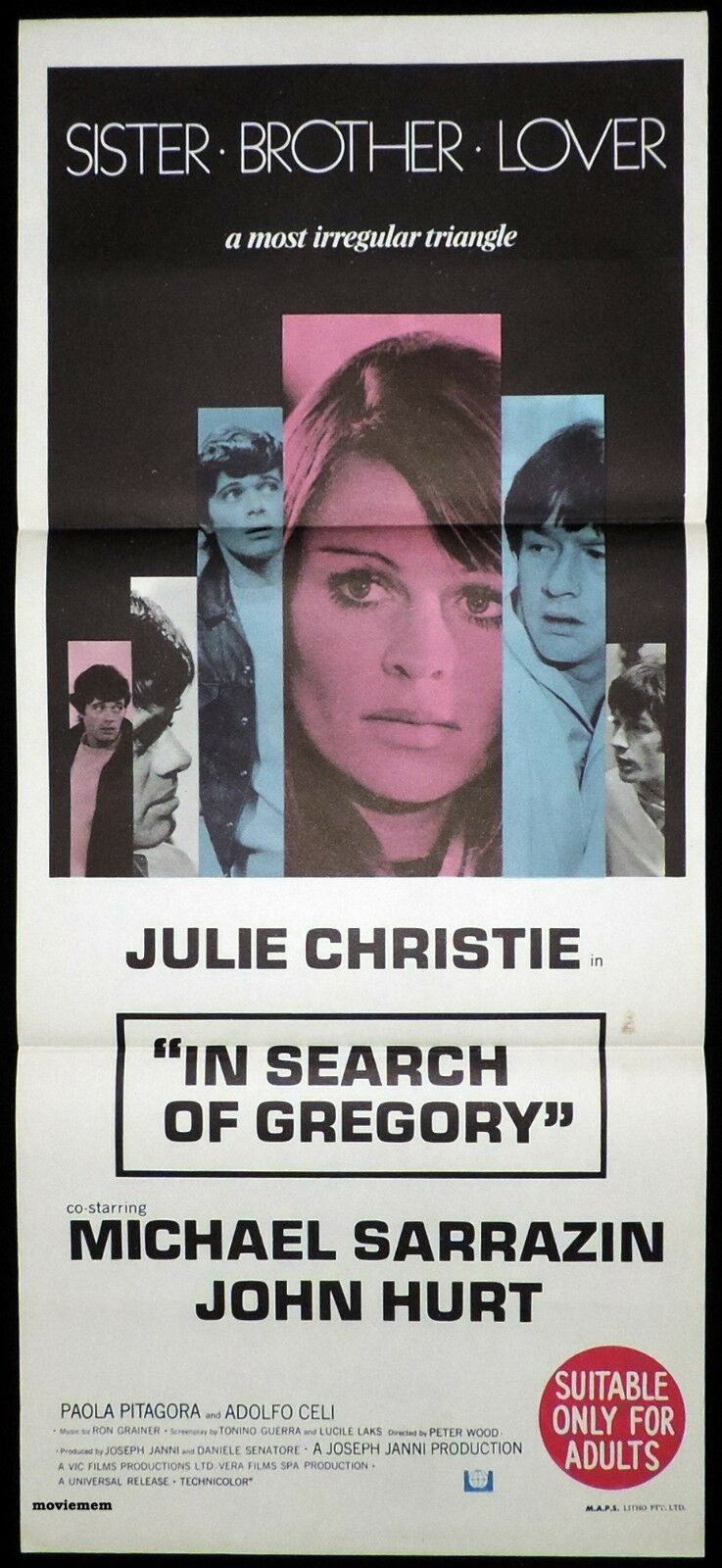
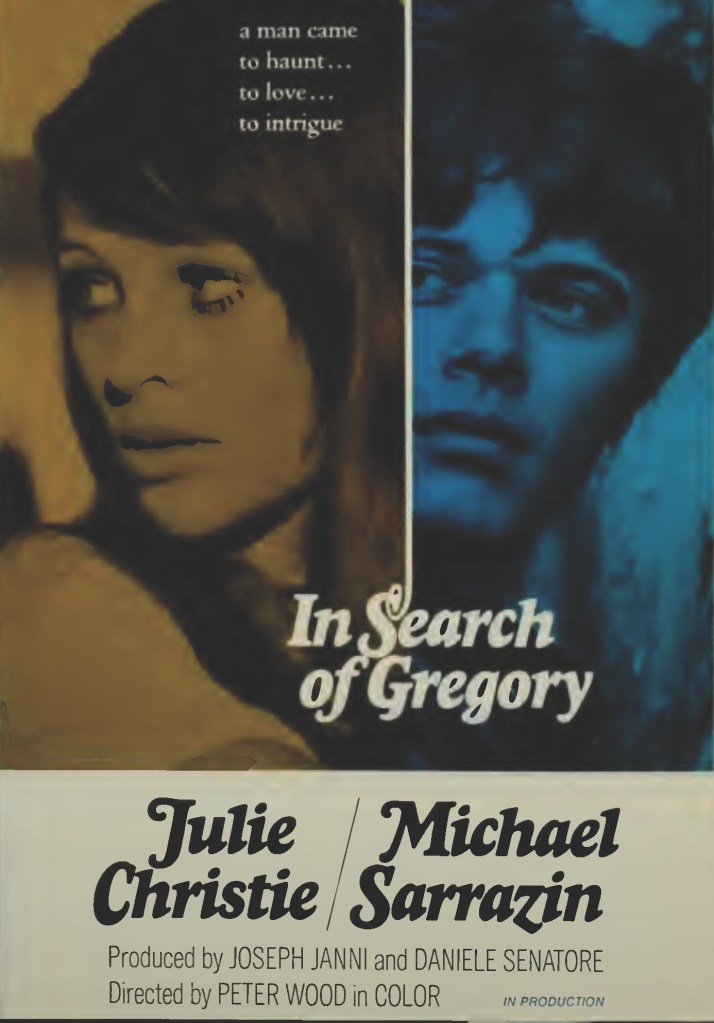
Off-beat examination of the fantasy vs. reality conundrum with an ever-watchable Julie Christie as the woman on the titular hunt. One of the great lost pictures – the only film of acclaimed British theater director Peter Wood is a more whimsical cousin to the more deliberately obscure works of Alain Resnais (Last Year at Marienbad, 1961) and Michelangelo Antonioni (Blow-Up, 1966) which pivoted upon the question of whether events presented actually occur or exist only in the head of the leading character.
Catherine (Julie Christie) is enticed to Geneva by her father (Adolfo Celi) for his latest wedding on the basis that she will meet the impossibly handsome Gregory (Michael Sarrazin). On arrival she discovers the agoraphobia of younger brother Daniel (John Hurt) has been temporarily lifted by Gregory. Catherine appears set to meet Gregory on a number of occasions, but either he does not turn up (the wedding) or somehow they miss each other, even at one point occupying adjoining phone booths. And it would have been a pretty dull picture if that was all that was going on. But whether the result of reality or Catherine’s imagination, the Gregory we see is a vivid screen presence. The world the character inhabits is unusual to say the least, so unique that it is either obviously real or fake, but virtually impossible to determine which.
The best Gregory sequence, of which Steve McQueen would be proud, involves the character moving by means of the windscreen from one side to the other of a car driven at high speed. In another scene Gregory plays the equally perilous game of Autoball, a kind of polo with stock cars. As convincing is Gregory’s avant-garde orchestra consisting of two guitars, bottles, a bicycle wheel, a waste bin and coins in a glass.
The detail is so extraordinary that it must be real. The brother seems real enough, too real if anything, close to enjoying (or pining for – the poster promises more than the picture delivers) an incestuous relationship with his sister. But for every moment that appears questionable – did she really witness Gregory making love to her future mother-in-law – there are others where doubts are immediately quelled (an address which appears non-existent is not). And long before anybody came up with the idea of selling bottled water, Gregory is apparently in the business of selling tinned Alpine air. Other moments she does not witness – Daniel riding a Lambretta/Vespa with feet on the handlebars – add to the prospect of genuine reality.
Catherine might even have met Gregory except that in going to bed with the man who looks very much like what we believe Gregory to look like she determines that he shall remain anonymous. So it’s anybody’s guess whether Gregory is a figment or phantom of her imagination. And why, of course, should such invention be necessary? Does it mean that her father and brother do not exist either? These days the unreliable narrator is a common literary device but that was not the case at the tail end of the 1960s, so in some senses this was way ahead of its time.
It’s interesting, of course, to attach logic to the idea that it all takes place in Catherine’s imagination. You can kind of understand that maybe she thinks her father’s latest bride is going to betray him at the slightest opportunity. But it’s some imagination that sends Gregory into devilry in the car with Daniel. And it begs the question if none of it is real why does she keep on missing Gregory all the time? Does that relate to an even deeper psychological feeling that she is always going to miss out?
It’s an entertaining mystery. There’s no great angst. Antonioni had the sense or cunning to ensure that consequence mattered in Blow-Up – a murderer escaping justice. But there’s no such tension here. While Catherine is tabbed a nympho by her brother (who never questions her father’s predilection for multiple marriages), the suggestion that she’d fly from Rome (where she lives with her boyfriend) to Geneva is the hope of a hook-up seems too far-fetched. Despite the presence of Julie Christie – who can certainly carry even as slight a picture as this – and a quixotic turn from John Hurt (Sinful Davy, 1969) it’s neither obscure enough to be arthouse nor sufficiently plot-driven to be mainstream and remains an oddity.
If you are going to be irritated beyond belief that will occur in the first fifteen minutes or so, but if you stay the course, you will find it a highly rewarding watch rather than a cinematic car crash.
Your best bet to catch this film is Ebay or other secondhand routes.
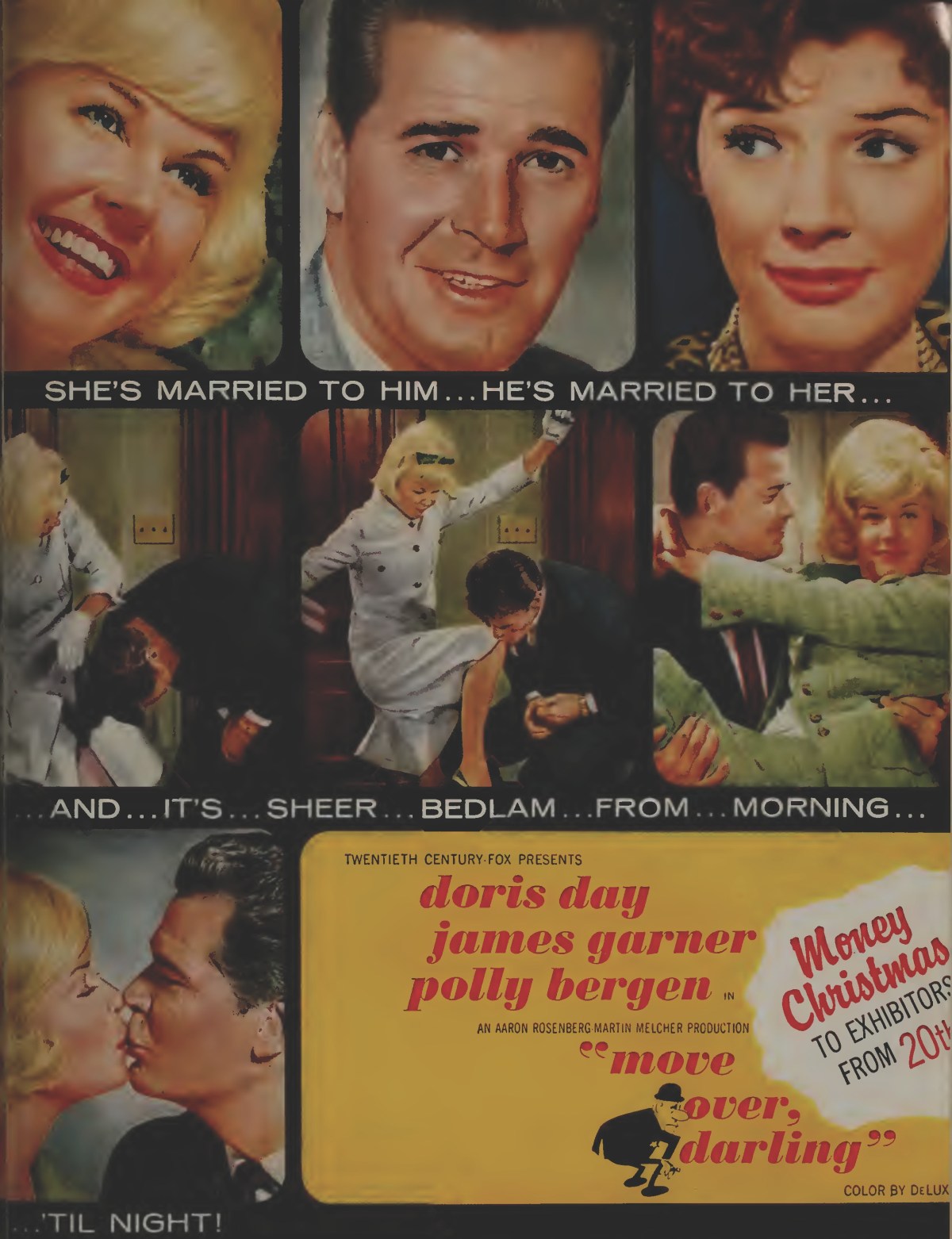
Doris Day never quite replaced Cary Grant or Rock Hudson in her romantic comedy ventures. This is her second outing with James Garner – The Thrill of It All had appeared earlier the same year. Ironically, it’s based on a Cary Grant film, My Favorite Wife (1940) with Irene Dunne. Having been lost at sea for the requisite five years, this version kicks off with Day being pronounced legally dead in court to pave the way for Garner to marry Polly Bergen (Cape Fear, 1962). Naturally, she turns up on the day of their wedding and the first part of the movie is Garner trying to keep the women apart. Cue comic pratfalls, double takes, diving in an out of bedrooms, but Day and Bergen seem to be trying to out-screech each other. The idea of bigamy, scandalous at the time, has lost its power to shock.
While Day spent much of the picture in hysterics, I didn’t, and wished they had moved quicker to the complication which was that she had shared her desert island with a hunk (Chuck Connors). The pace picks up a bit after that as Day has to pretend that it was nerd (Don Knotts) with whom she was stranded while Garner knows the truth. There is some good reversal, her kids, who naturally don’t recognize her, complaining about her singing. A number of set pieces save the day – two court scenes with an exasperated judge (Edgar Buchanan), Day disguised as a Swedish masseuse giving Bergen a savage work-over and Day trapped in car wash.
Michael Gordon had helmed Pillow Talk (1959) but missed the mark here. Don Knotts, prior to his incarnation as The Incredible Mr Limpet (1964) show his potential as the shoe salesman recruited by Day to impersonate Connors. Accomplished comedienne Thelma Ritter holds back on the comedy instead playing a straight role as the meddling mother-in-law. Fred Clark as the alternately bemused and suspicious hotel manager gets the best of the double takes. Garner, unfortunately, has little opportunity to exhibit his sly sense of humor or the laid-style that worked a treat in Support Your Local Sheriff (1969).
Hal Kanter, who worked on the George Gobel and Milton Berle television shows and scripted Blue Hawaii (1961) fashioned the screenplay along with the more versatile and sometime director Jack Sher (Paris Blues, 1961).
When it was known as Something’s Got to Give, George Cukor was set to direct a cast that included Marilyn Monroe, Dean Martin, Cyd Charisse, Tom Tryon and Phil Silvers from a script by Nunnally Johnson and Walter Bernstein. Monroe had nixed working with Garner and Knotts. When Monroe was fired, Kim Novak and Shirley Maclaine refused offers to replace her. Dean Martin refused to continue without Monroe and although re-hired she died before production recommenced.
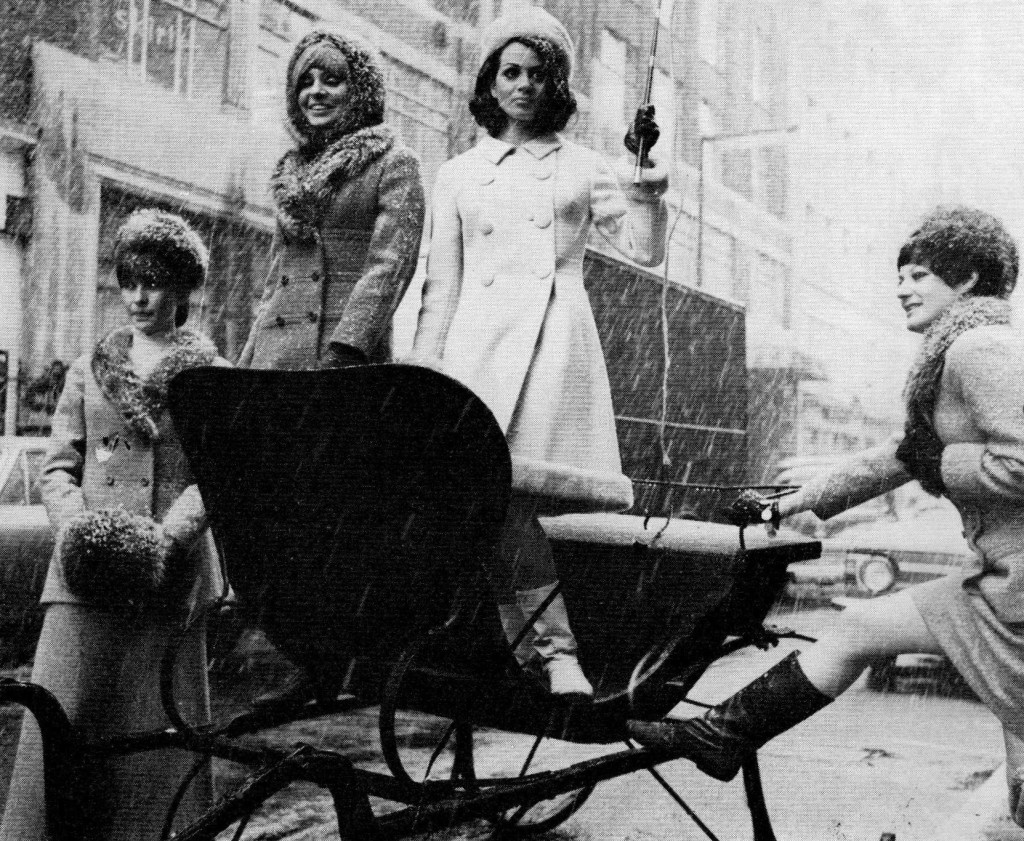
Yesterday was the 55th anniversary of the launch of the European premiere of Doctor Zhivago (1965) in London and would you believe it the English weather came to the promotional aid of the David Lean epic with an unseasonal snow shower as fur-clad models took to the streets on a sleigh. As was common in the 1960s, there was no such thing as a global release date. The film had been launched in the U.S. in December 1965 but only a couple of countries since then, the main drawback being the lack of available prestigious cinemas for a big budget roadshow. The delay was also caused by hope of major success at the Oscars – given Lean’s two previous films had won Best Picture – held in March.
Doctor Zhivago launched at the 1,330-seat Empire, Leicester Square, in the heart of the capital’s West End in the presence of Princess Margaret and with the director and five stars in attendance. The first public demonstration of colour television in Europe was a feature of the launch, a large screen set up in the theater foyer to relay the arrival of royalty and celebrities to the audience already seated in the cinema.
Typical advert with booking form.
MGM had pulled out all the publicity stops, the massive advertising campaign beginning on February 1, twelve weeks prior to the opening, with the switching-on of a 40ft by 20ft electric sign in Piccadilly Circus. That triggered an advertising campaign in the press about two weeks later announcing the premiere. That served only to stoke up interest, another two weeks elapsing before tickets went on sale. Advertisements ran virtually non-stop in national daily newspapers and London evening papers as well as entertainment and film magazines.
Roadshows benefitted from press advertising more than normal pictures. The bulk of the adverts for Doctor Zhivago carried a booking form so money started rolling in to the cinema long before the first screening. Selling tickets in this way was also a bulwark against sudden changes in weather – torrential rain or glorious sunshine as equally likely to deter moviegoers – whereas if you had already booked your ticket well in advance it did not matter whether you turned up or not, and most people would attend even in sweltering heat rather than forego their ticket.
MGM also undertook the biggest advertising campaign in its history in Britain. Unlike today, when there is one universal advertisement, in those days a film might have half a dozen different pieces of artwork. Doctor Zhivago boasted fifteen. Four weeks ahead of the opening 8,000 double-crown posters were plastered over the city. One-third of the entire London bus fleet carrying such artwork, while 50 Underground stations had 48-sheets (three times the size of the normal posters) on train platforms. In addition, closer to the launch, double quads were posted in a thousand locations. A special mobile box office toured the city advertising the film and selling tickets.
A special “Background to Doctor Zhivago Exhibition” was set up in the Garringes department store opposite Victoria Station, one of the capital’s biggest travel hubs, by the Historical Research Unit and including many costumes from the production. Tie-ins were far more numerous than for the New York launch. Mansfield Fashion launched a range of popular-priced clothing based on the film promoted by a sleigh-ride through London with a bevy of models against the unexpected background of snow on April 14. A more upmarket manufacturer Sidney Massin was promoting a more expensive fur coat.
Among the other fashion tie-ins were: a white coat of Kalgan lamb with a Mongolian lamb collar from Swears and Wells, long black wool coat with white fox fur hood and collar from Femina Furs, fur hats for men and women from Edmund Mann, evening dresses from Berkertex and fur-lined fabrics from Clarewood Fashions. Hardy Amies designed male fur coats for Hepworths department stores and range of gloves for either sex for Dent Allcroft. Worldwide the Zhivago look had been reflected in collections designed by St Laurent, Dior, Cardin, Chanel and Rabanne.
Unseasonal snow in London in mid-April helped the fashion launch.
Outside of fashion, there was a tie-up with Cossack Vodka. There was also a Cossack hair cream while Waddingtons produced a jigsaw puzzle. As well as hardback and paperback editions of the famous Boris Pasternak novel, there was also a hardback of the Robert Bolt Oscar-winning screenplay. The music also provided promotional crossover, the theme tune and original soundtrack already big hits. BBC2 aired a documentary on the filming of the movie and the stars and director appeared on numerous television and radio talk shows.
BBC News, Pathe newsreel cameras and CBS America all covered the premiere. Stars in attendance were Geraldine Chaplin, Julie Christie, Siobhan McKenna, Ralph Richardson and Rita Tushingham as well as Lean, Bolt and producer Carlo Ponti.
Although the movie failed to win any of the main Oscars, it still took home six: screenplay (Robert Bolt), color cinematography (Freddie Young), color art direction (John Box, Terence Marsh and Dario Simoni), set decoration (also Box, Marsh and Simoni), color costume design (Phyllis Dalton) and music score (Maurice Jarre). MGM promoted these accomplishments in its advertising and revamped its pressbook. And the studio was also able to take advantage of the fact that Julie Christie had been named Best Actress at that year’s Oscars for Darling (1965). Noted the new-look Pressbook: “probably no other motion picture actress has achieved the meteoric success and worldwide fame accorded Julie Christie.”
The Pressbook mainlined on awards of one kind or another. As well as Oscars, the Russian epic had picked up five Golden Globes included Best Dramatic Picture, Best Director and Best Dramatic Actor (Omar Sharif). It was named best film by the New York Daily News and was named one of the year’s top ten by the National Board of Review, and received awards from magazines as diverse as Seventeen, Parents and Scholastic.
Also contained in the Pressbook were snippets that might appeal to local journalists such as: six tons of nails were used in constructing the ten-acre set, Phyllis Dalton created 5,000 costumes and John Box 117 settings, rats in one scene were tested for infections, rumors of Omar Sharif shaving off his normal curly hair were false, movie livestock was donated to a local church at the end of filming.
Separately, a 32-page “Fact Booklet” was compiled for journalists.
As ever, exhibitors were bombarded with promotional ideas by MGM publicists via the Pressbook. One idea was to ask female members of the audience whether they preferred Omar Sharif clean shaven or with a moustache with the intention of interesting the local women’s editor in the results of the informal survey. Cinema owners were encouraged to send bottles of vodka to entertainment editors with a message in Russian. Empty shop windows were often available “for the asking” from rental specialists and could be used for advertising. Since Zhivago has a son in the film, one aspect encouraged was a “father and son” competition and of course it was a no-brainer to dress doormen and ushers as Cossacks.
MGM had also made special efforts to promote the movie to younger audiences and combined that with marketing the music. More than million copies of the soundtrack album had been sold and “Somewhere My Love,” a single by Teddy Randazzo incorporating lyrics to “Lara’s Theme,” had also caught fire. The combination of records and sheet music plus general publicity material could encourage record store window displays.
One of the taglines I most remember is “one man…two women…and a nation ablaze.” But it was certainly not one of the initial official taglines when the movie was originally launched. Many of the British posters had no tagline at all beyond perhaps “the entertainment event of the year.” The post-Oscar Pressbook went with either “A love caught in the fire of revolution…Turbulent were the times and fiery was the love story of Zhivago, his wife…and the passionate, tender Lara” or “The story of Zhivago – a man torn between his love for his wife and the passionate and tender Lara…told against the flaming background of revolution.”
SOURCES: Supplement to Kine Weekly, May 5, 1966; MGM Pressbook.
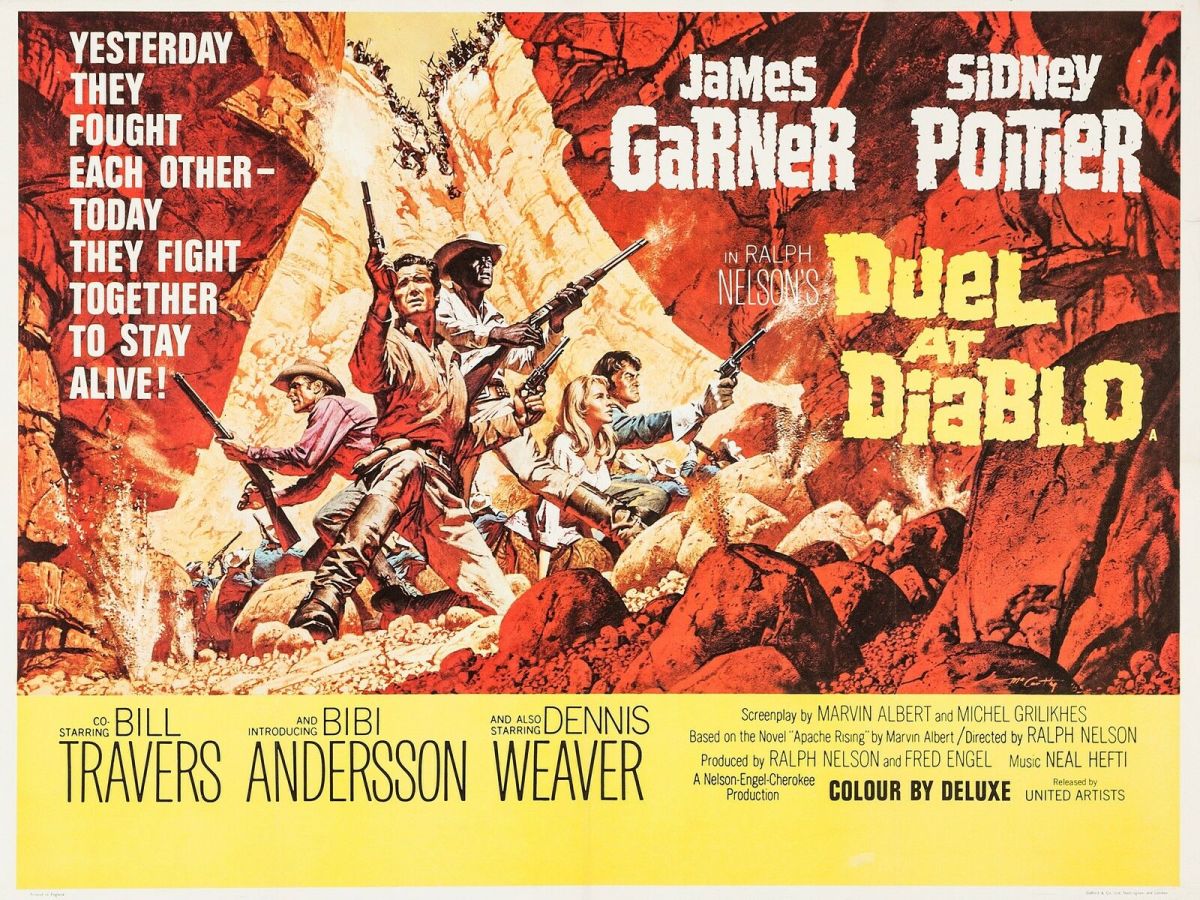
Action-packed and plot-jammed revisionist western with fresh performances from James Garner and Sidney Poitier caught up in an Apache uprising. Tough-as-teak ex-cavalry scout Garner has dispensed with his glib smart-aleck persona in favor of world-weariness and Poitier is a revelation as a cocky cigar-smoking ex-cavalry sergeant horse-dealer. Racism here concerns hostility towards Indian squaw Bibi Andersson (Persona, 1966), Garner, who had married a Commanche (now dead) the only one to treat her with any decency.
Returned to “civilization,” Andersson wants nothing more than to escape, back to her baby it transpires. Her crime is staying alive after Apache capture when she should have done the “decent thing” and killed herself rather than living as a squaw. But prejudice is leavened by husband Dennis Weaver (minus trademark moustache) who retains tender feelings towards her and, eventually, her baby. Apache chief John Hoyt is equally redeemed by his care towards the baby.
Director Ralph Nelson (Lilies of the Field, 1963) handles the action with aplomb but it is the Apaches who prove the masters of battlefield strategy, deftly maneuvering the cavalry into an ambush and cutting them to shreds. His biggest problem is delivering logical reasons for all the principals – Weaver is an arms dealer, Garner and Poitier no longer in the army – to join up with Bill Travers’ (Born Free, 1966) cavalry troop. However, rather than slowing the story down, the various complications add further tension.
Nelson never reins in reality. The cavalry are raw recruits, hardly able to control their mounts. Garner and Poitier don’t buddy-up, there is no camaraderie, and Andersson is an outcast in both worlds. And the good guys are constantly out-smarted by the Apaches, Poitier’s mistake leading to initial ambush, the Apaches targeting water supplies to derail the enemy and resorting to bow-and-arrow in case a stray bullet ignites the ammunition wagons. But it is still a duel, Poitier, Garner and Travers each in turn coming up with brilliant ideas to retrieve what looks like a desperate position trapped in a box canyon.
We might be more sympathetic towards the plight of the Apaches, shoved into a “hell-hole of a reservation,” had Nelson concentrated less on their brutality, the picture opening with the corpse of a mutilated man, the cavalry under siege at Diablo tortured by the screams in the night of a man being tortured, Andersson told that she will be buried alive. But when any Commanche woman can be killed and scalped just because she married a white man and Andersson viewed as fair game for rapists because she lived with Apaches, you can see how little regard the Native Americans have for their oppressors.
Garner and Poitier are superb and top marks for a rounded performance from John Hoyt, savage one minute, gentle the next. Scotsman Travers and Swede Andersson should have added to the authenticity since immigrants such as these provided the mass of settlers, but Travers seems quite out of place and Andersson never quite delivers the angst required of her situation. William Redfield (One Flew over the Cuckoo’s Nest, 1975) can be spotted. Nelson has a cameo and if you look closely you will see a fleeting glimpse of Richard Farnsworth. Western specialist Marvin H. Albert (The Law and Jake Wade, 1958) co-wrote the screenplay from his novel.
You might be able to catch this for free on Sony Action Movies, but otherwise here’s a DVD link. You might get it on Amazon Prime but last time I posted a link for that, it didn’t work.
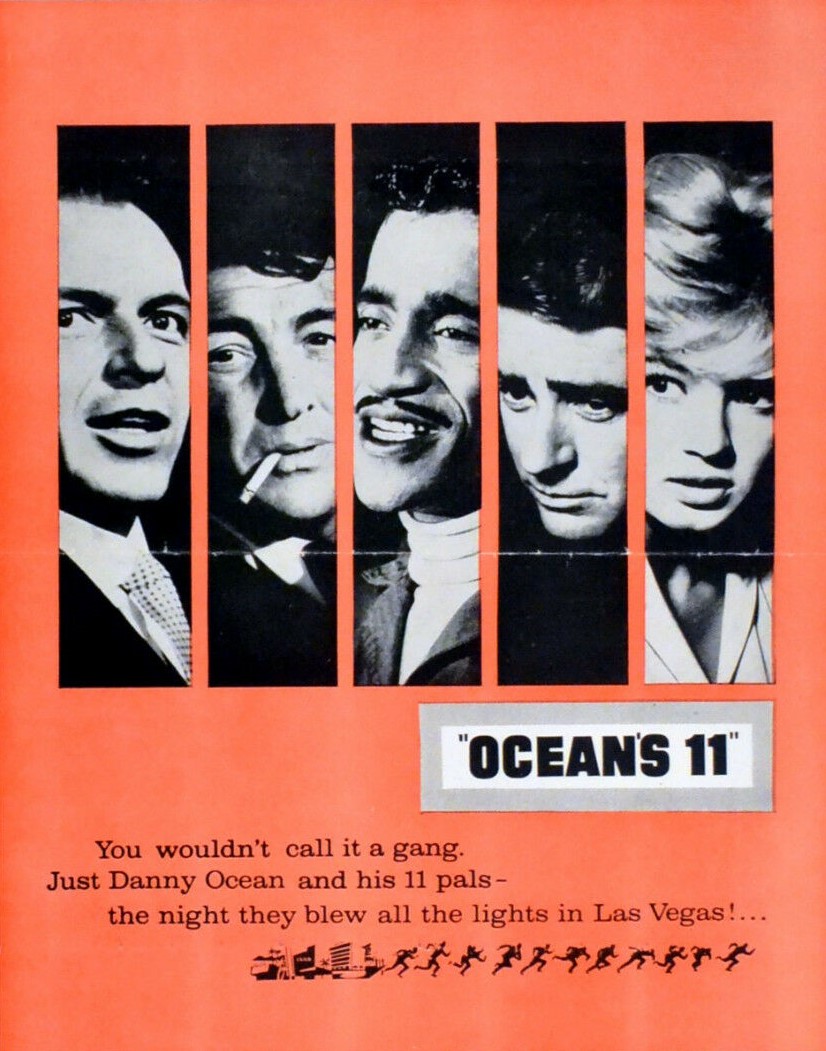
Heist pictures break down into planning, execution and reprisal. Here the planning stage moves at a leisurely pace, a bit of recruitment, and setting up bitebacks that will cripple the military-precision plan by ex-army buddies to rob five Las Vegas casinos of millions of dollars on New Year’s Eve. There’s a bit of reversal, Mr Big (Akim Tamiroff) is a collection of nervous tics, Jimmy Foster (Peter Lawford) a rich guy seeking financial independence from a possessive mother, Sam Harmon (Dean Martin) having second thoughts about the operation, and Danny Ocean (Frank Sinatra) trying to win back estranged wife Beatrice (Angie Dickinson) who surmises he prefers danger to intimacy. Mostly, it’s repartee between Harmon and Ocean while Foster makes a chump out of his mother’s next potential husband Duke Santos (Cesar Romero).
There’s not much hi-tech about the audacious plan, knocking out the electricity supply to the casinos, the switch to auxiliary power allowing the gang access to the inner sanctum where the cash is held, finding their way in and out of the darkness by nothing more sophisticated than luminous spray paint, and with a clever ruse to get the money out once all hell breaks loose.
The fun starts when one of the team (Richard Conte) drops dead post-raid and it transpires Santos is a big-shot underworld figure who investigates the robbery on behalf of the casinos and starts tracking the gang down, leading to a pay-off you don’t see coming.
Given the comedy element, there’s no great tension but it’s a pleasant enough diversion and Sinatra and Martin display an easy camaraderie that lights up the screen. It could have been funded by the Las Vegas Tourist Bureau so much attention is given to the wonder of the casinos, at a time when gambling was still only otherwise legal on racetracks, and with snippets of floorshows and the deluxe atmosphere. Add in a couple of numbers delivered a couple of times by Dean Martin (“Ain’t That a Kick in the Head”), legitimately since he is a cocktail bar singer, and Sammy Davis Jr. (“Eee-O-11”), somewhat shoehorned-in given he is a truck driver.
There’s a couple of neat reversals: Ocean’s dumped girlfriend Adele (Patrice Wymore) gets short shrift from Beatrice when she reveals the affair; casino bosses offered a double-or-quits gamble refuse to consider such a dangerous notion. Red Skelton and George Raft have credited cameos, Shirley MacLaine does not. As well as Richard Conte, Henry Silva (The Secret Invasion, 1964) has a small part as does Norman Fell (The Graduate, 1967).
Although there are on occasion outdated sexist attitudes, there is also a strong anti-racist statement in the hiring of Sammy Davis Jr., showcasing his talents in a big-budget picture, and clearly making the point that he has been welcomed by stars as big as Sinatra and Martin.
And it’s worth also considering the picture in terms of early-onset brand management. The “Rat Pack” was a loose group of entertainers which not only became a well-known stand-alone entity in its own right that celebrated what was considered “hip” at the time (assuming you excluded Elvis and his ilk), but as individuals supported each other on television and in live performance. They would make another two pictures as a team and another dozen or so where two or more of the players appeared. The principals were all major attractions at the nascent Las Vegas so they were also promoting their home patch. During the day they made the movie, at night they wove in and out of each others’ acts, creating an entertainment sensation. On top of that, Sinatra had his own record label Reprise – among the early acts Dean Martin and Sammy Davis Jr. So, in a sense, all this cross-promotion was money in their pockets.
Also of note are the opening and closing, the former for the credits devised by Saul Bass, the latter for the famous shot later appropriated by Quentin Tarantino for Reservoir Dogs. Ironically, Lewis Milestone, who devised the original shot, and long before that won two Best Director Oscars, is less well regarded these days than Tarantino.
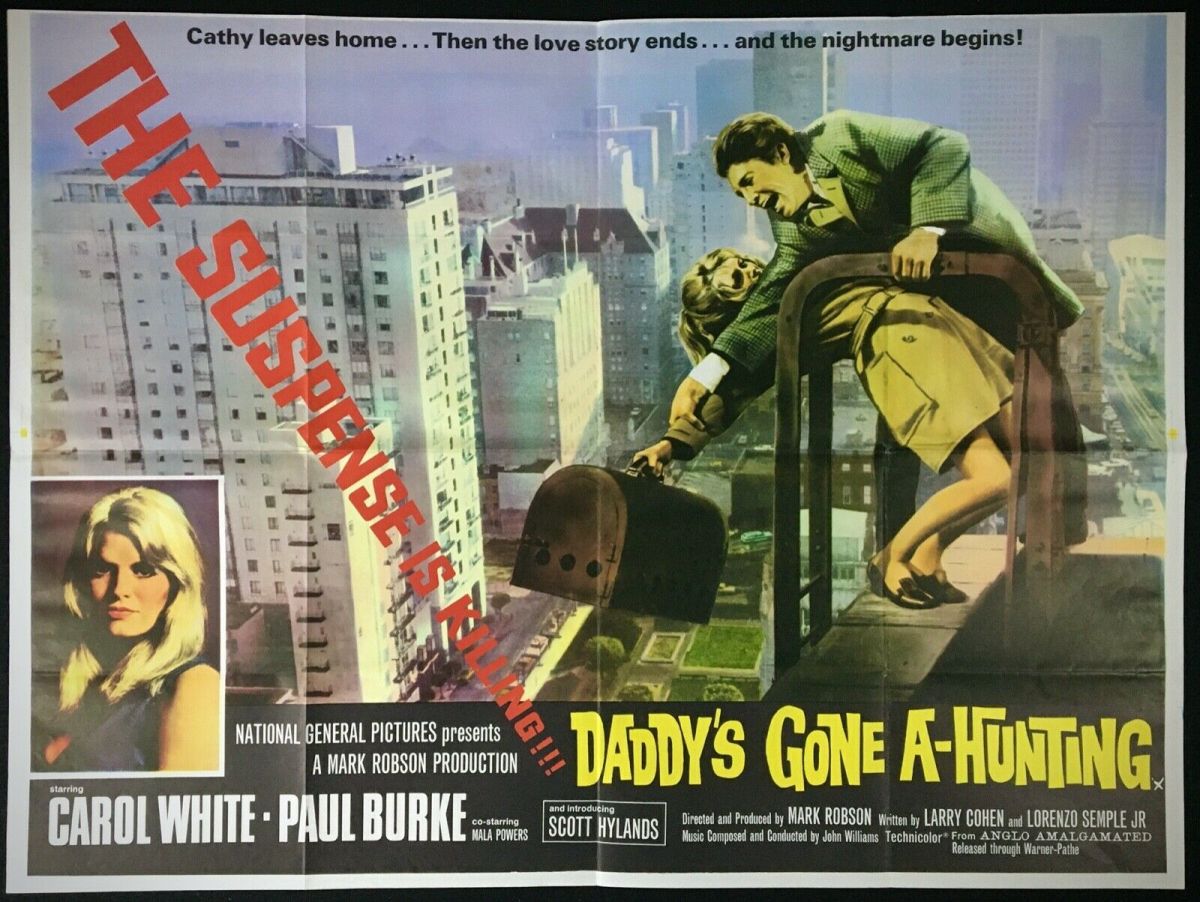
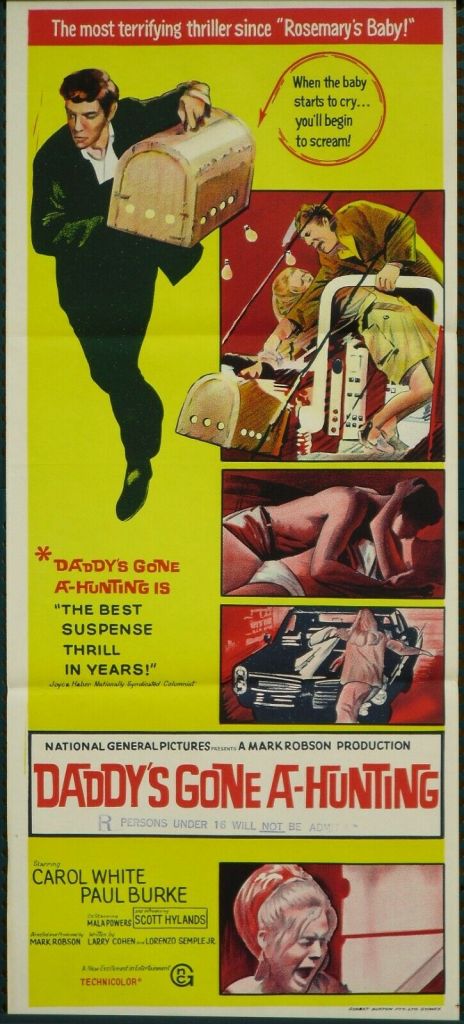
Everyone wants to be a star-maker. Director Mark Robson thought he had some form in this area after Valley of the Dolls (1968) showcased Barbara Parkins and Sharon Tate. There’s no doubt British actress Carol White reveling in critical kudos for Poor Cow (1967) had promise. But not necessarily good professional advice otherwise how to account for a supporting role in Prehistoric Women/Slave Girls (1967) her first picture after success in three BBC television productions. The female lead in Michael Winner’s I’ll Never Forget Whatisname (1967) was followed by a small role in the more prestigious John Frankenheimer drama The Fixer (1968). But none of these films did anything at the box office. Enter Mark Robson.
This thriller might have made her a star had it not been so darned complicated. It veers from paranoia to stalkersville to Vertigo via Gaslight without stopping for breath and some elements are so obviously signposted at the start you are just waiting for them to turn up. Plus, if ever a film has dated, it’s this one, going back to the days when abortion carried automatic stigma and fathers could get away with lines like “you murdered my baby.”
So, one of the few times in history San Francisco got snow (it averages zero inches annually according to Google) the meet-cute is sketch artist Cathy (Carol White) being hit by a snowball thrown by wannabe Kenneth (Scott Hylands, making his debut). But when she realizes how much he enjoys watching cats stalking canaries decides she doesn’t want his baby and aborts it. A few years later she marries congressional candidate Jack (Paul Burke from Valley of the Dolls) and when pregnant crosses paths with Kenneth who manages to insinuate himself into her family via her husband. Twist follows twist until we are on the Top of the Mark (a famous city landmark) for a gripping climax.
White does well as she shifts through the emotional gears but she is barely given respite from being overwrought so at times her acting appears one-dimensional rather than varied. In fairness to her, the movie’s plot gives her no chance to deliver a settled performance. Hyland looks as if he’s auditioning for a role as a serial killer, but the depth of his cunning and his twisted perceptions kept this viewer on edge -what it would take for Cathy to make amends will chill you to the bone.
Robson has some nice directorial touches, a scene reflected in the eye of a cat, a clever jump-cut from marriage proposal to marriage ceremony and some flies in milk. Mala Powers makes a welcome big screen appearance after nearly a decade in television. That this whole concoction emanated from the fertile imaginations of screenwriters Larry Cohen (It’s Alive, 1974) and Lorenzo Semple Jr. (Fathom, 1967) might give you an idea of what to expect.
Catch-Up: Mark Robson films previously reviewed in this Blog are: The Prize (1963) and Lost Command (1966).
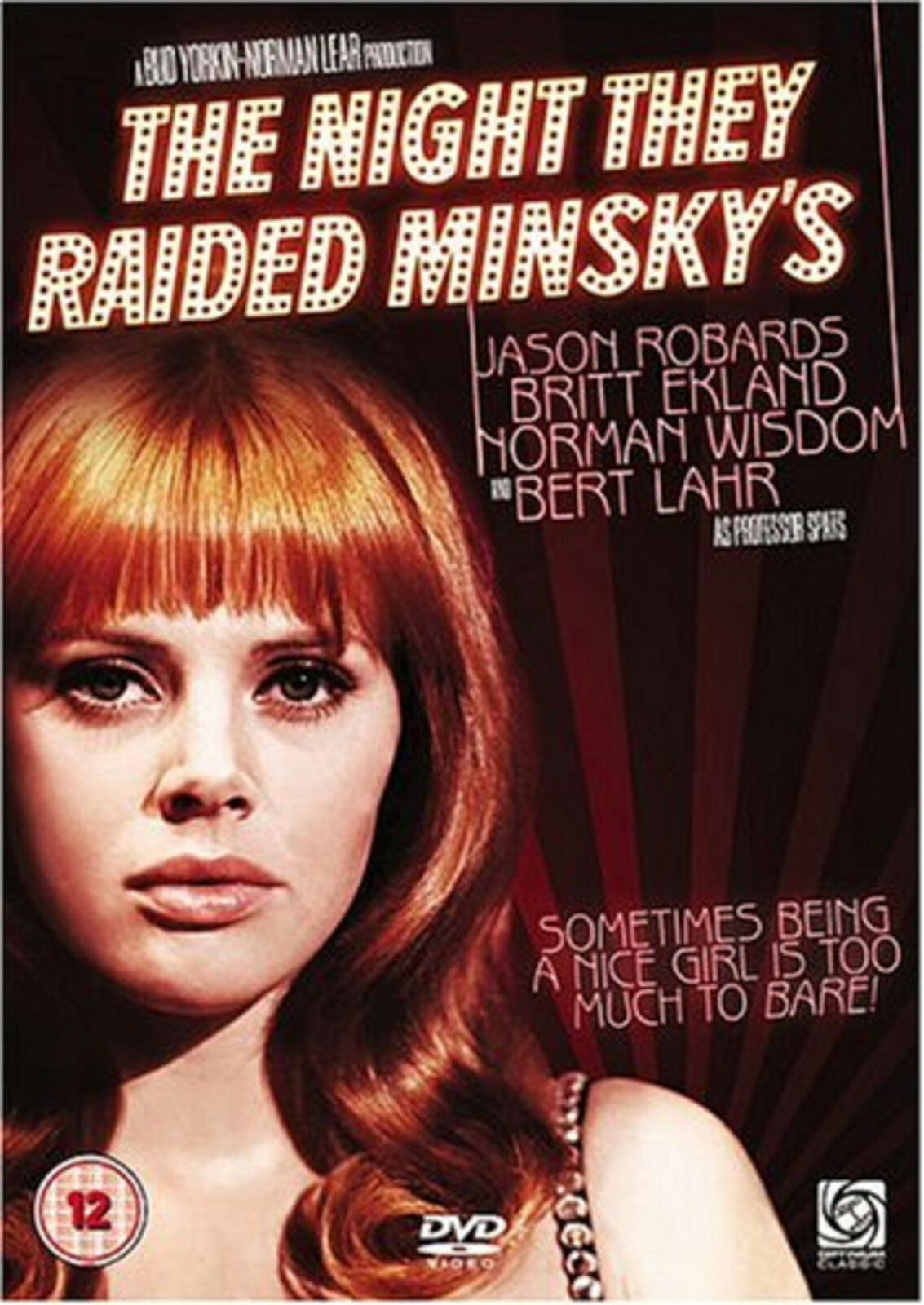
Why films are flops is sometimes more interesting than why they become hits. That’s assuming no one’s memory plays them tricks. Originally, according to Tony Curtis, he was going to produce The Night They Raided Minsky’s and at that point it was more focused on the strippers working there. “Each stripper thought she was going to end up being a star like Gypsy Rose Lee” he wrote in his autobiography. However, in the star’s memory this film was going to be made after the completion of You Can’t Win ‘Em All (1970) and Suppose They Gave a War and Nobody Came (1970) when he was a dead duck Hollywood-wise – he did not appear in another picture until Lepke in 1975. The fact that The Night They Raided Minsky’s was made in 1968, two years before You Can’t Win ‘Em All, appears to have escaped his attention or that of the book’s editors and publishers and, strangely enough, also of Michael Munn whose later biography of the actor Nobody’s Perfect equally oddly attributed his involvement in Minsky’s to after You Can’t Win ‘Em All.
Director William Friedkin has a better recollection, but, also strangely enough, nothing like as detailed as that for the film that made his name The French Connection (1971). He had met Bud Yorkin at a private screening at the house of producer David L. Wolper (The Devil’s Brigade, 1968). Yorkin and partner Norman Lear had a two-picture deal at United Artists. (In his autobiography Friedkin called United Artists “newly-formed” which was a hell of a miscalculation since that studio had been on the go since 1919 and even the modernized UA had come into being in 1951 – he was probably referring to the takeover of the studio in 1967 by Transamerica). Even though at that point Friedkin’s only picture had been the Sonny and Cher flop Good Times (1967) he was offered $100,000 to direct on the grounds that he could “bring something original and contemporary to an older subject.” He was honest enough to admit the fee probably swayed him since he found the script “thin, superficial, not funny.”
Friedkin makes no mention of Tony Curtis potentially being involved on the production side. The first actor to be approached, Curtis agreed to do the film if the script was rewritten. According to Friedkin, Curtis was “at the peak of his popularity.” That was wishful thinking. According to Variety, Curtis was one of the least successful stars in the business, his last four pictures averaging a lamentable $1.77 million in U.S. rentals. Curtis did not like the rewrite. He complained that between the two drafts, his role had “shriveled” and quit the production “due to differences in the concept of the male star role.” Or it could have been that he dropped out in favor of The Boston Strangler (1968).
For a while it seemed his departure might benefit the planned production. Two rising Broadway stars – Alan Alda and Joel Grey – showed interest. Alda was in The Apple Tree directed by wunderkind Mike Nichols and Grey was attracting fabulous notices for his performance in the stage version of Cabaret. “It was a real coup to land those guys,” purred Friedkin. But it was a coup too soon – they could not get out of their stage contracts. “Unbelievably,” commented producer Norman Lear, whose job presumably it was to read the fine print, “nobody read the fine print.”
All roads then led to Jason Robards (“my first choice anyway” according to Lear) third-billed in Yorkin and Lear’s Divorce American Style (1967). Although Norman Wisdom had primarily a British moviegoing following, he had just finished a run in the Broadway comedy Walking Happy, so he was not entirely unknown. Bert Lahr fell ill a third of the way through production and died within a week so the pivotal role he was to play, “as a kind of tour guide to burlesque…left a hole in the film’s emotional center.” To try and minimize his loss, the producers “included every frame of Lahr including test footage.”
Worse, according to the director, Robards and female lead Britt Ekland proved a mismatch and had “no chemistry as lovers.” Danny Daniels took over the staging of the burlesque routines and Friedkin came close to being fired.
At least Friedkin was honest about the film’s failings. The biggest problem, he admitted, “was my own ineptitude…I was in over my head….Each time I set up a shot or talked to an actor about a scene I was filled with uncertainty….much as I’d like to absolve myself of blame for the film, I see my handiwork all over it, especially in the documentary approach to many of the scenes.” He didn’t help matters by almost sabotaging the release when he told a late-night talk show host that the picture was “terrible” and advised viewers not to “bother to see it.”
But for all Friedkin’s later downplaying of the picture, at the time he was giving it big licks, anticipating some kind of artistic breakthrough in part through innovative use of the hand-held camera. He aimed to achieve a “Brechtian flavor of casual seediness.” It was the biggest production ever filmed in New York with a budget in the $3 million-$4 million region. Friedkin had rejected the New York streets available on Hollywood studio lots in favor of the real thing. The producers found a block on the Lower East Side scheduled for demolition that fitted exactly the art director’s exterior design and successfully campaigned Mayor Lindsay to postpone demolition until shooting was completed. Friedkin confidently boasted to Variety that the Lower East Side so closely resembled what it was like half a century before that “all you have to do is rip out the parking meters and conceal the air conditioning” and line the streets with vintage cars.
Cameraman Andrew Laszlo had developed a special camera that permitted much steadier handheld photography than before which would facilitate “Friedkin’s improvisational directorial style.” Friedkin called it “the most expensive movie ever made with a hand-held camera.”
The picture finished shooting at the end of 1967 but that it did not appear in theaters until the tail end of the following year indicated the problems facing the producers. You might think Xmas an odd time to launch a movie about what was effectively a tawdry subject no matter how affectionately filmed. In a bid to shine a light on the more successful aspects of burlesque, United Artists publicists gave a major push to Dexter Maitland, a 40-year veteran of the business who had a small part in the picture.
SOURCES: Tony Curtis with Peter Golenbock, American Prince: My Autobiography (Virgin Books – paperback, 2009) p279 ; Michael Munn, Tony Curtis, Nobody’s Perfect (JR Books, 2011) p214; William Friedkin, The Friedkin Connection, A Memoir (Harper Perennial, 2014) p115-120; Lee Beaupre, “Rising Skepticism on Stars,” Variety, May 15, 1968, p1; “Tony Curtis, Britt Ekland To Co-Star in Minsky’s,” Box Office, June 26, 1967, p12; “A Minsky Burlecue Theme Needs N.Y.,” Variety, August 2, 1967, 18; “Tony Curtis Withdraws from Minsky’s Pic,” Box Office, August 7, 1967, pW-2; “Wreckers Refrain,” Variety, September 27, 1967, p28; Lee Beaupre, “Costliest Ever on Hand Held Camera; UA’s Calculated Risks As To Minsky’s,” Variety, December 6, 1967, 3; “Norman Lear Digs ABC,” Variety, December 4, 1968, p22); “Dexter Maitland Is Alive and Real,” Variety, December 11, 1968, 4.
William Friedkin’s autobiography pictured below is immensely informative of the director’s somewhat controversial career.









 The Magnificent 60s