I am a published author of books about film - over a dozen to my name, the latest being "When Women Ruled Hollywood." As the title of the blog suggests, this is a site devoted to movies of the 1960s but since I go to the movies twice a week - an old-fashioned double-bill of my own choosing - I might occasionally slip in a review of a contemporary picture.
Few stars were as willing to trade their glamorous screen persona for a decent role as Elizabeth Taylor, here eschewing the trademark hip swivel, low cut dresses and elegant costumes for a clumping walk, frumpy look and eating with her mouth full. After a chance meeting on top of a bus with rich waif Cenci (Mia Farrow) middle-aged prostitute Leonora (Elizabeth Taylor) swaps a dingy bedsit for life in a massive mansion, cupboards stuffed full of furs, all her needs met. Cenci seeks a mother; Leonora, whose daughter drowned aged ten, seeks a child substitute.
Soon Leonora is prisoner to a fantasist, her own identity swamped by Cenci’s needs, accepting the role of “mummy” as the price of a life of luxury until she learns that what appears so freely given can be as easily taken away. This cloistered life is creepy. Cenci has rape fantasies. To a pair of interfering and thieving aunts, Leonora pretends to be Cenci’s dead mother’s cousin.
The fantasy conjured is threatened by the presence of Cenci’s poet stepfather Albert (Robert Mitchum) who intends to become the girl’s legal guardian. He talks like a child molester, “the extraordinary purity of my longings,” but given the depth of Cenci’s fantasies Leonora initially discounts inappropriate behavior on his part especially when Cenci wishes to become inappropriate with her. If Leonora stands in Albert’s way it is only to have the girl – and her wealth – to herself.
A psychological drama that appears more like a stage play in structure, skirting around core issues in favor of later revelation, and in essence making a good effort at dealing with behavioral problems which would find greater currency today – inherited mental illness, PTSD, low self-esteem, abuse, and incest. Though the last area is hard to specify, on the basis that, technically, Albert is a stepfather rather than a father, underage sex would appear to be more likely.
In an era when permissiveness virtually ensured audience shock, director Joseph Losey makes a decent stab at presenting the impact of sex on the vulnerable, despite her apparent steely exterior Leonora damaged by life as a sex worker, Cenci pretending to be younger as if that can sustain her innocence, not realizing how appealing that would be to a predator.
At once hypnotic and impenetrable, this is director Joseph Losey (The Servant, 1964) at his best, a story that by its subject matter must remain obscure, a mother-daughter relationship that should be twisted but reveals nothing but tenderness, ending for a time the torment of the emotionally unfulfilled, but when bonds appear to be strengthened they are fragmenting. However, the film is let down by the script and the somewhat grand guignol setting. Losey is wonderful at times with nothing to say just a prowling camera, only two lines of dialog exchanged in the first 15 minutes. You would certainly file it under “eclectic.”
The two main performances are electric. This is Taylor at her powerhouse best, her profession not glamorized as in Butterfield 8 (1968) and no male to bring to heel, and her last scene with Cenci is extremely touching. This was a bold role, too, for Mia Farrow after the success of Rosemary’s Baby (1967) turned her into a box office star. She brings believability to a difficult role, especially as she is far from the spoiled child one might expect.
Robert Mitchum fans must have received the fright of their life to see their hero not just with uncomely beard but portraying a sinister character, not an out-and-out villain which would have been acceptable, but fast forward a couple of years and you can see evidence here of the kind of portrayal he would evince in Ryan’s Daughter (1970). Look out for Peggy Ashcroft (The Nun’s Story, 1959) in a smaller role, her first film in nearly a decade.
Check out the “Behind the Scenes” article for this film.
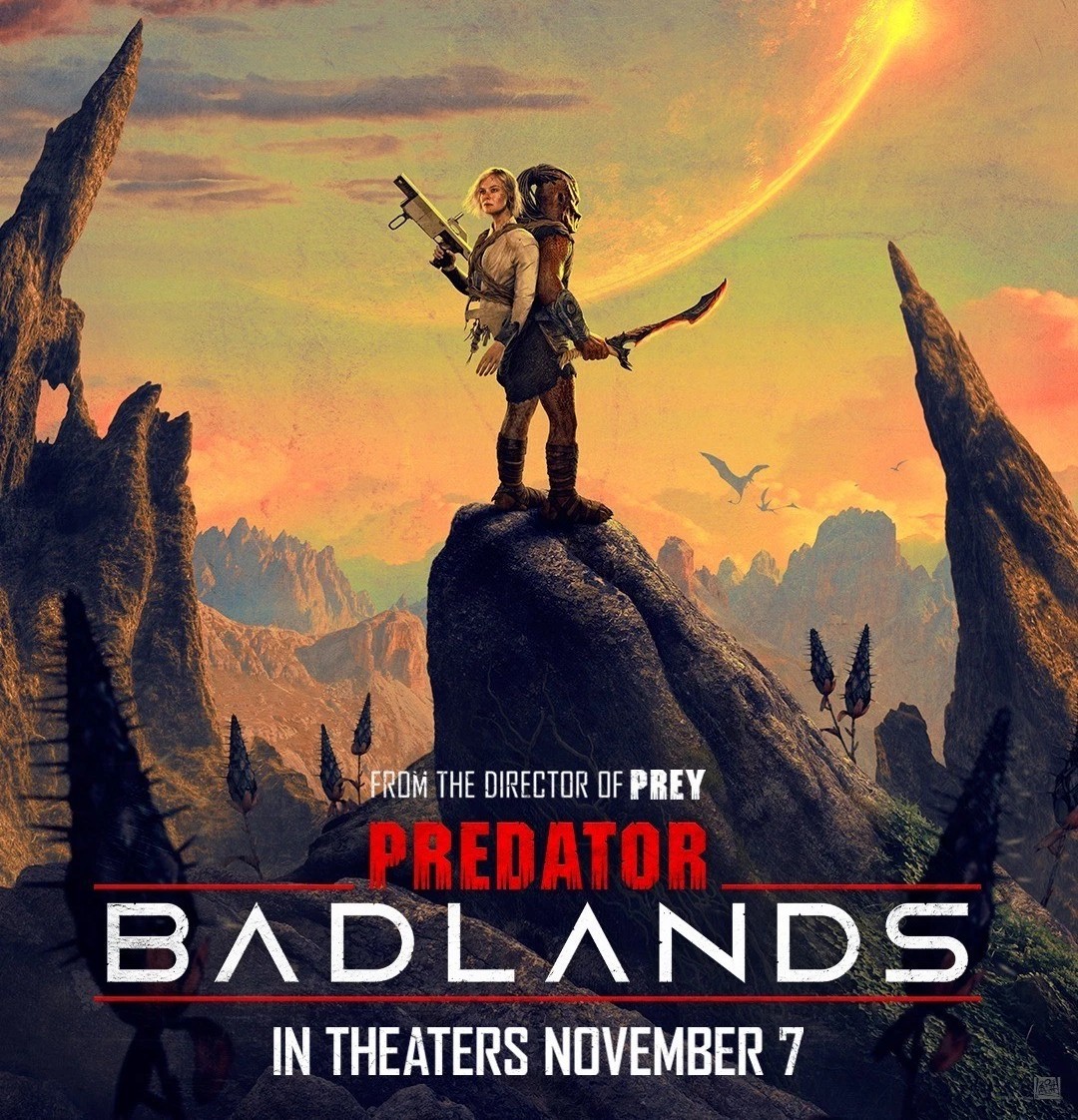
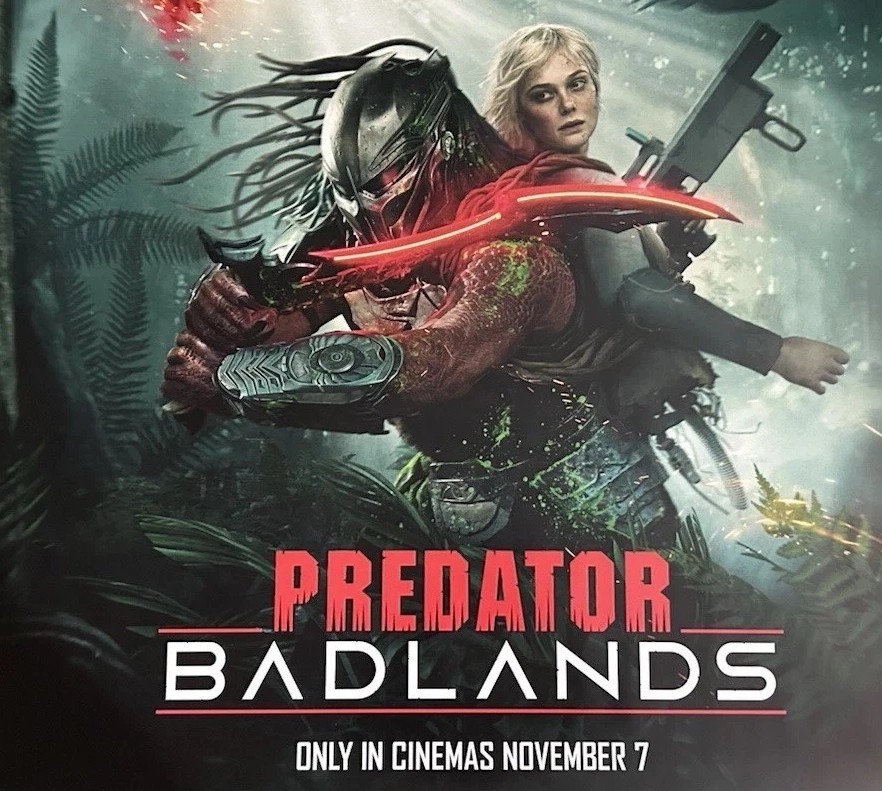
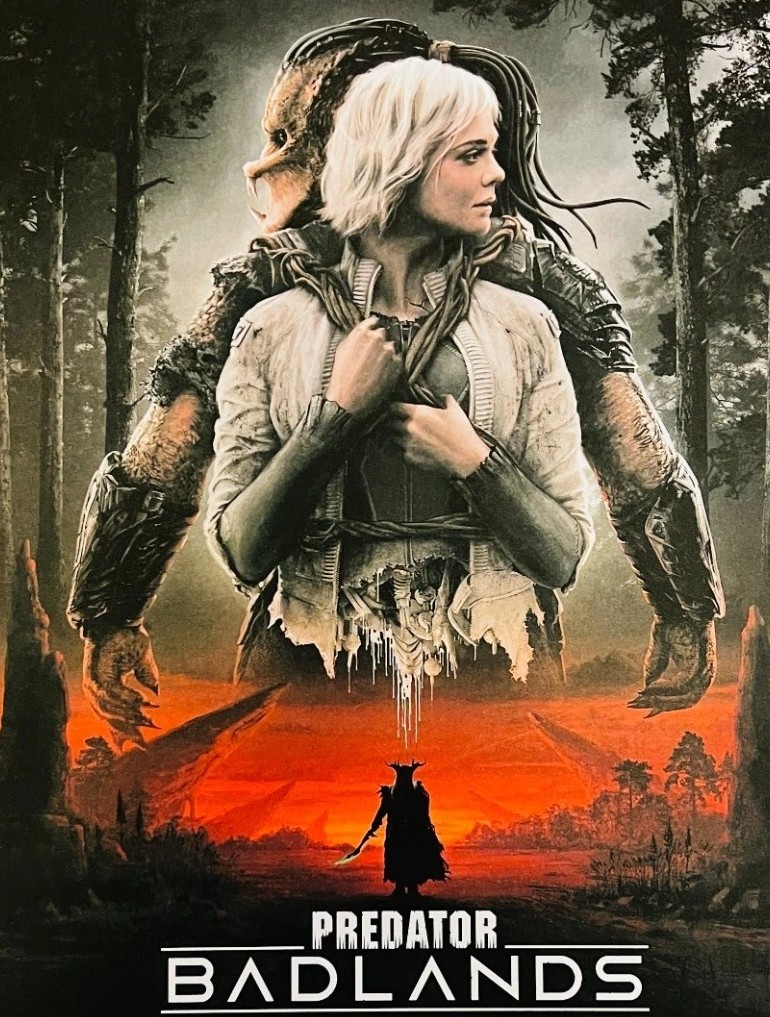
In possibly the most audacious pivot in sci fi here’s a movie minus any human characters. The leading character Dek (Dimitrius Schuster-Koloamatangi) is a monster straight out of the Alien back catalog and he is accompanied on his journey through the titular badlands by an android Thia (Elle Fanning), though one programmed with feelings though only for scientific purposes, and a mini-monster Bud (Rohinal Naharan) who when he’s not being fierce is quite cute.
The tale, however, has recognizably human dimensions. Dek is the runt of the litter and since weakness is despised in his clan he is scheduled to be terminated by his big brother, who can’t bring himself to do it so it’s left to his ruthless father to kill the protective brother. Meanwhile, Dek escapes to a distant planet, Genna, where everything is lethal including the grass. He hopes to prove his worth by killing the biggest monster in the universe, Kalisk. He teams up with a legless android Thia who has formed an affection of a sibling nature for a fellow synthetic Tessa (Elle Fanning).
The monsters encountered are pretty impressive and the landscape, whose rock formations suggest ragged versions of the spaceship that houses the aliens in the Alien series, is a visual treat. Though originally regarding Thia as nothing more than a “tool”, and happy to abandon whenever her usefulness ends, Dek ends up reacting in quite human fashion to her.
So if you’ve come expecting an extension of the Predator franchise where the monster merely exists to hunt down anyone in its path and you don’t get a glimpse of its character beyond the slicing and dicing this isn’t for you. But if you are open to a refreshing take on the monster universe, there’s plenty to enjoy.
And given the drought of audience-friendly pictures this last couple of months, an action picture with some emotional notes is more than welcome and thank goodness it hasn’t come with critics touting it for Oscar glory.
Turning the previous concept on its head, young Dek is the hunted not the hunter. He doesn’t have to go far to encounter venom, everything that moves or grows is dangerous. He’s got the moves and a scimitar that seems to owe something to a weapon from a different universe – the light saber. Even so, it’s often only by luck that he survives.
His teaming with Thia falls into a more conventional trope, the buddies who start out as enemies and/or the brain vs brawn combo. Thia speaks every language on the planet which helps when he is linguistically confounded. And Bud plays the unwelcome recruit which dates back to The Magnificent Seven (1960) and way before, though he turns out to play a significant part. There’s even time for some humor as when Thia’s disembodied legs stride down the street and go into vexatious action.
Given we’re dealing with non-humans, there’s a surprising emotional upside and a pay-off that provides a neat twist and suggests a sequel.
It would be non-stop action except for the interplay between hero and his “tool” and the emotional elements that spurt up every now and then. On the action alone it would be well worth your bucks, but the other elements take it a level above.
While Elle Fanning’s (A Complete Unknown, 2024) double turn isn’t as in-depth as that of Michael B Jordan in Sinners (2025) it’s still pretty good and had this been another kind of picture her misplaced affection for her scientifically-generated sibling might have received greater emphasis.
The stripped down and pedal-to-the-metal narrative is driven by director Dan Trachtenberg (10 Cloverfield Lane, 2016) who would be one of the few directors to genuinely deserve the “visionary” tag so carelessly thrown around. He had a hand in the screenplay along with Patrick Aison (Prey, 2022) based on the Predator characters invented by Jim and John Thomas.
Mirisch could easily lay claim to be the top independent production outfit of the 1960s generating hits like The Magnificent Seven (1960), West Side Story (1961), The Great Escape (1963), The Pink Panther (1964) and its sequel A Shot in the Dark (1964), The Russians Are Coming, Russians Are Coming (1966), In the Heat of the Night (1967) and The Thomas Crown Affair (1968) plus a shelf load of Oscars and Oscar nominations. But dependence on a partnership with Billy Wilder in the 1970s and a more lackluster performance at the box office – with the noted exception of Fiddler on the Roof (1971) – spelled the end of its 17-year relationship with United Artists, which was reeling from financial losses and under new management.
The company found a new partner in Universal which had a series of deals with other major producers like Alfred Hitchcock, Zanuck and Brown (Jaws, 1975) and George Seaton (Airport, 1970). Mirisch was not in any financial trouble, having severed ties with UA after Mr Majestyk (1974), a major success abroad, and recovered its development costs for Wheels, based on the Arthur Hailey novel but the script rejected by UA, from Universal which turned it into a mini-series.
The Universal deal was initially not as good as that enjoyed at UA. Universal charged a twenty-five per cent overhead whereas UA had charged nothing and Universal was now doing direct deals with directors rather than relying on the likes of Mirisch to tie up the talent.
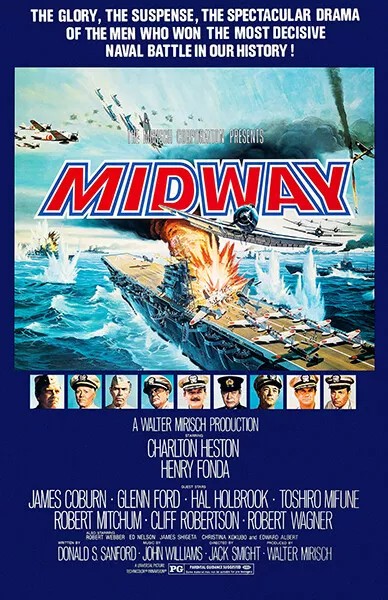
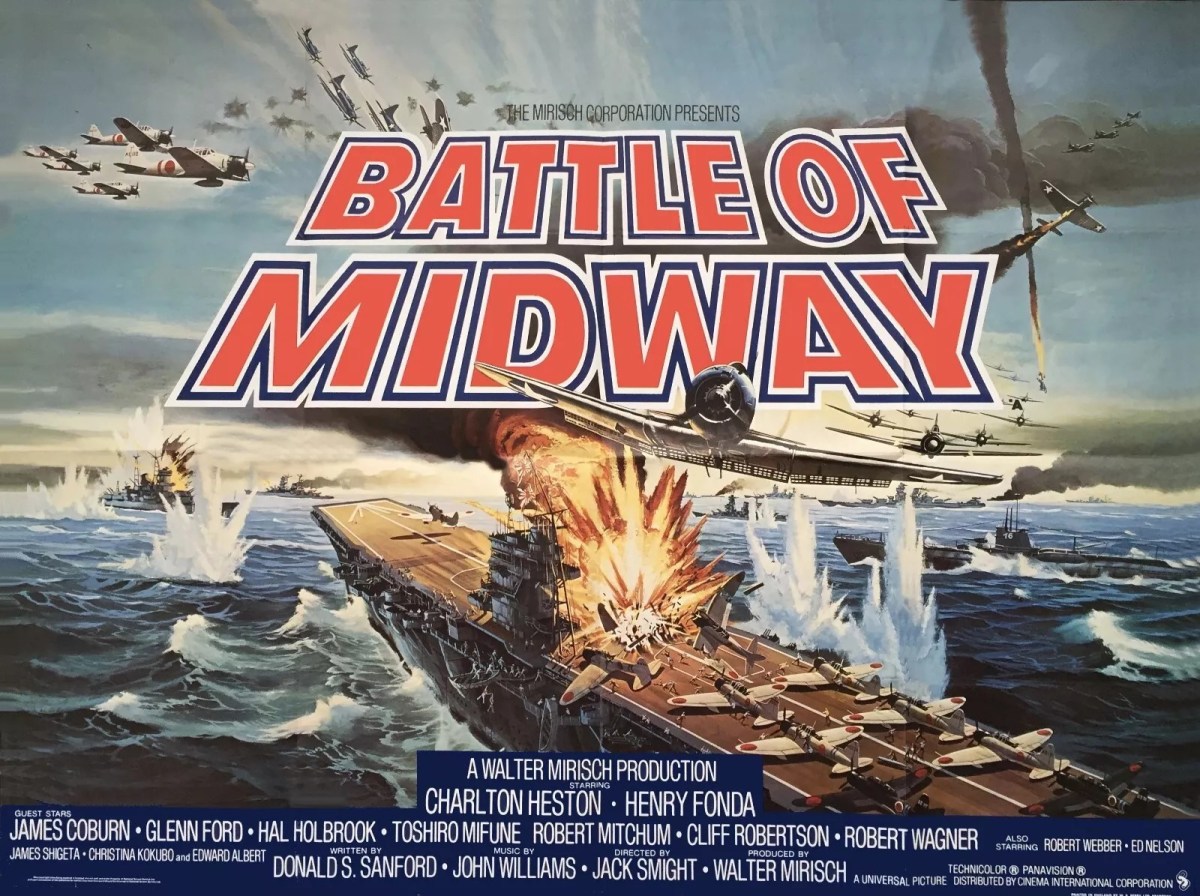
Many years before, Mirisch had commissioned a script on the Battle of Midway from Donald S. Sanford who specialized in war pictures but of the distinctly low-budget variety – Submarine X-1 (1968), The Thousand Plane Raid (1969) and Mosquito Squadron (1969), none of which had enjoyed any success.
Though all of the Mirisch war pictures had concentrated on Europe, Walter Mirisch, generally the creative driving force for the production company, in his previous incarnation with Allied Artists had some experience of the Pacific War, having produced Flat Top / Eagles of the Fleet (1952), set around an aircraft carrier during the Battle of Leyte Gulf, and was an avid reader of books about the Second World War.
John Ford and Louis de Rochmont had made documentaries about the Pacific naval battles. UA rejected the script twice, a shrewd move in the end because Tora! Tora! Tora! (1970) lost a packet for Twentieth Century Fox. The Sanford screenplay had initially taken more of a documentary approach but after gaining the interest of Charlton Heston, who had starred in Mirisch’s The Hawaiians (1970), the script was tweaked.
Programming a war picture was a risk for the studio. There hadn’t been a big-budget war picture in five years. And while Patton (1970) and Kelly’s Heroes (1970) ended up on the right sight of the ledger book, Tora!, Tora! Tora! and Too Late the Hero (1970) were stiffs.
Mirisch signed a two-picture deal with Universal, for Midway and Wild Card with a screenplay by Elmore Leonard (Mr Majestyk). Mirisch proposed to reduce costs by using footage from naval archives, converting the original 16mm film to 35mm. The producer also took footage from Japanese film Storm over the Pacific / I Bombed Pearl Harbor (1960) – the rights cost him $96,000. Footage of the Pearl Harbor attack in Tora! Tora! Tora! doubled for shots of the attack on Midway Island. A clip of the Dolittle raid on Tokyo from Thirty Secondsover Tokyo (1944) was used in the credit sequence after “subjecting it to a sepia bath.”
After the success of Earthquake (1975), Heston was back in the top ranks of box office stars and his involvement guaranteed the green light. The U.S. Navy offered its support, not surprising since Midway was considered its greatest success.
John Guillermin (The Towering Inferno, 1974) was hired to direct and Stirling Silliphant (In the Heat of the Night) signed up for a screenplay rewrite. Mirisch had determined to employ the all-star-cast device that had been an essential ingredient of many of the 1960s roadshow pictures, kicking off with Henry Fonda (The Boston Strangler, 1968), by now pretty much a spent force at the box office – he hadn’t made a picture in three years – but still a well-known name.
The amount of work involved for the other stars was minimal – mostly just one day – and, astutely, Mirisch called on stars who had worked for him in the past and who, like James Coburn (The Great Escape), Cliff Robertson (633 Squadron, 1964) and Christopher George (The Thousand Plane Raid) owed him something in terms of a career leg-up. Others included Robert Mitchum (The Sundowners, 1960), Robert Wagner (The Biggest Bundle of Them All, 1968) and Tom Selleck in an early role. Mitchum was the first of these stars to sign up, in March 1975, six weeks before the scheduled start date of April 27, followed two days later by Coburn.
Toshiro Mifune (Red Sun, 1971) headed up the Japanese cast and proved so meticulous in his preparations that he had his uniform made by Japanese tailors. The white gloves he wore had a finger shortened on the left hand because his character Admiral Yamamoto was missing a pinky. However, despite coaching in English by actress Miko Taka (Walk, Don’t Run, 1966), his dialog was revoiced by Paul Frees.
Guillermin demanded a bigger budget to accommodate more airplanes and equipment and a longer shooting period. Two months before filming was due to start, Mirisch put his foot down and told the director he couldn’t accommodate his requests as Universal had only provided funding on the basis of Mirisch’s original idea. Guillermin walked. As far as the public was concerned, the parting of the ways was due to a “conflict of schedules.” Jack Smight, who had directed Airport ’75 (1974), a box office success and also starring Heston, was his replacement.
The Navy lent aircraft carrier U.S.S. Lexington – the last remaining World War Two carrier – while it was at sea training pilots as long as the shoot didn’t interfere with those exercises. A limited number of World War Two vintage planes – in great condition having been cared for by their owners – were permitted on board. The Navy charged the crew for accommodation – Mirisch was housed in Admiral Strean’s quarters – and meals. “We had a detailed contract with the Navy,” recalled Mirisch, “in which we agreed to stay out of their way when asked.”
On board, the crew filmed scenes, some silent and others with dialog, and “made plates for rearview projection and aerial shots of our vintage planes so positioned that we could print them into flights of six or nine.” Charlton Heston, Glenn Ford (Rage, 1966) and Hal Holbrook (The Group, 1966) were aboard and the shoot went well. A scene involving Henry Fonda was shot at Pensacola. The Florida coast stood in for the Pacific. Additional exteriors were filmed in Los Angeles at Long Beach and Point Dune with interiors at Universal.
The construction of the interiors for the Japanese aircraft carriers was so authentic Mirisch was later asked to reassemble the set for the Smithsonian Institute for a presentation there. The interpolation of the old footage was crucial and it was planned in advance where such shots would appear. The old footage was precut and scenes were shot with actors with “scene missing” in those sequences into which the old footage could be dropped. Other devices were used to ensure the background in the old footage was more lively.
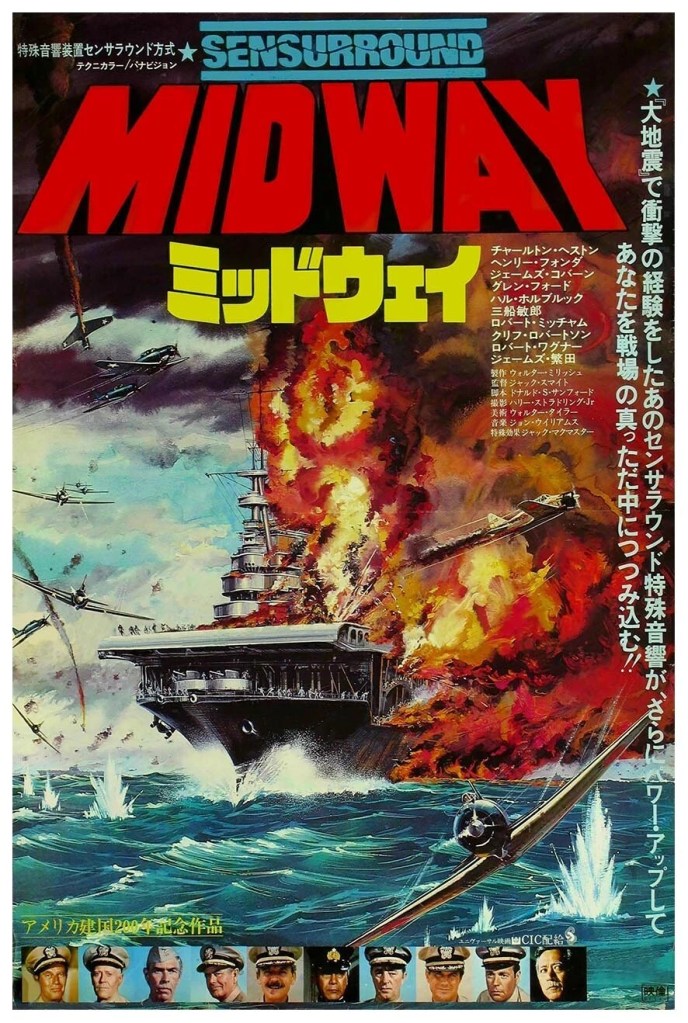
The final element was in cinematic presentation. Sensurround, a precursor of Imax, had been introduced with great success by Universal to Earthquake and this added greater realism to the battle scenes. While limited to those theaters which had installed the expensive equipment, and although the roadshow was long gone, it created an “event” aspect to those viewing it in that system. In his autobiography Mirisch suggested the addition of Sensurround was last minute and sparked by the success of Earthquake. But, in fact, Universal had announced a year in advance of opening that Battle of Midway would utilize Sensurround.
Some cinema owners were outraged at the stock footage, whose proposed inclusion had been kept from them when they went into the blind-bidding process at the start of the year. Mirisch countered that there was no alternative. “A great many aircraft,” he argued, “used in the battle no longer exist.” Universal’s terms were stiff – a minimum nine-week run starting at a 70/30 split for the first three weeks in the studio’s favor, a $75,000 advance guarantee from cinemas and 5% of the gross for use of Sensurround.
With the budget kept as low as a reported $4 million it was a massive hit, picking up $20.3 million in rentals (what the studio retains of the box office gross) – sixth in the annual box office league beaten only by Oscar-winner One Flew over the Cuckoo’s Nest, All the President’s Men with Robert Redford and Dustin Hoffman, demonic The Omen, Walter Matthau baseball comedy The Bad News Bears and Mel Brooks’ Silent Movie and just ahead of such offerings as Sidney Lumet’s Dog Day Afternoon with Al Pacino, and comedy Murder by Death but nearly doubling the take of the more critically-acclaimed Taxi Driver, Clint Eastwood western The Outlaw Josey Wales and thriller Marathon Man also starring Hoffman. The final domestic figure amounted to $21.8 million.
Foreign figures were astonishing, especially in Japan, where its gross exceeded $4 million. The benefits of the promotional tour undertaken by Heston in the Far East were soon obvious – in Manila it beat both Jaws and Earthquake. In the annual box office league there and Hong Kong, it ranked third. In Italy it proved a “big surprise”, coming in fourth behind King Kong, Taxi Driver and a local offering.
While a successful movie could expect to benefit from television viewings – this was before the video revolution – the movie had an unusual afterlife. NBC, which had bought the rights, wanted the film to be longer, so it could be shown over two nights, thus increasing advertising and setting it up as a more prestigious event. Largely by adding plotlines to the Heston character, the running time increased by nearly an hour, which proved a bonus for the future home screening revolution.
“Of all the films that I have made,” noted Mirisch, “it produced the greatest amount of profit.”
SOURCES: Walter Mirisch, I Thought We Were Making Movies Not History (University of Wisconsin Press, 2008) pp324-339; “Readying Midway,” Variety, February 5, 1975, p6; “Universal in New Shake,” Variety, July 23, 1975, p3; “Admiral Mitchum,” Variety, March 12, 1975, p18; ”Jap Feature Footage Inserted into Midway,” Variety, June 6, 1976, p7; “Midway Big in Manila,” Variety, August 11, 1976, p24; “Big Rental Films of 1976,” Variety, January 5, 1977, p14; “Jaws Led Bangkok,” Variety, February 9, 1977, p39; “International,” Variety, June 29, 1977, p35.
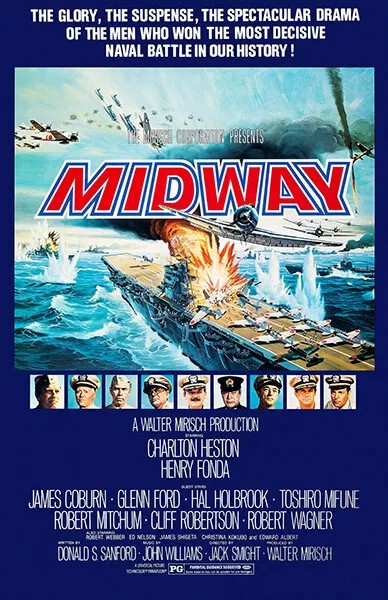
Even-handed documentary-style tale recounting of the most famous U.S. naval battle of all time, a turning point in the struggle for control of the Pacific in 1942. Both sides make mistakes, luck and judgement play an equal part.
I’d always assumed Midway was some abstract geographical position without any idea of its strategic importance – did the name mean it was halfway between the U.S. (or Hawaii) and Japan? But here I learned it was an actual island that the Japs planned to invade and the Americans intended to stop them. In some senses, it was bait, a way to draw the U.S. Navy out of Pearl Harbor. But the bait ran both ways. If the Yanks could coax the enemy out into the Pacific, they had a chance of gaining an advantage, even though the Americans were inferior in shipping tonnage.
The Japs have been stung into action by the audacious American bombing of Tokyo. Admiral Yamamoto (Toshiro Mifune) uses the perceived threat of further attacks to gain official approval for his plan to invade Midway.
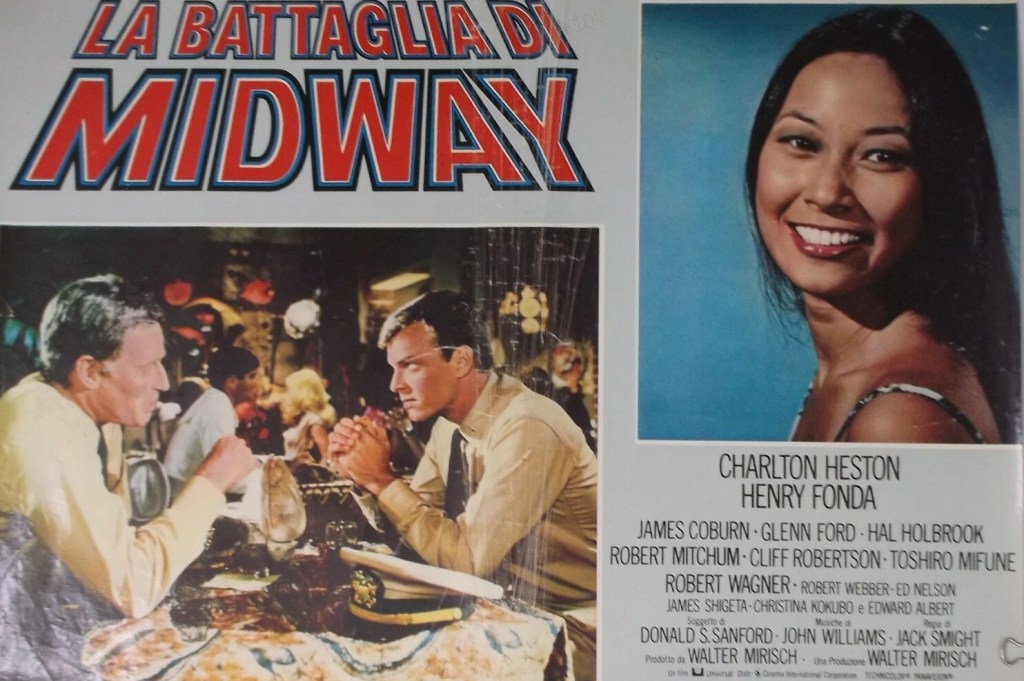
This is strictly a male show. However, in a bid to lower the testosterone levels a romantic subplot is inserted. The aviator son, Lt Thomas Garth (Eddie Albert), of top aide and former pilot Captain Matthew Garth (Charlton Heston) has an American-born lover Haruko (Christina Kobuko) of Japanese descent who’s being investigated for espionage and subsequently interned. On intervening, the father digs up a hodgepodge of racism – from both sides, Haruko’s parents against her forming a relationship with a non-Japanese. But the plan backfires causing a breakdown between father and son.
But that’s very much on the fringes and although it raises interesting cultural aspects, the movie concentrates mostly on the nuts-and-bolts of heading into a major engagement.
American intelligence, headed by Commander Joe Rochefort (Hal Holbrook), gets wind of the planned attack. But the clues are scant – the old trope of increased radio traffic not enough to convince – and while the audience knows the Japs are on the move with a mighty naval force including four top-class airplane carriers, the Americans remain ignorant almost until it’s too late.
Luckily, Admiral Nimitz (Henry Fonda), heading up the American naval contingent, is keen to inflict a blow on the enemy, even though he’s limited to two carriers and another just out of the repair yard. Each side relies on spotter planes to detect the enemy. But the Japanese, by imposing radio silence, shoot themselves in the foot, unable to switch tactics until too late. The hunch plays an important part.
There’s rarely much opportunity for individual heroics on a ship under fire, beyond rescuing someone. The fighter pilots are a better bet, especially since some of their forays are nearly suicidal given the firepower they attract. Matt Garth, who for most of the picture is an upscale backroom boy, is called into action with unexpected results.
Most battle films tend to concentrate on the heroics often at the expense of understanding in any detail what’s going on. Thankfully, this is different. We are kept informed of every change in the conflict. And whereas you might think that dull, in fact I wouldargue that it adds substantially to the tension, and the fact that the only one of the commanders who looks as if he could throw a punch (Robert Mitchum) in the manner of John Wayne is confined to his bed thus forcing the movie to concentrate as much on brain as brawn.
Audiences at the time welcomed all the talking and this was a substantial hit. Snippets of old war footage were carefully sewn into the lining of the action, bringing the kind of authenticity that moviemakers reckoned moviegoers craved. For me, there was more than enough going on already.
Nimitz’s decision to go for broke rather than dive for cover results in victory but he’s no gung-ho commander, rather presented as a thoughtful but determined individual. The lack of backstage effort especially in the communications department was partly to blame for the humiliation of Pearl Harbor but here these guys share the glory.
Boasting the kind of all-star cast that used to be the hallmark of the 1960s roadshow, this has a bunch of top-notch actors, albeit most just flit in and out of the picture. Charlton Heston (Planet of the Apes, 1968) effortlessly shoulders the main burden with Henry Fonda (Once Upon a Time in the West, 1969) the fulcrum of all decision-making. Robert Mitchum (The Way West, 1967) , James Coburn (Our Man Flint, 1966), Glenn Ford (Rage, 1966), Cliff Robertson (The Devil’s Brigade, 1968) and Toshiro Mifune (Red Sun, 1971) all feature.
Jack Smight (Harper / The Moving Target, 1966) directs from a script by Donald S Sanford (Mosquito Squadron, 1969).
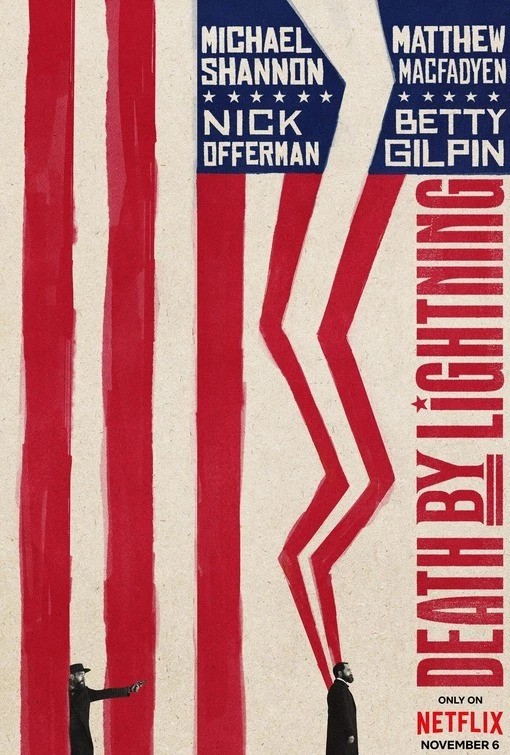
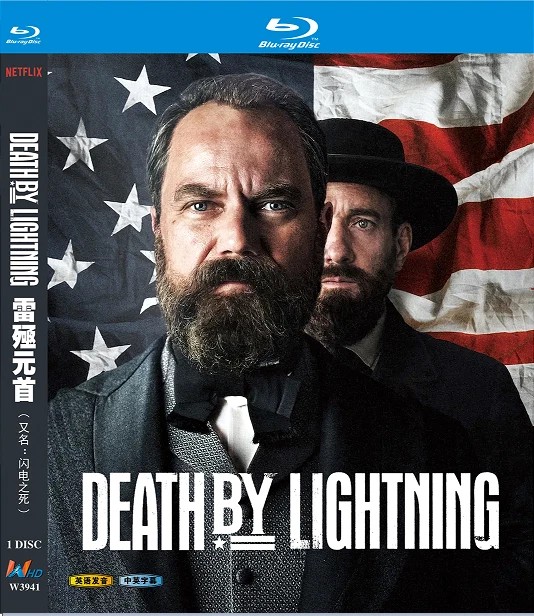
Streaming at its best. Take an obscure subject, a long-forgotten character, an incident that’s a mere blip in history, actors of less than middle rank in box office terms, and by breaking it down into easily consumable parts turn a history lesson that might be an indigestible three hours on the big screen into a riveting, enthralling drama of the highest quality that takes a no-holds-barred approach to politics
Small wonder you won’t have heard of U.S. President James Garfield (Michael Shannon) given he held office for around three months. Or of his misfit assassin Charles Guiteau (Matthew Macfadyen), less than a footnote in history for making the grave mistake of gunning down a President nobody had ever heard of.
Garfield shouldn’t even have been President. A mid-level politician on the verge of retirement, he wasn’t even in the running for the Republican nomination, which should have gone to Civil War hero Ulysses S. Grant. But in one of those quirks of politics, the voters liked what they heard of Garfield and in a grass roots rebellion shooed him in. He won the Presidential election by a whisker.
And then his troubles started. He was too honest for the job. Unwilling to follow the standard corruption and hand out highly-paid posts to rank-and-file unfitting for the job, he found himself up against the New York political powerhouse headed by Roscoe Conkling (Shea Whigham) who controlled the bulk of the revenue entering the country. And the battles with Conkling would have easily made a House of Cards-style series in itself as the dueling politicians attempt to outwit each other.
But in the background, and weaseling his way into the foreground, is con man, thief, forger, misfit Guiteau with as much entitlement as could sink a battleship who, nonetheless, grasps the key essential of politics of the era which is that helping to grease the greasy pole is all you need to reap the benefits. Except his efforts to become anyone’s righthand man fall way short, as his ambition and lack of any relevant skills are widely mocked – he expects to be handed an ambassadorial role although he speaks no foreign languages – despite occasionally finding an opening.
Having been dismissed by the President himself, he decides Garfield is totally the wrong person for the highest position in the land and takes it upon himself to rid the nation of this burden. Even the assassination is ham-fisted and Garfield would have survived except for the efforts of the ham-fisted surgeon who killed him through septic poisoning.
That’s the climax to a thoroughly involving mini-series where no punches are pulled as far as politics are concerned. Conkling doesn’t mind being the man behind the throne as long as he gets credit for pulling the strings. Political wheeling-and-dealing has never been so ruthlessly exposed.
But it’s not as if Garfield is an innocent in that department. While not stooping to corruption, he pulls the legs from under Conkling by appointing Conkling’s righthand man Chester Arthur (Nick Offerman) as his Vice-President, a scheme that while initially backfiring eventually pays dividends. And it’s ironic that Conkling’s demise is down to a thwarted mistress.
The narrative switches on like a thriller, twists and turns every inch of the way. But as much as the riveting narrative, the joy of this is in the performances. Matthew Macfadyen, double Emmy award-winner for Succession (2018-2023), is rightly going to be considered to have landed the plum role, a fellow so much of a misfit that in a “free love” community nobody wants to have sex with him. But it’s a close-run thing. Michael Shannon (A Different Man, 2024) is outstanding, and Shea Whigham (F1, 2025) has immense fun especially with his eyebrows and dominating curl, while Nick Offerman (Civil War, 2024) in shifting from oaf to man of honor has a peach of a role, not forgetting Betty Gilpin (The Hunt, 2020) as the straight-talking wife of the President.
None of these are stars, not even of the indie persuasion, and yet it’s amazing what they can do with their characters.
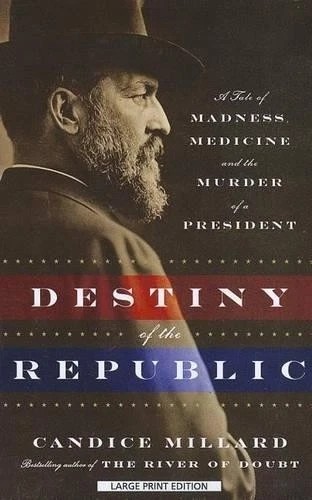
Directed with effortless style by Matt Ross (Captain Fantastic, 2016) from a script by Mike Makowsky (Bad Education, 2019) adapting the bestseller Destiny of the Republic by Candice Millard.
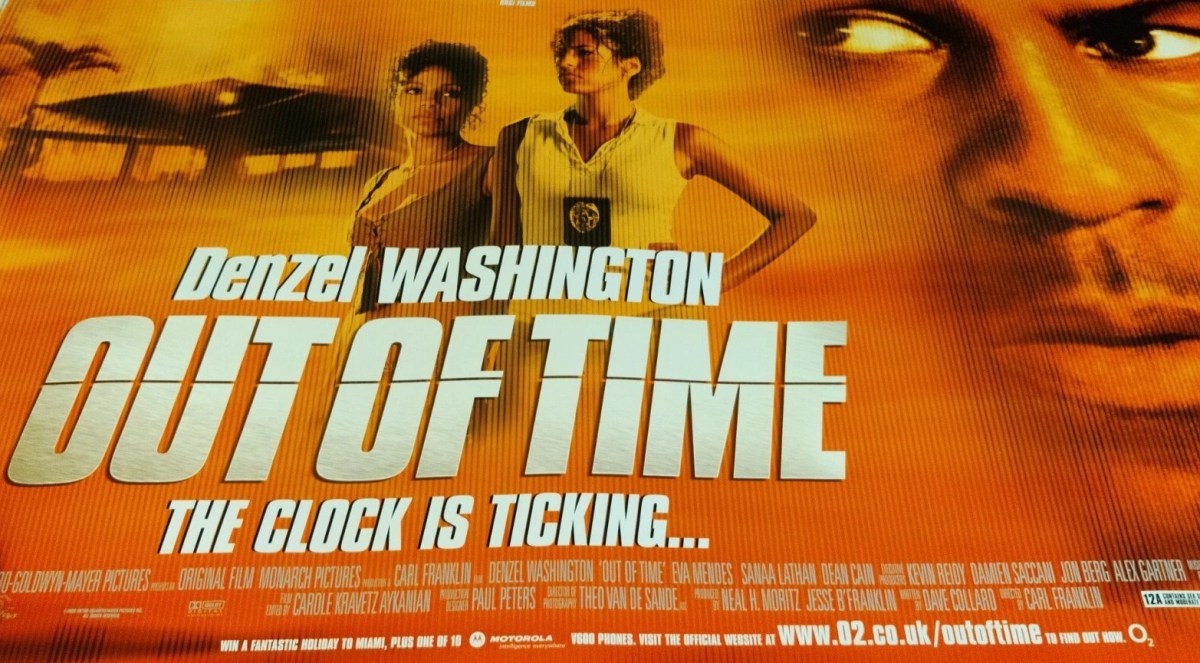
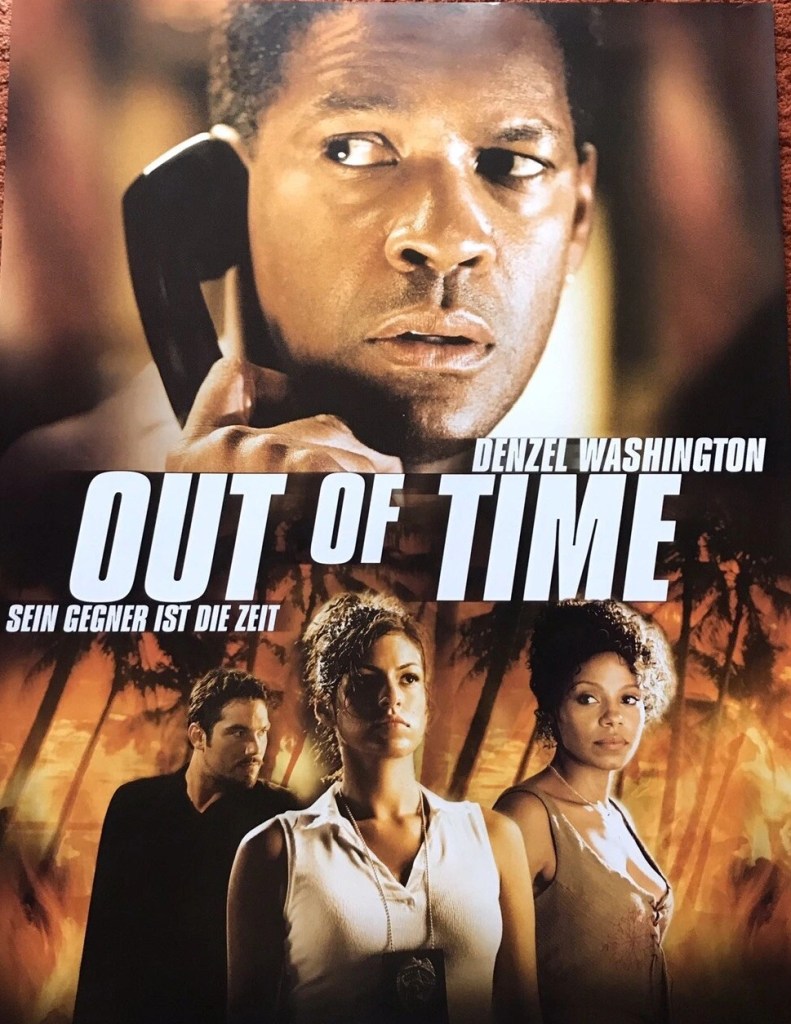
The most tension-filled thriller this side of The Day of the Jackal (1973). Stone-cold classic in my book. Admittedly not a big box office success in its day nor critically acclaimed, but this nod to film noir with cop taking a stroll for his own convenience down the wrong mean streets and an old-fashioned femme-fatale male-dupe scenario coupled with witty dialog and terrific set pieces suggests to me this is long overdue for reappraisal.
This was really the start of Denzel Washington as action hero – Crimson Tide (1995) was more a straightforward drama albeit with characters facing the ultimate consequence – and it probably helps that I’m looking back at this through the prism of more than two decades of the actor whizzing along in the derring-do department especially in his turn as The Equalizer (2014) – and sequels – where he demolishes opponents in seconds. Apart from the occasional side hustle as a bad guy, he’s generally been a good guy, the sort of dependable hunk that Tom Hanks would aspire to if he wanted to add brawn to his guy-next-door persona.
Matt Whitlock is the top law enforcement officer in a Florida slumber town (pop 1300) but he’s not as clean-cut as he looks given his affair with married Ann Harrison (Sanaa Latham) who bursts his romantic bubble by announcing she has just six months to live thanks to a cancer so advanced that only some new-fangled treatment could save her. I smelled a rat, I have to confess, the minute she decided she was going to make him the beneficiary of her million-dollar insurance policy.
So what’s a decent guy to do but steal the $500,000 drugs money he’s holding in his police safe, that’s liable to sit untouched for years to come, in order to fund her treatment on the assumption that the insurance policy acts as his insurance. How dumb can you be?
So when Ann and husband Chris (Dean Cain) die in a horrific fire, his world unravels, especially as detective soon-to-be-ex-wife Alex (Eva Mendes) is in charge of the murder investigation and the Feds arrive out of the blue looking for the drugs cash. So basically he’s an old-fashioned “running man”, diving from one hole to the next, barely keeping ahead of the cops and the FBI, fingered twice by witnesses, discovering that the specialist who diagnosed the cancer is an imposter, and not just being made to look the biggest fool who ever fell in love with the wrong woman but liable to pay for his error with a lengthy jail sentence.
Alex begins to suspect he knows more than he’s letting on, he’s desperate to trace the bogus doctor, all the while, in a nod to No Way Out (1987), desperately trying to stop a tsunami of telephone evidence – arriving via fax and computer – that links him to the supposed dead woman.
There are verbal confrontations galore and a couple of physical ones, a chase through a hotel culminating in a brawl on a balcony, and possibly a second murder charge.
It’s not just a terrific tale, mostly consisting of twists and narrow escapes, I counted half a dozen twists in the last ten minutes alone, but offers some terrific dialog. In a diner, the relationship between Matt and Chris is spelled out in style: Matt recommends the crab, Chris points out he’s allergic to crab. “I know,” retorts Matt. The movie opens with some decidedly salty goings-on between Matt and his lover and the verbal duel between Matt and Alex has the underlying Tracy-Hepburn classic squabbling.
For all that Matt is smart enough to chase down the missing cash and hold the Feds at arm’s length long enough, he’s still, when you come down to it, only going from dumb to dumber and the shock when he realizes just how well he’s been duped is a cracker.
So, obviously, the key is that the audience wants him, guilty though he is of theft and stupidity, to get away with it or at least be thrown a get-out-of-jail-free card and that’s part of the hook, and that element is brilliantly done. I had no idea how he was going to get off with it, as one avenue of escape after another was rigorously shut down, until the very end.
There’s a whole stew of those reversals that screenwriters throw at audiences who think they are one step ahead of the game.
It’s a great cast. Denzel Washington is superb, Eva Mendes (Training Day, 2001) is an excellent sparring partner, Sanaa Latham (AVP: Alien vs Predator, 2004) as slinky as femme fatale as you’ll find. Look out for television’s Superman Dean Cain and especially character actor John Billingsley.
Director Carl Franklin (Devil in a Blue Dress, 1995) piles on the tension and kudos to screenwriter Dave Collard (Annapolis, 2006) for creating the blueprint.
I caught this on Amazon Prime but be quick about it because it’s in the section that the streamer calls “leaving in 30 days.”
I am indebted to one of my regular correspondents, who goes by the name of “Fenny100,” for the following “Behind the Scenes” report:
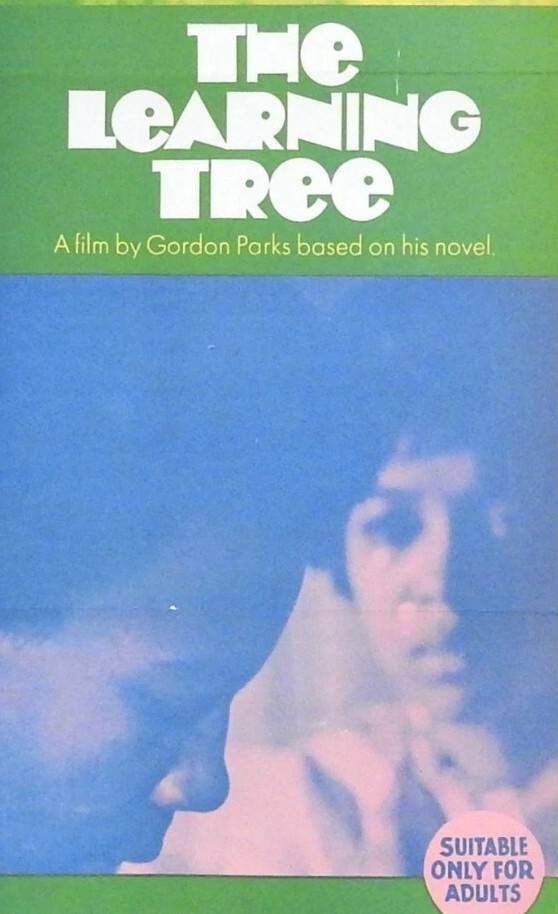
The working title of the picture was Learn, Baby, Learn. Based on his 1963 autobiographical novel, The Learning Tree, it marked the feature film debut of Gordon Parks, who was the first African American staff photographer for Life magazine. With the making of The Learning Tree, Parks became the first African American to direct a major theatrical motion picture. Parks had previously directed “several short film subjects and two one-hour features for National Education Television” (New York Times, 2 April 1968). The project was five years in the making (Variety, 17 April 1964), the writer-director in talks with producers interested in optioning his book. Two independent producers first acquired film rights (New York Times, 17 August 1969) but they were unable to raise the necessary funds. Another producer allegedly offered Parks $75,000 to adapt the script, with the stipulation that he must rewrite the black characters as white. Parks declined.
At some point, Bob Hope’s daughter, Linda Hope, was interested in producing the adaptation, (Variety, 7 November 1968). Parks’ friend, filmmaker John Cassavetes (Shadows, 1958), introduced his work to Kenneth Hyman, an executive at Warner Bros.—Seven Arts, Inc., which ultimately funded the production, although Cassavetes accidentally gave Hyman a copy of Parks’ 1966 memoir A Choice of Weapons rather than The Learning Tree. Hyman became enthusiastic about working with Parks and reportedly struck a four-picture deal with him within a fifteen-minute meeting. The Warner Bros.—Seven Arts deal (Variety, 1 April 1968) referred to Parks as “the first negro in film history to direct a major feature for a major film company.”
Also a well-respected musician, Parks was set to write the score, which (Variety, 12 July 1968) entailed a four-movement symphony. The production budget was set at slightly less than $2 million (Variety, 25 June 1969) and Parks was slated to receive twenty-five per cent of any profits (Los Angeles Times, 19 October 1969).
Principal photography was scheduled to begin on 30 September 1968 in Parks’ hometown of Fort Scott, Kansas, (“Production Chart,” Variety, 27 September 1968). Problems arose when the film crew, including six African Americans, began shooting in the town (Variety, 7 November 1968), a report which implied that the difficulties arose from racial tension. A later article (Variety, 25 June 1969) noted that there were twelve black crew members, not six, and blamed the tension between locals and filmmakers on the fact that Fort Scott residents wrongly assumed The Learning Tree was a “dirty film.” Parks said that shooting there eventually worked well, and that the local Elks Club admitted African Americans for the first time at a party thrown for the cast and crew. Parks was given a key to the city by local officials, and “Gordon Parks Day” was declared in early November 1968.
Following five-and-a-half weeks in Fort Scott, cast and crew moved to the Warner Bros.—Seven Arts studio lot in Burbank, California, where another two-and-a-half weeks of principal photography was scheduled, beginning in mid-November 1968. On 11 December 1968, Variety confirmed that filming had been completed.
Although William Conrad acted as executive producer throughout the shoot, his name was removed from the credits (Variety, 19 June 1969), though it was later explained that Conrad had agreed to help but wanted no credit, since The Learning Tree was “Gordon’s story.”
In discussing the small contingent of African Americans on his crew, Parks said (New York Times, 17 August 1969), “I hired 12 Negroes to work on the production. It was a fight, because the Hollywood unions are all white, but I got enormous cooperation from Warners.” The studio hired a black electrician, Gene Simpson, for the first time in its history (Los Angeles Sentinel, 13 March 1969), while publicist Vincent Tubbs – the only black union head as the president of the Hollywood Publicists Guild – worked on the film. Parks’ son, Gordon Parks, Jr., acted as still photographer. Seven African American craftsmen worked on the film (Box Office, 28 October 1968).
The Learning Tree was first screened on 18 Jun 1969 at a Warner Bros.—Seven Arts press junket held in Freeport, in the Bahamas (Variety, 18 June 1969). Following its debut there, Variety (25 June 1969) suggested that Parks’ “viewpoint on America and its racial problems” in the 1920s-set film might be negatively received by “black militants and other radical types.” Parks contended that black militants had been purposely planted in preview screenings, and although they had sometimes laughed at inappropriate times, they had generally congratulated him for his accomplishment. Parks stated, “But actually, I don’t care what they think. This is my story. I believe that in the black revolution there is a need for everyone.”
Despite the film’s perceived innocence, it received an M-rating (suggested for mature audiences) from the Motion Picture Association of America (Variety, 16 July 1969). It was due to have its world premiere on 6 Aug 1969 at the Trans-Lux East and West arthouses in New York City (Variety, 30 July 1969). Early reviews were mixed. Although the studio had initially planned a slow rollout of the film in arthouse theaters, its success at the more commercial Trans-Lux West – and relative failure at the Trans-Lux East – indicated the picture would play better at larger, inner-city theaters (Variety, 10 September 1969). A new “playoff pattern” was devised to take advantage of its box-office potential at theaters known for action films and other commercial fare.
Within seventeen weeks of release, cumulative box office gross topped $1.327 million from just 27 theaters (Variety, 5 November 1969).
At Los Angeles at Grauman’s Chinese Theatre, where The Learning Tree opened on 20 August 1969, a large fiberglass sycamore tree – which the studio planned to donate to the Crippled Children’s Society of Los Angeles County once the film’s run was complete – was built around the box office (Variety, 18 August 1969)
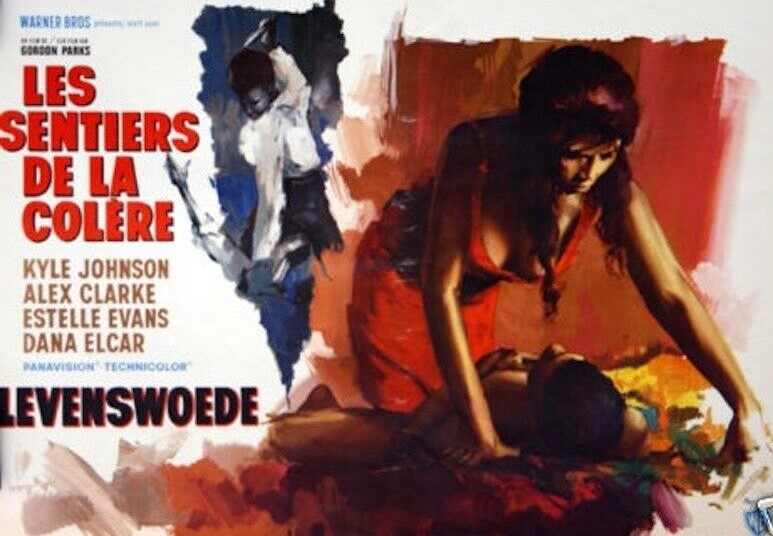
The Learning Tree was the U.S. entry at the Edinburgh Film Festival running 24 August – 7 September 1969. It won the Blue Ribbon Award from the National Screen Council in the U.S. for the month of September. The film went on to garner accolades including the National Association for the Advancement of Colored People (NAACP) Image Awards for Best Picture (in a tie with Joanna, 1968) Best Director, Best Actress in a Feature (Estelle Evans), and Most Promising Young Actor and Actress (Kyle Johnson and Alex Clarke).
Parks received an Annual Achievement Award from the Foundation for Research and Education in Sickle Cell Disease of New York City; an Achievement Award from the city of Cleveland, Ohio, presented by Cleveland Mayor Carl Stokes on the 24 September 1969 Cleveland premiere; and a Certificate of Merit from the Southern California Motion Picture Council, which also named the film a “Picture of Outstanding Merit.”
On the commercial front, the picture was a solid hit, raking in $1.5 million in rentals (what the studio earns after cinemas have taken their cut) in the annual box office chart (“Big Rental Films of ’69,” Variety, 7 January 1970).
Parks received honorary degrees from Boston University and Fairfield University in Connecticut. A week-long Gordon Parks Festival, also featuring Shaft (1971) and Shaft’s Big Score (1972), ran at Kansas State University in 1973.
Twenty years after its release, in 1989, it became one of the first twenty-five films selected for inclusion in the Library of Congress’ newly founded National Film Registry.
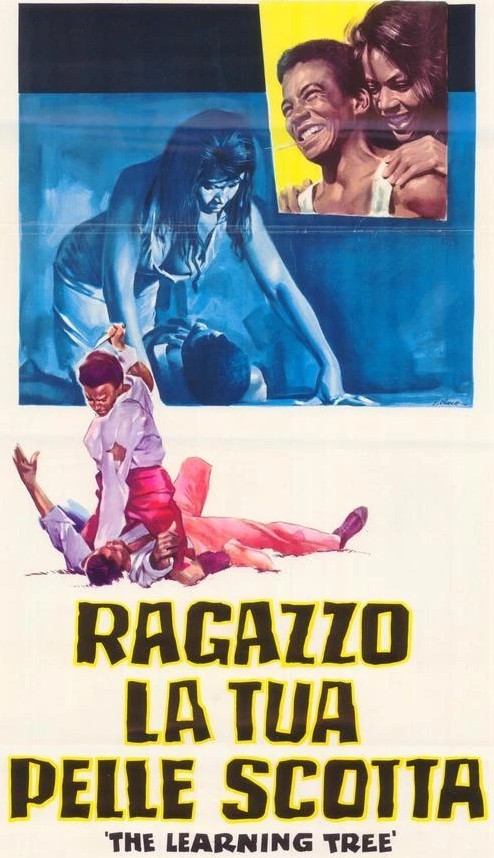
Director Gordon Parks made a big noise a couple of years later with Shaft (1971), Richard Roundtree shooting to fame as a slick and sexy private eye, memorable score by Quincy Jones. But The Learning Tree had possibly a bigger impact on the Hollywood consciousness, the first movie released by a major studio (Warner Brothers) that was directed by an African American. Although actors like Sidney Poitier and Jim Brown had smashed the Hollywood glass ceiling, directors lagged far behind. And this would have been an interesting tale in its own right of adolescence in 1920s Kansas had the leading character Newt (Kyle Johnson) and buddy Marcus (Alex Clarke) not faced such blatant racism.
Told today, the story would take a different route, concentrating on the dilemma of Newt in coming forward with the evidence that could convict Marcus’s father Booker (Richard Ward) of murdering a white man, not just the guilt at sending another African American to the electric chair but fear of the killing spree that must follow from enraged whites. Instead, that aspect comes at the tail end of a story that sees Newt and Marcus react in different ways to white supremacy. It’s not that Newt is spineless, toeing the line, but that Marcus, filled with venom, sees violence as the only way to establish any kind of equality.
When Newt, a reasonable enough scholar, though hardly in the genius class, is marked down by his teacher on the grounds that it’s a waste of time going to college when he will still end up a cook or a porter, the young man responds, “You hate us colored kids, well, we hate you, every one of you.” Marcus has a similar mantra, “this town don’t want me and I don’t want this town.” That underlying endemic racism contrasts with the more overt vicious bullying of local cop Kirky (Dana Elcar) who casually shoots any African American who sensibly runs away at his approach and who ends every sentence with the word “boy.”
What makes this so powerful is that for long stretches there’s just the ordinary coming-of-age tale of Newt falling in love with Arcella (Mira Waters), sneaking a kiss, finding their own special place among the daffodils, buying each other Xmas presents, the romance conducted among summer picnics, winter snow, rowing on the river, the young man showing his beloved every respect even given that he is not a virgin, having unexpectedly lost his cherry while sheltering from a tornado. He has a conscience, too, going to work voluntarily for a farmer whose apples he stole.
It’s not just Newt’s equable temperament that’s prevents him from reacting like Marcus to the unfairness of the white-dominated world. He has the ability to get the best out of situations. A born negotiator he manages to triple the reward offered by Kirky for helping bring up a dead man from a river, and, having been taught to box, earns good money in a match. Marcus goes to jail for beating up a white man who attacked him with a whip and this not being a sanitised version of the African American world on release ends up working in a whorehouse while his father steals a supply of hooch.
Even so this is a hierarchy even a prominent white person cannot overturn. When a judge’s son invites Marcus and Arcella into a drug store, the other two must take their drinks outside.
A staff photographer for Life magazine, director Gordon Parks, adapting his autobiographical novel, avoids the temptation to pack the movie with brilliant images, instead concentrating on core coming-of-age aspects to drive forward the narrative. He doesn’t have to do much to point up the injustice. That’s inherent in the material.
It probably helped that the three young principals were inexperienced, although at the time of course roles for African Americans, except in cliché supporting parts, were hardly abundant. Kyle Johnson (Pretty Maids All in a Row, 1971) was 16 when playing the 14-year-old, Alex Clarke (Halls of Anger, 1970) pushing 20 and making his debut as was Mira Waters (The Greatest, 1977). There’s no straining for dramatic acting effect. Everyone plays it straight.
Others involved are Estelle Evans (To Kill a Mockingbird, 1962), Dana Elcar (Pendulum, 1968), Richard Ward (Black Like Me, 1964) and Russell Thorson (The Stalking Moon, 1968). Not only did Parks write, produce and direct but he supplied the music too.
It’s an absorbing, if at times difficult, watch. It’s an accomplished picture for a beginner. And you can’t help but wondering how four decades after this story takes place little had changed for ordinary African Americans and another five decades after the film’s release the battle for equality has not been resolved.
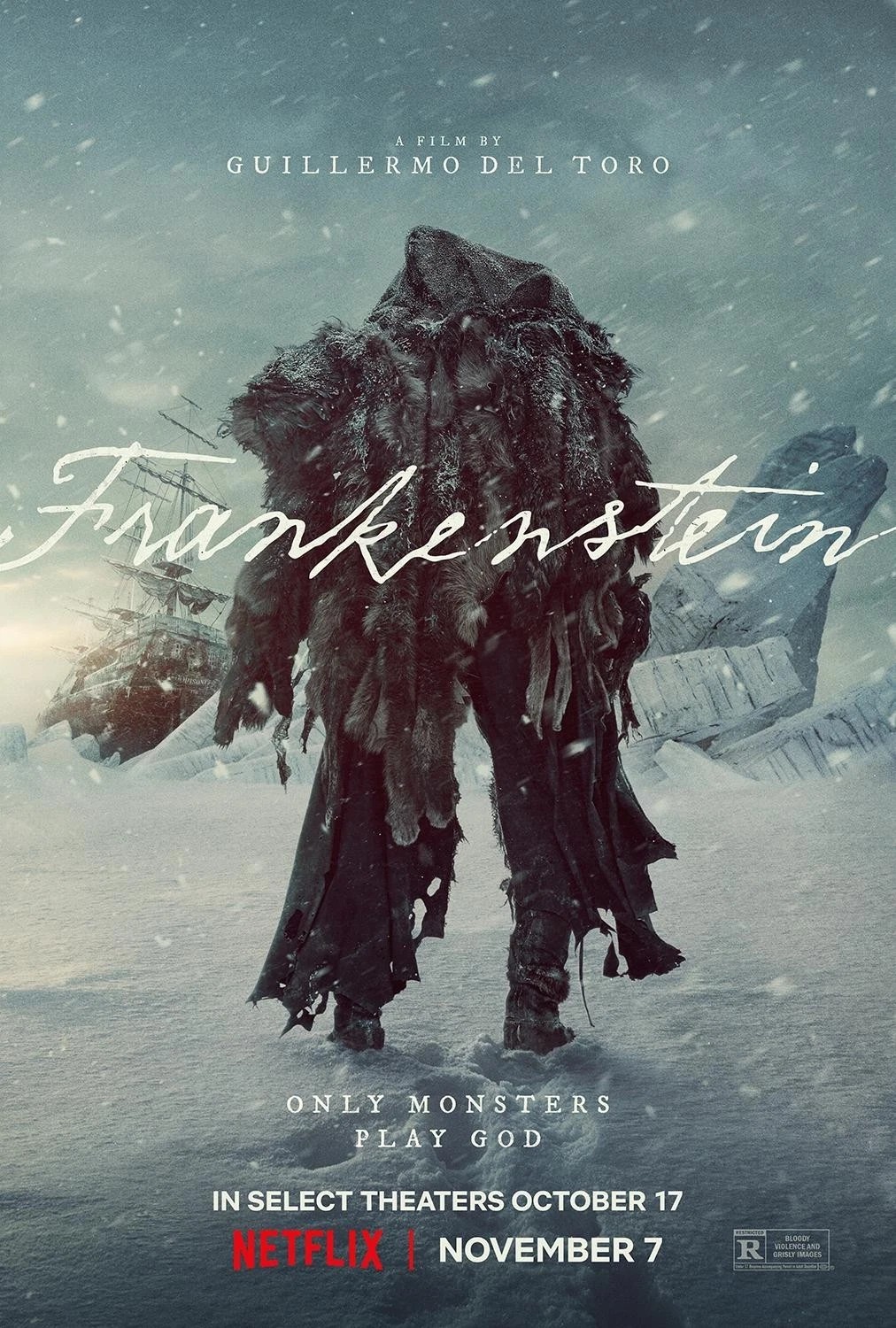
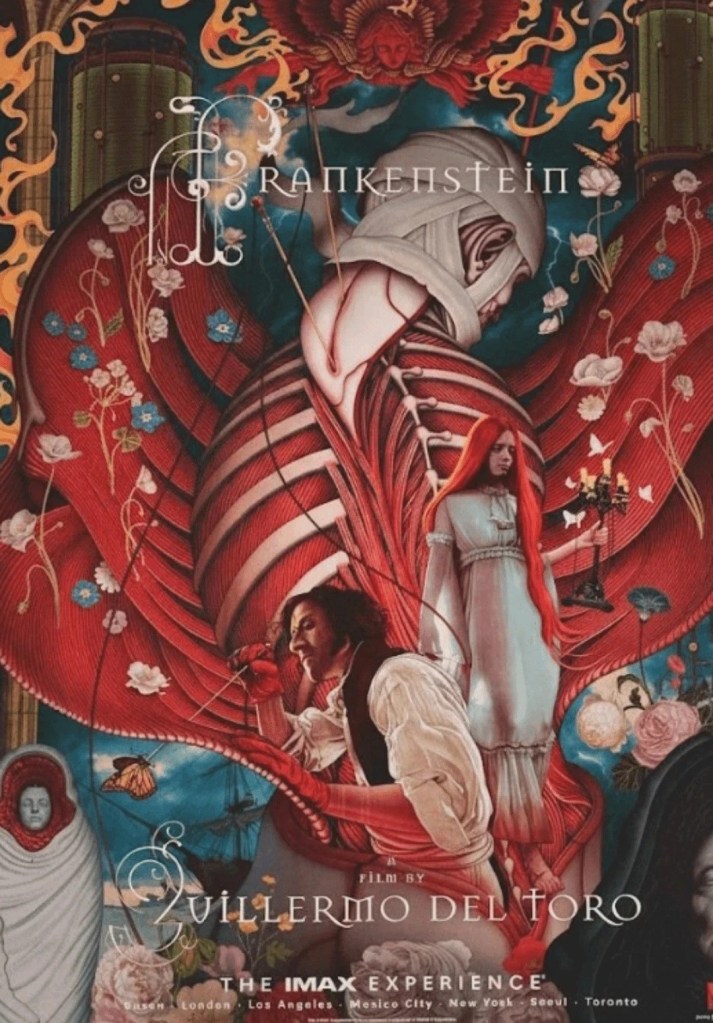
I came at this with a bucketload of reservations. First was the length. I grew up with versions of this tale that were around a good hour shorter. Ninety minutes seemed to be the ideal length not a stonking 150 minutes. Secondly, I’m not a huge fan of director Guillermo del Toro and excepting Pacific Rim (2013) – an outrider in his portfolio – and The Shape of Water (2017) felt his reach was not matched by his grasp. He was the kind of director whose work I was supposed to like and invariably responded less well than I had expected. And third of course was, even with the trend for reimaginations and remakes and in the hands of a “visionary director” (a vastly over-used term), I had seen this story so often before I wondered what else he could bring to it.
So I was very pleasantly surprised to find an emotionally satisfying thoroughly enjoyable work that did not outstay its welcome. Moreover, it doesn’t rely on the tropes of outraged villagers carrying torches and as far as I can gather without me going back to the sacred text whatever changes have been made to the original appear logical and true. Both the creator and the monster at various points will touch your heart.
One of the aspects I most enjoyed was the creation. The detail involved was in keeping with heist movies where robbers work out their plan in minute detail or war films where the audience is filled in on the strategy and tactics involved in battles as though they were adults who could understand the importance of long scenes of dialog rather than treating them as children who preferred to go straight into the action regardless of whether they understood what was going on or not.
Here, we begin in the Arctic where an exploration vessel trapped in ice comes upon a very ill Victor Frankenstein (Oscar Isaac) who is being pursued by the monster (Jacob Elordi) of his creation.
Then we’re in flashback mode. Victor is son of a famous but tyrannical surgeon (Charles Dance) whose adored mother dies in childbirth giving birth to a more favored brother William (Felix Kammerer).
Then we shift to a medical disciplinary court where Victor is on trial for his experiments in reanimating corpses, for playing God in a society where the Supreme Being was still considered in charge of everything on Earth. But no matter how clever the corpse appears, capable of apparently playing catch, the case goes against him and his dreams, and career, would be in tatters except for the intervention of wealthy arms dealer Harlander (Christoph Waltz), uncle of Elizabeth (Mia Goth) the fiancée of William.
She’s intellectually advanced for a woman of the era, studying insects, and more than a match for Victor and for a while it looks like we’re in for an awkward love triangle. Meanwhile, Victor is harvesting bits and pieces of fresh corpses from battlefields and stitching them together in a way that maintains the body’s unique nervous system while Harlander happily stumps up the enormous cost.
The experiment, which takes place in a remote castle and costs the life of Harlander, is a success but given the monster’s size (Jacob Elordi) Victor keeps him in chains in the castle’s vast cellar. But he soon becomes exasperated by the creature’s lack of intellect, speech limited to repeating his creator’s name (and his own as it turns out).
When Elizabeth discovers the creature, she falls in love with it and turns against the scientist and keeps the gift of a leaf the creature has given her pressed inside the pages of a book. Since the creature is fit for no more than a circus exhibit rather than acclaimed as an experiment, and needing someone to blame for Harlander’s death, Victor fits up the monster, blaming him for setting fire to the castle.
Victor escapes, takes refuge in a cottage where he is educated by a blind man, and discovers his own emotions. Hounded out of there, he sets out to find Victor who is attending his brother’s wedding. The monster’s plea for a female companion is derided by Victor and in a melodramatic moment he accidentally shoots Elizabeth. The monster carries the dying woman out of the wedding pieta style.
So the hunt is on. Victor flees to the frozen north and eventually when the monster engineers a confrontation, he is able to attempt reconciliation with his creator.
The question asked – who is the monster? The creator or the result of his tampering with nature?
The acting is top notch, Jacob Elordi (Saltburn, 2023) should have walked off with the acting plaudits except that Oscar Isaac (Dune, Part One, 2021) elicits our sympathy and then our horror and Mia Goth (Maxxine, 2024) excels in a role where she is not called upon, as so often before, to overact. As far as Christoph Waltz (No Time to Die, 2021) and Charles Dance (The First Omen, 2024) are concerned their roles are minor variations of characters both have played before.
Praise is very much due to writer-director Del Toro for not losing my interest for a minute.
Since this is a Netflix production I could have saved myself a few bucks and waited till it appeared on the small screen. But unlike other big budget works by “visionary” directors, this will work very well on the smaller screen because, despite some arresting visuals, it’s essentially a chamber piece involving a handful of characters.
The highest praise I can give any director of an epic is the ability to not lose my interest for a single minute. So all praise Del Toro.
The big buzzword in movie marketing back in the day was “pre-sold.” The reason Hollywood pumped so much money into buying up the rights to bestsellers and Broadway hits was the notion that they came with a built-in audience, either of readers of theater-goers, and without any substantive proof made the connection that anyone who had read the book or seen the play or musical would be only too desperate to see what a movie maker made of the piece. In the 1960s, as I pointed out in a previous article, Hollywood had discovered the paperback tie-in, which marketing hacks perceived as free advertising, since those book covers would go on display in over a 100,000 book outlets across the country.
Even so, it comes as something of a surprise to see how dependent the marketeers writing the 16-page A3 Pressbook/Marketing Manual were on drawing cinema managers’ attention to the fact that Sweet Bird of Youth had originated on the stage. The three main articles in the Pressbook either went with “repeats role” or made mention in the headline of its origins. Admittedly, it had been a hit on Broadway, and with Paul Newman attached, ran for over a year – its poor performance on tour was naturally omitted. The opening article sensibly went to promoting Tennessee Williams. This was deemed “one of his greatest hits” and moviegoers would certainly be aware of his name thanks to Cat on a Hot Tin Roof (1958) and Suddenly, Last Summer (1959), both big hits.
However, given that Geraldine Page was the female lead and Oscar-nominated the previous year for Summer and Smoke, it seems odd that more column inches are devoted to third female lead Madeleine Sherwood with second female lead Shirley Knight overlooked except for a couple of postage-stamp-sized photos.
The “distinguished cast” notion was pushed much in the same way as trailers these days will promote anyone with the slightest brush with the Academy Awards.
“People have wondered why I had to work so hard to repeat a role I had done for more than a year in New York,” said Newman. “My only answer is that during the entire Broadway run of the play, Geraldine Page and I worked and rehearsed every day as if we were preparing for first night.” Despite his box office success he nurtured other ambitions. “ I want to be behind the camera. I’ve got my sights on directing. But I’ll start only when I think I know enough.”
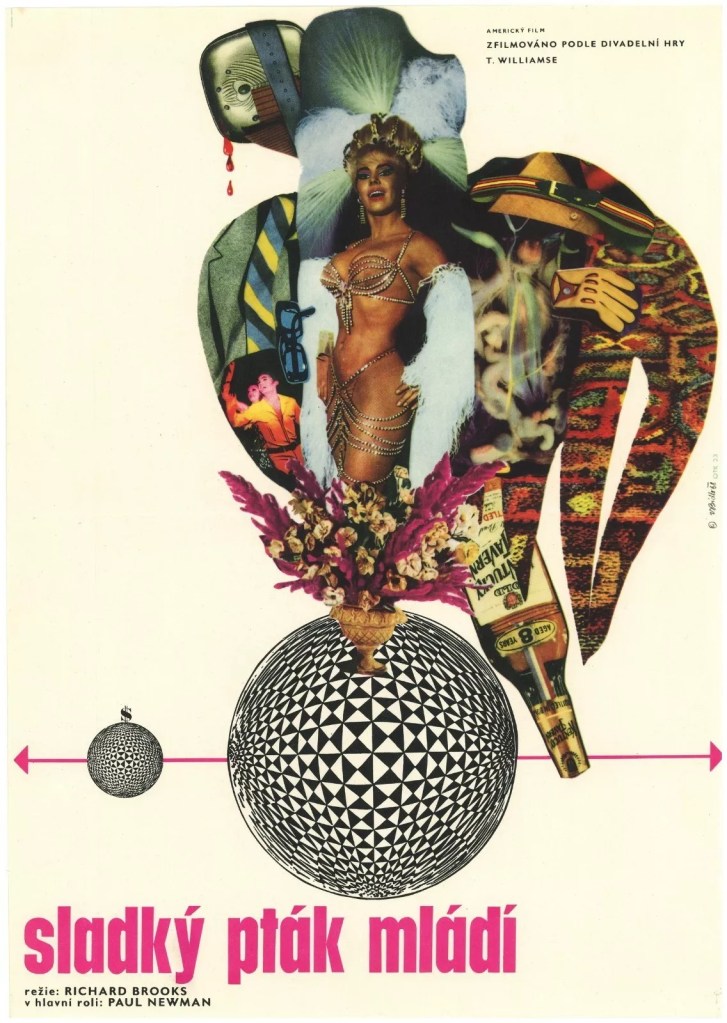
The first stab at artwork was less sensational than the final posters.
The marketeers fell in line with the notion now being touted in Hollywood that, despite leaving Geraldine Page out in the cold for seven years after she starred opposite John Wayne in Hondo (1954), was “a major talent to be reckoned with by fans and critics alike.”
Commented Page, “I played Sweet Bird and Summer and Smoke on stage for long so that I felt I knew the heroines Alexandra Del Lago (Sweet Bird of Youth) and Alma Winemuller (Summer and Smoke) as well as if they had been sisters of mine. This long-lived familiarity with a part might make some actresses feel cluttered but but it was a great comfort to me…You can work with them forever and never get bored…the longer you get to know them the more you become fascinated with them.”
And what was it, exactly, that was so fascinating about Madeleine Sherwood? It was the fact that she was a method actress, as though this was still big news after being known for over a decade. She explained that “emotional memory” as proposed by Lee Strasberg, method acting’s most famous proponent, was the key to her acting.
Pressbooks always tax the ingenuity of the marketeers who have to dream up snippets which might interest a local newspaper editor. Here we learn that virtually all the cast were blue-eyed, “associated with genius” according to the Pressbook team. For the scenes in which Newman drove a car – on a sound stage no less – he drove 600 miles without hitting a real road. We learned that Newman once wore a beard in a stage show in his early years and that Page once played an old crone also on stage. Also that Page was a dab hand a wearing a negligee, having spent time in her “lean years” working as a model in a negligee factory on Seventh Avenue.
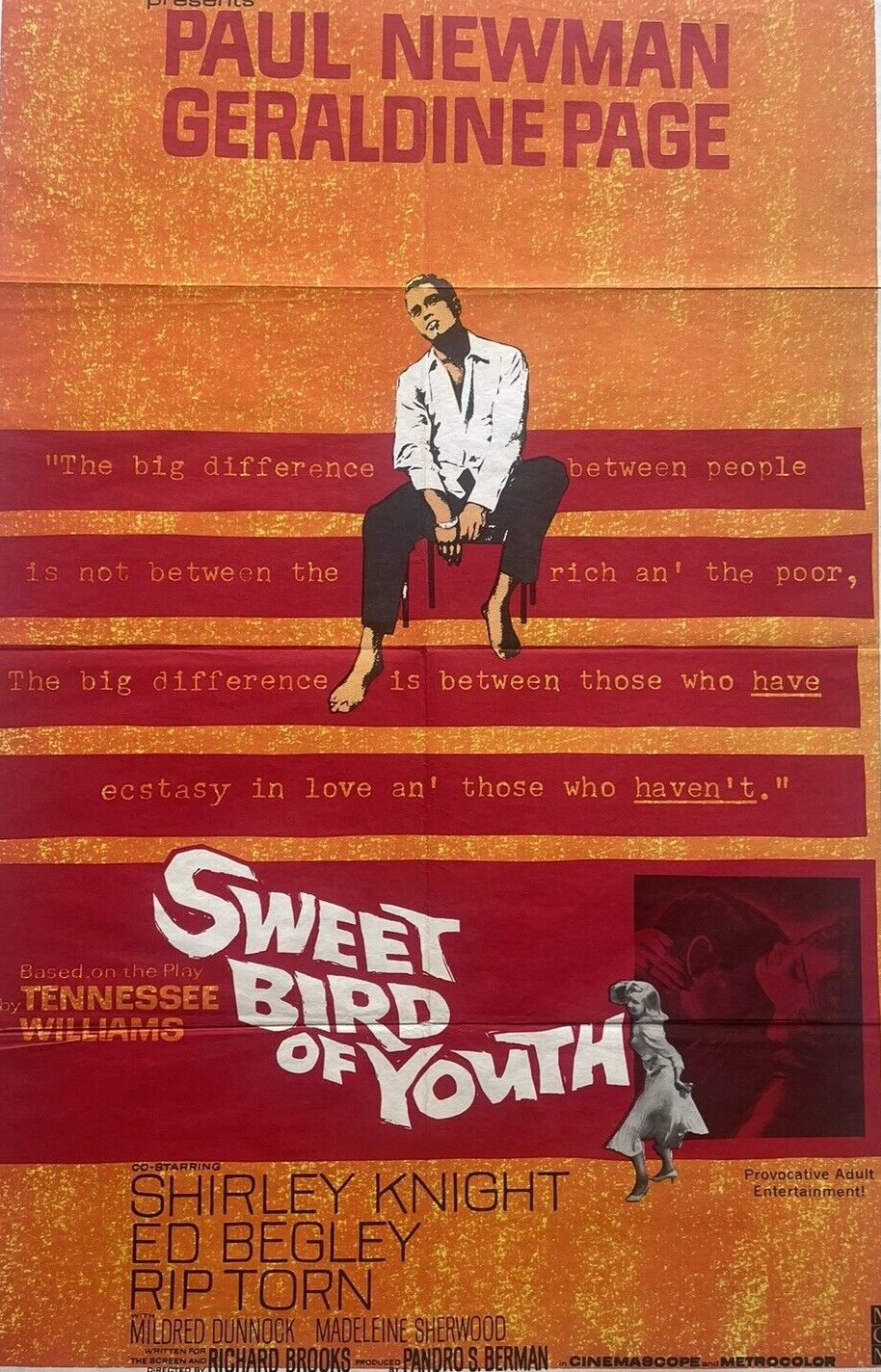
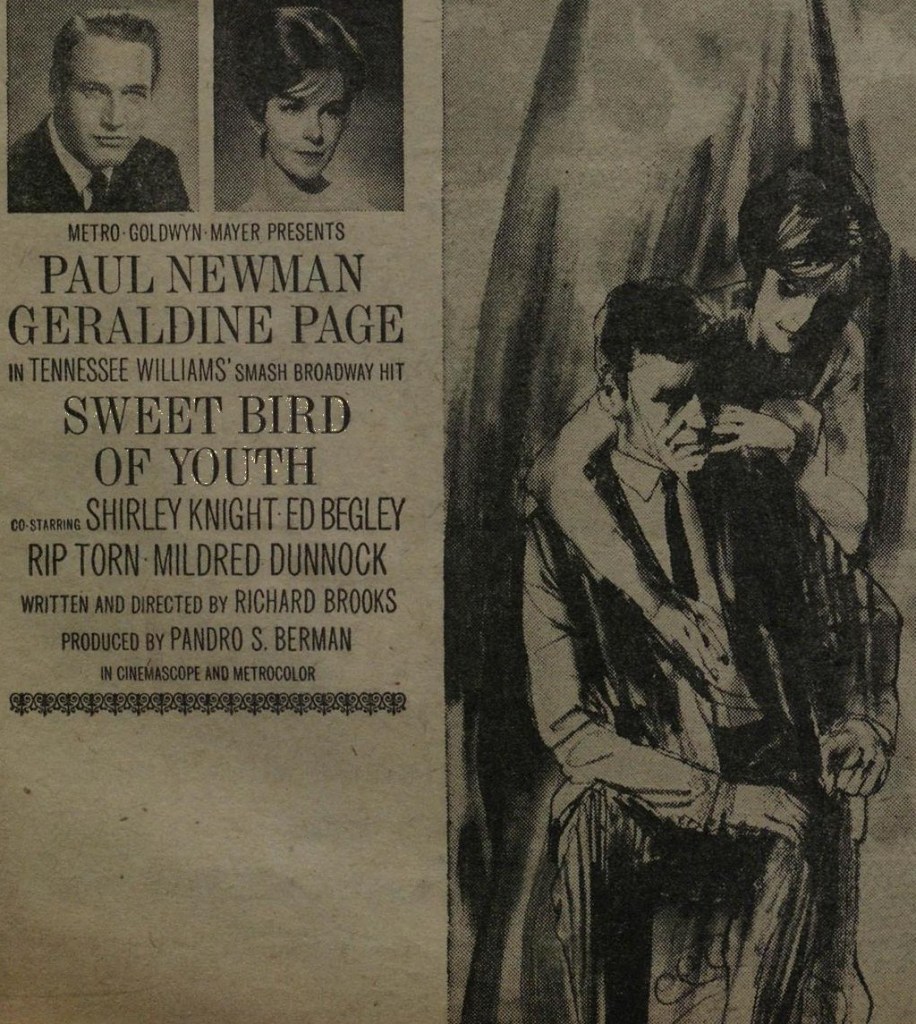
It would appear that there was a difference of opinion when it came right down to it about which advert – there were four to choose from – would lead the advertising pack. The Pressbook led with the tagline – “the big difference between people is not between the rich an’ the poor. The Big difference is between those who have ecstasy in love and those who haven’t.” Instead the team responsible for the posters went with the shorter, “He used love like most men use money.”
That tagline originated from a longer one, that more or less told the story of the movie. “Here he is right up on top of the gaudy world he swore he’d conquer. He’s got a movie contract in his pocket, a fish-tailed convertible in the hotel garage and a dame in his room payin’ for the drinks. He’s Chance Wayne who used love like most men use money!”
The speedboat that makes a brief appearance was central to the marketing campaign. Theater owners were urged to arrange tie-ins with local distributors of not just boats but boat engines. This was on the back of the Dumphy Boat Co of Oshkosh, Wisconsin, providing a $10,000 luxury speed boat for the shoot and because the Scott Racing Team supplied the $200,000 engine that powered it. Claims that the movie contained one of the greatest-ever telephone calls ever committed to celluloid provided the marketeers with an excuse to suggest a tie-in with a local telephone company.
Some ideas were more random. Because Newman wore a watch and Page a fur, tie-ins were suggested with those manufacturers. For no particular reason, except that she used them in her ordinary life, Shirley Knight was associated with cosmetics, perfumes and sportswear
A bit more imaginative was the idea of running a one-act play competition with a local dramatic group. A “Tennessee Williams Week” could be promoted through local libraries. A paperback version of the play had been published by the New American Library.
Actually, the biggest element of the Pressbook was the advertising. Twelve pages out of the sixteen were devoted to adverts in various shapes and sizes, that variety important because in those days cinema owners simply cut out the advert they required and passed it on to a newspaper to make up the advert to run there.







 The Magnificent 60s