I am a published author of books about film - over a dozen to my name, the latest being "When Women Ruled Hollywood." As the title of the blog suggests, this is a site devoted to movies of the 1960s but since I go to the movies twice a week - an old-fashioned double-bill of my own choosing - I might occasionally slip in a review of a contemporary picture.
In the days before computerised box office figures and the internet permitting easy access, fans of the sport had to make do with the weekly tallies in the “New York Showcase” section run every week in Variety. The “Showcase” was an early version of the wide release but instead of the 3,000-4,000 cinemas involved today in an opening week launch, movies would hit the Big Apple in 23-60 theaters. No matter the low theater count, it was still considered the most accurate prediction of how a movie would fare nationwide.
Some films opened straight into the showcase format, others ran day-and-date with a glossy opening on Broadway or a prestigious arthouse, and for a few this was the first step in general release after a roadshow run.
The same rules applied as today. A movie was retained for a further week only if the picture hit the target. Long runs were rare, two weeks the standard. As we shall see, some were movies making their 1969 debut while others were going wide after opening the previous year, the delay accounted for by holdover success in first run or Oscar recognition.
Just over 200 theaters took part in the showcase splurge, divided into five main strands generally through circuit or distributor affiliation plus one that brought together suburban arthouses. Not all the streams were in full-time operation, some weeks saw four new releases others six. Movies could count on losing theaters after the first week.
And, as with now, while overall receipts were the main factor, the per-theater gross could also offer up some indication of future performance.
The best single week’s take in 1969 was achieved by Dustin Hoffman comedy The Graduate which took $760,000 from 43 houses (per-theater average: $17, 674) followed very closely by Ali McGraw debut Goodbye, Columbus with $757,000 from 44 ($17, 204 per theatre). Steve McQueen thrill-ride Bullitt nabbed $684,000 from 45 ($15,200). In fact all three pictures placed twice in the single-week top ten.
Others flying high, at least for one week, were: Whatever Happened to Aunt Alice ($540,000 from 48), True Grit ($531,000 from 49), Joanne Woodward in Rachel, Rachel ($522,000 from 42), psychedelic outing The Trip ($520,000 from 49), sexploitationer Fanny Hill ($506,000 from 42), The Boston Strangler ($481,000 from 38) and I Am Curious Yellow ($480,000 from 40).
By contrast, at the other end of the heap, Marlon Brando in Night of the Following Day could only manage $125,000 from 31, The Assassination Bureau scraped up $82,000 from 22, Elliott Gould in Ingmar Bergman’s The Touch hit $48,000 from 26 while Michael Caine performed abysmally, Play Dirty knocking up just $91,000 from 24, The Magus $80,000 from 20, The Battle of Britain tumbling stratospherically from $366,000 from 32 one week to $101,000 from 27 the next.
But the showcase system also breathed life into arthouse hits attempting to break out into a wider marketplace. John Cassavettes’ Faces rocked up $469,000 in three weeks, Luis Bunuel’s Belle de Jour $329,000 over the same period, Brian De Palma’s Greetings $263,000 in a fortnight while one week of Robert Downer Snr.’s Putney Swope registered $205,000.
Reissues were also prime fodder to stoke up a distribution system creaking at the seams due to lack of new product. Gone with the Wind (1939) was the plum, $658,000 in three weeks. Disney’s Swiss Family Robinson (1960) chopped down $418,000 in two and Clint Eastwood pair A Fistful of Dollars/For a Few Dollars More – both released Stateside in 1967 – $279,000 in a fortnight. More usually, reissues lasted just a week, filling a gap in the annual program.
Even so, they could pull in some decent numbers: Peter Pan (1953) grossing $300,000, Sidney Poitier double bill Guess Who’s Coming to Dinner (1967)/To Sir, With Love (1967) $272,000, perennial favorite The Sound of Music $230,000, Rosemary’s Baby (1968)/The Odd Couple (1968) $215,000, James Bond dualer Goldfinger (1964)/Dr No (1962) $162,000, another Eastwood pair The Good, The Bad and the Ugly (1967)/Hang ‘Em High (1968) $155,000 and a lengthy coupling of Planet of the Apes (1968)/ Those Magnificent Men in their Flying Machines (1965) $115,000.
The overall winner in the annual New York Showcase stakes was The Graduate which over a five-week run grossed $2.24 million. Bullitt was the runner-up with $1.99 million over six weeks, though the last sally was in a double bill with Bonnie and Clyde. Goodbye, Columbus came third with $1.95 million over four weeks. Romeo and Juliet lasted a record eight weeks to pocket $1.69 million. Fifth was Swedish sensation I Am Curious Yellow on $1.28 million after five weeks.
After playing first run for the best part of six months Rachel, Rachel hit the showcases following an Oscar nomination for Joanne Woodward, bringing in $1.08 million over three weeks. Another anomaly was I Love You, Alice B. Toklas, such a flop the previous year it was ranked 78th in the annual box office race, but now emerging as a showcase front-runner with $1.03 million over five weeks.
Eighth spot went to The Boston Strangler ($932,000 in three weeks) followed by Charly – Oscar win for Cliff Robertson – on $910,000 for six weeks. Butch Cassidy and the Sundance Kid was tenth with $900,000 in two weeks – the western had launched at the tail end of the year and did so well it ran for another five weeks in 1970 to capture an extra $1.5 million.
Filling out the top twenty were, in order, Easy Rider, Ice Station Zebra, The Night They Raided Minsky’s, The Wild Bunch, Popi, On Her Majesty’s Secret Service, True Grit, Oliver!,Whatever Happened to Aunt Alice and Fanny Hill.
In general terms, New Yorkers response to showcase releases was mirrored throughout the country. The majority of the high-flying films mentioned ending up in the annual box office top 20. But there were some anomalies. Rachel, Rachel had finished the previous year in 37th place in the annual chart, hardly suggesting it was prime candidate for an exceptional showcase run. The Night They Raided Minsky’s came only 32nd in the 1969 chart. Whatever Happened to Aunt Alice did not earn enough around the country to qualify for inclusion on the annual chart. And, frankly, I’m mystified as to why I Love You, Alice B. Toklas did so well.
By contrast Paul Newman racing picture Winning performed so indifferently in the New York showcase that for the final two weeks of its three-week run it was bolstered by John Wayne oil adventure The Hellfighters, yet it ran out 16th for the year. Three in the Attic (18th in 1969) and Support Your Local Sheriff (20th) failed to match expectations in New York.
I rarely feel inclined to dig around the two streamers – Netflix and Amazon – available to me what with a vast backlog of 1960s DVD/VHS still to plough through and interest in contemporary cinema sated though a weekly visit to the multiplex. It’s rare that I can sit through more than five minutes of the movies funded or picked up by streamers, so poor is their quality control. So this came as a surprise.
The acting’s not the best and just when you are beginning to run out of patience suddenly the real twist kicks in and it makes terrible, terrible sense and a situation that has spiralled out of control ends up in a bottomless pit. I say the real twist because I had guessed the first twist, an obvious consequence of the set-up of these kind of films. But the real twist is much darker and eminently more savage.
So, the basic story is rock musician Jay (Peter Sarsgard), estranged from wife Rebecca (Mireille Enos), takes teenage daughter Kayla (Joey King) to dance camp and on the way picks up her best pal Trini (Dani Kind) and somewhere in the middle of an ice-bound wilderness said friend needs the toilet. Kayla and pal go off but only Kayla returns, admitting she has pushed friend off a bridge into icy river.
Jay’s now got to decide how to protect his murderous daughter, hide any evidence of Trini being in the car etc. He confides in Rebecca, and protecting their daughter brings the couple closer together. Meanwhile, Kayla is acting as if what’s all the fuss about. This is dysfunctional on the rocks.
Luckily, it turns out Trini has a record of running away and her dad Sam (Cas Anwar) has a terrible temper and may be abusing her so it’s relatively easy to get the police to consider him the main suspect, especially as he’s very lax in reporting the child missing. Plus, Rebecca seems to know her way about the police and Sam makes the mistake of causing a scene in the street.
But, of course, nothing goes according to plan, the situation gets worse, as the innocent parents try to fabricate something that will make the police go away. There’s a lot of other subtle stuff that complicates the situation. But essentially it’s two parallel stories diverging along psychological lines.
With those malevolent eyes, Peter Sarsgard (The Batman, 2022) has some difficulty passing for innocent, and of course his character is not exactly saintly, so that muddies the waters, as I guess is the intention, while the casting of Mirielle Enos (best-known as the detective in the U.S. television adaptation of Nordic hit The Killing, 2011-2014) also suggests the director is hoping to mislead the audience.
Joey King (Bullet Train, 2022) is so sulky and petulant from the outset that you wouldn’t be remotely surprised that her teenage hormones could escalate into murder and then for her sit back and enjoy watching her parents try to deal with the consequences.
And you might nitpick and wonder exactly what kind of town this is when there’s not a single neighbour to appear at the sound of an argument or a fight or a car accident, and no cameras on the streets. But generally, this is a tight mostly three-hander with tension quietly building, wrong decisions taken by people who think they are cleverer than they are, a finely balanced pyramid of parental attitudes to children and vice-versa and throwing out the one question every parent hopes to avoid: how will your react if your beloved child commits a heinous crime? What lengths will you go to protect them?
So in the context of the shattering ending, everything makes far worse sense.
A very neat thriller and almost a made-for-streamer feel about it, in the old made-for-television sense.
Writer-director Veena Sud (The Salton Sea, 2016) keeps a keen grip on a tale that is a remake of German picture Wir Monster (2015).
I have given in to entreaty. Demand might be too strong a word. Or you could say, using a phrase that I hope is consigned to the past, I have responded to “constructive criticism.”
I have been contacted by a goodly number of my readers wondering, to save them trawling through what is now close on 750 reviews, whether there was another, simpler, way for them to pore through the collection. If there was, in other words, a way of putting the collection together in a manner that could be accessed in one fell swoop.
Fortunately, I came up with a solution. I could publish them in book form, both in Kindle and for those, like myself, who prefer to hold a physical object, as printed material. Unfortunately, it would not be possible to put the entire set of reviews in one book. I’m not saying it would bust the Internet, but a book over 500,000 words long would be a very sizeable undertaking in either format. I should know, I got into trouble with my American publisher McFarland for delivering a book that totalled 250,000 words (Coming Back to a Theater Near You, in case you’re interested.)
So I’m publishing the works in stages and as two separate publications, although the titles, I have to admit, and the covers as well for that matter, are similar.
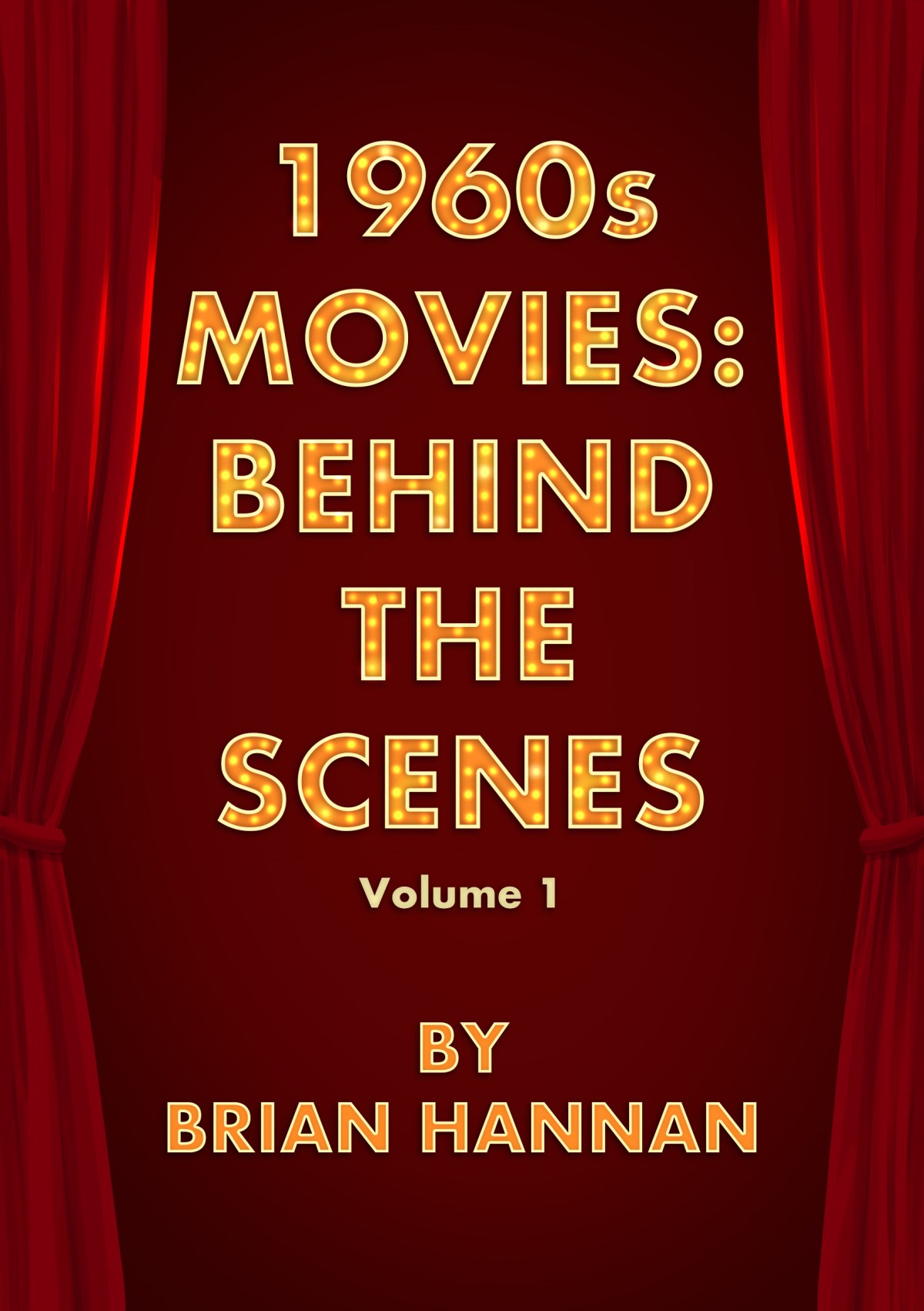
1960s Movies: Behind the Scenes Volume One does what it says on the tin. It’s a collection of the first 30-odd articles examining what went wrong or right in making particular movies during the decade. It ranges from Battle of the Bulge (1965), Dr No (1962), The Girl on a Motorcycle (1968) and now, officially, the greatest western ever made Once Upon a Time in the West (1969) to Operation Kid Brother (1967), Secret Ceremony (1969) and The Ipcress File (1965) plus the Alistair MacLean quartet of The Secret Ways (1961), The Guns of Navarone (1961), The Satan Bug (1965) and Ice Station Zebra (1968).
In addition, there is a sampling of two other popular features of the Blog , “Book into Film” and “Pressbooks,” – a couple of interviews and various articles on developments that affected the industry during the decade. There are illustrations throughout.
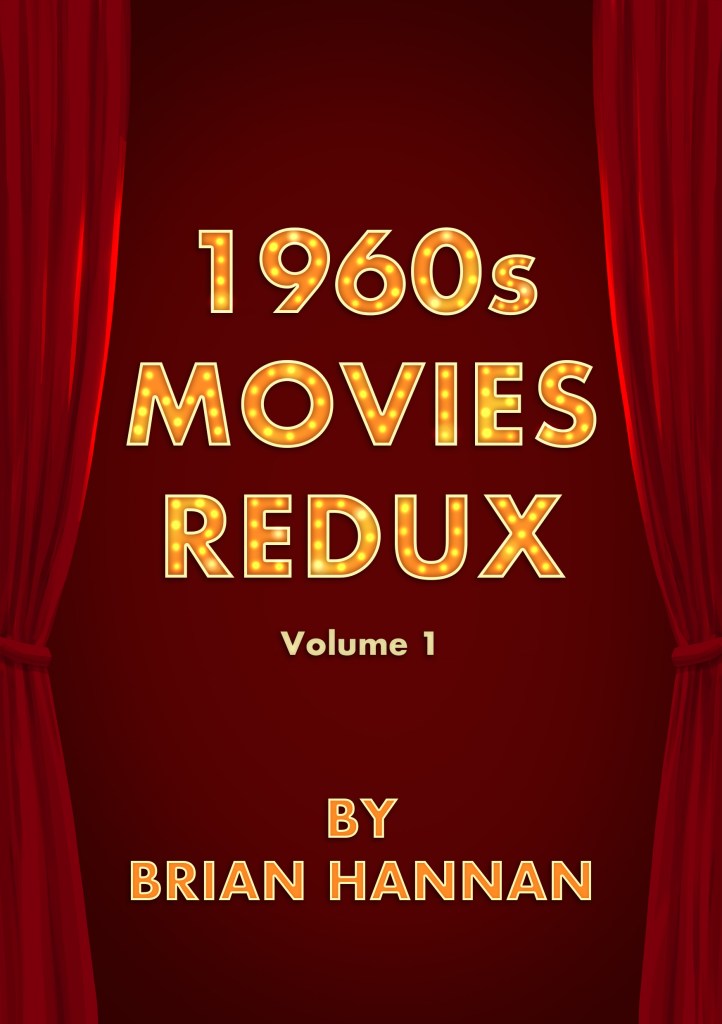
1960s Movies Redux Volume One is a companion piece featuring over 100 movies, including many of the pictures covered in the Behind the Scenes book, roughly presented in the order they originally appeared in the Blog. Ideal if you’ve still got a lot of catching up to do and don’t want to battle through the Blog to the beginning.
The content of this book varies from The Swimmer (1968), The Bedford Incident (1964), Point Blank (1967) and The Venetian Affair (1966) to The Blue Max (1966), Ocean’s 11 (1960), The Fox (1967), The Lost Continent (1968), Pharaoh (1966) and Moment to Moment (1966). But “varies” is an understatement as it swings at random through every genre.
There is no particular logic to my selection of movies to review, just what happens to be handy or something I’ve taken a notion to see. Again, there are illustrations throughout.
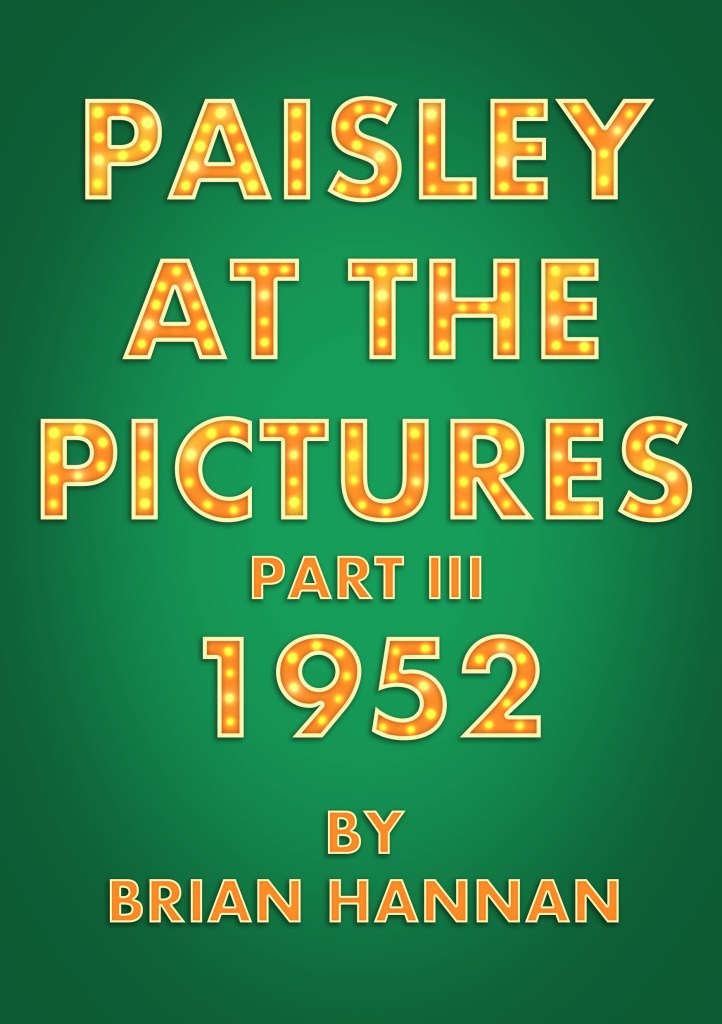
Skip back a decade and you’ll come to my third book Paisley at the Pictures, Part III: 1952. As the title suggest, this is in fact a sequel. In fact, it’s a sequel to a sequel as the previous book in the series Paisley at the Pictures, 1951 embodied the word “sequel” in the title.
Paisley, in Scotland, in case you didn’t know, is a large town, only a few thousand bodies short of qualifying as a city, and at the time eight cinemas served a population of 93,000. Seating capacity for the octet was just over 13,000 so on a Saturday night -. given that moviegoing was hugely popular especially before the advent of television – there was no guarantee you would get a ticket to the movie of your choice.
Six of the picture houses showed first run and two second run. Few movies ran for six days, most theaters operating on a split-week basis, one program running Mon-Wed and another Thu-Sat. (Films only ran on a Sunday if it was a charity fund-raiser.) Most programs were double bills. But over 1200 films were screened. And since Paisley was way down the movie distribution food chain it was mostly showing pictures that were months or possibly years old. There was, in any case, no such thing as the global wide release seventy years ago and only in very rare instances anything approaching day-and-date.
Historically, the year was significant for it marked the introduction of the X-certificate and the Eady Levy, a form of tax rebate to encourage film production. Sci-fi boomed. B-pictures could still be guaranteed an audience, as could serials. And cinemas began to welcome, on occasion, foreign fare.
The top films of the year in Paisley were: An American in Paris (1951), Singin’ in the Rain (1952), Show Boat (1951), Ivanhoe (1951), The Greatest Show on Earth (1952), The African Queen (1951), The Quiet Man (1952), The World in His Arms (1952), Laughter in Paradise (1951) and Jungle Jim in the Forbidden Land (1952).
Except for the latter these chimed with the top movies shown that year or in 1951 in the rest of Britain and, for that matter, excepting the British-made movie, the United States.
But that was not the case for the most popular stars.
The Top Ten stars in Paisley were: Randolph Scott, Virginia Mayo, Roy Rogers, Rod Cameron, Humphrey Bogart, Doris Day, Gregory Peck, John Wayne, Errol Flynn, and in joint tenth position Glenn Ford and Susan Hayward. These rankings might come as a shock to anyone who takes the annual top tens published in the trade press as gospel. But I suspect there were as many local variations on the national scale elsewhere as here. The annual charts tended to flatten out local differences and favor stars who were more popular in bigger cities.
An appendix lists all the films shown in Paisley cinemas that year, by month and by venue. There are over 120 illustrations, some very rare, many drawn from my collection of Pressbooks.
Now, down to the sticky matter of cost. You’ll be delighted to hear that both the 1960s books cost, as they say, less than a cup of coffee. On Kindle both are priced at $2.99 (£2.34 at current exchange rates for British readers and the equivalent for other countries). Printed copies cost £10 (around $12). And if you want your printed copy signed, that can probably be arranged. Both are available on Amazon, Kindle and enlightened bookshops.
Due to the huge number of illustrations – over 120 – the Paisley book is not available on Kindle, only in book form and costs £10 (about $12). But I’m working on a Kindle edition that reduces the number of illustrations,
If you are not interested in buying the books themselves I would be grateful if you could, nonetheless, circulate the information.
But, of course, I probably don’t have to point out that they will make ideal Xmas presents.
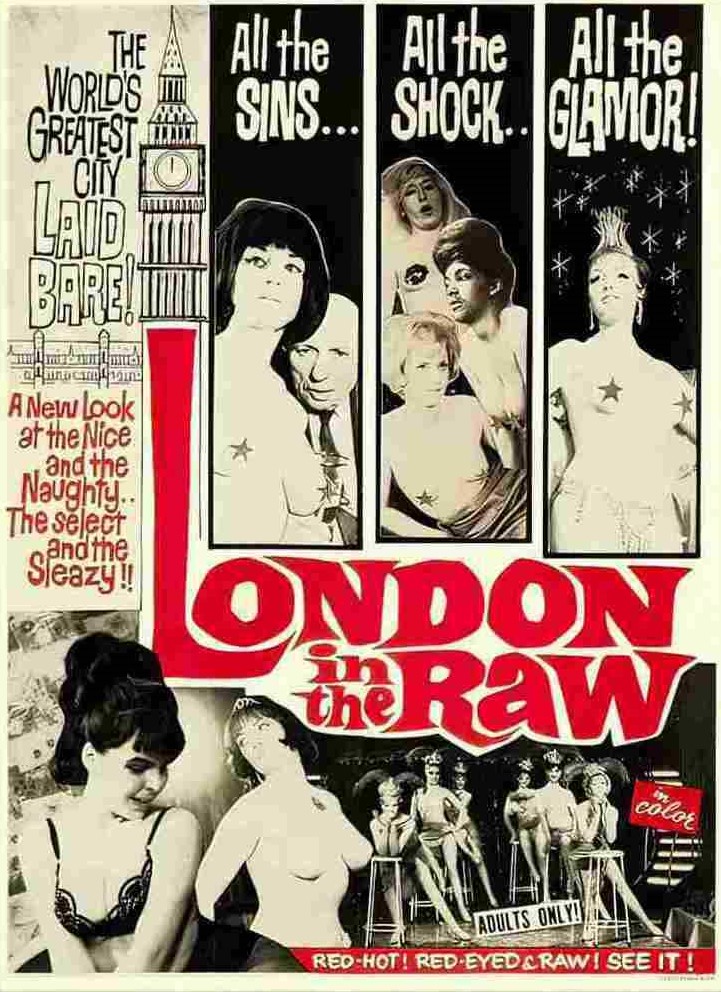
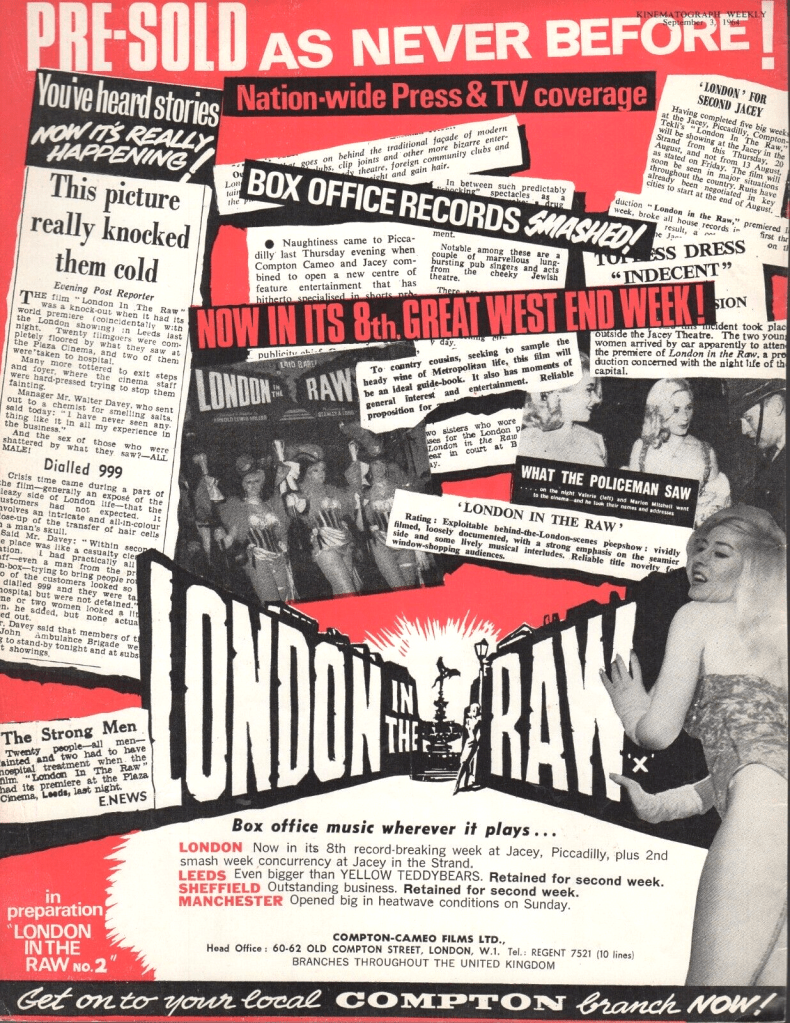
The headmaster of top English public school Harrow and the owners of upmarket emporium Grieves probably didn’t realize what they were letting themselves in for when they agreed to participate in this British version of Mondo Cane (1962), the movie that turned documentary into box office gold by the simple device of concentrating on the sleaze.
In truth it’s a bit of bait-and-switch, although anyone seeking titillation in those more repressed times when nudity was forbidden by the censor would be rewarded by the sight of three women topless, an anomaly explained by such nudity appearing in a non-sexual situation and my guess that the movie’s producers pointed to the stage loophole which permitted it as long as the women did not move. (That reasoning was explained, should you be interested, in Mrs Henderson Presents, 2005.)
The nudity occurs in the context of life classes, one organized by a bunch of beatniks as a means of funding their lifestyle, which includes eating baked beans cold and snacking on cat food, rebels that they are; when business is poor, they resort to taking snaps of the girls for Soho magazines. The other is the post-dinner entertainment in an upmarket restaurant where the customers sketch drawings of the undressed immobile models.
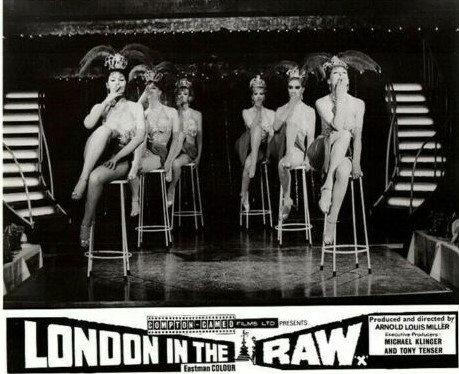
There’s an expose of clip joints, where elderly men are duped out of money by unfulfilled promise, paying extortionate amounts for non-alcoholic beverages, and a behind-the-scenes look at a strip club (nudity concealed behind nipple pasties) and a sex worker, the narrator making the point that while it’s not illegal for that woman to ply her trade indoors, a beggar playing a penny whistle in the street could be arrested. The strip club has the dingiest of entrances.
But in the main it’s a rather snippy examination of contemporary mores as staid London, at this stage not quite Swinging London, undergoes dramatic change. A health club enters the frame and there’s a gory piece on male hair transplants, a bloodier experience than audiences might expect, and a trawl round various unusual, but harmless, place of entertainment: an Irish pub with a horde of singers, an amateur Jewish theater, disco dancing at the renowned Whiskey-A-Go-Go, German students congregating for a slice of home at the Rheingold Club, the casino at Churchills, and cabaret.
“Bold! Brazen! Bizarre!” boasts the trailer and while that might be typical hype, audiences in those tamer times may well have been shocked especially when the camera focuses on two elements rarely discussed at that point in polite society: homelessness and drug addiction. Even so, it does find, as with the rest of the movie, unusual aspects of both. For example, the homeless lace their methylated spirits with milk. A director with an eye for dynamic composition could not have hit upon a better idea than contrasting the white contents of one bottle with the blue contents of another, the mixture being consumed in tea cups.
And I, for one, did not know that drug addicts were treated far more sympathetically in Britain than in the United States. That may well have been because the numbers were low, only 600 registered addicts compared to 47,000 across the Atlantic, though the degradation was no less pitiful, female abusers taking to the streets to pay for their addiction.
As a slice-of-life it’s less exploitational than the posters – or title – suggest and so falls into the historic category of The London Nobody Knows (1967), although less compelling, and it’s perhaps more interesting for the personalities involved, several of whom became significant figures, one way or the other, in the movie business.
Making the biggest later impact was Michael Klinger who went on to produce Roman Polanski’s Cul-de-Sac (1966), drama Baby Love (1969), gangster classic Get Carter (1971), Gold (1974) and Shout at the Devil (1976). Co-producer Tony Tenser went on to found Tigon, the horror outfit that challenged Hammer. Stanley Long turbocharged the British sexploitation industry with numbers such as Groupie (1970), The Wife Swappers (1970) and Eskimo Nell (1975).
But it didn’t open many doors for director Arnold L. Miller who managed only a handful of features such as Frustrated Wives/Sex Farm (1974) which was banned by the British censor. Uncredited co-director Norman Cohen later made The London Nobody Knows.
Interesting for the most part and buy it if you want to play your part in upholding the British Film Institute which has rescued this from the vaults in the hope of making a quick buck.
Not a great movie by any means but I am drawing attention to it for other reasons. While entering familiar small town soap opera territory with malice behind every curtain and the repression rampant a century ago, it’s a fabulous exploration of character.
The narrative drive is slim, young couple coming undone by circumstance. But that is more than compensated by the preoccupation with their actual characters, marital bust-ups for no reason, insecurities to the fore, a daring sexual overtness that for the time it was made does not stoop to the lowest common denominator, and without doubt the best performance in the career of Yvette Mimieux (Dark of the Sun, 1968) here taking center stage rather than as was more usual a mere appendage to the leading man.
Not sure what the rival picture was. any ideas?
The story is told primarily through the eyes of Anna (Yvette Mimieux), a poor uneducated homely girl who falls for dashing virile law student Carl (Richard Chamberlain), both of Irish descent, who, against parental wishes, run off to get married.
But marriage instantly brings financial calamity. As a married man, Carl is ineligible for college loans, and his wife is forbidden, following aspirational middle-class custom of the day, to work except for a bit of babysitting. Viewing Anna, coming from poorer stock, as a gold-digger, Carl’s father Patrick (Arthur Kennedy) not only withdraws financial support but demands repayment of loans.
So the pair struggle through. And that would be par for soap opera.
What brings this to the fore is the director’s fascination with character, allowing personality, with all its inexplicable whimsicalities, full rein rather than making that subservient to a more dramatic story.
If you think couples these days have difficulty communicating, imagine the situation a century ago where a man made all the decisions and expected obedience from his partner. And a wife so fearful of announcing a pregnancy for fear it would force her husband to abandon his studies. Beyond obvious worry, there is little problem-sharing or joint resolution of difficulties.
For all his charm, Carl is pretty gauche. His ardent inexperienced love-making borders on rough. He is so out of touch with his wife’s passion that he takes a job as a nightwatchman. He plays a mean trick on her in a communal shower. And although he refuses to cower to his father, in general he kowtows to authority.
The French have a word for it.
Anna is more feisty, challenging his father, ignoring patriarchal rules, almost pathologically opposed to using the word “Sir,” but full of compassion, befriending the gay florist, object of public ridicule, encouraging him in his writing, standing up, too, for the widow, forced by circumstance to become the mistress of a rich businessman (Oscar Homolka), taking money for the privilege.
Yet for all her outgoing confidence, she is insecure, so desperate to learn that she sneaks into the halls of the college to overhear lectures, a dictionary her constant companion. Sexually, she is conflicted, memories of stepfather abuse arising too often, and yet intensely physical, adoring the touch of a loving male.
Despite her homely beauty, she follows a more obviously attractive woman, copying the way she walks, swings her hips, flicks her hair. She wants a tight sweater when the fashion is to wear them loose. Unable to afford a hair salon, she has her blonde hair cut short enough in a barber shop so that it will bounce when she walks. Due to her deficiencies and in constant emotional turmoil, she is liable to snap at perceived insult.
The story could easily have gone down a more fairy-tale route, of Anna finding herself, espousing independence, becoming a writer, instead of – anathema to a contemporary audience – finding expression by supporting her husband. But that would not be true to the times. That she has hardly any home to look after, little in the way of furniture to polish, no cosy gang of housewives for coffee mornings, so her efforts at expanding her education would simply qualify as a sensible way to spend her day.
And while director Alex Segal (Harlow, 1965) does not trust her with the kind of soulful close-up accorded the likes of Elizabeth Taylor or Audrey Hepburn, where one look into the eyes reveals everything, and restricts emotion to dialog, he does provide countless small moments that allow proper character development. Nor does he trust himself much, only two compositions of any singularity; snow falling on a house that turns out to be a storekeeper tipping icing sugar over a model of a home for a shop window Xmas scene; and a shadow suddenly appearing when the couple are about to make love.
And there is a role reversal of sorts. It’s television heartthrob Richard Chamberlain (Twilight of Honor, 1963) who regularly disports semi-naked rather than Mimieux. Chamberlain took the opportunity to boost his burgeoning singing career, crooning the movie theme song. Although the undoubted star, it was Mimieux, though lumbered with an Irish accent, who took the acting plaudits.
Sally Benson (a career stretching from Hitchcock’s Shadow of a Doubt, 1943, to Viva Las Vegas, 1964) and Alfred Hayes (The Double Man, 1967) wrote the screenplay from the Betty Smith (A Tree Grows in Brooklyn) bestseller. Features one of the lesser-known scores of Bernard Herrman (Marnie, 1964) but you will instantly recognize swelling strings that wouldn’t be out of place in an obsessional Hitchcock piece.
An enjoyable picture, batting above average, almost Tarantino-esque in concentrating on character at the expense of story. Sure, there’s no equivalent to foreign hamburgers, but there is some quirky dialog and it’s worth it just to see what Mimieux can do when given the opportunity.
Seems easier to get hold of the Richard Chamberlain album than the movie, but it must be on streaming somewhere, it was on YouTube at one point so may return there.
It could as easily have been Cecil B. DeMille (The Ten Commandments, 1956) in the director’s chair. And Yul Brynner (The Magnificent Seven, 1960) and Jeanne Moreau (Jules and Jim, 1962) as the stars.
The Barabbas tale had already been plundered before Swedish novelist Par Lagerkvist published his relatively short bestseller – only 144 pages – in 1950. An earlier novel of the same name by Emery Bekessy hit American bookstalls at the height of the mid-1940s religious cycle kicked off by Going My Way (1944) and The Bells of St Mary’s (1945). DeMille – whose portfolio included Biblical epics The Ten Commandments (1923), King of Kings (1927) and The Sign of the Cross (1932) – was in competition with British producer Alexander Korda to buy the rights.
While that production never entered production, just to confuse matters a British film, Now Barabbas, based on a successful West End play and with no Biblical element, was released in 1949.
Swedish director Alf Sjoberg (Miss Julie, 1951), twice winner of the Grand Prix at Cannes, turned the Lagerkvist book into a black-and-white film in 1953, the first Swedish picture to be dubbed into English.
A bigger-budgeted version, piggybacking on the success of Ben-Hur (1959), was the brainchild of Italian producer Dino De Laurentiis who had pacted with Hollywood studio Columbia on a four-picture slate worth $17 million, the bulk of which, $10 million, was to be spent on Barabbas “with a cast of thousands headed by some of the biggest names in motion pictures.”
“Hollywood on the Tiber” was producing movies at a record rate – topping 200 a year – and De Laurentiis, who had shot to fame with Bitter Rice (1949) starring future wife Silvana Mangano and Fellini’s La Strada (1954) was intent on gaining a foothold in America beyond the arthouse market. Producing King Vidor’s War and Peace (1956) for Paramount had not done the trick and the Columbia slate was a last-ditch attempt to break into the Hollywood game.
Hollywood had originally invested in Europe to take advantage of tax breaks or to access monies frozen by countries after the Second World War, but by the 1960s the continent had become more attractive as a cheaper production alternative. While Britain had been a substantial recipient of Hollywood largesse, Italy was fast catching up as the chosen locale for pictures as varied as Cleopatra (1963), The Pigeon That Took Rome (1962) and Jason and the Argonauts (1963).
Director Richard Fleischer’s career was at a curious impasse. The son of world-famous animator Max Flesicher, creator of the Popeye cartoons, Richard had won critical acclaim for low-budget thriller The Narrow Margin (1951), followed up with a pair of stupendous action hits, 20,000 Leagues under the Sea (1954) and The Vikings (1958), both starring Kirk Douglas, and a daring examination of the world’s first “thrill killing” Compulsion (1959) with Orson Welles.
But he was at loggerheads with Twentieth Century Fox, to whom he was contractually tied, having turned down North to Alaska (1960) with John Wayne. As a result, he was relegated to lesser projects, Crack in the Mirror (1960), again with Orson, and The Big Gamble (1961), a picture with virtually no stars unless you count the questionable marquee value of Juliette Greco and Irishman Stephen Boyd trying to capitalize on his success in Ben-Hur (1959).
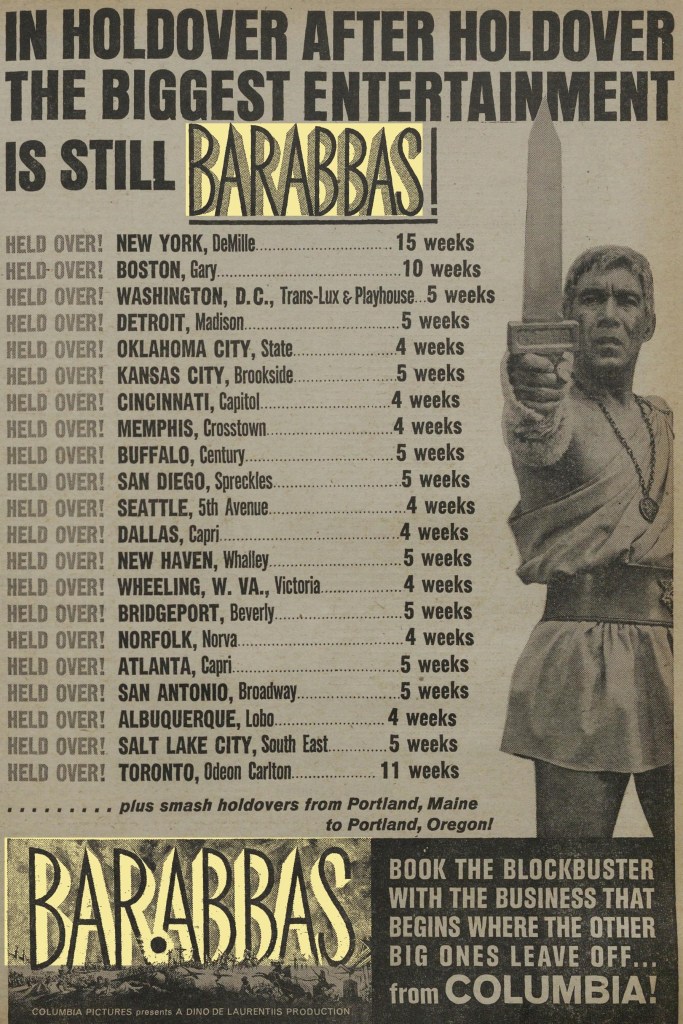
“Holdover” also meant it was not playing as a roadshow. In the roadshow exhibition situation, a cinema would be required to play a movie for an agreed number of weeks, generally a minimum of eight or thirteen. Non-roadshow films relied on box office performance for the length of their run, the engagement extended week-by-week.
He had been on Dino De Laurentiis’ radar before, approached to helm War and Peace, circumstances dictating otherwise, and a $10 million project, a 70mm roadshow, presented an ideal opportunity to resuscitate his moribund career. As Fleischer put it, “Even if I had loved Darryl (F. Zanuck, the legendary Fox producer of The Big Gamble), I would gladly have jilted him for this assignment.”
Despite the promise of the budget, the reality was off-putting. The De Laurentiis studio was housed in a “dreary industrial slum” and consisted of a two-storey wooden building housing the offices and “three decaying stages.” However, there was little downbeat about De Laurentiis, “an impeccably tailored bundle of raw energy,” according to Fleischer, “the impact of meeting him for the first time is something akin to sticking your finger into an electric light socket.”
The Italian producer possessed a quality that was appreciated in Hollywood, especially among old-school mavens. He was a showman. He could drum up publicity at the drop of a hat. His first publicity coup was hiring French star Jeanne Moreau, at the time considered one of the few foreign actresses who need not rely on buxom figure, as the female lead. Her arrival in Rome for pre-production prerequisites such as costume and make-up testing induced a flurry of front pages. A mob of about 30 reporters almost prevented any testing. “Even though the tests were purely mechanical, she became the character in the script the moment the camera turned,” observed Fleischer.
Unfortunately, De Laurentiis had no intention of hiring her, not when he had wife Silvana Mangano at home. The press reaction to Moreau might have suggested he was backing the wrong horse, despite Mangano’s own marquee appeal, but he appeared delighted to have achieved a publicity coup, no matter that he had manipulated and duped a great actress and the director.
De Laurentiis pursued Yul Brynner for the titular role, a suggestion with which the director was in accord. This was the real thing, attempted recruitment not just a publicity gag. Until Charlton Heston muscled in with Ben-Hur, Brynner was the go-to actor for historical epics, The Ten Commandments (1956) making him an instant star, a position solidified with an Oscar for The King and I (1956) and commanding a $750,000 payday, on a par with john Wayne and William Holden.
Brynner was initially disinclined to play the role but after a day in discussion with Fleischer they shook hands on a deal only to have it torpedoed by De Laurentiis.
Scriptwriters Christopher Fry, famed English playwright but novice screenwriter, Nigel Balchin (The Man Who Never Was, 1956) and Diego Fabbri (The Corsican Brothers, 1961) were recruited with De Laurentiis reporting that they were “currently at work after having studied the material at length.” Later added to the roster was Italian Nobel prize-winning poet Salvatore Quasimodo. Not trusting the producer to stick to the text, Lagerkvist assigned his son as overseer, a tactic that singularly failed to work.
Still lacking a male lead, De Laurentiis announced the movie would start shooting on January 7, 1961, with French pair Jeanne Moreau and Simone Signoret (Room at the Top, 1958) in the top female roles, neither of whom were ultimately involved.
Despite two Oscars as Best Supporting Actor, Anthony Quinn (Guns for San Sebastian, 1968) had failed to reach the top echelons of Hollywood stardom, stuck in the rut of male lead to top-billed female or starring in lower-budgeted pictures. To rectify the situation, he had embarked on a project intended to provide a prestigious showcase for his acting skills. He had signed up to play opposite Laurence Olivier in the Broadway production of Jean Anouilh’s acclaimed play Becket.
He had to be prised away from the Broadway run by De Laurentiis who forked out $37,500 in compensation and guaranteed the actor time off halfway through the shoot to fulfil a commitment to Lawrence of Arabia (1962). In fact, Becket, while attracting good notices, was a Broadway flop, the production only going into the black as a result of the De Laurentiis pay-off.
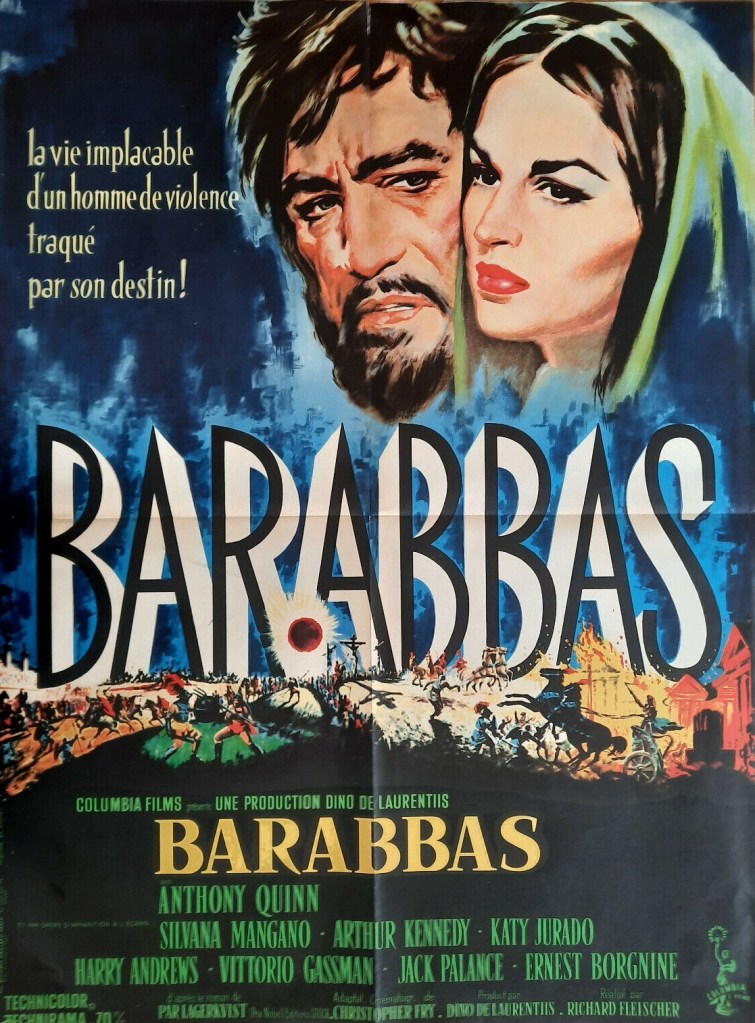
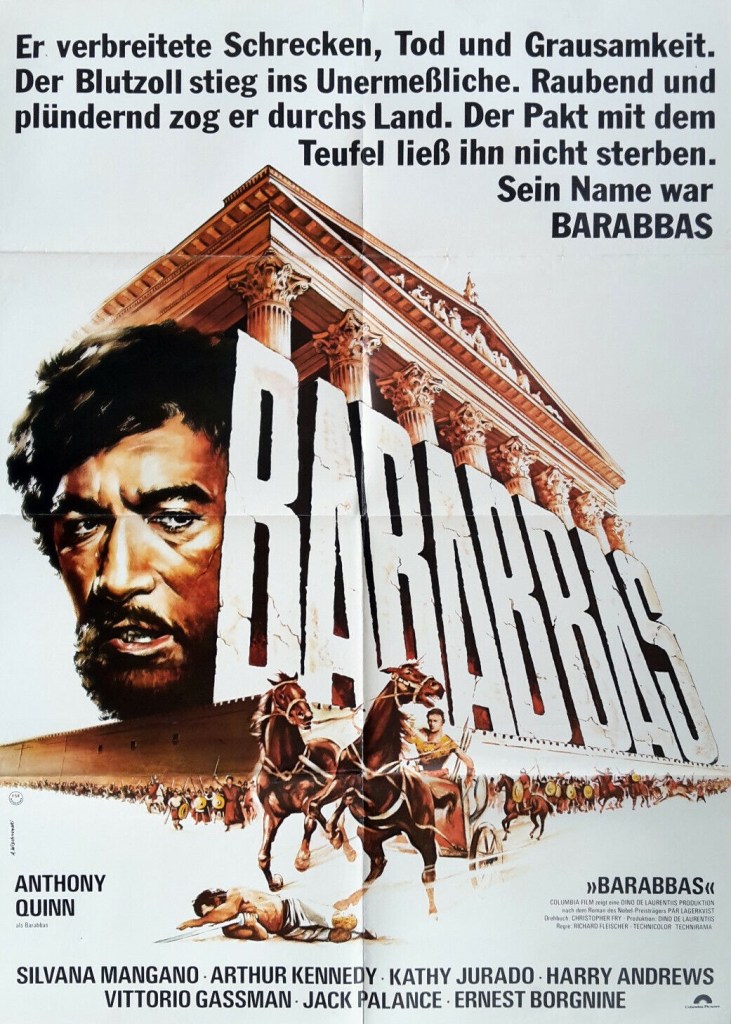
The all-star cast never materialized. But there was prestige aplenty, three members of the cast Oscar winners, another trio nominees. Vittorio Gassman (Ghosts of Rome, 1961) was at best a rising star, marquee value restricted to Italy. Jack Palance (Shane, 1953), was better known in Italy than the U.S., having spent the previous five years in Italy and now attempting a Hollywood comeback as a director. He was signed to play the notorious gladiator intent on killing Barabbas in combat. Ernest Borgnine (The Vikings) was still clinging on to vestiges of stardom after unexpectedly winning the Best Actor Oscar for Marty (1955). His wife Katy Jurado (High Noon, 1952) remained a starlet. Despite a bout of Oscar nominations in the supporting actor category Arthur Kennedy (Elmer Gantry) and never-nominated Harry Andrews (Solomon and Sheba, 1959) were no more than character actors.
It would have been impossible to make Barabbas on the tiny studio De Laurentiis owned so, encouraged by tax breaks, he invested in hundreds of acres of cheap land to build a new state-of-the art studio. But when Fleischer first saw it, it was nothing but a barren wasteland. Even so it was in these empty fields that production designer Mario Chiari would construct the ancient world.
Over several hours, simply by pointing his finger in vague directions, the pair came up with over 100 buildings, and the sets for Jerusalem and the Praetorium. The movie already had its arena – the 2,000-year-old structure in Verona – which would double for the Rome Colosseum. The complicated gladiatorial spectacle was the first sequence to be shot, with a world-record 9,115 costumed extras, arriving on a fleet on 75 buses from nearby towns. The only obstacle to rolling the cameras: Anthony Quinn’s specially designed gladiator sandals had been left behind in Rome. A temporary pair were mocked up so the first shot could be completed before lunch.
On the second day of shooting occurred a Hollywood fairy story. Looking for good characters to focus on in the crowd “one face truly stood out, that of an eighteen-year-old girl of stunning beauty.” The daughter of an officer at a U.S. military base in Vicenza, her name was Sharon Tate. Shortly afterwards, she moved in with Jack Palance, and not too long after that she was on the Hollywood glory trail prior to her premature death.
Another mishap threatened to spoil the scene where Quinn and Gassman, playing prisoners in the sulphur mine, were going to be chained together. The location was the top of Mount Etna in Sicily. On hand were 500 extras dressed as Roman slaves. It was a Sunday since that was the only day the roads would be clear enough to transport so many people and all the equipment up the two-hour drive from Catania up the twisty route.
The weather was terrible, the sky so black, the volcanic cinder ground a perfect match, with barely enough light to get an exposure. The only section of the scene unrehearsed was the riveting of the chains. And that required charcoal. But someone had forgotten the charcoal. A race down the mountain to bring back the charcoal took till the afternoon. But just as the charcoal arrived there was a break in the clouds and a spot of perfect light. It lasted just long enough for the shot to be taken.
The solar eclipse was no special effect. It was actually taking place on February 15, 1961, and Fleischer had cameras in place to record the phenomenon, the only genuinely ethereal scene in a movie that was more concerned with realism. The burning of Rome was also filmed “in camera,” the sets consumed in one take in one night.
While there were other occasional production errors, Fleischer found the Italian crew as professional as he required. And as accommodating. One day he was informed the crew had to go on strike for one hour. But after consultation with the director, the crew was happy to strike during the lunch break.
Even with a schedule rearranged to include Quinn’s time away filming Lawrence of Arabia (1962), shooting went smoothly with no overages or budget-blowing.
The production faced other threats. The 1953 version, already conveniently dubbed, was being reissued. There was a television production called Give Us, Barabbas, and a new play was launched off-Broadway by Belgian playwright Michel de Ghelderode, all of which could have stolen the limelight.
The movie followed an unusual distribution pattern. Launched in Italy at the tail end of 1961 to big box office it was another six months before it made a mark in London. In June 1962 it was the opening presentation for a new cinema, the Odeon Haymarket in London’s West End, a 600-seat underground emporium set up to take advantage of the demand for hard-ticket roadshow venues. The premises had not operated as a cinema since 1939 when it had been known for a short period as the Gaumont. It was only the second cinema built in London since the Second World War, the other being the Columbia in Shaftesbury Ave which had opened in 1959. In separate-performance advance-booking format, and tickets priced at $1.05-$2.80, Barabbas would remain at the Odeon for over six months.
It didn’t reach the United States – at the DeMille in New York – until October and even then was beaten to the North American punch by the 2,318-seat Odeon Carlton in Toronto, the largest cinema to enter the roadshow arena. And although available as a 70mm roadshow, in most locations it was more likely to be presented in 35mm minus the separate performances that were the hallmark of the prestigious hard-ticket presentation.
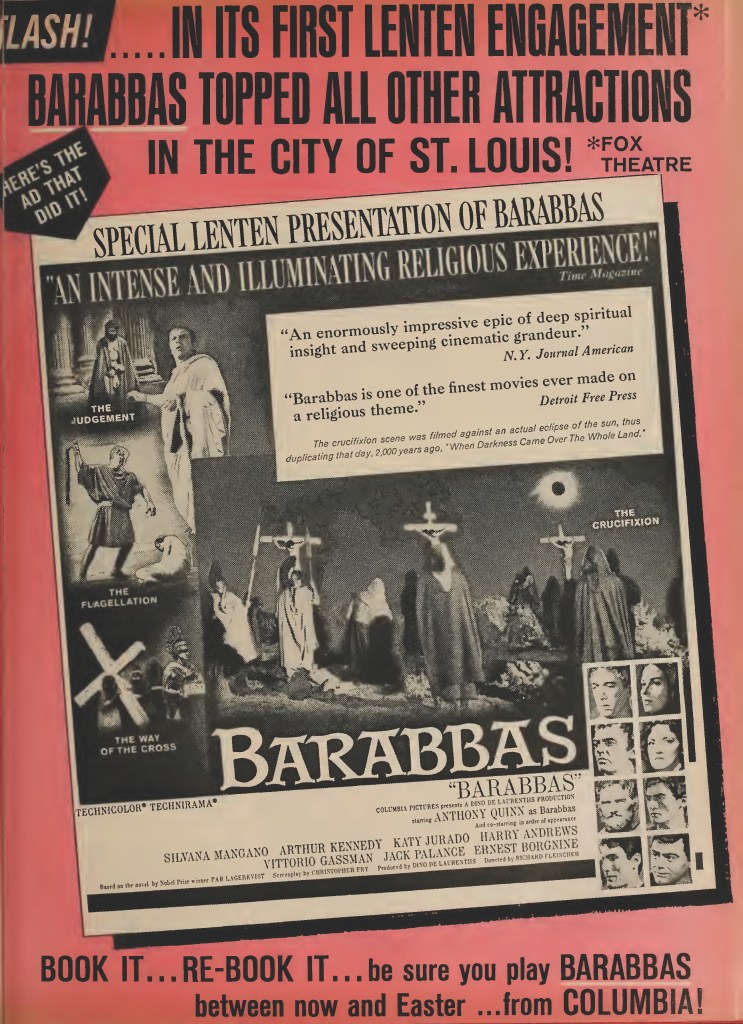
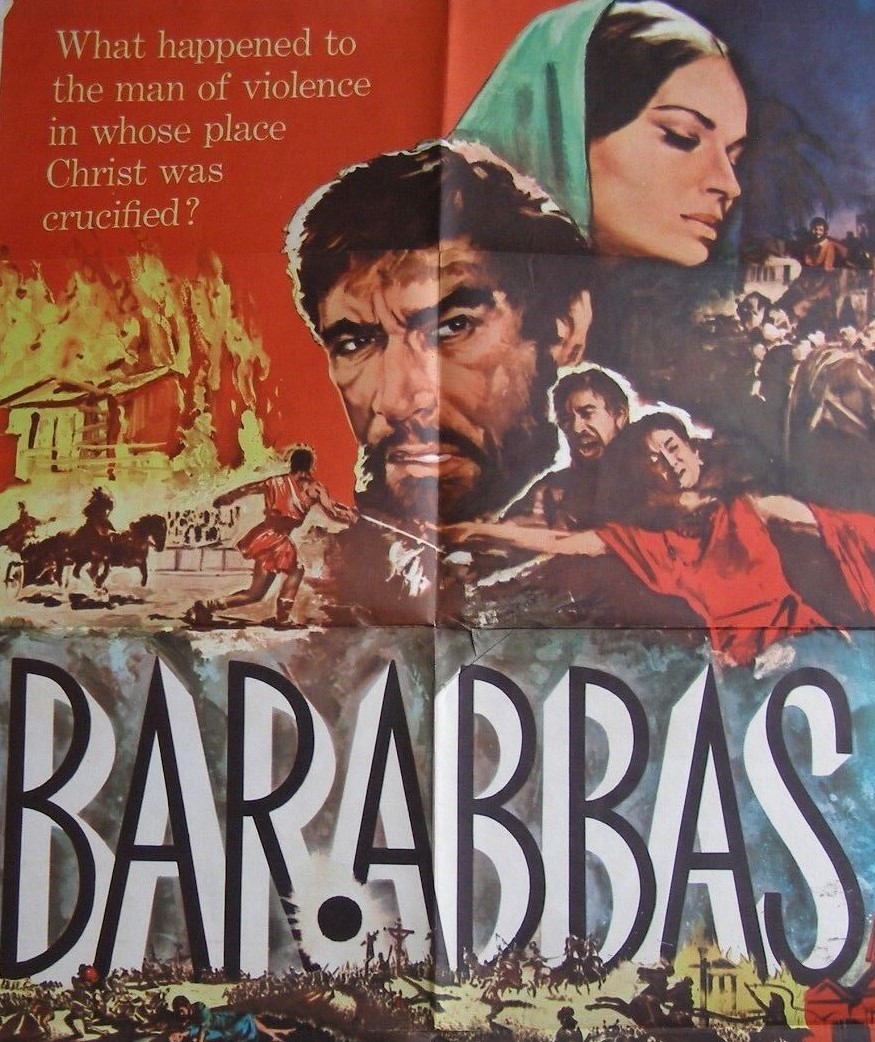
Columbia created some enterprising marketing concepts for the U.S. launch, including a touring exhibit by six well-known painters who had all used the film as the basis of artworks. A 41-foot high float including a 10-foot high revolving figure of Barabbas had been seen by 1.2 million people when paraded through Los Angeles. A special 190-page “making of” book was published in hardback. Six months after launch, the film was promoted as a “Special Lenten Presentation” in local cinemas with prices increased by 25 cents.
Although a huge success in native Italy and generally well-received at the international box office, Barabbas came up short in the U.S., rentals barely hitting $3 million, earning a lowly 35th place in the annual chart.
SOURCES: Richard Fleischer, Just Tell Me When To Cry, A Memoir (Carroll & Graf, 1993) p217-226; “Another Religious Picture May Be Barabbas Novel,” Variety, December 4, 1946, p4; “Now Barabbas Was A Robber,” Variety, June 1, 1949, p1; “First Swedish Picture Dubbed Into English,” Variety, June 23, 1954, p4; “Swedish Barabbas,” Variety, June 1, 1960, p4; “Lagerkvist, Nobel Winner, Assigns Son To Rome As Watchman on Barabbas,” Variety, December 14, 1960, p17; advert, Variety, January 4, 1961, p71; “Barabbas Budget over $10,000,000,” Variety, February 15, 1961, p3; “Dino De Laurentiis No 1 Indie Producer?,” Variety, February 15, 1961, p24; “Figure $17,500 for Off-Broadway Barabbas,” Variety, February 15, 1961, p71; advert, Variety, April 26, 1961, p71; “Becket Got 37½G On Quinn’s Exit,” Variety, May 3, 1961, p83; “Becket Folds As 40G Sleeper; Had Seemed Prestige-Only Flop,” Variety, May 31, 1961, p59; “Quinn Back To Work in Barabbas,” Variety, October 11, 1961, p17; “No Time To Fiddle in Rome,” Variety, November 15, 1961, p1; “To Write Barabbas Dialog,” Box Office, November 27, 1961, pW6; “Canada Coin,” Variety, March 21, 1962, p40; “Barabbas Exhibits Start Key City Tour,” Box Office, March 26, 1962, pE8; “Barabbas London Event: New York Date Oct 10,” Box Office, June 11, 1962, p14; “Barabbas Premiere Set For Oct 4 in Toronto,” Box Office, July 23, 1962, pE8; “Hard Cover Book to Ballyhoo Barabbas,” Box Office, July 30, 1962, p10; “Palance Back, Try Directing,” Variety, October 17, 1963, p3; “Big Barabbas Float,” Box Office, January 4, 1963, pA1; advert, Variety, January 23, 1963, p27; “Barabbas at Eight,” Box Office, February 18, 1963, pK2; “Lenten Angle for Barabbas Date,” Variety, March 13, 1963, p17; “Top Rental Features of 1963,” Variety, June 8, 1964, p37.
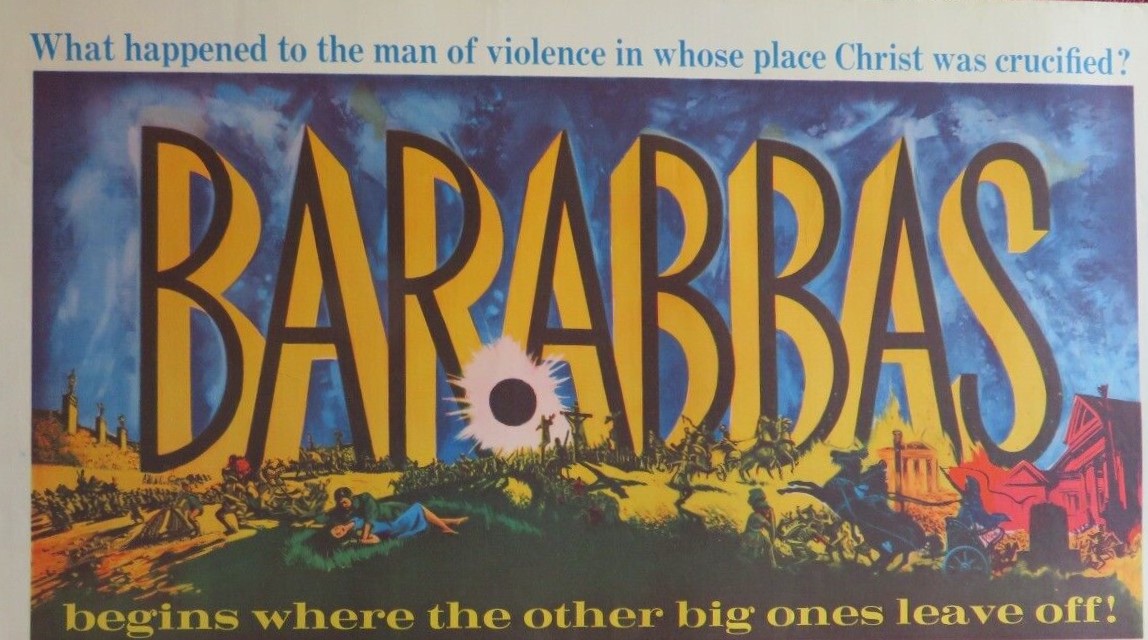
Brutally ironic ending adds a final twist to this religious epic that sheds a murky rather than heavenly light on the early days of Christianity. Barabbas (Anthony Quinn), in case you are unaware, is the criminal who, in a public vote, is spared crucifixion instead of Jesus Christ. Intent on returning to his lusty life, instead he finds himself drawn to the teachings of the Son of God despite his feverish attempts to deny it. Death might have been preferable to two decades spent imprisoned in the sulphur mines followed by a stint as gladiator only, finally refusing to deny his conversion, he ends up on a cross.
The fate of Barabbas in the Bible is undetermined, only meriting a few lines, but in the imagination of Swedish novelist Par Laverkvist he lived quite an extraordinary life, a criminal vagabond coming to believe in what he originally despised. The religious element is almost an excuse to investigate life at the edge of a pauper’s existence, a world in which faith is possibly the only way to get through the day. It’s an episodic tale with Barabbas as a Job-like peasant on whom constant indignity and humiliation is heaped.
A witness at times to the most exalted elements of Christianity – the eclipse surrounding the crucifixion, the stone rolled away from the tomb – he also sees lover Rachel (Silvana Mangano), a Christian convert, stoned to death. It’s a miracle he survives imprisonment in the mines and that when, thanks to an earthquake, he escapes it’s almost bitter irony that he ends up in gladiator school, facing the demonically sadistic Torvald (Jack Palance). Even when pardoned, he is again arrested for, believing the end of the world is nigh as described in the Christian teachings, helping burn Rome to the ground. Arrest this time sends him back to where he started, heading for crucifixion, though this time willingly.
Anthony Quinn (Guns for San Sebastian, 1968) is excellent as the dumb, mostly mystified peasant, only occasionally rising to the occasion, mostly defeated, or captured, and failing to defend those he should protect. Not entirely cowardly, witness his battle in the arena, but self-serving, and in a sense cursed by events outside his control.
Others are only briefly in the spotlight, Silvana Mangano (Five Branded Women, 1960) good as the converted Christian accepting her fate, ditto Vittorio Gassman (Ghosts of Rome, 1961) as an enemy prisoner in the mines, and Jack Palance (Once a Thief, 1965) over-the-top as the kingpin gladiator. In cameo roles – not exactly the promised all-star cast – you can find Ernest Borgnine (Chuka, 1967), Arthur Kennedy (Claudelle Inglish, 1961), Katy Jurado (A Covenant with Death, 1967), Valentina Cortese (The Visit, 1964) and Harry Andrews (The Charge of the Light Brigade, 1968).
Director Richard Fleischer (The Big Gamble, 1961) does a brilliant job of keeping reverence at bay, turning the potential awe of the eclipse into a moment of personal terror, ensuring that current persecution rather than potential eternal life remains foremost, focusing on the human not the ethereal. He presents Barabbas as constantly mystified at his escape, guilt-ridden that he has done nothing with his life, thwarted in virtually every attempt at redemption.
The big scenes are well-handled, the sulphur mines a pit of Hell, the arena far more realistic than Spartacus (1960), the burning of Rome that initially represents freedom turning into a trap. Filmed in Technirama 70mm, Fleischer makes the most of the widescreen and the historical detail.
In some respects this makes more sense if viewed alongside the director’s crime triptych of Compulsion (1959), The Boston Strangler (1968) and 10 Rillington Place (1970) which concentrate on outsiders coming to national attention through illicit activity.
Far from the usual stodgy religious offerings of the period, more in keeping with a Pasolini-like vision, with a keener eye on history than creed, it’s been rather overlooked and deserves reappraisal.
Christopher Fry (The Bible…in the Beginning, 1966) was credited with the screenplay from the book by the Nobel prize-winning novelist Par Laverkvist.
Enigma and irony are hard enough to pull off in a drama never mind an intellectual thriller that plays around with reality. So full marks for a terrific performance by Guy Pearce (The Seventh Day, 2021) holding together a relatively simple tale of paranoia, and writer-director Andrew Hunt (The Miles Between Us, 2016) for teasing it out.
Author Bruce (Guy Pearce) has written a bestseller that triggered sociopath Dwight Tufford (Alex Pettyfer) into carrying out a mass killing. Hiding out in a remote cabin away from any feeding frenzy, and drowning in alcohol, he’s nonetheless being stalked by obsessive fan William Dukent who sends him daily missives by post, conveniently attaching a contact number but infuriatingly never answering his phone. Aware how obsession can end (for example, in mass murder), he’s none too keen on meeting said fan, and is armed against intruders.
That his mental health is imperilled suggests some deeper psychological problem since beyond irritation there is no obvious threat. Ad bearing in mind he’s an alcoholic, there’s always a possibility his nemesis is himself. Before he achieved fame he was your standard creative writer teacher so we’re regaled in flashback or voice-over with some of the rules of writing, but what appears mere filler material takes on deeper meaning in the third act.
What makes this transparently different from your standard paranioa thriller is that Bruce is hardly equipped to hunt down bad guys, possessing none of the “particular set of skills” possessed by the likes of Bryan Mills (Taken, 2008), and no military background to call on. It takes him forever to even work out that the name of his antagonist is actually a clue.
Eventually, he is assisted in his endeavors by cop Officer Higgins (Alice Eve) but nothing makes much sense and he deteriorates further into an alcoholic haze. Even while every step forward turns into a step back, at least he is on the case. And then the twists come thick and fast.
I’m a pretty big fan of twists and because I generally watch twist-ridden pictures am inclined to go with the flow, though not without trying to figure the puzzle in my own mind. But when the final parts of this particular jigsaw unfold they are of the unexpected variety. If I tell you any more I’ll give the game away.
So, primarily, it relies on a somewhat incoherent fellow trying to find coherence in a world that has to all extents and purposes betrayed him. After years of rejection, he has finally grasped the brass ring (if that’s what you do with brass rings) filled with awards and a mass of cash (enough at least to fund this retreat and heroic alcohol consumption). Whatever his book has triggered in the mind of an assassin is never made clear; the novel is about a priest who disproves the existence of God. And given it’s impossible to understand the deranged mind, that could just leave him a victim of circumstance, in a perfect storm of angst, and all the while trying to determine how, as befits a writer, this chimes with his own personal narrative, every individual being the hero of his own tale.
Except for the title, this has got nothing to do with the film under review but I was stuck for another illustration and this came to hand.
As I said, it all hangs on the performance of Guy Pearce who’s been here before in Memento (2000) and he creates a believable contradiction, intelligent enough to try to make sense of his stalker but at the same time arguing with a telephone answering machine.
Only a couple of sections are questionable, how to engineer an escape from a super-maximum security prison and how Bruce would know the capabilities of a bullet when not fired from an actual gun. But by that time you’re already along for the ride.
Andrew Hunt doesn’t give much away until he has to and it’s to his credit that we care so much for an isolated character minus the standard wife or daughter there to generate audience empathy. Given the hero is not a particularly likeable character, it’s no mean feat to get us on his side, especially when he dips into philosophy and tips on writing. Hunt devised the screenplay from a story by Louis Kornfeld, who originated the source material, the wonderfully-titled The Hilly-Earth Society, for a podcast.
As unlikely as it sounds, John Wayne was once the leading contender to play Lawrence of Arabia. On January 14, 1953, the trade newspaper Variety reported that Cinerama, only known at the time for travelogs, was planning to move into feature filmmaking with productions of the hit Broadway musical Paint Your Wagon and Lawrence of Arabia, the latter with Wayne in the frame. Cinerama, as discussed in a previous Blog, was the sensation of the 1950s, the saviour of a movie industry eroded by television, prompting the boom in big-budget widescreen movies that were the hallmark of the next two decades.
It was a three-screen process, which meant filming with three cameras, somewhat unwieldy for working with actors. But This Is Cinerama, its first film, was the top earning film of 1952, even though it only played in a handful of cinemas. The driving force behind the idea was assistant board chairman Lowell Thomas, who, more than 30 years before, had single-handedly created the legend of Lawrence of Arabia.
Thomas had been a journalist covering the Middle East during the First World War. He had photographed the triumphant entry into Jerusalem in 1918 of the British forces led by General Allenby. The following year Thomas spun this event into a lecture that was launched in August in London to sensational results. Originally it was entitled ‘With Allenby in Palestine’, but after sensing the public was more interested in the unknown T E Lawrence, who he had photographed in Arab headdress, he changed the name to ‘With Allenby in Palestine and With Lawrence in Arabia’.
The show was so successful that when it came to the end of its run at the Covent Garden theatre, the owners offered 70% of the box office receipts to keep it on. Eventually, over five million people in Britain and the United States paid to see the lecture. And the Lawrence of Arabia industry was born. Thomas turned his lecture into a book which appeared in 1924 followed three years later by A Boy’s Life of Colonel Lawrence. Lawrence himself contributed to the legend with the publication of The Seven Pillars Of Wisdom (1926) and a shortened, easier-to-read, version called Revolt In The Desert (1926). Various best-selling biographies followed including Lawrence Of The Arabs (1928) by Robert Graves (Goodbye To All That), two tomes by military historian Capt Basil Liddell Hart, T E Lawrence: In Arabia And After (1934) and Colonel Lawrence, The Man Behind The Legend (1934) and Reginald H Kiernan’s Lawrence of Arabia (1935).
The first film on the subject was announced in 1929 by director Sydney Olcott for Supremacy Films, but the project came to nothing. In 1933 there was a US four-part serial by Jock Lawrence (no relation) called Flying Lawrence In Arabia, based on the exploits of Lawrence’s pilot during the war, Capt John H Norton. Two full-length feature films were announced the same year. First out of the gate was The Uncrowned King from RKO to feature top Hollywood star John Barrymore. Director Ernest Schoendanck spent several months in Mesopotamia shooting background material and by the time he returned the film had a new name, Fugitive From Glory.
In Britain movie magnate Alexander Korda’s London Films put Lawrence Of Arabia into production with Walter Hudd in the lead. Korda had acquired the rights to the biographies by Graves, Liddell Hart and Kiernan as well as Revolt In The Desert and an agreement from Lawrence’s trustees to use incidents from The Seven Pillars of Wisdom. After seeing British actor Walter Hudd in the George Bernard Shaw play The Apple Cart, Lawrence had declared Hudd was his personal choice for the part. But Korda agreed to delay production until after Lawrence’s death.
That came sooner than anyone expected, in a motorcycle accident in 1935 and generated such enormous public demand in the adventurer that publisher Doubleday Doran printed a limited edition of only a dozen copies of Lawrence’s last unpublished 76,000-word book The Mint for sale at an astonishing $500,000 each. U.S. producer Sherman S. Krellberg planned a serial based on Lawrence and a play was written by Mary K. Brookes. Korda moved quickly, getting financial backing from the Bank of America, acquiring the rights to the Thomas book and taking on the author as a technical adviser. The film was to be directed by Korda’s brother, Zoltan, who spent months in Jerusalem scouting locations, with a $400,000 budget. It was going to be momentous for another reason – it was planned as the first British film in color. In preparation, Korda sent to Hollywood for 8,000 items of color make-up and Natalie Kalmus of Technicolor was dispatched from the U.S. to supervise the process.
But it took another two years before Korda received the go-ahead from the UK government to film in Palestine, where there was political unrest. In the meantime, the first British color film had been released, Wings Of The Morning starring Henry Fonda. Hudd had been replaced by movie star Leslie Howard and Zoltan by U.S. director William K. Howard and the film was now being produced for Paramount. By then The Uncrowned King, produced now by Transamerica, had reached the screen, but only as a 10-part serial starring Lionel Atwill and with a 16-voice choir instead of an orchestra supplying the music. More importantly, the delay also allowed other U.S. studios to catch up.
Twentieth Century Fox dispatched director Otto Brower to Britain to begin a rival production and MGM was planning a film to star either Clark Gable or Paul Muni. In the end a Fox subsidiary New World became involved in the Korda film, but the project was called off after, it was rumored, severe government pressure. In 1938, the situation changed again. The sensation of the year was a claim by an Egyptian woman Nour Dahabi in Cairo to have found 3,500ft of film showing Lawrence on maneuvers in Arabia. MGM teamed up with Gaumont-British. And it was all change for Korda. His Paramount deal hit the rocks and he switched to United Artists, returned later in the year to the original studio, only to go back to UA who promised an increased budget. But, of course, in 1939 the beginning of the Second World War scuppered everyone’s plans.
After the war. Korda’s rights to Revolt In The Desert lapsed and he did not renew them. The American studios also gave up. John Sutro, who had helped found London Films, took over and, resurrected the project in 1947 at Rank under the banner of his Ortus Films. Although Rank was the biggest film company in Britain, involved in film production and exhibition, the film languished in development hell until 1953 when Cinerama appeared on the scene. Lowell Thomas had been instrumental in setting up the company in conjunction with Michael Todd. Thomas was the public face of the process and when projectors broke down in the middle of a Cinerama film, a short starring Thomas would fill the screen until the problem was solved.
But, as ever, the minute one company announced a Lawrence project, more popped up. David Rose claimed he was close to concluding a deal for the rights to Revolt In The Desert. British-based Anatole De Grunwald had a script by top British playwright Terence Rattigan who had written David Lean’s The Sound Barrier (1951).
In 1953 De Grunwald did a deal with Paramount who wanted Gary Cooper or Gregory Peck, who bore a likeness to Lawrence, in the lead, while De Grunwald pressed for Richard Burton. In the end the John Wayne project was shelved. By 1956 De Grunwald had approached American director King Vidor, and the film was due to roll in March 1957 but Vidor pulled out, Rank re-entered the equation, investing £2 million in a De Grunwald production with Anthony Asquith as directing Dirk Bogarde. In April 1958, Rank pulled the plug. Re-enter Twentieth Century Fox with Mark Robson helming.
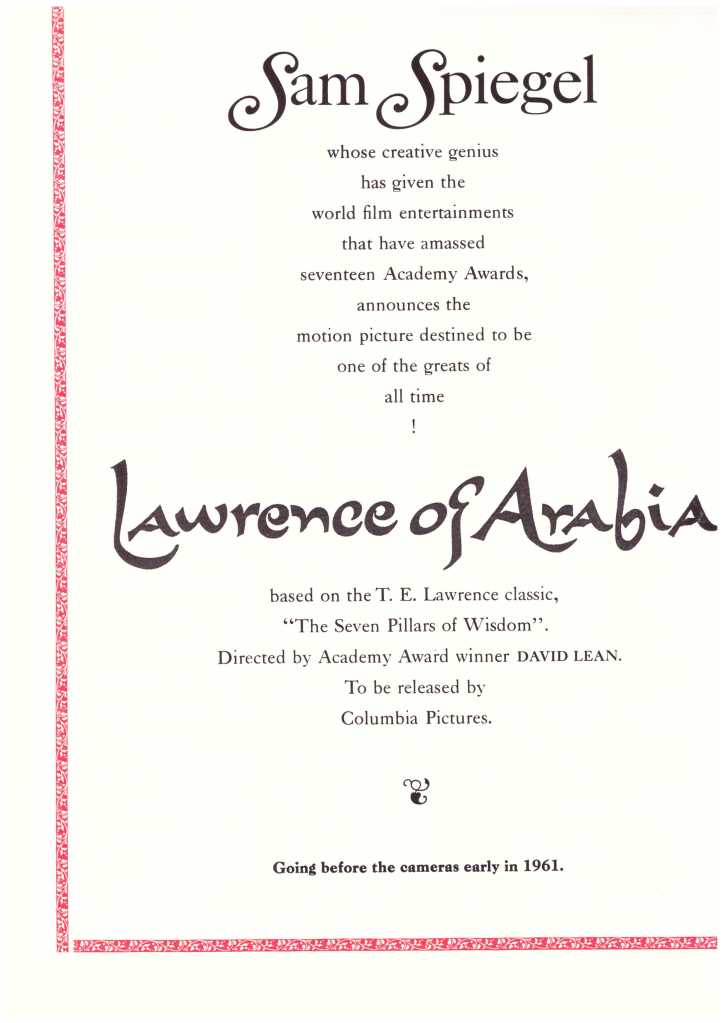
But in July 1959 Columbia made a deal with Sam Spiegel and David Lean who had turned Bridge On The River Kwai (1957) into the studio’s biggest hit. Meanwhile, Rattigan had turned his screenplay into the play Ross with Alec Guinness in the title role. Spiegel targeted Marlon Brando for Lawrence with a start date of summer 1960.
Spiegel had hired blacklisted screenwriter Michael Wilson, incurring the wrath of Columbia. Lean hired playwright Robert Bolt (A Man For All Seasons) to rewrite it. Meanwhile, Rank announced it had Alec Guinness for the lead.
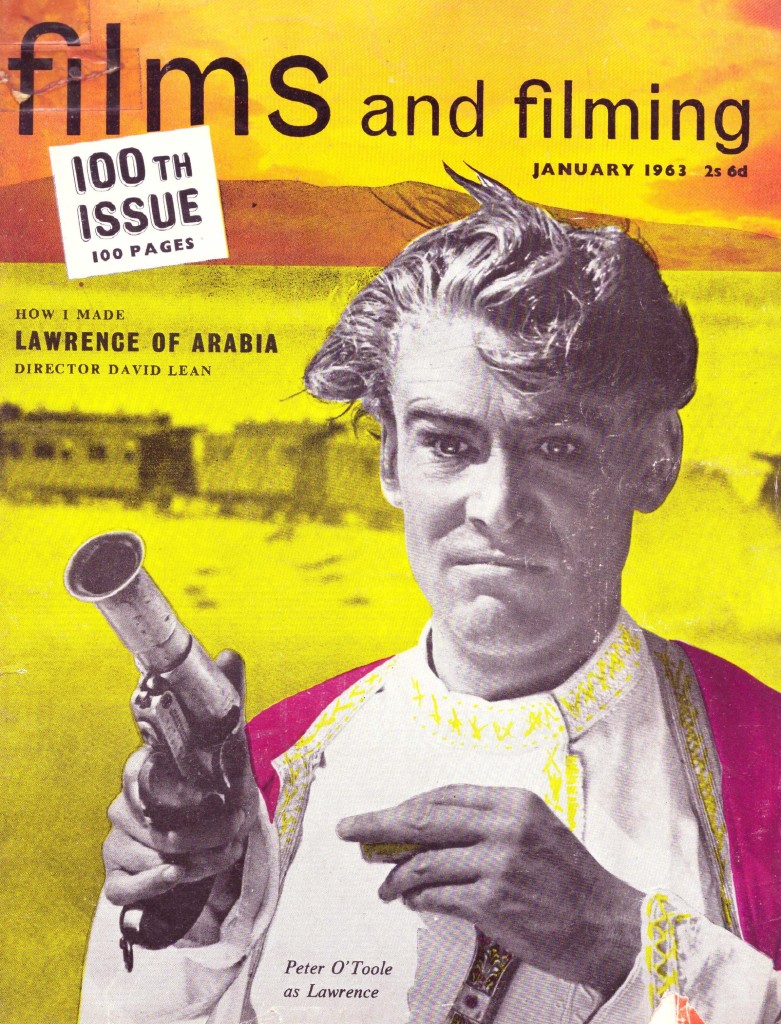
In July 1960 Brando pulled out. While Spiegel scoured Hollywood for a replacement, British producer Herbert Wilcox spent $364,000 on the rights to Ross with Laurence Harvey (Butterfield 8, 1960) to star. Lean went after British actor Albert Finney (Saturday Night And Sunday Morning, 1960) but the actor baulked at a long-term contract. His replacement was unknown Irishman peter O’Toole. Just as unknown, Omar Sharif was fifth choice for the pivotal role of Sherif Ali.
Filming was delayed until April 1961. Oscar-winner Alec Guinness, albeit in a supporting role, was crucial to bring cachet to the picture. The presence of two other Oscar winners, Jose Ferrer and Anthony Quinn, bolstered the marquee.
Finally, filming got underway in May in Jordan, despite an incomplete script. But conditions were horrific. Swarms of locusts hampered transport, temperatures hit 116 degrees Fahrenheit, the nearest water was 150 miles away. After a break, filming resumed in Spain on December 15 but Seville, chosen for its distinctive Arabian heritage, had just suffered the worst floods in a century, delaying production. The final location was Morocco and in July 1962 four planes flew 104 cast and crew there. Conditions there were as bad as in Jordan. After a few weeks in England, filming on the 313-day schedule ended on September 21, 1962. But with the world premiere set for December 10, it was panic all the way, especially after original composer Richard Rodgers of South Pacific fame quit.
Worse, ticket sales for the roadshow were poor, in part caused by the absence of a female in the cast. By mid-October sales for the U.S. opening stood at a paltry $11,424, compared to an advance of $700,000 for Exodus and $500,000 for How the West Was Won.
The world premiere of Lawrence Of Arabia took place in front of Her Majesty the Queen on December 10 at the flagship Odeon Leicester Square in London’s West End. The American premiere occurred on December 16 at The Criterion in New York.
But the public and the critics responded. On its first Saturday in London with only two performances, it set a new one-day record of $7,200. The Criterion’s opening week in New York was $46,000 which Variety described as ‘little short of amazing.’ The film was edited shortly after launch, the original prints cut by 20 minutes.
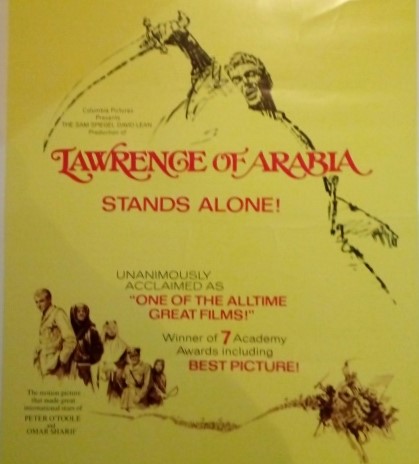
In the end it was both a box office and critical powerhouse, winning seven Oscars including Best Picture and Best Director, making stars out of O’Toole and Sharif, and for the past 60 years being acclaimed as one of the greatest films ever made.
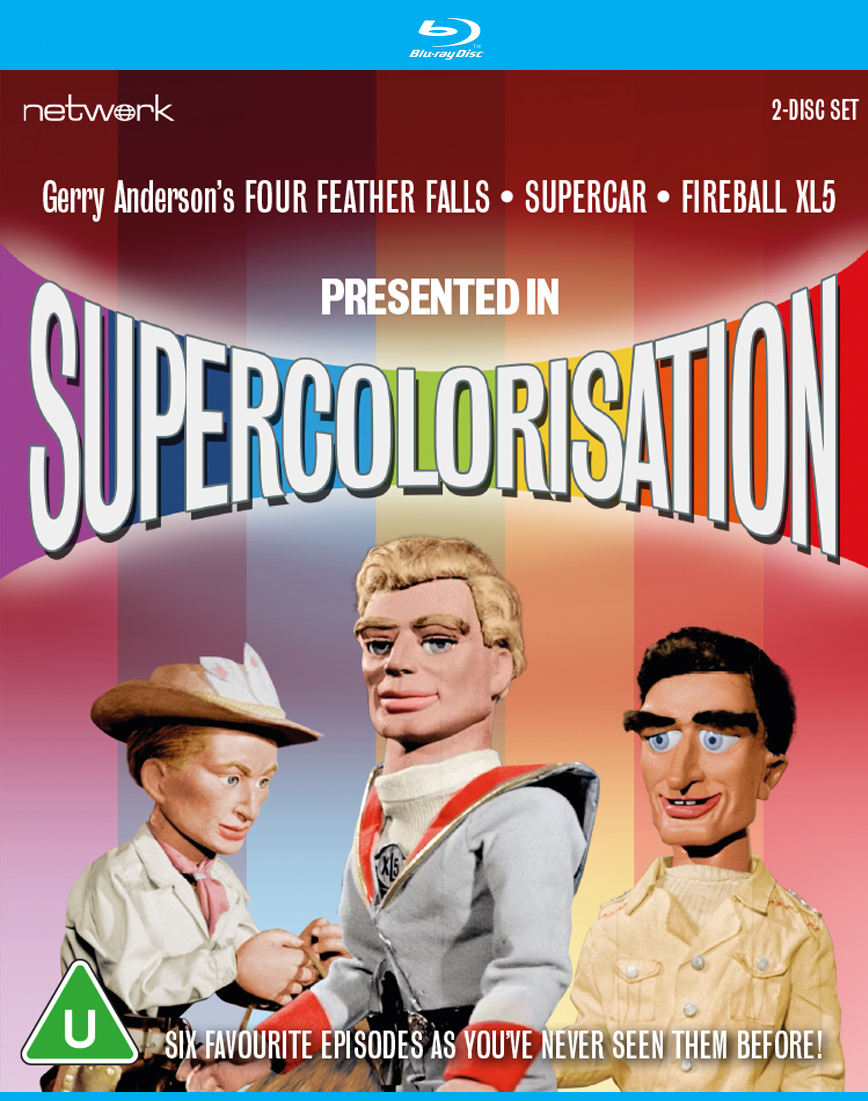
Heading for the five-star bracket on nostalgia alone. Before he hit the cult heights in full color with Thunderbirds (1965-1966, plus later films) and live action Space:1999 (1975-1976) innovator Gerry Anderson created a number of television series including the three highlighted here – western Four Feathers Falls (1960) and the futuristic Supercar (1961-1962) and Fireball XL5 (1962-1963).
Now colorisation, it has to be said, is anathema to the movie buff. A whole slate of top directors exploded in anger when Hollywood had the temerity to try and make an extra buck by colorising classic black-and-white movies in a bid to reach a younger audience.
Dynamic duo from “Fireball XL5” – Venus and Steve Zodiac.
But I can’t see anything wrong in making these wonderful programs, that would otherwise just be limited to the cult audience, more accessible to the modern youngster. To achieve the correct color palette, the producers here simply used on-set stills taken during the original shooting (you didn’t think actors in black-and-white programs or movies only wore black-and-white costumes, did you?) to match the vivid visuals of the later color series. Computer wizardry did the rest.
So the result is far more interesting than mere nostalgia, which would have been the case with releasing the three series in original format. Children of all ages are going to love the results.
Anyone unfamiliar, if that is humanly possible, with the Gerry Anderson output should be aware that he uses marionettes – based on the difficult Czech style. Ever with an eye to marketing, he called the process “Supermarionation.”
Inventiveness is the key to whether old television programs can capture a new market and I reckon this succeeds hands-down. While the color makes them instantly more attractive, the worlds established are what appeals more.
Got a copy of one of these memoranilia spin-offs and you’re probably sitting on a fortune.
Gerry Anderson’s sci-fi, far from rudimentary with advanced space-age machinery, had interesting heroes and narrative drive. In Supercar square-jawed hero Mike Mercury was supplemented by interesting boffins, Professor Popkiss and Dr Beaker. Pet monkey Mitch could be counted on for comedy. In Fireball XL5 Steve Zodiac has a female sidekick Dr Venus (voiced by Sylvia Anderson) , blonde template for Lady Penelope in Thunderbirds, while Professor Matic keeps everything shipshape and lazy pet Zoonie (vocabulary only marginally bigger than Groot’s) from a distant planet provides the humor.
Villains, invariably out to disrupt or destroy the universe and invariably recurring, were straight out of James Bond: Masterspy in Supercar and a whole bunch of them, the Subterrains, from Planet 46 in Fireball XL5.
Trademarks included a launch sequence, catchphrases, and a theme song (has any romantic lyric ever surpassed “my heart would be a fireball, a fireball, if you would be my Venus of the stars” in Fireball XL5?).
So what we’ve got here are three 30-minute episodes of Fireball XL5, two of Supercar and one 13-minute episode of Anderson’s debut series Four Feather Falls plus compilation features You’ve Never Seen These and Space City Specials. The Fireball trio are “The Sun Temple,” “The Granatoid Tanks” and “A Day in the Life of a General.” Supercar contributes “Pirate Plunder” and “Supercar: Take One” while the offering from the western is “First Train Through.”
The stories follow a similar format of threat and rescue – in “The Sun Temple” Venus is mysteriously captured and laid out to be tortured by the rays of the sun (think James Bond and the laser). And they’re none the worse for that.
Of course, I may be biased since Gerry Anderson formed a key component to my childhood, these programs followed in due course by Stingray, Captain Scarlet and the Mysterons, Joe 90 and Thunderbirds.
My only reservation is the strings often show up quite clearly. I viewed this via Vimeo on a screen that i doubt was even a foot wide, so a tiny screen by modern standards and the strings were clearly visible, so I’ve no idea what they’d look like on a 40-incher or bigger. Maybe another bout of computer wizardry in the future would erase those.
The colorization works a treat and opens up a new audience for these early Anderson programs. Hopefully, if the idea works, then we can look forward to the entire series of the three programs being colorised. If you want to make sure that happens, play your part by buying this new DVD which is available on December 12, but can be pre-ordered now. You wouldn’t want to miss out, would you? You can always pretend you’re buying it for the kids or grandkids.








 The Magnificent 60s