The Chalk Garden (1964) ***

You couldn’t make a movie like this now because (plot spoiler, I’m afraid) even the dottiest of old ladies would make at least a better attempt at collecting a reference from a prospective employee for fear she might be hiring someone disreputable. Though I doubt if many employers would expect a governess to turn out to be a murderess.

That this movie chimes with a contemporary trope – the criminal wanting to prevent others from following in their footsteps – makes it far ahead of its time. Made today, of course, the unruly child rather than merely threatening to unleash her arson impulses would probably have burned the house down.
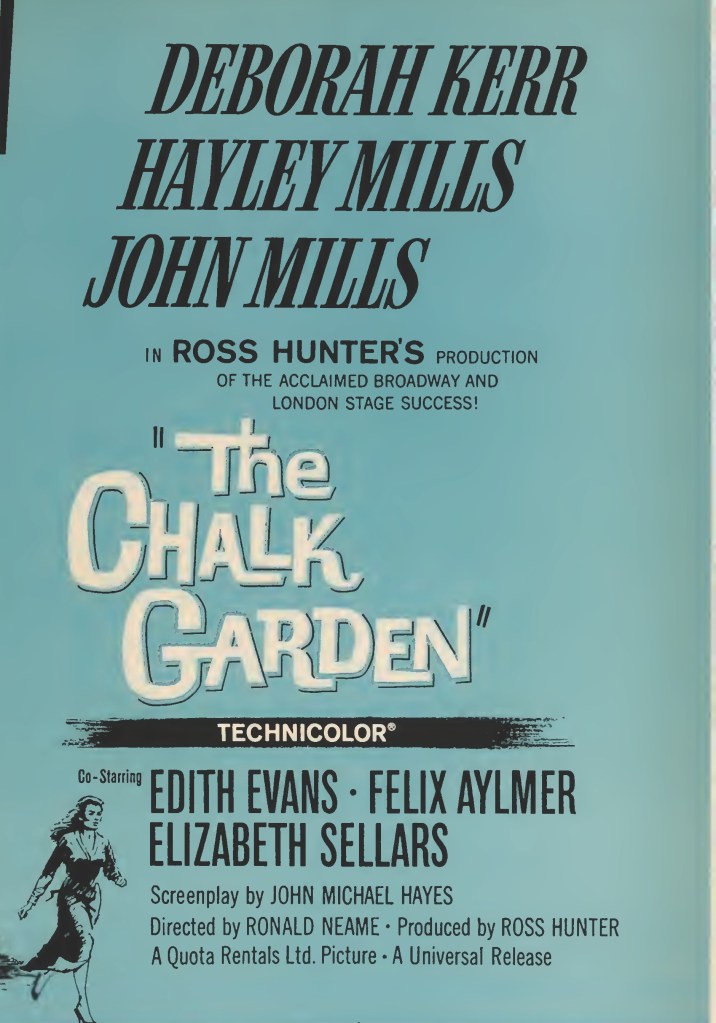
So it’s more a drama of manners, if you like. Very presentable but clearly down-on-her-luck Miss Madrigal (Deborah Kerr) is taken on by Mrs St Maugham (Edith Evans) as governess for her grandchild Laurel (Hayley Mills) because nobody else wants the job. Laurel’s outrageous behavior has sent a score perfectly well qualified ladies scurrying. Madrigal is hardly fazed by anything Laurel can get up to.

But the child is clearly suffering abandonment issues, her beautiful mother Olivia (Elizabeth Sellars) having gone off with another man. Grandmother incites grandchild to hate the mother. But Olivia’s maternal instincts have kicked in and she wants her child back. While Madrigal can deal with Laurel’s tantrums she is less fortified against the child’s inveterate snooping. Finding a mysterious suitcase leads Laurel to fantasize about Madrigal’s past.

Mostly the film is a four-hander, butler Maitland (John Mills) playing a significant role in proceedings, not least in his effortless management of the wild child. Quite why a such a pragmatic and assured gentleman should end up in this remote mansion is another mystery and thankfully there is no attempt made at playing up the cliff-top location in a suspenseful manner.

Mrs St Maugham is imperious but not entirely practical, either in setting child against mother or in trying to grow flowers in such chalky soil, though Madrigal appears to have sufficient horticultural knowledge to set her straight on the latter and attempt to intervene on the former.
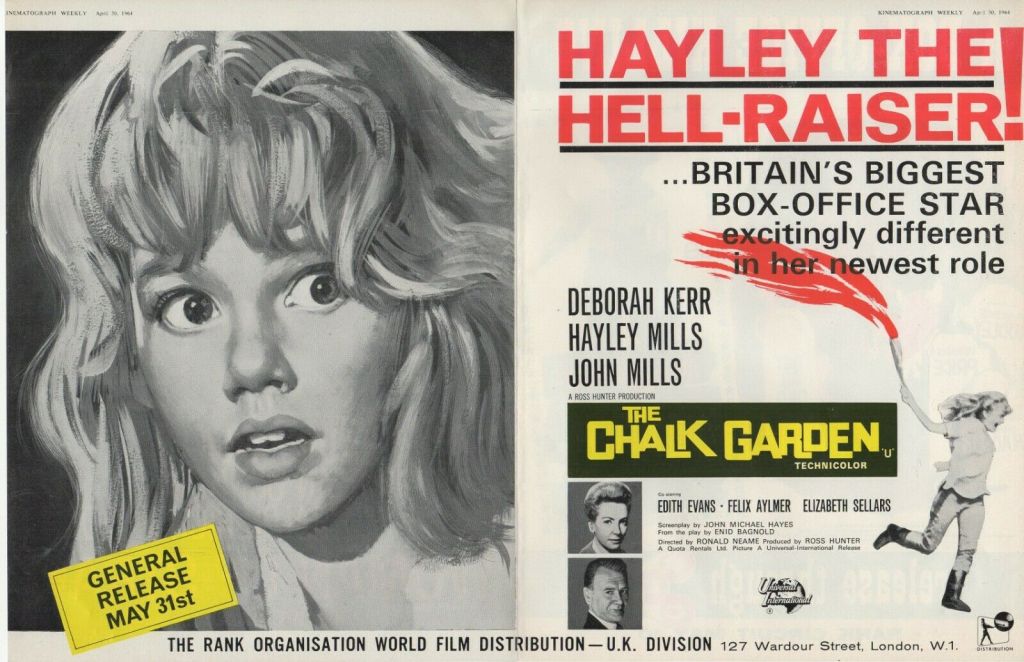
There’s a deadline of sorts. Olivia is coming to remove the child. Whether she goes willingly or not doesn’t matter. Madrigal sees her role as trying to prepare a child to love her mother and be more grown-up than the adults around her and forgive her.  

Madrigal’s guilt unnecessarily causes her to reveal that she had been jailed for murdering her stepsister, having been as resentful and jealous of the girl as Laurel currently is of her mother. Mrs St Maugham had called on old acquaintance Judge (Felix Aylmer ) for legal advice on how to prevent Olivia getting the child. He was the presiding judge in Madrigal’s case. Imagining he had not forgotten the trial – which of course he has – she feels duty bound to blurt out the truth before she is humiliated.  The confession helps Laurel realise how dangerous a path she is on and pushes her towards reconciliation rather than revenge.

It has all the making of a well-made play which is hardly surprising since it is based on Enid Bagnold’s Broadway success, at one time mooted as a film to star Joanne Woodward and Sandra Dee. So it moves along in the traditional three-act manner, plenty space given to establishing characters, introducing the undercurrents and leading to revelation and resolution.

So, mostly, it depends on the acting. Luckily, it is excellent. This was Hayley Mills in transition, far removed from Disney saccharine of The Parent Trap (1961) and about the same distance from the full-blown adult bottom-baring of The Family Way (1966). She projects a great deal more torment than in either of those films and comes across as believable, not exactly a young hoodlum but left to her own devices and starved of parental love only a matter of time before she would commit a crime of some kind.

Deborah Kerr hadn’t made a film in three years but her screen persona had shifted from the passionate – From Here to Eternity (1953), An Affair to Remember (1957), The Sundowners (1960) – to the repressed. Her spinster introduced in The Innocents (1961) had a great deal in common with her spinster of The Night of the Iguana (1965). But this is a different kettle of fish. Here, she exudes capability but with a self-awareness that undercuts such confidence, trying to keep a lid of emotions she struggles to handle.

John Mills (Tunes of Glory, 1960) casts a sardonic eye on the household while Edith Evans (The Whisperers) portrays a sorely wounded matriarch. Director Ronald Neame (Gambit, 1966) cleverly opens up the play, using the cliffs, gardens and rocky beach to considerable effect, but keeps the drama taut. John Michael Hayes (Nevada Smith, 1966) produced a workable screenplay.

Apologies for giving away the story, a good watch more for the acting than the twist.
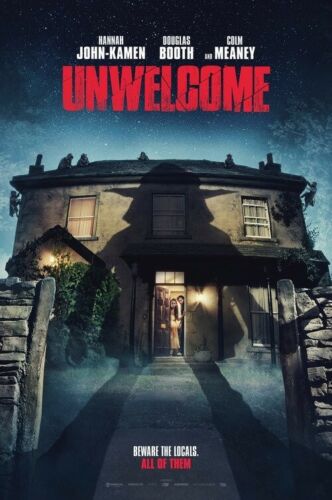
Unwelcome (2022) ***- Seen at the Cinema

Cult contender, assuming some basis in Irish legend. Otherwise, Straw Dogs (1971) meets Yoda with a side order of Barbarian (2022) and a touch of Se7en (1995). Someone’s definitely got it in for the Irish this year, but those finger-chopping Banshees have nothing on this little number.

After enduring a home invasion in the city, heavily pregnant Maya (Hannah-John Kamen) and cowardly husband Jamie (Douglas Booth) head for the Irish countryside, having inherited a rundown cottage from his odd aunt. Only thing is, warns neighbor and local publican Maeve (Maimh Cusack). you have to leave out a bit of bloody liver every day beside the back gate to assuage the Redcaps aka little people aka leprechauns aka goblins aka anything else you want to make up.

The story goes said aunt sacrificed her baby to save her dying husband, but it turns out the baby went missing, aged two, and was never found. Frosty reception at the local inn, a la An American Werewolf in London (1981), is a prank but the family of builders headed by a gobby Daddy (Colm Meaney), and his three kids, the gobby one from Derry Girls (Jamie-Lee O’Donnell), a thin gobby lad (Chris Walley) – with “the brain of a rocking horse” – and a peeping tom of a giant (Kristian Nairn) are on the malevolent side.

Not content with stealing any spare cash, Jamie’s stash of chocolate biscuits and his beer, and stirring up anti-English sentiment, smoking joints when they should be working and generally acting like workshy cliches, they constantly challenge the milksop Englishman who can thump a punchbag to his heart’s content but finds it hard to raise a finger in anger.

Beyond the gate there’s some kind of magical silent wood and a stone house. And feral creatures, Yoda-shaped, with shark-like teeth who might be able to fly and might have something to do with a nearby castle. A drunk man might have gone missing. Maya might be seeing what isn’t there. It’s that kind of film, mostly suggestive until it suddenly catches fire. Then it’s an onslaught.

And if you can take the Redcaps as being covered in Boy Scout badges and displaying some neat dance moves and a climax that seems relentless with Maya forced to become Final Girl since Jamie is about as helpful as having Jack Whitehall on your team. There’s more rain than in the Seven Samurai, though, to be fair, we were warned it rains 365 days a year in Ireland, Jamie treated as punchbag, the creepy giant trying his hand at rape, the thin one about to make his bones as a murderer, childbirth, the girl full of sexual swagger, decapitated heads in shopping bags, slicing, dicing, shotguns and shillelaghs and, you guessed, it a frying pan, and ending with the barmiest, although to some extent logical, image imaginable.

Like any cult contender, your first reaction might well be to laugh your head off at the preposterous goings-on but strangely enough it does work. While continuing to proclaim his manly abilities, and his sworn duty to defend his wife, Jamie is very much the modern husband, that is to say useless, completely lacking the protection gene, leaving it to the gutsier woman to clean up the mess that his unnecessary bravado creates.

Had I seen this poster which gives the entire game away I wouldn’t have gone.

To her credit, Hannah-John Kamen (Resident Evil: Welcome to Raccoon City, 2021) goes the whole nine yards, continually playing the supportive wife to a weakling, turning the paranormal to her advantage, not averse to pulling the trigger should the occasion demand. There’s little backstory to hang her character on, apart from a desperation to conceive given a previous abortion. But she has to deal with a continually changing scenario, negotiation with the wayward family, calming the giant, taking narrative center stage.

And it might be better going into it without cinematic preconception. If you’re of the age of the target audience you might have never seen Straw Dogs, therefore the villainous quartet might not appear descendants of the previous film, and, like Barbarian, you might happily accept the importance of babies to the modern horror picture.

A bit too long perhaps, and at times you might not know whether to laugh or applaud, but in the great tradition of The Evil Dead (1981) you might come back for more. Not a horror film in the gore/splatter league, and not that thoughtful either, but still capable of exerting a cinematic spell.

Lilith (1964) *****

You couldn’t make this now. What top-ranked actor would be willing to play a character who takes sexual advantage of a vulnerable young woman? You’d find it even harder to get a marquee name to play a female with paedophiliac tendencies, predatory sexual instincts and thinks it fine to drive a lovelorn young man to suicide.

That it was feasible back in the day was largely due to the restraints imposed by the much-maligned Production Code. Most of the issues are delicately probed, the problematic themes only touched upon, so that the result is quite amazing, the director turning to the lyrical,  rendered by its intensity a metaphor for internal conflict.

War veteran Vincent (Warren Beatty) takes a job as an occupational therapist at an upmarket mental institution, the kind that looks more like a country club or grand hotel with extensive manicured grounds. Few of the inmates are of the type found in the normal hospitals for the insane, the worst cases a woman with a maniacal laugh and another who treats a doll like a baby, but he is warned insane women are more “sinister” than crazy men.

One of his charges is the withdrawn Lilith (Jean Seberg) whom he gradually coaxes out of her shell, soon believing that it is his innate skill that brings about the possibility that such a high-risk individual could possibly achieve something akin to cure, or at least a greater degree of normality. You can hardly blame him for missing the obvious – that Lilith is using him – for the young woman is every inch the winsome innocent seeking guidance from the more mature responsible male.

It’s mostly shorn of obvious metaphor but there is one scene, compelling in itself, where Vincent plays the knight on horseback, complete with lance, winning a contest of skills for his lady, that completes his idealisation in her eyes. But he is already halfway there, with unexpected dexterity he frees her hair caught in loom, the kind of scene that in an otherwise more romantically-inclined movie would be the meet-cute.

And this isn’t one of those films about a madwoman in an attic or an apparently sane person turning demented. Instead, considerable time is spent analysing the condition of the schizophrenic, either through clinical lead Dr Lavrier (James Patterson) expounding his theories or through Vincent discussing individual patients with his boss Dr Brice (Kim Hunter). The idea of opening up a new realm to an audience is crystallised in one scene where Lavrier explains that even spiders go mad, resulting in asymmetrical webs rather than the typical formations to which we are more accustomed.

And by using one of the oldest tricks in the book, an inexperienced young man negotiating a new world, disbelief is suspended. But just when we think we are seeing everything from Vincent’s perspective, we are thrown into a heightened intensity linked to the lyrical – a river, a waterfall – the madness of ecstasy, what used to be called rapture, as Lilith stares and stares at nature.

But there are warnings about the personality of both characters. Lilith bears a startling resemblance to Vincent’s dead mother. He has difficulty committing, lack of communication while away at war resulting in girlfriend Yvonne (Anne Meacham) marrying someone else.

And there is plenty that is disconcerting about Lilith that only the besotted would overlook. She leads on lovelorn Stephen (Peter Fonda) to potential disasters he cannot foresee. Angry at Vincent, “I show my love for all of you and you despise me,”  she seduces vulnerable older patient Laura (Jessica Walter). But the worst aspect of her character is that she perceives no boundaries to behavior. She exhibits inappropriate attitudes to young boys, inviting one to rub his finger along her lower lip.

However, for most of the film the skilful direction of Robert Rossen (The Hustler, 1961) has you rooting for the young lovers. Even while never falling back on the cliché of the doctor-type saving the ill person, there is enough in Vincent’s earnestness and Lilith’s innocence to make that a distinct possibility, were it not for the other discordant elements of her character.  The picture is wrapped in natural sound – the river, waterfall, a flute playing mournful tune, ping-pong ball hitting bat, reeds or branches parting, rain, footsteps, a ticking clock, and the bulk of the music emanates from Stephen’s radio. And then he will twist it slightly, reflections are seen upside-down in the river, or a shot of the waterfall is held for too long, the sound of water increasing, or Lilith standing in the river bends down to kiss the surface, or at a picnic she eats a leaf irrespective of whether it might be poisonous.

Usually, when you get so much detail it’s a surfeit, and ends up drowning the viewer. But that’s not the case here. Either it builds or expands. And there is even a throwaway that mocks the notion of containing madness in an institution. The best, most revealing, line in the  picture is not spoken by either of the two principals, but secondary character Yvonne, seen only at the beginning and end. When for unspecified reasons Vincent turns up at her house and her husband (Gene Hackman) leaves them on their own, she says, “I told you I’d never really let you make love to me until I was married,” (pause), “well, I’m married now.”

Jean Seberg (Moment to Moment, 1966) is just superb, coming across as a young woman entering adulthood full of fears and insecurities, only suggesting the darker side of her character, and never giving in to the temptation of overplaying. Warren Beatty (Kaleidoscope, 1966) can’t quite match her for subtlety or kick those acting mannerisms – lowered head, looking away – but his stupefied expression towards the end as he realizes just what he has taken on is priceless.

There’s an outstanding cast of rising stars. Peter Fonda (Easy Rider) as the preppy insecure victim is excellent while Jessica Walter suggests the qualities that would make her the prime candidate for the femme fatale in Play Misty for Me (1971). Gene Hackman, in his movie debut and still working on his trademark chuckle, provides early evidence of his immense talent.  

Robert Rossen, who wrote the screenplay (from the novel by J.R. Salamanca) and also produced, couldn’t have wished for a better epitaph. This was his final film in a relatively short career – he only directed 10 films.

Despite contemporary reservations about the content this is a beautifully observed piece and well worth a look.

Plane (2023) **** – Seen at the Cinema

Gerard Butler is pure Ronseal. “It does what it says on the tin” goes that advert. And so does Butler. You want action, he is first in the queue, and he delivers. But our Gerard is no Bruce Willis and doesn’t pretend he can do it all on his own. Not only does he enlist a murderer, an elite military force is also in due course on his side. You’d think that would leave Gerard with little to do, but you’d be wrong.

He’s the moral center and the driving force and of course he’s the pilot. the only one who can get them in and out. Just as well there’s someone to do things by the book because his employers, desperate to make PR spin their way, are as cynical as they come, sending a pilot to fly through a storm to save a few bucks on fuel.

So, New Year’s Eve, widower Brodie (Gerard Butler) on a plane with only a handful of passengers crash lands on a remote island in the South China Seas where cut-throat separatists run a hostage business. Brodie frees murderer and ex-Foreign Legionnaire Louis (Mike Colter) and sets out to make contact with home. Meanwhile, back at the office, troubleshooter du jour Scarsdale (Tony Goldwyn) sends in a bunch of mercenaries. So it’s mostly escape and capture, you know the drill.

At least, at last, it’s not an airplane picture about apportioning blame after a disaster or stitching up the captain (Flight, 2012/Sully, 2016). There’s no ballast: no pregnant woman or child on board, not even a nun, and the pilot doesn’t have the hots for a stewardess and the criminal doesn’t hunker down at night and home in on audience sympathies with a heartrending tale, and there’s no retired airman called into service one last time, and it’s not the pilot’s final trip before retirement and there’s no wizard engineer who can put back together a broken machine and it’s not about everyone pulling their weight in a tight spot.

The passengers, those that survive that is, might be mildly annoying on the plane but once landed they’re too busy being terrified to make a nuisance of themselves. So it’s pretty realistic for what could otherwise have been a pure gung-ho actioner. When Brodie does get through to his company, he gets treated as a time-waster. And there’s really no way, realistically, without the intervention of mercenaries that he’s going to get the passengers off the island on his own.

In some senses it’s kind of two different movies jammed together in occasional clunky fashion and you wonder if initially it was devised as a pure rescue number before someone had the bright idea of bringing a star in as the pilot.

Brodie might be a rough diamond, but he sure can fly, witness two crash landings and a take-off hindered by enemy rocket launchers. He’s a true Scot, wouldn’t “lower himself” to be tabbed English, although the scriptwriters make an elementary howler in imagining that the traditional New Year dinner is haggis, neeps and tatties when it’s actually steak-and-kidney pie.

And the myth that a Scottish accent will get you through more doors than an English one, and that you’ll soon be nattering away convivially with your captors about Sir Sean and wee drams and kilts, is quickly exploded. Nationality in international war zones is mere currency. Brodie, of course, has to take one (more than one, actually) for the team but is happy to put himself in harm’s way to safeguard his charges.

Luckily, Louis has no such reservations, primarily with his own interests at heart, intent on escaping official clutches and disappearing into the jungle with a cache of cash.

This is Butler reinvented as Everyman. Yep, action abungo but humane with depths. With an astonishing 70 credits and too many supposedly star-making outings to count he has an equally diverse range, can hold his own against top female stars like Angeline Jolie (Lara Croft, Tomb Raider: The Cradle of Life), Katharine Heigl (The Ugly Truth, 2009) and Jennifer Aniston (The Bounty Hunter, 2010) but these days is more likely to be the go-to actioneer. I am hoping that some Hollywood producer might recognise his other qualities and pitch him a drama like A Man Called Otto. Imagine that snarl in your neighborhood.

You get exactly what you pay for here, for workmanlike read spare and lean, for reimagining previous rescue pictures read tension-filled character-driven edge-of-your-seat action. Butler brings tremendous humanity to a role that could as easily have been muscle-bound.

I’m less familiar with Mike Colter (Carter, 2022) but sensibly he underplays his role. Danielle Pineda (Jurassic World: Dominion, 2022) is good as the level-headed chief stewardess and Tony Goldwyn (Ghost, 1990) makes a sinister troubleshooter. MTA Kelly Gale makes her debut.

A welcome return to pedal-to-the-metal form for director Jean-Francois Richet (Mesrine, 2008) who employs hand-held cameras to great effect. Marks the screen debut of thriller writer Charles Cumming along with J.P. Walsh (The Contractor, 2022).

This is ideal counter-programming when we’re mired down in the Oscar-worthy.

You can’t go wrong with Butler.

Oldies Every Day of the Week

In the 1960s you could watch old films in the cinema in virtually every country in the world every day of the week. Except in the United States, television had not impacted so much on the availability for booking films made within the last decade, so there was generally plenty of scope to operate a picture house that specialized in old movies. They were called “repertory” theaters. Of course studios dipped in and out of the repertory business themselves, yanking out of the vaults old blockbusters, but on an irregular basis, that particular supply rapidly diminishing as old movies were sold off for small screen presentation. 

Pre-television, in the United States in the 1940s a small industry had grown up, both in distribution and exhibition, either buying up the rights to old movies and recycling them as instituted by the Producers’ Releasing Corporation and Realart and PRC or establishing mini-chains of cinemas like the Academy of Proven Hits. But when television made such big inroads into old stock in the U.S. you were more likely to find old pictures turning up in arthouses, and even then that was limited to known attractions like Garbo and Bogart and occasional retrospectives of Bette Davis and Joan Crawford. Or arthouses would slip in a series of oldies one day a week.

In the 1960s “no cinema in the United States except the Thalia in New York and the Cinema Guild in Berkeley has ever made a serious attempt at presenting cinema repertory.” Occasionally, a U.S. distributor acquired a bundle of old pictures as the basis of an ongoing program distributed through arthouses, such as the 27-film series from Janus or Tom Brandon’s batch of 75. Paris, on the other hand, was a paradise for lovers of old movies. 

The 1960s saw the beginning of the film studies phenomenon, so cinemas showing old movies found new custom. Prior to that, the most common way to view classics was via a film society, another booming sector. While boasting four million members worldwide, access was limited to one movie – in 16mm not 35mm – a week for one screening only and a program that ran for about half a year.

Surprisingly, Britain was at the forefront of the repertory industry. When I was growing up in Glasgow in the 1960s I was astonished to discover a commercial chain – the Classic – operating three cinemas in the city center. Two of the operations, the Classic Grand and the Tatler Classic, while retaining the company name gradually shifted into the sexploitation business, the latter as a private members’ club. But the flagship Classic, just down the road from the Odeon, one of the city’s most prestigious houses, ran a weekly program of old films.

Realart reissue from the 1940s.

At the start of the decade, Classic operated ten cinemas in London and another 80-plus  throughout the United Kingdom. Programmes changed midweek if showing just one film while a double bill would run a full week. Several cinemas ran late night screenings, usually on a Saturday, but these could also be found on a Wednesday or Thursday.

Sometimes the movies shown were foreign, other times there might be a short season of Marx Bros comedies or Hitchcock thrillers, but mostly they were British or American pictures whose quality or reputation suggested they deserved repeat viewing on the big screen. One print would be enough to feed the entire system, shunted from screen to screen.

Quite a few of the films would be hired on a flat fee basis, no sharing the box office with a distributor or studio. Older audiences, fed up with the sex and violence prevalent in current movies, took refuge in safer, older films. Younger audiences, wanting to catch up with great films, found the screenings an unexpected bounty, especially to see them projected in their original dimensions.

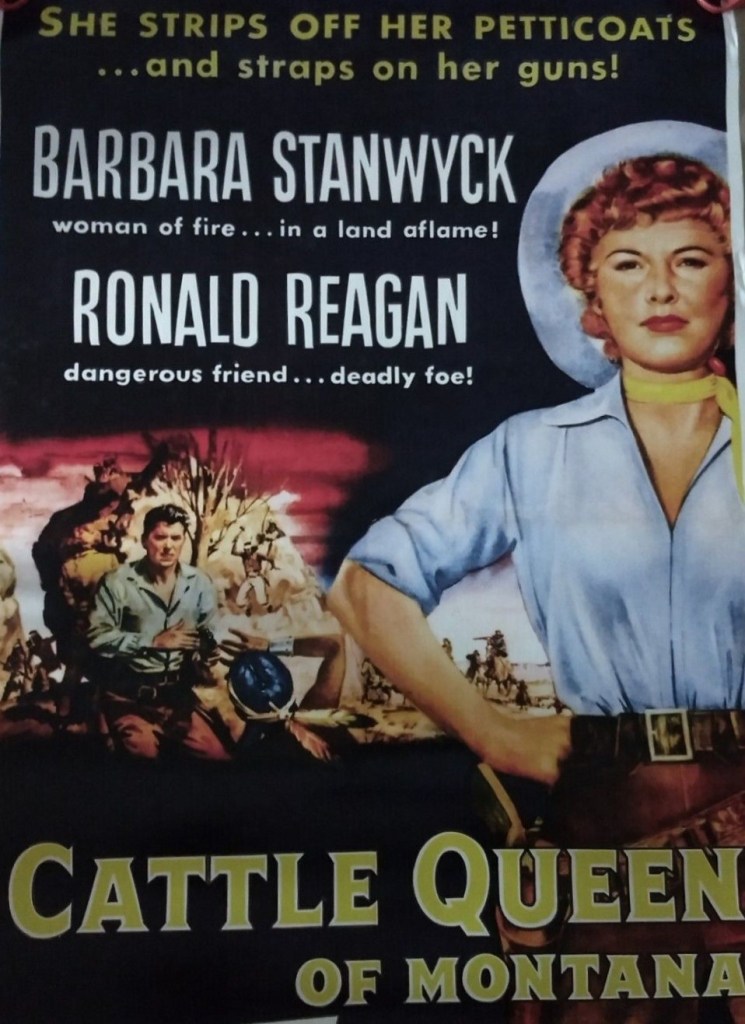
Just how old the offerings were varied. In 1968 over the period March 10-April 6 the youngest film presented on the Classic chain was Bonnie and Clyde (1967), the oldest Animal Crackers (1930), The Lady Vanishes (1938), Carol Reed’s The Stars Look Down (1940) and The Song of Bernadette (1943). In between you could choose between The Third Man (1949), Barbara Stanwyck as The Cattle Queen of Montana (1951), Viva Zapata (1952), The Brides of Dracula (1960), Billy Liar (1963), The Birds (1963), The Pawnbroker (1964) and Peter Sellers comedy After the Fox (1966).

On the foreign front, you could sample Vilgot Sjoman’s My Sister, My Love (1966), Godard’s A Woman Is A Woman (1961), offbeat French film Do You Like Women (1964) about cannibals owning a vegetarian restaurant, and Elke Sommer and Virna Lisi in Four Kinds of Women/The Dolls (1965). It was relatively easy to structure programs to cash in on a current picture by, for example, Peter Sellers or Marlon Brando or directors such as Alfred Hitchcock or Carol Reed.

By the 1970s repertory cinema was booming in America, 400 theaters in operation, major cities accommodating several, while in Britain the Classic chain was acquired by the Tigon production company.

SOURCES: Brian Hannan, Coming Back to a Theater Near You (McFarland, 2016) p48-49, 54, 63, 72-73, 77, 80-81, 72; Gideon Bachmann, “A New Generation of Critical Fans,” Variety, June 1, 1960, p5; Advertisement, Films and Filming, October 1961, p2;“One Night Revivals Add to Arthouse Profits,” Box Office, June 29, 1964, pA3; Gideon Bachmann, “International Film Societies Number 2,500,” Variety, April 20, 1967, p13; “Films in Repertory Set for Reade-Sterling House,” Box Office, February 8, 1965, pE5; “Brandon Lines Up Chain of 30 Arties for Medleys of Oldies and Offbeat Pix,” Variety, Septmeber 6, 1967, p5; “Repertory,” Films and Filming, April 1968, p23;“Squeeze More Coin on Last Run of Classic Films,” Variety, April 24, 1968, p7; “Classic Try Switch To Cinema Club,” Kine Weekly, February 8, 1969, p6; “Tigon Aims Complete Classic Deal by End July,” Kine Weekly, June 12, 1971, p3; Marianne Cotter, “Survival of Revival House,” Box Office, March 1, 1993, p24.

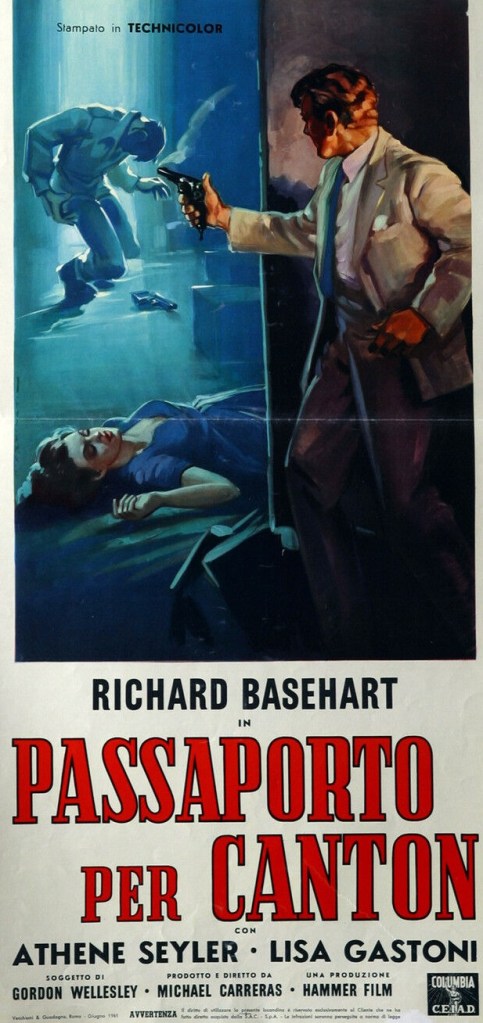
Passport to China / Visa to Canton (1961) **

Marked down for sheer laziness. Another Hammer “thriller,” this time with fading American star Richard Basehart and Italian glamor puss Lisa Gastoni. But mostly a hodge-podge travelog of stock footage with dialog taking the place of action, a tedious voice-over far removed from the snappy one-liners we are accustomed to getting from Chandleresque investigators. And let’s forget the red-eyed Chinese replete with drooping moustaches who pepper the picture.

A plane has gone down in Red China with an American courier carrying vital “scientific” information, Approached to help by US government personnel, snappily-dressed Hong Kong travel agent Benton (Richard Basehart) refuses. But when he discovers the pilot is Jimmy (Burt Kwouk), a member of a Chinese family he has befriended during World War Two, he mounts his own rescue mission. Which consists, by the way, of nothing more than floating a sampan up a river, avoiding a few bullets and whisking the lad away.

But he is blackmailed into rescuing the courier when Hong Kong police imprison Jimmy. So off he trots to Macao and then Canton aided along the way, in the opulent back room of a casino, by Chinese businessman Kong (Eric Pohlmann) who you might mistake for a James Bond villain such is his fondness for being surrounded by women – or such is his girth mistake him for a Robert Morley lookalike. Kong happens to be a Russian spy.

No sneaking into China by parachute or perhaps motor boat is required, Kong simply furnishes him with the visa of the title. Benton, vaguely assisted by a maker of fake porcelain, has clues –  Three Fishes, The Stream of the Willows.

In his hotel bedroom sits the courier, blonde Lola (Lisa Gastoni), held prisoner. But no sooner have they kissed, as you might expect of any self-respecting travel agent doubling as a spy, than they are interrupted by Kong. She disappears. Naturally, Benton finds her easily enough. She doesn’t have papers, instead a photographic memory.

But she’s not working for the Americans. She’s an espionage freelance, working for the highest bidder. She does it for the danger, perhaps like a certain James Bond, danger is the drug, heightens her senses.

But she’s also pretty damn clever. Knowing Kong is a double agent and can’t just snatch her out of China, she starts an auction for her information. Benton offers more. Therefore she is his property. To get over the tickly issue of Kong, in revenge, keeping her prisoner in China, he is conveniently accidentally shot.

So now they have to escape. But in the shoot-out at the docks (in a barn full of hay for some reason she gets shot) so the movie suddenly turns into one of those post-Bond thrillers where all that effort has been expended for no result.

But you might have thought a producer (Michael Carreras) would have introduced Lola much earlier in femme fatale fashion. But then this producer who, as it happens was also the director, seems to think that voice-over will solve all the tedious problems of actually creating a screenplay that works.

You shouldn’t have cared less about a snappy-suited character such as the one played by Gene Barry in his informal espionage trilogy – Maroc 7 (1967), Istanbul Express (1968) and Subterfuge (1968) – he’s about on a par as an actor as Basehart. But those movies at least had proper stories that made sense and were not just a series of jumps explained by voice-over, the hero neither having to undertake any shamus digging or go into harm’s way, or battle his way out of perilous situation.

It’s not even bad enough to eventually win over a cult audience. The problem is it’s well-made up to a point and the story is intriguing up to a point, but that mark is very low.

Richard Basehart (The Satan Bug, 1965) isn’t called upon to do much except act as the storyteller he’s okay and Lisa Gastoni (Maddalena, 1971) isn’t accorded sufficient screen time to really make a mark. Which is the biggest shame because an amoral spy like her would have made a brilliant femme fatale had she been introduced early on and then turned out to be the mercenary she was.

The rest of the cast are caricatures, though interesting to see Burt Kwouk in pre-Pink Panther persona but cringe-worthy to see Bernard Cribbins (You Must Be Joking, 1965)  mangle a foreign accent. Clearly Carreras learned a lesson from this implosion of talent and story because two pictures on he directed taut thriller Maniac (1963).  

Return from the Ashes (1965) ****

When your starting point is an arcane French inheritance law and the plot revolves around swindling a concentration camp survivor you are immediately on “icky” ground. Throw in a relationship between an adult male and the step-daughter of his deceased wife and the audience might already be backing off.

So it’s a tribute to the acting and that each character is not so much unlikeable as both vulnerable and predatory that this turns into a very involving drama. On the eve of World War Two in Paris Dr Michele Wolf (Ingrid Thulin) buys the love of penniless Polish chess player Stanislaus (Maximilian Schell) but at the cost of abandoning her step-daughter Fabi (Samantha Eggar). For him, love is contingent on wealth, but he marries Michele, a Jew, in a (failed) bid to save her from the clutches of the Nazis. Fabi, shorn of maternal love finds turns to a paternal variation, but is capable of coming up with an ingenious murder plot.

Just quite how hollow Michele has become is demonstrated in a brilliant opening scene set after the end of the war. In a railway carriage, a bored small boy endlessly kicks a door. Pretty much for 90 seconds we either see or hear that door being kicked. Foolishly, his hands wander from the window to the door handle. Next thing, he has fallen out. Cue screams, chaos, shocked passengers racing out of the carriage.

But when the conductor turns up to investigate the incident he finds Michele still sitting in her seat, oblivious to any death, even that of a child. When she returns to Paris, she takes a room in a hotel under a pseudonym, fearing that her ravaged looks make her unattractive, guilty at surviving (by volunteering to work in the camp brothel) when all her relatives were wiped out, unaware that she has unexpectedly inherited all their combined wealth.

So the story begins in a different way. When Stanislaus meets her accidentally under her false name, he immediately assumes she is just a dead ringer for his deceased wife and enrols her in a scheme to win the millions currently held in escrow under this inexplicable French law.

Since she continues to play the part of a different woman, she hears the truth about her relationship with Stanislaus, that although he committed the only unselfish “gallant act” in his life in marrying her nonetheless his prime reason was money. Already Fabi, in full femme fatale mode, is planning to rid the couple of Michele once the money has been legally acquired.

To his credit, Stanislaus initially balks at this notion, but when Michele reveals her true identity and scuppers his relationship with Fabi while at the same time trying to win back the affection of her step-daughter, matters take a deadly turn.

For the most part what we have is a menage a trois, equal parts driven by money and love, but in each instance propelled by innermost desire. Stanislaus is adept at pulling the wool over Michele’s eyes, she only too willingly blinding herself to his sexual deception. But Michele is equally willing, even when she knows his true feelings, to use her money to win him back while Fabi, aware that for her lover money will always trump romance, is determined to use her body to achieve the same effect.

What makes this so compelling is that, unusually, it avoids sentiment. It would have been easy to load each character up with such vulnerability that an audience would not condemn them. Instead, in addition to their individual weaknesses, we are shown their inherent predatory natures.

What makes it so enjoyable is the acting. So often Maximilian Schell is called upon to play stern characters, often typecast from his accent as a villainous German of one kind or another (Judgement at Nuremberg, 1961, The Deadly Affair, 1967), rather than allowing him to invent a more rounded character as he did in Topkapi (1964). This is a wonderfully involving performance,  the wannabe chess grandmaster who uses his considerable charm to buttress his fears of poverty, and is only too aware of his failing, full of joie de vivre, bristling at being a kept man yet at the same time only too ready to financially exploit the situation.  

Where in The Collector (1965) Samantha Eggar was constrained by circumstance and in Walk, Don’t Walk (1966) saddled with an initially cold character, here she is permitted greater freedom to develop a conflicted personality, loving and deadly at the same time, drawn to and hating her step-mother, attracted by the thought of the money that would secure Stanislaus but repulsed by the cost.  

Ingmar Bergman protégé Ingrid Thulin (Wild Strawberries, 1957) is given the least leeway, another of the tormented characters in her intense portfolio. Herbert Lom (Villa Rides, 1968) puts in an appearance as a friend trying to warn her off Stanislaus.  

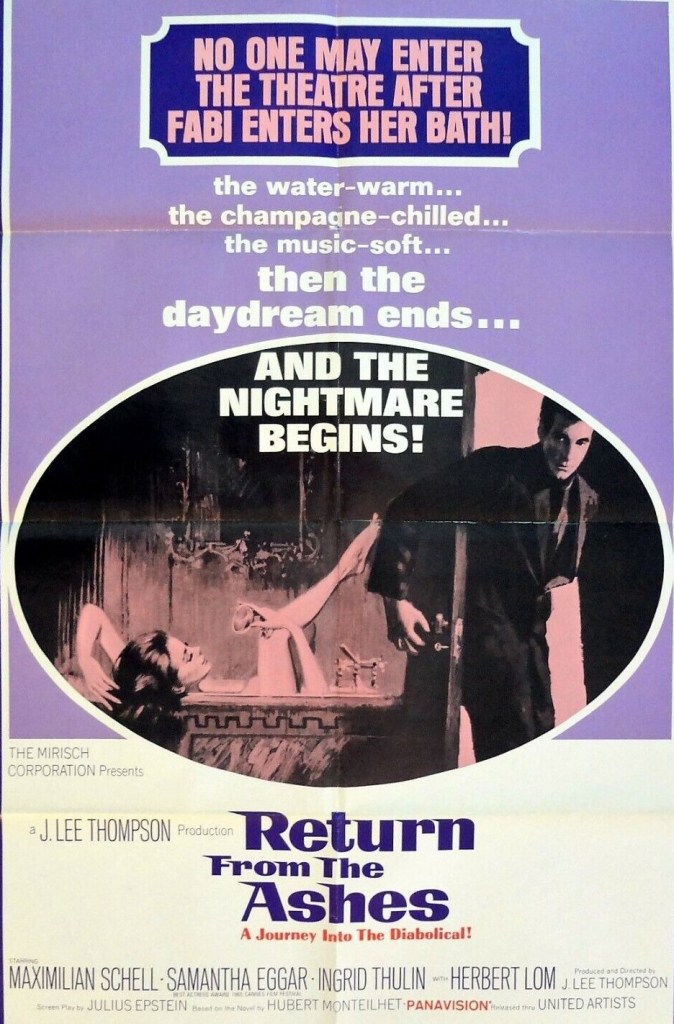
Director J. Lee Thompson (The Guns of Navarone, 1961) takes the bold approach of allowing characters and situation to develop before moving into thriller mode. There are a couple of quite superb scenes, running the opening segment close is the much-vaunted scene of Fabi in the bath (“No one may enter the theater once Fabi enters her bath” was a famous tagline). It is brilliantly filmed in film noir tones, bright light slashed across eyes rather than through windows, and Johnny Dankworth provides an interesting score. Julius J. Epstein (Casablanca, 1942) wrote the screenplay based on the bestseller by Hubert Monteilhet.

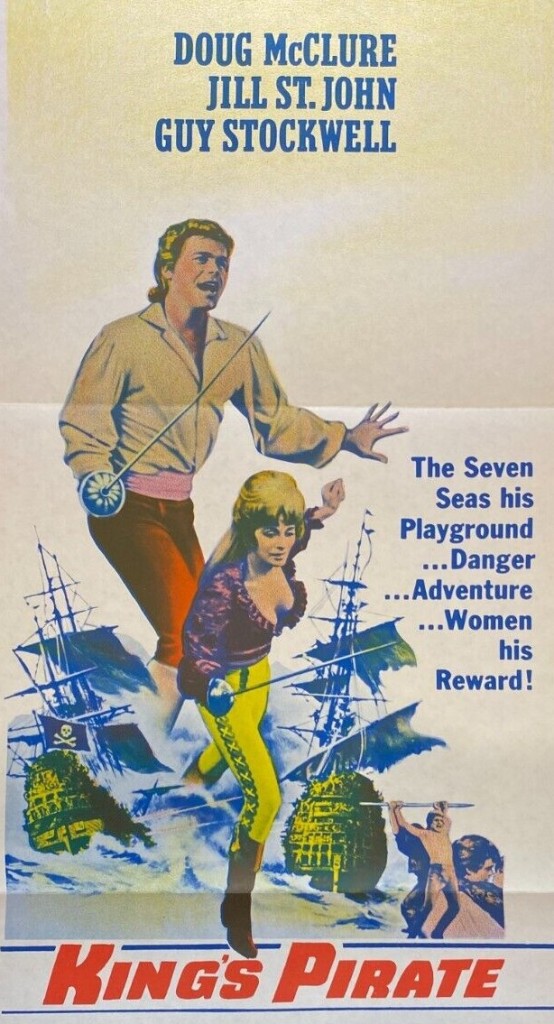
King’s Pirate (1967) ****

Swell show. Virtually every movie Doug McClure (Beau Geste, 1966) made was under-rated, mostly due to his presence, but here he is at his impish cavalier best in a swashbuckler that rather than offering a re-tread goes in for clever reversals, running jokes and a healthy dose of the flashing blade. While McClure is no Errol Flynn (Against All Flags, 1952) he would be a safe match for Tyrone Power and Jill St John (Come Blow Your Horn, 1963) as his nemesis/lover could give the pirate picture’s most reliable spitfire, Maureen O’Hara (Against All Flags), a run for her money.

Well, actually, it is a bit of a re-tread, a spirited good-humored remake of Against All Flags, and  follows the same story as Pirates of Tortuga (1961) of good guy infiltrating a pirate stronghold by pretending to be a buccaneer. But the locale has shifted a good three thousand miles to Madagascar, ideally placed to plunder cargo ships en route to India, and it would be hard to argue that Lt Brian Fleming’s (Doug McClure) motivation is pure, given he is expecting major financial reward for risking his life. 

Still, to complete his disguise, he submits to a flogging. His task is to incapacitate the cannons that protect the island from Royal Navy invasion. But his team is somewhat unusual, a bunch of acrobats headed by Zucco (Kurt Kasznar) which ensures he can avoid the wall/cliff-climbing normally associated with such endeavors. Having just about convinced pirate king John Avery (Guy Stockwell), Fleming’s mission runs into trouble when Mogul’s daughter Princess Patna (Mary Ann Mobley) falls in love with him after he saves her from a burning ship, though admittedly one he had helped set on fire. He falls foul, too, of “Mistress” Jessica (Jill St John), the island’s de facto ruler and accomplished femme fatale, expert swordswoman, but a la Pirates of Tortuga with a yen to be a “lady.”

So, basically, he has to dodge the suspicious Avery, and put off the princess while trying to woo Jessica in order to find a secret map of the cannon locations.

The island’s preferred style of execution is staking men at the water’s edge and letting the rising tide do the rest. When Fleming, on initial arrival on the island, gulps at this demonstration of barbarity, you probably don’t guess this will happen to him. It’s just one a litany of reversals that make this a delight.

Talking of reversals and delights, how about the Indian princess speaking in a Scottish accent, courtesy of her governess, the fearsome Miss MacGregor (Diana Chesney)?

Not to mention Jessica’s habit of making her romantic inclinations known at gunpoint. Unusually lacking in the female ability of expressing her emotions, Jessica’s actions tend to be the opposite of her stated intention, resulting in, having given Fleming the brush-off, bidding against him in the slave market for Princess Patna to avoid the Indian lass getting her romantic claws into him. But not only is Jessica expert with the sword she is a crack shot and can shoot the end off a rapier.

Of course, when his sword can’t do the talking. Fleming has to weasel his way out of many a dicey situation with an inventiveness that would do Scheherazade proud.

All in all the best pirate film of the decade – though there wasn’t much competition. Competently made with McClure and St John striking cinematic sparks with former Miss America Mary Ann Mobley (Istanbul Express, 1968) happily cooperating in turning her character into a comedic gem.

While there’s certainly a touch of the Tony Curtis in McClure’s portrayal it is also his stab at carving out a position as a jaunty leading man. Jill St John, given a lot more to do than in most of her pictures, takes the opportunity to shine. Guy Stockwell (Beau Geste) delivers another villain.

Don Weiss (Billie, 1965) directed and does exceptionally well steering audiences away from unfulfillable expectation, given the low budget, by focusing on the qualities of the stars and a ripping tale knocked out by television comedy writer Paul Wayne, who rewrote or incorporated material from Aeneas MacKenzie and Joseph Hoffman responsible for the original.

Catch it on YouTube.

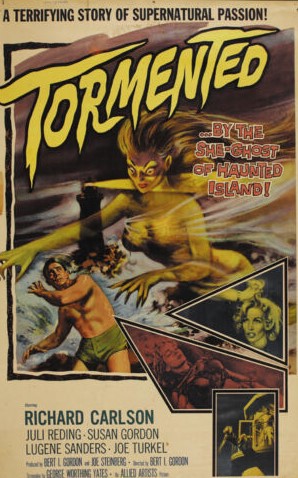
Tormented (1960) ***

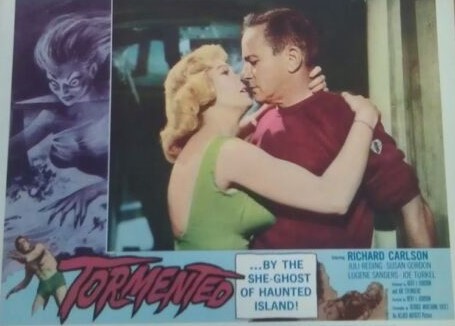
Effective island-based thriller. The marriage plans of jazz piano “genius” Tom (Richard Carlson) are thrown into disarray by the sudden arrival of old flame Vi (Juli Reding). A tryst atop an abandoned lighthouse ends in disaster when Vi tumbles over a railing and Tom refuses to rescue her. Fishing her corpse out of the water the next day he finds instead he is holding wet seaweed.

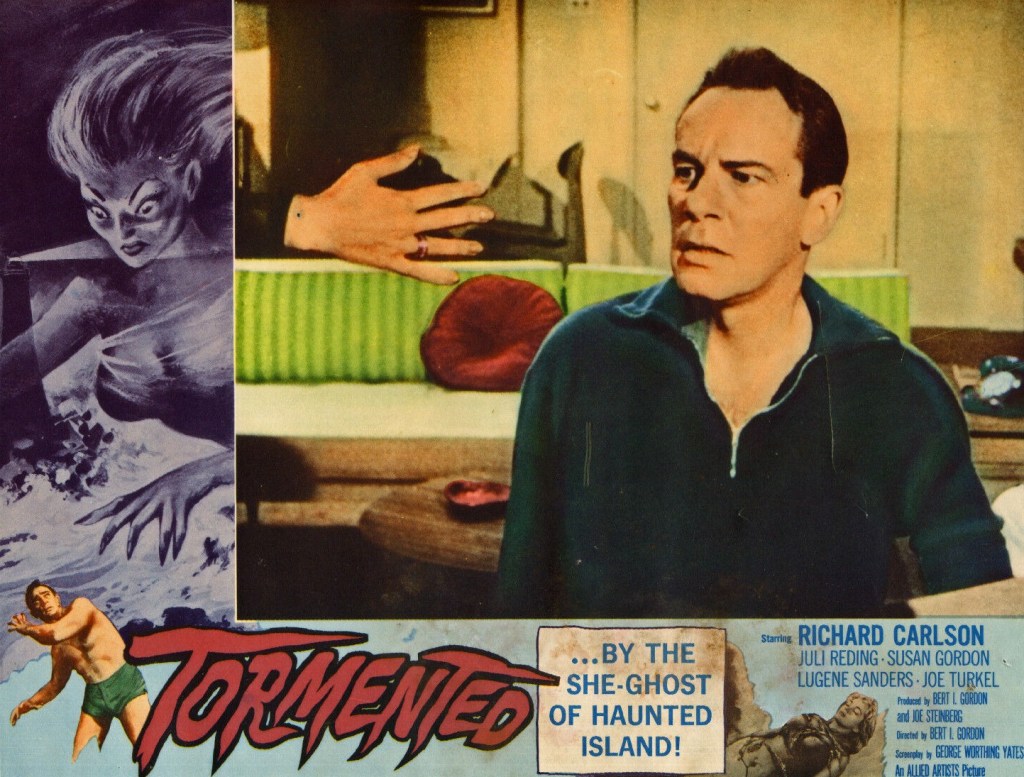
Cue all sorts of strange events: footprints on the beach, a lingering smell of perfume, a vinyl platter recorded by Vi playing all on its own, missing wedding ring, wilting flowers, wedding dress is covered in seaweed, ghostly apparitions of the dead woman.

Richard Carlson and the disembodied.

Initially denying his guilt, Tom soon finds himself consumed by it. Blind Mrs Ellis (Lillian Adams) suspects the supernatural. Fiancee Meg (Lugene Sanders) is soon on red alert, the situation exacerbated by her younger sister Sandy (Susan Hubbard) who develops an unhealthy crush on Tom and has a creepy hold over him.

Tension is racked up by the arrival of boatman Nick (Joe Turkel) intent on blackmailing Tom ahead of the imminent wedding. It doesn’t end the way you’d expect, but Tom proves a darker character. This kind of thriller you’d expect a final twist but you’d have to be very savvy to guess this one.

It’s a bold enterprise for a B-picture. Director Bert I. Gordon had made his name on special-effects-driven pictures like The Amazing Colossal Man (1957) but here that element is underplayed, the main focus on the gradual disintegration of Tom as he succumbs to guilt and the voices and sights he imagines. Some images are clearly inside his head, but Mrs Ellis and Meg detect the perfume scent, the flowers wilt in full view of everyone, and Sandy is present when the ring vanishes. Gordon employs the Hitchcockian technique of having subsidiary characters propose various unsettling possibilities to the guilty party. The jazz soundtrack is not the cool music you might expect but a more jangly score. And any time there’s a quiet moment you can hear thundering surf in the background.

B-picture and sci-fi veteran Richard Carlson (The Power, 1968) isn’t quite able to suggest sufficient internal anguish, you’d need a James Stewart in Vertigo mode to manage the kind of obsession required. But Carlsen goes neatly enough from composed epitome of “cool” to nervous wreck, likely to land himself in trouble from reacting too violently to the unreal.

And there’s enough peripheral tension, Meg’s wealthy father (Harry Fleer) opposes the wedding, believing a jazz musician a poor candidate for his daughter’s hand. Mrs Ellis probing a little too close to the bone, the innocent Sandy unwittingly endangers herself. Virgin Meg is oblivious to the fact the man she is marrying is scarcely in the same category.

It’s a chamber piece, a few characters rattling round each other, uneasiness emanating from Tom visualizing phantoms. And it’s short, barely 75 minutes, classic length for a supporting feature, and it’s to the director’s credit he makes no attempt to puff it out. One twist after another and specters everywhere, all the template you need. It set some sort of record for killing off careers. It was the last movie for Juli Reding, Susan Gordon and Lugene Sanders but you might recall Joe Turkel from The Shining  (1980).

Very good example of what you can do with a low budget, an edgy script and a director who doesn’t lean too heavily on the special effects.

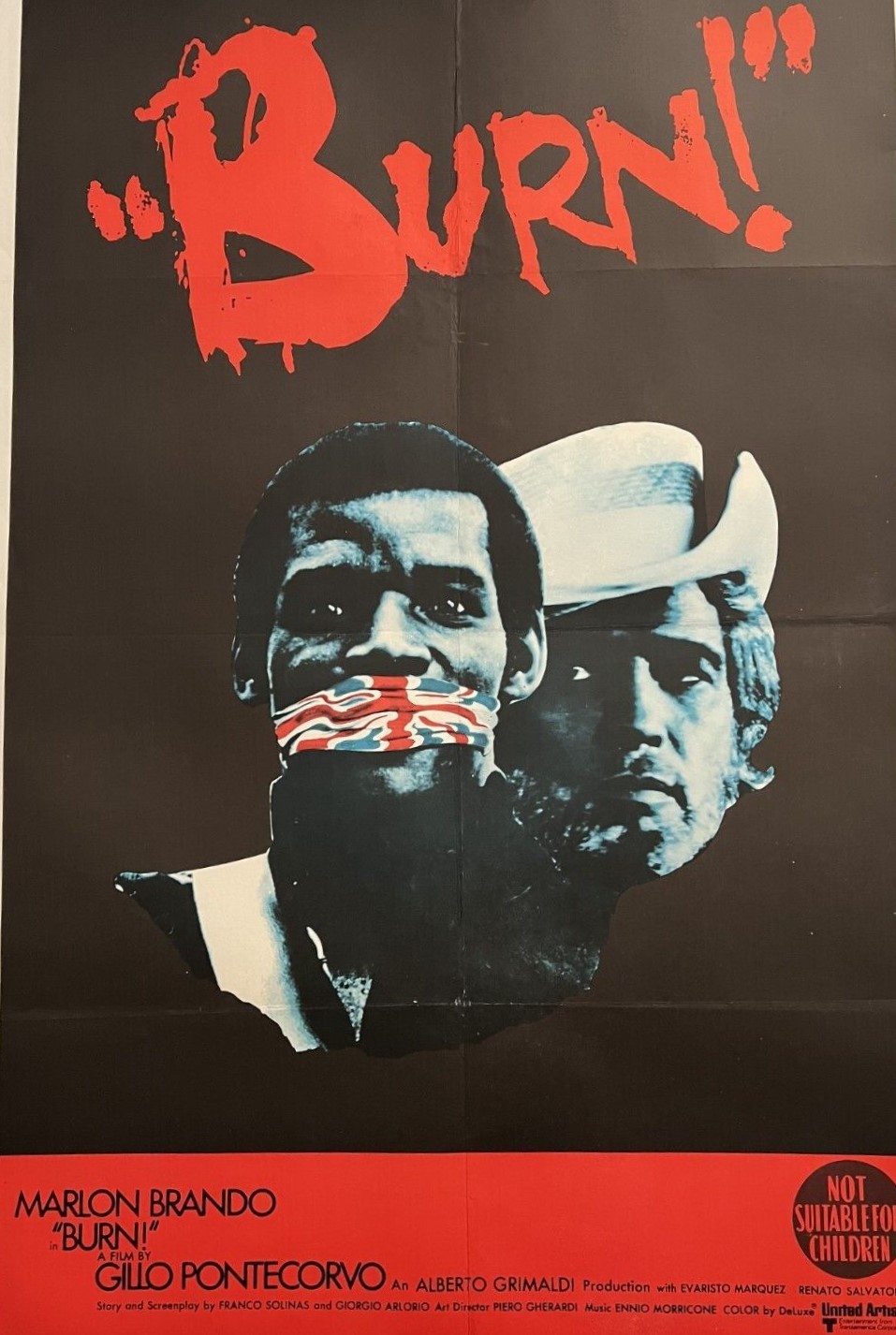
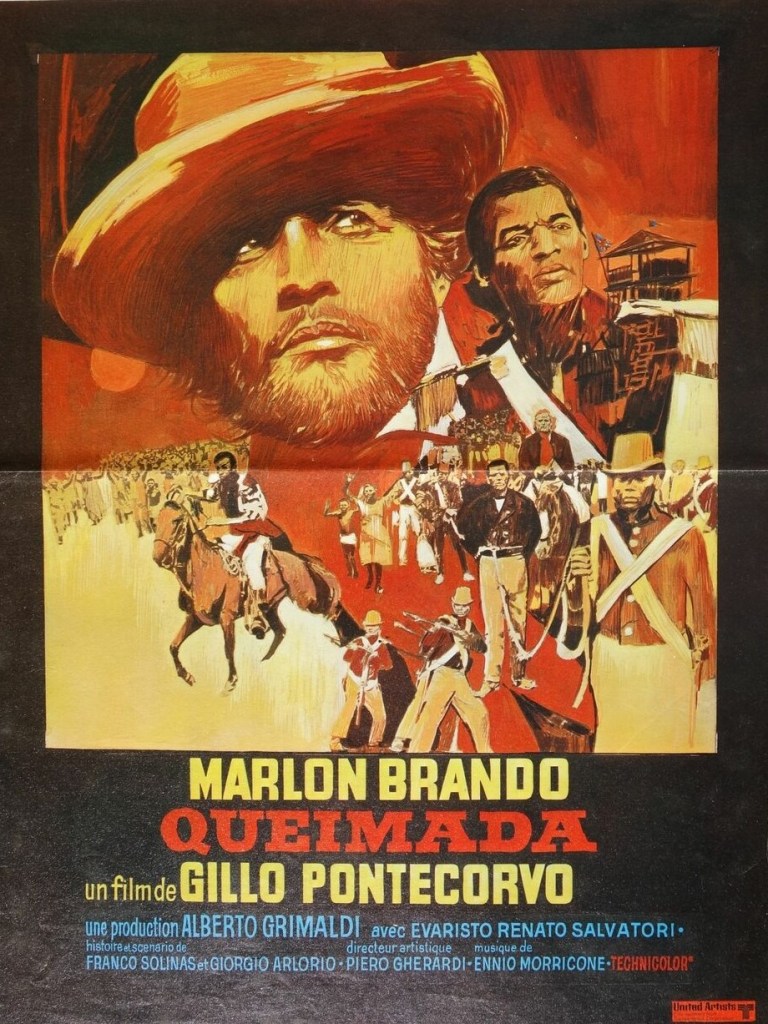
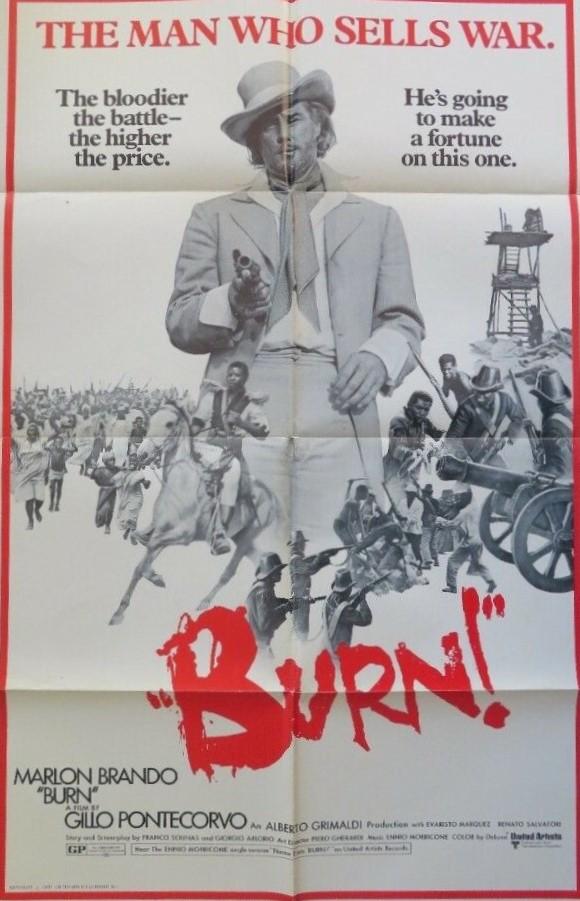
Burn / Quiemada (1969) *****

May have lost its allegorical power now that Vietnam is no longer a cause but even more compelling for standing as a generic condemnation of imperialism. The Vietnam connection is invoked immediately as Englishman Sir William Walker (Marlon Brando) on arrival is told that the Portuguese conquered the island hundreds of years before simply by setting fire to it until all the natives had perished or fled and restocking it with slaves from elsewhere. For a 1960s audience, that summoned up images of U.S. military use of napalm and carpet bombing.

The idea must have stuck in Walker’s head because that’s exactly the strategy he devises towards the end of the movie. Beyond his title, and the fact that he looks and talks like an upper-class Englishman of the mid 1800s, Walker is one of these shady characters you often found in the Colonies doing shady work for the British government. While this island is ruled by the Portuguese rather than the British, that’s about to change since the British find Portuguese attitudes to free trade too restrictive.

So Walker sets about creating the spark for an explosion. Having earmarked the local bank for an easy heist, he recruits Jose Dolores (Evaristo Marquez) to head a team of locals. Of course, such a large-scale robbery ensures pursuit. Capture is evaded when Walker produces a cache of rifles aware that in defending themselves the natives will trigger revolution. Walker then goes to work on the upper-classes, explaining how much better off they would be if they could side with the rebellion and overthrow the Portuguese.

Mission accomplished, he scoots off home, only to return when corruption has so destroyed the island, now a British colony, that Jose Dolores is back creating rebellion. Old friend becomes foe and is ruthlessly hunted down.

You can’t help but admire Walker’s guile. To create a large enough distraction to pull off the robbery he simply gets the entire town population drunk on free booze, giving soldiers more than enough rioting to cope with. To provide the circumstances to assassinate the President, he takes advantage of the costuming for a festival, allowing people to sneak past guards in any disguise. But when cunning doesn’t work, it’s down to brute force. The group with the biggest army, more weapons and the greater degree of ruthlessness will always win.

This isn’t one of those movies that sets out to idolise a rebel leader or where a small band of outlaws outwit the ruling power with clever ruses or filled with duels or ambushes or full-on battles. This is about the puppeteers, the men who use violence for their own commercial ends.

Like General Custer, Walker is a man with a job to do, even while he might despise it and certainly is filled with disgust at the ruling party. He claims he is not the author of either group’s misfortune but merely “the instrument.” On his return, he argues, “I didn’t start it; when I arrived you were already butchering each other.” In other words, blameless, just following the orders of either government or employer. But he takes pride in doing his job “well,” no matter the cost.

Every action has consequence. Even attempting to save Jose Dolores’s life, it is with consequence in mind. Let him live and set him free elsewhere and he will be viewed as a traitor. Kill him and he will be seen as a martyr, the most dangerous currency for incipient rebellion.

He knows exactly what buttons to press. In order to convince the ruling band of natives to support revolution in the first place, he makes a comparison with prostitution. You hire a sex worker by the hour to fulfil a need, you are not required, as with a wife, to dress her and feed her and look after her for her entire life. Should the employers free their slaves, that would eliminate the need for a lifetime of care (no matter how little) but could hire them as required.

The brutality is not dwelt upon, no The Wild Bunch-style bloody carnage, just a growing number of corpses on either side depending which group has the upper hand. The difference between the brutal Portuguese and the sedate English is in their approach to execution. The Portuguese rely on the garotte, by which a steel band fixed round the neck is slowly twisted until life is extinguished. The English prefer the speed of the gallows.  

Marlon Brando considered this one of his finest performances and I am inclined to agree. There is no showboating either way, neither inflating a character nor deflating him, as the actor was apt to do when playing a loser. Instead, Walker never loses a grip on his emotions, no temper, no tears, just saying whatever someone wanted to hear, guiding with a hidden hand, a man who might have invented the term “results-based.” It is the calmest you will ever see Brando, and you might catch elements of this portrayal in his Godfather pushing pawns into place. But you won’t see here a single explosion of anger. For a non-actor, Evaristo Marquez gives a superb performance, though mostly he is also restrained, as if he was learning from a master.  

Director Gillo Pontecorvo (The Battle of Algiers, 1966) takes a semi-documentary approach to the subject, concentrating on the machinations, no attempt to pull audience heartstrings with images of poverty. The garotte death does the work of explaining the brutality to come.

But there are three brilliant scenes that showcase the unstoppable character of war. In the best, the rebels, trying to escape an island ablaze, seek shelter on the higher ground. But this arid region is also exposed, no jungle here to provide cover, and scrambling up the naked slopes they are picked off, in long shot, one by one.

In the second example, the closest Walker comes to emotion is waking up one morning to the sound of a gallows being built. He takes a moment, listening, aware perhaps, though unwilling to admit it, that the harvest of a seed sown is about to be reaped. Brando is such a good actor that sadness only appears as a flicker of regret that the rebellion he began took a wrong turn once it was taken over by the wrong hands.

And, technically, his hands are clean. He is never seen firing a weapon. In the last of this trio of scenes, the English introduce hanging to the island. But since no one possesses the expertise to make a noose strong enough to support a head, Walker shows how.

There are two versions of this movie. It was filmed as Quiemada and this version is 17 minutes longer than the one released as Burn! I would urge you to see the far more atmospheric former. Editing down the picture, the distributors took out much of the background material. As a plus, there is a score by Ennio Morricone.

One of the best films ever made about the politics of war and the destructive force of commerce.

Discover WordPress

A daily selection of the best content published on WordPress, collected for you by humans who love to read.

The Atavist Magazine

by Brian Hannan

WordPress.com News

The latest news on WordPress.com and the WordPress community.