Contemporary audiences will be accustomed to studios playing fast and loose with a successful IP, all sorts of tricks to keep a series alive; although maybe the most famous occurred in TV soap Dallas when the death of a major character turned out to be only a dream.
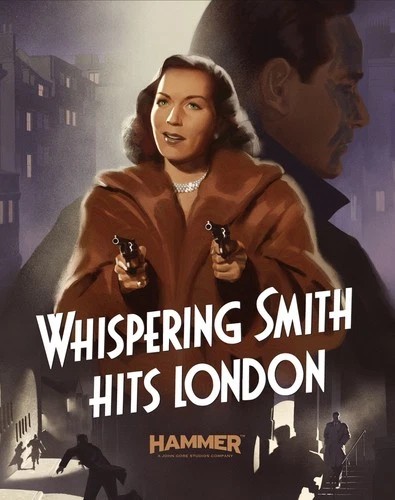
Still, British studio Hammer, in its pre-horror days, takes some beating when it relocates Alan Ladd’s Whispering Smith (1948) 70 years into the future, and from the American Wild West of the 19th century to London in the 1950s and deletes the character’s, railroad detection, in favor of ordinary murder.
The first Frank H. Spearman western was published in 1908, triggering an extensive series. The four silent versions, Alan Ladd effort and a TV series in 1961 stuck to the original concept. British screenwriter John Gilling attempted to anglicize the idea, and though Smith remained a Yank there was no sign of railroad detection.
William Hinds founded Hammer in 1934 but the project was short-lived, going bankrupt three years later. However, in 1935 he formed Exclusive, a distribution company, with Enrique Carreras and that survived. The principals’ two sons, Michael Carreras and Anthony Hinds, were recruited, and Hammer was revived Post-War, embarking on low-cost crime pictures. As part of a deal with American outfit Lippert, Hammer cast Americans in leading roles. The company was still rooted in crime until its first horror venture in 1953.
Richard Carlson fitted the category of rising star rather than marquee name when hired for Whispering Smith Hits London. Though he had written for Collier’s magazine and written and directed plays, this as the actor’s first top-billed role and paved the way for him to become a leading figure in the 1950s sci fi cycle – It Came from Outer Space (1953) and The Creature from the Black Lagoon (1954).
Norwegian Greta Gynt was not as established a star as you might have expected, after a failed attempt by Rank to market her as the next Jean Harlow and following parts like the female lead in such British films as The Dark Eyes of London/The Human Monster (1939) opposite Bela Lugosi and Tomorrow We Live (1943). She had revived a failing career with the female lead in MGM’s Soldiers Three (1951) starring David Niven and Stewart Granger.
Herbert Lom also had another string to his bow, as co-editor of the magazine Clubman. He had been steadily rising up the supporting actor ranks, receiving good notices for State Secret (1950), Cage of Gold (1950) and Hell Is Sold Out (1951). Scot Rona Anderson was married to fellow actor Gordon Jackson.
John Gilling had five directorial credits – in the 1960s he specialized in horror most notably Shadow of the Cat (1961) – when he began work on the screenplay of Whispering Smith, envisaging this as the first in a series.
The Pressbook was typical for the period, four pages A4 with a color cover and one page in spot color. As far as B-picture British Pressbooks went, this was a step up – often they were only a double-sided A4 or four-page A5 and minus any colour. Unlike bigger budgeted productions there was little excess when it came to advertising and promotion.
There was only one tagline – “America’s Ace Detective in Britain’s Greatest Mystery” (the American distributor was a bit more adventurous in the tagline department – “Murder Nobody Can Prove…A Body Nobody Can Find” and “Mad Killers Stalk Yank Sleuth”).
And in terms of the advert, beyond Carlson puffing on a cigarette and a hint of the tunnel sequence, audiences were given very little to go on. Whether any moviegoers recalled the Alan Ladd version of four years previously and wondered at the change in style and locale is unknown. Unlike other Pressbooks, there was no attempt to offer cinema managers any advice in how to promote the movie.
One page of the Pressbook is devoted to a detailed synopsis, another shows six ads, all in the same style but in different sizes (that a cinema manager would cut out and take down to the local newspaper to make up an advert), and the final page is given over to star biographies.
Sign of the times in that Greta Gynt confesses that her favorite hobby is “looking after her hobby” although Rona Anderson’s favored activity is “lazing in the sun.”
Turns out this Pressbook is something of a highly sought-after item, the combination of the names Hammer and Exclusive apparently the cause.


