When critics applauded the inspired use of a reaction shot via Omar Sharif to convey the horror of a massacre on the Mocow streets in Doctor Zhivago (1965), they omitted to mention that the technique had been used to similar stunning effect – and twice – in The Longest Day. The first comes when the camera cuts to Red Buttons dangling from a parachute down a building witnessing a massacre in the square below. The second, oddly enough, in virtually the same locale, when John Wayne arrives and views the aftermath.
Emotion was generally not considered a requisite of this epic war picture about the D-Day landings. The general consensus these days is that at best it’s a docudrama or at worst a star-a-minute mess with a dozen storylines vying for supremacy. In fact, it’s neither, but a surefooted and even-handed depiction of a complex battle, concentrating as much on the backroom staff as the soldiers in the line of fire.
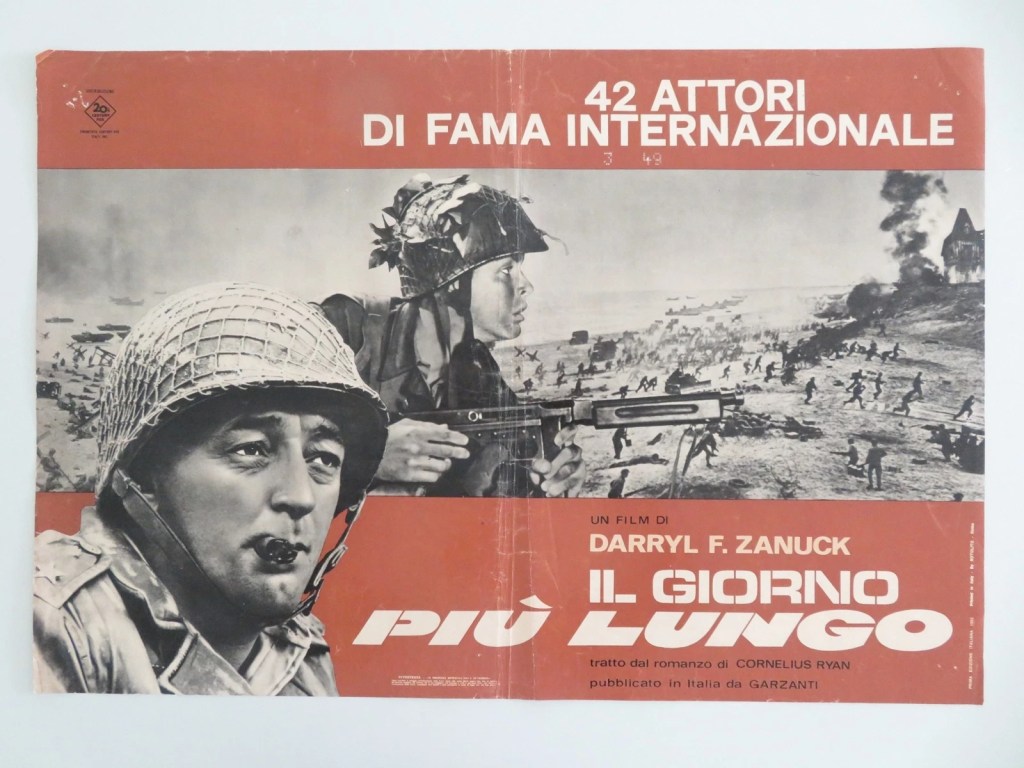
Except for German complacency, the Allied forces would have faced fiercer opposition. The German troops had no air cover except for two planes and the Panzers had been pulled back in reserve. High-ranking officers had high-tailed it out of German HQ to enjoy a night on the town. Yes, the Germans expected the invasion to come from Calais rather than Normandy, but once their mistake became obvious, they did little to counter the attack, spending too much time arguing with each other and being too frightened to wake Hitler from his beauty sleep to trigger the tanks and planes.
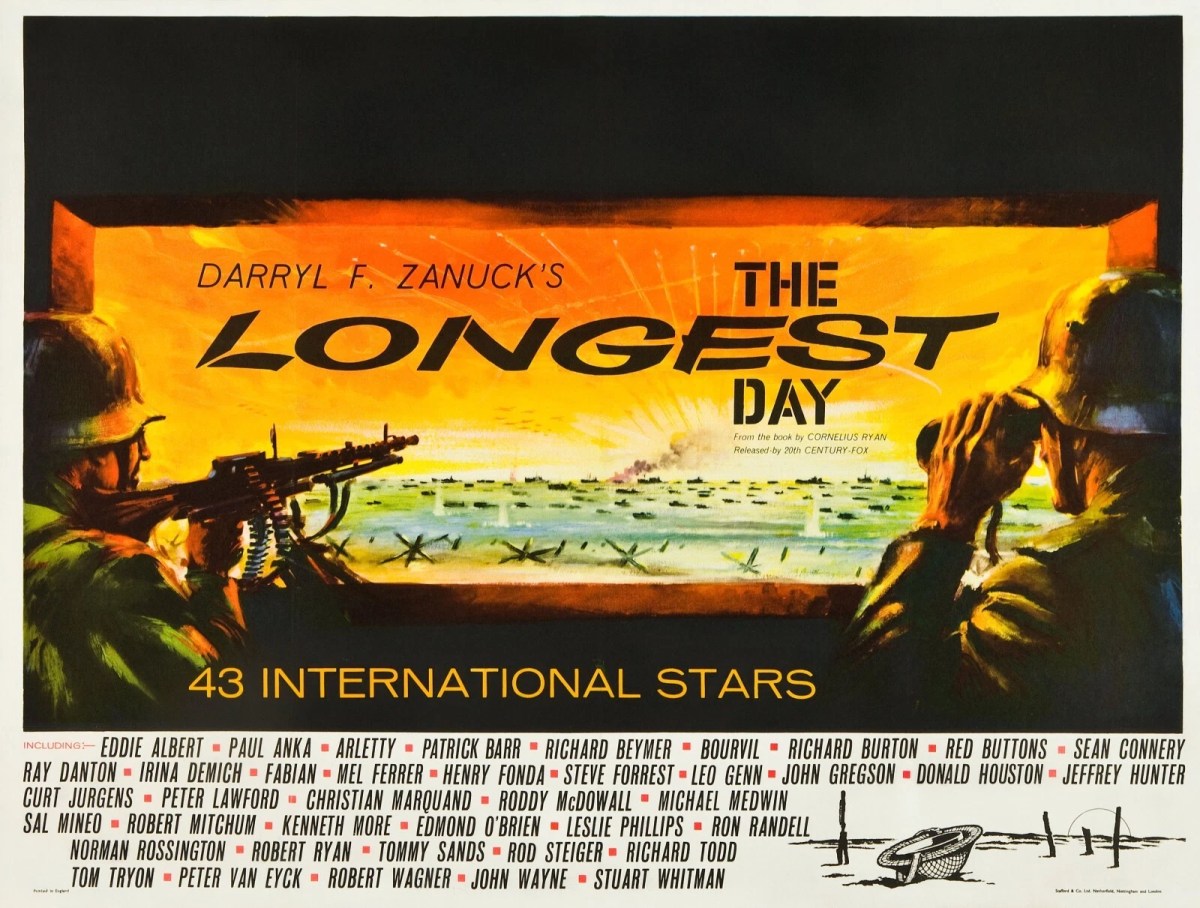
Producer Darryl F. Zanuck covered his back by enrolling 40 stars for his venture. While most had varying marquee appeal, he had drawn on leading actors and actresses from countries other than Britain and the USA. And there was clearly a calculated decision to make audiences wait for the two major stars, John Wayne and Robert Mitchum, to put in an appearance. It’s a good 15 minutes before we spot Wayne, that time spent setting up the event from British, French, German and American perspectives.
Unusually for major stars, Wayne and Mitchum are not averse to carrying exposition, something generally left to the supporting cast, Wayne in particular spelling out the pitfalls of his particular parachute drop situation. Incidentally, two of the best sequences took a good less time to show – as later explained in feature-length detail in A Bridge Too Far – the dangers inherent in parachuting into enemy territory and trying to capture and hold vital bridges.
The picture could easily have been titled A Gamble Too Far because Zanuck was betting the future of Twentieth Century Fox, facing a financial burnout, on its box office outcome.
While covering the planning for the landings in sweeping terms, the movie concentrates on three major actions – Omaha Beach and the scaling of the impenetrable Pointe du Hoc featuring the Americans headed up by Brig General Norman Cota (Robert Mitchum), a British commando raid led by Major John Howard (Richard Todd) on the Pegasus Bridge and the parachute drop led by Lt Col Benjamin Vandervoort (John Wayne).
By today’s standards the bloodletting is non-existent but the brutality of combat hits hard. Flight Officer David Campbell (Richard Burton) heads up the victims, knowing he is going to die but trying to keep up his spirits. French peasant Janine (Irina Demick) distracts German soldiers with her beauty. Lord Lovat (Peter Lawford) goes into battle accompanied by bagpipes and beachmaster Capt Maud (Kenneth More) tries to keep troops moving on the beach.. Comic interludes are provided by Private Flanagan (Sean Connery) and his buddy and German Sgt Kaffekanne (Gert Frobe).
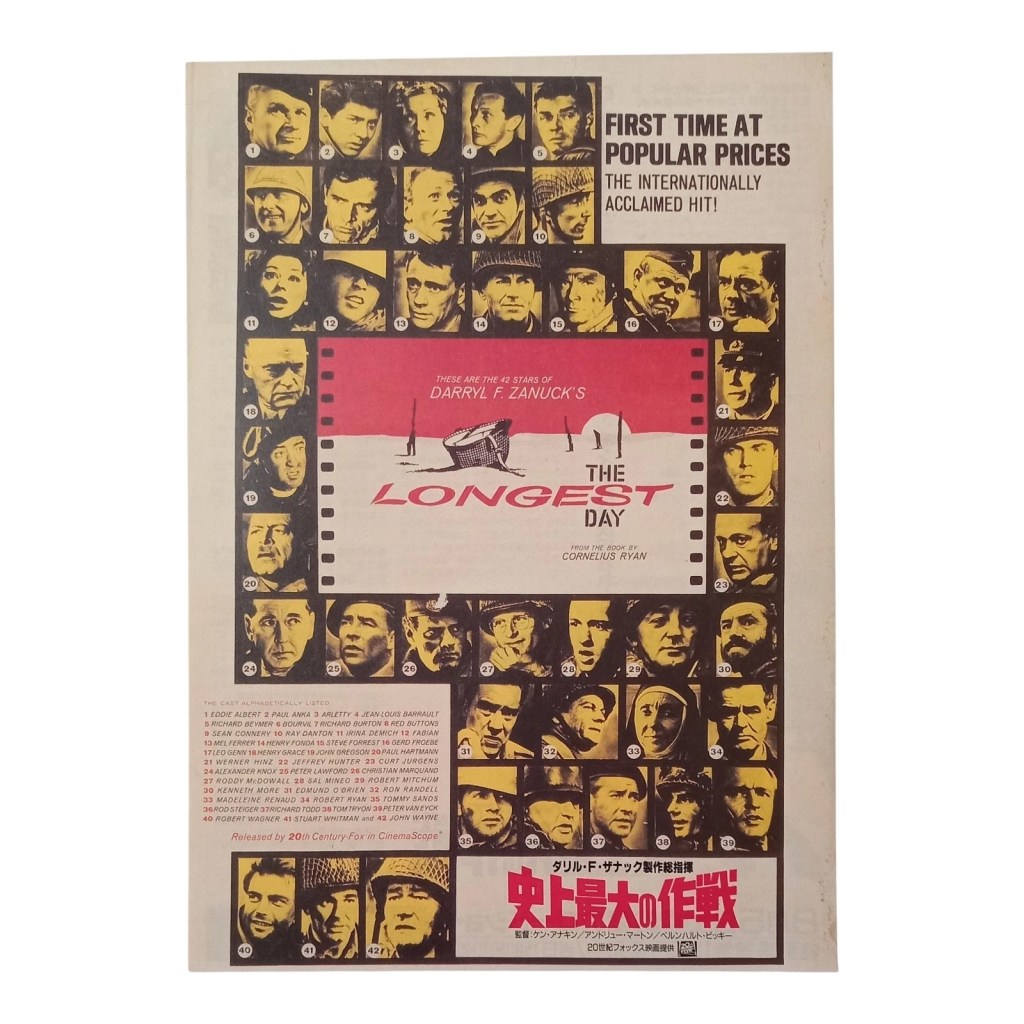
Many of the commanders that would feature in later World War Two pictures – Lt Gene Omar Bradley (Patton, 1970) and Brig General James Gavin and General Sir Bernard Montgomery (A Bridge Too Far, 1977), played respectively by Arthur Hill, Robert Ryan, and Trevor Reid. German General Rommel had already had his shot at Hollywood fame through The Desert Fox (1951) and Desert Rats (1953) and was the American nemesis in Patton.
Given the amount of rubbernecking by the audience, it’s worth noting the number of actor in small parts who eventually made good including Sean Connery (Dr No had just appeared by the time The Longest Day opened in the U.K.), Christian Marquand (The Corrupt Ones/The Peking Medallion, 1967), George Segal (Bridge at Remagen, 1969), Tom Tryon (The Cardinal, 1964) and Robert Wagner (Banning, 1967).
You could do an entire review just listing who played who. But in spreading the field and covering French and German activities alike Zanuck brings a wider understanding of the proceedings.
Five directors were involved and unlike most anthology pictures where individual styles clash, here everyone follows the same playbook. Ken Annakin (Battle of the Bulge, 1965), Andrew Marton (Africa, Texas Style, 1967), Gerd Oswald (Agent for H.A.R.M, 1966), Bernhard Wicki (The Visit, 1964) and Darryl F. Zanuck all took a turn at the helm.
While author Cornelius Ryan (A Bridge Too Far) was credited with the screenplay he received help in the shape of Frenchman Romain Gary (Birds in Peru, 1968) , American novelist James Jones who wrote From Here to Eternity, and British screenwriters David Seddon and Jack Pursall (The Blue Max, 1966). Remains an awesome experience, one I’d just love to see in 70mm

 The Magnificent 60s
Some info:
“The 19 Sep 1962 LAT noted that the title was originally coined by German Field Marshall Erwin Rommel. Realizing that the first twenty-four hours of the invasion would determine the war’s outcome, Rommel predicted it would be “the longest day” for both sides of the conflict.
The 27 Mar 1960 NYT announced French producer Raoul J. Lévy’s acquisition of motion picture rights for journalist Cornelius Ryan’s 1959 book, The Longest Day: June 6 1944, detailing the events of “D-Day,” the Allied invasion of Normandy, France. Lévy planned to cast forty actors from the U.S., Great Britain, France, and Germany to portray key historical figures who contributed to the event. Location filming in England and France was scheduled for spring and summer 1961. The production had an estimated budget of $6 million. Two days later, the 29 Mar 1960 LAT reported that Lévy was discussing the “advisability of investing $6 million” with executives at Columbia Pictures. According to the 8 Jun 1960 NYT, director Michael Anderson joined the project, to be produced through Associated British and Cinedis, and actor Jack Lord was being considered for a major role, as stated in the 5 May 1960 LAT. Less than two months later, the 2 Jul 1960 LAT reported that actor David Knapp had been cast, with David McLean directing.
The project remained in limbo for several months until the 3 Dec 1960 LAT announced that Lévy sold the film rights to producer Darryl F. Zanuck for $175,000. A related article in the same issue stated that Lévy’s associate, Michael Mindlin, would likely continue working on the picture, although his name does not appear in subsequent credits. Zanuck planned location shooting in England, France, Germany, and the U.S., to be directed by a native of each country. He told the 15 Feb 1961 LAT of his intention to cast John Wayne as Brigadier General Cota, based on the actor’s reputation as a cinematic war hero. The part was later given to Robert Mitchum. The 20 Apr 1961 LAT listed James Jones, Noel Coward, Romain Gary, and Erich Maria Remarque as Zanuck’s “literary consultants.” Neither Coward nor Remarque were credited on screen.
In the 21 May 1961 NYT, Zanuck claimed that he took over the project after convincing Lévy that it would be too costly. Locations would include actual battlefields along the Normandy coast, including Omaha Beach, the Orne Bridge, the Ouistreham Casino, and Utah Beach. A portion of the English shoreline would substitute for Sword Beach. Although Zanuck was ready to begin work the following month, he anticipated delays as the French military was undergoing reorganization following a recent mutiny.
On 21 Jul 1961, LAT columnist Hedda Hopper announced the casting of William Holden as “Colonel Vandervoort.” That same day, NYT identified Bernard Blier in the role of the Mayor of Ste. Mere Eglise. He was later replaced by Bourvil. The 31 Jul 1961 LAT noted that the town’s actual mayor, M. Reynaud, would appear on screen as a firefighter in a sequence filmed the following day. In the 16 Aug 1961 LAT, columnist Philip K. Scheuer reported the casting of “rock ’n’ roll crooners” Fabian, Tommy Sands, and Paul Anka as U.S. Army rangers. Anka also wrote the film’s theme song. The 26 Oct 1961 LAT reported that Zanuck refused to cast actor Audie Murphy, a bona fide war hero, because it was common knowledge that Murphy was in Anzio, Italy, on D-Day. Academy Award-winning set decorator Henry Grace made his acting debut as “General Eisenhower,” as reported in the 4 Jan 1962 NYT. On 15 Jan 1962, NYT stated that John Wayne would assume the role of Colonel Vandervoort, giving no explanation for William Holden’s departure.
The 7 Sep 1961 NYT reported that Zanuck augmented his production duties by acting as “overall coordinator of direction.” An item in the 21 Dec 1961 LAT revealed that Zanuck was directing several interior scenes, which would likely continue through Feb 1962. According to the 30 Jul 1961 LAT, Zanuck oversaw the recreation of an historical moment in which an English milk truck emerged from a landing barge during the invasion. As explained in the article, the truck and its driver were accidentally trapped aboard the barge on 5 Jun 1944 and carried to Normandy with a fleet of tanks. After the scene was completed, the driver distributed milk to the cast and crew.
Although the U.S. Department of Defense had promised Zanuck 700 European-based American soldiers for background actors, the 15 Sep 1961 LAT reported that recent tensions between the U.S. and East Germany forced military leaders to reconsider their commitment. The issue arose after CA Congressman Bob Wilson demanded an explanation for transferring the troops from Germany to France to appear in the film. Weeks later, the 21 Oct 1961 NYT stated that the U.S. Army could only spare 250 soldiers. The original deal for 700 was reportedly criticized by members of the U.S. Congress due to Zanuck’s friendship with General Lauris Norstad, the “supreme allied commander in Europe.” However, an article in the 17 Oct 1961 LAT stated that the simulated amphibious operation was considered by the Department of Defense to be an excellent training exercise. A news item in the 24 Oct 1961 NYT revealed that Zanuck was expected to cover the expense of transporting the German-based troops to and from La Rochelle, France. The soldiers were expected back in Frankfurt, Germany, on 9 Nov 1961. An anonymous entertainment executive complained to the 12 Nov 1961 NYT that the reduced presence of American soldiers on screen only served to perpetuate the “fallacy” that British troops were responsible for the Allied victory on D-Day. Great Britain reportedly supplied approximately 500 troops to the production, compared to the 250 provided by the U.S.
Among the American soldiers who participated in the film was Sgt. Joseph T. Lowe, a World War II veteran who told the 17 Sep 1961 NYT that both the battle and the production were equally fraught with confusion. Lowe was one of 100 D-Day veterans from the U.S. who appeared as background actors. Location filming continued for three weeks, during which American director Andrew Marton struggled to create an authentic reenactment of the battle, including errors and mishaps.
A news brief in the 4 Nov 1961 NYT stated that scheduling conflicts required actor Henry Fonda to “film three weeks of interior scenes” in New York City. Upon completing his obligation to Advise & Consent (1962, see entry), Fonda planned to spend two weeks in France for exterior scenes.
Excerpts from an interview with Robert Mitchum appeared in the 12 Nov 1961 LAT, in which actor criticized the reluctance of American soldiers to board a landing craft during inclement weather along the Normandy coast. The U.S. Army refuted Mitchum’s account, saying the soldiers’ hesitance was the result of a malfunctioning ramp on one of the vessels. A statement from Mitchum appeared in the 13 Nov 1961 LAT, denying the criticism as a “complete distortion.” The 30 Dec 1961 LAT reported another controversy as Senator Sam J. Ervin, chairman of the Senate Subcommittee on Constitutional Rights, investigated complaints from soldiers who were “compelled under threat of reprisals” to participate in the film. The U.S. Army refuted the complaints, as stated in the 20 Jan 1962 LAT.
he18 Mar 1962 NYT estimated the films budget at $10 million. While Zanuck did not verify the amount, he admitted to spending $986,000 to feed his cast and crew. After actor Mel Ferrer injured his back while doing the “twist,” the 4 Feb 1962 LAT reported that Zanuck barred the entire cast from doing the popular dance until photography was completed the following month.
In the 1 Apr 1962 LAT, Zanuck explained that the film’s $10 million budget was considerably more than he anticipated, but he was satisfied with the results. He estimated actors’ salaries at twenty percent of the budget, noting that the “Sword Beach” sequence required 2,000 men. In addition, the cost of transporting U.S. troops to and from Germany totaled $300,000. Zanuck revealed that there were as many as four units shooting on any given day, and commended associate producer Elmo Williams with coordinating all of them. Although Zanuck admitted to directing the most scenes of his entire career, he preferred that his four directors and Williams receive the credit. One third of the scenes were filmed at France’s Studio Boulogne, which contained forty-seven sets. The result was sixty-six hours of film, accumulated over ten months of production, which would be edited to approximately 200 minutes by late Jul 1962.
The Longest Day premiered 25 Sep 1962 in Paris, France, at the Palace de Chaillot. The 2,700 members of the audience paid $30 each to attend, and were treated to a performance by singer Edith Piaf, perched on the nearby Eiffel Tower. Proceeds supported four charities “connected with World War II French resistance.” A New York City opening followed on 4 Oct 1962 at the Warner Theatre. Profits were donated to the Salk Institute for Biological Studies. A preview screening was scheduled for the previous evening, as reported in the 29 Jul 1962 NYT. Proceeds benefited the International Rescue Committee, comprised of such dignitaries as General Omar Bradley, former U.S. president Herbert Hoover, financier Nicholas D. Biddle, and Mrs. Kermit Roosevelt, among others. A brief in the 3 Oct 1962 NYT noted that the Department of Defense cancelled the National Guard band’s performance at the event, as it conflicted with military regulation. The Fordham University Band performed instead. The picture made its Los Angeles, CA, debut on 11 Oct 1962 at the Carthay Circle Theater, with celebrities such as Jack Benny, George Jessel, and Danny Thomas in attendance. Proceeds benefited the Diabetes Association of Southern California and its Summer Camp for Diabetic Children.
Reviews were generally positive. While production was underway, NYT critic Bosley Crowther expressed concern in his 10 Sep 1961 column that the picture would glorify the horrors of war. His review in the 5 Oct 1962 NYT suggested that his fears were unfounded. The 24 Oct 1962 Var declared it the highest-grossing film of the season. However, the 6 Mar 1963 Var noted that a civil rights group, known as the Hollywood Race Relations Bureau (HRRB), picketed screenings to protest the absence of African Americans in the cast.
As the president of Twentieth Century-Fox Film Corporation, Zanuck told the 24 Aug 1962 LAT that the studio’s annual losses would likely reach $25 million. The 30 Aug 1962 NYT reported that Zanuck would place half of his 600 employees on unpaid suspension, although editing would continue on Cleopatra (1963), another costly epic.”
LikeLiked by 1 person
Fabulous stuff. Thanks.
LikeLike