Landman (2024) *****

The blue collar worker has not taken up much of Hollywood’s time. There was a movie  disdainfully called Blue Collar (1978) but the best pictures about people doing actual physical hard work was Five Easy Pieces (1971) about a fella who was putting in the long  yards to spite his old man and The Molly Maguires (1968) which was more about politics and anarchy. The British did it better, but concentrating on the monotony, in such ventures as Saturday Night and Sunday Morning (1960) and Gold (1974). though images of anyone  getting their hands dirty was fleeting

Generally, films about work are movies or television series about management (Wall St, 1989 or Succession, ) and/or a soap opera (Dallas). Most commonly, there’s a picture about farming – Grapes of Wrath (1940), The River (1984)– but there’s very little farming involved. You get a better idea of what it’s like to till the earth from the recurrent image in Gladiator (2000) when Maximus smells the soil.
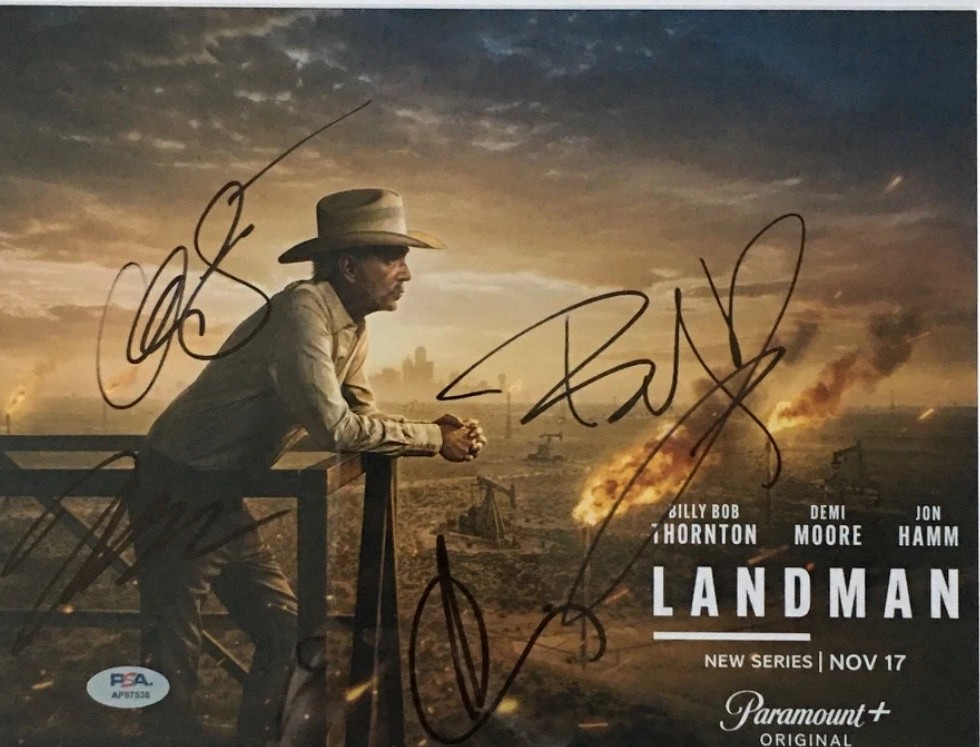
Until Taylor Sheridan came along and realized the immense dramatic potential of actual hands-on dirty work and rode Yellowstone (2018-2024) to enormous critical success and sufficient commercial endowment to be able to write his own ticket. I rarely buy DVDs these days, not because I’ve already got thousands of themd, but because that old impetus is long gone, the days when we desperately waited for a movie to turn up at the video rental store, one that you couldn’t otherwise get your hands on or missed on its cinema release, one that you wanted to own so you could watch it again and again.

Now I tend to buy DVDs if I don’t have a subscription to a particular streamer. I did it for Yellowstone and I did it for this Taylor Sheridan enterprise Landman.

On the face of it, this might seem like another oil or big business venture where the emphasis is on wheeling and dealing and heirs fighting over money and how to spend it and everyone just the hell arguing because that’s instant drama. The element devoted here to wheeling and dealing is negligible, restricted to oil tycoon Monty Miller (Jon Hamm), one whisky away from a heart attack, at the other end of a phone getting agitated and taking out his frustration on anyone in sight.

Instead, it’s about very dirty work, the kind where workmen come home saturated in filth and the kind where you could in a flash lose your hand or your life. There have been four instantaneous deaths so far and I’m only at episode six of Series One. We’re not in the all-action Hellfighters (1968) business of quelling fires, but in the dull maintenance part of ensuring that wells with 35 years accumulated wear and rust are kept going.
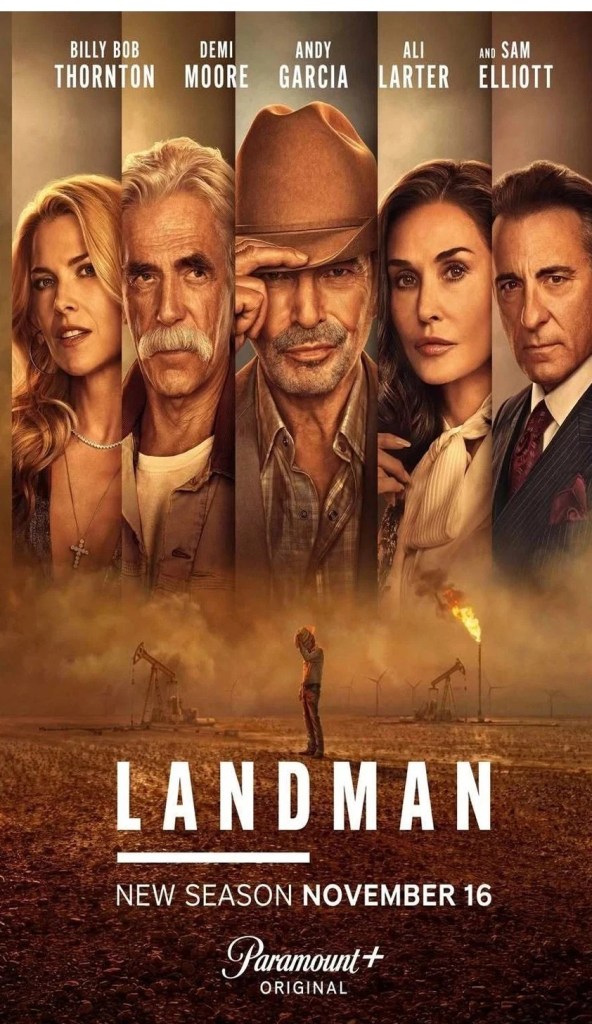
I might have to buy into Paramount+ to catch the second series.
Don’t think I could wait for the DVD.

It’s the job of Tommy Norris (Billy Bob Thornton) to make sure these wells keep producing and all it takes is a stray spark or a moment’s lack of concentration and the coffins are mounting up. Along the way, we are brought up to speed on how the oil business works – or doesn’t.

Exposition used to be a hell of an issue for screenwriters until those Game of Thrones dudes invented “sexposition” where acres of naked flesh kept the audience awake through the dull stuff. Here, however, Sheridan manages something of a coup by having Monty or Tommy gush like oil wells while setting others right about the business.

This series kicks off with an oil tanker tearing along at 60mph crashing into small airplane that’s parked on a road to disburse its cargo of drugs. And that triggers two increasingly fraught, sometimes thrilling, elements. First, we’ve got the drug dealers seeking revenge and recompense. Secondly, you’ve got legal repercussions in the shape of the all-time Jaws of a lawyer Rebecca Falcone (Kayla Wallace) and how Tommy has to snake through the vagaries of the law, not, for example, pursuing thieves who steal the company’s planes or tankers to shift their ill-gotten gains because the law will invariably impound such items of transport for the couple of years it takes to get a case to court and because the drug dealers are only borrowing them for a short period and return them after use.

On top of that, Tommy is trying to blood son Cooper (Jacob Lofland) into the business, starting off as a roughneck, while turning up out of the blue are glamorous ex-wife Angela (Ali Larter) and daughter Ainsley (Michelle Randolph), who views philanthropy as a tax dodge.

There’s some terrific humor from Tommy’s housemates Dale (James Jordan) and, mostly in reaction shots, Nathan (Colm Feore).

You won’t have seen any of these storylines before, not even the returning wife and daughter, because all the characters are so original and the performances so powerful. Billy Bob Thornton (Bad Santa 2, 2016) has eschewed all his acting tropes, dumped the sarcasm and temper tantrums, and instead plays a weary debt-laden foreman who fails to resist the lure of his trophy wife.

I remember Ali Larter from such unchallenging fare as the original Final Destination (2000) so she is something of a revelation. While Angela is as vapid as any other trophy wife, majoring on shopping and looking good, actually she’s an education in how an ageing trophy wife stays the course. She is a fabulous cook, for starters, and she puts in the hours at the gym to keep trim. But she’s also a manic depressive and so her emotions spin on the toss of a coin, extremely charming, not to mention endearing, one minute, a venomous snake the next. This is a performance reverberating with depth that should qualify for an Emmy.

Jacob Lofland (Joker, Folie a Deux, 2024) is Gary Cooper reborn. The stillness, the reticence, and yet when necessary, taking no prisoners. He’s way out of his depth not just with the crew he’s landed with, but in unexpected romance with young widow Ariana (Paulina Chavez). But that’s not the last of the star-making turns. Kayla Wallace (When Calls the Heart series, 2019-2025) is phenomenal as the ball-busting lawyer eating up misogyny for breakfast and heading for a showdown with anyone in sight. Sassy Michelle Randolph (1923 series, 2022-2025) has many of the show’s best lines.

And that’s before we come to Jon Hamm (Mad Men series, 2007-2015) and Demi Moore in a more believable role than The Substance (2024). And the simple earworm of a score by Andrew Lockington (Atlas, 2024).

Truly original and riveting.

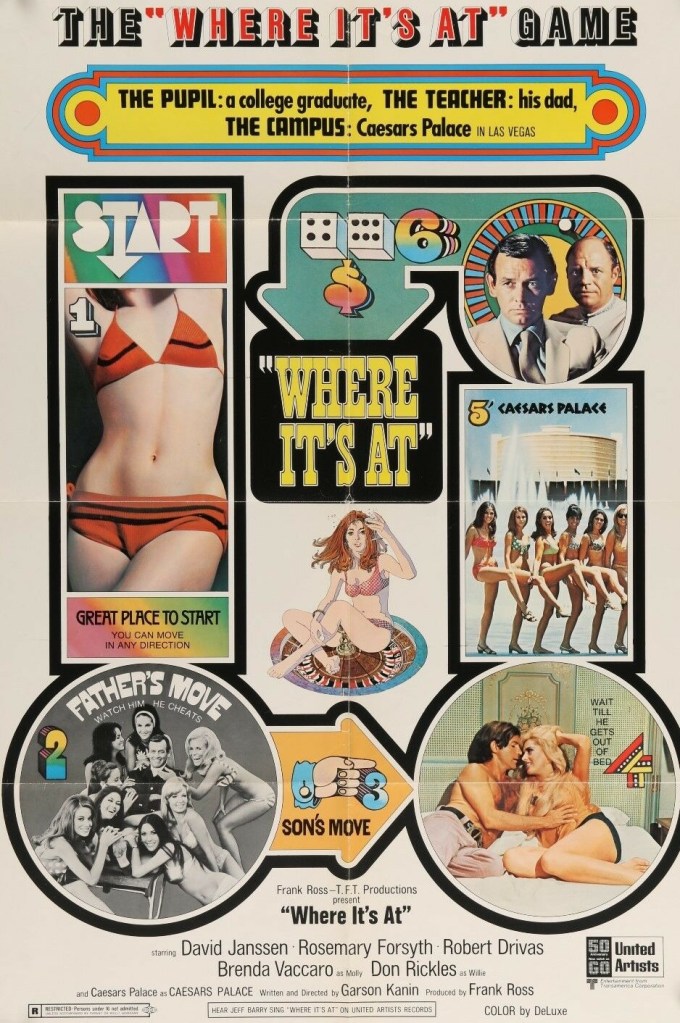
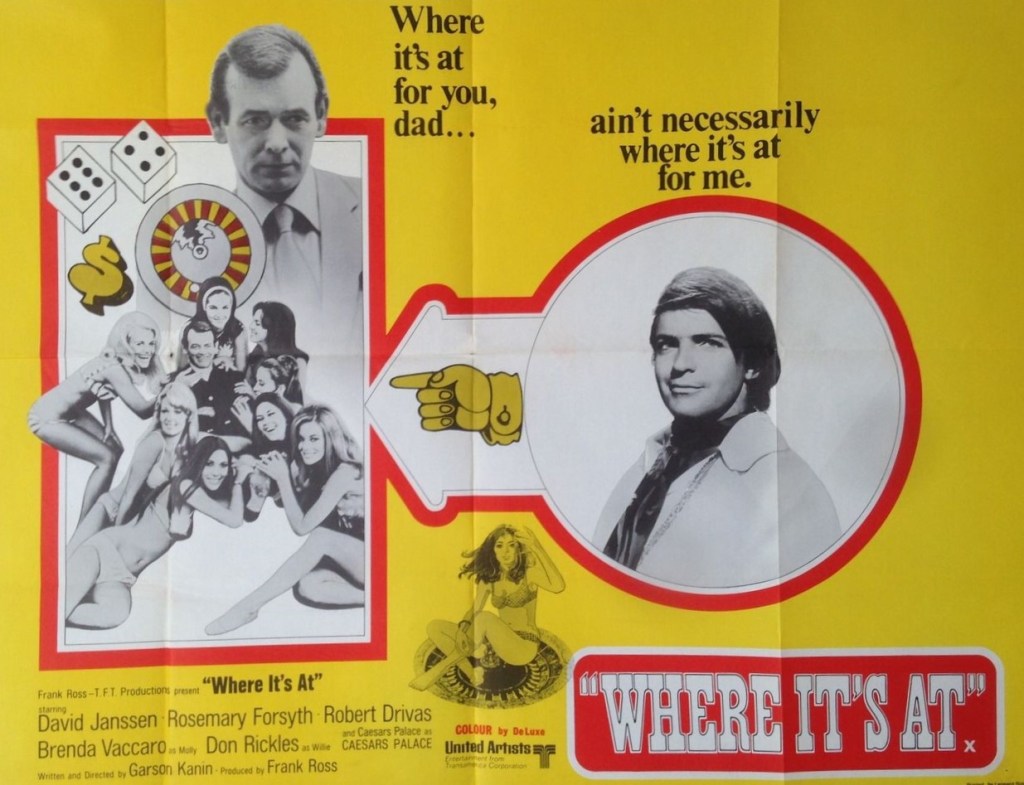
Where It’s At (1969) ****

There is probably no more stunning definition of Las Vegas than the brief shot in this otherwise widely-ignored film of a woman playing the slot machines with a baby at her naked breast.

I doubt if anybody has watched this all the way through in the fifty-odd years since its release. And I can see why. I nearly gave up on what I thought was a lame generation gap comedy. But some distinguished directors at the time clearly perceived its value, the flash cuts and overlapping dialog initiated here turning up, respectively, in Sydney Pollack’s They Shoot Horses, Don’t They (1969) and Mash (1970). And as I gamely persevered, I realized it was a different movie entirely, a cross between Succession and The Godfather.

Though saddled with a trendy catchphrase of the period for a title – though making more sense if applied in ironic fashion –  the original title of Spitting Image was much more appropriate to the material. As both veteran and new Hollywood directors struggled with understanding the burgeoning counter-culture, youth-oriented efforts of the Tammy and Gidget and beach pictures variety fast fading from view, and Easy Rider (1969) yet to appear, a generational mismatch between Hollywood veterans and younger audiences was in evidence.

And you would hardly turn to Garson Kanin to capture the zeitgeist. Although acclaimed as a screenwriter, with wife Ruth Gordon responsible for a string of Tracy-Hepburn movies like Adam’s Rib (1949), he had not directed since 1941. The story he wanted to put over – he wrote the script as well – was not an easy sell. So he’s disguised it as a coming-of-age tale exploring the generation gap and as a lurid expose of Las Vegas with behind-the-scenes footage of the reality underpinning the glamour.

It’s pretty clear early on it’s not about some middle-aged parent getting jealous over the amount of sex his child has, for widowed casino owner A.C. (David Janssen) can have as much as he wants courtesy of fiancée Diana (Rosemary Forsyth) – and a wide range of available and eager-to-please showgirls – and certainly far more than the majority of his male customers whose biggest thrill is gawping at topless women on stage. Las Vegas was the epitome of Sin City, at the beginnings of its sacred position in American popular culture where what you got up to remained secret.  The representation of the “showgirl” world is less brutal than in Showgirls, but even so an audition includes removing your bra.

A.C. wants to introduce son Andy (Robert Drivas) into the business not realizing he is laying out a welcome mat for a viper. At first Andy is happy to learn the ropes by working in menial positions and wise enough to resist obvious lures like showgirl Phyllis (Edy Williams), whose interaction with him is recorded. However, when like Michael Corleone, he is required to make his business bones – “pay your dues and stop your whining” – by transporting cash skimmed from the business and banked in Zurich back home, where if caught he will have to take the rap, a more calculating and dangerous individual emerges. A.C. has been working a Producers-type scheme where by massaging profits downwards he hopes to panic his investors into offloading their stock cheaply to him.

The ploy works but it turns out his partners have sold their stock to Andy, who hijacked the Zurich cash to pay for it. Rather than chew out Andy, A.C. is delighted at the ruthlessness of the coup, until his son, now holding the majority of shares, takes complete control, easing him out – “If I need you, I’ll send for you.” Andy’s prize could easily include, had Andy showed willing, the duplicitous Diana. However, that’s not the way the picture ends and I won’t spoil the rest of the twists for you.

This is one of the few genuine attempts to show the pressure under which businessmen operate. No wonder A.C. is so glum, barking at everyone in sight, little sense of humor, when the stakes are so high and as with any game of chance you might lose everything. Employing indulgence to insulate himself against emotion, he is surrounded by what he deduces is the best life can offer, driven by mistaken values. Optimism is the automatic prerogative of youth, pessimism the corrosion that accompanies age.

The second half of the picture has some brilliant brittle dialog. Assuming the young man has principles, when his acceptance of the Las Vegas dream is challenged Andy replies, “Who am I to police the party?” In a series of visual snippets and verbal cameos, the film captures the essence of Las Vegas, from the aforementioned woman breast-feeding while playing the slot machines to the telephone call pleading for more money, waitresses hustling drinks, a machine in A.C.’s office rigged to give high-rollers an automatic big payout and leave them begging for more, customers not even able to enjoy meal without a model sashaying up to the table to sell the latest in swimwear, never mind the more obvious tawdry elements.

There’s a superb scene involving a cheating croupier (Don Rickles). Of course, when Martin Scorsese got into the Vegas act, violence was always the answer. A.C. takes a different route, allowing the man to pay off his debt by working 177 weeks as a dishwasher. There’s a neat twist on this when Andy, guessing which way Diana is going to jump, warns “watch out you don’t end up washing dishes.”

David Janssen (The Warning Shot, 1967) gives another underrated performance, gnarly and repressed all the way through until he can legitimately feel pride in his son. Robert Drivas (The Illustrated Man, 1968) is deceptively good, at first coming over as a stereotypical entitled youngster (or the Hollywood version of it) before seguing into a more devious character. Rosemary Forsyth (Texas Across the River, 1966) is excellent, initially loving until casually moving in on the young man when he appears a better prospect than the older one. Brenda Vaccaro (Midnight Cowboy, 1969), in her debut, plays a kooky secretary who has some of the best lines. “Two heads are better than one,” avers Andy. Her response (though Douglas Adams may beg to differ): “Not if on the same person.”

Garson Kanin takes the difficult subject of ruthless businessman and provides audiences with an acceptable entry point before going on to pepper them with vivid observations. This is not a picture that divided audiences – not enough critics or moviegoers saw it to create divergence – but it’s certainly worth another look especially in the light of the shenanigans audiences have welcomed in Succession. And if you remember the pride Brian Cox took when shafted by his son, check out this picture and you will see where the idea came from.

And it’s worth remembering that the defining youth-culture movie of 1969, Easy Rider, was actually about two young businessmen. The fact that their product was drugs didn’t make them any less businessmen. The idea that what a young buck “digs” the most is making money rather than peace and love seemed anathema to critics as far as Where It’s At went but not Easy Rider.

To be sure, none of the characters are likeable. Maybe likability was an essential ingredient of 1960s movies, but we’re more grown-up now. Compared to the the horrific characters populating The Godfather and today’s Succession, these appear soft touches. One critic even pointed out that The Godfather did it better without seeming to notice that Where’s It’s At did it first.  And there’s certainly a correlation between Andy turning his nose up at his father’s business and Michael Corleone showing similar disdain until the chips are down and the old cojones kick in.

Critics who complained this had little in common with the Tracy-Hepburn pictures missed the point. The Tracy-Hepburn films were always about power, in the sexual or marital sense. Kanin has merely shifted from a male-female duel to that of father-son.

Not currently available on DVD or on streaming, but easy to get hold of on Ebay and YouTube has a print.

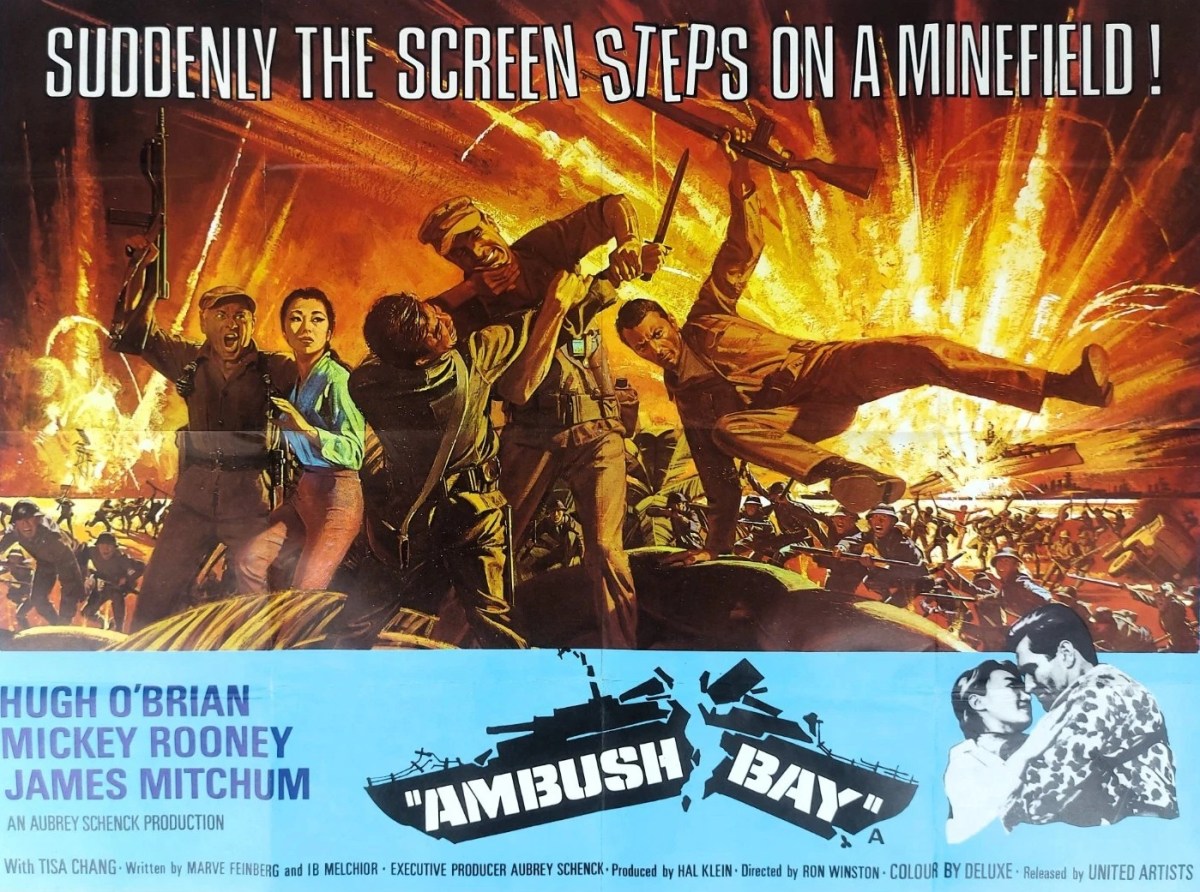
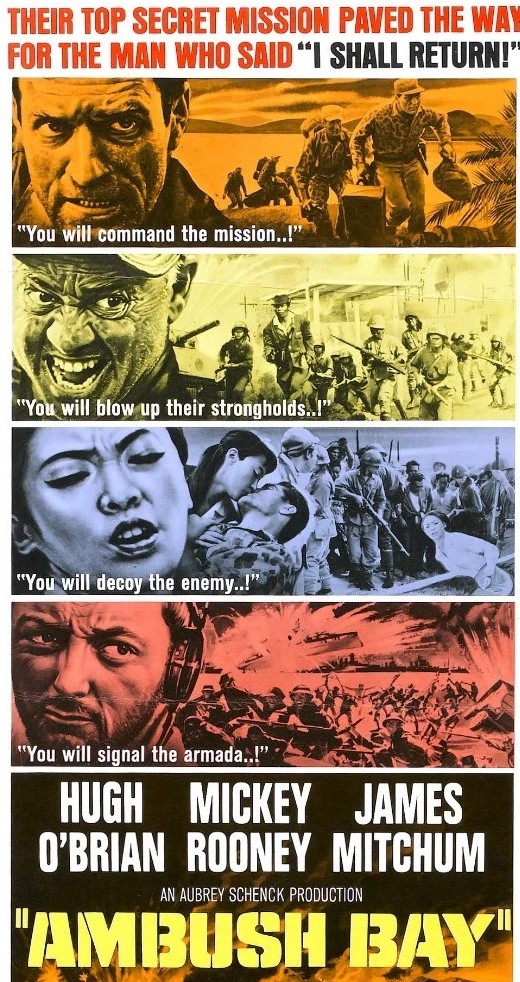
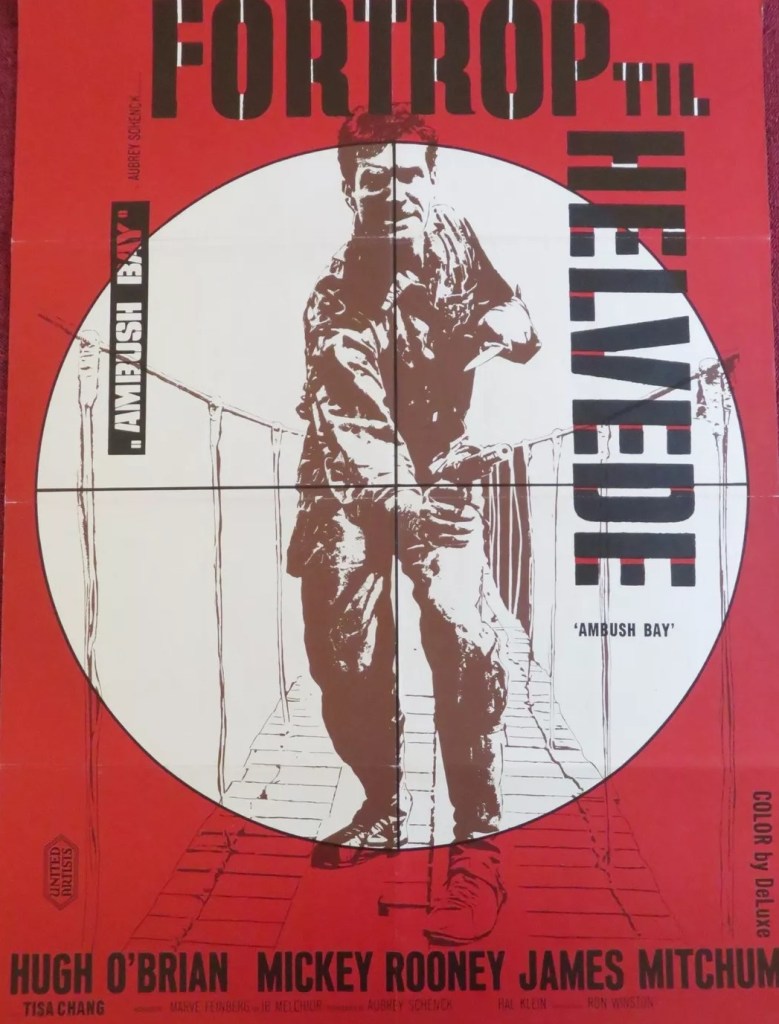
Ambush Bay (1966) ****

I’m going out on a limb on this one. I don’t think anyone’s done anything but give it a cursory examination and mark it down as a standard programmer of the era. But I saw a lot that was considerably impactful.

Generally speaking, although the war picture had gradually shifted from the gung-ho to the more realistic (Operation Crossbow, 1965, Von Ryan’s Express, 1965), it’s generally accepted that it was The Dirty Dozen (1967), Beach Red (1967) and Play Dirty (1968) that ushered in the new era of authenticity and violence.

Oddly enough, this little picture, minus the bloodletting, was the bridge. It’s way tougher than you would expect for a low-budget picture only ever intended to fill out the lower half of a double bill and never going to catch the eye of a critic hoping to find an unknown movie to punt.

Let’s start with the ruthlessness. A bunch of Yanks on a secret mission in the Philippines are hounded by Japanese soldiers. At their first encounter, knives are the weapon of choice so as not to attract attention. We don’t see the knives going in but we hear them slicing into flesh. They capture one of the enemy who begs to be taken prisoner but nobody’s got time to bother with such niceties so they tie him to a tree and come morning he’s dead. Rather than give away their own position, they don’t fire on the pursuing Japanese which results in one of their own being killed. A female American-born Japanese spy, convinced her natural charms can distract the Japanese, volunteers at one point to stay behind, even if that means becoming the sexual plaything of the Japanese commander and then passed on to his men. And when that ploy fails she is ruthlessly sacrificed.

There are other narrative reversals. The Dirty Dozen, for example, begins with a lengthy introduction to each of the condemned men. Here, as the team prepare to land on the Philippines, we are introduced, via voice-over, to each of the team. And then you learn that the real reason for this is that we’ll count up the number of men in the group and become aware that they are gradually being whittled away.

And then there’s the voice-over itself. This not being one of those post-modernist numbers where the narrator is speaking from beyond the grave, audiences know that a narrator is a survivor. But what they’re not going to guess is that he’ll be the only survivor.

Or that he least deserves to survive. Private Grenier (James Mitchum) is a rookie – “six months ago he was stacking shoe boxes” – and he’s truculent and troublesome. His only job is to keep the radio safe, excused fighting duties so that he can broadcast to the waiting General MacArthur the outcome of the mission. But he’s as useless at guarding the radio as he is at everything else and the radio is shot to pieces. He’s so dumb he doesn’t realize the purpose of a Japanese tea house.

There’s not an ounce of the gung-ho. The dialog is delivered in an undertone. Nobody makes a meal of any line of dialog no matter ho juicy. Everything undercuts. When Commander Sgt Corey (Hugh O’Brian) plans to go into serious harm’s way his number two Sgt Wartell (Mickey Rooney) asks what will happen if he doesn’t come back. In matter-of-fact tones, but without the snap of someone thinking he’s delivering a great line, Corey replies, “You get a field promotion and an extra eight bucks a month.”

The Ambush Bay of the title is supremely ironic. It’s the Americans who are going to be ambushed. The Japanese have seeded the sea-bed of the beach where they guess the Americans are going to land with mines. Nothing unusual there. Minesweepers will clear the path. Except these are unusual mines, anchored to the seabed and only loosened by remote control by the enemy.

The initial mission is just to locate the aforementioned spy Miyazaki (Tisa Chang) who turns out to be a sought-after sex worker in the tea house. But when the radio is out of action, they have to disable the radio tower controlling the mines. By this point they’re down to just two men, Corey and Grenier.

Grenier has the ingenious plan of draining fuel from a truck to make a Molotov cocktail, toss it into a fuel dump and in the confusion make their way to the radio tower. Even at this late stage, reversals come thick and fast. Great idea – you got a match? Nope. But the lorry driver is smoking. He discards a lighted cigarette. But when he gets out of his cab he grinds the cigarette with his foot. Luckily, they can revive it.

All the way the dialog is like loaded dice. “Idiot,” muses Grenier, “that’s the nicest thing he’s said to me.”

Miyazaki has some choice lines. “If you’re dead that won’t help me.” And, encountering Corey’s disbelief at her gender,  “Suppose I refused to believe you were my contact.” And in the understated manner of every individual, of the leering Japanese commander, she notes, “He desires me, I think that’s the phrase.”

Visually, this isn’t littered with gems. Most of the visuals are under-stated, brutality generally off-camera but there’s one unforgettable scene. The Japanese commander, having been distracted by Miyazaki puts his pistol in his holster. A few minutes later, realizing he has been duped, he takes it out of its holster.

Hugh O’Brian (Ten Little Indians, 1965) is superb as the non-scene-stealer-in-chief. Mickey Rooney (The Secret Invasion, 1964) has less opportunity for grandstanding than in most of his pictures. And surely this is the recently-deceased James Mitchum’s (In Harm’s Way, 1965) best role, as he shifts from amateur to professional. If you’re looking for an understated scene-stealer Tisa Chang (better known for her stage work – she only appeared in five films) is choice.

Directed by Ron Winston (Banning, 1967) from a script by Ib Melchior (Planet of the Vampires, 1965) and Marve Feinberg in his debut.

The lowest-budgeted film, just $640,000, in the 1966 release schedule of United Artists, on a cost-to-profit scale this proved one of its most successful pictures hammering out $1.7 million in rentals.

Worth going out on a limb for.

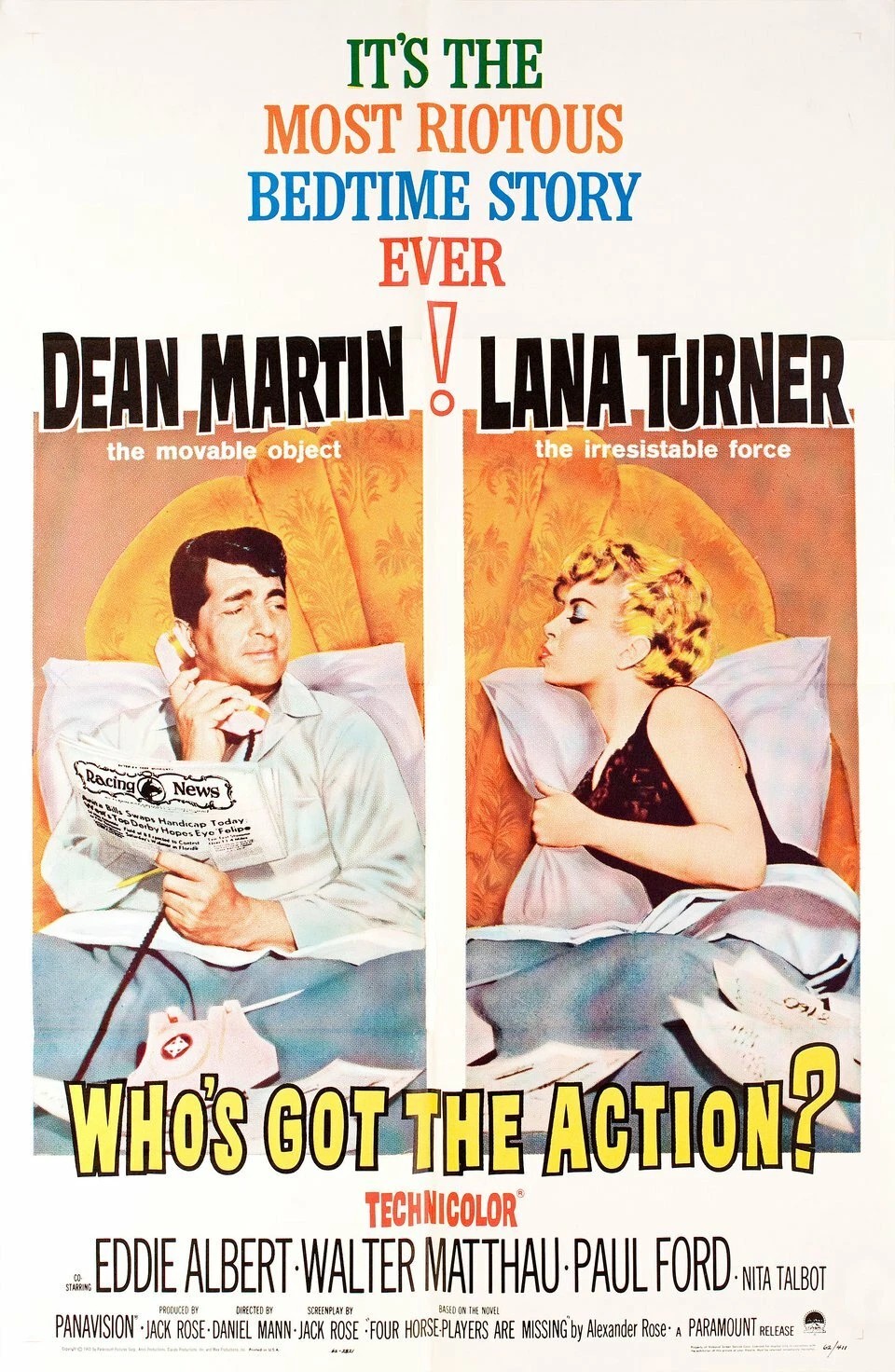
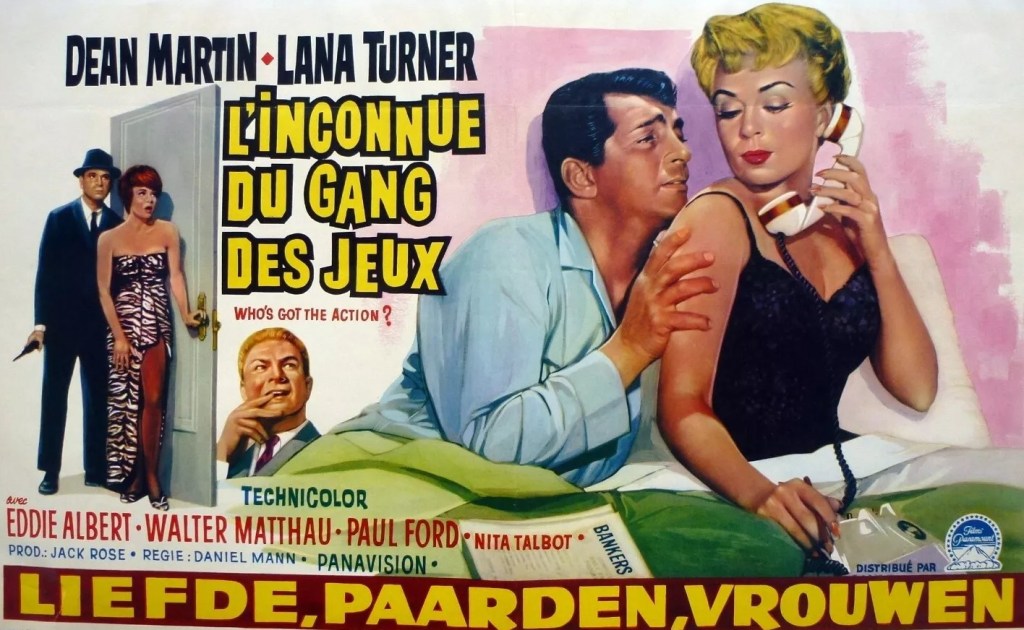
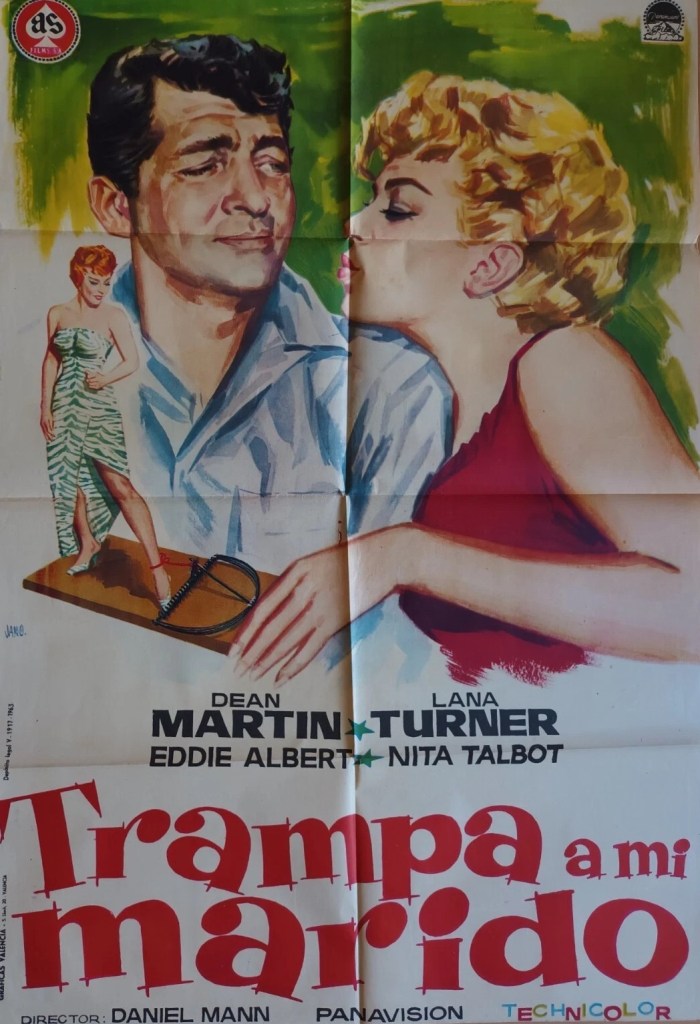
Who’s Got the Action (1962) ***

Complication. The keenest weapon in the screenwriter’s armory. And the most overused and, conversely, not employed to its greatest potential. Generally, it’s the only device for a romance – boy meets girl, (enter complication as…) boy loses girl, boy gets girl. But, just occasionally, it appears with some skill, layer after layer of deft complication until a whole story is tied up in acceptable and believable knots.

Before we get into all that it’s worth pointing out how language changes. These days mention of “action” will carry connotations of a sexual nature, so, just to be clear, here we’re talking about gambling, betting on horses, the mythical sure thing. And if you want to take a more cosmic perspective, we can apply the scientific rule that every action has a re-action, in other words consequence.

Attorney Steve Flood (Dean Martin) has a gambling addiction. He’s $8,000 in the hole to illegal bookie Clutch (Lewis Charles). Steve’s wife Melanie (Lana Turner) comes up with a clever idea to wean him off his addiction, by creating a fictional bookie, so that her husband’s losses will come to nothing. So she calls in Steve’s partner Clint Morgan (Eddie Albert) triggering Complication No 1. Clint’s always had the hots for Melanie and hopes to take advantage of Steve’s problems, helping her out by agreeing to act as the mythical bookie.

And that would be fine except for Complications No 2 and No 3. Instead of losing, as has been the trend, Steve wins big on his first bet, so now Melanie has to find a large chunk of dough. In dumping Clutch, Steve has come to the attention of mobster Tony Gagouts (Walter Matthau) who’s wondering about the mysterious new bookie queering his pitch and denying him a good customer (such is the definition of a loser).

Steve’s gambling success creates Complication No 4, attracting the interest of a pair of judges who are happy to stake the gambler, whose winning streak shows no sign of stopping.

Complication No 5 – Melanie turns to nightclub singer Saturday Knight (Nita Talbot), her next door neighbor and girlfriend of Tony, for help in raising cash and she obliges by buying some of the couple’s furnishing while Melanie also pawns jewelry.

Complication No 6 is created by Tony, who, trying to trace the rival bookie, installs a wiretap that leads him to the Flood apartment. And that should be the end of the tale, and little chance of a happy ending, except for Complication No 7. Tony has incriminated himself via the wiretaps and with an attorney ready to exploit the situation, it all works out fine, original debt to the gangster wiped out and the mobster blackmailed into marrying Saturday.

Now, with so many complications and sub-plots, this isn’t a Dean Martin picture the way the Matt Helm series is, especially not with a co-star like Lana Turner (By Love Possessed, 1961) who, not weighed down by the kind of heavy romantic tangle that seemed her remit at this point of her career, has the chance to steal a good deal of the limelight.

But the strong supporting case also do their best to chisel scenes away from the big stars. Eddie Albert’s (Captain Newman M.D., 1963) idea of a seductive lunch is a cracker and Nita Talbot (Hogan’s Heroes series, 1965), fashion ideas like Audrey Hepburn on speed, can’t help but play up to the camera. Walter Matthau is trying out a characterization for Charade (1963).

The beauty of this is that the narrative follows a neat logic. You can’t just muscle in on the illegal gambling business.

Director Daniel Mann ( A Dream of Kings, 1969) whips up an entertaining Runyonesque comedy from a screenplay by Jack Rose (It Started in Naples, 1960) based on a novel by namesake Alexander Rose   who you might have spotted wearing his acting hat in The Hustler (1961).

They seemed to be a lot better at these effortless concoctions back in the day.

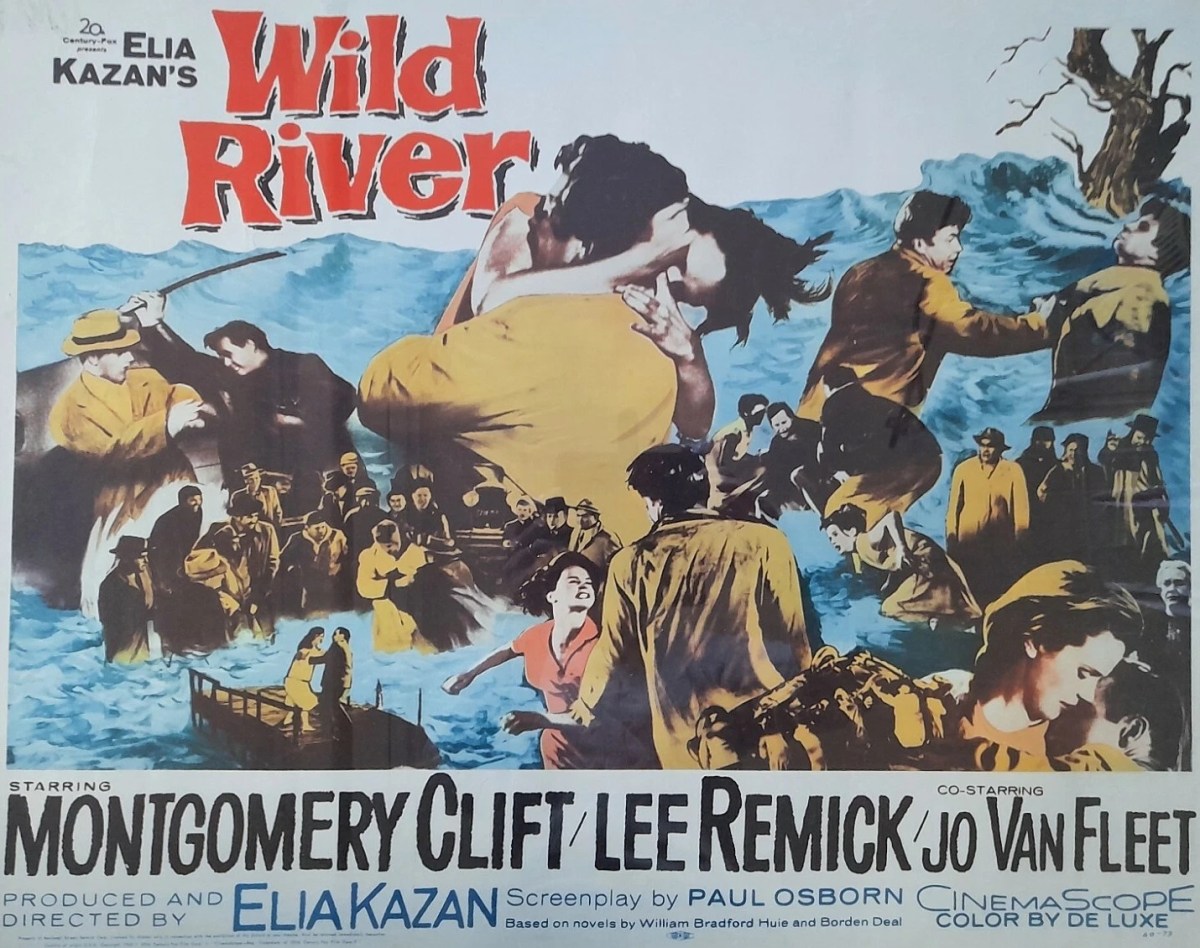
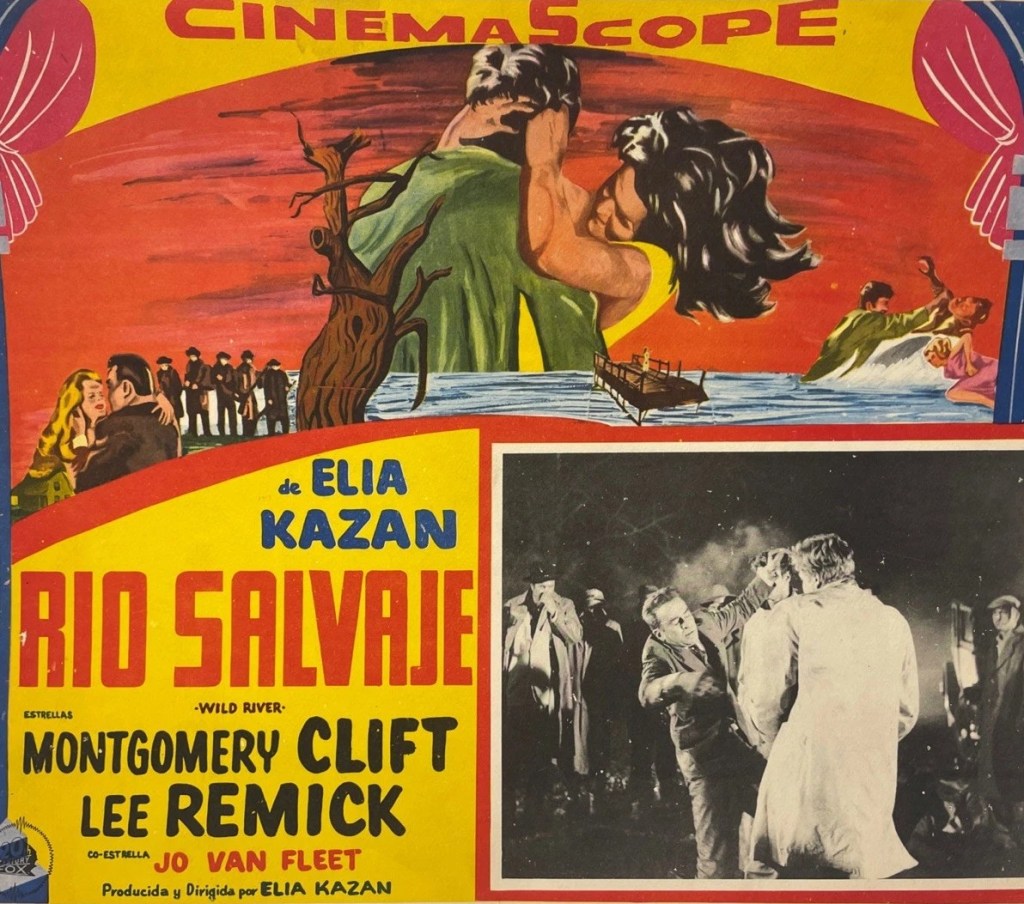
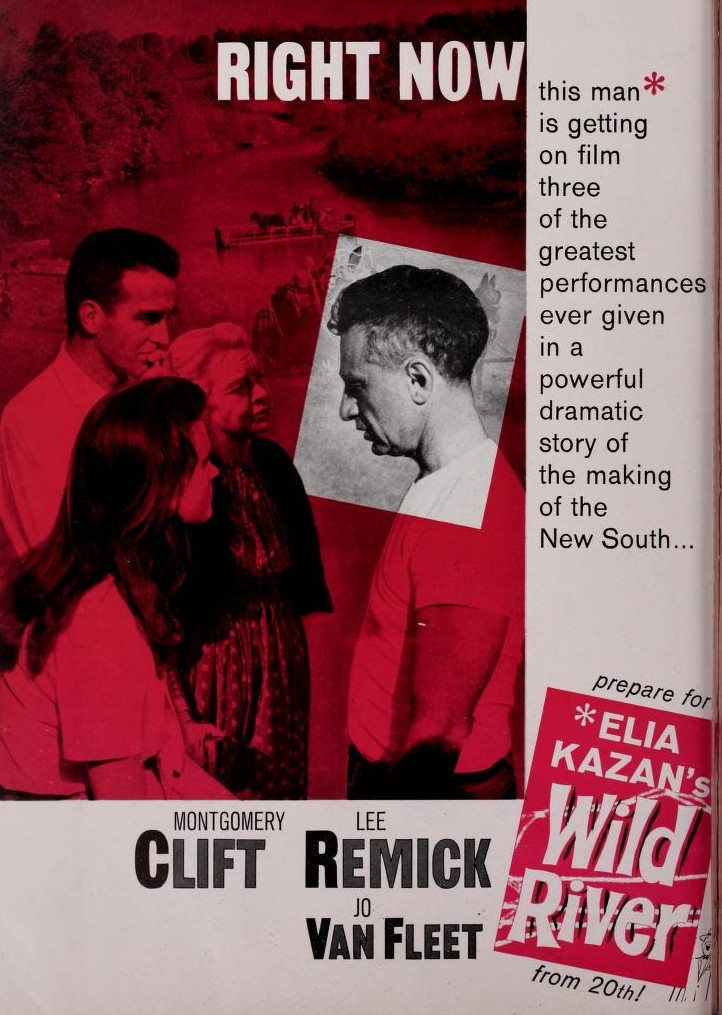
Wild River (1960) ****

Funny how you remember the circumstances of seeing a film for the first time. This was  important for me because it was the start of me digging into the vast heritage of the movies rather than watching just what was showing at my local cinema. I can’t pin down the exact date, but I have a feeling I was still at school, though in the advanced stage of that academia. I saw this on a 16mm print in a terraced house sitting on the hard kind of seats you used to get in assembly halls.

The location was the Scottish Film Council, the predecessor of the Glasgow Film Theatre, which was located in the city’s West End. The occasion was the final film in an eight-movie retrospective of Elia Kazan pictures. Either before or after I attended a similar Fellini retrospective. Certain more controversial films were omitted, so no Gentleman’s Agreement (1947), Pinky (1948) or Baby Doll (1956) and although this was the early 1970s no room for Splendor in the Grass (1961), America, America (1963) or The Arrangement (1969). Afterwards, there was a cup of tea and a biscuit and a discussion hosted by John Brown, who in my memory smoked small cigars, later a television and screen writer.

It was an introduction for me to the power of the retrospective, to view a huge number of a director’s films back-to-back (the screenings were weekly) and to understand the thematic symmetry of their work. Kazan predated the New Hollywood of the late 1960s and 1970s, so, although his movies usually challenged existing norms, these days they are often viewed as more stolid than of the first rank, his cause not helped by revelations that he named names at the anti-Communist hearings of the 1950s.

Wild River is one of those films that plays completely differently now thanks to the intervening decades. A contemporary audience is unlikely to sympathize with hero Chuck Glover (Montgomery Clift) whose job is to persuade farmers in the early 1930s to clear out of the way of  land that is going to be swamped with water to supply a new dam that would serve to both control the catastrophic flooding in the Tennessee Valley and bring electricity to an impoverished area.

These days ageing landowner Ella Garth (Jo Van Fleet) would attract massive publicity in her fight to avoid being shifted from land that had been in her family for generations, especially as she claims that dams go “against nature.”. And no matter how sympathetic a character like Chuck might be to her circumstances he would be viewed as a more well-meaning-than-most government apparatchik.

And in some respects, this plays much better as one of the few movies exploring the plight of the African American at the hands of the racist authorities. Chuck incites local hostility when he recruits Blacks to work alongside Whites, in the end conceding that they should work in separate crews. But he comes unstuck when he sticks to the principle that they should be paid the same, more than double the going daily rate for Blacks.

In consequence he is beaten up and, worse, a gang of thugs attack the house inhabited by his lover Carol (Lee Remick) and her two young children and the cops, when they arrive, are apt to condone the violence.

Ella takes a maternal attitude to her Black workforce and while certainly nobody received abusive treatment at her hands she has a patronizing manner, though in the end she encourages them to leave.

Despite his democratic and anti-racist views, Chuck comes over as a clever dick, thinking his smooth eastern charm can convince the reluctant woman to move and for the racists to abandon their inherent racism.

I’m not sure about the widowed Carol either, she almost seems to be throwing herself at the first decent man who comes her way. While she is already being courted by a local fellow, who is more decent than the rest, that is clearly going to be a marriage of convenience, but what exactly makes Chuck so much more an attractive proposition is never made entirely clear except that, for narrative purposes, it creates a romantic deadline – is she just a fling, thrown over when he heads home – and a whiff of tension.

However, marriage to the other man would have made her just a passive housewife, whereas she realizes that in many ways she is smarter than Chuck, more grounded, and she would have more freedom in this kind of match.

Oddly enough, there’s a Hitchcock vibe here. At several points the camera tracks Glover in longshot as he appears to be heading for trouble.  

The racist elements give this its bite rather than any ecological issues. The acting is certainly of  high quality, Montgomery Clift (The Misfits, 1961), less mannered than in some of his work, in one of his last great roles. It’s an interesting part. At one point he wishes he could once in a while win a physical fight, and it’s Carol who is more likely to show the venom required in battle.

Lee Remick (No Way To Treat A Lady, 1968) continued to build on her exceptional promise. Jo Van Fleet (Cool Hand Luke, 1967) gets her teeth into the kind of role most actors dream of. You can spot Bruce Dern (Once Upon a Time in Hollywood, 2019) in his first role.

An unusual approach to the screenplay, too, by Paul Osborn (The World of Suzie Wong, 1960). Like The Towering Inferno (1974) a decade later, this derived from two novels –  Dunbar’s Cove by Borden Deal and Mud on the Stars by William Bradford Huie (The Americanization of Emily, 1964).

Despite my ecological reservations, still stands up..

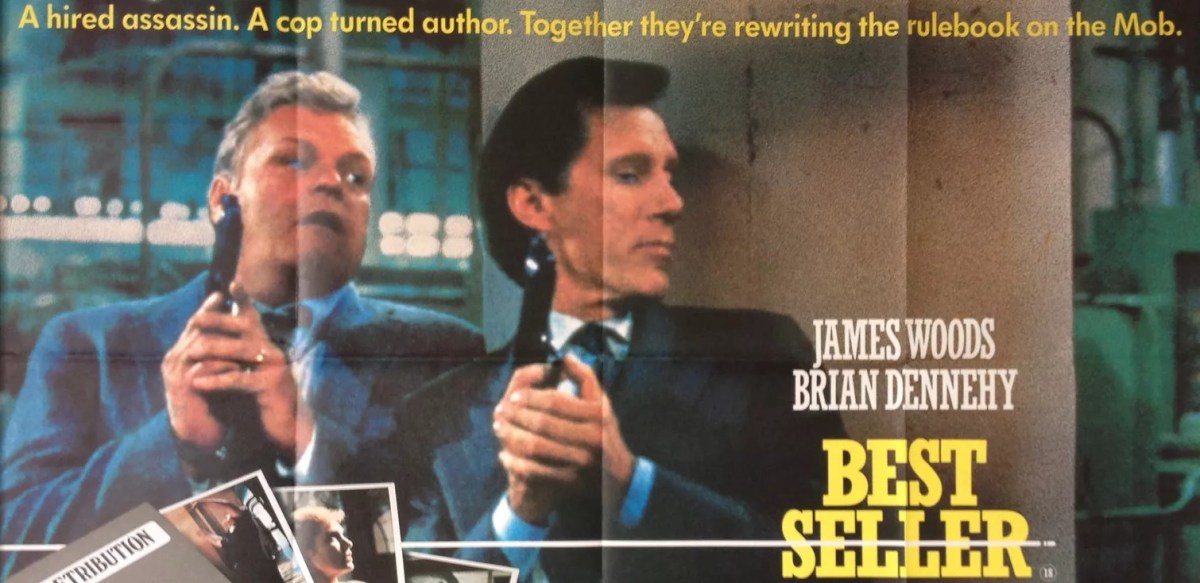
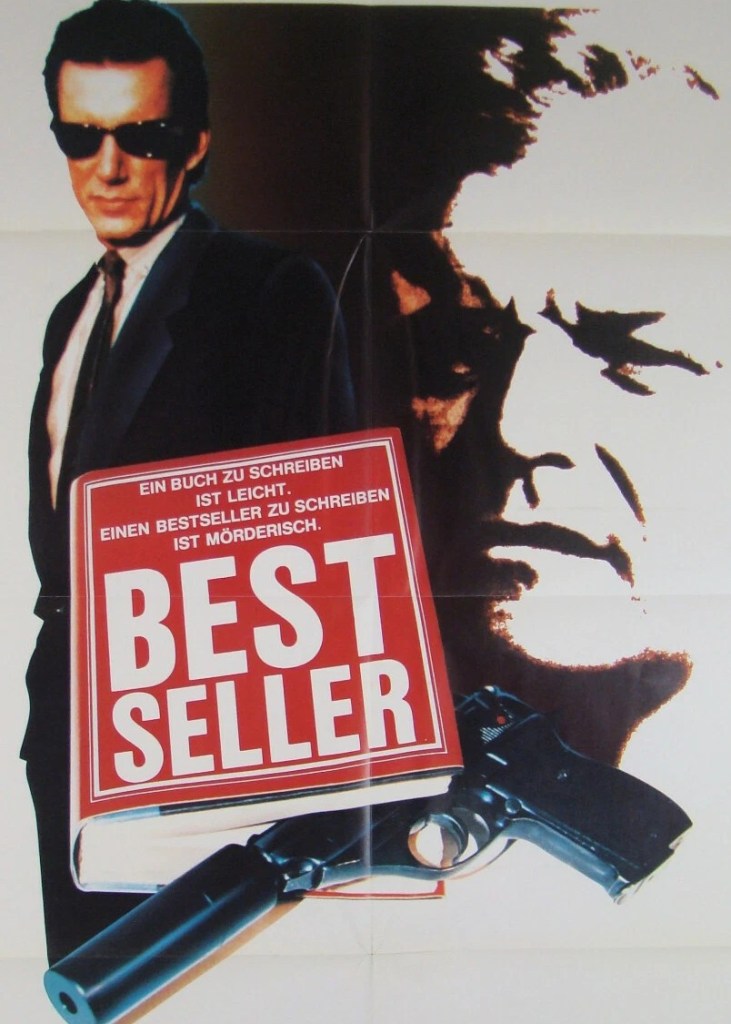
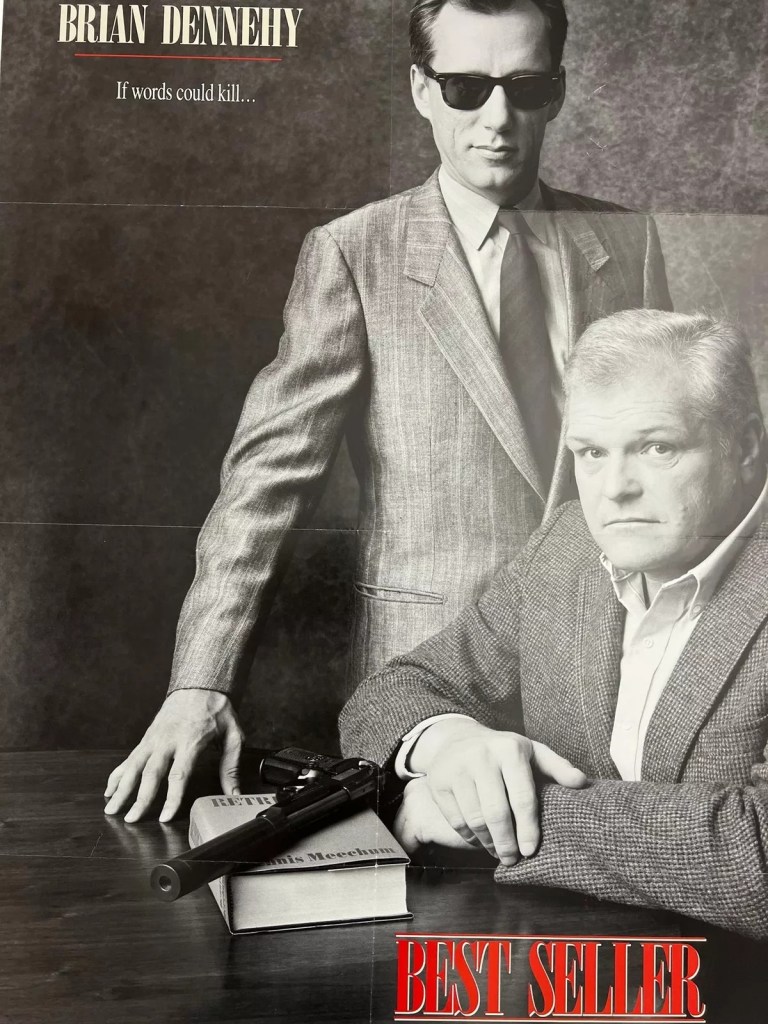
Best Seller (1987) ***

If nobody’s shot your dog or killed a member of your family, it’s kinda hard for an assassin to work up much audience sympathy. And although this is closer to John Wick than say The Mechanic (1972) or Day of the Jackal (1973), it doesn’t help the sympathy cause if your leading character is played by James Woods (Oscar-nominated the same year for Salvador) who so often essays an amoral fidgety weasel.

So it’s left to Brian Dennehy (F/X, 1986) to do the heavy lifting. Dennehy was the kind of stolid supporting actor who once in a while in the Hollywood Dream made it through on occasion to top billing. His brawn was not in the obvious top-off mold of muscle men Sylvester Stallone and Arnold Schwarzenneger and more in keeping with Holt McCallany (The Amateur, 2025).

It’s not unheard of for characters on either side of the law to team up to tackle the bad guys, but it’s a bit of a stretch for incorruptible widowed hero cop Dennis Meechum (Brian Dennehy) not to toss assassin Cleve (James Woods) into the pokey especially when there are ample witnesses to one of the killer’s killings. But, wait, let’s throw him a get-out-of-jail-free card because he saved the life of Meechum.

Even so, Cleve is as creepy as all get out and even if – especially if – he was a fantasist and not an accomplished assassin you would expect the sensible cop to run a mile, especially after he kidnaps Meechum’s daughter. For reasons unknown, Cleve is handed another get-out-of-jail-free card because actually he didn’t kidnap the 16-year-old Holly (Allison Balsam) but just gave her and her pals a lift home. Quite why a cop’s daughter would fall for the line given by a complete stranger that he was her dad’s pal is anyone’s guess, except it suits the script.

There’s quite a lot of what used to be called “high concept” – in other words getting away with the most unlikely of scenarios – here, not least that Meechum would go along with the psychotic Cleve in order to get the material to write a book, that particular well having dried up after the death of Meechum’s wife.

The fact that Meechum has a side hustle as a best-selling author – though still a cop – is one of the many stretches in the tale. You have to go along with quite a lot until the proper narrative kicks in, and realize that, in fact, Meechum is merely the dupe to allow Cleve to achieve his real aim which is to gain revenge by knocking off former employer David Madlock (Paul Shenar) who, regardless of whatever other malarkey he is up to, had the good sense to rid himself of the psychotic entitled gunman.

It seems inconceivable, too, that, by the simple device of employing a barrage of lawyers, big businessman and philanthropist Madlock would not be able to block publication. Meechum refuses to bow under pressure but his publisher might well do once she has been terrorized by Cleve.

And this wouldn’t work at all except for Cleve. Like Jeff Bridges in Thunderbolt and Lightfoot (1974) he’s a loner (though also like that character having no problem seducing women) who’s desperate for male friendship and appreciation. He wants to buddy up with Meechum and for the cop to enter into such a relationship willingly. In Cleve’s demented eyes, sharing the same woman appears to be one way they could cement the relationship. He appears to view the publication of the book which would uncover the illegitimate activities of the seemingly legitimate Madlock as a means of redemption. He wants to come out well in the book, even introduces Meechum to his quite normal family, and sees that as some kind of weird redemption.  

Eventually, there’s enough shoot-out action, especially when Cleve enters silent John Wick assassin mode, to make the journey worthwhile. But although Cleve is a fascinating original character and the dynamics of the relationship constantly shift, it beggars belief that Meechum would entertain him for a moment especially when he discovers Cleve was responsible for wounding him and killing some of his colleagues in a robbery several years before.

Woods is the standout though Dennehy does stake a decent claim as a leading man. Despite being third-billed Victoria Tennant (The Ragman’s Daughter, 1972) hardly appears.

Screenwriter Larry Cohen (It’s Alive, 1974) is no stranger to the genre mash-up and generally gets away with inconsistencies but here the bar is set way too low at the outset for the tale to be believable. Director John Flynn (The Sergeant, 1968) goes with the flow.

Worth it to see Dennehy get a shot at the big time and for another in Woods’ tribe of weasels but will have you scratching your head with the unlikeliness of the tale.

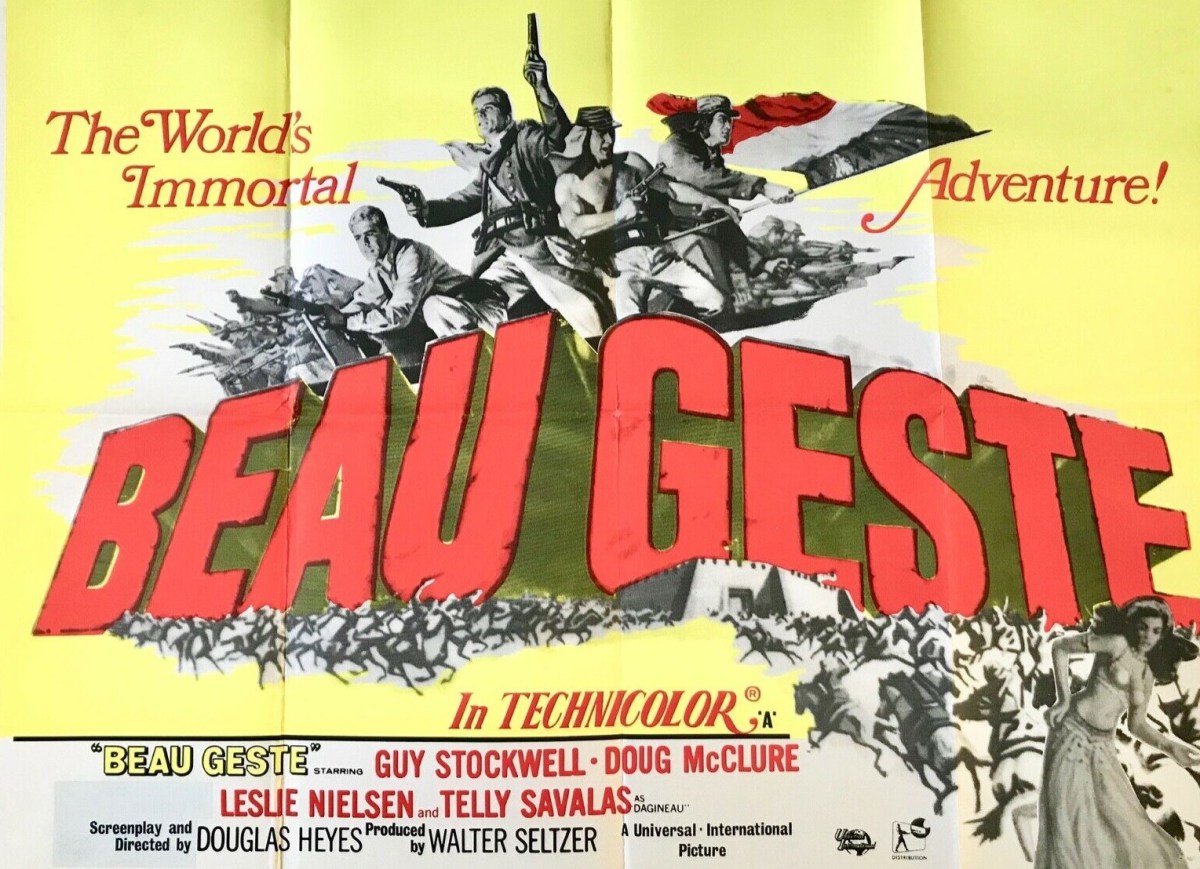
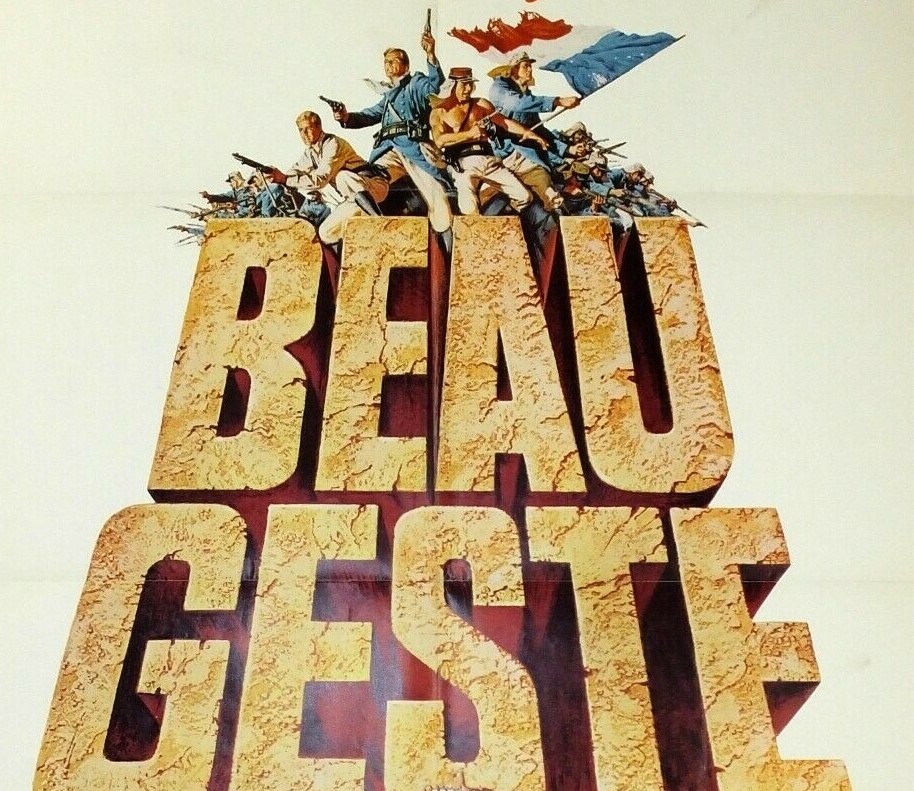
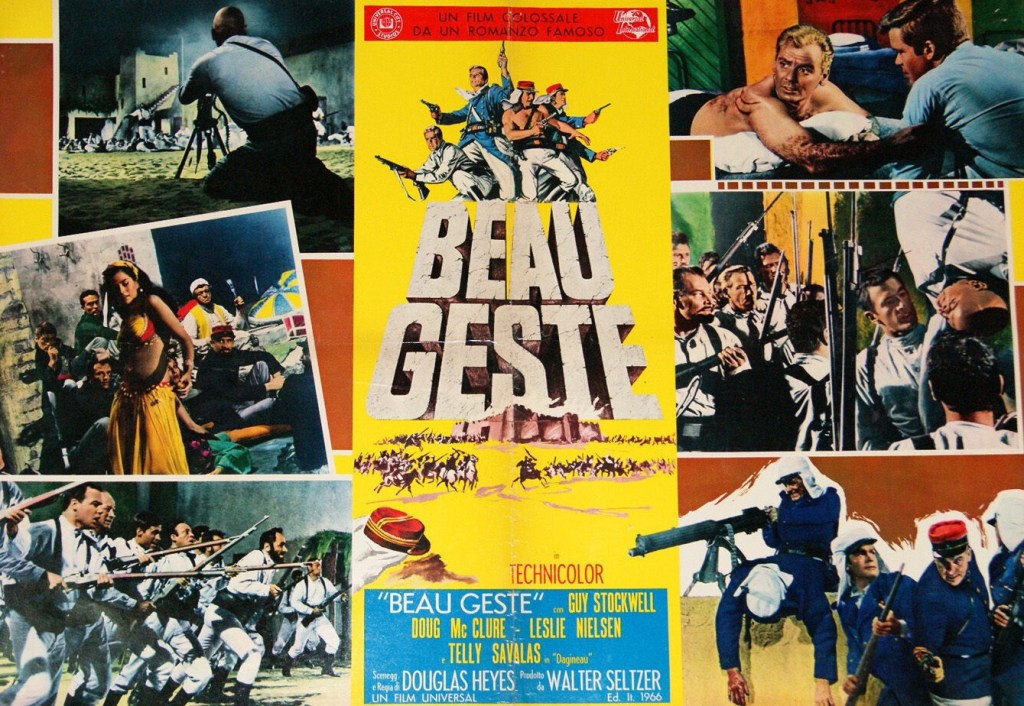
Beau Geste (1966) ***

Two brothers battle inhospitable terrain, warring tribes and a sadistic sergeant major in a  remake of the classic tale. The title translates as “noble and generous gesture” and is a pun on the name of hero Michael Geste (Guy Stockwell), an American hiding out in the French Foreign Legion in shame for being involved, innocently as it happens, in embezzlement. His attitude is markedly different to the “scum of the earth” who make up the battalion and his quick wit and refusal to kowtow make him a target for Sgt Major Dagineau (Telly Savalas), a former officer busted to the ranks.

Dagineau delights in imposing hardship and devising mental torture, making some recruits including Geste walk around blindfold at the top of a cliff. Geste’s resistance to his superior is almost suicidal and he even volunteers to take a whipping on behalf of his comrades. “It’s me he wants,” says Geste, “if not now the next time.” At another point he is buried up to his neck in the blazing sun.

Joined by his brother John (Doug McClure), the battalion sets out as a relief force for a remote fort but when commanding officer Lt De Ruse (Leslie Nielsen) is seriously wounded, the sergeant-major takes charge. Under siege from the Tuareg tribe, honor, treachery, mutiny, fighting skills and courage all come into play in a final section.

The action and the various episodes and confrontations are strong enough and Geste has a good line in witty retort, but blame the casting for the fact that it turns into Saturday afternoon matinee material. It was always going to be a stretch to match Gary Cooper, Ray Milland and Susan Hayward from the 1939 hit version.

Stagecoach, remade the same year, was able to rustle up a bona fide box office star in Ann-Margret (Viva Las Vegas, 1964) and a host of supporting players with considerable marquee appeal including Bing Crosby (Robin and the 7 Hoods, 1964), Robert Cummings (Promise Her Anything, 1965) and Van Heflin (Cry of Battle, 1963). Nobody in the cast of Beau Geste could compare. Apart from the Spanish-made Sword of Zorro (1963), Guy Stockwell usually came second or third in the credits, as did Doug McClure (Shenandoah, 1965) while Telly Savalas, despite or because of an Oscar nomination for The Birdman of Alcatraz (1962), was viewed as a character actor.

But that was the point. Universal gambled on turning the latest graduates from its talent school into major box office commodities. The set pieces and the action are well handled and while there are excellent lines especially in the verbal duels between hero and villain, it’s not helped by the most interesting character being Dagineau, who, despite his failings, accepted his fall from grace, worked his way back up the career ladder, believing brutality the only way to control the soldiers, and in the end out of the two is the one who has the greater sense of honor, refusing to allow a lie to befoul the truth, rejecting the notion of when the legend becomes fact print the legend, And it’s a shame that the movie has to present his character in more black-and-white terms rather than invest more time in his background or accept his version of reality.   

Telly Savalas (The Scalphunters, 1968) steals the show with a performance of considerable subtlety. Guy Stockwell (Tobruk, 1967) is little more than a stalwart, the heroic hero, with little sense of the irony of his situation. Doug McClure (The King’s Pirate, 1967) presents as straighforward a matinee idol. If you only know Leslie Neilsen from his later spoof comedies like Airplane! (1980) you will be surprised to see him deliver a dramatic performance as the drunken commander who still insists, in an echo of El Cid, in rising from his sick bed to lead his troops. Normally this kind of macho movie – The Magnificent Seven (1960) and The Dirty Dozen (1967) prime examples – throws up burgeoning talent who go on to make it big. It’s one of the disappointments here that this does not occur.

This was the second and final movie of Douglas Heyes (Kitten with a Whip, 1964).  

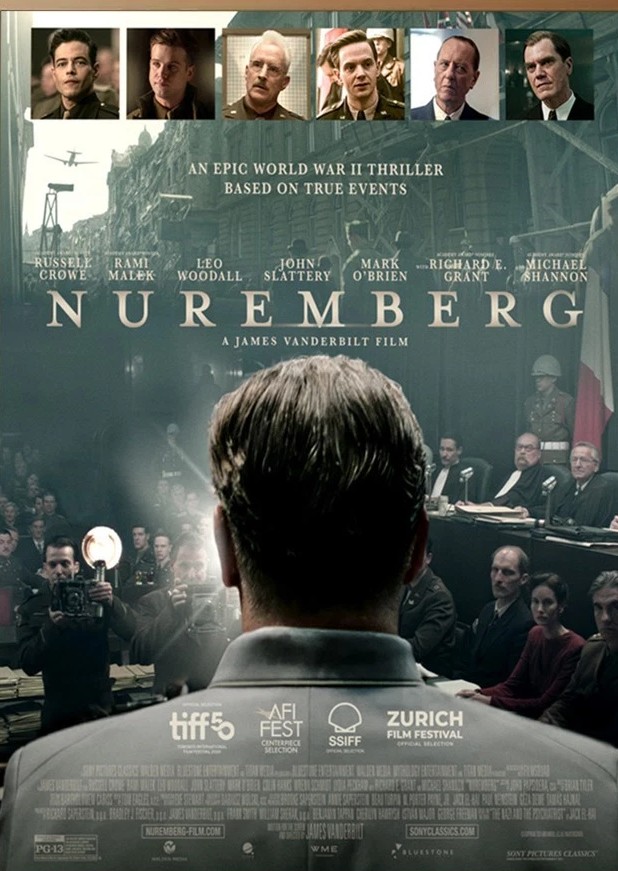
Nuremberg (2025) **** – Seen at the Cinema

Richly satisfying drama of the kind they don’t make any more. For a start writer-director James Vanderbilt isn’t spoiling everything by preening with the camera, trying to draw attention to himself at the expense of what is a very solid narrative. Where you might expect all the hypocrisy to be laid at the door of the Nazi High Command, in fact it’s evenly spread, two prime examples among the legal team hoping to bring Hitler’s second-in-command Goering (Russell Crowe) to his knees. And although lazy journalists, and even lazier marketeers, are hyping Crowe (The Exorcism, 2024), if they took a closer look they would find four other performances worth more than a passing mention.

Of course, everyone knows how this ends. Or do they? Theoretically, it’s about making an example of Goering and the other top Germans who greenlit the Holocaust. But, in fact, the reality is that it has never ended, and that other rulers, in the same almighty positions of power as the Nazis, have continued to commit genocide long after Hitler’s regime was disbanded.

Like Judgement at Nuremberg (1961) this in part sets out to discover what was it about the German character that permitted them to carry out their atrocities. Psychiatrist Dr Kelley (Rami Malek) commits professional suicide by determining that there was nothing, particularly unique about the Germans and that given the right circumstances it could as easily happen in the United States or any other civilized country.  

Although it’s promoted as a duel between Goering and Kelley, there’s more at stake. The whole concept of war crimes for a start, the idea that a group of countries can legally arbitrate in the affairs of another country, here the USA, Britain, France and Russia must come to together to argue the case against Germany. Nobody wants to get their hands dirty should the whole idea fall flat on its face, so Justice Jackson (Michael Shannon), leading the American legal attack, could as easily be fall guy as hero.

Goering is more humanized than Kelley. Following an unusual meet-cute, there’s an opportunity – but the director doesn’t fall for it – to set up Kelley in a romantic relationship with journalist Lila McQuaide (Lydia Peckham) but instead the card tricks that appeared to melt her heart become a different magical metaphor. Goering is a doting husband and father and Kelley becomes surreptitiously involved with his loving wife and piano-playing daughter. And despite appearing smart in his profession, Kelley is out of his depth with women, given a sharp lesson by Lila.

Kelley has taken on this job in the hope of writing a bestseller about his experience. Jackson expects to be nominated to the Supreme Court. Goering just wants to stay alive. Kelley takes the measure of Goering far better than the intellectually arrogant Jackson. In fact, Kelley is fearful that if Jackson doesn’t tread carefully, then Goering will wipe the floor with him.

The prosecutors have a few clever tricks up their sleeve. Kelley, under the guise of befriending Goering, uncovers his legal plan, which stops the German in his tracks.

But only for a moment. Goering is such a smooth operator that he skewers Jackson and it takes the last-minute intervention from languid Brit Sir David Maxwell-Fyfe (Richard E. Grant) to save the day.

There’s a fifth peripheral character here in Sgt Howie Triest (Lee Woodall), a German-speaking American, who has two of the best scenes. In a reversal of the usual trope where it’s the hero in an idle moment who divulges his past, here it’s the supporting actor. And where Kelley has only pretended compassion with Goering its Triest who provides another condemned German with the dignity to walk to the gallows.

Usually when you have a writer-director, the writer aspect is subservient to the director, but here James Vanderbilt (Truth, 2015) is fully in command of the narrative without resorting to tricksiness. The screenplay is littered with cutaways that maintain the tension as the story leaps ahead from one narrative point to the other. There’s a classical structure here, Vanderbilt laying the ground rules, what’s a stake for everyone, heightening the tension as it plays out, and throwing a few spanners in the expected works to keep it brimful of twists right to the end.

Virtually everyone gets the chance to be haughty, virtually everyone thinks they have a winning hand and how hopes are dashed makes for a terrific tale.

For sure, Crowe is ahead in the lazy journalist’s eyes in terms of plaudits, but Rami Malek (The Amateur, 2024) runs him close and in the supporting actor stakes it’s a toss-up between Michael Shannon (Death by Lightning TV mini-series, 2025), who switches from confidence to despair in the twinkle of an eye, and Lee Woodall (One Day TV mini-series, 2024) who waits and waits and waits before snipping in and stealing chunks of the picture.

Adapted by Vanderbilt from a book by Jack El-Hai.

For once, zippy dialog and nippy narrative merge. Supremely confident direction turns this into an engrossing, adult, movie.

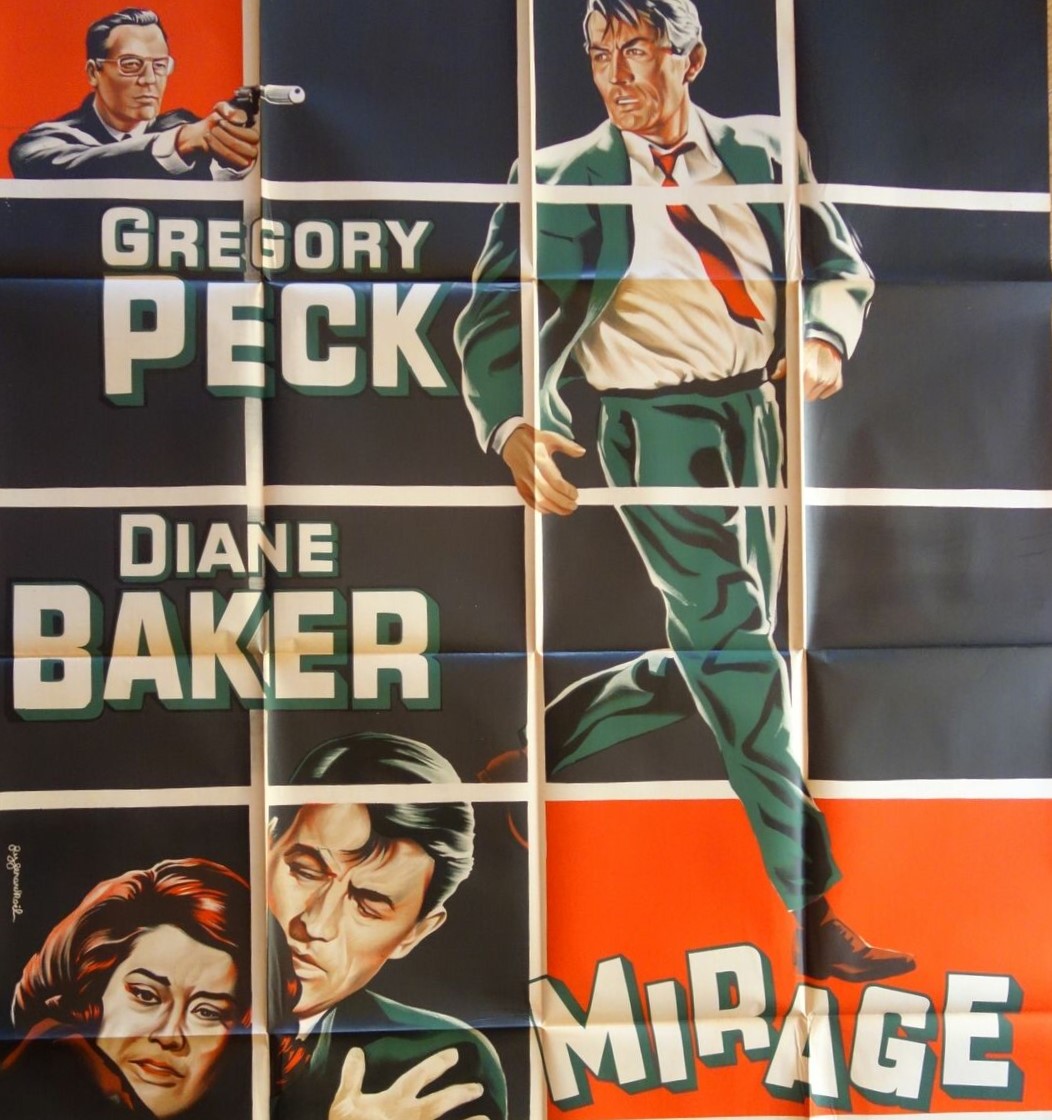
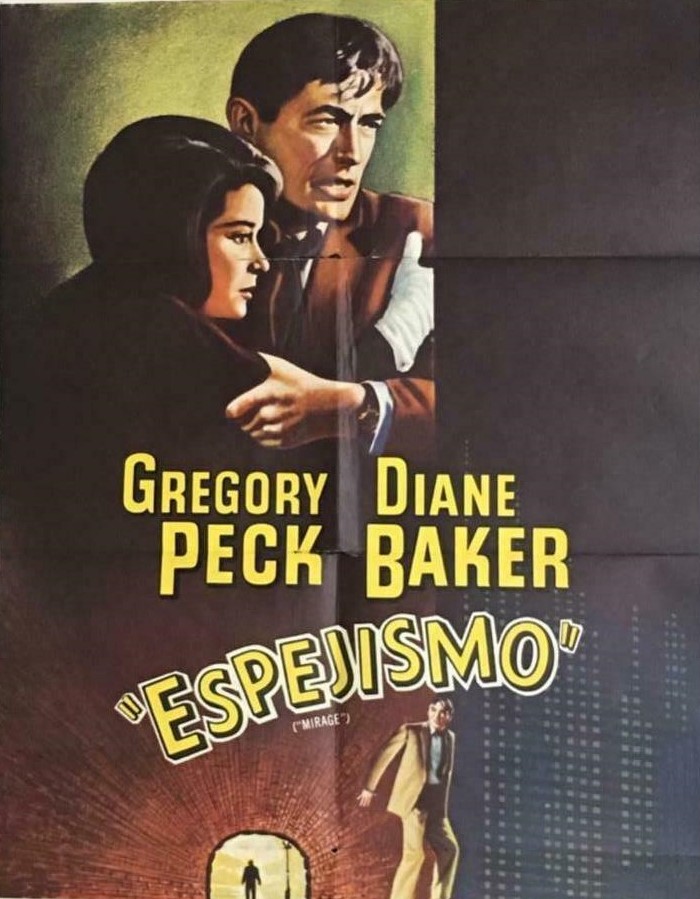
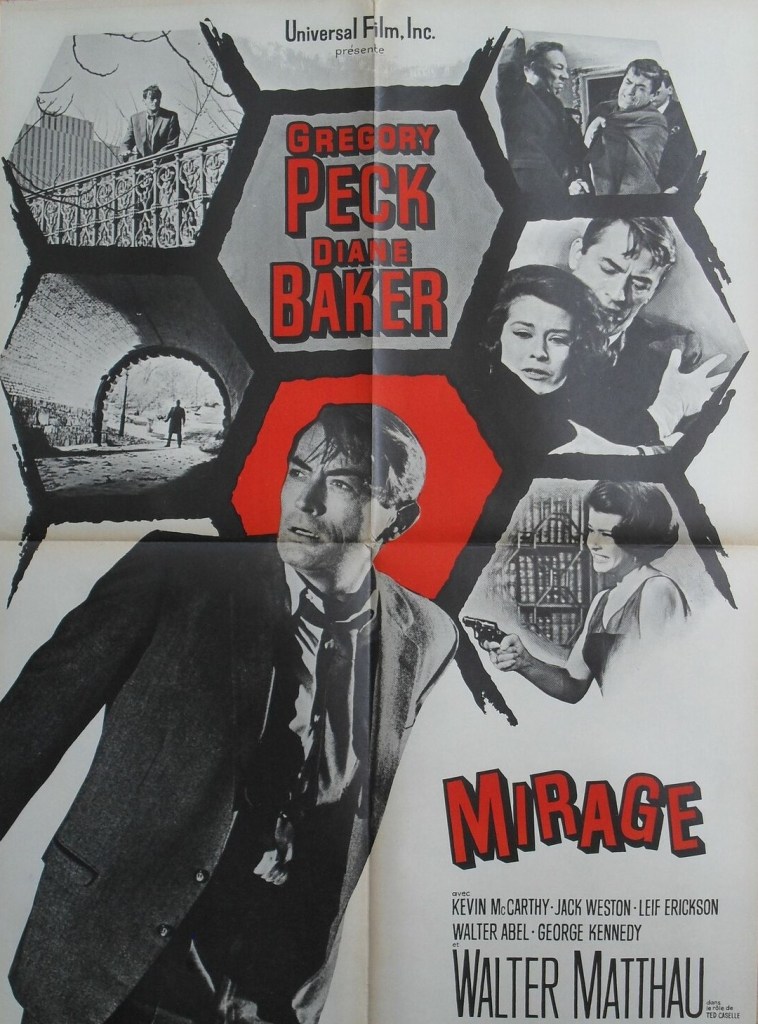
Mirage (1965) ****

“I owe you some pain,” barks the heavy to hero in one of the memorable lines in this classy thriller with surprisingly contemporary overtones. Underlying this tale of amnesiac David Stillwell (Gregory Peck) recovering his memory are themes of personal commitment, commitment to cause (“if you’re not committed to anything you’re just taking up space”), of individuals taking a stand against powerful forces seeking to thwart democracy, and of malevolent pandemic, the oldest of them all, greed, that infects even the most philanthropic enterprises.

The structure is brilliant. To every question David Stillwell (Gregory Peck) asks in trying to establish his identity, the answers are mystifying. He doubts his sanity and is plunged into a  life-threatening conspiracy.   

The film opens superbly. The camera pans across a New York skyline at night, every skyscraper lit up. Suddenly, one of the buildings goes dark. Cut to confusion inside as workers deal with the electricity cut-out. Among them Stillwell who is surprised to meet a woman on the stairs, Shela (Diane Baker), who not only recognizes him but seems to know a lot about him that is unfamiliar to him. They end up in the fourth level of the basement and on leaving discover that Charles Colvin (Walter Abel), a name that’s only vaguely familiar to Stilwell, has committed suicide by jumping from the building.

When he gets home to his apartment he is accosted by gunman Lester (Jack Weston) who tells him “The Major” wants to see him. Stillwell escapes but on reporting the incident to the police can’t remember his date of birth. After his amnesia being rejected by a psychiatrist he turns to private eye Ted Caselle (Walter Matthau) who takes up the case. But in Stillwell’s apartment a fridge he recalls as being empty is now full, the same with a dispatch case, the opposite with a closet, and in the building where he thinks he works there is now a wall where his office should be.

Stillwell believes he was employed as a cost accountant without a notion what that job entails. The building has no fourth level. Another gunman Willard (George Kennedy) is also in pursuit. Corpses pop up with increasing regularity. To add to the mystery, nobody actually wants him dead. He is too valuable alive. He has a secret only he doesn’t know what. The police connect him to the suicide.

And so the movie plays out brilliantly, with the audience only knowing what Stillwell knows, as confused as he, until piece by piece the jigsaw comes together although at times with cunning sleight-of-hand the pieces are the wrong shape or, worse, don’t fit the jigsaw in hand. There’s an emotional jigsaw to be put back together too, one that requires proper commitment, Shela’s “togetherness is not enough” could have been a mantra for today’s generation.

All the time Shela bobs in and out, hard to tell whether she is a victim or conspirator, whether to be trusted or merit suspicion, and she has an interesting philosophy of her own in terms of the trapped and caged.

As in the best thrillers we have been given the clues all the time, just not realized them for what they were, and in a series of brilliant scenes you cannot help but applaud the entire mystery is carefully stitched together. You will never in a million years guess the cause of Colvin’s mysterious death.

The ending is satisfying on a variety of levels. Yes, mystery solved, the secret Stillwell holds a good one, but the climax involves characters taking sides, displaying commitment, challenging their consciences, circumstances reflecting very much the world in which we find ourselves now.

One of the beauties of the movie is how it plays with our expectations. Peck has done amnesia before in Hitchcock’s Spellbound (1945) but since then his screen persona has been men of upstanding character, Atticus Finch in To Kill a Mockingbird (1962) the personification, confusion not a trait readily identified with him. Equally, the heavies look anything but,  Jack Weston small and rotund, George Kennedy bespectacled and slim.

Diane Baker, enigmatic throughout, far from the glamorous thriller female lead (think Audrey Hepburn in Charade or Sophia Loren who partnered Peck on Arabesque or Claudia Cardinale in Blindfold teamed with Rock Hudson), describes herself as a “lonely woman with a low opinion of herself due to many mistakes.” In the middle of the high tension, with Stillwell being pursued by cops, there is a wonderful scene where a little girl lets him hide in her apartment and on making him coffee it turns out to be the pretend coffee little girls make.

Gregory Peck (Arabesque, 1966) is superb, his face absorbing shock at his condition, at once welcoming unravelling mystery at the same time as doubting its source, wending his way through a past he cannot believe is true, a personality that occasionally appears abhorrent, and having to make the same decisions that he feared making in the past. Diane Baker (Marnie, 1964) has a difficult role, introspective where most heroines in this kind of film are more voluble, and frightened of her own vulnerability.

You can see from here how much George Kennedy bulked up for his breakthrough movie Cool Hand Luke (1967). Walter Matthau, too, was a stage away from interesting supporting roles to full-blown star in The Fortune Cookie (1966). Jack Weston might have been rehearsing his role as the stalker in Wait until Dark (1967). I am not going to mention the other sterling supporting players since that will give the game away.

Diane Baker makes the cover of Films in Review magazine.

Veteran director Edward Dymytryk (Alvarez Kelly, 1966) is on song, stringing the audience along beautifully, extracting wonderful performances, not frightened to give the film deeper meaning. The theme of commitment, of standing up to malevolent forces, seems an odd one for a straightforward thriller but it reflected Dmytryk’s experience as a victim of the anti-Communist witch-hunt of the 1950s.  

On the debit side, I can’t see any reason why this was made in black-and-white and it certainly served to put off the public, the film’s box office poor, but I dispute the criticism of what appeared too-frequent flashbacks. Rather than re-emphasizing plot points for the audience, I saw this instead as Stillwell holding up a mirror to a memory he doubted he could trust.  

Top-notch screenplay by Peter Stone who knows his way around this genre, having previously written Charade and with Arabesque round the corner, from the novel called Fallen Angel by ,surprisingly, given he is best known for Spartacus, Howard Fast under the pseudonym Walter Ericson. At least a dozen quotable lines included this cracker relating greed to a pandemic: “You’re a carrier, you infected him and he died from it.”

All told, an excellent thriller with modern resonance.

Oddly enough, Mirage was remade a couple of years later as Jigsaw (1968), directed by James Goldstone and starring Harry Guardino.

P.S. I see you that the “I owe you” line was adapted for use by Willow in the Buffy, The Vampire Slayer TV series. There’s even a link to that scene on YouTube. Glad to see it has found some kind of immortality. It’s the kind of line that should be a gimme for t-shirt manufacturers.  

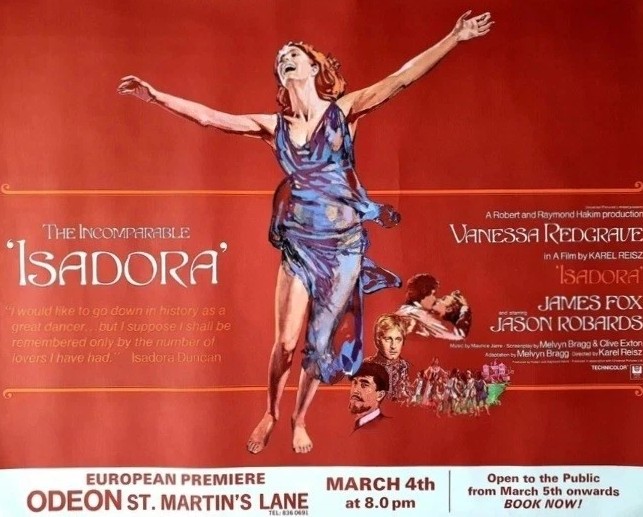
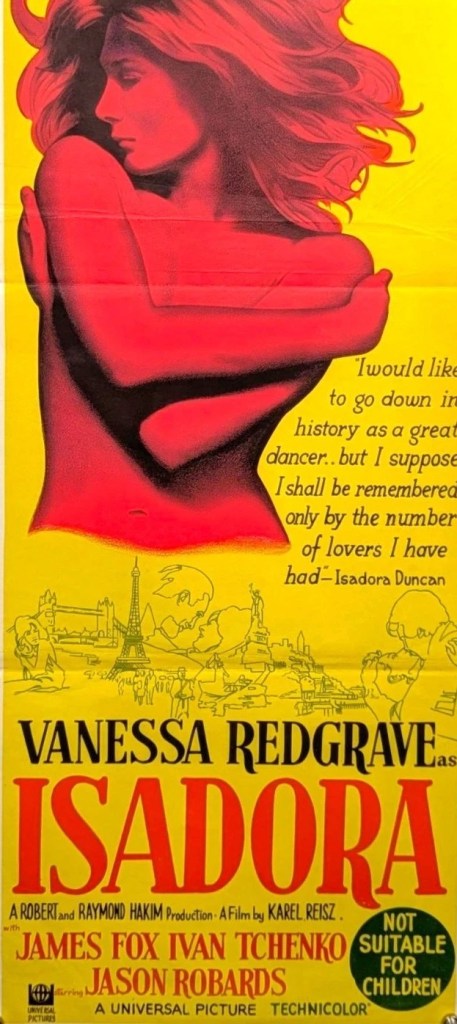
Isadora / The Loves of Isadora / The Incomparable Isadora (1968) ***

We’re two years away from the 100th anniversary of the death of feminist icon and pioneering dancer Isadora Duncan, but this movie has been in cold storage virtually since its release, so I’m wondering whether its sudden appearance on Amazon will trigger any interest in this long-forgotten, heavily edited, commercial flop of a movie.

Due to the clumsy structure it’s occasionally heavy going. We start off in Nice in the South of France where Isadora (Vanessa Redgrave) is dictating her memoirs to journalist (not lover) Roger (John Fraser) and the whole picture is rendered in flashback. And there’s something morbid about this structure, because essentially we’re waiting for her to die. Unfortunately, what she is most remembered for is getting her trademark long scarf tangled in the wheels of a moving Bugatti and snapping her neck. So we’re sitting around waiting for her to hop into a passing Bugatti with a Bugatti (Vladimir Leskovar).

The rest of her life was somewhat fractured, consisting of her leaping from one lover/husband – Gordon Craig (James Fox), Paris Singer (Jason Robards), Romano Romanelli, Sergei Essenin (Ivan Tchenko) – to the next so characters appear and then disappear. Never mind her rebellious nature and determination to forge her own way  and reinvent dance, her life was peppered with tragedy – all three of her children died, two drowning in the Seine (a fact repeated in a variety of ways to get the full emotional punch) – so there’s more than enough angst.

Her dancing is exuberant and uninhibited – she wore flowing dresses which looked as though any minute they would slip off her slender frame and there was scandal at one point when she bared her breasts during a performance. The first time she hits the stage is exceptionally ho-hum because it’s in a Paris nightclub and she’s a conventional, if very attractive, dancer of the ooh-la-la persuasion. But when she gets into her stride as a serious dancer, then visually it’s a treat, as she commands the stage – and screen- in a series of sexually provocative sinuous movements.

But, unfortunately, once is enough. You’d have to know a lot more about artistic dance than I do – and I guess the bulk of the original and contemporary cinematic audience – to know what changes she implemented and how, apart from her individual style (she danced solo not as part of an ensemble), her act developed and how it impacted on dance. She ran her own dance schools which probably liberated a ton of young women who were in the mood to be liberated.

But, as a biopic, even with 30 minutes knocked out, it’s way too long at the remaining 140 minutes, and the rest of the cast struggle to offer any competition to the lustrous Isadora.

Vanessa Redgrave, Oscar-nominated, is the best reason to watch and she is certainly compelling and, oddly enough, though there is plenty of incident and drama it somehow isn’t dramatically compelling.

She is generally naïve in her politics and her innocence in this department works to the advantage of the character. But mostly, we flit like a mobile time capsule through different periods, each well defined cinematically, and even though it’s clearly much harder to (in visual terms on film) convince as a genuine dancer than as, for example, a pianist, unless you were an expert on dance you wouldn’t know what to complain about.

You end up with a biopic about an interesting woman rather than a fascinating biopic. Vanessa Redgrave (Blow-Up, 1966) delivers another of her flawed characters and holds the screen effortlessly. The same cannot be said of the insipid males, James Fox (Thoroughly Modern Millie, 1967) and a miscast Jason Robards (Hour of the Gun, 1967).

Hard to know what the plans were of director Karel Reisz (Morgan!/Morgan, A Suitable Case for Treatment, 1966) because this isn’t his 168-minute version (the one that was released in the U.S. after disastrous opening weekend was trimmed to 128 minutes and in the UK to 140 minutes). Written by Melvyn Bragg (Play Dirty, 1969) and Clive Exton (10 Rillington Place, 1969) from a number of sources.

Sheds an interesting, but not enough, light on a legendary character.

Discover WordPress

A daily selection of the best content published on WordPress, collected for you by humans who love to read.

The Atavist Magazine

by Brian Hannan

WordPress.com News

The latest news on WordPress.com and the WordPress community.