El Dorado (1966) ****

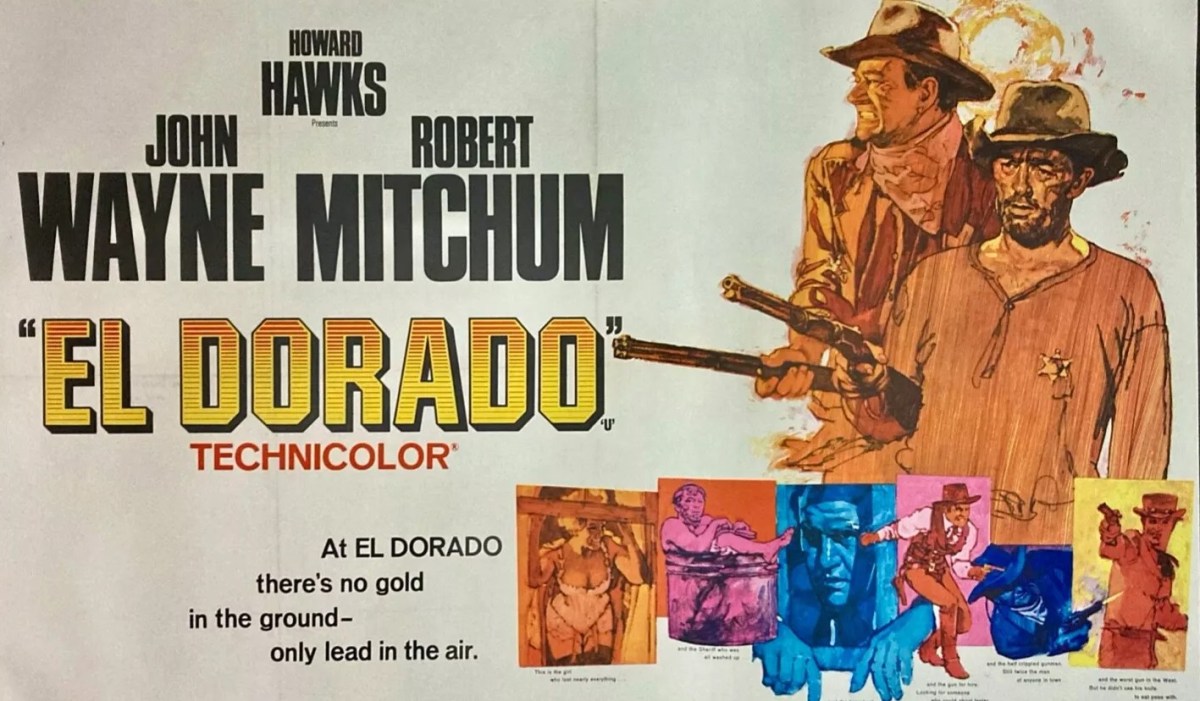
John Wayne incapacitated? Robert Mitchum a liability? The hell you say! You bring together two of the greatest male action figures only to turn the genre upside down and inside out. And I know it’s tradition for heroes to be unable to listen to their hearts, never mind deal with emotion, but it’s a heck of a stretch for them to just completely fall apart when spurned. And I know also that Duke is not invulnerable, this isn’t the MCU for heaven’s sake, and he’s been known in his long career to take a bullet, but to be shot by a woman! That’s very close to taking the proverbial.

Also, westerns usually operate on fairly tight timeframes. If the situation takes place over a longer period that’s usually because it involves a journey. Here, there’s a split of six months between the opening section and the main action, and it does kinda defy belief that the bad guys don’t make the necessary hay while the sheriff is drunk and his main assistant has scarpered.
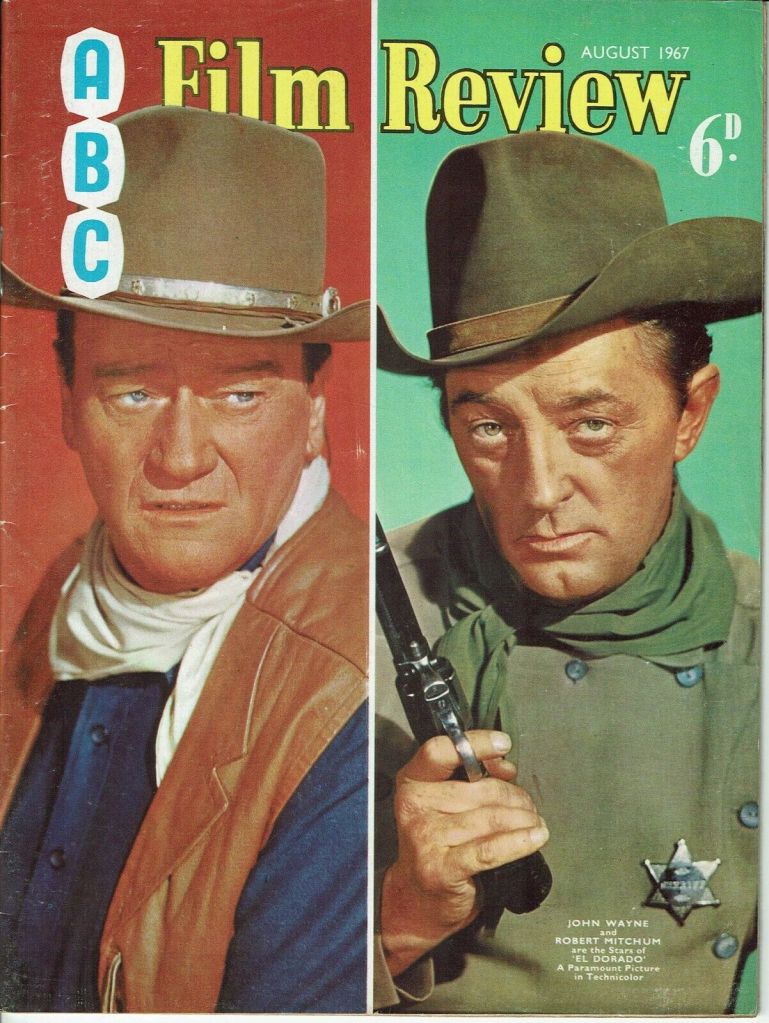
There’s hardly a word spoken here – between the good guys again for heaven’s sake – that isn’t an insult. Never mind The Magnificent Seven (1960) this is teed up as The Bickering Quartet. And I do have to point out a couple of elements that won’t go down so well with a contemporary audience, one character imitating a Chinese, and a scene where one of our heroes is constantly interrupted in the bath by females, a twist to be sure on the usual scenario of the female lead skinny dipping in a handy pool or river, but it’s like a lame comedy sketch.

This won’t have been influenced by the spaghetti western, the first Sergio Leone game-changer wasn’t screened in the U.S. until the following year, so it’s also worth pointing out that some of the action is pretty savage, both John Wayne and Robert Mitchum indulging in the kind of mean behavior that was usually the prerogative of the villains. Wayne even cheats when it comes to the traditional shoot-out. And while there’s none of the blood-letting that later became synonymous with the genre, director Howard Hawks does something else that is far more realistic than anything that has gone before and would count as a genuine shock to our senses. The gunfire is incredibly loud. Imagine that on Imax and you’d be jumping out of your seat every few minutes.

And just in case you think this is nothing more than a remake of Rio Bravo (1959) where a gunslinger and a drunken sheriff are holed up in jail, here the jail is mostly used as a base, the good guys racing out every now and then to pick someone off. That running, too, by older guys certainly prefigures later action pictures like Taken (2008).

We need the time gap to allow Sheriff J.P. Harrah (Robert Mitchum), one of the three best gunslingers alive, to disintegrate. He goes from tough lawman keeping an unruly town in order and holding back the worst instincts of land-owner Bart Jason (Ed Asner) planning to go in mobhanded against rival rancher Kevin MacDonald (R.G. Armstrong) in an argument over water rights.

Hired gun Cole Thornton (John Wayne), one of the three best gunslingers alive, turns up for a job with said Jason but is turned off the idea when J.P. gives him the lowdown on the situation. He dallies long enough to set up the notion that he’ll try to win back saloon-owning old flame Maudie (Charlene Holt) from J.P.

Thornton moseys off to the Mason spread to give the owner the bad news. On the way back, Luke Macdonald (Johnny Crawford), Kevin’s youngest son, on guard duty, mistakes Thornton for the enemy and shoots at him. Which results in his death. So Thornton does not get a good welcome when he arrives at the Macdonald farm toting a corpse.

Turns out the young whelp, although taking bullet in the gut, committed suicide because the pain was too much and Luke had been told by his dad that he wouldn’t recover anyway and just suffer a hideous death. While the father accepts this, his daughter Joey (Michele Carey) does not and ambushes Thornton, putting a bullet in his back. Said bullet is mighty inconveniently lodged close to his spine and needs more than the town quack to remove it. Despite sparking up old feelings for said old flame and the prospect of stealing her back from old buddy J.P., Thornton doesn’t dally longer than it takes to get temporarily fixed up, bullet still in place to cause later problems.

Now the tale takes a detour. Not only has six months passed and Thornton miles away from El Dorado, but we’ve got to hold up proceedings to introduce naïve youngster Mississippi (James Caan). Howard Hawks certainly hasn’t learned the knack of the compact introduction from John Sturges a la The Magnificent Seven (1960) so we learn that this young whelp is best with the knife and has spent two years tracking down the four killers of his foster father. The last man to die happens to be an employee of Nelse McLeod (Christopher George), one of the three best gunslingers alive, on his way to take up the job Thornton turned down, a task made a helluva lot easier because J.P is now the town drunk, having hit the bottle when spurned by a woman, not Maudie I hasten to add.

Thornton heads for El Dorado with Mississippi tagging along, armed with of a sawn-off shotgun. First task is to sober up the sheriff – by fistfight and awful concoction – and stop him becoming a worse figure of fun. On the evidence here Deputy Bull (Arthur Hunnicutt) was probably one of the three best riflemen – not to mention archers – alive. He also totes a bugle.
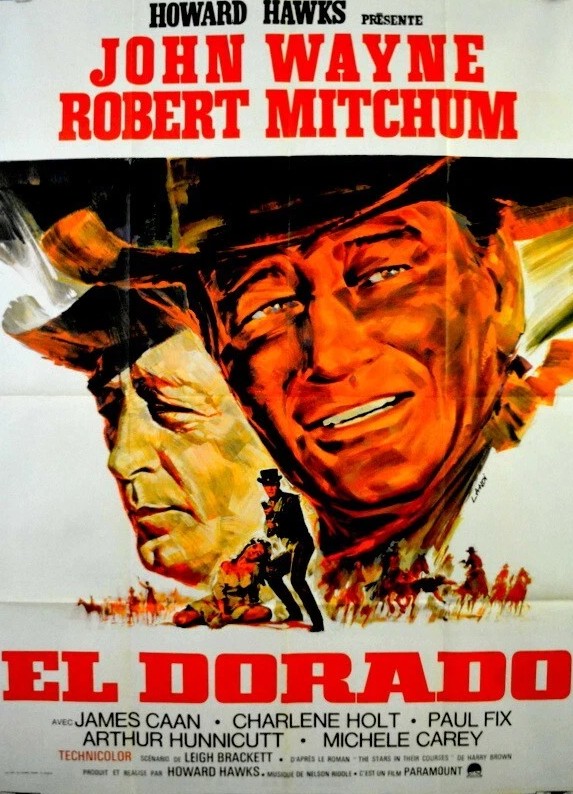
The sober J.P. strolls into the saloon and arrests Bart Jason and sticks him in jail, and to avoid being in a complete siege situation, the quartet, sometimes as a group, sometimes a pair, sometimes alone, venture out, as I mentioned, to pick off the enemy. This allows Mississippi a meet-cute with Joey who’s planning a short-cut to justice by shooting Jason. Maudie re-enters the frame.

The bullet in the back sporadically paralyzes Thornton and J.P. is wounded in the leg so eventually the pair are hobbling around on crutches. Maudie also turns out to be a liability, taken hostage, ensuring Thornton goes to the rescue. But the bullet in the back plays up at exactly the wrong time and Thornton’s also captured, trussed up like a hog (what, John Wayne?) then traded in for the prisoner.

Having by now reduced the odds and not wanting to be caught in a siege, the quartet take the battle to the enemy, ambushing them front and back in the saloon, Thornton ridding Nelse of the notion that he and Thornton will enjoy a winner-takes-all shootout by killing him with a rifle while lying on the ground.

While it could be trimmed – television screenings generally eliminate the racist Chinese impersonation – the action when it comes is blistering. There’s a terrific scene in a tower when Bull targets the bells to disorientate the enemy with their horrendous ear-jarring clanging. And the final shoot-out is exceptionally well done.

In ways not usually gone into, the quartet are experts in their fields. Thornton backs up his horse to get out of a difficult situation, J.P. detects a man hidden behind a piano in the saloon, Mississippi stalks a potential lone assassin, Bull uses bow-and-arrow when silence is required.

Theoretically, Robert Mitchum (Five Card Stud, 1968) steals the show as the drunken sheriff, but that’s only if you are taken in by the surface. The sight of John Wayne with his useless twisted right hand harks back to the arm in The Searchers (1956) and his one-armed rifle action predates True Grit (1969). James Caan (The Rain People, 1969) tries to steal scenes but what chance does he have with these two stars at the top of their game and past master at the scene-stealing malarkey Arthur Hunnicutt (The Cardinal, 1963). Charlene Holt (Red Line 7000, 1965) and Michele Carey (The Sweet Ride, 1968) come out honors even as do Edward Asner (The Venetian Affair, 1966) and Christopher George (The Thousand Plane Raid, 1969).

I don’t put this in the same bracket as Howard Hawks’ Red River (1948) and Rio Bravo, but it’s certainly one of the best westerns of the decade. Written by Leigh Brackett (Hatari!, 1962) from a novel by Harry Brown.

Not one to miss.
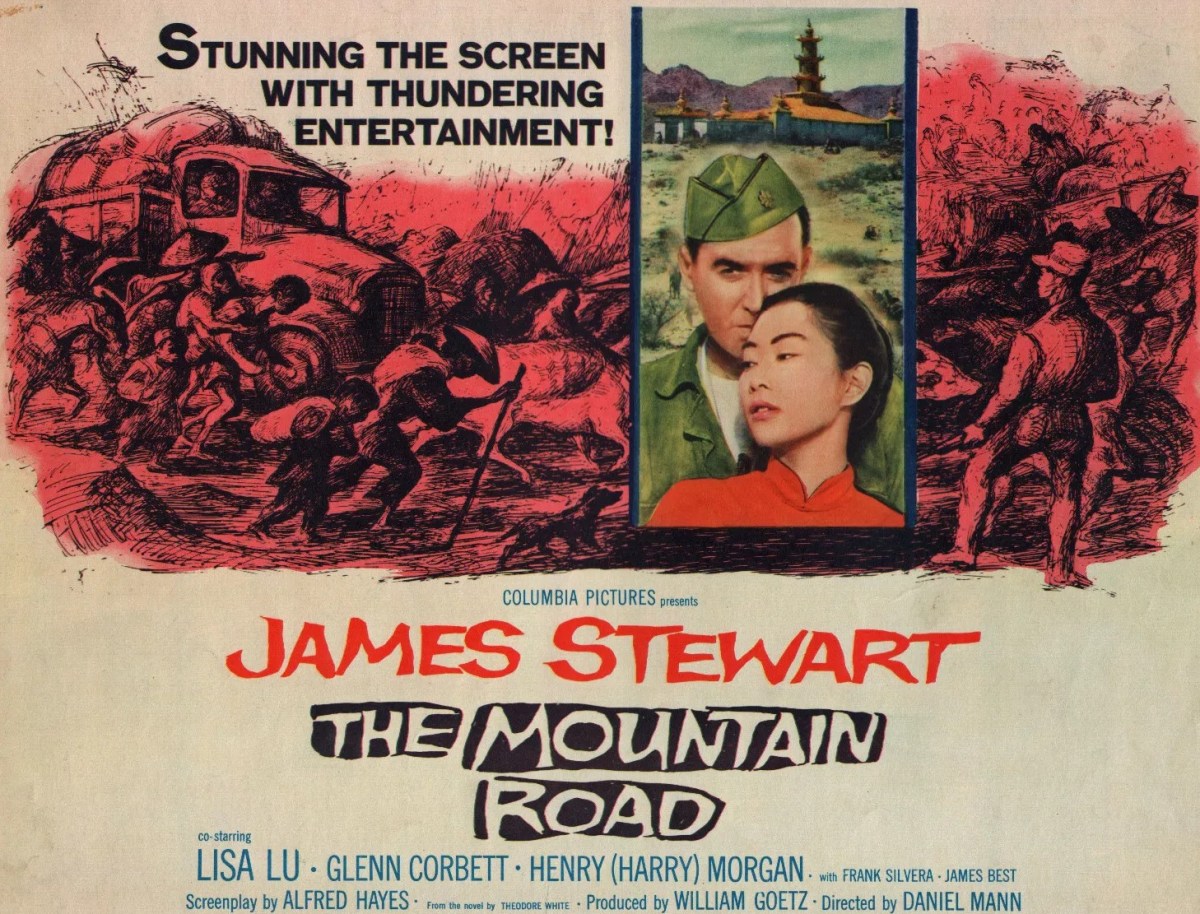
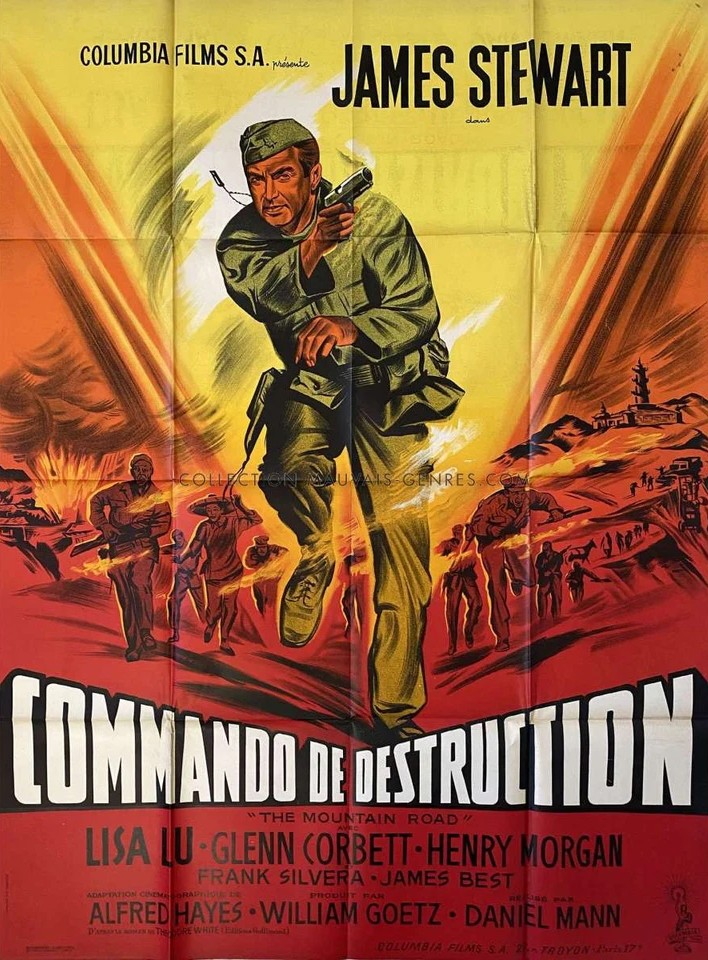
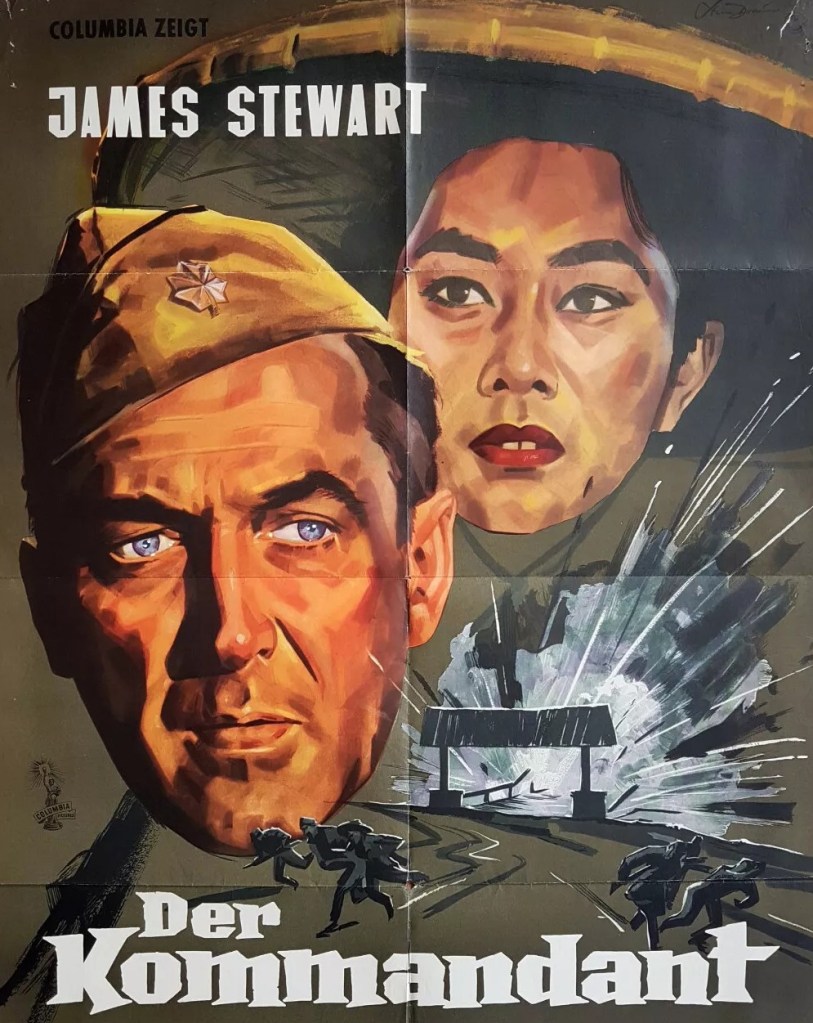
The Mountain Road (1960) ****

First film to deal with U.S. Army war crimes. Though here’s it’s tabbed as abuse of power but amounts to the same thing when it relates to the wanton killing of innocents. Not the first film to examine a commander totally unsuited to command – The Caine Mutiny (1953) would be your first port of call for that, although that was a career officer rather than a conscript. But the blistering under-rated Oscar-ignored performance by James Stewart (The Rare Breed, 1966) is easily comparable to the Oscar-nominated Humphrey Bogart.

And director Daniel Mann (A Dream of Kings, 1969) is helluva sly. He dupes the audience into thinking this is a mission picture, blowing up a massive ammunition dump to prevent it falling into enemy hands. And if you’re one for the easy action of explosions, this is for you, the kind of fireworks not seen till MCU entered the equation.

And here’s a line that’s going to knock you for six. “China and America are friends.” Say again? You what? As far as I can remember in all my decades of moviegoing, China has always been the enemy, either providing a succession of nefarious villains, or on the brink of starting a nuclear war, or just totally ungrateful for all the efforts the West has made bringing to the country Christianity and the western idea of civilization.

But it’s true. Before Communist China reared its ugly head, the U.S. and China were allies against the Japanese in the Second World War. But towards the end of that conflict, the Japanese had invaded and the Yanks were pulling out. Not wanting to leave anything behind for the enemy – like a huge arsenal or thousands of gallons of diesel – is the trigger for the story.

Except it’s not. Major Baldwin (James Baldwin) doesn’t have to go on any mission. His job is just to blow up a much smaller ammunition dump that’s easily accessible without the need to go on a long trek through the mountains. It’s his choice to take on the bigger job. There’s not even any pressure to do so. It’s entirely at his “discretion.” And you can see in the tone of his superior’s voice that it’s not such a good idea. He can just complete the small job and high-tail it out of there.

But Major Baldwin wants to experience command in action. He’s not a glory hunter in the normal sense but there’s definitely something off in a backroom soldier who’s got that on his wish list. It never occurs to him that there’s more to command than ordering about grunts, many of whom he considers “slobs,” and that the position comes with the task of making difficult decisions.

He’s got a very small team, chief among whom is Sgt Michaelson (Harry Morgan) and translator Collins (Glenn Corbett). Chinese officer Col Kwan (Frank Silvera) is meant to smooth his path and the widow of a Chinese general, Sue Mei (Lisa Lu), is thrown his way, initially you would guess to sweeten the load by becoming a love interest, but actually to become his conscience.

Just to fill you in on the background. China and Japan had been at war since 1937. After Pearl Harbor China became critical to US operations in the Pacific by tying down Japanese forces and after the fall of Burma the US airlifted supplies over the Himalayas.

Baldwin soon discovers that leadership equates to callousness. He has little sympathy for the refugees swarming over the mountain roads seeking sanctuary from the invading Japanese. He blows up a bridge and creates an impasse on the road to delay the Japanese without giving any thought to how that will endanger the natives.

He’s pretty inhuman in his treatment of one of his men, suffering, it later transpires, from pneumonia and might be taking all his cues from General Patton who hated all wounded soldiers. While he’s trying to convince the soldier to get back on his feet all the grunt can do is whimper, “Milk! Milk” like a child. Baldwin even sees little problem in stacking the ill man beside a corpse on the back of a lorry.

It would help if Baldwin had been trained in command, in making decisions, rather than picking faults everywhere and letting the pedantic side of his nature run wild. Sei Lei to some extent tries to rein him in, accusing him of blatant racism, treating the Chinese as if they were a lower form of humanity.

When he does relent and orders surplus food to be handed out one of his men is killed in the stampede. The last straw is Chinese bandits who kill and strip three of his men. So he leads a raid on a Chinese village, rolling a barrel of fuel stacked with dynamite down a hill to destroy the village and innocent villagers.

Up till then things were going along nicely on the romantic front, Sei Lei clinging to him when the massive ammunition dump goes up, and kissing on the cards. She’s westernized after all, spent a lot of time in America, well educated, and so easily a contender for marriage. But she tries to stop the barrel-rolling, telling him this action is unjustified, pure revenge.

He thinks she’ll accept an apology, that some madness came over him, he was consumed by power. But she’s having none of it.

Mission accomplished but human flaws exposed.

This isn’t the James Stewart you’ve come to expect, far from it. There’s certainly times in his career when he’s been mean or ornery and in his Hitchcock excursions a bit creepy, but he’s never been so awful as here, the guy desperate for power without knowing how to use it or draw the line. Purely in a technical capacity, working out where to plant explosives and plan a demolition, he’s in his element, but let him loose on human beings and he’s a loose cannon trying to rein himself in, stuck in a mess of his own making, unable to understand consequence. But sometimes even guilt isn’t enough.

This was an unlikely role for Stewart because, after his own experience in World War Two, a pilot in Bomber Command flying missions over Europe, he had turned down every war picture. Perhaps this movie reflected the guilt he felt of dropping bombs and knowing there would be civilian collateral damage, that sense of power over the powerless might equate to the feelings Baldwin has over the Chinese.

This is by far the most human character Stewart ever played, doing away with both the aw shucks everyman and the commanding often truculent cowboy, and instead portraying someone who’s way out of his comfort zone.

Ace scene-stealer Harry Morgan (Support Your Local Sheriff, 1969) is the pick of the support though Lucy Lu (One Eyed Jacks, 1961), being the conscience of the piece, has all the best lines.

Just as with A Dream of Kings, Daniel Mann takes a flawed individual and doesn’t hang him out to dry. But in retrospect, the war crime, of blowing up the innocent civilians, would not have received such a free pass, which puts a different slant on Baldwin. Alfred Hayes (Joy in the Morning,1965) wrote the script from the Theodore H. White bestseller.

Much to ponder.

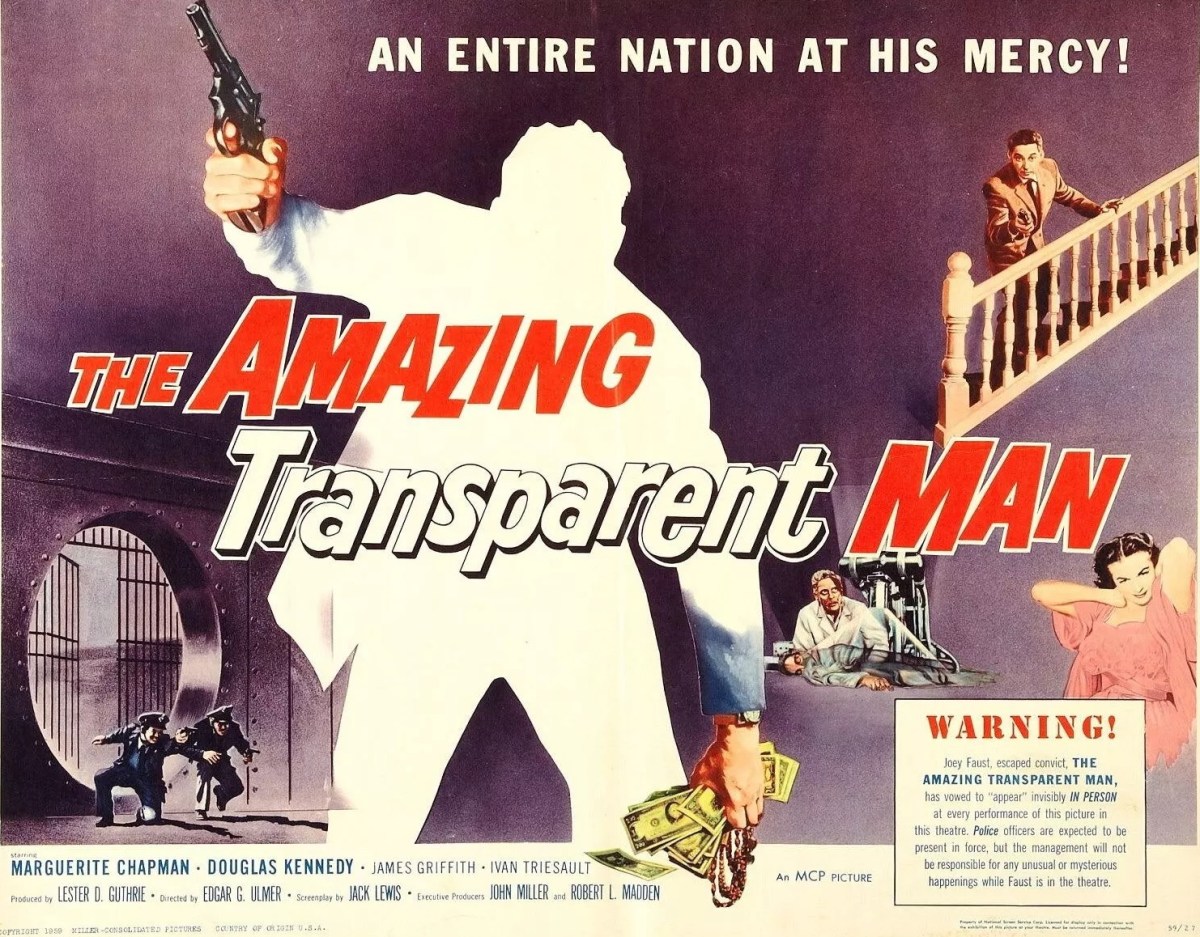
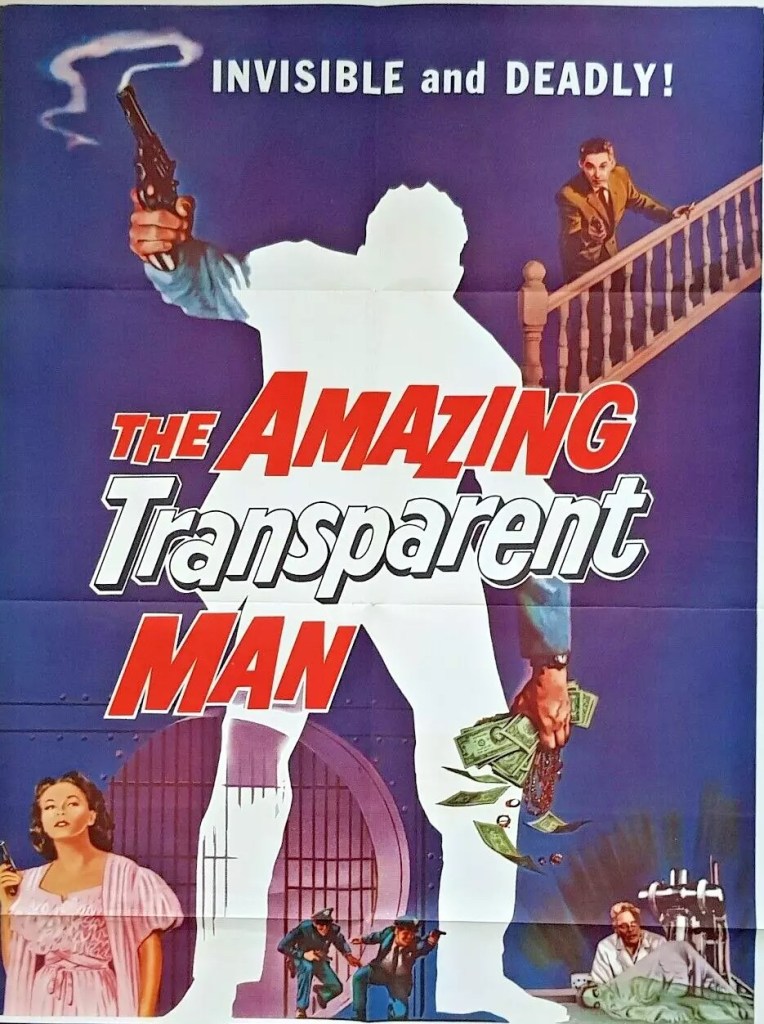
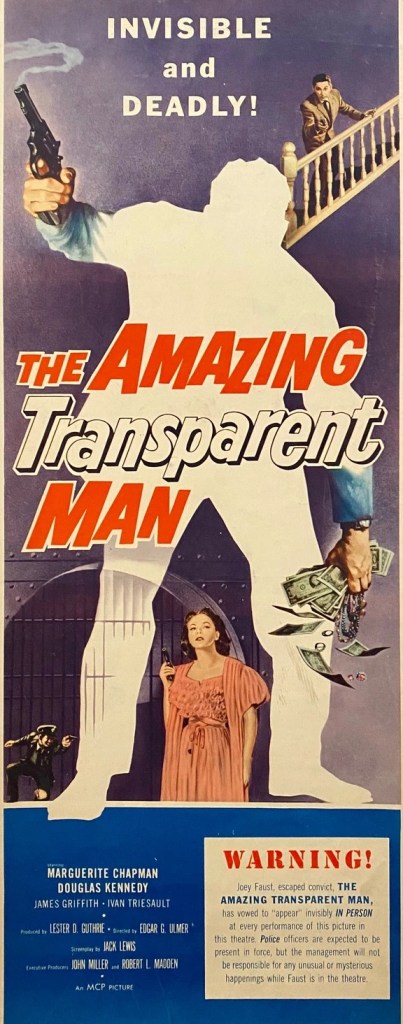
The Amazing Transplant Man (1960) ***

Sci fi film noir. Anything that involves cult director Edgar G. Ulmer (Hannibal, 1960) tends to put an unusual twist on a tale and here he takes the kind of mad scientist who would be perfectly at home in the MCU and turns him inside out. In fact, Major Krenner (James Griffith) is pretty close in intent to Valentina Allegra de Fontaine (Julia Louis-Dreyfuss) in the asterisk version of Thunderbolts (2025) in wanting to build an indestructible army.

His is going to be invisible. (Presumably, this would have been called The Invisible Man had Universal been more obliging.)

It was quite the thing as we have seen from I Aim at the Stars out the same year for the U.S. after World War Two to purloin German scientists, and here Krenner is one step ahead of the Government by snaffling Dr Ulof (Ivan Triesault).

The good doctor is given something of a free pass here because he’s been coerced into working for the major on account of his daughter being held hostage. And because he accidentally killed his wife during one of his experiments. But given he was working for the Germans in a concentration camp and his experiments, had they been successful, would have resulted in the creation of an invisible army for the enemy, maybe we shouldn’t be so lenient.

Ulmer isn’t so lenient with the rest of the bunch and there’s double cross all the way. Safecracker Joey (Douglas Kennedy) doesn’t show the gratitude you’d expect after being sprung from jail by Krenner and his moll Laura (Marguerite Chapman). Being amply rewarded for being a guinea pig isn’t enough and he reckons that if he can walk unnoticed into a government facility and steal nuclear materials, then he could just as well walk into a bank unnoticed and make off with the kind of cash that would fund retirement.

Laura begins to warm to the notion of sharing her bed with a hunky action man rather than a weedy pedant and even more to the idea of sharing the loot and the retirement. There’s also a resident thug Julian (Boyd Morgan) who’s been duped by the major into adding muscle to the operation.

Clever publicity stunt. Joey is going to appear invisibly in person at every performance.

So instead of the usual set-up of good guy, and a girl he met on the way (or vice-versa), intent on stopping the mad scientist, you’ve got the complete opposite, bad guy and hook-up planning to keep on being bad.

There’s a heap of good old-fashioned fun with the invisibility. Some trick photography to make Joey disappear but it’s more fun to watch the other actors throw themselves around to simulate being punched in the face or stroke an empty space and pretend they are touching a real human being, and to see vault doors miraculously open, or onlookers agape at watching a bag of loot hovering in midair. Or even better to see parts of Joey’s body unexpectedly materialize in the middle of a robbery.

You can’t build tension in normal heist fashion. You don’t need to endlessly go over an elaborate plan or hold your breath to see if a guard or some such is going to appear at an awkward moment or another obstacle get in the way, not when you can just walk in and walk out and nobody even know you’re there. So Ulmer doesn’t bother with that aspect, concentrating more on the personalities involved, each as mean and calculating as the others.

Even free pass Ulof, who could sabotage the project at any opportunity, decides it would be better if a hunky action man rather than another weedy individual took on that task. So he lets on to Joey that just as invisibility wears off so does his lifespan courtesy of the radiation which is slowly poisoning him. So it’s Joey who does the needful, not out of a hero’s ambition to save mankind, but out of pure revenge.

Thanks to the characters involved this is never corny. Old-fashioned maybe in an enjoyable old-fashioned way before it cost the world to create special effects.

It says a lot about the marquee quality of the stars that Marguerite Chapman (The Seven Year Itch, 1955) as the femme fatale is top-billed when she hadn’t been in a movie in half a decade and wouldn’t be in another one ever again. Douglas Kennedy (The Destructors, 1968) was a bit-part player and this was as close as he’d get to playing a leading man. Ditto James Griffith (Heaven with a Gun, 1969). But since mostly what they’ve got to show is malevolence nobody is being asked to step outside their comfort zone.

Ulmer filmed this back-to-back with Beyond the Time Barrier, with the two films forming a double bill.

Good fun.

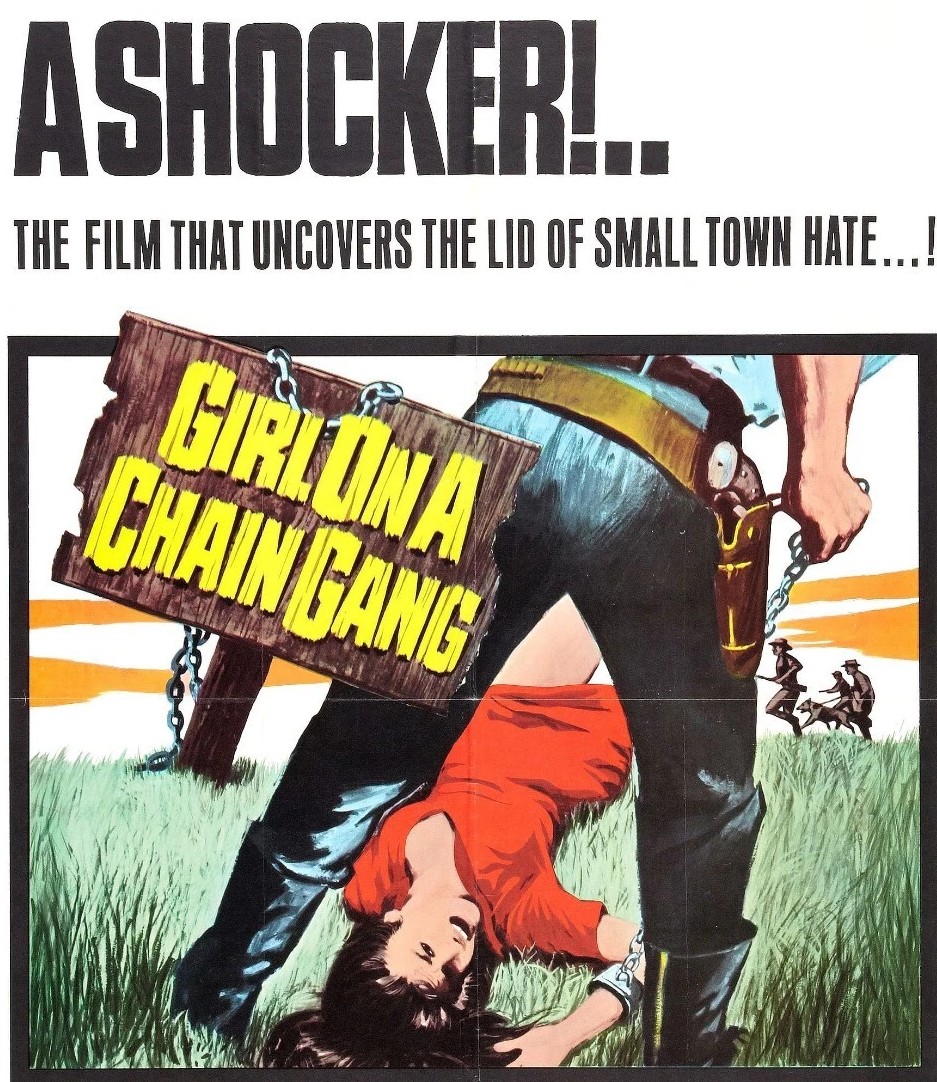
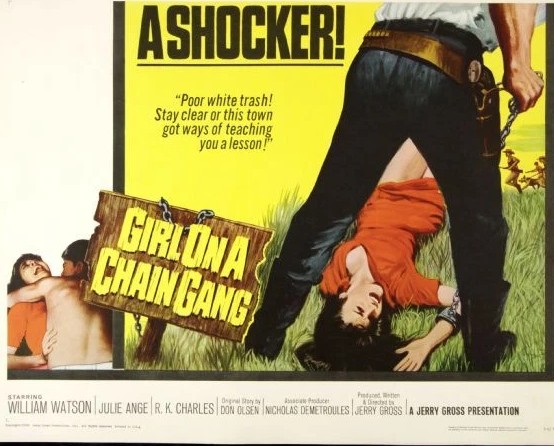
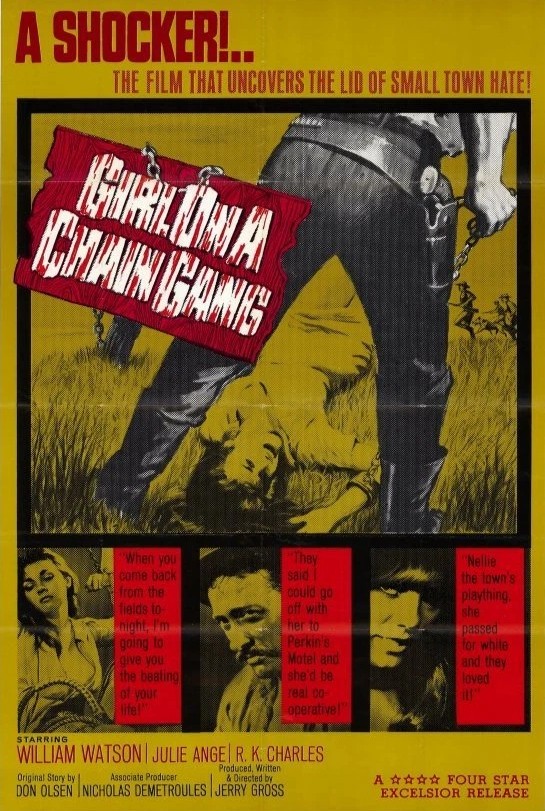
Girl on a Chain Gang (1966) **

Trash and intentionally so, but with some unexpected merit. In the first place it was the forerunner of films set in the Deep South such as In the Heat of the Night (1967) and Mississippi Burning (1988) and where the former deals primarily in racism the latter adds Civil Rights to the equation. More pertinently, and to save us according this more acclaim than it deserves, it was the beginning of the Women in Prison genre. Writers, generally, date Jess Franco’s 99 Women (1969) as the beginning of that genre, but that’s mostly because it clicked at the box office, thanks to liberated censorship permitting more exploitation license.

To put it crudely, this is straight exploitation but given more credence because it’s not as vivid sexually in its exploitation. There’s rape and by later standards that’s discreetly done but there’s a complete absence of nudity.

Jean (Julie Ange), Ted (Ron Segal) and African American Claude (James Harvey) are stopped for speeding in Carson Landing, and subsequently arrested. Sheriff Wymer (William Watson) beats up the men in turn, fines them $150, which, luckily they can pay. They are let go but shortly afterwards arrested again on the trumped up charge of prostitution (her) and violation  of the Mann Act (the men) for transporting a sex worker across state lines.

Claude turns down the chance of freedom that would be granted should he agree to sign a confession put to him in seductive fashion by the Sheriff’s squeeze Nellie (Arlene Faber). The cops lure the guys into attempted escape by leaving a door open, which, as you might expect, results in their demise. Jean, who has the sense to not take the bait, is raped.

Jean is convicted nonetheless of prostitution and at her trial vents her feelings. “You’re nothing but a bunch of pigs and murderers…It takes a whole town plus a phony judge and jury to convict me,” she spouts.

There’s not much time for her to spend on the eponymous chain gang because she seems to spend most of her time chained up. But because she lacks a “way of showing her appreciation” and thus being rewarded with a softer job of cleaning or cooking, she’s eventually added to the chain gang. Luckily, on her first day out, another prisoner Henry (Tom Baker) helps her escape and they head for the swamps. He sacrifices himself to save her but not before showering the Sheriff with snakes. When Jean is found, she becomes a witness against the corrupt cops.

I doubt if writer-director Jess Gross (Teenage Mother, 1967) had anything more on his mind than making a quick buck in the grindhouse/drive-in exploitation market, and that anything prophetic was purely happenstance. Most movies around this time in that genre sold more on promise than what they could deliver, and he had made his marketing bones through the U.S. distribution of the first two Mondo Cane (1962/1963) films as a double bill. He only directed three pictures and was better known as a producer including the lurid Whirlpool (1969) and the more legitimate Blaxploitation Sweet Sweetback’s Baaadass Song (1971).

In part because of censorship prohibition, this carries some weight because more is imagined than shown, sexuality repressed rather than expressed, but that was not the case with violence and while it’s not marked by the bloodletting that would later be de rigeur the cops hand out some stiff beatings, exemplifying not just their racist credentials but their antipathy to liberals from the big city.

This didn’t prove a breakout movie for the stars although William Watson had a reasonable career as a tough guy – Lawman (1971), Chato’s Land (1972). Julie Ange and Ron Segal only made one more film, Teenage Mother. James Harvey didn’t make another. Arlene Faber was the star of Gross’s other two movies, the last being Female Animal (1970), and she had a small part in The French Connection (1971).

Of minor historic interest.

F1: The Movie (2025) **** Seen at the Cinema in Imax

Buckle up – the summer blockbuster is here. And if you’ve got the sense to see it in Imax double buckle up because you’ve just never seen the like. As regular readers will know I’m a sucker for race pictures – Grand Prix (1966) that invented the genre, Rush (2013) and Ford v Ferrari/Le Mans ’66 (2019) the top trio in my book. And all driven by interesting narrative, a shade too much soap opera in the first, a real-life on-track duel in the second, and the machinations of big business in the third. And the last two with scenes that took place outside the racetrack that have stuck in my mind since – in Rush Niki Lauda (Daniel Bruhl) kicking into high gear in an ordinary motor to impress his soon-to-be wife, Carroll Shelby (Matt Damon) taking Henry Ford II (Tracy Letts) for a terrifying spin.

This one has jettisoned narrative complexity for thrills on the track and the sheer screen charisma of star Brad Pitt (Bullet Train, 2022) off it. For all my love of movies about motor racing I’ve never been compelled to watch any of the current F1 action or a single episode of the seven-season (and counting) Netflix series Drive to Survive, so my understanding of the rules is rather vague.

Here, you might come away with the notion that tires/tyres are more important than speed and that if you are mighty clever you can fry those rules within an inch of their lives and get away with it. And I’m not sure if the climactic set-up where the race is reduced to the equivalent of a golf play-off between four cars over three circuits of the track is actually a genuine element of the business.

So, ex-gambler thrice-divorced itinerant Sonny Hayes (Brad Pitt) who 30 years before was an up-and-coming Formula One Driver before an accident wrecked his career is tempted to return to the greatest arena of all by old buddy Ruben (Javier Bardem) whose racing team is on the point of collapse. He’s recruited as wing man to cocky up-and-coming talent Joshua (Damson Idris) who is repulsed by the idea of giving a second chance to an elderly citizen. The idea that Sonny will mentor the young guy is torpedoed when the younger ace nixes that notion.

But Sonny has got street smarts and knows how to win dirty. There are the usual reversals and obstacles, mostly self-imposed, before the team learn to back Sonny’s combat instinct.

And while the racing footage will take your breath away – even not seen in Imax it’s going to be a thundering visceral involving experience – it’s Brad Pitt who brings this one home. He’s one of only three surviving Hollywood stars, Leonard DiCaprio and Tom Cruise would be the others (though you could maybe make a case for Matt Damon), whose attachment can greenlight a picture and put the bucks into the box office.

One of a posse of producers and one of the many real-life participants to make an appearance.

Ever since a glorious entrance in Thelma and Louise (1991) he’s strode the Hollywood firmament like, as they say, a colossus, never taking the easy role, backing his own judgement, and often putting his own dough into projects (his Plan B shingle is one of the many production outfits credited here) and lighting up the screen with an easy charm.

Luckily, the screenplay by Ehren Kruger (Top Gun: Maverick, 2022) crackles and Pitt’s realism cuts through the social media engagement world inhabited by Joshua and the jargon-ridden world of the back-office team. “Hope isn’t a strategy,” he snaps. And there’s a lively verbal duel with designer Kate (Kerry Condon) and a couple of scenes where he takes what’s coming, especially from Joshua’s irate mum Bernadette (Sarah Nile), and one of those classic scenes where he dupes the youngster into thinking he’s won.

Usually enigmas aren’t this captivating, even Sonny can’t explain what drives him, but beyond a skeletal backstory, we don’t need to learn much about him because his whip smart delivery and scathing lines keep the audiences on their toes.

So Brad Pitt at the top of his game, excellent support from Javier Bardem (Dune: Part Two, 2024) and Kerry Condon (The Banshees of Inisherin, 2022). While Damson Idris (Snowfall, 2017-2023) isn’t in the breakout league of Glen Powell in Top Gun: Maverick, he still looks a talent to watch. Tobias Menzies (Outlander, 2014-2018) as a sneaky financier has a stand out supporting role.

Joseph Kosinksi (Top Gun: Maverick) does for earthbound speed what he did for supersonic speed in the Tom Cruise sequel.

Summer has arrived. Go see.

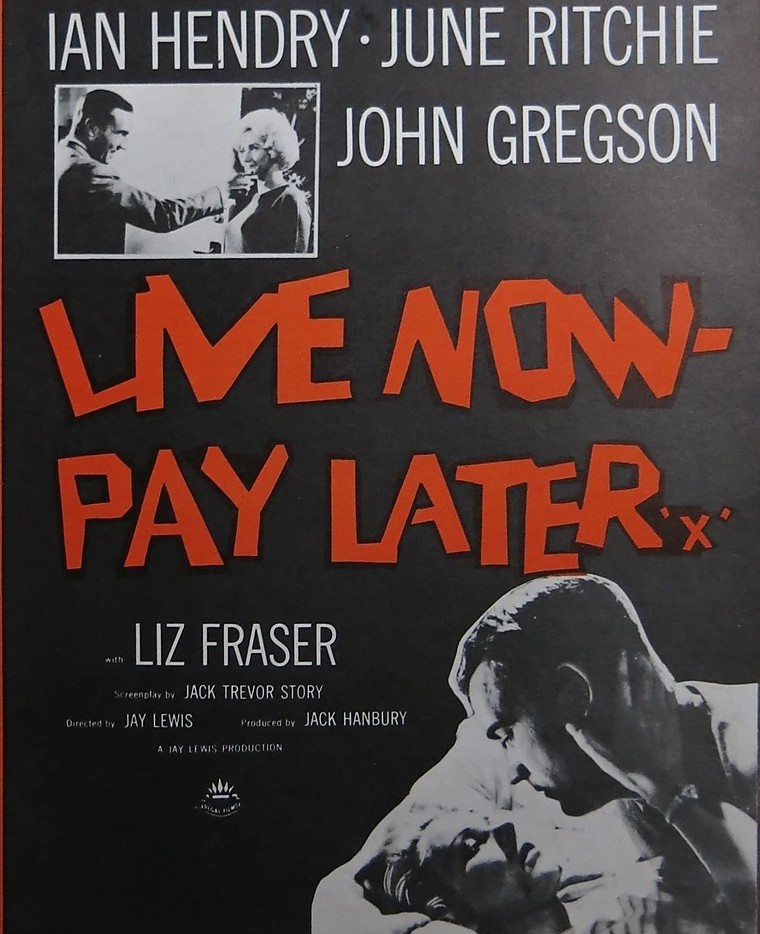
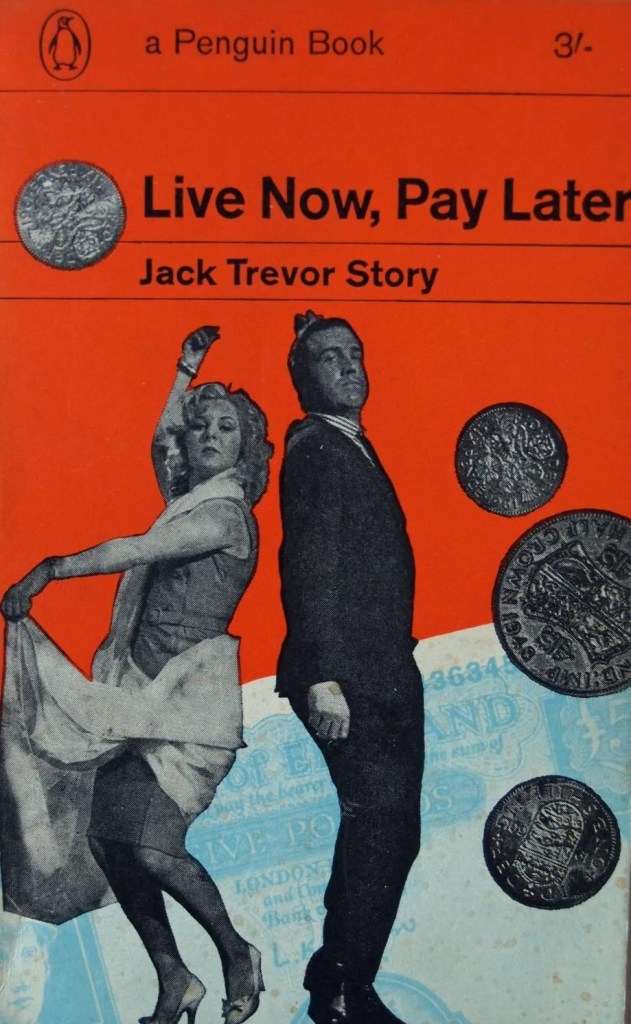
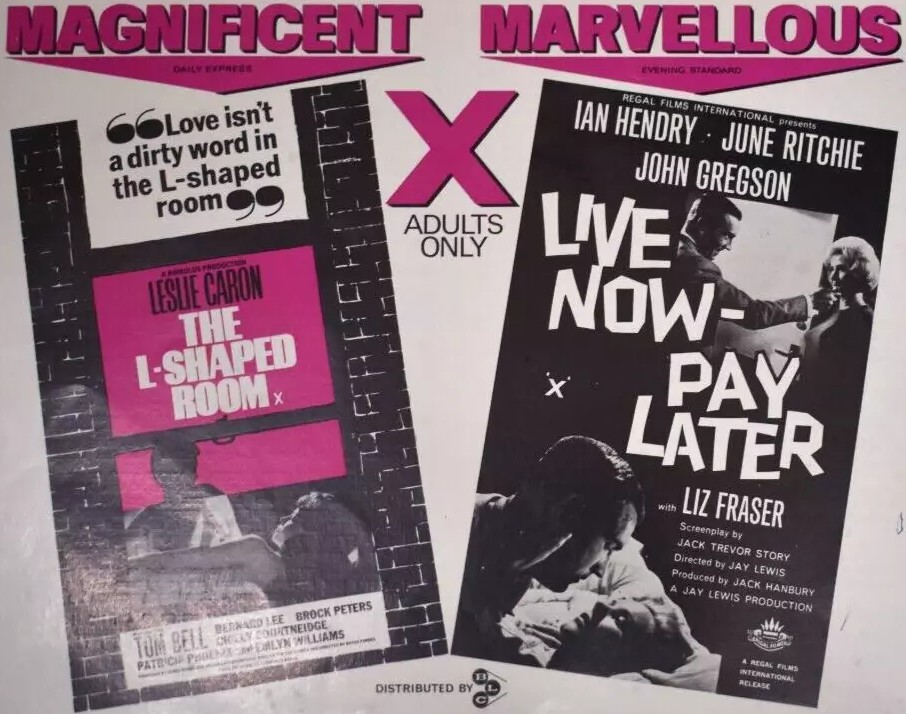
Live Now, Pay Later (1962) ***

Easy credit led to a boom in the standard of living but also created global recession after the sub-prime mortgage scandal. Back in the day you couldn’t borrow money except from a bank and they only lent to people with money. To get a mortgage you needed to prove you could save, you required at least a 10 per cent deposit before any bank would loan you money for a mortgage, and you needed to go through a stiff criteria test. Even then, you were at the mercy of inflation. If you were absolutely desperately you could go to money-lenders and pay back inflated sums, the notorious “vig” of the Mafia.

But then someone invented the notion of buying on credit from largely unlicensed brokers. You could live the dream – television, white goods, carpets, furnishings, a car – even if you couldn’t afford it and you didn’t have to go through any kind of procedure to qualify. Of course, you ended up paying two or three times the original price but the payments were spread over years so, theoretically at least, affordable. These days, credit cards lure people into the ease of purchasing and giving no thought to repayment. You don’t have to repay at all – or only a very small fraction – if you don’t mind your debt accruing exponentially.

In Britain it was called “hire purchase” or more colloquially the “never-never.” Nobody was called to account for selling goods to people who were inherently unable to afford it, were clearly incapable of managing money or, just as likely, were apt to get carried away.

While on the one hand this is one of the saddest movies you’ll ever see, lives crushed by debt, the tone is so mixed the reality gets lost in the characterization of the kind of chancer who would later be epitomized by the likes of Alfie (1965). But whereas the Michael Caine character has oodles of charm and eventually comes good, here equally charming  ace salesman Albert (Ian Hendry) never sees the error of his ways.

One of the dichotomies of the tale is that despite his earnings and his financial wheezes on the side Albert never has enough money to fund his lifestyle – snazzy sports car, great clothes – and lives in a squalid flat while ostensibly living the dream, string of women on the side. Like Werner Von Braun (I Aim at the Stars, 1960), he can’t face up to consequence much less take responsibility for his actions. But he’s not the only one using easy credit as a means of moving up in society, his boss Callendar (John Gregson) has taken up golf with a view to rubbing shoulders with estate agent Corby (Geoffrey Keen), whom he views as rising middle class without being aware that Corby also has unsustainable delusions of grandeur, hosting dinner parties for local politicians, ensuring his house is filled with desirable items.

Without doubt Albert is a superb salesman, adept at not only overcoming initial customer reluctance but persuading them to invest in far more than they ever dreamed. He is so good that his boss is more than willing to overlook his various pieces of chicanery.

But too often the comedy gets in the way. The idea that Albert can weasel his way out of any difficult situation – twice he dupes the man coming to repossess a car on which he has evaded payments for years – take advantage in unscrupulous fashion of any opportunity (he takes over an empty flat, steals the orders of rivals) and even offers advice on how to outwit, legally, bailiffs, sets him up as the kind of character (the little guy) who can defeat authority. But cheap laughs come at the expense of more serious purpose.

He leaves a trail of destroyed lives in his wake. He abandons his illegitimate daughter, fruit of a supposed long-term fling with Treasure (June Ritchie). One of his many married lovers, Joyce (Liz Fraser), wife of Corby, commits suicide – and he then proceeds to blackmail the husband. Albert’s boss is on the verge of losing out to a bigger rival.

For women, he is at his most dangerous when being kicked out, at his most persuasive and charming when trying to weasel his way in. He always finds some new woman and generally has a few on the go at the one time. The only time he appears to have any standards is when he walks away from one lover on discovering that her husband is a scoutmaster and therefore the seduction has required little skill.

But all Albert’s charm can’t disguise the brutality of debt. The arrival of the bailiffs strikes terror in hearts. A dream can turn to dust in an instant. Consequent shame unbearable. And there are no shortage of characters pointing out to Albert how heinous his actions are.

Ian Hendry (The Hill, 1965) captures the smooth-talking salesman. June Ritchie (The World Ten Times Over, 1963) has a meaty role as does Liz Fraser (The Family Way, 1966). John Gregson (The Frightened City, 1961) is unrecognizable while Geoffrey Keen (Born Free, 1966) essays the kind of grasping businessman that would become his forte. Nyree Dawn Porter (The Forsyte Saga, 1967) has a small part.

Directed somewhat unevenly by Jay Lewis (A Home of Your Own, 1964) from a script by Jack Trevor Story based on the bestseller by Jack Lindsay.

Prophetic.

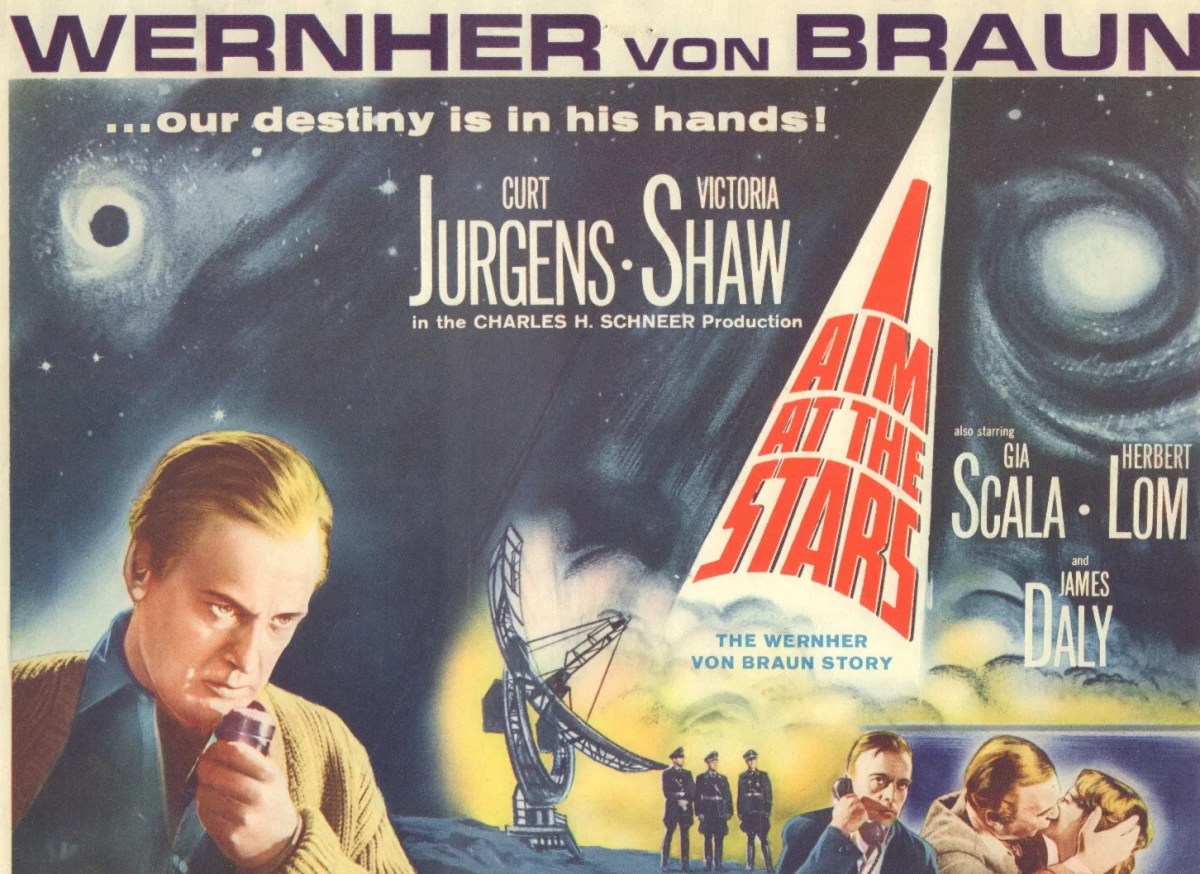
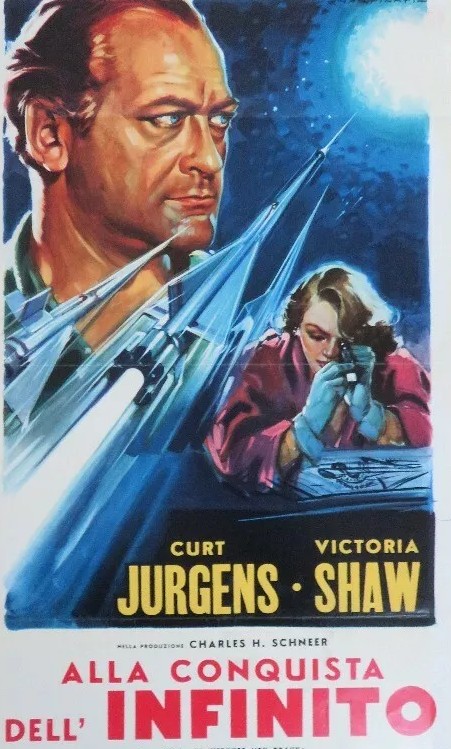
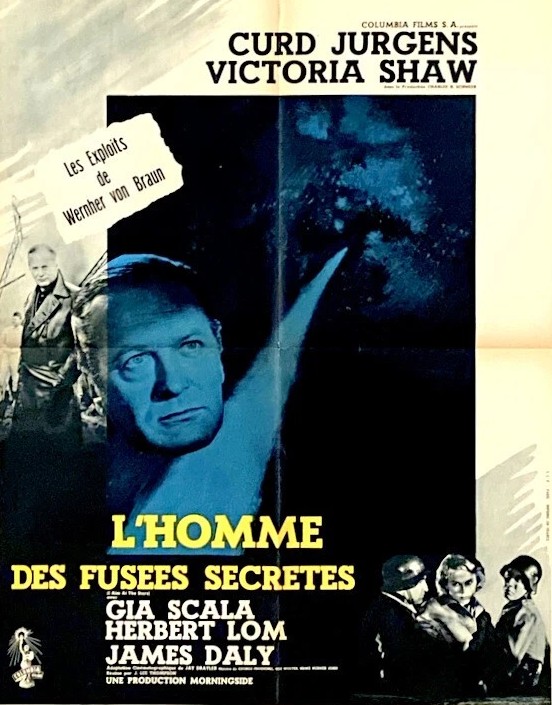
I Aim at the Stars (1960) ***

Could not be more controversial or contentious. But we’ve been here far more recently than six decades ago. Oppenheimer (2023) covered similar ground in terms of a scientist harnessing his brain to create a weapon of awesome destructive power. J. Robert  Oppenheimer was also condemned as a traitor and though he did not switch allegiance he was excluded from the nuclear community after the Second World War.

Director J. Lee Thompson (The Guns of Navarone, 1961) sets out to achieve the impossible – create a valid biopic while trying to deal with the central issue that while German Werner von Braun (Curd Jurgens) directed the U.S. operation to put an unmanned rocket into orbit around the Earth he was also responsible for the V1 and V2 rockets that devasted London towards the end of the Second World War.

The first half of the movie is straightforward biopic, genius scientist overcomes obstacles to reach his achievement. Von Braun was “addicted to rockets” from a very early age and when the Nazi Government sought to use his skills to create a missile, he didn’t show much opposition. Although occasionally indiscreet about Hitler and the Nazi Party, he was able to overlook their shortcomings in the interests of science.

What could have been a dry biopic is filled out with romance. Von Braun eventually finds time to marry Maria (Victoria Shaw) who occasionally has reservations about his aims. His assistant Anton (Herbert Lom) has a more interesting relationship with the widowed Elizabeth (Gia Scala), Von Braun’s secretary. While refusing to marry him, she does carry on a longish affair (whether sex was involved is unclear) with him and you are given the general impression that she is more in love with her boss.

But that turns out to be a clever piece of sleight-of-hand. The reason she spends so much time with Von Braun is that she’s a British spy, copying blueprints with an ingenious miniature camera disguised as a working lipstick. And when she is caught by Anton, he is too much in love to expose her, though her reason for the espionage is that the Germans by mistake killed her husband.

At the end of the war, Anton is the only one among the top scientists who refuses to desert his country. The others decide to become traitors, choosing to defect to the Americans rather than the Russians. And at this point Von Braun comes face to face with his “conscience” in the shape of U.S. Major Taggart (James Daly) who initially is determined to try Von Braun as a war criminal. When higher-ups in the U.S. Government intervene and send the scientists to America to continue their rocket research, Taggart continues his verbal assault on the German.

The spy also turns up and clearly her regard for Von Braun outweighs her conscience, although she enters, eventually, into a relationship with Taggart (who goes back to his former profession of journalist), and attempts to soften his attitude.

Von Braun refuses to take personal responsibility for the thousands of Londoners who died as the result of his invention. He represents the idea of invention without repercussion or personal consequence. But it’s fair to say that all the arguments against the man are given a good airing.

However, there’s a serious omission in the narrative. The conscience of the higher-ups never comes into it. Nobody in a senior position in Government explains why Von Braun deserved a get-out-of-jail-free card and never entering the discussion – not even in the sense of realpolitik – is the issue of how the British must have felt when their ally appropriated the skills of one of their most dangerous enemies.

Ultimately, the picture leaves too many questions unanswered with the American people seemingly eventually worshipping the man who put an American craft into space. The British shunned the picture on release.

Technically, it looks pretty good. I couldn’t really tell from seeing it on the small screen whether the rocket footage was taken from newsreel or academic footage or whether it was shot specifically for the movie.

As played by Curd Jurgens (Psyche 59, 1964) Von Braun is not an easy character to like. Though billed higher, Victoria Shaw (Alvarez Kelly, 1966) makes less of an impact than Gia Scala (The Guns of Navarone), who has the best role in the picture, while Herbert Lom (Bang! Bang! You’re Dead!, 1966) does good work as the patsy and loyalist. James Daly (The Big Bounce, 1969) is mostly the mouthpiece for all the accusations you’d like to fling at someone like Von Braun.

J. Lee Thompson does as well as you might expect within the restrictions of the material. Written by Jay Dratler (Laura, 1944) in his final screenplay.

Flawed but interesting.

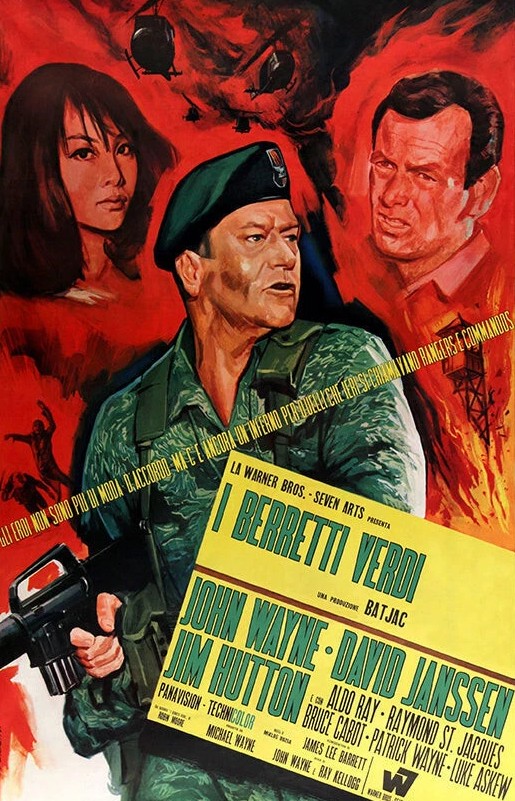
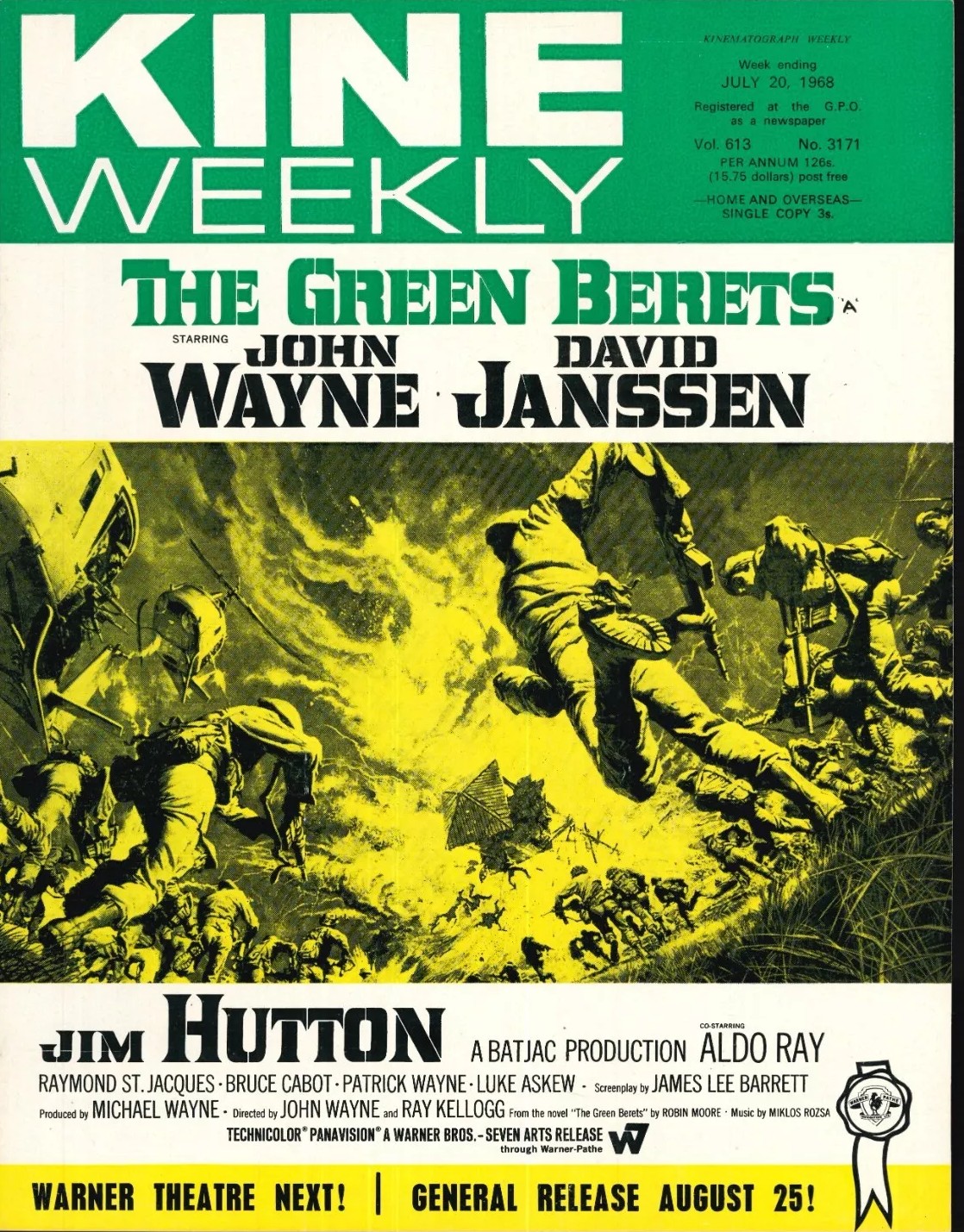
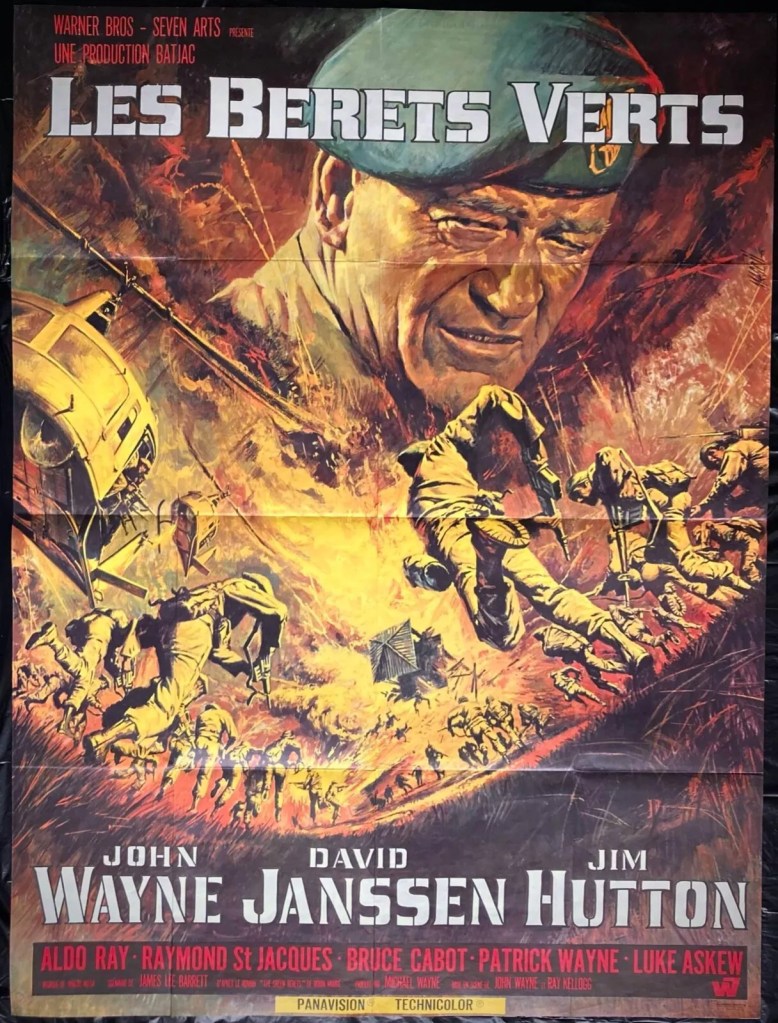
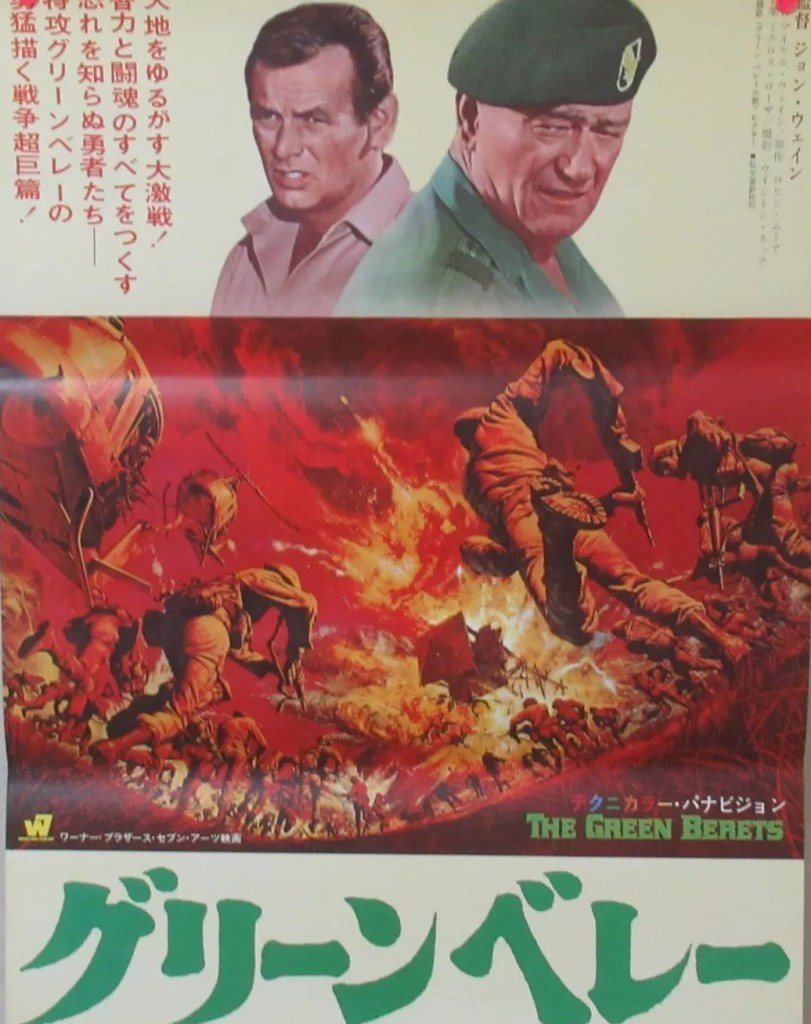
Behind the Scenes: “The Green Berets” (1968)

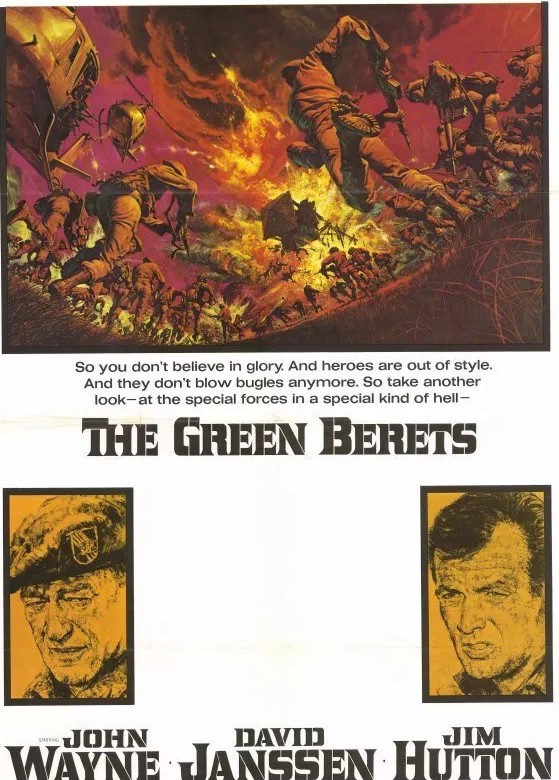
As if John Wayne hadn’t endured enough directing The Alamo (1960), he took on an even weightier task with this Vietnam War picture which, from the start, was likely to receive a critical roasting given the actor’s well-known stance on the conflict and his anti-Communist views that dated back to the McCarthy Era of the 1950s. Wayne had enjoyed a charmed life at the box office with three successive hit westerns, Henry Hathaway’s The Sons of Katie Elder (1965) with Dean Martin, Burt Kennedy’s The War Wagon (1967) co-starring Kirk Douglas, and best of all from a critical and commercial standpoint Howard Hawks El Dorado (1967) pairing Robert Mitchum. Outside of box office grosses, Wayne’s movies tended to be more profitable than his box office rivals because they were generally more inexpensive to make.

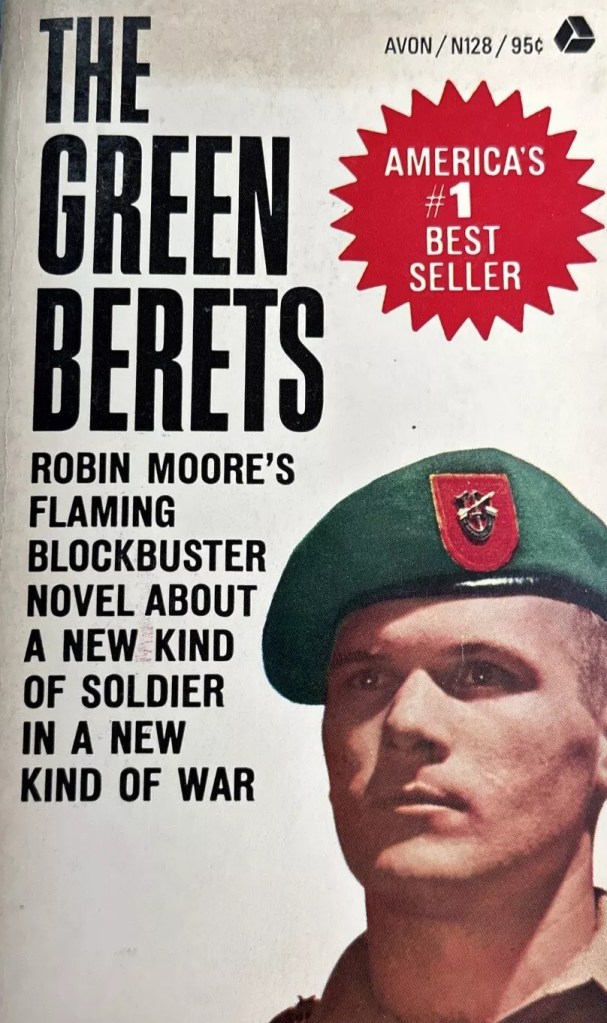
Columbia had been the first to recognize the potential of the book by Robin Moore and purchased the rights pre-publication in 1965 long before antipathy to the war reached its peak. A screenplay was commissioned from George Goodman who had served in the Special Forces the previous decade and was to to return to Vietnam on a research mission. But the studio couldn’t turn out a script that met the approval of the U.S. Army. Independent producer David Wolper (The Devil’s Brigade, 1968) was next to throw the dice but he couldn’t find the financing.

In 1966 Wayne took a trip to Vietnam and was impressed by what he saw. He bought the rights to the non-fiction book by Robin Moore (who also wrote The French Connection) for $35,000 plus a five per cent profit share. While the movie veered away in many places from the book, the honey trap and kidnapping of the general came from that source, although, ironically, that episode was entirely fictitious, originating in the mind of Robin Moore.

Universal originally agreed to back The Green Berets with filming scheduled for early 1967 but when it pulled out the project shifted to Warner Bros. And as if the director hadn’t learned his lesson from The Alamo, it was originally greenlit for a budget of $5.1 million, an amount that would prove signally inappropriate as the final count was $7 million. Wayne turned down the leading role in The Dirty Dozen (1967) to concentrate on this project. Wayne’s character was based on real-life Finnish Larry Thorne who had joined the Special Forces in Vietnam in 1963 and was reported missing in action in 1965 (his body was recovered four decades later).

As well as John Wayne, the movie was a platform for rising stars like Jim Hutton (Walk, Don’t Run, 1966), David Janssen (Warning Shot, 1967) and Luke Askew (Easy Rider, 1969) who replaced Bruce Dern. Howard Keel, who had appeared in The War Wagon, turned down a role.

Wayne holstered his normal $750,000 fee for acting plus $120,000 for directing. But it turned out The Alamo had taught him one important lesson – not to shoulder too much of the responsibility –  and Ray Kellogg for the modest sum of $40,000 was brought in as co-director. It was produced by Wayne’s production company, Batjac, now run by his son Michael. But neither Wayne nor Kellogg proved up to the task and concerned the movie was falling behind schedule and over budget the studio drafted in veteran director Mervyn Leroy – current remuneration $200,000 plus a percentage – whose over 40 years in the business ranged from gangster machine-gun fest Little Caesar (1931) to his most recent offering the Hitchcock-lite Moment to Moment (1966).

But exactly what LeRoy contributed over the next six months was open to question. Some reports had him directing all the scenes involving the star; others took the view that primarily he played the role of consultant, on set to offer advice. Even with his presence, the movie came in 18 days over schedule – 25 per cent longer than planned. Unlike the later Apocalypse Now (1979), it didn’t go anywhere near South-East Asia so the location didn’t add any of Coppola’s lush atmosphere, though the almost constant rain in Georgia, while a bugbear for the actors, helped authenticity.

It was filmed instead on five acres of Government land around Fort Benning, Georgia, hence pine forests rather than tropical trees.  President Lyndon B. Johnson and the Department of Defense offered full cooperation. But that was only after the producers complied with Army stipulations regarding the screenplay. James Lee Barratt’s script was altered to show the Vietnamese involved in defending the camp and the kidnapped was switched from being over the border. Also axed, though this time by the studio, was Wayne’s wish for a romantic element – the studio preferred more action. Sheree North (Madigan, 1968) was offered the role of Wayne’s wife but she also turned it down on political grounds. Vera Miles (The Hellfighters, 1968) was cast but she was edited out prior to release.

The Army provided UH-1 Huey helicopters, the Air Force chipped in with C-130 Hercules transports,  A-1 Skyraiders and the AC-47 Puff the Magic Dragon gunship and also the airplane that utilized the skyhook system. Actors and extras were kitted out in the correct jungle fatigues and uniforms. Making a cameo appearance was Col Welch, commander of the Army Airborne School at Ft Benning. The sequence of soldiers doing drill was actually airborne recruits.

The attack on the camp is based on the Battle of Nam Dong in 1964 when the defenders saw off a much bigger enemy unit.

This set was built on a hill inside Fort Benning. The authentic detail included barbed wire trenches and  punji sticks plus the use of mortar fire. While the camp was destroyed during filming the other villages were later used for training exercises. .

The pressure told on the Duke physically – he lost 15lb. But the oppressive heat and weather of that location – it was mostly shot in summer 1967 – was nothing compared to the reviews. It was slated by the critics with Wayne’s age for an active commander called into question, never mind the parachuting, the gung-ho heroics and the dalliance in an upmarket nightclub.

“In terms of Wayne’s directorial career,” wrote his biographer Scott Eyman, “The Alamo has many defenders, The Green Berets has none.” That assessment, of course, would be to ignore the moviegoers around the world who bought tickets and put the picture into reasonable profit.

Wayne was clear in his own mind about the kind of movie – “about good against bad”  – he was making and accommodated neither gray areas nor took note of current attitudes to the war as exemplified by nationwide demonstrations. Co-stars David Janssen, Jim Hutton and George Takei were opposed to the war. Takei, a regular on the Star Trek series, missed a third of the episodes on the second season; his lines were written to suit the character of Chekov, who went on to have a bigger role in the television series. Composer Elmer Bernstein turned down the gig as it went against his political beliefs. “The Ballad of the Green Berets,” heard over the opening credits was not composed for the film, having been released two years earlier.

Most critics hated it – “Truly monstrous ineptitude” (New York Times); “cliché-ridden throwback” (Hollywood Reporter); “immoral” (Glamour). Even those reviews that were mixed still came down hard: “rip-roaring Vietnam battle story…but certainly not an intellectual piece” (Motion Picture Exhibitor). Not that Wayne was too concerned. At the more vital place of judgement – the box office – it took in $9.5 million in rentals (what’s returned to the studios once cinemas have taken their cut) – $8.7 million on original release and a bit more in reissue – in the U.S. alone plus a good chunk overseas.

It was virtually impossible to examine a movie like this without taking a political stance. Other movies covering the same topic were allowed greater latitude regarding authenticity, audiences and critics like appearing to accept that creating watchable drama often took precedence over the facts. Both The Deer Hunter (1978) and Apocalypse Now, considered the best of this sub-genre, clearly ventured away from strict reality. With over half a century distancing the contemporary viewer from those inflammatory times, it’s worth noting that it still divides critics. Or, rather, critics and the general public take opposing views.

Although Rotten Tomatoes deems it “an exciting war film”, the critics voting on that  platform gave it a lowly 23 per cent favourable report compared to a generally positive 61 per cent from the ordinary viewer. That contrasts, for example, with a more even split for the likes of Exodus (1960) – 63 per cent from critics and 69 per cent from audiences. However, The Green Berets attracts twice as much interest, collaring 9,000 votes compared to just 4,300 for Exodus.

After this, Wayne’s fee went up to a flat million bucks a picture. “He wasn’t a guarantee of success,” explained his son Michael, “he was a guarantee against failure.” At this point in his career, he was gold-plated. Where other stars in his commercial league suffered the occasional box office lapse – Paul Newman’s career in the 1960s, for example, was riddled with flops like The Secret War of Harry Frigg (1968) – he did not. Especially with a global following, his pictures never lost money.

SOURCES: Michael Munn, John Wayne, The Man Behind the Myth, Robson, 2004; Scott Eyman, John Wayne, The Life and Legend, Simon and Schuster, 2014; Brian Hannan, The Magnificent 60s, The 100 Top Films at the Box Office, McFarland, 2023; Robin Moore, Introduction, The Green Berets, 1999 edition, Skyhorse Publishing; Laurence H. Suid, Guts and Glory, University of Lexington Press, 2002; The Making of The Green Berets, 2020; Review, Hollywood Reporter, June 17, 1968; Review, Motion Picture Exhibitor, June 19, 1968; Renata Adler, “The Absolute End of the ‘Romance of War’”, New York Times, June 30, 1968; Glamour, October 1968; “Big Rental Pictures of 1968,” Variety, January 8, 1969.

The Green Berets (1968) ***

Apart from attempts to justify the Vietnam War and a hot streak of sentimentality, a grimly realistic tale that doesn’t go in for the grandiosity or self-consciousnesss of the likes of Apocalypse Now (1979), The Deer Hunter (1978) and Platoon (1978). It’s been so long since I’ve watched this that my DVD is one of those where you had to turn the disc over in the middle.

The central action sequence is a kind of backs-to-the-wall Alamo or Rorke’s Drift siege. There’s no sense of triumphalism in the battle where the best you can say is that a reasonable chunk of the American soldiers came out alive but only after evacuating the staging post they were holding, more like Ridley Scott’s Black Hawk Down (2001) where survival is all there is to savor. It’s all pretty brutal stuff, the Americans handicapped by having to also look after the fleeing Vietnamese villagers taking refuge in their camp.

There are plenty grim reminders of how war has become even more devastating in the aftermath of World War Two. The Vietcong take, literally, no prisoners, seen as killing civilians as easily as soldiers. The Americans, for their part, have no compunction in using more sophisticated weaponry, with the addition of targeted air strikes.

Into the mix, somewhat unnecessarily, comes left-wing journo George (David Janssen) whose main job is to change his mind about the work the soldiers are doing, though admitting that to report the truth will lose him his position. He’s slung into the middle of a defensive action headed up by Col Kirby (John Wayne) to hold a position under threat against superior (in numbers) forces. There’s a fair bit of the detail of war but virtually zero about the strategy, whether that’s the U.S. Army’s plan to defeat the enemy or this individual unit’s method of defending this position. Apart from extending the perimeter of the camp to create a more effective killing zone, it’s hard to work out what the heck is going on, no matter how often orders are barked through field telephones or walkie talkies. There are squads out in the field and units in the camp and how the whole operation is meant to mesh is beyond me.

There’s not much time to flesh out the characters, save for “scrounger” Sgt Peterson (Jim Hutton) who adopts an orphan, Vietnamese soldier Capt Nim (George Takei) and Sgt Provo (Luke Askew). The rest of the motley bunch are the usual crew of monosyllabic tough guys and friendly medics and whatnot.

Though the emotional weight falls on Lin (Irene Tsu), fearing shame and being ostracized by her family for befriending the Vietcong general who killed her father and for whom she now lays a honeytrap, Kirby expresses guilt at having to kill anybody.

Despite being sent out to reinforce the position, the Americans are forced to retreat and enjoy only a Pyrrhic victory when the cavalry, in the shape of an airplane, arrives to mow down the enemy after they have captured the position.

The fighting is suitably savage, and there is certainly the notion that the Americans are not only being out-fought but out-thought and that no amount of heavy weaponry is going to win the day.

Possibly to prevent the idea of defeat destabilizing the audience, the movie shifts into a different gear, more the gung-ho commando raid picture that the British used to do so well, where Kirby heads up an infiltration team to capture the Vietcong general who has been seduced by Lin. This sets up a completely different imperative, all stealth and secrecy, the kind of operation that in the past would have been a whole movie in itself rather than the tag-end of one.

While the prime aim of this is to have the audience leave the cinema happier than if they had just witnessed the retreat from the camp, in fact it also serves two purposes. One is worthwhile, to emphasize the sacrifices made by the Vietnamese. Lin, having agreed to prostitute herself, fears being cast out as a result. But the other outcome of this mission is to kill off Sgt Peterson thus leaving the little Vietnamese lad even more orphaned than before.

John Wayne (The Sons of Katie Elder, 1965) doesn’t attempt to gloss over the weariness of his character. Jim Hutton (Walk, Don’t Run, 1966) shifts with surprising ease from comedy to drama. Even as a cliché David Janssen (Warning Shot, 1966) is underused. Watch out for Aldo Ray (The Power, 1968), George Takei (original Star Trek series), Raymond St Jacques (Uptight, 1968), Luke Askew (Flareup, 1969) and Irene Tsu (Caprice, 1967).

Three hands were involved in the direction: John Wayne, veteran Mervyn Leroy (Moment to Moment, 1966) and Ray Kellogg (My Dog, Buddy, 1960). Written by James Lee Barrett (Bandolero!, 1968) from the book by Robin Moore. Worth pointing out the score by triple Oscar-winner Miklos Rosza (The Power, 1968) especially the low notes he hits to provide brooding tension.     

Certainly a mixed bag, the central superb action sequence weighted down by the need to find something to shout about.

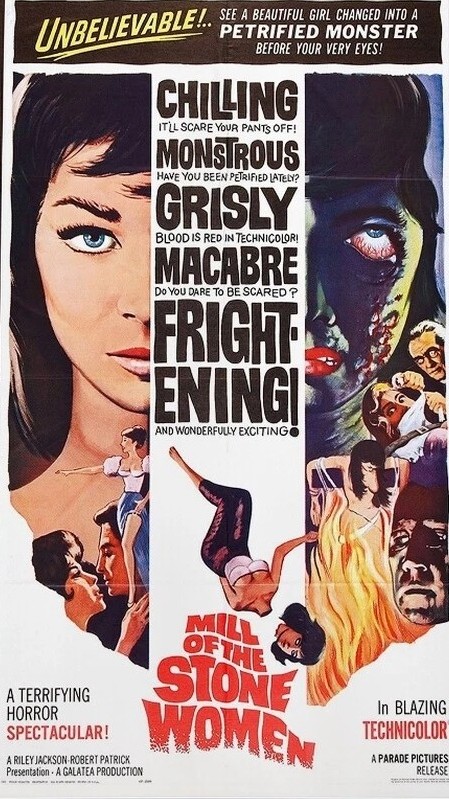
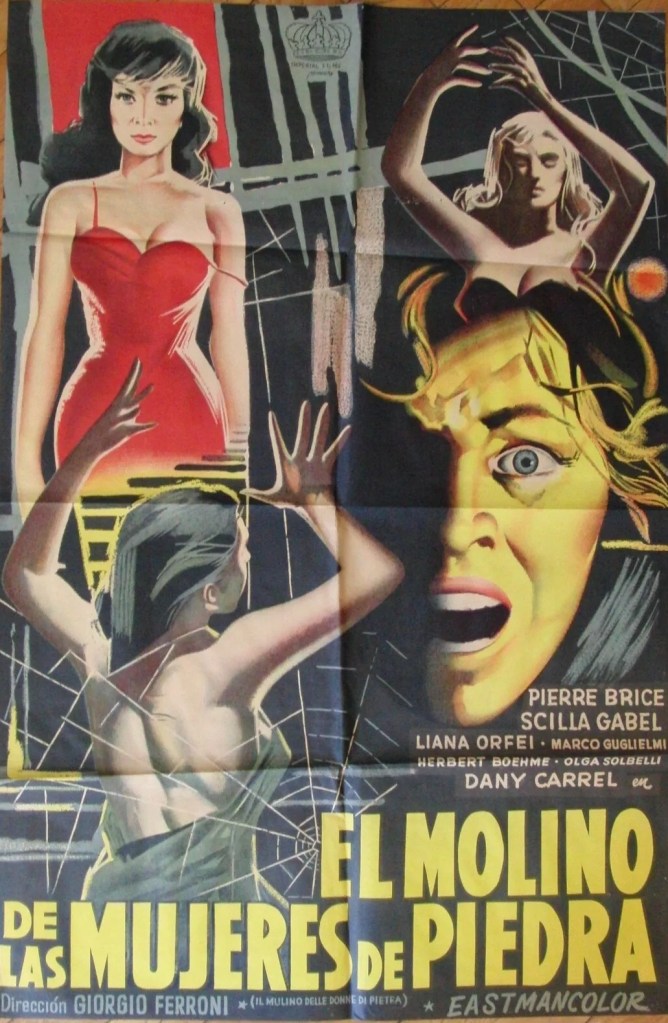
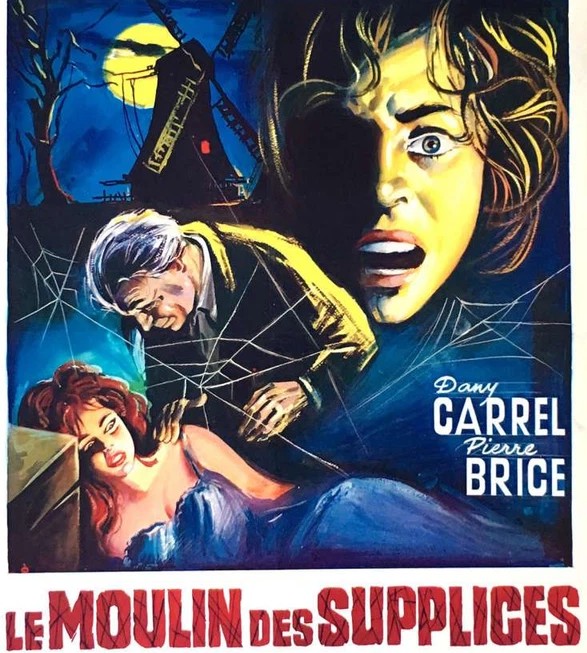
Mill of the Stone Women (1960) ****

Character has generally been replaced by gore or slaughter in the modern horror film. Ever since Hammer ruled the roost, blood-letting has assumed greater and greater significance, and ever since The Exorcist (1973) the genre has traded on shock values. Current box office sensation Sinners (2025) has gone some of the way to re-aligning the balance with its emphasis on character and thematic symmetry.

So it’s somewhat reassuring to discover that prior to those developments there could be an absolute chiller of a tale where nonetheless character, and not just for the two principals, was all. I should tell you right away that there is a vampiric element in the drawing of blood but that is carried out in the more refined scientific manner of medical blood transfusion. And the undead do rise again, just to get that story point out of the way, but it’s not because an evil count refuses to be put to sleep, but out of a father’s love for his daughter.

Quite the most fearful element here is the preponderance of unrequited love. The man whose medical skills saves a woman’s life is rejected by her, she in turn is ultimately rejected by an unforeseen suitor while he, in turn, for a time turns his back on his long-term girlfriend. The father also shows he has little loyalty to the man who deserves that most of all.

But let’s start at the beginning. In nineteenth century Holland, land of canals and dykes you will recall,  student Hans (Pierre Brice) arrives at the watermill owned by Professor Wahl (Herbert Bohme) to write a report on the macabre carousel he has devised, a feat of engineering running on levers and gears and wheels, that present a “theater of death” populated by very lifelike inanimate statues. While there, he espies a beautiful woman.

Hans’s girlfriend Liselotte (Dany Carrel) is immediately jealous and unsure whether he loves her as much as she, a childhood friend, loves him. Back at the mill, Hans encounters smug Dr Bohlem (Wolfgang Preiss) who is on constant call to look after the professor’s very ill daughter Elfie (Scilla Gabel), the aforementioned beauty.

Although for mysterious reasons Elfie’s life depends on the doctor’s ministrations she rejects his overtures with haughty disdain. Meanwhile, she seduces Hans. Although initially smitten, Hans soon realizes the error of his ways. But Elfie, who it turns out has seduced many male visitors, becomes obsessed with him. Before he can break off their relationship, she collapses and dies.

Hans is accused of murdering the girl. Out of his wits, he’s sedated by the doctor and when he wakes up is convinced he has seen Elfie alive and another woman trapped in a room. He is persuaded by the professor and the doctor that he is going mad and he flees the mill, in theory never to return. The professor and doctor have kidnapped local girl Annelore (Liana Orfei), sometime life class model and chanteuse, and revive Elfie via a blood transfusion from the captive. The pair don’t need to get rid of the body, the professor transforming it into one of his very lifelike sculptures by covering it in wax.

Liselotte’s jealousy evaporates when she has Hans all to herself, nursing him back to health, and he asks her to marry him. Though nagged by his visions, he manages to dismiss them until he sees a photo of Annelore, whom he previously never met, and whom he glimpsed tied up in the mill.

Meanwhile, the doctor has discovered a serum by which Elfie can live a proper life, and it only requires one final transfusion. To that end he’s kidnapped Liselotte. But the doctor is determined to extract a price. Knowing that Elfie will no longer be dependent on him, he demands her hand in marriage. Despite what she owes him, she still, as high-and-mighty as before, rejects him. Using the same argument, the doctor appeals to the professor who is even more outraged at the idea, given the doctor was thrown out of his profession for malpractice and is an ex-convict.

The professor is even less grateful than his daughter and kills the doctor. Having witnessed the transfusion so many times, he begins to carry it out himself. But at the critical moment, he can’t find the serum. And it’s gone. When the doctor fell, the bottle of serum in his pocket smashed.

Hans rescues his fiancé while the mill burns to the ground, the wax melting from the sculptures betraying the skeletons underneath.

Most of the horror is left to audience imagination. There’s no gore, no throats slashed, very little blood, not even a scream. It’s the most discreet horror picture you’ll ever see and all the more effective for it. We probably didn’t need the scene of the conspirators gloating and giving away their evil plan but otherwise it works a treat.

All the characters are given clear identities, father and daughter gripped by obsession, doctor by the delusion of marriage as reward, Hans wayward in his affections but sensible enough to recognize stifling love when he sees it, and even Liselotte is best defined as overly jealous.

It’s handsomely mounted too, and the mill interiors have all the eerie trappings of the normal castle. Pierre Brice (Old Shatterhand, 1963) and Scilla Gabel (Sodom and Gomorrah, 1962) are given license to overact, and while Dany Carrel (Delphine, 1969) works through gritted teeth, Wolfgang Preiss (The Train, 1964) and Herbert Bohme (Secret of the Red Orchid, 1962) are the epitome of the cultured villain.

Unable to call upon a vast cauldron of blood to splatter, this is a more intelligent horror picture, directed with measured cadence by Giorgio Ferroni (The Lion of Thebes, 1964) from a script by the director, Ugo Liberatore (The Hellbenders, 1967) and Giorgio Stegani (Death on the Fourposter, 1964).

Rewarding watch.

Discover WordPress

A daily selection of the best content published on WordPress, collected for you by humans who love to read.

The Atavist Magazine

by Brian Hannan

WordPress.com News

The latest news on WordPress.com and the WordPress community.