Behind the Scenes: “La Dolce Vita” (1961) – Part Two – The Crossover King

La Dolce Vita opened in New York and Boston the same day – April 19, 1961 – and smashed the first day record in both cinemas. And the weekly record. In truth, given the hype, and the increased ticket prices, that was no surprise. But whereas La Dolce Vita made $16,000 in its first week in New York and $35,000 in Boston, Mein Kampf made $87,000 in New York. In the 1960s, movies lasted in cinemas far longer than they do now. And that kind of longevity cannot be maintained by advertising alone. The two most powerful tools in giving a film ‘legs’ were word-of-mouth and the critics, who could make or break a movie in a way that is impossible these days.

Reviews were superlative. ‘Awesome but moral,’ commented the New York Times. ‘Brilliant’, ‘outstanding’, ‘a masterpiece’, seemed to be the consensus. Another powerful opinion-maker, in that it was her business to put her money where her mouth was, Helen Thompson, bought out 25 complete shows for her Play-of-the-Month club. There were sell-out performances in New York and Boston, but would the rest of the country fall in line?
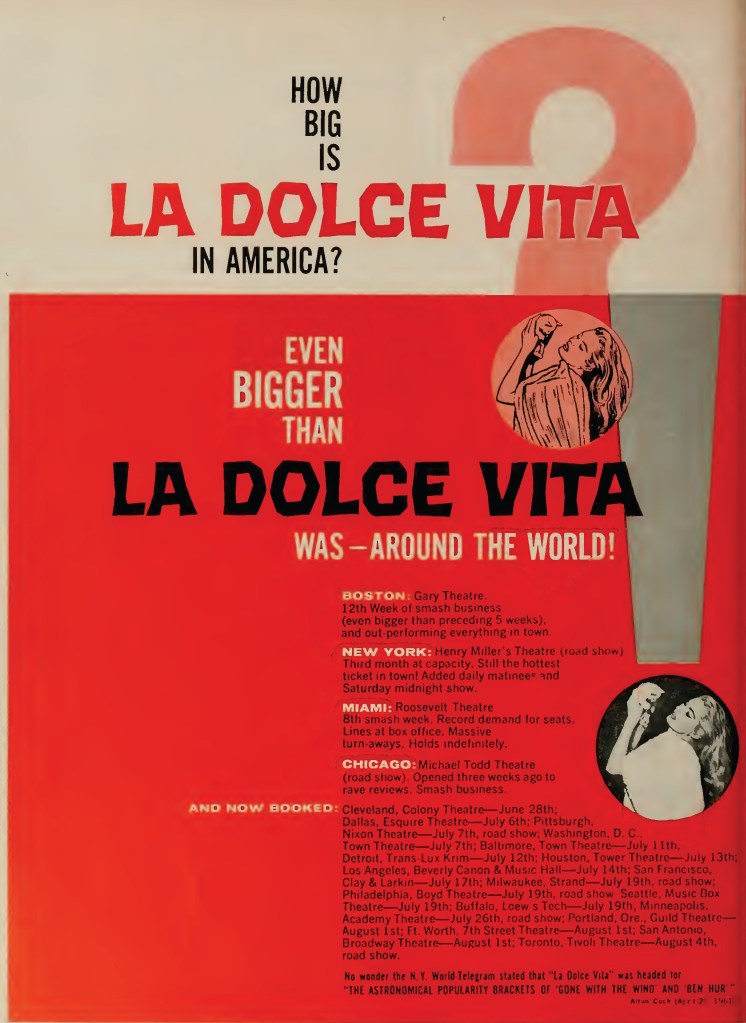
In an attempt to create a bidding war, Astor screened the movie for 25 cinema owners from the big cities. The Todd Theatre in Chicago was chosen as the next venue, also as a roadshow, but that was for a limited period only and when it moved onto continuous performances (called ‘grind’), it set a new high for ticket prices – $2.50 compared to the previous record of $1.80. In Los Angeles, Herbert Rosenor, owner of two arthouses, guaranteed $75,000 and an eight-week minimum run.

Despite breaking so many rules in the launching of La Dolce Vita, there was one rule that remained sacrosanct.

In the 1960s, delay, which in turn created heightened anticipation, was a powerful marketing tool. It was used by the major studios to build demand for their roadshows. So it did no harm that the rest of America had to wait for La Dolce Vita.

It took three months for the film to reach Los Angeles. On arrival it shattered all records, taking in upwards of $30,000 between the two cinemas. And its first weeks elsewhere that July achieved similar results – $17,000 in Pittsburgh, $14,000 in Baltimore, $26,000 in Detroit. Astoundingly, it was keeping pace with the year’s biggest blockbuster The Guns of Navarone. In its 25th week at the Henry Miller Theatre, La Dolce Vita registered $25,000 while The Guns of Navarone in its 6th week at two cinemas took a combined $66,000. In the first week of both films in San Francisco, the war film made off with $32,000 at one 1,400-seater while the art film scrambled £28,000 at two 400-seat cinemas, and both had the same top price of $2.

In Baltimore, the second week of La Dolce Vita beat the second week of The Guns of Navarone. In the weekly national box office chart compiled by Variety, which covered the 24 US major cities, La Dolce Vita notched up fifth position. By August it was fourth and then third. 

Ancillary marketing helped. RCA issued the soundtrack album, which included the sensuous theme as well as Rota’s adaptations in the movie of standards like “Yes, Sir, That’s My Baby” and “Jingle Bells.” While the album reached the lower echelons of the Top 50 album charts for  several weeks, which, for an arthouse film would be considered an excellent result, it was overshadowed by its biggest competitor Never on Sunday, which spent over a year there, reaching the top five. Ballantine publishers brought out a paperback of the screenplay with 200 stills.

Controversy was milked when Atlanta threatened to boycott the movie and the Los Angeles Times censored an advert, blacking out most of a prostrate girl with her hands on her breasts. Clubs began springing up calling themselves La Dolce Vita. Archbishop William Scully launched a campaign to prevent its showing in Albany. ‘Pass this one up for the good of you soul,’ he intoned. Getting equal press attention was a review in The Presbyterian Life which called it  ‘a highly moral movie.’ The media latched onto news reports that the tossing of coins into the Trevi Fountain in Rome had trebled.

To prove it was not a one-hit wonder, in July Astor launched its follow-up movie, another Italian film, Rocco and His Brothers, directed by Luchino Visconti. This had been a  box office sensation in Italy, earning over $625,000 in its first year, and the rights had cost $325,000.

Astor had made three versions – subtitled and dubbed versions of the full 175-minute film and an edited 145-minute dubbed one. Now that Astor was a proven success, cinemas opened up to them and it was able, this time, to launch the Visconti film on two cinemas, the Beekman and the Pix. The film was launched on June and broke records at both cinemas, with $15,000 at the Beekman. Using a promotional technique borrowed from La Dolce Vita, to coincide with the launch the company released a single, “The Ballad Of Rocco”, even when there was no such song in the movie, following up with the original soundtrack, by Nino Rota, in August. 

With other backers from Italy and France, it was financially involved in a planned remake of the Hedy Lamarr 1930s sensation Ecstasy and was in negotiation with the new pretenders to the Italian artistic throne, Michelangelo Antonioni and Luchino Visconti.

Astor purchased India by Robert Rossellini and, as if not wishing to lose trace its roots, The State Department Murders and were hoping to conclude a deal with Russell Hayden for three pictures. Having been pipped by Joe Levine to Boccaccia 70, a compendium of short films directed by Fellini, Visconti, De Sica and Mario Monicelli and starring Loren and Ekberg, Astor turned towards the French New Wave.

George Foley snapped up Roger Vadim’s Les Liaisons Dangereuses, so controversial no other distributor had gone near it since its launch in September 1959, Alain Resnais’ Last Year at Marienbad and the new film from Francois Truffaut, hot after Breathless and 400 Blows, Shoot the Pianist. The company moved into prestigious offices in Madison Avenue and recruited more staff including Douglas Netter who joined as international president from Samuel Goldwyn’s head office. Soon it would set up a literary department, its first purchase The Only Reason by Tereska Torres, which, since it was set in Paris, was being proposed as a future project for Vadim.  Confidently mapping out the company’s direction, Foley said, ‘In coming years we foresee co-productions in every major picture-producing locale where satisfactory projects can be created.’

Gradually, Astor achieved its ambition of expanding La Dolce Vita beyond its core audience in the big cities. Mastroianni embarked on a 28-city promotional tour. On October, a double-page advert in Variety announced: ‘All over American cities and towns, theatres that have never played a subtitled picture before are doing terrific business with La Dolce Vita.’

The advert listed cinemas in previously unimaginable locations for an art film such as Little Rock and Hot Springs, Arkansas, Wilmington in Delaware, Macon in Georgia, and Dodge City in Kansas. In all, 162 cinemas had shown the film including nine roadshows, all still running, and nine modified roadshows. The top roadshow run was in New York (27 weeks).  The roadshows totalled 121 weeks including stints in Chicago, Miami, Philadelphia,  Milwaukee, Minnesota, Toronto (US grosses always include Canada), New Jersey and  Vancouver. Astor had bookings for another 134 cinemas.

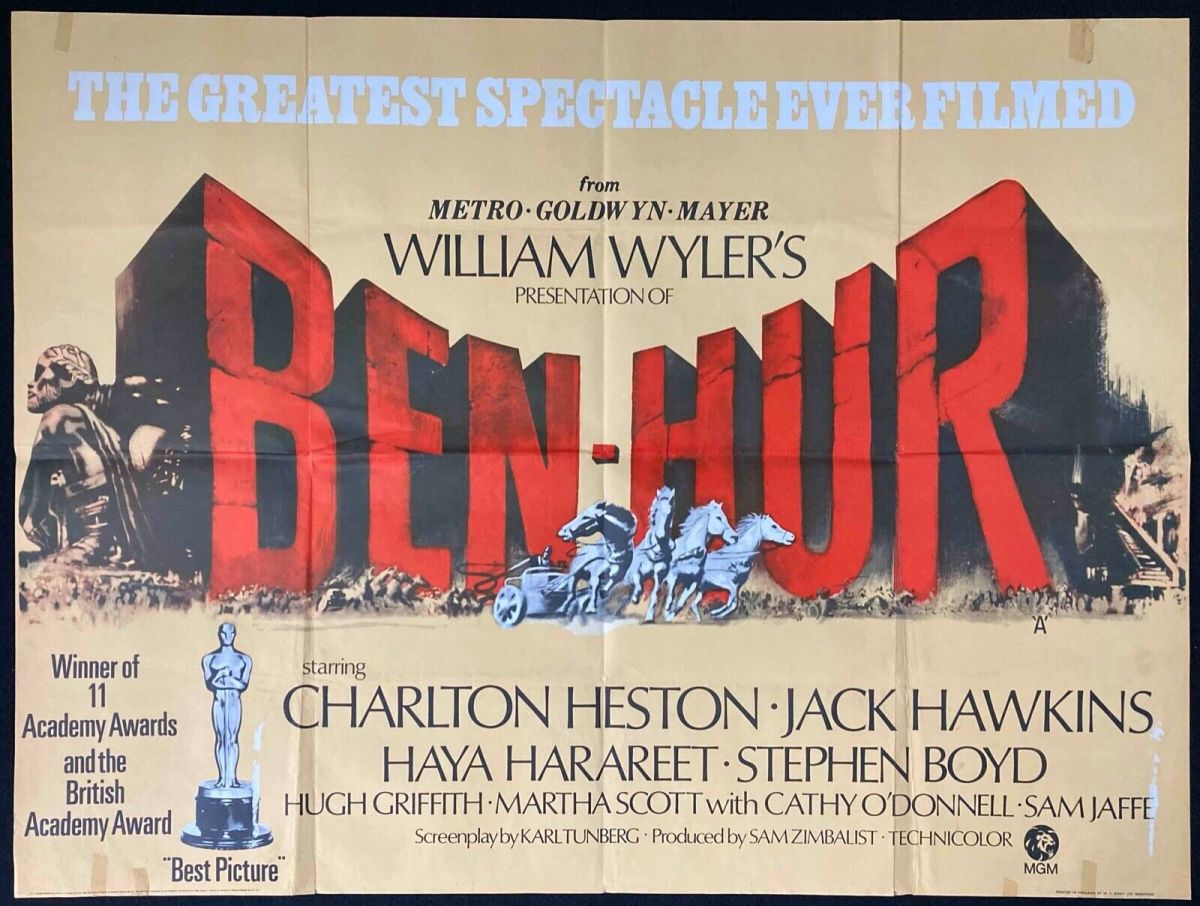
Towards the end of the year, it started moving into neighborhood theatres where, at lower prices (called ‘popscale’), it played extended runs. In London, after ending its run at the Curzon, La Dolce Vita transferred to the Berkeley where it ran for another 20 weeks, and then went on national release through the National Circuit cinema chain. Its 34th and final week, in December, at the Henry Miller Theatre generated $10,000. In Italy, it was bracketed with Ben Hur as the top film of the 1960-61 season, beating the Hollywood epic in several cities including Milan.

When all the US figures were in, La Dolce Vita proved the most successful gamble of the year, the three-hour arthouse epic turning into a massive mainstream hit well beyond even the most optimistic expectations of the ambitious Astor, taking in an astonishing $9m (gross not rental).

It ranked 12th  on the 1961 box office chart, above other big-risk movies like One Eyed Jacks and Cimarron. It finished ahead of Paul Newman in The Hustler, Audrey Hepburn in Breakfast at Tiffany’s, John Wayne in North To Alaska, Elvis Presley in Blue Hawaii, Never On Sunday and Mein Kampf. In that nationwide list, The Guns of Navarone came top, with The Alamo 5th and The World of Suzie Wong 8th. But in the placings for Los Angeles, La Dolce Vita came 5th, beating all three. Of course, the cognoscenti claimed it was a fluke.  But the simple riposte to that was that every hit film was a fluke, otherwise the supposedly wiser Hollywood heads who had committed millions in One Eyed Jacks and The Alamo would have been left celebrating, rather than ruing, their investment.

Come the year end, La Dolce Vita was on every critics top ten list, if not the film of the year. It was named best film by the National Board of Review and the New York Film Critics Circle. It should have been a shoo-in for the best foreign film Oscar. In fact, it was not put forward, as the nomination was done by the Italian government, which believed, bizarrely that La Dolce Vita had won too many awards, and it was someone else’s turn.   

Everyone involved, however peripherally, in La Dolce Vita wanted to build on its  success. Columbia, for example, released La Verite starring Brigitte Bardot in the same Columbia/Curzon duet in London but its first week had brought in only a combined $13,500. But Omat soon faded from the marketplace. Other majors like 20th Century Fox were inspired to invest in European films, most notably The Condemned of Altona, starring Loren, and Luchino Visconti’s The Leopard starring Burt Lancaster.

Meanwhile, Embassy had not conceded defeat on the arthouse front. Joe Levine knew only too well, from his success with Hercules, how to parlay an investment in a foreign film into gold at the American box office. And it was clear to him that Astor had copied his marketing techniques to turn La Dolce Vita into an enormous success.

So he cast around for another foreign film. He found it in De Sica’s Two Women. This toplined Sophia Loren who had the added benefit of already being a marquee name in the US, having starred with top names like Alan Ladd in Boy on a Dolphin, Frank Sinatra in The Pride and The Passion, John Wayne in Legend of The Lost, William Holden in The Key, and  more recently, Houseboat (which, incidentally, produced another hit single) with Cary Grant.

Noting the success of the English-language Never On Sunday, Embassy was canny enough to make a dubbed version of this film. Of course, for the sake of appearances, a subtitled version was also available, but, inevitably, the bulk of cinema owners, especially outside the big cities, opted for the dubbed version. When Sophia Loren was nominated for the Best Actress Oscar in spring 1962, Levine capitalised on the publicity. She was far from being the favorite. She was the unexpected victor and, naturally, her win boosted bookings and, by association, conferred on Levine the mainstream recognition he craved.

Boccaccio 70 produced another fierce bidding war, this time just between Astor and Embassy. Levine was determined not to lose another prized asset. Again, Levine broke the rules, and on the strength of the directors and stars, pre-sold the movie to distributors in various countries. By the time the film opened, he reckoned he would have already broken even, before he received his share of the profits.

His boldness reached new levels. The four directors in the film had each made a segment that last one hour. He toyed with the option of releasing the movie in two parts. In the end, he simply chopped out the least well-known director Mario Monicelli, leaving him with a three-hour movie. Not only did he intend to present Boccaccio 70 as a roadshow, but it would have two intermissions instead of one, so that each section would be seen afresh.

His new-look company also had two films by Swedish director Ingmar Bergman, who had just won the Best Foreign Film Oscar for Through the Glass Darkly, lined up for distribution and Il Bel Antonio starring Claudia Cardinale and Mastroianni. Already involved, with various partners, in the production of Italian movies, he now had American movies in development. In total, he had committed nearly $10m to Sodom and Gomorrah, Boccaccio 70, The Wonders of Aladdin and Boys Night Out, for which he was paying star Kim Novak $500,000. In addition, he was planning a big budget roadshow film about the San Francisco earthquake plus psychological thriller Whatever Happened to Baby Jane (he pulled out of this after a row with director Robert Aldrich) and The Carpetbaggers (made for Paramount).

Every bit as bullish as Astor, he announced, ‘I want theater owners all over the world to know this is the kind of schedule they can expect from me.’

Until now the director had been the prime tool for marketing arthouse films, but La Dolce Vita and Never On Sunday threw up, for the first time, actors, in the shape of Mastroianni and Melina Mercouri, as dependable marquee names. They became ‘bankable’ names for European producers looking for a guarantee of selling their films to an American audience. Mastroianni appeared in most of the films by the big Italian directors while Mercouri was absorbed into the mainstream in films like The Victors and Topkapi. Fellini, of course, now the biggest box office draw in foreign films, could more or less write his own ticket. He was in talks to make his first American movie, but not with Astor. Instead, he opened negotiations with the Mirisch Brothers, who were known for entering into deals that actors and directors found profitable. 

Part Three tomorrow.

SOURCES: Brian Hannan, La Dolce Vita and the American Box Office Bust-Out (Baroliant, 2018) ; “Brian Hannan Revisits La Dolce Vita,” Cinema Retro, No 33.
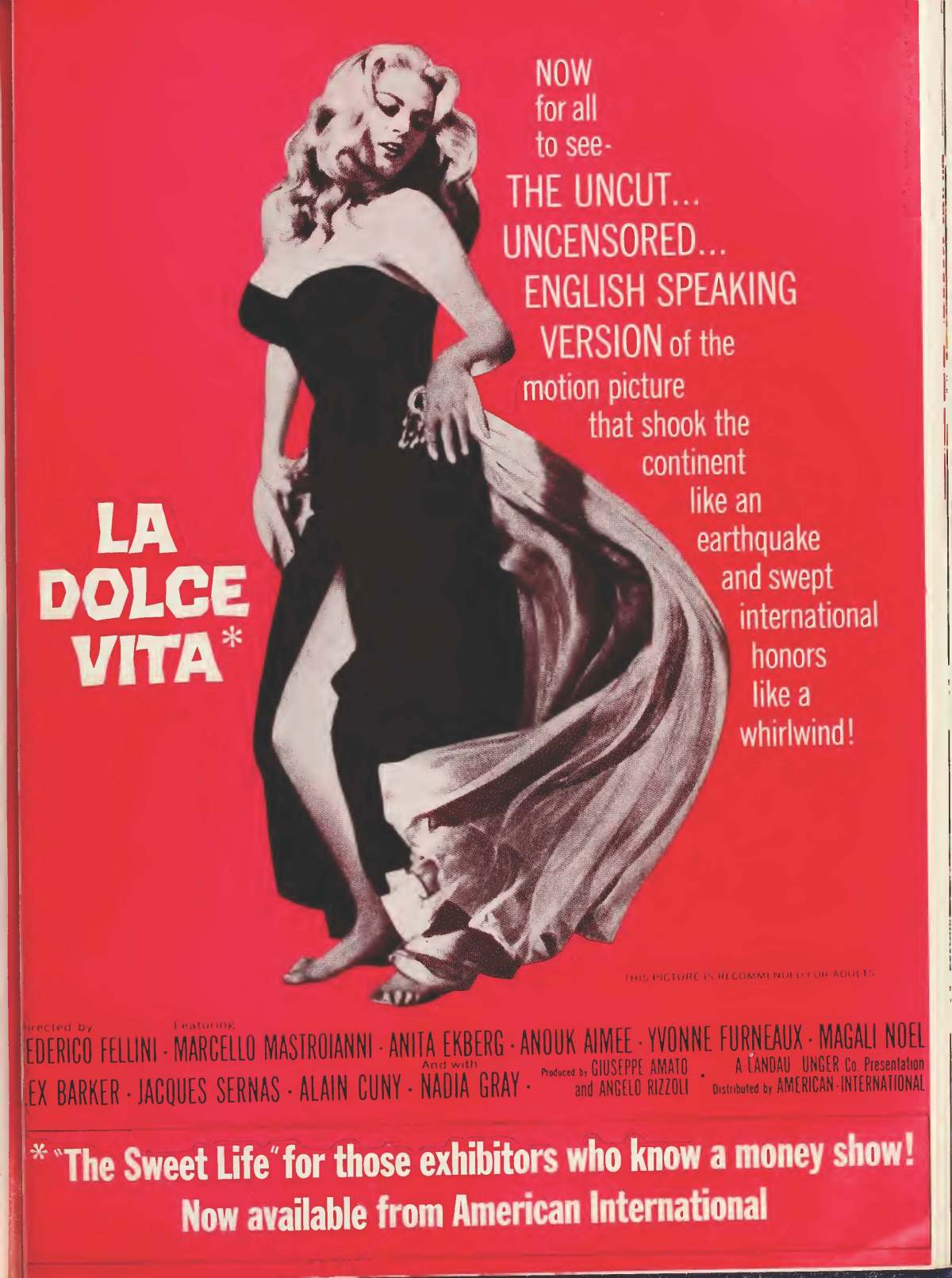
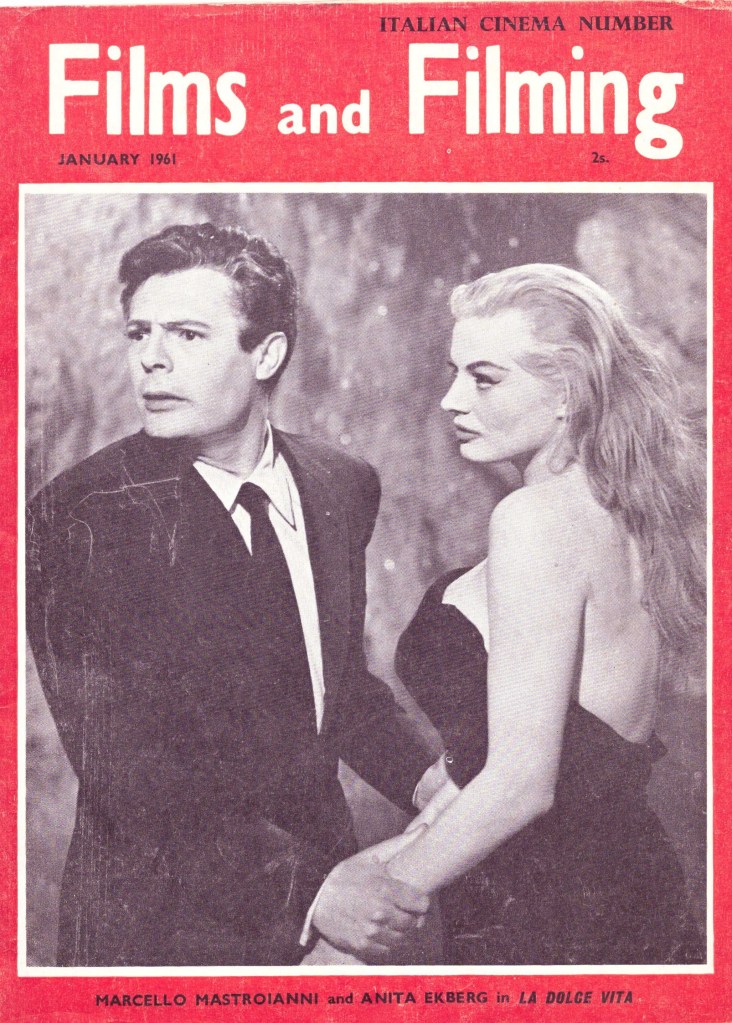
Behind the Scenes – La Dolce Vita (1961) – The Biggest Roadshow Gamble Of All Time

In 1961, Hollywood was a casino. The advent of the roadshow and the lure of repeating the big-budget successes of Ben Hur (1959), Around The World In 80 Days (1958), Bridge On The River Kwai (1957) and The Ten Commandments (1956) had seen every studio sink colossal sums on the roll of the box office dice. United Artists had lavished $4m on three-hour epic Exodus about the formation of Israel with a star Paul Newman who had no blockbusters to his name. Columbia had sanctioned an even bigger budget, $5m, for war film The Guns Of Navarone.

Two studios were backing the directorial debuts of two major stars whose inexperience had seen both budgets soar. United Artists was part-funding John Wayne’s The Alamo while Paramount had too much riding on Marlon Brando’s western One-Eyed Jacks. MGM had a roadshow re-make of the 1931 Oscar-winner Cimarron with Glenn Ford and unknown Maria Schell in the leads. Even Disney had been tempted into the big-budget arena with Swiss Family Robinson, its most expensive live action movie.

None of these represented the biggest gamble of the year.

That honour, or should it be folly, went to the three small distributors bidding the unheard-of sum of $500,000 (the equivalent of $5m now) for the US rights for a three-hour Italian black-and-white Italian arthouse film, La Dolce Vita, directed by Federico Fellini.  Despite the success in America in the 1950s of films like the Japanese Seven Samurai and Fellini’s previous La Strada and the current vogue for Swedish director Ingmar Bergman (The Seventh Seal) and the French New Wave, the marketplace for arthouse movies was tiny.

For marketing, arthouse exhibitors depended on movies winning prizes at film festivals or being directed by someone who had previously won such a prize. In the past decade only a handful had ever made $1m. Even the most successful of the recent spate of British films, classed as imports, such as Room at the Top, driven by massive publicity from its Oscar nominations and wins, had barely hit the $2m mark. The most successful foreign-language art movie had been Roger Vadim’s And God Created Woman, which had grossed $7.5m. But that had starred Brigitte Bardot in a state of some undress.

Fellini was certainly a solid arthouse marquee name, having been awarded the Oscar for Best Foreign Film in successive years for La Strada (1956) and Nights of Cabiria (1957). In this he had matched the director credited with Italy’s post-war movie renaissance, Vittorio De Sica, who had also won Honorary Oscars (predating the Foreign Film category) for Shoeshine (1946) and Bicycle Thieves (1948). But Fellini was also aligned with the wider European New Wave, in 1958 forming a loose partnership with French directors Jacques Tati (M Hulot’s Holiday) and Robert Bresson (Diary of a Country Priest). Tati had his own company and had already invested in Bresson’s Lancelot du Lac and there had been talk of Fellini directing Tati in Don Quixote.

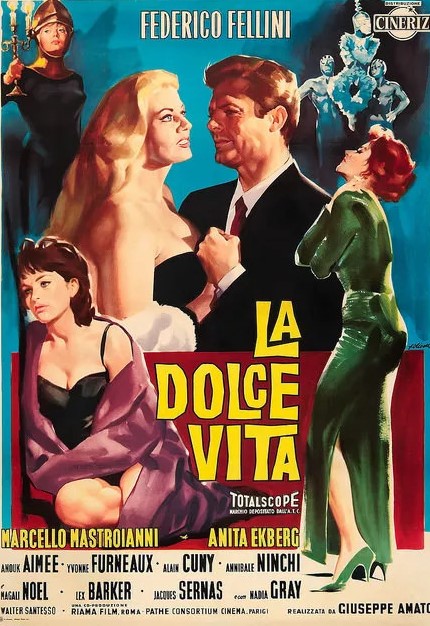
Filming of La Dolce Vita began in February 1959 with a cast including Marcello Mastroianni, Swedish actress Anita Ekberg and Anouk Aimee. Based on the performance of his previous films, producers Cineriz were dubious about its commercial prospects, but went ahead because it was a prestige picture. When the movie opened in Rome on St Valentine’s Day 1960, it astonished and shocked in equal measure.

The Catholic Church was outraged, demanding cuts, controversy boiling over when this met with refusal. Fellini had no truck with censorship. He said it was ‘dangerous in any way, in any occasion, because an artist cannot create under the sign of the guilty.’ Initial reaction to the movie was mixed; there was even a smattering of boos at the premiere. But some were already calling it a masterpiece.

Its opening weekend in Rome set a new house record of $16,000 (the equivalent to over $160,000 today) and then it broke every other conceivable record. In May it won the Palme D’Or at the Cannes Film Festival. Record giant RCA issued the popular theme tune by Nina Rota in Italy and in France a novelisation,  La Douceur de Vivre, was published complete with screenplay and soon it would appear as an illustrated book in Italy with shooting script and behind-the-scenes photos. Fellini was already planning his next film, The Trip, to star Ekberg and Sophia Loren. After six months, still in its two launch cinemas, La Dolce Vita was taking $15,000 a week in Milan and $9,000 a week in Rome. By October it was outgrossing most new releases. By year’s end it had hoisted a sensational $1.125m in Italy. The season’s box office champion by a considerable margin, it left big-budget-Hollywood films in the dust.

Columbia Pictures, which had sizeable investments in European films, was quickest off the mark, purchasing in August the rights to distribute the film in the UK, where a November release was planned, and the British Commonwealth. Convinced the film was too controversial to receive a Production Code Seal (the censorship system of the time) in the US, nor wishing to drag the company name through any subsequent scandal, Columbia did not bid for the American rights. And so it became the tale of three companies, Omat Corporation, Embassy Pictures and Astor Pictures, who all had the same aim, to reinvent themselves through entering the arthouse business.

They were a disparate bunch. Omat had made its name reissuing old American movies which had been withheld from television. An abortive move into film production with Brotherhood of Evil had almost bankrupted it. But it  had come back to buy a batch of Mexican films for distribution including Beyond The Limit starring Jack Palance and films with lurid titles like Never Take Candy From A Stranger. Embassy was run by Joe Levine, an independent distributor from Boston with an impeccable pedigree until he decided to relaunch himself in 1957 as a wheeler-dealer on a national scale, buying the rights to the Italian-made Attila the Hun starring Anthony Quinn and Sophia Loren and sending it into the American market on the back of more promotional dollars than it had cost to purchase. The next year, on a much bigger scale, he did the same thing with Hercules starring Steve Reeves, opening the movie with 600 prints nationwide in July. It made him a fortune. He followed up with films like Hercules Unchained and Jack the Ripper.

But soon he sensed a change in the marketplace and wanted to build up the prestige of his company away from the exploitation marketplace. ‘A small revolution is taking place,’ he told Variety, ‘among the major and independent circuit operations. Many large houses (cinemas) are converting to specialty and art policies. Demand for those films is growing. That’s for me.’

He bought a French film called The Law, directed by Jules Dassin, and changed the title to the more snazzy, and suggestive, Where The Hot Wind Blows. But by late 1960 he had another reason to be in hot pursuit of La Dolce Vita. He had missed out on Jules Dassin’s new movie Never On Sunday, at that time just opened in New York to record business. Astor Pictures was Embassy on a smaller scale, distributing exploitation films like The Girl in Room 13, Festival Girl and Yellow Polka Dot Bikini. The 30-year-old company had been taken over from the estate of Richard Savile in 1959 by a group including George Foley, financier and vice-president of City Stores Franklin Bruder, and Everett Crosby, brother of Bing and his business representative. Like Embassy, it had bigger aspirations, planning to release 10 features, the most in its history, including three produced by Crosby, in 1961. And then it saw an opportunity to crash the arthouse system.

Each company put in a bid in the region of $500,000 – an astronomical sum for an arthouse flick – for the rights. And each believed its bid had been accepted. In October 1960, Omat claimed it had a deal with Italian producers Cineriz for that sum plus a percentage and promptly announced the film on their distribution list.  Joe Levine contested that, saying he had a ‘handshake deal’ that later turned into a ‘verbal agreement’, binding under Italian law, in front of two witnesses, for roughly the same amount. Astor also claimed victory. But in December Cineriz took out an advert in Variety declaring all claims were premature, as the US rights had not yet been granted. To everyone’s surprise, on January 7 1961, Astor was announced as the winner with a contract to prove it. They had outbid the others, paying a whopping $625,000 for the privilege. Al Schwartzberg of Omat complained: ‘All I know is we had a deal and nobody had told me different.’ 

Even more astonishing, Astor planned to spend a further $400,000 – more than the lifetime gross of  most arthouse movies in the US – on promotion. Just to break even (since the cinema took about 50% of the gross), it would need to make $2.5m. In order to do that, it would have to achieve what had not been done since And God Created Women, guarantee an arthouse film a nationwide release. For a three-hour film foreign film without Brigitte Bardot, it was madness.

Astor wanted to start recouping their investment as quickly as possible. There was just one problem. That would prove impossible in the current system of releasing arthouse movies.

There were only a handful of such specialist cinemas, just 15 in New York, the biggest city in America. A New York opening was paramount, the gateway to the rest of the American arthouse circuit. The problem was every cinema was already tied up months in advance. Once a US distributor had bought a foreign movie it could take upwards of a year to find a New York cinema to release it in. And there had been a squeeze of another kind. The British New Wave was sweeping into America via the arthouse circuit and swallowing up screens wholesale. Since they did not require either dubbing or subtitles, British films were more accessible to American audiences, and cheaper for distributors.

Out of the approx 700 weeks playing time available annually at the New York cinemas, British films had accounted for 252 weeks (up from 154 the year before) compared to 85 weeks for French films and 45 weeks for Italian films. In addition, the majors had started to use arthouses for the kind of mainstream releases that would appeal to that particular audience. Even with arthouse films, there were trends, and there was a fear that American audiences would start to reject subtitled films altogether.

Never having played this game before, Astor decided to break the rules. To get round the Production Code, they simply did not apply for approval. Technically, they were within their rights; only films made by US companies were required to comply with the Code. After Room at the Top, which had not been passed by the Code, had won two Oscars earlier in the year, the exhibitors organisation (TOA) attempted to plug this loophole, aiming to force cinema owners to play only films passed by the Code.

Even United Artists, which had decided to release Never on Sunday through its subsidiary Lopert to avoid being besmirched by scandal, had submitted the film to the Code, receiving the worst rating. Still, there was no dodging the National Legion of Decency, at the time an extremely powerful force. The Legion passed its verdict whether you liked it or not. By normal standards, given the content, La Dolce Vita should have been condemned. But the Legion had a special category, for films with artistic merit dealing with dubious issues, and it decreed that La Dolce Vita was actually a moral film. Normally, Legion disapproval could boost a movie’s box office, since sophisticated arthouse movie buffs considered the Legion irrelevant. But that only worked if your target market was just the chic crowd. For Astor to have any chance of getting its money back, La Dolce Vita had to break out of the strictly arthouse market.

So Astor made a deal with the Legion. The Legion placed the film in a ‘separate classification’ and pronounced it was ‘animated throughout by a moral spirit.’ The Legion said, ‘The shock value is intended to generate a salutary recognition of evil as evil, sin as sin.’ Nonetheless, there were conditions. The film was cut by five minutes. Astor had to guarantee its advertising would have no prurient appeal, and, more important, agreed not to dub the film  – the Legion felt dubbing would make the film more accessible to a younger, impressionable, audience. To show the film only in subtitles was a massive gamble, especially for the intended wider audience. Then Astor broke the rules again. Initially, in order to gain the impact it felt the movie required, it intended opening it on two arthouse screens in New York rather than one. But, of course, that was just doubling the problem. So with no cinema immediately available, it opened at the 946-seater Henry Miller Theatre in New York, which had never, in its history, shown a film, only presented plays. Astor had to guarantee the theatre $100,000 before the theatre was converted at a cost of $50,000.

Now Astor went for broke, and decided to release La Dolce Vita as a roadshow film. This move – arrogant, impudent or plain crazy, take your pick – was met with universal incredulity. The roadshow was the preserve of big-budget American-made major-studio widescreen colour films like Ben Hur not for foreign black-and-white interlopers. (Two foreign films had gone down this route before, The Golden Coach in 1954 and Tosca in 1958, but both had met with dismal failure). The only thing La Dolce Vita had in common with Ben Hur was the running time.  In truth, Astor hedged its bets, also opening the film in the normal way in a proper cinema, the Gray Theatre, in Boston.

In New York, there was a reserved seat policy for each of the ten performances, one show per night plus matinees on Wednesday, Saturday and Sunday. In Boston, there were four shows a day, starting at 11am with barely 10 minutes between each performance, and reserved seats at the weekend. There was one instant advantage to going roadshow – putting up the prices (called ‘hardticket’).  How the film went out to other cinemas thereafter – if it went anywhere at all – would depend on which release technique proved more successful.

Astor embarked on the kind of campaign associated with a roadshow. There were adverts in newspapers and customised PR, it was featured in Life magazine and on television, a paperback tie-in was published and RCA issued six different singles of the theme tune. The trailer was unusual, a scattergun sequence of still images.

From the UK came encouraging news. As well as opening in December 1960 in the country’s most prestigious art house cinema, the 500-seater Curzon in Mayfair to a record gross of $11,000, La Dolce Vita had also opened at exactly the same time in a mainstream West End cinema, the 740-seater Columbia, the first time such a thing had occurred (called ‘daydating’ in exhibitor terminology), grossing $16,000. To put that in perspective, the week’s top film was Tunes of Glory which took $22,000 at the 1,400-seater Odeon Leicester Square. In January, each cinema was outgrossing the West End takes of Burt Lancaster in Elmer Gantry and William Holden in The World of Suzie Wong, which had opened in the same week as La Dolce Vita. At the Columbia it ran for 11 weeks, but was in its 18th week at the Curzon (still grossing a healthy $6,600) by the time it opened in the States.

On the other hand, by now, unexpectedly, La Dolce Vita had competitors for that sophisticated in-crowd. Major studio Columbia, which had baulked at Never on Sunday, had  Mein Kampf scheduled to open in New York the same month. Jules Dassin’s Never on Sunday, which cost just $125,000 to make, was already doing terrific box office. On the one hand, the fact that a foreign film, equally controversial due to its content, was making money, could be construed as good. On the other hand, since the films appealed to the same audience, there were doubts whether the restricted marketplace could accommodate both. In addition, Never on Sunday had a far more popular theme tune, a singles chart-topper, the music acting as a powerful promotional tool for people who had never heard of the movie. And although the subject matter of Never on Sunday was prostitution, it was treated in such a light-hearted, charming, way that people fell in love with the film. And it had been made in English, not dubbed, so its appeal was instantly more universal.

Yet Never on Sunday demonstrated the pitfalls facing small distributors like Lopert and Astor. Black Orpheus, distributed by Lopert, had won the best foreign film Oscar in 1960, but the week it won was taken off the Plaza, the cinema owned by Lopert, because another film was pre-booked. There was just no flexibility in the arthouse industry. Like others in the market Lopert trod a fine line between art and profit. And in same month as Black Orpheus won the Oscar, Lopert announced twelve new films, more bread-and-butter than arthouse, including two horror films, one from Japan and one from Italy, and a Brigitte Bardot movie which would change its title from The Woman and The Puppet to the more sensational A Woman Like Satan. If a subsidiary of major studio United Artists could not survive in the arthouse field, what chance was there for an upstart like Astor?

Part Two tomorrow.

SOURCES: Brian Hannan, La Dolce Vita and the American Box Office Bust-Out (Baroliant, 2018) ; “Brian Hannan Revisits La Dolce Vita,” Cinema Retro, No 33.
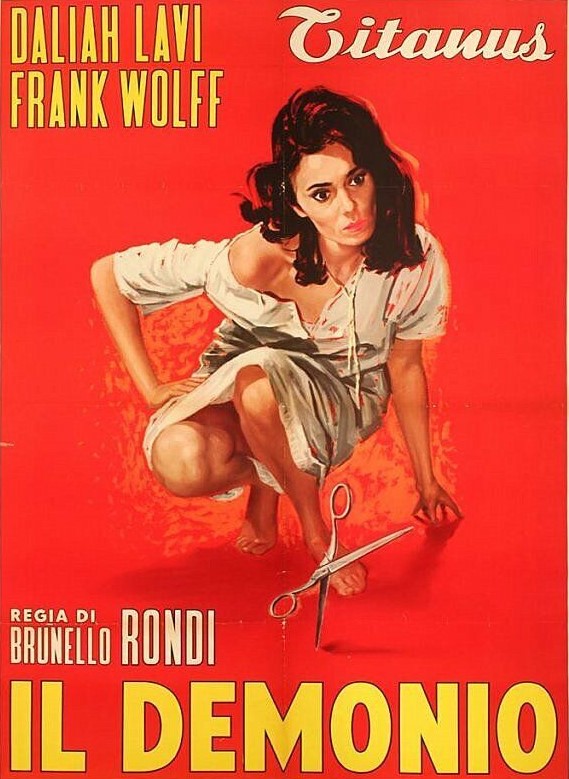
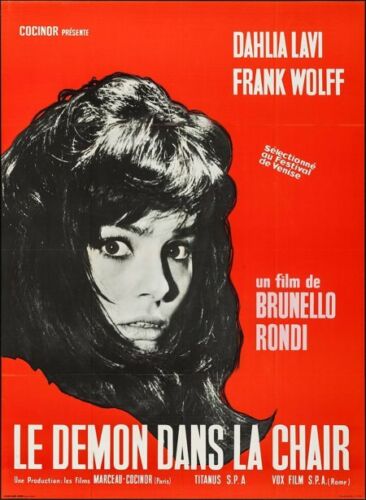
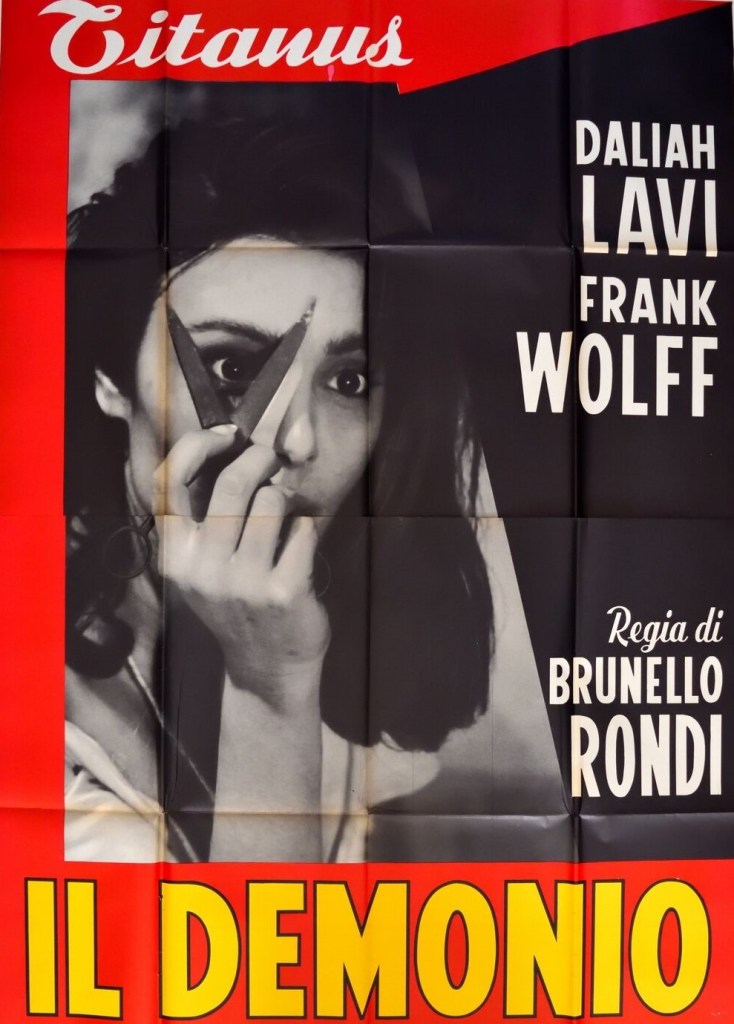
The Demon / Il Demonio (1963) *****

I was riveted. This is one of the most extraordinary films I have ever seen. Highly under-rated and largely dismissed for not conforming to audience expectation that horror pictures should involve full moons, castles, darkness, fog, costumes, nubile females exposing cleavage, graveyards, a male leading character, shocks to make a viewer gasp, and the current trend for full-on gore. So if that’s what you’re looking for, give this a miss. Even arthouse critics, spoiled by striking pictures by the Italian triumvirate of Fellini, Visconti and Antonioni, were equally scornful. For the most part this takes place in broad daylight and set in an impoverished town in the Italian mountains, so primitive farmers till the soil with horse and plough and water is collected in buckets from the river.

One of the most striking aspects of the picture is that it creates its own unique universe. The townspeople are both highly religious and deeply superstitious, every traditional Catholic ceremony matched by old-fashioned ritual. Even some of the formal traditions seem steeped in ancient belief, sinners marching up a steep hill being scourged or carrying a heavy rock, in a convent the tree of a suicide covered in barbed wire. Less conformist notions include a wedding night rite involving shoving a scythe under the bed to cut short Death’s legs with the bedspread covered in grapes to soak up evil and discord arranged in the form of a cross to act as bait for bad thoughts and poison them before they can cause the couple harm. When the people run through the town brandishing torches it is not, as would be genre tradition, to set fire to a castle but to vanquish evil from the air.

It is filmed in austere black-and-white. In the Hollywood Golden Era of black-and-white movies lighting and make-up transformed heroines, rich costumes enhanced background. Here, if the heroine is wearing make-up it’s not obvious and the only clothes worth mentioning are a priest’s robes or a plain wedding dress. Otherwise the most arresting feature is the stark brightness against which the black-dressed figure of the heroine Puri (Daliah Lavi) scuttles about.

And although there are no jump-out-of-your-seat shocks, there are moments that will linger on in your mind, not least the heroine enduring a vicious extended beating from her father, an exorcism that turns into rape and the sight, Exorcist-fans take note, of a spider-walk, the young woman’s torso thrust up high on elongated arms and legs. Virtually the entire success of the picture relies on atmosphere and in places it is exquisitely subtle, the audience only realizes she has been raped by the look on her face.

The picture opens with a dialog-free scene of stunning audacity, foreshadowing the idea from the start that image is everything. Puri pierces her chest with a needle, cuts off a chunk of her hair to mop up the blood, throws the hair into the oven and rams the crisp remains into a loaf of bread. Not to be consumed as you might imagine, but as a tool of transport. Shortly after, having failed to seduce Antonio (Frank Wolff), she tricks him into drinking wine infused with the ashes of her bloodied hair, bewitching him, so she believes, to abandon his betrothed. In an echo of a Catholic sacrament she shouts, “You have drunk my blood and now you will love me, whether you want to or not.”  

The next morning when collecting water at the river she has a conversation with a boy Salvatore only to discover he has just died, his death blamed on her because his last words were a request for water, which she is judged to have denied him. She is beaten by women. She is feared by everyone in the village, her family tainted with the same brush, wooden crosses nailed to their door. She is not a ghostly figure, flitting in and out of the townspeople’s lives, an apparition tending towards the invisible, but fully formed, highly visible in her black dress and anguished expression, doomed by often vengeful action and forceful word.

Much of the film involves Puri being beaten or chased or captured, at one point trussed up like a hog. Attempts to exorcise her, whether pagan or Catholic, focus on getting the demon to speak his name. The ritual performed by heathen priest Guiseppe involves blowing on a mirror before taking on sexual aspects which culminate in rape. The Catholic version in a church in front of her family is primarily, as it would be in The Exorcist, a duel between the priest and whatever possesses her.

Movie producers took one look at the beauty of Palestinian-born Daliah Lavi (Blazing Sand, 1960) and thought she would be put to better use in bigger-budgeted pictures made in color that took full advantage of her face and figure and that stuck her in a series of hardly momentous movies such as The Silencers (1966) and Some Girls Do (1969). They should be ashamed of themselves for ignoring her astonishing acting ability. And much as I have enjoyed such films, I doubt if I could watch them again without thinking what a waste of a glorious talent. This is without doubt a tour de force, as she alternatively resists possession and adores the being who has taken hold of her mind. She dominates the screen.

The rest of the mostly male cast are dimmed in comparison, as if overawed by the power of her personality. Future spaghetti western veteran Frank Wolff (Once Upon a Time in the West, 1968) comes off best. Director Brunello Rondi (Run, Psycho, Run, 1968) is better known as a screenwriter for Federico Felllini. He made few films, none matching this in scope or imagination, perhaps as a result of the picture not receiving the praise it deserved. Even now it does not have a single critical review on Rotten Tomatoes.

One other point: you may have noticed that in general the proclivities of male horror characters are never in need of psychological explanation. Nobody considers that the Wolfman must have suffered from childhood trauma or that a vampire drinks blood because he was a rejected suitor. Strangely enough, as would be the case in The Exorcist and other instances of female possession, psychiatry is usually the first port of call and here all reviews I have read implicitly see Puri’s actions as based on sexual inhibition and rejection by Antonio. 

Behind the Scenes: From Cinerama to Imax

Given I’m on my annual Cinerama binge, it’s interesting to see how current giant-screen format Imax developed from the previous king of the giant screens, Cinerama.

Quiz question: what connects King Kong (1933) to Cinerama? Follow-up quiz question: what connects Lawrence of Arabia (the man not the film) to Cinerama? Tie-breaker: what connects Cinerama, which had its heyday in the 1960s, to the current Imax.

Merian Cooper, the producer behind King Kong, and Lowell Thomas, the broadcaster whose fame was built on the dramatic footage he took of Lawrence of Arabia during World War One, were both vital to the development of the new screen sensation Cinerama, which made its debut two years before Twentieth Century Fox unveiled Cinemascope.

Both Cinerama and Imax began as vehicles for documentaries, the cinematography they involved initially considered too cumbersome for Hollywood directors to use. Initially, also, both formats were presented in cinemas specifically designed for showing films made in the process.

But, effectively, both Cinerama and Imax followed the same business model, one that Hollywood only too readily appreciated. They were premium priced products. Whereas most items you buy are the same price wherever you make the purchase, movies followed an extended version of the way publishers sold books. Readers had to pay extra to be first in the queue for a favorite author’s latest work, the hardback version of a novel appearing about a year in advance of the cheaper hardback.

In the silent era, Paramount instituted a food chain for movie presentation. Pictures opened first in the big city center theaters at top dollar prices ($2 – the equivalent to $35 now – not unusual in the 1920s) before working their way down a dozen different pricing levels until they reached the cheapest cinemas. As the business developed, although the U.S. cinema capacity grew to around 20,000 outlets, Hollywood reckoned that 70 per cent of a movie’s income came from a fraction of those houses, primarily from the more expensive first- or second-run cinemas.

Treatment of audiences is more democratic now. All tickets cost the same and the food chain is long gone, but in the 1950s and 1960s when Hollywood was battling the beast of television it appeared that audiences could be wooed back to the movies by giving them something bigger and better – and they were happy to pay the price. Imax follows the same pricing strategy.

Cinerama was not just the ultimate in widescreen but it offered visceral thrills. Given camera point-of-view audiences raced down a rollercoaster in This Is Cinerama (1952) and were astonished to see different global vistas presented in their full glory rather than as mere backdrops to actors. And while audience response was astonishing even by industry standards, and receipts tumbled in hand over fist, the concept soon lost popularity as audiences moved on to the more dramatically-accessible Cinemascope and its imitators and by the 1960s the format was more or less dependent on the company spinning out its back catalog in endless reissues.

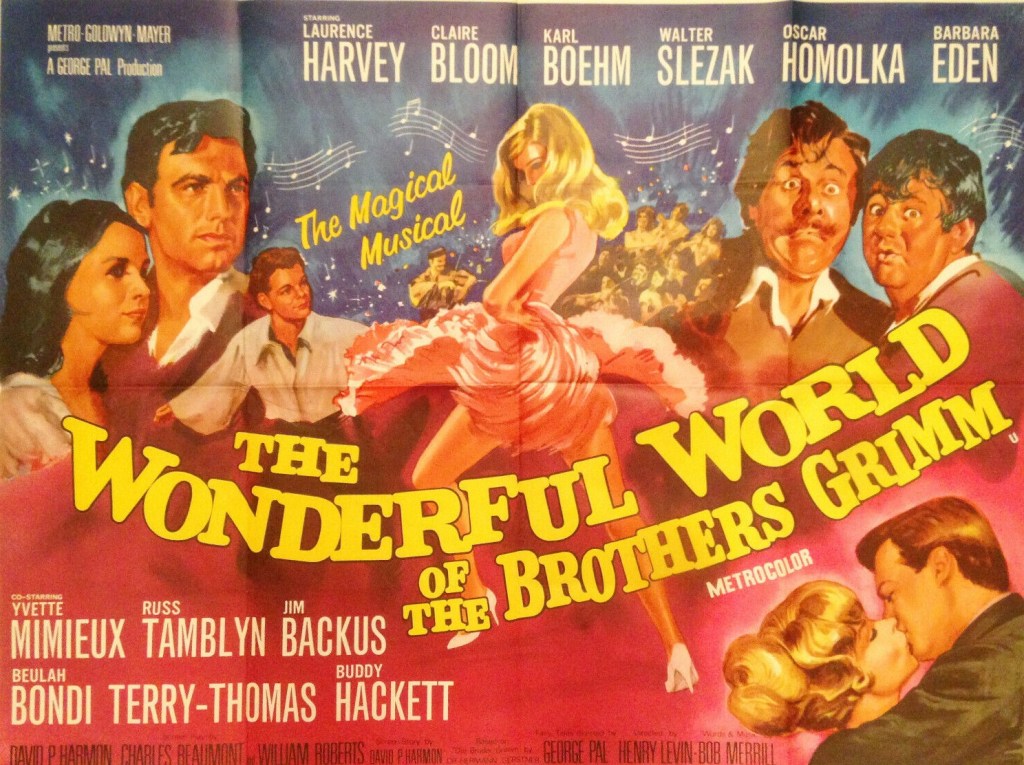
Hence, the move towards dramatic storylines as instanced by How the West Was Won (1962) and The Wonderful World of the Brothers Grimm (1962), both initially presented in the premium-priced roadshow, separate performance, format. In quick fashion, too, Cinerama dispensed with the cumbersome three-lens camera and invented a single-lens alternative which made it much easier for directors.

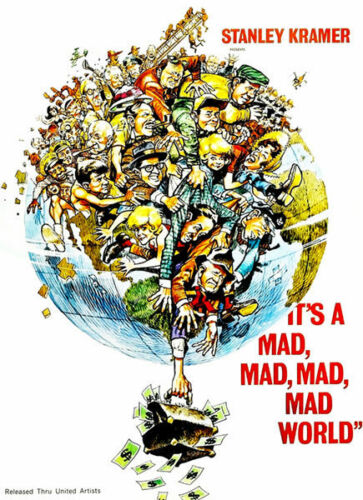
During the 1960s Cinerama presented another eleven big Hollywood pictures ranging from It’s a Mad, Mad, Mad, Mad, World (1963) and Grand Prix (1966) to Ice Station Zebra (1968) and Krakatoa, East of Java (1969). But as the industry hit the financial buffers at the end of the decade, the writing was on the wall, and although Cinerama invested in 35mm movies like Straw Dogs  (1971) the game was over for the format by 1972.

Imax was pretty soon positioned as its natural successor, unveiled in 1970 in Japan with Tiger Child, the first purpose-built cinema opening in Toronto in 1971 with North of Superior. The screen was much bigger than anything Cinerama or 70mm had offered. It was over three times the size of Cinerama. But it was of different dimensions; where Cinerama went wider, Imax went taller.

But again, the camera was an obstacle for Hollywood use. And like Cinerama, the format’s attraction was sheer spectacle. All the initial output was documentary-based, often with an educational purpose, though soon progressing to what was termed “entertainment” (Everest, 1998) and the movies were short by Hollywood standards, often less than an hour, which permitted Imax theater operators to present a greater number of daily screenings than an ordinary cinema.

Initially, they were not specifically premium-priced, but potentially more profitable because of the number of daily showings. Theaters typically kept 80 per cent of the box office which limited entrepreneurial interest since budgets for these movies were in the $6 million-$12 million range, not low enough to easily turn a profit. The movies could run for months, but there was the same problem as before – shortage of new product.

By 1990 Imax had largely pulled out of exhibition, ownership limited to nine theaters, and out of production.

Oddly enough, it was reissue that revived Imax. Disney planned a reworked version of its classic Fantasia (1940) as a method of generating more money from a picture that had already grossed $184 million on video. Traditionally, Fantasia got its best results from limited release, its previous revival outing shown in a maximum of 500 houses. Nor did Disney agree to the usual financial terms, demanding a 50 per cent share of the box office, rather than the normal 20 per cent.

Fantasia 2000 (2000) was released in 54 cinemas willing to commit to an 18-week run. While every Imax record was smashed, the picture, at a cost of $90 million, didn’t break even. But it did usher in Imax as a reissue vehicle. Disney used Imax for the 10th anniversary relaunch of Beauty and the Beast (1992), bringing in an extra $25 million in rentals. Two years later The Lion King (1994) in Imax brought in $15.6 million and Apollo 13 (1995) $1.7 million.   

Naturally enough, Disney recognized the potential for Imax for new films and made Treasure Planet (2002) in an Imax version. But the big boost came with The Matrix sequels. Both The Matrix Reloaded (2003) and The Matrix Revolutions (2003) were digitally remastered for Imax, the latter the first to be shown simultaneously with the ordinary print.

Nowadays, Imax is part of the release mix, bringing a hefty chunk of premium-priced box office to the overall gross and also, as witness the current Interstellar (2014) a hyped-up reissue vehicle.

SOURCES: Brian Hannan, Coming Back to a Theater Near You, A History of Hollywood Reissues (McFarland, 2016) p5, 10, 12, 295, 297-298; Kim R. Holston, Movie Roadshows (McFarland, 2013 )p 112-113; James B. Stewart, Disneywar (Simon and Schuster, 2008), p346-347; “A Decade of Limited Release,” Variety, February 18, 1998, p23; “Eric J. Olson, “Fantasia Signs Up Increase,” Variety, May 24, 1999, p32; Joseph Horowitz, “A Fantasia for the MTV Generation,” New York Times, January 2, 2000; “Fantasia Hits Imax Record,” Variety, January 4, 2000, p7; “Top 125 Worldwide,” Variety, January 15, 2001, p24; “The Top 250 Worldwide,” Variety, January 6, 2003, p26.

Bradford Widescreen Weekend 2024

We are so conditioned to watching old movies on tiny screens it comes as something of a primal shock to see them in all their original glory. Most festivals lean towards the arthouse end of the cinema business so it’s all the more delightful to find an event that without apology concentrates on the mainstream. Widescreen Weekend takes place at the National Science and Media Museum in Bradford, England, and mostly in its Pictureville Cinema, the only venue in the country equipped to show Cinerama pictures in the original three-strip version which requires three projectors.

And while most other film festivals attract general movie lovers, this one appears to appeal in large part to those who have had something to do with the movie-making business or its technical side. Speakers might include, for example, Cinerama restoration specialist Dave Strohmaier or Kevin Brownlow, editor turned director, and among the audience you might find people like Keith Stevens from Australia, a former operations executive with Village Roadshow there, but who started out as a projectionist and regaled me with tales of projecting The Sound of Music (1965) in its original roadshow run.

There’s a limited number of movies that were made, mostly in the 1960s, either in Cinerama or 70mm, so the event has expanded to take in the earlier Cinemascope and the other versions of widescreen technology on which Hollywood depended as the marketing hook to bring back audiences from the all-encompassing maw of television in the 1950s. Later films whose directors understood the cinematic impact of 70mm are also added to the mix.

You are transported back to a time when screens were just enormous – this one is 51ft wide – and were curtained, and those curtains would not open (to the sides) until in typical roadshow fashion, a lengthy musical Overture, highlighting aspects of the movie’s music, had run its course. There is something quite sumptuous about sitting in a movie theatre staring at huge red curtains and waiting for the house lights to dim and the music to begin.

Roughly half-way through the movie itself, the curtains would close for an intermission, and before the picture restarted there would be more music, what was termed the Entr’Acte. Some DVDS of roadshows contain both Overture and Entr’Acte but there is a lightyear of difference between hearing them in your lounge and being exposed to them in a picture house built to bring out their best sound.

This is a homage not just to old movies but the old way of seeing a movie.

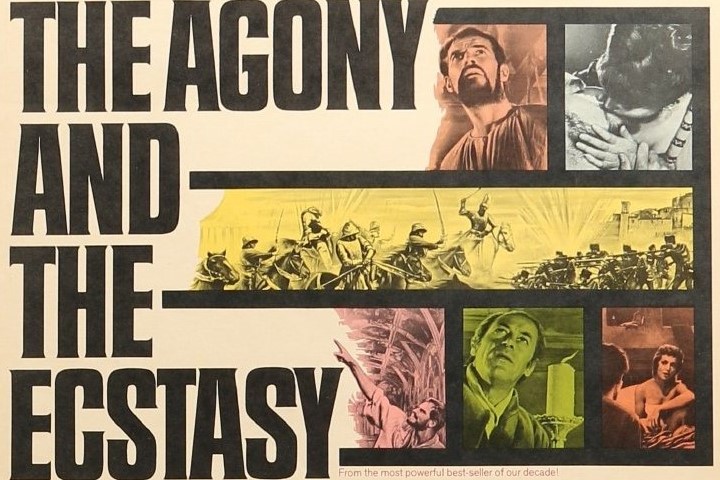
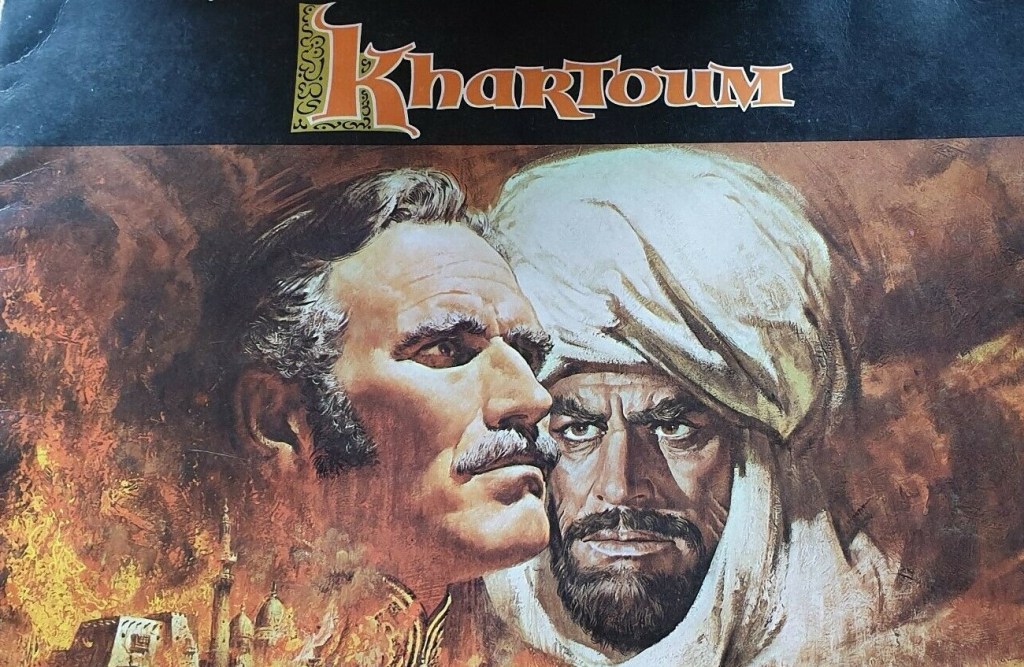
In previous years the programs have included Ice Station Zebra (1968), West Side Story (1961), 2001: A Space Odyssey (1968), Lawrence of Arabia (1962), Ryan’s Daughter (1970), Khartoum (1965), a pair from William Wyler that could not have been more diverse – Ben-Hur (1959) and Funny Girl (1968) – This Is Cinerama (1952), and Carol Reed’s  The Agony and the Ecstasy (1965). Throw in a healthy helping of 1950s Cinemascope and Vistavision features and more contemporary pictures which embraced 70mm and you have the makings of an always satisfying weekend.

So one of the highlights is to see old favorites. This year we are being treated to the three-strip version of How the West Was Won (1962), your feet tapping immediately at the sound of the driving Alfred Newman score, David Lean’s Doctor Zhivago (1965), which was blown up from 35mm to 70mm for roadshow, one of the original Cinerama travelogs Seven Wonders of the World (1956) and Stanley Donen musical Funny Face (1957) in Vistavision. For many the highlight will be a showing of the forgotten La Fayette (1962) in 70mm, at the time the most expensive French movie ever made.

There’s a Hitchcock strand including the 70mm version of Vertigo (1958), Cleopatra (1962) in 70mm, John Ford’s The Searchers (1956) and Fellini’s La Dolce Vita (1961).

The event takes place in two cinemas so there’s up to six movies a day. This year’s edition begins today and ends on Monday. I’ll be there. If you’re going and are a subscriber to my blog feel free to say hello.

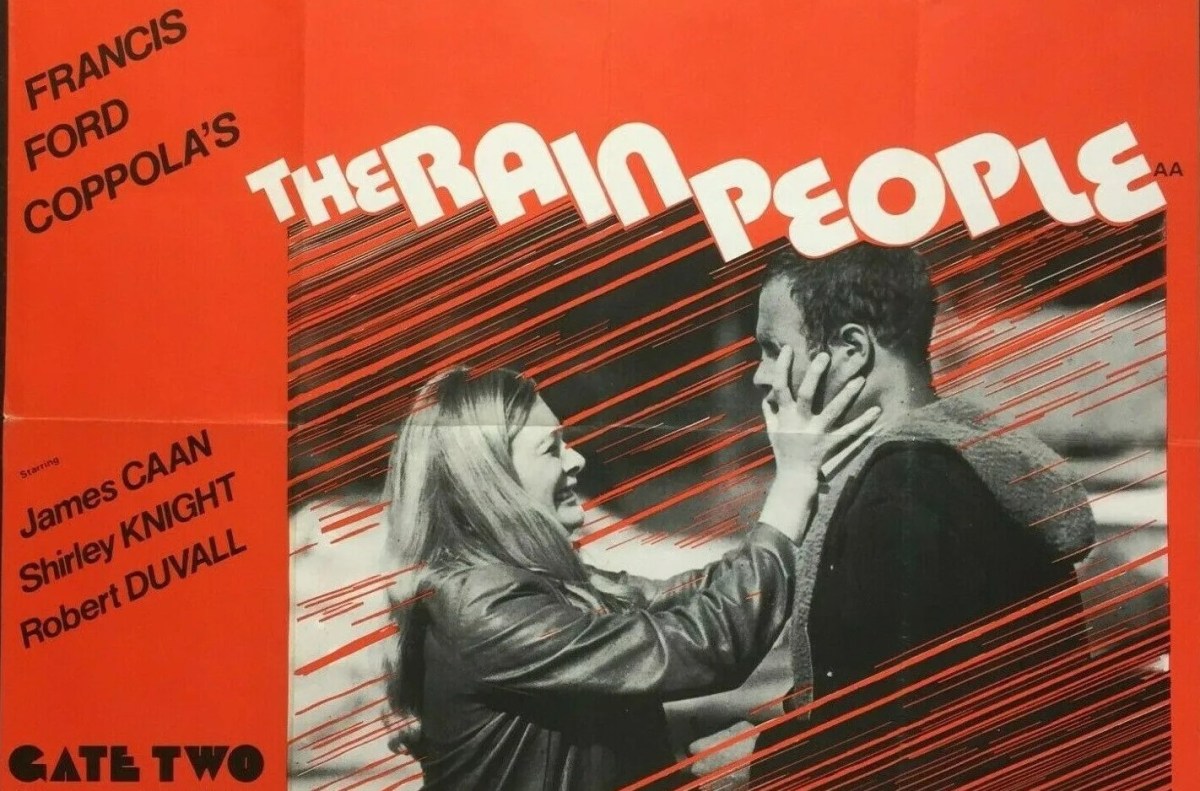
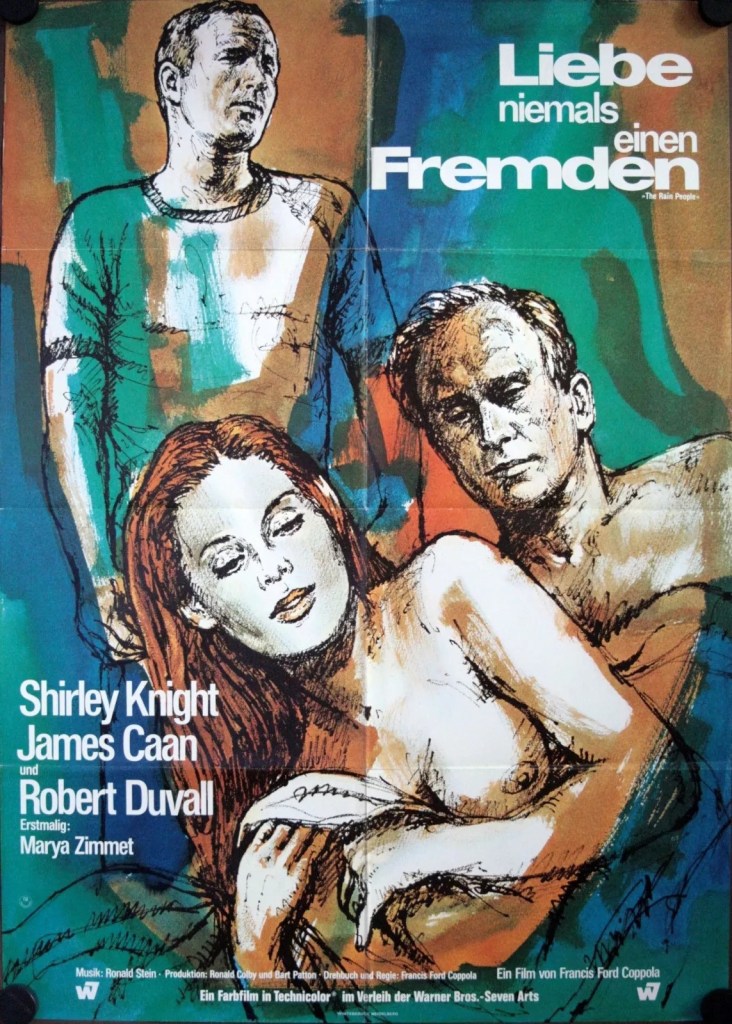
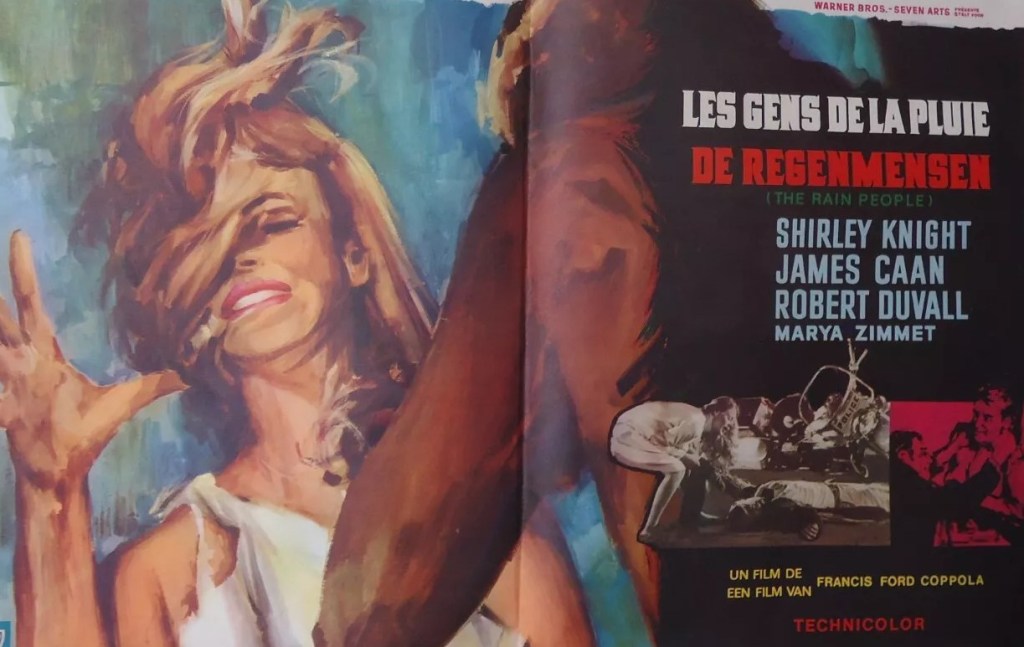
The Rain People (1969) ****

You could argue that grandiose ambition sucked the life out of Francis Ford Coppola. That if he had continued along the more intimate trajectory suggested here there might have been  a more consistent output, perhaps on an even higher plane. Even if grounded in American life, this has a distinct European sensibility and while you won’t find a single memorable image you will definitely find characters of substantial depth drowning in agonizing circumstance.

That’s not to say you won’t find outstanding sequences. I defy you to find a more cruel and character-defining scene than the one where our heroine Natalie (Shirley Knight),  running away from the chains of domesticity, takes dominance to a new extreme by demanding that muscular ex-college footballer Jimmy (James Caan) crawl round on the floor beneath her feet.

There’s no excuse for such behavior except that she wants some kind of revenge on her husband, whom she accuses of trapping her into said domesticity by the old-fashioned route of making her pregnant. This is before she discovers that Jimmy is simple-minded as the result of brain damage following an American football injury, and that it’s easier now for him to obey people rather than as before argue and stand his ground.

F. Scott Fitzgerald once famously said there were no second acts in American acts. What he failed to mention was that some people barely got to the end of the first act. Jimmy is an outcast, nobody willing to take responsibilty for him, everyone dodging such commitment. Because American scoiety has no place for losers, they fall through the cracks and stay there.

As a result of his injury Jimmy was given a thousand bucks and “told to leave.” So, he went. He’s got a destination in mind, salvation of some kind, I guess, heading towards a drive-in where he has been promised a job by the father, previously a huge fan, of his ex-girlfriend Ellen (Laura Crews).

Natalie is on a road trip to find herself, firstly at the very least just to escape, secondly requiring the seclusion to decide if she wants to keep the baby, but also to have fun, pick up other men for sex. That’s how she happens upon Jimmy. But there’s no sex, not with the shame she feels after humiliating him and realizing just how dumb he now is.

But the alpha horse-riding girlfriend doesn’t want him, she’s humiliated that anyone would associate her with this shambling hulk, and the promised job flies out the window. Natalie dumps him at a reptile zoo where the duplicitous owner appropriates his thousand bucks, leaving Natalie so delighted to be rid of him she races off and is pulled over for speeding by lovelorn cop Gordon (Robert Duvall). Circumstance forces a return to the zoo where Jimmy has caused chaos by freeing all the livestock.

But she’s taken enough by Gordon and desperate for the sense of freedom that illicit sex brings that she ends up in his trailer. Only his rebellious young daughter doesn’t take kindly to him bringing home his conquests and while he’s trying to bed Natalie, initially very complicit despite the awkward presence of the awkward child, causes a ruckus outside. Natalie would still be up for it except she takes umbrage that Gordon’s unable in his lovemaking to forget his dead wife, killed along with his son in a house fire.

The scene turns ugly and she’s rescued by Jimmy who proceeds to put his football playbook moves on Gordon, picking him up and throwing him to the ground and ramming him in the stomach, none of your standard fisticuffs here. But given Gordon’s a cop, there’s a gun on the loose and the daughter picks it up and shoots Jimmy stone dead.

That last scene comes out of nowhere and stops the audience as dead as it does Jimmy and in a bitter ironic twist wraps up a scenario where the lost never find what they’re looking for. You might find similar in, despite their power, later characters such as Michael in The Godfather (1972) and Col Kurtz in Apocalypse Now (1979).

Compare the Caan and Duvall of The Godfather and you’ll think they’ve swapped their personalities from here, Caan adopting the firmness and overt masculinity of Gordon and Duvall the soft-spoken tones of Jimmy.

I mispoke when I said there were no memorable images. There are, but their meaning comes later. We see Jimmy sweeping up leaves in playful fashion and only later discover that’s all he’s fit for. We see Natalie as trapped in a phone booth as in her marriage trying to talk her way out of returning to her husband, whose tone changes from angry to whining and desperate, and all we get of him is his voice. There are a few of those lingering shots of rainwater and drab early morning scenery that you would get in an arthouse picture but this quickly grows out of them and into the meat of the situation.

James Caan is particularly superb, completely altering is screen persona. Shirley Knight (The Group, 1966) delivers on previous promise and Robert Duvall demonstrates his range. Original screneplay also by Coppola.

Lost in the acclaim for Coppola’s more grandioise efforts but well worth digging out.

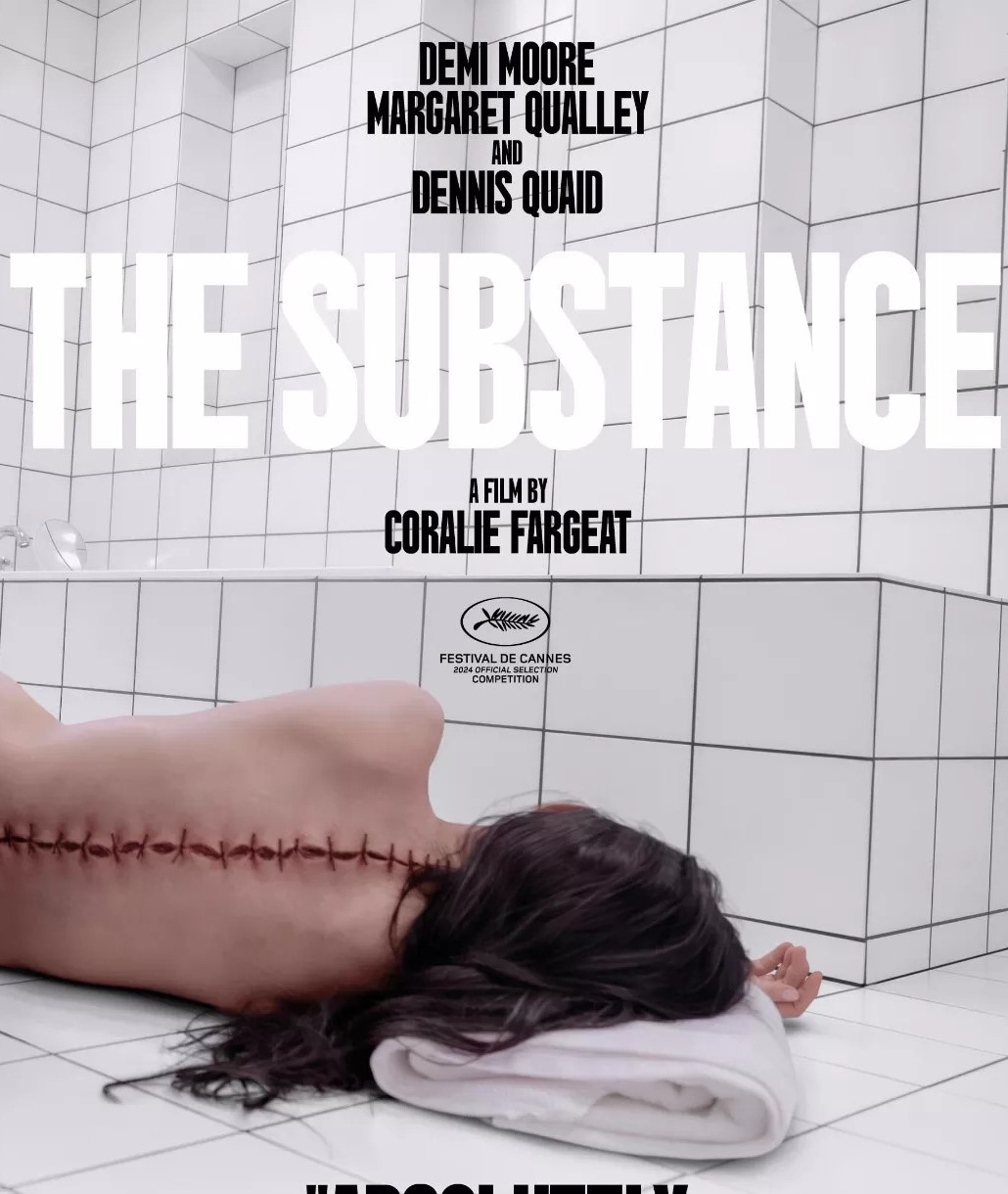
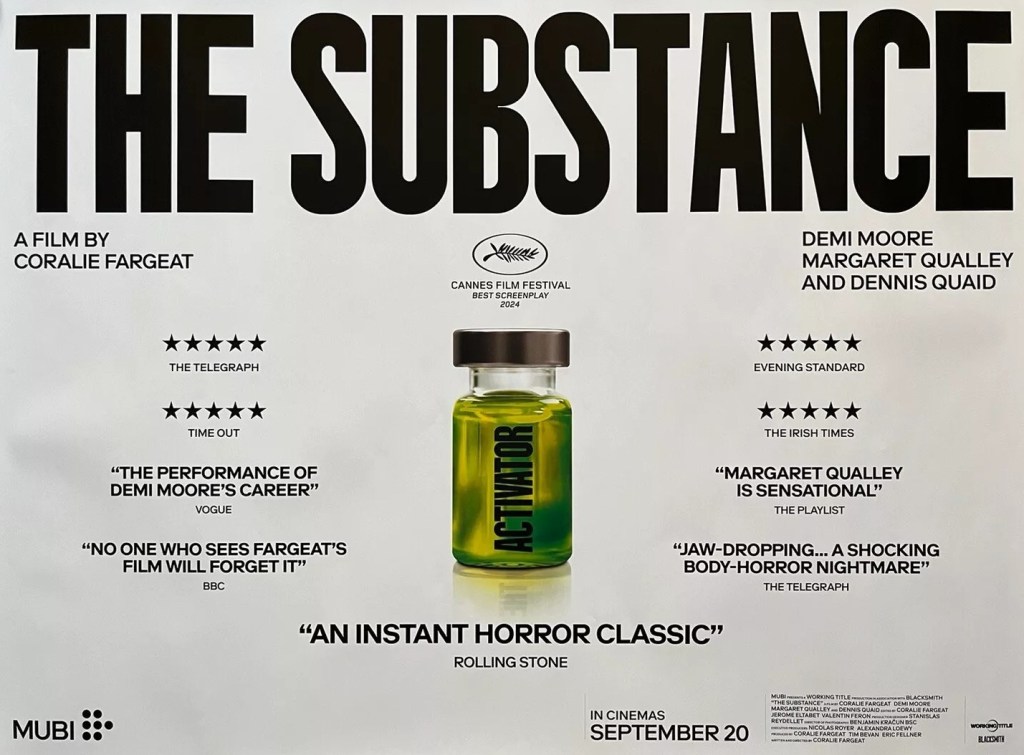
The Substance (2024) **** – Seen at the Cinema

Like Tar (2022) suffers from stylistic overkill and outstays its welcome by a good 30 minutes, but otherwise a perfect antidote to Barbie (2023). While not entirely original, owing much to the likes of The Picture of Dorian Gray and The Stepford Wives and the doppelganger and split personality nrrative nonetheless a refreshing take on the ageing beauty syndrome. Shower fetish might be a homage to Brian DePalma and except that the movie is directed by Frenchwoman Coralie Fergeat (Revenge, 2017) we might be lambasting its rampant nudity for misogynistic reasons.

On the plus side, everything else about it feels new. The whole story plays out like a demonic fable, the participants only caught out because, in their greed, they refuse to play by the rules. But like all the best horror films this occupies its own world. Whoever offers this free drug and the chance to relive your life through the best possible you is a monosyllabic voice at the end of a telephone. Not only is there gruesome rebirth but a stitching-up process. The black market drug at the center of the tale can only be accessed in a deadbeat part of Los Angeles by crawling under a door, but then, suddenly we’re in a pristine room and the various constituent parts of the substance are laid out on the Ikea model with easy-to-follow instructions.

After surviving a horrific automobile accident, onetime movie star Elizabeth (Demi Moore), reduced to breakfast television exercise guru, is passed a mysterious note by an incredibly good-looking young man that takes her down this particular rabbit hole. Like Eve’s forbidden fruit or Cinderella’s toxic midnight, there’s a catch to reliving her beautiful youth. She must switch back “without exception” to her original persona every seven days.

Of course, that’s too much to ask, and as the double named Sue (Margaret Qualley) steals minutes then hours and days the effect is seen on Elizabeth, a monstrous aged finger appearing in her otherwise acceptable hands first sign that these rules cannot be broken. Warning that there are two sides to this singular personality goes ignored. Instead of acting in concert each prt of the split personality conspires againt each other until entitlement spills over into abhorrent violence.

Apart from the initial rebirth squence, and the toothless section, the best scenes are more toned down, in one Elizabeth is faced with an alternative future, the other when she re-does her make-up four times for a date, unable to decide on which face she wishes to present.

Demi Moore (Disclosure, 1994) is being touted as a shoo-in for an Oscar nomination, but that’s mostly on account of her willingness to appear without makeup and for long sections without clothing. I’m not convinced that there’s enough heartfelt acting beyond the bitterness that was often her trademark. Margaret Qualley (Poor Things, 2023) isn’t given much personality to deal with except for exuding shining beauty and horror when it starts to go wrong.

All the males are muppets, it has to be said, wheeler-dealer Harvey (Dennis Quaid) the worst kind of obnoxious male. But this doesn’t feel much like a feminist rant but a more considered examination of refusal to accept oncoming age. Everyone has the kind of vacuous personality that’s endemic in presenting the best face (and body) to the viewing (television, big screen) public.

The movie plays at such a high pitch that most of the time you can ignore the deficiencies, but the 140-minute running time is at odds with hooking a contemporary horror audience and the gore at odds with hooking the substantial arthouse crowd required to generate the returns needed to pay back acquisition rights. None of the characters has any depth, little backstory, virtually nothing in the way of the usual confrontation with others in their lives, but then Elizabeth already lives a life of isolation, clearly lamenting her longlost fame and the attention it brings.

This won at Cannes for the script and  not the direction and that feels about right. Great idea in ultimately the wrong hands, too much of the repetition that was so annoying in Tar and the determination to make every single shot different, a movie beaten into style every inch of its running time.

Coralie Fergeat has a triumph of some kind on her hands, but one that might struggle, due to excessive length, to find an audience. Not sure, either, why tis is being sold as comedy-horror, a peculiar sub-genre in the first place to make work, but I don’t remember laughing once.

However, like Saltburn (2023) this has a good chance of attracting the young crowd via word-of-mouth, the kind who are just waiting to find their own cult material.

Both facinating and repellant.

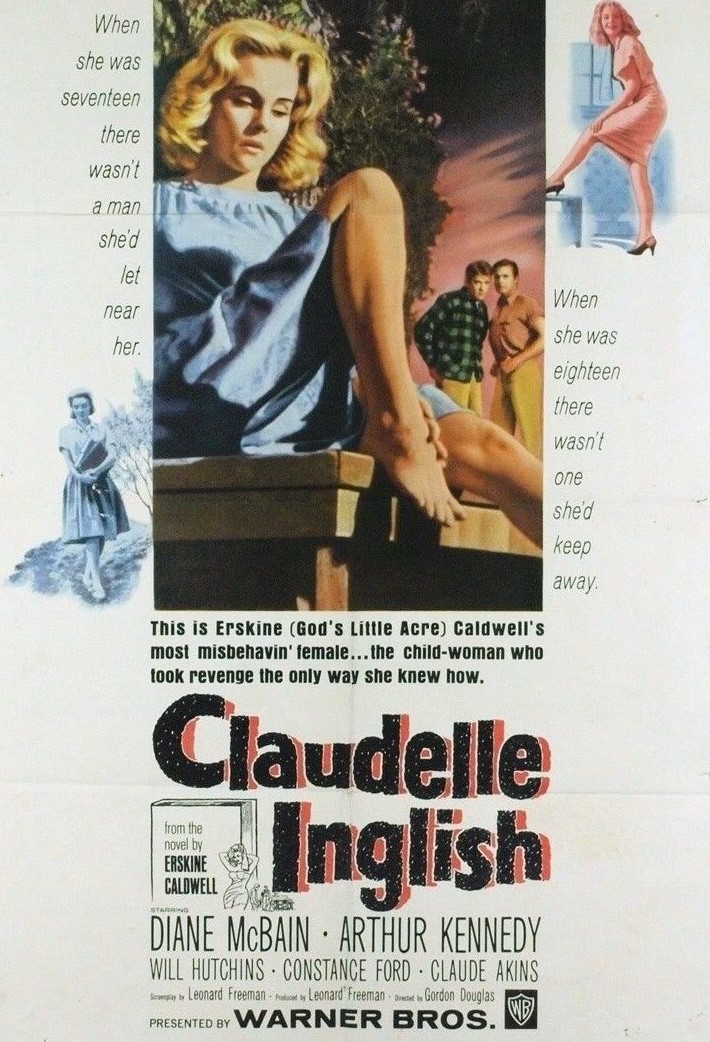
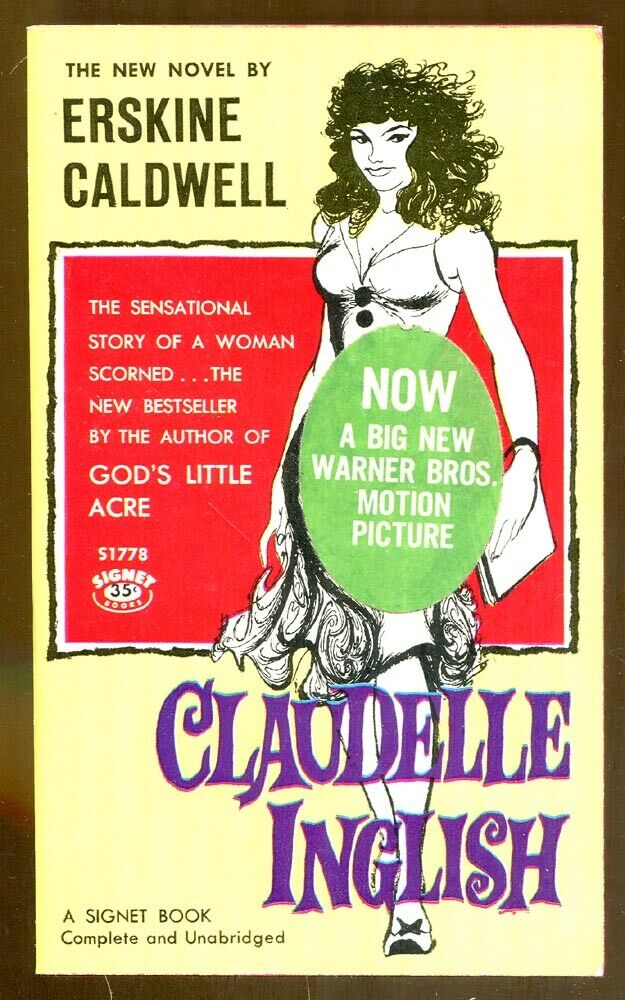
Claudelle Inglish (1961) ****

Simple small-town morality tale, brilliantly told, with a quiet nod to The Blue Angel and Citizen Kane. Shy dirt poor farmer’s daughter Claudelle Inglish (Diane McBain) after falling for the handsome Linn Varner (Chad Everett) expects to be married when he returns from his Army stint. But he rejects her. Initially, devastated, keeping all his letters and the dancing doll she had won with him at a fair, she decides that lying in bed all day and staring at the ceiling is not going to work. So she smartens up her frumpish look with lipstick and turns her simple wedding dress into a more attractive outfit.

She discovers that the boys are so desperate to come calling on this new-look creature that they will bring presents to every date, ranging from the biggest box of candy in the shop to a pair of red shoes. Encouraging her determined manhunt, dissatisfied mother Jessie (Constance Ford), who has endured twenty years of broken promises throughout marriage to hardworking Clyde (Arthur Kennedy),  beseeches her to go after a rich man. Luckily, there is one within the vicinity, the widowed S.T. Crawford (Claude Akins) who happens to be their landlord. Crawford tries to bribe Clyde with free rent and other benefits to put in a good word, but to no avail, the father believing that true love cannot be bought and, furthermore, will alleviate abject poverty.

Claudelle bluntly rejects Crawford as “too old and too fat” but takes his present anyway and, under pressure, agrees to go for a ride with him without allowing him to stop the car. Dennis Peasley (Will Hutchins), eldest son of a store owner, believes he is the front runner, deluging her with gifts, naively believing she is his sweetheart until he realizes he is in competition with a horde of other local boys, including his younger brother, and outsider Rip (Robert Colbert). Jessie, seeing the prospect of a rich husband slip away, embarks on an affair with Crawford. Soon, Claudelle has the entire male population in the palm of her hand, piling up presents galore. However, tragedy, in the way these things go, is just round the corner.

What struck me first was the subtlety. Nothing here to bother the censor, beyond the immorality on show, and despite Hitchcock breaking all sorts of sexual taboos with Psycho the year before. This isn’t an all-hot-and-bothered essay like the previously reviewed A Cold Wind in August or a picture that pivots on twists-and-turns like A Fever in the Blood, both out the same year. It took me a while to work out Claudelle was actually having sex with all these guys.

The initial shy girl blossoming under the first blush of love is done very well, a gentle romance ensuing, Claudelle still withdrawn in company, agreeing to an engagement even though Linn cannot afford a ring, waiting anxiously for his letters, adoring the dancing doll,  paying off a few cents at a time material for a wedding dress. It’s only after she receives a Dear John (Dear Jane?) letter that it becomes clear, though not crystal clear, that sex has been involved because that word is never spoken and that action never glimpsed. Only gradually do we realize that present-givers are being rewarded, and as her self-confidence grows she is soon able to pick her own presents.  One look is generally all it takes to have men falling all over themselves to give her what she wants, which is, essentially, a life where promises are not broken. But the closest she gets to showing how much she is changed from her original innocent incarnation is still by implication, telling a young buck she is “pretty all over.”

I was also very taken with the black-and-white cinematography by Ralph Woolsey. The compositions are all very clear, but in the shadows Claudelle’s eyes become glittering pinpoints. The costumes by Howard Shoup won an unexpected Oscar nomination, his third in three years. Veteran director Gordon Douglas (Them!, 1954) does an excellent job of keeping the story simple and fluent, resisting all temptations to pander to the lowest common denominator while extracting surprisingly good performances from the cast, many drawn from Warner Brothers’ new talent roster.

Diane McBain (Parrish, 1961) handles very well the transition from innocence to depravity (a woman playing the field in those days would be tagged fallen rather than independent) and holds onto her anguish in an understated manner. In some senses Arthur Kennedy (Elmer Gantry,1960) was a coup for such a low-budget production, but this could well have been a part he was born to play, since in his movie career he knew only too well the pain of promise, nominated five times for Best Supporting Actor (some kind of record, surely) without that nudging him further up the billing ladder. His performance is heartbreaking, working his socks off without ever keeping head above water, repairs getting in the way of promises made to wife and daughter, kept going through adoration for his wife.

Constance Ford (Home from the Hill, 1960) is heartbreaking in a different way, scorning her loving husband and dressing like her daughter in a bid to hook Crawford.  Television regular Claude Akins is the surprise turn. In a role that looked like a cliché from the off – i.e. older powerful man determined by whatever means to win the object of his desires – he plays it like he was auditioning for The Blue Angel, hanging on every word, being twisted round her little finger, demeaning himself as he is made to wait, sitting downcast outside the Inglish house like an rejected schoolboy. Of the younger cast, Will Hutchins was Sugarfoot (1957-1961), Chad Everett was making his movie debut, and Robert Overton had appeared in A Fever in the Blood (1961). Leonard Freeman (Hang ‘Em High, 1968) wrote the screenplay based on the Erskine Caldwell bestseller.

And where does Citizen Kane come into all this? The dancing doll Claudelle won at a fair when dating Linn is something of a motif, never discarded, as if a symbol of her innocence, and in close-up in the last shot of the film.

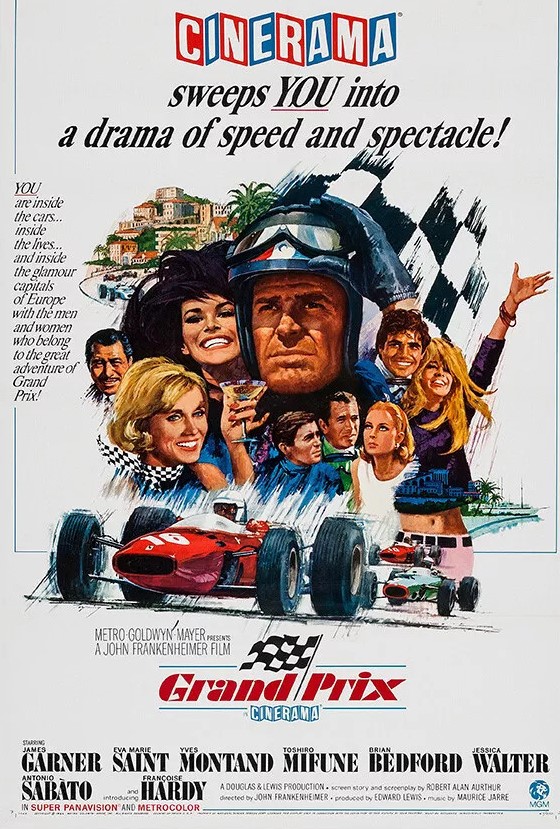
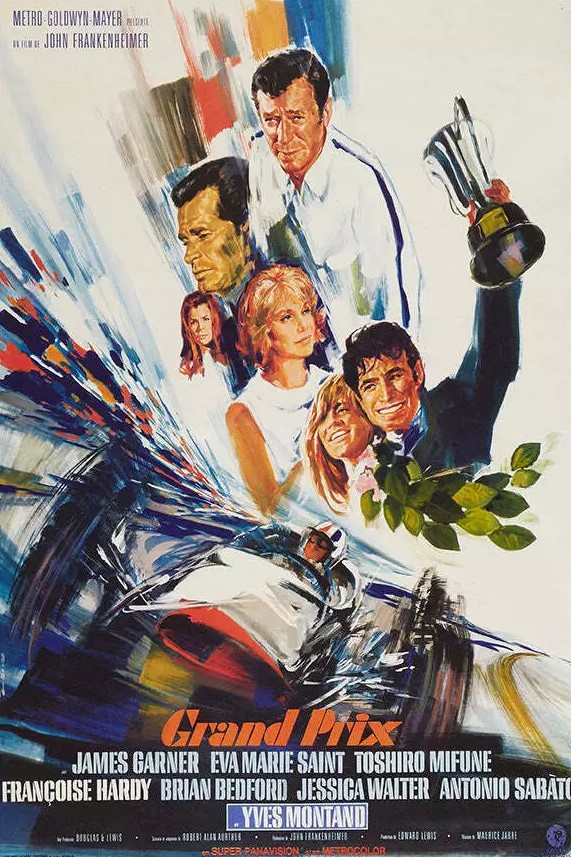
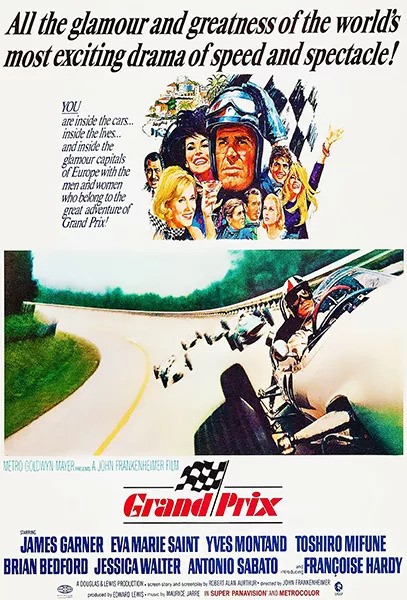
Grand Prix (1966) *****

If ever there was a case to be made for six-track stereophonic sound or, for that matter, split screen Grand Prix would form the first line of defense. That it was made in Cinerama 70mm was merely a bonus. Most roadshow movies start with an overture, a ten-minute or so musical introduction that would thematically at least give the audience some indication of the picture they were about to watch. Thrumming and roaring engines formed the montage opening to Grand Prix, a noise that almost shook a cinema to its foundations.

Cinerama had been built on its ability to create almost primeval effects. There was always a downward rush, a runaway train, a roller coaster, something to set an audience on the edge of its seat in pure exhilaration. But the visual had nothing on the aural and what set Grand Prix apart was danger, that constant thrum of engines rising to impossible crescendos. Split screen allowed the director to tell several stories at once as competitors chased each other round perilous circuits at a time when death was a racing driver’s constant companion and in fact of the thirty-two professional participants including Graham Hill, Jim Clark, Juan Fangio and Jack Brabham five were dead within two years of the movie’s completion. Nobody needed to remind an audience how hazardous the sport was, they could read about the continuous carnage in the newspapers, but what was less easy to convey, although such events were well attended, was the pure thrill of being at a race meeting. Grand Prix set out to rectify that problem.

At nearly three hours long it had room to tell several stories and in that respect it was more of an ensemble picture than something like Lawrence of Arabia (1962) which took even more time to tell just one story. Many of these stories came to an abrupt end as the character died in an accident.

Steve McQueen and Paul Newman, both racing aficionados, were front runners for the leading role but it went instead to James Garner, also a racer who did all his own driving (though not necessarily at the speeds indicated). And to properly represent the competition it required an international flavor so other drivers were played by Yves Montand (The Wages of Fear, 1953) in a part first offered to Jean-Paul Belmondo and Antonio Sabato (in his second film) with Adolfo Celi (Thunderball, 1965) as the Ferrari boss and Toshiro Mifune (Seven Samurai, 1954) as a Japanese team owner. Swedish star Harriet Andersson (Through a Glass Darkly, 1961) was cast as the female lead but dropped in favour of Eva Marie Saint (Exodus, 1960) in a role turned down by Monica Vitti (Modesty Blaise, 1966).

Garner and Saint had previously worked together in thriller 36 Hours (1964) and it said a lot for his marquee credentials that he was still best known for The Great Escape (1963). Although he had reached top billing status, films like The Art of Love (1965) and Mister Buddwing (1966) did not deliver commercially. Saint’s career had been as peripatetic after Exodus (1960) as before, star of All Fall Down (1962) but third-billed in The Sandpiper (1965) and second-billed in The Russians Are Coming, The Russians Are Coming (1966), the latter two both big hits.

Frankenheimer had directed Saint in All Fall Down and enjoyed a distinguished career with The Birdman of Alcatraz (1962), The Manchurian Candidate (1962) and Seven Days in May (1964) although the high regard in which he was generally held was somewhat tarnished by The Train (1965) and thriller Seconds (1966), the latter a spectacular flop. Grand Prix was not only the biggest film of his career, though The Train had given him a grounding in action, but also his first in color.  The movie was filmed on existing legendary circuits with Formula 3 racing cars adapted to look like Formula 1 and a thousand other incidental details including an appearance by a Shelby Mustang (with Carroll Shelby as technical adviser) that made it an accurate depiction of the sport. Eighteen cameras were used to film the races.

The narrative arc follows the Grand Prix season and while the actual competition dominates the movie it is against the background of the emotional turmoil the sport wreaks on the drivers and the wives and girlfriends who have to live with the knowledge that their partners might not come home at the end of the day. Garner is considered too reckless for the top spot in a racing team and in a bid for redemption signs for a new company. Former world champion Montand is coming to the end of his career. English actor Brian Bedford makes his mainstream movie debut as a driver recovering after a horrific crash caused by Garner. The emotional subplots comprise Garner having an affair with Bedford’s wife (Jessica Walter); Montand embarking on an affair with Saint who plays a magazine writer, with French actress  Francoise Hardy (better known as a chanteuse) involved with Sabato. In addition, there are some telling sequences in which the drivers unload about their fears.

Frankenheimer does a terrific job in marshalling all the effects and the minute details, and the fact that there is no big star in the mix makes the battles between the characters more realistic.  

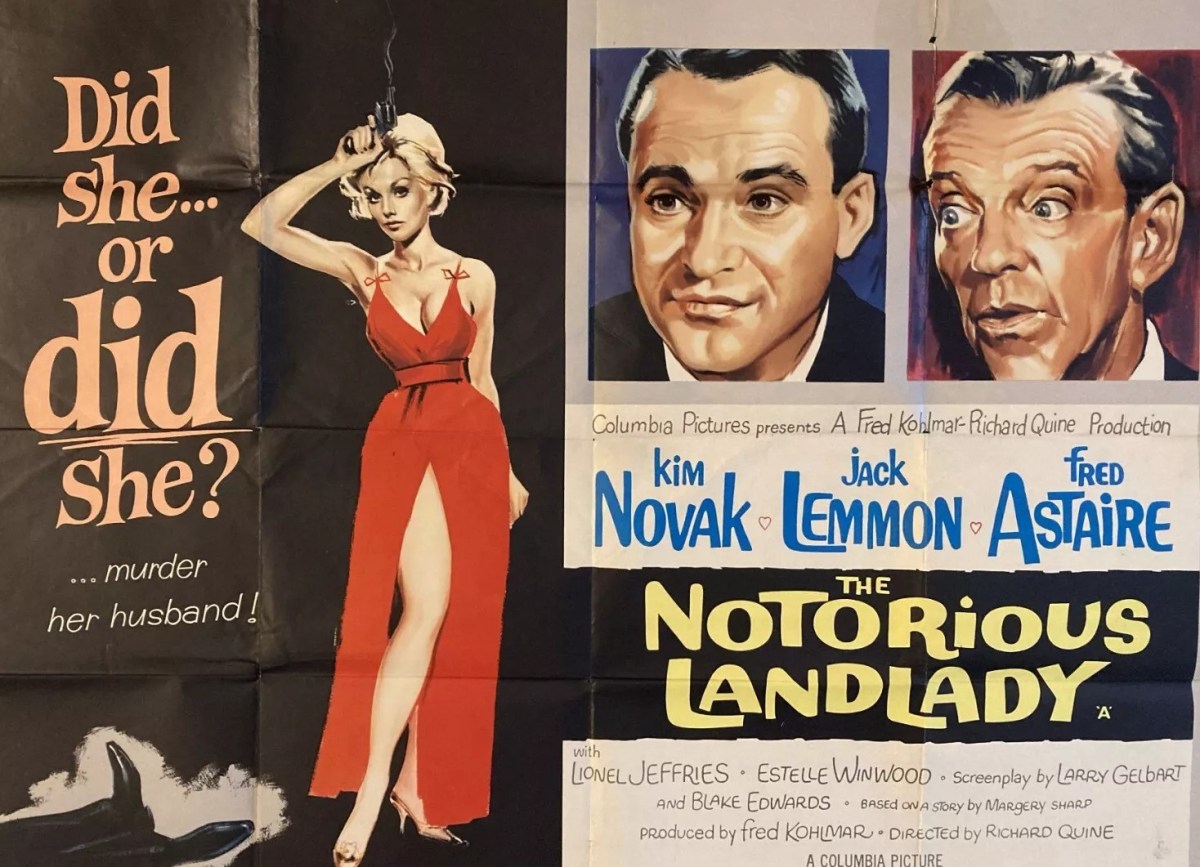
The Notorious Landlady (1962) **

Botched job. Not an all-out stinker. Something that should easily have worked – and didn’t. Thanks to the principals involved. Biggest finger of blame points at Jack Lemmon (How To Murder Your Wife, 1965), who jitters and jabbers, arms waving, eyeballs swivelling, classic example of over-mugging the pudding.

But Kim Novak (Strangers When We Meet, 1960) is as bad for the opposite reason. She’s completely insipid. Sure, she’s meant to be playing someone frightened out of her wits but she could as easily be worrying about how to lay the table for all the energy we get.

Director Richard Quine (Strangers When We Meet)  hardly gets off scot-free for allowing this to happen as well as quite bizarre shifts in tone from a fog-wreathed London straight out of Sherlock Holmes, to a denouement with Novak naked in the bath – Lemmon averts his eyes but the camera and hence the audience doesn’t – and a climax straight out of the Keystone Cops. I know Quine had a fling with Novak but it looks like he’s trying to share her physical charms with all and sundry, scarcely a scene goes by where’s she’s not in her underwear, night-time apparel, soaking wet one way or another or wearing revealing outfits. The “Notorious Cleavage” might have been a better title.

As I say, this should have worked. The story is straightforward enough, a mystery, red herrings aplenty, mysterious lurking figures, enough twists to give it edge.

Diplomat William Gridley (Jack Lemmon), newly arrived from the States, comes to view an apartment to rent in Mayfair only to find landlady Mrs Hardwicke (Kim Novak) most unwelcoming. Unfortunately for her, it’s love at first sight for him, so she can do no wrong. Which is unfortunate for him, for she is suspected of murdering her husband. That doesn’t sit well with Gridley’s boss Ambruster (Fred Astaire) who feels staff should be completely above board and not risk the good name of the U.S. by consorting with film noir style damsels.

Ambruster is already in cahoots with Inspector Oliphant (Lionel Jeffries) and it’s not long before Gridley is enrolled to act in an undercover capacity, sneaking into her bedroom, finding a gun in a drawer and overhearing suspicious phone calls all the while continuing to romance her. Meanwhile, he’s woken up in the middle of the night with her playing an organ. He’s such a clumsy clot he manages to set fire to a garage, which attracts front page headlines and puts his career in jeopardy.

Anyway, various red herrings later and Ambruster somewhat mollified after falling for Hardwicke’s charms himself, we discover that her husband isn’t missing after all, but when he turns up, she shoots him dead and so ends up in court charged with his murder. His death, while convenient, is treated as accidental.

But the fun’s only just beginning. What could have been a shade close to film noir or the kind of romantic thriller Hitchcock turned out in his sleep, now takes a quite bizarre turn. It transpires that her husband, a thief, has hidden stolen jewels in a candelabra which, because she’s short of cash, she has sold to a pawnshop. This emerges in the aforementioned bathtub contretemps. But Hardwicke is being blackmailed by the witness whose evidence cleared her. Said witness has made off with the jewels and now plans to kill off the real witness. So they all end up at a retirement village in, where else, Penzance. Gridley has to save the real witness from being run off the edge of a cliff in a wheelchair while Hardwicke and the fake witness would have had a real old catfight if either of them could have managed to land a punch, instead of hitting the ground or falling backwards into bushes, so the entire climax suddenly takes a distinct comedic turn.

There’s not even a decent performance from Fred Astaire (The Midas Run, 1969) or Lionel Jeffries (First Men in the Moon, 1964) to lift proceedings. In fact, the best performance comes from villain Miles Hardwicke (Maxwell Reed) who rejoices in lines like, “ I like you better when you’re frightened.”   

Written by Larry Gelbart (The Wrong Box, 1966) and Blake Edwards (The Great Race, 1965), which would make you think comedy, and that this was a spoof in the wrong directorial hands, except that Edwards was responsible for Experiment in Terror / Grip of Fear (1962) so knew how to extract thrills.

Coulda been, shoulda been – wasn’t.

Discover WordPress

A daily selection of the best content published on WordPress, collected for you by humans who love to read.

The Atavist Magazine

by Brian Hannan

WordPress.com News

The latest news on WordPress.com and the WordPress community.