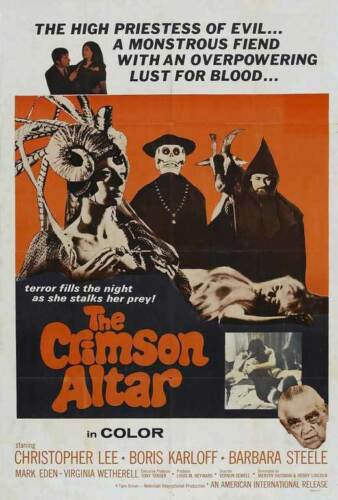
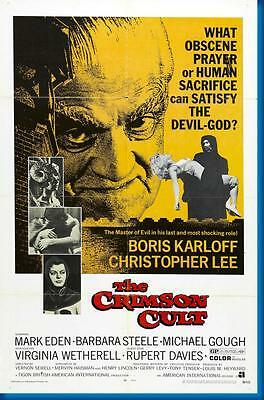
Horror is a small world and at any moment you are likely to bump into stars of the caliber of Christopher Lee, Boris Karloff and Barbara Steele – or in this picture all three. Investigating his missing brother Peter sends antiques dealer Robert Manning (Mark Eden) to a remote country mansion where he encounters owner Morley (Christopher Lee), his seductive niece Eve (Virginia Weatherall), the wheelchair-bound authority on witchcraft Professor Marsh (Boris Karloff), deaf mute Elder (Michael Gough) and a centuries-old mystery.
Morley can legitimately deny that Peter has ever set foot on the premises since it was common for the brother to adopt an alias when seeking out significant antiques. By the time Robert amasses sufficient clues to challenge Morley on this particular issue, it appears that further ideas of more sinister goings-on may be illusory. On his first night Robert observes an annual celebration of the Black Witch but although an effigy is burned this festival appears to have more to do with the innocent consumption of alcohol and heady bouts of sex than satanism.
And after a while, Robert indulges in carnal delight with Eve. However, he is plagued by a nightmare that involves a grotesque trial by a jury wearing animal heads. Gradually, he learns Morley, meanwhile, is such a congenial host, and his niece delightful and sybaritic company, that the finger of suspicion points at Elder, who does take a pot shot at Robert, and the professor who has a collection of instruments of torture.
Were it not for veteran director Vernon Sewell (Urge to Kill, 1960) beginning proceedings with some kind of black mass complete with floggings and female sacrificial victim, the audience might have been kept in greater suspense. As it is, the non-violent annual celebration throws us off the scent as does the seduction of Eve and the prospect that Robert’s nightmare is little more than psychedelic hallucination. The denouement is something of a surprise. The ritualistic aspects of the picture are well done and given this is a Tigon film rather than Hammer you can expect harsher treatment of the S&M element, especially for the period.
The eerie atmosphere and well-staged witchcraft scenes are a plus, but, despite the involvement of a handful of horror gods, the movie’s reliance on lesser players to drive the narrative is a minus. Lee, Karloff and Steele (though in a more minor role) are all excellent as is the demented Michael Gough but Mark Eden (Attack on the Iron Coast, 1968) is too lightweight to carry the picture although Virginia Wetherall in her first big part suggests more promise. More of Lee, Karloff and Steele would have definitely added to the picture but since this type of film often requires the young and the innocent to take center stage that was not to be.
Directed by Vernon Sewell (The Blood Beast Terror, 1968) from a script by Dr Who writers Mervyn Haisman and Henry Lincoln and Jerry Sohl (Die, Monster, Die, 1965).
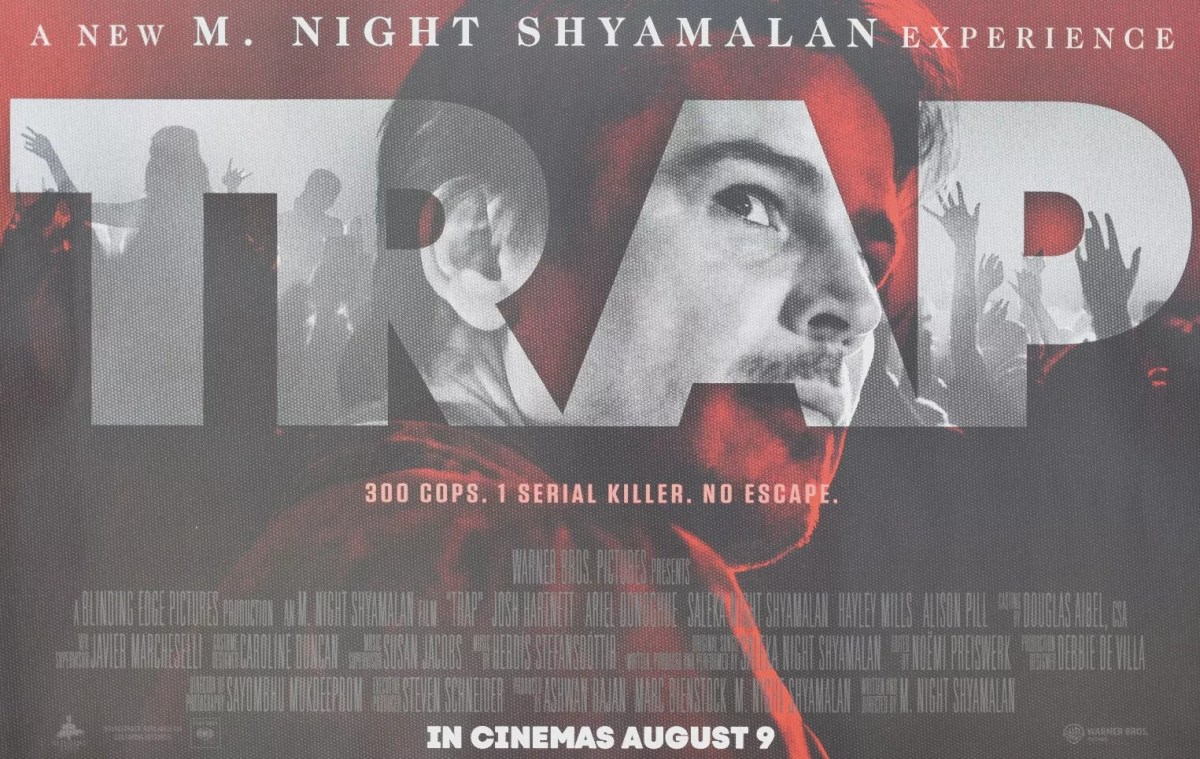
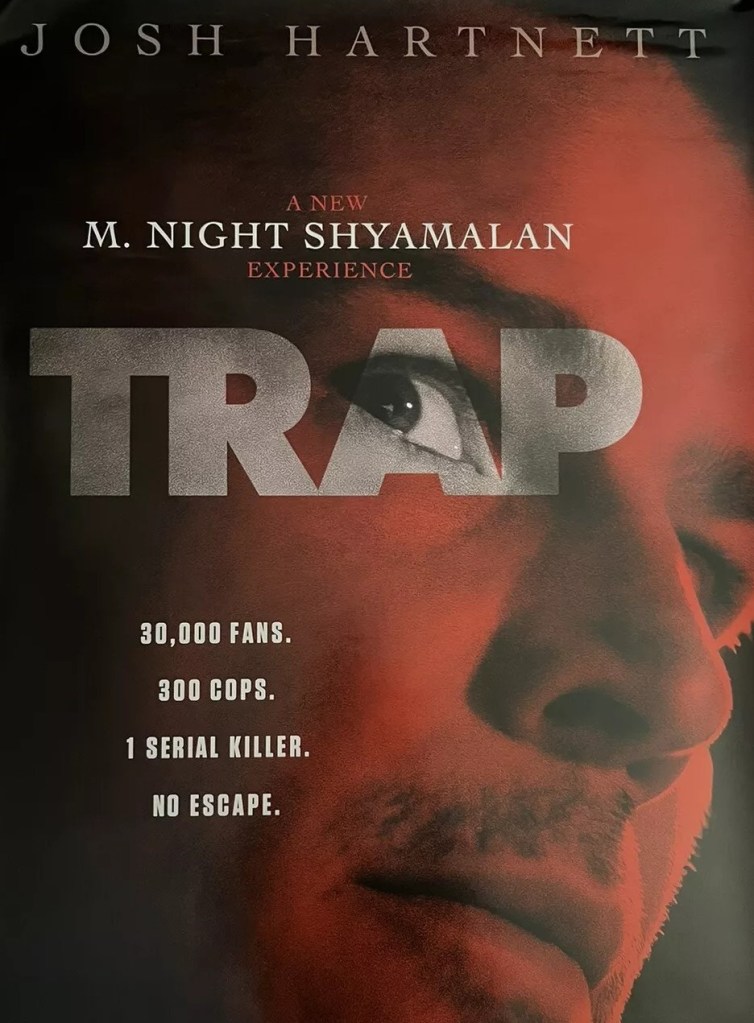
The nepo is in – resulting in an all-time calamitous vanity project. Not only has director M. Night Shyamalan chosen to devote a good 30 minutes of the running time to showcasing his daughter Saleka’s talents as a singer (and for I know she may be the next big thing) but has also decided that this movie would provide an ideal opportunity for her movie debut. On top of that, star Josh Hartnett has opted for a cartoonish portrayal of his character, all goggle eyes, wiggling eyebrows and over-the-top facial expression.
Having bored us to death for well over an hour, the director then opts to let fly with twist after nonsensical twist. Virtually every law enforcement person has uniform emblazoned with FBI, POLICE, or SWAT, but you might as well have branded them all as DUMBASS for all the sense they show. Despite theoretically having some kind of description of the serial killer known as The Butcher (top marks for originality), the cops proceed to pull out of a concert any number of people who bear no resemblance at all to each other.
The set-up, should you be remotely interested, sees Cooper (Josh Hartnett) taking teenage daughter Riley (Ariel Donoghue) to a sold-out concert by latest pop sensation Lady Raven (Saleka Night Shyamalen) only to discover the venue is crawling with cops and FBI hoping to ensnare said killer by the simple device of stopping all of the 3,000 male attendees as they leave unless in one of their random audience selections they happen upon the villain. Cooper is soon alert to the problem and finds clever ways to avoid detection, including convincing Saleka’s uncle (M. Night Shyamalen) whom he couldn’t know from Adam that his daughter has recovered from leukemia, the kind of sob story that will result in Riley being selected to join the singer on stage for one number.
Cooper then manages to nip out the back door by taking Lady Raven hostage. Though, wait for it, it turns out that the FBI have trained her about what to do in the event of such an occurrence, which is some psychobabble about behaving like his mother and telling him to stop being effectively (shades of Life of Brian) such a naughty boy. Turns out, too, his wife Rachel (Alison Pill) has harbored sufficient doubts about her husband that she’s alerted the police that the killer is going to be attending the concert, hence the manhunt, but not done the sensible thing of fully identifying him which, of course, would stop him killing anyone else and save the police the cost of putting a couple of hundred cops on duty at the concert hall (some people!). Nor with a kettle boiling has she the gumption to pour the boiling water over him.
Just when it looks as if clever Lady Raven has outwitted our thug and called on her social media cohort to track down his latest victim, we’re treated to a whole spree of idiotic twists, mostly of the catch-and-escape-catch-and-escape variety.
Mostly, I felt insulted. I’ve been loyal to M. Night Shyamalen over the past quarter of a century, even recently popping back to the cinema to view (and review) his classic The Sixth Sense (1999). After Unbreakable (2000) and Signs (2002), his output became variable, disastrous ventures like The Last Airbender (2010) and After Earth (2013) partly redeemed by Split (2016) and Glass (2019). He’s kept hmself in the game by independent production and low-budgets, his name retaining enough marquee pull to keep his pictures in profit.
But with Trap he’s just showing contempt for his audience. Will Smith I remember going down a similar route, demanding his offspring have major roles in some of his projects, but the whole nepo business is getting out of hand. Sure, you can’t blame kids for being born to parents who are global superstars nor for believing they are entitled tofollow suit. But Hollywood is littered with kids who were showered with praise or given unfair advantage only to find audiences held their efforts in little regard.
This might well have worked if we’d got to the twists quicker, lopped off a good 20 minutes of concert footage and stuck to the narrative. As it was, by the time we get to anything that could remotely be deemed thrilling, the audience has fallen asleep.
Josh Hartnett’s all-time worst performance. M. Night Shyamalan’s worst film. Hopefully, all this effort to build up his daughter’s singing career is worth it because I can’t be the only one who feels duped.
Vanity project. Two words to strike fear into the heart of a studio executive. Generally means a star has got the worthy itch. Determined to attach himself to a movie of Shakespearian proportions. Something with literary heft. Wants to break clean away from the persona that made him a star.
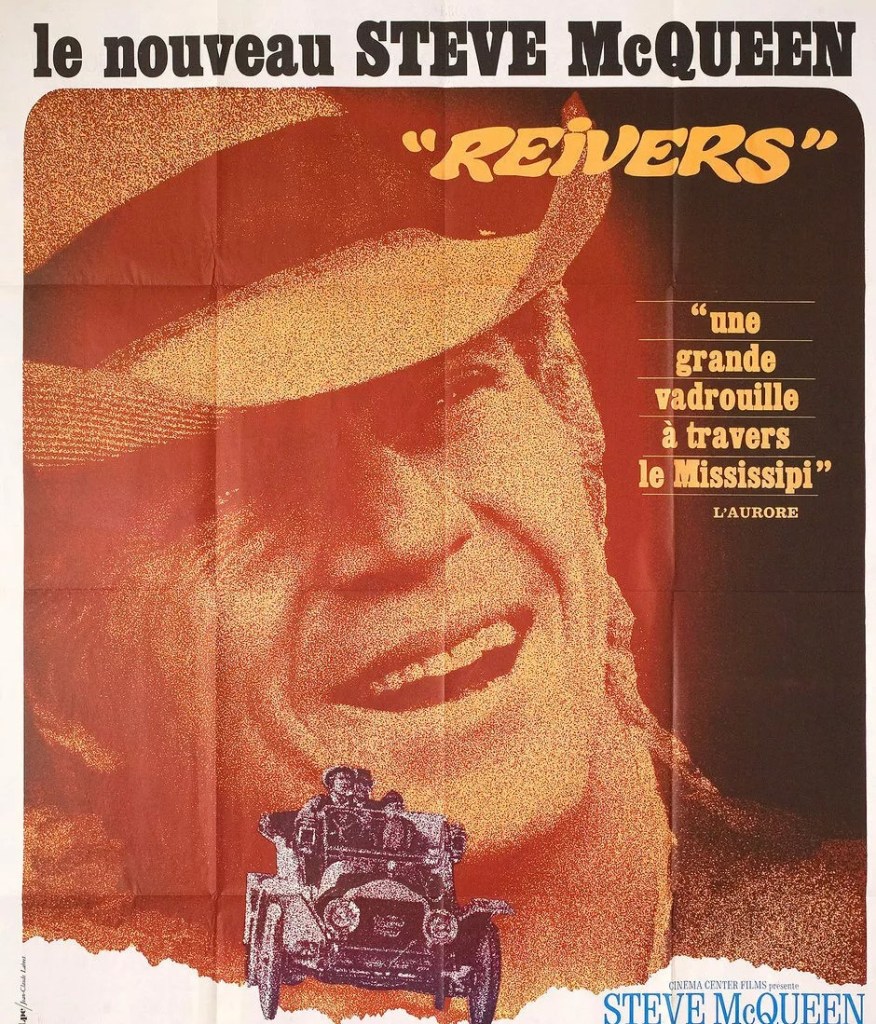
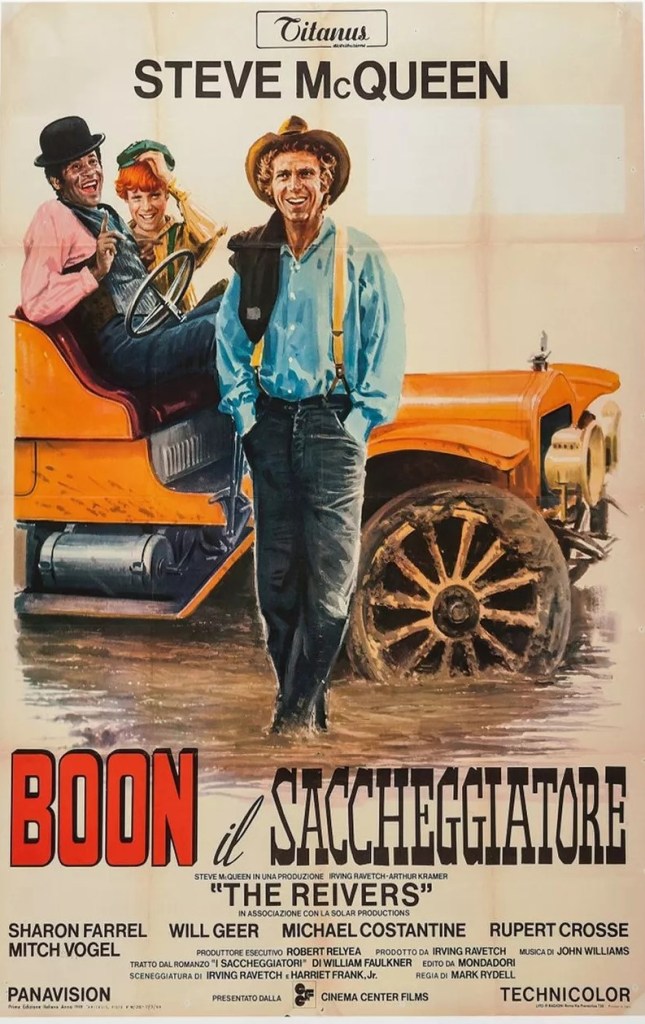
Experienced studio honcho, scenting red ink a mile off, rejects the proposal, or agrees to it on the condition said star first makes two, maybe even three, of the studio’s more straightforward movies. (Warner Bros had Steve McQueen on a six-picture contract). On the other hand, out there, in the Hollywood hinterland, there’s always some less well-known producer willing to pony up an enormous fee as the price of making his name. Or, in this case, a nascent mini-major, the kind that thinks it will become an ”instant major” should it sign a contract with the biggest name on the planet after the rip-roaring box office of Bullitt (1968). Step forward Cinema Center, the movie arm of CBS television, desperate to make a Hollywood splash.
Am sure the pitch wasn’t: “comedy about a thief and a sex worker.” More likely the plus point was William Faulkner, America’s most famous living writer (along with John Steinbeck), winner of the biggest award in literature, the Nobel Prize, whose short story provided the source material. Faulkner also, as it happened, had a decent movie pedigree having adapted Bogart-Bacall vehicles To Have and Have Not (1944) and The Big Sleep (1946) while an adaptation of his short stories into The Long, Hot Summer (1958) hit the box office jackpot.
Admittedly, The Sound and the Fury (1959) and Sanctuary (1961) had been less successful, but Fox had also turned The Long, Hot Summer into a television series that ran for two seasons, so the author’s name would be fresh in the audience mind.
It’s always a worry when an actor changes his hair style. Means he’s going method or “acting.” Here, Boon (Steve McQueen) sports a bushy blond barnet. And spends most of the time in “aw shucks” mode, whirl-winding his arms, contorting his features, doing most of the things a decent director would have told any other actor to cut it out. It would take a lot more acting talent than Steve McQueen, pushing 40, can tap into to successfully convince as a guy in his 20s
At least, he’s acting enough to allow himself to be covered head-to-toe in mud, something a major star would generally avoid. The comedy is as broad as you can get and director Mark Rydell (The Fox, 1967) shows little aptitude for it, not least in knowing when to stop milking a scene.
Biggest problem is that Boon, in narrative terms, is not the star, merely the conduit. The story actually concerns 11-year-old Lucius (Mitch Vogel) growing up, as he’s lured into a scheme hatched by Boon to borrow his employer’s spanking new automobile (this is 1909, by the way) and head off for the local whorehouse. Along the way, the child becomes a jockey riding a race Boon must win.
Sex worker Corrie (Sharon Farrell) has the other major story strand and the biggest element here is the relationship between herself and the boy. When he brings out her mothering instincts, she is ashamed of her profession and she plans to quit. The boy sees a naked woman for the first time – a painting, not in person – loses his worship of Boon and doesn’t “quit” as if he’s in a hard-tack B picture.
Pretty much glossed over is the rape. You can’t have rape in a comedy, can you? But for various reasons Boon and his black buddy Ned (Rupert Crosse) and the ladies from the whorehouse have ended up in jail. Price of freedom is Corrie having sex with corrupt cop Butch (Clifton James). Corrie has the best scene, the look of humiliation on her face, when released from the cell to be raped by the cop. And this was a film sold as “a lark.”
And, of all things, Boon is purportedly in love with Corrie, but not so much that he doesn’t plan on having sex with one of the other girls, given he visits the whorehouse three times a week and Corrie, in a bit of a tizz, has turned him down.
Small wonder this has never been the subject of an anniversary revival. Hard to see how the attitudes reflected here would connect with the contemporary audience. Scarcely believable that McQueen could get himself involved, even for the privilege of being linked, at some remove, with William Faulkner.
Chances are what originated from the Faulkner pen as a more somber coming-of-age tale was altered by screenwriters Irving Ravetch (doubling up as producer) and Harriet Frank Jr (The Dark at the Top of the Stairs, 1960) to fit in with McQueen’s ambitions. The star had not wanted to make Bullitt, having an aversion to cops, and this looks like his attempt to make up for it.
Actually, it did well at the box office, Rupert Crosse and composer John Williams nominated for Oscars and McQueen and Mitch Vogel for Golden Globes.
A different McQueen, to be sure, but the subject matter is objectionable and the comedy is forced.
Considerably more prescient than perceived at the time. Predicts the influence of pop stars – immeasurably magnified now through social media – and instant cancellation as a consequence of inappropriate action or remark, plus the way marketing tie-ins can boost product. Itemizes more succinctly the corporate pressure brought to bear on entertainers as well as the constant public exposure that denies performers any privacy. The radio in a watch was way ahead of its time and you could also argue that it predates A Clockwork Orange (1971) in identifying the attraction of violence and it touches on self-harm.
It’s both daft but realistic, overblown but intimate, mixing gibberish and brilliance so well it’s hard to know which side to come down on. All the obvious targets – Church, Government, big business, the dumb young – are here.
The story is set in a Big Brother style “near future” when control of the masses is the aspiration of Government. Steven Shorter (Paul Jones) is the messianic pop star trapped by fame. His stage act is quite stunning. Imprisoned in a cage, handcuffed, brutally beaten by warders, he sings of freedom to a young, mostly female, audience driven to tears by his ordeal, and occasionally on the point of rioting.
Paul Jones’s performance was criticized at the time because reviewers wanted performer more than puppet, but, at the distance of a half a century, it looks more like the actor has made the correct choice, entombed by the restrictions placed upon his life.There’s scarcely a rebellious pop/rock star alive who hasn’t been in the thrall of big business. Rebellion is the modern equivalent of “bread and circuses,” whatever keeps the young happy and limited to venting their own revolutionary tendencies in a contained situation, and in this case endorsed by the State. The history of music is littered with entertainers taken advantage of by big business and, just as likely, willingly signing a big deal they later regretted – Creedence Clearwater Revival, George Michael come to mind though Taylor Swift found a sweet way of taking financial revenge. And of decades of tours that appeared to benefit as much the sponsors as the entertainers.
While there’s a 1984 vibe here, that element of a single party in eternal control of Britain is as relevant now as then. Some would argue the world, through the dominance of social media, is more vacuous than before. Others, precisely because of social media, less vacuous. Entertainers might be willingly enrolled to sell a variety of products or promote political activity, any one of which could be interpreted as as harmless as being used to sell 600 million apples which will go to rot unless immediately consumed, which is the marketing task in hand here.
Critics at the time were less taken by the principals, the pop star Steven Shorter (Paul Jones) and potential love interest Vanessa (Jean Shrimpton), recruited to paint his portrait but, in effect, presented as a glorified groupie. They wanted the performer to be as charismatic offstage, in the manner of Mick Jagger or John Lennon, as on, as if stage antics could not be separated from reality. But I found the numbing down of Shorter more authentic. He had lost/sold his individuality, he went where his bosses dictated, and although not indicated you could as easily equate his offstage life to being stoned out of his mind, which would accord with the experience of lot more entertainers afterwards than at the time.
If he only comes alive through performance that, too, while taken to an extreme, would be in line with the experience of many performers whose personality only catches fire when performing. Many actors, for example, will insist that fulfillment comes from wearing a variety of stage or screen masks.
And Shorter’s inherent masochism, willingly accepting the blows delivering by his truncheoned guards on stage, his back covered in scars, resonates more strongly today when self-harm in an indicator of poor mental health. Yet, he can rebel, aware of the individual control he exerts, that he chooses to demonstrate almost contemptuously when at a grand dinner party he refuses wine and insists instead that everyone, even his supposed boss, partakes of hot chocolate.
The other notion touched upon, which resonates far more today than then, is the price fame exacts, most importantly loss of privacy. When Vanessa, not unexpectantly, falls for our hero, she declines to take their brief affair further, “we’d never be alone together, not really.” And it’s surely not unintentionally ironic that the theme of his main song is “set me free.”
Bob Dylan embracing the electric guitar, scandalizing his purist folk base, might have provided the impetus for the climactic scenes, when the messianic Steven turns his back on rebellion (“repents” in a brilliantly staged concert) and instead embraces traditional Christian values, providing an opportunity for surprisingly entertaining pop versions of Onward Christian Soldiers and Jerusalem.
I haven’t mentioned that this isn’t a straightforward candidate for the A Star Is Born sub-genre, reporting rise and fall in standard manner, but instead is presented as documentary, but of the kind that would be more easily appreciated today, seductive camera dominant rather than the intrusive presenter, with all subsidiary characters either justifying their behavior or being shown abusing their position.
Probably most relevant of all is that Shorter’s career comes to a close from inappropriate remark, triggering cancelation and loss of “privilege.”
I can see why director Peter Watkins chose someone who could sing for his main character – Paul Jones had been lead singer of Manfred Mann before going solo, in both guises releasing a string of hit singles – since that kind of veracity is virtually impossible to achieve from miming or imitation. Instead of delivering a poor performance, and elivening every moment with “charisma,” it appears to me that Paul Jones, in his movie debut, is instead correct to follow his intuition or inner truth that offstage an entertainer is a mere ghost of himself. I would hazard that model Jean Shrimpton wasn’t called upon to do much acting, but her own soft-spoken Engish rose personality with just a hint of steel suits her character well.
Watkins, too, resisted the temptation to litter the background with scene-stealing supporting actors, or those hoping for a career break, and of these only Jeremy Child (A Fish Called Wanda, 1988) might be instantly recognizable.
Watkins had made his name with what appeared at the time to be tougher-talking television docu dramas Culloden (1964) and The War Game (1966), the latter so graphically showing the effects of nuclear war it was promptly banned. While Privilege on initial release carried little of the power of the first two, in retrospect it has come into its own. The only screenplay by Norman Bogner, better known for television, from an idea by Johnny Speight (BBC’s Till Death Do Us Part, 1966-1975) which translated to the U.S. as All in the Family, 1971-1979).
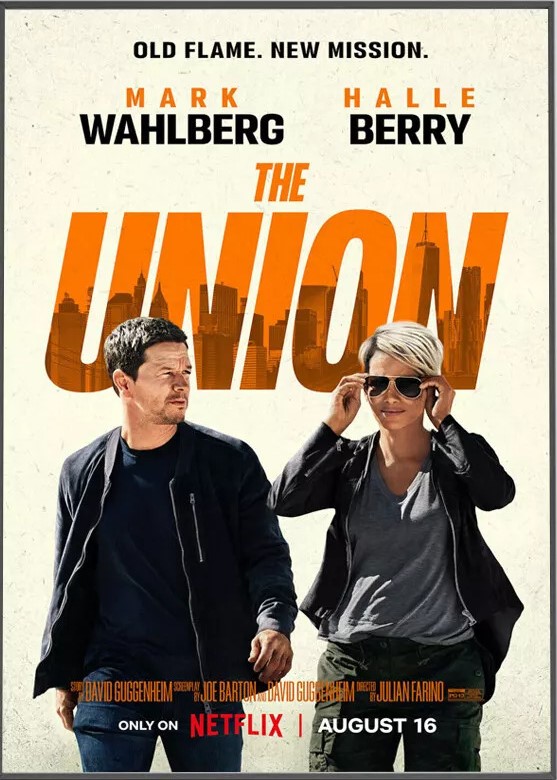
Wahey! At long last Netflix gets it right (almost). Admittedly, the narrative depends on a very slippery MacGuffin, the kind that would take gold at the MacGuffin Olympics and still come back for more. That aside, it’s got pretty much what audiences are looking for in a fresh take on the hoary old espionage combo. Mark Wahlberg has been long under-rated, can do action (Planet of the Apes, 2001, Uncharted, 2022), caper (The Italian Job, 2003), comedy (Ted, 2012) and drama (Father Stu, 2022). Half the time he’s the driving force behind his projects, 44 credits as producer, which means he’s pretty independent and often turns in the type of picture you think he shouldn’t do or won’t work and sometimes it does and sometimes it doesn’t.
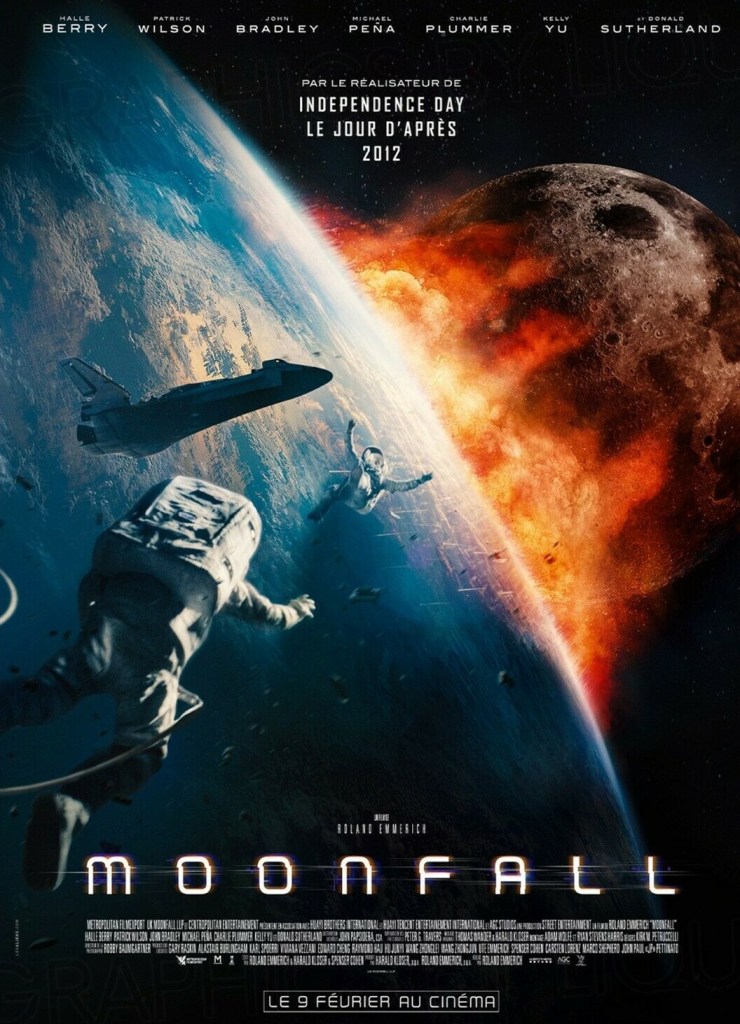
He’s wearing the producer’s jacket for this one and you’d be surprised how well it spins because this is a team effort, very much dependent on the chemistry created with Halle Berry, who you have to agree you wondered where the hell she had gone beyond the lead in the financially disastrous Moonfall (2022), supporting parts in the likes of John Wick 3: Parabellum (2019) and Kingsman: The Golden Circle (2017) and some worthy but ignored pictures.
Netflix is pretty mean when it comes to posters so here’s another with Mark Wahlberg that I reviewed before.
Well, she’s back and yes she’s kicking ass, but that’s not what makes this movie tick any more than Mark Wahlberg punching and shooting. What makes it sizzle is their chemistry, every bit as solid as Glen Powell and Sydney Sweeney in Anyone But You (2023). And if you recall, that worked because Powell and Sweeney bickered all the way through it. Maybe this is what contemporary romance has come to: a quarrelsome couple.
It certainly keeps this pair on their toes. There’s been any number of fish-out-of-water action scenarios that have sunk like a stone (Argylle, anyone?) because the director didn’t hit the correct tone. Here, English director Julian Farino, best known for television, strikes exactly the right tone between incipient romance, action and comedy.
Middle-aged Mike (Mark Wahlberg) isn’t exactly hero material or Brad Pitt. He goes for the cougars, and we first come upon him in the bed of his Seventh Grade school teacher while his mother (Lorraine Bracco) is always one step ahead of her cocky son. We meet secret agent Roxanne (Halle Berry) in the middle of a disastrous operation of which she’s the only survivor.
You have to pass over the logic of how ultra-secret Government agency The Union comes to recruit construction worker Mike, setting aside that Roxanne once had the hots for him. Anyway – MacGuffin alert – the Government has lost the biggest MacGuffin of All Time and have to get it back by way of lots of things that don’t make much sense, but we’ll let that go as well. Anyways, Mark gets trained up in a mighty peculiar and highly entertaining fashion and becomes her sidekick as they hit the MacGuffin trail which takes them to foreign spots.
I was one of the few people who liked “Moonfall” with Hally Berry so I don’t mind giving it another plug.
There’s supposedly a mole in the Union and the finger points at their boss Tom Brennan (J.K. Simmons) but there’s a whole bunch of other secrets and twists in the mix and not much time what with the frenetic action to work out what exactly is going on beyond said MacGuffin running riot.
But there are some terrific set pieces and Mike’s girder-balancing skills come in handy when there’s even a moment when the action stays relatively still because most of the time it’s hurtling all over the place, chase upon chase, and normally that would spell the kiss of death, as we discovered with Argylle et al, except somehow here, with the chemical interplay between the two leads and supporting characters more interesting than most – look out for Jackie Earle Haley and Jessica De Gouw – and some zingy lines, it’s just dandy.
The ending sets up a sequel so bring it on. Top marks to Mark Wahlberg in his producer’s capacity for seeing this over the line and also, as with Uncharted, not trying to hog the picture and happy to accept that even as the denoted hero he’s going to be outfought and outsmarted a good chunk of the time and better not think he’s ever going to get the better of the Halle Berry character.
Wahlberg is as good as I’ve seen him and this is Halle Berry back on top form, with a lot more to do than in previous action outings where her character got stuck in first gear. As I said, super chemistry between the pair. J.K. Simmons (Spider-Man: No Way Home, 2022) tones it down from his normal over-acting to splendid effect. Jessica De Gouw is one to watch. Joe Barton (Girl/Haji TV series, 2019) and David Guggenheim (Safe House, 2012), in places with their tongues firmly in their cheeks, knocked out the screenplay.
Highly entertaining, even if the MacGuffins are a bit rampant.
Con men at opposite ends of the grifter divide face off in a duel over territoriality in the French Riviera. Freddy Benson (Marlon Brando) is a low-level scam artist who is happy to scrounge a meal or talk his way into an innocent damsel’s bed. Lawrence Jameson (David Niven) is his polar opposite, posing as an impoverished aristocrat to relieve gullible women of their wealth, seduction an added extra.
Initially, Jameson gets the better of their encounters until Benson realizes just what a killing the Englishman is making. Initially, too, Benson is happy to pair up with Jameson, although that involves demeaning himself as a supposed mad brother kept in a dungeon, until the Englishman dupes him out of his share. Eventually, they agree a winner-take-all battle – whoever can swindle heiress Janet Walker (Shirley Jones) out of $25,000 shall inherit the shyster kingdom.
Benson takes the sympathy route to the woman’s heart, turning up in a wheelchair, while James adopts a psychological approach, persuading Ms Walker that Benson’s illness is psychosomatic for which he has the cure for the small consideration of $25,000. And then it’s one devious twist after another as the pair attempt to out-maneuver, out-think and generally embarrass the other. Both have a despicable attitude towards women, whom they view as dupes, but it is woman who proves their undoing.
Most comedies rely on familiar tropes and you can usually see the twists coming, but this is in a different imaginative league and once the pair are in their stride I defy you to work out what they will come up with next. It is full of clever quips and small dashes of slapstick and because neither actor chases the laughs but plays their roles straight it is a very effective and entertaining morsel.
Director Ralph Levy in his movie debut knows more than where to just point a camera since he had decades of experience extracting laughs in television with top comedians like Jack Benny and Bob Newhart. Brando (The Chase, 1966) free of the shackles of the angst he normally incorporates into his dramatic performances, looks as if he is having a ball and while teetering occasionally on the edge of mugging never quite overplays his hand.
David Niven (Prudence and the Pill, 1968) was born with a stiff upper lip in his mouth and while this kind of aristocratic character is a doddle for an actor of his stature the portrayal here is much more like the sharpest tool in the box. While oozing charm, Niven exhibits deadly spite.
Screenwriters Stanley Shapiro and Paul Henning had previously collaborated on Lover Come Back (1961) and Shapiro particularly made his bones on the Doris Day-Cary Grant-Rock Hudson axis so it is interesting to see him shift away from the romantic comedy cocoon into something that is a good deal sharper.
Enjoyable and original with excellent performances from the two principles and great support from Shirley Jones (The Music Man, 1962) as the mark and Egyptian Aram Stephan (55 Days at Peking, 1963) as an only too congenial French policeman.
For such a harmless picture The Lion raises a couple of troubling issues. The first concerns the titular beast. Doubt if you’d get the authorities these days to greenlight a movie where a pre-pubescent girl was in such close proximity to a full-grown lion. Having as a safety measure two sharpshooters on the sidelines out of camera range, as director Jack Cardiff did here, might not cut it.
Secondly, we’ve got censor double standard. I remember my shocked parents forbidding me from seeing Zulu (1964), a massive hit in Britain, on account of the toplessness of the indigenous females. The censor didn’t slap an X-certificate on that sequence on the assumption that such nudity, in the context of tribal tradition, wouldn’t apparently incite the lewd male gaze. Had this been white breasts on show, in whatever tradition, the censor would not have been so lenient, signifying an inherent racism. Here, surprisingly, we’ve also got female toplessness, somewhat more discreet than Zulu, but coming as a surprise to your reviewer.
Perhaps the oddest feature of the picture is the contradictory message: Africa is wonderful but it’s not the place to bring up a young girl. Certainly not one who embraces the wildness with considerably more conviction than a passing wildlife tourist. As the imdb stub puts it: the young girl Tina (Pamela Franklin) must be brought “back to civilization.”
And there’s a distinctly old-fashioned tint to a storyline that demands the appearance of her father Robert (William Holden), long divorced from wife Christine (Capucine), as the firm male hand required to drag his estranged daughter back to said civilization. Christine’s current partner John (Trevor Howard), grizzled poacher-turned-gamekeeper, former big game hunter now eking out a living as a game warden, appears more sanguine about the girl’s lifestyle but less welcoming to the visitor. Tina has raised the wild lion King from a cub and as their bond is intense she is reluctant to give him up.
Disney would have taken a different approach, buffing up the cuter aspects. That the studio could show adult and child perspective in tandem is instanced by Pollyanna (1960) and in the later The Jungle Book (1967) solved the problem of a young boy becoming too involved with his wild playmates by having an intriguing young girl tempt him away. Or a touch of the Born Free (1966) playbook might have seen Tina simply mutate from childhood to an adult job in the animal preservation business
Instead, playing out in almost literal fashion, are two human male beasts battling it out (though not physically, unfortunately) over the mother with the needs of the child seemingly swept to one side as the love triangle takes hold.
The best scenes concern Robert and Tina, especially her early disinterest in his presence, and her later delight at leading him a wild dance through the jungle and seeing how his terror of her lion pal equates with her complete lack of fear. While John’s role is to keep a grip on poaching, he’s not so friendly to the animals, almost determined to torment them by running his jeep recklessly at or around them to elicit maddened response and alarm the visitor with their wildness rather than their apparent, at a distance, docility.
Perhaps the lack of a punch-up ensures this movie never catches fire. There’s quite a perplexing sub-plot that dictates the outcome. The son of the local tribal chief has his eye on Tina and during the aforementioned tradition it’s clear the young girl wants to participate in the frenzied dance courtship ritual.
But this kind of tradition is at the polar opposite of civilization as is the tradition that an old man, succumbing to fatal illness, should be left out in the wild to die. Christine intervenes to save him. Meanwhile, believing his father dead, the son sets out to achieve manhood by killing the lion and in the ensuing tangle John kills both young man and lion. The tribal response to the death of their new chief goes unrecorded but Bullit’s action drives Tina towards her parents. With the lion dead, it’s a lot easier to winkle the girl away from Africa and back to civilization.
Plenty of wildlife for your buck, but plot and characters are not a patch on Hatari! (1962) or The Last Safari (1967). William Holden, whose yen for making movies as far away from the U.S. tax authorities as possible was destroying his career, is good value as the estranged father and if you are looking for smouldering then Trevor Howard (The Long Duel, 1967) is your man. Capucine would tee up with Holden – the pair had an affair – again in The 7th Dawn (1964) but she was more effective in the later picture than here.
Jack Cardiff (Girl on a Motorcycle, 1968) directs from a script by Irene and Louis Kamp (The Sandpiper, 1965) based on the bestseller by Joseph Kessel (L’Armee des Ombres/Army of Shadows, 1969).
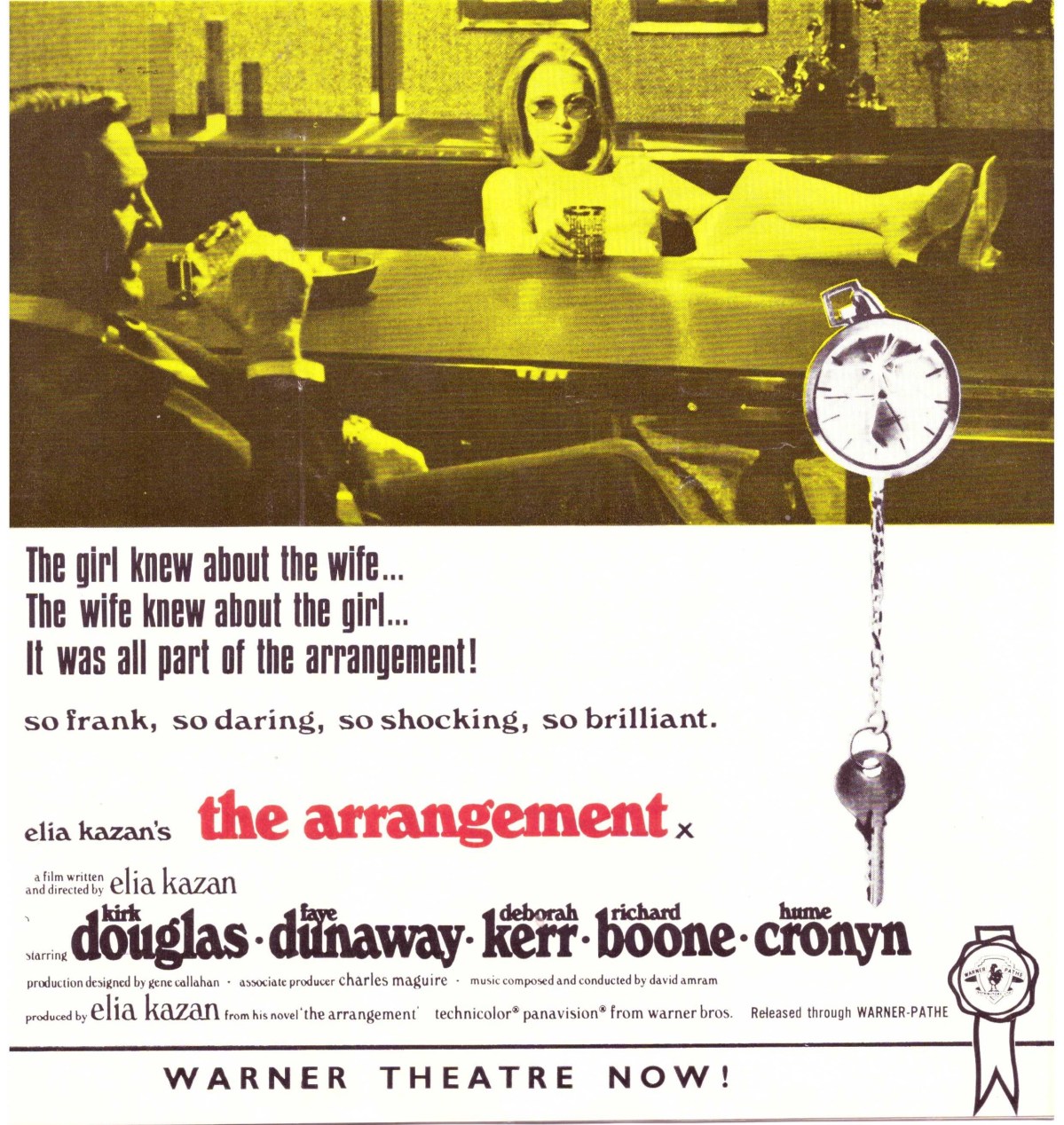
It might have been better if director Elia Kazan had handed over the screenwriting chores for this adaptation of his bestseller about the midlife crisis of advertising man Eddie Anderson (Kirk Douglas). As director he over-angsts the pudding. Anderson’s attempts to juggle wife Florence (Deborah Kerr) and mistress Gwen (Faye Dunaway) coupled with growing disgust at selling a new brand of cigarettes, Zephyr (“The Clean One”), in a way that pointedly avoids their cancer potential, leads to a suicide attempt.
During convalescence he determines to quit the advertising world and go back to his first love, writing, but in fact he ends up sabotaging his career. Florence represents impossible seduction and conscience. Slinky, in dark glasses, hot-tempered rather than submissive or demure, she accuses him of self-deception in his job. The picture flits back and forth between his various choices – different job, return to wife, settle down with mistress, or what seems his ideal world, cossetted by both Gwen and Florence.
Gwen is an excellent study of the modern woman (of that fast-changing period, I hasten to add), who needs a man for sex but not necessarily love, and can use the opposite sex as ruthlessly as any man. What she actually requires in her real life is quite different to what she seeks in the fantasy love she enjoyed with Anderson, sex on the beach, the buzz of controlling a high-powered man. Florence could be seen as an old-fashioned portrait of the adoring wife except for capturing so well the bewilderment of betrayal.
Kazan conjures up some wonderful images: the tension before the suicide attempt as Anderson plays chicken between two trucks, Gwen emerging wet from the pool to eat dangling grapes or with her legs up on Anderson’s desk, Anderson’s mother lighting votive candles in her house before using the same match for her cigarette, Kerr’s futile attempts to win back her fallen husband, Anderson flying solo.
In parts well-observed and directorially savvy, quick cuts between the present and the past, however it sinks beneath its own self-indulgence. My guess is that author Kazan could not bear to kill off a single one of the characters he had created for his acclaimed novel and the upshot is a vastly over-populated picture, few of whom cast any real light on Anderson’s predicament. So we are not only introduced to mother, dying father, brother, sister-in-law and analyst but priest and a bucket of clients and guys from the office. And there are some plot oddities – Anderson gets time off apparently to write journalistic pieces – and what is clearly intended as hard-hitting satire of the advertising world does not come off.
Dunaway (Bonnie and Clyde, 1967) is the standout as Gwen, living life according to her own rules, and with an unexpected vision of domesticity but Deborah Kerr (Prudence and the Pill, 1968) does pain like nobody else and is extremely convincing. Strangely enough, I didn’t go much for Douglas (Seven Days in May, 1964). He could have been leading a cavalry charge for all the range of emotions he exhibited. Douglas is no Montgomery Clift (Wild River, 1960), James Dean (East of Eden, 1955) or Marlon Brando (On the Waterfront, 1954) who was Kazan’s first choice. Kazan had not made a picture in six years and it had been eight years since his last hit Splendor in the Grass (1961). Not quite out-of-touch in concept and delivery, nonetheless it was shunned by the Oscar fraternity.
An odd one distinguished by Deborah Kerr and Faye Dunaway.
Takes a good while to come to the boil, perhaps as a result of trying to find the right chemistry between Doris Day and her latest 1960s partner Rod Taylor, after her highly successful pairings with Rock Hudson in three films. Her turn with Cary Grant (That Touch of Mink, 1962) was also successful, but finding another pairing proved dificult. There was a single outing with David Niven (Please Don’t Eat the Daisies, 1960), a pair with James Garner (The Thrill of It All and Move, Over Darling, both 1963) plus a couple of ventures outside the comedy genre, thriller Midnight Lace (1960) with Rex Harrison and musical Billy Rose’s Jumbo (1962).
One of the curiosities was her billing status, credited below Rock Hudson and Cary Grant, but above all the others. Hudson, Grant, Garner and Niven demonstrated a clear knack for comedy, less so the rest. So one of the elements facing any screenwriter or director was how to make a pairing fizzle. With the top-billed stars, there was more of a guarantee of equal playing time so that they could spark off each other. In the remainder, more reliance on the actress’s pratfalls and slapstick and being some kind of fish out of water.
Here, the Ameican fish is let loose in London waters and good chunk of the opening section is taken up with the oddities of England from an American perspective. First of all, it’s the coinage. A simple transaction with a cab driver soon involves a policeman what with her difficulty in getting to grips with “too many coins”, most of which to add to the confusion often have a nickname, resulting in her paying eight shillings and sixpence for every subsequent ride since that’s the one amount she’s mastered.
Then it’s the problems of driving on the wrong side of the road, using a different gearbox, and the peculiar nature of village names, that either result in a crash or getting lost or both. The difference between electrical plugs lends itelf to electrocution jokes, and the inefficiency of the British telegram system tops off a scene. There’s not much magic even a Doris Day in her prime can add to such standard situations.
She comes into her own somewhat by standing up to the masters of a fox hunt and their snarling hounds. But somehow sheltering a fox appears to give her some affinity with animals and before you know it her country house is awash with unsuitable beasts such as goats.
Still with me? That’s kind of the feeling I had about a third of the way into the picture. So here’s the set-up: businessman Mike (Rod Taylor) and wife Janet (Doris Day) have moved to London. He details her to find an apartment, meaning in central London close to his office. Instead, she lands them in a country cottage, and he immediately resents being so remote from the city and with the extra travelling time plus the evening functions (held in the company flat) in his schedule soon the couple are heading towards estrangement.
He has a pretty secretary Claire (Maura McGiveney) in tow and the functions are meant to be wife-free zones, and when Janet tests out her suspicions she is initially brought down to earth with a thump.
But, of course, suspicion grows horns and with the encouragement of interfering landlady Vanessa (Hermione Baddeley) she decides to play him at his own game. Once handsome Frenchman Paul (Sergio Fantoni) hoves into view she pretends to take up with him to bring her husband to heel. This involves a romantic trip to Paris where, of course, Doris Day is in her comedic element, desperately trying to avoid the advances of her suitor and getting drunk in the process. Day makes an excellent drunk and inebriation cue for many of her best sequences.
Much of the seduction is driven by the foreigner and the secretary so husband and wife find themselves in one compromising position after the other. However, this narrative ploy means the two stars are often apart and the success of the picture depends on two separate individuals rather than the teaming as with the Hudson and Grant movies. To use the old cliché, it’s game of two halves, three-thirds really since the opening section is mostly the fish out of water stuff. They’re an odd combination from the outset, a wife who does the opposite of what her husband wants then complains when, tied down with business, he doesn’t want to live in the country.
There’s an occasional belly laugh but it seems such routine fare that you wonder why Day got involved in the first place – blame husband Martin Melchior for signing her up.
After original director Ralph Levy (Bedtime Story, 1964) – you could view this as a reversal of Bedtime Story with the principals target for seducation rather than doing the seducing – took ill, George Marshall (Advance to the Rear, 1964) finished it off. Written by Milt Rosen (movie debut), Richard L. Breen (Captain NewmanM.D., 1963) and William Fairchild (Star!, 1968)
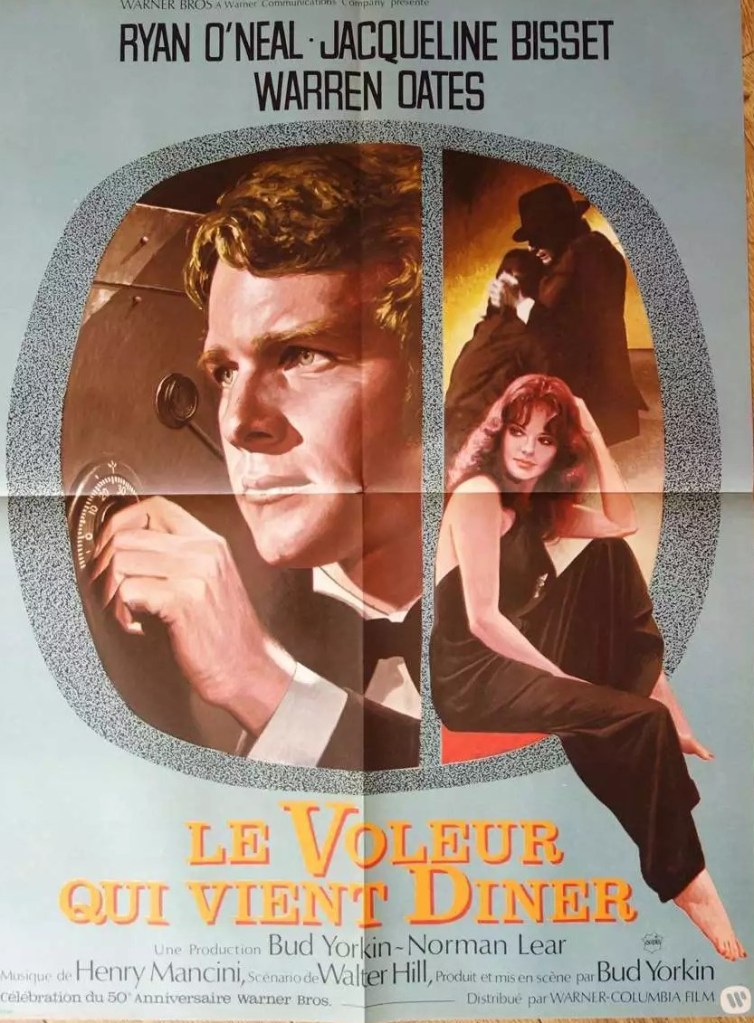
Very unusual entry into the cat burglar subgenre since it plays like a bromantic version of The Thomas Crown Affair (1968), investigator and investigated striking up some sort of relationship, though with an elegant dame on the sidelines to take care of the jewel thief’s sexual needs. Might be surprised to see Bud Yorkin – better known at the time for comedy – helming this classy thriller and Walter Hill, not yet known for tough thrillers, relegated to screenplay duties.
Webster (Ryan O’Neal) quits his job as a computer geek to go into the thieving business. He’s pretty business-like about it, too, setting up a deal with fence Deams (Ned Beatty) before he gets started, and none of this no honor among thieves nonsense. The first break-in, to the house of politician Henderling (Charles Cioffi), delivers a handy bonus of uncovering documents relating to corruption so Webster’s able to blackmail the victim into providing him with an entrée into high society where he can scope the jewellery on show at various parties, and where he meets Laura (Jacqueline Bisset) who appears to be in the same line of work, if at a much lower level.
We never see Laura at work and mostly she hovers in the background, there’s no angst in this relationship, she’s the kind of thief who steals because she’s the bored kind of rich gal looking for kicks. Most of the thieving is interesting one way or another. On his first gig, though Webster had invested in one of those devices that hold onto the glass once you’ve nefariously released it from the frame, he’s so inexperienced the glass breaks.
Instead of quieting guard dogs with doped meat, he sends in a bitch to distract them. He has to deal with illicit lovers turning up in the middle of a robbery. And, of course, with an amazing diamond on show, he just has to organize a way of stealing it.
So with Laura not providing any of the tension, not the usual refusal to become entangled with a criminal, not just the normal lovers’ tiffs, it’s left to insurance investigator Dave (Warren Oates) to provide the friction. He’s not the confident, cocky, kind of detective and it’s diligence that leads him to consider Webster his main suspect. And so begins the cat-and-mouse element, the cat often subverted since Webster knows when he’s being tailed and can lead Dave a merry dance. But, mostly, Webster seems to enjoy the battle of minds.
Webster, and a psychiatrist would have a field day here, leaves a calling card at every robbery in the shape of a chess move, guaranteed to get him the headlines he presumably craves of “The Chess Burglar Strikes Again” variety, which only serves to ratchet up the pressure on the supposed incompetence of his pursuers.
Dave has the bright idea of getting a chess expert Zukovsky (Austin Pendleton) to take the thief up on the game, thus introducing a splendid subsidiary character primarily for comic effect, Zukovsky unaware that Webster’s moves are plotted by computer.
Dave and Webster do spend a lot of time together one way or another, Webster even visiting the detective when he’s hospitalized, and an element of mutual respect evolves. Once their relationship is established, Laura has less to do than be an accomplice, arranging ingenious escapes and so forth, so she’s not entirely out of the picture.
But the most interesting relationship is certainly between thief and ersatz cop. There are some excellent individual scenes, most of the thefts contain some unique element, the confrontations between the two principals play out like a low-key chess game, while the originally cocky Zukovsky, initially relishing the publicity, is reduced to fury at being beaten by an amateur. Webster’s ex-wife (Jill Clayburgh) relishes the change in his personality.
But mostly this is Ryan O’Neal (The Big Bounce, 1969) at the top of his game. No smirking and no screwball comedy. He’s given a well-developed character to play – physically fit, able to hold his own in the boxing gym, capable of cutting a deal with underworld figures – and the screenplay cleverly withholds the one element that all crime movies fall down on, the explanation of why anyone would turn to crime, so Webster weaves a sense of mystery. Jacqueline Bisset (The Detective, 1968) makes an excellent partner. And this is a stripped-down Warren Oates (The Wild Bunch, 1969), eliminating the meanness or exuberance that were his screen trademarks. Jill Clayburgh (An Unmarried Woman, 1978) has a cameo.
Bud Yorkin, who at the time was producer of the top three television comedies on U.S. television, foregoes comedy for tension and thrills. Walter Hill (48 Hrs, 1982) sneaks in some of the elements that would later become trademarks.










 The Magnificent 60s