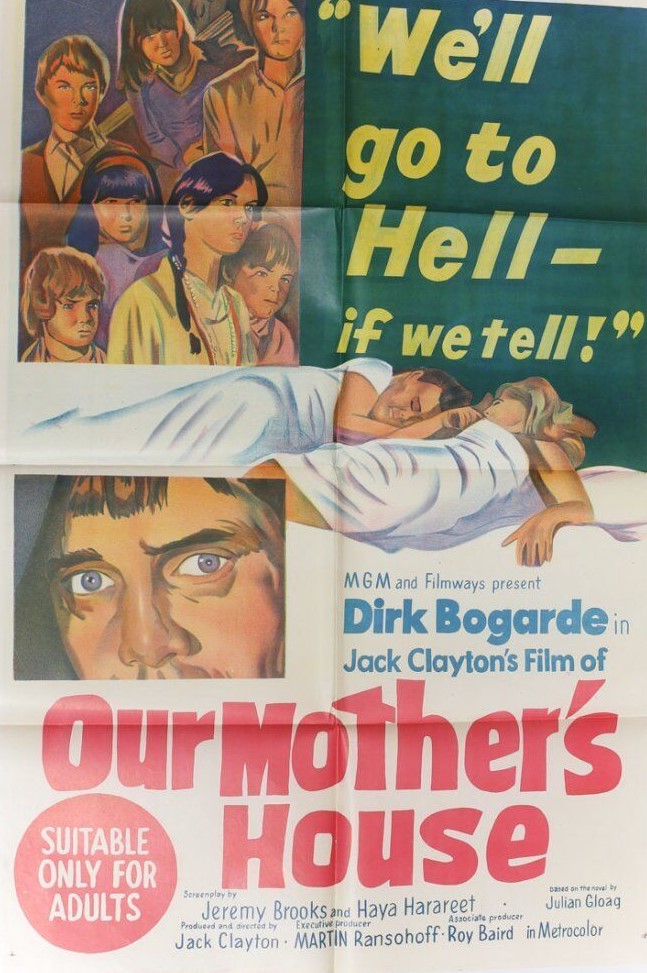
Lord of the Flies set in a sprawling London Victorian mansion. At its best when kids give rein to vivid imagination, not so strong when melodrama intrudes.
After the death of her invalid mother and dreading being sent to an orphanage, eldest child Elsa (Margaret Brooks), who has been with the help of a maid running the house anyway, determines that she and the rest of the brood will pretend their mother is still alive. They bury the body in the garden, manage financially after Jimimee (Mark Lester) discovers an aptitude for forging their mother’s signature on the monthly cheques she receives from a trust fund, and hold séances in the shed to commune with the deceased one.

To maintain the pretence, they get rid of the nosey and querulous maid Mrs Quayle (Yootha Joyce) and come up with all sorts of reasons to explain their mother’s absence to school teachers and neighbors. Child fears run rampant as they visualize the terrible lives they would lead in an orphanage. But the generally tolerant community lifestyle is disturbed by the dictatorial rule of Elsa, determining that Gerty (Sarah Nicholls), for example, must have her long hair sheared off for innocently breaking a house rule and, in keeping with their mother’s fundamentalist beliefs, refuses to call a doctor when the girl falls ill. But the séance takes on a creepier aspect, Elsa the one in communion with her mother and therefore using the supposed other-worldy presence to enforce her will.
So far, so Lord of the Flies, and excellent in its depiction of a world ruled by children according to their fears and beliefs and without adult intercession. But it loses its grip when melodrama takes hold.

Their mother’s dissolute husband Charlie (Dirk Bogarde) returns, romancing Mrs Quayle, and, initially, spoiling the children, who are delighted to see him. He soon reverts to form, spending all their money, getting Charlie to forge his mother’s signature on the house deeds, planning to pocket the proceeds and dispatch the kids to an orphanage. Worse, he breaks the spell their seemingly devout mother had over their children, informing them that their mother’s conversion to religion only came after a life of debauchery and that, in fact, every single one of them is illegitimate and not his offspring. That’s too much for Diana (Pamela Franklin) who kills him with a poker.
Too many twists for sure and by diverting a fascinating dissertation of childhood into adult melodrama robs the film of much of its power.
Director Jack Clayton had been here before with The Innocents (1961) but, there, less was spelled out. Dirk Bogarde (Justine, 1969) is surprisingly good as the charming rough layabout with an eye to the main chance but it’s the children who captivate especially Pamela Franklin (And Soon the Darkness, 1970) and Mark Lester (Oliver!, 1968). The children’s innocence in any case would have been despoiled as they challenged Elsa’s rule and it would have been more satisfying to go down that route.
It was based on the bestseller by Julian Gloag and for anyone wondering what happened to Haya Harareet (Ben-Hur, 1959, and The Secret Partner, 1961) she married Clayton and is credited with the screenplay of this along with Jeremy Brooks.
Slow-burn that trips the wrong way.

 The Magnificent 60s
Sounds very much somewhere between 1968’s If….and 1969’s Leo the Last, there was a whole lotta youth culture revolution even in England back in the day…
LikeLiked by 1 person
Alternative lifestyle for sure, especially when you can knock off any interfering adult.
LikeLike
Excellent review. I have never heard of this film, but it does sound like I would enjoy it. I love mystery films that are set in sprawling mansions. The plot for this film reminds me a lot of Alfred Hitchcock’s “Rebecca”. Incidentally, that film was also based on a classic novel by Daphne Du Maurier. It told a supernatural story about a widower whose mansion was haunted by the ghost of his previous lover. Similar to “Our Mother’s House”, that film also involved mysterious housemaids playing a crucial role in operating mansions. Based on these similarities, I think I will check this out when I have the time. Here’s why I adored Alfred Hitchcock’s masterpiece:
LikeLiked by 1 person
This isn;’ based on a DuMaurier novel. there’s a reason why Selznick’s name comes before Hitchcock. He had significant input into the film and when you exmaine his ouevre it’s as mcuh a Selznick picture as it is a Hitchcock.
LikeLiked by 1 person