Red Line 7000 (1965) **

Quentin Tarantino is probably alone in preferring this movie mishap to John Frankenheimer’s Grand Prix (1966) – or I have somehow missed a “cult” picture. There was no doubt director Howard Hawks could handle speed. Check out the action in Hatari! (1962) as jeeps battle across tougher terrain than NASCAR racing circuits. But for some reason, he thought he would get away with interspersing footage of races and spectacular crashes with shots of actors behind the wheel. Any time something exciting is about to happen we’re alerted by the commentator saying “oh oh” or “wait a minute” or “hold it.” There’s none of the feverish excitement or authenticity of Grand Prix.

Hawks hired a no-name cast in a bid a) to become a star-maker, b) to prove he did require the marquee wattage of the likes of John Wayne and c) to show he could make a movie cheaply. He failed on all three counts. He probably didn’t think he was taking any kind of gamble at all, as a man approaching 70, in trying to depict the lives of people around 50 years younger. James Caan, in his sophomore outing, comes out best, but that’s not saying much since he has very little to do except growl and look broody. Marianna Hill (El Condor, 1970) is also believable.

While the racing footage has dated in a way that Grand Prix has not, the main problem is just a jumble of characters getting lost in a jumble of stories. No sooner has one character been introduced than we are onto another. There’s none of the cohesive story-telling that marked out The Big Sleep (1946) or Rio Bravo (1959) and, frankly, none of the characters are particularly interesting. And what possessed him to stick in a song sung by a character (Holly, played by Gail Hire) who cannot sing – she talks the lyrics – with a backing group made up of waitresses, I can’t begin to guess.

The most fun to be had is spotting in bit parts people famous for other reasons. Carol Connors, for example, who co-wrote the lyrics to “Gone Fly Now” (Rocky, 1976) appears as a waitress. As does Cissy Wellman, daughter of veteran director William Wellman. Comedian Jerry Lewis has a cameo. It says much for Hawk’s star-spotting abilities that of two female leads, Laura Devon only made five pictures and Gail Hire just two.
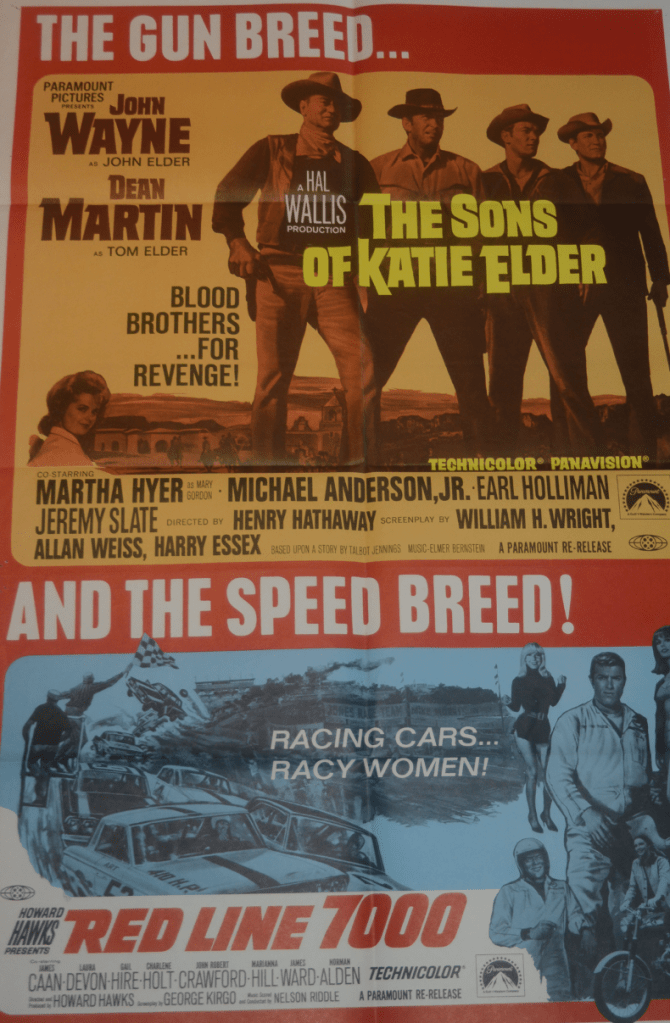
Henry Hathaway and Howard Hawks…Together!

Of the main supporting males, this was the beginning and end of John Robert Crawford’s movie career while Skip Hire made a bigger splash as a producer of television series The Dukes of Hazzard. Co-written by the director, George Kirgo (Spinout, 1966) and Steve McNeil (Man’s Favorite Sport, 1964)..

However, the French had a word for it – “genius.” Despite being dismissed as a rare misstep by the bulk of critics worldwide, Cahiers du Cinema decided it was one of the year’s Top Ten pictures. So what do I know?
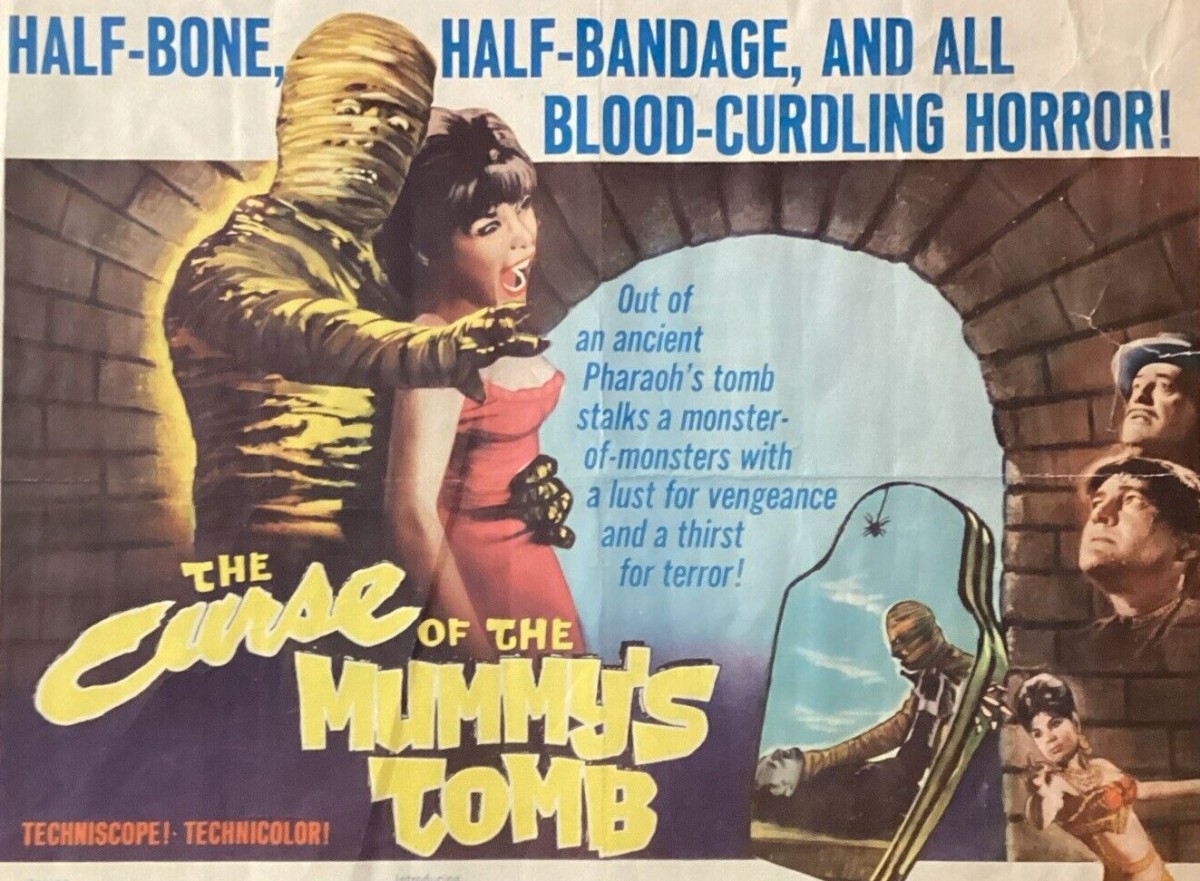
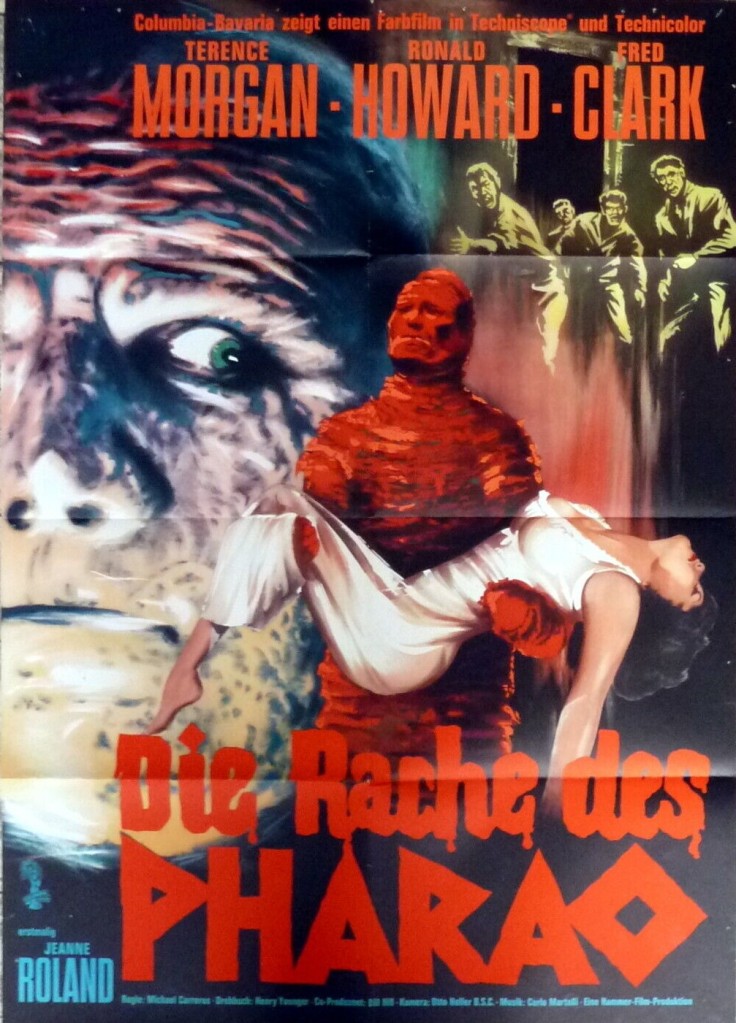
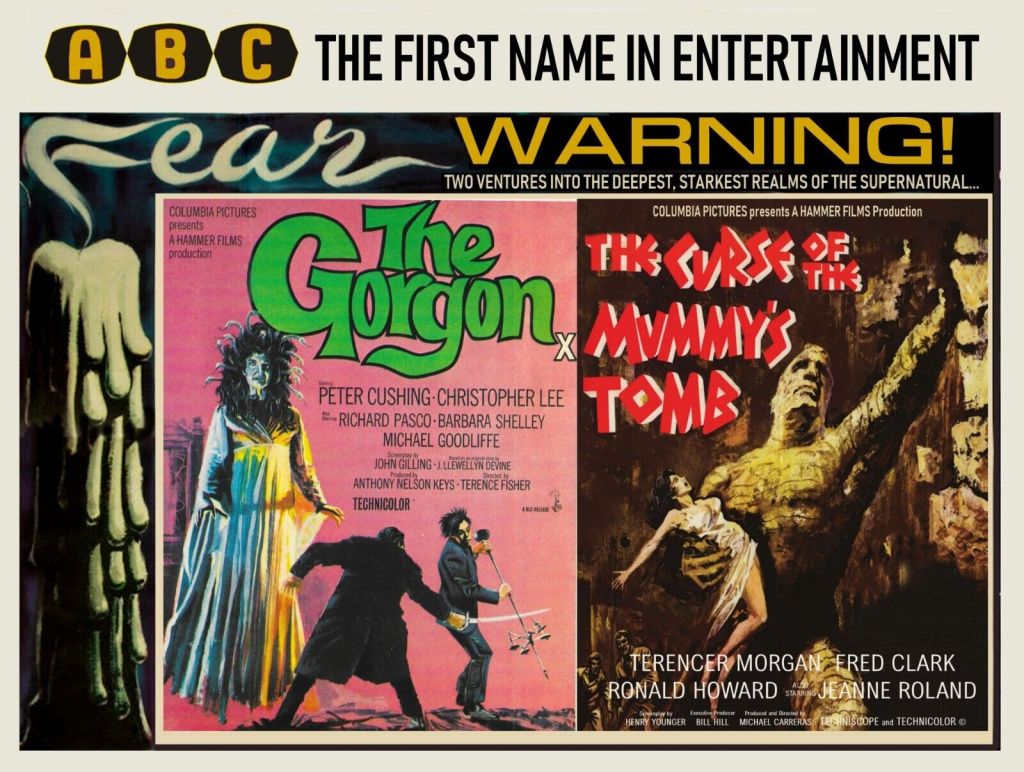
The Curse of the Mummy’s Tomb (1964) ***

Approach with affection and you will be rewarded. This is third tier Hammer, way down the pecking order behind Dracula and Frankenstein and after attracting studio stalwarts Christopher Lee and Peter Cushing for its first venture into this territory (The Mummy, 1959) dumps them for the sequel. And in the absence of the CGI that transformed the Stephen Sommers version in 1999 – and triggered the misguided Universal Monsterverse – struggles these days to prevent audiences laughing at the special effects. The titular beast was little more than a bandaged version of the lurching creature created by Dr Frankenstein so chills were always going to be in short supply, especially minus the plague of scarabs that dominated the later proceedings.

More interesting is the backstory that drives the narrative, warring siblings in ancient Egypt, the death of the rightful monarch and a reincarnation curse that travels down the centuries. Throw in bombastic King Kong-style showman Alexander King (Fred Clark) determined to monetize an archaeological find, shift the story to London, bring in a damsel Annette (Jeanne Roland) infatuated with the villain, and you have the makings of a decent tale. Alternatively, if you’re of a different mind, that could all be to cover up shortcomings in the plot and the wrong reasons for delaying the appearance of said monster.

People tampering with Egyptian graves tend to get their hands chopped off, but that’s as much warning we get of evil afoot although there are hints of malignancy in the flashback that shows the murder of Ra-Antef, son of Rameses VIII. But triumphant returning Egyptologists John Bray (Ronald Howard), Sir Giles Dalrymple (Jack Gwillim) and Annette, daughter of famed Professor Dubois who died in the line of duty, are inclined to take no precautions.

Poetic license – the mummy just ain’t that big in the movie.

Until the mummy is let loose, much of the tale centres around the ruthless grasping King and a love triangle developing between Annette, her fiancé John and the newcomer Adam (Terence Morgan) she met on the voyage home. While John is kept busy by King arranging for the grand public opening of the tomb, Adam slips in to romance Annette, not letting on of course that he possesses the amulet that can revive the sleeping monster. The setting – sophisticated London rather than remote Transylvania – and the delay of the murderous onslaught ensures that most of the picture survives on intelligent conversation, motivations and characters set out in non-cliché manner, and no squads of villagers set up for a marauding.

The monster is pretty effective when he does deign to appear, bursting through windows, picking up the damsel in a pose that I’m convinced Oliver Stone snaffled for Platoon (1986), and making his way to the nearest sewer, unlikely locale for a climax. There’s a propensity for lopping off hands and when that loses its impact stomping on heads.

But it’s not camp, is well-acted and the storyline makes sense. It probably helps that it’s free of Cushing and Lee because with unfamiliar actors the audience has to work harder. Terence Morgan (The Penthouse, 1967) is the pick of the stars because he carries most of the mystery. But Fred Clark (Move Over, Darling, 1963) steals the show by making a meal out of his outrageously greedy businessman. Top marks to Hammer for making Burmese-born Jeanne Roland (You Only Live Twice, 1965 and Casino Royale, 1967) a professional – she is an archaeologist – rather than a cleavage-ridden damsel in distress. And for those of a nervous disposition you will be pleased to know that the monkey is not present just to nibble poison intended for one of the principals.

However, from the outset it was destined for the lower half of a Hammer horror double bill, so the kind of budget that could do it justice was never in evidence. Studio boss Michael Carreras (Prehistoric Women, 1967) always gave the impression of over-extending himself but here  as writer-producer-director he manages to keep the picture on an even keel long enough for the monster to do its worst.

Ripley (2024) ***

I’m not sure I can take eight episodes of this especially in this trendy audience-alienating black-and-white version. Going all monochrome is like a bit like a novelist never deigning to describe the weather or what clothes their characters are wearing and I don’t go for the argument that the B/W is to prevent audiences being distracted by glorious Italian scenery when that’s the exact reason Dickie Greenleaf (Johnny Flynn), spoiled son of shipping mogul, went there.

I don’t know what time of year the tale was set because even the Italian seaside, warm enough presumably for Greenleaf and girlfriend Marge (Dakota Fanning) to go for a swim (Ripley remaining on the beach because his parents drowned, maybe), just looks gloomy. Anyone who can render Italy gloomy needs their head examined.

This isn’t Schindler’s List (1993) – which director Steve Zaillian wrote – that used B/W to sensible artistic effect or even Belfast (2021) where it was employed to depict the grimness of life.

I’m not even convinced by Ripley (Andrew Scott). Sure, the grifter was much more charming and personable, if occasionally awkward, as portrayed by Matt Damon (The Talented Mr Ripley, 1999) or John Malkovich (Ripley’s Game, 2002). This Ripley is just glum. Sure, his little cons don’t always work, but he can’t be as doom-struck as this.

Anyway, the story (eventually) starts when Greenleaf’s father pays Ripley, whom he believes to be a university chum of his son, to bring the errant boy, wasting his time on painting, writing and general idling, back from Italy, presumably to take on the role of inheriting the family business instead of living off his trust fund.

Like Sydney Sweeney’s character in Immaculate (2024) it hasn’t occurred to him that not everyone in Italy can speak English and so is thwarted trying to find directions to his prey’s pad. There’s a seemingly endless scene of Ripley climbing endless flights of stairs (how unfit can he be, Denzel Washington in The Equalizer 3 at least had a decent excuse) and this Ripley seems incapable of worming his way in (at least in Episode One) to his prey’s affections.

Yes, there are a couple of interesting scenes, Ripley changing seats on the subway because he sees a man staring at him on a different train. But most of the directorial art is devoted to snippets of images that have no relevance to the story or even the mood. There’s quite a barmy opening scene, too, of Ripley bumping a corpse down a flight of stairs in a tenement, not, to minimize noise,  wrapping it up in a carpet or hoisting it on his shoulders. But that is clearly a denouement and it could be an awfully dull time away.

All build-up and not much else so far.

Scoop (2024) ***

Except for the interviewee being an obliging idiot, this could as easily have turned into an own goal by a BBC desperately trumpeting its values to an indifferent nation that has been wooed away by the streamers. When the top dog is indulged by having her own top dog, a whippet, sitting at her feet everywhere she goes in BBC HQ and the supposed news bosses believe a scoop is snatching someone else’s scoop you’re on a very sticky wicket indeed.

And it’s worth bearing in mind that this show only came about because the person who set up the interview Sam McAlister (Billie Piper) had a severe case of schadenfreude and believing she hadn’t been sufficiently well rewarded wrote a book about the episode and nabs a writing credit here.

There’s not really a sympathetic character in the whole feature, unless you count the 450 journalists being shown the door because the Government won’t let the BBC raise the licence fee to cover its running costs and the BBC refuses to lower the fees it pays its top presenters (who only stay out of the goodness of their hearts because of course they would get richer pickings on commercial channels) to achieve the same end.

The only person who comes close is the sad-eyed Royal PR guru Amanda Thirsk (Keeley Hawes), heart roasted by looking after spoiled man-child Prince Andrew (Rufus Sewell in an ill-fitting face mask) – inclined to throw a tantrum should some housekeeper fail to arrange his battalion of teddy bears in the correct order – and clearly desperate to believe the prince could not possibly be at fault. However, the idea that you would let such a dope loose on Newsnight, facing one of the world’s toughest interviewers in whippet-lover Emily Maitlis (Gillian Anderson), shows remarkably poor judgement, especially when the prince just can’t see what all the fuss was about when he was doing the right thing by standing by his old pal, a convicted paedophile.

Anyone expecting proper investigative journalism or a thrilling narrative up to standards of All the Presidents Men (1976) or Spotlight (2015) – where the journalists actually do the hard work of the digging rather than just regurgitating a story that’s already out there, albeit with a bit more gloss, and the luxury of a one-hour time slot – would be looking in the wrong place.

Wouldn’t it be nice if we had discovered just a little bit more about Bernstein and Woodward’s personal lives, whether they owned dogs or had girlfriends or maybe a sick mother, just to fluff out the story a bit, but luckily Alan J. Pakula had more to worry about than what clothes his Woodward and Bernstein had to wear when confronting their subjects.

The BBC high-ups, when not toddling off to sit in boxes at the opera, come across as up their own backsides. Sam is shown to be an outsider, who, unfortunately, dresses like she’s going clubbing, which gets everyone’s back up, but, red card here, seems surprisingly ignorant of the juicier details of the story she’s investigating.

Netflix has been on a roll with The Crown so presumably thought any story with a royal connection would be equally a ratings winner, not realizing that you still need interesting characters to snaffle the viewers and no number of angst-ridden people is going to cut it.

I can’t vouch for the truth of the impersonations of real characters, but while Gillian Anderson seems to catch the essence of Emily Maitlis, Rufus Sewell’s intonations are very much the actor’s own while the face mask seems to wobble from time to time. Billie Piper got the thumbs-up from Sam. I doubt if Amanda Thirsk would care for her worst PR moment to be dramatized but Keeley Hawes at least lends her gravitas. 

Suicide by television is the best way to describe the prince, locked into a self-serving version of himself as charming war hero best suited to modelling Army uniforms glittering with medals. However, it struck me at the time and I was reminded of this omission here, that none of the investigative journalists have sought to investigate the small matter of the Pizza Express alibi. I would have thought it would be relatively easy to establish if Andrew was there on the night in question. Directed by Philip Martin.

This only goes to prove that not only can you lead a horse to water but without much encouragement you can get it to drown itself.

The original interview is better value than this. But we should perhaps thank Netflix for allowing its rival a moment in the sun.

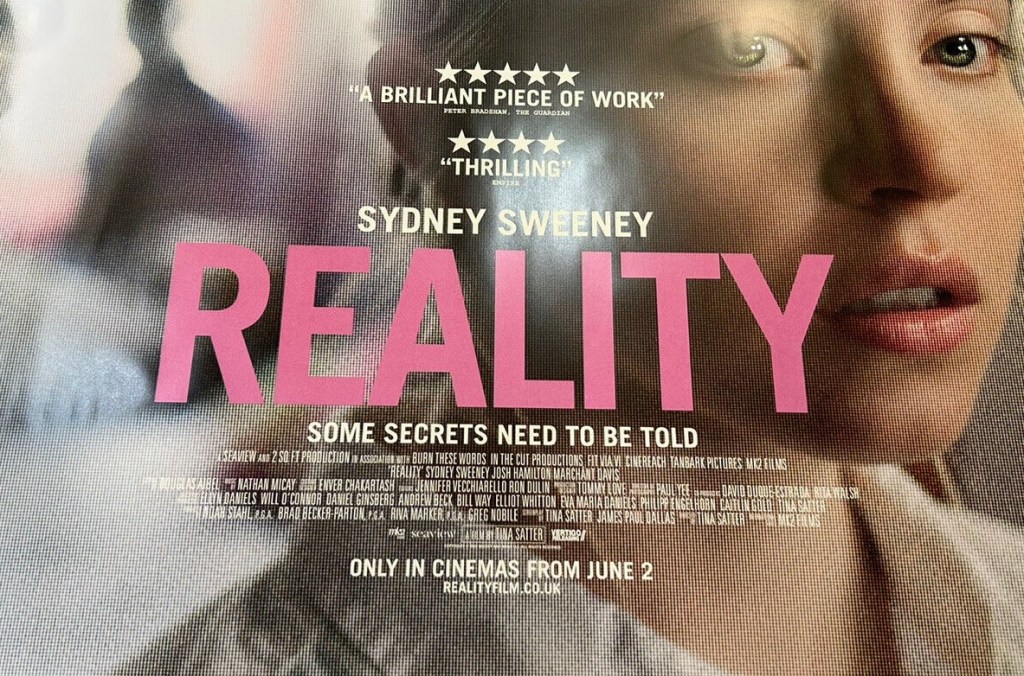
Reality (2023) ****

This never gained much traction on initial release but now Sydney Sweeney is a name to watch, worth checking it out.

When F.B.I. agents turn up at your door with a search warrant, surely your first instinct is to ask what the hell is going on? When that doesn’t transpire, an audience’s gut feeling is that you are hiding something. Or, this being America, it’s going to be a miscarriage of justice. Whether it is that in the end would depend on your political point of view.

Keeping politics out of it for the moment this is a riveting piece of what used to be called cinema verité and now probably is labelled docu-drama. The title would be ironic except that this main character had the kind of parents who named her Reality (Sydney Sweeney).

Initially, it’s just two rather amiable non-threatening FBI officers, Agent Garrick (Josh Hamilton) and Agent Taylor (Marchant Davis), who turn up in 2017 at the aforesaid door. They are advance warning, if you like, for soon there’s a posse of agents tumbling out of the cliché black vehicles. There’s certainly no sense of menace though Reality is kept clear of touching her mobile phone and kept outside and possibly thinking from the continued amiable chat with Garrick that it’s all going to be a misunderstanding. But then, as luck would have it, she’s got a room in her house that could stand in for a jail cell any day of the week, no furniture, bleak, and a snail plodding along the window ledge. And it’s in this room that the interrogation takes place.

What’s superb I guess is that the dialog all comes from F.B.I. transcripts so instead of the waterboarding or good-guy-bad-guy routine or just beating up a suspect that we’ve been fed as the truth by umpteen Hollywood movies the actual interrogation is so low-key you think this has got to be a case of mistaken identity. Or that someone out of malice has pointed the finger at an innocent party.

Reality is a linguist – speaks fluent Farsi (an Iranian language) – with high-level clearance working for the National Security Agency. Oh, and she teaches yoga, competes in weightlifting competitions and if I got this right owns three guns including an automatic rifle.

So, the questioning is pretty much along the lines of the F.B.I. just wanting to clear up a few things. Did she, for example, by accident ever take out of the building something classified that should never have left the office?  Sure enough, way back, by accident she had done so. But it soon becomes clear, if ironic, that someone engaged effectively in espionage is just as open to being spied upon as the country’s adversaries.

But as the tension mounts, the tone never changes. It’s Reality who looks more and more under pressure. From standing stock still and meeting their eyes, her attention is diverted by the antics of the snail and she starts moving around and eventually slides to the floor. Occasionally, Taylor will take a turn asking questions and both are equally adept at expressing surprise, especially convincing given it’s soon evident they know her every move.

These guys could be classic courtroom lawyers, because they make no wild assertions, just gently lead her on to admitting what they know is true. They make a point of telling her they don’t think she’s a big badass spy, and that she’s just someone who made a mistake, maybe in the heat of the moment, what with so much going in the U.S. Presidential Elections of 2016.

And you’d be amazed at how the guilty party commits herself on the slightest of details, a piece of paper folded over, for example. Turns out Reality has been a whistle-blower and getting her to admit makes the consequences easier, especially when all her answers have been recorded, for the prosecution.

It’s quite obvious where debut director Tina Satter’s political views lie but that doesn’t get in the way of a stunning piece of cinema. She’s had the sense to keep it short – it barely passes the 80-minute mark – and to limit editorial outrage to the end.

As it stands, setting aside the political element, it’s an engrossing watch. Sydney Sweeney is superb as the guilty party while Garrick and Taylor are equally good at tying her up in knots. Sweeney cuts her dramatic teeth on this one, and is more impressive than in Immaculate, so counting this in with Anyone but You, studios should be throwing at her some decent dramatic as well as comedic vehicles. She doesn’t necessarily need a Glen Powell at her side,

One to watch, regardless of which end of the political divide you favor. This is the kind of movie that a Sidney Lumet – it reminded me both of the dryness of The Offence (1973) and the courtroom spectacle of The Verdict (1982) – or a John Frankenheimer would have pumped out in their prime or the fly-on-the-wall documentaries of Frederick Wiseman (Basic Training, 1971).

A must-see.

Godzilla x Kong: The New Empire (2024) ****

Monster mash-up that delivers. Hollow Earth hits the target, a better parallel universe/ multiverse/monsterverse than all the other verses put together, not to mention it’s also of the versus inclination with any number of big beasties (I lost count to be honest) going head-to-head and super bonkers malarkey of giant apes riding prehistoric monsters. Plus, if you’re of a sentimental nature, and given that this week I’ve been hit from all side by tales of a maternal bent, whose heart would not give a whimper to see big bad Godzilla all curled up for the night in the Colosseum in Rome. Or for that matter Kong taking a paternal interest in a bad wee mini-Kong. Compared to the emotions stirred by these giants, boffin Ilene (Rebecca Hall) struggling with her maternal issues comes over as rammed-in and wishy-washy.

Having taken Mother’s Instinct to ruthless task for its illogical plotlines, I am happy to do a complete somersault and let the monster punch-up off scot-free for all its inconsistencies and coincidences because, heck you know it, fun always triumphs. Plus we’ve got a hippie vet Trapper (Dan Stevens) who, despite awkward accent and Hawaiian shirt, is loose enough to chill out straight-laced Ilene with podcaster du jour Bernie (Bryan Tyree Henry) on hand to add humor.

Throw in some Aztec/Inca-style ancient civilisation, the revival of another Japanese kaiju in Mothra, people who communicate with telepathy, all sorts of daft exposition, Godzilla snorting up radiation like it was coke, pyramids of various kinds, more rabbit holes than you could shake a bunny at, an ape that goes all Raiders of the Lost Ark with a whip made out of bones and full-on Planet of the Apes knockdown.

I’m not even going to bother with the plot, what I can remember of it, except to say Ilene and Trapper need to get Godzilla and Kong together to take on the giant ape villain and the monster he rode in on otherwise (guess what) (I think) the world as we know it (or at last this invented world) will cease to exist.

The humans do their best not to get in the way of the fun. Trapper is smart and glib and occasionally a genius and Ilene is smart but weighted down with maternity while the object of her affection is stuck with the where-do-I-belong trope and mostly stares off soulfully into the distance. It’s the monsters that bring the humanity. That little scamp of a baby giant ape takes some handling, always ready (literally) to bite the hand that feeds him while you gotta feel sorry for Godzilla having to tramp through all those cities that someone stuck in his way when all he wants is a nice nest close by a nuclear plant.

Plus we get ice ice baby. The bad ape’s chained prisoner blasts out ice instead of fire, like he’s an exile from the Night King, but at least he’s not like the latest Ghostbusters iteration that’s been heavily trumpeted in the trailer only not to appear till what seems like the last five minutes in order to give Bill Murray a weak punchline.

This was easily the best part of this week’s Quadruple Bill. I’m not even going to review Ghostbusters – it seems to have got lost in the family nonsense that’s infecting virtually every decent series, meaning we’ve now got to accommodate the size of casts that used to be an attraction in pictures like Lawrence of Arabia, but now feels like an overstuffed very threadbare cushion, and could we care less.

Adam Wingard (Godzilla vs Kong, 2021) directs though spare a nod for the CGI team.

Let’s hear it for these mean mothers.

Immaculate (2024) ***

As you know we live in a Big Brother pampered society and even going to the movies comes with a health warning. But, I have to tell you, Dear British Censor, “strong bloody violence” doesn’t cut it. Now, I’m as happy to be scared out of my wits as the next guy, jump-out-of-your-seat shocks are part of the fun of horror pictures. But having to close your eyes to plain sadistic action – tongues cut off, feet branded, bellies of pregant women cut open, babies stoned to death – sorry that’s a bit more than “strong.” Maybe torture porn should have a category of its own.

Which is a shame because this is a clever twist on the old trope of the demonic child as proferred by Rosemary’s Baby (1968) and The Omen (1976) – possibly no coincidence either that’s beaten the Omen remake to the punch. Instead of satanic satanists it’s satanic priests and nuns mainlining on some kind of more scientific genetic Da Vinci Code.

And thanks to the runaway success of last year’s Anybody But You, there’s another element at play here, the breakout star’s follow-up picture to gauge if breakout picture was fluke or welcoming a new star into the firmament. Julia Roberts followed up massive hit Pretty Women (1990) with tepid thriller Sleeping with the Enemy (1991) and the soppy Dying Young (1991) but nobody cared how indifferent the follow-ups were and both turned into big hits and wow a star is born. Sandra Bullock arrives out of nowhere in Speed (1994) and follows up with ropey romance While You Were Sleeping (1995) and tepid thriller The Net (1995) and bingo a star is born.

So this is breakout star Sydney Sweeney’s follow-up – excluding Madame Web of course – and I’m not sure if it will sweep up that many of her newfound followers in its wake. Not because it doesn’t deliver the horror goods because outside of the torture porn it’s pretty creepy and with effective twists and if you want to see a bloodied Sydney creep out of a hole in the ground and give birth and then, as if confounding her newfound bubbly screen personality, beat the baby to death then this one is for you.

Anyway, let’s backtrack. Cecilia (Sydney Sweeney), a young American who had a near-death experience, hives off to an Italian convent filled mostly with the devout, the lost and the broken. It’s not Nun of Monza, and it’s not terribly strict either and even though she couldn’t be bothered learning Italian (don’t these nuns speak English?) there’s always someone on hand to help translate. She makes one friend and one enemy, but, hey, like any boarding school that’d be par for the course.

So, here she is settling in, becoming a bride of Christ, taking vows of chastity, obedience and poverty when suddenly charming Fr Tedeschi  (Alvaro Monte) comes over all nasty, questioning whether she is a vigin or not. Just when that is established to everyone’s content comes the zinger – she’s pregnant by what is known in Catholic Church parlance as immaculate conception. Quite how this occurred is never explained, except the convent has an artefact claimed to be one of the nails that stuck Jesus to the cross and therefore containing remants of blood (we’re going Jurassic Park here) and thus his genetic code.

You won’t be surprised to learn that she’s not the first victim of this kind of conception. Things start to get fairly nasty after this – someone tries to drown here and then we’re in for the tongue-cutting, branding etc – and Cecilia goes from docile to vengeful. She comes up with a clever trick to escape and when that doesn’t work has to find another way out of her dilemma and if that involves strangling someone with rosary beads that seems nicely ironic in the circumstances.

It was certainly a day of mean mothers in my Quadruple Bill on Monday, this being the last of my quartet. It was certainly well done and the concept no more barmy than any of the demonic baby tropes, if a bit more up-to-date medically, and there was enough of the claustrophic creepiness that comes with the convent territory and the throwback barbarity of the Church (Spanish Inquisition, anyone?). Apart from the torture porn, a good entry into the genre but, despite Sweeney’s performance, this would not have put her in the break-out league. So I think this will just be put behind her as she charts a new rom-com course. Incidentally, like Anna Hathaway and Jessica Chastain in Mother’s Instinct, she was the producer.

Worth seeing for Sweeney, though, and the clever plot ploy.

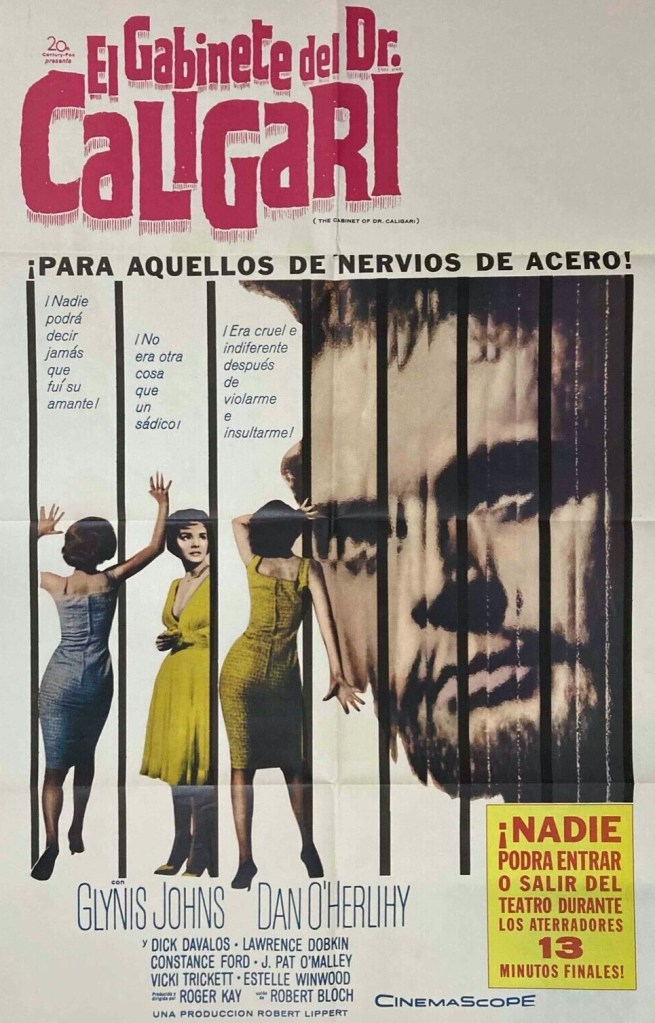
The Cabinet of Caligari (1962) ***

If you’re going to put an English rose through the mill who better than husky-voiced Glynis Johns and except for the giveaway title you might expect from her previous screen ventures that when her car breaks down in a foreign country we’re all set for romance. But you’re probably on the alert anyway after realizing Robert Bloch (Psycho, 1960) wrote the script. The narrative engine runs on twists and the chances would be poor of audiences comprehending the psychiatric devices involved so it’s pretty much a contemporary haunted house mystery with our heroine trapped in an ever-worsening situation and most of the terror emanating from her own mind.

After her tire blowout, and exhausted from trudging along country roads, Jane (Glynis Johns) seeks help from Swede Caligari (Dan O’Herlihy) who owns a large estate in the country. But when she wakes up in the morning, she is unable to leave or telephone for help. There follows a series of disturbing events including (a la Psycho) a peeping tom (bath not shower), being presented with pornographic photographs, interrogated, witnessing torture and being chased by revolving glass. Other images are terrifying, babies baked in ovens, people buried up to their necks, a torture rack. Nothing and nobody are what they seem.

The twist is that she’s in a mental asylum, the car breakdown a fiction to make acceptable to herself her presence there, the other incidents all explained as various versions of psychiatric treatment including electric shock. The central conceit, that she’s trapped, is well-maintained what with other guests dressing in glamorous fashion for dinner and none behaving like inmates. But when Jane tries to make friends with them in order to organize a breakout or escape, she doesn’t know who to trust, and even attempts seduction.

It kind of works and kind of doesn’t. When the camera explains seconds later the reality behind her crazy visions, it ruins the effect. The expressionistic approach helps in presenting the visuals but can’t provide proper insight into her state of mind. The images are odd rather than helping the story. There’s a disjointed feel to the whole thing, as if director and star were on different planets. And there’s a major plot flaw suggesting Jane must be truly out of her mind if she can’t recognize that Caligari and inmate Paul are the same person, give or take a false beard.

It was a bold career choice for Glynis Johns (Dear Brigitte, 1965), generally the sassiest of heroines, to be so out of control. In his only movie, television director Roger Kay makes a bid for the big time with his visuals but too often loses sight of the characters. Of course, it was always going to be a tough ask to match the original German The Cabinet of Dr Caligari (1920) though I doubt many who saw the loose remake would be aware of its existence.

Interesting for the visuals and Glynis Johns losing the rag.

Mother’s Instinct (2024) **

Another cheat. Anatomy of a Fall Part Two. Let’s set the story in the early 1960s when cops were too dumb to think it unusual that three adults in neighboring houses could commit suicide within a very short space of time. Let’s just plain ignore the fact that the woman who has lost a child miraculously gains one from this unlikely sequence of events – in fact let’s give it our blessing and  allow a woman who’s plain loopy to adopt an orphan because, as we all know, sentiment runs wild in adoption cases.

Let’s saddle the audience with the kind of serious actors whose normal instinct would be to run a mile from this shoddy bill of goods. Yikes, we can’t even blame a manager or  casting director because Anne Hathaway and Jessica Chastain not only signed up to this but are behind it being brought to the screen, they are the producers.  

Bad things happen to glamorous people would be a more sensible take on these shenanigans and if the movie had gone down the more interesting route of how the well-off cope with grief and loss it would have worked even when these are the kind of mean mothers who would give mean mothers of the male variety a bad name. This is filled with the kind of underplayed bad acting that Oscar winners think they can get away with.

Both mothers have a get-out-of-jail-free card. Celine (Anne Hathaway) can’t have any more children and is the kind of fun mother who rarely exists in real life. Alice (Jessica Chastain) is a lot less fun because she’s saddled with a kid, Theo (Eamon Patrick O’Connell), who will die if he eats peanut butter and is prevented from going back out to work because, heck, what would the neighbours say. Plus, their husbands are only pretending to be lovey-dovey and the minute their wives start behaving like nutters out comes the finger-waving and dragging by the arm.

And it pivots on the dumbest of pivots. Celine’s son falls off a balcony. Alice, in her garden seeing the boy teetering precariously on a ledge, screams a warning that Celine can’t hear pecause perfect housewife that she is she’s busy with the vaccum and that just makes so much noise it shuts out the screaming of a demented woman. And if that dumb pivot isn’t enough Celine thinks that Alice thinks (you see where this is going) that it’s all her fault. That, presumably, she didn’t scream loud enough.

The original French film.

Worse, dumb pivot No 3, Alice places Theo’s beloved fluffy toy bunny alongside the corpse in the (natch!) open coffin (as if every parent at the funeral service just wants to gawp at a dead child) and Theo (who, of course, needed to sneak a peak at his dead buddy) kicks off and is the first of the people to be dragged off somewhere by the exasperated adult male.

Of course, when the women fall out, it doesn’t occur to Celine to ask Alice for her front door key back. Nor, when Alice sneaks into Celine’s house, is the former, suddenly returning, capable of noticing the pair of high heel shoes Alice left in the foyer so she could creep about the house undisturbed.

This is just so bonkers it overrides all the good bits. The Mad Men Meets Desperate Housewives malarkey, the men who can’t believe they’ve got it so good, scoring wives way out of their league, nice kids, food on the table, cocktails aplenty, the women all dolled up like they stepped out of a fashion catalog, and intelligent conversation about John F. Kennedy and Jackie O before she became Jackie O.  

But this relies not just on your suspending disbelief but on you sympathizing with two women you would run a mile to avoid them. It’s based on a French film (Duelles) and I’m wondering if the French had a way of getting away with this kind of stuff. Nope, wait a minute, it was the French who came up with Anatomy of a Fall.

This was the start of my Quadruple Bill – I was catching up because I’d spent the previous Monday at the theater (blasphemy, I know) watching Hamilton – and I though this looked a winner.

So it’s a big nope from me.

Behind the Scenes: Double Bills 1970-1971

Giving customers value for money – the impetus behind the original double bill that was standard fare at local neighborhood cinemas for decades – was by the 1970s the least of the worries of exhibitors, their audiences slashed by the onslaught of television, the future in serious jeopardy owning to the financially precarious Hollywood studios. As audiences grew more picky, exhibitors, even with fewer films to hand, went back, in certain instances, to the double bill, hoping that the coupling of two relatively unattractive pictures would succeed where one on its own would not. Usually, for films playing the cinema circuits, it was left to the studios to devise the double bill programs.

So where Love Story (1970), The Godfather (1972), The Sting (1973), Jaws (1975) and Star Wars (1977) need not worry about being teamed with an unlikely partner, there were plenty movies who would have no choice in the matter. I should point that a) this survey only refers to Britain since I have in my possession books covering all weekly releases on the main circuits and b) it’s not touching upon those barmy programs dreamed up by some clever-dick independent cinema manager.

So I’m only looking at those interesting/odd double-A double bills which might leave you wondering why one or even both of the titles was considered so lacking in appeal that it didn’t merit single-billing. Many of these were tough sells even as a double bill. You could start with The Mind of Mr Soames (1970) featuring Terence Stamp awakening from a lifelong coma coupled with William Wyler’s last, disastrous, effort The Liberation of L.B. Jones. (1970). You got to wonder who would be queueing up for the incestuously-hinting Goodbye Gemini (1970) starring Judy Geeson and Mumsy, Nanny, Sonny and Girly (1970) starring nobody and featuring hippies forced into role-playing. Drug drama The People Next Door (1970) headlined by Eli Wallach (hardly a big draw on his own) was linked with C.C. and Company (1970), the movie that tried to make a star out of footballer Joe Namath and nearly wrecked the career of Ann-Margret.

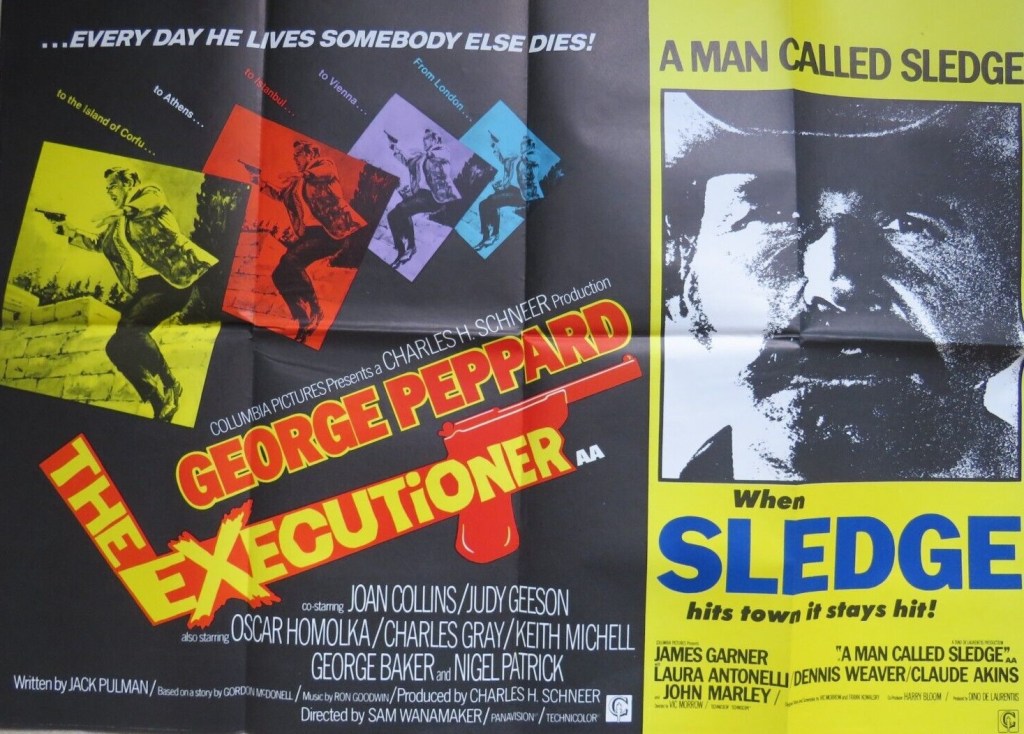
On the other hand some were tailor-made value-for-money packages featuring genuine star wattage. George Peppard in hitman thriller The Executioner (1970) went head to head with James Garner western A Man Called Sledge (1970). Sidney Poitier in They Call Me Mister Tibbs (1970), sequel to the Oscar-winning In the Heat of the Night (1967), went out with Rock Hudson-Sylva Koscina World War Two number Hornets’ Nest (1970). Top British star Hayley Mills fending off Oliver Reed in Take A Girl Like You (1970) hit the sack with Getting Straight (1970) starring Elliott Gould and Candice Bergen. Underrated Hitchcockian thriller Fragment of Fear (1970) with David Hemmings and then-wife Gayle Hunnicutt touched base with romantic drama Loving (1970) with George Segal and Eva Marie Saint. Charles Bronson-Tony Curtis adventure You Can’t Win ‘Em All (1970) stuck it to Gregory Peck and Tuesday Weld in I Walk the Line (1970).

David Janssen in revenge western Macho Callahan was supported by Charles Bronson French thriller Rider on the Rain (1970). Double bill of the decade has to be Raquel Welch as Myra Breckenridge (1970) and the even camper Beyond the Valley of the Dolls (1970), Russ Meyer’s mainstream paean to T&A. Mia Farrow couldn’t escape Blind Terror (1971) as Dyan Cannon headed up a platoon of Doctors’ Wives (1971). Jack Nicholson’s Oscar-nominated turn in Five Easy Pieces (1971) rode shotgun on Samantha Eggar in The Lady in the Car with the Glasses and the Gun (1971). Western Doc (1971) got the drop on World War One aerial spectacular The Red Baron (1971).

The double bill also opened doors for movies that otherwise wouldn’t stand a chance of reaching a wider audience. French crime flick The Samourai (1967) starring Alain and Nathalie Delon supported bloody western A Town Called Bastard (1970) with Robert Shaw and Stella Stevens. Charles Bronson’s Italian-made Violent City (1970) propped up Elliott Gould sex drama I Love My Wife (1970). Milo O’Shea as a sex-mad Irishman Paddy (1970) sought the shade beneath Last Summer (1970). John Mackenzie’s debut One Brief Summer (1971) clicked with demonic The Mephisto Waltz (1971) starring Alan Alda and Jacqueline Bisset. Ray Milland courtroom drama Hostile Witness (1969) found shelter with Lee Van Cleef western Barquero (1970). Walter Matthau-Ingrid Bergman-Goldie Hawn comedy Cactus Flower (1969) took pity on Machine Gun McCain (1969).

You would have thought the horror double bill was sacrosanct. And so it was in large part. Check Twins of Evil (1971)/Hands of the Ripper (1971), Scars of Dracula (1970)/The Horror of Frankenstein (1970), Count Yorga, Vampire (1970)/Cry of the Banshee (1970), and Dr Jekyll and Sister Hyde (1971)/Blood from the Mummy’s Tomb (1971). But strange developments were afoot and someone decided that if the vampire happened to be lesbian it was better for the movie to be paired with a biker picture. Hence, Countess Dracula (1970)/Hell’s Belles (1969) and Lust for a Vampire (1971)/The Born Losers (1967).

SOURCES: Allen Eyles, ABC: The First Name in Entertainment (CTA, 1993) p124-125; Allen Eyles, Odeon Cinemas 2 (CTA, 2005) p214-215.

Discover WordPress

A daily selection of the best content published on WordPress, collected for you by humans who love to read.

The Atavist Magazine

by Brian Hannan

WordPress.com News

The latest news on WordPress.com and the WordPress community.