Fast Charlie (2023) ****

If you like your characters to sport monikers like Donut (“don’t call me Donut”) or Blade (not that Blade, obviously) or The Freak (“get me The Freak”) and like to see death dealt out in novel fashion – taxidermized bird beak through the eye, beer bottle through the mouth, and an update on the Magnum .357 “blow your head clean off” trope – then this one is for you. Not to mention the riffs on Quentin Tarantino and John Wick. And, here’s the kicker, a delicate meditation on old age and father-son relationships.

Your first port of marquee call, of course, should be star Pierce Brosnan. Not the Abba-magnet of Mamma Mia (2008), and far removed from James Bond, but with a hint of the clever machination of The Thomas Crown Affair remake (1999). You might regard his character as a common-or-garden retired hitman now doing business as a chauffeur to a younger generation of hitmen (step up Donut) but he tends to see himself as a “problem-solver” or even “concierge” (as though we might be talking The Continental Hotel). I suspect Brosnan was drawn to the script for the “cowboy draw” soliloquy that has echoes of the gold watch in Pulp Fiction (1994).

Add in director Philip Noyce, director of Patriot Games (1992) and Clear and Present Danger (1994), the titles heavily promoted on the poster, and also, more importantly from this picture’s perspective, Dead Calm (1989). The poster says nothing about screenwriter Richard Wenk but since he gave us The Equalizer trilogy – three of my favorite pictures – then suddenly this little movie, shoved out into streamer with none of the publicity accorded lesser movies, has got my attention.  

I started out not liking this at all but gradually warmed to it and at the end considered it a pretty good addition to the sub-genre of new-gangster-takes-over-old-gangster’s-territory-but-with-a-twist. So  Charlie (Pierce Brosnan) is driving hitman Donut (Brennan Keel Cook) to knock off low-end crim Kramer. Donut’s M.O. is the knife, but this being the kind of picture where characters swerve from the norm, he decides instead he’ll stick some explosive device in a box of donuts. That works, for sure, but it has the unfortunate by-product of blowing the guy’s head clean off – clean off as in no longer attached to the shoulders and, even if you could scrape up the bits and pieces, unrecognizable.

Therein lies the problem. To pick up his dough, Charlie needs to show an identifiable corpse. Donut is soon out of the picture, the dumb sonofa, pistol in hand while driving over bumpy road, shoots himself in the head, brings down a telegraph pole and sets the car on fire. Still Charlie isn’t known as fast for nothing (in fact, the title had no relevance whatsoever, so if you’re expecting a car chase buckle up and get frustrated) and he decides the dead man’s wife should somehow be able to identify him.

Sure enough, Marcie (Morena Baccarin), now an ex-wife but still harboring sentimental thoughts about her deadbeat now dead husband, explains he has a tattoo on his ass that she is willing to verify as belonging to the ass of said deceased. That should be that, another problem solved by our problem-solver or concierge, if you prefer.

Except, suddenly, all hell breaks loose. It’s gang war time.   Charlie’s ageing boss Stan (James Caan) is the object of the hit and, unfortunately, for the hitters, Charlie treats this old man very much like a father (hence the “cowboy draw” soliloquy) and takes agin anyone who could have been responsible for the hit, which is pretty much anyone who has crossed the screen in the early part of the picture.

These dudes will have names, for sure, but heck, they hardly appear before Charlie starts to knock ‘em off so don’t expect me to remember them all. In any case, the movie, I warned  you to expect a narrative swerve, moves in a different direction. One route is that subtle kind of May-December romance Wenk gave us in The Equalizer 3 (2023), Charlie, while trying his hand with Marcie, aware that he’s got very little chance of success, given the age gap (acknowledged at least rather than expecting younger women to jump into bed with any old guy just because they’re an ageing movie star and that’s what the audience expects), even though he’s a cultured hitman, pretty ace in the kitchen and old-style in attitude to women. Whether it’s her particular set of skills – see what she can do with a bird beak – or her lost soul that’s the attraction.

But that element is left kind of floating in the background as the story shifts up a gear as we discover why the hit was out on Kramer in the first place and why everybody else was getting rubbed out. It wouldn’t be this kind of picture without a couple of twists at the end.

Charlie is a laid-back hardman with a nice line in quips, self-possessed and self-effacing, but a regular guy when it comes to the regular things in life. His relationship to Stan is very touching and the romantic element is underdone.

So if you’re going to buckle up for his one, ignore the opening sequence, set the Tarantino vibe aside and wait until it gets into the meat-and-potatoes of relationships and of course, for the thrill-seekers out there, Charlie taking revenge.

Shows there’s more to Brosnan than a raised eyebrow, a last hurrah for James Caan (no introduction needed), and Brazilian actress Morena Baccarin (Deadpool, 2016) reveals unusual reserve in what could easily have been, in other hands, a more showy part.

Worth a look and free on Amazon Prime.
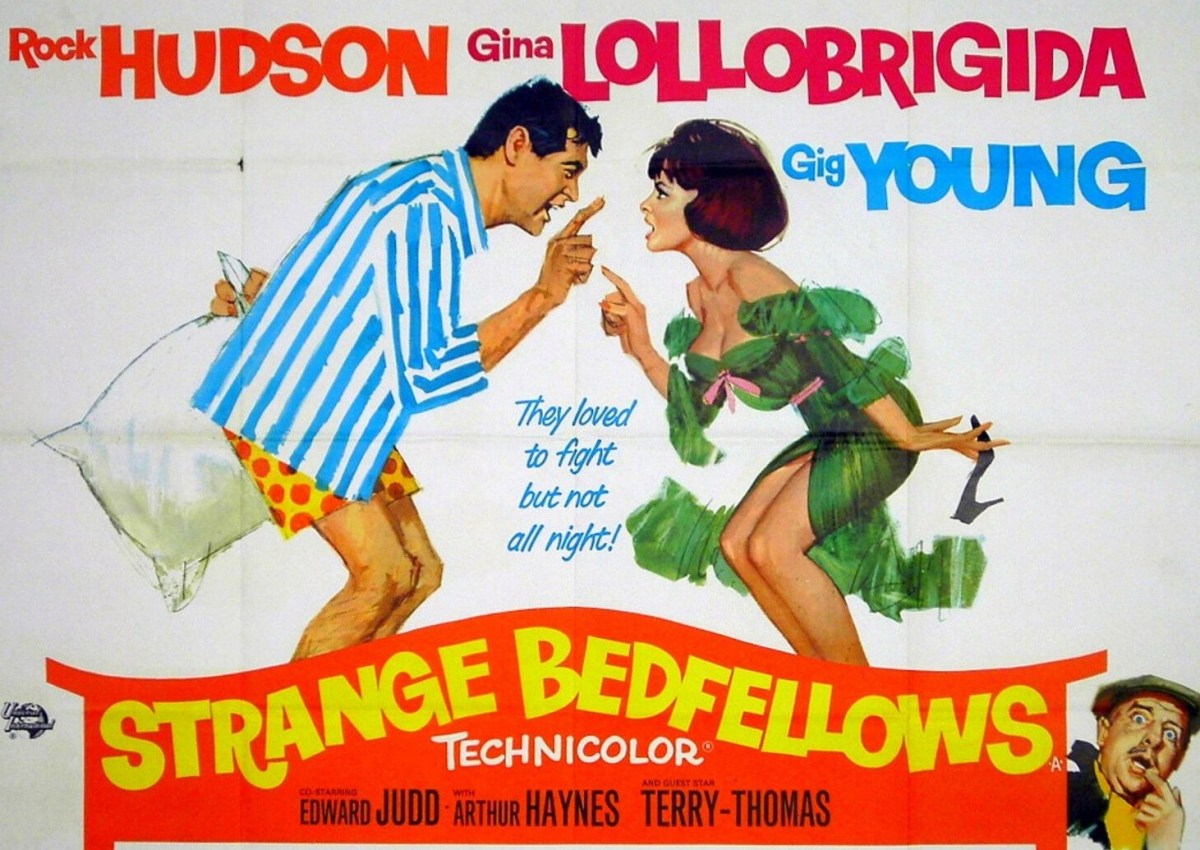
Strange Bedfellows (1963) ****

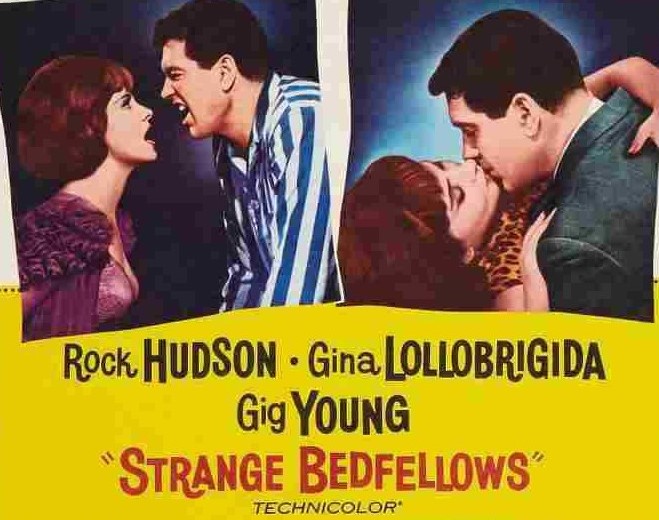
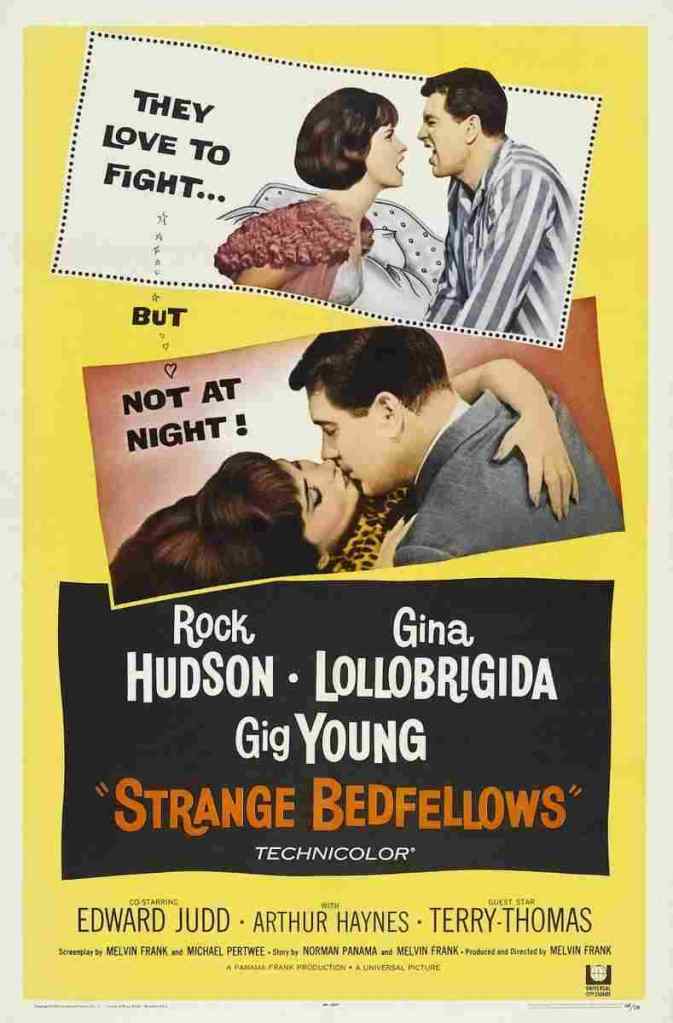
I had my first belly-laugh within seconds, a wonderful sight gag and was chortling all the way through this London-set battle-of-the-sexes comedy. Carter Harrison (Rock Hudson) is a high-flying businessman who needs to win back long-estranged wife Toni (Gina Lollobrigida) in order to gain promotion at a family-conscious oil company. Initially, Carter re-discovers the reasons he had first fallen in love with her but then, of course, only too bitterly, why they split. Hudson and La Lollo had previously teamed up for Come September (1963) and Hudson had spent most of the 1960s in romantic mishap with Doris Day so he could call on an extensive range of baffled and enraged expressions. Toni is an artist-cum-political-firebrand which sets up hilarious consequence. Richard Bramwell (Gig Young) is on hand to act as referee.

There’s some marvelous comic invention, a conversation between the two principals relayed through taxi controllers turns into a masterpiece of the misheard and misunderstood. Complications arise from Toni’s Lollobrigida’s fiancé Harry  (Edward Judd from First Men in the Moon, 1964), also an activist, but on the pompous side, and an Italian lothario. Taking advantage of the less than congenial London weather, there are jokes aplenty about umbrellas and in a nod to farce occasions for Carter to lose his trousers and share a bed with the fiancé. Smoldering sexual tension also kindles many laughs. By the time the film enters its stride it’s one comedic situation after another. It being England, naturally enough Lady Godiva is involved.

Hudson in suave mode trying to cope with the feisty Lollobrigida is an ideal comedy match. Costume designer Jean Louis has swathed the actress in a stunning array of outfits, some of which leave little to the imagination. When Doris Day got angry you tended to laugh, not quite believing this was anything more than a moderate hissy fit, but if you crossed Lollobrigida you were apt to get both barrels and it never looked like acting, she was a very convincing when she switched on the fury engine, plus, of course, whatever she threw added both to the comedy and her character’s conviction.   Both have terrific comic timing.

Writer-director Melvin Frank was something of a comedy specialist, a dab hand at suiting comedy to screen persona having previously set up Road to Hong Kong (1962) and Mr.  Blandings Builds a Dream House (1948). Terry-Thomas makes an appearance as a comic mortician and there are parts for English comedian Arthur Haynes and Dave King. Hudson and Lollobrigida exude screen charisma and while not in the class of Come September this delivers enough laughs to make you wonder why they don’t make them like that anymore.

The Brides of Fu Manchu (1966) ***

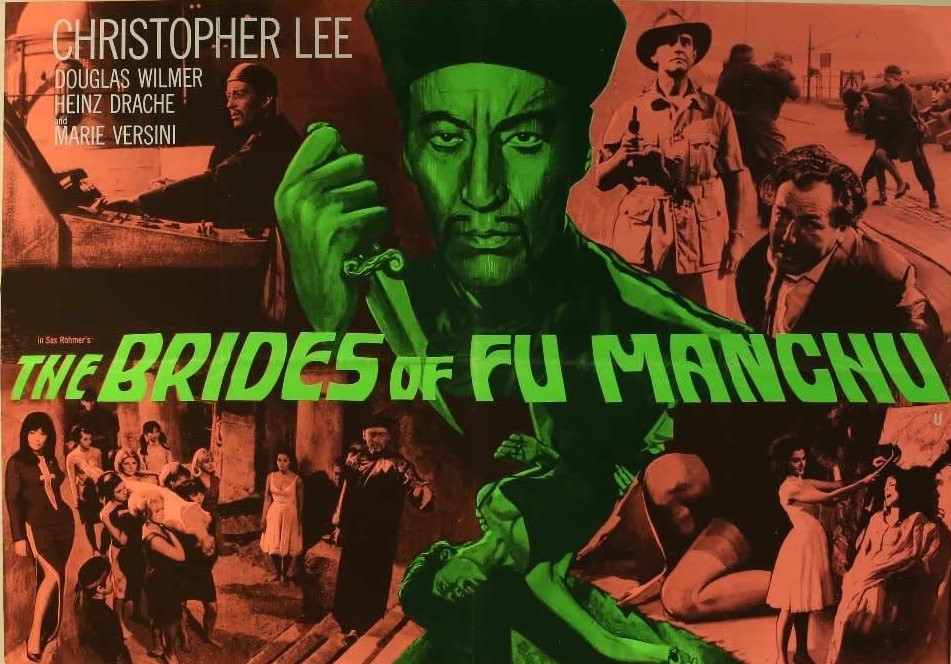
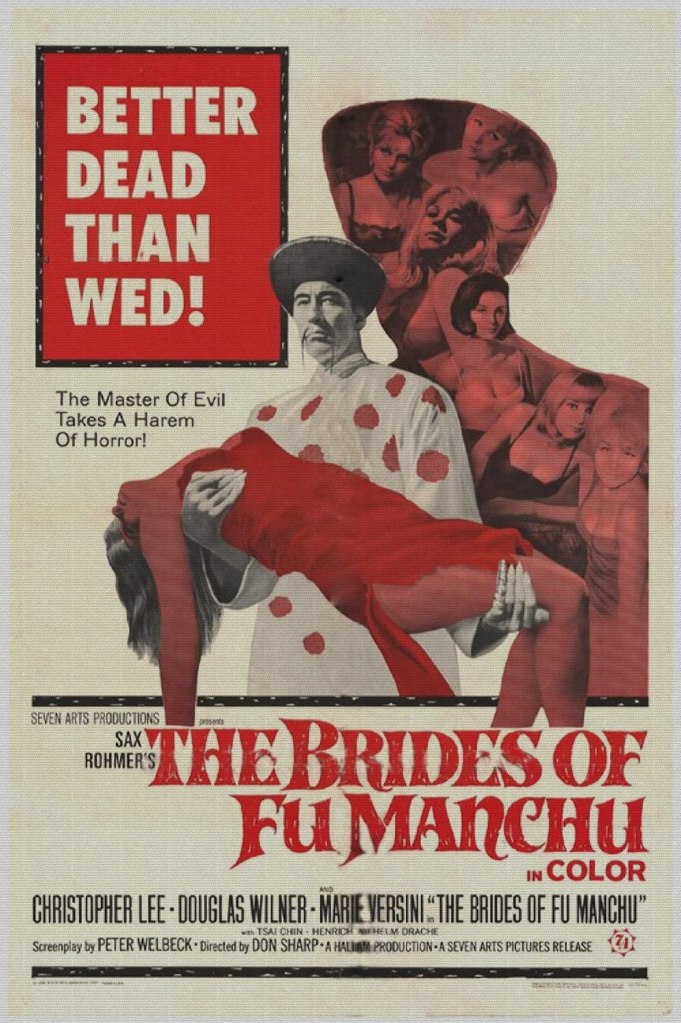
The 1960s was awash with movie megalomaniacs, most courtesy of the spy vogue. You could also count on secret agents for trailing in their wake bevies of beauties. So no surprise then that criminal mastermind Fu Manchu (Christopher Lee) has his own gang, his “brides,” although they are hardly volunteers, being the kidnapped daughters of top scientists. His plan for global domination this time consists of transmitting energy as sound waves, using miniaturization, a sonic death ray, with enough power to destroy a city.

The result is good hokum, a thriller set in the 1920s with a cracking pace, plenty of action, explosions, burgeoning romance, and a plot that gets more complicated by the minute as a tribe of worthies try out to outwit the evil genius. There is a terrific lair – where the disobedient end up in a snake pit – a passable laboratory, chases, truth serums (“the dust that loosens tongues”), hypnotism, bait-and-switch tricks and decent special effects.  Three stories race along in a parallel pell-mell: Manchu needs one more kidnapping to complete his complement of daughters, while the good guys headed by Fu Manchu’s old adversary Nayland Smith (Douglas Wilmer) are trying to locate the bad guy’s secret location while at the same time attempting to find out where he will strike next. 

While Fu Manchu is indestructible – supposed dead after the previous film – his henchmen (and henchwomen) are all too human. It takes three attempts to kidnap Manchu’s next victim. They are easily identifiable by their giveaway cummerbunds and bandanas and their method of assault is not kung fu but brawling so a good solid British punch of the old-school soon sorts them out. Manchu’s daughter Lin Tang (Tsai Chin) is a chip off the old block, delighted at any opportunity to torment the brides.  

The brides, in diaphanous gowns that might have been a job-lot from the set of She, are far from compliant, even rebelling at one point, and employing vicious fight tactics. Fans of director Don Sharp will find him every bit as inventive as in The Devil-Ship Pirates (1964) and  Bang, Bang, You’re Dead  (1966) . It’s another Harry Alan Towers (written under his pseudonym Peter Welbeck) effort so that means an international cast.

Two television cops, British Rupert Davies (BBC’s Maigret) and German Heinz Drache (cop in a Francis Durbridge series), plus Francois Mitterand’s brother-in-law Roger Hanin, provide solid support. Not forgetting Burt Kwouk as a henchman. Brides of the year include French Marie Versini (German western Winnetou, 1963) and Rhodesian Carole Gray (Curse of the Fly, 1965). The film did not prove much of a jumping-off point for other brides such as Ulla Berglin, Danielle Defrere and Anje Langstraat, for whom this debut was as far as their careers went.

Christopher Lee, despite the dodgy moustache, is resplendent, exuding evil, and with a gift for rising again (just like Dracula) as he would do for another three films in the series.

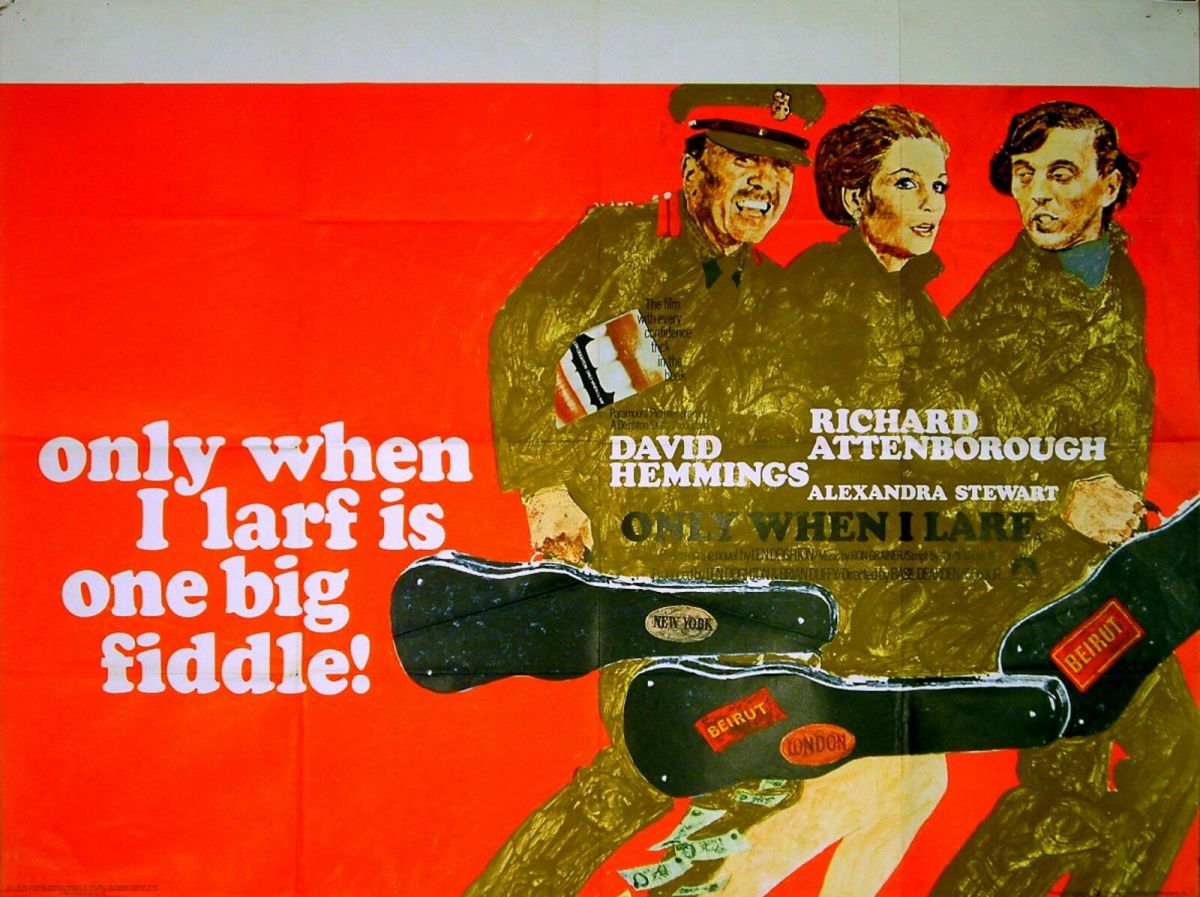
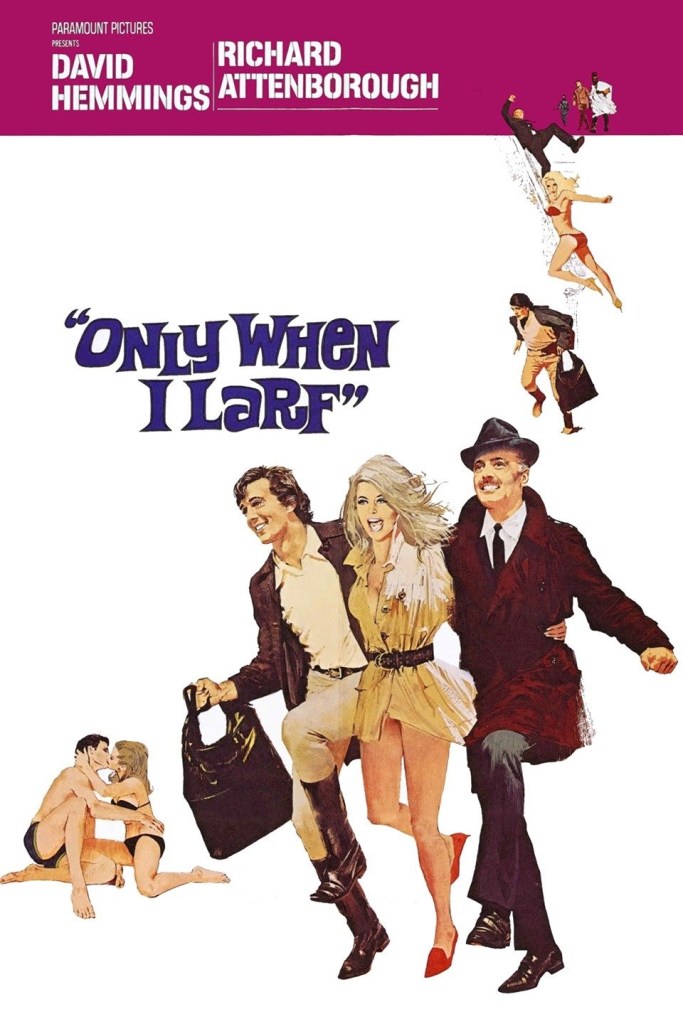
Only When I Larf (1968) ***

Terrific, elongated, 20-minute pre-credit sequence sets up this brisk con-man thriller as the trio of Silas (Richard Attenborough0, his younger lover Liz (Alexandra Stewart) and apprentice Bob (David Hemmings) fleece a couple of greedy businessmen in New York.  The action moves with military precision, the trio so appealing, the scam so well-worked, you want them to escape.

But when their next sting fails to come off, roles are reversed and it is floppy-haired Bob  who takes charge, organizing the scheme, and making moves on Liz. Meanwhile, Silas is planning to double-cross them. The first and last schemes work a treat but the middle one sags, even allowing for cracks to appear in the relationships.

Attenborough is the pick of the bunch, switching accents and personalities, one minute a suave businessman, the next a nervous Lebanon banker, while at other times his stiff upper lip contends with his sergeant-major attitude. Hemmings’ accents are less convincing, all over the place at times, but the switch from junior partner to operation controller is convincing especially as he clearly enjoys putting Attenborough in his place, forcing him to shave off his moustache and giving him the name Longbottom.

And Stewart is never quite what she seems, willing to indulge either man to suit her purpose. Scottish actress Melissa Stribling, wife of director Basil Dearden, is a late addition to the crew and colder-eyed.

This was Attenborough’s first starring role since Guns at Batasi (1964) – Best Actor at the Bafta Awards – and although he had featured roles in Hollywood productions The Flight of the Phoenix (1965) and The Sand Pebbles (1966) – his screen person was quite confined in those pictures. Here, it feels like he has been let free. Hemmings was coming off three heavy roles in Camelot (1967), The Charge of the Light Brigade (1968) and The Long Day’s Dying (1968) so it felt like he, too, had a spring in his step. This was a distinct mainstream jump for Canadian actress Alexandra Stewart, although she had small roles in Maroc 7 (19670 and Truffaut’s The Bride Wore Black (1968),

Basil Dearden slipped this one in between the more lavish Khartoum (1966) and The Assassination Bureau (1969). There is a slapstick chase reminiscent of the latter but, basically, he keeps to the story and allows character to develop. This being a British film, you might find some outdated British attitudes. This was bestselling author Len Deighton’s first stab at production.


Sergeants 3 (1962) ***

There’s a terrific western directed by John Sturges (The Magnificent Seven, 1960) inside this Rat Pack offering, the second of four in the series. On the plus side are plenty twists on traditional scenarios, Frank Sinatra and Dean Martin displaying a certain kind of easy screen charisma, and three exceptional and well-choreographed battle scenes. Sinatra, Martin and Peter Lawford play the eponymous sergeants, Lawford committing the cardinal sin of wanting to quit the regiment to get married, with Sammy Davis Jr. as a former slave, bugler (an important plot point) and horse-lover wanting to sign up, and Joey Bishop (television star and occasional movie actor) as their sergeant-major boss.

A fair bit of time is spent on the usual Rat Pack shenanigans, getting drunk, brawling, playing tricks on each other, and exploring odd comic notions such as playing poker with a blacksmith’s implements as chips. But when it gets down to proper western stuff, it fairly zings along, with a decent plot (a Native American uprising) and excellent action scenes. You could have had William Goldman writing the script for the number of reversals, where the picture keeps one step ahead of audience expectation.

For a start, rather than flushing out outlaws from a town, the troopers have to remove Native Americans who have taken it over. Instead of the cavalry pursuing Native Americans, it is mostly the other way round. It is the soldiers rather than the Native Americans who attack a wagon. Sinatra finds himself employing a bow-and-arrow and then a tomahawk rather than being on the receiving end of such weaponry.  Instead of dynamite, the good guys make do with fireworks. Where Native Americans are usually pinned down, this time it is Sinatra’s merry band. And when it comes to resorting to serious violence, that, too is usually the remit of the Native Americans, not as here, Sinatra chucking man off a cliff.

When it sticks to action, the picture is very well done and involving. When Sinatra has to take charge instead of larking about, the movie has focus. Both Sinatra and Martin were undertaking serious roles around this time, the former in The Manchurian Candidate (1962), the latter in political drama Ada (1961) so this might have appeared welcome relief. The comedy isn’t along the laugh-out-loud lines of Support Your Local Sheriff (1969) or Blazing Saddles (1973) and the action of so full-on you wonder why anybody thought this required comedy at all, although there is a pretty good punchline ending. Action aside, it’s almost the equivalent of easy listening. The Rat Pack was a particular 1960s institution, the members joining each other on stage in Las Vegas or featuring in television programs, but there’s no real modern correlative.

It was interesting to see how the Rat Pack concept developed. This movie chucked out the idea of including a few songs as with Oceans 11 (1960) while the next one in the series, 4 for Texas (1963) was more of a serious straight western. But the final picture Robin and the 7 Hoods (1964) went in the opposition direction and was a full-on musical as if by the time they came to making that picture everyone had realized the film would make more sense if it played to their inestimable talents. The series developed in other ways, too. Romance was minimal in Oceans 11, barely seen here, but was a major element of 4 for Texas – who would want to waste the talents of Ursula Andress and Anita Ekberg – but just as Andress is a smooth operator in 4 for Texas when it came to the last Rat Pack picture Barbara Rush was also a significant player for whom romance was merely a means to an end.

Lost Command (1966) ***

Derring-do and heroism were the 1960s war movie default with enemies clearly signposted in black-and-white. This one doesn’t fall into that category, in fact doesn’t fall into any category, being more concerned with the military and political machinations pervasive on both sides in war. Movies about revolutions generally succeed if they are filmed from the perspective of the insurrectionists. When they take the side of the oppressor, almost automatically they lose the sympathy vote, The Green Berets (1968) in this decade being a typical example, although the sheer directorial skill of Francis Coppola turned that notion on its head with Apocalypse Now (1979) when slaughter was accompanied by majesty. 

In the 1950s-1960s the French had come off worse in two uprisings, Vietnam and Algiers. This movie covers the tail end of the former and the middle of the latter and it’s a curious hybrid, part Dirty Dozen, part John Wayne, part dirty tricks on either side, with a few ounces of romance thrown in.

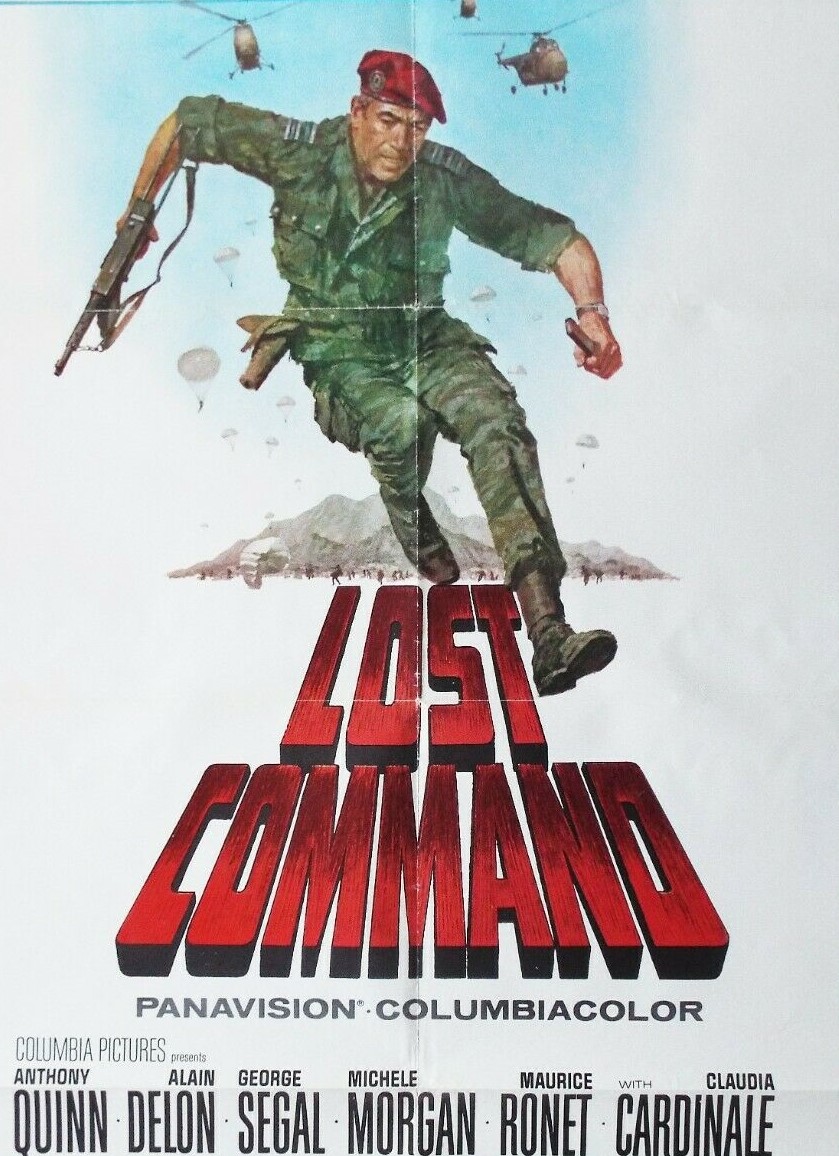
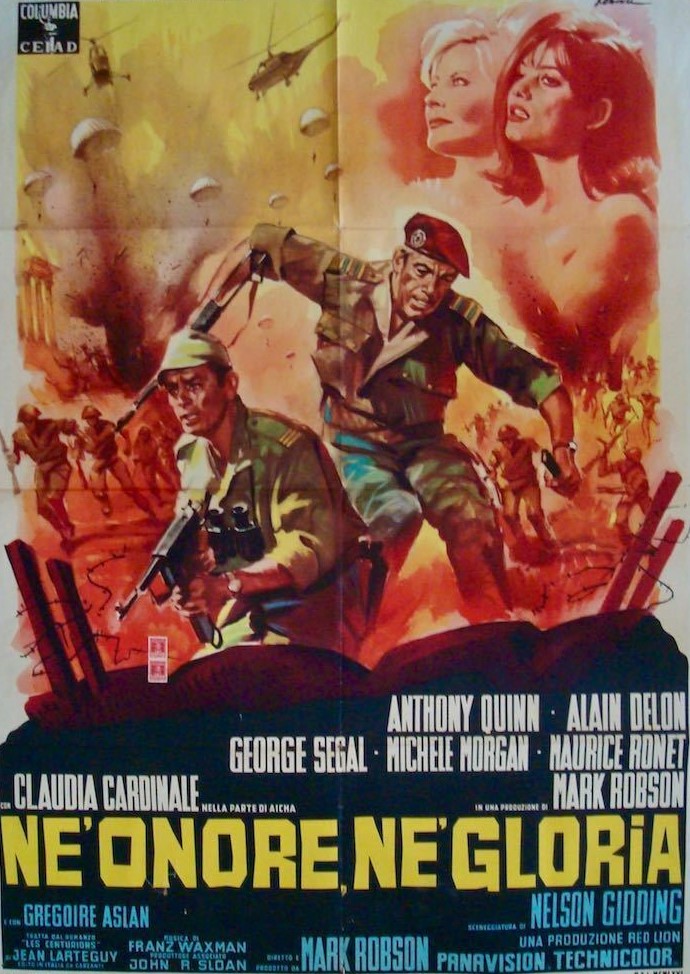
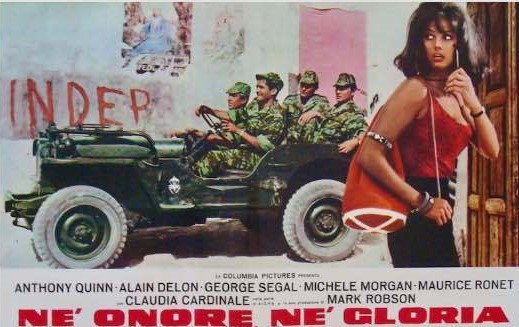
Col Raspeguy (Anthony Quinn, in unlikely athletic mode – that’s him leaping in the poster) is the officer of a paratroop regiment who sees out the debacle of the final battle of the French war in Vietnam, loses his commission, and then, reprieved, is posted to Algeria, where the fight for independence is in full swing, with a ragbag of rejects plus some faithful comrades from his previous command. In any spare moment, the colonel can be seen keeping fit, doing handstands, swinging his arms, puffing out his chest, and a fair bit of running (presumably to avoid the contention that Quinn was too old for this part). Sidekick Capt Esclavier (Alain Delon) is a bit too moralistic for the dangerous business of war, plays his sidekick. The colonel is an ideal anti-hero for a hero, an officer who ignores, challenges or just plain overrides authority, adored by his men, hated by the enemy, ruthless when it matters.

The brutal realism, which sometimes makes you quail, is nonetheless the best thing about the picture, no holds barred here when it comes to portraying the ugly side of battle. The training in The Dirty Dozen is a doddle compared to here, soldiers who don’t move fast enough are actually shot, rather than just threatened with live ammunition, and there’s no second chance for the incompetent – at the passing out ceremony several are summarily dismissed. The only kind of Dirty Dozen-type humor is a soldier who fills his canteen with wine. Otherwise, this is a full-on war.

Battles are fought guerilla style, the enemy as smart as the Vietnamese, catching out the French in ambushes, using infiltrators sympathetic to the cause and terrorism. Unlike Apocalypse Now where the infantry appeared as dumb as they come, relying on strength in numbers and superior weaponry, Lost Command at least has an officer who understands strategy and most of what ensues involves clever thinking. The battles, played out in the mountains, usually see the French having to escape tricky situations rather than blasting through the enemy like cavalry, although having sneakily pinched a mayor’s helicopter gives Raspeguy’s team the opportunity to strafe the enemy on the rare occasions when they can actually be found, their camouflage professionally done.

Arab rebel chief Lt Mahidi (George Segal, unrecognizable under a slab of make-up apart from his flashing white teeth), matches the French in terms of tactics and brutality, shooting one of his own men for disobeying orders. His sister Aicha (Claudia Cardinale) is the femme fatale making a play for Esclavier, though he’d have to be a lot dumber than the audience to fall for her obvious ploys (guess what, he is dumber). With both sides determined to win at all costs, atrocities are merely viewed as collateral damage, so in that respect it’s an unflinching take on war.

The picture could have done with another 15 minutes or so to allow characters to breathe and develop some of the supporting cast. The movie did well in France but sank in the States where my guess is few of the audience would even know where Algeria was. Gilles Pontecorvo’s The Battle of Algiers, out the same year, gave the revolutionaries the leading role.

For the most part Anthony Quinn (Guns for San Sebastian, 1968) is in bull-in-a-china-shop form but his character is more rounded in a romantic interlude with a countess (Michele Morgan), his ability to outsmart his superior officers, his camaraderie with his own soldiers and, perhaps more surprisingly, the ongoing exercise routines which reveal, rather than a keep-fit fanatic, an ageing soldier worried about running out of steam. Alain Delon (Texas Across the River, 1967) is entrusted with the morally ambivalent role. George Segal (The Quiller Memorandum, 1966) presumably didn’t realize how culturally inappropriate he would be.

Mark Robson (The Prize, 1963) lets worthy get in the way of action. Screenwriter Nelson Gidding (Nine Hours to Rama, 1963) had the same problem.

Set the politics aside and it becomes much more interesting.

Villa Rides (1968) ***

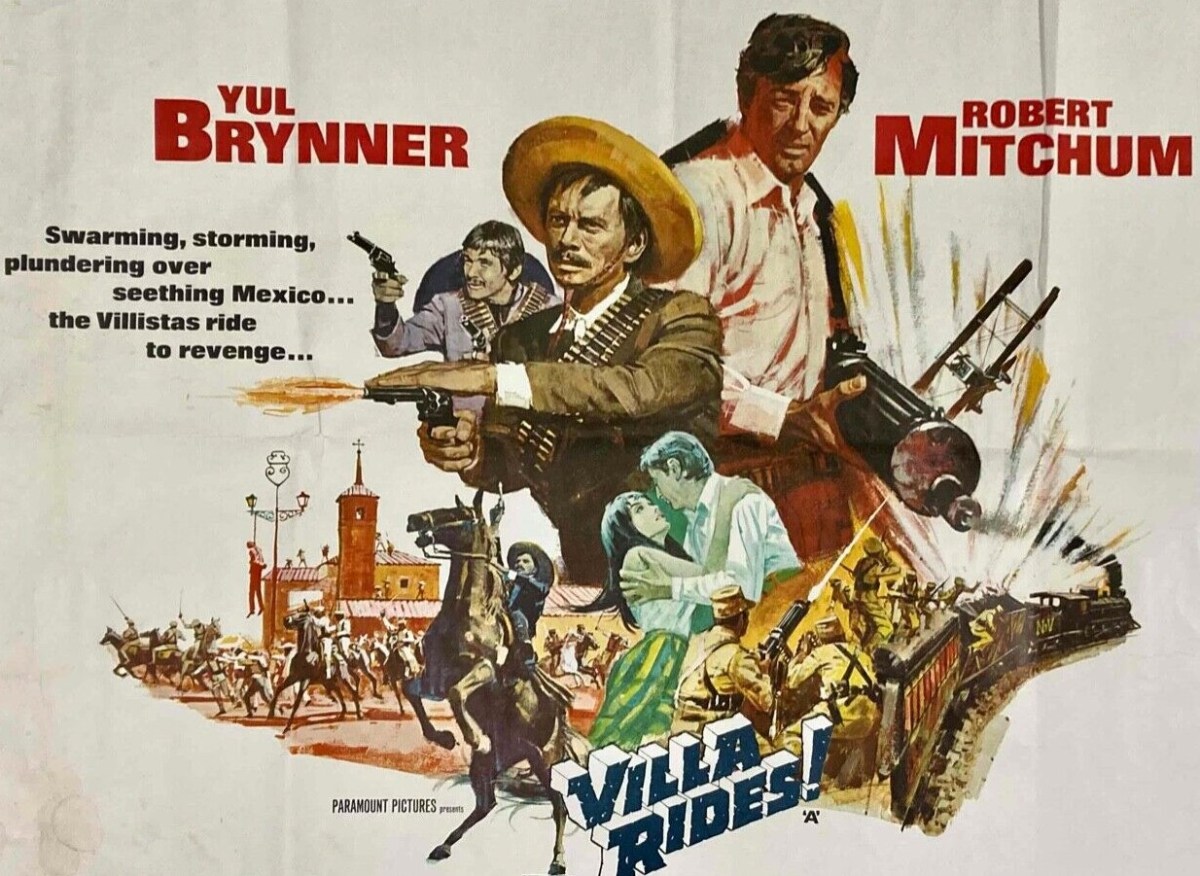
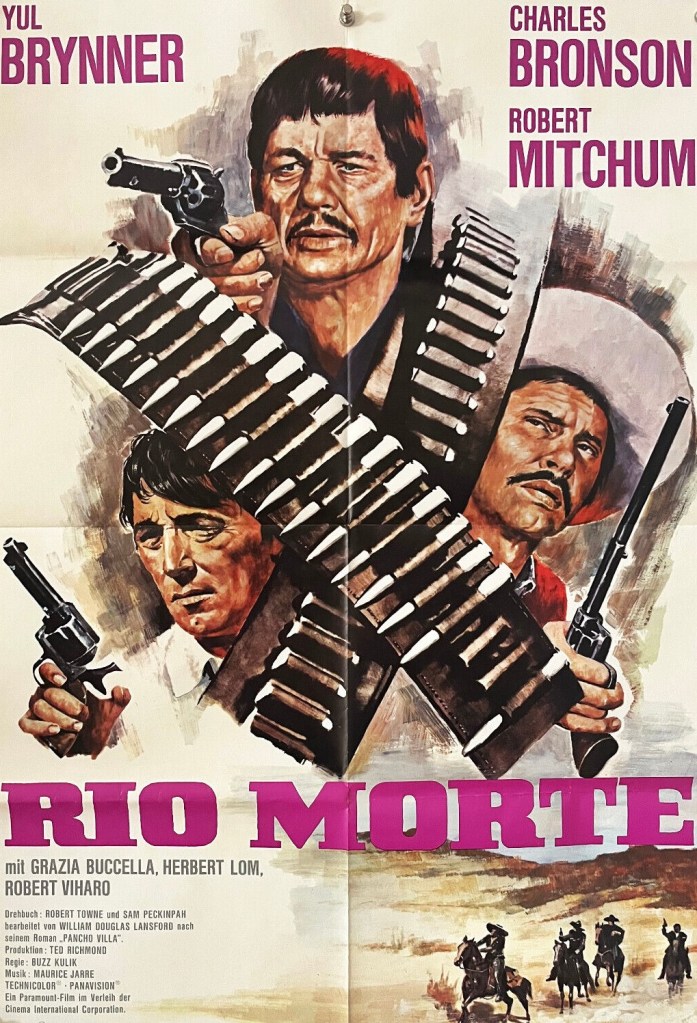
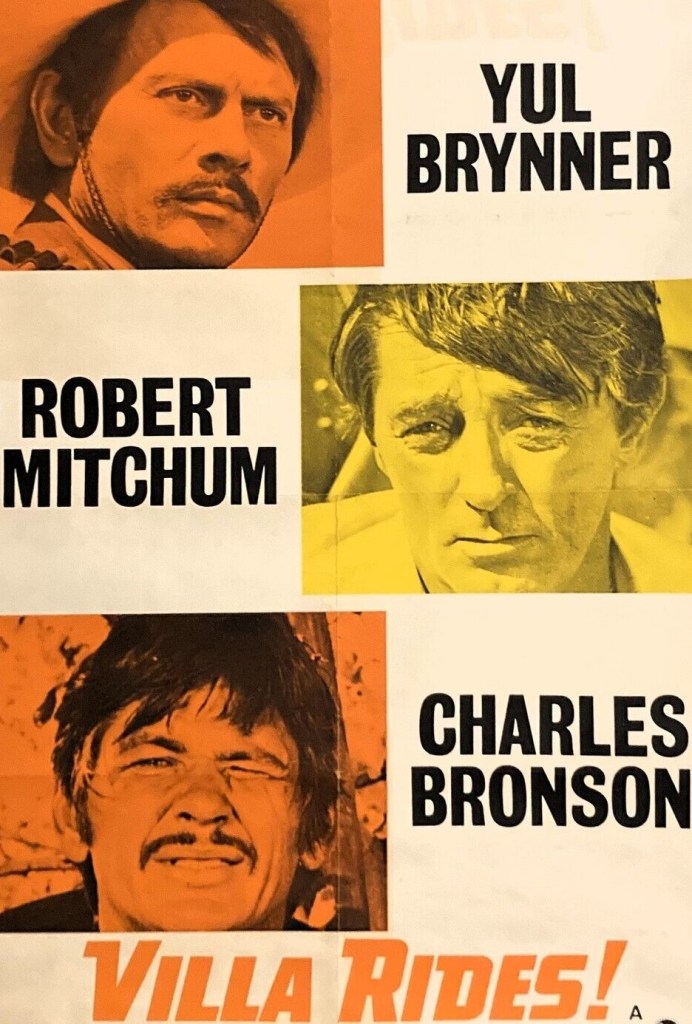
Best viewed as Charles Bronson’s breakout movie. Yes, he had played supporting roles in The Magnificent Seven, The Great Escape and The Dirty Dozen, but these had all been versions of the same dour, almost monosyllabic, persona. Here, though somewhat ruthless, he steals the show from the top-billed Robert Mitchum and Yul Brynner with many of the best lines and best situations with an extra slice of humor (make that first-ever slice of humor) to add to the mix. He is the most interesting of the three main characters, in part because he does not have to spout any of the “good revolution/bad revolution” dialog that falls to the other two.

Villa (Brynner) is fighting the Colorados but his superior General Huertas (Herbert Lom) is planning to overthrow President Madero (Alexander Knox). Mitchum is an aeronautical gun-runner from El Paso, initially against the revolutionaries, stranded in Mexico when his plane breaks down. He has just about time to romance a local woman Fina (Maria Grazia  Buccello) before the Colorados arrive, take over the village, start hanging the leaders and raping Fina. Villa saves them, Bronson slaughtering the Colorados with a Gatling gun on the rooftop. Faced with the one-man firing squad that is Bronson, Mitchum turns sides. His plane comes in handy for scouting the enemy, then bombing them.

The actions sequences are terrific especially Villa’s attack on a troop train. To get Villa out of the way, Huertas puts him in the front line in a suicidal attack on a heavily-defended stronghold which turns into another brilliant set-piece with cavalry charges.  The plot is constantly interrupted by politics of one kind or another and comes to dead stop when Villa is arrested by Heurtas and Villa demands a proper trial. It’s kind of hard to take when a murdering bandit, no matter how legendary, decides that he has been hard done by.

That aside, there are interesting attempts to build up his legend. He doesn’t want power for himself, but to give it to the people, although he has sat back and let the first village be attacked so that the people there learn to hate the Colorados enough to join the fight. There’s not really any good guys – Brynner and Bronson are stone-cold killers, Mitchum a mercenary. But Brynner does marry Fina in order to prove that a raped woman should not be treated with dishonor, though he has a tendency to marry other women as well.

Bronson’s unusual one-man firing squad involves him laying on the ground with a pistol in each hand and giving prisoners the opportunity to escape before he shoots them. After all that hard work, he bathes his hands. Then he decides he can kill three men with one bullet, lining them up exactly so he can drill them all in the heart. But he’s also the one who shoots a molester in a cantina, then delivers the classic line: “Go outside and die, where are your manners?” He is at the heart of some well-judged comedy – continually sending back his meals and trying to get out of getting into a plane with Mitchum. Without him, there would be too much justification of slaughter (Brynner) and arguments against (Mitchum). This is the first time in the kind of action role that suits him that he has an expanded characterization.

Brynner did not like Sam Peckinpah’s original script so Robert Towne (Chinatown) was brought in to present Villa in a more appealing light. Bronson (Adieu L’Ami/Farewell Friend, 1968) shows hints of the screen persona that would so appeal to the French. Yul Brynner (The Double Man, 1967) adorns his character with many shades of grey, but Robert Mitchum (Secret Ceremony, 1969) has less to do.  Buzz Kulik (Warning Shot, 19660 has great fun with the action, less fun with some of the turgid dialog-ridden scenes.   

Good for action and Bronson.

Behind the Scenes: The Box Office Bump

Ancillary – the famed “long tail” – has all but disappeared. Used to be movie studios could count on up to 90 per cent of a picture’s overall earnings coming after it had completed its initial run in the cinemas. Until streaming cut off ancillary at the pass,  that long tail consisted of an extraordinary number of revenue streams. Once a film was out of the cinemas, and assuming it wasn’t going to return in a steady reissue pattern like the James Bond or Disney movies or blockbusters such as Star Wars, its ancillary journey would begin with VHS/DVD (of which there were several sub-streams), then television (again, sub-divided into network, cable, syndication, and specialist operations like Turner) and then you could still be talking remake. Plus, you could bunch up an entire library of old pictures and sell them on again. The beauty of the system was that when movies hit whatever ancillary segment, there was rarely any such thing as an outright buy. Movies were leased. That meant every three or four years they could be sold all over again.

The forerunner of ancillary was network television. Television had begun mopping up old movies by the bucketload in the 1950s, and in such quantities that the attraction of old movies on the small screen prevented audiences seeking out new movies on the big screen and in part accounted for the steady decline of the moviegoing habit. By the 1960s, networks were beginning to fork out big bucks for individual pictures – Cleopatra (1963) going for several million.  

By the 1970s, the income from a television showing of a movie could exceed what it had made at the cinema. For United Artists, in the period 1970-1972 (this covers the dates films were made not when released), television sales, calculated on an overall annual basis, brought in at least an extra 24 per cent on top of revenue from cinema release. That figure came from 1970, but in 1971 that shot up to 38 per cent and the following year dipped slightly to 37 per cent. And that was just for the United States. Although other countries tended to pay a lot less for movies, they still paid something and in total might bring in half as much again.

The ancillary gold mine had started to pay off big time. In the 1960s, the amounts networks ponied up for television rights depended very much on initial box office, the assumption being there was some obvious correlation between the numbers who would go to see a particular movie at the cinema and the size of the subsequent television audience. And while it was true the biggest cinematic blockbusters tended to attract the biggest television audiences, it was soon equally clear that television audiences were as segmented as much as cinema ones and therefore the amounts paid by networks for individual movies began to show sharp  divergence.

There was no doubting that James Bond ruled the television roost as far as UA was concerned in 1970-1972. Diamonds Are Forever and Live and Let Die, regardless of U.S. box office – the former earning $20 million in rentals (the studio’s share of the box office), the latter $16.2 million – were each sold to American television for the same, princely, sum of $5.2 million, by far and away the most any movie pulled in.

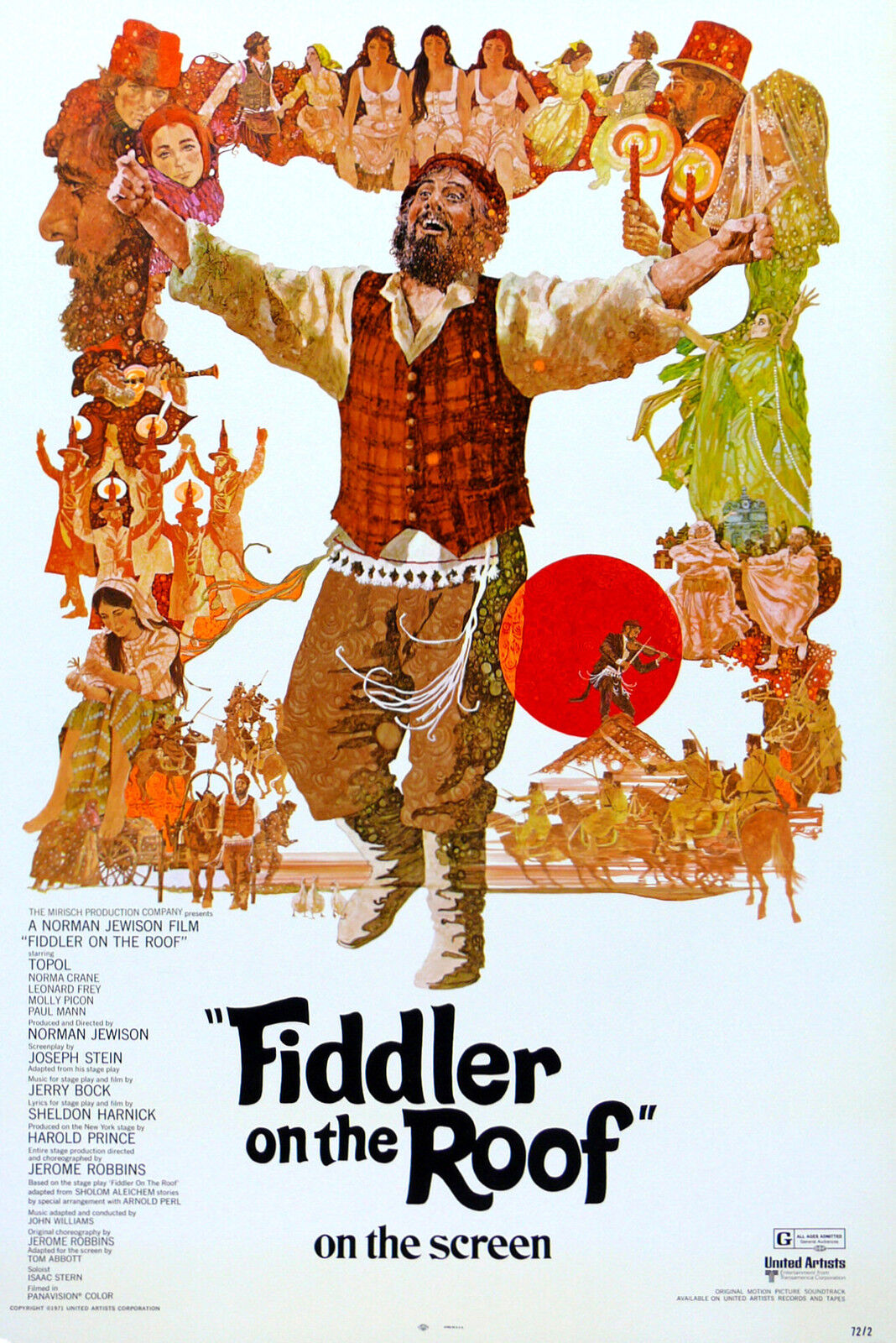
Not far behind was Fiddler on the Roof which netted $5.12 million. But here’s the kicker – the musical earned more than both Bonds put together, a colossal $37 million in rentals. but in terms of attracting a television audience was considered a weaker proposition than both. But musicals were believed to be somehting of a golden goose for television, otherwise how to acocunt for Tom Sawyer which cost networks $2.76 million. Comparatively speaking, that made no logical sense because it had only taken in $5 million in rentals. But family-friendly fare was so rare it had networks duking it out for the rights. A third musical Man of La Mancha went to television for $1.7 million having racked up just$3.7 million at the cinema.

Conversely, networks weren’t remotely interested in films with a sex theme, no matter how well they had done at the box office. Last Tango in Paris had harnessed a colossal $16 million in rentals but was worth only $120,000 (yes, that’s right, $120,000) to any television station willing to show it (heavily cut of course). It didn’t even matter if you took a comedic approach to sex. Woody Allen’s Everything You Wanted To Know About Sex hauled in $8.2 million at the cinema but only $130,000 from television. But maybe Woody Allen was the problem. Bananas, with a highly-profitable $3.3 million at the box office, could only manage less than half a million from television, the comedian perhaps considered an acquired taste which not enough of the public had acquired.

But television, rather than being viewed as the perennial enemy, was often seen as salvation for under-performing movies, maybe not recouping the entire negative costs but going some way to stem the flow of red ink. And perhaps the more interesting statistics relate to those pictures which earned more from television than they did in their entire U.S. cinema run.

Michael Winner espionage thriller Scorpio headlined by Burt Lancaster and Alain Delon notched up $1.35 million at the cinema but $1.56 million from television. Similarly, Robert Altman’s critically-acclaimed The Long Goodbye with Elliott Gould as the iconic private eye picked up a mere $1 million at the U.S. cinema compared to $1.51 million from a network. Another private eye caper, Hickey and Boggs, teaming Robert Culp (who also directed) and Bill Cosby from a Walter Hill script, had snapped up just $900,000 from cinemas but $1.2 million from television. Cops and Robbers hoisted $1.32 million in small screen larceny as against $1.2 million elsewhere.

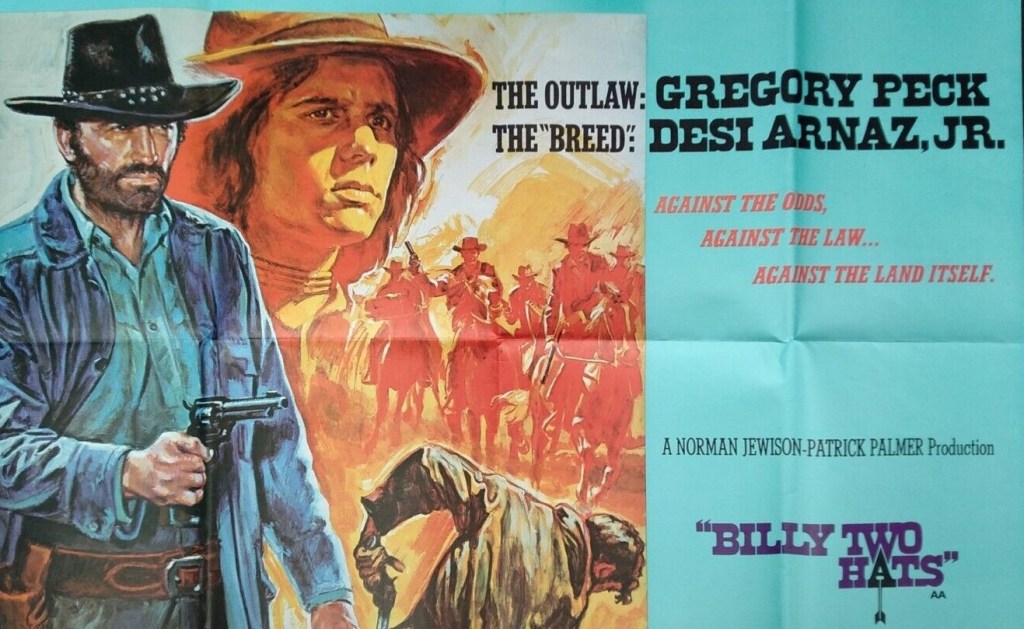
Westerns The Magnificent Seven Ride, the fourth in the series, and Ted Kotcheff’s Billy Two Hats starring Gregory Peck and with a script from Scotsman Alan Sharp, both did better financially from television than cinema. The former’s small screen take was $1.16 million compared to $750,000 from the cinema, the latter $1.15 million compared to $440,000. But for The Hunting Party with a top-line cast of Gene Hackman, Candice Bergen and Oliver Reed it went the other way, the $460,000 from television going hardly any way to offset the paltry $800,000 from cinemas.

It’s possible that star power, and weighted towards veterans, counted more in television. As well as Scorpio, Lancaster westerns Valdez Is Coming and Lawman tucked away $1.47 million and $1.5 million, respectively, from their television outings.

SOURCE: “Results of Distribution of Released Pictures (by production year),” MCHC 82, Box 1, Folder 8, The United Artists Archive, University of Wisconsin.

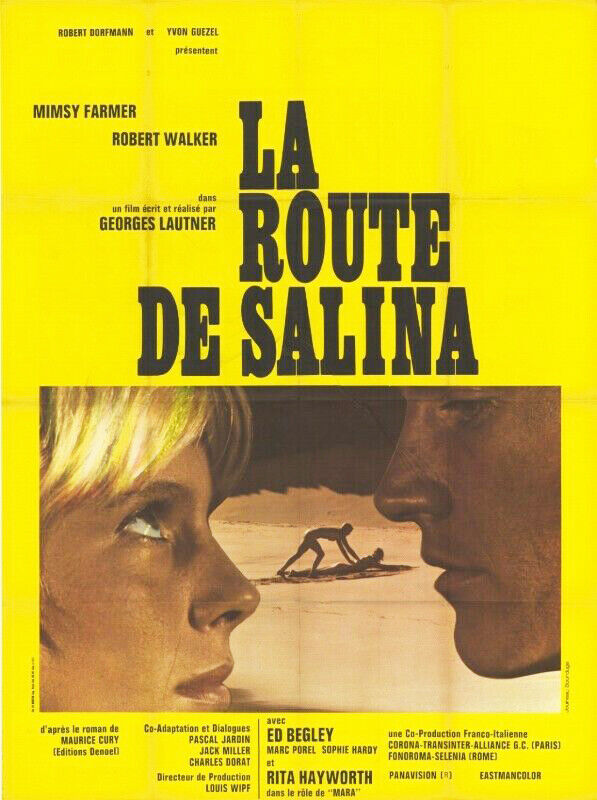
The Road to Salina (1970) ***

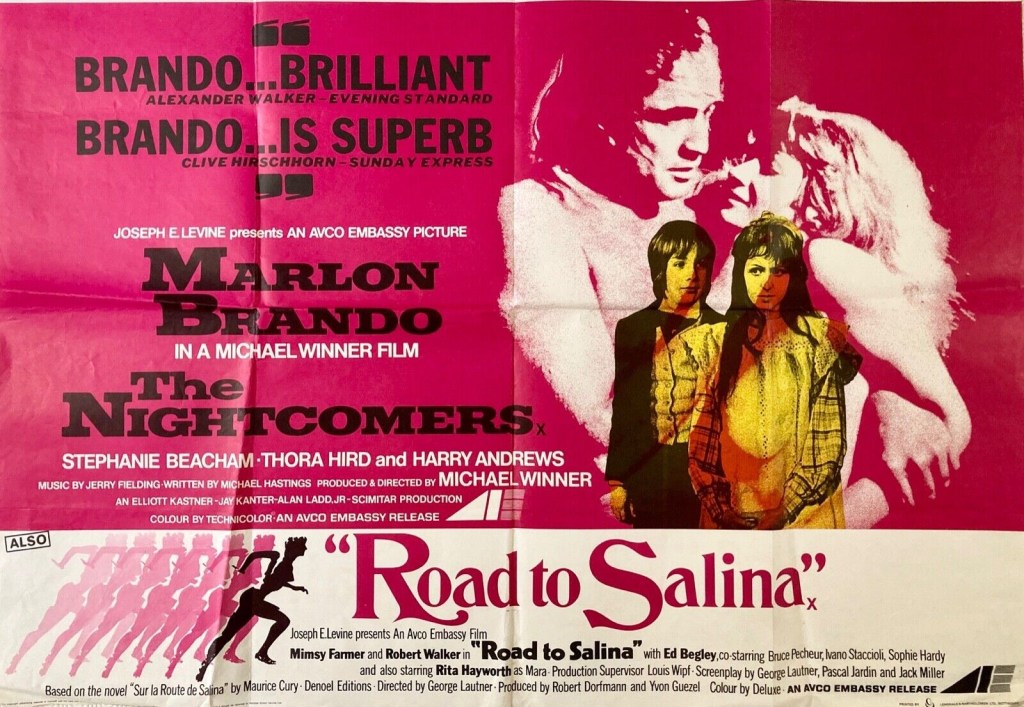
I thought I’d taken a stab at finding out what happened to Mimsy Farmer after More (1969) and by chance stumbled upon Rita Hayworth (The Happy Thieves, 1961), also persona non grata in mainstream Hollywood.

Pivots on the tricky trope of mistaken identity. Or, rather, someone who insists on believing that a stranger turning up is actually a long-lost son / lover / whatever. Jodie Foster was the too trusting wife in Sommersby (1993), for example, but it’s hard to pull this off once suspicions are aroused. Unless, of course, the potential dupe is determined to believe because it fills an emotional hole, thus providing sufficient narrative undercurrent.

Double bill of creepiness.

That’s the case here, when drifter Jona (Robert Walker Jr) turns up at the roadside service station run by Mara (Rita Hayworth) his resemblance to her dead son Rocky (Marc Porel) is so uncanny she believes it is the child returned. Just to be clear, Rocky died in mysterious circumstances, corpse never found, so there’s some foundation to her belief beyond maternal madness. Seizing the opportunity for a warm bed and some decent grub and the chance to be spoiled, Jona plays along – especially after Rita’s neighbour Warren (Ed Begley) supports her delusion – and soon he’s invited into another bed, that of Rocky’s sister Billie (Mimsy Farmer). The savvy daughter has her own reasons for going along with it. Then we’re into flashbacks within the flashback as the mystery unfolds and we dip in and out of incidents around the gas station and the somewhat unusual relationship between brother and sister.

As with most slow-burn dramas, you wouldn’t really call it a thriller, it depends on atmosphere, but in the same way as, for example, Don’t Look Now (1973), there’s definitely something insidious here and noir-ish if you don’t mind a story played out away from that genre’s physical darkness. It digs deep into the worst emotion of all, loneliness, and how the hankering after relationship, and an inability to steer clear of the psychosexual, anything to stop you from being alone, can bring torment and tragedy. Dangling fantasy in front of a woman incapable of dealing with reality is a dangerous temptation.

While some of the elements verge on the bizarre, and the narrative threatens to tip into confusion, the viewer is nonetheless kept on pretty much an even keel by the direction, which doesn’t play hard and loose with the facts, but just takes its own slow way heading towards resolution.

The main younger characters aren’t anything we’ve not seen before and the impetuous immoral Billie could easily be a cousin to Estelle in More (1969) while Jona is just every dopehead drifter with an eye on the main chance, except he turns patsy under the femme fatale wiles of Estelle. Rita Hayworth (The Money Trap, 1965), by now a Hollywood back number, brings a healthy dose of reality, and it’s worth the admission just to watch the former sex symbol fry eggs and dance around with the equally middle-aged and frumpy Ed Begley (Hang ‘Em High, 1968) while tacitly acknowledging the bolder elements of the counter culture.

Robert Walker Jr (The Happening, 1967) doesn’t bring much to the party but Mimsy Farmer sizzles. The movie trips easily through the decades, contemporary 1970s buzz undercut by old-fashioned  1940s sensibilities.

French director George Lautner’s stylish concoction – this begins with a downpour, character trapped in torrential rain, an unusual image for the times, and unwinds in flashback – forces you to suspend disbelief long enough to guide the endeavour to a satisfactory conclusion.

Under-rated, this should appeal beyond the Farmer and Hayworth fan clubs.

Girl with a Pistol (1968) ****

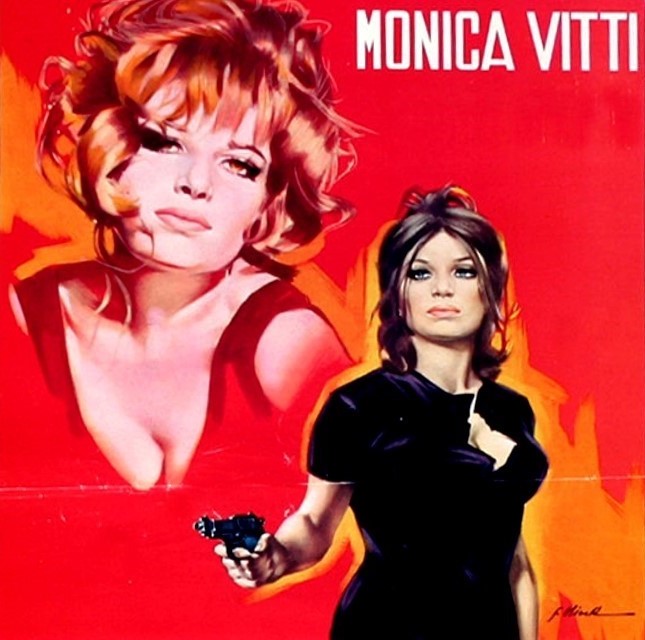
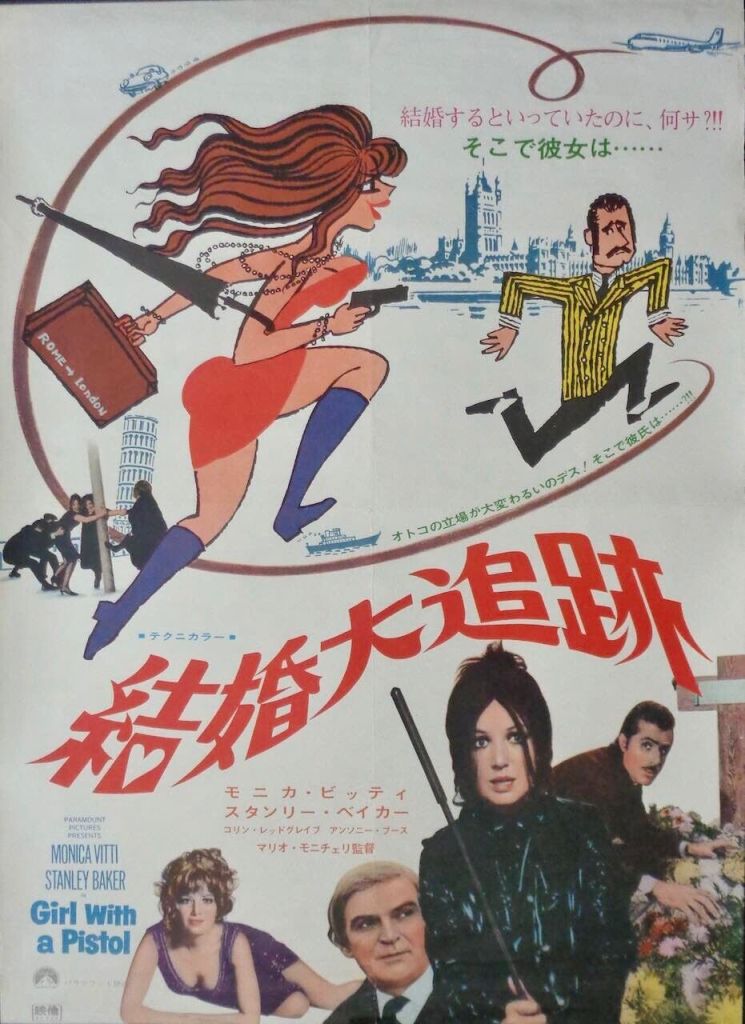
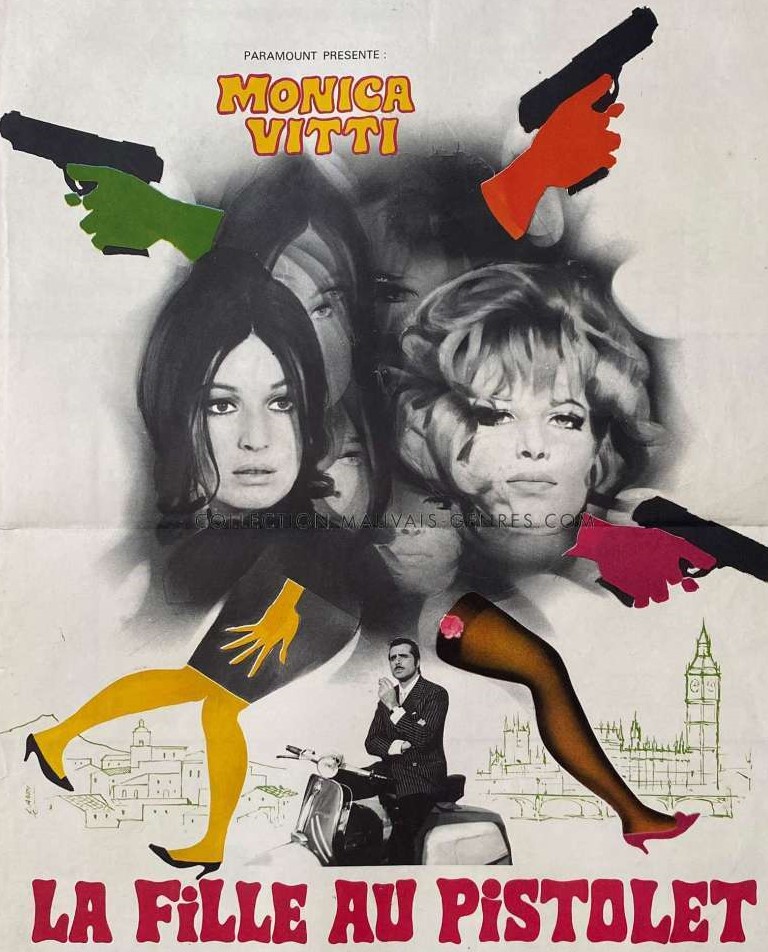
Off-beat Oscar-nominated comedy-drama that is both a marvelous piece of whimsy and a slice of social realism set in the kind of Britain the tourist boards forget, all drizzle and grime. It zips from Edinburgh to Sheffield to Bath to London to Brighton to Jersey as if the characters had been dumped from an If It’s Tuesday It Must Be Belgium sketch. If your idea of Italy was Fellini’s glorious decadence or Hollywood romance amid historic ruins and fabulous beaches, then the upbringing of Assunta (Monica Vitti) is the repressive opposite.

All women in her small town wear black. Men are not allowed to dance with women and must make do with each other. A man like Vincenzo (Carlo Giuffre) desiring sex must kidnap a woman, in this case Assunta, to which she will consent as long as he marries her. When instead he runs off to Scotland, she is dishonored and must kill him, armed with the titular pistol.

Pursuit first takes her to Edinburgh and a job as a maid, has a hilarious encounter with a Scottish drunk, and various other cross-cultural misinterpretations – in a bar she cools herself down with an ice-cube then puts it back in the bucket. Then it’s off   to Sheffield where she falls in with car mechanic Anthony Booth (television’s Till Death Do Us Part) because he is wearing Italian shoes.

She can’t imagine he can watch sport for two hours. “You’re a man, I’m a woman, nobody in the house and you look at the television.” Although tormented by images of being attacked back home by a screaming mob of black-robed women, she begins to shed her inhibitions, wearing trendier clothes, although an umbrella is essential in rain-drenched Britain and given the Italian preference for shooting exteriors.  

In between sightings of Vincenzo there are episodes with a suicidal gay man (Corin Redgrave) and a doctor (Stanley Baker). She becomes a nurse, then a part-time model, sings Italian songs in an Italian restaurant, drives a white mini, wears a red curly wig and more extravagant fashions. It turns out she can’t shoot straight. Gradually, the mad chorus of home gives way to feminist self-assertion as she becomes less dependent on men and a world run by chauvinists. It’s a startling mixture of laugh-out-loud humor and social observation. And while the narrative that at times verges on the bizarre, Assunta’s actions all appear logical given her frame of mind.

Vitti was Italian director Michelangelo Antonioni’s muse (and companion) through  L’Avventura (1960), La Notte (1961) and L’Eclisse (1962) to Red Desert (1964). She had a brief fling with the more commercial, though still somewhat arty, movie world in Joseph Losey’s Modesty Blaise (1966) and the nothing-artistic-about-it comedy On the Way to the Crusades (aka The Chastity Belt, 1968) with Tony Curtis. Director Mario Monicello had two Oscar nominations for writing but was best-known for Big Deal on Madonna Street (1958) and Casanova ’70 (1965). Girl with a Pistol was nominated in the Best Foreign Language film category at the Oscars.

Discover WordPress

A daily selection of the best content published on WordPress, collected for you by humans who love to read.

The Atavist Magazine

by Brian Hannan

WordPress.com News

The latest news on WordPress.com and the WordPress community.