Diamond Head (1962) ****

Bold examination of racism years ahead of its time. Narrative not sweetened for audiences by a detective story (In the Heat of the Night, 1967) or grumpy father-of-the-bride comedy (Guess Who’s Coming to Dinner, 1967) or by protagonists unrepresentative of society by being criminal (The Defiant Ones, 1958) and criminally insane (Pressure Point, 1962), the issue of racism – miscegenation and interbreeding – smack bang in the middle. Though it takes place in Hawaii, theoretically at one remove from the violence emanating in the U.S. Deep South, the points made strike home.

If a shade melodramatic, that is undercut by a set of very fine performances by all the principals. Charlton Heston, later lacerated in democratic circles for his defence of the right to bear arms, here employs his marquee value to deal with the ticking time bomb.

Yep, that is an advert shaped as a diamond. Subtle, huh?

The tale is simple enough. Headstrong Sloane (Yvette Mimieux) decides to marry native-born Paul Kahana (James Darren) against the wishes of her older brother, widowed millionaire landowner “King” Howland (Charlton Heston). Despite using equality as an election platform in a bid to become a Senator, King fiercely objects to the marriage on the grounds that it will dilute his bloodline and, in effect, hand over control of his empire to an outsider. His spinster sister-in-law Laura (Elizabeth Allen) backs him on this score as does, oddly enough, Paul’s mother Kapiolani (Aline McMahon) who complains that interbreeding has reduced the number of native Hawaiians to a mere 12,000.

Complicating matters is King’s hypocrisy. His mistress, Mai Chen (France Nuyen), already is of mixed parentage. But when she announces she is pregnant, he demands she have an abortion. Spicing up that particular complication is her brother Bobbie (Marc Marno) who sponges off the perks King provides and now decides to hit the gold seam by blackmailing King. And just in case that’s not enough in the way of complications Sloane has always had a yen for Paul’s older and more successful brother Dean (George Chakiris), now a hospital doctor. In fact, as outlined in a flashback, Paul was decidedly second-best in Sloane’s eyes and there is a hint she romanced him to spite the more sensible brother.

Bobbie doesn’t get the chance to put his scheme into practice as he is implicated in the death of Paul, who had been trying to stop the blackmailer from drunkenly attacking King at a traditional engagement ceremony. Paul is killed accidentally by King.

That should have simplified matters, but it doesn’t. King is abandoned by Sloane and Laura leave and Mai Chen throws him out. The scandal of Paul’s death should have ended his political ambitions, but despite his backers dropping out, arrogantly he decides to go it alone until receiving the slow-handclap treatment from the public. He is fully aware of the consequences of his action, pointing out that $3 million spent on philanthropy wouldn’t “buy me a tear.”

It could have ended there, proud man brought down by ambition, institutional racism and stubbornness, but it follows a different, and reconciliatory, tack at the end.

And it could have been a heaving brew of melodrama with dilated nostrils and screaming matches but it’s redeemed from that by most of the actors downplaying their roles. There is some impressive playing by Charlton Heston (55 Days at Peking, 1964) who carries off his hypocrisy in some style, but doesn’t descend to the obvious ploy of disinheriting the defiant one or at the very least chucking her out and generally manages to keep the lid on his temper. George Chakiris (Flight from Ashiya, 1964) uncannily captures all the elements of his character. An educated man so can’t be downtrodden but has to watch his step in confronting such a powerful man, so he makes his point with quiet determination.

In an early starring role Yvette Mimieux  (Joy in the Morning, 1965) is given a lot more to do than in some later offerings. She exhibits defiance not just in regard to racism but sexism as well, determining that her marriage would be an equal relationship not one where she would be subservient to her husband. Had she been able to rein in her pig-headedness and present herself as more interested in the business than its perks  she might have allayed her brother’s fears that in endorsing the marriage he was risking handing over his empire to her idiot husband, so lacking in the brain department he needed extra years to graduate at college.

France Nuyen (Man in the Middle, 1964) has a peach of a part, plenty good lines, and the beneficiary of the few scenes not driven by narrative requirements, in particular her observations at watching her lover dress. James Darren (The Guns of Navarone, 1961), given  less to do, is not surprisingly more of a cliché. Oscar-nominated Alice McMahon (Cimarron, 1960) is quietly impressive as the equally torn parent who could, at one point, take legal revenge on King.

Director Guy Green (The Magus, 1968), aware the content is inflammatory enough without the principals going overboard, does pretty well to stick to the issues. Screenwriter Marguerite Roberts (5 Card Stud, 1968), in adapting the bestseller by Peter Gilman, makes several changes to keep the focus on the key element.

In his diary, Charlton Heston noted that that movie was overly melodramatic but with the proper treatment it could work. He was right. The plot has more cogs than any wheel could comfortably accommodate, but by keeping the central issue central the movie would be viewed today as the highpoint of Hollywood’s opposition to racism rather than being  superseded five years later by the pair starring Sidney Poitier.

The Bliss of Mrs Blossom (1968) ***

The predatory female was a late 1960s trope but this takes it stage further by suggesting that a woman can have it all, husband, lover and career fulfilment. Usually, it’s the powerful male that sets his mistress up in an apartment. It being British, Mrs Blossom (Shirley MacLaine), wife of bra manufacturer Robert (Richard Attenborough), stashes lover Ambrose (James Booth) in the attic.

There’s an element of Carry On in the focus on Robert’s profession, sniggering at the audacity of it all when it’s little more than an excuse to show a succession of half-naked girls modelling the product. The central conceit is ahead of its time, not so much one-size-fits-all, the Holy Grail of all manufacturers, but that women can have the bosom-shape they desire (rather than these days opting for the under-wired bra or going the whole hog with cosmetic surgery) through inflating the brassiere to suit.

Except toward the end, the bra business takes second place to the sex business as Mrs Blossom demonstrates exactly how to have your cake and eat it. Her shenanigans with Ambrose cause her to make greater effort with Robert. Although the male perspective occasionally intrudes: Mrs Blossom “ecstatic” at the prospect of making two men happy.

There’s not much going on plot-wise beyond Robert hearing strange noises in the attic and discovering a number of items, purloined by Ambrose, going missing, resulting in him seeking the help of a psychiatrist (Bob Monkhouse).

The whole enterprise is doused in modernity, probably post-ironic for all I know, Mrs Blossom’s painting tending towards Pop Art, some in-jokes (one dot on a canvas turns out to be a “sold” sticker). Since there’s not much else going on, Robert, kept sexually satisfied, hardly imagining his wife is engaged upon an affair, scarcely raising a scintilla of suspicion, the lovers carry on as if they are, in the best Hieronymus Merkin fashion, embarking on a welter of fantasies, primarily of the cinematic variety, so nods to Hitchcock, David Lean and even Raymond Chandler etc.

The climax at some kind of ticker-tape convention featuring Robert speaking atop a giant bra-clothed statue looks as though it consumed most of the budget. At bit more of the money could have been spent on jokes, because, without the danger of the illicit couple being found out, it lacks any real tension, unless you count a pair of bumbling and/or camp detectives (Freddie Jones and Willie Rushton) whose sole purpose appears to be to over-act. There’s a clever twist at the end.

Director Joseph McGrath (The Magic Christian, 1968) is something of an acquired taste. His main claim to fame at this point having helmed music videos for The Beatles and his scattergun approach rarely hits the target. One of the few examples where opening up a play (by Alec Coppel – of Vertigo fame!!) results in in racing in too many directions.

Shirley MacLaine (Sweet Charity, 1969), by now the decade’s most celebrated kookie, brings immense charm to the role and it has to be said it’s the acting in the main that keeps this on an even keel when the director is so clearly on a different planet. Richard Attenborough (The Flight of the Phoenix, 1965) is believable as a workaholic who lets off steam conducting an imaginary orchestra. James Booth (Fraulein Doktor, 1969), meanwhile, in a role that could have gone seven ways to Sunday, makes a convincing lothario.

Comedian Bob Monkhouse is surprising good as the madcap psychiatrist and you might have some fun spotting John Cleese, Barry Humphries and a young Patricia Routledge. Producer Joseph Shaftel (The Biggest Bundle of Them All, 1968) wrote the script with Denis Norden (The Best House in London, 1969).

Kind of has to be seen to be believed.

Wives and Lovers (1963) ***

Key name here is Jay Presson Allen. You may remember her for giving theatrical and then cinematic shape to Muriel Spark’s novel The Prime of Miss Jean Brodie (1969). The clarity she brought to both stage and movie productions resulting in critical kudos and box office. She would do the same with Cabaret (1972). And, undeniably, in Wives and Lovers she was also prophetic. Had it been filmed under the title of the play from which it was adapted, Allen’s The First Wife, we would not have been acknowledging the insight so much of The First Wives Club nearly three decades later.  

By shape of course we mean structure and there’s not much you can do when the source is a Broadway hit other than expanding it out away from the inherent staginess. And here nobody makes the mistake of trying. This belongs to the tag end of the Rock Hudson-Doris Day comedy when innocents are not too badly punished for their errant ways and generally see the light at the end.

Here, struggling writer Bill (Van Johnson), financially supported by dental hygienist wife Bertie (Janet Leigh), hits the jackpot when his novel is published, becomes a Book-of-the-Month-Club (extra loot), is purchased by Hollywood (more loot) and is turned into a play (even more loot) by the author. As if he has swallowed a lorryload of steroids, the quiet spoken somewhat child-pecked Bill ups sticks to more fashionable Connecticut and charges headfirst into temptation. this appears in the form of cocktail parties, Hollywood stars, sexy agent Lucinda (Martha Hyer) and every excuse to spend endless nights on the town rather than cuddling up at home with Bertie and working out how to make the new-fangled stereo work.

There’s not much to this other than your standard three-act play: initial enjoyment of success, the aforementioned temptation, and coming to the kind of understanding that couples in the early 1960s were still permitted before divorce appeared the more convenient and adult option.

On hand to warn against that option is disillusioned divorced first wife neighbot Fran (Shelley Winters) whose “companion” (his position is left comfortably vague) Wylie (Ray Walston) spends most of his time belittling their interior décor. Also on hand to show how difficult it is to fit into the upmarket set is snippy housemaid (Lee Patrick). With neighbors and maid on hand to put her in her place, and husband rarely around to help her explore their newfound status, it’s hardly surprising that Bertie, assuming Bill’s late nights include some illicit romance, tries to find solace with predatory Hollywood star Gar (Jeremy Slate), neatly fitting into this jigsaw as the proposed leading man of the stage adaptation and as Fran’s ex-.

So, basically, it’s the usual comedy of errors, though for a time Bill does seem hellbent on making the most of a mid-life crisis. While it’s strewn with good and often funny lines, the timing of the actors often fails to accommodate them, so it’s kind of helter-skelter at some points. It’s pretty easy to move in high-falutin’ circles because everyone you meet goes by the moniker of “Sweetie.” On reaching a marital crisis, the couple resolve the situation in a clever, humorous manner.  

Certainly, it’s the gentlest of comedies, but no worse for that and although former MGM matinee idol Van Johnson (Divorce American Style, 1967) takes a sledgehammer to his role, not least from trying to stop Jeremy Slate (The Devil’s Brigade, 1968) from stealing the picture, in fact it’s the more subtle performance of Janet Leigh (The Manchurian Candidate, 1962) that keeps the movie ticking over, assisted by, in less combustible form than usual, Shelley Winters (A House Is Not a Home, 1965). The most worldly-wise character on show is daughter Julie (Claire Wilcox).

In one of those bizarre Hollywood anomalies, since Allen at this time was not a screenwriter figure of any importance, the more experienced Edward Anhalt (Becket, 1964) was handed the job, but with already such a cleverly contrived structure it’s hard to see what he brought to the party. Television director John Rich (The New Interns, 1964) doesn’t bring much more than the innate skill of knowing when to leave well alone.

Likeable enough, especially to see Janet Leigh in one of her rare starring roles in the decade. No intellectual exertion required.

Stolen Hours / Summer Flight (1963) ***

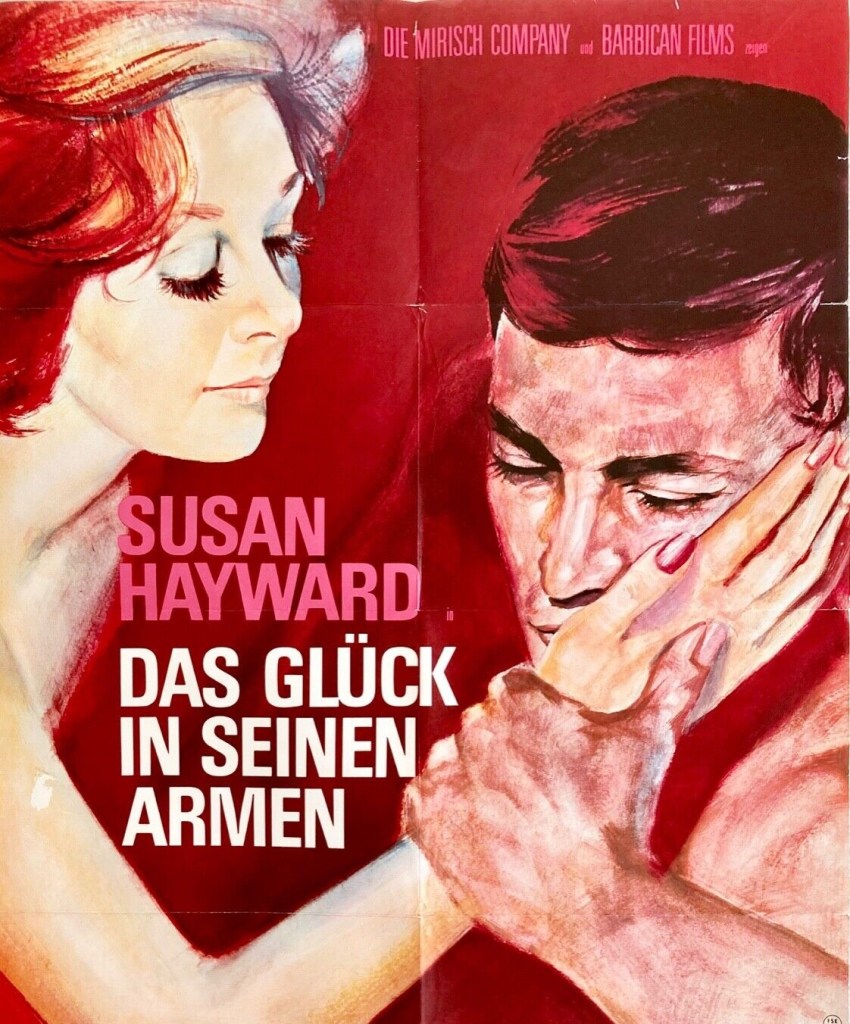
New York Times critic Bosley Crowther famously took Susan Hayward to task for over-acting in the first half of this picture before turning subtle in the second without realizing that was the whole point. Hayward was always full-on, either because he played tougher-than-tough characters (weakness their Achilles heel) or was squaring up against macho males like Clark Gable (Soldier of Fortune, 1954) or John Wayne (The Conqueror, 1956).

Here, she duped audiences. Anyone expecting to view her normal feisty screen persona would come away happy with the first half, bewildered by the second. But, as I said, that was the whole point, a superb effort turning expectations on their head. In any case it was a pretty bold undertaking. In the 1960s, Hollywood went on a cycle of regurgitating old classics but mostly with newcomers like Alex Cord standing in for John Wayne in Stagecoach (1966) or Doug McClure for Gary Cooper in Beau Geste (1966).

There were not many actresses who would think of trying to match the legendary Bette Davis in one of her legendary roles. But Susan Hayward was not just larger than life but a queen of melodrama, able to ratchet up emotions with a look. No actress in the early 1960s could match Davis’s record of two Oscars and a further eight nominations (she would win another one later). By that point Katharine Hepburn equalled her on number of wins but had two fewer nominations (her other wins also came later).  But Hayward ran both pretty close, one win (for I Want To Live, 1959) and four nominations.

So if you were going to select an actress to take on the Davis role in a remake of Dark Victory (1939) you could do worse than choose Hayward. The plot’s been transitioned to England but it follows the same formula as before – in other words stand by for a full-scale weepie. Jet-setting divorced socialite Laura (Susan Hayward) lives life to the full – and then some. When diagnosed with a brain tumor, her reaction is to let all her wildness hang out, reviving romance with old racing driver boyfriend Mike (Edward Judd) before taking stock and abandoning the high life and settling down in the back of beyond (remote Cornwall) with Dr Carmody (Michael Craig).

It’s basically a film of two halves. The almost otherworldly life of the rich and famous who chase after every expensive delight without any notable increase in their happiness quotient contrasts with life in a Cornish village where problems, although apparently smaller, are every bit as vital to those affected. The gaudy section is filled with fine costumes, grand houses and glorious scenery. The serious part is a good bit more down-to-earth as the grande dame discovers her neighborly and maternal qualities. The characters inhabiting the rich life appear flimsy, the poorer people much more realistic. It is almost as if she has swapped fantasy for reality and uncovered a different kind of richness.

There’s not much more to the story than that so it requires acting of the highest caliber to keep us hooked all the way through. Well, for that, you’ve certainly come to the right place. What appears over-acting in the first section is just that, and deliberately so, since the personality switch is the ideal hook. The film’s emotional impact will hit you hard especially the ending. What initially appears to be heading for the sensational soon pulls back to reveal an ordinary person trying to overcome adversity, not with a grand gesture, but simply by living an ordinary life to the full.

While Michael Craig (Life at the Top, 1965) is pretty much a bystander, his calming approach sorely needed in the first half is redundant in the second as Laura comes into her own, developing an inner life she never knew was possible. Hitchcock protege Diane Baker (Mirage, 1965) continues to show early-career promise.

Perhaps more attention should be focused on director Daniel Petrie (The Main Attraction, 1962) who slides out from under his journeyman tab to over-egg the first section and under-egg (if there is such a word) the second. You could almost get the impression of a conductor fine-tuning an orchestra of one.

Superb showing from Hayward certainly gives Bette Davis a run for her money though you could argue she was too old for the role, Davis half her age in Dark Victory, but it’s to Hayward’s credit that you feel the loss of such a vibrant middle-aged personality as you do with Davis’s younger protagonist.

They don’t do melodrama like this anymore, mostly because there isn’t the likes of a Susan Hayward to make them work.

Playgirl After Dark / Too Hot to Handle (1960) ***

Passable British crime B-picture, mainlining on sleaze, plot as flimsy as the costumes of the dancers, rescued by, flipping her screen persona on its head, a heartfelt performance by Jayne Mansfield.  Career tumbling spectacularly after her Frank Tashlin heyday (The Girl Can’t Help It and Will Success Spoil Rock Hunter, both 1957) she was loaned out to any outfit that would have her. Director Terence Young’s (Dr No, 1962) career was also at a low ebb after Safari and Zarak (both 1956) while Carl Boehm (Peeping Tom, 1960) and future Carry On stalwart Barbara Windsor, minus trademark Cockney accent, were on the way up.

Ostensibly an expose of the Soho strip club business, invests too much time in cabaret, though Midnight Franklin’s (Jayne Mansfield) number is surprisingly well done. Parallel plots see journalist Robert (Carl Boehm) investigating the industry while rival night club owners Johnny Solo (Leo Genn) and Diamonds Dielli (Sheldon Lawrence) duke it out over the spoils.

As you might expect, such clubs are populated by seedy customers, some harmless like a Leipzig salesman falling for disinterested showgirl Lilliane (Danik Patisson), others on the creepier side like Mr Arpels (Martin Boddey) who tempts unwary girls with talk of setting them up in the movie business. Naturally, so many girls together, jealousies simmer and tensions flare, resulting, as you might expect, in a catfight. But that’s nothing compared to the beating handed out to Johnny by Diamonds’ thugs. Matters aren’t helped by Johnny’s manager Novak (Christopher Lee) being in the pay of the opposition.

Apart from wearing outfits that would give the censor of the time a heart attack, Midnight is really a sensible girl, hating violence, warning boyfriend Johnny to get out of the business before he ends up dead. She’s got few illusions left, hardly expecting Johnny to pop the question, but like Richard Widmark in yesterday’s Two Rode Together (1961) gradually becoming repelled by his actions.

For the most part she accepts that Johnny effectively pimps out his acts to wealthy customers like Arpels but recoils when he attempts to do so with Ponytail (Barbara Windsor) whom most people believe to be under-age. However, when Ponytail’s attempted rape turns into murder and the police turn up at the nightclub, Midnight, initially obeying the laws of omerta, turns on Johnny after she discovers his gun. But in a wonderful closing scene, she picks up the discarded flower he wore in his lapel and kisses it.

There’s some surprisingly potent dialogue and sharp one-liners – “that’s a very nice dress you nearly got on” / “I had a friend once but it didn’t take”/ “there’s not enough milk of human kindness around here to fill a baby’s bottle” / after a date with Arpels “some girls came back with promises…one came back with a baby.” A good bit more of such zingers and the movie would barrel along regardless of limp plot.

Energy is lost by focusing too long on the cabaret acts and on the growing romance between Robert and Lilliane. As glamorous fading nightclub star, Midnight provides the necessary oomph in more ways that one, but the movie would have benefitted by concentrating more on her ruefulness and self-awareness. Though besotted by Johnny, she knows he’s no lifetime ticket, tries to keep from herself as long as possible acknowledgement of his more sinister side, not so much knowing her place but aware which barriers not to cross. There’s a terrific scene in the middle of the night when she guesses he might be in trouble but hesitates over telephoning him in case this would be deemed over-familiar intrusion. Even she doesn’t know why she still hangs around a joint like this except “fish gotta swim, bird gotta fly.”

Bombastic on stage, she’s subtle off. You will come away believing Jayne Mansfield can actually act. But there’s nothing much to get excited about from the other performers, mostly in the stolid category, though it’s interesting to see what Barbara Windsor can do without  reverting to a Cockney accent. Oscar-nominated Leo Genn (55 Days at Peking, 1963) proves that even crooks can possess a stiff upper lip. At this point with only a couple of horror pictures to his name Christopher Lee (The Devil Rides Out, 1968) could still be found in dramatic fare, but this is no break-put role.

Herbert Kretzmer, credited with the screenplay along with Harry Lee (All That Heaven Allows, 1955), would go onto worldwide fame and enormous wealth for Anglicizing French hit musical Les Miserables. While posters boast of Eastman color, which would have added to enjoyment of the dance routines, you can pretty much only find this in black-and-white and with ten minutes lopped off.

Wanna feel sorry for Jayne Mansfield, this is for you.

Two Rode Together (1961) *****

Never quite considered top drawer John Ford, yet it should rank alongside Stagecoach (1939), The Searchers (1956) and The Man Who Shot Liberty Valance (1962). I’ve been talking recently about a movie completed in a single take (Grenfell, 2023) and the power of a single scene (The Manchurian Candidate, 1962), and now I’m touching upon another piece of cinematic dexterity – the fixed-camera seqeunce.

This is a beauty and it lasts four minutes. Yep, for a four-minute medium-shot scene featuring the  two major characters the camera doesn’t move. Lawman Guthrie McCabe (James Stewart) and Cavalry officer Jim Gary (Richard Widmark) take a break from the 40-mile journey back to the fort. You think this is where Gary is going to spring upon McCabe exactly why his presence is so necessary for Army business. But instead, the scene, driven by Gary, is set up to discover why McCabe is so agreeable to taking a temporary leave of absence from an exceptionally comfortable lifestyle back in his small town.

Sure, this scene boasts a bit of business, the waving about of cigars and some pointing and McCabe’s head bobbing around, but otherwise the camera just observes. First of all we discover that McCabe earns $20 a month more than the soldier – that is, when the officer is paid at all, three months since he saw any money – and that McCabe is on the mean side and sarcastic with it. McCabe starts puffing on a long cigar and has to be nudged to offer Gary one. “You can afford matches,” he notes when Gary produces a packet.

McCabe has temporarily upped sticks it transpires because he’s getting unwelcome heat from his hotel owning lover Belle (Annelle Hayes),  on the sticky subject of marriage. The subject was brought up with a woman’s “animal cunning” when Belle asked why he was content with just taking 10 per cent of her income when, through entering into a partnership via marriage, he could receive 50 per cent. Gary is taken aback that his old pal is getting a slice off the top. And then somewhat shocked to learn that McCabe takes the same percentage from every business in town. McCabe is surprised to learn this comes as news to Gary. How else could the marshal support his lifestyle.

This mild interrogation is interrupted by a nugget about Belle. She has a stiletto strapped to her leg. That’s not news to Gary. McCabe is perturbed. How did he know. You just told me is the speedy retort. That takes a moment to sink in before McCabe’s suspicions are aroused and then allayed.

In other hands, this scene could have lasted a minute. Some speedy dialog would have got to the point faster. But that’s not the point. You can’t attempt this length of fixed camera scene unless you have two wonderful actors. It might appear indulgent but the director wants us to be sucked in by the affable McCabe.

Not sure where they got the image of the women in red being hanged – must be from another movie.

Because until now it has been all economy. The movie opens with a well-heeled fella dozing on a hotel veranda being woken up by a waiter bringing him beer and a cigar, candle at the ready to light the tobacco. The stage arrives. Two cowboys approach asking where they can get a decent drink. The man pulls back his jacket to reveal his badge. The mention of his name, Guthrie McCabe, is enough to make the pair reconsider staying.

A cavalry troop arrives with Gary at the head. Gary’s uniform is covered in dust, so thick you can hardly beat it off, so thick that unless accompanied by McCabe he would have been forbidden entry to the hotel by the owner. There’s snippy dialog here but it’s all delivered by Belle as she provides a series of sharp observations about men. Uninvited, she joins the pair as they sit down, Gary somewhat vague about his mission. Outside, we encounter McCabe’s dumb deputy, escorting a bunch of prisoners back to the jail because the judge was too drunk to appear in the courtroom – it’s that kind of town. McCabe, seeking re-election shortly for his position, sets them free and buys them a drink. Then we’re off on the 40-mile trip.

Still, we don’t know why McCabe’s presence at the fort is so important. John Ford doesn’t usually fall back on mystery as a narrative device unless it’s some personal secret hidden by a character. So McCabe is astonished to be hailed as a conquering hero, cheered by the people inhabiting an encampment outside the fort. One woman even says she can see his halo. What the…

Inside, it transpires Gary is merely doing his superior’s dirty work. And it’s cynical stuff at that. Major Frazer (John McIntyre) wants rid of the rabble who are giving him grief over their sons and daughters long ago kidnapped by the Commanche. Due to the current treaty, the Cavalry can’t just wade in and collect the kids, grown-up by now some of them. So he needs someone who is on nodding terms with the tribal chief (Henry Brandon) and negotiate their release.

McCabe’s first thought is how much he would be paid, given a cavalry officer’s salary would hardly keep him in cigars, reckoning it would be worth $500 a skull. “Whatever the market can bear,” insists McCabe. Both officers are appalled and even more so when McCabe reckons he’ll screw the money out of the distraught families. And that’s what he does. Affable has suddenly turned callous. The camera in this next scene focuses on Gary’s face, until he can take no more of his old buddy’s blatant greed.

Sucker punch number two. McCabe is as mercenary as the later Man With No Name. but he’s not the only one displaying cynicism. To appease his second wife Henry J. Ringle (Willis Bouchey) will cough up $1,000 if McCabe can bring back any child, not the actual one lost, because the kid was so young when kidnapped that his wife won’t know the difference and he has to get her off his back because it’s interfering with his business.

But there’s more sucker punches to come. McCabe won’t accept Gary’s leadership and won’t even agree to work out their approach together. But when it comes to action, it’s soon pretty clear that McCabe is the tougher character, can anticipate the enemy reaction. And he’s right to be cynical because when Elena (Linda Cristal) is returned to the fold, she is despised, all the fort wives want to know is how many Native American braves she slept with, and why she didn’t commit suicide instead.

There’s a sting in the tale for McCabe when he returns home and finds Belle has taken decisive action in his absence.

McCabe is a superb creation, none of that risking your life for nothing in his game plan, possibly the most realistic character in the Ford oeuvre, who doesn’t care a whit what people think about him, as long as he is paid what he feels is his due. Sure, he puts his life on the line, but you can be guaranteed that’s not much of a gamble, he is so accomplished with the gun and can outwit any foe. As corrupt as he is, he’s a lot more straightforward than the apparently high-principled wives and officers who treat Elena so abominably.

There’s a good bit more to this picture than I’ve described. I’ll pass over the usual punch-up to which Ford appears addicted. Gary’s romance with civilian Marty (Shirley Jones) is well done, she carrying the burden of surviving Indian attack when her younger brother was taken, and she is an accomplished pioneer, in another superb scene Gary congratulates her on pitching her tent out of the wind, far enough for the creek to escape mosquitoes and near a dead tree to get firewood.

And there’s another brilliant scene, revolving around a music box, that could have been a cliché but in another sucker punch takes a different, quite awful, direction.

This is so beautifully written and directed I’m just astonished it wasn’t met with acclaim at the time or since. The typical western has ever been so undercut nor typical action met with such dire consequence, the soft underbelly of life at the fort never so cruelly exposed.

You might think James Stewart was taking a chance in assuming the mantle of the man who killed Liberty Valance in order to advance his political career when in reality he did no such thing. But this character is light years away from that simple theft. His character in that Ford picture was exactly the high-principled guy you had come to expect from Stewart, even if, at the last instant, succumbing to a lie.

In the hands of another director McCabe would have been played by a sleazy Lee Marvin or another actor who could not rise above his bad-guy persona. This must be James Stewart’s finest hour, making an unattractive character appealing, so much so you almost appreciate his point of view in relation to the corruption and his antipathy to matrimony, and taking pains to conceal not the goodness underneath but his understanding of the harsher realities of Western life, at which he is more than adept at dealing.

Richard Widmark (The Secret Ways, 1961) also discards his normal screen persona, his job to act as observer to the Stewart character, to lead audience disapproval, and to be hoodwinked as much as McCabe by the cynical Major while enjoying none of the reward. He is gentler than usual, more resigned to his job, expecting little. Good supporting cast including Oscar-winner Shirley Jones (Bedtime Story, 1964), Linda Cristel (The Alamo, 1960) and especially, in her only movie, Annelle Hayes, as an extremely savvy character who gets the better of her slippery lover.

Brilliant film. And if like me you come to the four-minute scene you might just rewind once or twice to enjoy what Ford, Widmark and Stewart achieve. I was so taken with the entire film, which I’d never seen before, that I watched it again the next night.  

The Golden Claws of the Cat Girl / La Louve Solitaire (1968) ****

A sheer delight, a twisty thriller with a standout sexy burglar. It might put you immediately in mind of To Catch a Thief (1955) but this takes the Hitchcock embryo and molds it in something effortlessly stylish and not just to keep the audience on the hop. A second viewing has raised it in my estimation.

Unless you were a fan of the more permissive pictures at the end of the 1960s or kept a close eye on the gossip columns – or for that matter Playboy magazine – you were unlikely to have come across slinky blonde Daniele Gaubert. A former teen model and supporting actress in a number of French and Italian films at the start of the 1960s, she had a brief brush with Hollywood as Yul Brynner’s girlfriend in United Artists’ Flight from Ashiya (1964) but then married Rhadames Trujillo, son of the Dominican Republic dictator.

The year after The Golden Claws of the Cat Girl she starred in Radley Metzger’s provocative Camille 2000 which set pulses racing especially at the censor’s office. Then marriage beckoned again, this time to French Olympic triple gold medallist skier Jean-Claude Killy with whom she made her last picture The Snow Job (1972) also known, depending on where you lived, as The Ski Raiders and The Great Ski Caper.

She only made eighteen movies but The Golden Claws of the Cat Girl is by far the standout. A taut thriller with plenty of twists and stylish action scenes, the French-Italian co-production  was the only film of documentary film maker Edouard Logerau and that background helps shape the movie with many of the most thrilling sequences lacking musical accompaniment.

Female empowerment is not normally associated with crime, given that organized crime is generally organized by men. But burglary is a different matter, lending itself to non-gender-specific individual enterprise. Though there are safes to break, there’s no glass ceiling in this brand of thievery.

Gaubert plays a cat burglar ironically known as “the lone wolf” (as in the original title) who is forced to trade her freedom by stealing a cache of drugs for the police in order to apprehend a criminal mastermind (Sacha Pitoeff). (Maybe this notion inspired Luc Besson’s Nikita.)  Her sidekick is Michael Duchaussoy, seconded from his usual job as an embassy press attache, on the grounds that he can lip-read (which proves more than a gimmick as the plot unfolds).

Given that this was all shot “in camera” – Christopher Nolan’s favourite phrase – without the benefit of CGI or, so it would appear, much in the way of bluescreen, the burglary scenes are pretty impressive. For a kick-off, Gaubert is a sexy as you can get in a skin-tight cat-suit. Furthermore, her character calls on skills from her previous occupation as a trapeze artist. While the director doesn’t match Hitchcock’s in the tension-racking stakes, the sheer verve of the burglary takes the breath away.

The first burglary – before she is caught – takes place at a fancy chateau where a party is in full swing (owners in residence less likely to take extra precautions to hide their valuables), Gaubert nips over a wall, slips up a tree,  uses a line thrower (a type of harpoon) to connect tree to building, and then proceeds to walk along the tightrope. Mission accomplished, she zooms off in a sports car, only stopping to remove false tyre treads and strip out of her costume before hiding her ill-gotten gains in a secret compartment at the back of the fridge.

The police burglary is in an office block. She and the lip-reader are holed up in an apartment opposite watching via a telescope. Although they pass the time in gentle flirtation, especially as she favours revealing outfits, she is not quite as imprisoned as it might seem and is already hatching her own plans to outwit her captors. This burglary is even more dangerous, in the pouring rain for a start, across Parisian rooftops, and involving a trapeze and ropes.

Thereafter, plot twists come thick and fast after this. She escapes to Switzerland, pursued by lip-reader (to whom she has clearly formed an attachment), cops and furious drug runners. Eventually re-captured she agree to another official burglary as a way of finally trapping Mr Big.

The tone is lightened by repartee and some interesting characterization. The lone wolf turns out to have very strong principles that prevent her just running off. Mr Big is a stamp aficionado. A lava lamp is turned into a weapon. Instead of counting to five before killing someone, a bad guy does the countdown according to the number of people diving into a swimming pool. Gaubert fools her captors into thinking they have a flat tyre by dangling her handbag over the edge of the door until it bumps into the tyre and makes the thwock-thwock of a burst tyre. “Survivors give me goose flesh,” quips a thug.

The closest comparison is not Hitchcock but Danger: Diabolik (1968) featuring John Philip Law which has a definite comic book riff. And you might also point to Joseph Losey’s Modesty Blaise (1966) or even, for a self-contained independent woman, to Raquel Welch’s Fathom (1967. But this lone wolf is ice-cold. Blonde is not enough. She is one step ahead of the law and the criminals. There are hints of a tragic past – a trapeze artists requires a partner, for example.

The last shot has Genault triumphant on a Paris rooftop. There is a nod to Hitchcock (think Rear Window) in the use of a telescopic framing device for many scenes, giving them a voyeuristic aspect. Sure, a bigger budget and a better supporting cast – and perhaps a more obvious romance – might have lifted the picture but Genault’s presence ensures that the film does not lack style. Gaubert dominates so much you could imagine she harldy needed direction but it is the cleverness of Edourd Logerau (Paris Secret, 1965) that makes it appear seamless.

Definitely deserves a more appreciative audience.

The Manchurian Candidate (1962) *****

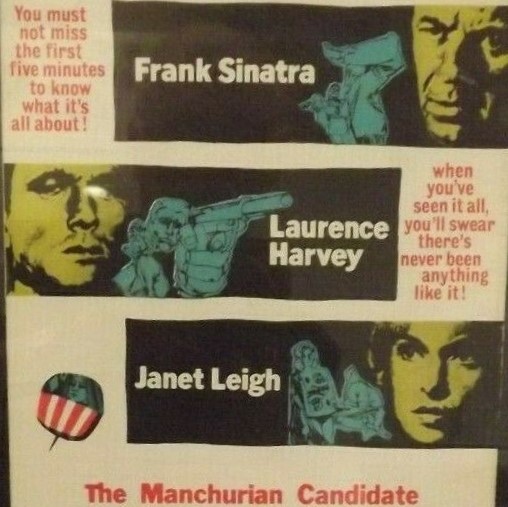
The most celebrated of the conspiracy thrillers and rightly so. But I’m not going to start with the Korean brainwashing, extraordinary cinematic sequence that that is, but with the scene on the train, the pickup scene as it might be known in those days, meet-cute now. There is little cute about this picture which stretches the bounds of normality. And I guess I was already so unsettled, and perhaps settling into film noir mode when an easily available woman was always to be distrusted, and thought that the sudden appearance of Eugenie (Janet Leigh) was a plant.

But that wasn’t in itself what lodged that scene in the caboose so firmly in my mind. But the superlative acting of Frank Sinatra as the investigative Major Marco. Sure, we’ve seen good, sometimes great acting before from Sinatra, generally under-rated due to the myth that nobody could seriously give a good performance after just one take, as if stage actors do not do this every night of the week. But this is above and beyond.

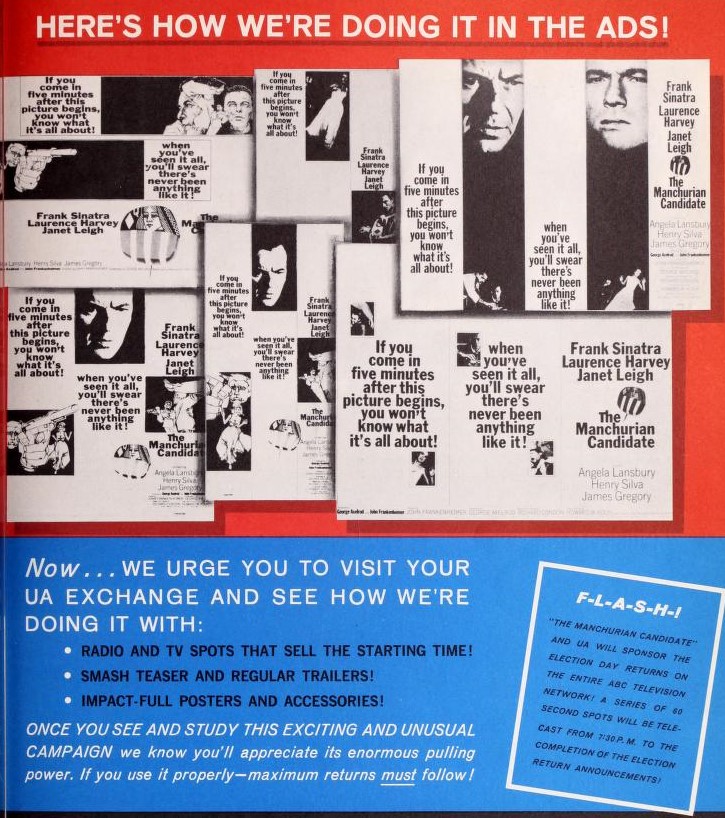
Ads aimed at the cinema manager.

What makes this so outstanding is the depth. Whatever he is saying, that’s not what he’s thinking. He is so dislocated his mind is elsewhere.

Now you give an actor punchy dialog and that’s the way he’s going to treat it, like a punchball, zing zing zing, but that’s not the case here. You can see from his expression that while he is responding well enough to this apparently sympathetic dame that his mind is not completely gone, but that he is barely holding himself together. Another actor would have shown greater signs of mental collapse, signs of a tear perhaps or using an artefact for support, a glass to crush in his hands. But not here. It’s all in the face.

He’s helped of course that the dialog is all about identity. Who is Eugenie? Not as in, who is she really, which would be a good question to ask at this point in the proceedings, but how does someone cope with a name like Eugenie and so the dialog rambles around the various shortenings of her name, while at the same time, recognising he desperately needs a port in a storm, she ensures she knows her address.

The way this movie is going that could be code, too, or a trigger, or that when he turns up at her apartment he’s going to encounter some obstacle, but it doesn’t turn out that way either, even though this is a movie where no one is what he or she seems. Insanely ambitious politician’s wife Eleanor (Angela Lansbury) double crosses her country, the Koreans double cross her by turning her son (rather than any old grunt) into an assassin,  and in the end the son, the rather effete Raymond Shaw (Laurence Harvey), turns on the mother in the most murderous way imaginable. Much as she loves her son, she is willing to sacrifice him for the chance of becoming the President’s wife and when she does will exert her revenge on the Koreans.

The “exchange” is an old industry term, literally like a library, meaning where you would take the movie you had just screened and swap it for your next movie. You would pick up all your advertising material and campaign manual at the same time. Certainly saved on the postage. And the exchange manager, meanwhile, would try to sweet talk you into taking another movie you had never heard of.

I’ve gone on before about the beauty of the single-take movie (Grenfell, 2023) but here I’m in raptures at the single scene, how a movie pivots on superb acting. I could have used the brainwashing as an example, but that’s not about acting, but about directing, about perception, about how the audience as much as the participants is being led around by the nose by director John Frankenheimer, who would return to questions of identity and voluntary brainwashing in Seconds (1966).

But back to the brainwashing. This hits the mother lode. A troop of captured U.S. soldiers face an audience with a ringmaster demonstrating just how much they are under his command and can be hypnotised into carrying out any order, even cold-blooded murder. But each of the soldiers sees a different audience. That’s the cinematic coup. I would have loved to have been part of the original audience back in the day, brought up on war movies or thrillers that followed a straightforward narrative arc. Even critics singing the praises of the French New Wave would have never seen anything like this.

Anyway, it soon occurs to Major Marco that his ongoing nightmares are part of a deeper problem especially as his memory of Shaw does not tally with what he finds himself saying about his troop leader.

We follow two parallel stories, Marco trying to get to the truth before he fries his brain, and the audience being let in on much of the truth by tracking Shaw, who, to spite his hated mother, has taken a job with, effectively, the opposition and has fallen in love again with Jocelyn (Leslie Parrish), the daughter of one of her husband’s most implacable foes.

You couldn’t get a more twisty movie, set against the backdrop of the Communist witch hunt, when a politician could garner headlines just by pretending to name Communists in high office. The political element is just as cynical as the same year’s Advise and Consent and savage as the ineffectual Senator Iselin (James Gregory) is, he’s not much worse than the clowns in the Preminger picture. So it all rings true.

There’s scarcely a moment wasted as the movie screams towards a terrifying climax. The built-in control trigger I didn’t see coming, and Shaw’s transformation from strict man-in-charge to bumbling romantic fool is a joy.

Frank Sinatra (The Detective, 1968) gives the performance of his life, Laurence Harvey (Life at the Top, 1965) proof of the power of love, Angela Lansbury (In the Cool of the Day, 1963), the mother from Hell, are all outstanding. The support cast includes Janet Leigh (Psycho, 1960), Henry Silva (The Secret Invasion, 1964) and John McGiver (Breakfast at Tiffanys, 1961).

Frankenheimer directs with elan from the script by George Axelrod (Breakfast at Tiffanys) based on the Richard Condon (The Happy Thieves, 1961) bestseller.

An absolute must.

Behind the Scenes: “The Happy Ending” (1969)

You had to be a mean son-of-a-bitch to cast your alcoholic wife in a movie about an alcoholic wife. The title of Douglass K. Daniel’s biography of director Richard Brooks, Tough As Nails, did not specifically refer to The Happy Ending but it might as well have. But on top of what you might from the outside consider a somewhat callous attitude, you would also have to reflect on the movie’s message: that a man might be implicit in the woman turning towards the bottle and that a woman can break free of a stultifying marriage.

Marriage to Brooks in 1960 meant Jean Simmons, until then a huge star, leading lady to  opposite Marlon Brando (Desiree, 1954), Frank Sinatra (Guys and Dolls, 1956), Gregory Peck (The Big Country, 1958), Burt Lancaster (Elmer Gantry, 1960) and Kirk Douglas (Spartacus, 1960), dialled back on her career, opting instead for wifedom and motherhood. Six movies in eight years, compared to 14 pictures in the previous comparable period, spelled the extent of her commitment.

Both had been riding high at the time of their marriage. Despite the setback of Lord Jim (1965), Brooks regained favor through the commercial and critical success of The Professionals (1966) and In Cold Blood (1967). But Simmons tumbled down the pecking order with little compensation on the marital side. As single-minded a director as Brooks spent far more time on his movies than his marriage. The long separations caused by his work took their toll. Like the middle-aged character she played in The Happy Ending, “I started sitting around,” Simmons told her husband’s biographer, “looking in the mirror, feeling sorry for myself a lot. I was slugging down a lot more than anyone should. Sometimes it would bring out the ugly side – when you want to hurt people. And who do you want to hurt? Why, it’s always the one who is closest to you.”

Recognizing she was an alcoholic Simmons began a battle against the disease. Her husband came up with an unusual way of helping, one that would, in some senses, help bridge the gap between them, by writing a movie in which she would star and he would direct. I doubt if she was so far down the pecking order by that stage that if a director of Brooks’ commercial caliber had decided to cast her in a more commercial project, his heist picture $ (1971) for example, I would be surprised if he did not get his way.

However, he had set his mind on a more personal project. Though he was writer-director to trade, had tended to adapt other people’s novels or plays, he hadn’t come up with an original screenplay in nearly two decades, since Deadline U.S.A (1952). So it was odd in some respects that it was his wife’s alcoholism that fired up his creative juices.

“He was trying to help me understand alcoholics,” explained Simmons. “and he would go to (AA) meetings, too, just to find out what people talk about and what people do and didn’t do.” Even so, it was a hard part to envisage. There was too much of herself in the script, Brooks using words she had spoken in real life. “It suddenly hit me as more personal – and it hurt quite a bit to feel so exposed. It was too close to home.”

But the movie proved an original piece of therapy. “He pulled me out of it, made me straighten up, so to speak.” And it was certainly a courageous role to play, knowing that this was something you had experienced yourself and that audiences, should her alcoholism become public knowledge, might judge her as they judged the character.

Brooks softened the potential risk for a major studio by keeping the budget low – incredibly low, in fact, just $1.7 million in the end. The movie was made mostly on location in Denver and the Bahamas, deliberately steering clear of Hollywood back lots. The cast was solid rather than costly – John Forsythe still best known for Hitchcock’s The Trouble with Harry (1955), Shirley Jones (Two Rode Together, 1961) another fading star, Teresa Wright (Shadow of a Doubt, 1943)  in only her second movie in a decade, television star Lloyd Bridges in only his fourth movie in 11 years, comedian Dick Shawn, out-of-favor Bobby Darin (Pressure Point, 1962) and Tina Louise (The Warrior Empress, 1960).

Simmons had to endure worse than she had suffered as an actual alcoholic – Brooks filmed her going through having her stomach pumped. The director employed a trick to get a reaction from Forsythe at the movie’s end. He has Simmons ask Forsythe an unexpected question and his response, in character, was just right.

Brooks saw the movie as a critique of marriage rather than a rallying call for feminism. “All I wanted to say was that marriage was not for everybody and, by itself, certainly isn’t a solution to anything,” said Brooks, clearly unaware of the impact the harm that putting such a point-of-view on screen might do to his wife.

By and large critics murdered the movie, it was cited as one of the ten worst of the year by the New York Times. Only Charles Champlin in the Los Angeles Times and Rex Reed were its only champions. Even though the Academy members recognized the strength of Simmons’ performance to give an Oscar nod, the movie, despite the meagre budget, still proved a flop.

Astonishingly, even today it is routinely ignored, only a handful of review for example on Imdb and a 33 per cent score on Rotten Tomatoes.

SOURCES: Douglas K. Daniels, Tough As Nails( University of Wisconsin Press, 2011)  p187-190

The Happy Ending (1969) ****

Vastly under-rated, critically dismissed at the time, this early reflection on feminism has now come into its own. Yet it starts out as a completely different picture. At first it appears as ruthless a depiction of the self-destructive alcoholic as the later Leaving Las Vegas (1995). In passing, skewering the conventions of marriage in an era or strata of society where divorce was not a convenient option. And a time when women, chained to the home but craving attention, might risk the humiliation of being turned away by a secretary on visiting their  husband at the office.

When love had turned into transactional sex. Where women hid out in beauty parlors, sanctuaries which men would dare not invade, to drink and play cards in peace. Or, indulging in the working aspect of such places, underwent breast augmentation or brutal hair removal or other procedures with a view to holding on to their men, seen as daily riding a wave of temptation in the Mad Men world of cocktails and expense account living. For this class of men the word “inappropriate” has never been invented as they paw at any female within reach.

From snow-kissed romance and champagne to….

A largely redundant and lengthy (eight minutes, for goodness sake) montage (including credits and a post-credits – what! – theme song) serves to emphasize the part Hollywood played in reinforcing the celluloid image of initial romance being the mere prelude to happy ever after. The reality was a much whiter shade of pale.

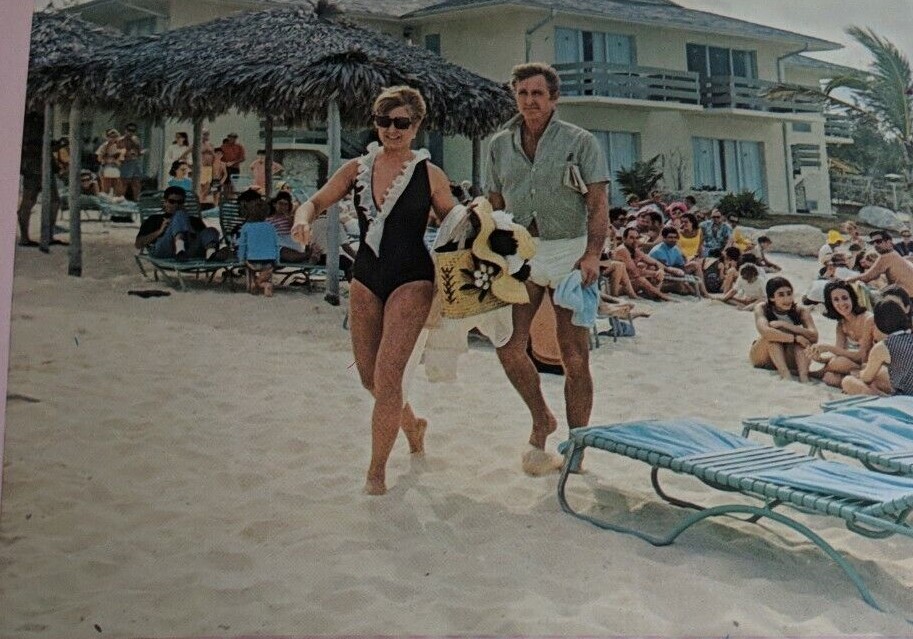
Facing up to their sixteenth wedding anniversary – their marriage, topically, spanning the birth of Prince Charles and his anointing as Prince of Wales, seen via cinema newsreel and television news – alcoholic middle-aged housewife Mary (Jean Simmons) re-evaluates her stultifying life. Lawyer husband Fred (John Forsythe) jokingly refers to himself as “the F.B.I.” but the surveillance he undertakes to ensure his wife has not fallen off the wagon would have earned him a gold star in that particular organization. He has housemaid Agnes (Nanette Fabray) snoop on his wife, goes through all her drawers and clothes until he finds the mercifully unopened bottle of vodka hidden in a boot, checks up on her movements at the hairdresser and even knows which bar she is likely to frequent.

Although managing to refrain from drinking anything alcoholic, Mary’s behavior take her perilously close. She drinks tomato juice from a champagne glass, buys a fellow alcoholic a whisky in a bar just to savor him drinking it. And for all her husband’s attempts to keep her away from the stuff gets pretty loaded himself at times and the catering table at a previous anniversary party fairly groaning with booze has proved a temptation too far. She’s been an extreme player – her stomach pumped out in flashback.

…anything that comes in a glass or a bottle. She even has booze secreted in a bottle of perfume.

Husband’s control extends to finance. She is denied credit card, cheque book and ready cash. Even her mother (Teresa Wright) refuses to lend her money. Unable to go through with putting another good face on their marriage via the anniversary party she pawns a necklace and jaunts off to the Bahamas. On the plane she meets old buddy Flo (Shirley Jones) who is enjoying a clandestine affair with a married man. Mary dips her toe in those illicit waters but her flight has sobered her up enough to face up to her dilemma and not cover all the wounds with alcohol.

I’m not planning to spoil the story by telling you the ending but the ending is the whole point. While the movie’s title is initially perceived as an ironic tilt at the state of marriage – the traditional movie “happy ending” – in reality the ending Mary chooses for herself is the feminist one of self-determination, independent of a man, her self-worth not tied up in his appreciation of her, and she takes the extremely bold decision to quit the marriage, not for another man as might have been de rigeur and in some ways more acceptable within society, but to find herself.

This was a terrible flop, the worst in director Richard Brooks’ career which at the time had reached the commercial and critical peaks of The Professionals (1966) and In Cold Blood (1967), for which he was Oscar-nominated. Audiences failed to respond despite Jean Simmons (Rough Night in Jericho, 1967) receiving her second Oscar nomination.

And you can see why it sank. If people didn’t walk out during the interminable montage sequence, then for the most part it was interminably depressing. The only thing worse than watching an alcoholic getting drunk is watching an alcoholic desperate to get drunk, holding back from indulging as if standing on the edge of a precipice, almost willing themselves to fall over for the sheer relief of oblivion.

And yet it is extremely watchable as the couple play out their marital game, Fred, the ostensible loving husband, protecting his wife from herself, Mary blaming her drinking for their marital problems rather than the other way round.

Jean Simmons is a compelling watch. This is really a tremendous performance and a shame she lost out to the more showy acting of Maggie Smith in The Prime of Miss Jean Brodie. As good as that was, it was pretty much all surface, Smith playing a character who was pure invention, for the most part sashaying through life by force of her incredible personality, not a woman grasping at straws from the outset, damned by all in sight who were only too aware of her affliction, unable to come to terms with herself, denied all that was casually tossed to often worthless men.

John Forsythe (Topaz, 1969), who grits his teeth so much they appear likely to puncture his cheeks, is as good as I’ve ever seen him in a whale of a part that calls upon him to play two roles effectively, the dutiful husband restrained by having to watch over his errant wife, and a man who, out of her sight, can still enjoy himself, and, it is hinted, has been illicit himself with colleague’s wife Helen (Tina Louise).

Structurally, it’s very cleverly done, and Richard Brooks continues with the façade of the happy marriage and the wife’s drinking being the root cause of their dual unhappiness before letting rip late on with the incipient feminism.

A tremendous movie and well worth seeing.

Discover WordPress

A daily selection of the best content published on WordPress, collected for you by humans who love to read.

The Atavist Magazine

by Brian Hannan

WordPress.com News

The latest news on WordPress.com and the WordPress community.