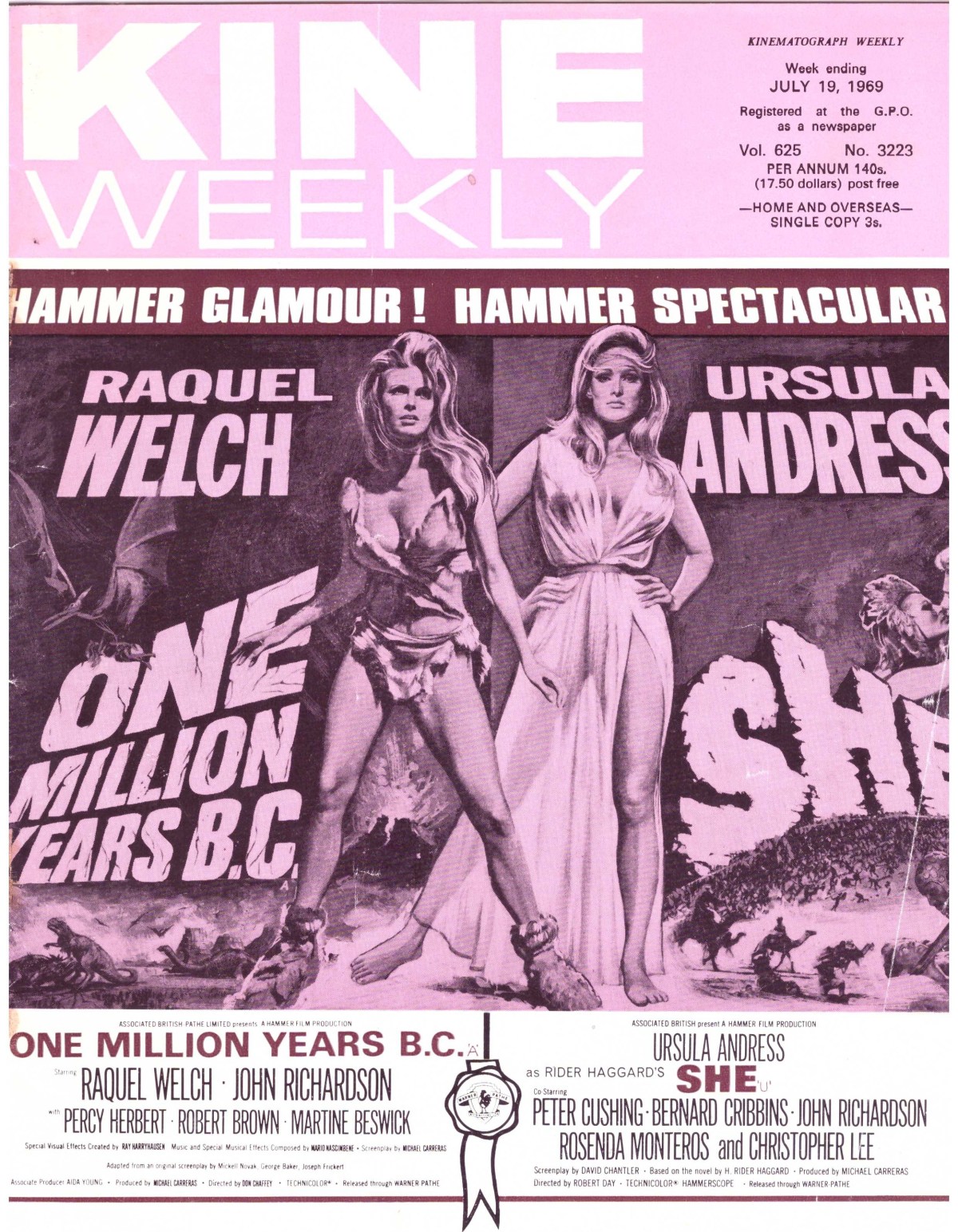
When Raquel Ruled The Reissue

Despite being sold to television within a few years of initial release, as was standard at the time, One Million Years B.C. enjoyed an exceptionally long big-screen life, still available in reissue over a decade after premiere. Although a highly successful reissue double bill with She (1965) in the British home market in 1969, that revival did not strike gold in the U.S. One Million Years B.C. had enjoyed a surprisingly successful launch in the U.S., beating the Thunderball record at the New Amsterdam theatre in New York and going on to hoist $2.5 million in rentals putting it ahead in the annual box office race of A Fistful of Dollars, For a Few Dollars More and Point Blank.

Factors in its unexpected longevity included: proving a natural stablemate for movies set in the distant past or distant future, as double bill material for other Welch product, and supporting other Fox new releases. It was a studio workhorse. In 1967, it supported western Hombre, gangster picture The St Valentine’s Day Massacre, comedy Caprice, war epic The Blue Max and a revival of Those Magnificent Men in Their Flying Machines. The following year it backed Frank Sinatra in Tony Rome, Walter Matthau comedy Guide for the Married Man, Steve McQueen big-budgeter The Sand Pebbles, Sinatra again in The Detective, The Bible and hoping-to-be-hip The Sweet Ride. Roll on to 1969 it was the support to westerns Butch Cassidy and the Sundance Kid and The Undefeated.

And that should have been the end of its big screen career. By then it had been shown on television, on ABC, the second best program of the week. So, in theory at least, that should have been the end of exhibitor interest.

But it wasn’t. Come 1970 and it turned up in a triple bill of Butch Cassidy and The Boston Strangler, was geared up as support to Mash and Patton, and another triple bill, Butch again, with The Prime of Miss Jean Brodie. Butch Cassidy was its partner again in 1971.

Outside of the Twentieth Century Fox connection, there were sorties with She and its sequel The Vengeance of She, and The Lost Continent, a triple bill with Hammer stablemates The Viking Queen and Prehistoric Women, and in 1970 with She and Goliath and the Seven Vampires plus the following year a quadruple bill featuring The Viking Queen, The Vengeance of She and Five Million Miles to Earth.

The following year it turned up as support to When Dinosaurs Ruled the Earth (“from the creators of One Million Years BC”), The Creatures The World Forgot, and the original King Kong (1933). In future years there were triple bills with Tarzana the Wild Girl and Prehistoric Women and with The Valley of Gwangi and Earth vs Flying Saucers.

With striking regularity it was teamed up with Planet of the Apes, Beneath the Planet of the Apes, Escape from the Planet of the Apes, Conquest of the Planet of the Apes and Battle for the Planet of the Apes.
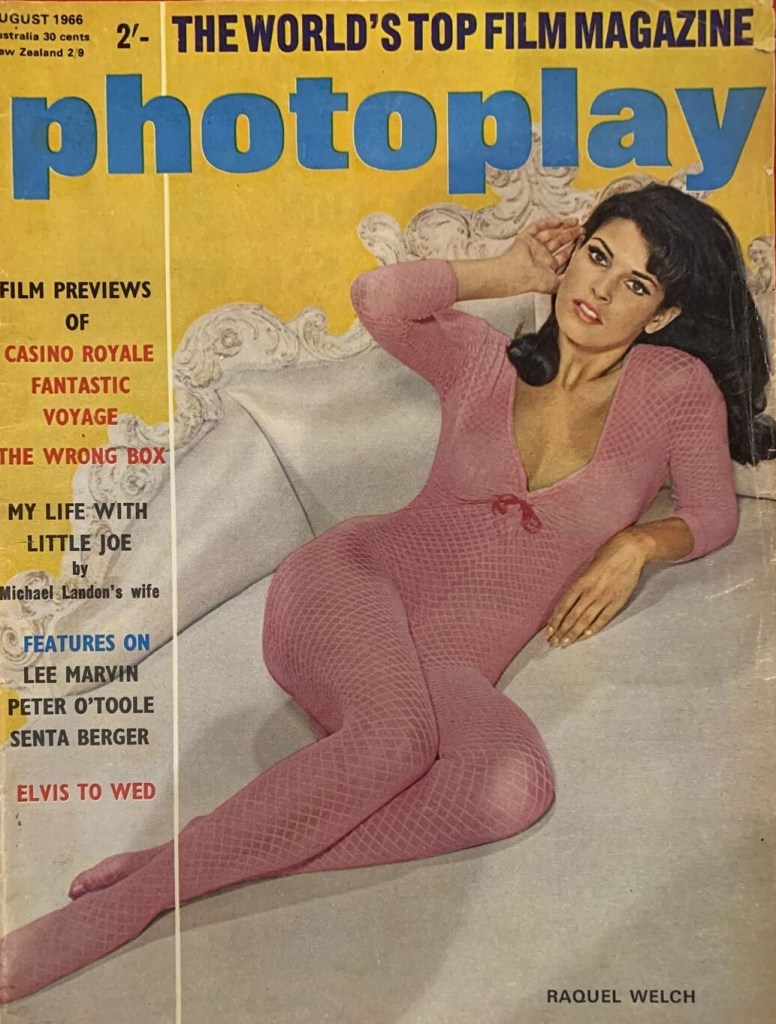
Elected to form a Welch double bill with One Million Years B.C. were Fantastic Voyage (various bookings over 1967-1969), Fathom (1967-1968), The Biggest Bundle of Them All, 100 Rifles, Bandolero and The Three Musketeers (1974) while a Welch triple bill in 1973 augmented the dinosaur picture with Fantastic Voyage and Lady in Cement.

While Fox had first call on its services, at a certain point the studio relinquished exclusivity and exhibitors were free to book it whenever they wanted, Fox content to make a few extra bucks every time. So it went out with Paramount westerns El Dorado with John Wayne and Robert Mitchum and Five Card Stud with Robert Mitchum and Dean Martin, Disney animated feature The Jungle Book and its revival of In Search of the Castaways, UA war picture The Devil’s Brigade, comedy Inspector Clouseau and football drama Number One, MGM comedy The Maltese Bippy, big-budget war spectacular Where Eagles Dare with Clint Eastwood and Richard Burton and the reissue of Ben-Hur, NGC comedy How Sweet It Is, Columbia’s space drama Marooned,  French political thriller Z, Harry Alan Tower’s jungle adventure Eve and the British sex drama All Neat in Black Stockings.  The last sighting I made of it was with sci-fi Futureworld in 1976.

Add One Million Years B.C to Ben-Hur and you’re talking a near-five-hour program, four hours for Where Eagles Dare. You can see from the indiscriminate double bills that nobody was trying to find the ideal match. Exhibitors didn’t have to, Raquel Welch and her fur bikini had something everyone wanted, a picture that moviegoers were happy to see again and again.

Where were you when you first saw One Million Years B.C.? And what age? And what gender? Did you see it on the small screen or the big, on original release or a reissue?

SOURCES: Brian Hannan, Coming Back to a Theater Near You, A History of Hollywood Reissues 1914-2014 (McFarland, 2016), p208-210; “Georgy, Flint in ABC Film Line-Up,” Variety, April 30, 1969, p35. Box office figures Variety: August 2, 1967, p 11; August 16, 1967, p10; Jul 21, 1971, p8. Listings in Newspapers: Argus, Fremont; Evening Standard, Uniontown; Valley News, Van Nuys; Independent, Long Beach; Kingsport Times; Standard-Examiner, Ogden; Des Moines Register; Tucson Daily Citizen; Abilene Reporter News; Kansas City Times; Wellsville Daily Reporter; Morning Herald, Uniontown; San Antonio Express; Aniston Star; Manhattan Mercury, Kansas; Gastonia Gazette; El Dorado Times; Fresno Bee; Gallup Independent; Post-Standard, Syracuse; Arizona Republic; Daily Times, Salisbury, Maryland; News Journal, Mansfield, Ohio; Corpus Christi Caller; Naples Daily News, Florida; Journal News, Hamilton, Ohio; Statesville Record and Landmark, North Carolina; Hamburg Reporter; Beckley Post-Herald; Brownsville Herald; Nashua Telegraph; Portsmouth Herald; Delta Democrat-Times; South Illinoisian; Terre Haute Tribune; Pasadena Independent; Xenia Daily Gazette; El Paso Herald-Post; Cumberland News, Maryland; Delaware County Times; and Northwest Arkansas Times, Fayetteville.
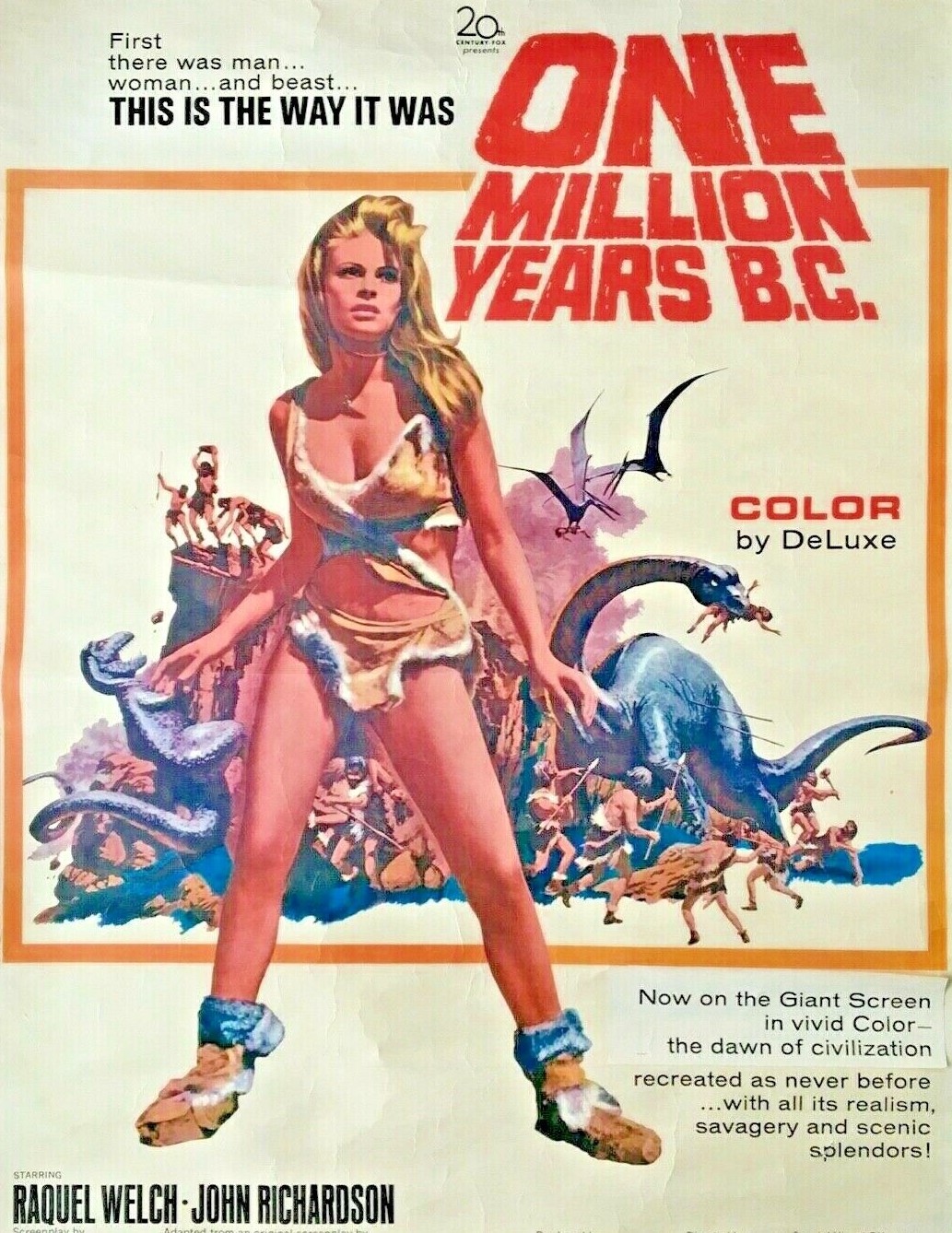
Raquel Before She Ruled

Raquel Welch did not exactly come out of nowhere. Potential audiences had probably seen her image without necessarily knowing her name. In retrospect, she had one of the cleverest build-ups of any new star. Of course, it wasn’t unknown for glamor pictures to pave the way for a new sex-queen, Marilyn Monroe had posed for plenty cheesecake pictures before she hit the screen.

But those kind of pictures did not break out of the confines of cheesecake magazines. Raquel Welch was different. Although she had taken the usual route of an ingenue, bit part in movies and television programs, there was no obvious sign that she was made for bigger things.

Not what you’d expect when you see the term “cover girl.”
And hardly the magazine men were going to buy.

Blink and you’ll miss her debut as a call-girl in A House Is Not a Home (1964). You wouldn’t have seen much more of her in Roustabout (1964) or Do Not Disturb (1965). When she won a role on television, she wasn’t credited much more than as saloon girl (The Virginian, 1964), stewardess (Bewitched, 1964), beauty queen (The Rogues, 1964) or the billboard girl in three episodes of Hollywood Palace (1964-1965).

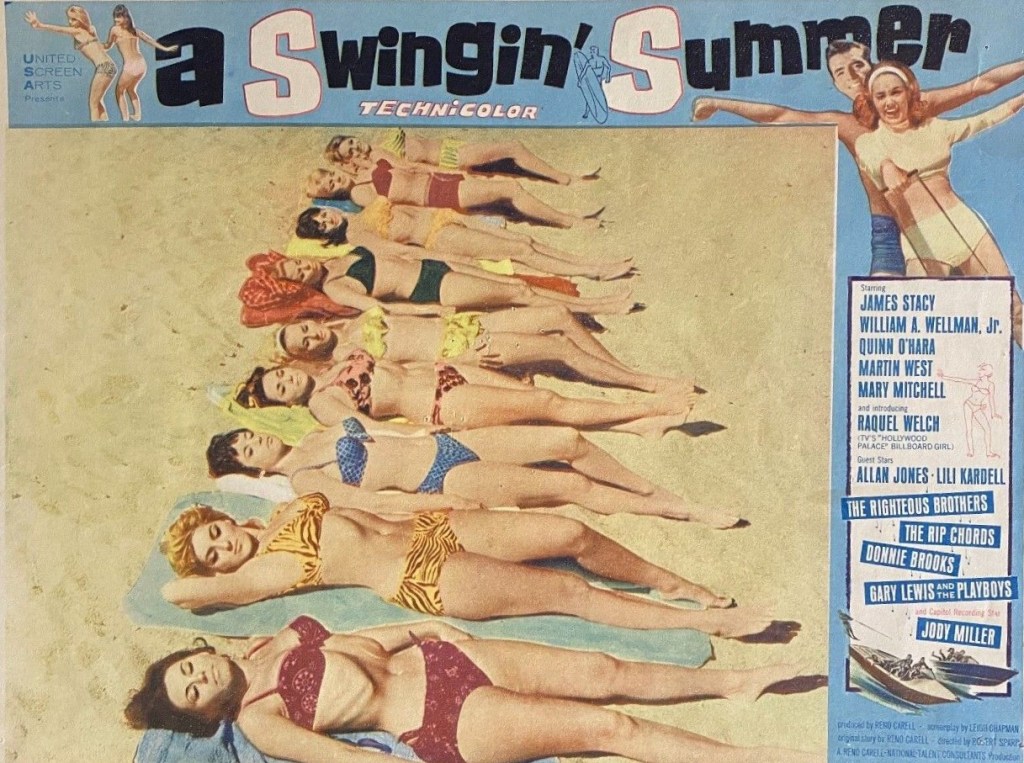
There might have been an inkling of something in A Swingin’ Summer (1965). Reviews said she “shows promise” and “it’s hard to look away when she’s in view” but this was a low-budget beach movie with little chance of becoming a breakout. (Though by the time it reached Britain in October 1966, she was miraculously the denoted star.)

Amateur photogrpahers of course lived the dream.

And although Welch would later claim all the fuss over One Million Years B.C. took her by surprise, that she was just an ordinary mother of two, that was far from the case, as she was actively involved in trying to expand her movie career, whether with the help of studios like Fox and MGM, or as an independent producer. I mentioned in a previous article that the company she ran with her husband Patrick Curtis – Curt-Wel Productions – was attempting to put together starring vehicles for her. Long before Twentieth Century Fox entered the equation Curt-Wel announced that production would start in fall 1965 of The Other Side of the Fence, an original musical comedy.

Yet, even as her best efforts to improve her career prospects faltered, somehow she seemed to get far more coverage than other young women in her position. You were as likely to find her photo in a newspaper with Salvador Dali (involved with Fantastic Voyage) or Groucho Marx. But while her face adorned the covers of ordinary magazines in the U.S. – Real Story, Intimate Story, U.S. Camera & Travel and she modelled for adverts for Wate-On, it was a different story abroad. Magazines in Europe could not get enough of her, either adorning their covers, or given a full-page feature inside, parading in a bikini or skimpy clothing. No photographic editor on a European magazine turned down the opportunity of a spread featuring Raquel Welch.

Nothing could define the differences between current generations and that of the 1960s – unless anorexia was a hidden scourge – than this advert telling women to get bigger. A more sexist ad you could not find – “a full figure…is a man’s way of judging a woman.” !!!

And despite her lack of proven screen product, she was a guest at the world premiere in London of Born Free, was photographed cutting the cake to celebrate the first anniversary of The Sound of Music at the Dominion in London’s West End and was tabbed as “one of the most publicized stars of the year.”

Whereas features might use her name and explain that she was a rising star, perhaps justifying her presence by pointing to her role (sixth- billed) in A Swingin’ Summer (1965), she was usually anonymous on covers, just the gorgeous woman who attracted buyers on the newsstand.

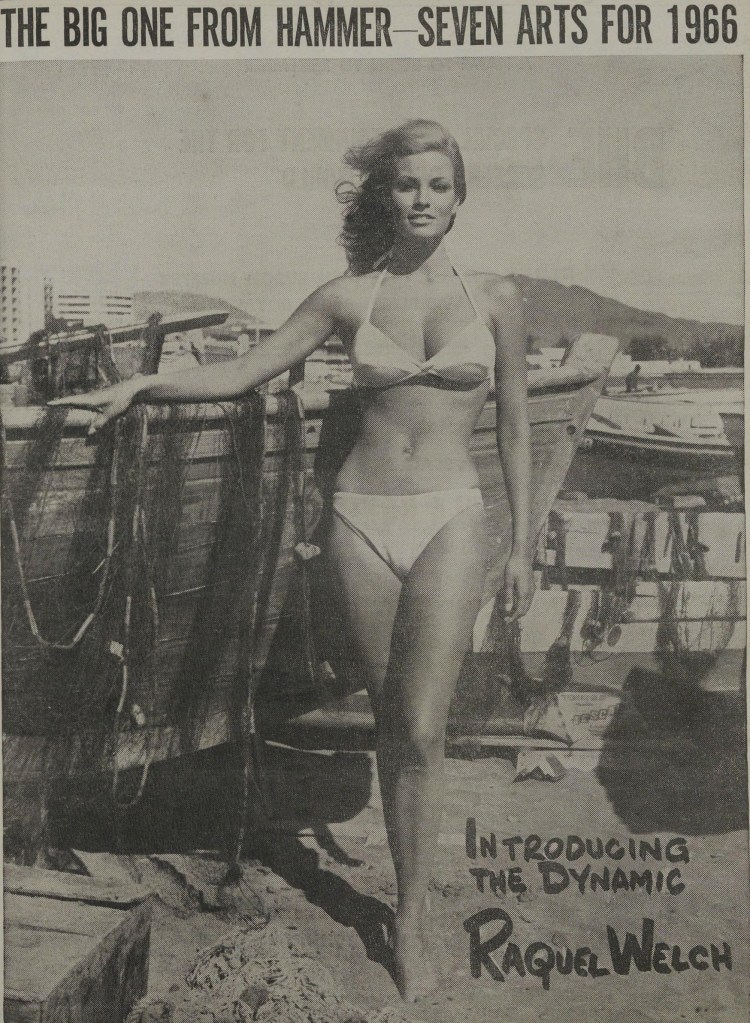
And if the fur bikini doesn’t attract their attention, thought Hammer, we can always fall back on a more straightforward bikini shot. Tjhis advert appeared in “Variety” – one month
after the initial fur bikini advert.

And while Twentieth Century Fox had her under contract, and could throw out a whole rash of glamour pictures aimed at the glamour market, it was unlikely that more prestigious magazines would come calling. Yet they did. “There is no pinpointing exactly what it is about her,” noted the fawning author of a two-page feature, “Raquel Welch: The Definitive Chickie,” that appeared in the October 1965 issue of Esquire.

But if the journalist didn’t know what she had, Welch certainly did. “I just seem to have glomped on those foreign cats. I’m on every one of their covers,” she explained.

In those more innocent times, an actress might have Playboy sniffing around for a tasteful nude shot, but it was more usual for an actress to only apparently be naked but in reality conceal her entire body either by clever use of her arms or behind a bikini or a skimpy dress. Prior to One Million Years B.C., Welch had often been photographed in a bikini.

Spoof newspaper produced for the Pressbook.

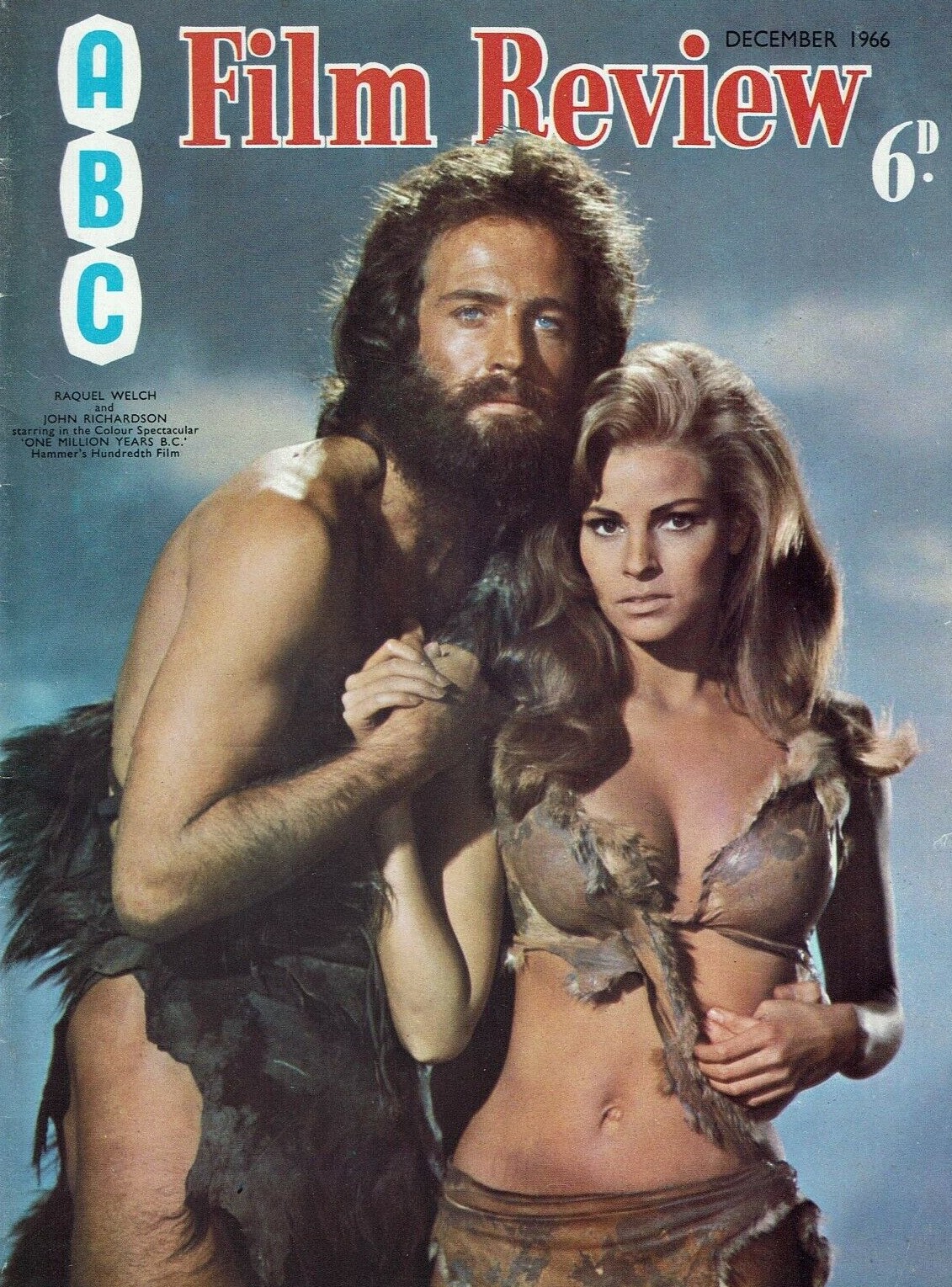
But the fur bikini was something else. The image proved iconic.

Hammer knew and Twentieth Century Fox, the company that had built up Marilyn Monroe on the back of her sexuality, knew it. Welch was signed to a one-picture-a-year deal with the studio but it had exercised its option six months early when One Million B.C. – that remained the title as late as November 1965 – came up as part its contract with Hammer.

One Million Years B.C. received its world premiere in London in December 1966 and opened in the U.S. a couple of months later. The movie had gone before the cameras in the Canary Isles on September 19, 1965. In December 1965, 15 months ahead of the U.S. launch Hammer ran the first fur bikini advert in Variety. How prescient, you might think. The studio clearly knew Raquel Welch in a bikini could sell tickets.

Spot the Raquel.

It just didn’t know which bikini. It followed up that ad with another one of the actress in an ordinary bikini (if that word could ever be applied to how the star wore that item of clothing) standing on a beach in front of a boat. Eventually, of course, studio, exhibitor and public reaction made the decision for Hammer. Fur bikini won hands done.

The poster sold a million copies.

By the time the movie appeared she was one of the best-known women on the planet. If there had been an Internet in those days, she would have broken it. There hadn’t been an image like it since Monroe stood over grate and let the wind blow up her dress in The Seven Year Itch (1955).

Critics tended to be dismissive in the 1960s of anyone who led with their looks but Welch, like George Peppard for example, soon proved she could act, even if that was routinely ignored.

SOURCES: “Review”, A Swingin’ Summer, Variety, March 3, 1965, p6; “Review”, A Swingin’ Summer, Box Office, March 22, 1965, pA11; Advert, Screen Stories, June 1965; “Other Side of the Fence,” Box Office, July 26, 1965, pW5; “Raquel Welch Will Star in One Million BC,” Box Office, September 6, 1965, pW3; front cover, U.S. Camera & Travel, October 1965; “London Report,” Box Office, November 8, 1965, pE4; advert, Variety, December 1, 1965, p21; Advert, Variety, January 5, 1966, p179; front cover, Intimate Story, February 1966; “London Report,” Box Office, April 4, 1966, pE4; Real Story, 1966; “Review,” A Swingin’ Summer, Kine Weekly, October 20, 1966, p22; “MGM Productions Showcase New Talent,” Box Office, December 5, 1966, p12.

One Million Years B.C. (1966) ****

The three ages of man: child watches this film for the dinosaurs, teenager for Raquel Welch, mature male for the dinosaurs now he knows who Ray Harruhausen is.

Guilty pleasures multiplied. Add the Mario Nascimbene (The Vengeance of She, 1968) score to the delights of Raquel Welch in a fur bikini and Ray Harryhausen’s sensational stop-motion animation.  Generally dismissed as high-level hokum, it features an intriguing gender role reversal, and is virtually, not to be too academic about it, a throwback to silent cinema, minus the title cards that helped audiences a century ago work out what was going on. Everything relies on facial expression and gesticulation.

Luckily, there’s not too much in the way of narrative complication. Tumak (John Richardson), the son of the chief of the Rock Tribe, is chucked out into the wilderness for standing up to his father. He probably wouldn’t be crying too much about that, given the strong rule over the weak, old men are left behind to die, and the feeble are last in line for food.  Plus, his brother Sakana (Percy Herbert) is prone to stabbing people in the back.

Unusually, the picture went straight out into U.S. wide release (saturation). It was an 80-theater break. Twentieth Centry Fox mounted a huge advertising campaign based on the fur bikini image, but by this point she wasn’t an unknown star, already seen in “Fantastic Voyage.” The New York Times might be wincing now at its “monument to womankind” now.

Reaching a distant shore, Tumak is rescued by Loana (Raquel Welch) of the Shell Tribe who takes an instant fancy to him, helping protect him from a huge marauding creature. But his aggressive temperament doesn’t sit too well among this peace-loving democratic group either, despite him saving some kids from another marauding creature. But when he’s chucked out this time, Loana goes with him.

But you know that any journey pretty much takes them into the heart of dinosaur heaven, and Tumak makes the mistake of retuning to his own tribe, where Loana is made unwelcome by Nupondi (Martine Beswick), Tumak’s previous squeeze. It’s power politics all over again until marauding creatures and a convenient volcano intervene and matters can be settled.

All eyes are on Loana and her miraculous bikini until a dinosaur appears, which occurs at frequent intervals. Then you can’t take your eyes off Ray Harryhausen’s creativity, at first expecting the match between humans and his wizardry to be so obvious the illusion will be shattered, but once you realize that is not going to be the case you just sit back in wonder.

Spoof newspaper from the Pressbook.

Harryhausen has made dramatic improvements in his techniques since previous highpoint Jason and the Argonauts (1963). Cleverly, he builds anticipation by matte work to present scenes of live creatures. The first, the warthog, is of normal proportions, and its capture suggests man’s domination over beast. But that proves a false assumption. Anything later is just gigantic – iguana, turtle and tarantula. In normal circumstances only the giant spider might appear a threat but in the distant past it would appear any creature bigger than man looked upon humans as an easy meal.

And that’s before the allosaurus rampages into sight and a pteranodon swoops out of the sky snaring Loana and then has to battle a rhamphorhynchus over its prey, almost as if Harryhausen was determined to animate the most difficult creatures possible in order to prove his innate skill.

Sure, hostility is much easier to telegraph than other emotions and a fair bit of the picture is people getting cross with each other, but meet-cute between Loana and Tumak involves little as significant, glances and eye contact the core of communication. It’s pure cinema. Stripped of any meaningful dialog, the camera captures everything we need to know. It’s a brutal world, dog eat dog, man eat warthog, dinosaur eat woman, every living thing is a snack of one kind or another and when they’re not killing for food they’re battering each other out of power lust, rivalry or jealousy.

And although nobody could have guessed the impact Ms Welch would have on the male pulse, Hammer had previous in the department of introducing a stunning female into a tale, and it may be pure coincidence that both Loana and Ayesha in She (1965) were woman of power, rather than mere playthings of men. Ayesha is introduced in stunning fashion, her presence pre-empted, most of the picture prior to her appearance serving merely to build her up. Obviously, Ursula Andress did not disappoint but she was introduced in majestic fashion rather than catching fish at the seashore. Albeit Loana sported a bikini, so did all the other fisherwomen and director Don Chaffey resisted the temptation to present her in more statuesque fashion, regardless of the image presented on the poster.

Just as it’s hard to underestimate the iconic impact of Raquel Welch in a fur bikini, so, too, is the work of Harryhausen. And I would also add the innovative score of Nascimbene, with sounds Ennio Morricone would have been proud of.

Despite myth to the contrary, it’s rare for an unknown to emerge from a movie a real star, but Raquel Welch certainly did, though her image on a million posters might have had something to do with her sudden success.

As he did with Jason and the Argonauts, Don Chaffey keeps the story spinning along, makes the best of the lunar landscape and raw actors like Welch and John Richardson (She). Michael Carreras (The Lost Continent, 1968) based his screenplay on One Million B.C. (1940).

The problems of creating believable dinosaurs were so evident that nobody really tackled pre-history until Steven Spielberg waded in with Jurassic Park (1993). It’s a measure of how successful this effort is that the director eschews the cute kids that seemed endemic to the later genre and had his characters facing up to the monsters rather than running away like crazy or expecting that somehow man could control them.

Much more entertaining than I expected, high class special effects, strong narrative, and more than enough to wonder at.

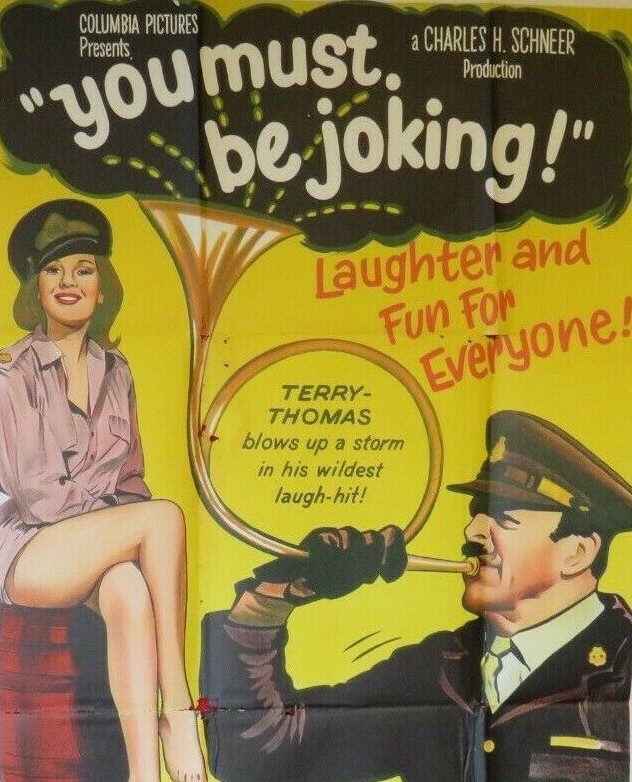
You Must Be Joking! (1965) ***

British thriller specialist Michael Winner (Death Wish, 1974) learned all about structure churning out low-budget comedies like this unusually contemporary number. A precursor of the reality television trope of a variety of characters in competition to complete a series of odd tasks, this has a military set-up, aiming to find, oddly enough in an organisation where strict hierarchy dominates, people capable of bending the rules. Initiative, in other words.

Some of the motley crew, of course, have no intention of bending any rules if they can get everyone else to do the work for them, namely upper-class Capt Tabasco (Denholm Elliott) who gets the game rolling by calling in a helicopter as a favor from an old school chum to rescue him from a maze, the first task. He spends most of the time pampered in a hotel suite while dispatching girlfriend Poppy (Tracy Reed) on various expeditions.

Saved by the double bill: Winner’s comedy found a bigger audience
by being booked as the support for hit “Cat Ballou.”

There’s a Yank involved, of course, to target the all-important American market, Lt Tim Morton (Michael Callan) also using assistance in the form of upmarket girlfriend Annabelle (Gabriella Licudi) whose specialty is causing vehicle pile-ups. We’ve got a whisky-drinking Scot, Sgt Major MacGregor (Lionel Jeffries), stiff upper back rather than stiff upper lip with his constant snapping to attention, and two graduates from the Army Hapless Division in Sgt Clegg (Bernard Cribbins) and Staff Sgt Mansfield (Lee Montague). Directing proceedings are Major Foskett (Terry-Thomas) and General Lockwood (Wilfred Hyde-White), at opposite ends of the character arc, the former frantic, the latter laid back.

A couple of the five tasks involve unravelling clues, finding a particular rose, for example, but the whole purpose of the exercise is to have the soldiers constantly getting in each other’s way, trying to outwit one another, falling into bizarre scenarios – a fox hunt the cleverest – and generally getting all muddled up one way or another, so that initiative is the last thing they display.

What the movie does have in abundance is imagination, otherwise how to explain the involvement of a seductive housewife, pop star, television show, tunnelling, Lloyd’s of London, Rolls Royce and a greyhound racetrack. On the other hand this might be a smaller-scale precursor to If It’s Tuesday, It Must Be Belgium (1969) in shovelling together all sorts of British institutions and tourist attractions. And certainly Capt Tabasco with his love of the finer things of life demonstrates just how much fun it can be to be British if you’re upper class, wealthy, went to the right school and are not above a bit of blackmail.

As you might expect, the pace is hectic, which is just as well, because if you stopped to think about what was going on you might well throw in the towel. That’s not to say it’s not enjoyable in a riotous sort of way, running jokes almost in a separate competition of their own, and if you always hankered to see Michael Callan’s dance moves this is for you – suffice to say he’s not in the Fred Astaire class. But everyone here is there to be made a fool of, except Capt Tabasco, who rises above it all in classy fashion and when he’s out for the count appears blessedly delighted.

Denholm Elliott (Station Six Sahara, 1963) comes off best, testing out his lazy scoundrel, but  the top-billed Michael Callan (The Interns, 1962) might never have signed up if he’d known the consequence was being relegated to television for seven years. However, given we are well accustomed to the shtick of the likes of Bernard Cribbins (The Railway Children, 1970), Lionel Jeffries (First Men in the Moon, 1964), Terry-Thomas (Bang! Bang! You’re Dead! 1966) and Wilfred Hyde-White (The Liquidator, 1965), he does at least have the advantage of standing out, if only as a novelty.

And just in case the goings-on don’t hold your attention, Winner has recruited a platoon of top British stars in bit parts including Leslie Phillips (Maroc 7, 1967) and James Robertson Justice (Guns of Darkness, 1962) and rising stars such as Tracy Reed (Hammerhead, 1968), Gabriella Licudi (The Liquidator) and Gwendolyn Watts (The Wrong Box, 1966) and future British television treasures Clive Dunn (Dad’s Army, 1968-1977), Richard Wattis (Copper’s End, 1971) and Peter Barkworth (Telford’s Change, 1979). So if you get fed up trying to work out what’s what you can play who’s who.

Alan Hackney (Sword of Sherwood Forest, 1960) wrote the screenplay based on a story by director Winner.

Not non-stop hilarity but definitely non-stop something with a good few chuckles thrown in.

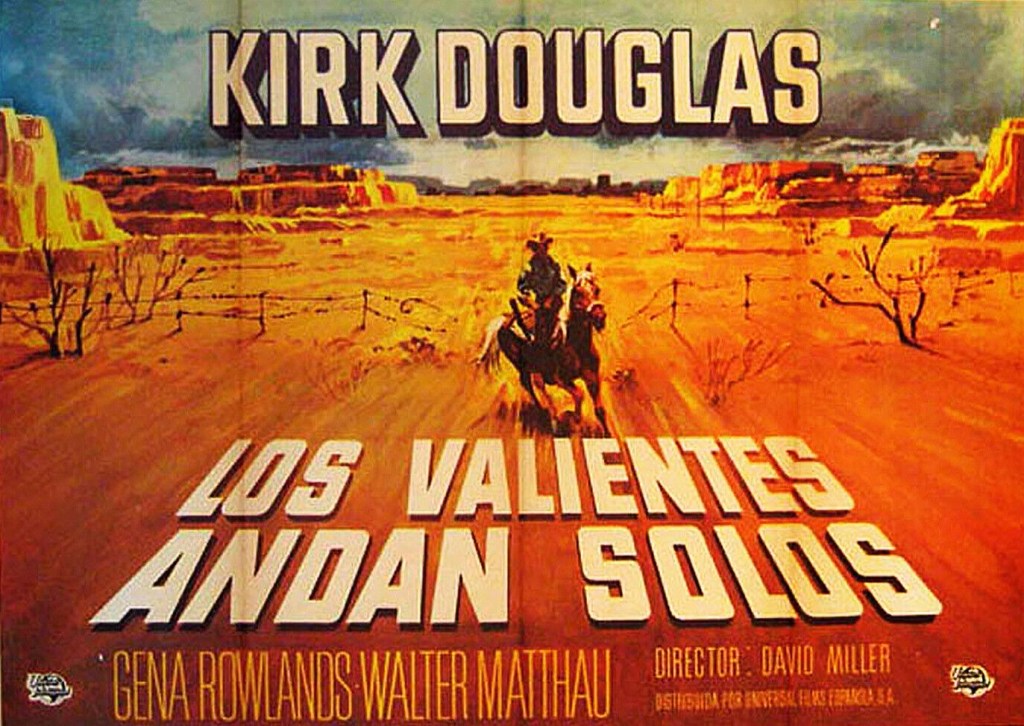
Lonely Are the Brave (1962) ***

Wannabe blood brother to The Misfits (1961) but more like a distant cousin, cowboy out-of-time yarn too pre-emptive for its own good.  Freedom-loving, don’t-fence-me-in Jack Burns (Kirk Douglas) falls foul of the law by escaping prison and is pursued into the hills by competent and sympathetic Sheriff Morey Johnson (Walter Matthau) who is saddled with an incompetent law enforcement team out of their depth up against a true man of the west. You can see the end coming a mile off, a truck that interrupts the narrative for no particular reason.

The only problem for me are certain inconsistencies.  A man who refused to be tamed tames a wild horse, his freedom coming at the expense of a captive animal, hobbled overnight to prevent escape. And instead of leading a frightened beast across a busy highway rides him in clear danger.

And I don’t get this voluntary incarceration malarkey, highly principled though it appears, breaking into jail in order to break out a friend Paul (Michael Kane) who just wants to serve out his relatively short sentence instead of being faced with a longer one as an escapee.

Jack won a Purple Heart in Korea but although he was 22 when World War Two broke out there’s no mention of that war record. And it seems a bit of an unlikely cliché that you can still break out of prison in the 1960s with just small hacksaw.

David (Hammerhead, 1968) Miller’s film tries too hard to make a very obvious point, forgetting that it was cowboys like Jack who turned the West into the antithesis of freedom. There are some unexpected touches. Jack, wanting to start a brawl as a means of being arrested, finds himself with a tougher customer than he envisaged, a World War Two veteran who doesn’t take prisoners. There’s a nod towards immigrants swarming into America. Paul, knowing he has crossed a line in the contemporary world, just wants to pay his debt and move on, rather than trying to disappear into a fantasy life. Cops, with all the modern accoutrements, find themselves undone by a man with old world skills.

R.F.D. stands for Rank Film Distributors, patting itself on the head for getting
the picture off to a good start in the London West End.

Once the movie heads into the hills, which is what all this lengthy preamble is for, it becomes more interesting, if only because in what is intended to be a game of cat-and-mouse, the cop cats are revealed as the mice.

But Kirk Douglas, having lit a fire for freedom in Spartacus (1961), seems more intent on going down a similar route than creating a proper character. And, as usual, given he is top-billed, reveals acting insecurity, or arrogance, trying to steal every scene, tipping back his hat just one of his many bits of business to ensure the audience eye follows him.  

On the plus side is some notable playing by Walter Matthau (Mirage, 1965), encumbered with a bunch of lazy cops who spend more time eating and sleeping than doing their job and easily outgunned in the wilderness by a cowboy for whom it spells home.  Gena Rowlands (Machine Gun McCain, 1969) is impressive as Paul’s worn-down wife with a soft spot for Jack though she finds it hard to stand by a dumb man. George Kennedy (Cool Hand Luke, 1967) makes a mean sadistic cop. And there’s an early role for Carroll O’Connor (The Devil’s Brigade, 1968). If you’re talent-spotting Bill Bixby (television’s The Incredible Hulk, 1977-1982) is a helicopter pilot.

Kirk Douglas and business partner Edward Lewis were the producers and hired the former blacklisted Dalton Trumbo (Spartacus) to script Edward Abbey’s novel Brave Cowboy.

I thought the title was a bit of misnomer: Lonely Are the Foolhardy might be more accurate.

My Greatest Hits: The Blog Speaks

Yep, I’m back on the air in a podcast on “The Misfits” with the wonderful and well-informed Grace Collins who runs this acclaimed operation.

Here’s the link below.

https://truestoriesoftinseltown.podbean.com/e/i-speak-to-brian-hannan-from-the-blog-the-magnificent-60s-about-the-making-of-the-misfitsclark-gable-and-marilyn-monroes-final-film/

Copy this into your browser. That opens up the podcast page and then if you scroll down to the Start button you’ve got it.

But if it doesn’t, you’ll get there in a couple of clicks doing this: go to the “contact me” link further down the page then on the top right hand corner click on “episodes” and the interview with me is the first one down.

And if that’s not enough for you, you can catch me in a previous podcast about the making of “The Magnificent Seven.”

Hey, I’m not done – there’s this little introduction to my book “When Women Ruled Hollywood.”

Mrs Harris Goes To Paris (2022) **** – Seen at the Cinema

How is that the British, way down now in the rankings of global movie production, have come up with a successful genre all of their own – the national treasure. Maggie Smith and Helen Mirren to be sure first came to prominence in the same year, 1969, with The Prime of Miss Jean Brodie and Age of Consent respectively, but whereas Hollywood has turned its back on the ageing female contingent, the British film industry has wrapped its most famous stars in cotton wool and proceeded to give them roles they can take to the Oscar bank.

Mirren was in her early 60s when she romped home in The Queen (2006); you only have to say Downton Abbey and Smith, already two Oscars to the good, is regarded as screen royalty. And that’s before Judi Dench enters the equation, a few years older than Mirren when she nabbed the Oscar for Shakespeare in Love (1998). You can pretty much count on getting funding for any picture if you can rustle up any of this trio. Want to bring back the older crowd? Dangle these carrots!

Elevated into this category now is Lesley Manville, the 66-year-old star of the delightful Mrs Harris Goes to Paris. While largely escapist, there’s enough of a contemporary vibe, a Paris redolent of filth, the downtrodden going on strike, to provide an edge, and a narrative that continually punctures dreams any time fantasy looks like running away with itself. Set in 1950s London and Paris where the poor know their place, and are rigidly kept in it by the arrogant rich, but where aspiration can at any moment take flight.

Cleaner Mrs Harris, dreaming of buying a £500 dress – we’re talking the best part of £14,000 these days – scrimps and saves, and through a couple of more than fortuitous events, finds her way to the House of Dior where she is despised by haughty manager Claudine (Isabelle Huppert), adored by philosophic model Natasha (Alba Baptista) for having such aspirations, and manages to cast a spell, although not for the reasons expected, over rich widower the Marquis de Chassagne (Lambert Wilson).

There’s not much plot. She has to remain in Paris for a fortnight for fittings and whiles away the time helping along the romance between under-manager Andre (Lucas Bravo) and Natasha, assisted by their existentialist leanings, eventually overcoming hostility and putting everything to rights in the Dior empire. But you don’t need plot when you’ve got charm. The English notion of fair play initially comes a cropper when facing French egalitarianism out of whack, when the rich can jump the queue and basically make everyone jump to their tune. But when a character like Mrs Harris settles for second best you can be sure she’ll come up trumps. Whether it’s icing on the cake or to make a rubbish-strewn Paris more palatable, there’s a good ten minutes of oo-la-la devoted to parading the latest fashions.

Not content with conquering one city, Mrs Harris developed sequelitis and headed for New York.

And there’s not just a philosophical undertone – people not what they appear on the surface – but a feminist one, women holding the world together while men whistle. But by and large it’s joyous entertainment, a confection straight out of the Hollywood top drawer, a poor woman having her day in the sun through sheer strength of character.

Unless you’re British or a big fan of arthouse director Mike Leigh or noticed her Oscar  nomination in the largely unnoticed The Phantom Thread (2017) Lesley Manville will probably have passed you by. She nabbed a cult following as the dumped-upon lead in comedy series Mum (2016-2019) and picked up a wider audience as Princess Margaret in The Crown, but mostly she’s known for a certain kind of acting, where she can change expression 20 times in a minute without ostensibly doing anything different. Just like her predecessors, Smith, Dench and Mirren.

You can’t take your eyes off her, which is quite feat when she’s up against French screen royalty (perhaps a “tresor national”) Isabelle Huppert (Elle, 2016). Alba Baptista (Warrior Nun series) could well be the breakout star here though Lucas Bravo definitely runs her close. I saw Bravo in Ticket to Paradise (2022) and the characters there and here could not be more different. Ellen Thomas (Golden Years, 2016), Lambert Wilson (Benedetta, 2021), Anna Chancellor (For Love or Money, 2019) and Jason Isaacs (Operation Mincemeat, 2021) have smaller roles.

Director Anthony Fabian (Skin, 2008) adds deeper issues to a movie that was crying out to be all surface. He co-wrote the screenplay with Carroll Cartwright (What Maisie Knew, 2012) based on the classic Paul Gallico novel.

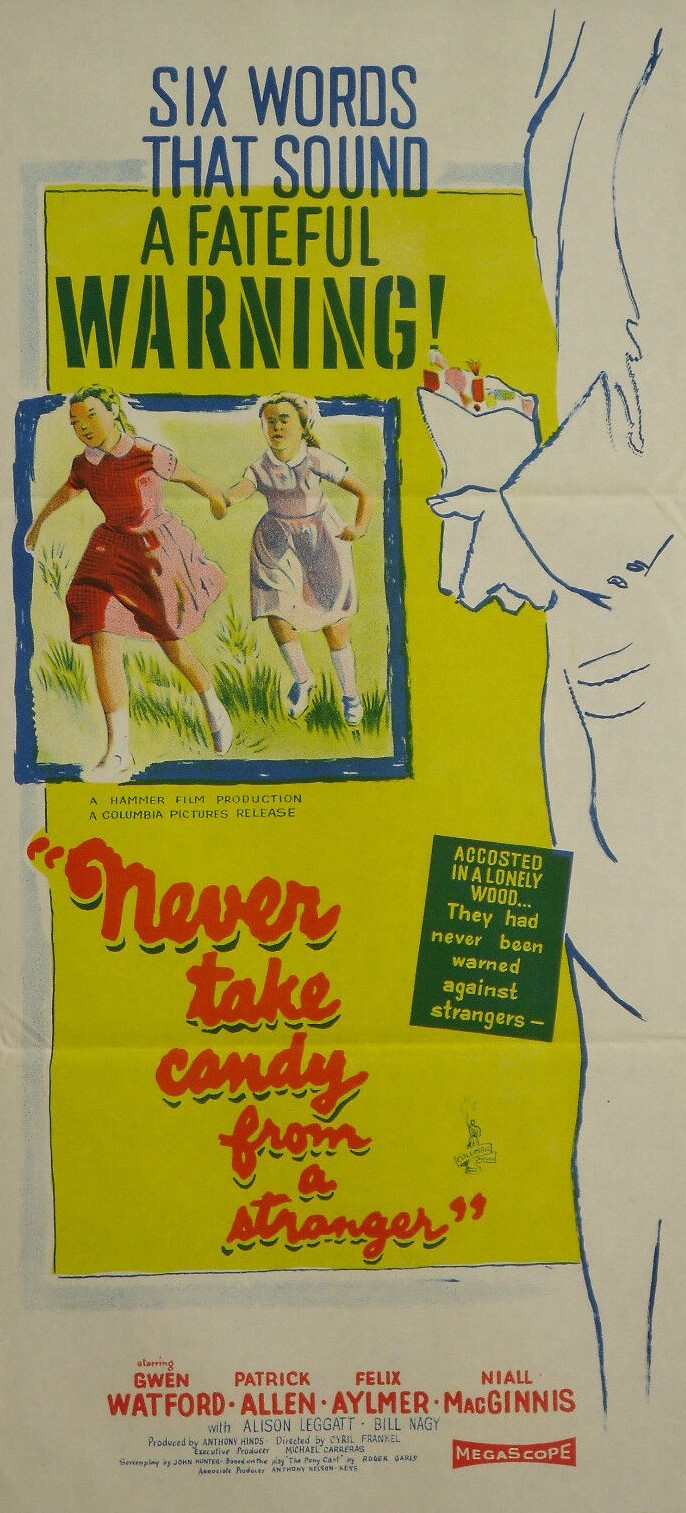
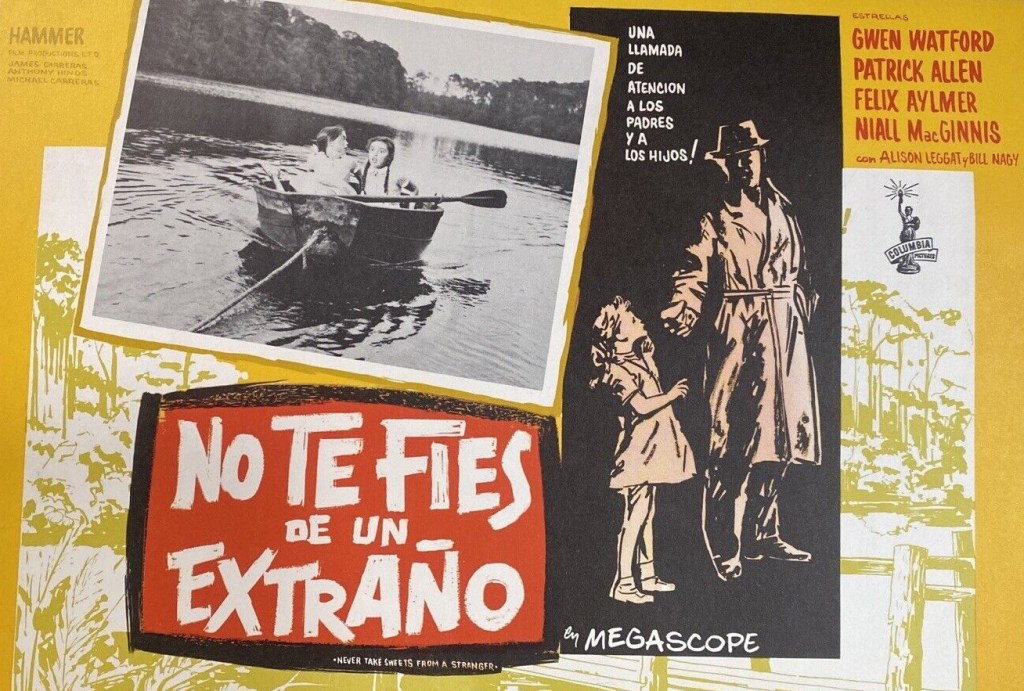
Banned, Reviled, Ignored: “Never Take Candy from a Stranger” (1960)

Paedophilia was the last taboo according to the Production Code, the self-censorship system organised by Hollywood in 1960. You could talk about rape in explicit detail (Anatomy of a Murder, 1959) and serial killers (Psycho, 1960) were acceptable, but you must not “violate the edict against depicting sex perversion…the only subject strictly forbidden by the code.”

Without the Production Code Seal (of approval), cinema bookings would be hard to come by. Cinemas that relied on the goodwill of their patrons would not dare risk upsetting them by renting a film that had met with such disapproval.

Headline news in “Variety.

Never Take Candy from a Stranger – a.k.a.Never Take Sweets from a Stranger – had been passed as an X-certificate in Britain, where, despite being set in Canada, it had been made. While that meant it could only be seen by adults over 18, there was no objections to it being shown.  It had been shot over six weeks beginning October 1959.

It had even been positively reviewed in the U.S. where Variety called it and “an exceptionally restrained film…directed with considerable skill” and Box Office magazine, another trade weekly, rated it “touching” though warned exhibitors that the “the subject matter is not to be sold as lure.” 

It did not help the case that James Carreras of British studio Hammer  had set out to make a movie that was “explosively exploitable” with the aim of cracking open America on the back of “heavy-exploitation marketing such as sex crimes against children” and that the movie intended to be “as frank with its theme as was Anatomy of a Murder in dealing with rape.”

The case went to appeal. The argument in its defence, as put by Roger Garis, author of the play on which the film was based, was that the movie wasn’t so much about paedophilia but about the public’s resistance to hearing about it, and the battle by two parents to rid the community of such a menace. He pointed out that on the play’s initial opening in New York in 1954 “no review indicated in the slightest degree that the subject matter was distasteful.”

But perhaps the U.S. censors took more note of the review printed in the British Monthly Film Bulletin that complained the “film’s seriousness is dissipated by an unnecessarily horrible climax.”

Hammer appealed the decision, but the Production Code would not budge. 

Despite the cautionary note struck by Box Office magazine, it was almost certain that it would be sold as exploitative, and attract the wrong sort of clientele, and for moviegoers of the wrong disposition it might well be only too big an attraction. In Britain, for example, it had been sold as a sex-shocker double bill, on the ABC circuit teamed up with Brigitte Bardot number Come Dance with Me (1959).

U.S. distributor Columbia could not be seen to be selling a movie that went against the ruling of the Production Code, but it couldn’t just dump it either since it was contractually obliged to release it. So instead it was passed on to its sub-division Lopert, an independent operation with no ostensible links to the parent company, that would find a way to get it into cinemas. Lopert would either sell it through the states rights method, divvying up the picture to a different set of local distributors who would each undertake the release in an individual state, or sell it on to another distributor, perhaps with experience of handling dodgy material. Lopert did both. Distribution was handled in some territories by Omat, which had successfully ushered La Dolce Vita (1960) through the system, and later Pathe-American, and in others by an independent.

The trade magazines had urged exhibitors to enrol the assistance of parental groups in marketing the movie, but these would hold no sway in terms of publicity. A local newspaper which had denied the movie any advertising space – a nationwide ban that followed such extreme Code disapproval –  was hardly going to give it editorial coverage.

But of course there were exhibitors who would take it. Arthouses were one possibility. They had been dealing with the disreputable ever since foreign production companies realized they could bypass the Production Code. If they were not signatories, they did not have to submit their movies for assessment. That was why there was such a flood of movies from France, Sweden and Italy heralding a sensational star like Bardot or Sophia Loren and promising greater leniency towards nudity than would be acceptable to the Code.

And there were many, especially among the more articulate classes, who felt the Code was outdated anyway, and that foreign films were breaking new cinematic ground, and that the directors of such films, Ingmar Bergman, Fellini et al, should be praised rather than condemned. But it was inevitable that movies from abroad with genuine artistic purpose got mixed up with those made with purely salacious intent.

The arthouse had been compromised so much that anything that could lure in the public was fair game. Even so, most arthouses drew the line at a film about child molestation. While Never Take Candy from a Stranger did receive a number of bookings in city center U.S. houses between 1961 and 1962 they were rarely in an arthouse. Most were in cinemas accustomed to offering patrons lurid product. In Chicago, outside of the major cinemas, it went out as a double bill with Sam Peckinpah western Deadly Companions.

Tracking the release through the pages of Variety and Box Office, I discovered it had only occasionally proved a success, a holdover for a second week generally one way of demonstrating that measure.

(Note that cinema capacities were much larger than today in the multiplex era and it was far from uncommon for  moviegoers to be part of a 1,000-plus audience)

In May 1961 in Boston it ran for two weeks at the 689-seater Mayflower, hitting $4,500 in the first week with a relatively small drop to $4,000 the next. In November, most likely as a filler for a movie that failed to hit its targets and was pulled early, it reached the 2,995-seat Palms in Detroit, clocking up a fair $10,000, but only permitted three days the next week, for another $3,000.

But by then a different reelase strastegy was in place. The same month in an “unusual first-run hook-up” it played a couple of drive-ins in Kansas City, those theaters were dragged into the first-run loop in the absence of other available or willing houses. One week at the 900-car Crest and the 700-car Waldo brought in a “mild” $6,000.  Perhaps in a bid to secure a bigger audience it was teamed with Beware of Children (1960). But anyone expecting another dip into perversion would be disappointed for it was a British marital comedy starring Leslie Phillips.

But release was a long drawn-out process, and perhaps to limit expenditure few prints were made. And by 1962, yet another different approach was taken, targeting the arthouses. In February it reached Baltimore, $3,000 at the 860-seat Avalon, In April it lasted one week at the 238-seat Capri Art in Denver taking $900 gross at the box office.

And then, never having not scaled the heights that a movie trading on controversy might expect, it disappeared. Obviously never a contender for television, and no sign of it being shoved out during the VHS boom, when virtually any movie made was revived in the hope of snaring a few extra bucks.

It took a helluva long time for the movie to surface, but when it did, it was to plaudits.

SOURCES:  “Hammer’s Slant,” Variety, October 21, 1959, p4; “Realism Outbreak in Britain,” Variety, October 31, 1959, p3; Review, Monthly Film Bulletin, January 1, 1960, p48; James Carreras, “British Horror Pix As Insurance For That Wide-Open Global B.O.,” Variety, January 6, 1960, p166; Review, Variety, March 16, 1960, p6; “Child-Molesting Theme in Abeyance,” Variety, April 27, 1960, p3; “Candy Story Author Sez Not About Perversion But Public’s Own Laxity,” Variety, May 11, 1960, p4; “Candy Loses Appeal for Code Seal,” Variety, May 18, 1960, p17;  Advertisement, Variety, January 11, 1961, p14; Review, Box Office, August 21, 1961, pA1; “Says Wilmington Press Is Pre-Judging Ads,” Box Office, October 30, 1961, p15; “Set Up Pathe Campaign,” Box Office, December 18, 1961, pNE6. Box office figures from Variety issues: May 31, 1961, p9; November 22, 1961, p8-10; February 14, 1962, p8; April 18, 1962, p9.

Never Take Candy/Sweets From a Stranger (1960) ****

Banned in the U.S., box office flop in Britain, consigned to the vaults for over three decades,  and when revived and you wonder how everyone could have been so wrong. A sensitive portrayal of a family caught up in local Canadian politics when their daughter accuses a dignitary of molestation, it carefully avoids the exploitation trap. At times tense, thrilling and heart-rending, with dynamic use of sound – sirens, footsteps, tracking dogs – it’s probably the best Hammer picture of the decade.

Young Lucille (Frances Green) takes her new friend Jean (Janina Faye), daughter of newly-arrived immigrants Peter (Patrick Allen) and Sally Carter (Gwen Watford), to visit an old man Clarence Olderberry Sr (Felix Aylmer). When the child returns home, not initially perturbed by what occurred, it transpires that, in return for a handful of candy (sweets in British parlance), she danced naked.

Sally’s mother Martha (Alison Leggatt), conscious of the disruption accusations might cause, tries to play it down. Sally reports the incident to the police chief Hammond (Budd Knapp) who is reluctant to pursue a case against the town’s most important person. Clarence Jr. (Bill Nagy) warns Peter of disastrous consequences. Lucille’s parents send her away so she cannot back up Jean’s story.

There follows trial by town, the whole family receiving the enmity of the local populace, while Jean is destroyed in the witness box by the prosecutor (Michael Gwynn), ending up so distraught her parents throw in the towel, the accused walking released scot free. Rancour is such Peter quits his job but as they prepare to quit the town, Jean goes off playing in the woods again with Lucille.

Stalked by the old man, they race terrified through the woods and into a rowing boat on the water only for the assailant to grab the tow-line and pull them back.

Movie tie-in by the author of the original play.

What could have easily pandered to the worst possible taste is incredibly well done. Strangers arousing the ire of a local populace is a trope as old as the hills so none of the consequence of their action was surprising. Nor, for the time, was the disgust expressed that such an accusation could be cast, not even if the old man has a history of mental illness, a voluntary patient whose records have conveniently vanished.

Whether the son has any inkling of the truth, or whether he is equally appalled, is never made clear as he is in any case duty bound to defend the family’s good name.  But compromise is the name of the game. And whereas you can understand Lucille’s father not wanting to risk his job, Sally’s mother falls into a different category, the uptight Englishwoman who dare not challenge the existing order. There’s a terrific scene when she is suddenly made aware that she is in the wrong but is too frightened to admit it.

Jean’s experience could easily be repeated today, thousands of women refusing to accuse in case they end up slandered or defamed, or find themselves taking on powerful men with powerful friends. We all know how easy it is for an unscrupulous lawyer to embark on witness character assassination. Initial corruption of innocence can be heightened by testifying in a witness box.

The sub-text of the film, while never remotely explicit, is that adults were only too aware of the existence of paedophiles, regardless of trying to write them off as harmless as Martha does, and it was virtually impossible is those more innocent times to explain to a child the dangers of taking candy from a friendly stranger.

Director Cyril Frankel (Operation Snafu, 1961) has done an excellent job of opening up the stage play by Roger Garis, and yet imposed quite a claustrophobic feel to the enterprise. Having escaped a potential captor, Jean is a prisoner of consequence, initially disbelieved, paraded in front of a hostile town, belittled by the prosecutor, despised by the jury, and let down in the end by her fearful parents who, having put her through the court ordeal, decide it is too much. And when she is free it is only to fall prey once again.

Patrick Allen (The Traitors, 1962) is custom-made for this kind of principled role, but Gwen Watford (Taste the Blood of Dracula, 1970) makes the most of a rare top-billed part, caught between conscience and status quo, battling an entrenched male hierarchy, undone by her own mother. Janina Faye (Day of the Triffids, 1963), only a couple of years older than the character she was playing and hopefully had little knowledge of the background to her role, is excellent as the young girl who discovers that innocence has a guilty side.

Well worth a watch with, unfortunately, a story that still rings true today.

Ride the High Country (1962) ****

Far from routine western with director Sam Peckinpah, in his sophomore picture, channelling territory that would later become more familiar, old friends turning enemies, the encroachment of civilization, the passing of the Old West, and sharing with The Misfits (1961) incredulity that the once noble occupation of cowboy/lawman has become redundant.  In Major Dundee (1965) and The Wild Bunch (1969), the story turns on former friends turned enemies, here that aspect is in its infancy.

Down on his luck former lawman Steve Judd (Joel McCrea), shirt collar frayed, holes in his boots, eyesight not what it was, recruits old pal Gil Westrum (Randolph Scott), reduced to running a western sideshow, to help him escort a load of gold down from the mountains. Gil brings along his younger sidekick Heck Longtree (Ron Starr). Along the way, romance beckons for the ever romantically-inclined Heck when he encounters young Elsa (Mariette Hartley), daughter of Bible-thumping farmer Joshua. When she runs off, intending to marry prospector Billy Hammond (James Drury) at the mining camp, they act as her escort.

Gil turns out not to be the straight-shooter he originally appeared, planning to rob the gold consignment on the way back, with or without Steve’s assistance. The plot takes a wild detour in the mining settlement when Elsa realizes that her marriage will take place in a brothel, her fiancé is a drunk, and that his four brothers reckon they will have equal claim on her sex-wise. Gil arranges for the marriage to be apparently annulled, which doesn’t for a moment fool the Hammond brothers, and the return journey, already splintered by Steve working out what was on Gil’s mind, turns into one ambush after another.

The narrative switch away from the cowboys bewailing their lot, or, in Gil’s case planning payback for a life gone awry, to the plight of the vulnerable woman in the last of the lawless western wildernesses, is a nifty one. But you can’t help seeing Gil’s point, all the gun wounds, gunfights, months in hospitals, jobs lost as a result of confinement, make a man’s mind turn to the notion he has not been correctly reward for his endeavours. And not quite as convinced as Steve that honor makes up for everything.

There is some very lively dialog, great banter as Gil tries to sow sedition in Steve’s ear, Steve with an endless fund of humorous retorts, gently explaining that the hole in his boot is a masterpiece of the shoemaker’s art, a clever method of hidden ventilation, at each point deflecting a wily tongue probing for weakness. Steve is soon revealed as anything but a gunman past his past, or even a bare-knuckled fighter, knocking out cold a disbelieving Heck.

The romance is well done, Heck convinced he has prised Elsa away from her father, only to discover he is not included in her plans, and the isolated virgin unlikely to respond to male ardor. But when the reality of marriage strikes home, a slap in the face required to guarantee compliance, Elsa is extremely lucky not just to find Steve and Gil willing to come to her rescue, but for the less upstanding Gil to take legal matters into his own hand, although you can’t help feeling, in terms of the subsequent mortality rate, this is a hell of a price to pay for a young girl who was not aware of the realities of married life. But, hell, every decent western requires sacrifice.

Peckinpah introduces some excellent twists on more common scenes. A horse race is won by a camel, belly dancers instead of saloon girls, the restaurant bust up in the traditional fistfight is Chinese, Steve assumes the crowds lining the streets to witness the race are extending a hospitable welcome to him, courtesy of his previous exploits. And to Gil’s consternation, the fat pot of gold, literally, diminishes by the minute, the original quarter of a million dollars reduced first to twenty thousand and then a mere eleven, almost hardly worth reneging on a lifetime friendship. Unusually, the lusty young Heck begins to question turning criminal. And the clue to Joshua’s behavior is visual, as we glimpse his wife’s headstone, marked “harlot.”

But when it comes to the showdown you will see an early rehearsal of the famed shootout in The Wild Bunch. But here observation takes the place of action and the steady drip-drip of Gil’s moans serve to highlight a life wasted in community service and Steve’s stoical insistence on law and order, a code that demands good humor in the face of adversity.

This was a splendid last hurrah for Randolph Scott (Western Union, 1941) , well past his Hollywood heyday and now consigned to B-movie westerns, though lucky enough to team up with Budd Boetticher for the seven late-1950s pictures known as the Ranown Cycle, now held in very high esteem. Joel McCrea (Union Pacific, 1939), too, was on the downward Hollywood slide, pretty much restricted to westerns for the whole of the 1950s. This proved to be his final movie of this decade and he only made three more. So, for both, Ride the High Country, was a fitting send-off. Future Wild Bunch alumni Warren Oates and L.Q Jones had small parts.

Ron Starr (G.I. Blues, 1960) and Mariette Hartley (Marnie, 1964) were unlucky that their performances did not reach a wider audience, especially among producers, because they both created multi-faceted characters. Sam Peckinpah was far luckier, Ride the High Country becoming a calling card among foreign critics.

Discover WordPress

A daily selection of the best content published on WordPress, collected for you by humans who love to read.

The Atavist Magazine

by Brian Hannan

WordPress.com News

The latest news on WordPress.com and the WordPress community.