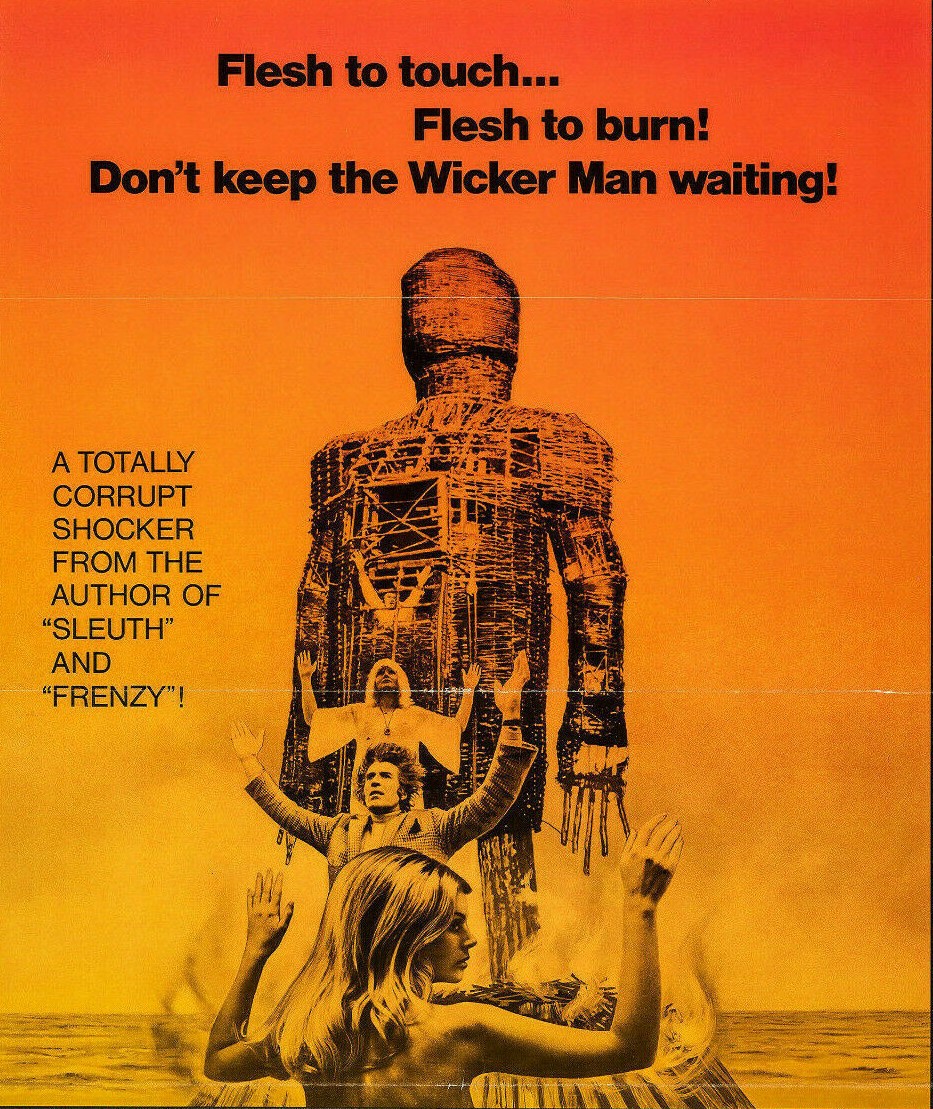
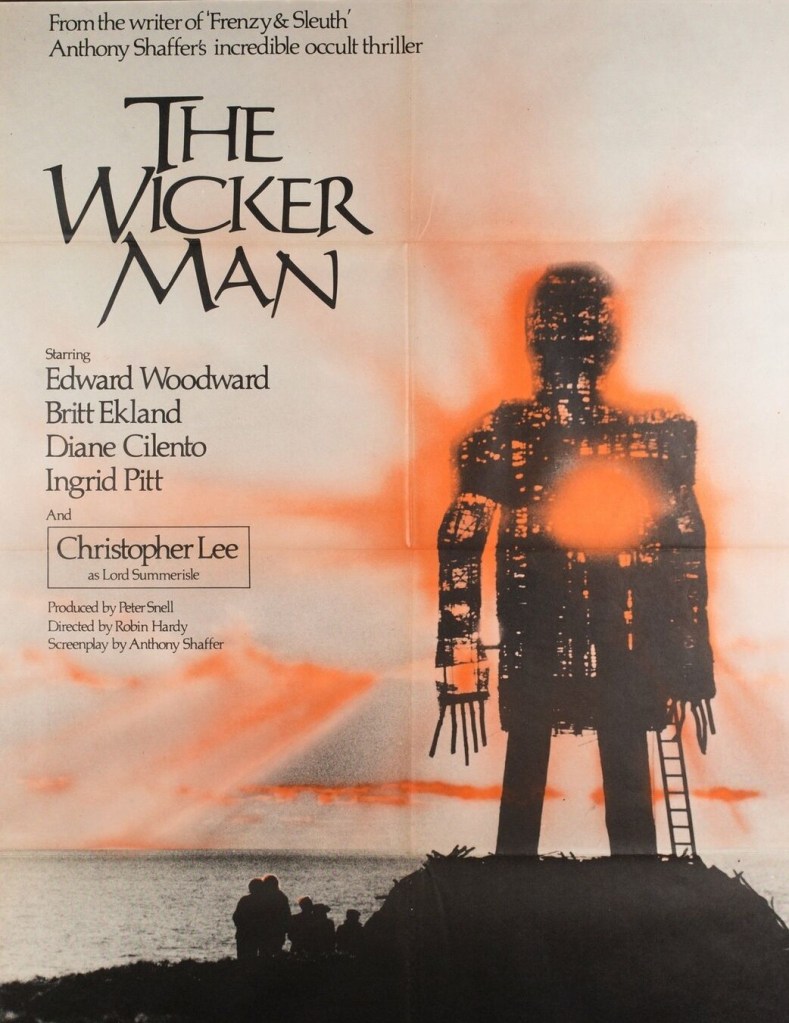
I first saw The Wicker Man in 1973, dismissed by critics on release, on the lower half of a double bill with Nicolas Roeg’s ecstatically-reviewed Don’t Look Now (1973), the films connected less by the horror elements than that they both made by British Lion. t’s now rubbing shoulders with the most superior kind of cult picture, the ones that the public will actually fork out hard-earned cash to see on the big screen, as was my experience this week. Some clever marketing person had the bright idea, given the picture concerns May Day activities of a dark nature, of running a special revival on May Day. What surprised me more was that the cinema was full (on a Monday night, no less), the audience was 20- and 30-year-olds and younger, and judging from overheard chatter afterwards they clearly enjoyed the experience.
What struck me most when watching this was the clarity of the pagan worship, compared to, for example, The Northman where I had no idea what they were worshipping beyond a rough notion. The procreation element was very well thought-out, the idea that such paganism should be taught in schools the way in the era when the film was made religion was on the curriculum. Most horror films do not take religion seriously, But here, even if it’s not your idea of true religion, the entire community invested in the symbolism of animals and trees and fertility rites such as jumping over a fire naked (otherwise your clothes would catch fire) in order to become pregnant. A naked woman weeps over a headstone in a graveyard. You can cure a cough by letting a toad sit in your mouth. And the entire soundtrack, often performed by folk singers in the pub, is filled with songs where the emphasis is on sex. But the detail is really quite extraordinary. Beyond The Wicker Man itself which I understand comes from the Druids, I’ve no idea if this is patchwork of other religions imbued with fictional elements, but it doesn’t matter because, no matter how fantastical it appears, it all rings true.
Policeman Sgt Howie (Edward Woodward) pilots a small seaplane to Summerisle to investigate the disappearance of a young girl, Rowan Morrison. At first the villagers deny knowing about the girl’s existence, and then provide conflicting reports, even going so far as to claim she is dead, or has transmogrified into the hare that lies in her supposed coffin. The villagers appear to either discreetly or openly mock him and certainly find much humor in his steadfast Christian beliefs. The schoolteacher Miss Rose (Diane Cilento) denies that the empty desk in her classroom belongs to Rowan. Island chieftain Lord Summerisle (Christopher Lee) debates Christianity. Landlord’s daughter Willow (Britt Ekland) and the librarian (Ingrid Pitt) are on seduction duty.
Frustrated, and threatening to return with more officers, Howie intends to leave but his airplane engine has broken down and soon he is convinced Rowan has been kept alive for ritual sacrifice on May Day as a way of providing rebirth for the island’s failing crops and fruit. In disguise as Punch, he joins the villagers in their parade only to discover that is the hunter who is hunted and that he has been tricked into coming onto the island. The climax is horrifying, in part because the lack of CGI or a bigger budget, in part down to the delight of the observers, has meant that most of what occurs is left to the imagination.
What at one point appeared an idyllic spot populated by relatively harmless if somewhat wayward people with a highly-developed sense of community and none of the infighting that might common in such a remote location. In another reversal to audience expectation there was none of the bloodlust surrounding the burning of a witch or monster. The smile on the face of a killer indeed!
The audience is brilliantly enmeshed. The investigation appears to drive the narrative, the various obstacles in the way of the policeman just par for the course in this kind of mystery. Just as we are beginning to become more enchanted by this community’s open attitude to sex especially when compared to Howie’s repressed Christianity, the story takes a sudden switch as the deeper level of meaning is revealed, that fertility actually means rebirth and that the ancient ways of achieving that are not for the faint-hearted.
Edward Woodward (File of the Golden Goose, 1969), making a debut as the star after hitting the television ratings heights as Callan (1967-1972), is excellent as the stern God-fearing policeman who gradually loses his power in a community where there is no tolerance for his kind of law. Christopher Lee (The Devil Rides Out, 1968) breaks out of his typecasting, especially with the wigs, with a very affable performance as a benevolent landlord. It’s hard to view him as an outright villain his actions are for perceived betterment. Britt Ekland (The Night They Raided Minsky’s, 1968) is convincing as the free-as-a-bird aphrodisiac-on-legs damsel with vulnerability to the fore. Diane Cilento (Negatives, 1968) and Ingrid Pitt (Where Eagles Dare, 1968) have little to do but keep the plot ticking.
Robin Hardy, on his debut, does a remarkable job of setting the seductive atmosphere although the film’s box office failure meant he only made two further films. Anthony Shaffer (Sleuth, 1972) adapted the novel Ritual by David Pinner.
The movie celebrates its 50th anniversary next year so look out for more showings especially if it becomes inextricably linked to the May Day festival the way Casablanca had been adopted by St Valentine’s Day marketeers.
All films released in Britain in the 1960s made their debuts in London’s West End which comprised a total of 18 cinemas, nearly half of these playing roadshows. While the performance of openers here was important, just as critical an indication of box office potential was length of run. Half the cinemas could seat 1,300-plus patrons. Ticket prices ranged from 70 cents to $4.20. The week ending May 4, 1965, provided this snapshot.
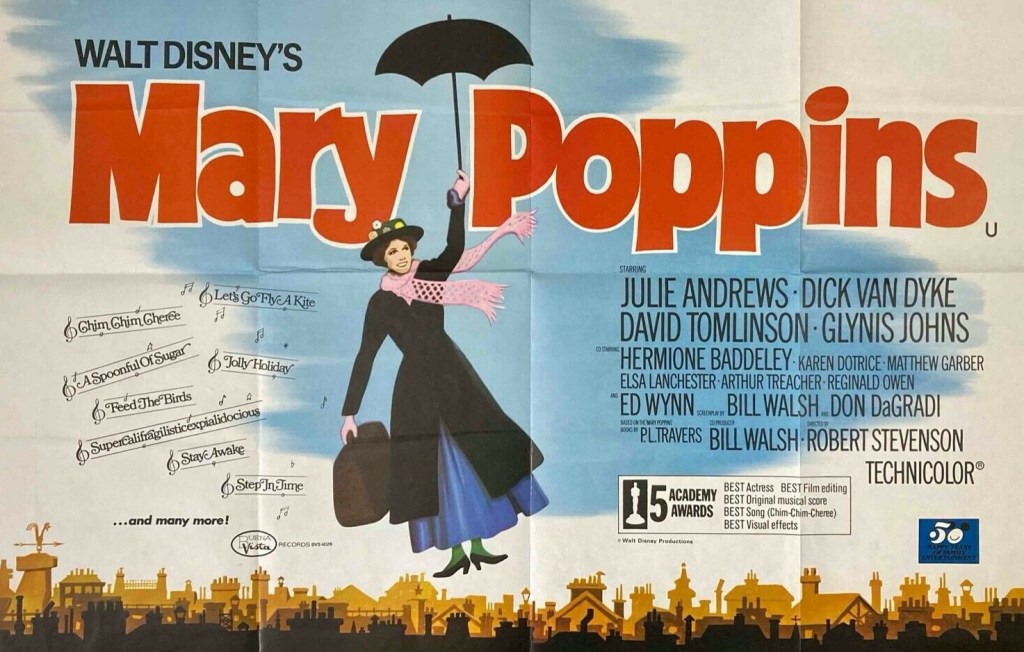
The top three films, all playing roadshow (i.e. two separate performances per day), were musicals. My Fair Lady at the 1,562-seater Warner pulled in $40,500 even though the movie was in its 15th week, some distance ahead of The Sound of Music which in its 5th week racked up $36,400 at the 1,712-seater Dominion. Much further behind, but setting a house record in the 16th week of its residency at the 600-seat Odeon Haymarket, was Mary Poppins which cleared $20,000. Both the Dominion and the Warner operated with the same ticket prices, cheapest seats setting customers back $1.45 with the most expensive seats costing $4.20, by far the dearest prices in London, no other West End cinema even breaking the $3 barrier. Tickets at the Odeon Haymarket ranged from $1.05 to $2.80.
Prospective longevity made the headlines ahead of new openings. Roadshows needed legs to justify the expense of running a movie at just one cinema in the British capital. Often, a major roadshow would play London weeks ahead of any other engagement in the country. The kind of wide release that was becoming increasingly common in the United States did not occur in Britain outside of the circuit releases in the two major chains, ABC and Odeon, which usually took product after it was played out in the West End.
Only two pictures made their debuts that week. Sylvia starring Carroll Baker was in pole position with $12,000 at the 1,889-seat Plaza (ticket prices $0.90-$2.80) just ahead of Robert Aldrich’s Hush, Hush, Sweet Charlotte which potted $11,000 at the 1,128-seat Carlton ($0.70-$2.10) but the latter, with its smaller seating and cheaper tickets, may well have been counted the winner.
The other big noise on the roadshow front was that the star-studded Samuel Bronston epic The Fall of the Roman Empire had entered its second year at the 1,474-seater Astoria. The movie had flopped in the United States where it had kicked off in 22 hard-ticket engagements in March 1964. In London in its 57th week it brought in $5,900. It would not go into general release, on the Odeon circuit, until September 1965; in other words, around 18 months after its launch.
Other roadshows displaying legs were: Lord Jim starring Peter O’Toole with $13,500 at the 1,394 seat Metropole ($1.05-$2.80) in its 6th week after moving over from the Odeon Leicester Square and The Greatest Story Ever Told grossing $16,000 in its 3rd week at the 1,155-seat Casino ($1.20-$2.80). Two Cinerama productions had been recently launched – Mediterranean Holiday snapping up $12,000 in its 3rd week at the 1,795-seat Coliseum ($1.20-$2.50) while The Golden Head marked up $4,700 at the 862-seat Royalty ($1.20-$2.50).
But other pictures playing continuous performance were held over if justified by box office returns. Peter Sellers in his second outing as Inspector Clouseau in A Shot in the Dark had taken $8,500 in its 11th week at the London Pavilion ($0.80-$1.80). In its 7th week at the 430-seat Ritz ($0.70-$1.15) was The Yellow Rolls Royce with $3,400. The 5th week of Ursula Andress as She posted $5,500 at the 556-seat Studio One ($0.50-$1.20). Anthony Quinn as Zorba the Greek turned in $5,000 in the 4th week at the 529-seat Rialto ($0.70-$1.90). The second and final week (truncated to five days) of Fail Safe at the 740-seat Columbia ($0.70-$2.10) knocked up $6,700. Films completing a third week were: The Americanization of Emily with $11,800 at the 1,330-seat Empire ($0.70-$2.10), Masquerade with $8,500 at the 1,375-seat Leicester Square Theatre ($0.70-$2.40) and Strange Bedfellows on $12,800 from the 2,200-seat Odeon Leicester Square ($0.70-$2.20).
New openings had been announced for the double bill of Invitation to a Gunfighter and That Man from Rio which was moving into the London Pavilion on May 13, Those Magnificent Men in their Flying Machines flew into the Astoria on June 3 while Operation Crossbow hit the Empire on May 19.
However, there was often a considerable time gap between roadshow movies finishing their West End run and moving into general release on the circuits – dominated by the Odeon and ABC chains. My Fair Lady would not receive an ABC general release – and the rare accolade of an extended run of two weeks – until January 1967, nearly a full two years after it had premiered in the West End and it would be 1969 before The Sound of Music received an Odeon general release (and then only in London).
On the other hand, The Yellow Rolls-Royce, while still picking up decent coin at the Ritz, entered ABC general release at the end of January – and proved one of the top box office hits of the year on that circuit. She, enjoying a healthy stint at the Studio One, had been released through ABC in April. Mary Poppins would swing onto the Odeon circuit in time for the main English summer holiday period in August 1965. The ABC circuit played the double bill of The Americanization of Emily and To Trap a Spy at the start of May 1965, only a couple of weeks after its West End bow. Hush, Hush, Sweet Charlotte, on the other hand, wasted no time in shifting into top gear, sent out onto the Odeon circuit virtually day-and-date with its West End showing, and Strange Bedfellows would head down the same route barely a month after its opening.
I should point out that general release meant a movie was playing at the local/neighbourhood cinema. The big cinemas in big city centres throughout Britain would have mostly, but not always, shown the movie shortly after the West End debut, occasionally simultaneously. To complicate matters further, in Britain general release meant London rather than the entire country. And even then the London release was split in two – to save on prints – the north side of the capital receiving the film a week ahead of the south. But I remember well, as teenager, scanning the adverts and the listings in Films and Filming magazine, noting with disappointment that films being shown in local cinemas in London had yet to be shown in any of the big cinemas in my home town of Glasgow.
SOURCES: “West End Firm Despite Few New Pix,” Variety, May 12, 1965, p8; Allen Eyles, Odeon Cinemas 2 (Cinema Theatre Association) p211-213; Allen Eyles, ABC (Cinema theatre Association ) p123.
British espionage team embarking on a scheme to fool Adolf Hitler during the Second World War find they are susceptible to deceit and deception in their own lives. What could have been a plodding step-by-step documentary-style picture is given a huge fillip by examination of the lives of those involved. The twists and turns of this extraordinary tale, both in the professional and personal sense, make for a very enjoyable picture. It is no less thrilling for, like The Day of the Jackal (1973), being aware of the outcome.
Planning to invade Sicily in 1943, the Allies are determined to convince Hitler that they are instead more likely to attack Greece. The British come up with “Operation Mincemeat,” a variation on the Trojan horse with the “gift” this time being secret papers referring to the Greek assault that are contained in a briefcase attached to a corpse which washes up on the shores of Cadiz in Spain. The assumption is that the German high command is predisposed to being hoodwinked after having ignored the papers on a genuine corpse that came their way prior to the invasion of north Africa.
Tasked with devising the operation are the accomplished Ewen Montagu (Colin Firth) and the gawky Charles Cholmondeley (Matthew Macfadyen) into whose orbit comes Jean Leslie (Kelly Macdonald) whose persona is used to provide a romantic background for the corpse. Although the project has been given the green light from the highest authority i.e Winston Churchill (Simon Russell Beale) not everyone is in favour and the team face obstacles, since technically the plan comes under the remit of the Royal Navy, from Admiral John Godfrey (Jason Isaacs).
The romantic intrigue that ensues creates sufficient resentment for one member of the team to spy on the other at the behest of the admiral, thus ensuring that those charged with deceiving Hitler through moral means are entering into immoral personal activity.
But what drives this picture is the detail. Finding the correct type of corpse, ensuring it is preserved and has sufficient water in the lungs to make a convincing drowned man at the same time as creating a suitable legend for the character. Films dependent on the inner workings of espionage science, for want of a better word, do not always work. Enigma (2001), a riveting book, did not translate well onto the screen while The Imitation Game (2014), covering similar territory, did. Here, the minutiae of minutiae are presented in such detail it is an education, down to the importance of an eyelash, how to extract a letter without breaking the seal on an envelope, and, critically how to judge whether the Germans have examined the material closely enough to ensure they have taken the bait.
The story has already been told though not in such detail as “The Man Who Never Was” (1956) but with Hollywood stars Clifton Webb and Gloria Grahame playing the leads.
And that’s before other twists and turns. The corpse was a down-and-out, abandoned, so it appeared, by all and sundry, until out of the blue his sister arrives to claim the body. The coroner on duty in Cadiz turns out, against all expectations, to be an expert in drowning. The British Attache in Spain must seduce both genders to ensure smooth passage of the secret documents. On the more human side, widows abound, husbands lost in combat. A spy on the British side must be unmasked or rendered harmless. A host of other smaller stories unfold within the larger narrative. Above all lies the tension of the necessity for the operation’s success, failure would mean the deaths of thousands of men on the Sicily beachheads and possibly a thwarted invasion.
Matthew Macfadyen (Succession, 2018-2021) steals the show as the over-sensitive individual with the sense of entitlement that comes from having too big a brain, Oscar-winner Colin Firth (Kingsman: The Secret Service, 2014) the imperturbable figure who finds emotion wreaks havoc, Kelly Macdonald (Goodbye Christopher Robin, 2017) the secretary drawn deeper into a world where genuine emotion has little place.
The cream of British character actors providing sturdy support include Johnny Flynn (Emma, 2020) as spy writer Ian Fleming, Penelope Wilton (Downton Abbey: A New Era, 2022), Mark Gatiss (The Father, 2020), Alex Jennings (Munich: The Edge of War, 2021), Jason Isaacs (The Death of Stalin, 2017) and Mark Bonnar (Guilt, 2019-2021). ,
Oscar-nominated John Madden (Shakespeare in Love, 19980 directs with something approaching verve, never letting the pace drop, zipping from scene to scene, from the war effort into more intimate moments, without any sign of the tension flagging. In her movie debut Michelle Ashford (The Masters of Sex, 2014-2016) does an excellent job of distilling Ben McIntyre’s bestselling book.
Sure, this is one of those British pictures in a long line of movies that show the country at its best, generally in the thick of war, but the story is so involving that it merits viewing. It is still showing at the time of writing in British cinemas but in the United States and Latin America it will air on Netflix on May 11.
Unusually for an Otto Preminger project, this took an unconscionably long time to get off the ground, given he had purchased rights to the bestseller by Evelyn Piper which had been published in 1957. The first problem was that no one could lick the screenplay. Getting first bite was Ira Levin (Rosemary’s Baby, 1967), followed by “wholesale doctoring” by Dalton Trumbo (Exodus, 1960) who delivered a “polished script.” But that failed to satisfy the director either and triggered further attempts by Charles Eastman (Little Fauss and Big Halsy, 1970) and Arthur Kopit (Oh Dad, Poor Dad, Mummy’s Hung You in the Closet and I’m Feeling So Sad, 1967). But nobody seemed able to come up with a satisfactory job. The book had been set in New York as had the various subsequent screenplays. The solution appeared to be to shift the location some 3,000 miles to London. Penelope Mortimer (The Pumpkin Eater, 1964) wrote a draft but ended up having a fight with Preminger and withdrew and the project was completed by her husband John Mortimer (John and Mary, 1969).
The Levin screenplay was dismissed as being too faithful to the book, the kidnapper in this instance turning out to be a former teacher who was childless and afflicted with “menopausal psychosis,” a character Preminger found weak and uninteresting. Trumbo changed the villain into a wealthy woman, not just childless but judged unfit to adopt, an approach the director deemed “very theatrical and wrong.” The Kopit and Eastman versions offered no better solution. “I almost gave up Bunny Lake,” admitted Preminger, “because while working in the script I realized that women would not like the film…because they are afraid of all situations in which a child is in danger.” After considering transplanting the story to Paris, Preminger finally settled on London, and hired the Mortimers whose villain brought the picture a 2new dimension.”
Until now, and in keeping with the original novel, Newhouse, while assisting in the investigation, had been a psychiatrist. In the hands of the Mortimers he now morphed into a police inspector. Wilson who had been Newhouse’s quite respectable friend turned into a drunken reprobate. At this point the heroine’s name remained Blanche as in the book. There was one other significant element that changed between the initial Mortimer script and the final shooting script: at the start of the film the Ann and Steven were shown reacting as if the child was there, whereas when the movie went before camera the question of the child’s existence remained in doubt. Penelope Mortimer dropped out when, summoned with her husband to Honolulu where Preminger was filming In Harm’s Way, she was roundly ignored.
Filming was originally scheduled to slip in between Anatomy of a Murder (1959) and Exodus (1960) with a budget set at $2 million. But something always seemed to get in the way. Occasionally it was a bigger project. After Columbia announced filming was scheduled for 1961, Bunny Lake was pushed back to spring 1962 to permit the filming of Advise and Consent (1961). Then The Cardinal (1962) took precedence but only to the extent of shifting the Bunny project till later that year. Then it was set to be completed by fall 1963. Further cause of delay was the decision to accommodate the pregnancy of that Lee Remick who had signed for the leading female role. But when she was ready to go, Preminger was not and she fell out of the equation.
At one point, fearful of his schedule becoming too crowded – filled with expensive projects like The Cardinal and In Harm’s Way (1965) – Preminger had tried to wriggle out of the directorial commitment, planning to limit his involvement to producing only, but studio Columbia would not accept this. Preminger was in considerable demand, like a major movie star contracted to deals with rival studios, in 1961 for three pictures with United Artists and four for Columbia and by 1965 adding into the mix a seven-picture deal with Paramount, and most of these big pictures, leaving little time for a relatively low-budget – by his standards – picture.
A good example of the British distribution system. The film opened at the Odeon Leicester Square and quickly went into general release, first in cinemas in North London and a week later the prints shifted to South London. In the West End, it ran solo, in the suburbs as a double bill.
Finally, Bunny Lake received the green light with filming beginning in London on April 9, 1965. Unusually, the movie was shot entirely on location, the director expressing a “yen for realistic on the spot” filming in a dozen places including a pub, the Cunard office and Scotland Yard. A school in Hampstead doubled for the nursery, the mews flat was found just behind Trafalgar Square. He was quick to point this was not a matter of economy. “What you save in studio (time) you spend in other ways. But I think it leads to more urgent film-making.” Somewhat surprisingly, he aimed to shoot in black-and-white, colour now being predominant except for low-budget movies and those wishing to take advantage of black-and-white world War Two newsreel footage as was the case with his previous picture In Harm’s Way.
Carolyn Lynley (The Pleasure Seekers, 1964) was given the lead with Keir Dullea (David and Lisa, 1962) in the pivotal role of her brother. Neither could be considered a big star although Lynley had the second female lead in The Cardinal and moved up the credit rankings to female lead in the low-budget Shock Treatment (1964). But she was such a hot prospect Preminger in 1965 signed her to a four-picture deal although this was not exclusive as she also had contracts with Twentieth Century Fox and Columbia. Dullea was potentially a better prospect, picking up some acting kudos for David and Lisa, the designated star of that picture and The Thin Red Line (1964) but only second lead for Mail Order Bride (1963) and the Italian-made The Naked Hours (1963).
Although some decades away from his Hollywood box office prime, the casting of Oscar-winner and five-time nominee Laurence Olivier (Spartacus, 1960) was something of a coup, although he was only hired because another actor proved too expensive. Other parts were filled by actors experienced in the Preminger school of film-making, Martita Hunt from The Fan (1949)- and Bonjour Tristesse (1958), Victor Maddern (Saint Joan, 1958) and David Oxley (Saint Joan and Bonjour Tristesse).
The first day’s shooting was in a television studio to capture the newsreader and pop group The Zombies which the content of the show shown in the pub on television. Contrary to depictions of Preminger as a martinet on set, he was keen in rehearsals to “put everyone at ease” although he emphasised the need for “slow, thoughtful diction.” The famous Preminger wrath came down heavily on personnel failing to carry out their job correctly. But he accepted Olivier’s decision to omit a particular phrase. He was specific about the look he wished to achieve, required high contrast black-and-white cinematography while nothing was to be done “to enhance Carol Lynley’s beauty: instead…to deepen her features, bring out her emotions.”
And he was determined to get what he wanted, 18 takes required to complete a lengthy tracking shot that flows Inspector Newhouse (Laurence Olivier) and Miss Smollett (Anna Massey) as they negotiate a passage through a group of noisy children in a classroom and then across a hall. Accepting Lynley’s difficulty in expressing the pain of losing a child, he instructed her to forget about subtext and play the moment. However, 14 takes of a scene between Lynley and Olivier was too much for the actress but she was comforted when Preminger told her the famous actor was the problem not her. But on another occasion, Preminger ended up giving her an almost line for line reading of how he wanted the scene played. The only way he got what he wanted was to reduce her to “sobbing uncontrollably” and then start the camera rolling.
Without question, Keir Dullea came off first. “He would humiliate you, he would scream at you…his dripping sarcasm was the worst of it,” recalled Dullea. “I was always very prepared in terms of knowing my lines…but the stress, there was some action where I was supposed to put a glass down or pick up a glass” that Dullea kept getting wrong. In face of what he deemed incompetence, Preminger accused him of being “an actor who can’t even remember a line and if heremembers a line he can’t remember an action…what, you can’t do these two things at the same time.” In the end Dullea faked a nervous breakdown and after than “he never screamed at me again.”
Olivier would occasionally coming to rescue, persuading the director to ease off and “stop screaming at the children.” Olivier found Preminger such a bully that it “almost put me off his Carmen Jones, which I found an inspired piece of work…It’s a miracle it came from such a heavy-handed egotist.” On the other hand Noel coward, who played the landlord Wilson, believed Preminger an excellent director.
Preminger spun his marketing on a similar gimmick to that utilised by Alfred Hitchcock for Psycho (1960) in preventing the public from entering once the movie had started. To make this more dramatic, he had clocks installed in the lobbies of theaters that counted down the length of the performance and a sign that stated “nobody admitted while the clock is ticking.” Preminger was credited with coming up with a longer tagline for the advertisements: “Not even Alfred Hitchcock will be admitted after the film has started.”
The only problem was Return from the Ashes, released at the same time, had adopted a similar marketing ruse, nobody admitted “after Fabi enters the bath.” Despite this, Preminger went hell-for-leather for this marketing trick, to the extent of adding a rider to exhibitor standard contracts to that effect, not a problem in more sophisticated cities where by now patrons had become accustomed to turning up for a picture’s announced start time but a problem in smaller towns and cities where the whole point of continuous programme (i.e. no break between one film and another) was that moviegoers could walk in whenever they liked.
The whole tone of the marketing did not meet the approval of two important segments of the greater movie community. The National Association of Theater Owners opined that the marketing campaign was weak and were astonished to learn that there was nothing Columbia could so about it – Preminger had advertising-publicity approval. Allowing that some of the advertising images for Preminger pictures, courtesy of designer Saul Bass – The Man with the Golden Arm (1953), Anatomy of a Murder, Exodus etc – were among the most famous in Hollywood history, it would appear Preminger knew what he was doing. But, in fact, although the Saul Bass credit sequence showing pieces of newspaper being torn away made sense in the framework of the picture, the idea was not so effective taken out of that context.
Not intentionally, perhaps, Preminger also riled the critics, deciding that to “preserve the secrecy of the surprise ending,” the movie would open without the normal advance screenings for reviewers. Such action was more likely to set alarm bells ringing, it being a standard assumption among critics that the only films that went down this route were stinkers. From a practical point-of-view it also ensured that marketing was undercut since the lack of timed reviews denied the picture an essential promotional tool.
Finally, the movie ended up in a war with the censors. Many states in the U.S. had their own censors. Columbia objected to having to wait on the say-so of a local censor – in this case Kansas – before being able to release a movie. And for any release to be delayed if there was any nit-picking by the censor, especially as this movie had an undercurrent of incest. So Columbia refused to conform and failed to submit Bunny Lake Is Missing to the Kansas censors. After being promptly banned for such arrogance, Columbia objected again and the case went to the Kansas State Supreme Court which judged that the censor was unconstitutional. That resulted in the censors losing their jobs when the board was abandoned and the movie entering release a good while after its initial opening dates.
Although it made no impact at the Oscars, Village Voice critic Andrew Sarris picked it as one the year’s ten best and it was nominated for cinematography and art direction at the Baftas. The film was a flop, failing to return even $1 million in rentals at the U.S. box office. In fact it probably made more when it was sold to ABC TV for around $800,000.
SOURCES: Chris Fujiwara, The World and Its Double, The Life and Work of Otto Preminger, p330-342; (Faber and Faber, 2008) “Trends,” Variety, January 14, 1959, p30; “Ira Levin Pacted by Preminger for Bunny,” Variety, September 2, 1959, p2; “Col Primed To Start ½ Dozen Prods,” Variety, April 5, 1961, p3; “Otto Preminger Views Film Festivals As Important Marketplaces,” Box Office, May 1, 1961, p11; “Trumbo May Script for UA,” Variety, May 31, 1961, p5; “Bunny Lake Delayed,” Variety, June 7, 1961, p18; “Preminger Postpones One,” Box Office, June 12, 1961, p13; “Otto Preminger to Film Cardinal for Col,” Box Office, August 7, 1961, -10; “Otto Preminger Is Guest of Soviet Film Makers,” Box Office , May 14, 1962, pE-4; “Two Writers Signed,” Box Office, August 6, 1962, pSW-3; “Preminger,” Variety, September 12, 1962, p15; “Preminger’s New Rap at Costly U.S. Distribution,” Variety, October 10, 1962, p7; “Preminger Gets Rights to Hurry Sundown,” Box Office, November 23, 1964, p9; “Prem’s Next in London,” Variety, January 13, 1965, p18; “Preminger Signs Actress for Four More Pictures,” Box Office, February 8, 1965, pW-3; “Advertisement,” Variety, April 7, 1965, p1; “Preminger-Paramount Pact Calls for 7 Films,” Box Office, April 26, 1965, p7; “100% Location for Bunny,” Variety, May 5, 1965, p29; “Not Even Hitch,” Variety, September 1, 1965, p4; “Preminger’s Nix on Pre-Opening Critics,” Variety, September 22, 1965, p16; “2 Pix Enforce Entrance Time on Ticket Buyers,” Variety, September 29, 1965, p5; “Time Rules Are Set for Bunny Shows,” Box Office, October 4, 1965, p13; “Preminger’s Promotional Prerogative,” Variety, October 27, 1965, p13; “Clock for Bunny Lake,” Box Office, November 8, 1965, p2; “Village Voice Vocal on Bests,” Variety, January 26, 1966, p4; “Col Kayos Kansas Censoring,” Variety, August 3, 1966, p5.





 The Magnificent 60s