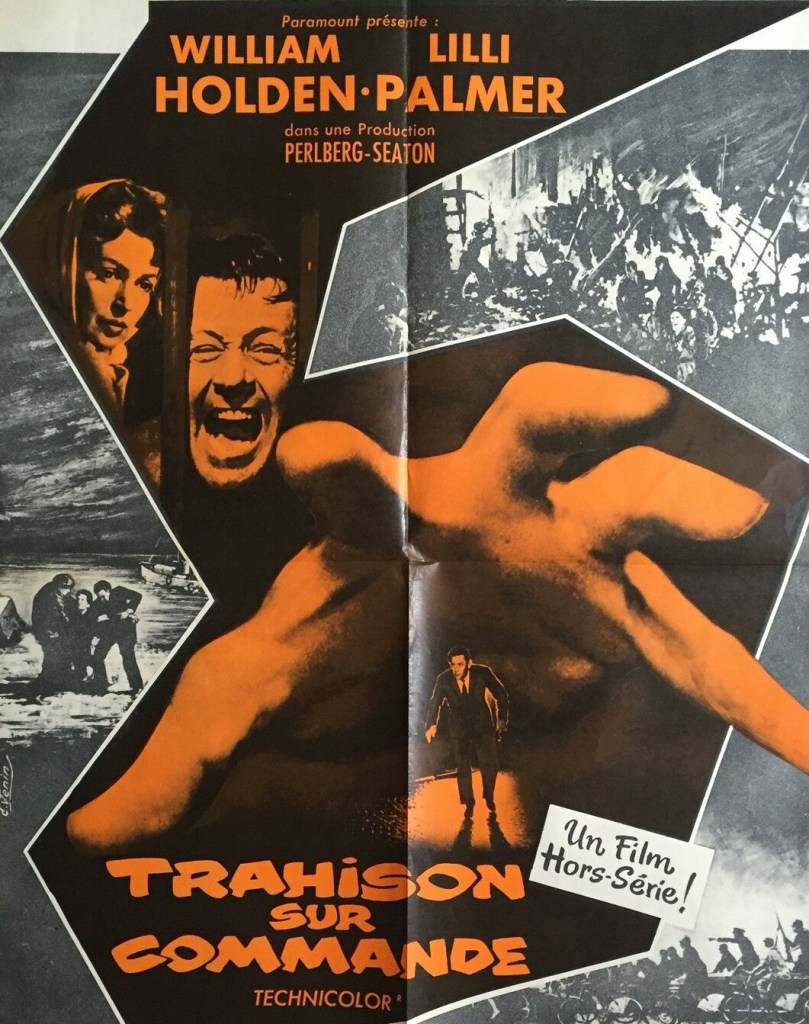
Cynical and opportunistic Swedish oil executive Eric Erickson (William Holden) blackmailed into World War Two espionage finds redemption after witnessing first-hand the horrors of Nazi Germany. Two extraordinary scenes lift this out of the mainstream biopic league, the first Erickson witnessing an execution, the second a betrayal. While some participants in the espionage game pay a terrible price, others like spy chief Collins (Hugh Griffiths) manage to maintain a champagne lifestyle.
Structurally, this is something of a curiosity. The first section, with over-emphasis on voice-over, concerns Holden’s recruitment and initial attempts at spying on German oil installations on the pretext of building a refinery in Sweden. Although resenting the manner in which he was recruited, Erickson has no qualms about resorting to blackmail himself to enlarge his espionage ring.
But it’s only when Marianne Mollendorf (Lili Palmer) enters the frame as his contact in Germany that the movie picks up dramatic heft. As cover for frequent meetings, they pretend to be lovers, that charade soon deepening into the real thing. While abhorring Hitler, she suffers a crisis of conscience after realising that the information she is passing on to the Allies results in innocent deaths. The final segment involves Erickson’s thrilling escape back home.
The picture is at its best when contrasting the unscrupulous Erickson with the principled Marianne. Virtually every character is trying to hold on to a way of life endangered by the war or created by the conflict and there are some interesting observations on the way Erickson manages to harness foreign dignitaries while being held to hostage in his home country. Loyalties are sparing and even families come under internal threat.
Sweden was neutral during the Second World War so in assisting the Allied cause Erickson was effectively betraying his country and once, in order to keep proposed German investors sweet, he begins to spout Nazi propaganda at home finds himself deserted by friends and, eventually, wife.
In some respects, Holden (The Devil’s Brigade, 1968) plays one his typical flawed personalities, easy on the charm, fluid with convention, but once he learns the true cost of his espionage a much deeper character emerges. The actor’s insistence, for tax reasons, on working abroad – this was filmed on location in Europe – would hamper his box office credibility and although not all his movie choices proved sound this was a welcome diversion. Whether American audiences were that interested in what a Swede did in the war was a moot point, as poor box office testified. And the title might have proved too sophisticated for some audiences, given there was no counterfeiting of money involved.
Lili Palmer (Sebastian, 1968) is excellent as the manipulative Marianne, betraying her country in order to save it from the depredations of Hitler, not above using her body to win favour, but paralyzed by consequence. Hugh Griffith (Exodus, 1960) provides another larger-than-life portrayal, disguising his venal core. Werner Peters (Istanbul Express, 1968) puts in an appearance and Klaus Kinski (Five Golden Dragons, 1967) has a bit part.
Double Oscar-winner George Seaton (Airport, 1970) makes a bold attempt to embrace a wider coverage of the war than the film requires and could have done with concentrating more on the central Erickson-Mollendorf drama, especially the German woman’s dilemma, but, made before James Bond reinvented the idea of espionage, this remains a more realistic examination of duplicity in wartime.
CATCH-UP: William Holden pictures reviewed in the Blog are Alvarez Kelly (1966) and The Devil’s Brigade (1968); Lili Palmer movies reviewed are Operation Crossbow (1965), Sebastian (1968) and Hard Contract (1969).
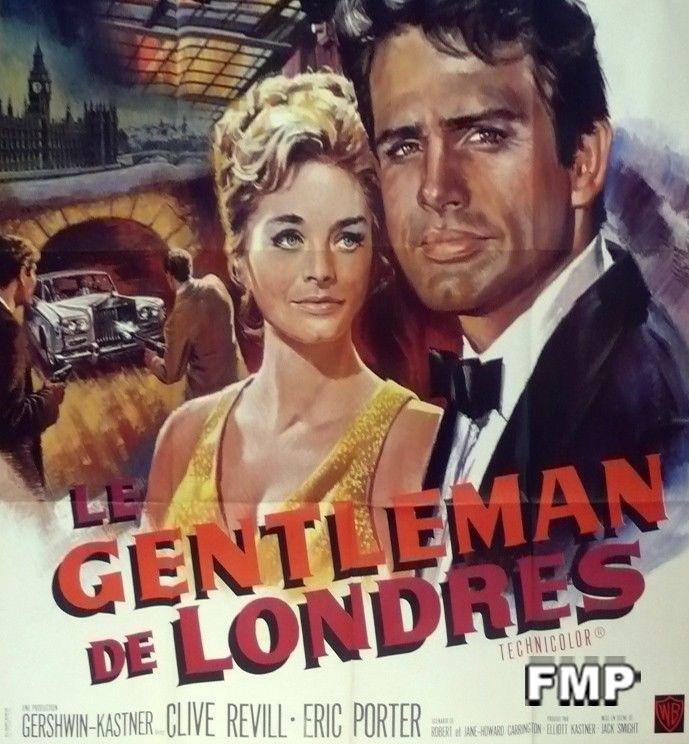
Amazing the tension that can emanate from one turn of a card. Or, more correctly, waiting for one. Only problem is we’re two-thirds through the movie before high-stakes poker begins – the pot nudging £250,00 (close on a cool £5 million now). Mostly, the earlier tension derives from not knowing what the hell is going on in this enjoyable thriller made at the height of the Swinging Sixties as playboy gambler Barney (Warren Beatty), a walking Carnaby St model driving an Aston Martin DB5, tilts the odds dramatically in his favor.
Barney is a gambler but the problem with gambling is the odds. They can be against you too much. So Barney decides to turn himself into a burglar, the kind that can clamber over rooftops, abseil between buildings, and break into – a printing business called Kaleidoscope. This just happens to print the playing cards supplied to all the major European casinos. So Barney does a little doctoring of the master printing plates. Bingo, the odds are a bit more even now that he knows what cards are coming out of the shoe – he plays chemin de fer (as it is known in posh casinos; pontoon or 21 to you and me).
While cleaning up he bumps again into fashion designer Angel – their original meet-cute taking place in a traffic jam – who he dated once in London. Unbeknownst to him, she is on a scouting mission, looking to snare the kind of high-rolling gambler who can take on and completely fleece drugs kingpin Harry (Eric Porter) being pursued by her father Manny (Clive Revill), a cop who, rather than waste so much time collecting the required evidence to put the villain behind bars, decides it would easier done by making him broke. Unable to pay his debts, some other villain would put him out of business in the traditional cemented-boot fashion.
It takes a while for the movie to line up all its ducks in a row, mainly by holding back the vital information the audience requires. But the audience is privy to details of the way Manny works that Barney is not. Even for ruthless villains, Manny has a peculiar calling card, one that would make any gambler think twice about entering his lair. Of course, it doesn’t take long for Manny to rumble Barney’s game so the stakes are much higher than the charmer imagines.
Throw in as much fashion as London was capable of generating at this time, the burgeoning romance, some exotic European locations, a castle with a moat, and the usual tourist guide stuff of red buses, Big Ben, Piccadilly Circus, pubs and Tower Bridge and you have all the ingredients of an easy on the eye thriller.
A bit over-reliant on star power. That is, if you don’t need Beatty to do much more than be Beatty, all teeth and charm. At this point Beatty’s career looked as if it was fast approaching its end. The box office success of Splendor in the Grass (1961) had been followed by a string of flops, romantic dramas and comedies that should have had audiences queuing up plus an occasional wild card like Arthur Penn’s Mickey One (1965), the biggest flop of all. He does make an engaging crook, and he never loses his screen charisma here, but there ain’t quite the right number of twists that moviegoers weaned on the likes of Topkapi (1964) had come to expect.
Hollywood had been doing its best to position Susannah York as a top box office attraction and she had snagged leading female roles in The 7th Dawn (1964) opposite William Holden and Stanley Baker in Sands of the Kalahari (1965) but she was recovering from the colossal flop of Scruggs (1965) by ‘poet of the cinema’ David Hart. Kaleidoscope offered the kind of role York could do with her eyes closed. So while the screen pair were not exactly sleep-walking it was not the kind of story that was going to create sparks.
Character actor Clive Revill (Fathom, 1967) and Eric Portman (The Pumpkin Eater, 1964) take more leeway with their roles, the latter almost chewing he scenery, the former content with just chewing his lips. Look out for Jane Birkin (Blow-Up, 1966) and British television stalwarts Yootha Joyce, George Sewell and John Junkin.
The title would have been more enigmatic, original meaning of images twisted out of shape, had it not also applied, straightforwardly, to the card-making company. Giving Harry the surname of Dominion seems overkill.
Director Jack Smight (No Way to Treat a Lady, 1969) came to this after twisty private eye picture Harper/The Moving Target (1966), a big hit starring Paul Newman, but this is too lightweight a feature to command such interest, but he does keep the story rolling along and it’s an effortless watch and it has a certain offbeat quality. The screenplay was fashioned by Robert Harrington and Jane-Howard Hammerstein, making their movie debut, who also co-wrote Wait until Dark (1967). It was also the debut for Winkast Productions, the Jerry Gershwin-Elliott Kastner production team who went on to make Where Eagles Dare (1968).
Army vet with PTSD learns how to deal with his trauma by transporting cross-country a dog with PTSD. In one of the few Covid box office winners, this has found an audience by the old-fashioned method of word-of-mouth. The trailer pitched this as a kind of Chevy Chase comedy, hapless man with unruly dog, and alternatively as a feel-good picture, but once audiences saw it and realized what it was really about nobody seemed to care they had in equally old-fashioned manner been duped by the marketing and just settled in to watch the best film yet about Army veterans. Eschewing the heavy melodramatic approach of so many other pictures addressing much the same issue, this simple tale outscores them all by sticking to the knitting, a tale with, sure, plenty laughs, but again equally old-fashioned, a movie about friendship and redemption.
Channing Tatum has built a career on playing against his physical attributes, generally excelling at a character but more brawn than brain, often lost in the modern world and this is almost an ode to that screen persona. We have witnessed so many arrogance-driven pet (no pun intended) projects by actors that fall apart under the weight of their own hubris and lack of understanding of cinema, that it is astonishing to realize that not only was Tatum a producer on this movie (and possibly giving up his salary in return for a back-end to keep the budget low enough – just $15 million – to make it low-risk) but he is also the co-director.
If I wanted to be more high-falutin’ and appeal to the arthouse crown I would say this is a cross between Ulysses and Easy Rider (1969), a man on a long journey through a land he scarcely recognizes where his military heroism earns him no points, and the values he espouses are generally derided. It’s also close at times to Rain Man (1988) in that the protagonist just wants to get a job done until he discovers a deeper emotion at work. But even closer to the opposites unwillingly paired together that made movies like 48 Hours (1982) zing and by the end it is playing like a buddy comedy with a darker, emotional core.
Anyway, after all that rambling, let’s cut to the chase. Former Army Ranger Briggs (Channing Tatum) agrees to take former Army Ranger dog Lulu on a road trip down the Pacific coast to the funeral of the dog’s former handler. Briggs, on a whole load of meds to cope with his condition, is convinced that if he completes the task he will be re-enlisted in the Army. This self-delusion is obvious from the start. His short-term memory is so shot he can’t even take an order straight at the deli joint where he is employed. This is only a sample of the general chaos of his daily life. Lulu, a breed known as Belgian Malinois (no, I had never heard of it either), looks cute but, equally distraught by her wartime experiences and missing her master, is hell to handle.
Apart from what you might expect of the comedy that ensues from a half-crazy dog left with a disenfranchised handler, the odyssey element conjures up a variety of contemporary attitudes to the military. A soldier with the medals to prove his valor is treated royally in one city but the fact of his employment cuts no ice with the women he tries to chat up in bars. He also runs into racists, psychics and a variety of oddments.
Critics didn’t like this much, audiences (and not just dog-lovers) took a different attitude. As far as I can see critics objected to the fact that the movie did not dig deeper into the human ramifications of war and make a more pointed and I would guess more anti-military statement while I felt that exactly by ignoring such an obvious trap the movie scored more highly on an emotional level since Briggs is not the kind of character who would be able to process his experiences in any manner that could bring him closure.
If you like dogs, you’ll love this, if you like Tatum – who hasn’t been on the screen in four years – you’ll love this, but even if you thought like I did that this was far too mawkish to be of the slightest interest you will be in for a hell of a surprise in how quietly effective this picture is in getting the emotional job done.
This is far more worthy of plaudits than the arthouse-seeking mess of Power of the Dog (2021) which was so boring that I left the cinema halfway through.
This also marks the directing (or co-directing) debut of Reid Carolin, best known for his screenplay of Magic Mike (2012) and its sequel. If ever a little movie punched above its weight, taking on difficult subject through a clever audience-appealing stratagem, this is it.
As dramatic a box office flop as this movie scarcely deserves a book as superb.
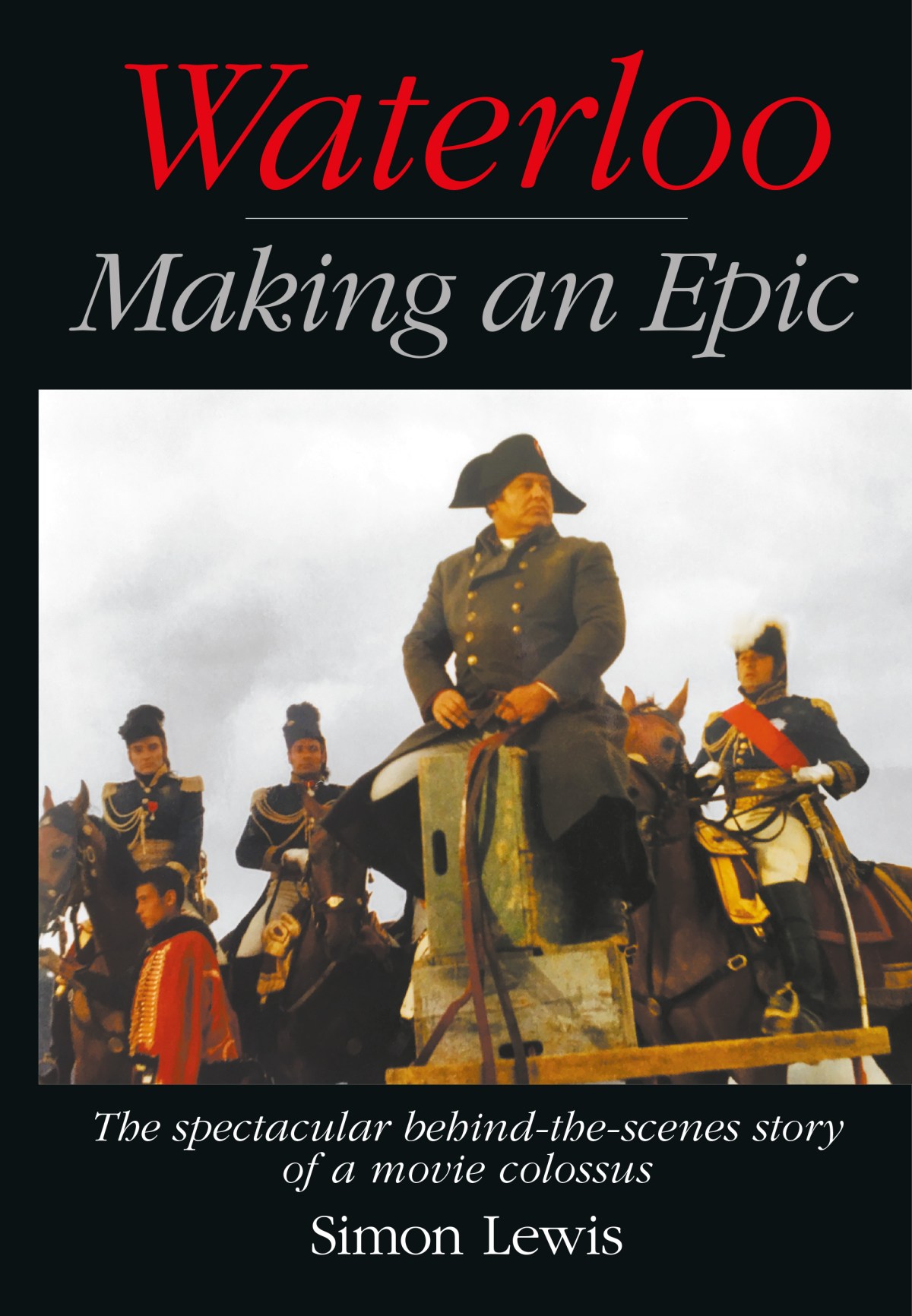
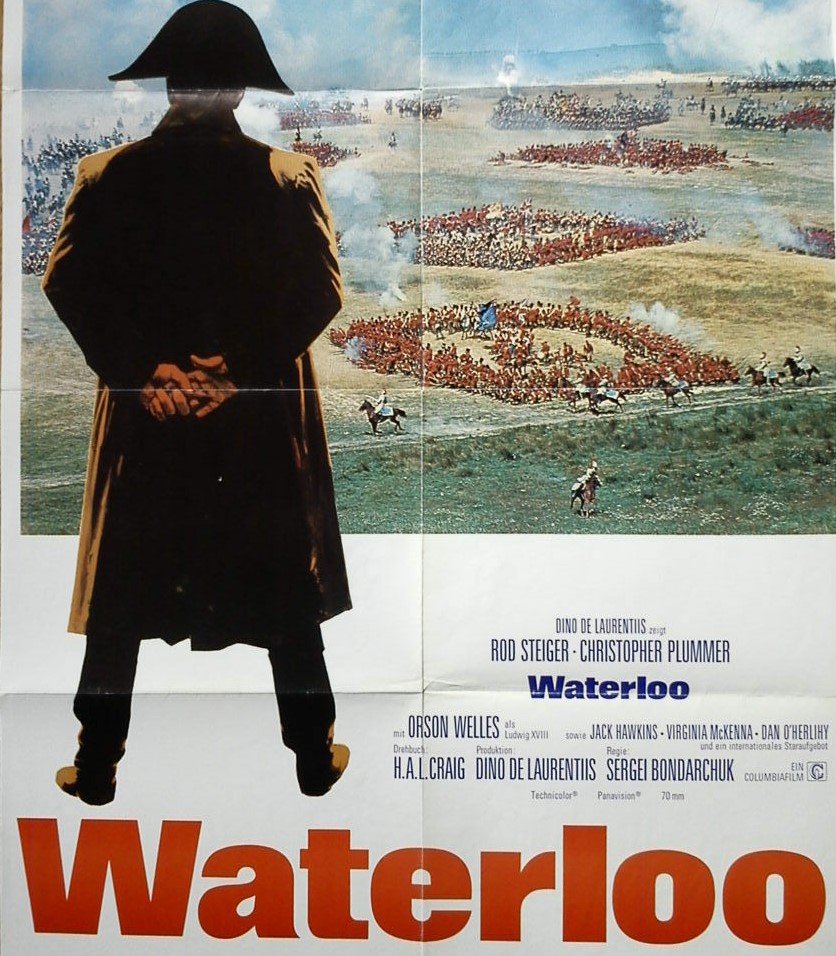
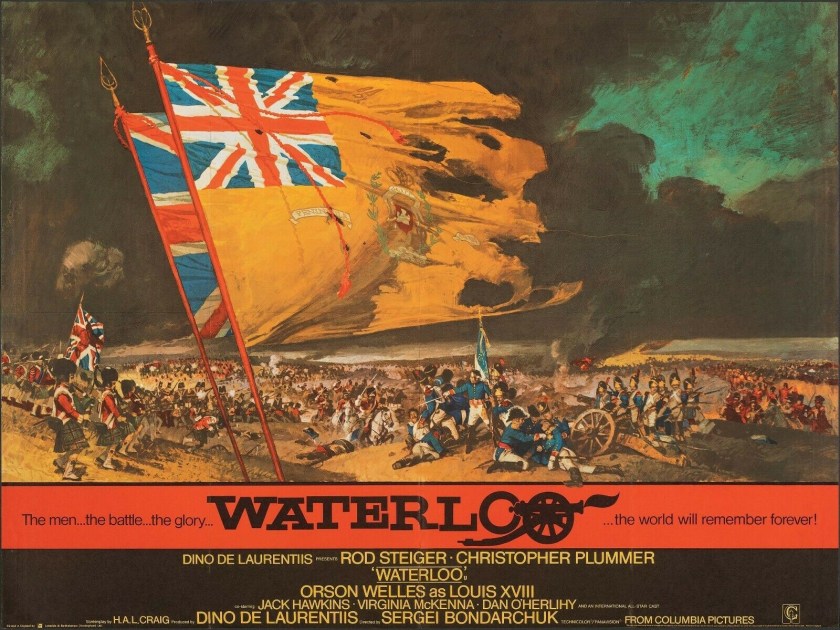
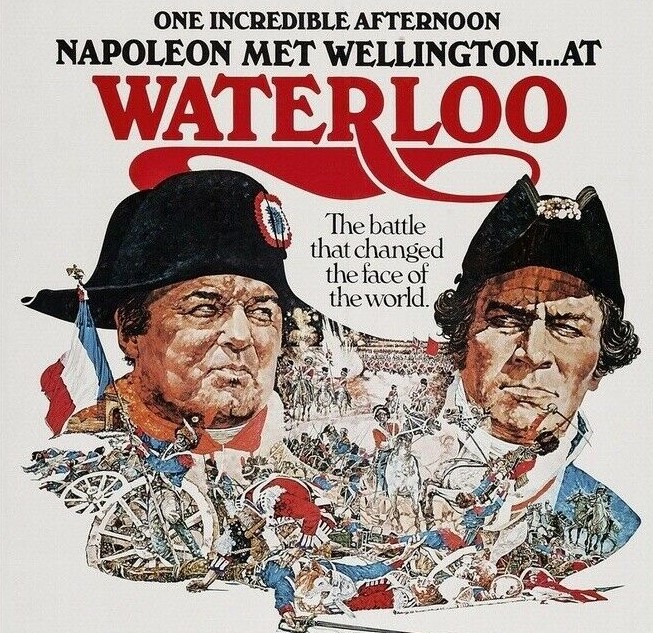
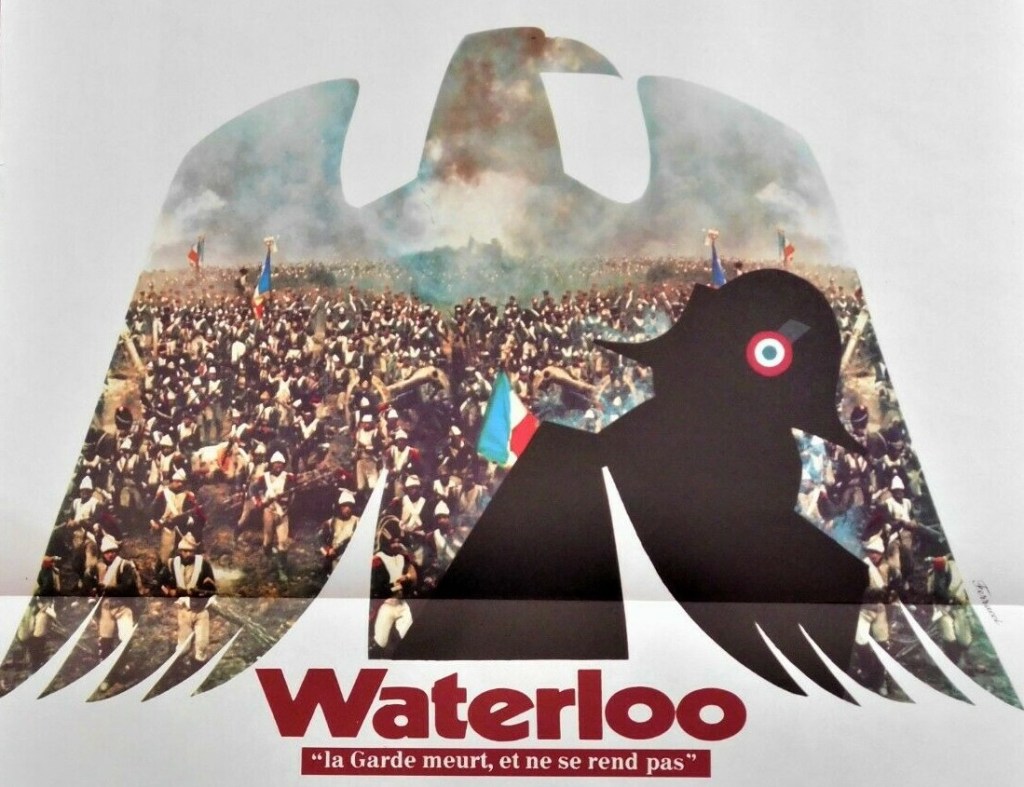
In quite extraordinary detail, author Simon Lewis discusses every aspect of the making of the film, from initial set-up to release, by way of analysis of dozens of separate scenes through to rarely discussed elements like the editing and mixing, and even the myth of the missing longer version and the importance of wooden boxes (as illustrated by the front cover). It might have helped the movie’s commercial chances, and not put too much of a dent in the ultimately massive budget of $26.1 million, if producer Dino De Laurentiis has snagged original dream team of Richard Burton (Napoleon) and Peter O’Toole (Wellington), both of whom carried much greater box office marquee than Rod Steiger and Christopher Plummer.
Burton was never really a possibility but by 1968 O’Toole was “practically set” although turning it down because he thought it would flop. John Huston, who had just completed The Bible (1966) for De Laurentiis, was original choice for director and got so far as being involved in the screenplay being written by H.A.L Craig (Anzio, 1968). When he dropped out, Gilles Pontecorvo (The Battle of Algiers, 1966) was briefly in the frame. However, a six-hour version of War and Peace (1965) put Sergei Bondarchuk in pole position.
Requiring thousands of properly trained and preferably “celluloid-seasoned” troops to carry out disciplined manoeuvres rather than extras, De Laurentiis was in negotiation with Turkey, Hungary, Yugoslavia and Bulgaria before plumping for Russia, whose production arm Mosfilm pumped in $8 million (later rising in line with budget increases). Paramount and Columbia contributed a combined $7 million with worldwide rights selling for a total of $25 million. Once filming began, Paramount chiefs Charles Bludhorn and Robert Evans, watching elements of shooting, were so taken with what they saw they wished they had invested more. Evans was reportedly “enthralled by hours of film material.” Craig’s screenplay was augmented by the director and Vittorio Bonicelli as well as uncredited contributions by Jean Anouilh (Becket, 1964), Samuel Marx and Edward O. Marsh, not to mention additions by the two main actors. Steiger pocketed $385,000, Plummer $300,000, Craig $121,000 but Anouilh only $21,000. Gordon Highlanders pipers and drummers picked up £7 a day.
Lewis is at his best when forensically examining particular scenes, for example, the Duchess of Richmond Ball which used 4,000 candles inserted into candelabras, the slightest draught causing these to melt and drip wax on performers, a carpet used to get camera shots from a very low level.
Steiger played Napoleon almost as a dead man walking, having got hold of a copy of the French Emperor’s autopsy which revealed advanced cirrhosis and gonorrhoea. Steiger and Bondarchuk met the night before to iron out ideas for the following day but Steiger was not above forcing the director’s hand by in one instance the actor removing his trousers to ensure he could only be shot in close-up. Orson Welles matched Steiger in trickery. Only hired for two days, Welles extended his employment by insisting on doing his own make-up which of course was never up to scratch and required amendment. And in terms of movie trickery, Steiger was required to sit on a wooden box on his horse to ensure he could be kept in focus. Jack Hawkins dispensed with the horse altogether – he was either atop a box or on top of stilts, as he was unsteady on an animal.
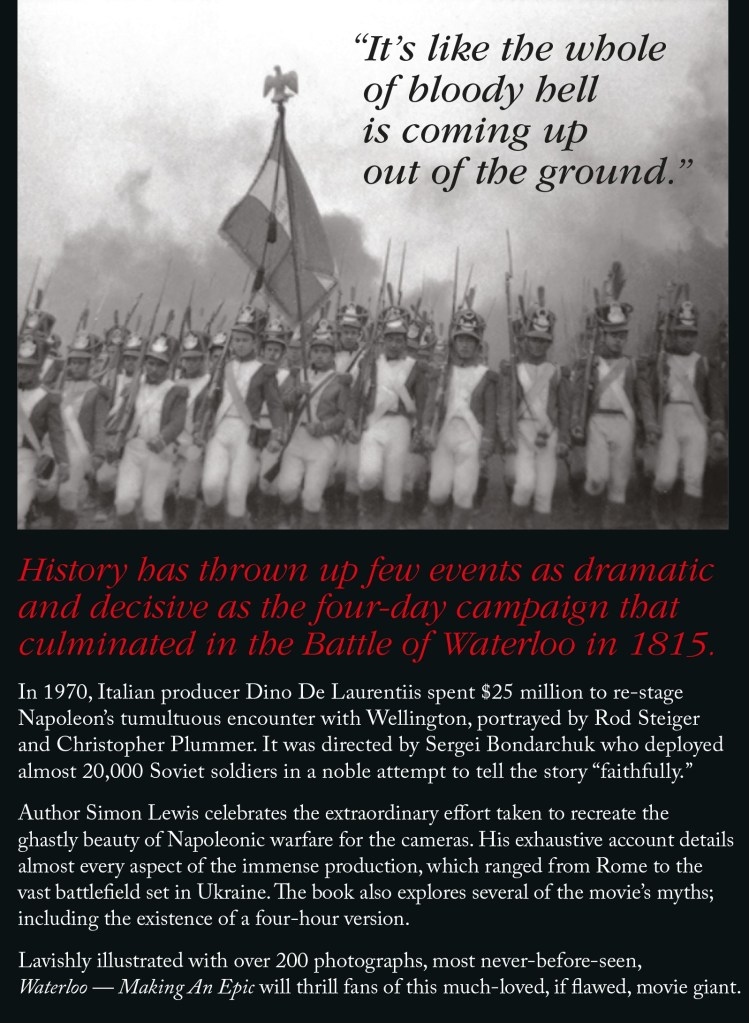
In the absence of CGI of the kind Ridley Scott could employ for his battle scenes, the real soldiers were occasionally augmented by mannequins. Five thousand were made, two real soldiers at either end of a row held eight mannequins in place by the use of a single wooden plank which “allowed all regiments to march forward.” Among the many wonderful candid pictures in this lavishly illustrated tome – 200 photographs, many never seen before – is one of three girls staring at the mannequins as well as photos of Steiger and Hawkins on their boxes.
The Waterloo battlefield had one of the biggest sets ever built. A total of 17,000 soldiers, mostly from Siberia and including 2,000 cavalry, lived in a tented city a mile away. Steiger noted: “It would have taken assistant directors three days to put untrained men, mere extras, into position. When they broke for lunch it would be another three days to arrange them again. These guys are superb.” Real soldiers working with their actual commanders was the difference between waste and superb. Having a general in charge of the troops often created issues. Bondarchuk would select the horses he wanted based on the effect he wished to achieve with the light, demands often obstructed by the commander if it meant the chosen horses had not been properly fed. “I will order soldiers – but how do I order animals?” was the dry comment from the army chief. .
Although the battlefield was primarily authentic – mud for one scene created by pumping two days’ worth of water into the soil before cavalry churned up the area – there were occasions when filming conformed to the Hollywood norm. “The use of fiery explosions had been cinematic shorthand for battle scenes long before Waterloo” when in reality these would be minimal. “Most ammunition that was fired comprised large iron balls and so low was its speed it was possible to watch their progress.”
The famous charge of the Scots Greys was described thus in the script: “they came straight into camera – like centaurs in their magnificence.” The sight of 350 Arabian mounts travelling at breakneck speed was captured by use of a specially constructed railway powered by a diesel locomotive. Five cameras were sited in different positions on the train. The famous slow-motion effect – possibly the most exhilarating moment in the picture – was achieved by over-cranking the camera at 100 frames per second which slowed down what you saw by a factor of four.
Perhaps the best reveal regarding movie trickery was the moon above Wellington as he rode past the carnage. It comprised “special silver paper for front projection – 3M – like shark skin. You put one light on it and it reflects ten times brighter.” The moon was shown as one quarter less than full since the effect of a full moon would be harder to carry off. “Blue ink made some spots as moon craters.” The fake moon was suspended with one wire on top and two left and right to prevent it from moving, then one light was projected onto it.
Back cover of the book.
Lewis rebuts the myth of the missing longer version. He reckons this probably came about because over 300,000 feet of film – 55 hours – was shot and the first rough cut was five hours long. The final cut was 133 minutes – not much longer than if you had worked out the length by counting the pages of the screenplay – and release cuts varied because, for example, the British censors cut out 28 seconds of horse falls and the ending includes 50 seconds of music over the credits. It was never shown with the intermission which was de rigeur at the time for longer roadshows and would have, artificially, inflated the running time. There was some confusion over the final print because a novelisation by Frederick E. Smith included some scenes that didn’t make it into the final print, and Smith’s book, written of necessity before the film appeared, would have used as its main reference tool the screenplay. But Lewis spends a whole chapter explaining why a longer cut never existed.
The world premiere was held on 26 October 1970 in London where the movie released as a roadshow (i.e. separate performances) was a huge success. It ran for a few weeks short of an entire year in the London West End, breaking box office records at the Odeon Leicester Square and the Metropole where it opened on December 3rd, 1970, before shifting to the Columbia on June 17, 1971, and then a final week at the Odeon Kensington from September 30 1971. But audience appeal in the United States was at the other end of the spectrum. It went from a strong opening week of $25,436 at the Criterion in New York to just $1,775 in its fourth week, and nationwide racked up only $1.4 million in rentals (the studio share of the box office). It was derided in France in part because the film was about the defeat of a legend and the French could not come to terms with the idea that it was directed by a Russian.
Where most “making of” books concentrate on the stars and the director, Lewis goes into fantastic detail about all aspects of the production, the chapter on editing and mixing an education in itself. There’s a chapter on how historically accurate the film actually was. The author was helped by the discovery of a diary kept during production by actor Richard Heffer who played the small part Mercer. But Lewis also managed to make contact with Dino De Laurentiis’s daughters, Raffaella and Veronica, and around two dozen people connected with the film in some way, and clearly examined every scrap of information available on the picture. The Notes are another mine of information.
Even if the film is not at the top of your must-watch list, this book should go to the top of your must-read list.
Waterloo, The Making of An Epic, The Spectacular Behind-the-Scenes Story of a Movie Colossus by Simon Lewis is published by Bear Manor Media, 534 pages, illustrated (B&W), Hardback, Paperback & Ebook, ISBN 978-1-62933-832-3 .
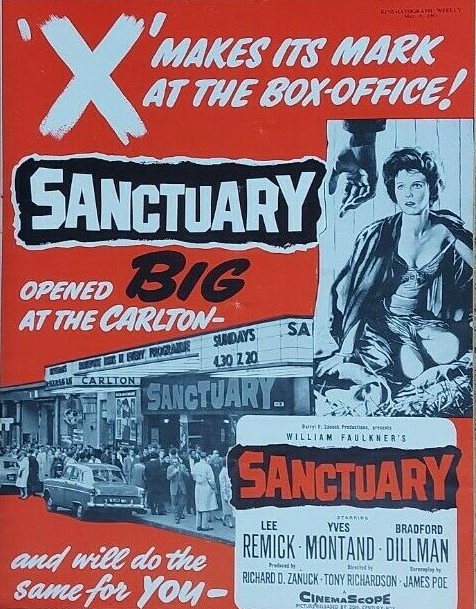
This overheated melodrama stands as a classic example of Hollywood’s offensive attitudes to women. Nobel prize-winning author William Faulkner could hardly blame the movies for sensationalising his misogynistic source material since if anything the movie took a softer line. Told primarily in flashback as headstrong southern belle Temple Drake (Lee Remick) attempts to mitigate the death sentence passed on her maid Nancy (Odetta). Given that such appeals are directed at Drake’s Governor father (Howard St John), and that the maid has been condemned for murdering Drake’s infant child, that’s a whole lot of story to swallow.
Worse is to follow. Drake takes up with Prohibition bootlegger Candy Man (Yves Montand) after being raped by him and thereafter appears happy to live with him in a New Orleans brothel – the “sanctuary,” no irony intended, of the title – despite him slapping her around. The film steers clear of turning her into the prostitute of the original book, but pretty much sets up the notion that high class women will fall for a low-class tough guy whose virility is demonstrated by his brutality. In other words a “real man” rather than the dilettantes she has previously rejected.
After the Candy Man dies, Drake returns home and marries wealthy suitor Gowan Stevens (Bradford Dillman) who blames himself, rightly, for Drake falling into the clutches of the gangster in the first place. But a past threatening to engulf her precipitates the infanticide.
Faulkner was a Hollywood insider, adapting Sanctuary for The Story of Temple Drake (1933) and earning high praise for his work on Bogart vehicles To Have and Have Not (1944) and The Big Sleep (1946). The success of The Tarnished Angels (1957) starring Rock Hudson, The Long, Hot Summer (1958) with Paul Newman and The Sound and the Fury (1959) headlined by Yul Brynner had sent his cachet rocketing. But all three were directed by Americans – Douglas Sirk and Martin Ritt – who had a distinctive visual style and an ear for what made melodrama work.
Sanctuary had been handed to British director Tony Richardson (Look Back in Anger, 1959) and he didn’t quite understand how to make the best of the difficult project. So while Lee Remick manages to suggest both strength and fragility, and makes her character’s wanton despair believable, Yves Montand is miscast and Bradford Dillman fails to convince even though portraying a weak character. Too many of the smaller roles appear as cliches. And it’s hard to believe the maid’s motivation in turning murderer. Watch out for Strother Martin (Cool Hand Luke, 1967).
What was acceptable steamy melodrama in the 1930s fails to click three decades on. Faulkner’s thesis that high-falutin’ women want a man to master them and furthermore will fall in love with their rapist seems to lack any understanding of the female mind and will not appeal any more to the modern sensibility than it did on release. Lee Remick is what holds the picture together, in part because she plays so well the role of a woman embracing degradation, and refusing – no matter how insane the idea appears – to let go of the man she believes is the love of her life. It’s not Fifty Shades of Grey, but it’s not that far off that kind of fantasy figure, and given the success of that book, it’s entirely possible there is a market for what Faulkner has to peddle.
Not easy to find. This is actually on YouTube if you go onto that channel and search. Strangely enough, if I post a link, it says it is no longer playing there – but just as strangely if you go looking you will find it.
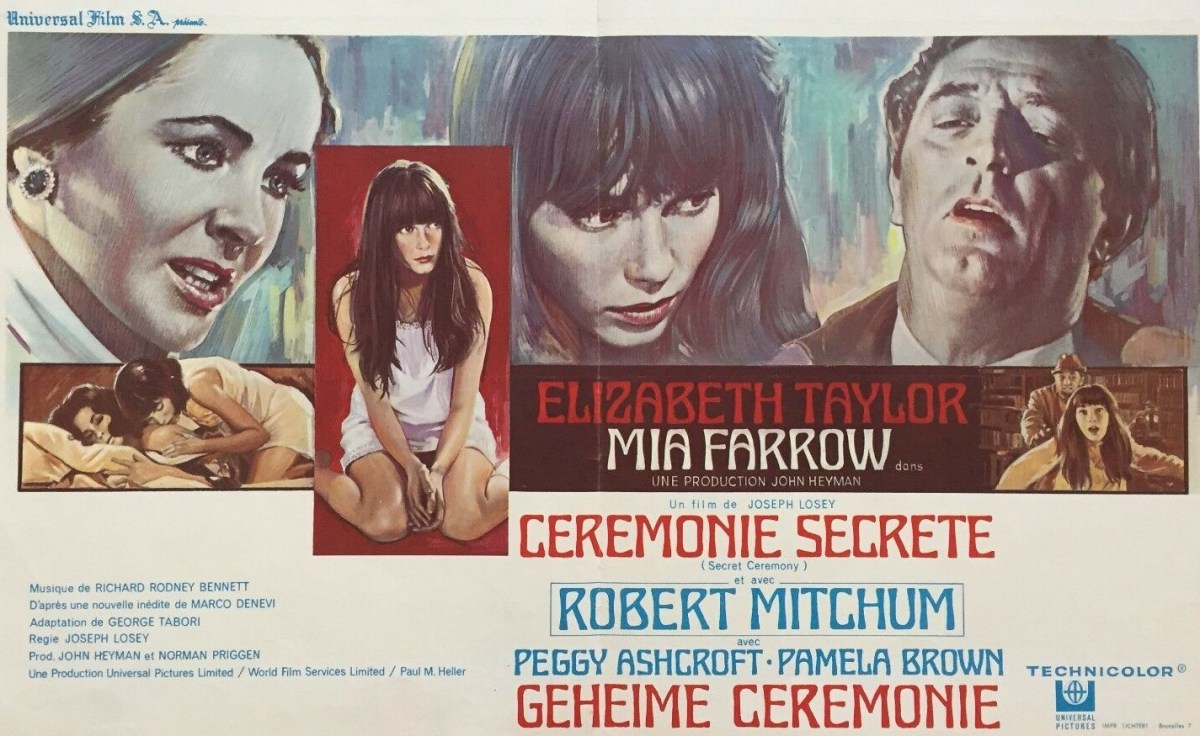
I was probably as surprised as anyone to discover that far from being a flop, Secret Ceremony was in fact a hit, taking $3 million in rentals in the U.S., ranking among the Top 20 foreign movies at the French box office, and hitting the target in Italy, Germany and Australia. Yet, outside of France, it was universally derided by the critics.
Joseph Losey (The Servant, 1964) held the unusual position of being a cult director working in Britain. He was the “object of a vociferous cult….his following grown in scope and size with each new film” and, conversely, as his popularity among the arthouse fraternity increased, he attracted more critical ire. Courting popularity by entering the spy genre with Modesty Blaise (1966) and linking up with the Elizabeth Taylor/Richard Burton box office colossus for Boom! (1967) seemed to go against the critical grain. Losey ascribed the critical coruscation Boom! received as less to do with the merits of the film itself than “people using the opportunity to launch personal attacks on the Burtons.”
Boom! had been packaged John Heyman, who coupled acting as agent for Burton and Taylor with being the producer, not necessarily a good combination. Universal was convinced it had “Virginia Woolf in color,” a reference to the previous enormous hit, although the box office told a different story. Jay Kanter, Universal’s London production chief who greenlit the project, commented: “When the Burtons were involved a lot of my judgement was colored by the magnitude of the star she (Taylor) was considered to be.”
So it was something of a surprise to find Losey and Taylor teaming up again for Secret Ceremony. Of course, it may have been the money, Taylor at this point still holding out for a million-dollar purse. Heyman said, “We were regarded as whizz-kids just for making two consecutive films with Elizabeth Taylor and bringing them in under budget.”
Losey’s world reflects a “highly selective form of naturalism.” Except for Accident (1966), from Sleeping Tiger (1954) through to Secret Ceremony, Losey worked with the same design consultant/production designer Richard MacDonald whom the director treated as a sounding board, to “test (ideas) and reject them in the telling.” This is a director for whom “patterned exoticism is extraordinarily precise.” A more important collaborator had been playwright Harold Pinter who had fashioned The Servant (1963) and Accident, bringing to both films his distinctive ear for dialogue. He was hardly required for Boom! whose screenwriter was the even more famous playwright Tennessee Williams (A Streetcar Named Desire, 1951) and for Secret Ceremony Losey went elsewhere for his screenwriter.
Losey was among the string of American talent who taken refuge in Britain in the wake of the anti-Communist hysteria of the late 1940s/early 1950s – others included producer Carl Foreman (The Guns of Navarone, 1961), and directors Cy Enfield (Sands of the Kalahari, 1966) and Edward Dmytryk (Mirage, 1965). By the time of Secret Ceremony, Losey had been working in Britain for nearly a quarter of a century and established himself as a director of distinctive vision, a critical fave in his adopted homeland, wildly appreciated by the French, with an occasional box office home run.
But although regarded as a British film-maker, Losey made Secret Ceremony – and Boom! for that matter – exclusively with Hollywood money, the budget 100 per cent supplied by Universal, that studio having decided that anything coming out of Britain would appeal to younger audiences. There was an untapped pool of talent available in British television who could be hired for substantially less than their U.S. counterparts. In three years Universal’s London production unit, headed by Jay Kanter, spent $30 million on a dozen projects. The biggest budget was allocated to Boom! with $3.9 million followed by $3.5 million to The Countess from Hong Kong (1967) starring Marlon Brando and Sophia Loren. The Night of the Following Day (1968) cost $1.5 million as did Fahrenheit 451 (1967) and Three into Two Won’t Go (1968). Secret Ceremony came in at $2.45 million.
Robert Mitchum and Joseph Losey went way back to a time in Hollywood when both were working their way up the RKO ladder. As well as Losey, Mitchum had been friends with many who would fall foul of the blacklist including screenwriter Dalton Trumbo, Dmytryk and Howard Koch (Casablanca, 1942). When Mitchum’s dalliance with drugs brought him a jail sentence, Losey visited him and brought him chilli from a famed restaurant.
Mitchum was recommended for the role in Secret Ceremony by Roddy McDowell, a friend of Taylor, who had been working with the actor on Henry Hathaway western Five Card Stud (1968). Mitchum received the job offer while on holiday in Mexico. For two weeks’ work he would earn $150,000. The role itself was scarcely onerous, drawing on aspects of the loathsome character he had created for Night of the Hunter (1955), but it did require an English accent of some kind and to his amusement Mitchum found himself on the telephone, like a salesman listing available product, going through the variety of accents he bring to the part.
Whether it was almost having to sell himself to the director or some previous incident, Mitchum and Losey did not resume their friendship. In fact, their relationship was the polar opposite. “He was very unpleasant,” recalled the director, “it was extremely hard for me to work with him.” Losey never found the source of Mitchum’s contempt. “In some curious way I must have made some mistake with him; I don’t know what it was.” Even attempts to recall Mitchum’s collaboration with Charles Laughton on Night of the Hunter failed to break the ice. Losey believed that Mitchum played tough to mask “an intense sense of failure.”
Mitchum wasn’t above sneaking away from the set. On one occasion taking himself off to visit old friend Robert Parrish, he knocked back some tequila and complained about the movie. On the Holland section of the shoot, Mitchum got into a food fight with a hotel diner. In the end, Losey was so disturbed by Mitchum that he was grateful when he departed as per contract despite the fact that some scenes had not been shot, including, according to the actor, the bathtub sequence, which would have accentuated the incest theme rather than the hint of lesbianism. Mitchum’s epitaph to the movie was that he talked Mia Farrow out of True Grit (1969) claiming Hathaway was a terror to work with.
The bath scene turned out to be the cause of some marital anguish. The set was cleared for its shooting of the scene after Taylor froze on emerging from her dressing room to see so many people gathered. But this was hardly Taylor at her beautiful best as she had been gaining weight. Even so Losey filmed her at times as though she was the grand Hollywood star with hair framing her face and the camera glimpsing her cleavage, but at other times her weight was a source of determining her character, when she eats with her mouth full and belches.
Halfway through filming Taylor was afflicted by severe physical pain and she was rushed to hospital for a hysterectomy, an operation that lasted over three and a half hours. Complications followed the surgery and she was given drugs that caused her to hallucinate. Writing in his diaries, Richard Burton noted: “This is the first time I’ve seen a loved one in screaming agony for two days, hallucinated by drugs, sometimes knowing who I was and sometimes not, a virago one minute, an angel the next.” She went from commanding him to leave the room to crying out for him to return. Sometimes she believed she was on board their yacht, other times that a film was playing on the switched-off television set.
The loss of her uterus may have affected her performance since in the film she plays a mother who has lost a child and in reality was a woman who had lost the ability to have another child.
The film exacerbated the tensions in the Burton-Taylor marriage. It was usually Taylor who was the one who had to keep a watchful eye on her partner in case he strayed. In this case, ironically, it was Burton who exhibited the jealous streak. The way Losey had whispered in the actress’s ear to build up her confidence during the bath scene while getting rid of extraneous crew found its way back to Burton who misinterpreted the action as intimacy. “My wife and Joe Losey are having a professional love affair,” he claimed. He spent a lot more time than usual on the set of his wife’s film. He even offered to take on the Mitchum role.
Losey had long been fascinated by a strange-looking house in West Kensington, London, and managed to hire it for the shoot. Debenham House in Addison Road, between Holland Park Avenue and High St Kensington, is one of a handful of truly Gothic London buildings. The church used was in Little Venice, St Mary Magdalene in Rowington Close, also in London, and the antique shop was located at the corner of St Stephen’s Mews and Westbourne Green. When the production shifted to Holland it was to the coastal town of Noordwjik with use made of the Grand Hotel there.
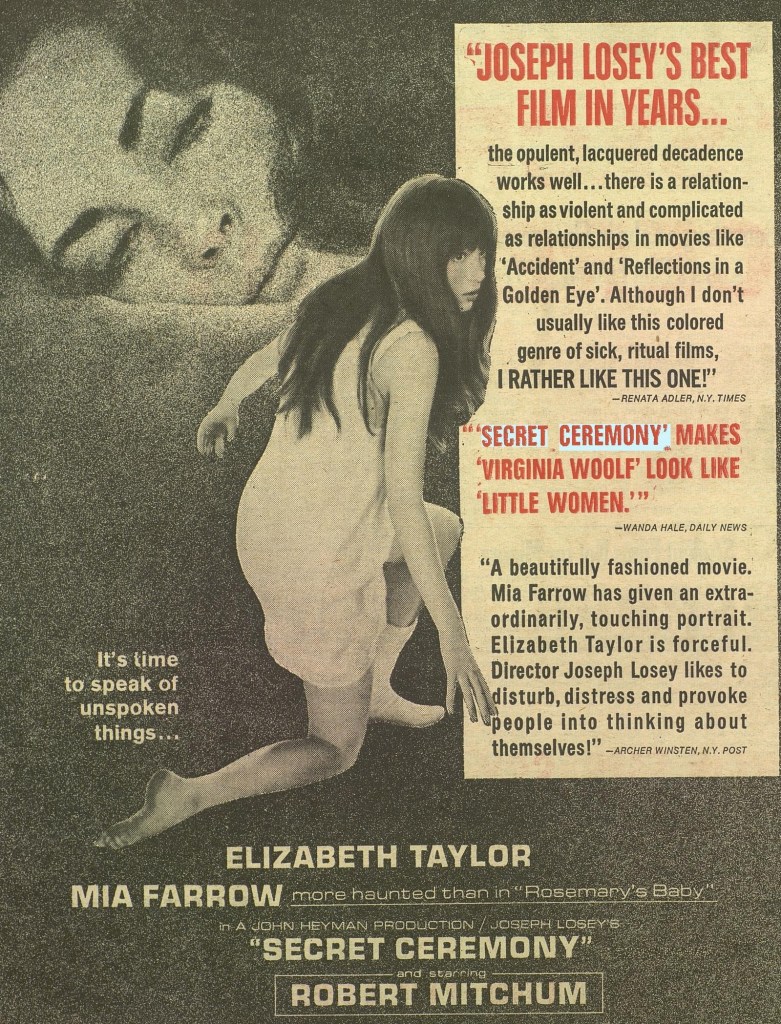
By the time the film opened, Taylor found herself in the middle of a storm over foul language (“gutter talk” in Variety parlance) for which she was seen as the “chief exponent.” It was an ironic position for Taylor to find herself in given her expletive-ridden performance in Who’s Afraid of Virginia Woolf (1966) had not only been critically acclaimed and a huge box office hit but seen as helping to break down the censorship barriers. However, it appeared that the “urination expression” and a word that was prefixed by “bull” were beyond the pale and Variety proclaimed that it was “evidently assumed that if a star of her (Taylor’s) magnitude can be gotten to speak the words, everyone else – actors, actresses, distributors, exhibitors and the public – will be accustomed to strong lingo in pix.” It was hardly coincidence that on the same day that this article was the leading story on the trade paper’s front page that inside six out of seven New York critics gave Secret Ceremony a drubbing, the exception being Renata Adler of the New York Times who called it Losey’s “best film in years.”
Even producer Heyman had his doubts about the material. “It should have been the story of two people who need and trust each other,” he said, “until one leans on the other a little bit more than she should. Unfortunately, the kind of sympathy which Losey shows for people in real life was absent from the relationship which is what I think made it unacceptable.” He summed up, “A cold picture.” (This has the taint of someone trying to work out why the film was a critical failure because otherwise I think Heyman got it exactly right for the movie I saw I did not view as cold nor unacceptable.)
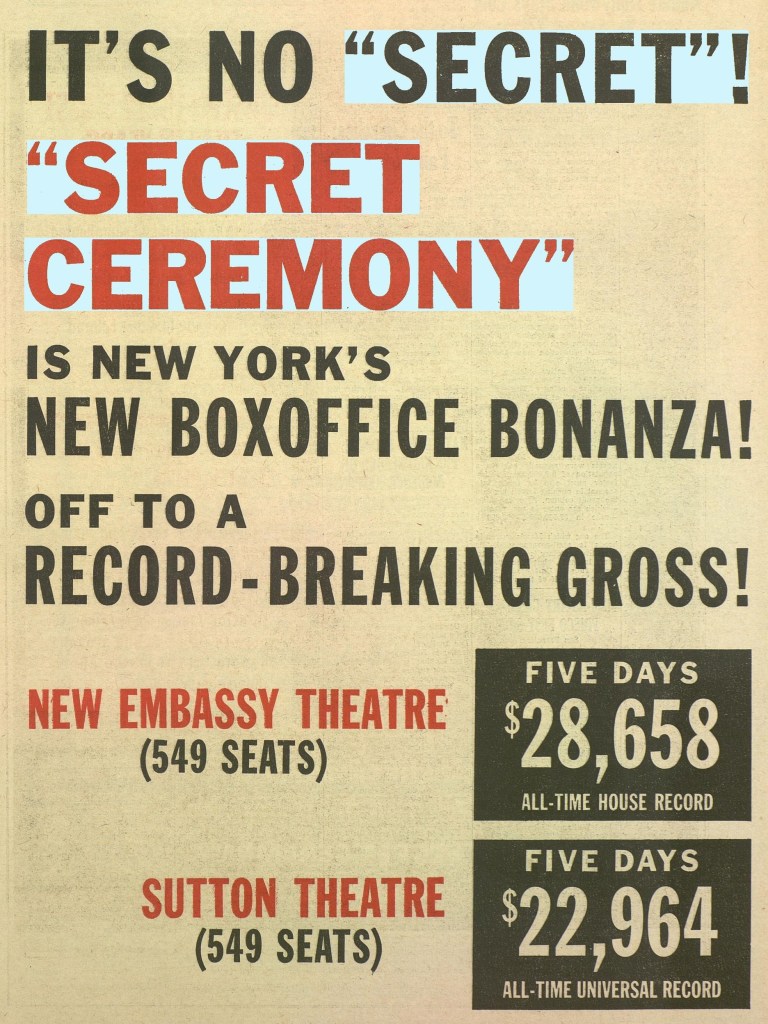
And neither, strangely enough, did the public. Although making a poor showing in Britain, it was not a box office disaster. That was averted by astute marketing, the potency of the stars and a public who, not for the first time, ignored the critics. The movie broke records when it opened at the New York arthouse pair, the Sutton and the New Embassy, and further afield in cities like Dallas. Arthouse success would have been anticipated but nobody would have expected that when it went wide in New York the second week improved upon the first. As well as a decent showing in the States, it hit the ground running around the world, and “ought to be credited” as one of Universal’s “most successful pictures from either domestic or foreign source.” In the French box office rankings, it placed above The Detective (1968) and Hang ‘Em High (1968) and just below The Thomas Crown Affair (1968). Acclaimed by that country’s critics, the Academie du Cinema named it best foreign film with Taylor and Farrow taking the gongs for best foreign actresses.
When Universal sold the movie to television for $1.25 million, a fee which certainly provided the picture with a decent extra profit margin, fourteen minutes were cut out and replaced by a 500 lines of extra dialog and a filmed discussion of the psychological issues raised, prompting Losey to demand his name be removed, claiming it “exactly reversed the meaning an intention of my film.”
SOURCES: Lee Server, Robert Mitchum, Baby I Don’t Care, (Faber and Faber, 2001) p169, 232, 509-512; Sam Kashner & Nancy Schoenberger, Furious Love, (JR Books, 2011)p240, 242-243,2; Alexander Walker, Hollywood England, (Orion Books, 2005) p200, 345, 354-257; “Screen: Secret Ceremony,” New York Times, October 26, 1968; “Joseph Losey Following Has Grown,” Box Office, October 28, 1968, pE1; “No End to Gutter Talk,” Variety, October 30, 1968, p1; “N.Y. Critics This Week: Ouch,” Variety, October 30, 1968, p12; “Secret Ceremony Sets House Mark at Sutton, New Embassy,” Box Office, November 4, 1968, pE2; “Secret Ceremony Setting New Records in Dallas,” Box Office, January 13, 1969, pSW1; “This Week’s N.Y. Showcases,” Variety, February 5, 1969, p9; “Jay Kanter,” Variety, February 26, 1969, p78; “Kanter No Martyr,” Variety, March 19, 1969, p26; “Ceremony, Z Nab Kudos,” Variety, May 7, 1969, p107; “French Filmgoing,” Variety, January 28, 1970, P27; “Paris First Runs,” Variety, April 29, 1970, p76; “Losey Wants His Credit Blipped from Vidversion of U’s Secret Ceremony,” Variety, September 16, 1970, p70; “All-Time Film Rental Champs,” Variety, October 15, 1990, pM184.
Trade magazine Variety’s innovative weekly Top 50 based on grosses that had begun in April 1969 changed the way exhibitors regarded box office. Instead of waiting till the appearance of the magazine’s year-end round-up which was limited to around the top 100 movies, cinema owners now got a week-by-week snapshot of how new movies were playing. All box office figures had previously concentrated on the big movies of the day – the roadshows and pictures with big stars – that opened at the first run city center houses that were easier for Variety to track. The switch to a computerized system made it more feasible to examine the takings from hundreds of cinemas not necessarily showing the big movies sucking up all the publicity oxygen.
An examination of the films hitting the coveted number one position in the weekly chart illuminated the changes in the business. For a start, to reach number one a movie had to be showing on over 30 cinemas, but this could rise to 100-plus, and began to show the benefits of the wider first run release. This was also really the beginning of the per-screen average. High figures could be achieved by recruiting a large number of screens but exhibitors could easily disseminate the information and decide whether the number of screens massaged the figures or showed how successful a film really was. And this was the start of another promotional ploy, the business of a movie holding onto to the top spot for a second, third or even fourth week, proof a movie had “legs.”
The Year’s weekly Top Ten performers make interesting reading. The biggest figures posted in any one week during 1969 were for On Her Majesty’s Secret Service which hauled in a massive $1.22 million (equivalent to $9.6 million today) from 99 screens – a $12,323 screen average. This was followed by Goodbye, Columbus with $935,000 from 65 screens, a higher screen average of $14,384. Next came The Love Bug with $724,000 from 76 houses ($9,526 average). Another week of Goodbye, Columbus shouldered $681,000 from 60 ($11,350).
The Love Bug had a further two weeks at the top, pinching $658,000 from 117 ($5,623) and $633,000 from 44 ($14,386). Seventh-best week was taken by The Killing of Sister George with $621,000 from 70 ($8,871). Snatching eighth spot was Fanny Hill with $625,000 from 49 ($12,755). Ninth was Krakatoa, East of Java with $621,000 from 68 ($9,132). Last place in the top ten went to I Am Curious, Yellow with $594,000 from 52 ($11,423).
From the exhibitor perspective there were two notable points. The first was the per-screen average. Secondly, cinema bookers could not fail to notice not only that two of the top ten in weekly gross and three of the top five films in terms of screen averages went to sexploitation pictures.
It was soon abundantly clear that producers could sell their pictures to sometimes doubting exhibitors by the simple process, not so much of bombarding them with adverts and Pressbooks extolling a film’s potential, but of getting a movie into sufficient theatres for the box office figures to tell their own story.
Although the other big films expected to top the weekly chart did achieve that aim – among them True Grit (twice), Butch Cassidy and the Sundance Kid (also twice), Ice Station Zebra, Easy Rider (three times), Midnight Cowboy, Oliver! and Paint Your Wagon – there were as many unfancied movies perching atop the weekly pile.
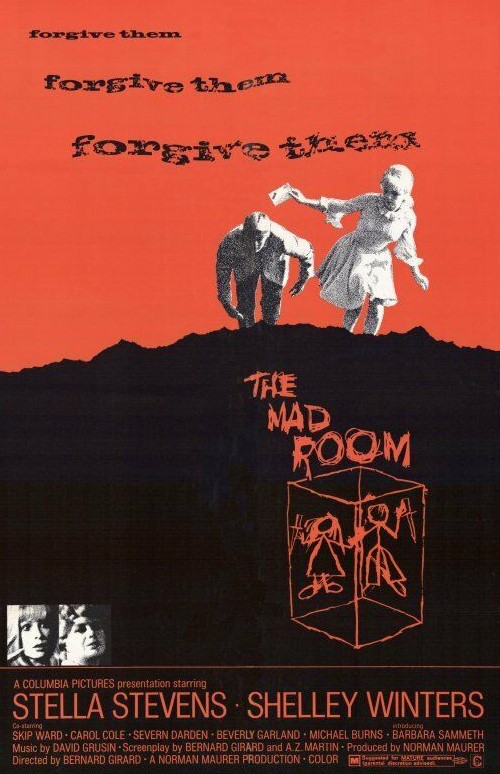
Apart from the sexploitation films and The Killing of Sister George, others holding down the number one spot for a week were British star Carol White in Mark Robson thriller Daddy’s Gone A-Hunting ($544,000 from 71), What Ever Happened to Aunt Alice ($540,000 from 48), Gordon Parks’ bittersweet drama The Learning Tree ($401,000 from 49), Stella Stevens and Shelley Winters in horror film The Mad Room ($283,000 from 38) and reissues Bonnie and Clyde/Bullitt ($546,000 from 81) and The Longest Day ($501,000 from 76).
Distributors of low-budget pictures used to have to take ads out in the trades to prove to potential customers that their movies were pulling in decent business. Now they had better proof, from the most important source of all, Variety, whose box office figures were scanned by every cinema manager in the country. Once a week without a distributor putting a hand in their advertising pocket there was all the promotional evidence they needed.
This was the second sea change in the way cinema owners perceived the business, the first being the opening up of the collection of box office figures through Variety’s annual report on upwards of 1,000 titles. To have figures at your finger tips for the price of a subscription to a newspaper was a game changer.
But there was yet another game changer to come.
SOURCES: The Top 50 Grossers chart appearing weekly in Variety from April to December 1969.
Screenwriters Ben Maddow and Mitch Lindemann earned their keep on this one. The source was a literate historical novel by A.B. Guthrie which, despite winning the Pulitzer Prize, was seen primarily as a western. In considerable detail, it covered what a wagon train heading to Oregon needed to do and know in order to make the 2,000-mile trip. It is a fascinating read, told from many points of view. But very little of the book found its way into the film.
It wouldn’t have been much of a film if the screenwriters had simply followed the book structure, for much of that was internalized, thoughts and feelings of the settlers, dramatic incident not so much. So if this was going to be a big-budget western it needed a lot more.
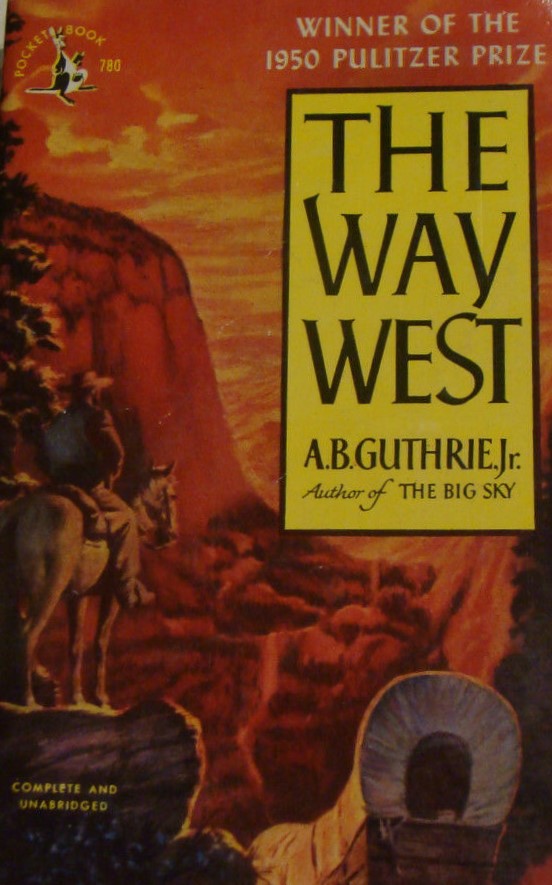
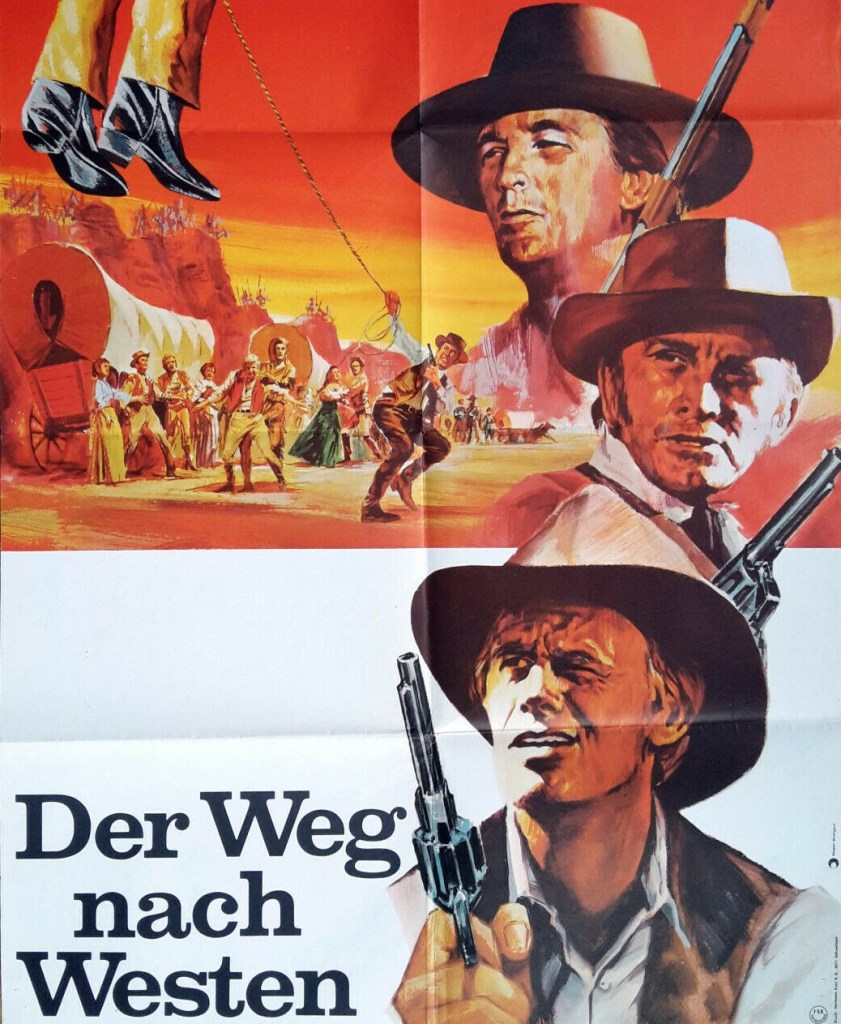
The paperback was sold as a western not as a novel of literary merit so it was inevitable that the Native Americans who played a minor role in the book took center stage on the book cover to target the expected audience.
What isn’t in the book: Tadlock (Kirk Douglas) isn’t a Senator for a start, he’s not a widow and doesn’t have a child. He’s not a visionary either with some grandiose map of how he envisages the town he’ll build. He doesn’t hang a man, get a whipping or die falling over a cliff. He’s quit the wagon train long before the cliff section. And he stopped being the leader of the expedition less than halfway through the book.
What isn’t in the book: Evans (Richard Widmark) isn’t overfond of alcohol, doesn’t create an unforced halt in order to celebrate Independence Days several days too soon, doesn’t have a grandfather clock whose loss causes him to lose his rag with Tadlock, in fact it’s he who picks the fight after discovering Tadlock intends to hang a thieving Native American.
What isn’t in the book: Dick Summers (Robert Mitchum) isn’t losing his eyesight, though recently widowed his wife wasn’t a Native American, and he doesn’t have a lucky necklace to pass on to a young man or woman.
So there’s a whole passel of wonder right there. The screenwriters have instantly dramatized all three leading characters by providing them with different attributes, making Tadlock and Summers more sympathetic than in the book, rendering Evans less sympathetic. The problem with the book’s Summers is that what makes him interesting is his lore, his knowledge of everything to do with the West, little of which translates to the screen. So providing the toughest of them all with an impediment allows him an immediate story arc.
What isn’t in the book: a Native American child is not killed by a settler, there’s no settler hanged by Tadlock to placate the warring tribe. There’s no warring tribe. There’s no race with other wagon trains at the outset and no racing across a river to get ahead of a rival. There’s no stowaway preacher either, though there is a preacher (Jack Elam). There is only one stop along the way in the film, at Fort Hall, but two in the book, the other being Laramie.
What isn’t in the book, I’m sorry to say, is the wonderful sequence of lowering wagons down a cliff, and Brownie (Michael McGreevy) marries Mercy (Sally Field) because otherwise she’s going to leave the wagon train at Fort Hall and he doesn’t make a pledge in public that her unborn child is his. And there’s no part for Stubby Kaye.
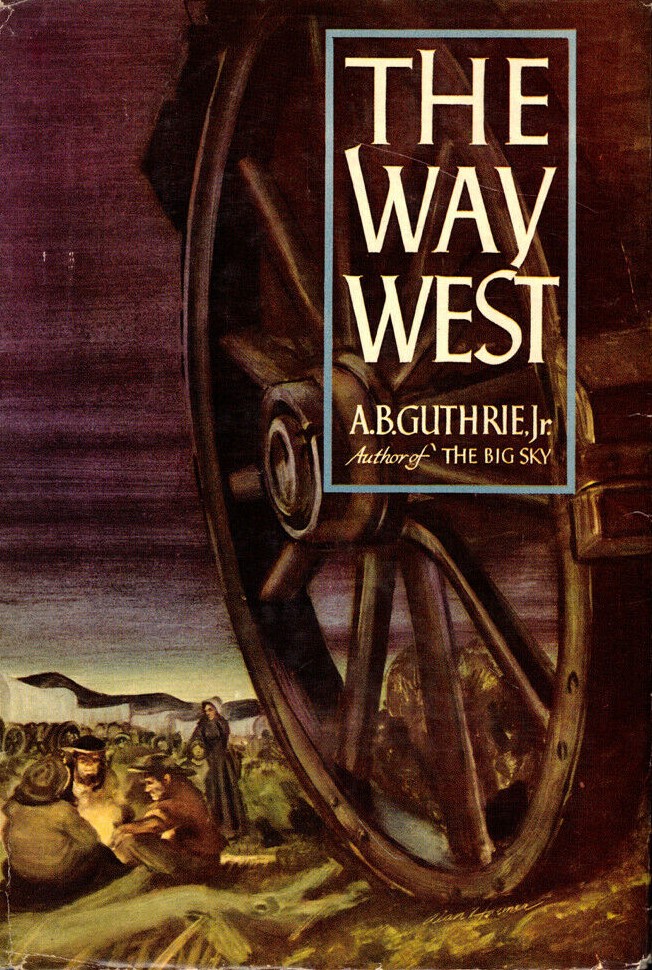
This hardback cover gives far better representation of the novel’s content.
Some of the more solid emotional material is retained. The frigidity of Mrs Mack (Katherine Justice) remains, giving her husband (Michael Witney) the excuse to seduce Mercy, considerably more innocent in the book, where she is described not as sassy but awkward in adult company, “growed up in body and not in knowing.” While not loving Brownie, she marries him for convenience, though she learns to love him. Brownie gets advice on handling Mercy from Summers and much of that dialog is imported straight from the book.
From the book comes the idea of the settlers chiseling their names on the rock, of Brownie, while doing so, being captured by Native Americans and being traded back to his father.
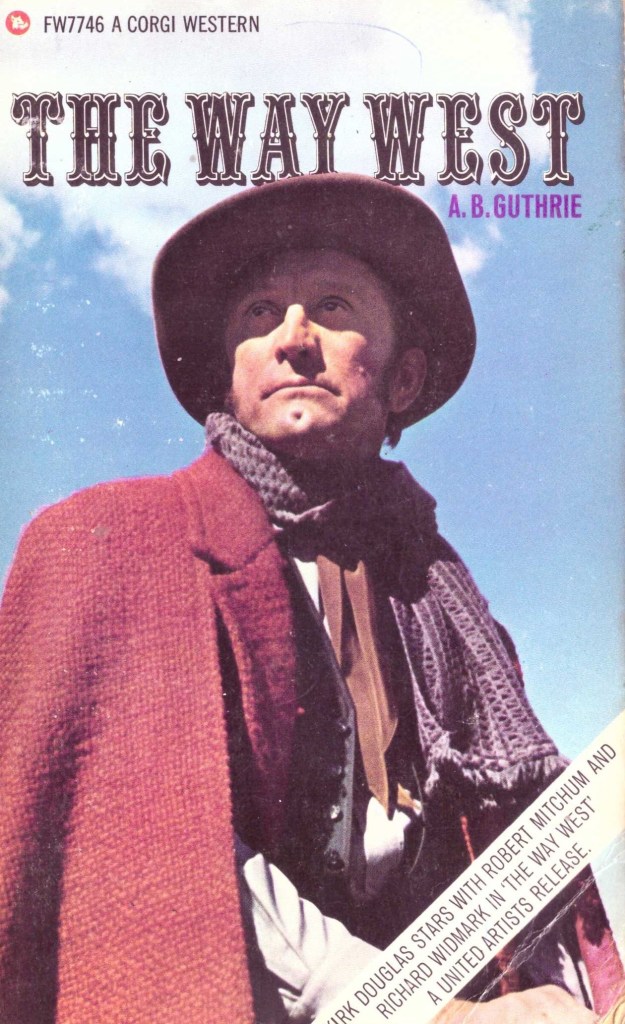
Cover of the British Corgi movie tie-in paperback printed in 1967.
But there are some ideas lifted from the book out of sequence that the screenwriters build up into major dramatic incidents. The river crossing at the start of the film is taken from the river crossing near the end of the book. Close to the start of the novel, Mack kills a Native American, whose tribe seek justice but are sent away empty handed by Tadlock. That becomes a key sequence in the film when Mack is hanged by Tadlock. A child is killed by a rattlesnake and that is transferred to a different father who gives full expression to his grief.
The screenwriters exacerbate the tensions between the characters, create more moments of high drama, invent the visionary element, and are responsible for the vast bulk of crisp dialogue. While the dialogue in the book sounds authentic, it lacks the brittleness and thrust of the words spoken in the film.
A.B. Guthrie was a celebrated American novelist, a journalist who had come to fiction late, over 40 when he produced his first book, a mystery novel set in the West. But after winning a fellowship to Harvard, his writing took a literary turn, and his West did not take the traditional romanticized view. Two of his novels had been filmed – The Big Sky (1952) starring Kirk Douglas and These Thousand Hills (1959) directed by Richard Fleischer – and he had written an Oscar-nominated screenplay for Shane (1953), based on the Jack Schaefer novel, as well as for The Kentuckian, based on the Felix Holt book. The Way West had become such a touchstone for originality and an acclaimed masterpiece that it seemed impossible to turn it into a film.
Whether the film’s negative critical reaction and audience disregard was down to the screenplay veering so far away from what was considered a classic novel is hard to say. This is a very good example of a book that appeared unfilmable being somehow turned into a more than watchable film.
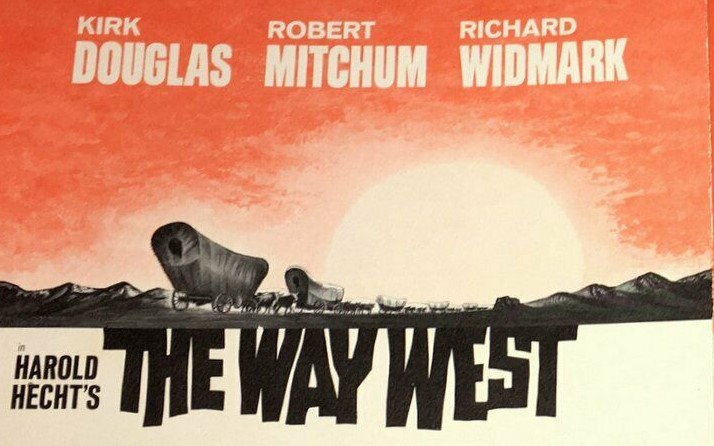
As you might expect with a title like this John Wayne was in the frame, at least at the start. But when Burt Lancaster’s production outfit Hecht-Lancaster bought the property that was the end of that casting idea. Hecht-Lancaster was at its peak in 1956, each of its first 11 pictures turning a profit, and just signed up to a $40 million three-year deal with United Artists. Biggest project on the table: $5 million for The Way West with a dream team of Lancaster, James Stewart and Gary Cooper and a script from Clifford Odets (The Sweet Smell of Success, 1957). But by 1959 the dream had soured, with $545,000 already shelled out on the western with no sign of a start date. A year later the project was shelved. When Harold Hecht split from Lancaster, the rights reverted to United Artists.
Hecht’s initial efforts as a solo producer had not paid off, Taras Bulba (1962), Flight from Ashiya (1964), both starring Yul Brynner, and Tony Curtis comedy Wild and Wonderful (1964) all covered in red ink, before suddenly resurfacing with the hit Cat Ballou (1965), making him imminently more bankable than before. However, given the impact music had in Cat Ballou, Hecht hankered after something in the same vein, except bigger, and bought the rights to Finian’s Rainbow, a Broadway hit from 1947. When casting issues caused delay, Hecht signed a one-picture deal with United Artists for The Way West. The studio had such high hopes for the movie that plans were made for its world premiere to be held at the Houston Astrodome, a first, and it was considered a natural for roadshow treatment.
A substantial rejig was required of the source material, the Pulitzer-Prize-winning novel by A.B. Guthrie, by screenwriters Ben Maddow and Mitch Lindemann, not least to ensure that the character played by Kirk Douglas remained with the wagon train until the end of the trail, unlike in the book. Andrew V. McLaglen, with three box office western hits behind him in McLintock (1963) starring John Wayne and Maureen O’Hara, Shenandoah (1965) with James Stewart and The Rare Breed (1966) co-starring Stewart and O’Hara, was first choice to sit in the director’s chair.
Charlton Heston (El Cid, 1961) was approached to play the lead of Senator Tadlock. When he turned it down, Kirk Douglas signed on for his first western in five years – although his next would also be a western, The War Wagon (1967) with John Wayne – Robert Mitchum (Villa Rides, 1968) was offered the choice of either scout Dick Summers or firebrand Life Evans. At the end of a long lunch with Hecht and McLaglen, Mitchum could not make up his mind and the producer and director assigned him the role of the scout.
“I’m awfully glad it worked out the way it did,” recalled McLaglen, “because Widmark was perfect for the other part and Mitchum was perfect for the scout.” It might not have been Widmark because Max von Sydow was also reputedly offered a part. Von Sydow was too big a star to play any of the other supporting parts and the part assigned to Widmark was Scandinavian so in that sense an ideal fit.
While Widmark did not attempt a Scandinavian accent, Mitchum spoke Lakota, apparently with a decent accent, in several scenes where he had to communicate with Native Americans. He didn’t learn the language, as modern actors might do, but simply recited the words spoken to him off-camera. Mitchum and Douglas had acted together in Out of the Past (1947), where the former had the larger role, and, while not sharing scenes, appeared in The List of Adrian Messenger (1963), where the billing was reversed. Although not in a directorial capacity McLaglen had worked with Mitchum on Blood Alley (1956) before the actor was fired.
It was an arduous shoot, virtually the whole picture shot as exteriors, in Tucson, Arizona, and in various locations in Oregon including Bend, Christmas Valley and the Crooked River Gorge. Around 400 members of cast and crew made the trek. In the absence of CGI, everything seen on the screen was achieved for real without any recourse to blue screen. The desert was real. When the river was forded, it was with real wagons and the cast. The wagons were raised and then lowered from the tops of cliffs using the old-fashioned methods that would have been available at the time, that is by rope-and-tackle.
In order to begin filming or play less arduous scenes on top of the cliffs, cast and crew went up in a ski lift. “You’re up there, hundreds of feet up, nothing but rocks to call on,” Jack Elam remembered. “If you had to go to the bathroom it was a matter of half an hour down and half an hour up.” When the wagons were lowered down the cliff all the actors at some point had to participate and according to Elam “some people landed in the hospital.” The river crossing was no less dangerous, with the potential for drowning a constant hazard.
“Andy McLaglen…was wonderful through the whole thing. Stayed calm through thick and thin,” said Elam. Added assistant director Terry Morse, “Nothing intimidated him…for all the difficulties he kept it right on schedule.”
Given three stars with reputations, it was not surprising there were flashpoints, Kirk Douglas, apparently, at the heart of most, accused of snatching newspapers out of the hands of supporting players and trying to usurp the director. Commented Harry Carey Jr., “He tried to take over the thing at some point. Widmark got furious at it, very agitated. He screamed, ‘You’re not directing this goddam movie.’ Really raised hell with Douglas.”
Said McLaglen, “Somebody like Kirk Douglas and somebody like Mitchum, they were poles apart in personality. Bob was an easygoing guy and Kirk was more volatile. But there was never a feud.” Just how easygoing Mitchum was – a production assistant was assigned to keep an eye on him just in case he got carried away with his predilection for fishing and was wading in the water when it was time for his next scene.
Kirk Douglas thought so little of the picture there’s not a single mention of it in his autobiography The Ragman’s Son.
The movie wrapped on August 29, two days ahead of schedule, which was quite remarkable given how tough the shoot had been. The fact that it took almost a year to reach screens suggested UA had problems with the finished product. Andrew McLaglen asserted that it had been shorn by nearly 30 minutes after the first round of cinema screenings, but that memory seems faulty given that the film Variety reviewed the movie in mid-May 1967 – a month before its world premiere in Eugene, Oregon, on June 13 – ran 122 minutes, the stated running time. Critics were not kind but the director thought it was “a terrific picture” and “one of the things I dream about today.”
SOURCES: Kate Buford, Burt Lancaster, An American Life (Aurum Press, 2000) p171,192, 194; Lee Server, Robert Mitchum, Baby I Don’t Care, (Faber and Faber, 2002), p491-495; Kirk Douglas, The Ragman’s Son (Simon & Schuster, 2012); “Largest Independent Motion Picture Deal,” Variety, April 13, 1956; “Hollywood Report,” Box Office, November 15, 1965, p20; “Hecht’s Oncer for UA,” Variety, March 30, 1966, p5; “Astrodome May Show Hollywood’s Way West,” Variety, May 4, 1966, p12; “Hecht Finishes Production of UA’s The Way West,” Box Office, September 5, 1966, pW5; “Review,” Variety, May 17, 1967, p6.
Hollywood has been hitting the retread button for over a century. Today’s reboots and re-imaginings are nothing new. Although in the past the excuse was technological development, the splurge of remakes in the 1960s including Beau Geste (1966), Stagecoach (1966) and Goodbye Mr. Chips (1969) were superior to the originals in one particular aspect – they were in color.
When silent films went from two-reels to four-reels and from six-reels to eight-reels, roughly the length of a modern picture, and when silent gave way to sound the remake business went into overdrive. The 80-minute Tess of the Storm Country (1914) starring Mary Pickford was transformed into a 137-minute version eight years later headlined by the same star. Zane Grey westerns starring William Farnum Raiders of the Purple Sage (1918), The Lone Ranger (1919) and The Last of the Duanes (1919) were remade as Tom Mix vehicles between 1923 and 1925 and toplining George O’Brien between 1930 and 1931. Over 120 remakes were made between 1928 and 1930, with around 80 per cent going out with the same title. There was another remake burst at the end of the 1930s including The Hunchback of Notre Dame (1939).
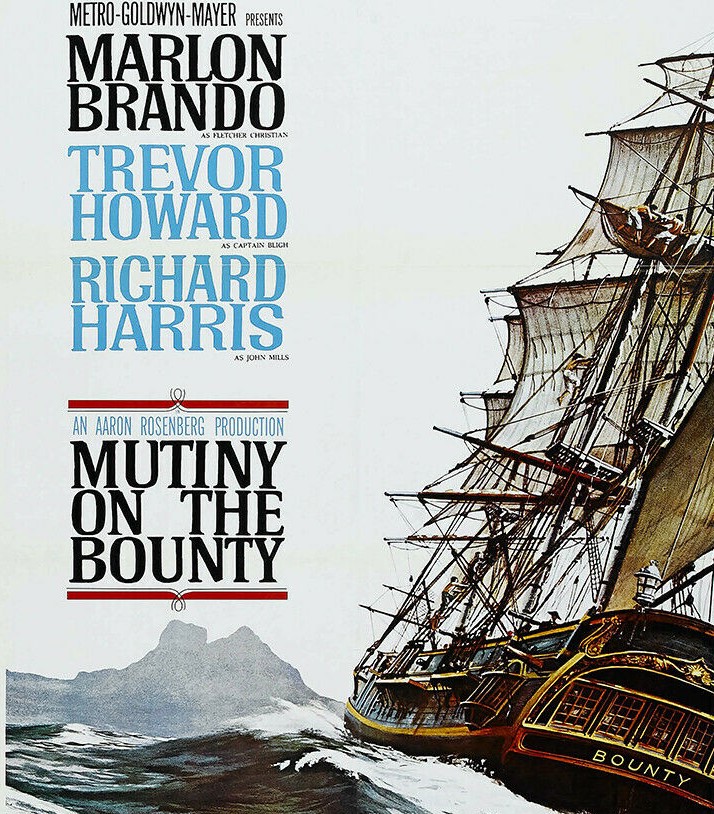
Color was the prime instigator for the remake business in the 1960s. But you could also add the technological development of 70mm, the key element of roadshow pictures. Many big-budget films of the 1920s and 1930s had hit the box office target and with studios looking for as many sure-fire winners as possible it seemed sensible to give a new look to older projects. Ben-Hur (1959) could be seen as lighting the remake touch paper especially when it scored equally highly at the box office and the Oscars. MGM followed through with roadshows of Mutiny on the Bounty (1962), one-third as long again as the 1935 original, Cimarron (1960) with an extra 20 minutes compared to the 1931 Oscar-winner. But the reimagining of The Four Horsemen of the Apocalypse (1962) ran about the same length as the Rudolph Valentino version of 1921 as did King of Kings (1961) compared to the 1927 Cecil B. DeMille version.
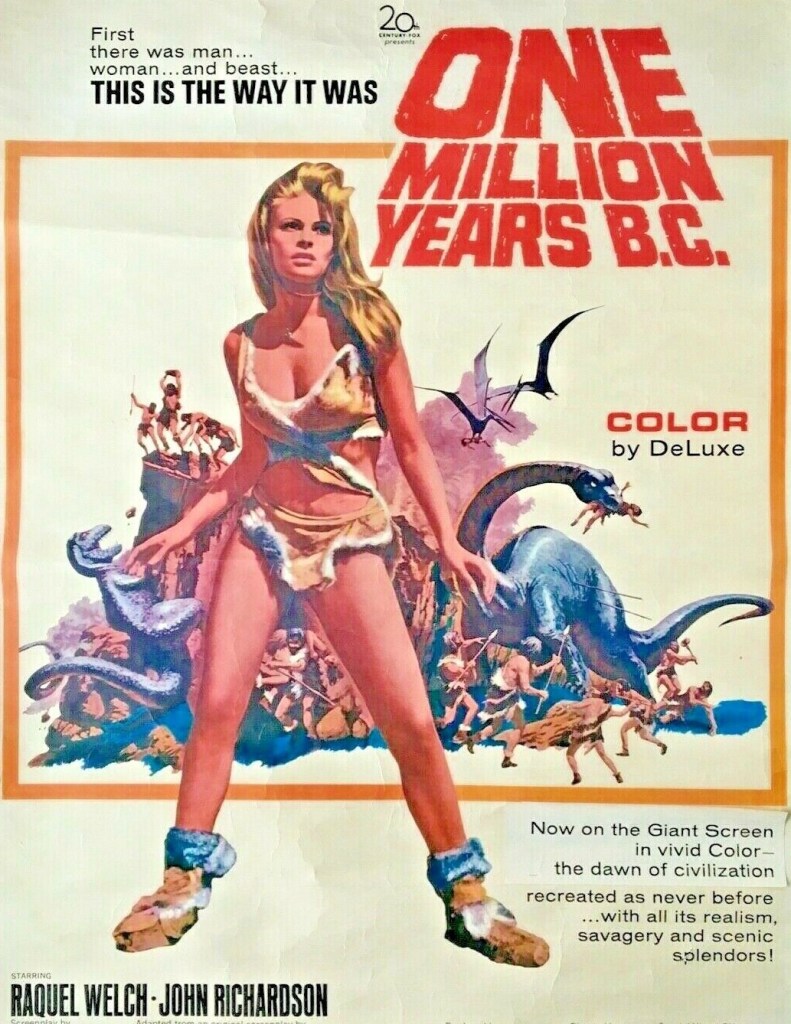
The famed Raquel Welch vehicle was based on a film of 1940.
Prior to considering the expensive business of investing in a remake, studios had been able to rely on sticking out the old movie as a reissue, limited financial exposure often resulting in considerable box office. But it was impossible to sell silent pictures, excepting comedians like Charlie Chaplin, to a modern audience and many of the big hits of the 1930s had either been already sold to television or were considered dated by contemporary standards and although black-and-white films were still being made halfway through the decade (In Harm’s Way, 1965, for example) they were a difficult re-sell.
Far easier to revamp a well-known, perhaps beloved, product with the addition of color cinematography, better sound, and possibly with major stars in the vein of Marlon Brando (Mutiny on the Bounty) and Peter O’Toole (Goodbye, Mr. Chips). It also seemed the case that lesser stars could still prop a remake with little adverse effect on the receipts especially if the lower-priced actors substantially reduced the budget and consequently the income required to turn a profit.
Some movies appeared to be on an endless recycle. The Count of Monte Cristo (1964) had been filmed in 1956, 1954 and 1934, the latter starring Robert Donat. The Perils of Pauline (1967) had been remade twice since Pearl White had made the character her own in 1914. Back Street (1961) with Susan Hayward had been filmed twice before in 1941 and 1932. The Spanish-made The Last of the Mohicans (1963) starring Jeffrey Hunter was the fifth attempt at filming the famous novel after movies made in 1920, 1932, 1936 and 1957.
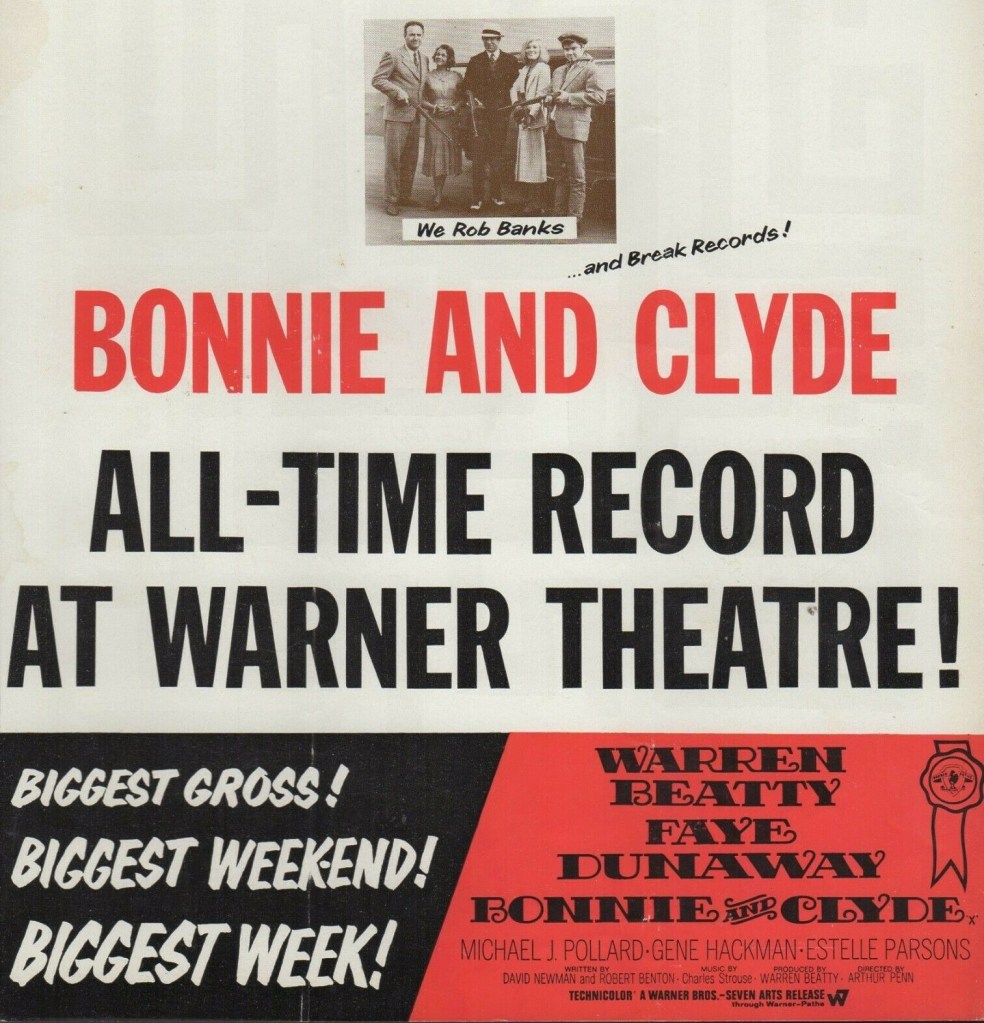
“The Bonnie Parker Story” laid the groundwork for this box office smash-and-grab.
Some remakes changed their titles. Cary Grant comedy Walk, Don’t Run (1966) was based on The More the Merrier (1943), Stolen Hours (1963) with Susan Hayward on Dark Victory (19390 with Bette Davis, Doris Day vehicle Move Over Darling (1963) on My Favorite Wife (1940), and Agatha Christie’s Ten Little Indians (1963) on The Old Dark House (1932). William Wyler’s The Children’s Hour (1961) starring Audrey Hepburn drew on These Three (1936), Uptight (1968) was a modern take on John Ford’s Oscar-nominated The Informer (1935), and comedy The Shakiest Gun in the West (1968) with Don Knotts had its origins in The Paleface (1948) starring Bob Hope. Akira Kurosawa’s Japanese classic Rashomon (1950) retuned as The Outrage (196) starring Paul Newman. The Bonnie Parker Story (1958) was drastically retuned as Bonnie and Clyde (1967). Frank Capra’s A Pocketful of Miracles (1961) was based on his own Lady for a Day (1932). Gregory Peck thriller Mirage (1965) took only three years to re-emerge as Jigsaw (1968).
Other studios decided the original title was too big an attraction to be discarded. Of Human Bondage (1964) with Kim Novak and Laurence Harvey had been made 30 years earlier with Bette Davis and Leslie Howard. Night Must Fall (1965) starring Albert Finney had originated 27 years prior. Raquel Welch-starrer One Million Years B.C. (1966) had been slightly truncated from One Million B.C. (1940), Lee Marvin and Angie Dickinson headlined The Killers (1964) based on characters originally essayed by Burt Lancaster and Ava Gardner 18 years previously, Mayerling (1969) with Omar Sharif and Catherine Deneuve had starred Charles Boyer and Danielle Darrieux in the 1936 version.
Horror was the most obvious genre to receive a revamp. Robert Bloch rewrote The Cabinet of Dr Cagliari (1962) forty-two years after the original. Hands of Orlac (1961) with Mel Ferrer had previously been known as Mad Love (1936). Herbert Lom reprised The Phantom of theOpera (1962) following on from Lon Chaney in 1925 and Nelson Eddy in 1943. French-made The Golem (1967) was based on versions screened in 1921 and 1937.
Some films were remade with music, Goodbye Mr. Chips – the Robert Donat, Greer Garson original belonging to 1939 – the most obvious example but The Sound of Music (1965) was essentially a musical version of the Germanic The Trapp Family (1956), and Three Coins in the Fountain (1954) set in Rome turned up as the musical The Pleasure Seekers (1964) set in Madrid, both films directed by Jean Negulesco. On the other hand, State Fair (1962), which had been turned into a drama in 1945 despite being based on a Rodgers & Hammerstein musical, was restored to its roots.
Not every remake idea proved a slam dunk. Projects that failed to get off the ground included: TheBirth of Nation (1915), Ecstasy (1933), Metropolis (1927) to be directed again by Fritz Lang, Wuthering Heights (1939) to star Richard Harris, Dark Angel (1925 and 1937) with Rock Hudson, The Lives of a Bengal Lancer (1935), The Crusades (1935), The Charge of the Light Brigade (1936) with Roger Moore – although it was remade in 1968 – Wee Willie Winkie (1937), Jane Eyre (1943) to star James Mason, The Macomber Affair (1946) and The Postman Always Rings Twice (1946). Anthony Quinn was touted for a remake of Kurosawa’s Sanjuro (1962) and Saul David planned a westernized version of that director’s The Hidden Fortress (1958).
French director Claude Chabrol had ambitions to make a version of Hamlet (1948) from Ophelia’s point of view though a Russian version appeared in 1964. MGM blocked a remake of Tarzan of the Apes (1931). Francis Ford Coppola proposed Heaven Can Wait, a reworking of Here Comes Mr. Jordan, to star Bill Cosby. Stephen Boyd was mooted for a remake of The Quiet Man (1952).
Producer Ray Stark (Funny Girl, 1967) announced new versions of Casablanca (1942) and a Peter Collinson-directed The Maltese Falcon (1941). Musical versions were announced of The Private Life of Henry VIII (1933), Our Town (1937), Rebel Without a Cause (1955) and Roman Holiday (1953), the latter to star Robert Redford.
SOURCES: Brian Hannan, Coming Back to a Theater Near You, A History of Hollywood Reissues, 1914-2014 (McFarland, 2016), p21, 27, 31; “Drift Towards Remakes Grows on Coast,” Box Office, March 11, 1939, p37; “That Birth of a Nation Title,” Variety, April 13, 1960, p6; “Sales Come-On But Never Mislabel Content – Hathaway,” Variety, October 26, 1960, p13; “Bischoff-Diamond To Make Charge,” Box Office, July 10, 1961, p11; “Bash Vindicated – After 4 Yrs,” Variety, July 12, 1961, p5; “MGM Is Upheld In Suit over Tarzan,” Box Office, July 10, 1961, p13; “New Cycle of Classics for French Prods,” Variety, July 12, 1961, p16; “Dark Angel Remake to Writer Lee Mahin,” Box Office, December 18, 1961, pW-8; “Robert Blees Plans Remake of Macomber Affair,” Box Office, March 12, 1962, p16; “Anderson-U.A. Talk Wuthering Remake,” Variety, August 28, 1963, p22; “Spain’s Latest Western,” Variety, October 23, 1963, p18; “MGM Signs for 3 Co-Productions in Spain,” Variety, January 15, 1964, p22; “Hollywood Report,” Box Office, February 10, 1964, p16; “Japanese Sanjuro Remake for Quinn,” Variety, May 5, 1965, p4; “Weintraub Sends Down L.A. Roots,” Variety, January 12, 1966, p5;“Universal Re-Do of DeMille 1935 Crusades,” Variety, April 13, 1966, p3; “Plan Rebel Without Cause For Remake As Musical,” Box Office, April 18, 1966, p9; “Lee Thompson Busily Reprints His Musical Version of Henry VIII,” Variety, April 27, 1966, p17; “U’s Future Parks 17 Vehicles,” Variety, May 25, 1966, p33; “Re-Do of Quiet Man,” Variety, March 5, 1967, p5; “De Laurentiis in New Par Dickers,” Variety, January 10, 1968, p5; “David to Re-Do Kurosawa Plot As U.S. Western,” Variety, June 12, 1968, p4; “Re-Do of Falcon,” Variety, July 10, 1968, p14; “Star In W7 Pic,” Variety, January 15, 1969, p3.











 The Magnificent 60s