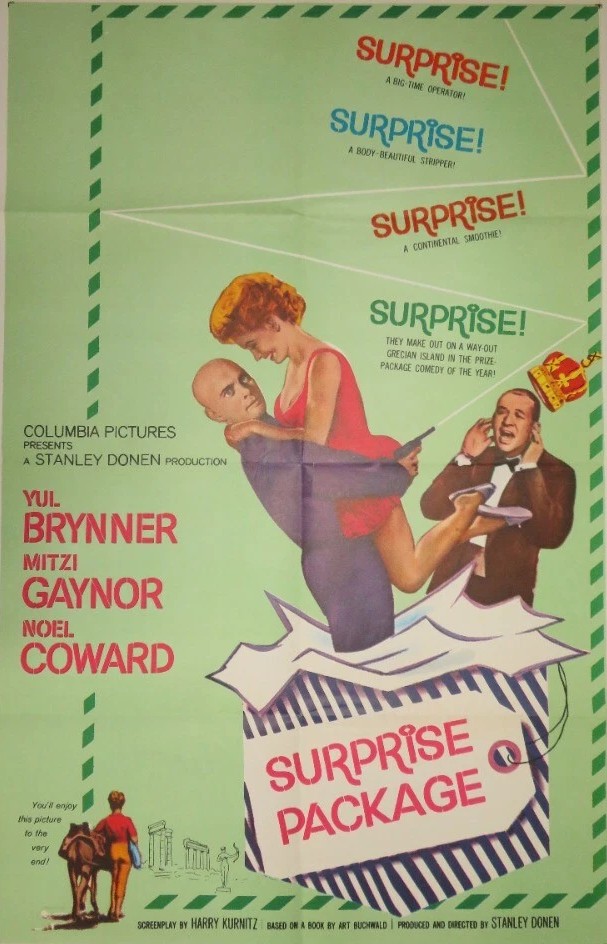
Surprise Package (1960) **

Poses two questions. Is this every bit as bad as Once More with Feeling, Stanley Donen’s previous picture? Yep, sorry, it’s every bit as wretched. The second question is: how on earth did Donen go from this mess to sublime romantic thriller Charade three years later? Well, the answer might simply be in the casting. Yul Brynner is no Cary Grant. And in this movie he’s not even Yul Brynner.

My guess is he’s meant to be a humorous twist on the Brynner screen persona. But playing a gangster with a thick Noo Yoik accent was always the preserve of the dumb supporting actor not the star. And since Yul Brynner isn’t any more convincing in this than in Once More with Feeling the project is in trouble from the start.
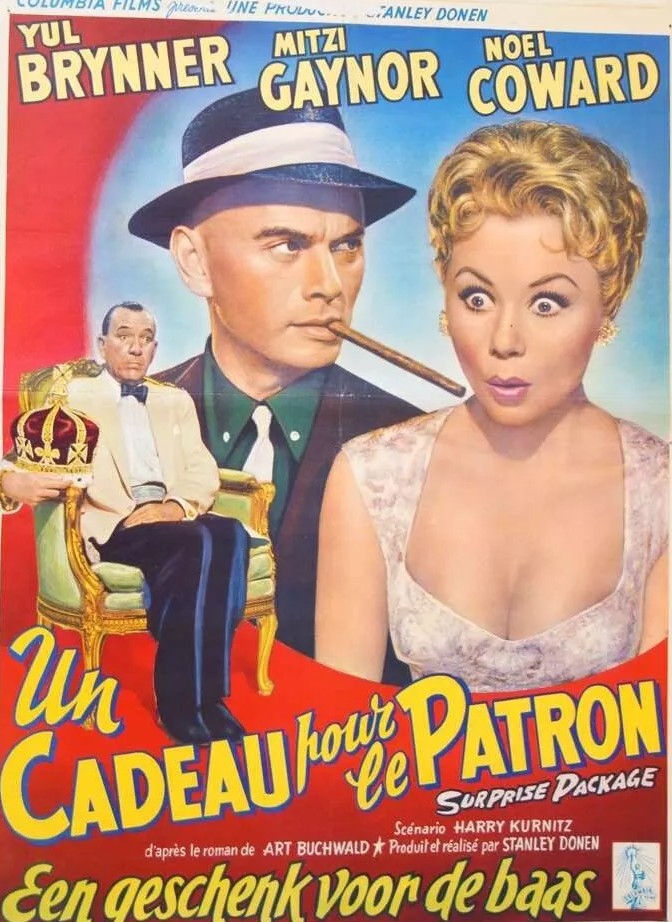
We’re given too much of this faux gangster drivel at the start when mob kingpin Nico (Yul Brynner) is collecting tributes from his underlings. Then, for no particular reason, he is deported, sent back into exile to his homeland of Greece. There he encounters the only smart guy in the picture, the corrupt chief of police Stefan (Eric Pohlmann) who’s so astute in the bribery department that all Nico receives in return for his thousand dollar bribe is to be told he won’t be arrested for bribery.

Stefan sets up Nico to meet another exile, deposed King Pavel II (Noel Coward), whose accent makes no sense either unless he was exclusively raised in high class British society, schooled at Eton, a member of upper class clubs etc etc, otherwise how to explain the plummy tones unless this is also meant to be as over-the-top gag as Nico’s Noo Yoik accent. Nico plans to buy the king’s crown for a million bucks. But the boys back home stiff him and instead of the cash send him instead his girlfriend – the surprise package of the title – mob moll Gabby (Mitzi Gaynor), and the ongoing gag here is that, what with Nico trying to elevate himself in society, Gabby’s table manners and speech let him down.

So with no cash forthcoming, what’s a gangster to do to pad out his exile? So Nico decides to steal the crown. And if there had been either a hint of the classic heist a la Grand Slam (1960) or Topkapi (1964) or its alternative, the totally inept thief, then we might have been onto something. But instead we’ve got much what we might expect from such a poor piece – not much. And in any case, the laffs are meant to come from another party, representing the king’s citizens, and led by Dr Panzer (George Coulouris) who wants the crown restored to its proper home. Two crooks chasing the same prize? What a crazy idea. But this works as well as the rest of the picture.

Thanks to Gabby’s principles, the crown goes in neither’s pockets. To make a buck, Nico and the king transform the latter’s villa into a casino with Gabby, now Mrs Nico, employed as the hat check girl.

Stanely Donen made three pictures in 1960 and then not another man for three years, which suggested he was a) working on too many projects at once and b) that break sure refreshed his cinematic skills. Just like Once More with Feeling he gets wrong virtually most of the directorial decisions, beginning with the accents and ending up with the storyline and characters you don’t care a button for, which wouldn’t have mattered if they could generate a laugh.

Yul Brynner followed this up with his iconic performance in The Magnificent Seven (1960) so perhaps he can be excused. This pretty much killed off the career of Mitzi Gaynor (South Pacific, 1958) – it was another three years till she appeared on screen again, and that was her final picture. It took Noel Coward (Bunny Lake Is Missing, 1965) four years to get another screen role.

Written by Harry Kurnitz (Once More with Feeling) from the Art Buchwald novel so I am assuming this was greenlit before the results of the previous Donen-Brynner teaming were known.

At least Charade revived Donen’s career.
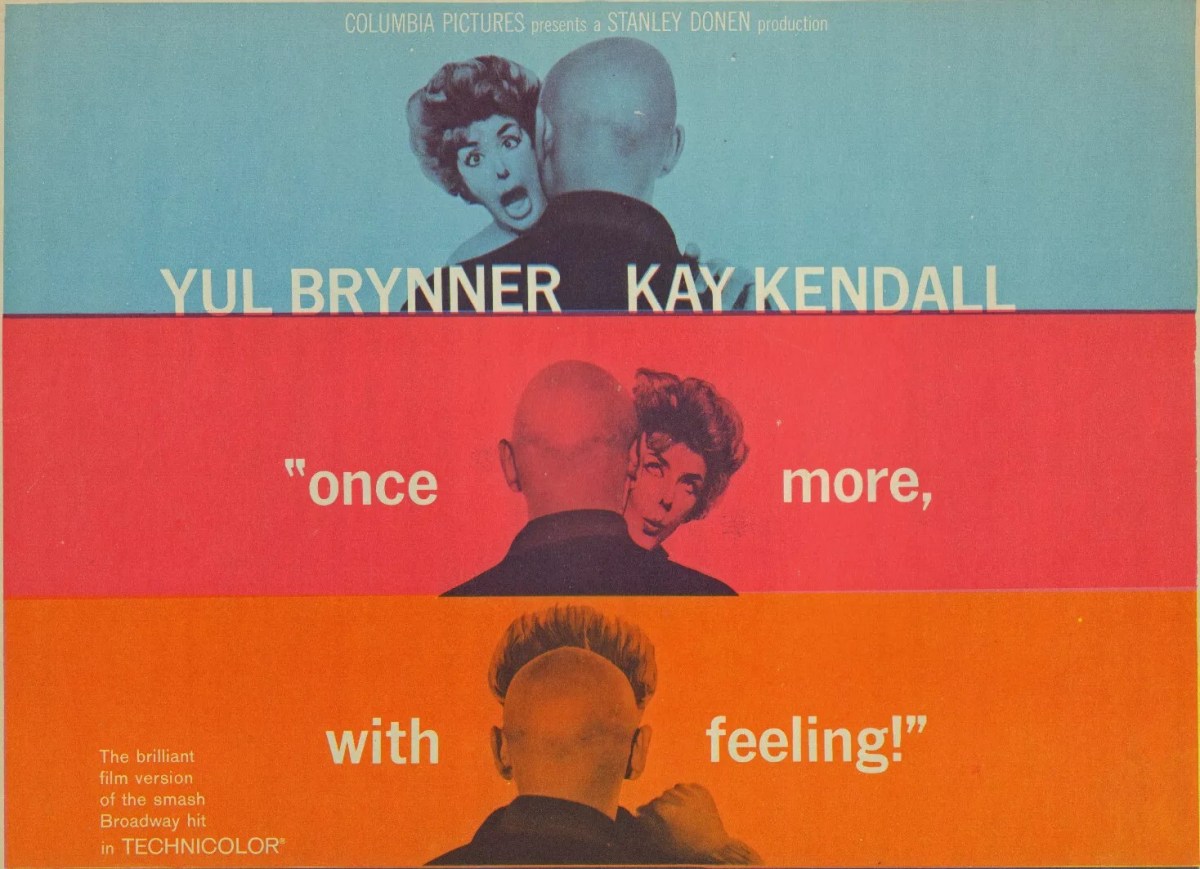
Once More With Feeling (1960) **

At the very least I had thought, given the involvement of classy director Stanley Donen (Charade, 1963) that this might go down as a glorious failure rather than just a straightforward glossy dud thanks to the woeful miscasting of Yul Brynner (The Double Man, 1967) and a bizarre plot. Am sure it must have appeared a welcome change of pace from a string of heavyweight dramas for the actor.

Adapted from the Broadway success by playwright Harry Kurnitz (Goodbye Charlie, 1964) this never escapes its stage origins, too many dramatic entrances, faked dramatic faintings, unwelcome guests ushered out. That would all have been manageable had Yul Brynner shown the slightest instinct for comedy. Bluster doesn’t compensate. Playing a tyrannical orchestra conductor would hardly take any acting for a performer who radiated intensity.

Victor Fabian (Yul Brynner), as egomaniacal and temperamental as you’d expect from a top conductor, is caught in flagrante by harpist wife Dolly (Kay Kendall) with young musician Angela (Shirley Anne Field). After she storms out, he loses his mojo. Worse, his orchestra loses its most efficient fundraiser, since Dolly is the one who keeps donors sweet.

Dolly has wasted no time acquiring a new admirer, esteemed physicist Richard (Geoffrey Toone), and wants a divorce in order to marry him. But wait, there’s a catch. Not the obvious one that Victor turns over a new leaf and determines to win her back, abandoning arrogance in favor of humble ardent wooing.

No, she can’t leave him because, wait for it, they never married. Well that’s not so jaw-dropping as the consequence. He insists that she can’t get a divorce unless she marries him and during an agreed short period together presumably that will give him time to flex his romantic muscles and win her back.

I can only assume that in the sophisitcated circles in which they run, the idea that they have been living in sin might cause her considerable embarrassment. But I’m perplexed at the notion, even for the less permissive times, that this would provoke sufficient scandal – more scandal than getting divorced in the first place? Or that they would expect nobody to notice the sudden marriage and wonder how they have managed to so openly live together? This seems nothing more than a jumbled-up head-over-heels barmy plot strand.

Anyway, she agrees, and he does his best to win her back even to the extent of playing a piece of music, beloved of a sponsor, that he detests.

The plot belongs to the golden age of the screwball comedy but the picture doesn’t play it that way. There’s more to being frenetic in pursuit of laffs than just being frenetic and this never takes off.

While Brynner is strictly one-note and never manages to bring a suggestion of genuine romance into the proceedings, the director is equally at a loss to inject any oomph or style and it looks as if he’s done little more than film a stage show with all its cinematic limitations.

Kay Kendall (Les Girls, 1957) in her final role – she died of leukemia – is equally constricted by a character who huffs and flounces and never embraces the comedy side of screwball.

This was the first of two straight comedies pairing Donen and Brynner and I’m dreading its successor Surprise Package (1960). Kurnitz adapted his own play which had been a decent success on Broadway, so the movie failure can’t all be blamed on him.

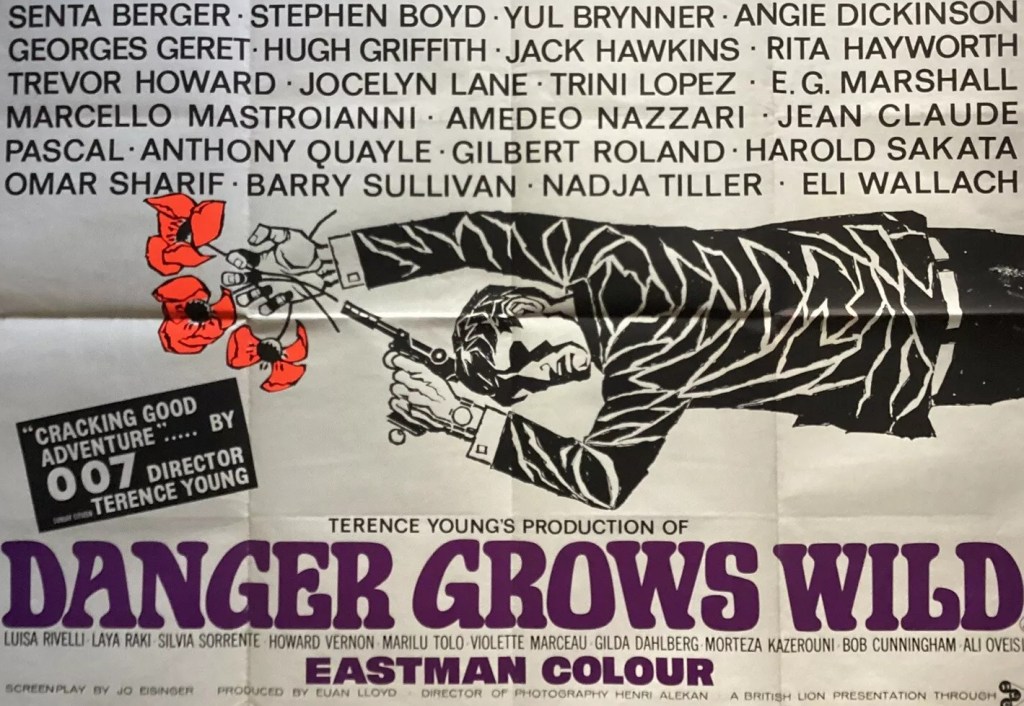
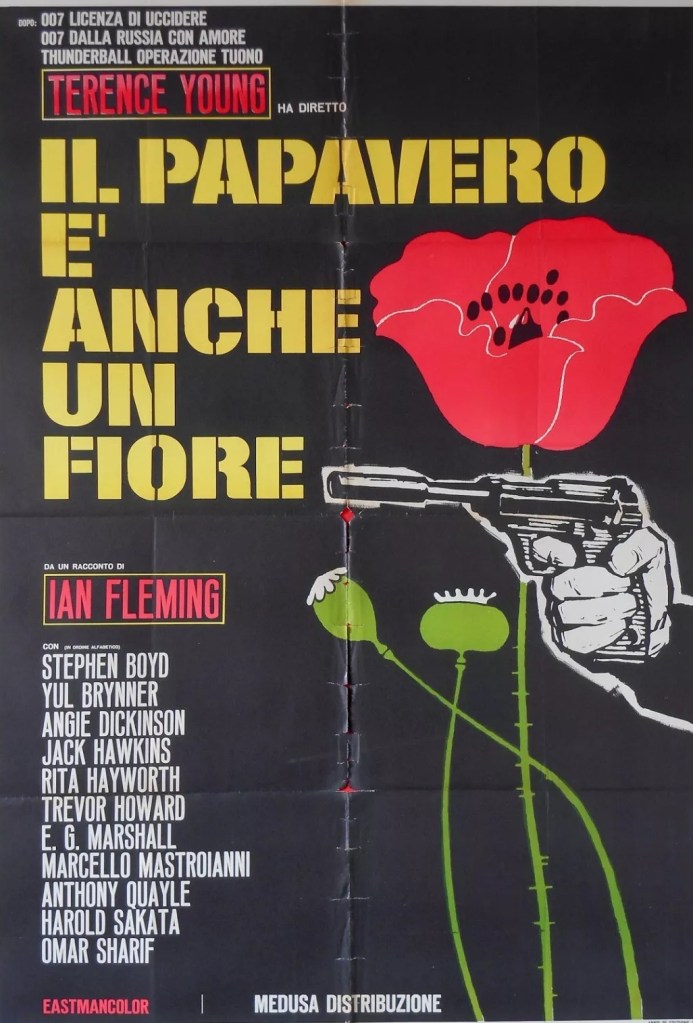
The Poppy Is Also A Flower / Danger Grows Wild (1966) ***

Audiences were likely disgruntled to discover that out of a heavyweight cast boasting the likes of Omar Sharif (Doctor Zhivago, 1965), Yul Brynner (The Magnificent Seven, 1960), Rita Hayworth (Circus World/The Magnificent Showman, 1964), Senta Berger (Cast a Giant Shadow, 1966) and Stephen Boyd (Genghis Khan, 1965), that the heavy lifting was done by a couple of supporting actors in Trevor Howard (Von Ryan’s Express, 1965) and E.G. Marshall (The Chase, 1966).

Most of the all-star cast barely last a few minutes, Stephen Boyd’s character killed in the opening sequence, Senta Berger and Rita Hayworth putting in fleeting appearances as junkies. Like many of the gangster pictures of the decade, it’s set up as a docu-drama, giving the down’n’dirty, courtesy of United Nations which funded the picture, on the international drugs trade.

Benson (Stephen Boyd) heads up an infiltration operation targeting drug suppliers in Iran, where poppies “grow wild as weeds.” Though quickly bumped off, and the goods he’s purchased stolen, he’s replaced by Col Salem (Yul Brynner) who has the Bond-esque notion of enriching the opium with radiation and then tracing it using Geiger counters.

When that scheme fails, it’s down to agents Sam Lincoln (Trevor Howard) and Coley Jones (E.G. Marshall) to hunt down the drugs. Considering themselves unlikely lotharios, they compete over women and play a neat game of stone-scissors-paper to decide who is assigned which task, varying from chatting up Linda (Angie Dickinson), the gorgeous widow of Benson, or searching her room. Linda isn’t all she seems, not least she may not be a widow, carries a gun, and turns up in too many unsavory dives to be on the side of the angels.

Given drug-dealing was not the rampant business it later became, audiences might not be so shocked to discover that opium was transported by cargo ship and refined in Naples before being shipped all over the world. Possibly as interesting is the use of ancetic anhydride in the refining process. As Sam and Coley trudge across half of Europe, from Naples to Geneva to Nice, the audience is filled in on the details of the drug business and they latch on to a Mr Big, Serge Marko (Gilbert Roland).

There’s a hard realism about the project – though not to the levels of The French Connection (1971) -: nightclub dancer needing make-up to hide the tracks on her arms; Marko’s wife (Rita Hayward) stoned out of her skull; director Terence Young (Dr No, 1962) pulling a fast one Hitchcock-style in killing off Sam; and, despite a climax which sees Coley collar Marko, it ends with a pessimistic air – “someone else to take his place.” There’s a good fistfight on a train, and you’ll have guessed what Linda is up to. But there’s an odd softer centre, the movie taking a couple of breaks to highlight the singing of Trini Lopez and female wrestlers.

Before virtue-signalling was invented this was a do-gooder movie, the cameo players signing up for a buck, Grace Kelly on hand for the introduction. These days it stands as an almighty alarm that was scarcely heeded, not as the drug-fuelled counter-culture was about to burst onto the world, and with middle-class drop-outs championing the illicit there was little chance of the warning being heeded.

More like The Longest Day (1962) than Lawrence of Arabia (1962) in its use of the all-star cast. Still manages to make its points with the least amount of lecturing and hectoring.

Terence Young comes into his own in the action highpoints. Written by Jo Eiseinger (Oscar Wilde, 1960) and Jack Davies (Gambit, 1966) from an idea by Ian Fleming.

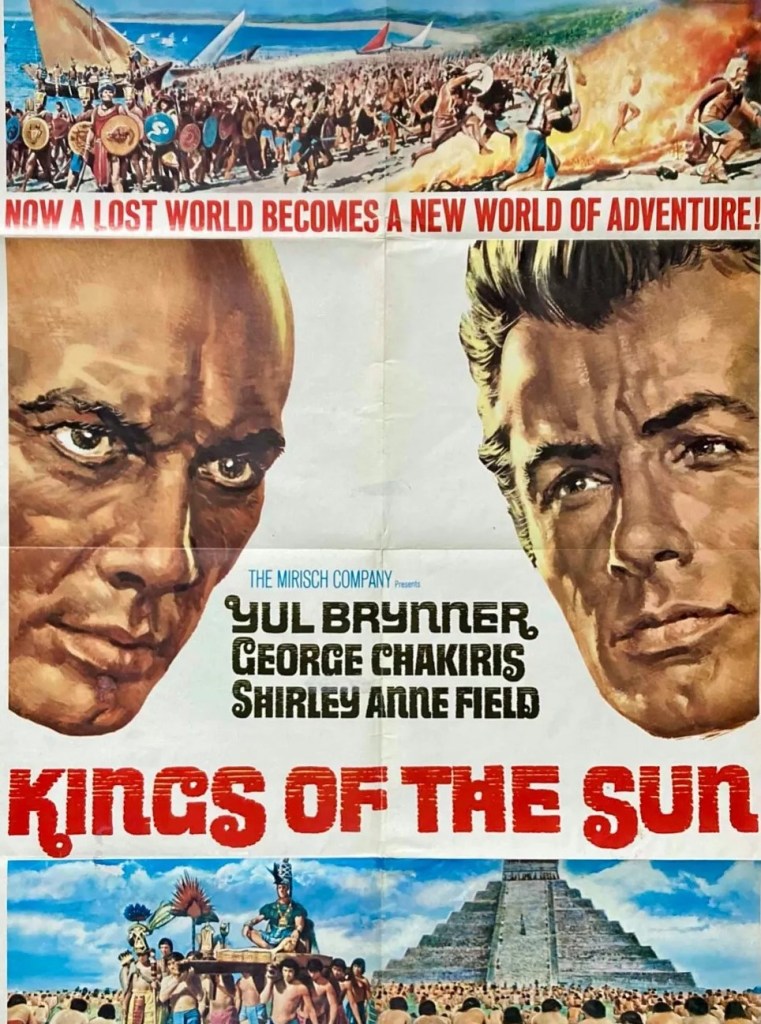
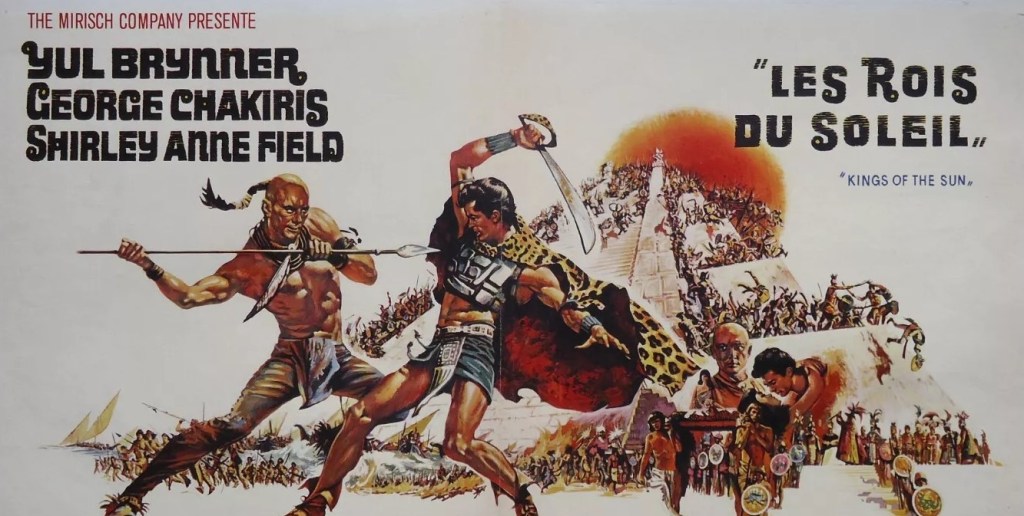
Kings of the Sun (1962) ****

With the current Conclave  bringing the subject of organized religion to the fore, no better time to examine a religion that Christianity put to the sword back in the day. While Christianity centers on unwelcome crucifixion transformed into willing sacrifice, in other cultures sacrifice was viewed as the highpoint of a life. And as demonstrated here, not a cruel expression of power, but a person executed in order to carry a message to the gods.

Of course, that could still be interpreted as barbarity and state vs religion is one of several themes here. Sold as an action picture but actually a thoughtful discussion of contemporary issues and worth viewing alone for an extraordinary performance by Yul Brynner, whose screen persona is turned completely upside down. As epitomized by The Magnificent Seven (1960), Brynner was Mr Cool. He was rarely beaten, and if he couldn’t talk his way out of trouble then guns or fists would do the job for him. For the most part here, he’s a prisoner, setting up the kind of template that Clint Eastwood would later inherit, of the brutally battered hero, except in this case there’s no murderous revenge.

And the movie cleverly switches perspective, so we move from sympathy with a defeated fleeing Mayan tribe and their efforts to rebuild their lives in a foreign land to the problems their unexpected incursion creates among the inhabitants of the new country.

Forced out of his homeland by invaders, King Balam (George Chakiris) leads his tribe across the seas of the Gulf of Mexico, trying to prevent high priest Ah Min (Richard Basehart) giving in to a predilection for sacrifice every few minutes. In order to keep the peace between two warring elements of the tribe, an unwilling Ixchel (Shirley Anne Field) has been promised in marriage to the king.

The Mayans adapt quickly to their new circumstances, fishing, building houses, diverting rivers to grow crops and building a pyramid. When they capture Black Eagle (Yul Brynner), a local Native American chief, they plan to sacrifice him to the gods.

Complicating matters is that Ixchel has taken a shine to the prisoner. As a potential sacrificial victim, living like a king for a day, the prisoner is entitled to impregnate any woman he pleases. Although Black Eagle has also taken a shine to Ixchel, he rejects her when she doesn’t come to him with open arms. She, equally, takes against Balam because, while he can’t prevent such congress (to use a Biblical expression), he doesn’t express his dissatisfaction in the process.

While a prisoner, Brynner has been impressed with the Mayan diligence, their ability to extract a living from what appeared harsh soil, and Balam, for his part, was hoping the two tribes could work out a way of co-existence. Where Black Eagle is voluble, Balam suppresses his emotions. It turns out that Ixchel, while responding to Black Eagle’s ardent wooing, would rather it was the more monosyllabic king uttering such words.

The action is kept to the minimum, probably accounting for initial audience disinterest. And the fact that it seems to be hewing towards peaceful co-existence rather than open warfare ensured that the expected battle took a long time coming. Sure, there’s a duel of sorts between the two leaders, but the more important battle of wits concerns who wins the woman.

In the end, Balam turns against this religion and sets Black Eagle free which is convenient because the armies which have chucked Balam out of his native land have pursued him across the seas and now attempt an invasion. Balam and Black Eagle unite to drive back the invaders. However, Black Eagle dies in the conflict, removing the love triangle.

From the moment Black Eagle was captured, I was expecting a different outcome. There’s some allegorical mischief at play here, with the prisoner splayed out in crucificial fashion,  arms and legs tethered by rope. But I was expecting such an obvious muscle-bound angry hero to escape and wreak revenge. However, that scenario avoided, it permits considerable discussion on co-existence as well as the nature of marriage, the old-fashioned manner (to prevent war or build a dynasty) vs the more liberated version (for true love).

Brynner is easily the standout, provided with far more opportunity for emotion than usual. George Chakiris (Diamond Head, 1962), range of expressions limited through both emotional incontinence and immaturity, appears sulky rather than majestic. Shirley Anne Field (Saturday Night and Sunday Morning, 1960) would appear miscast except she can convey so well inner feelings through her eyes.

No idea why anyone thought a disquisition on ancient religion and morality, with an anti-war sub-theme, would play with audiences of the period brought up on blood and thunder, and even when presented with notions of peaceful co-existence, as with any number of westerns featuring stand-offs between settlers and Native Americans, could rely on gun-runners to kickstart the shooting.

The action scenes, when they come, are good but it’s what happens in between that makes this perhaps more worthy of comment now than on initial release. Directed by J. Lee Thompson (The Guns of Navarone, 1961) with a screenplay by James Webb (How the West Was Won, 1962) and Elliott Arnold (Flight from Ashiya, 1964)

Carries surprising contemporary heft and Yul Brynner as you’ve never seen him before.

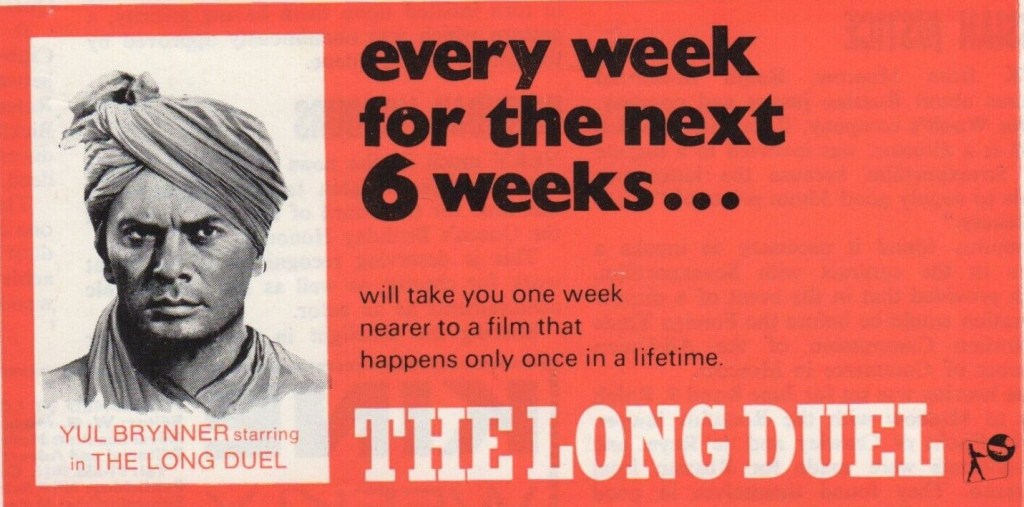
Behind the Scenes: “The Long Duel” (1967)

Due some unexpected reverence after being chosen by Quentin Tarantino for his inaugural eponymous festival that kicked off at the Dobie theater in Austin, Texas, in 1996. I thought I’d throw that in since my opinion alone may not have swayed you as to this film’s merits. Ken Annakin (Battle of the Bulge, 1965) wasn’t first choice as director. It was initially on the slate of Jack Cardiff (The Girl on a Motorcycle, 1969) and should have also made waves as the first big British-Indian co-production. After his World War Two tank epic, Annakin’s career unexpectedly stalled.

He backed out of a project to make a Las Vegas version of Grand Hotel (1931), another, the $1.5 million The Fifth Coin, written by Francis Coppola and to star George Segal, got snarled up on the starting grid. He balked at Texas Across the River (1966) – when the females leads were going to be Shirley MacLaine and Catherine Deneuve – due to concerns about the schedule. He actually shot half of The Perils of Pauline (1967) with Terry-Thomas, Pat Boone and Pamela Austin, wife of super-agent Guy McIllwhaine, before being fired, for reasons that were unclear. Still, he remained in demand and was immediately off to Italy to shoot Raquel Welch heist picture The Biggest Bundle of Them All – not released until two years later as explained in my Behind the Scenes blog on that movie.

However, before jetting off to Italy, he had been sounded out by British producer Sydney Box who had a commitment from Yul Brynner and Trevor Howard to star in the $3 million The Long Duel being financed fifty-fifty by British studio Rank and fourteen Indian investors taking advantage of a tax-shelter deal. Annakin was in line for his biggest-ever fee. For Rank it was a brave new world. The British studio after years of relative inactivity was back on the production front foot, initially in co-production deals with American majors and British investment outfits like the National Film Corporation. It planned to invest $12 million in eight pictures. Initially, its stake in The Long Duel was limited to 60 per cent at a time when the movie was budgeted at $2.3 million. This was “particularly surprising because it came at a time when Britain was caught in a severe economic freeze” although the surprise success of the Bond pictures suggested the country’s movie industry was, in contrast, riding the crest of a wave.

Things turned sour on the location scouting trip to India. A “bottomless pit” of laborers was on standby to build a rope bridge across as soon as the money came through. Timber had been ordered to build a fort on a plateau with stunning views of snow-capped mountains, but nothing would arrive until money changed hands. While Rank had committed three-fifths of the finance with the rest coming from the release of blocked rupees guaranteed by a Maharajah, without any immediate cash and with the stars on pay-or-play contracts, there was no option but for Rank to pick up the entire cost and seek out alternative locations. That meant it was the single biggest British production financed domestically without a foreign partner.

Matters worsened when producer Sydney Box suffered a heart attack, triggering his departure from the business, in which he had been a mainstay for 33 years, movies ranging from The Seventh Veil (1945) to Accident (1966). In addition, Annakin was negotiating to make a permanent move to France while his wife was at home in England dealing with an adopted new-born baby. Annakin – acting also as producer for the first time – gambled on shifting the movie to Spain.

After the success of Doctor Zhivago (1965), Spain was fast being viewed as an ideal terrain, Custer of the West (1967), Camelot (1967), Fathom (1967) and The Bobo (1966) jostling for space. Having made a couple of movies there, Annakin assured the backers, the terrain was “not dissimilar” to the locations he had viewed in India. “I believe we can make Spain into India, so long as the crowds are dressed as Indians, which will cost quite a lot more because it means providing all the costumes whereas in India they already exist,” he explained. He had three weeks before the actors were due.

Yul Brynner and Trevor Howard would have seemed best buddies by now, having appeared in three films together over the past two years – Morituri (1965), The Poppy Is Also a Flower (1966) and Triple Cross (1966). Brynner’s career had revived thanks to Return of the Seven (1966). He was considered poor box office in the U.S. but made up for it with his global marquee appeal. Howard had been on an unexpected box office roll following Father Goose (1964), Operation Crossbow (1965), Von Ryan’s Express (1965) and The Liquidator (1965).

Annakin turned to the Sierra Nevadas to double as the Himalyas, located the rope bridge in a ravine near Ronda, the villages transplanted to the dusty Andalusian plains, and found sufficient horse-riding extras among the gypsies of Dacoit country. The Alhambra was called in to action for part of the Indian palace. A steam train of sufficient vintage was found.

Brynner supplied his own motor home, one of the most luxurious on the market, but required considerable assistance to move it around, especially on narrow country roads linking locations. Over 300 horses were required, with complications when the animals had to be moved in the dark. The major scenes required extensive lighting and nobody had taken into account the fierce winds which nearly blew everything away. The dancing bear was supplied by Chipperfield Zoo near Windsor, England. In the scene where Brynner returns to find his tribe massacred, the bear is also a victim. But, when the bear was knocked out by an injection, it didn’t wake up again. Cast and crew were so shocked that filming was abandoned for the day.

Howard’s alcoholism was another issue, liable to leave the actor so disoriented during the shooting of dangerous scenes that his close-ups were often shot at a later date, though, eventually informed of this accommodation, the veteran sobered up. If you felt when watching the movie that the female stars were out of place, you wouldn’t be far wrong. In the original tale there was no significant female role. But acceding to the demands of studio and distributor required various love interests. Suzanna Leigh (Subterfuge, 1968) turned down the lead, providing Charlotte Rampling (Three, 1969) with a worthy role.

Convinced it was onto a winner, Rank took out adverts in the trades claiming “all signs point to it being…among the greats” and it took the bold step of launching it in roadshow at the Odeon Marble Arch simultaneous with continuous performance at the Odeon Leicester Square in London’s West End.

SOURCES: Ken Annakin, So You Wanna Be a Director (Tomahawk Press, 2001) p186-189, 197-206; “Sydney Box $10-Mil Prod Program,” Variety, January 26, 1966, p14; “Rank Now Measuring Up,” Variety, July 27, 1966, p25; Advert, Variety, August 24, 1966, p27; “$3-Mil Rank Duel May Be Costliest British Film Ever,” Variety, October 26, 1966, p5; Advert, Variety, November 9, 1966, p27; “Sydney Box Quits Film Posts,” Variety, August 7, 1967, p2.

The Long Duel (1967) ****

Surprisingly thoughtful action-packed “eastern western”  with obvious parallels to the plight of the Native American. Here, the British attempt to shift nomadic tribesmen from their traditional hunting grounds in north-west India to “resettlements.” Set in post World War One India, the duel in question between tribal chief Sultan (Yul Brynner) and police chief Young (Trevor Howard) brims over with mutual respect.

Unusually intelligent approach for what could otherwise have been a more straight forward action picture, more critical of the British, whose idea of civilization is to turn everything into “a bad replica of Surrey,” than you would have expected for the period. Ruthless pursuit in large part because the British “can’t afford local heroes.”   

After his tribe is taken captive with a view to forced repatriation by boorish police superintendent Stafford (Harry Andrews), Sultan organises a breakout, taking with him heavily pregnant wife Tara (Imogen Hassall) who dies while on the run. The Governor (Maurice Denham) of the province brings in Young – who knows the territory and is more familiar, through a previous career as an anthropologist, with the nomadic lifestyle, and largely sympathetic to their cause – to head up an elite force and bring to justice Sultan, whose men are now murderers.

Young seems lacking in the stiff upper lip department, condemned for “misplaced chivatry,” unwilling to just do his job, and certainly not to blindly obey the more ruthless ignorant Stafford. Aware he is unable to stop what the British would like to call progress, hopes he can ease the transition, avoid driving the tribesmen into the ground and prevent a noble leader like Sultan ending up a despised bandit, the kind who were forever presented as the bad guys in films like North West Frontier / Flame over India (1959).

Young has the sense not to be dragged all over the country searching for his quarry, and sets up his team in more sensible fashion, but still, is largely outwitted by Sultan, especially as Stafford, who later gets in on the act, is too dumb to fall for obvious lures. Adding  complication is the arrival of Stafford’s equally intelligent daughter Jane (Charlotte Rampling), a Cambridge University graduate, who falls for Young.

Thankfully, there’s no need for the British hero to transition from brute into someone more appreciative of the way of life he is forced to destroy – a trope in the American western – and equally there’s no corrupt businessman selling the tribesman weaponry and there’s no savage attack either on innocent women and children, and removal of these narrative cliches allows the movie more freedom to debate the central questions of freedom. The tribesmen acquire rifles and the occasional Gatling gun simply by stealing them from the more inept British soldiers.

Anyone expecting a shoot-out or more likely a swordfght between Sultan and Young will be disappointed, the title, as with the entire picture, is more subtle than that, especially as each, in turn, have the opportunity to save each other’s lives. Eventually, Young’s sympathetic approach is deemed ineffective and Stafford is put in charge, leading to a superb climax.

While Sultan’s nomadic lifestyle is eased by dancing girl Champa (Virginia North), whose loyalty to her lover is soon put to the test, and who is not, surprisingly, necessarily looking for love, his emotions center more around his younger son, whom he doesn’t want to grow up wearting the tag of bandit’s son. The solution to that problem seems a tad simplistic, but still seems to work.

With the feeling of western with splendid use of superb mountainous locales, and excellent widescreen, an astute script opts as much for intelligence as adventure.

One of Yul Brynner’s (The Double Man, 1967) last great roles before he turned into a parody of himself and certainly more than matched by Trevor Howard (Von Ryan’s Express, 1967), given a role with considerable depth and scope. Charlotte Rampling (Three, 1969) also impresses while Virginia North (Deadlier than the Male, 1967) and Imogen Hassall (El Condor, 1970) provide support. Harry Andrews (The Night They Raided Minsky’s / The Night They Invented Striptease, 1968) has played this role before. You can catch Edward Fox (Day of the Jackal, 1973) in a tiny role.

Superbly directed by Ken Annakin (Battle of the Bulge, 1965) from a script by Peter Yeldham (Age of Consent, 1969), Ernest Borneman (Game of Danger, 1954) and Ranveer Singh in his debut.

Well worth a look.

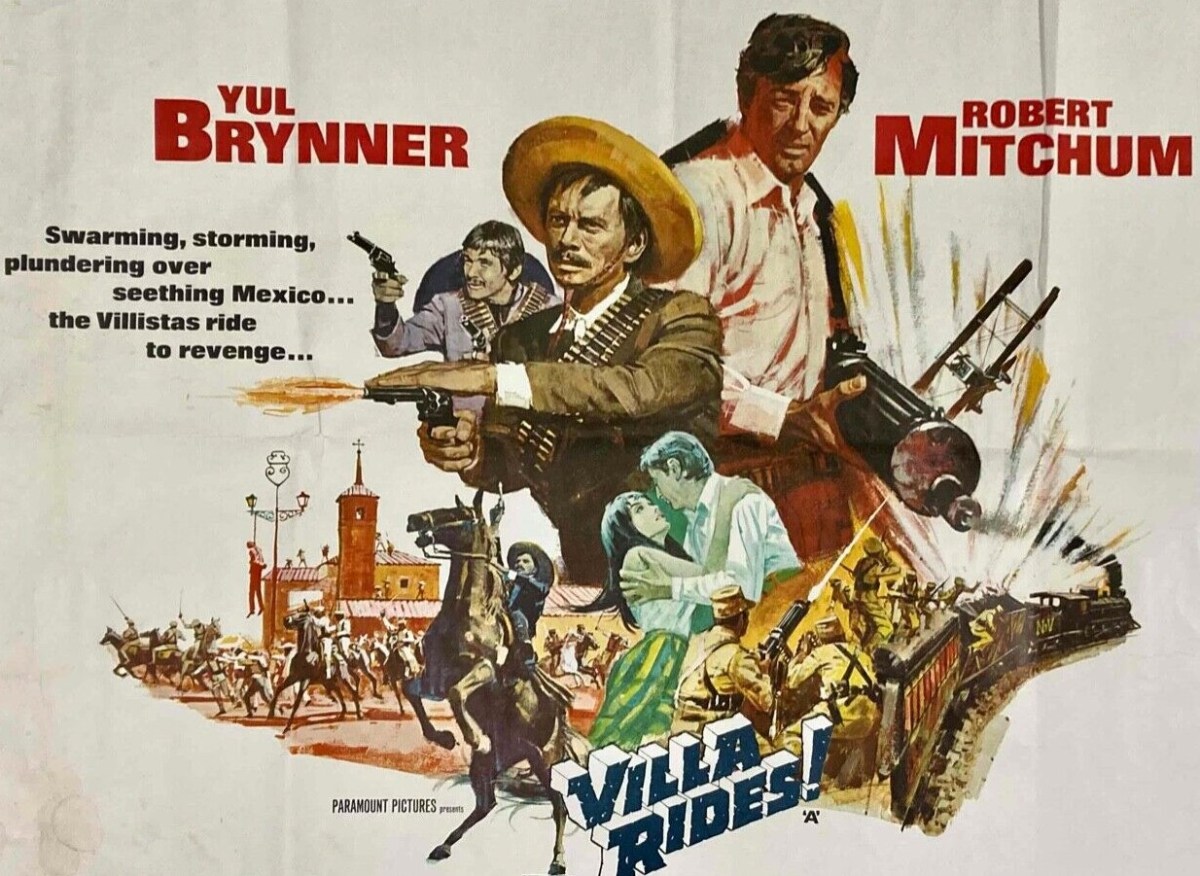
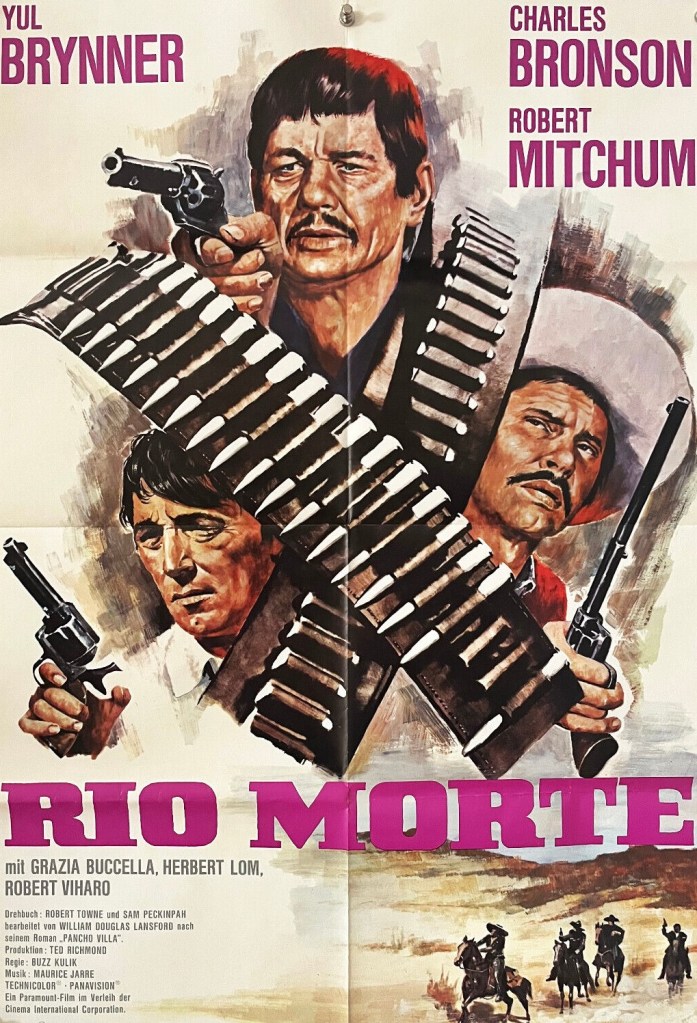
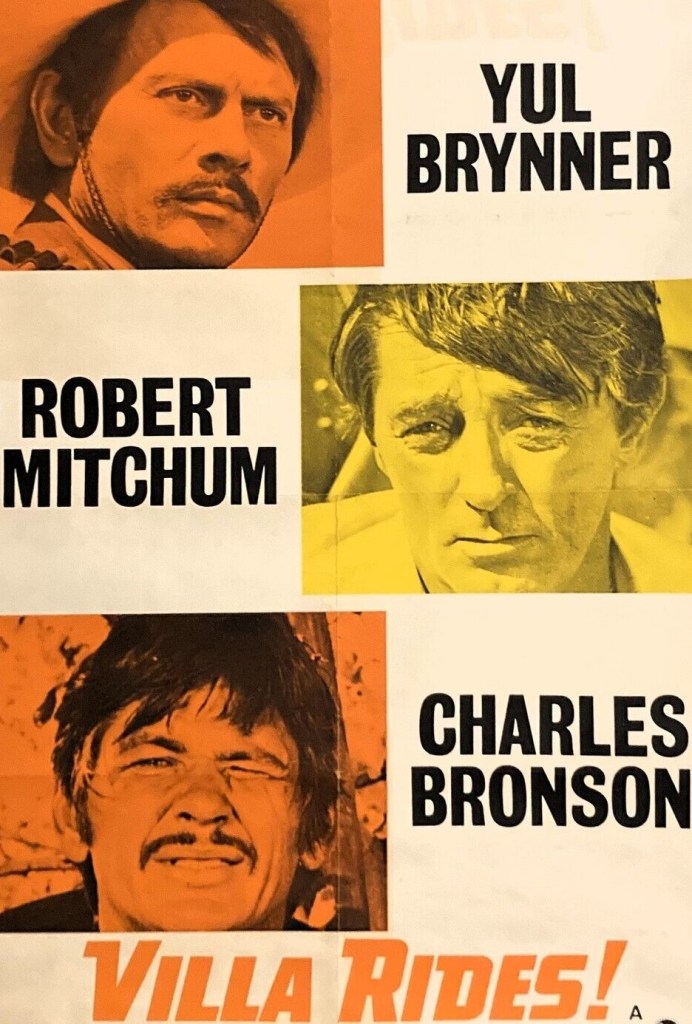
Villa Rides (1968) ***

Best viewed as Charles Bronson’s breakout movie. Yes, he had played supporting roles in The Magnificent Seven, The Great Escape and The Dirty Dozen, but these had all been versions of the same dour, almost monosyllabic, persona. Here, though somewhat ruthless, he steals the show from the top-billed Robert Mitchum and Yul Brynner with many of the best lines and best situations with an extra slice of humor (make that first-ever slice of humor) to add to the mix. He is the most interesting of the three main characters, in part because he does not have to spout any of the “good revolution/bad revolution” dialog that falls to the other two.

Villa (Brynner) is fighting the Colorados but his superior General Huertas (Herbert Lom) is planning to overthrow President Madero (Alexander Knox). Mitchum is an aeronautical gun-runner from El Paso, initially against the revolutionaries, stranded in Mexico when his plane breaks down. He has just about time to romance a local woman Fina (Maria Grazia  Buccello) before the Colorados arrive, take over the village, start hanging the leaders and raping Fina. Villa saves them, Bronson slaughtering the Colorados with a Gatling gun on the rooftop. Faced with the one-man firing squad that is Bronson, Mitchum turns sides. His plane comes in handy for scouting the enemy, then bombing them.

The actions sequences are terrific especially Villa’s attack on a troop train. To get Villa out of the way, Huertas puts him in the front line in a suicidal attack on a heavily-defended stronghold which turns into another brilliant set-piece with cavalry charges.  The plot is constantly interrupted by politics of one kind or another and comes to dead stop when Villa is arrested by Heurtas and Villa demands a proper trial. It’s kind of hard to take when a murdering bandit, no matter how legendary, decides that he has been hard done by.

That aside, there are interesting attempts to build up his legend. He doesn’t want power for himself, but to give it to the people, although he has sat back and let the first village be attacked so that the people there learn to hate the Colorados enough to join the fight. There’s not really any good guys – Brynner and Bronson are stone-cold killers, Mitchum a mercenary. But Brynner does marry Fina in order to prove that a raped woman should not be treated with dishonor, though he has a tendency to marry other women as well.

Bronson’s unusual one-man firing squad involves him laying on the ground with a pistol in each hand and giving prisoners the opportunity to escape before he shoots them. After all that hard work, he bathes his hands. Then he decides he can kill three men with one bullet, lining them up exactly so he can drill them all in the heart. But he’s also the one who shoots a molester in a cantina, then delivers the classic line: “Go outside and die, where are your manners?” He is at the heart of some well-judged comedy – continually sending back his meals and trying to get out of getting into a plane with Mitchum. Without him, there would be too much justification of slaughter (Brynner) and arguments against (Mitchum). This is the first time in the kind of action role that suits him that he has an expanded characterization.

Brynner did not like Sam Peckinpah’s original script so Robert Towne (Chinatown) was brought in to present Villa in a more appealing light. Bronson (Adieu L’Ami/Farewell Friend, 1968) shows hints of the screen persona that would so appeal to the French. Yul Brynner (The Double Man, 1967) adorns his character with many shades of grey, but Robert Mitchum (Secret Ceremony, 1969) has less to do.  Buzz Kulik (Warning Shot, 19660 has great fun with the action, less fun with some of the turgid dialog-ridden scenes.   

Good for action and Bronson.

The Light at the Edge of the World (1971) ***

Had me at pirates! Unfortunately, I feel suckered. These scumbags, even with a dandified Yul Brynner (The Double Man, 1967) at the helm, give the traditional swashbuckler a bad name. That said, it’s a decent Rambo-esque adventure, derived from a Jules Verne novel, that sees Kirk Douglas (A Lovely Way To Die, 1968) single-handedly take on the venomous pirate crew, with Samantha Eggar (The Collector, 1963) thrown in as lure.

Ex-gold-miner Denton (Kirk Douglas) runs the southernmost lighthouse off the perilous coast of Argentina leading to the dreaded Cape Horn passage, the only route round South America prior to the opening of the Panama Canal. Helping him out are veteran seaman Capt Mortiz (Fernando Rey), who constantly upbraids Denton for his lack of naval lore, and young lad Virgilio (Jean Claude Drouot) and his pet monkey. When a ship hoves into view and anchors off-shore, Mortiz and Virgilio head up the welcome party only to be ruthlessly – and gleefully – cut down as they climb on board.

Pirate chief Kongre (Yul Brynner) has come up with a neat scam. Switch off the whale-oil-fuelled lights in the lighthouse, wait for unsuspecting ships to be wrecked and pocket the proceeds. After being tormented and humiliated, Denton manages to escape and hide out in the caves, but only for as long as Kongre, bored with idleness, decides to hunt him down astride his white horse armed with a unicorn-like sword, the lighthouse keeper only avoiding capture by diving into the sea, where he is presumed drowned.

But when the first victim of Kongre’s scheme breaks asunder, Denton rescues Montefiore (Renato Salvatore) from the ensuing sadistic massacre. The only other person saved, at Kongre’s behest, is the beautiful Arabella (Samantha Eggar), for whom the captain goes through an almost courtly charade before, espying photographs in the lighthouse cottage, deciding that since his captive bears some resemblance to Denton’s former lover he could inflict further torment to Denton by parading the woman, hoping to use her as lure to bring his enemy out from his hiding place.

While Denton has escaped capture and is carrying out guerrilla warfare against the invaders he’s not particularly successful, given he lacks any decent weaponry, is heavily outnumbered and Kongre is pretty cunning. Denton’s innate decency sees him attempting to rescue the girl only, in a stunning twist, to be knocked back as he has little to offer except hiding out in caves and the captain has been treating her royally. Unfortunately for her, when his ruse fails, Kongre tosses her to the sharks in the shape of the lusty crew who proceed to commit mass rape. Meanwhile, Montefiore has been captured, strung up in the rigging and is being flayed alive, slices of skin torn from his body to the delight of his captors.

As it happens, the pirates, to reinforce defence of the island should they themselves come under attack from the British or Argentinian Navy, have brought their ship’s cannons ashore. As it happens, not only are they trained on the ship, but Denton, despite no experience at all, proves an ace artillery commander. As the ship burns and sinks, he turns his attention to Kongre, conveniently swanning around in the lighthouse rather than the cottage, and in a piece of savage irony sets fire to the building with whale oil.

Could do with shaving 20 minutes off the running time, and certainly have to suspend disbelief at other points, but otherwise it’s a pretty early edition of the Rambo-style revenge, the one-man army that can wipe out a superior force. Despite my desire for a decent swashbuckler, the pirates are probably more realistic than anything served up by Errol Flynn or Johnny Depp, and their cruelty seems consistent with their profession. The scenes with Denton being pursued relentlessly by the mounted Kongre are especially effective as is the rejection of Denton by the snooty girl.

Kevin Billington (Interlude, 1968) directed from a screenplay by wife Rachel and Tom Rowe (The Green Slime, 1968).

Long-lost film that deserves an audience.

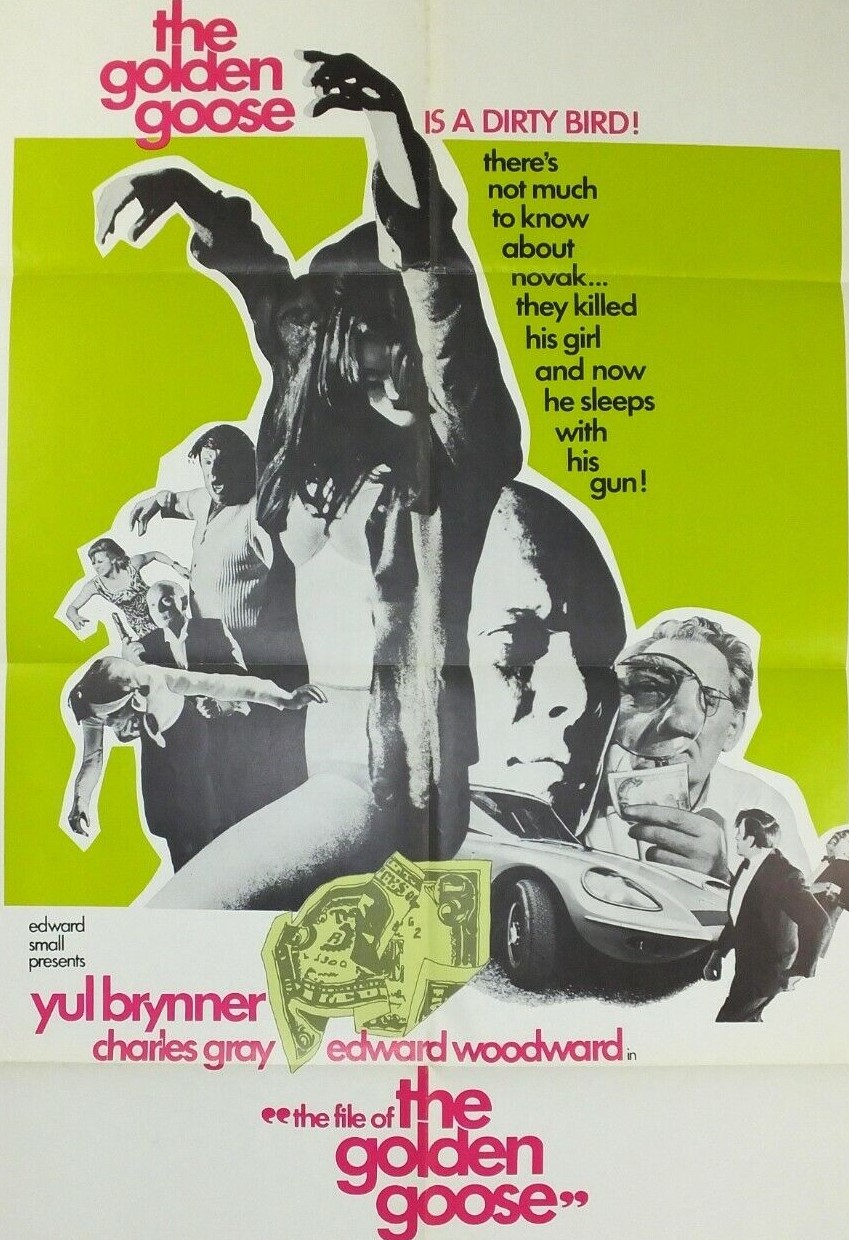
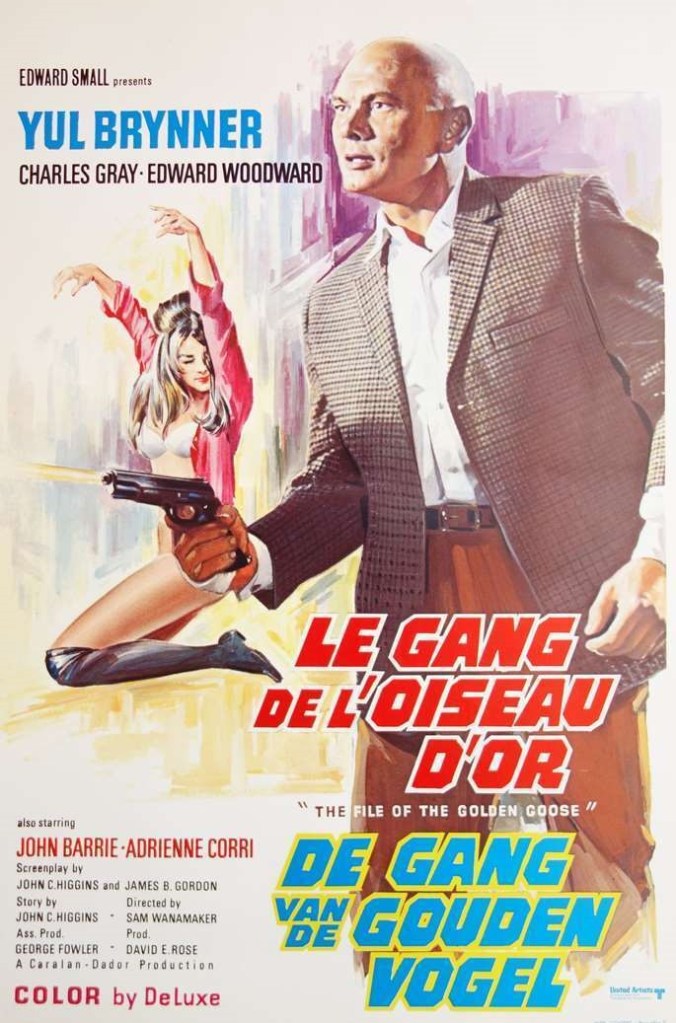
File of the Golden Goose (1969) **

A dud. Not even Yul Brynner, whom I pumped up as under-rated yesterday in Escape from Zahrain (1962), can save it, nor a camped-up Charles Gray (The Devil Rides Out, 1968). Takes too long to get started, meanders all over the place while suspension of audience disbelief breaks new ground.

The first ten minutes or so via voiceover are wasted telling us stuff that one character could deliver in a single line. That is, there’s a worldwide counterfeit operation in place and London is the next target. Hence, American Treasury Agent Novak (Yul Brynner) being seconded to Scotland Yard where he is saddled with ineffective British sidekick Thompson (Edward Woodward).

For no particular reason, they head off to Liverpool where they attempt to infiltrate the gang. The mobsters are so dumb they fall for their lame story, though without first giving them routine warehouse work (cue montage of the pair falling asleep on the job and doing the wrong thing). Novak, it has to be said, is pretty slick at avoiding any traps, cleverly talking himself out of dodgy situations, pinning any blame on whoever is convenient.  

But, eventually (thank goodness), they reach London. And if you have been waiting virtually the whole movie with bated breath for the appearance of female lead Adrienne Corri (Africa Texas Style, 1967)  you can stand easy for now she turns up as ostensibly the gangster queen-pin.

The journey to here is enlivened by hitman Smythe (Graham Crowden), as English as they come, bowler hat and all,  whose weapon of choice is a blade embedded in a walking stick, and The Owl (yep, The Owl, played by Charles Gray) with every fetish under the sun whose presence seems to demand an orgy.

By the time you get to the final shoot-out you couldn’t care less. With a bit more care and attention to detail, this could have been a reasonably thrilling picture. Novak is two-fisted enough to cut the mustard, and naturally treats the English cops as dumb-as-they-come, what with their lily-livered aversion to weapons. Surprisingly, Thompson takes to mobster life and quite enjoys dishing it out in a most un-English fashion.

There’s quite a nice twist when the chief counterfeiter leads Novak into a soundproof vault because he can’t be overheard spilling the beans on his colleagues and seeking witness protection.   

But the movie appears to have been not made for a contemporary audience. Given Lee Marvin has reinvented the movie tough guy in Point Blank (1967) and Clint Eastwood the hardnosed cop in Coogan’s Bluff (1968), Novak doesn’t come close, and since British gangsters are slick enough to pull off Robbery (1967) and The Italian Job (1969), it seems the criminals here have lived a very sheltered life.

There’s not even the old reliable comedic standby of American fish out of British water, such as occasionally helped along pictures like Brannigan (1975). In fact, all the humor rests upon the dry-witted Owl.

Television director Sam Wanamaker (Catlow, 1971) makes his movie debut. John C. Higgins (Impasse, 1969) wrote the screenplay along with Robert E. Kent (The Fastest Guitar Alive, 1967).

For Yul Brynner completists only.

Hard to find, but Talking Pictures has this, but only until Dec 10. Strangely enough, I can’t see any rush.

https://www.tptvencore.co.uk/Video/The-File-of-the-Golden-Goose?id=8a918a69-adf1-4db0-938c-921eaa6494e9

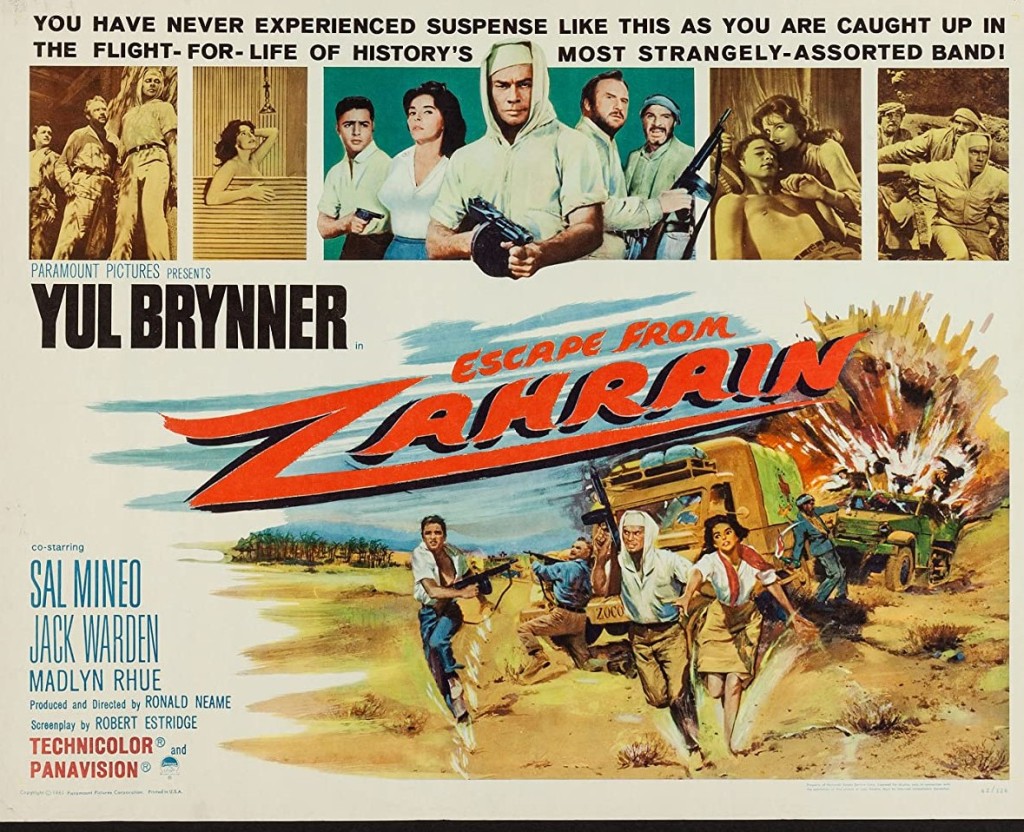
Escape from Zahrain (1962) ***

After being attacked by armored cars and strafed by airplanes, stranded in the desert, and overcome various tensions within the small group of escapees, there is still considerable life left in this picture at the end as Jack Warden, making his departure, comes up with a classic last line: “We must do this again sometime.”

In truth, the picture has far more going for it than a mere outline would suggest. In rescuing rebel leader Sharif (Yul Brynner) from a lorry bound for jail, the escapees led by Ahmed (Sal Mineo (Exodus, 1960) in a stolen ambulance also scoop up three convicts including American fraudster and loudmouth Huston (Jack Warden) and all-purpose thug Tahar (Anthony Caruso) plus nurse Laila (Madhlyn Rhue) as a hostage. Like most stranded-in-the-desert films, the storyline is on who will survive and how.

Action is one constant. The threat of failure is another. Supplies are rationed and, of course, someone steals more than their fair share. The members regularly switch allegiance. At various points someone is about to give up Sharif. Their gas tank is punctured so, thanks to Huston’s engineering skills, they just make it to a remote pumping station where they encounter maintenance man (James Mason in an uncredited cameo). Their numbers diminish and despite his recalcitrance Huston’s engineering skills save them again when they reach an oasis.

What makes the film different is that the characters all change. In a country where “half the wealth is stolen by Europeans and half by corruption,” Sharif is the altruistic leader whose ideals are shattered. Laila,  a Muslim, drinks alcohol and questions the number of deaths necessary for a revolution but declines to leave when the opportunity arises. Ahmed who thinks “women should be as free as men” reacts badly when Laila enjoys such freedom. Huston, who has embezzled $200,000, and has loyalty to no one stands by the shambolic crew.

I had always believed Brynner had enjoyed a rare case of beginner’s luck when he won the Oscar for his debut in The King and I (1956) and that once Hollywood became wise to his acting schtick he would never be nominated again – as proved the case. But after watching Brynner in The Magnificent Seven (1960) and its sequel and Invitation to a Gunfighter (1964) and Flight to Ashiya (1964) I have become convinced he is under-rated as an actor. He acts with his eyes and his delivery is far more varied than I had supposed. Here, clothed in Arab costume, there is no bald pate to distract. 

Sal Mineo (Exodus, 1960) can’t compete in the acting stakes with the canny Jack Warden (Blindfold, 1966). Anthony Caruso (a television regular) is lost in the mix but Madhlyn Rhue (A Majority of One, 1961) certainly looked a good prospect.

British director Ronald Neame (Tunes of Glory, 1960) holds the enterprise together, keeping to a tidy pace but allowing tension and character to emerge. Screenplay was courtesy of Robin Estridge (Eye of the Devil, 1966) based on the Michael Barrat novel and with an injection somewhere along the line by Dudley Nichols (Heller in Pink Tights, 1960).

Tight script, taut direction.

https://amzn.to/3Td6m1d

Discover WordPress

A daily selection of the best content published on WordPress, collected for you by humans who love to read.

The Atavist Magazine

by Brian Hannan

WordPress.com News

The latest news on WordPress.com and the WordPress community.