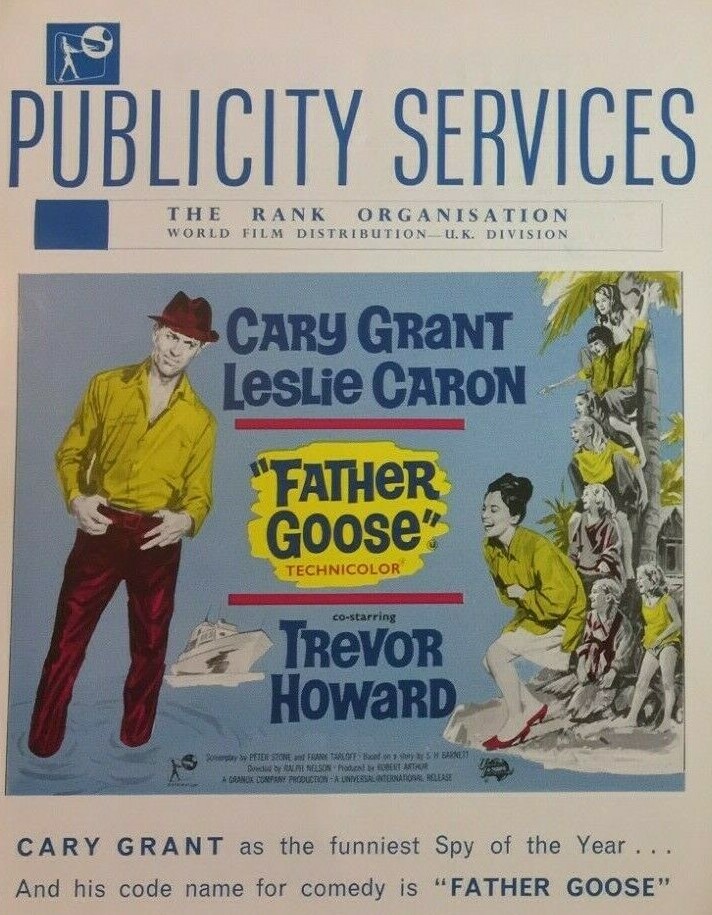
The African Queen with kids or 100 ways to see Cary Grant deflated. The penultimate movie in the screen giant’s career is a tame affair especially after the thrilling Charade (1963) and it may have prompted him to shy away from attempting to carry on a romance with a woman decades younger as occurs in his final offering Walk, Don’t Run (1966). When Trevor Howard (Von Ryan’s Express, 1965) effortlessly steals the picture with a performance that turns his screen persona on its head, you can be sure it’s not quite top notch.
In World War Two, Walter (Cary Grant), a hobo on water with a knack of stealing official supplies, is commandeered by British officer Houghton to operate a radio outpost on a Pacific island giving early warning on Japanese aircraft sorties. While there, he encounters Catherine (Leslie Caron), a French schoolmistress and consul’s daughter, in charge of a pack of female schoolkids.
Effectively, both relationships follow a pattern of verbal duels, initially with Walter losing them all as he is kept on a leash by Houghton and then is beaten by teacher and children. The kids steal his hut, his bedding, clothes (shredded and sewn to fit young girls), food, booze and sanity.
The straight-laced Catherine is happiest when straightening a picture. Walter only regains some of his standing when it transpires he has practical skills like catching fish, repairing a boat and encouraging to talk a girl who has been traumatized by war into temporary dumbness. Naturally enough, any time Leslie warms to him he does something off-putting. But gradually, of course, they get to know each other better, romance is in the air, and secrets are revealed, his hidden past laughable.
It’s a series of set pieces, designed to make the most of Cary Grant’s deftness with physical comedy, he can pull faces with best of them and long ago mastered the double take and the pratfall. So there’s little here you’ve not seen before. And the trope of man and woman trapped on a desert island – most recently probably best exemplified given its inherent twist in Heaven Knows, Mr Allison (1957) – has long been over-used and this addition to the sub-genre suffers from lack of originality.
The little blighters are less an innovation than a complication (or perhaps a multiplication) but they do have the advantage of reducing him to impotence, since he can hardly deal with their transgressions the way he might Catherine. And of them is smart enough to realize that he runs on booze and rations this out.
All in all it’s gentle stuff, nothing too demanding, redemption neither an issue nor an option. Cary Grant is an unusual species of top star in that, as with Rock Hudson and a few others, he didn’t mind being the butt of all the jokes, and in some respects sent up his screen persona.
Keeping Cary Grant in check might well be a sub-genre of its own, so Leslie Caron (Guns of Darkness, 1962) is inevitably limited in the role, primarily a foil/feed for the Grant, the part not not quite of the caliber of the roles played by actresses in his thrillers such as like Grace Kelly (To Catch a Thief, 1965), Eva Marie Saint (North by Northwest, 1959) and Audrey Hepburn in Charade.
As I mentioned, Trevor Howard is the surprise turn, and steals the show. Ralph Nelson (Soldier Blue, 1970) directs from s script by Peter Stone (Charade), Frank Tarloff (The Double Man, 1967) and S.H Barnett, a television writer in his only movie. I’ve clearly under-rated the script because it collected the Oscar.
Perfectly harmless and enjoyable, if a tad obvious.
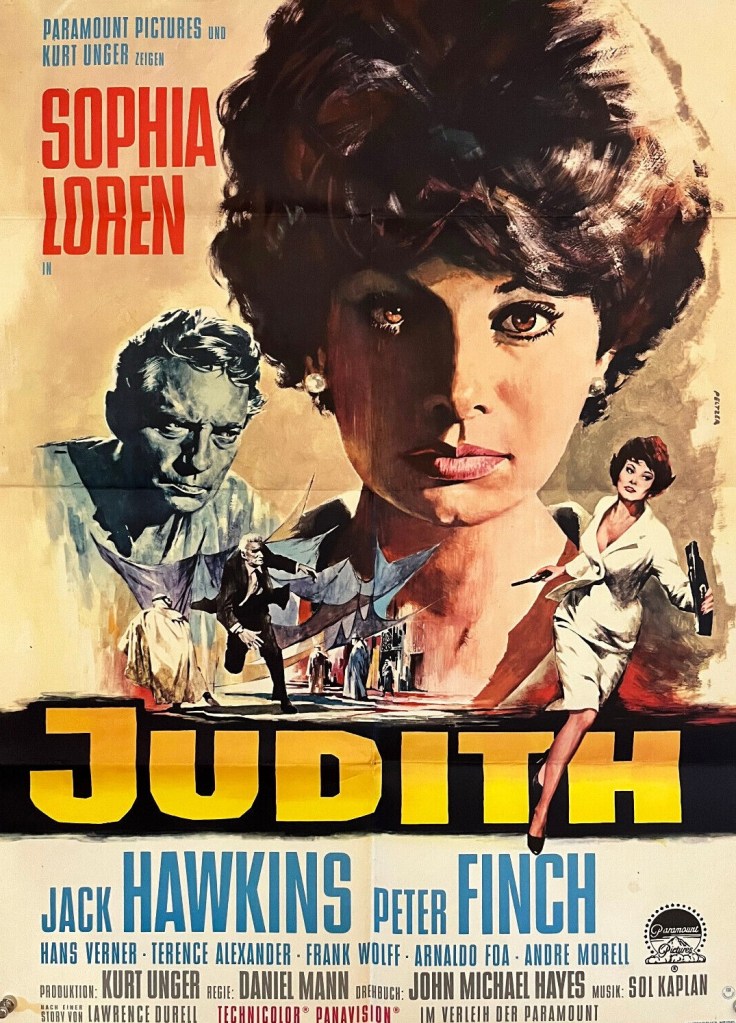
This is why you hire Sophia Loren. In the middle of a complicated story she provides the emotional anchor.. And she can do it without words. A few close-ups are all you need to guess at her inner turmoil in a world where, as with Play Dirty (1968), the individual is disposable. The good guys here, Israelis fighting for survival at the rebirth of their country, are every bit as ruthless as the commanding officers in the World War Two picture.
And it’s just as well because the tale is both straightforward and overly complex. Like Cast a Giant Shadow, out the same year, or the earlier Exodus (1961), it’s about the early migrants staving off Arab attempts to destroy the tenuous foothold Jewish immigrants on the land with the British, stuck in the role of maintaining law and order, cracking down on illegal landings of refugees and arms smuggling. But where the earlier movies take the war to the enemy, this is all about defence, holding on to hard-won positions.
Israeli leader Aaron (Peter Finch) discovers General Schiller (Hans Verner), a former German WW2 commander wanted for war crimes, currently in charge of the Arab tank regiment, is planning imminent assault. After locating Schiller’s wife Judith (Sophia Loren), he smuggles her into Israel with the intention of using her as bait to kidnap the general.
This would be no romantic reunion. The general had abandoned his wife, a Jew, and she spent the war in Dachau where she survived as a sex worker. She wants nothing more than revenge. But it takes a fair while for the cloak-and-dagger elements to warm up. First of all she has to seduce British Major Lawton (Sophia Loren) into revealing details of her husband’s whereabouts.
Turns out Lawton is the only principled official on show, out of general decency and a British sense of fair play (unlike the soldiers, for example, in Play Dirty) turning down the offer of her body in return for his aid. But it also transpires that Judith also lacks any notion of fair play and stabs her husband at the first opportunity, making it virtually impossible for his captors to discover the specifics of the planned attack. You wouldn’t need much of a sense of irony to share the Israeli anger when uner interrogation the captured general tosses back at them the Geneva Convention.
Judith’s involvement in the hunt for the general had the potential to be a very fine film noir on its own, especially had the wife been required to show willing to the husband in order to lure him out into the open.
Unfortunately, that’s not the tack the movie takes. Instead, we follow a series of forgettable characters either espionage agents, or at the kibbutz or effectively just there in passing, on the edge of the action, even when they might be in the heart of the real action either being unloaded into the surf or under attack from Arabs. There’s a sense of trying to cram too much historical incident into what would have worked best as a straightforward thriller. How far would Judith go to extract revenge? And, can Aaron stop her ruining his delicately-balanced plans?
Plenty of room for maneuver too on the sticky point of country vs individual. Where Aaron is happy to sacrifice or exploit Judith to satisfy his agenda, albeit to the greater glory of his country, so, too, is Judith unwilling to surrender her individuality for that more beneficial cause.
So what we get is a riveting mess. When Sophia Loren (Operation Crossbow, 1965) is onscreen you can’t take your eyes off her. When the action switches to the sub-plots, you keep on wondering where she’s got to and when will she next turn up. Judith is a fascinating character, batting away contempt about the way she survived the concentration camp, arriving in an old-fashioned cargo container with the corpse of a companion who failed to last the journey, and before long sashaying through the kibbutz delighted to attract male attention.
Yet, despite the hard inner core, and keeping one step ahead of both Aaron and Schiller, as if she had long ago stopped trusting men, she is emotionally vulnerable and proves easily manipulated when either pierces the carapace.
That director Daniel Mann feels duty bound to attempt to tell the bigger story of the Israeli struggle is somewhat surprising since he was best known as a woman’s director. Under his watch both Shirley Booth and Terry Moore were Oscar-nominated for Come Back, Little Sheba (1953), both Susan Hayward and Anna Magnani Oscars winners for I’ll Cry Tomorrow and The Rose Tattoo, respectively.
John Michael Hayes (Nevada Smith, 1966) cooperated with Lawrence Durrell (Justine, 1969) on the screenplay.
Hungarian Andre de Toth’s somewhat cavalier career had become ultra-cavalier during the 1960s. Best known for westerns such as Ramrod (1947) with Joel McCrea, Springfield Rifle (1952) starring Gary Cooper and The Indian Fighter (1955) headlined by Kirk Douglas plus House of Wax (1953), he was not, you might have imagined, riding high in the critical stakes. Hollywood considered him a journeyman. Esteemed French magazine Cahiers du Cinema, which had championed Hitchcock in the face of mainstream indifference, believed otherwise and interviewed him for a 1967 issue.
He might have been the name of everyone’s lips for more hard-won commercial reasons had attempts in the late 1950s come to fruition of filming the Ian Fleming portfolio beginning with Dr No. Instead, he was deemed a spent force and during the ensuing decade limited to only four films: Man on a String (1960) and the Italian-funded Morgan The Pirate (1960), The Mongols (1961) and Gold for the Caesars (1963).
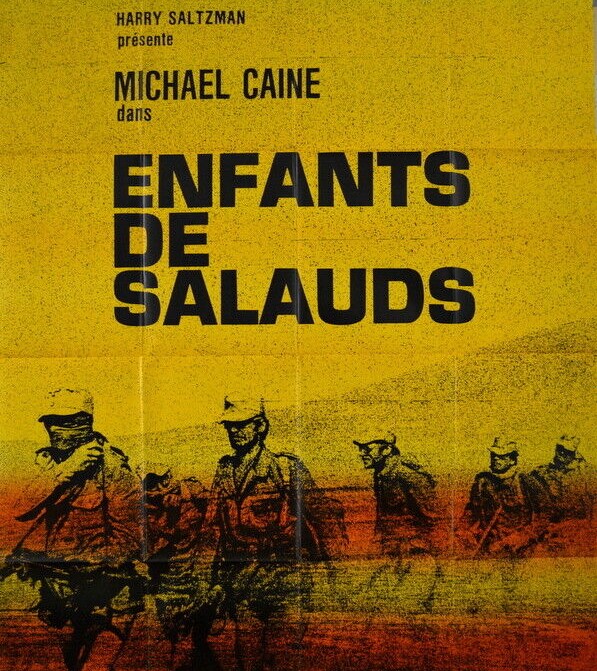
The Fleming enterprise had put him into the orbit of Harry Saltzman which led to a producing gig on Billion Dollar Brain (1966). Saltzman was also involved in The Deadly Patrol – the basis of Play Dirty – with French director Rene Clement (Rider on the Rain, 1970). According to de Toth, Saltzman wanted to elevate himself in movie circles. He “looked down on the Bond pictures” and wanted to make more serious movies.
And the pair clashed on style. “Genteel Rene wanted to make ‘a poetry of war.’ Harry wanted blazing guns and roaring tanks.” Saltzman feared Clement’s version “was going to be some kind of art movie.”
Play Dirty was originally set to be shot in Israel – even though insurance was impossible – as a favor to Arthur Krim, head honcho at United Artists which was providing the finance. In the end filming was switched to Spain, even though neither Saltzman nor Clement was familiar with the terrain of Almeria, and the reality fell far short of the Lawrence of Arabia landscape both envisaged.
De Toth, by now part of the Saltzman entourage, was again assigned production duties with a new script to be written by de Toth, John McGrath (Billion Dollar Brain) and Melvyn Bragg (Isadora, 1968) as long as the credits made room for Lotte Colin, Saltzman’s mother-in-law. Shuttling pages to Saltzman, de Toth had little conviction the revised screenplay was being passed on to the Frenchman.
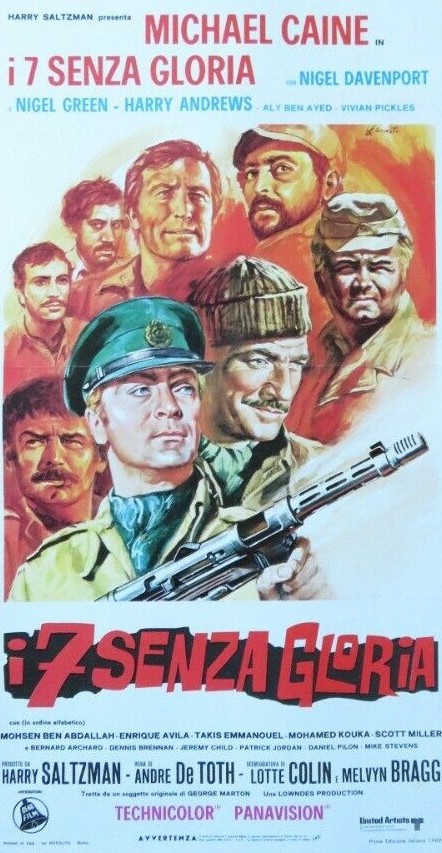
Michael Caine, already contractually committed, was keen to make a movie “good, bad or indifferent” with Clement. Richard Harris, on a salary of £150,000, pulled out of the role of Capt Leach after script rewrites eliminated four of his major scenes. “I wasn’t going to play second fiddle to Caine,” raged Harris. (Nigel Davenport, originally in a supporting role, was upgraded to take his place). Caine didn’t like the script. But it was either go ahead or Saltzman lose out on all the money already spent. Sets were built with still no guarantee from Clement that he would actually turn up.
The inducement of receiving the final chunk of his salary, payable on completion of the picture, did the trick. At first Clement appeared fully committed, altering the script, and “observant and meticulous about details.” But soon mere tinkering escalated into demanding to “revamp the set, find new locations maybe in North Africa; in short, shoot another film.” When de Toth turned up on set, Clement vanished. Then the director went sick but refused to admit a doctor to his hotel room. A three-day enforced hiatus ended after De Toth was subjected to a barrage of abuse down the telephone by Saltzman and then instructed to get on the set and start shooting.
“It was a strange way to get the directorial assignment,” noted de Toth. “I would have been a hypocrite to deny I wasn’t happy. I had wanted to do a story like Play Dirty since I had wallowed in the blood of futility in Poland.” But that combat experience came in handy. “I had learned in Poland how to crawl under barbed wire with fishhooks dangling on it and if you were caught and the tin cans rattled you had no chance to start your last prayer.” De Toth’s acquaintance with the realities of war inform the film. Location manager Andrew Birkin, brother of actress Jane Birkin, described de Toth as “more of a sergeant-major and he made the picture that way which was probably the right way to do it.”
“Michael Caine was probably more disappointed than I and I understood him and his resentment of the film. He felt uncomfortable, insecure, in the film without Clement, which made his portrayal in Play Dirty so remarkable, considered by many one of his very best…My respect for his professionalism grew as we drilled.”
Unexpectedly in the desert, rain came to the aid of the already hard-pressed production. The downpour turned the sand into a flower garden. Shooting was postponed for two weeks allowing the cast and crew to bond and iron out the script.
Since the beginning of the decade Almeria, decidedly smaller than it usually appeared, was a an in-demand location, favored by King of Kings (1961), El Cid (1962), Lawrence of Arabia (1962), Cleopatra (1963) and, following the success of A Fistful of Dollars (1964) hugely popular for westerns. The local authorities had regulations in place regarding usage, limiting employing of the sand dunes made famous by Lawrence of Arabia. “You got them for two weeks because another picture was coming in.” Even so, competing movies often got in each other’s way.
Michael Caine recalled that one scene requiring German tanks to advance over the desert sands were “confronted round one of the dunes by a horde of American Indians in full battle cry in pursuit of a nineteenth-century stagecoach” for the western Shalako (1968). The noise of the tanks made the horses rear up, throwing off their riders, and the war picture production was delayed while all evidence of the western, including, of course, mounds of horseshit, were cleared away.
Caine remembered the experience more for the opportunity to meet Brigitte Bardot, the female lead on Shalako. One afternoon his peace was disturbed by the arrival of Bardot who uttered the immortal words, “I have been looking for you everywhere.” Caine leapt to his feet, knocking over a table of drinks.” Caine’s assumption that the French sex goddess had her eyes on him was wide of the mark. Instead, it was Bardot’s assistant, Gloria who was keen to make Caine’s acquaintance, the actor falling far short of Bardot’s taste in men, extremely young and very dark.
Despite disgruntlement about not working with Clement and over the picture in general, there was a happy ending for Caine. For his 35th birthday present, Saltzman presented him with an envlope containing his contract torn up into small pieces.” From being beholden to Saltzman, albeit his salary on a seven-year contract signed in 1965 was incrementally increased on an annual basis – the fee for The Ipcress File was just £6,000), Caine was now a free man.
Lotte Colin hated the end result and tried convincing Saltzman to shelve it – unlikely given the millions involved and the commitment to a distributor and not least because Caine’s name attached guaranteed audience interest . But she did succeed in removing elements of the Michel Legrand score. And she did replace de Toth on the screenplay credits.
Play Dirty disappointed at the U.S, box office bringing in a miserly $650,000 in rentals (the amount returned to studios once cinemas have taken their cut of the gorss). It did better overseas with $2 million in rentals. but since it cost $3 million it incurred a loss.
“Play Dirty” managed to offset some of its losses by being a regular on the reissue scene – though it would probably have been hired for a fixed fee rather than a percentage. It later showed up as the support to “Beach of the War Gods” (1973).
This proved to be de Toth’s last directorial assignment. But it might not have been. The bosses of new production shingle National General were ardent pacifists and wooed de Toth. Offered the choice of producing or directing western El Condor (1970) he chose the latter.
Nowadays de Toth is best described as a director’s director, an “unsung hero,” by the likes of Martin Scorsese who confesses to being “fascinated” by the “underlying anger and determination” that often makes the director’s movies “very disturbing.”
“Take Play Dirty for instance,” he observes. “The characters have no redeeming social value; they don’t think, they just act. They have a job to do and they’re going to do it. The nihilism, the pragmatism – it’s at least unsettling. Disguise becomes a way to survive that brings doom at the end.”
SOURCES: Andre de Toth, Fragments: Portraits from the Inside (Faber and Faber, 1996) p390-391, 399, 416,433-447; Michael Caine, What’s It All About? (Century, 1992) p247, 256; Michael Caine, From Elephant to Hollywood, The Autobiography ( Hodder and Stoughton, 2010) p142-144; Robert Sellers, When Harry Met Cubby, The Story of the James Bond Producers (The History Press, 2019) p182-184; De Toth on de Toth (Faber and Faber, 1997) p151, 158; “United Artists Corporation and Subsidiaries, Motion Picture Negative Costs for Pictures Released in the Year Ended January 3, 1970” (University of Wisconsin).
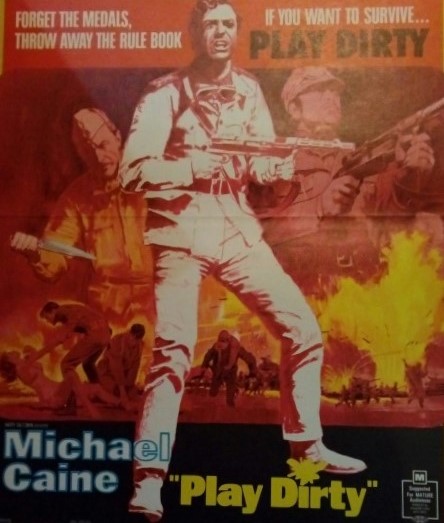
Heroism is a handicap in this grimly realistic, brutally cynical, ode to the futility of war. David Lean would have struggled to turn this stone-ridden desert into anything as romantic as his Lawrence of Arabia (1962) though he might have recognized the self-serving glory-hunting superior officers.
There’s a murkiness at the outset that is never quite clarified. You could easily assume that the long-range bunch of saboteurs led by Captain Leach (Nigel Davenport), with the peculiar habit of losing new officers, was involved in something more nefarious rather than doing its utmost to disrupt Rommel’s supply lines in North Africa during World War Two.
Brigadier Blore (Harry Andrews) appoints raw officer Captain Douglas (Michael Caine) to take charge of the next mission – a 400-mile trek to blow up a fuel dump. Col Masters (Nigel Green), in overall charge of the commandos, bribes Leach to ensure Douglas comes back alive. Blore is using this small unit as a decoy before deploying a bigger outfit to complete the mission with the singular aim of snaffling the glory for himself.
Leach proves insolently disobedient, forcing Douglas at one point to draw his weapon on his crew. But when it comes down to a question of heroism vs survival, Leach takes control at knifepoint, preventing Douglas going to the aid of the larger outfit when ambushed by Germans.
It’s mostly a long trek, somewhat bogged down by mechanics of desert travel. You’ll be familiar with the process of rescuing jeeps buried in sand dunes and of personnel sheltering from sandstorms, so nothing much original there. What is innovative is the terrain. Stones aren’t conveniently grouped together, edges softened by time, as on a beach. They’re jagged- edged and less than a foot or so apart so as to more easily shred tires. So there’s a fair bit of waiting while tires are replaced.
Some decent tension is achieved through sequences dealing with mines – threat removed in different fashion from Tobruk (1967) or, for that matter, The English Patient (1996) – and in crawling under barbed wire. But that’s undercut by the sheer brutality of the supposed British heroes slaughtering an Arab encampment and viewing a captured German nurse as an opportunity for rape.
A couple of twists towards the end raise the excitement levels but it’s less an action picture than a study of the ordinary soldier at war. Captain Douglas, the only character worth rooting for, soon loses audience sympathy by foolish action and behavior as criminal as his charges.
A few inconsistencies detract. For a start, there’s no particular reason to assign Douglas to this patrol. Primarily a backroom boy, he’s put in charge because he was previously an oil executive. But it hardly takes specialist knowledge to lob bags of explosives at oil drums. And the ending seems particularly dumb. I can’t believe Douglas and especially the canny Leach, both dressed in German uniforms, would consider walking towards the arriving British forces waving a white flag rather than stripping off their uniforms and shouting in English to make themselves known to the trigger-happy British soldiers.
And a good chunk of tension is excised by the bribery. Why not leave the audience thinking that at any moment the bloody-minded Leach would dispatch an interfering officer rather than offering him a huge bounty (£75,000 at today’s prices) to prevent it?
It suffers from the same affliction as The Victors (1964) in that it sets out to make a point and sacrifices story and character to do so. That individuals will be pawns in pursuit of the greater good or glory is scarcely a novel notion.
Having said that, I thought Michael Caine (Gambit, 1966) was excellent in transitioning from law-abiding officer to someone happier to skirt any code of conduct. There’s no cheery Cockney here, more the kind of ruthlessness that would emerge more fully grown in Get Carter (1971). Nigel Davenport (Life at the Top, 1965) adds to his portfolio of sneaky, untrustworthy characters. Equally, Harry Andrews (The Charge of the Light Brigade, 1968) has been here before, the kind of upper-class leader who behaves like a chess grandmaster.
In his first picture in half-a-decade Andre de Toth (The Mongols, 1961) produces a better result than you might expect from the material – screenplay courtesy of Melvyn Bragg (Isadora, 1968) and in her only known work Lotte Colin, mother-in-law of producer Harry Saltzman – and creates some exceptionally tense scenes and the occasional stunning image.
It wouldn’t be the first time that a director, disgruntled by his fee or some snit with the producer, was wrong in his summation. But John Frankenheimer’s pronouncement that it was “an absolute disaster from beginning to end” is only slightly off the mark. It only really comes apart mid-section when you discover what makes the British Lt. Commander Finchhaven (David Niven) anything out of the ordinary.
Up till then it resembles a decent enough riff on The African Queen (1951), the bearded Finchhaven perennially drunk though not wild-eyed and disorderly like Humphrey Bogart, and take your pick from Lt Krim (Alan Alda) or Jennifer (Faye Dunaway) as the character trying to keep him on the straight and narrow. Instead of being sharp-tongued, Jennifer is a sharp-shooter.
And if anyone’s in the habit of communing with God, it appears to be the British captain. And it’s a bit more upscale, Finchhaven in charge of a ship – the oddly named HMS Curmudgeon, which should give you a hint all is not fine and dandy – rather than a small steamboat.
But he’s stranded on a Philippine island towards the end of World War Two when rescued by four U.S. Marines who themselves have been uncommonly detached from their vessel during a lifeboat exercise in the fog.
But there is more than enough talent assembled to keep any seagoing yarn shipshape. You wouldn’t discount an immediate return to form, despite flopping with The Fixer (1969), by director John Frankenheimer, a huge name after The Manchurian Candidate (1962), Seven Days in May (1964) and Grand Prix (1966) though you might have worried a tad since comedy did not appear to be his forte.
David Niven, whose war movie credentials were still held in high regard after The Guns of Navarone (1961), had resurrected a fading career with unexpected hits The Impossible Years (1968) and Prudence and the Pill (1968) while Faye Dunaway was riding extremely high in Hollywood following the double whammy of Bonnie and Clyde (19670 and TheThomas Crown Affair (1968) and a pre-Mash Alan Alda was a rising star.
Cut off from contact with either British or American forces, and unaware of Hiroshima turning the tide in the Far East, Finchaven and Co (Krim has three buddies) set off in pursuit of the enemy. If anybody is the odd one out at this point in proceedings, you would put your money on Krim who is liable to fall overboard with every turn of the wheel.
But before they get anywhere near the kind of action that typified The African Queen or the later The Sea Wolves (1980 – also starring Niven), there’s the big reveal. Krim is puzzled that the captain never seems to eat and continues to drink constantly despite no sign of any obvious supplies, doesn;t require sleep or to launder his uniform. Krim would never get his detective’s badge, his suspicions are only really raised when he discovers an old photograph of the captain, dated 1914, and when Finchhaven’s empty whisky bottle miraculously refills.
Finchhaven is a ghost. Yep. Have you ever? Nope. The dumbest notion ever to set sail or be funded by a major studio. His back story is worth the price of admission alone if you have your heart set on the so-bad-it’s-good fraternity. He died, wait for it, at the start of World War One, when he fell overboard drunk on this very ship and is condemned, so it would appear, to a hellish life of captaining the ship.
Well, after that, you just couldn’t care less.
You might have already begun to get itchy feet by the constant barrage of newsreel or stock footage interjections, presumably offered as social and/or comic commentary, or perhaps to augment the length which stands at a very neat 80 minutes, somewhat short of the standard feature. Or the fact that after demonstrating her shooting skills, Dunaway gets nothing more to do.
On the plus side, which is still stretching it a bit, David Niven makes a believable ghost, not existing in an imaginary world of his own making, behaving in every way as a normal ship’s master. And Alan Alda gives glimpses of his somewhat unique screen persona. This might have worked on paper – the source is a novel by Phillip Rock – but Frankenheimer makes a pig’s ear of translating it to the screen.
I’m still toying with giving this a one-star review.
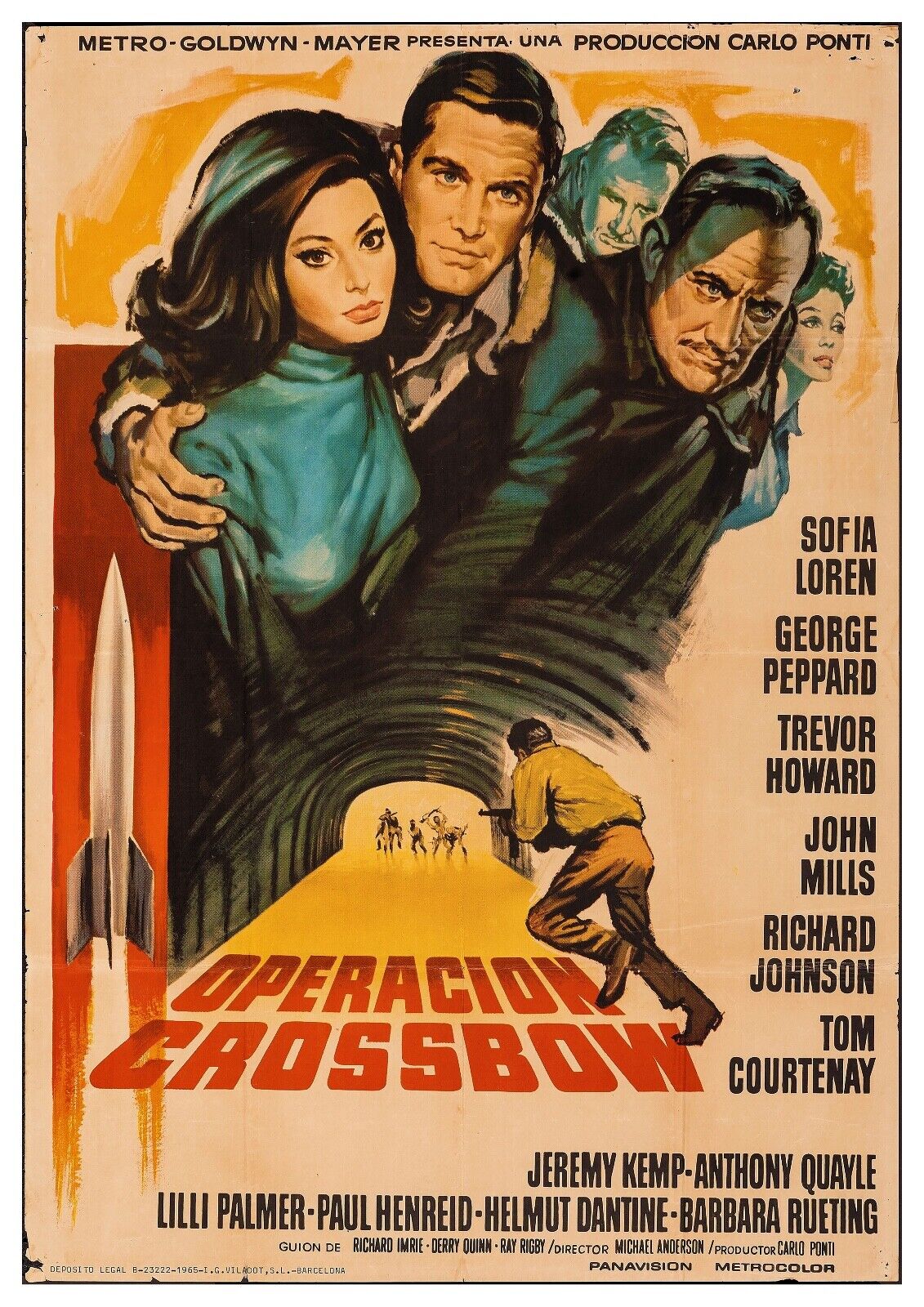
A clever mixture of detail and derring-do, World War Two picture Operation Crossbow (1965) – based on the true story of Allied infiltration of a German rocket factory – was a surprising hit at the British box office. The picture took a risk in keeping star George Peppard hidden from view for the first 28 minutes (top-billed Sophia Loren took nearly another 20 minutes to show up). Prior to their appearances the opening sequences were loaded up with a roll-call of British stars familiar with the genre in the vein of John Mills (Ice Cold in Alex, 1958), Trevor Howard (Cockleshell Heroes, 1955) and Richard Todd (The Dam Busters, 1955). Anthony Quayle, who puts in a later appearance, was also a war movie veteran after turns in Battle of the River Plate (1956), Ice Cold in Alex and The Guns of Navarone (1961).
Most war films relating to destroying a vital enemy base involved bombing (The Dam Busters, 633 Squadron, 1964), sinking (Sink the Bismarck!, 1962) or blowing things up (The Guns of Navarone, 1961). Operation Crossbow falls into the last-named category. The story breaks down into four sections: the discovery towards the end of the war by the British that the Germans are forging ahead with building V1 and V2 rockets; the recruitment and training of spies to parachute into Occupied France; a tense sequence abroad where complications arise; and, finally, attempts to obliterate the rocket plant.
Director Michael Anderson (The Dam Busters) switches through the genres from docu-drama to spy film to action adventure, further authenticity added by bold use (for a mainstream picture) of subtitles, all characters speaking in their native tongues. Various real-life characters are portrayed, among them photo reconnaissance expert Constance Babington Smith (Sylvia Sims), German aviatrix Hannah Reitsch (Barbara Rutting) and Duncan Sandys (Richard Johnson) who was on the British War Cabinet Committee.
Trevor Howard, at his irascible best, is the scientist pouring scorn on the idea of rockets – until they start raining down on London. Volunteers – Peppard, Tom Courtenay (Billy Liar, 1963) and Jeremy Kemp (who appeared with Peppard the same year in The Blue Max) – trained to spike the new weapon are recruited primarily on their language skills. Character is sketchy, Peppard designated a womaniser because he arrives in a taxi with two women.
But the operation has been assembled in such haste that not enough attention has been paid to the identities assumed by the agents. Courtenay’s character turns out to be wanted for murder. Peppard is accosted by his character’s divorced wife (Loren). So the mission faces immediate exposure. Although Loren’s role in terms of screen time amounts to little more than a cameo, she delivers a powerful emotional performance to a picture that could as easily have got by on tension alone. The harsh realities of war are shown in abundance. Twists come thick and fast in the second half, not least that Peppard’s face has become known, before the movie reaches a thrilling denouement.
Impressive vastly underrated whodunit that breaks all the rules. Take the length for a start – just stopping short of two-and-a-half hours. The investigation covers multiple time periods – 1942, 1944 and 1965. The killer outwits the detective. Most important of all, the murder is clearly a MacGuffin to examine politics among the German officer class.
A Polish woman who turns out to be a German agent is viciously stabbed to death in Warsaw in 1942 during a period of staunch resistance by the inhabitants. General Tanz (Peter O’Toole), sent in to quell a potential uprising, is one of three generals on the suspect list compiled by Major Grau (Omar Sharif), the others being the alcoholic General Khalenberge (Donald Pleasance) and the philandering General von Seidlitz-Gabler (Charles Gray).
But Grau is no ordinary detective or, put another way, this not an ordinary investigation.
Grau lacks any of the powers we associate with an investigator. Yes, we expect obstruction, perhaps collusion, as the murderer tries to avoid detection. But Grau might well have been a sergeant for the disdainful treatment and lack of cooperation he receives. And there’s a fair chance he’s going to be shot at as he prowls the streets, and resistance fighters in tenement exchange fire with the invaders. None of the generals can account for their whereabouts on the night in question.
While Tanz is benign to children, ordering a hungry bunch fed from his own supplies, he is ruthless with adults, willing to employ flamethrowers (Phase Two of his plan) to drive snipers out of buildings and if that fails move onto Phase Three which simply uses tanks to obliterate everything. Like some knight of old, Tanz stands upright in his jeep directing operations in full view of the enemy, almost taunting them to kill him.
The most powerful image in the film – the one used in the posters – has Tanz standing (on the right of the screen) upright in his jeep with the world on fire behind him. What’s edited out of the poster is that Grau occupies the left side of the screen, standing like a servant awaiting his master’s orders.
That Grau makes no progress at all is down to the power of his superiors. Since he commits the cardinal sin of getting in the way, he is just shuttled out of Warsaw, promoted to Colonel and given other duties in Paris. So the scene shifts to the Parisian capital in 1944 after D-Day. The same three generals are on duty in the French capital, not supervising, as you might expect, the defence of the city against the encroaching Allies, but planning an attempt on the Fuhrer’s life (Operation Valkyrie). This time it’s Tanz, returning from the Russian front where his regiment has been decimated, who is shuttled to one side, ordered to take two days leave so he doesn’t get in the way of the saboteurs.
At this point, the movie boldly switches perspective, in part to encompass the assassination subplot, in part to focus more closely on Army politics, in part to follow Tanz, not just an alcoholic but a poster boy for OCD, as he tries to enjoy some downtime. He is accompanied on his tourist trip through the city and jaunts to visit museums by his chauffer/butler Corporal Hartmann (Tom Courtenay) whose other duties include spying on the general on behalf of the plotters. Grau, meanwhile, recruits French Inspector Morand (Phillippe Noiret) to assist in his investigation, which is otherwise being obstructed on all sides.
I won’t reveal the shocking ending which shows just how clever the murderer is because that’s not actually the ending and the story shifts to 1965 when the generals have been rehabilitated after the war, the case still open because a third woman has been killed in the same fashion.
I may have seen this back in the day and certainly remember it vaguely from a pan-and-scan version edited for television, but I had generally avoided it because of the poor reviews. I wonder how many critics just found it in poor taste, to be spending big Hollywood bucks on a story that treated German generals as pretty well ordinary human beings, the war itself so much in the background you would think it non-existent. Plenty critics sniped at the performance of the principles, perhaps because Peter O’Toole (Becket, 1964) and Omar Sharif (Genghis Khan, 1965) played so much against type. The image I mentioned of O’Toole with the world ablaze is an ironic one, not charged with the glory of David Lean’s vision of the actor in Lawrence of Arabia (1962). Similarly, not once does director Anatole Litvak (Five Miles to Midnight, 1962) rely on Omar Sharif’s soulful brown eyes the way Lean did in Doctor Zhivago (1965), in fact there is no such shot here at all. Sharif looks weary and jaded, kept going in the face of obstruction by his own convictions about justice. O’Toole is so wound up he likes like he’s about to explode and at times certainly teeters off-balance.
Critics seemed so intent on dishing out barbs that they missed two excellent performances, Sharif , in particular, unable to call on his romantic side, delivering very fine work. Donald Pleasance (Soldier Blue, 1970), devoid of his usual physical tics, is also memorable. And there is so much to enjoy from the direction. Litvak, in particular, makes superb use of the tracking shot. Often a scene begins with a close-up, tracks back to reveals others, allows them to deliver their lines, then tracks back into the original character, usually the one with most to lose at this moment. He allows time to develop the other characters. Without ever appearing drunk in the way of Tanz, Khalenberg is always pouring or drinking a shot of alcohol. Seidlitz-Graber is inhibited by family politics as his wife (Coral Browne) attempts to ease their daughter Ulrike (Joanna Pettet) into high society.
I must also mention the brilliant score and the pithy lines that shoot out from cynical mouths. “Making up one’s mind is one thing,” observes Seidlitz-Graber acidly, “speaking it is another.” On hearing of the assassination plot, Grau points out, “when things were going well, the generals enjoyed the war as much as Hitler.” Music came courtesy of Maurice Jarre (Doctor Zhivago) and the screenplay was a joint effort between Joseph Kessel (Army of Shadows, 1969) and Paul Dehn (The Spy Who Came in from the Cold, 1965) who hacked away at the H.H. Kirst novel, retaining only the opening.
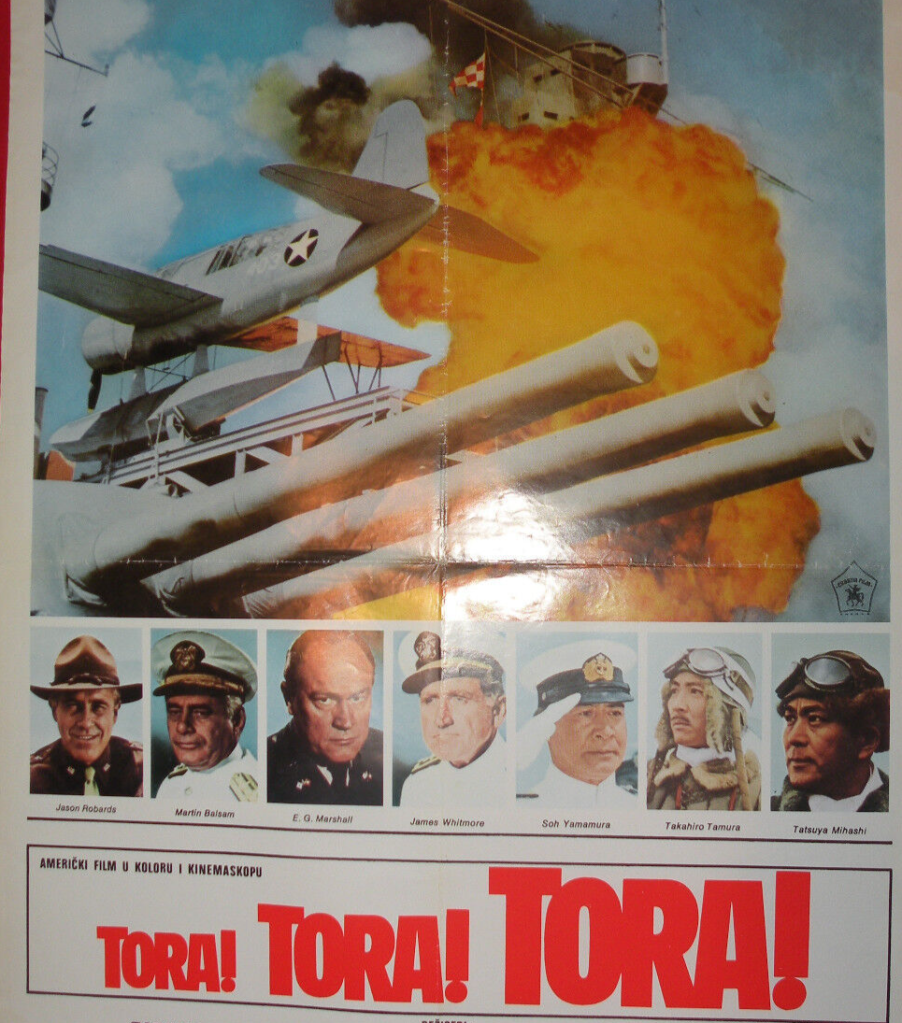
In cinematic terms director Richard Fleischer’s work on a Pearl Harbor project had begun in 1962, for a proposed movie called Zackary, the true story of an American spy living in Japan prior to the infamous attack. Fleischer signed a one-year contract with Dino de Laurantiis, the Italian producer behind the director’s previous movie Barabbas (1962). Italian screenwriters had a crack at the tale, then, in a foretaste of things to come, de Laurentiis turned to a Japanese writer whose idea of a screenplay was restricted to a document less than two pages in length. And so began one of the director’s periods in movie purgatory.
After Zackary was abandoned, Fleischer was put to work on four other concepts, none of which made their way to the screen. Worse, the pay-checks stopped coming and Fleischer sued Dino for a million dollars. Next up was The Nightrunners of Bengal from the bestseller by John Master for Samuel Bronston (El Cid, 1961). That, too, ended up in the courts.
If those rollercoasters weren’t enough, Fleischer revived his career with Fantastic Voyage (1966) and nearly sunk it with the financially disastrous Doctor Dolittle (1967), resuscitated his standing again with The Boston Strangler (1968) and dug another commercial hole with Che! (1969).
But he was the first port of call when producer Elmo Williams and his paymaster Darryl F. Zanuck, for whom Fleischer had made The Big Gamble (1961), decided on the biggest gamble in Hollywood history outside of Gone with the Wind (1939) and Cleopatra (1963). In some respects Fleischer was on board as makeweight. For the undeniable directorial star of the show was intended to be legendary Japanese helmsman Akira Kurosawa (Seven Samurai, 1954). Never mind that the vast bulk of the global paying public had never heard of him, let alone pronounce his name, Kurosawa undoubtedly represented a critical coup. American critics responsible for building appreciation of him in academic circles were unlikely to lambast him for working with Hollywood, especially as, in the even-handed manner of this project, Kurosawa would be telling the story of the attack on Pearl Harbor from the Japanese point-of-view.
In fact, it wasn’t so much one epic, as two parallel films, telling the tale from opposing perspective, edited together.
But just getting to the filming stage had required research of Cecil B. DeMille proportions. Dr Gordon Prang of Maryland University had spent years on the subject, interviewing every participant on either side. He broke down the research into a daily accounting of the year prior to December 7, 1961, and a second-by-second analysis of the day before the attack. Every incident used in the film came from this research.
The bigger problem was assembling a Japanese fleet. Only one destroyer remained of the Japanese World War Two taskforce. The rest had been sunk. To do the movie justice, Twentieth Century Fox had to someow conjure up – just from the Japanese side – six aircraft carriers and the 353 aircraft they transported plus another 27 vessels that made up the escort. Whether the U.S. Navy would have been keen on lending a hand, it wouldn’t be much help either in providing the necessary material since most of its fleet from that period had long since been mothballed.
A million dollars was spent on a set that comprised half a battleship that could float and be towed. The rest was miniatures, but given the scale, most of these would come in around the 40-foot mark. There were 19 Japanese miniatures and 10 American.
There were no Japanese Zero planes either. So 28 Vultee AT-6 aircraft were stretched six feet and adapted to resemble the Japanese plane. The production team raided the country for Flying Fortresses, P-40s and VT-13s that could serve the purpose if reconditioned. Dozens of vehicles from the era period were rescued from junkyards and repaired, restored and repainted.
Coordinating the work of the two directors was always going to be the main problem. How would the styles fit? For the scheme to work did one of Fleischer or Kurosawa have to assume supreme commander status? It didn’t help that neither could speak the other’s language. The few meetings held between the two directors were entirely about the Kurosawa section of the screenplay. To Fleischer’s astonishment, at the rather aggressive nudging of Elmo Williams, Kurosawa made concessions.
Fleischer came up with the practical solution to melding the two separate movies. His suggestion was: don’t do it. He intended showing the Americans as sloppy and overly-relaxed while Kurosawa wanted to emphasize the spit and polish of the Japanese Navy. The contradictory approaches would make each section appear such opposites as to make the entire production seamless.
Surprisingly, the studio won some cooperation from the U.S. government in the shape of the loan of an aircraft carrier. But such goodwill did not go unnoticed and the studio was forced to repay the Defense Department $515,000 for its use. But, in general, the Government was not inclined to cooperate, wanting paid for everything they supplied. Off-duty soldiers and sailors were received standard Hollywood fees to act as extras. Every piece of machinery had to be rented. Tugs, Elmo Williams soon discovered, were available only at extortionate cost.
Water explosions were not only time-consuming but if the production encountered too much delay they become waterlogged and didn’t explode. Extras found it hard not to react to the explosions all around and just as difficult to wait for cues.
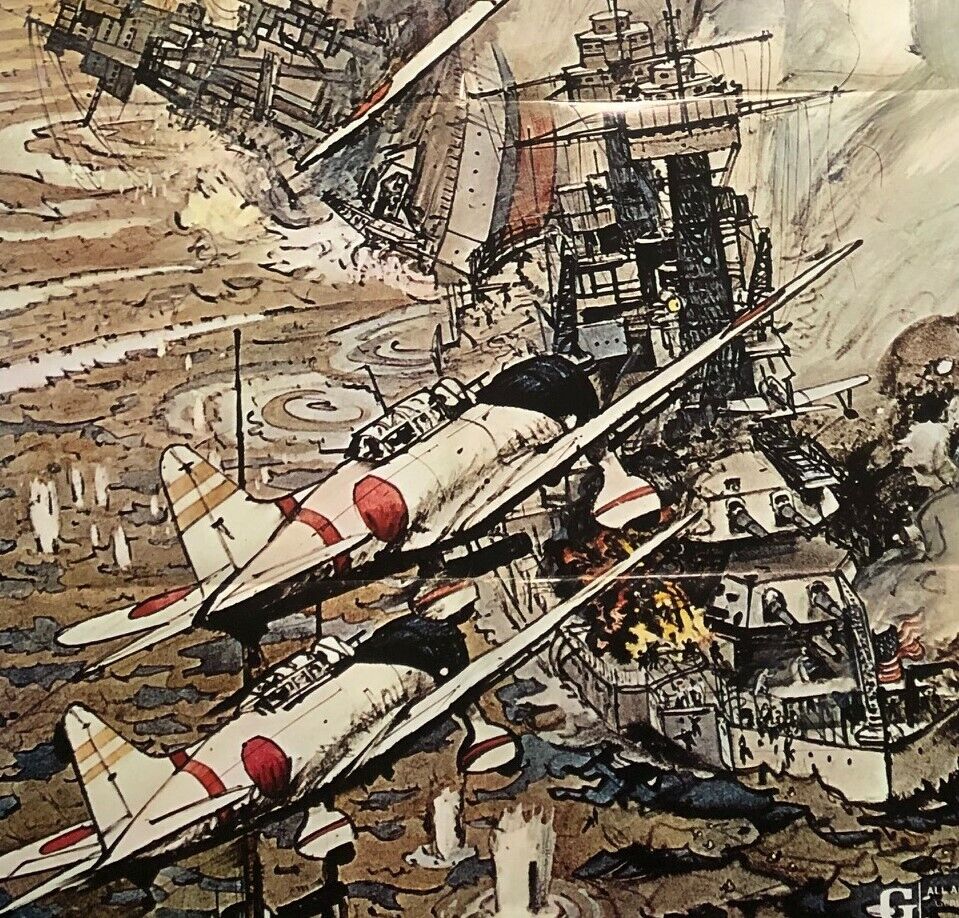
The biggest, most expensive and most spectacular, scene was the one battleship, the USS Nevada, that somehow managed to escape the harbor only to be attacked by dive-bombers. As mentioned, the only battleship constructed was only half-built. Part of what was missing were the engines. So it needed to be towed into position and allowed to drift on the current past five strategically-placed cameras with dozens of waters explosions synchronized to split-second timing. There were explosions on the deck, too, and stuntmen ready to be blown overboard. The planning and choreography required to show all hell breaking loose was staggering. The sequence was so expensive it would be impossible to re-stage.
Disaster on a movie set does not require everything possible to go wrong. Just one thing. In this case the ship got underway sooner than expected. With everyone on set working to sight cues, naturally they just did what was expected. Except it was unexpected. And the worst kind of unexpected. The water was ripped apart by explosions, the stuntmen were diving into the water, bullets and bombs were raining everywhere.
And the cameras had not turned an inch. The battle was half over before anything was photographed.
Fleischer and Williams had no alternative but to send their footage to the labs anyway. It would be processed overnight and screened the next morning to studio bosses. Fleischer expected to be fired. Luckily, they had filmed sufficient action for Zanuck to send a congratulatory telegram.
But the Fleischer experience – his section of the movie came in ahead of time – was nothing as bad as the Japanese one. Kurosawa hired business tycoons with no acting experience for “all but the leading roles” in the hope they would finance his next picture. He was as obsessive over detail as David Lean, shutting down production to repaint the set or replace a set of books on a wall. Kurosawa’s production also required a fake battleship, at a cost of $1.6 million. He built it wrong. The rate of filming was catastrophically slow. An unhappy atmosphere turned disastrous when the director turned on an assistant. The upshot was the most feted Japanese director of all time was fired.
Fleischer blamed the studio for forcing Kurosawa to work in the Hollywood manner, interfering with the work of a director who had achieved his fame by being autonomous. The only scene filmed by Kurosawa that ended up in the picture was that of the American ambassador in the US embassy in Tokyo.
Unsurprisingly, many took issue with the notion of making the film at all. In the U.S., Representative John M. Murphy called it “an affront to americans fighting in vietname…every ethical standard is besmisrched by the Hollywood-Pentagon hook-up to produce a film glorifying the Japanese attack on Pearl Harbor.2
One of the last 70mm roadshows and erroneously viewed as a financial disaster on account of its performance in the United States, in fact the movie made a reasonable profit from its global release and, of course, a fortune in the course of its lifetime, counting television, DVD and streaming.
SOURCES: Richard Fleischer, Just Tell Me When To Cry, (Carroll and Graf, 1993) p227-233, 273-287; “Controversy Boils Up As Tora! Opens,” Desfret News, September 25, 1970, p8C.
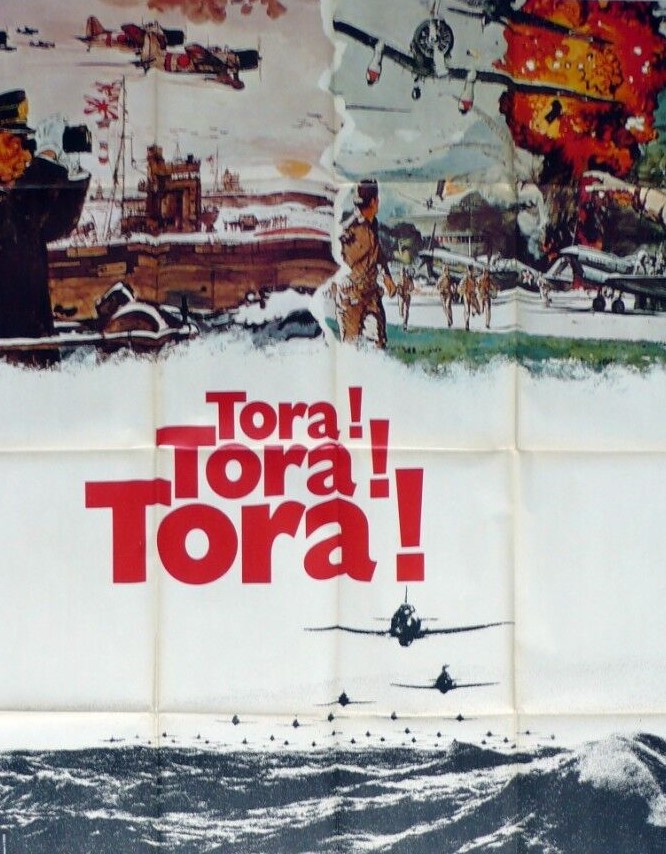
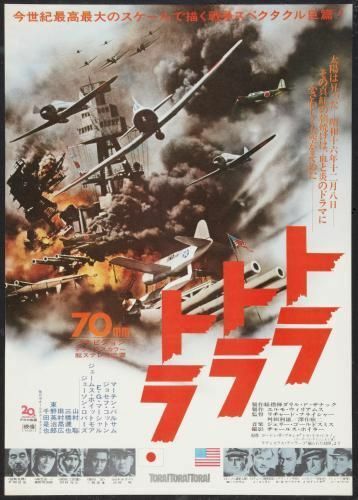
Thankfully devoid of the empty triumphalism that marred In Harm’s Way (1965) and Pearl Harbor (2001) and the gritty backs against the wall heroism and snatching some kind of victory from the jaws of defeat of The Alamo (1960) and Zulu (1964), and with a documentary-style approach much more acceptable these days than then, there is an immense amount to appreciate and absorb in this last-gasp 70mm roadshow from a financially flailing Twentieth Century Fox.
Shorn, too, of the traditional all-star cast bar Jason Robards (Hour of the Gun, 1967) – who might not count – nor the regiment of rising talent stuffed into such epics in the hope one might catch the eye and float to the top. And there’s no room to ram in a distracting romance such as in the previous and future films focusing on the military disaster. Instead, stuffed with dependable supporting players like Martin Balsam (Harlow, 1965), E.G. Marshall (The Chase, 1966) and James Whitmore (The Split, 1968) stops audience rubber-necking in its tracks, unlike producer Darryl F. Zanuck’s previous The Longest Day (1962), in favor of forensic analysis of what went wrong in the defence and what went so brilliant right in the attack.
Like most of the best war epics – The Longest Day, Battle of the Bulge (1965), taking an even-handed approach in presenting both sides of the battle, except here you could argue considerably more time is spent with the Japanese, beginning with the opening credits where the camera floats in and around a giant battleship. Despite the sudden attack which went against all the traditions of war – a timing error apparently – the Japanese are presented as honorable and even arguing against going to war as well as worrying about the consequences of poking the tiger.
And there is none of the endless owing and scraping and not attempting to rise above your station in the traditional Western-view of the Japanese. Here, from the outset, superior officers are questioned possibly in manner that would be permitted among the opposing forces.
The first half is given up to the superb organisation of the attack, including the bold use of using aerial torpedoes – proven to work by the British in an earlier assault on a harbor without the apparent depth of water required – and contrasting it with the general U.S. ineptness, bureaucracy, interdepartmental battles and overall lack of preparation even though several personnel believed an attack imminent. The Yanks had even broken the Japanese codes so could easily have taken heed of obvious omens, had working radar on site though its employment was handicapped by being limited to three hours a day and initially lacking a means of communicating findings. Someone had even worked out that the Japanese would need six aircraft carriers to mount an attack and that the ideal time would be early morning on a weekend, someone even predicting an attack down to the exact time except a week out.
Of course, the U.S. at this point was not at war and so could be excused switching off in the evening or being uncontactable in the morning because they were still out carousing from the night before or sedately riding a horse. While there is a growing sense of alarm, the chain of command is woefully stretched often in the wrong direction and at one point stops before it reaches the President.
Fearful of sabotage, the Americans shift planes away from the perimeter of airfields smack bang into the runway where they can be more easily destroyed. Perhaps the greatest irony is that in shifting the U.S. fleet from its home base in San Diego, the Americans made such an attack possible.
When it gets under way, the battle scenes are superb, especially given none of the CGI Pearl Harbor could call upon, and yet with the U.S. aircraft carriers by luck still at sea failed to deliver a killer blow for the Japanese.
It’s handled superbly by director Richard Fleischer (The Boston Strangler, 1968), Kinju Fukasaku (Battle Royale, 2000) and Toshio Masuda (The Zero Fighter, 1962). The American flaws are dramatized rather than being dealt with by info-dump. Larry Forester (Fathom, 1967) and long-time Akira Kurosawa confederates Hideo Oguni (Ikiru, 1952) and Ryuzo Kikushima (Yojimbo, 1961) fashioned a sharp screenplay from mountains of material.
Long rumored to be a box office flop it turned out to have made a decent profit, albeit not in the U.S.
The documentary approach adds immensely to the movie and it remains one of the all-time greats precisely because of the lack of artificial drama.
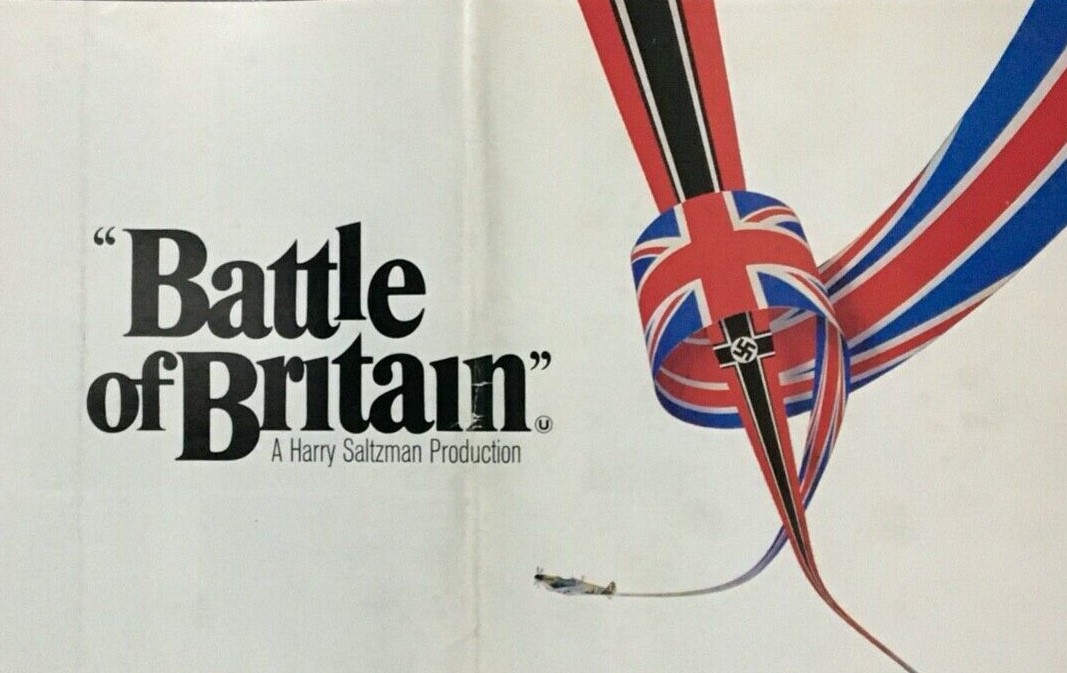
Fabulous aerial sequences countered by grim reality. Like The Longest Day (1962) and Battle of the Bulge (1965) even-handedly doesn’t treat the Germans as the evil enemy, but unlike those films victory is somewhat obscure, no rattling of spears as in Zulu (1964) to announce opposition departure, just clear skies indicating an absence of foe. Anyone going into this – persuaded by Dunkirk (2017) that this retreat was a triumph – and with little knowledge that after Hitler had overrun Europe invasion was imminent might be surprised to discover that this was a campaign lasting over three months rather than one conclusive battle.
That’s to the benefit of the movie, allowing it space to breathe, for characters to develop, rather than everything crammed in pell-mell. Given the situation changed from day-to-day, the one constant, which we’re scarcely allowed to forget, is that the British are heavily outnumbered in the sky. It’s a war of attrition. The Germans can lose hundreds of planes, the British nary a one.
But it’s far from gung-ho, the British coming in for criticism for their unpreparedness, surprised when the Germans bomb airfields, even more astonished when the opponent starts dropping bombs on London. Perhaps, given the relatively short running time for an epic – 46 minutes shorter than The Longest Day, 35 minutes down on Battle of the Bulge – it might have been better to avoid slipping in a section on the impact of the Blitz on Londoners, though that is counteracted by panic in Berlin when that city is also bombed.
But, by and large, it’s an engrossing tale. And bold, too, in the version I saw no subtitles for German dialog, leaving audience reliant on facial and body expressions. To slow down the action, I guess, and add some class, several scenes involve people walking down long corridors.
All the salient points are covered, pilots thrown into battle with barely a few hours experience of flying a Spitfire, the lack of pilots, in-fighting at the top, checkers moved across the board at mission control indicating German aerial advance, the inability of getting aircraft up quick enough or repaired quick enough. Above all, the reality of death is shown in astonishing detail; once the pilot was shot or the airplane destabilized, there was almost no escape, fire enveloped anyone inside, hatches failed to open, planes burst into flame or crashed into the sea. And it was the same death, regardless of nationality. And there were no scenes of callous Germans shooting down a British pilot parachuting to safety.
The aerial sequences are quite astonishing. I’ve seen this on big screen and small, but even on a small screen, the camerawork is quite extraordinary, even getting this number of workable planes in the air must have been some feat, then flying in formation and peeling off in attack. It is kind of hard from time to time to work out who is shooting at who since the planes are all the same grey color and only distinguished when the camera is close enough to identify them by RAF roundel or Nazi swastika. But the overall effect is a sense of sorrow rather than triumphalism, young lives of any nationality brought to a brutal close. There is no scene, as in Battle of the Bulge, of the over-zealous Nazi, the singing that made them appear such an implacable foe. Here, there’s no need to play up implacable. Unless they abandon the fight, the Germans, courtesy of superior numbers, will inevitably win. All the British can do is stave off defeat for as long as possible.
The all-star cast is only an all-star cast if you’re British. Without a Hollywood star in the vein of John Wayne, Robert Mitchum and Henry Fonda, and in the absence of British superstars like Sean Connery and Peter O’Toole, it’s an all-star cast by default. The biggest name, Michael Caine (Deadfall, 1968), has one of the smallest parts. But the equality of the cast works in its favor, there’s none of the rubbernecking that got in the way of The Longest Day.
Christopher Plummer (The High Commissioner/Nobody Runs Forever, 1968) has the biggest role as a squadron leader determined to force his wife out of the front line working on the airfields and into a safer position. But the best acting comes from Laurence Olivier as the dry Air Chief Marshal Sir Hugh Dowding who has no truck with interfering politicians. Accused of inflating figures of German casualties he replies that if he is wrong the Germans will be in London in a week.
But it’s a close-run thing between him and Susannah York (They Shoot Horses, Don’t They, 1969) as the aforesaid wife with a growing streak of independence and Ian McShane (The Pleasure Girls, 1965) as a lowly pilot called upon to express grief more than most. There’s certainly a sense of solidarity among the cast, no show-boating from the usual scene-stealing culprits like Trevor Howard (Von Ryan’s Express, 1965) and Robert Shaw (Battle of the Bulge) whose normal determination to bristle at the slightest opportunity is dropped for the good of the cause.
The great and the good appeared to be happy with the slightest role just to take part. The roll-call includes Ralph Richardson (Khartoum, 1966), Michael Redgrave (The Hill, 1965), Kenneth More (Dark of the Sun/The Mercenaries, 1968) and a hatful more.
Guy Hamilton (Goldfinger, 1964) directs with some distinction, his biggest achievement to concentrate on fact rather than flag-waving, no better demonstrated than by my realization that the stirring theme tune that I remembered so well by Ron Goodwin (Where Eagles Dare, 1968) does not make an appearance until the very end. The screenplay by James Kennaway (Tunes of Glory, 1960), Wilfred Greatorex (The High Commissioner) and, in his only movie work, Derek Dempster, displays more finesse than you might expect.












 The Magnificent 60s