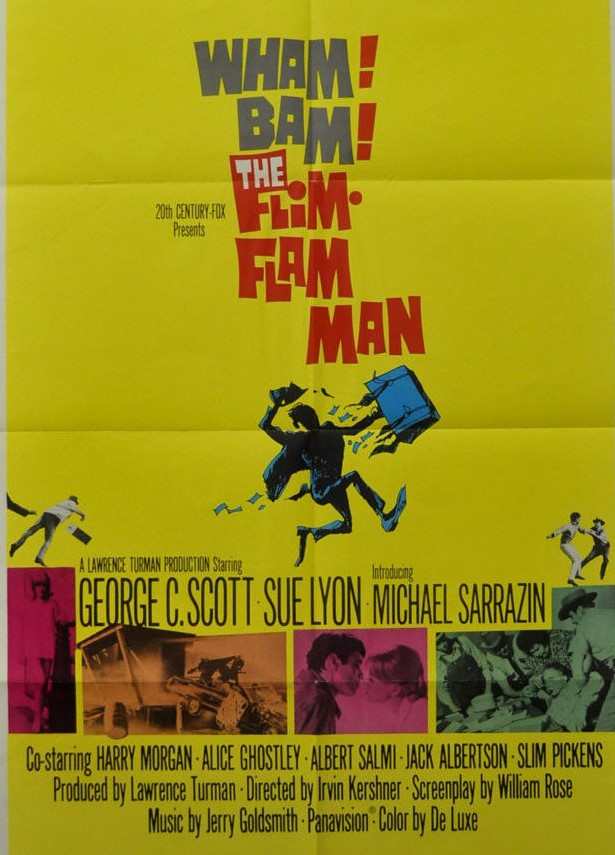
The Flim Flam Man / One Born Every Minute (1967) ***

Throwback to It’s A Mad, Mad, Mad, Mad World (1963), prelude to Smokey and the Bandit (1977) and in the middle of the car chases and town wrecking a character study of a pair of grifters, one veteran, the other his pupil.

U.S. Army deserter Curley (Michael Sarrazin) teams up with veteran con man Mordecai (George C Scott) who teaches him the tricks of the trade. There’s nothing particularly innovative about the older man’s techniques – Find the Queen, The Lost Wallet, selling hooch as genuine whiskey – and the rewards are not particularly rewarding unless you are living at scavenger level in whatever run-down habitat you can find.
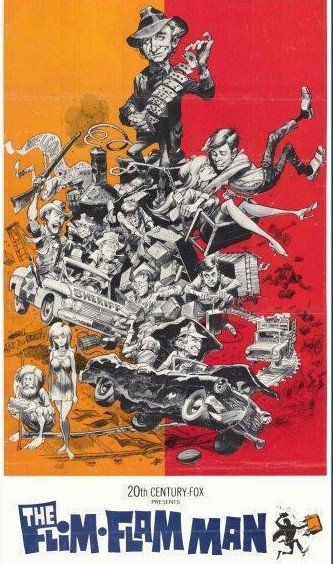
The dumb cops, Sheriff Slade (Harry Morgan) and Deputy Meshaw (Albert Salmi), aren’t quite so stupid otherwise they wouldn’t occasionally happen upon their quarry. And the larcenous duo offer nothing more clever by way of escape except to hijack vehicles.

So once you get past the aforementioned car chases and town wrecking it settles down into a gentle old-fashioned drama. Luckily all the good ol’ boy shenanigans are limited to the police, and neither main character is afflicted by over-emphatic accents.

Mordecai ain’t no Robin Hood nor a criminal mastermind who might have his eyes on a big- money heist. His ethos is stealing not so much from the gullible but the greedy. All his suckers think they can make an easy killing from a guy who appears a harmless old duffer.

He’s not looking for a big score because he’s got nobody to settle down with and because, although on a wanted list (as “The Flim-Flam Man” of local legend) he’s not going to exercise the authorities except cops with very little otherwise to do. He is as laid-back a drifter as they come.
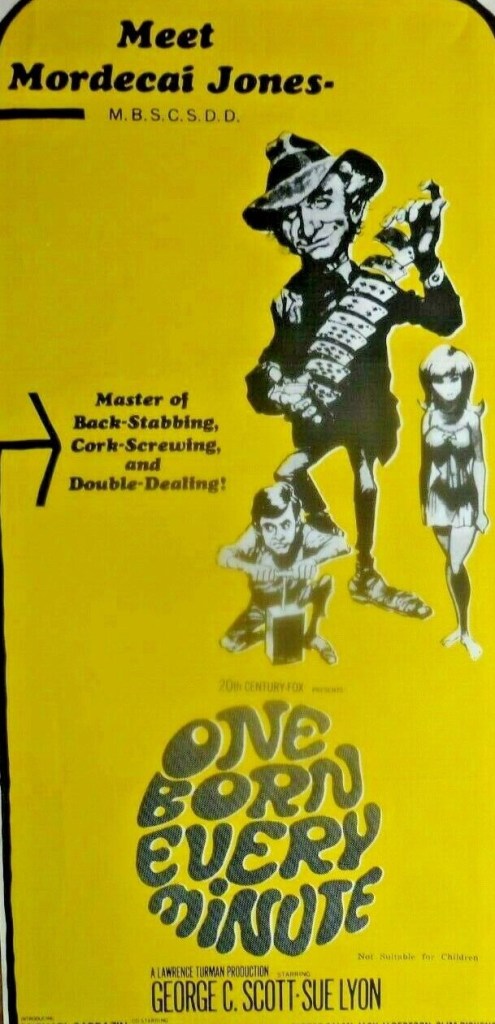
Curley offers the drama. He starts to have qualms not so much about stealing from the greedy but about the repair bills for the cars they wrecked, especially one belonging to the young innocent Bonnie Lee (Sue Lyon), to whom he takes a fancy. While she reciprocates it’s only up to a point, having the good sense not to hook up with a criminal, so eventually he has to choose between giving himself up and serving time in the hope Bonnie Lee will hang around and severing his links with Mordecai, whom he treats as a father figure.

How he works that out is probably the best scene, especially given his temporary profession. Whether this is the first picture to feature so prominently incompetent cops rather than either the tough or corrupt kind I’m not sure but Slade and Meshaw take some beating.

In his first starring role, Michael Sarrazin (Eye of the Cat, 1969) is the cinematic catch. All the more so because director Irvin Kershner doesn’t take the easy route of focusing on his soulful eyes, permitting the actor to deliver a more rounded performance. He’s certainly more natural here than any future movie where he clearly relied far more on the aforementioned soulful eyes.  

While I’m not sure the ageing make-up does much for him, George C. Scott (Petulia, 1968), in his first top-billed role, tones down the usual operatics and makes a convincing loner who can make one good romantic memory last a lifetime. He switches between completely relaxed to, on spotting a likely victim, sharp as a tack. The harmless old man guise falls away once he smells greed, replaced by cunning small-time ruthlessness.

Sue Lyon (Night of the Iguana, 1964) has little to do except not be the sex-pot of her usual screen incarnation and that’s to the good of the picture. By this stage of his career Harry Morgan was more likely to be found in television so it’s a treat to see him make the most of a meaty supporting part. Look out for Strother Martin (Cool Hand Luke, 1967) and Slim Pickens (Rough Night in Jericho, 1967).

Irvin Kershner (A Fine Madness, 1966) appears on firmer ground with the drama than the wild car chase/town wrecking but I suspect it takes more skills to pull off the latter than the former where the actors can help you out. Though I notice Yakima Canutt is down as second unit director so he might be due more of the credit. Screenwriter William Rose had already plundered the greed theme and, to that extent the car chase, for his seminal It’s A Mad, Mad, Mad, Mad World.

The outlandish elements, fun though they are, give this an uneven quality that gets in the way of a tidy little picture.
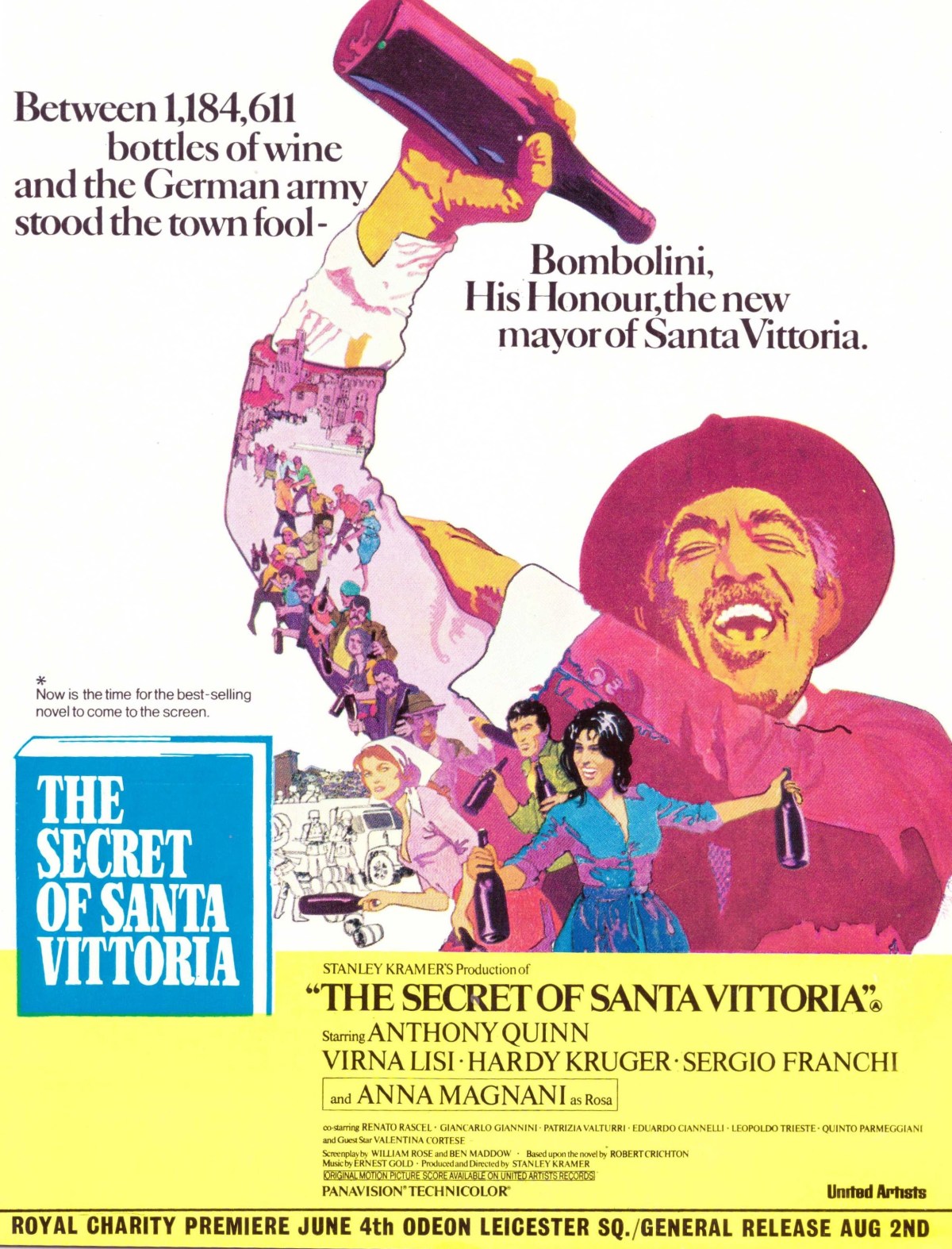
The Secret of Santa Vittoria (1969) ***

Sounds like a treasure hunt picture, contemporary buccaneers or thieves in search of missing gold. But there’s nothing in the way of maps waiting to be discovered, no clues, no character unhinged by its pursuit. In fact, the valuable commodity here is wine, over a million bottles of it. Everyone in the hilltop town of Santa Vittoria is in on the secret. Because they hid it from prying Germans who have taken over the place after the death of Italian dictator Mussolini. And that element of the story, once we finally embark on it, doesn’t begin until halfway through.

Meanwhile, we are treated to the browbeaten drunk Bombolini (Anthony Quinn), too dumb to realize that being elected mayor – the previous incumbent kicked out for being a Fascist – is a poisoned chalice. However, taking a few tips from Machiavelli he works out that his survival depends on bringing together a council of more sensible heads. His new position cuts no ice with disgruntled wife Rosa (Anna Magnani) whose weapons of choice, vicious tongue apart, include copper pans and an elongated rolling pin.

But if you were desperate to know how to bury treasure, here’s your chance. A good quarter of an hour is spent on that element. I’m not entirely sure what fascinated director Stanley Kramer (Guess Who’s Coming to Dinner, 1967) about this. Because, clever though the scheme is of vanishing into thin air more than a million bottles, it takes little more than lining up the populace in rows close enough together so they can pass a bottle onto their neighbor, until the total amount – minus 300,000 bottles left behind to fool the Germans – is hidden in tunnels in the caves below the village.

Assuming of course the Germans fail to prod the stones concealing the tunnels and discover the cement is too fresh to be ancient. But Bombolini is in luck because German leader Captain von Prum is a “good German,” inclined to take things easy, coming down hard of any of his soldiers who pester female villagers, allowing the mayor to negotiate to retain some of the supply being handed over to the invaders, half his mind on the local Countess Caterina (Virna Lisi) with whom he fancies his chances, but in gentlemanly fashion of course, aiming to seduce her over dinner rather than resorting to force.

That matter is complicates because the widowed countess already has a lover, a wounded soldier Tufa (Sergio Franchi) whom she nursed. It’s only when the captain realizes that he has been duped by the apparent buffoon of a mayor and by the countess that things start ugly and soon you can hear cries of the torture echoing out over the piazza.

The odd mixture of comedy and reality fails to gel. Anna Magnani (The Fugitive Kind, 1960) doesn’t look as if she’s acting in showing her distaste of Anthony Quinn (Lost Command, 1966) possibly because he is over-acting, cowing and whimpering and using his hands to express every single word he speaks. But it looks authentic enough. Either Kramer has rounded up every aged extra left over from Once Upon a Time in the West (1969) or he has recruited scores of ordinary peasants to play the villagers.

Kramer’s usual earnestness has disappeared, and although his first movie was a comedy, and Guess Who’s Coming to Dinner, his previous picture, played on the comedic elements of the situation, his feeling for comedy is rusty at best, non-existent at worst. It’s hard to feel any particular sympathy, as would be the point, in the villagers outwitting the Germans and in the fact that they have changed from ostensible World War Two conquerors to the conquered once their erstwhile allies turned on them.  

You might consider this a feminist twist on The Taming of the Shrew, Rosa not only being a shrew who would never be tamed, not even by Germans, but actually the family breadwinner. While, until his election, her husband is a nonentity. And it might be viewed as a choice role for Anthony Quinn, a dramatic shift away from the heroic roles with which he was more often associated. Anna Magnani mostly looks as if wondering why she agreed to participate.

The best acting comes from Virna Lisi (How to Murder Your Wife, 1965), a widow realistic about the lack of true love in what sounds like an arranged marriage, and faced with having to keep the amorous captain sweet, and possibly doing whatever that takes in order to protect the townspeople. Hardy Kruger (The Red Tent, 1969) has also abandoned his normal arrogance, is uncomfortable with being a despot, wanting to maintain friendly relations with the villagers, and seeking solace in gentlemanly fashion from the countess. He has the best scenes, the look of superiority as he outwits, he thinks, Bombolini, and the look on horror on his face as he discovers the countess’s lover.

Based on the bestseller by Robert Crichton with a screenplay by William Rose (Guess Who’s Coming to Dinner) and Ben Maddow (The Way West, 1967)  it’s the kind of movie that raises a lot of questions without bothering to answer any of them.  

Discover WordPress

A daily selection of the best content published on WordPress, collected for you by humans who love to read.

The Atavist Magazine

by Brian Hannan

WordPress.com News

The latest news on WordPress.com and the WordPress community.