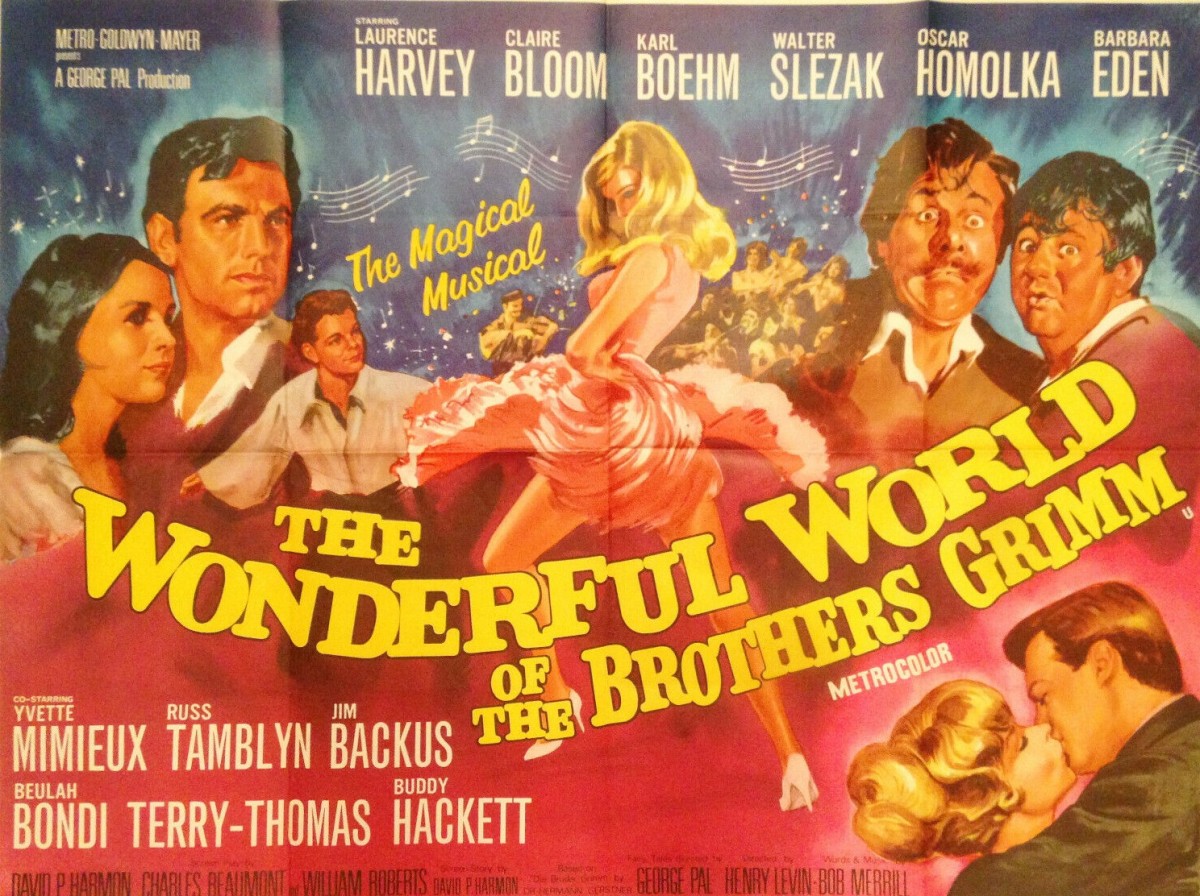
The Wonderful World of the Brothers Grimm (1963) *** – Seen at the Cinerama

With Hollywood already snagging the best characters of the Grimm inventory – Snow White, Cinderella, The Sleeping Beauty and Tom Thumb – and others like Rumpelstiltskin not deemed cute enough, George Pal (The Time Machine, 1960) had a battle on his hands to come up with a decent enough second string. Spurning for no obvious reason contenders like Hansel and Gretel and The Frog Prince, he plumped for a strange hybrid.

He incorporated three fairy stories – The Dancing Princess, The Elves and the Shoemaker and The Singing Bone – in a drama about the authors. Both sides of this tale had a common background, 19th century Germany with its rich vein of fairy castles and cobbled streets where kings ruled. The Grimms are posited as wannabe writers but with warring personalities.
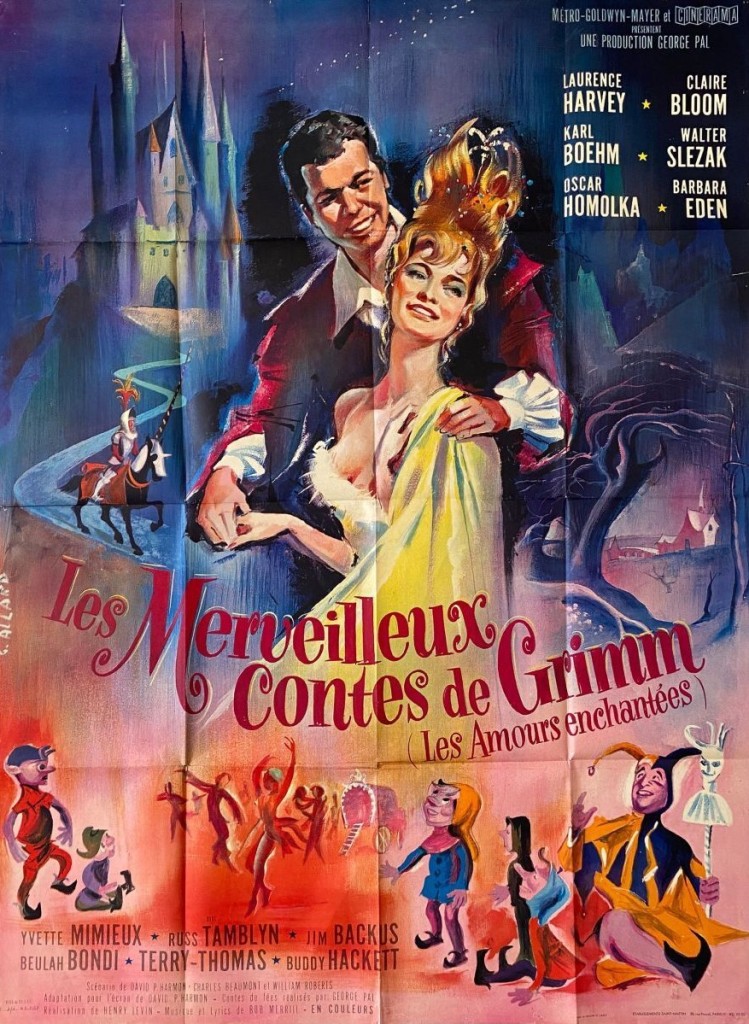
Unmarried Jacob (Karl Boehm) wants to stick to the knitting and complete the work, a biography of the Duke (Oscar Homolka), they are being paid for while married Wilhelm (Laurence Harvey) prefers to use that time instead to write down the stories he has collected from a variety of sources.

The stories Pal chooses to bring to life pop into the narrative by the simple devices of telling kids a bedtime story or overhearing the tale. Jacob is actually more interested in academic writing; books on law and grammar are what capture his imagination. The narrative switches between the brothers falling out, enduring poverty and Jacob falling in love with Greta (Barbara Eden) but lacking the romantic touch mostly making heavy weather of it.

The first tale in the triptych – The Dancing Princess – is simple enough. A King (Jim Backus) promises the hand of his daughter (Yvette Mimieux) in marriage to whoever can find out what she does at night which a humble woodsman (Russ Tamblyn) manages with the help of a cloak that makes him disappear. In the second story elves come to life to save the skin of a shoemaker more interested in helping orphans than his rich clients.  
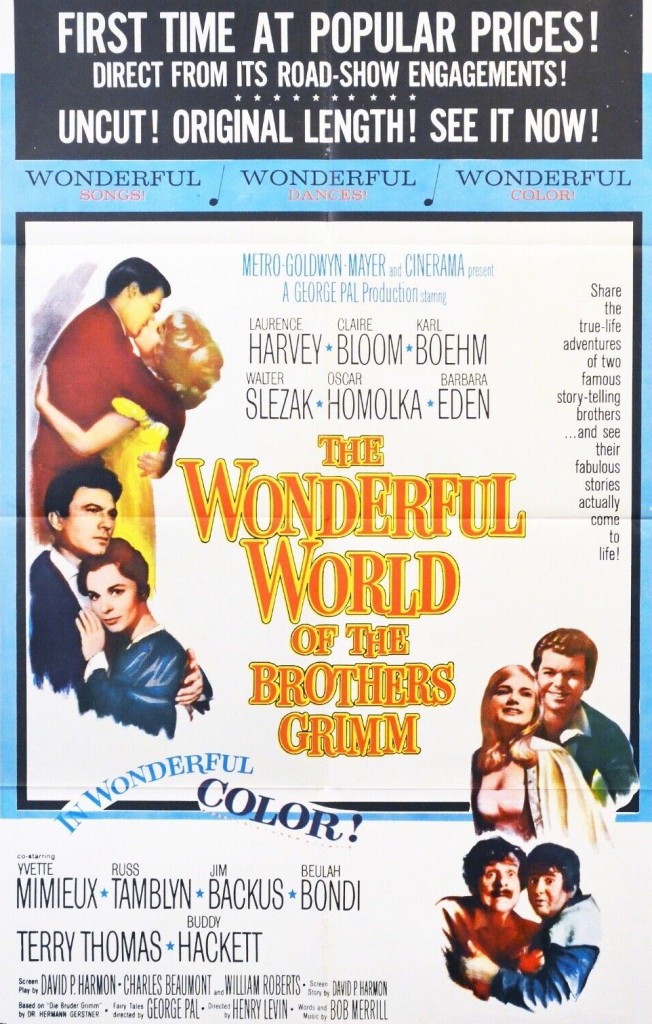
The third, demanding the biggest special effects, less successfully translates to the screen since it involves the creation of a dragon to be slaughtered. However, it is saved by humor, since the knight (Terry-Thomas) is too cowardly to do the job and relies on servant Hans (Buddy Hackett) for the actual slaying, and by the most gruesome of endings.

Plus, since it is in Cinerama, something speeding is required seen from the audience point-of-view or a hero who could fall into a canyon. And in the best fairy tale tradition the heroes are unsung and under pressure.

Laurence Harvey (A Dandy in Aspic, 1968), Karl Boehm (The Venetian Affair, 1966) , Claire Bloom (Two Into Three Won’t Go, 1969) and Barbara Eden (I Dream of Jeannie television series, 1965-1970) are just about buoyant enough to keep the main story ticking along and carve out a piece of Disney territory without so much as a decent song to help proceedings. Three unexpected twists – four if you count a miraculous recovery from serious illness – nudge this in unexpected directions.

The first is the solidity of brotherly love, with one having to choose wife over his close bond with his sibling – the kind of emotional hit that would be more common in an adult picture, though kids obviously couldn’t care less. The second is the appearance of virtually all the famous Grimm characters in what amounts to a cameo. Last is a proper fairy tale ending where it’s the kids who elevate the brothers to literary success.

Laurence Harvey hides his snide side and does his best Dirk Bogarde impression as the errant brother whose imagination brings his family to near-ruin. Despite being offered love on a plate, Karl Boehm remains steadfastly dour, while Claire Bloom as Wilhelm’s wife has little to do. Scene stealing honors go to Oscar Homolka (The Happening, 1967) while Terry-Thomas (How to Murder Your Wife, 1965) just about shades it in the comedic duel with Buddy Hackett (The Love Bug, 1968).
George Pal concentrated on the fantasy elements with Henry Levin (Genghis Khan, 1965) directing the drama so it’s a mixture of very grounded and very flighty. It’s not really long enough for a true Cinerama roadshow movie but with an overture and intermission it stretches enough.

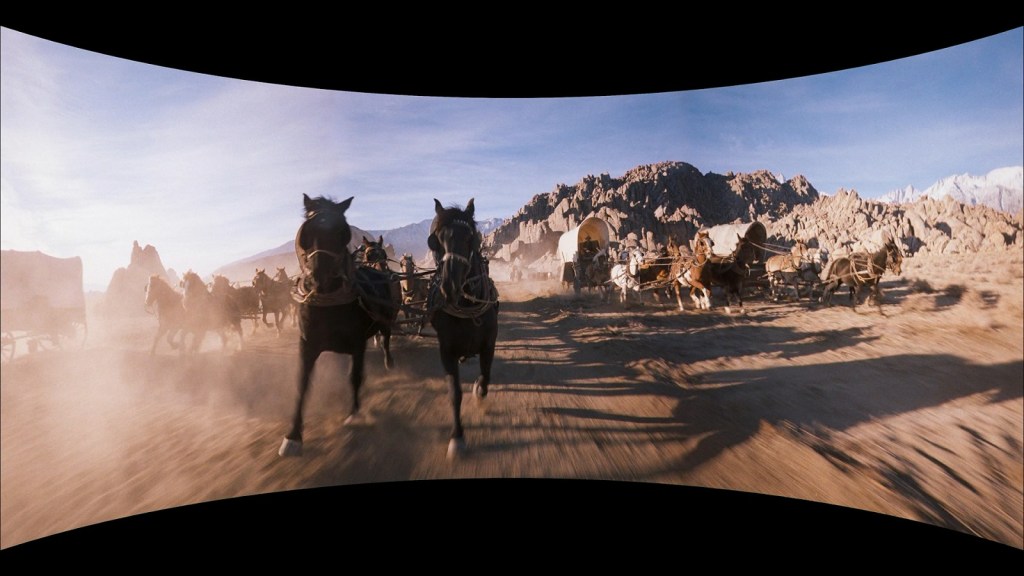
It was filmed with the traditional three Cinerama lenses and would have been projected with three projectors but at the Bradford Widescreen Weekend  I saw a new restoration that does away with the vertical lines. For contemporary audiences who only view fairy stories through the microcosm of animation and for whom live-action means Ray Harryhausen, the special effects here will come as something of a disappointment. But on the other hand it is still George Pal, so enjoy.

William Roberts (The Magnificent Seven, 1960), Charles Beaumont (Mister Moses, 1965) and David P. Harmon (Dark Purpose, 1964) cobbled up the screenplay.

As I said I saw this in the magnificence of the big screen and in widescreen Cinerama to boot so I am bound to be a shade benevolent but this still holds up, the drama dramatic enough, as a biopic interesting, and kids who might be taken with the fairy stories are way too young to complain about the effects.
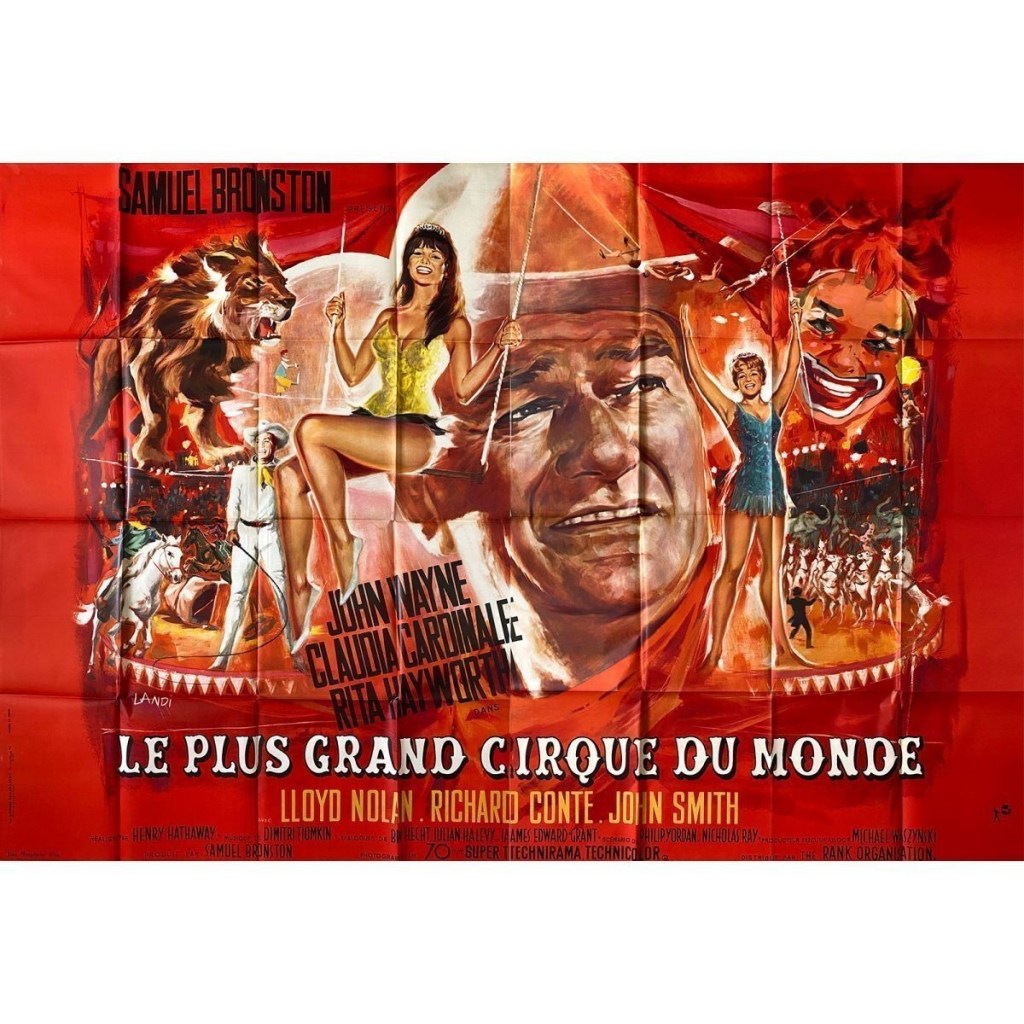
Circus World / The Magnificent Showman (1963) **** – Seen at the Cinema

Bookended by disaster – a ship turning turtle, fire raging in the big tent – and kept aloft by giddy circus turns this long-ignored movie in the John Wayne canon is ripe for reassessment. In more down-to-earth mold, with no villains to rein in, no gun-toting required, this calls upon something more basic from the actor, the dramatic skill required to make the audience fix on a strong character within a spectacular screen event.

Presented in stunning Super Technirama, the swansong of maverick producer Samuel Bronston (El Cid, 1961), and mistakenly viewed as little more than a travelog or a compendium of circus acts, this dwells instead on transition and loss as Matt Masters (John Wayne) struggles to allow adopted daughter Toni (Claudia Cardinale) to grow up and to come to terms with the part he played in the romantic calamity – father a high-wire suicide, acrobatic mother Lili (Rita Hayworth) fleeing to Europe – that left her parentless.  

It’s no coincidence that sending his three-ring circus cum Wild West Show on a lucrative tour of Europe in the early part of the 20th century provides an opportunity to hunt for Lili, the love of his life. But the circus ship capsizes in Barcelona, leaving Masters penniless, forced to  work for a rival European promoter until he can scrape together enough dough to start again. Masters uses the opportunity of traveling through European capitals to scout new acts, including clown Aldo (Richard Conte), a lion-tamer turned tiger-tamer Emile (Hans Dante), and ballerina Katharyna (Giovana) who performs on the high wire while Toni wants to chance her arm against Matt’s objections as an acrobat and flex her romantic muscles in romantic dalliance with Matt’s new partner Steve (John Smith).

The subplots add dramatic heft, the lion-tamer is frightened of tigers, Aldo has vengeance in mind, so in between the scintillating circus acts the storyline is compressed around the drink- and guilt-sodden Lili and conflict on several fronts with Toni while old retainer Cap (Lloyd Nolan) is on hand to pep up or challenge Matt.

You wouldn’t be allowed to make this kind of film these days so it’s worth glorying in the glory days of the circus – dancing horses, lions, tigers, elephants, acrobats and genuinely hilarious clown sequences. It being a three-ring circus there’s always something going on, plus the Wild West element which comprises a stagecoach being attacked.

John Wayne is as befuddled as ever in romance, restricting his trademark double take to astonishment at Tony’s transition to womanhood. There’s an occasional reversal but mostly  it’s a battle against the odds, potential triumph leavened by gritty loss.

A modern producer would have switched the disasters – it didn’t really matter how Matt got into a fix. But the capsizing, appearing so early the effect is stunning, is brilliantly handled, not just the rescue of people and animals but Matt in lion-taming mode and ending with a clever coda. In every photograph Lili’s face has been scratched out but in among the saturated notes of Matt’s vital cash box is a picture of her.

Some critics have suggested John Wayne (In Harm’s Way, 1965), recovering from his own financial debacle caused by over-investment in The Alamo (1960), took the role for financial expediency. But I can see the attraction, as I’m sure the actor did. This is a far more rounded character than anything since The Searchers (1956) and he can’t even find redemption from a six-shooter. He’s more protective than aggressive, paternal instinct triggering character reaction, and it’s more of a James Stewart type of role, coming back from adversity, and nothing straightforward about a man whose love affair caused marital disaster.

Critics have also taken pot-shots at Claudia Cardinale (The Pink Panther, 1963) as if she was not already an accomplished actress (a favorite of Visconti, for example) in a compelling role and competing on even terms with a star of John Wayne’s charisma without being able to fall back on the old saw of the romantic interest. Although playing a character nearly a decade younger, Cardinale  brings an earthy feistiness to a character with a bucket of decisions to make, turning on its head her relationship with Matt and going through the dramatic hoops with Lili.

Rita Hayworth (The Happy Thieves, 1961) has shucked off the glamor, a worn-down relic of her former self, turning to drink and religion in equal measure in vain hope of finding peace. Veteran Lloyd Nolan (The Double Man, 1967) and Richard Conte (Assault on a Queen, 1966) hold their own, but John Smith (Waco, 1966) does not. Look out for former British star Kay Walsh (A Study in Terror, 1965).  

Henry Hathaway (5 Card Stud, 1968) does a terrific job marshalling all the elements, containing the core family drama within the wider action-oriented structure. While there’s never a dull moment, in among all the spectacular scenes are some exhibiting a particularly sensitive directorial touch such as when Matt discovers Lili’s hotel room and reflects on his own misdemeanors.

There were almost as many writers as circus performers – James Edward Grant (The Commancheros, 1961), Ben Hecht (Spellbound, 1945), Julian Zimet (A Place for Lovers, 1968), Bernard Gordon (55 Days at Peking, 1963), Nicholas Ray (The Savage Innocents, 1960) and Philip Yordan (El Cid).

Come at it from the fun perspective and you won’t go wrong. John Wayne completists will adore it.

I was lucky enough to see this is full glorious widescreen at the cinema where it was the Closing Film at this year’s  Widescreen Weekend in Bradford. What a way to end a show!

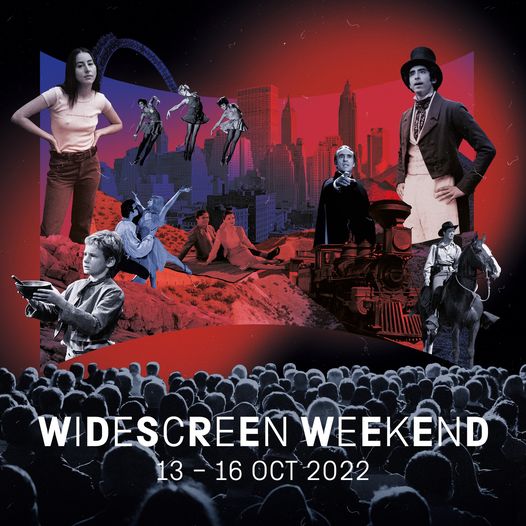
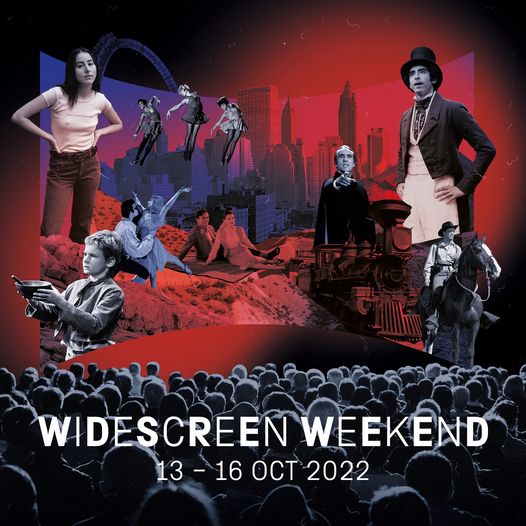
Widescreen Weekend 2022

We are so conditioned to watching old movies on tiny screens it comes as something of a primal shock to see them in all their original glory. Most festivals lean towards the arthouse end of the cinema business so it’s all the more delightful to find an event that without apology concentrates on the mainstream. Widescreen Weekend takes place at the National Science and Media Museum in Bradford, England, and mostly in its Pictureville Cinema, the only venue in the country equipped to show Cinerama pictures in the original three-strip version which requires three projectors.

Wagons race to escape attack in “How the West Was Won.”

And while most other film festivals attract general movie lovers, this one appears to appeal in large part to those who have had something to do with the movie-making business or its technical side. Speakers might include, for example, Cinerama restoration specialist Dave Strohmaier or Kevin Brownlow, editor turned director, and among the audience you might find people like Keith Stevens from Australia, a former operations executive with Village Roadshow there, but who started out as a projectionist and regaled me with tales of projecting The Sound of Music (1965) in its original roadshow run.

There’s a limited number of movies that were made, mostly in the 1960s, either in Cinerama or 70mm, so the event has expanded to take in the earlier Cinemascope and the other versions of widescreen technology on which Hollywood depended as the marketing hook to bring back audiences from the all-encompassing maw of television in the 1950s. Later films whose directors understood the cinematic impact of 70mm are also added to the mix.

You are transported back to a time when screens were just enormous – this one is 51ft wide – and were curtained, and those curtains would not open (to the sides) until in typical roadshow fashion, a lengthy musical Overture, highlighting aspects of the movie’s music, had run its course. There is something quite sumptuous about sitting in a movie theatre staring at huge red curtains and waiting for the house lights to dim and the music to begin.

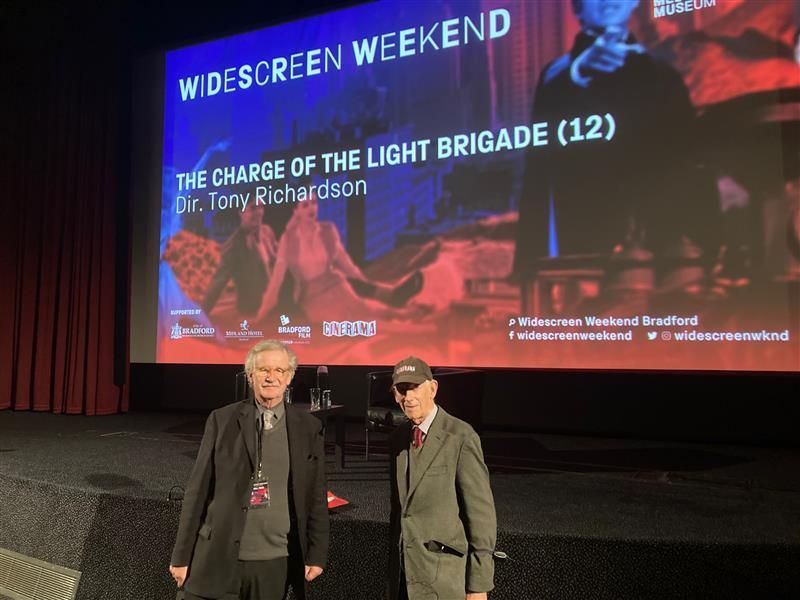
Christopher Frayling and Kevin Brownlow getting ready to introduce “The Charge of the Light Brigade.”

Roughly half-way through the movie itself, the curtains would close for an intermission, and before the picture restarted there would be more music, what was termed the Entr’Acte. Some DVDS of roadshows contain both Overture and Entr’Acte but there is a lightyear of difference between hearing them in your lounge and being exposed to them in a picture house built to bring out their best sound.

This is a homage not just to old movies but the old way of seeing a movie.

In previous years the programs have included Ice Station Zebra (1968), West Side Story (1961), 2001: A Space Odyssey (1968), the David Lean trilogy of Lawrence of Arabia (1962), Doctor Zhivago (1965) and Ryan’s Daughter (1970),a pair from William Wyler that could not have been more diverse – Ben-Hur (1959) and Funny Girl (1968) – This Is Cinerama (1952), Carol Reed’s  The Agony and the Ecstasy (1965), John Frankenheimer’s split-screen Formula One epic Grand Prix (1966) and of course the mother of all roadshows The Sound of Music (1965). Throw in a healthy helping of 1950s Cinemascope features and more contemporary pictures which embraced 70mm and you have the makings of an always satisfying weekend.

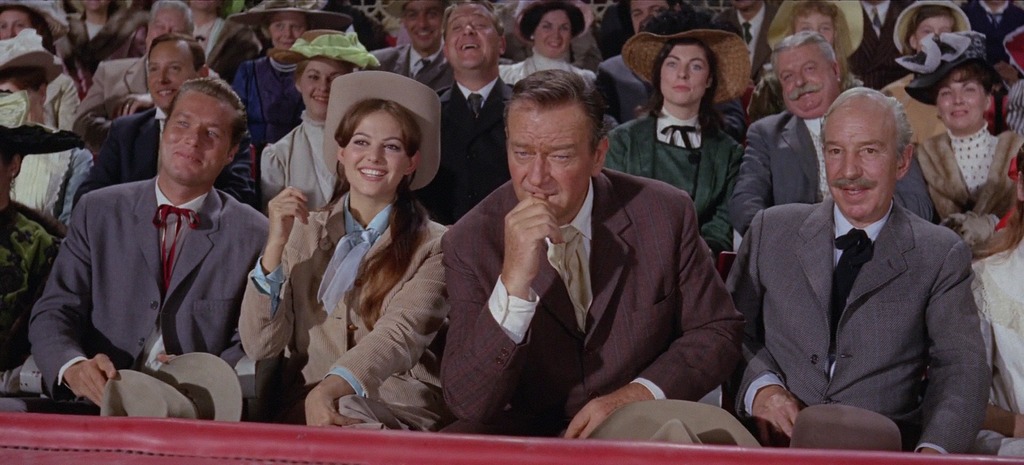
A thoughtful John Wayne next to Claudia Cardinale in “Circus World.”

So one of the highlights is to see old favorites. This year we were treated to the three-strip version of How the West Was Won (1962), your feet tapping immediately at the sound of the driving Alfred Newman score, and a restored The Wonderful World of the Brothers Grimm (1962), the first two movies made in the Cinerama process that had dramatic purpose and were not mere travelogs.

But there was also an opportunity to watch old movies that have never been screened in their original version since their initial release, such as Circus World / The Magnificent Showman (1964) shown in Super Technirama 70. Also on the program was Carol Reed’s Oscar-winning Oliver! (1968), Bob Fosse debut Sweet Charity (1969), The Charge of the Light Brigade (1968) and Douglas Trumbull’s Brainstorm (1983), Natalie Wood’s last picture and one that experiments with screen size. Extending the program into non-70mm widescreen there was a screening of Dracula, Prince of Darkness (1966) and A Star Is Born (1954). Every screening was introduced by an expert and there were occasional surprise guests like Kevin Brownlow, the editor of The Charge of the Light Brigade.

The event takes place in October every year and I’m already looking forward to the next. Kathryn Penny, who has organized the event these past few years, is moving onto a post in academia, and she will be sorely missed.  

Discover WordPress

A daily selection of the best content published on WordPress, collected for you by humans who love to read.

The Atavist Magazine

by Brian Hannan

WordPress.com News

The latest news on WordPress.com and the WordPress community.